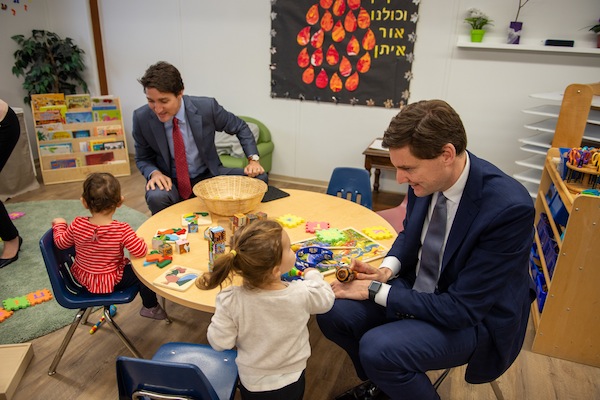
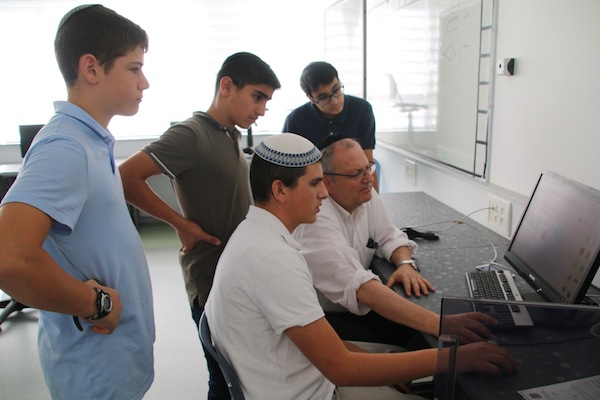
Prime Minister Justin Trudeau and B.C. Premier David Eby interact with kids at Richmond Jewish Day School on Dec. 2. (photo from Province of BC)
On Dec. 2, Prime Minister Justin Trudeau and federal Minister of Families, Children and Social Development Karina Gould were joined by B.C. Premier David Eby, B.C. Minister of State for Child Care Katrina Chen and Musqueam Indian Band Chief Wayne Sparrow at Richmond Jewish Day School to highlight federal and provincial efforts to make childcare more affordable.
RJDS established its Early Learning Centre this past September, with Sara Solomon as director. (See jewishindependent.ca/rjdss-new-early-ed-program.) It offers two preschool programs, one for infants and toddlers (0-3 years old) and one for children ages 3-5.
Reut Dahan, a parent at RJDS, commented on the government’s reduction of childcare fees, calling it “life-changing.”
“Thanks to this amazing program being implemented, our costs are now reduced by over $1,000 a month, allowing both of us to work full time and easing some of our financial stress,” said Dahan, who has three kids – a toddler, a preschooler and a school-aged child.
Among those from the Jewish community who attended the Dec. 2 event were Ezra Shanken, Jewish Federation of Greater Vancouver chief executive officer; Geoffrey Druker, chair of the Centre for Israel and Jewish Affairs’ Local Partnership Council; Michael Lipton, RJDS board chair; Shannon Gorski, a board member of both Federation and Jewish Family Services; and Federation marketing and communications manager Sara Bandel. In his weekly email message, Shanken thanked RJDS principal Sabrina Bhojani and Lipton for making RJDS’s Early Learning Centre a reality.
– Courtesy Richmond Jewish Day School, Jewish Federation of Greater Vancouver and Province of British Columbia
A basketball game may not be able to bring about world peace, but at least one game has acted as a bridge to increasing mutual understanding and empathy.
The graphic novel The Basketball Game (Firefly Books, 2022) is based on the National Film Board of Canada animated short of the same name. Written by Hart Snider and illustrated by Sean Covernton, it is based on Snider’s memories of his first year at Jewish summer camp. It proved to be a unique experience.
It was July 1983. The camp was Camp BB Riback in Pine Lake, Alta. Snider was 9 years old and “totally homesick,” finding refuge in the comic books he had brought with him. That is, until he meets Galit. (The book is dedicated to his “partner, collaborator, inspiration and best friend, Galit,” his daughter and his parents.)
For young Hart, Camp BB made him feel at home. “Even both my parents went to this camp,” he writes. “It was a tradition in the community. It was a place to just be ourselves … and that was important because back then, growing up Jewish in Alberta wasn’t always so easy.”
Back then, in Eckville, Alta., the winter before Snider’s first summer at camp, teacher Jim Keegstra, “also the town’s mayor, was fired by the local school board.
“Believing the curriculum was ‘incomplete,’ Keegstra had been teaching Holocaust denial and antisemitic conspiracy theories in his classroom – that Jewish people had an international plot to control the world and were to blame for everything that’s wrong.”
But one Eckville parent, Susan Maddox, “noticed her 14-year-old son had some strange new opinions.” She looked through his notebooks, then filed a complaint with the school board.
Meanwhile, more than a thousand people attended a rally at the Edmonton Jewish Community Centre to figure out how to respond to the situation. One of the ideas proposed – by then Camp BB director Bill Meloff, z’’l – was to invite some of Keegstra’s former students to the camp for a “day of fun and fellowship,” which included the title’s basketball game.
(Text by Hart Snider / illustrations by Sean Covernton)
In a brilliantly drawn sequence, the team players are depicted as their negative stereotypes, how they see one another. Blue Team – a horned demon, a world-controlling banker and an evil wizard – versus Red Team – a skinhead, a Nazi and a member of the KKK. The game is intense. Then, an opposing player compliments Hart’s shot. “Thanks, man,” says Hart. The game continues, kids versus kids, no more monsters.
“Looking back, it’s amazing that it happened at all,” writes Snider. “That Keegstra’s students were invited to the camp, and they actually came.”
(Text by Hart Snider / illustrations by Sean Covernton)
That’s the thing. Someone had to extend the invitation, and someone had to accept. An illustrated reproduction of an actual newspaper clipping from 1983 notes that attendance at the camp was voluntary and that a preliminary survey indicated that about 10% of Eckville Junior-Senior High School’s 186 students “would be willing to attend.”
Here we are, almost 40 years later and, as Snider notes in his introduction: “Racism, conspiracy theories and antisemitism are spread every day on social media and other platforms. The hate that Keegstra taught in his classroom is now found in memes, videos and forums. Over and over again, we are challenged with the question, how do we deal with fear and prejudice?
“I hope we can continue to find common ground and have empathy for each other, but, most importantly, I hope that parents and kids keep talking to each other.”
The book, intended for readers 12 years old and up, includes more on the Keegstra trial, discussion questions and a glossary.
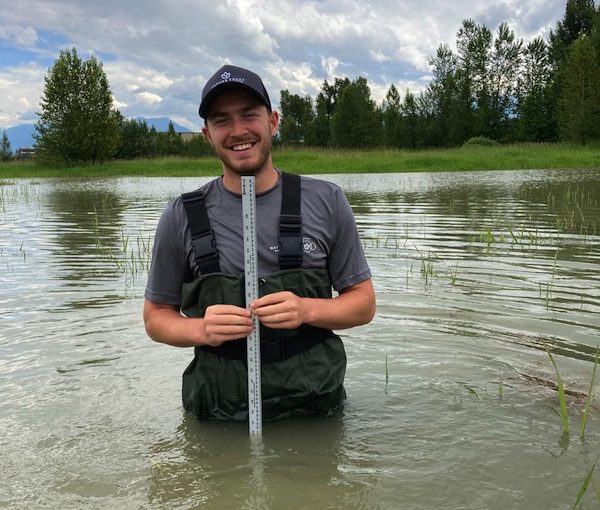
Vancouverite Jack Scher is a student at Tel Aviv University’s Porter School of Environmental Studies. (photo from Masa Canada)
Born in the United Kingdom, Jack Scher grew up in the south of France from the age of 6 till he was 13, far away from any Jewish community. Now, he is surrounded by community – and living like a local, while studying in Israel with Masa Israel Journey.
After moving to Vancouver, Scher attended St. George’s and received an athletic scholarship to play rugby. Following high school, he followed a traditional British path by taking a gap year, and went on to play rugby in New Zealand. While there, he went on a Canadian delegation Birthright trip to Israel.
“That was the first time I saw with my own eyes the soldiers and Yad Vashem, and it was also the first time where 30 other Jews from Canada surrounded me,” he recalled. “To meet young Jews from Vancouver, Montreal and Toronto; it was unbelievable.”
It was then that he knew he wanted to return to Israel and live there.
Last year, when he was in his final stretch of a bachelor of arts at the University of British Columbia, Scher shortlisted top schools for master’s programs in England, Canada and the United States. Then, his father, a board member at Congregation Schara Tzedeck, read about Masa opportunities in a synagogue eblast.
Upon hearing about Masa Israel Journey – a joint initiative of the Israeli government and the Jewish Agency that aims to cultivate Jewish connectedness through long-term, immersive programs in Israel – the rugby player registered to study abroad at Tel Aviv University.
Scher’s life story is a unique one. However, his Masa Israel Journey experience is similar to that of thousands: taking the risk of a new opportunity and growing both personally and professionally while connecting to Jewish identity and Israel.
In the short time that Scher has been in Israel, he has connected to a community and already feels like he belongs. “I’m not just studying,” he said. ‘Through Masa, I get to attend social events and see Israel in a real way. I am living here like a local.
“The Porter School is where I have my environmental studies [classes], and the building is a world-class building in terms of sustainability…. It is the first building that is LEED certified in Israel,” he continued. “The entrance to the building is facing west, the wind comes off the sea and goes through the building. The shape is cool, the air comes in where the building is wider, and then the air spins and goes up. The building thins as it goes up, which means that the building does not require air conditioning or light[ing] because of the windows. All the pipes are facing the sun and get heated that way, and that is how the building receives heat as well. There is a rooftop garden and patio.”
The message Scher wants to impart to his peers is this: take the risk, inquire about your options, including Masa, which offers a range of programs lasting from a few months to a year – volunteering, studying, career development and teaching.
Follow @masacanada for a weekly dose of what life is like on the ground in Israel for Canadians.
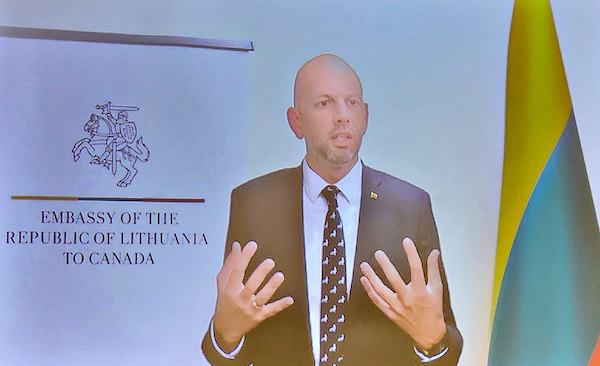
Lithuania’s ambassador to Canada, Darius Skusevičius, greets participants in pre-recorded video. (photo from Lithuanian Community of BC)
As a young teen growing up in Vancouver in the 1960s, I used to be puzzled by Remembrance Day. We were given red poppies at school to honour the soldiers who served Canada during the First and Second World Wars. But I knew my parents had also experienced war, and their families – my grandmothers, aunts, uncles, cousins, even my half-brother and stepsister – had been horribly murdered. Why were there no red poppies for them and the six million others who had died in the Holocaust? Where were their memorial parades, their wreaths?
In Vancouver’s Peretz School, which I attended a couple of afternoons a week to learn about Jewish culture, we commemorated Yom Hashoah, which was established by the Israeli government in 1959. Our commemoration was a small event, important to staff, students and families, but ignored by Canadian society in general. It was not until 2005, when the United Nations General Assembly established Jan. 27 as International Holocaust Remembrance Day, that non-Jews as well as Jews began to join in collective memorialization – or so I thought until quite recently.
In 1994, the Lithuanian Parliament established Sept. 23 as National Memorial Day for the Genocide of Lithuanian Jews. Every Sept. 23, the anniversary of the liquidation of the Vilna (Vilnius) Ghetto, commemorative activities are held at Lithuanian memorial sites, in schools and in other educational institutions. Government institutions, with the support and involvement of local Jewish communities and survivors’ groups, shape the content of these activities, and Jewish and non-Jewish Lithuanians regularly participate in them.
A few years ago, I joined the Lithuanian Community of British Columbia (LCBC), where I currently serve on the board of directors. This year, on Sept. 22, with the support of the Vancouver Holocaust Education Centre (VHEC) and generous volunteers from Lithuanian and Jewish communities, LCBC and its partners, National Memorial Day for the Genocide of Lithuanian Jews was commemorated. The event, which took place at the Peretz Centre for Secular Jewish Culture in Vancouver, was held for the first time in Canada.
Participants were welcomed by Algis Jaugelis, president of the LCBC, followed by opening remarks by Nina Krieger, the executive director of the VHEC. The ambassador of Lithuania to Canada, Darius Skusevičius, kindly provided a recorded welcome to the event, followed by a written statement from Christopher Juras, the honorary consul of Lithuania in Vancouver.
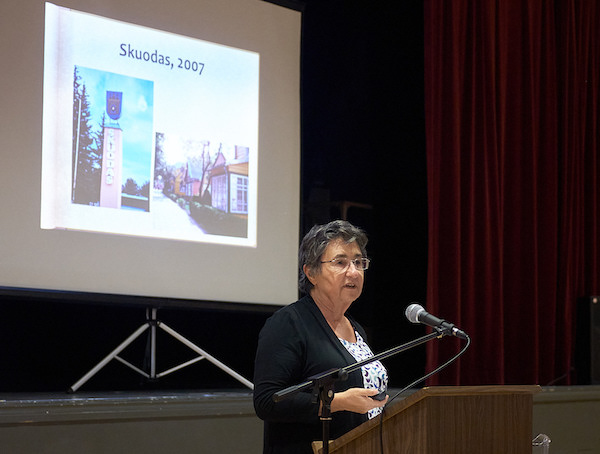
LCBC member and historian Dr. Gene Homel presented an overview of Jewish life in Lithuania from the 1300s to the present day. I gave an illustrated presentation on the Jewish community in my father’s ancestral town in Lithuania, using photos and information found in my research.
Rachel Mines characterizes the lives of the Jewish residents of Skuodas, Lithuania. (photo from Lithuanian Community of BC)
Helen Mintz, a Yiddish translator, read a selection from one of her translations of Abraham Karpinowitz’s short stories. Karpinowitz, the son of a theatrical family in Vilna, survived the Holocaust and later wrote several volumes of stories memorializing prewar Jewish life in Vilna.
The ceremony ended with the singing of the “Partisans’ Song” / “Zog Nit Keynmol,” written by Hirsh Glick in the Vilna Ghetto, which was followed by a recording of Glick’s words translated into Lithuanian and read by high school student Giedrius Galvanauskas under the auspices of Eli Rabinowitz’s We Are Here! international educational project.
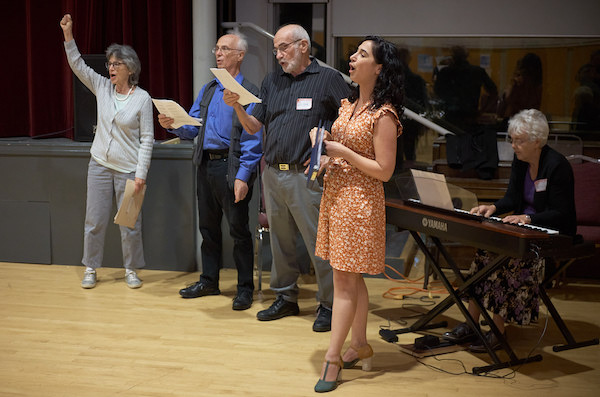
The ceremony ended with the singing of “Zog Nit Keynmol.” Left to right are Celia Brauer, Alan LeFevre, Victor Neuman and Kathryn Palmer. At the piano is Cathrine Conings. (photo from Lithuanian Community of BC)
Lithuanian and non-Lithuanian participants found the remembrance ceremony both educational and emotional, and emphasized the importance of dialogue and reconciliation. According to Jaugelis, it was “an important and moving event, an opening of doors and minds, with great potential for future intercultural and bridge-building events.” Andrea Berneckas, another LCBC director, wrote, “It was such a privilege to be part of this solemn, yet beautiful and hopeful event. I look forward to being part of the Lithuanian community’s strengthening of ties by the sharing of stories and experiences.”
“I look forward to more opportunities to bring the communities together,” said Krieger. And Celia Brauer, a local Yiddishist whose parents survived the Holocaust in Latvia and Poland, summed up the general feeling: “We are far away from the original homeland, yet this event brought people closer together – which is incredibly important.”
National Memorial Day for the Genocide of Lithuanian Jews is now on LCBC’s yearly calendar of events and the next memorial will take place in September 2023.
More information about the Lithuanian Community of British Columbia can be found at lithuaniansofbc.com.
Rachel Mines, the daughter of Holocaust survivors, was born and raised in Vancouver. As a child, she attended classes at the Peretz School (now the Peretz Centre for Secular Jewish Culture) and served on Peretz’s board of directors 2015-2016. Mines, whose Lithuanian citizenship was reinstated in 2022, now serves on the board of directors of the Lithuanian Community of British Columbia.
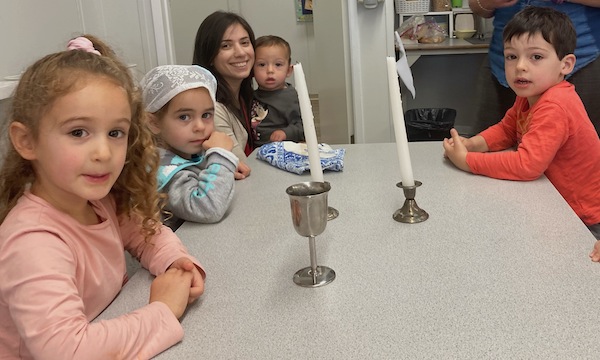
Richmond Jewish Day School preschool children gather for Shabbat celebration, with Sara Solomon assisting. (photo from RJDS)
Sara Solomon, Richmond Jewish Day School’s new program director for early education, knows firsthand the importance of a community-centred Jewish day school. She can remember making the daily half-hour bus ride each way from Richmond to Vancouver to attend the nearest Jewish elementary school. It wasn’t until 1992, when RJDS opened its doors, that she could attend school closer to home. But it isn’t sentimentality that has drawn her back to RJDS. It is the school’s novel and forward approach to teaching elementary education.
“[RJDS’s] family-centred culture of the school and the progressive approach to education … aligned with my own values,” said Solomon, who graduated from Langara College in 2010 with a diploma in early childhood education and a certificate in special needs. She said the school’s focus on innovative teaching methods for individualized education aligns with her own practice of “emergent curriculum” – a teaching method that supports the belief that children excel when they are permitted to learn at their own speed and according to their own strengths, interests and abilities – was a deciding factor when it came to applying for the position.
RJDS offers two preschool programs: Gan Alef, for infants and toddlers (0-3 years old) and Gan Bet, for children ages 3-5. For both, the school employs what RJDS principal Sabrina Bhojani refers to as a “constructivist play-based approach” to education. Instead of using teacher-led lessons and activities, educators use curiosity and inspiration to nurture the child’s development. “This provides opportunities, experiences and materials that are responsive to children’s interests and passions,” said Bhojani.
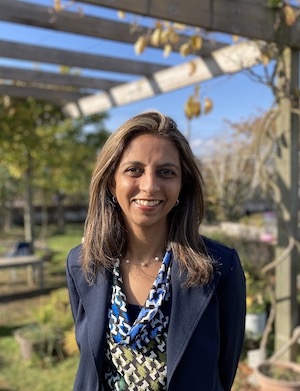
Richmond Jewish Day School principal Sabrina Bhojani. (photo from RJDS)
Although the children are usually in group settings, individuality of expression is encouraged. “We also weave Judaic concepts and history through storytelling; language and traditions are experienced through holiday celebrations and Hebrew songs,” Bhojani explained.
“We try to incorporate [the curriculum] in as natural a way as possible without it seeming like we’re inputting information,” Solomon added. The curriculum often uses Jewish holidays to inspire exploration of colours, themes and Hebrew words. “For Sukkot, [we had] a picture of a sukkah and there was a discussion about what the sukkah is, how it’s used,” she said by way of example.
The school also had a small sukkah outside that the students could visit. “The younger children were given some natural materials the teachers collected from outside,” along with some paints. “The older group were given the leaves or needles from an evergreen tree for the roof, some popsicle sticks and a few other things. There was no expectation for it to look like a sukkah,” Solomon explained, noting that the kids weren’t given specific exercises or told to decorate the structure. But the materials were provided for creative expression and exploration that eventually led to decorating the sukkah.
Bhojani said the new RJDS-run early education centre was created to overcome several challenges facing the Richmond Jewish community. The first was to expand access to early childhood education, an urgent need that is being felt throughout the Metro Vancouver area and beyond.
According to Bhojani, infant-toddler spaces are in high demand across British Columbia. “In the last few years, the number of childcare spaces has simply not been enough to meet the needs of families. This has been a province-wide issue, but it has been far worse for families in Richmond, particularly those families seeking a place they could be assured that their Jewish children could express themselves in an authentic manner.” At the moment, she said, “RJDS Early Learning Centre is the only Jewish child care in the Lower Mainland that accepts child under 18 months old.”
The new centre will support continuity of education for children throughout the elementary school experience.
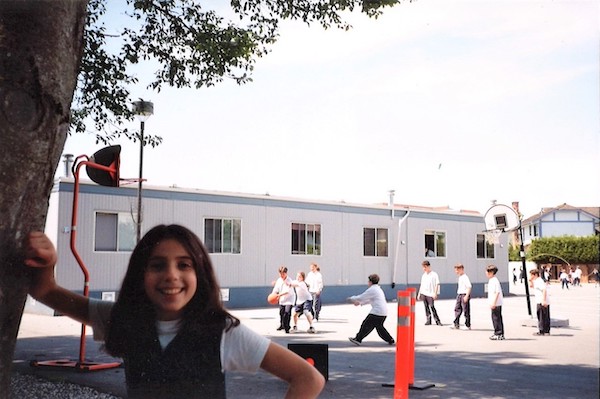
Sara Solomon when she was in sixth grade at RJDS. Solomon was one of the school’s first graduates. (photo from Sara Solomon)
Bhojani said the previous preschool was run by an independent contractor that rented space from RJDS, but its curriculum wasn’t synchronized with what was being taught in the upper grades. “[Being] that it was a third-party organization, we had no authority or oversight in the daycare’s programming,” she said. With the demand for childcare spaces, the former preschool also wasn’t able to guarantee availability for families that wanted to enrol all of their children at RJDS for preschool through Grade 7 attendance.
“We realized quickly we needed our own licensed facility,” and one that fit with the new lesson plans, Bhojani said. “Soon after, we made a commitment to building our own learning centre in order to be able to better serve our community.” That included renovating parts of the school.
The improvements were paid for by two local grants, one of which was specifically tailored to increasing the number of childcare spaces in British Columbia. The B.C. New Spaces fund, offered through the provincial government, helped cover the cost of structural renovations in the preschool area.
The second grant came from the Jewish Community Foundation, which provides unrestricted grants for a wide variety of community needs. While the school did not disclose the amounts they received from each grant, Solomon said the two grants allowed them to make targeted upgrades in time for the 2022/23 school year.
“So far, we have been able to repaint the building, put in all new flooring, upgrade the lighting, and the next steps are going to be some plumbing upgrades,” Solomon said.
The school will still have some further additions to make, such as a new washer and dryer, a sink in one of the classrooms and some improvements in the outdoor play space. Solomon said she is hoping the school will be able to develop an engaging play area, where classes can be held outdoors, too. “We have the most beautiful property here,” she said. “We are on farmland and we are really hoping that we can incorporate that into our outdoor play space.”
Bhojani said the school’s new early education program director comes with the life experience and drive that will help make the new preschool a real success. “As an original RJDS graduate, current school parent and former board member, Sara Solomon has an unparalleled dedication and commitment to our school,” said Bhojani. “She, along with a highly qualified and experienced staff, in the short time that we have been open, have created beautiful spaces in which children feel nurtured and loved.”
Jan Leeis an award-winning editorial writer whose articles and op-eds have been published in B’nai B’rith Magazine, Voices of Conservative and Masorti Judaism and Baltimore Jewish Times, as well as a number of business, environmental and travel publications. Her blog can be found at multiculturaljew.polestarpassages.com.
The Diamond Foundation is leading the way in contributing to JWest, with an historic $25 million gift – and community donors have matched this gift with another $25 million.
The Diamond Foundation’s matching gift is the first philanthropic contribution to the project and it is the largest donation ever made by the Diamond Foundation. Completing the match means $50 million toward the JWest capital campaign target of $125-plus million.
Alex Cristall, chair of the JWest capital campaign, had this response: “I want to thank the Diamond Foundation for this transformational gift. A project of this magnitude will not be possible without the tremendous generosity demonstrated by the Diamond Foundation, as well as philanthropic support from the community at large. It is our hope that the Diamond Foundation’s incredible community leadership will serve as inspiration, and we are now calling on others to work with our team to champion this project in an equally impactful way.”
The Diamonds’ gift will have a significant impact on the plans for JWest, providing a social, cultural, recreational and educational asset for all. This is the most extensive project in the history of the Jewish community in Western Canada and it is estimated to cost more than $400 million. Bringing it to life will require philanthropy, government funding and astute financing.
Gordon and Leslie Diamond, who are honorary JWest campaign co-chairs and members of the Diamond Foundation’s board, shared: “We are pleased to be the first family to make a significant contribution to JWest’s capital campaign. Our family has called Vancouver home for almost a century, and we have always believed in contributing whatever we can to ensure there is a bright future for our children and their children.”
The announcement builds on the $25 million funding provided in 2021 by the B.C. government.
“Mazal tov! I’m so pleased that our government’s shared mandate commitment of $25 million and a $400,000 investment in redevelopment planning has been bolstered with philanthropic support from the Diamond Foundation and community,” said Melanie Mark, Hli Haykwhl Ẃii Xsgaak, minister of tourism, arts, culture and sport. “These generous contributions underscore the importance of a renewed Jewish Community Centre to 22,590 Jews and all people living in this community. It speaks to the power of working together to shine a light on our province’s diversity and inclusion.”
The new space, once complete, will deliver a state-of-the-art community centre, expanded space for the Vancouver Holocaust Education Centre, double the current number of childcare spaces, expanded seniors’ programming, a new theatre, a relocated King David High School and two residential towers that will provide mixed-use rental housing (a portion of which will be below-market rates).
“JWest is the amalgamation of decades of work, and the fact that we saw our gift matched so quickly sends a clear signal that the community stands behind this project,” said Jill Diamond, executive director of the Diamond Foundation. “The Diamond Foundation has had a unifying focus to assist and advocate for initiatives in the Vancouver area that help improve the quality of people’s lives. The impact JWest will have on the Jewish community and the surrounding Oakridge community is undeniable.”
* * *
The Louis Brier Jewish Aged Foundation has added two new members to its board of directors: Mervyn (Merv) Louis and Michelle Karby. They join an impressive group of volunteers, who for the past decades, have donated both their time and funds to care for the elderly of the Vancouver Jewish community.
Mervyn (Merv) Louis (photo from Louis Brier Jewish Aged Foundation)
Louis, a certified public accountant, emigrated with his family from South Africa to Canada in December 1978 and joined a small accounting firm in Vancouver. In the summer of 1979, the firm was acquired by Grant Thornton LLP. In 2016, Louis retired as a partner of Grant Thornton LLP, where he worked for 38 years, of which 33 were as a partner specializing in audit, accounting and business advisory services. Louis advised and worked with clients in many different industries, including manufacturing and distribution, real estate investments and construction, entertainment, and professional practitioners.
After his retirement from Grant Thornton LLP, Louis worked as the chief financial officer of Plotkin Health Inc. and MacroHealth Solutions Limited Partnership until retiring again, in August 2020. During these years, he successfully helped merge a U.S. partnership and a Canadian company to form the parent partnership of MacroHealth Solutions Ltd. Partnership, a medical cost management and solutions provider in North America.
Louis has been married for 46 years and has two sons. He and his wife love to travel and are particularly fond of cruises; they have toured North America, Europe, Asia, Australia and Southern Africa. Louis is an avid sports fan and, while his playing days are over, he loves watching all sports, notably hockey, golf and rugby.
Michelle Karby (photo from Louis Brier Jewish Aged Foundation)
Karby is an experienced wills, estates, trusts and corporate lawyer heading up the wills and estates group at Owen Bird Law Corp. She helps clients plan, build and protect their legacies. Prior to developing her expertise in this area, Karby spent many years in and out of a courtroom honing her skills as a commercial litigator.
While born and raised in Vancouver, Karby’s adventurous spirit and love of travel translated into 18 years studying and working in places that included Montreal, Toronto, Israel, Cape Town, Melbourne and Sydney. Now settled in Vancouver with her husband and two teenage sons, Karby enjoys the beautiful natural environment, being close to her family and giving back to the community that she grew up in.
* * *
Kimberley Berger has joined Jewish Federation of Greater Vancouver as its new outreach worker in the regional communities. In particular, she will focus on White Rock, South Surrey and New Westminster.
Berger has worked in the nonprofit sector for more than 30 years, focusing on community development and family support. She has held many roles, ranging from frontline work to executive director of South Vancouver Family Place. She also dedicates time to supporting parents whose children are undergoing cancer treatment at B.C. Children’s Hospital with the West Coast Kids Cancer Foundation.
Berger believes that a strong sense of connection makes both individuals and communities more resilient. Building relationships is central to her role at Jewish Federation and in her own personal life with her family of four in East Vancouver.
* * *
This year, the Isaac Waldman Jewish Public Library raised more than $30,000 for the library. These funds will help it purchase new books and supplies for programs. Thank you to all of the Friends of the Library, and to the volunteers who helped make the fundraising a huge success.
* * *
Boys Town Jerusalem ranked in the top 10% of 838 high schools examined over the 2021-22 academic year. (photo from Boys Town)
The Israeli Ministry of Education has granted Boys Town Jerusalem an Award for Excellence. The school ranked in the top 10% of the 838 high schools examined over the 2021-22 academic year.
In releasing its findings, the Israel Ministry of Education cited Boys Town Jerusalem (BTJ) for reaching outstanding achievements in the academic and social realms, as well as for instilling crucial ethics and values. BTJ principal Yossi Cohen noted that the prize reflects the ministry’s findings of the extraordinary efforts by BTJ instructors to spur students to reach a high academic level, avoid dropout and advance to Israel Defence Forces enlistment and higher education.
This marks the third time in the past decade that Boys Town Jerusalem has been awarded the prize for excellence, and the first time in which the school has reached the top-echelon rank. The Ministry of Education Award for Excellence includes a monetary reward for teachers among the highest-scoring schools.
In saluting BTJ’s instructors, Cohen stressed the COVID-related hardships over the past two years, which have demanded exceptional efforts to keep students focused and excelling despite the increased illness, poverty and strife they face at home.
* * *
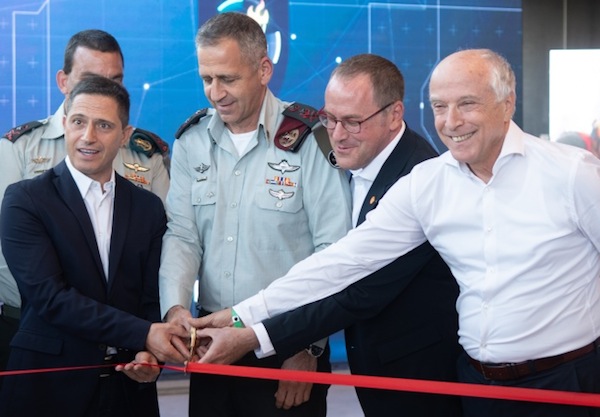
Cutting the ribbon, left to right, are Ruvik Danilovitch, mayor of Beer Sheva, Israel Defence Forces Maj.-Gen. Aviv Kochavi, Ben-Gurion University president Daniel Chamovitz and Avi Jacobovitz, Gav-Yam real estate company director general. (photo from Canadian Associates of BGU)
A ceremony dedicating the new home of the Israel Defence Forces (IDF) Communications Branch School for Software and Cyber Security was held in August at the Advanced Technologies Park (ATP) located at Ben-Gurion University of the Negev (BGU).
BGU president Prof. Daniel Chamovitz, IDF chief-of-staff Lt.-Gen. Aviv Kochavi, head of the communications branch Col. Eran Niv, Be’er Sheva Mayor Ruvik Danilovich and other officials and guests were in attendance.
The school’s new location will enable collaboration with BGU and the high-tech companies in the ATP. The school is the first of the communications branch units to move south as part of the national move to strengthen the Negev following the government decision to move the IDF south. The branch’s new main base is under construction alongside the ATP.
The move will assist in the preservation, development and empowerment of the technological human-power in the IDF while creating opportunities and a space for new collaborations in the south.
Imagine an interview where the interviewer wanders around the office, conducting work while asking intrusive personal questions. The interviewee trails behind. An hour-long appointment stretches into two. Things get further off track. The potential employee, apologizing profusely, gets herself out of the building and into the safety of her car. Cheeks burning, she drives herself home, wondering, “What the heck was that?” Days later, she fields phone calls from the interviewer, asking why she won’t accept an offer that is a dollar or two more than minimum wage. The amount would not likely cover the gas, taxes, work clothes and household/childcare coverage it would take to do the job. Advanced degrees and experience don’t matter, she hears. This is the going rate.
Meanwhile, at home, the same potential employee “works” at the numerous tasks that pop up every day. She self-drafts a clothing pattern, because a kid needs pyjamas of the right size and the pattern she has doesn’t fit. She mends a favourite pair of school pants. She prepares multiple meals in advance, baking bread ahead, too. These tasks are lined up for quick moments to spare amid managing homework and extracurricular activities. She contacts tradespeople to see if they can provide affordable repair quotes, responds to school emails and fits in applying for other jobs or doing her current work as she can. She is sadly behind in keeping up with her friends and family, but doesn’t know when to fit that in.
In between, she walks the dog, meets the kids at the school bus, takes them to medical appointments, or pays bills. She politely tries to get out of volunteer commitments that moms “should” do for the school and community organizations.
This might sound familiar to parents, mostly mothers. It’s all the work that goes unnoticed and is uncompensated in our society. Daring to seek compensation for some of these skills is seen as selfish. After all, these parents (usually mothers) are told, “If you expect to earn anything for your experience or education, you’re mistaken. You ‘chose’ not to stay consistently in the full-time workforce. You chose to have children/get married/study a less-lucrative topic in university….” The list goes on.
Our society functions in many ways because of the unpaid labour. It’s most often women’s physical, emotional, social labour done behind the scenes. It feels new and unfair in every generation, I suspect, even as some things change for women slowly over time.
As I study Ketubot, which is a Babylonian talmudic tractate dedicated, at least in theory, to marriage contracts, I’ve had competing demands on my time. It’s forced me to read aspects of the text differently. When the rabbis debated these issues (1,600 to 2,100 years ago, give or take), women’s roles were more circumscribed. However, some of the basic arguments seem to arise in ways that don’t surprise me.
Some of the takeaway nuggets from this tractate…. When a woman marries, her husband is owed her labour and the fruit from her properties. Even if she brings servants into the marriage, there are certain tasks she must do herself. Her virtue and loyalty are worth a monetary value in the marriage.
There are surprises though. If the husband dies, the woman is owed the price of her marriage contract, or the husband’s heirs must take care of her upkeep. She (or her representatives) may write obligations into the marriage contract that the husband will be required to honour. For instance, if she brings a daughter from a previous marriage with her, she can obligate the new husband to pay for the daughter’s physical support in the contract. (Ketubot 102)
Long story short, smart women can sometimes find ways to protect themselves. This is true even in a rabbinic system that isn’t designed necessarily for them. In these texts, women – and their families – both look out for one another and treat each other unfairly.
What can we draw from all this? I feel less alone when considering that expectations may have changed a bit in 2,000 years, but that many of our sometimes truly overwhelming expectations and commitments remain. Further, clever people have protected themselves whenever they can, throughout the centuries. It’s not new to look out for one’s own interests and avoid being taken advantage of by creating some safe boundaries.
Studying these texts at this point in my life offers me a level of maturity that I didn’t have the first time I went through a bad interview. More than once, I was offered a job that took a lot of skill but offered only a low wage. I remember feeling torn up about these experiences, wondering if I was worth so little. It was also a feeling of desperation. I needed a certain amount to live, and this offer wouldn’t provide it.
One privilege of being older is that women who value themselves aren’t embarrassed to ask for what they’re worth. Earning less than what we need doesn’t do us or our families any favours but, of course, in financial desperation, many women must take those jobs anyway. This is what fuels the cycle of low wage work in the first place.
We aren’t all experts in everything. Drafting a sewing pattern doesn’t make one a professional fashion designer. Finding the right document in a bunch of storage boxes is like finding a needle in a haystack, but it doesn’t make me an archivist or a research librarian. We all have our areas of true expertise. Also, just as the rabbis debated the value of one’s roles and responsibilities in marriage, we do the same. Is our work worth something? Heck, yes.
Tractate Ketubot’s messages about the value of a woman or a wife sometimes seem mercenary, but this, too, is Torah. Sometimes, being mercenary is the way to have our work be seen, valued or compensated appropriately.
Joanne Seiff has written regularly for CBC Manitoba and various Jewish publications. She is the author of three books, including From the Outside In: Jewish Post Columns 2015-2016, a collection of essays available for digital download or as a paperback from Amazon. Check her out on Instagram @yrnspinner or at joanneseiff.blogspot.com.
The Elie Wiesel Foundation for Humanity (EWF) in New York is launching a new impact-driven philanthropic strategy to advance human rights around the world.
The foundation, led by Elisha and Marion Wiesel, will adopt a hybrid approach that will not only grant funds but also work with organizations directly as partners, offering access to innovative thinking partners and acting as an emblematic megaphone to champion their cause.
The foundation’s recalibrated grantmaking program will seek to fund organizations that embody Nobel Peace Prize winner Elie Wiesel’s legacy as an educator and activist. Grants to educators will support moral educational programs inspired by Jewish values. The foundation is seeking to support programs and projects that foster dialogue, especially in engaging ways.
Activist grants, meanwhile, will focus on programs that restore the rights and dignity of the Uyghur population, in keeping with Elie Wiesel’s belief that “sometimes we must interfere. When human lives are endangered, when human dignity is in jeopardy, national borders and sensitivities become irrelevant. Whenever men or women are persecuted because of their race, religion or political views, that place must – at that moment – become the centre of the universe.”
The foundation will be awarding one or more grants in each portfolio for its next cycle, ranging in size from $50,000 to $200,000. Applicants must be financially sound 501(c)(3) tax-exempt organizations or have a U.S.-based fiscal sponsor at the time of application, and be able to demonstrate realistic plans for carrying out the program or project for which they seek funding. Submissions will be reviewed internally through various stages and finalists will be considered by a group of notable names, passionate about the respective value track. Grant applications are being accepted online through the foundation’s website (eliewieselfoundation.org) and are due by Dec. 15, 2022.
“The values my father stood for – combating indifference, educating youth, calling out injustice and defending human rights – continue to be the moral bedrock of the Elie Wiesel Foundation,” said Elisha Wiesel. “We are so excited to announce our new grantmaking program to provide nonprofits that embody those values with the resources to achieve lasting impactful change.”
“Elie Wiesel was my dear friend and trusted partner in the fight for human rights around the world. I think it is very appropriate that his foundation put the fate of the Uyghur people as one of its main priorities and will be focused on delivering resources and moral support to those advocating for the Uyghurs,” said human rights activist and EWF advisory board member Natan Sharanksy. “The free world cannot stay silent about China’s horrific persecution of its Uyghur minority. I know firsthand the power of outside support to those standing bravely against totalitarian regimes. That is why I am glad to serve as an advisory board member at the Elie Wiesel Foundation, dealing with this issue.”
Other members of the advisory board on the Uyghur crisis include Mark Hetfield, president and chief executive officer of the Hebrew Immigrant Aid Society, the oldest resettlement organization in the world; and Gulhumar Haitiwaji, the daughter of a Uyghur woman who survived a Chinese re-education camp.
The advisory board on moral educational programs includes neuroscientist, actress, podcast host and author Mayim Bialik, an outspoken activist for mental health and Jewish causes; Dr. Mehnaz Afridi, a professor of religious studies and the director of the Holocaust, Genocide and Interfaith Education Centre at Manhattan College; and Sarah Idan, the founding chief executive officer of Humanity Forward, a multi-dimensional organization that promotes education and peace.
The Elie Wiesel Foundation was established after Wiesel was awarded the Nobel Peace Prize in 1986. Under the direction of Wiesel and his wife Marion, the foundation developed, implemented and funded several critical humanitarian programs in Israel, including the Beit Tzipora Centres and the Darfurian Refugee Program. This new direction will allow the foundation to widen its scope through meaningful, action-driven partnerships.
Laura Soda, right, with her host family, the Lipiks, and some of her MITF colleagues at Rosh Hashanah. (photo from Laura Soda)
Growing up as a Jewish young adult in White Rock, I always had mixed feelings about celebrating the High Holidays. On one hand, I enjoyed the traditions and the feeling of community that I experienced when we would go to services. However, early fall has always been a hectic and stressful time for our family as well. Aside from Rosh Hashanah and Yom Kippur, there was the beginning of a new school year, all four family birthdays falling within a month of one another and, finally, Thanksgiving. It’s a six-week family marathon.
During the High Holidays, I also was overwhelmed with the feeling of being the “token Jew” in every class. At the beginning of every school year, I dreaded having to approach the teacher and ask for time off so that I could observe holidays that most of my peers, and even some of my teachers, had never heard of. I almost had a sense of guilt, as if I were inventing holidays just to get out of class. All I wanted was to fit in and be like everybody else. And, in the White Rock of my childhood, there was little cultural, ethnic or religious diversity. There were two other Jewish kids at my school, but we rarely – if ever – acknowledged our mutual Jewish connection outside the context of Hebrew school, synagogue or youth group. It wasn’t that we were actively hiding our Jewishness; for me, I simply felt that any sign of difference was “uncool.”
I am currently on a 10-month program teaching English in Israel with Masa Israel Teaching Fellows (MITF). I am living in Kiryat Gat, a small, mostly religious up-and-coming city in the south of Israel. For the next 10 months, I will be teaching English to the children of the community in which I live. Most of the people here do not speak English, and I feel grateful to be in a place where I can help break language barriers and contribute to English language education. For me, however, it has been quite an adjustment.
With the challenges of settling into a new country, in a town where not many people speak English, I am overwhelmed by the tremendous sense of community and unity. Despite the inconvenience of the train and bus schedules around the holidays, it wasn’t just me being inconvenienced. For the first time in my life, I was in the same situation as everyone around me.
Recently, I celebrated my first Israeli Rosh Hashanah with a host family that I was connected to through the MITF program. The Lipik family welcomed my peers and I, quite literally, with open arms and have made us feel at home. My roommate and I walked to Rosh Hashanah services in the morning and passed many others doing the same. Suddenly, I realized that, although I had been prepared to feel like an outsider in a tight-knit community of people who were more religious than me, my Rosh Hashanah experience was so welcoming. I smiled at the children who listened to the shofar with wonder, and I was reminded that children are simply children, no matter where they live or what language they speak.
Later, we joined our host family at their backyard barbeque along with their extended family and friends, and we ate our hearts out as we basked in the smell of smokey chicken kebabs and toasted marshmallows for dessert. Throughout it all, it sunk in that, this year, I don’t have to explain myself. This year, it is my turn to learn – to watch and listen to how other Jews celebrate, being curious about the differences, but, more often, being surprised by the many similarities in our traditions. My first Rosh Hashanah in Israel taught me that although I am far from my home in Canada, I am exactly where I need to be – I feel right at home.
Laura Sodais currently on a 10-month program teaching English in Israel with Masa Israel Teaching Fellows. For more information on the MITF and other Masa programs, visit masaisrael.org.
Every election gives us the power to make a difference. Every election is an opportunity to make an impact. This municipal election, you can make both happen.
The past two years have seen British Columbians head to the ballot boxes more than once. A provincial government was elected in 2020, a federal one in 2021 and, now, we’ll be completing the trifecta on Oct. 15, with municipal elections. This makes it the perfect time to sign up to volunteer on the campaign of your choice.
Municipal elections are unique because voters are electing multiple officials, including a mayor, city councilors, school board trustees and, depending on the municipalities or regional districts, a slew of other positions, such as park board commissioners, rural directors and more. These are all opportunities for the Jewish community to build relationships with candidates and incoming elected representatives.
The job of the Canadian Jewish Political Affairs Committee (CJPAC) is to encourage the Jewish and pro-Israel community to get engaged in politics and to facilitate that involvement.
CJPAC does this not by lobbying or advocating but by providing community members with the tools and confidence to build relationships with politicians. Your involvement in politics helps politicians become more familiar with the community’s needs, concerns and goals.
The Jewish community makes up less than one percent of the population in British Columbia. Because it’s so small – demographically speaking – community members need to step up in a big way. Volunteering across campaigns and parties strengthens our community, especially because of how spread out the Jewish population is around the province.
Volunteering gives community members firsthand experience to see what it takes to elect a candidate and, most importantly, plays a valuable role in building lasting relationships with politicians. When you volunteer, you become a key driver of the number one goal of a campaign: “getting out the vote.”
If you want an idea of just how much every vote can matter, look no further than 2018 when the Vancouver mayoral election was decided by only 984 votes – that’s a difference in total votes of less than one percent.
Volunteering is easy and flexible. It can include both in-person and remote tasks, such as making phone calls, door-knocking, delivering and/or putting up signs and so much more. Another crucial volunteering activity is scrutineering, where candidate representatives are trained by the campaign to scrutinize the ballot-counting process.
Political volunteering is geared for all ages. It’s especially great for adults and seniors who have a few hours to spare to enhance the Jewish community, and high school students eager to get their volunteer credits. (By the way, applications for this year’s Generation program for Jewish politically savvy high school students are now being accepted. The deadline for submissions is Oct. 14, at cjpac.ca/generation.)
Learn more by using CJPAC as your political concierge to connect you to the campaign/candidate of your choice and train you to be an election volunteer. Sign up at cjpac.nationbuilder.com/bcmelxn22.
Still need more information? RSVP at cjpac.ca/event/meetmayor to attend the Sept. 29, 6 p.m., Meet Your Next Mayor event at Vancouver Talmud Torah, which CJPAC is co-hosting with the Centre for Israel and Jewish Affairs (CIJA). Community members who attend will get to interact with Vancouver’s mayoral candidates and ask their questions.
As Jews, we are committed to contributing to the greater society. With Rosh Hashanah on the way, CJPAC encourages you to renew your commitment to the community by making an impact on the political world and making cities across the province more welcoming and safer places for all British Columbians.
Contact CJPAC’s B.C. regional director, Kara Mintzberg, at kmintzberg@cjpac.ca or 778-903-1854, to get your volunteering journey started, or for any other inquiries.