Skip to content
  • Home
  • Subscribe / donate
  • Events calendar
  • News
    • Local
    • National
    • Israel
    • World
    • עניין בחדשות
      A roundup of news in Canada and further afield, in Hebrew.
  • Opinion
    • From the JI
    • Op-Ed
  • Arts & Culture
    • Performing Arts
    • Music
    • Books
    • Visual Arts
    • TV & Film
  • Life
    • Celebrating the Holidays
    • Travel
    • The Daily Snooze
      Cartoons by Jacob Samuel
    • Mystery Photo
      Help the JI and JMABC fill in the gaps in our archives.
  • Community Links
    • Organizations, Etc.
    • Other News Sources & Blogs
    • Business Directory
  • FAQ
  • JI Chai Celebration
  • JI@88! video

Recent Posts

  • Sharing her testimony
  • Fall fight takes leap forward
  • The balancing of rights
  • Multiple Tony n’ Tina roles
  • Stories of trauma, resilience
  • Celebrate our culture
  • A responsibility to help
  • What wellness means at JCC
  • Together in mourning
  • Downhill after Trump?
  • Birth control even easier now
  • Eco-Sisters mentorship
  • Unexpected discoveries
  • Study’s results hopeful
  • Bad behaviour affects us all
  • Thankful for the police
  • UBC needs a wake-up call
  • Recalling a shining star
  • Sleep well …
  • BGU fosters startup culture
  • Photography and glass
  • Is it the end of an era?
  • Taking life a step at a time
  • Nakba exhibit biased
  • Film festival starts next week
  • Musical with heart and soul
  • Rabbi marks 13 years
  • Keeper of VTT’s history
  • Gala fêtes Infeld’s 20th
  • Building JWest together
  • Challah Mom comes to Vancouver
  • What to do about media bias
  • Education offers hope
  • Remembrance – a moral act
  • What makes us human
  • המלחמות של נתניהו וטראמפ

Archives

Follow @JewishIndie
image - The CJN - Visit Us Banner - 300x600 - 101625

Goldstein removed from exhibit

Goldstein removed from exhibit

Dina Goldstein stands in front of two of the 10 works that comprise her In the Dollhouse series featuring Barbie and Ken. (photo from Dina Goldstein)

Dina Goldstein had her work pulled from a Vancouver exhibition just days before it was set to open – in what she has described as “a blatant act of antisemitism.” But the gallery is claiming its decision to cut the Israeli-Canadian artist from the show was based on financial considerations, despite a recent news report and documentation from Goldstein that suggest there may have been other reasons.

An internationally acclaimed artist, Goldstein was scheduled to have her works shown at the Vancouver Centre of International Contemporary Art (CICA) from May 9 to June 29 as part of a group exhibition titled Toy Story, a look at the world of toys as seen through the eyes of artists from around the world. Goldstein, who received widespread attention for her Fallen Princesses and In the Dollhouse series of tableaux, was listed as recently as late April on the CICA website among the artists whose works would appear in the exhibit.

According to a report on Stir, a Vancouver website covering art news, Goldstein was notified by the gallery’s curator, Viahsta Yuan, on April 30 that her works – three pieces from the 10-image In the Dollhouse series – would not be shown during the exhibition. (Goldstein earlier had arranged for the gallery to pick them up on May 2.)

Regarding her agreement with CICA after a studio visit by the curator on April 26, Goldstein said, two large pieces and two medium pieces were confirmed, available at the studio, framed and ready to be installed.

“One medium piece had to be produced because it is a diptych with a missing partner. This she requested I get going on. The other selections would be printed in small format. I was waiting to hear about the production of the small version. [The curator] wanted to show all 10 images if possible,” Goldstein said.

But then, in Goldstein’s account, which was sent to the CJN, Yuan disclosed to her that the gallery had received an email from a small group of Vancouver artists who wanted her excluded because she supported Israel. The unnamed artists, in Goldstein’s words, felt that she did not deserve to exhibit her work during this time of war. Goldstein was offered an alternate solo exhibition within a year or two, or when the situation in Israel and Gaza might subside.

Yuan had, as Goldstein recalled, agreed that punishing an artist because of their Jewish identity was unjustifiable. Goldstein asked the curator to relay this message to the gallery committee, as well as the importance of standing up to discrimination. When she reached out to Yuan for an update on her meeting with the gallery committee, Goldstein received an email that cited, as she says, “a sudden budgetary issue as the reason for her removal. This explanation contradicted the previous acknowledgment of discrimination, with the decision now framed as a last-minute ‘creative choice.’”

“This experience takes me back to the times we may have had in our youth and being bullied. This is part of what antisemitism feels like,” Goldstein told the CJN, noting that the works in question have nothing to do with Gaza or Israel.

Goldstein, too, recounted that, unlike most people associated with the exhibition, she had been to Gaza and the West Bank while on an assignment in 1999, photographing Palestinians alongside her pictures from Jerusalem and Tel Aviv. She has shared those memories on Instagram in recent months.

In the Dollhouse, which was created by Goldstein in 2012, features a pink, adult-size dollhouse in which Barbie and Ken reside. The series offers satirical situations around the house, sometimes with a risqué approach to social commentary. Notes about the images on Goldstein’s website say that, in them, Barbie represents the notion that beauty is the ultimate trait and is necessary “to attain power and happiness.” Meanwhile, Ken discovers and expresses his true self after four decades of being “trapped in an imposed marriage.”

In the invitation to participate in the exhibition, CICA wrote that Goldstein’s dollhouse series “offers an intricate exploration of identity, conventional values, gender equality and beauty. The inclusion will not only enrich the depth of the exhibition but also provide viewers with a fresh and unique reflection on the toy that has influenced a generation of people.

“We believe that the inclusion of In the Dollhouse will offer a unique perspective and contribute significantly to the exhibition’s dialogue on the transformative power of toys as symbols within our lives.”

In Yuan’s version of events, as reported by Stir, after consultation with others at the gallery, CICA had originally selected five pieces from the series. After visiting Goldstein’s studio, she said only three of the pieces were ready.

Yuan then had another discussion with the gallery committee, and it was decided that CICA did not have the budget for production costs. Further, another artist was showing a piece about a dollhouse, and the gallery believed showing two works in dollhouses would be excessive.

CICA released a statement on May 4 in which it denied its decision to pull Goldstein’s work from the exhibition was based on “religious and cultural affiliation” but rather was related to financial considerations. Works by two other artists, Roby Dwi Antono and Aya Takano, CICA said, were also removed from the lineup. The organization emphasized its desire “to cultivate artistic dialogue and community engagement while emphasizing inclusivity and representation.”

“As a woman and BIPOC-led organization, prioritizing diversity is not just a goal but a guiding principle that informs every aspect of our work,” the statement from CICA read. “Since our inception, we have been dedicated to showcase a pluralistic range of contemporary art and ideas through our multidisciplinary exhibitions and programming.

“We are grateful to have collaborated with a distinguished group of over 35 local and international artists, with more than two-thirds from visible minority backgrounds. These cross-cultural collaborations are a testament to our commitment to platforming diversity while fostering a safe and accessible environment for all.”

CICA stressed that, like many nonprofit arts organizations, it faced budgetary constraints and, with limited resources, it needed to make difficult decisions. As a result, three artists were not shown because of limited finances, a short time frame and “curatorial direction.”

The cultural and religious background of an artist would never warrant exclusion from the gallery, CICA went on to say, and that decisions were made only on artistic merit and how a work would fit into an exhibition.

“Discrimination of any kind has no place within our organization, and we remain steadfast in our commitment to platforming 

diversity and ensuring equitable representation in everything we do. Looking ahead, we will continue to embed the values of equity, inclusion and diversity into every facet of our operations,” CICA said.

Established in 2021, CICA is a nonprofit, multidisciplinary arts organization. According to its website, it provides “a forum for everyone to step into the art and learn while having fun” and aims “to enhance public engagement in the arts and bridge local and international artists for idea exchange, knowledge sharing, and collaboration.” 

Sam Margolis has written for the Globe and Mail, the National Post, UPI and MSNBC. This article was originally published on thecjn.ca.
Format ImagePosted on May 24, 2024May 23, 2024Author Sam MargolisCategories Visual ArtsTags antisemitism, art, Centre of International Contemporary Art, CICA, Dina Goldstein, Fallen Princesses, In the Dollhouse, Viahsta Yuan
MP talks to community

MP talks to community

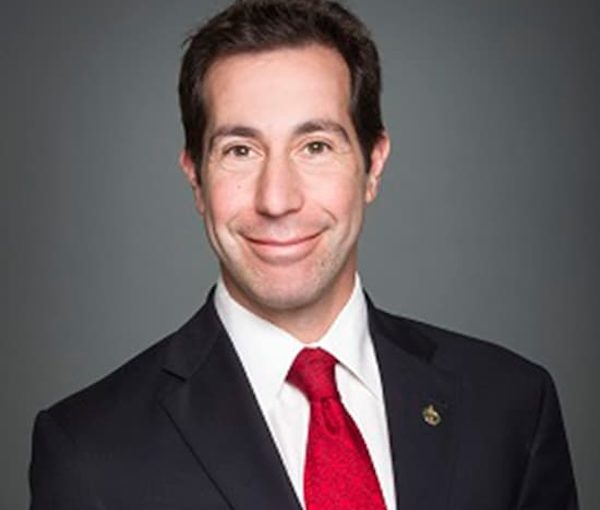
MP Anthony Housefather was in Vancouver last week. (photo from Government of Canada)

Anthony Housefather, the Liberal MP who openly considered joining the Conservatives, made an urgent plea during a presentation in Vancouver last week for Jews and pro-Israel voters to keep a foot on both sides of the political divide.

Housefather, member of Parliament for the Montreal riding of Mount Royal, was on the West Coast for a series of meet-and-greets with Jewish organizations and individuals. At Temple Sholom just before Shabbat on May 17, Housefather was open about the disappointments some Jewish Canadians – including himself – have felt with the current Liberal government.

“We’ve seen a government that has had an excellent record on Israel for the past eight years turn away from that excellent record that we all cherish so much,” he said before going into examples he said show his party has been a voice for Jews and Israel.

Since Justin Trudeau and the Liberal party came to power in 2015, Housefather said, Canada has had a better voting record at the United Nations than the previous Conservative government had.

“We voted against 87% of the anti-Israel resolutions at the UN, comparable only to the United States, at about 90%,” he said. “Most European countries were between zero and 10%.”

On antisemitism, Housefather said it was his party that appointed a special envoy on Holocaust remembrance and antisemitism – first Irwin Cotler and now Deborah Lyons – and adopted the International Holocaust Remembrance Alliance Working Definition of Antisemitism. The federal government apologized for this country slamming the doors on Jewish refugees before and during the Holocaust, initiated Jewish Heritage Month, and made antisemitism one of four pillars of the federal antiracism strategy, he said.

“I’ve been proud of the record of my party while we have been in government on these issues,” he said.

“Since Oct. 7, I think the Jewish community across the country has felt somewhat abandoned,” he said. In January, the government was “not able to articulate that Israel was not committing genocide,” he said. The decision to restore funding to UNRWA – the UN’s Palestinian relief agency some of whose employees, evidence shows, were involved in the Oct. 7 terrorism – was a blow to many Jewish Canadians. The turning point for Housefather was the New Democratic Party motion that was widely seen as condemning Israel, including calling for an end to military trade with the country.

“Unfortunately, the decision was made to amend [the motion], which made the resolution better, but it was still bad,” Housefather said. In the end, only he and two other Liberals voted against the motion. What really hurt, said Housefather, was when the NDP member who moved the motion was given a standing ovation, including by Liberal MPs.

This combination of events led Housefather to question his place in the party and to publicly acknowledge he was considering crossing the floor. He decided to stay with the Liberals, in part because the prime minister tasked him with new responsibilities to address antisemitism, but also, he said, because he realized that his voice – and those of other Jewish and pro-Israel Canadians – is needed in the governing party.

“I need to be there to make our voices heard in the party,” he said. “Once you place all your eggs in one basket and you have no allies in the other party when it comes to power, then you’re screwed.” 

Housefather has a list of actions he wants from the government and others. He is urging Criminal Code amendments to add “bubble legislation,” which would prevent protests within a certain distance from synagogues, Jewish schools and community centres, after protesters laid siege to a Jewish community building in Montreal and people inside were prevented from leaving for hours. 

Police need to be told that they must enforce the law around harassment and hate speech, and university administrations need to act to keep students safe, he said. 

Housefather pushed for parliamentary hearings on campus antisemitism, which have now begun. 

He urged Jewish Canadians to develop relationships with their elected officials, and he passionately urged them to leave their hatred aside. 

Housefather said he gets barraged by hate messages from antisemites and anti-Zionists – including death threats – but it’s the hate from Jews that really upsets him. No matter how much some voters agree with him on issues that are important to the Jewish community, he said, they nevertheless condemn him in extreme terms – “traitor,” “quisling” – for being part of the Liberal party.

“If our community wants MPs to support our community, you have to deal with them in a way that doesn’t send them hate, that doesn’t treat them like dirt.”

Above all, Housefather said, Israel and Jewish issues shouldn’t be a partisan issue. 

“We should all fight for them and we shouldn’t be trying to create wedge issues that divide the Jewish community,” he said. 

Format ImagePosted on May 24, 2024May 23, 2024Author Pat JohnsonCategories LocalTags Anthony Housefather, governance, hate, Israel-Hamas war, Liberals, Oct. 7, politics, United Nations, UNRWA
A new generation of leaders

A new generation of leaders

Howard Kallner is being honoured at Schara Tzedeck’s MOSAIC gala on June 4 (photo by kenneth88/wikimedia)

“I have been very lucky in my life to be surrounded by lifelong volunteers and builders of community, both my parents, my in-laws and multiple other role models, and it just seemed natural to volunteer and be involved,” Howard Kallner told the Independent.

Kallner is being honoured by Congregation Schara Tzedeck at MOSAIC, the synagogue’s annual gala, on June 4.

“The first thing that came to my mind was discomfort,” said Kallner about finding out he was being recognized. “I was hesitant to accept because there are so many long-time shul volunteers, donors and community-builders who would be deserving of being honoured.”

Kallner has been a part of the congregation since he was 13 years old.

“My family had emigrated from South Africa when I was very young and their synagogues in South Africa were very similar to Schara Tzedeck,” he explained. “My parents, and now my family, have been members for over four decades. On my wife’s side, her great-grandfather, David Davis, was a founding member of Schara Tzedeck, and her grandfather, Charlie Davis, was a past president.”

photo - Howard Kallner
Howard Kallner (photo from Howard Kallner)

For his part, Kallner was on the board for seven years before becoming president. He served three years as president and three more as past president, for a total of 13 years. He was serving as president when the pandemic hit.

“When the COVID pandemic hit, we needed to pivot immediately to online programming, online services where applicable, continue live services with restrictions and make sure our community members, particularly our vulnerable ones, were connected and taken care of,” he said of how his role was affected. “One of the programs that came out of this was Shabbat in a Box. We recognized a need amongst our members and others in our community and delivered over 450 meals a week at the height of the pandemic. For the Jewish holidays, we were delivering over 650 meals accompanied by holiday-specific items so they could celebrate the holidays.

“Additionally, Schara Tzedeck, being an Orthodox synagogue, could not have Shabbat services online,” said Kallner. “With the exception of a few weeks when the government would not allow any public gatherings, we continued services in person with some significant modifications. When limited to 50 people per gathering, we moved services outside, in a tent in our parking lot. At times, services were held in sub-zero temperatures, with most attendees wearing ski jackets, toques and gloves. For the High Holidays that year, we had nine services a day for a maximum of 50 people. We had to find three sets of Torah readers, shofar blowers and leaders of the services.

“While, during COVID, it was undoubtedly the hardest I worked as president of the shul, it was also the most rewarding,” he said.

Now officially “just” a member and supporter of the synagogue, Kallner continues to be part of the Schara Tzedeck Cemetery Board and is a governor of the Jewish Community Foundation, as well. 

“Giving back to a community that has given me and my family so much was very important,” he said. “With different experiences in my life and my relatives’ lives, including immigrating to a new country with little means and losses during the Holocaust, strong Jewish institutions ready for whatever the world would throw at them seemed crucial, and I wanted to do my part.”

Schara Tzedeck’s senior spiritual leader, Rabbi Andrew Rosenblatt, described Kallner as representing the beginnings of a new generation of leadership. At the time Kallner was getting involved, said the rabbi, “There weren’t a lot of people in their 40s who were stepping up to the highest levels of leadership at Schara Tzedeck.”

Kallner helped take the synagogue from being a 20th-century organization into being a 21st-century organization, said Rosenblatt. 

”The backbone of an Orthodox synagogue, certainly in the Pacific Northwest, certainly in Vancouver, is people who have come from much more traditional Jewish communities,” he explained. “For example, Schara Tzedeck has a lot of Holocaust survivors. These are people who came from very traditional Eastern European communities, but you could also have people from Winnipeg or Toronto or Montreal, New York, those places you associate with very traditional, very committed Jewish communities. For a long time, we were able to be a community of people who grew up in that kind of tradition, but there was a recognition at Schara Tzedeck that we needed to be able to be a place which translated to people who did not have that kind of traditional upbringing.”

Kallner had the analytical, organizational and people skills to help the synagogue do that, said Rosenblatt, highlighting Kallner’s leadership during the pandemic. 

“He was practically a paid member of the staff at that point, in terms of generating and developing policy,” said the rabbi. “He was involved in helping us make sure that we were operating on the next level. And he also understood that our organization had to be structured in a way where we could have the manpower to be able to do that, and that outreach. Part of that was that the information technology had to be updated.”

Describing Kallner as “a very humble person but also very hard working,” Rosenblatt said, “one of the things that he was strongest at was helping us transition into a place where we were reaching out more…. One of the programs we developed under his watch was Shabbat in a Box. There were some pre-iterations before that, but it came to its full maturity under him.”

Among the other programs that will benefit from the funds raised at MOSAIC are the synagogue’s education initiatives, some of which reach beyond the shul to the broader Jewish community, such as the series Rosenblatt gave on the history of the Marranos.

“I recognize,” he said, that “one of the great sources of inspiration in Jewish identity is Jewish history.”

Since the Oct. 7, 2023, terror attacks and the subsequent war, his education efforts have been more focused on Israel.

“When Oct. 7th hit, and people started to hear immediately just garbage about colonialization, I realized that there was just so much that people didn’t know or understand,” he said.

The Zionist story most of us have been taught is the inspirational one, he said. “Not that it’s wrong, it’s just not complete, and all histories have complexities. I didn’t want people to be caught flat-footed on these things and be surprised by them.”

He gave the example of a sign he saw on an overpass on the way into Whistler Village recently.

“It says there can be no peace on stolen land. And I’m thinking to myself who stole the land from whom? At what point do you decide that the land belongs to someone? Are you willing to say that 638 is where we’re going to start everything, when Omar ibn al-Khattab conquered Jerusalem, is that the right time? Should we ask ourselves when the Abbasids or the Fatimids or the Umayyads, which one of them? Were the Ottoman Turks? Which one becomes the real owner? At what point do you decide that these things happen? People don’t know – maybe now they do more, but certainly on October the 8th they didn’t know – when was Israel first called Palestine, when did Muslims come to Jerusalem, when were Jews forced out, which empires conquered it … what really happened at Deir Yassin, what were the stages of the War of Independence, what happened? These things, there are a lot of resources on them … and, I thought, Jews didn’t know these things – not to mention that there are libraries full of evidence on Jewish indigenous life in Israel that is far, far older than anything having to do with the name Palestine, and I wanted Jews to be able to know that. I wanted Jews to be able to articulate it. I want Jews to understand a stronger connection to Israel. And I think that has been something that has been a real value added to people’s knowledge base.”

The congregation has several individuals who have gone to do military service in Israel. “They are primarily Israelis who are here for various purposes, as shlichim [emissaries] or for educational reasons, and we’ve had real success in having them share their experiences and stories over the past number of months,” said the rabbi.

These types of programs have been a priority, said Rosenblatt, “to make sure that our community really stays close and understands the nuances and the issues. Every time we have the opportunity to give further insight, we do that.”

One of the people from Schara Tzedeck who has gone to serve was Assistant Rabbi Ishay Gottlieb. “He’s a major in the reserves in the IDF, and he left on Oct. 9th and wasn’t really back until the beginning of January,” explained Rosenblatt. “You’re essentially funding a staff member, like many Israeli organizations [are having to do], but there’s lots that had to be compensated for in that context.

“In some ways,” added Rosenblatt, “we’ve doubled our programming – run a regular program plus an Israel program. Not that we’re that different from the other synagogues [in that respect] but everything costs money and this is part of a case for giving. Since Oct. 7th, we really have been prioritizing the connection with Israel.”

He said, “When you walk into Schara Tzedeck, we want you to feel like you’re in a little embassy of Israel in this building. And participating in MOSAIC means that’s what you’re doing, you’re helping to support that – you’re helping to support a branch of Am Yisrael that is in Vancouver.”

To attend MOSAIC, RSVP by May 28 to 604-736-7607 or [email protected]. 

Format ImagePosted on May 24, 2024May 23, 2024Author Cynthia RamsayCategories LocalTags Andrew Rosenblatt, COVID, education, fundraiser, fundraising, history, Howard Kallner, Israel, leadership, Mosaic, Schara Tzedeck, volunteerism
Chutzpah! needs your help

Chutzpah! needs your help

Chutzpah! Festival acting managing director Jessica Gutteridge. (photo by Tallulah Photography)

After nearly 25 years at the forefront of Jewish arts and culture in Western Canada, Vancouver’s international performing arts festival, Chutzpah!, faces an urgent financial crisis. And it needs your help to keep the stage lights on.

Shifting priorities in government arts funding, as well as the impacts of Oct. 7 and the war in Gaza, have created a perfect storm resulting in a dramatic drop in revenue.

How did this happen?

Chutzpah! depends significantly on government grants. Presently, the stagnant pool of arts funding, alongside a growing number of applications, means fierce competition for fewer dollars. In addition, Jewish arts programming officially falls outside of funders’ “designated priority groups.” Funders have told the festival that, this year, only 15-20% of proposals will be approved, and Chutzpah! has already been declined for several grants that it has received historically.

“The arts community, generally, is facing difficulties with sustainable government arts funding, as the funding pool has returned to pre-pandemic levels with more applicants seeking funding,” explained artistic managing director Jessica Gutteridge. “But there are compounded challenges that Jewish performing arts and artists are facing, especially as tensions escalate locally in response to the war in Israel. Jewish organizations and events require additional security and access to funding is hampered by the fact that Jewish artists are excluded from funding priority categories, due to a misunderstanding that Jews are a marginalized ethnocultural group, and not solely a religious group.”

Adding to the financial challenges, Chutzpah! opened last year within weeks of the Hamas attacks and war in Gaza, within an atmosphere of rising anti-Jewish hate that has been felt both globally and locally. Despite the festival’s efforts to ensure the safety of performers, audience and staff, ticket sales suffered dramatically. With Jewish arts organizations and events in Vancouver, across Canada and elsewhere targeted with petitions and protests, the erasure of Jewish language, art and culture is, once again, a real threat. As a community, we cannot allow this to happen.

This is why Chutzpah! urgently needs support. The challenges the festival faces are serious, but not insurmountable, and organizers are taking several steps to try and secure its future.

Chutzpah! is speaking with new philanthropic foundations, exploring capacity-building needs in the short- and long-term. Increasing its capacity would give the organization more resources to diversify and grow revenue through grants, audience development plans, sponsorships, private donations, and more.

As well, the festival has established a circle of advisors – a few community members who are passionate about the arts, the Jewish community and Chutzpah! With their help, the festival hopes to strengthen its base of individual donors and identify prospective program sponsors and partners.

Chutzpah! is also reaching out directly to its community of patrons and supporters to share the challenges it is facing and ask for support.

“We’ve been so heartened by the response to our campaign to date. We’ve nearly reached 50% of our goal,” said Gutteridge.

The goal is to raise $60,000 by May 31. There are five ways people can help:

1. Contribute to the campaign. You can donate online directly and securely through CanadaHelps (or by cheque to Vancouver West Side Theatre Society). 

2. Help Chutzpah! grow its network of support by sharing information about the situation with like-minded friends/colleagues. Add a brief note explaining why you support the festival and ask them if they might consider doing the same.

3. If you or your contacts donate before May 31, campaign co-chair Emet Davis will match all gifts, up to a maximum of $10,000.

4. Increase your own impact by offering a formal or informal matching gift challenge within your personal or professional networks. Simply direct friends and colleagues to the festival’s donations page, confirm gifts, then issue your matching gift. Let the festival know if you do this.

5. Be a sponsor. Sponsorships subsidize production and associated costs for festival performances. There is a range of giving levels, recognition and other benefits. 

“With rising costs for artists, staff and production expenses, all needed to bring the high-quality work that Chutzpah! audiences are accustomed to, we are looking to gather a small but mighty group of philanthropists and arts lovers to support us – producer-level supporters,” said Gutteridge. “This group will help offset the challenges we’re facing with limited government arts funding and rising costs, by financing specific content for the festival and joining us to share those programs with their networks. We can match their artistic interests to our programming – for example, help produce a series of Israeli artists, or step up to support an evening of klezmer music.”

“Until several years ago, I only attended Chutzpah! occasionally,” said Davis. “To be honest, I think I took for granted that it was a permanent fixture in our community. But, when I made a decision a few years ago to engage more meaningfully in Jewish community, the festival became part of my journey – it has deepened my knowledge and my sense of pride in my identity. Chutzpah! is about something much more than entertainment – it’s about the preservation and celebration of our language, art and culture. Now more than ever, I’m reminded we can’t take that for granted.”

Donate via chutzpahfestival.com or save Chutzpah! the processing fees and give by cheque to Vancouver West Side Theatre Society, mailed to 950 West 41st Ave., Vancouver, BC, V5Z 2N7. 

– Courtesy Chutzpah! Festival

Format ImagePosted on May 24, 2024May 23, 2024Author Chutzpah! FestivalCategories Performing ArtsTags Chutzpah!, COVID, economic crisis, Emet Davis, fundraiser, Israel-Hamas war, Jessica Gutteridge, Oct. 7, performing arts
New JFS scholarship fund

New JFS scholarship fund

Fay and Ken z”l Golden, whose support has allowed Jewish Family Services to offer two education scholarships. (photo from JFS)

Thanks to the generosity of Fay and Ken (z”l) Golden, Jewish Family Services Vancouver has introduced the Fay and Ken Golden Annual Scholarship fund, aimed at supporting the educational endeavours of individuals entering accredited post-secondary institutions.

“We are delighted to support the educational aspirations of Canadian students through the Fay and Ken Golden Annual Scholarship Fund,” said the Goldens. “Education is a cornerstone of personal and societal growth, and we hope these scholarships will empower talented individuals to pursue their academic dreams.”  

JFS will offer two scholarships yearly, each valued up to $2,500. These funds will be disbursed as a one-time lump sum per academic year, providing financial assistance to qualified recipients.

The 2024 application period started May 15 and goes until June 30. Successful applicants will be notified no later than Aug. 1, 2024.

To be considered for the Fay and Ken Golden Annual Scholarship Fund, applicants must meet the following requirements:

• Be a Canadian citizen or a permanent resident of Canada.

• Be 40 years old or younger at the time of application.

• Be a first-time post-secondary student.

• Have an annual household income below $60,000.

• Currently be attending or planning to enrol in a post-secondary academic program provided by an accredited, certified educational institution in Canada. 

This yearly scholarship fund embodies JFS’s commitment to fostering education and opportunity within the community. JFS is grateful for the Goldens unwavering support and belief in education. For application instructions, visit jfsvancouver.ca/golden. 

– Courtesy Jewish Family Services

Format ImagePosted on May 24, 2024May 23, 2024Author Jewish Family ServicesCategories LocalTags education, Goldens, JFS Vancouver, scholarships

Pushing back against antisemitism

With antisemitism rising in British Columbia, professionals from three sectors – health care, post-secondary education and K-12 schools – have started organizing so incidents of hatred in their workplace are challenged at every opportunity.

The Jewish Academic Alliance of British Columbia and the Jewish Medical Association of British Columbia have launched in the past few months, while BC Teachers Against Antisemitism has grown more active since the Hamas terror attacks on Oct. 7, 2023.

“Antisemitism is reaching crisis levels in BC, and we are proud to be able to support the important work of these newly formed groups at this critical time for our community,” said Ezra Shanken, chief executive officer of the Jewish Federation of Greater Vancouver.

“I am in awe of all of our community members and allies who are stepping up to address what is a clear crisis at workplaces across the province – particularly since employees are uniquely positioned to address workplace issues with their employers,” noted Nico Slobinsky, vice-president, Pacific Region, Centre for Israel and Jewish Affairs.

“We have seen an incredible increase in worrying activities – from terror-affiliated organizations like Samidoun setting up an encampment at UBC to teachers making inappropriate comments towards Jewish students in the classroom, to troubling behaviour in our healthcare system. Yet, we have seen little by way of new activity by government,” said Slobinsky.

“The rise of antisemitism inside health care has been chilling. In a profession dedicated to healing people, we’ve witnessed hateful words and actions that have some fearing for their safety,” said Sharon Gershony, clinical instructor, pediatric nuclear radiologist, BC Children’s Hospital. “The Jewish Medical Association of BC is a supportive community for Jewish physicians, trainees and allied healthcare professionals. Together, we will create safe workspaces by confronting antisemitism with engagement, education and promotion of respect and greater tolerance.”

“Post-secondary institutions across BC have been a focal point of antisemitic activities and actions, some of these threatening the safety of faculty, staff and students. There is no place for this in BC,” said David Silver, a University of British Columbia professor who is helping form the Jewish Academic Alliance of BC. “By bringing together Jewish professors, educators and staff from across campuses, the Jewish Academic Alliance of BC will work to ensure that hate is confronted and campuses are again a place where Jews can feel safe.”

“Since Oct. 7th, some horrible things have happened in classrooms and in schools – to teachers and students alike, who have been singled out because they are Jewish and only because they are Jewish,” said Ginaya Peters, founder of BC Teachers Against Antisemitism. “We have had to become more active and will continue to push back against the hatred and discrimination and create a safe learning environment for all.” 

– Courtesy Jewish Federation of Greater Vancouver

Posted on May 24, 2024May 23, 2024Author Jewish Federation of Greater VancouverCategories LocalTags antisemitism, BC Teachers Against Antisemitism, CIJA, education, Ginaya Peters, Hamas terror attacks, health care, Israel-Hamas war, Jewish Academic Alliance, Jewish Medical Association, K-12, Nico Slobinsky, Oct. 7, post-secondary education
DOTE happens in June

DOTE happens in June

Karen Kaeja and Allen Kaeja in Lasterday. (photo by Kendra Epik)

Featuring more than 30 performances June 13-22, Dancing on the Edge audiences will see world premières, Western Canadian debuts and works-in-progress. This year’s lineup includes the Vancouver première of Lasterday, with choreography by Hanna Kiel, music by Adam Campbell, lighting by Gavin McDonald and performances by Kaeja d’Dance, Toronto Jewish community members Karen and Allen Kaeja.

Lasterday is part of EDGE 1, which also features Tiger Princess Dance Projects and Calder White. Performances are June 16 and 17, 7 p.m., at the Firehall Arts Centre.

Lasterday delves into the relationship of two individuals who carry different memories and perceptions of the same events from their past – sense of timeline, emotional impacts and interactions – revealing how they remember and interpret their shared history. Lasterday is part of the Kaeja d’Dance’s lifeDUET commissioning series. The works explore the Kaejas’ creative and personal partnership. Many duets have toured across the world through Canada and to Spain, India, England, Japan, Mexico, Venezuela and Israel. (For more, see jewishindependent.ca/life-stories-told-in-dance.)

Kiel is a Dora Award-winning artist hailing from Seoul, South Korea, who made Vancouver her home in 1996. Founder and artistic director of Human Body Expression, Kiel is also a resident choreographer at Canada’s JörgenDance.

Campbell is a sound designer, composer, percussionist and singer-songwriter. Originally from Summerside, PEI, and currently living in Stratford, Ont., he has worked as sound designer/composer with many festivals.

McDonald has designed lighting for more than 25 years, across North America and the United Kingdom, and teaches lighting and media design at York University.

Karen Kaeja is an award-winning choreographer, performer and educator. The heart of her research, creation and writing concentrates on the agency of touch. She develops platforms for collaborative relationships between dancers and everyday people, highlighted in her Porch View Dances festival and concept. She is currently co-choreographing with Roshanak Jaberi for Jaberi Dance Theatre’s international collaboration with Sweden – Architecture of Violence.

Allen Kaeja is an award-winning choreographer and dance film director. The child of a refugee and Holocaust survivor, he has created 30 years of Holocaust-inspired stage and film works. He has created more than 210 stage works and choreographed/directed 35 films. His works have been featured in commercials, films and festivals around the world. He teaches Kaeja Elevations and Dance Film master classes worldwide. 

About the overall DOTE program this year, the festival’s artistic producer, Donna Spencer, said, “This year, we are pleased to honour one of Canada’s great dance and contact improvisation creators, Peter Bingham, and share his work with the presentation of EDAM’s Dead Weighting. Peter’s body of work has had such an impactful ripple on many of the artists participating in this year’s festival. We are also excited to offer what was a work-in-progress at last year’s festival as a world première this year with Company 605’s lossy; and to bring new choreographic voices such as Anya Saugstad, Clala Dance Project and Simran Sachar to the festival. Stirring things up is in DOTE’s DNA, and we can’t wait for audiences to experience this year’s lineup.” 

The complete festival schedule is available at dancingontheedge.org. Tickets can be purchased online via the website or by phone at 604-689-0926. 

– Courtesy Dancing on the Edge

Format ImagePosted on May 24, 2024May 23, 2024Author Dancing on the EdgeCategories Performing ArtsTags contemporary dance, Dancing on the Edge, DOTE, Kaeja d'Dance, Lasterday
Stand Up celebrates 20th

Stand Up celebrates 20th

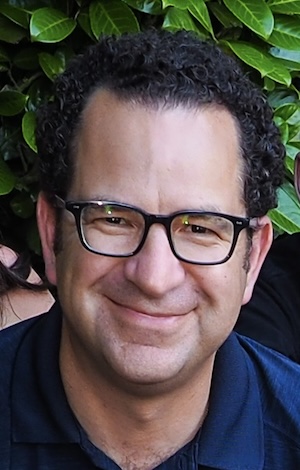
Stand Up for Mental Health founder David Granirer. (photo from smhcomedysociety.org)

Stand Up for Mental Health (SMH), a program started in Vancouver that teaches stand-up comedy to people with mental health issues as a form of therapy and to destigmatize mental illness, celebrated its 20th anniversary this spring. 

“It feels like such an accomplishment. Helping so many people has been the highlight of my life,” said David Granirer, the founder of SMH. “One thing I am really good at is making other people into stars, and I feel like I have done that a lot. Over the past 20 years, I have trained about 700 comics. So, that’s a lot of stars.

“I had no idea what I was doing when I started out, so I had no expectations about the program being successful or not. I could never have imagined this,” he said.

Granirer, a counselor by profession, as well as a stand-up comic, told the Independent that the two-decade journey has been unforgettable. “Everything stands out,” he said. “Every show, every comic I have ever trained, every laugh we have gotten.”

When considering some of the more memorable bits over the years, he recalled writing a mental health version of the Beatles song “While My Guitar Gently Weeps.” In Granirer’s rendition, the guitar has dizziness, dry mouth and is too depressed to get out of bed.

Granirer, who is open about his own struggles with mental illness, has trained groups in more than 50 cities, in Canada, the United States and Australia, in partnership with various mental health organizations. He plans to continue the program and run it in more cities in the coming years.

The idea for SMH originated from a course Granirer has been teaching at Langara College since 1998 called Stand-Up Comedy Clinic. Occasionally, he would see people have life-changing experiences by getting on stage and using comedy to tell a club full of people who they were.

“One woman had a fear of flying and told me that the day after our event she had to get on a plane and she said, ‘My fear was gone. I felt like once I’d done stand-up I could do anything,’” Granirer said. “And I thought, wouldn’t it be amazing to be able to give this experience to people who wanted to do comedy but who also wanted to change their lives? And since I work in mental health and I also have a mental illness, I thought that would be the perfect place to start.”

For Filomena Black, a graduate of the course, SMH has been a lifeline. An introvert by nature, she said she has been able to be more comfortable around people.

“I’ve lost my self-conscious focus and become more engaged in enjoying other people’s company. I’m now looking forward to successfully meeting challenges in all aspects of my life rather than avoiding them,” Black said.

Asked to tell one of the jokes in her repertoire, Black responded, “I used to run away from home a lot, but my kids always found me.”

Another SMH graduate, April Soon, also speaks highly of the program, lauding Granirer for shining a light on what people with mental health issues can do and not letting finances be a barrier to participation.

Soon, a veteran of public speaking through Toastmasters, did not find standing up before a crowd as intimidating as others might have and, these days, she not only performs at SMH gigs but at other venues around Vancouver.

“When bad things happen to me now, I wonder how I can use it as material,” said Soon. “SMH has helped reframe my thinking and provided good resilience training.”

On a lighter note, she added, “Being involved with SMH has exposed me to many other mental illnesses I want to try out.”

Kevin Scow similarly expresses his gratitude, saying the program has given him his voice and was vital to his recovery.

“This came to me at exactly the right time,” he said. “Instead of seeming strange … now they know I am strange … and they love me all the more for it. Thanks to David and my fellow alumni for nurturing my voice and helping with making it funny. My First Nations side says thanks.”

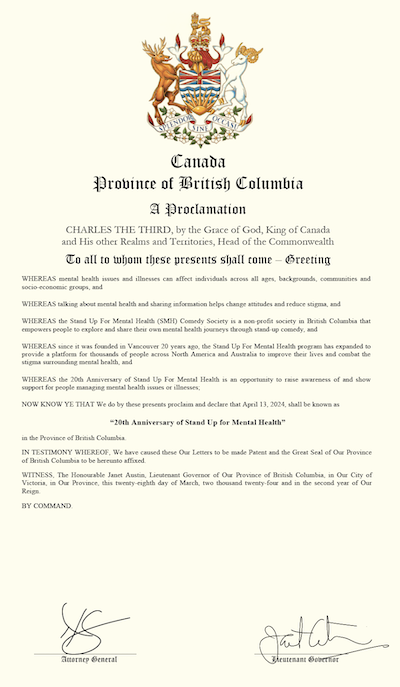
image - SMH’s 20th anniversary was recognized last month with a proclamation from the Province of British Columbia declaring April 13 as Stand-Up for Mental Health Day
SMH’s 20th anniversary was recognized last month with a proclamation from the Province of British Columbia declaring April 13 as Stand-Up for Mental Health Day.

SMH’s 20th anniversary was recognized last month with a proclamation from the Province of British Columbia declaring April 13 as Stand-Up for Mental Health Day. The proclamation reads, in part, that SMH provides a program for thousands of people “to improve their lives and combat the stigma surrounding mental health and … is an opportunity to raise awareness of and show support for people managing mental health issues or illnesses.”

Since 2004, Granirer and his comics have performed more than 500 shows for mental health organizations, government departments, corporations, universities, correctional facilities and the military. Granirer also gives “laughter in the workplace presentations” to organizations across North America, helping them use humour to lower stress, improve wellness and cope with change. Granirer, too, is the author of The Happy Neurotic: How Fear and Angst Can Lead to Happiness and Success.

SMH’s classes in Vancouver last for six months and students step on stage for two shows, a debut and a graduating performance. As Granirer says, “The comics go from knowing nothing about stand-up to killing it.”

Stand Up for Mental Health is currently recruiting for its next class, which starts July 30. For more information, visit smhcomedysociety.org. 

Sam Margolis has written for the Globe and Mail, the National Post, UPI and MSNBC.

Format ImagePosted on May 24, 2024May 23, 2024Author Sam MargolisCategories Performing ArtsTags April Soon, comedy, David Granirer, Filomena Black, health, Kevin Scow, mental health, milestones, performing arts, Stand Up for Mental Health
Keeping Jewish history alive

Keeping Jewish history alive

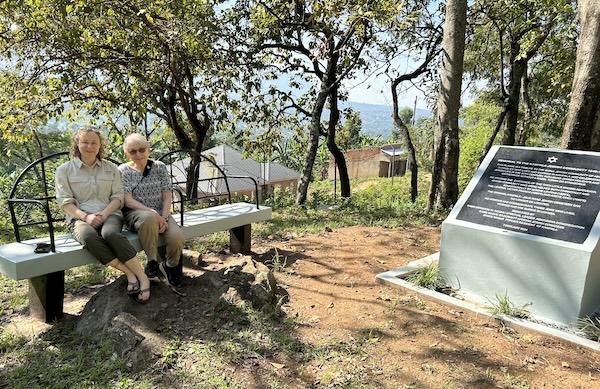
Janice Masur and her daughter, Liora Freedman, on March 3, after unveiling the memorial plaque in Nagoya village near Mbale, Uganda. (photo from Janice Masur)

I have just come back from Uganda, where my family used to live, in the Jewish community that existed from 1949 to 1961. My daughter, Liora, had returned 10 days earlier, as planned. I had to stay longer because my passport had been stolen two weeks previously, off my lap while sitting in a slow-moving car. Thankfully, after Liora involved my local member of Parliament, my temporary Canadian passport, processed in Nairobi, Kenya, finally arrived in Kampala, and I was able to leave. 

Although still essentially an agricultural economy, Uganda is touted to visitors as the most entrepreneurial country in Africa. Most people in the countryside have a small plot to grow their own food and sell the surplus. Large-scale plantations of sugar cane, tea, coffee and bananas are grown for export. The Pearl of Africa is rich in mineral deposits and China is beginning to drill for oil on the edge of Murchison Falls National Park.

I could not find my way around Kampala anymore. It used to be a self-contained town situated over seven hills. Now it sprawls and spreads in all directions with Ugandan street names I can barely pronounce. My old house has a high fence and a guard at the gate, with a gun slung across his shoulder, who wouldn’t let us enter. I was charmed to find the same small five-petaled purple flowers floating down like tiny propellers, strewn on the driveway just as they had done in my childhood. Across the rutted road, there was a new modern hotel instead of modest houses.

We drove up Kibuli Hill to see Kibuli Mosque. In my day, the mosque was a friendly looking place of worship. I was shocked to see how fortress-like it had become, painted grey instead of white, with the words “None shall be worshipped but Allah. Muhammad is his prophet.”

I tried to find my bearings on Tank Hill – named for the three extremely large round water tanks in the neighbourhood – where we had once lived but couldn’t. Instead of being given help, I was told not to take photos, or I might be thought to be spying on an army unit. Important ministers travel in cars with armed guards seated outside of the cars facing sideways, guns at the ready.

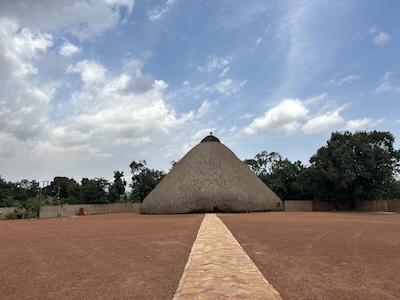
photo - Kasubi Tombs on the Hoima Road, Kampala, Uganda
Kasubi Tombs on the Hoima Road, Kampala, Uganda. (photo from Janice Masur)

I visited the Kasubi Tombs, where the kabakas, or kings, have been buried since pre-Christian times. I had never known about this sacred UNESCO site when I lived in Uganda. A steep thatched roof, reaching almost to the ground covered intricate woven designs in the inner ceiling of one of the tombs. It was my absolute luck to have Prince Joseph as my tour guide. When I showed him a photograph, he told me proudly that he was the grandson of Edward, the brother of the kabaka, Mutesa II or Freddy, who was one of the two Ugandan men in the picture.

My purpose for traveling to Uganda was to unveil two memorial plaques for my Jewish community, which had been there from 1949 to 1961. None of the community infrastructure exists today, not even the cemetery, now submerged under real estate. 

We placed a plaque in the Nagoya village near Mbale, where the Abayudaya, who converted to Judaism in 1921, live. Conservative Rabbi Gershom Sizomu and his wife, Tziporah, and others in the community were so welcoming and warm, helpful and supportive. We had a wonderful Shabbat evening, with lots of music and drumming, and Shabbat lunch under two large mango trees, with stunning views of Mount Elgon.

On Sunday, the whole community was invited to the unveiling of the plaque. We ambled down to a lower flat piece of land after morning minyan in the synagogue. There were speeches by Rabbi Sizomu and by Rabbi Netanel Kaszovitz, a young Orthodox rabbi visiting from Nairobi, who is responsible for administering to all the Orthodox Jewish communities in East and West Africa. The plaque glowed in the dappled sunlight. Two newly planted mango trees and two benches were nearby, offering enough room for a minyan, at Rabbi Sizomu’s request. The white lettering on the black granite looked impressive; beautifully supervised by Ariel Okiror Eyal.

photo - Rabbi Gershom Sizumo and Janice Masur with the Kampala plaque that will be held in storage
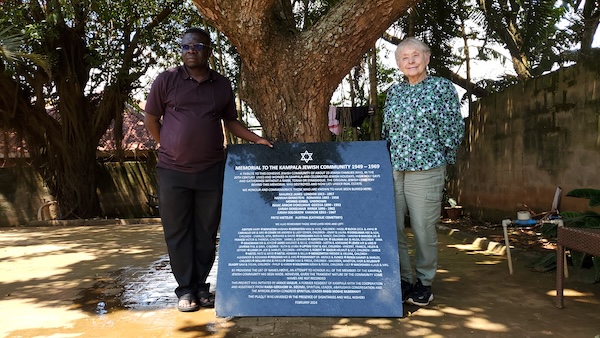
Rabbi Gershom Sizumo and Janice Masur with the Kampala plaque that will be held in storage. (photo from Janice Masur)

I experienced all sorts of conflicting emotions, as you might imagine. At long last a plaque to commemorate the help that my Uganda Jewish community had given the Abayudaya last century was installed. Nothing had marked the presence of the once-vibrant, secular, 23-family Jewish community, which functioned without a rabbi, a Torah or a synagogue. Who would have guessed that, in 2024, a Conservative and three Orthodox Black Jewish communities would exist, interspersed with Muslim villages?

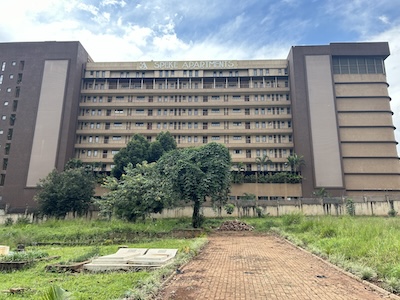
As for the other plaque I hoped to place, it was for the Jews who were buried more than 60 years ago in the Jewish cemetery just off the Kampala-Jinja Expressway, abutting the Christian cemetery. It is not common knowledge that the Jewish cemetery here had been destroyed and Speke Apartments, built by Dr. Sudhir Ruparelia, lies on top of where it had been. After many months of trying to contact Ruparelia I finally succeeded while in Kampala. In reply to my request to place a plaque somewhere in the vicinity of the apartments, in a discreet corner or on a less important wall, he said “No! None.”

photo - Speke Apartments in Kampala, which is built alongside an unkempt Christian cemetery and on top of the Jewish cemetery
Speke Apartments in Kampala, which is built alongside an unkempt Christian cemetery and on top of the Jewish cemetery. (photo from Janice Masur)

Perhaps I could mount the plaque at the edge of the unkempt Christian cemetery? It requires a Ugandan minister’s permission to approve a location near the 1972 Entebbe Raid plaque at the difficult-to-access old Entebbe Airport. Maybe at the Uganda Museum? The garden of the Chabad compound was also considered. Unfortunately, none of these placements have materialized.

I traveled to Uganda to place two memorial plaques, but my mission was not fully accomplished, and the second plaque lies in storage with Rabbi Sizomu. The Chabad Rabbi in Kampala, Moshe Raskin, said he would try to place it somewhere, perhaps in the future grounds of the new plot of land they will buy for Chabad, because Rabbi Moshe says Chabad is in Kampala to stay.

That I couldn’t find a place to mount the second plaque greatly saddened me. In many parts of the world, history is important and physical spaces or buildings are repurposed and feature plaques to show that a mikvah is buried here or a synagogue was once there. Today, few Ugandans know their local history, including that former governor (1952-1957) Sir Andrew Cohen was a British Jew. He was the first governor not to plunder Uganda’s wealth and he encouraged education and self-rule.

Now it is my task to contact my East African friends and perhaps schools and associations because Albert Kasozi, executive director of Buganda Heritage and Tourism – to whom Prince Joseph introduced me while we drank African tea at my hotel – would like as much 19th-century Bugandan history collected as possible for a new museum that has just been built in Kampala and will be formally opened soon. The banner exhibit I created, Shalom Uganda, will find a home in this new museum and I am very happy about the prospect. And the Kampala memorial plaque? To be determined…. 

Janice Masur is a Vancouver author and speaker. Her book, Shalom Uganda: A Jewish Community on the Equator, tells her story of growing up in the bygone Ashkenazi Jewish community of Kampala from 1949 to 1961.

Format ImagePosted on May 24, 2024May 23, 2024Author Janice MasurCategories WorldTags commemoration, family, history, Kampala, memorial, Uganda
Community milestones … Labowitz, Lederman, Schwartz & Lipovetsky

Community milestones … Labowitz, Lederman, Schwartz & Lipovetsky

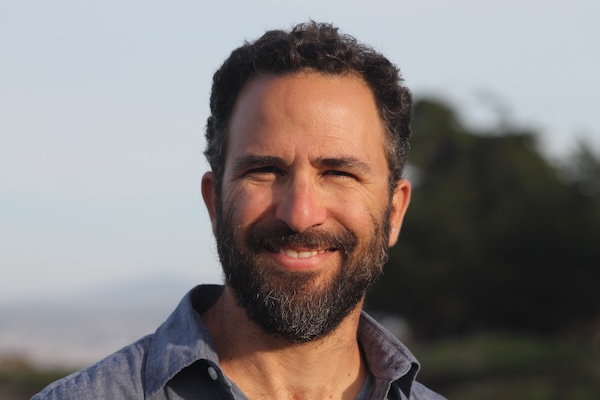
Rabbi Arik Labowitz (photo from Or Shalom)

Rabbi Arik Labowitz will step forward as Or Shalom’s rabbi when Rabbi Hannah Dresner retires.

Rabbi Arik is presently serving as the congregation’s half-time assistant rabbi and has signed a two-year contract as full-time rabbi, beginning Nov. 1. Rabbi Hannah’s partnership with Rabbi Arik will facilitate a smooth transition of leadership as Or Shalom navigates renovating their building while maintaining the congregation’s vibrancy.

The synagogue has already enjoyed Rabbi Arik’s breadth of Torah learning, the depth of his davening and meditative offerings, his musicality, his sensitive pastoral manner, his delight in children, his commitment to intergenerational programming and the new enrichment he brings, focusing on the spirituality of the congregation’s Cascadian outdoors. 

As Jewish Renewal’s oldest synagogue, it is meaningful that Rabbi Arik is a second-generation Renewal rabbi and that his presence ties the congregation back to the rabbis who raised and schooled him, including Reb Zalman Schachter-Shalomi and Reb Shlomo Carlebach. Born into a legacy of Jewish Renewal, with parents Rabbi Phil Labowitz and the late Rabbi Shoni Labowitz z”l, Arik’s formative years were enriched by learning from Reb Zalman and his early students during weekend retreats at his family’s South Florida home.

Eager to delve deeper into his spiritual path, Arik journeyed to Israel to immerse himself in traditional life and studies, spending transformative years at Yeshivat Machon Meir and Darche Noam/Shapells in Jerusalem from 1995 to 1997. Returning to North America, he continued his studies at the Graduate Theological Union in Berkeley, California, embodying a commitment to a diverse and enriched understanding of Jewish tradition.

Over the past two decades, Rabbi Arik has played pivotal roles in various Jewish leadership capacities. From 2007 to 2021, he served as the spiritual leader of Congregation Eitz Or, and as a regular visiting leader for several communities along the West Coast.

Rabbi Arik, along with his wife, Aliza, and their two sons, Judah and Noah, recently relocated to Vancouver, drawn by the desire to be closer to family as well as the beauty of the water and mountains.

* * *

photo - Marsha Lederman, winner of this year’s Max Wyman Award for Critical Writing
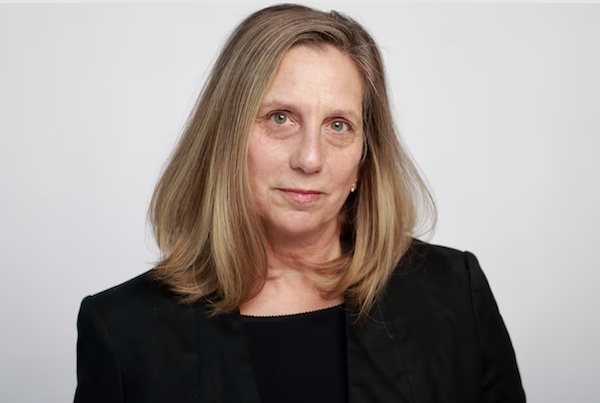
Marsha Lederman, winner of this year’s Max Wyman Award for Critical Writing. (photo from Max Wyman Award)

Arts and culture critic and commentator Marsha Lederman is the winner of this year’s Max Wyman Award for Critical Writing.

The annual award celebrates critical commentary on the visual, performing and literary arts in the province of British Columbia. The winner receives a prize of $5,000 and a gold and emerald pin designed by Vancouver artist Robert Chaplin. A mentee, named by the laureate, receives a $1,000 prize. This year’s mentee is Ming Wong, an emerging writer and illustrator.

The award was established in 2017 by philanthropist Yosef Wosk to honour the career and lifetime contributions of the Vancouver author, arts critic and commentator Max Wyman. It recognizes writers who have amassed a significant body of work. Eligible subjects of criticism include the visual arts, architecture and design, theatre, literature, dance, music, film and television, as well as more general cultural commentary. 

Lederman is an award-winning journalist and author. She has been with the Globe and Mail since 2007. For 15 years, she served as its Western arts correspondent, covering visual art, theatre, music, dance, books and publishing, film and architecture. In 2022, she became a full-time columnist for the newspaper, but continues to write about arts and culture. Her memoir Kiss the Red Stairs: The Holocaust, Once Removed, was published by McClelland & Stewart in 2022. It was a national bestseller and last year won the Western Canada Jewish Book Award for biography or memoir. She has won several journalism awards, including the 2019 National Newspaper Award for Arts and Entertainment, and the inaugural Webster Award for Arts and Culture Reporting in 2023. Before joining the Globe, Lederman held a variety of positions with CBC Radio, including national arts reporter. Born and raised in Toronto, she has lived in East Vancouver since 2007.

“Marsha Lederman’s writings over the years have provided a consistent and powerful demonstration of what she has called ‘good journalism’s power to inform, guide and potentially change the world’ – precisely in line with the aims of this award, which seeks to honour informed and compelling writing that stimulates critical thinking and demonstrates the value of creative commentary in our understanding of the world around us,” said Wosk. “I am delighted that she has been chosen as this year’s laureate.” 

The jury citation reads: “Marsha Lederman has made significant contributions to the field of journalism and literature through her extensive writings on social issues seen through the lens of arts and culture and social justice. The jury is unanimous in its appreciation of her ability to engage and inspire her readers, through lively and accessible writing that opens eyes and minds to fresh insights and creative thinking.”

photo - Ming Wong is this year’s mentee
Ming Wong is this year’s mentee. (photo from Max Wyman Award)

Wong is an art director, graphic designer and journalist at the Globe and Mail, where she produces and edits visually-driven stories for print, online, social and beyond. Her design work has been recognized by the Society of News Design and the Digital Publishing Awards. Born in Hong Kong and raised in Burnaby, she currently lives in Vancouver.

“I began working with Ming Wong as a mentor in 2022,” said Lederman. “She was particularly interested in writing about pop culture. And she has been fantastic, showing enormous creativity, drive and dedication as a writer. She is curious and smart, and writes interesting, intelligent and highly readable pieces about popular culture from her millennial perch. I can’t wait to read more from Ming over the years.”

Previous winners of the Wyman award are critic and educator Jerry Wasserman; Dorothy Woodend, arts editor of the Tyee; freelance art critic Robin Laurence; and author, critic and former University of British Columbia gallery director Scott Watson. Previous mentee award winners are Paloma Pacheco and Angie Rico.

* * *

photo - Ellen Schwartz’s Galena Bay Odyssey has won a 2024 Historical Writing Award
Ellen Schwartz’s Galena Bay Odyssey has won a 2024 Historical Writing Award (photo by William Schwartz)

Galena Bay Odyssey: Reflections of a Hippie Homesteader by Ellen Schwartz (Heritage House, 2023) has received a 2024 Historical Writing Award, presented by the British Columbia Historical Federation.

On May 4, the recipients were announced and acknowledged at the BC Historical Federation annual conference and awards dinner, where author Ellen Schwartz was in attendance to receive the honour.

image - Galena Bay Odyssey book coverGalena Bay Odyssey traces Ellen’s journey from a born-and-raised Jewish urbanite from New York who was terrified of the woods to a self-determined homesteader living on a communal farm in the Kootenays. Throughout the memoir, Ellen reflects on what her homesteader experience taught her about living more fully, honestly and ecologically. (For a review, see jewishindependent.ca/a-hippie-homesteader-in-b-c.)

Schwartz is an award-winning author of more than 18 books for children. In addition to writing books, she works as a corporate writer and editor and as a freelance magazine writer. She and her husband live in Burnaby.

* * *

The Arts Club Theatre Company has commissioned six new scripts as part of their Silver Commissions program, celebrating the company’s 60th anniversary. Founded in 2006 to commemorate the 25th anniversary of the first world première of a Canadian play at the Arts Club, the Silver Commissions program is designed to foster the creation of new Canadian scripts. Through this initiative, the Arts Club has commissioned, developed and produced 20 new plays.

The 2024/25 Silver Commissions includes Beware the Glunkus: A Christmas Musical, by Ben Elliott and Jewish community member Anton Lipovetsky. The other commissions are An Enemy of the People by Colleen Murphy, Fan Tan Alley by Jovanni Sy, Florida Social by Bronwyn Carradine, Little Darling by Amy Lee Lavoie and Omari Newton, and Murder on the Pacific Spirit Express by Frances Koncan.

The story of the Glunkus is a legend that Joe’s dad used to tell him as a kid about a mischievous gnome that hates Christmas. Once a heartfelt artist, Joe now exclusively makes corporate jingles and generic reality TV soundtracks. But when Joe’s niece discovers his unproduced musical in a drawer and stages a reading with his neighbours in the living room, Joe’s distaste for the holiday spirit goes big – and he starts to transform into a Glunkus (complete with pointy ears and an elf-like voice). With the help of Bella and his dad, he must open his heart before it’s too late!  

Elliott is an award-winning multidisciplinary artist living in Vancouver. When not working in the theatre, he writes, records and performs his own music, animates his own music videos and composes for film, TV and radio. 

Lipovetsky is a songwriter, actor, musical director, sound designer and educator based in Vancouver. He has performed on stages nationwide and his original musicals have been shortlisted three times for a Playwrights Guild of Canada Tom Hendry Award.

Together, Elliott and Lipovetsky have written the musicals The Park (with Hannah Johnson) and The Best Laid Plans (with Vern Thiessen).

Format ImagePosted on May 24, 2024May 23, 2024Author Community members/organizationsCategories LocalTags Anton Lipovetsky, Arik Labowitz, Arts Club Theatre, Ben Elliott, Beware the Glunkus, Ellen Schwartz, Galena Bay Odyssey, Hannah Dresner, Historical Writing Award, Marsha Lederman, Max Wyman Award, Ming Wong, Or Shalom, Silver Commissions

Posts pagination

Previous page Page 1 … Page 86 Page 87 Page 88 … Page 667 Next page
Proudly powered by WordPress