Skip to content
  • Home
  • Subscribe / donate
  • Events calendar
  • News
    • Local
    • National
    • Israel
    • World
    • עניין בחדשות
      A roundup of news in Canada and further afield, in Hebrew.
  • Opinion
    • From the JI
    • Op-Ed
  • Arts & Culture
    • Performing Arts
    • Music
    • Books
    • Visual Arts
    • TV & Film
  • Life
    • Celebrating the Holidays
    • Travel
    • The Daily Snooze
      Cartoons by Jacob Samuel
    • Mystery Photo
      Help the JI and JMABC fill in the gaps in our archives.
  • Community Links
    • Organizations, Etc.
    • Other News Sources & Blogs
    • Business Directory
  • FAQ
  • JI Chai Celebration
  • JI@88! video

Recent Posts

  • המלחמות של נתניהו וטראמפ
  • Zionism wins big in Vegas
  • Different but connected
  • Survival not passive
  • Musical celebration of Israel
  • Shoppe celebrates 25 years
  • Human “book” event
  • Reclaiming Jewish stories
  • Bema presents Perseverance
  • CSS honours Bellas z”l
  • Sheba Promise here May 7
  • Reflections from Be’eri
  • New law a desecration
  • Resilient joy in tough times
  • Rescue dog brings joy
  • Art chosen for new museum
  • Reminder of hope, resilience
  • The national food of Israel?
  • Story of Israel’s north
  • Sheltering in train stations
  • Teach critical thinking
  • Learning to bridge divides
  • Supporting Iranian community
  • Art dismantles systems
  • Beth Tikvah celebrates 50th
  • What is Jewish music?
  • Celebrate joy of music
  • Women share experiences 
  • Raising funds for Survivors
  • Call for digital literacy
  • The hidden hand of hate
  • Tarot as spiritual ritual
  • Students create fancy meal
  • Encouraging young voices
  • Rose’s Angels delivers
  • Living life to its fullest

Archives

Follow @JewishIndie
image - The CJN - Visit Us Banner - 300x600 - 101625

Byline: Janice Masur

Panama City welcoming

Panama City welcoming

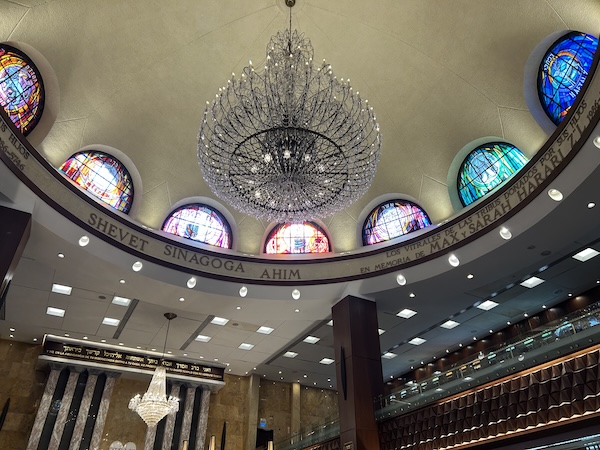
The ceiling of the Sephardic synagogue Shevet Ahim, which is located in the Bella Vista neighbourhood of Panama City. (photo by Janice Masur)

My solo trip to Panama City this past February had seemed so far away when I organized it, knowing I would require some respite from caregiving. I had a yen to experience the Miraflores and San Pedro shipping locks, but not on a cruise. I had listened to a talk from Qesher, a website about Jewish communities worldwide, highlighting Jewish life in Panama, so I gathered my courage to travel alone and booked my hotel and flights. And then my beloved husband died. 

This changed my reason for going and started me thinking, What would I do there by myself? How would I manage to converse in Spanish and make myself understood? Could I give a talk about my Ugandan vanished Jewish community? (See jewishindependent.ca/honouring-community.) Despite my concerns, I made the journey.
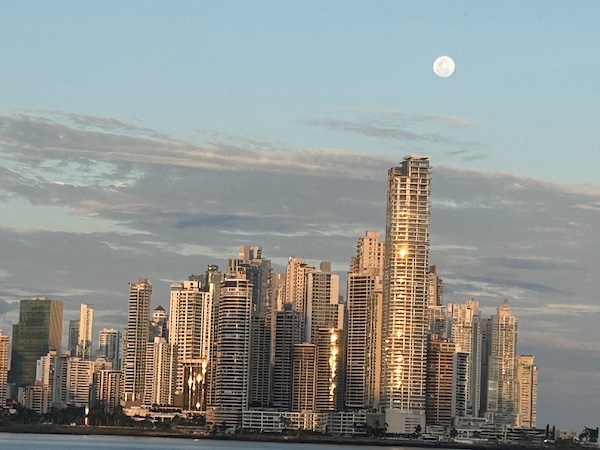
photo - Panama City was a great place to travel solo – and as a Jew
Panama City was a great place to travel solo – and as a Jew. (photo by Janice Masur)

I had a half-day tour with an excellent Jewish guide, Patricia, to see all four of the Orthodox synagogues, each one more beautiful, all situated within a small area of Panama City. 

There were all types of Jews staying in my hotel: a Dutch woman who only recently discovered her Jewish heritage, a fur-hatted Jewish man, and two Jewish Tunisian-born sisters, whose family history included having been ousted from their home in Tunis during the Second World War, their home commandeered to be a Nazi headquarters. 

At Kol Shearith Reform synagogue, I struggled with the Spanish and Hebrew prayer book, spellbound by my surroundings. The Sephardic tunes of the prayers made only a handful of them familiar to my ear. The Oneg Shabbat was delicious: fish ceviche and crème caramel, a childhood favourite, as well as several dishes new to me. We stood around the loaded tables and talked.

Jews started arriving in Panama in the 15th century and there are about 17,000 Jews in Panama, with most living in Panama City. Apparently, Panama is a “Jewish bubble,” with basically no antisemitism. I was told that there are many families from Vancouver soon moving there. “Why?” you may ask. Imagine 40 kosher restaurants, two very large kosher stores, apartment buildings housing only Jewish families, a Jewish support system from birth to death, Sephardic Shevet Ahim in the Bella Vista neighbourhood with offshoots in Punta Paitilla, Ashkenazi Beth El Synagogue, two Chabad synagogues, and the oldest synagogue, Kol Shearith.
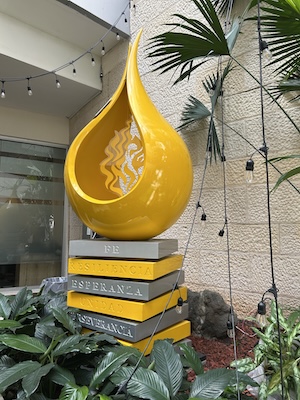
photo - “The Eternal Flame,” an Oct. 7 memorial at Beth El Synagogue in Panama City. The artists were Ilanit Schwartz and Michael Ostroviack
“The Eternal Flame,” an Oct. 7 memorial at Beth El Synagogue in Panama City. The artists were Ilanit Schwartz and Michael Ostroviack. The sculpture is composed of seven levels, each bearing a word: faith, resilience, hope, unity, perseverance, identity and strength. The flame is a reminder that there will always be light, even in the most difficult times. And, within the flame is the Shema Yisrael prayer. There is also the symbol of the “necklace of liberation,” associated not only with the promise to bring home the hostages, but the struggle for life and freedom for all human beings. (photo by Janice Masur)

Geographically, Panama City is situated on a narrow isthmus, making it an elongated city running east-west, mainly facing the Pacific Ocean. It is full of incredibly high and distinctive skyscrapers lining the long promenade.

The Old Town is being gentrified. Hotel La Compañía Casco Antiguo has a Spanish, French and American wing, each built in a different century. A large cathedral faces onto Plaza Herrera, and I saw my first modern-day monk. He was wearing a brown habit and many nuns were spilling out into the sunlit plaza. Brightly painted buildings and small shops catered to the tourists. The imposing Opera House faces the ocean.

I felt quite safe on my own and was touched by how a local family pointed out animals and kept an eye on me as we wandered around Metropolitan Natural Park, where I saw turtles, agoutis and my first ever armadillo.

I took myself to the botanical garden situated about 40 minutes outside the city. Along the route were American army barracks now being repurposed. At the garden, I enjoyed seeing flowers I had never seen before. A large red flower that only grows from a tree trunk; an orange flower whose seed pod is hard and round and slightly bigger than a tennis ball. The garden also showcased two- and three-toed sloths, plus several monkey species. In its far reaches, I saw a lone jaguar, who let out such sad, lonely notes with his rib cage working like an accordion that I could not bear to stay near his cage. I wondered about the information exhorting visitors to take care of the planet and not to shoot wild animals. Jaguars are on the at-risk list because of habitation loss and human interference. 

On the spur of the moment, I took a Black African walking tour of the old city. The young guide was very good. Highlights included some colourful historic wall paintings and an old church, which is now a Black African museum. We finished the tour at the San Felipe public market, where I had a large, freshly squeezed and most-welcome passion fruit drink in 32˚ C heat and then crashed on my bed for a nap. 
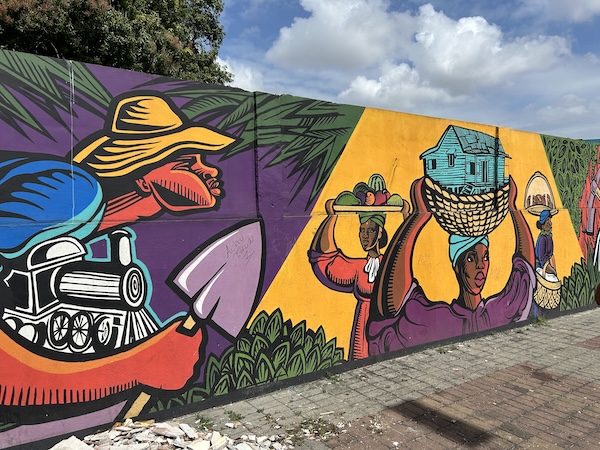
photo - A painted wall in Old Town, depicting Panamanian Black African history
A painted wall in Old Town, depicting Panamanian Black African history. (photo by Janice Masur)

The Biomuseo (biodiversity museum), designed by Frank Gehry, is well worth a visit, with a lovely seawall walk and an eco-friendly garden, where I rested and listened to the birds. I also took a private birding tour, which yielded some wonderful sightings. The couple of hours on my own watching close to 100 pelicans circling and diving for fish was spectacular.

And, of course, I took a tour on a small boat that passed through the Miraflores and San Pedro locks. It was fascinating to observe the speed with which large shipping vessels are lowered and raised through the original canal lock gates, which opened in 1914. Tugs and railway engines synchronize the adjustment of a ship in the lock with steel ropes to prevent it from damaging the canal walls – it’s a specialized job, and I was happy to learn there are some women pilots.

I was warmly welcomed in Panama City, and the Jewish hospitality was inclusive and friendly. It was a fun and easy holiday – it has given me the appetite for more solo adventures. 

Janice Masur is a Vancouver author and speaker. Her book, Shalom Uganda: A Jewish Community on the Equator, tells her story of growing up in the bygone Ashkenazi Jewish community of Kampala from 1949 to 1961.
Format ImagePosted on March 27, 2026March 26, 2026Author Janice MasurCategories TravelTags Ashkenazi Jews, history, Jewish history, Judaism, Panama, Panama City, Sephardic Jews, synagogues, travel
Keeping Jewish history alive

Keeping Jewish history alive

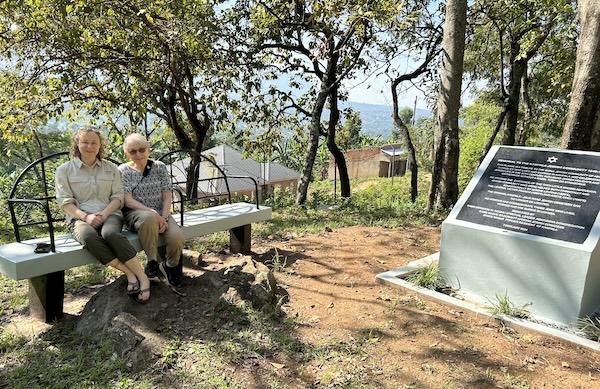
Janice Masur and her daughter, Liora Freedman, on March 3, after unveiling the memorial plaque in Nagoya village near Mbale, Uganda. (photo from Janice Masur)

I have just come back from Uganda, where my family used to live, in the Jewish community that existed from 1949 to 1961. My daughter, Liora, had returned 10 days earlier, as planned. I had to stay longer because my passport had been stolen two weeks previously, off my lap while sitting in a slow-moving car. Thankfully, after Liora involved my local member of Parliament, my temporary Canadian passport, processed in Nairobi, Kenya, finally arrived in Kampala, and I was able to leave. 

Although still essentially an agricultural economy, Uganda is touted to visitors as the most entrepreneurial country in Africa. Most people in the countryside have a small plot to grow their own food and sell the surplus. Large-scale plantations of sugar cane, tea, coffee and bananas are grown for export. The Pearl of Africa is rich in mineral deposits and China is beginning to drill for oil on the edge of Murchison Falls National Park.

I could not find my way around Kampala anymore. It used to be a self-contained town situated over seven hills. Now it sprawls and spreads in all directions with Ugandan street names I can barely pronounce. My old house has a high fence and a guard at the gate, with a gun slung across his shoulder, who wouldn’t let us enter. I was charmed to find the same small five-petaled purple flowers floating down like tiny propellers, strewn on the driveway just as they had done in my childhood. Across the rutted road, there was a new modern hotel instead of modest houses.

We drove up Kibuli Hill to see Kibuli Mosque. In my day, the mosque was a friendly looking place of worship. I was shocked to see how fortress-like it had become, painted grey instead of white, with the words “None shall be worshipped but Allah. Muhammad is his prophet.”

I tried to find my bearings on Tank Hill – named for the three extremely large round water tanks in the neighbourhood – where we had once lived but couldn’t. Instead of being given help, I was told not to take photos, or I might be thought to be spying on an army unit. Important ministers travel in cars with armed guards seated outside of the cars facing sideways, guns at the ready.

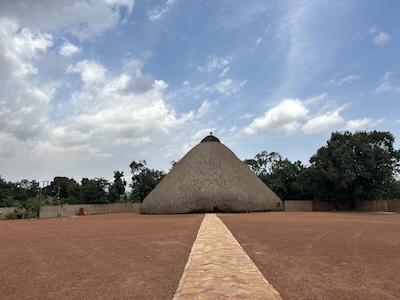
photo - Kasubi Tombs on the Hoima Road, Kampala, Uganda
Kasubi Tombs on the Hoima Road, Kampala, Uganda. (photo from Janice Masur)

I visited the Kasubi Tombs, where the kabakas, or kings, have been buried since pre-Christian times. I had never known about this sacred UNESCO site when I lived in Uganda. A steep thatched roof, reaching almost to the ground covered intricate woven designs in the inner ceiling of one of the tombs. It was my absolute luck to have Prince Joseph as my tour guide. When I showed him a photograph, he told me proudly that he was the grandson of Edward, the brother of the kabaka, Mutesa II or Freddy, who was one of the two Ugandan men in the picture.

My purpose for traveling to Uganda was to unveil two memorial plaques for my Jewish community, which had been there from 1949 to 1961. None of the community infrastructure exists today, not even the cemetery, now submerged under real estate. 

We placed a plaque in the Nagoya village near Mbale, where the Abayudaya, who converted to Judaism in 1921, live. Conservative Rabbi Gershom Sizomu and his wife, Tziporah, and others in the community were so welcoming and warm, helpful and supportive. We had a wonderful Shabbat evening, with lots of music and drumming, and Shabbat lunch under two large mango trees, with stunning views of Mount Elgon.

On Sunday, the whole community was invited to the unveiling of the plaque. We ambled down to a lower flat piece of land after morning minyan in the synagogue. There were speeches by Rabbi Sizomu and by Rabbi Netanel Kaszovitz, a young Orthodox rabbi visiting from Nairobi, who is responsible for administering to all the Orthodox Jewish communities in East and West Africa. The plaque glowed in the dappled sunlight. Two newly planted mango trees and two benches were nearby, offering enough room for a minyan, at Rabbi Sizomu’s request. The white lettering on the black granite looked impressive; beautifully supervised by Ariel Okiror Eyal.

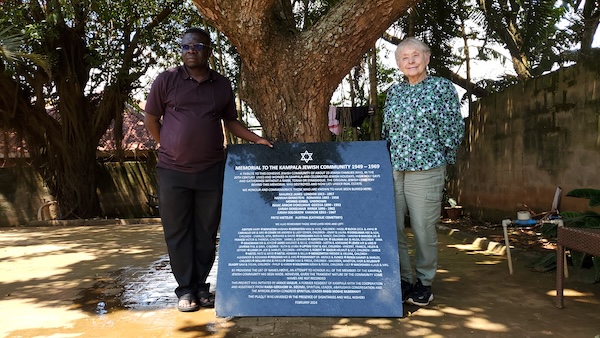
photo - Rabbi Gershom Sizumo and Janice Masur with the Kampala plaque that will be held in storage
Rabbi Gershom Sizumo and Janice Masur with the Kampala plaque that will be held in storage. (photo from Janice Masur)

I experienced all sorts of conflicting emotions, as you might imagine. At long last a plaque to commemorate the help that my Uganda Jewish community had given the Abayudaya last century was installed. Nothing had marked the presence of the once-vibrant, secular, 23-family Jewish community, which functioned without a rabbi, a Torah or a synagogue. Who would have guessed that, in 2024, a Conservative and three Orthodox Black Jewish communities would exist, interspersed with Muslim villages?

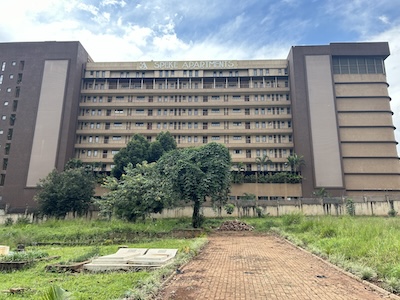
As for the other plaque I hoped to place, it was for the Jews who were buried more than 60 years ago in the Jewish cemetery just off the Kampala-Jinja Expressway, abutting the Christian cemetery. It is not common knowledge that the Jewish cemetery here had been destroyed and Speke Apartments, built by Dr. Sudhir Ruparelia, lies on top of where it had been. After many months of trying to contact Ruparelia I finally succeeded while in Kampala. In reply to my request to place a plaque somewhere in the vicinity of the apartments, in a discreet corner or on a less important wall, he said “No! None.”

photo - Speke Apartments in Kampala, which is built alongside an unkempt Christian cemetery and on top of the Jewish cemetery
Speke Apartments in Kampala, which is built alongside an unkempt Christian cemetery and on top of the Jewish cemetery. (photo from Janice Masur)

Perhaps I could mount the plaque at the edge of the unkempt Christian cemetery? It requires a Ugandan minister’s permission to approve a location near the 1972 Entebbe Raid plaque at the difficult-to-access old Entebbe Airport. Maybe at the Uganda Museum? The garden of the Chabad compound was also considered. Unfortunately, none of these placements have materialized.

I traveled to Uganda to place two memorial plaques, but my mission was not fully accomplished, and the second plaque lies in storage with Rabbi Sizomu. The Chabad Rabbi in Kampala, Moshe Raskin, said he would try to place it somewhere, perhaps in the future grounds of the new plot of land they will buy for Chabad, because Rabbi Moshe says Chabad is in Kampala to stay.

That I couldn’t find a place to mount the second plaque greatly saddened me. In many parts of the world, history is important and physical spaces or buildings are repurposed and feature plaques to show that a mikvah is buried here or a synagogue was once there. Today, few Ugandans know their local history, including that former governor (1952-1957) Sir Andrew Cohen was a British Jew. He was the first governor not to plunder Uganda’s wealth and he encouraged education and self-rule.

Now it is my task to contact my East African friends and perhaps schools and associations because Albert Kasozi, executive director of Buganda Heritage and Tourism – to whom Prince Joseph introduced me while we drank African tea at my hotel – would like as much 19th-century Bugandan history collected as possible for a new museum that has just been built in Kampala and will be formally opened soon. The banner exhibit I created, Shalom Uganda, will find a home in this new museum and I am very happy about the prospect. And the Kampala memorial plaque? To be determined…. 

Janice Masur is a Vancouver author and speaker. Her book, Shalom Uganda: A Jewish Community on the Equator, tells her story of growing up in the bygone Ashkenazi Jewish community of Kampala from 1949 to 1961.
Format ImagePosted on May 24, 2024May 23, 2024Author Janice MasurCategories WorldTags commemoration, family, history, Kampala, memorial, Uganda
Proudly powered by WordPress