Skip to content
  • Home
  • Subscribe / donate
  • Events calendar
  • News
    • Local
    • National
    • Israel
    • World
    • עניין בחדשות
      A roundup of news in Canada and further afield, in Hebrew.
  • Opinion
    • From the JI
    • Op-Ed
  • Arts & Culture
    • Performing Arts
    • Music
    • Books
    • Visual Arts
    • TV & Film
  • Life
    • Celebrating the Holidays
    • Travel
    • The Daily Snooze
      Cartoons by Jacob Samuel
    • Mystery Photo
      Help the JI and JMABC fill in the gaps in our archives.
  • Community Links
    • Organizations, Etc.
    • Other News Sources & Blogs
    • Business Directory
  • FAQ
  • JI Chai Celebration
  • JI@88! video

Recent Posts

  • Story of Israel’s north
  • Sheltering in train stations
  • Teach critical thinking
  • Learning to bridge divides
  • Supporting Iranian community
  • Art dismantles systems
  • Beth Tikvah celebrates 50th
  • What is Jewish music?
  • Celebrate joy of music
  • Women share experiences 
  • Raising funds for Survivors
  • Call for digital literacy
  • The hidden hand of hate
  • Tarot as spiritual ritual
  • Students create fancy meal
  • Encouraging young voices
  • Rose’s Angels delivers
  • Living life to its fullest
  • Drawing on his roots
  • Panama City welcoming
  • Pesach cleaning
  • On the wings of griffon vultures
  • Vast recipe & story collection
  • A word, please …
  • מארק קרני לא ממתין לטראמפ
  • On war and antisemitism
  • Jews shine in Canucks colours
  • Moment of opportunity
  • Shooting response
  • BC budget fails seniors
  • Ritual is what makes life holy
  • Dogs help war veterans live again
  • Remain vital and outspoken
  • An urgent play to see
  • Pop-up exhibit popular
  • An invite to join JWest

Archives

Follow @JewishIndie
image - The CJN - Visit Us Banner - 300x600 - 101625

Event raises spirit, support

photos - Richmond Jewish Day School and ORT Canada’s first-ever Pickleball & Pastrami fundraising event was held June 23
Richmond Jewish Day School and ORT Canada’s first-ever Pickleball & Pastrami fundraising event was held June 23. (photos from RJDS)

On June 23, the gymnasium of Richmond’s Belvedere Club was filled with the sounds of laughter, cheers and paddles in motion as Richmond Jewish Day School (RJDS), in partnership with ORT Canada, hosted its first-ever Pickleball & Pastrami fundraising event. What began as a simple idea to bring families and community members together through sport evolved into a high-energy, heartwarming event that raised critical funds to enhance student access to technology.

The event began at 9:30 a.m. as guests arrived and checked in before heading onto the eight indoor courts. Players scanned QR codes posted throughout the venue to view the game schedule, locate their assigned courts, and meet their doubles partners. For those not playing, there was plenty to enjoy, including student STEM displays created in partnership with ORT, a 50/50 raffle and a silent auction.

The auction raised more than $1,000, and many donors stepped up with pledges towards the purchase of a class set of iPads, which will allow for enriched learning experiences in coding, research, presentation and creative expression in both general and Judaic studies classrooms.

Following two hours of pickleball, guests gathered for a deli-style pastrami lunch. The room buzzed with conversation as people enjoyed food and connected with fellow parents.

Members of the organizing committee – including Marie Doduck, Jeff Topp, Mindy Zimmering, Beverly Pinsky, Mary Tobin, Jordan Sukkau and Sabrina Bhojani – spoke, expressing gratitude to attendees, sponsors and volunteers. Winners of the auction and 50/50 draw were announced, bringing a close to the formal portion of the day.

“This event truly captured everything RJDS stands for, including joyful learning, meaningful connection and community support,” said Bhojani, principal of RJDS. “We’re so grateful to everyone who helped make this day such a success, from our committee and volunteers to every person who donated, played or simply showed up in support of our students.”

The fundraiser was not only a financial success but also a reminder of what’s possible when community comes together around a shared purpose. RJDS is still accepting contributions toward its iPad initiative. Donations can be sent via etransfer to [email protected] with “iPad” in the message.

To learn more about RJDS and its programs, visit rjds.ca or follow the school on Facebook and Instagram. 

– Courtesy Richmond Jewish Day School

Format ImagePosted on July 11, 2025July 20, 2025Author Richmond Jewish Day SchoolCategories LocalTags education, fundraising, ORT Canada, Richmond Jewish Day School, RJDS, technology
BC celebrates Shavuot

BC celebrates Shavuot

Among the many Shavuot celebrations that took place around British Columbia was PJ Library’s Cheesy Shavuot in collaboration with Congregation Har El. (photo from PJ Library)

The BC Jewish community observed Shavuot June 1-3 in a variety of ways. Here are but a few examples. 

photo - Shavuot at Har El
Shavuot at Har El. (photo from PJ Library)

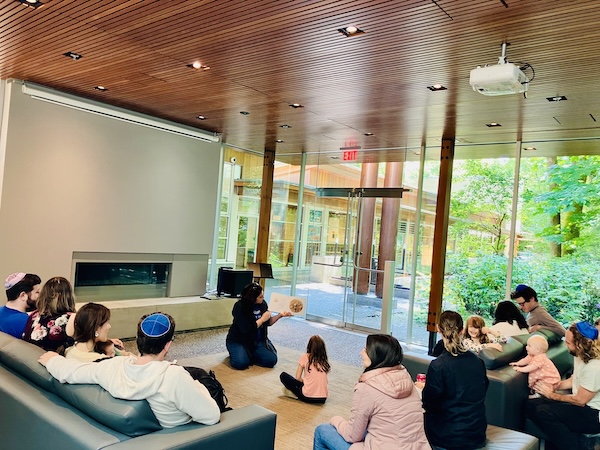
On the North Shore, families gathered at Congregation Har El for a celebration hosted by PJ Library and the Jewish Federation of Greater Vancouver. They enjoyed cheesecake, fresh fruit and plenty of laughter while participating in story time with Katia Fermon, PJ Library’s manager. The festivities continued with an interactive musical session led by Monika, which was filled with singing and activities for the kids.

More than 80 community members gathered in Langley for a farm-to-table dairy experience. Families celebrated the holiday with hands-on activities, dairy treats and moments of connection. From feeding and milking cows to churning butter, everyone embraced festive family fun while deepening their connection to the agricultural roots of Shavuot. 

The Shavuot celebration also made its way to Whistler, where Rabbi Paul Plotkin led a night of Torah, topped off with ice cream, cheesecake and spirited discussion. 

On Salt Spring Island, a Shabbat on the Beach and Shavuot celebration captured the unique spirit of Jewish life in remote communities. 

– Courtesy Jewish Federation of Greater Vancouver

Format ImagePosted on July 11, 2025July 10, 2025Author Jewish Federation of Greater VancouverCategories Celebrating the HolidaysTags Congregation Har El, Jewish Federation of Greater Vancouver, PJ Library, Shavuot
Ex-pats make good in Israel

Ex-pats make good in Israel

Former Montrealers Shmarya and Lainie Richler opened their first Muffin Boutique in Jerusalem in 2014; their second, in 2023. (photo by Adina Horwich)

My interview with Muffin Boutique owners Lainie and Shmarya Richler took place on the afternoon following the US airstrike on Fordow and other Iranian nuclear facilities. It was 2 o’clock on Sunday and the couple took time out from their breathlessly busy schedule to sit with me at their Talpiot location, minutes from Haas Promenade, aka Tayelet Armon Hanetziv, in Jerusalem.

I have been coming to this coffee shop almost every Tuesday afternoon for almost a year. As a participant in the Anglo Women’s group, which was initially supported by the local community centre, we are encouraged to meet and eat. Facilitated by Helena Flusfeder and Rachel Beenstock, we enjoy a hot or cold beverage, salad, bagel with a variety of spreads, a slice of cake or a muffin, good company and laughs. Another of the members is native Montrealer Paula Dubrow, Lainie’s mother.

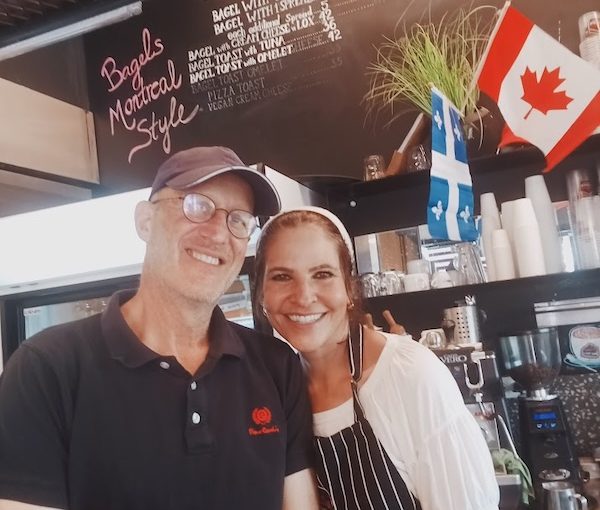
photo - A Canadian flag flies beside the province of Quebec’s fleur-de-lis
A Canadian flag flies beside the province of Quebec’s fleur-de-lis. (photo by Adina Horwich)

The café, which has indoor and outdoor seating for about 30 people, was busy, while the rest of the city felt deserted. I introduced myself, sharing my own Montreal experiences as an adolescent from 1969 to 1975. While the younger Richlers used to live in the very Jewish neighbourhoods of Côte Saint-Luc and adjacent Hampstead, I had lived in the suburbs, with a much smaller Jewish presence.

Shmarya hails from the large and prominent Richler family, most famous of whom was his first cousin, author Mordecai Richler. Shmarya’s mother, a survivor from Hungary, immigrated after the Second World War. Lainie’s paternal grandmother was English, as was my paternal grandfather.

We discussed their decision to make aliyah. It was always in the cards, they said, both having been raised in Modern Orthodox and Zionist homes. They studied at Jewish day schools and attended Tifereth Beth David Jerusalem Synagogue in Montreal. As teens, both were active in the Bnei Akiva youth movement, which is where they met and later started dating. Lainie studied and completed a master’s in psychology, while Shmarya majored in commerce. They married and had three children.

In 1995, they moved to Israel, living at first in Beit Shemesh, later and currently, in Efrat. Two more children were born here.

Lainie had intended to work in her field, but, as is wont to happen for immigrants to many countries, ran into the profession’s licensing body demands that, for her credentials to be recognized, she would need to take further studies. Since Lainie was trying to acclimatize to life’s challenges with a newborn, she preferred to shift her focus to that and raising the other children. 

She became involved in various exercise classes, giving them at community centres and other venues around Gush Etzion. Nutrition was a subject that had captured her interest, too, so she delved into that, taking a training course and becoming a certified alternative nutrition counselor.

Shmarya worked at first for a foreign company, then at a few Israeli startups, in high-tech, but the sector was continually growing and the jobs became increasingly demanding.

Needing to support a family of five kids, while coping with the everyday adjustments of aliyah, the couple began to wonder what to do. Their vision for retirement had been to run a B & B in the Galil or Golan. They thought, why not bring that idea forward, adapting it to their current situation.

Friends and family were skeptical, saying they were unrealistic, out of their depth; many a naysayer told them it would never work. But Lainie was determined to give it a go. She had always loved baking and cooking, informally making and selling muffins to friends and neighbours. She improved by testing many a recipe and soliciting feedback.

Shmarya was reluctant at first, but soon agreed. He took a  government-sponsored course at MATI (Jerusalem Business Development Centre), which trains and assists people interested in starting a small business. He was mentored by someone who took a serious interest and fully backed the couple’s plans, believing they could and would succeed.

photo - A Quebec licence plate – sporting the Quebecois nationalist slogan “Je me souviens” (“I remember”) – is prominently displayed behind the counter
A Quebec licence plate – sporting the Quebecois nationalist slogan “Je me souviens” (“I remember”) – is prominently displayed behind the counter. (photo by Adina Horwich)

Their first shop opened in 2014 on Jerusalem’s fashionable and ever-popular Ben Yehuda Street, a key menu component being Montreal-style bagels. And the store is replete with Canadiana. A Quebec licence plate – sporting the Quebecois nationalist slogan “Je me souviens” (“I remember”) – is prominently displayed behind the counter. It brings a half-smile to my face.

The second location, where I was conducting my interview, opened nearly two years ago. Scheduled to open Oct. 10, 2023, just days after the tragic events of Oct. 7, the opening was delayed – but only by a couple of weeks. When the doors opened on Oct. 23, the Richlers could barely keep up with the crowds. Locals warmly welcomed a chance to reaffirm their lives.

Ever since, this has been the local go-to café – the place is open 11 hours a day. Behind the register, a Canadian flag flies beside the province of Quebec’s fleur-de-lis.

photo - Both Muffin Boutiques prominently features the Richlers’ Canadian roots
Both Muffin Boutiques prominently features the Richlers’ Canadian roots. (photo by Adina Horwich)

Shmarya runs between the two branches, overseeing operations, keeping an eye on inventory, dealing with suppliers, expenses and all matters related to the running of the business.

Lainie is in charge of getting the daily, on-site baking up and running, with the help of a dedicated and hardworking staff. The restaurant serves coffee and breakfast from 8 a.m., while also accepting orders from their dairy menu for events, be they an office party or a family simcha. This aspect of the business comprises some 30% of its income. Everything is prepared fresh daily, using only natural ingredients, under Lainie’s expert watch and Badatz Mehadarin hechser (kosher certification).

Many employees have worked at both of the locations, most are native or near-native English speakers. This is vital, as the clientele is largely Anglo olim (immigrants). 

Every effort is made to maintain a family atmosphere – two of the Richlers’ children regularly work the counter – with friendly, personal service.

When you come to Jerusalem, do pay a visit to the Muffin Boutique, either at 16 Ben Yehuda or 13 Daniel Yanovsky, and have a nosh. Tell them Adina sent you! 

Adina Horwich was born in Israel to Canadian parents. In 1960, the family returned to Canada, first living in Halifax, then in a Montreal suburb. In 1975, at age 17, Horwich made aliyah, and has lived mostly in the Jerusalem area. She won a Rockower Award for journalistic excellence in covering Zionism, aliyah and Israel for her article “Immigration challenges.”

Format ImagePosted on July 11, 2025July 10, 2025Author Adina HorwichCategories IsraelTags aliyah, bakery, coffee, food, immigration, Israel, Jerusalem, Lainie Richler, Muffin Boutique, restaurants, Shmarya Richler, tourism

Love and learning 

People from many cultures show love via food and, of course, Jews are no exception. And what a palate our culture has, since we have lived in so many places. Two children’s books from Collective Book Studio, one new and one from recent years, highlight the flavourful diversity of Jewish culture, while teaching other valuable lessons.

image - Tali and the Timeless Time book coverComing out this August, Tali and the Timeless Time by Mira Z. Amiras, with illustrations by Chantelle and Burgen Thorne, shares the love of a granddaughter for her grandmother, and vice versa. Every Friday, Tali helps her nona get ready for Shabbat. Nona gives hugs, tells stories, still tries to get Tali to nap, even though she’s older now. When Nona dozes off, Tali explores in the backyard, cleans up the small fountain there, feeds the goldfish. When Nona awakes, it’s time to cook.

“We bake!” says Tali. “Today, it’s bourekas, yummy for eating. Nona makes them with filo (which it turns out is cheating). She says her nona let her ’cause it doesn’t need kneading.”

The week before, the pair made stuffed grape leaves – yaprakas, dolma or dolmades. Nona’s favourite dish is huevos (eggs) cooked in tomatoes with feta and arroz (rice). 

While Tali’s grandmother might get Tali’s name wrong, or forget a word or two, she has these recipes ingrained in her. 

“I’m having big thoughts,” says Tali, “but Nona’s not listening – she’s singing ‘chakchouka,’ it’s sometimes called, not just huevos, in the Holy Land, Tunisia and the land of the pharaohs. In Mexico, it’s a lot like huevos rancheros….” But Nona loses focus, she starts dancing with “her zills and her fans.” Tali finishes making dinner, the pair eat together, then dance some more.

In another role reversal, Tali tucks Nona into bed for the night, not sure she should leave her alone. Luckily, Tali and her family live nearby.

It’s a lovely book, “timeless time” being a beautiful description of a day spent with a loved one, doing this and that, in no particular order, sharing stories, mixing up past with present, making memories that will adapt over time.

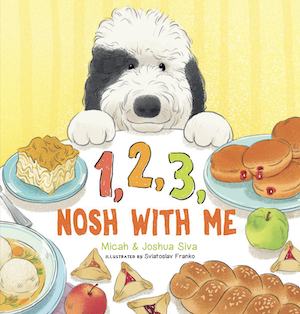
image - 1, 2, 3 Nosh with Me book coverFamily and food are also at the heart of 1, 2, 3 Nosh with Me, written by Micah and Joshua Siva, and illustrated by Sviatoslav Franko, which was published a couple of years ago. In it, the dog Buckwheat shows us the yummy food the family eats, starting with the “One golden challah, to celebrate Shabbat…” We work our way up to “Ten crispy latkes, served by candlelight.” In between, we have matzah balls, matzot, kugel, knishes, apples for a sweet new year, sufganiyot, bagels and hamantashen. (It’s not clear why the Hanukkah treats are separated, but that’s a quibble.)

Tali covers a few Sephardi staples and Buckwheat has the Ashkenazi favourites down. Between the two books, the breadth of world Jewry, as seen through just some of its traditional foods, is impressive. 

Posted on July 11, 2025July 17, 2025Author Cynthia RamsayCategories BooksTags aging, Ashkenazi, children's books, Collective Book Studio, counting, culture, education, food, generations, identity, learning, Sephardi, traditions

From the JI archives … yum

While the odd recipe or food-related article can be found in the Jewish Western Bulletin even before it became the Bulletin, regular food columns or special sections seemed to have become a part of the paper under Sam and Mona Kaplan, who owned the paper from 1960 to 1999. The Independent has carried on the tradition, with its annual Food & Drink issue, which you hold in your hand, and with the inclusion of recipes in our three holiday issues, Rosh Hashanah, Hanukkah and Passover. One thing that becomes apparent in flipping through the archives is that tastes change, and not every recipe, or recipe name­, withstands the test of time.

image - JI at 95 clippings related to food, part 1

image - JI at 95 clippings related to food, part 2

Posted on July 11, 2025July 10, 2025Author Cynthia RamsayCategories From the JITags food, history, Jewish Centre News, Jewish Western Bulletin, milestones
“Royal” mango avocado salsa

“Royal” mango avocado salsa

Mango salsa on a fish taco. The Accidental Balabusta enjoyed her husband Harvey’s salsa with quesadillas, marinated salmon and broccoli. (photo from jamdownfoodie.com)

Forgive me. I am late to the party. The one that happens on May 5. While Cinco de Mayo is not exactly what you’d call a national holiday in Canada, it is cause for celebration for many people. Note: I am including my husband Harvey. He loves anything Mexican, especially the food. Tamales – excelente! Enchiladas – muy bien! Chile relleno – la mejor! But the food that garners the most points is salsa. Any and all types.

In the spirit of all things Mexican, Harvey decided to make his famous mango avocado salsa. He was swayed in his decision by the fact that we had four-and-a-half very ripe avocados languishing in our fridge, just waiting to be transformed into something fabulous. Who am I to say no to such a perky side dish?

So, off Harvey went to Whole Paycheque to shop for the other key ingredients, which should have included a few limes, cilantro, one jalapeño, a red onion (optional) and a few mangoes. A couple hundred dollars later, Harvey arrives home. He waltzes in, all proud of himself, with blue organic tortilla chips, tequila, all the makings for quesadillas and some MANGOES. I capitalize this fruit because they feature front and centre in this Mexican-Canadian drama. These were not just any old mangoes, bought in bulk with the odd imperfection, scrawny in stature from early picking and a long journey north. These were capital M mangoes. Probably flown in on a private jet.

My first tip-off that these were indeed fruit royalty was their house. Yes, each organic mango came in its own dwelling. Not a mansion, but a respectable-sized condo, made of slatted wood, so the mango could breathe on its journey, nestled among shredded paper (probably also organic). Not only that, but each mango was encased in Styrofoam-like padding.

I took one look at the MANGOES and asked Harvey the fatal question (central to this drama): “Harvey, how much did you pay for each mango?” 

Harvey: Silence.

Me: “Seriously, what did they cost?”

Harvey: “They’re worth it.”

Me: “Spill it. Now.”

Harvey: “Look at the bill.” (Harvey slinks off into the living room.)

I feared what I might see. (Note: self-fulfilling prophecy.) After a few minutes of silence, Harvey returns.

Harvey: “I went up to the cashier at Whole Foods and she scanned the first mango. Then, in a hushed voice, so as not to potentially embarrass me, she asked if I knew how much it cost. Proudly, with head held high, I said I did. Then she asked me if I still wanted to buy it.”

At this point, I realized that my husband’s dignity and masculinity were on the line. There was no way he was going to decline buying the mangoes, as though admitting that he couldn’t afford them. He was damn well going to buy those mangoes, even if it meant getting a bank loan or selling a kidney. In true macho fashion, he told the cashier – with mock enthusiasm for these extravagantly priced fruit – “Of course I want them!”

Once he escorted his royal fruit (and other plebian ingredients) home, he entered the house looking like a Golden Retriever who’d just eaten his owner’s socks. Very, very sheepish. Yet somehow triumphant. Once I heard his long, drawn-out confession and his assurance that this would be the greatest salsa ever (do I hear echoes of Trump – “Make mangoes great again!”), what could I do? I might have threatened divorce if he ever did this again.

Without further ado, he got to work. And I hate to admit it, but it was the best darn mango avocado salsa I have ever scarfed down. And I’ve scarfed a lot of salsa in my day. Thank you, Harvey.

MANGO AVOCADO SALSA 

2 ripe avocados, peeled and diced into 1/4- to 1/2-inch pieces
2 cups ripe mango, pitted, peeled and diced into 1/4- to 1/2-inch pieces
2 tbsp lime juice (or lots more, if you prefer)
2 tbsp cilantro chopped (or more, if you really like cilantro)
1/2 jalapeño, finely chopped
2 tbsp red onion, finely chopped (optional)
1/4 tsp kosher salt

Other recipes for mango avocado salsa call for diced red pepper and grated lime zest. Use your tastebuds as your guide.

The salsa was the star of our belated Cinco de Mayo dinner, which also included quesadillas, marinated salmon and broccoli, none of which came in its own house. A few shots of tequila later and we were all dancing the samba, la bamba, the rumba and the danza de acatlaxques (just kidding about this last one … I have no idea what it is, but it sounds festive). I no longer cared what the mangoes cost. My anger had subsided (as had their capitalization) and Harvey was no longer in danger of being divorced. Our guests were cheerful and well-lubricated, and a good time was had by all.

Will I ever let Harvey buy mangoes again? Hell, no. But I do let him loose in Costco once a month. I suppose I run the risk of him potentially coming home with a kayak. Or an $8,000 massage chair. Or a $20,000 golf simulator. But he knows in his heart that I’d rip his tonsils out through his ears if he did that. Using common sense (and his fondness for his tonsils) as his guide, the most exorbitant thing he ever purchases at Costco are ribeye steaks. And I’m not going to argue with that! Also, how can I get mad at a man who comes home with a 48-pack of two-bite brownies and chocolate truffles, just because? I realized later that I had no business berating him about those diva mangoes. After all, I wasn’t paying for them. And I did reap the benefit. 

The takeaway is this: when hubby overspends on something, let it slide. Unless he comes home minus a kidney. Then you can start worrying. In case you’re wondering, each mango was $13.50. Enough said. 

Shelley Civkin, aka the Accidental Balabusta, is a happily retired librarian and communications officer. For 17 years, she wrote a weekly book review column for the Richmond Review. She’s currently a freelance writer and volunteer.

Format ImagePosted on July 11, 2025July 10, 2025Author Shelley CivkinCategories LifeTags Accidental Balabusta, cooking, Jewish Mexican food, recipes, salsa

מחכים למשיח

שירו הגאוני של של שלום חנוך, מחכים למשיח, שנכתב בשנת 1985, מתאים למה שקורה בישראל היום לא פחות מאז. כותב חנוך בשירו: “תאונה למי שואל ארציאלי הבן. תאונה למדינה עונה השוטר המסכן. הבורסה נפלה, אנשים קופצים מהגג, גם משיח קפץ והודיעו שהוא נהרג. הכל אבוד, בוכה עזרא דהן הקבלן. משיח בשמיים ואנחנו בלי הכסף כאן. וירדנה היפה ממלמלת זה לא ייתכן. משיח לא בא משיח גם לא מטלפן. דצמבר המר זעקו כותרות בעיתון. ושר האוצר נתן במבט ראיון. הציבור מטומטם ולכן הציבור משלם, מה שבא בקלות באותה הקלות יעלם. האזרח הקטן נאלץ לשלם בגדול ואותי מעניינת ירדנה יותר מהכל. הולך למילואים וסופר את הכסף שאין. משיח לא בא. משיח גם לא מטלפן”

חנוך הסביר בשעתו את הרקע לכתיבת מחכים למשיח: “כעסתי על הציבור שנתן לאנשים ברמה בלתי מתקבלת על הדעת להנהיג אותו. כעסתי על כך שהעריצו דמגוגים טיפשים, שכל מה שמעניין אותם זה הפוזה בטלוויזיה. נדבקו למישהו והפכו אותו לגדול בשעה שצריכים היו לדרוש ממנו מקסימום של אמינות, אמת, אחריות, רמה מוסרית ושכלית. חיינו במדינה מטורפת, והראשון שצריך היה ללכת הביתה היה בגין עצמו. אבל הוא הבין רק כשהגיע בנפילה הגדולה שלו לקרקע. אין בעיני דבר נורא יותר מאנשים שעושים החלטות קלות לגבי החיים שלנו בשם הדמוקרטיה. כעסתי ואני אכעס עוד הרבה על ההפסד הגדול של המלחמה. על כך אין כפרה ואין סליחה”

היום בישראל המצב עוד הרבה יותר חמור מהמצב לפני ארבעים שנה. מנהיג דיקטטור נוכל, בנימין נתניהו, יושב על כיסא כמלך כבר יותר משבעה עשרה שנה. נתניהו לא מתכוון ללכת הביתה ומתכנן להמשיך ולשלוט בישראל עוד שנים רבות. רבים ממתנגדיו טוענים כל העת שהנה הוא כבר הולך הביתה וכל פעם הם מתבדים מחדש. מדהים לדעת עד כמה בישראל הציבור מטומטם כפי שאומר חנוך במחכים למשיח, וממשיך לתת לנתניהו וחבריו המושחתים להמשיך ולנהל את ענייני ישראל, שהולכת ושוקעת. בעולם ישראל נחשבת כיום לאחת המדינות המבודדות השנואות ביותר. לא פלא שהאנטישמיות כלפי ישראלים ויהודים בעולם מגיעה לשיאים חדשים כל הזמן. כלפי פנים: מדינת ישראל מפורקת לחלוטין בין מחנה מתנגדי נתניהו לבין חבורת המעריצים העיוורים שלו. אין סיכוי לגשר בין הפערים שנוצרו והשנאה הפנימית עברה כבר מזמן את הגבול. נתניהו האחראי הראשי לפציול החברתי בישראל, כמו גם לבידוד של ישראל בעולם, לא יקח שום אחריות על מעשיו והפאשלות הגדולות שלו לאורך כל ימי שלטונו. כמו ראש ארגון פשע בעולם התחתון, נתניהו מעולם לא לקח אחריות על מעשיו שגרמו לישראל נזק קשה ביותר, שקשה להאמין שאפשר לתקנו

בשיחות שלי עם בני משפחה וחברים בישראל, הם אומרים לי כל העת כי מרבית העם שונא את נתניהו וימיו כראש ממשלה ספורים. כך הם אמרו לי מיד לאחר השבעה באוקטובר, כך אמרו לי שוב לקראת סוף שנה שעברה, ולאחר מכן לפני מספר חודשים בעת אישור התקציב החדש בכנסת. עכשיו הם טוענים כי בעת הזו נתניהו הולך הביתה. אז חלומות לחוד ומציאות לחוד

האופוזיציה לנתניהו וממשלתו הנוראית היא חלשה עד גיחוח והיא איננה מסוגלת לארגן את השורות, לאחד את כל המפלגות המתנגדות לו, לארגן הפגנות ואספות עם, להשבית את המשק ולהפעיל את כל מה שניתן כנגדו. המצב בישראל וקשה ולנתניהו לא אכפת כלל כל עוד הוא יושב על כיסא המלך

Posted on July 9, 2025July 4, 2025Author Roni RachmaniCategories עניין בחדשותTags Israel, Netanyahu, politics, Shalom Hanoch, Waiting for the Messiah, ישראל, מחכים למשיח, נתניהו, שלום חנוך
Arab Zionist recalls journey

Arab Zionist recalls journey

On June 12, Rawan Osman spoke with Daniel Koren, founder and executive director of Allied Voices for Israel, which brought her to the West Coast. (photo by Pat Johnson)

Rawan Osman, among the most visible Arab advocates contesting antisemitism and anti-Israel ideology, recently brought to Vancouver a bleak overview of hate ideologies across the Middle East and North Africa – but her prognosis is hopeful.

Osman is a Syrian-born, Lebanon-raised, German-based – and soon to be Israeli – accidental activist who shared her experience going from what she said is a characteristically antisemitic Arab into an “Arab Zionist.” She spoke at Temple Sholom June 12, in conversation with Daniel Koren, founder and executive director of Allied Voices for Israel, which brought her to the West Coast.

Osman took Islamic and then Jewish studies at Heidelberg University. After Oct. 7, 2023, she founded a social media channel called Arabs Ask, to combat antisemitism in the Arab world. She is writing a book about her relationship with Judaism and Israel, and is the narrator and central figure in the documentary film Tragic Awakening, about antisemitism after Oct. 7.

“My case is unusual,” she acknowledged. “There aren’t many people born in the Arab world who support Israel.”

She recounted the story of her first encounter with a Jew. She had moved to Strasbourg, France, and found herself living in the Jewish Quarter. She had assumed that the neighbourhood’s name was like the Jewish Quarter in Beirut or Damascus – an historical designation. When she went into a grocery store on her first day there, she stumbled into a kosher grocery and saw real-life Jews for the first time.

She had a panic attack, left her purchases and belongings behind and fled to her apartment. After she recovered and returned to collect her things, she had a life-altering experience.

She made an excuse that she had forgotten her wallet but she is certain the shopkeeper knew what had happened. He asked where she was from and how long she had been in town. He helped her with her groceries and behaved like a human being, not the monster she had been told was the way of the Jew.

“He allowed me to save face and, that day, without knowing it, that gentleman converted me from an enemy to an ally,” she said. “I realized it was the first time in my life that I was sharing the same space with a Jew, the enemy, and it was the first time in my life when I asked, why is the Jew my enemy?”

Osman’s father was Sunni from Damascus and her mother was Shia from the Beqaa Valley, which is the stronghold of Hezbollah.

“I grew up in Lebanon, attending a French Catholic school,” she said. But, negotiating between her family’s dual Muslim identities and Christians in Lebanon, she chose a middle path of atheism.

“They were secular, progressive, relaxed, laid-back,” she said of her family and the broader environment in which she was raised – with one exception. “The only thing everybody hated was Israel and the Jews and the Zionists.”

She said she employs these three terms – Israeli, Jewish and Zionist – interchangeably because that is how they are used in the Arab world.

“They say, I am anti-Zionist, not antisemitic. That’s a farce,” she said. “I grew up in that part of the world and I too believed [they were different things].” 

Studying abroad and having access to uncensored information in Europe was a privilege with which she was unaccustomed. The more she explored the history of Judaism and met and interacted with Jews, the more she rejected the antisemitism with which she was raised. Eventually, she moved back to the Middle East and decided to challenge the prevailing narrative.

“After living in the Middle East for awhile, I decided, OK, it’s hopeless,” she said. “I’m going to leave. I’m going to move to Europe. And I did.”

She chose Europe because she identified with Western values, she said, and because, as one person, “what can I change?”

She opted to mind her own business in Germany. Even so, she was alarmed by what she was seeing.

She viewed the notorious gang rapes that took place in Cologne on New Year’s Eve and the early hours of 2016 as a symptom of Arab misogyny imported to Europe. What was more jarring to her was seeing herself in the place of others perpetrating hate crimes. She watched a video of a young Arab man encountering a Jew in Berlin.

“He took off his belt and he was hitting the young Jew with the metal buckle on his head,” she recounted. “This was me. I was the civilized version … I wouldn’t hit a Jew. But I had a panic attack the first time I saw a Jew.”

She did not plan to become an activist. After Oct. 7, it just happened.

“I started speaking on social media and became an accidental activist and influencer,” she said. “I thought influencers made nail designs, baking and makeup.”

She is part of a small but notable group of Arabs who are speaking out against antisemitism and other regressive realities.

“We refuse to continue to raise our children and grandchildren in a world that tolerates what happened on Oct. 7,” she said. 

It is something she could not have undertaken if her extended family did not also live abroad, she said. To be known as an activist for Jews and Israel would endanger family in the Arab world, which means even many who live in the West remain silent, she said. But those who have the freedom to do so need to join her, she contended.

Osman receives private messages from Arabs and Iranians lauding what she does. She admires the courage of those who write to her from the Middle East. For those writing from Sydney or Toronto, she has strong advice.

“Those people who are living in the comfort of Toronto or Sydney tell me, I’m proud of you, I wish I could do what you’re doing,” said Osman. “Don’t be proud of me, darling. Do it. Do it. You might lose a friend or two but you will make a thousand more.”

Osman has chosen to convert to Judaism and is making aliyah this summer.

“The thing I love most about Judaism, what’s phenomenal, is that Judaism encourages your imagination. It encourages debate. Two Jews, three opinions. This is the talmudic tradition. It encourages challenging ideas.

“Islamic ideology is exactly the opposite,” she said.

When she decided to convert to Judaism, she got pushback – from Jews.

“Jews will tell me, you have to be a Muslim Arab ally,” she said, noting that some have told her she has a more powerful voice as an outsider. “You’re missing the point. Converting to Judaism is a privilege, my privilege. It’s not my dirty secret. It is time to say, I stand for that.… Your ancestors accepted that mission not because you’re special – you are the chosen people because you accepted that mission.”

Israel is not an easy place, she acknowledged, but the dichotomy of life in the Jewish state amazes her. The Israeli who pushes in front of her in queue and steps on her toes would, conversely, take a bullet for her, she said. 

“As soon as there is an alarm, a siren, they have each other’s back,” she said. “It’s unbelievable.”

Osman ultimately is hopeful. The new Syrian president, Ahmed al-Shara, is a jihadi terrorist turned – apparently – a suit-and-tie-wearing diplomat. Some doubt his sincerity. Osman believes that young Arabs who are drawn to extremism can see his transformation and believe there is an alternative path for them as well.

A billion Muslims are not going anywhere, she said. The only resolution to what she sees as a civilizational conflict is internal reform within Islam. This is already visible in the Abraham Accords – which she is certain that Syria will join – and the small number of activists like her speaking out.

Gabriela Rosenblum, director of education with Allied Voices for Israel, welcomed the audience and thanked Dr. Neil and Michelle Pollock of Pollock Clinics for sponsoring the event. Rabbi Carey Brown, associate rabbi of Temple Sholom, welcomed guests to the synagogue and led a prayer for the redemption of those held captive and a prayer for the soldiers of the Israel Defence Forces. 

Format ImagePosted on June 27, 2025June 25, 2025Author Pat JohnsonCategories LocalTags Allied Voices for Israel, anti-Judaism, Islam, Israel, Judaism, Rawan Osman
Bringing joy to people

Bringing joy to people

Ira Pettle, middle, with actors Dave Francis and Cedar Lynn Dobbin. (photo from Ira Pettle)

Laugh Out LIVE! will be hitting the road in the fall. On the list of cities and towns it will be visiting are Pemberton, Squamish, North Vancouver and Bowen Island, with classes on the North Shore coming this winter.

Known as a children’s entertainer for the last 25 years, Ira Pettle began producing Laugh Out LIVE! in December 2021 in Whistler with funny woman and partner, Rebecca Mason.

“Comedy has always been on my radar. Laughter is the best medicine and it lights me up to bring joy to others. Being raised on SNL, In Living Color, and a countless number of comedy films, TV shows, actors and the like, I feel like I’ve always known this was one of the paths for me,” Pettle recently told the Jewish Independent.

Currently, Laugh Out LIVE! brings stand-up, improv and sketch comedy shows to packed houses at various venues in Whistler, including the Maury Young Arts Centre, Rainbow Theatre, Whistler Conference Centre, Dusty’s Bar & BBQ, and the Garibaldi Lift Co. Bar & Grill (GLC). Pettle performs in all three shows. 

The Marquee Variety Show is devoted to a mix of different comedic acts and can involve improv, sketch, musical comedy, film and parody. The Improv Battle pits teams against each other weekly “to claim unscripted victory,” and Stand-Up Standoff is a monthly competition where the best comics win $500 in prize money. There are also opportunities for writers, theatre technicians, stage managers and filmmakers on the show’s website. 

Pettle began his improv and sketch career at the Second City Conservatory program in Toronto but was drawn to comedy from an early age.

“As a kid, I was always drawn to and fascinated by comedy. Watching The Carol Burnett Show, and SCTV (Second City Television) with John Candy, Eugene Levy, Andrea Martin, Catherine O’Hara, Rick Moranis … those were the most influential comedy shows for me as a young, aspiring performer,” said Pettle, who lists Jerry Seinfeld, Mel Brooks, Gene Wilder, Adam Sandler and Bob Einstein as the Jewish comics he has been most influenced by.

Pettle has a master’s of education and has taught improv, acting and music to thousands of kids, teens and adults. In 2022, his debut children’s album, A Little Bit, co-written with Juno Award-winning singer/songwriter Norman Foote, was nominated for children’s artist of the year at the 2023 Western Canadian Music Awards. His next record is slated for release this winter.

Known as “DJ Ira” throughout the Sea-to-Sky Corridor, Pettle is a sought-after family entertainer. As a key player in the BC performing arts scene, he was named the 2019 Champion of Arts and Culture at the Whistler Excellence Awards, with another nomination at the 2023 awards.

“I discovered very early in my life that I was a performer,” he said. “An entertainer. I remember as a kid, the joy I felt bringing a smile to someone or soliciting a laugh. In those early days, it was my coming to the dinner table on all fours, pretending I was an ape, making my mom giggle, or going to the Blue Jays baseball game when I was 14 with my buddies and pretending to fall down the stadium stairs, getting 500 people sitting in the stands to simultaneously gasp.”

Today, when he’s not entertaining children or performing comedy, Pettle leads a number of improv, stand-up comedy, public speaking and presentation workshops. He uses improvisation as a tool to “release tension, awaken joy and return to the present moment.”

Many of the performers on his improv stage started out taking classes with him. 

Pettle grew up in Toronto and says that learning about Judaism was a huge turning point in his life. 

“Having been raised Reform, and being the grandchild of a Holocaust survivor, I was always told how important my Jewish roots were,” he shared. “But, because my family’s religious practices were very surface level, I was confused and became deeply confronted by what I was told versus what I was doing in my daily life as a ‘Jew’ and, through a series of divine interventions, became committed, for the first time, to seeking out a deeper understanding of my Jewish roots.”

Pettle eventually found out about the yeshivah Ohr Somayach and studied with them in Israel.

“I felt ready (and passionately interested) in making a clear choice on whether to declare myself Jewish definitively and pursue/develop a more conscious connection to Judaism, or allow my Jewish roots to remain as is, or simply fall by the wayside/disappear. I needed to dive deep into the learning at the source.”

Pettle’s connection to Judaism was affirmed and, with a renewed and more solid understanding of his cultural roots and heritage, he remains, he said, “very honoured to be Jewish.”

To contact Pettle regarding his work as a kids entertainer, go to irapettle.com. For Laugh Out LIVE! inquiries, contact him via laughoutlive.com. 

Cassandra (Cass) Freeman is a Vancouver improviser and journalist.

Format ImagePosted on June 27, 2025June 25, 2025Author Cassandra FreemanCategories LocalTags children's music, comedy, DJ Ira, education, entertainment, improv, Ira Pettle, Judaism, Laugh Out LIVE!, stand-up

Doing “the dirty work”

Israel’s decades-long conflict with Iran is no longer a proxy war, but a real war. Israel has bombarded sites associated with Iran’s nuclear program – as has the United States – and assassinated top military officials and nuclear program scientists. Israel also has targeted installations of the Iranian Revolution Guard Corps, the branch of Iran’s military that reports directly to the supreme leader and protects the nation’s Islamic identity from internal and external threats. Iran has launched missiles at Israel, as well as at a US military base. As of press time, a US-brokered ceasefire appeared to be holding.

Ending Iran’s nuclear program, or, at a minimum, setting it back, is the objective of Israel’s military operation. Regime change – a situation in which the Islamist government of the ayatollahs is replaced by something presumably better – is on the lips of Israeli and American leaders. But, as tempting and positive as that might sound, the immediate mission is more specific and tangible. Some express hope that the debilitated Iranian regime may be subject to internal rebellion. We should remember, though, that the Iranian regime fought an eight-year war with Iran that cost a million lives and millions more injured. That conflict, which ended in an effective stalemate, suggests massive loss of life is not a barrier to the ayatollahs’ ideological objectives.

Western countries, Americans especially, have seen the dangers of becoming entrenched in catastrophic military affairs half a world away, with decades-long engagements in Iraq and Afghanistan in which the people of the region by some measures are now worse off than ever.

We all prefer diplomacy to war, of course, and the discourse in the lead-up to Israel’s strikes on Iranian sites was focused on whether a negotiated resolution was possible. For now, however, negotiation is off the table, although a weakened Iran with a disabled nuclear program would presumably be more amenable to talking.

The objective of preventing end-times religious fanatics like those of Iran’s government from obtaining nuclear weapons is something that most reasonable people can get behind. But “mission creep,” the potential for a limited military plan to expand into a long-term engagement, is one of many dangers stemming from the current situation. 

Underestimating the seriousness of the enemy is another threat. Neville Chamberlain, the British prime minister in 1939, notoriously negotiated with Hitler and his name has gone down in history as someone who, put mildly, badly misjudged the preference for negotiation over force.

There have been dramatically conflicting reports about how close Iran is – or was – to nuclear weapons. Reports that Iran was on the cusp of nuclear capability were the justification for Israel’s attacks. Other reports suggest they were further away than Israel alleged. Perhaps no one knows but the Iranian regime.

We wish for peace. We also wish for a world where those who threaten peace can be contained. These basic truths can seem contradictory in the short term. But the long-term wish for peace, indeed the very survival of the Jewish people to judge by the explicit genocidal expressions from the top leaders of Iran in recent decades, requires that the nuclear program they have been constructing must never be allowed to near completion.

Interestingly, many voices who have condemned Israel’s approach to the war in Gaza are far more amenable to their approach with Iran. Although some people certainly view the Iranian threat and the Hamas threat as two prongs in the same war, the world seems more likely to acknowledge the urgent danger posed by Iran than they do the threat by Hamas, which is, at this point, limited primarily to Israelis. A nuclear Iran is viewed, by people in the West, as a direct threat to their own well-being – and that has seemed to focus their minds and create a common cause with Israel in ways the battle with Hamas has not.

Self-interest is a powerful force. A few leaders – notably Germany’s Chancellor Friedrich Merz, who said Israel is doing “the dirty work” for “all of us” – have acknowledged that the fight against Hamas and Iran are parallel battles. Others seem determined to view them as largely separate, as though existential threats to Israel are neither as concerning nor as world-changing as the Iranian dangers.

This may be true, in terms of scope, especially now that Hamas is widely seen to be massively weakened. However, the larger reality, as expressed by the German leader, remains: Israel is the frontline in a war that affects us all. 

Posted on June 27, 2025June 25, 2025Author The Editorial BoardCategories From the JITags Iran, Israel, nuclear capability, politics, United States, war

Posts pagination

Previous page Page 1 … Page 32 Page 33 Page 34 … Page 662 Next page
Proudly powered by WordPress