Skip to content
  • Home
  • Subscribe / donate
  • Events calendar
  • News
    • Local
    • National
    • Israel
    • World
    • עניין בחדשות
      A roundup of news in Canada and further afield, in Hebrew.
  • Opinion
    • From the JI
    • Op-Ed
  • Arts & Culture
    • Performing Arts
    • Music
    • Books
    • Visual Arts
    • TV & Film
  • Life
    • Celebrating the Holidays
    • Travel
    • The Daily Snooze
      Cartoons by Jacob Samuel
    • Mystery Photo
      Help the JI and JMABC fill in the gaps in our archives.
  • Community Links
    • Organizations, Etc.
    • Other News Sources & Blogs
    • Business Directory
  • FAQ
  • JI Chai Celebration
  • JI@88! video

Recent Posts

  • New rabbi settles into post
  • A light for the nations
  • Killed for being Jewish 
  • The complexities of identity
  • Jews in time of trauma
  • What should governments do?
  • Annie will warm your heart
  • Best of the film fest online
  • Guitar Night at Massey
  • Partners in the telling of stories
  • Four Peretz pillars honoured
  • History as a foundation
  • Music can comfort us
  • New chapter for JFS
  • The value(s) of Jewish camp
  • Chance led to great decision
  • From the JI archives … camp
  • עשרים ואחת שנים להגעתי לונקובר
  • Eby touts government record
  • Keep lighting candles
  • Facing a complex situation
  • Unique interview show a hit
  • See Annie at Gateway
  • Explorations of light
  • Help with the legal aspects
  • Stories create impact
  • Different faiths gather
  • Advocating for girls’ rights
  • An oral song tradition
  • Genealogy tools and tips
  • Jew-hatred is centuries old
  • Aiding medical research
  • Connecting Jews to Judaism
  • Beacon of light in heart of city
  • Drag & Dreidel: A Queer Jewish Hanukkah Celebration
  • An emotional reunion

Archives

Follow @JewishIndie
image - The CJN - Visit Us Banner - 300x600 - 101625

Category: Arts & Culture

Forgotten music performed

Forgotten music performed

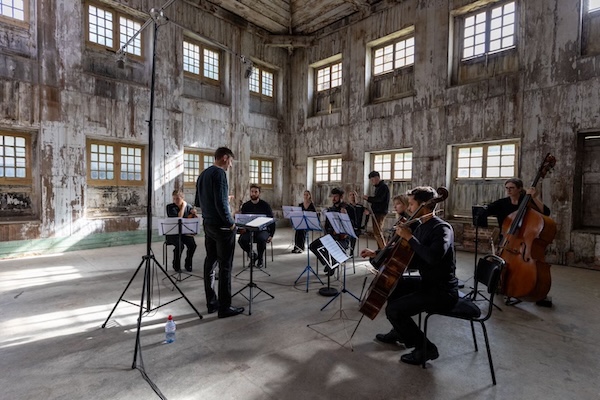
Through a chance conversation with a curator at the Auschwitz Memorial and Museum, conductor and composer Leo Geyer came across musical scores composed by concentration camp prisoners during the Holocaust. June 3 to 7, at London’s Bloomsbury Theatre, the music Geyer documented was played for the first time in 80 years. (photo from Sky Arts)

In 2015, London-based musician and composer Leo Geyer was commissioned to write a tribute honouring British historian Sir Martin Gilbert, who had recently died. Visiting Oświęcim, Poland, to better understand the Holocaust historian’s research, a chance conversation with a curator at the Auschwitz Memorial and Museum led Geyer to a trove of forgotten musical scores composed by prisoners who had been forced to perform in the SS-run orchestras in the Nazi concentration camp, where more than 1.1 million died in gas chambers, mass executions, torture, medical experiments, exhaustion and from starvation, disease and random acts of violence.

The deteriorating and fragile sheets of music, written in pencil, were faded and ripped. Many had burn damage. Intrigued, Geyer devoted nearly a decade of detective work to studying the documents and filling in missing gaps, and the music formed the basis for his doctorate at Oxford University. From June 3 to 7, at London’s Bloomsbury Theatre, the music Geyer documented was played for the first time in 80 years, to commemorate the liberation of Auschwitz in January 1945. The opera ballet included the unfinished scores that Geyer completed and choreography by New York-born choreographer Claudia Schreier.

“The musicians took incredible risks to make brazen acts of rebellion. When good news of the war [of the Allies’ June 6, 1944, D-Day landings] reached the men’s orchestra in Auschwitz I, they performed marches not by German composers but by American composers,” Geyer said in an interview with France 24’s daily broadcast Perspective.

The guards couldn’t distinguish between a Strauss waltz and a John Philip Sousa march.

The musicians “would also weave in melodies from Polish national identity such as St. Mary’s Trumpet Call (a five-note Polish bugle call closely bound to the history of Kraków). We also know of secret performances [that] would take place, which would principally encompass Polish music, but we also know Jewish music was performed as well,” said Geyer.

The story of the orchestras at Auschwitz was popularized by Fania Fénelon, née Fanja Goldstein (1908-1983), a French pianist, composer and cabaret singer whose 1976 memoir Sursis pour l’orchestre, about survival in the women’s orchestra at the Nazi concentration camp, was adapted as the 1980 television film Playing for Time. The orchestra, active from April 1943 to October 1944, consisted of mostly young female Jewish and Slavic prisoners of varying nationalities. The Germans regarded their performances as helpful in the daily running of the camp in so far as they brought solace to those trapped in unimaginable horror. As well, the musicians held a concert every Sunday for the amusement of the SS.

Geyer explained that the SS organized at least six men’s and women’s orchestras at Auschwitz, and perhaps as many as 12. The groups principally played marching music as prisoners trudged to the munitions factories and other industrial sites, where they worked as slave labourers, he explained.

“Musicians had marginally better conditions than other prisoners,” he noted. Nonetheless, he said, “The vast majority of the musicians and composers did not survive the war.” Most of their names are lost. Geyer was able to track down the composer of one unsigned composition by comparing the handwriting to a document found at a conservatory in Warsaw.

Adding poignancy to the performances in London, the musicians played from copies of the original scores.

“We poured our heart and soul into these performances,” said Geyer. “I am neither Jewish nor Romani. But I am human.” 

Gil Zohar is a writer and tour guide in Jerusalem.

* * *

A replica of Auschwitz

Due to conservation issues, the Auschwitz Memorial and Museum no longer permits the filming of movies at the historic site. Using advanced spatial scanning technology, the museum employed a team of specialists, led by Maciej Żemojcin, to create a digital replica of the Auschwitz I camp. The project was recognized at the Cannes Film Festival.

Museum spokesperson Bartosz Bartyzel told Euronews Culture that the replica was created “out of the growing interest of directors in the history of the German camp.”

“The Auschwitz Museum has been working with filmmakers for many years – both documentary filmmakers and feature film directors,” he said. “However, due to the conservation protection of the authentic memorial site, it is not possible to shoot feature films [there]. The idea to create a digital replica was born out of the need to respond to the growing interest in the history of the Auschwitz German camp in cinema and the daily experience of dealing with the film industry. This tool offers an opportunity to develop this cooperation in a new, responsible and ethical formula.”

– GZ

Format ImagePosted on July 25, 2025July 24, 2025Author Gil ZoharCategories Music, WorldTags Auschwitz, Claudia Schreier, history, Holocaust, Jewish composers, Leo Geyer, music, virtual reality

Enjoy the best of Broadway

“It may sound like a cliché, but I really believe that music is a unique language. You don’t have to know how to read it, you might not understand the lyrics, but it can still touch your heart and soul,” Omer Shaish told the Independent. “At the end of the day, it doesn’t matter what genre you listen to, it will always make you feel something. That’s what I always hope to do when I get on stage – use the music to touch people’s hearts and souls.”

photo - Omer Shaish brings My Broadway Shpiel – stories, Broadway tunes, popular Hebrew songs and original music – to Vancouver Aug. 21
Omer Shaish brings My Broadway Shpiel – stories, Broadway tunes, popular Hebrew songs and original music – to Vancouver Aug. 21. (photo from omershaish.com)

Shaish brings My Broadway Shpiel to Vancouver Aug. 21, 7:30 p.m., at Temple Sholom. In addition to offering a night of Broadway tunes, popular Hebrew songs and his own original music, the performance will raise money for Temple Sholom’s campership program.

While Shaish never attended summer camp growing up, he did talk about growing up in the Jewish community.

“We’re one big family and I love that about us,” said the singer, who was born and raised in Rishon LeZion, which is about 20 minutes south of Tel Aviv.

“I spent most of my teenage years and my early 20s in Tel Aviv, where I was surrounded by great art, amazing people and incredible food!” said Shaish, who knew from a young age that he was going to be a singer.

“My parents say that, as a toddler, I’d pick up anything that could resemble a microphone and sing at the top of my lungs – everywhere. I always loved having an audience,” he said. “Even though, in real life, I sometimes come across as a bit shy and introverted, having an audience to sing for always made me feel at home. Up until today, having an audience, no matter how big or small, brings me to life.”

Shaish started his career as a vocalist in the Israeli Air Force Band, performing on military bases and in Jewish communities in Europe and Canada. He also is an actor, performing in Israel before moving to New York City in 2007 and graduating from the American Musical and Dramatic Academy. He has numerous theatre, vocalist and soloist credits to his name, but mainly has been touring internationally as part of the classical vocal trio Kol Esperanza and with his self-produced, one-person show My Broadway Shpiel.

“Even though I love acting, I’ve been focusing on singing in the past few years,” he told the Independent. “I realized, throughout the years, that I feel more at home just being myself on stage. I enjoy sharing these moments with the audience and it makes every show feel different and so alive. Playing a character can be interesting, too, but, for me, there’s nothing better than simply being myself.”

At the moment, Shaish calls Baltimore, Md., home. Previously, he toured the United States for many years, and lived a few years in Los Angeles and in Miami.

“I absolutely love traveling, seeing the world and meeting lovely, interesting people,” he said. “My friends always make fun of me and say that they never know where I’m at, to which I reply with, ‘neither do I.’ It can be exhausting at times, but it’s always worth it. I feel very lucky to do what I love and that gives me a lot of energy to keep at it.”

He’s looking forward to performing here.

“I love Vancouver!” said Shaish. “I’ve been there many times and I think it’s one of the most beautiful places on earth. The last time was only a few months ago, for rehearsals and a recording session. I’ve performed in Vancouver before and I can’t wait to be back and enjoy the views, the fresh air and, of course, the wonderful people!”

About the show he’s bringing with him, My Broadway Shpiel, he said, “As I tell my story and share some anecdotes about the Jewish story of Broadway, I sing some classics from Fiddler on the Roof and West Side Story, and all the way to some surprises by ABBA and Elvis Presley!”

One of his favourite moments in the performance is when he shares the experience of living in the United States with a foreign name. 

“I have heard so many variations of my name from so many people that I have met,” he said. “‘Omer’ apparently isn’t very easy to pronounce. So, one day, I thought, why not write a song about it? I took Liza Minelli’s ‘Liza with a Z’ and turned it into ‘Omer with an E.’ At first, I wanted that to be the name of my show, but My Broadway Shpiel felt more fitting.”

As for the importance of music, he said, “This brings me back to how I see music as a language. It has superpowers. It can take us away from one reality and bring us to a completely different one within a split second. It triggers our emotions in such a powerful way. When people talk to me after a show and say that I made them laugh, made them cry, or made them forget about their day, I know I did something right.”

For tickets to My Broadway Shpiel, visit tickettailor.com/events/templesholom/1702794. 

Posted on July 11, 2025July 21, 2025Author Cynthia RamsayCategories Performing ArtsTags camperships, fundraising, Jewish summer camp, music, My Broadway Shpiel, Omer Shaish, storytelling, Temple Sholom
Two visions that complement

Two visions that complement

Kim Rosin, left, and Alejandra Morales’s shared exhibit, Parallel Visions, is at the Zack Gallery until July 21. (photo from the artists)

The double exhibit Parallel Visions opened at the Zack Gallery on June 25. It introduces two artists – Kim Rosin and Alejandra Morales – who have different backgrounds, are different ages and had never met before. But their art is amazingly compatible.

“When Alejandra submitted the photos of her pieces, they were mostly of fruit, along with a fruit stand. I thought that it would be interesting to pair her with Kim’s allotments,” said gallery curator Sarah Dobbs about why she combined both artists in one show. “However, when I saw Alejandra’s work at her studio, there was so much more, so I had to rethink. 

“Upon reflection, I realized that both Kim and Alejandra turn to the natural world as more than just subjects of beauty. For Kim, painting from a community garden in West Vancouver becomes a way to reflect on growth, nourishment and the fragility of food systems in times of scarcity. Alejandra, working from northern Mexico, uses natural imagery as well, but in a dreamier way – exploring how Latin America is romanticized by outsiders. Though grounded in different geographies and experiences, both artists explore how abundance can hold layers of tension between beauty and critique, comfort and resistance. Hence the title, Parallel Visions.”

Rosin’s paintings are of her plot in a community garden. “I have always been interested in growing food,” she said. “From nothing, just a little seed, wonderful, nourishing plants grow. It feels almost magical. It makes me happy but also a little sad, because not everybody can grow their own food. Some people have to go without, when they don’t have a garden and can’t buy their vegetables because of high prices. When I look at my plot, I think of the food chain on our planet.”

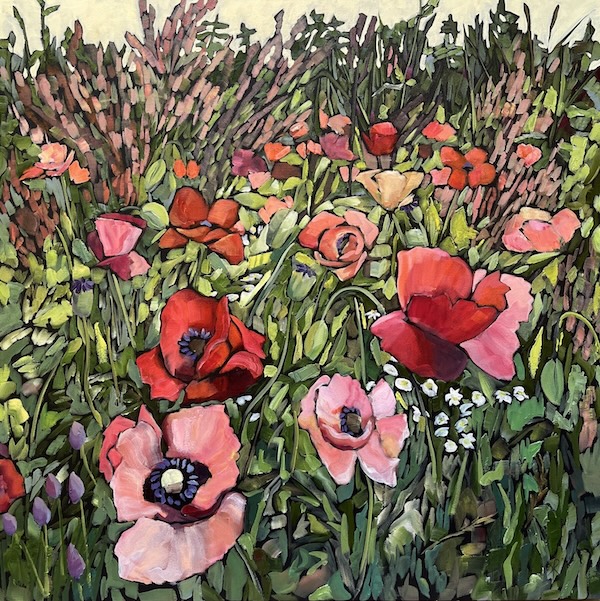
Her paintings are full of edible green things: kale and lettuce, beets and carrots. One can imagine the labour that went into growing such a lush garden and the tasty dishes after the harvest. The images reflect the artist’s love for the plants she grows, as well as her longing to share her cornucopia with everyone. Her painting of red poppies is a worthy companion to the vegetable plots, adding beauty to the nutritional component. “Many people grow poppies in our plots,” she said. 

photo - “Plot 5: Poppies and Pollinators” by Kim Rosin
“Plot 5: Poppies and Pollinators” by Kim Rosin. (photo from the artist)

Rosin also enjoys painting still life. “It is like a recording of a moment in time,” she said. “And the decorative element is there, too. People often appreciate such paintings, especially if they could ask me to include their favourite objects in the image.” 

She likes working on commissions, which she describes as “collaborations with the clients.”

“Commissions take a different mindset from making art of my own, less creative freedom,” she acknowledged. “Some clients have a certain vision, and my job is to bring that vision to life. One example is dog portraits. Dog owners want them realistic, almost photographic. I don’t have to interpret anything, as I do in my own paintings. It is easier in some way, like a mechanical exercise. My creativity is not as important as my skills as a painter. Of course, it is not that simple. When I paint, the image occasionally changes on its own, it has its own demands. Then I worry. What if the client doesn’t like the end result? What if they won’t buy this painting? Fortunately, that has never happened to me.”   

People’s stories have always served as an inspiration for her art. “I’m curious about everything – traveling, music, nature. Before I moved to Vancouver, I lived in Seattle,” she said. “I worked on theatre sets for several fringe theatres there…. After I moved here, I created a set for a musical on Granville Island. Teaming up with theatre companies was always a fabulous experience, despite the low budgets.” 

Like Rosin, Morales also likes working on commissions. “Some people are very relaxed. ‘You’re the artist. You know what to do.’ Other people are very involved. They want exactly what they envision and you, the artist, need to give them what they want,” she said.          

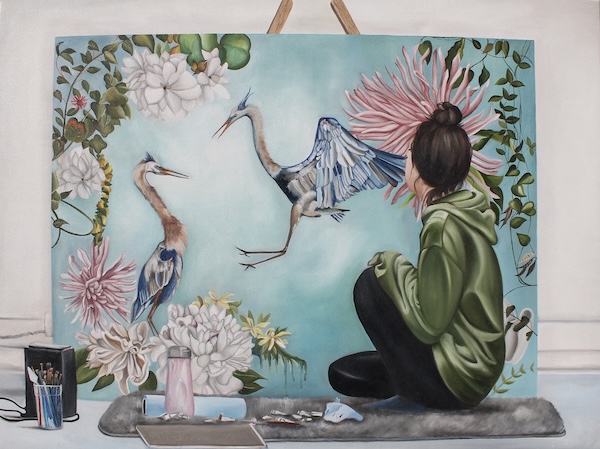
On the other hand, unlike the serene greenery in Rosin’s paintings, Morales’s paintings emphasize her unease with society’s contradictions and paradoxes. Her flowers are colourful and gorgeous, but unrealistic. “I wanted them too beautiful for this world, almost uncomfortable,” she said. “And the animals in my paintings – they fight, like humans do. There are conflicts there.”    

In her self-portrait, which is on display, the dichotomy between the pastel tones, the elaborate, narcissistic flowers, the birds in the middle of an angry confrontation and the pensive woman facing the painting echoes the artist’s contemplation on the incongruities of life. 

The self-portrait is titled “Will Happiness Find Me?” Many of Morales’s other paintings also sport titles that add a verbal facet to the art’s visual impact. “My titles come from books or songs. Or, I remember someone saying something, and it is relevant for this painting. Or a title could be a quote from an old show,” she said. Her tranquil landscape of a Vancouver shoreline is called “Nothing Mattered More Than Anything Else.”     

photo - “Will Happiness Find Me?” by Alejandra Morales
“Will Happiness Find Me?” by Alejandra Morales. (photo from the artist)

Morales moved to Vancouver four years ago from Mexico. “I received my BA from McGill University in 2016 and studied for my master’s degree in visual arts at UBC.”

Besides Canada, she studied art in Spain and in her native Mexico. “When I took art classes in Mexico, many students were housewives,” she recalled. “North Mexican culture is different than here. Women are supposed to follow a traditional path of a wife and a mother. The women that took art classes were anxious because they deviated from that path. I wanted to show their anxiety, their inner struggle in my paintings.”

According to Morales, women are freer here in Canada, the entire society more relaxed, and her art reflects the difference. “I painted a jungle in Mexico – and it was very bright and colourful. But when I painted a jungle here, the colours became less vivid, more muted. Maybe because it was raining outside,” she said.

Morales taught fine art as a teacher’s assistant, while she studied at UBC. “I liked teaching. I would like to do more of that,” she said. 

Her latest artistic project is rather unusual. She painted a series of cityscapes featuring dumpsters around Vancouver. “Some of them have amazing graffiti. It was such fun,” she said. 

Parallel Visions is on until July 21. Rosin’s website is kimthings.com; Morales’s is moralesalejandra.com. 

Olga Livshin is a Vancouver freelance writer. She can be reached at [email protected].

Format ImagePosted on July 11, 2025July 10, 2025Author Olga LivshinCategories Visual ArtsTags Alejandra Morales, Kim Rosin, Parallel Visions, Sarah Dobbs, social commentary, Zack Gallery
A melting pot of styles

A melting pot of styles

Seattle band Shpilkis helps open the Mission Folk Music Festival July 25. (photo from shpilkisseattle.com)

“We’re delighted to be featured at a folk music festival that understands the vast and expansive variety that makes up folk music, and to bring our unique sound to a community that may have never heard klezmer before,” Michael Grant of the band Shpilkis told the Independent. “We have a secret agenda to get hundreds of Mission Folk Fest enthusiasts into a Yiddish dance line! We love playing festivals and expect this to be a beautiful time.”

The Mission Folk Music Festival’s introduction to Shpilkis begins, “Are you ready to shake your tuchus, Mission folkies? Have we got the band for you!” Shpilkis is part of the weekend festival’s opening night lineup July 25. They play a midday concert on July 26 and share the stage for two different afternoon performances July 27. It’s the Seattle band’s first time participating in the festival, though trombone player Jimmy Austin has played it before, with a different group.

Grant plays the trumpet. He and Austin will be joined in Mission by Zimyl Adler (clarinet), Layne Benofsky (baritone), Stefanie Brendler (French horn), Nancy Hartunian (alto and soprano sax), Gary Luke (sousaphone) and Joey Ziegler (drum kit).

Shpilkis formed in 2017, originally convened by Brendler, said Grant. “The low brass players had been in a successful Seattle Balkan band together, and the rest of us knew each other from Jewish community and music spaces. In 2018, we added our sax and trombone players, and, in 2023, finally found a drummer!”

Some of the members play in other groups or musical projects, but Shpilkis is the primary band for all the musicians, he said.

Shpilkis plays traditional Eastern European Yiddish music, as well as more recent forms of it. The band’s description notes that “members come to this glorious music from a hodgepodge of backgrounds: religious, spiritual, secular, pagan; East Coasters, Midwesterners and Pacific Northwesterners born and raised; Jews and gentiles; music-educated and self-taught, with foundations in jazz, punk, folk, classical and pop.”

“Klezmer, particularly by the later 20th century, is a melting pot of styles – you can hear Greek, Balkan and Eastern European melodies mixed in with Americanish sounds – particularly jazz and even bluegrass,” Grant explained. “We love drawing from across the historical spectrum of klezmer music, from traditional 19th-century repertoire that’s been unearthed via the Kiselgof-Makonovetsky Digital Manuscript Project from a Kiev archive, to songs that were written in 1980s Brooklyn or Philadelphia, to fusion and contemporary repertoire. We always arrange songs to put our unique, raucous klezmer brass stamp on it, thinking, ‘How do we get our audience out of their seats and dancing to this?’ Klezmer is inherently dance music, so we prioritize songs that can both be played and danced to at a simcha or nightclub.”

But klezmer is even more than that. 

“Klezmer is the sound and musical language of our people,” said Grant. “It is exciting because it is inseparable from the Ashkenazi diaspora, as it integrates the musical influences of its changing environment and geographies while staying rooted in tradition. We as klezmorim love playing klezmer because it connects us to the past, present and future of Jewish cultural expression beyond borders.”

For the full Mission Folk Music Festival lineup – which features more than 20 acts, performing a range of genres – and tickets, visit missionfolkmusicfestival.ca. 

Format ImagePosted on July 11, 2025July 10, 2025Author Cynthia RamsayCategories MusicTags culture, folk music, klezmer, Michael Grant, Mission Folk Music Festival, Shpilkis
TUTS debut for Newman

TUTS debut for Newman

(photo by Emily Cooper)

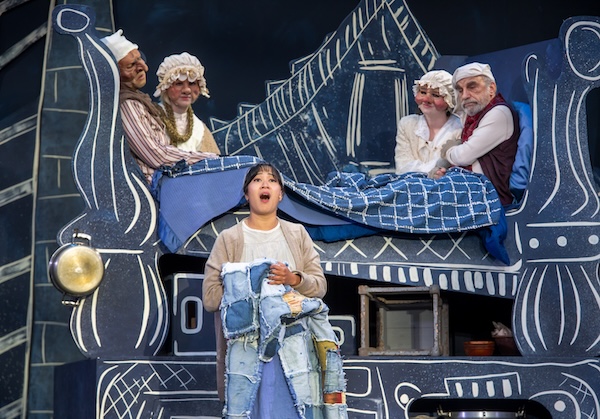
Jewish community member Richard Newman, top right, makes his Theatre Under the Stars debut, playing Grandpa Joe in Charlie & the Chocolate Factory, which alternates nights with Legally Blonde until Aug. 16 at the Malkin Bowl in Stanley Park. He is pictured here with, left to right: Bernardo Arana (Grandpa George), Twyla Raffé-Devine (Grandma Georgina), Imelda Gaborno (Mrs. Bucket) and Sophie O’Brien (Grandma Josephine). For tickets to either TUTS show, visit tuts.ca.

Format ImagePosted on July 11, 2025July 10, 2025Author Theatre Under the StarsCategories Performing ArtsTags Richard Newman, Theatre Under the Stars, TUTS

Love and learning 

People from many cultures show love via food and, of course, Jews are no exception. And what a palate our culture has, since we have lived in so many places. Two children’s books from Collective Book Studio, one new and one from recent years, highlight the flavourful diversity of Jewish culture, while teaching other valuable lessons.

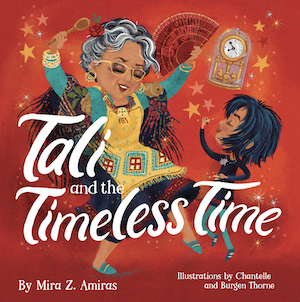
image - Tali and the Timeless Time book coverComing out this August, Tali and the Timeless Time by Mira Z. Amiras, with illustrations by Chantelle and Burgen Thorne, shares the love of a granddaughter for her grandmother, and vice versa. Every Friday, Tali helps her nona get ready for Shabbat. Nona gives hugs, tells stories, still tries to get Tali to nap, even though she’s older now. When Nona dozes off, Tali explores in the backyard, cleans up the small fountain there, feeds the goldfish. When Nona awakes, it’s time to cook.

“We bake!” says Tali. “Today, it’s bourekas, yummy for eating. Nona makes them with filo (which it turns out is cheating). She says her nona let her ’cause it doesn’t need kneading.”

The week before, the pair made stuffed grape leaves – yaprakas, dolma or dolmades. Nona’s favourite dish is huevos (eggs) cooked in tomatoes with feta and arroz (rice). 

While Tali’s grandmother might get Tali’s name wrong, or forget a word or two, she has these recipes ingrained in her. 

“I’m having big thoughts,” says Tali, “but Nona’s not listening – she’s singing ‘chakchouka,’ it’s sometimes called, not just huevos, in the Holy Land, Tunisia and the land of the pharaohs. In Mexico, it’s a lot like huevos rancheros….” But Nona loses focus, she starts dancing with “her zills and her fans.” Tali finishes making dinner, the pair eat together, then dance some more.

In another role reversal, Tali tucks Nona into bed for the night, not sure she should leave her alone. Luckily, Tali and her family live nearby.

It’s a lovely book, “timeless time” being a beautiful description of a day spent with a loved one, doing this and that, in no particular order, sharing stories, mixing up past with present, making memories that will adapt over time.

image - 1, 2, 3 Nosh with Me book coverFamily and food are also at the heart of 1, 2, 3 Nosh with Me, written by Micah and Joshua Siva, and illustrated by Sviatoslav Franko, which was published a couple of years ago. In it, the dog Buckwheat shows us the yummy food the family eats, starting with the “One golden challah, to celebrate Shabbat…” We work our way up to “Ten crispy latkes, served by candlelight.” In between, we have matzah balls, matzot, kugel, knishes, apples for a sweet new year, sufganiyot, bagels and hamantashen. (It’s not clear why the Hanukkah treats are separated, but that’s a quibble.)

Tali covers a few Sephardi staples and Buckwheat has the Ashkenazi favourites down. Between the two books, the breadth of world Jewry, as seen through just some of its traditional foods, is impressive. 

Posted on July 11, 2025July 17, 2025Author Cynthia RamsayCategories BooksTags aging, Ashkenazi, children's books, Collective Book Studio, counting, culture, education, food, generations, identity, learning, Sephardi, traditions
Deborah Wilde makes magic

Deborah Wilde makes magic

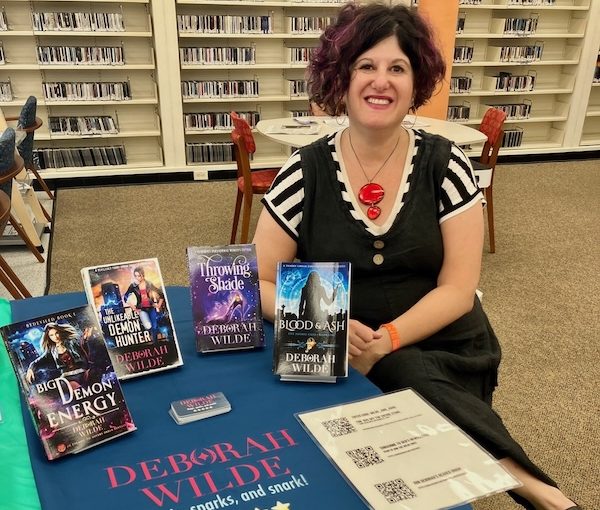
Writer Deborah Wilde is more public now about the Jewish elements in her novels, which have always had a Jewish sensibility. (photo from Deborah Wilde)

East Vancouver author Deborah Wilde has been a writer since childhood, when she filled countless notebooks with her stories. Born and raised in Greater Vancouver, she also spent some years in Kitimat; hers was the only Jewish family in town. She read Isaac Bashevis Singer and watched Neil Simon movies. It was an upbringing she describes as being “rich in tradition.” 

Wilde started her writing career in TV and film. “I loved it. I got to be in writers’ rooms, it was a real privilege,” she said. However, she added, screenwriters are “part of a machine: you’re hired to work on other people’s stories. I wanted to tell my stories.” These stories, as it turns out, are ones with strong Jewish representation and tough, sassy female protagonists.

With the movie industry being in what she describes as “a terrible state,” Wilde took the leap into young adult fiction. In writing the Nava Katz series, she was pleased to find that many of her screenwriting skills were transferable to this new genre. “Dialogue is my happy place,” she laughed. “I had a great time doing it.”

She knew that she had to have Jewish protagonists. “I was an avid reader as a kid but I only saw myself in Holocaust stories,” she explained. “Where was the Jewish girl falling down the rabbit hole or going through the cupboard into Narnia?”

In Wilde’s books, we meet a Jewish mom from Mumbai, and the love interest in her current series is a Mizrahi Jew. Diversity even within the Jewish community is vital, she said. “I want smart Jewish women who have adventures, who are the object of desire.”

Having embarked on her career in fiction, Wilde has reached her initial goal of publishing five books in three years. It took a lot of stamina and she learned that being an independent (or “indie”) young adult author was “not sustainable.” Setting her sights on an adult audience, she took inspiration from her “love of old Hollywood – it was the banter. And I’d always read romances,” she said, “so I wanted to include that as well.” 

Wilde settled on first-person, urban fantasy. A relatively new but extremely popular genre, urban fantasy tales are set in the world we live in but with magical and supernatural elements. Ordinary or “mundane” activities are constantly disrupted by these troublemaking nasties, sometimes with deadly consequences.

And that is where we meet Jewish heroine Ashira Cohen, private investigator. Walking down a Vancouver street, Cohen comes across a “grimy convenience store selling long-distance phone cards and bongs.” A Vancouver scene we probably recognize, but she might also run into a bodyguard who’s been possessed by a demon or a delinquent teen with a talent for vanishing into thin air. Cohen is fast-talking, feisty and funny, but she’s also “someone you’d want to run into at Café 41,” said Wilde. 

Meanwhile, Cohen’s finances are in a state, her love life is stagnant and she’s extraordinarily (and creatively) accident prone. The character is unsentimental, caustic and cynically bored. An interview with a young adult client gave her, she says, “all the details about their nauseatingly cute courtship and very little useful information.” 

Wilde’s novels bring a big helping of zany chaos, a nod to the screwball comedies of the 1940s, staple viewing in the author’s childhood home. But, while the books conform to established genres – such as the “chosen one” trope, the terribly attractive and just as infuriating nemesis – they’re also full of little winks at the reader: neurotic elders, Jewish idioms, references to Jewish traditions. 

Wilde’s talent lies in her ability to layer elements of regular life – like an eye-rolling teen whose statements sound like questions, or the intrusive badgering of Ash’s mother at a moment when tensions are already running high – over the frenzied dangers of the world inhabited by Cohen. The result is fiction that is absurd, surreal and peppered with rapid-fire dialogue reminiscent of the classic film His Girl Friday. 

There is also a serious undercurrent. The author seasons her prose with references to history. For example, one of the magical characters, Meryem, is a Turkish magic refugee who has fled the “purges.”

Jewish representation is very important to Wilde. “There is so little fiction and television with strong, tough Jewish characters,” she said. The Jezebel narrative isn’t a Jewish story but, explained Wilde, “it has a Jewish sensibility – because that’s my own. It’s authentic to my experience.” 

There has always been a Jewish flavour to Wilde’s writing, but it was more subtle; it could be found in the humour. “Readers would find the Jewish stuff eventually,” she said. “But now I’m talking about it in my ads, or even in certain interviews. I’m more public about it now.”

This is one of the aspects that makes Wilde’s work original. While Greek, Celtic, Roman and Norse tales have been all the rage for years, Jezebel’s Jewish folklore and mythology make it stand out. “I won’t write it if I don’t have something original to say,” said Wilde. And that’s where we find a magical organization called Nefesh, or, in Hebrew, “soul” or “life.”

Wilde is both a prolific writer and a businessperson. Talking about the switch to indie authorship, she describes it as “exhausting and a huge learning curve.” She is now both an author and her own publishing house. She has learned about search engine optimization, how to print and distribute books, the advantages of the different platforms and the wizardry required to publish ebooks online. But, despite all the technology that runs behind the scenes, Wilde finds that “word of mouth is still the best form of advertising – many people comment on my ads with things like, I just bought this book because of all the comments, so it had better be as funny as you all said!”

But she’s not alone in her work: her team now includes her husband (who designed the back end of her online store), an editor, cover designers and a slew of peers on whom she has depended for critical (but kind) feedback, moral support, professional insight and companionship. 

Wilde sells her books directly to readers. She explained that, when you buy from Amazon, “you’re actually leasing the book.” Instead, she said, “When you buy digitally from an author, you actually own the book – it’s yours, not just a link you have access to while you have that device.”

Past and present intersect with Wilde’s writing. Most of her grandfather’s family was killed in the Warsaw Ghetto. Of those who survived, she said, “They ended up in a displaced persons’ camp in Germany. My mom was born prematurely in that camp, delivered by a former Nazi doctor.” So, stories about how Jews once lived in Russia, which invaded Poland in 1939 and fully occupied it at the end of the Second World War, “that was my childhood.” 

Having been raised by her grandparents, Wilde said, “I know there is absolutely an aspect of me working through this generational trauma, baggage, but, at the same time, there’s also me working through the patriarchal aspect of Judaism.” 

Shula Klinger is an author and journalist living in North Vancouver.

Format ImagePosted on June 27, 2025June 26, 2025Author Shula KlingerCategories BooksTags Deborah Wilde, fiction, identity, Judaism, novels, urban fantasy, writing

With the help of friends

“‘You’re dead, Weiss!’ Declan shouted. He turned back to his friends. ‘This is our chance. Let’s get him!’”

And so the chase after sixth-grader Matthew Weiss begins, led by bully classmate Declan Bollard, with Declan’s three followers right behind. It leads to an adventure all the kids might have been happy to forego, but also a lesson in humanity that they all needed, even the bullied Matthew, who discovers not only his self-worth, but that people who seem to have everything going for them probably don’t.

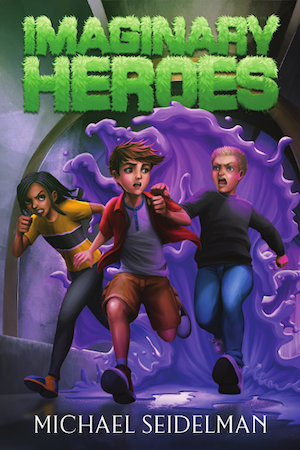
image - Imaginary Heroes book coverMichael Seidelman’s latest novel for readers around Matthew and Declan’s age – called Imaginary Heroes – is propelled by fear and anger but resolved by putting those feelings to constructive use, refusing to be defined by others, trusting in ourselves and braving the day, whatever challenges we face.

Like the character of Matthew, Seidelman has Tourette’s Syndrome and was bullied growing up because of it, which makes his descriptions of Matthew’s feelings so realistic that readers’ hearts will break a little.

Most kids ignore Matthew’s involuntary actions and sounds, a few laugh, but Declan menaces, with Booker, Booker’s twin sister Sam, and Cricket as an audience. After a particularly nasty incident at lunch, where, thanks only to Booker’s intervention, Declan steals Matthew’s dessert instead of beating him up, Seidelman writes: 

“The bell rang, and Matthew did his best to hold back his tears until the lunchroom was empty. Then he let it all out. Every day, he had to deal with those jerks, and this wasn’t even one of the worst days. At least Declan hadn’t hurt him physically this time. So far, at least.”

Arriving just in time for class nonetheless, the teacher berates Matthew for not getting there earlier. The adults – teachers and other kids’ parents – are little help to Matthew, just as they were to Seidelman as he was bullied growing up.

“Though many teachers and school administrators were of little to no help with the bullying I endured, there were a few who stood up for me, and those individuals have not been forgotten,” writes Seidelman in the acknowledgements. “And again, I must thank my parents and family; without their support, I truly don’t know where I would be today.”

The character of Matthew also has a supportive, loving family. And he has two imaginary friends, who not only help get him through the school days, but really step up when he, Declan, Booker, Sam and Cricket find themselves in a literal hole, with no apparent way out. The journey that ensues is a danger-filled adventure during which all the kids find out more about themselves and one another, and what bravery and humanity entail not only in life-threatening moments, but also in life in general.

To purchase an electronic or hard copy of Imaginary Heroes, or Seidelman’s Garden of Syn trilogy, visit michaelseidelman.com. 

Posted on June 27, 2025June 26, 2025Author Cynthia RamsayCategories BooksTags disability awareness, fantasy, Imaginary Heroes, Michael Seidelman, youth fiction
Light and whimsical houses

Light and whimsical houses

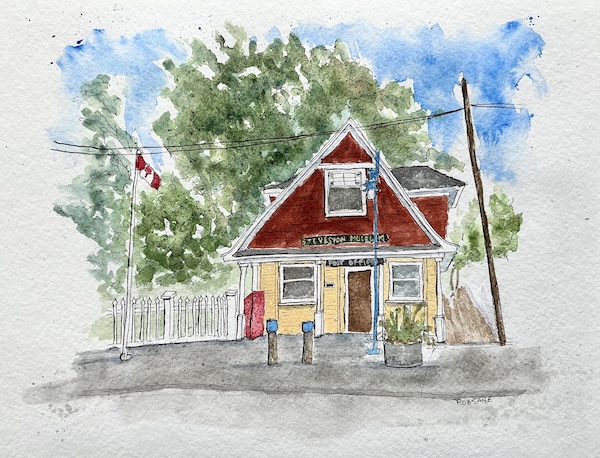
Roxsane Tanner’s watercolours are on exhibit at the Steveston Museum and Post Office (painted here by Tanner) this month. 

“Steveston is such a beautiful place,” artist Roxsane Tanner told the Independent. Her first solo show of watercolours features quaint houses of the village, where she has lived and worked for many years. The exhibit opened at the Steveston Museum and Post Office on June 1 and will be on display for the month.

photo - Roxsane Tanner
Roxsane Tanner (photo courtesy)

Born in Holland soon after the Second World War, Tanner came to Canada with her family in 1951.

“My father was in the resistance, and my mother was in hiding during the war. They were both Jewish and wouldn’t have survived otherwise,” she said.

Her older sister was born during the German occupation, and her mother had to hide her baby with a local family. “My sister was 3 years old when my mom came for her after the war, to take her back. That was the first time she saw her mother.”  

After the family came to Canada, her parents moved a lot. “They were very entrepreneurial,” said Tanner. “We lived in many small towns in Ontario and Quebec. Sometimes, my parents had several businesses open at the same time in the same town: a pet shop, a fabric shop, some others. They always worked hard. When I was 19, my parents and I moved to Vancouver. In the beginning, we lived in a trailer, the same one we drove here from across Canada.”

Tanner inherited her parents’ work ethic and their courage to try new things. “After high school, I wanted to study nursing, but soon after I started classes, I hurt my knees and had to come home – I couldn’t walk.”

After she healed, she became a dental assistant and worked as one for several years. “Until I met my first husband,” she recalled with a smile. “He was a wallpaper hanger. I fell in love with the man, married him, and joined his business. We worked together for several decades.”

Even after her first husband’s untimely death from cancer, she continued their business on her own. Many houses in Richmond and Vancouver feature wallpaper installed by Roxsane Tanner. By now, she has been a wallpaper hanger for more than 50 years. “But I’m slowing down,” she said. “I’m not accepting many new clients, not anymore.”

Now, she is becoming more and more absorbed in various artistic endeavours. Art was always on the periphery of her life. “I always dabbled,” she said. “Then, about 15 years ago, my second husband, Fred, and I visited Italy. He was a high school counselor before he retired; we were chaperoning a group of kids on that trip. I saw some beautiful jewelry local artisans sold on the street. I liked it, but it was too expensive. I thought maybe I could make something like that, and Fred encouraged me. When we returned home, I enrolled in a course on silversmithing and started making my own jewelry. Fred built a silversmithing studio for me in our backyard.”

She took more classes in different techniques, many of them on YouTube. “I can spend hours watching educational videos on YouTube,” she said. “There is always something new. Thousands of talented artists offer classes there. The good thing about YouTube: once you subscribe, you can watch the same lesson several times, until you really get it.” 

She sells her jewelry – earrings, bracelets and necklaces – in a local Steveston shop. Occasionally, she offers her own classes in jewelry-making, to children and adults. What started as a hobby from a casual observation in Florence ended up becoming a small business, as many of Tanner’s hobbies tend to do: sewing, for example.

“My mother taught me to sew, knit and crochet,” she said. And, wanting to pass the skills on to others, she started, out of her home, to teach children how to sew. “We buy special kits and make hats and scarves for the homeless,” she said. 

But that was not enough for her. Her creativity needed another outlet. About the same time as she embarked on jewelry-making, she also started painting in watercolours. “I took classes, of course, some on YouTube, others at the local Phoenix Art Workshop here in Steveston. At first, I painted landscapes, but I didn’t like it. A few years later, I went to Malta on a trip with the Phoenix Studio – they have amazing houses there, and I was inspired. The next year, we traveled to Mexico. I admired their historical buildings, but we also have amazing houses here, in Steveston. There are many heritage places here. I wanted to paint them.”    

When she returned from Mexico, she noticed a blue house in Steveston she liked and took a photo of it. “I painted it from my photo. It was my first, and my friends kept bugging me: you need to show your painting to the owner. So, I went and knocked on his door. I never met him before that day, and he was somewhat gruff at first. He asked me if I would sell it to him, and I agreed. That’s how it started.”

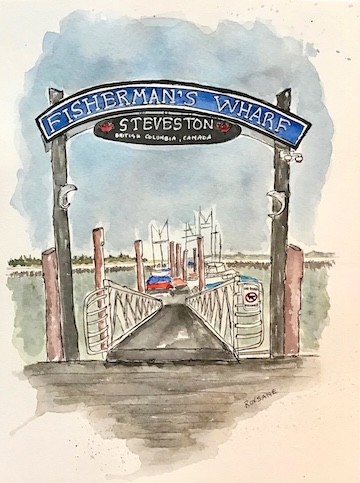
image - Steveston’s Fisherman’s wharf, painted by Roxsane Tanner
Steveston’s Fisherman’s wharf, painted by Roxsane Tanner.

Tanner has built another small business on that foundation. “I paint houses that are for sale. Realtors around Steveston commission my paintings as gifts for the new homeowners. People also come to me and ask me to paint their houses, or their children’s houses, as gifts. Sometimes, I paint from my own photographs. Other times, the clients bring their photos and order a painting from that image.”

Besides personal homes, she paints heritage places around Steveston. The old community centre, a coffee shop, a church turned into a thrift store, the pier, with its picturesque boats, and the tiny post office – the same one where some of her work is now on display.

The exhibition includes Tanner’s original watercolour paintings plus postcards and mugs with her artwork. Some of the paintings sport charming, quirky houses found only in the artist’s imagination. “I go online and search for heritage homes around the world. If I like one, I use it as my inspiration, but I don’t copy the photos. I want my painted houses light and whimsical, like a fairy tale. Maybe a bit crooked, but reflecting the essence of the house, its soul and personality. Even the real houses I paint are not exact copies of the photos. I don’t use a ruler to make the straight lines. I use my watercolours to remind people of the fun and joy their homes bring them.”

You can see more of Tanner’s art at instagram.com/studioplace99. 

Olga Livshin is a Vancouver freelance writer. She can be reached at [email protected].

Format ImagePosted on June 13, 2025June 12, 2025Author Olga LivshinCategories Visual ArtsTags art, exhibits, jewelry, painting, Roxsane Tanner, Steveston, watercolours
Will you help or hide?

Will you help or hide?

Bema Productions’ The Last Yiddish Speaker cast, director and crew: standing, left to right, Tess Nolan, Kevin McKendrick, Andrea Eggenberger, Nolan McConnell-Fidyk and Ian Case; seated, Siobhan Davies, left, and Zelda Dean. The play imagines a world in which the Jan. 6, 2021, attack on the Capitol in Washington, DC, was successful and Christian nationalists have taken over the United States. (photo by Peter Nadler)

Victoria’s Bema Productions is staging the international premiere of Deborah Laufer’s The Last Yiddish Speaker at Congregation Emanu-El’s Black Box Theatre June 18-29.

The drama imagines a dystopian world in which the Jan. 6, 2021, attack on the Capitol in Washington, DC, was successful and Christian nationalists have taken over the United States. In the play, a Jewish father and daughter must be careful and cunning, as any deviation from the norm could be deadly. When an aged Yiddish-speaking woman lands on their doorstep, they must decide whether to take the risk of helping the woman or focus on saving themselves.

Laufer has numerous full-length plays to her credit, as well as dozens of short plays and even musicals (written with composer Daniel Green). Her plays have been produced around the world and she has been recognized with numerous awards.

While The Last Yiddish Speaker focuses on Judaism and the right for Jews to exist, the play could be about any marginalized group, in any country.

“Although the play is set in the USA, the theme is universal: the struggle of good over evil,” Zelda Dean, founder and managing artistic director of Bema, told the Independent. “In this play, Canada is still a safe place for Jews.” 

That said, it has a message for Canadian audiences, as well, Dean said. “It is very important that we address social and political issues, particularly with the huge increase in antisemitism in Canada. The play is entertaining, engaging and enlightening. It takes place in 2029, when the fascists have taken over the USA. It is timely and powerful.”

Directed by Kevin McKendrick, The Last Yiddish Speaker features Ian Case, Siobhan Davies, Nolan McConnell-Fidyk and Dean.

McKendrick is an award-winning director, notably being recognized by the Alberta Theatre Projects for significant contributions to theatre in Calgary. Case, a veteran stage actor on Vancouver Island, is also a director and arts advocate. Davies, meanwhile, is a stage and cinematic performer – she will be appearing in the upcoming film Allure, shot in Victoria. McConnell-Fidyk is a local actor who appeared in Survivors, a play aimed at spreading information about the Holocaust to audiences from Grade 6 and up. (See jewishindependent.ca/theatre-that-educates and jewishindependent.ca/survivors-play-brings-tears.)

Before the November 2024 presidential elections, Laufer told Philadelphia public radio station WHYY about her reasons for writing the play, including that she was deeply disturbed by the events of Jan. 6. “I thought, ‘Is this the end? Is our democracy completely ended?’” she said.

“The play reminds us there are times in history when we have the choice to speak out against oppression or choose to remain silent. You get the government you deserve,” McKendrick told the Independent. “How will you respond when faced with outright injustice?”

Tickets for The Last Yiddish Speaker can be purchased at ticketowl.io/lastyiddishspeaker. 

Sam Margolis has written for the Globe and Mail, the National Post, UPI and MSNBC.

Format ImagePosted on June 13, 2025June 12, 2025Author Sam MargolisCategories Performing ArtsTags antisemitism, Bema Productions, democracy, dystopia, justice, politics, terrorism, Zelda Dean

Posts pagination

Previous page Page 1 … Page 5 Page 6 Page 7 … Page 160 Next page
Proudly powered by WordPress