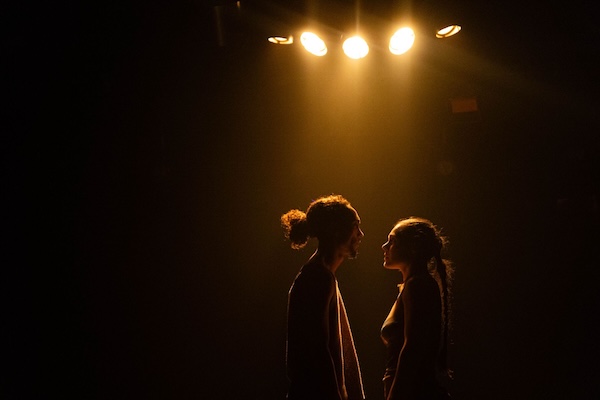
Among the performers at this year’s Vancouver International Jazz Festival are Ard n’ Saul (Ardeshir and Saul Berson), at Tyrant Studios on June 21. (photo by Joshua Berson)
The 40th anniversary edition of the Vancouver International Jazz Festival runs June 20 to July 1. It offers more than 180 events, with 50 free shows at 14 locations around the city.
The festival took its maiden voyage Aug. 19-25, 1985. Billed as the first annual Pacific Jazz and Blues Festival, the event featured 100 musicians from British Columbia, Oregon and Washington state at clubs and venues around the city. It was created – and mostly financed – by John Orysik, Robert Kerr and Ken Pickering, along with Deborah Roitberg, who would become a founding board member. Together, they founded the Coastal Jazz and Blues Society, which was born with the intent of providing a 10-day music festival along with a year-long jazz presence.
In this year’s festival, there will be open jazz jams June 20-29, presented at and with Tyrant Studios. Come for the 9:30 p.m. sets ($18 in advance, $20 at door), then stay as the headliners become hosts, sharing the stage with visiting artists and local players alike starting at 11 p.m. (pay-what-you-can). Among the headliners are, on June 21, Ard n’ Saul, who pay homage to the classic two horns and rhythm section tradition – the group is led by alto saxophonist Saul Berson and tenor saxophonist Ardeshir.
On June 22, 6 p.m., at Zameen Art House, Infidel Jazz presents Asef ($20 in advance, $25 at door). Members of the group – Berson (saxophones), Itamar Erez (guitar), Sam Shoichet (bass) and Liam Macdonald (drums/percussion) – bring to the stage many years of experience playing a variety of music from around the world, including Balkan folk, tango, klezmer, flamenco and bebop.
Also on June 22, at the Georgia Street Stage at 6:30 p.m., Dawn Pemberton and her band – which includes Max Zipursky on keys – play a free concert of music from gospel and R&B, to jazz, funk and soul. Zipursky also plays with Confiture on June 29, 8:30 p.m., at Ocean Artworks ($15 at door). Led by vocalist Tim Fuller, Confiture celebrates 30 years of house music, blending classics with original tracks.
Andrea Superstein plays at Frankie’s Jazz Club on June 26. (photo from coastaljazz.ca)
On June 26, Juno-nominee Andrea Superstein plays at Frankie’s Jazz Club, at 8 p.m. ($20-$25), and the Evan Arntzen Quartet, with special guest Lloyd Arntzen, perform a free show on July 1, noon, at Ocean Artworks.
Vancouver-born, New York City-based saxophonist, clarinetist and vocalist Evan Arntzen blends modern jazz influences with deep roots in the genre’s history. The quartet will be joined by Arntzen’s grandfather, Lloyd Arntzen, a legendary clarinetist, saxophonist and vocalist who’s been a pillar of Vancouver’s traditional jazz scene since the 1940s.
For the full festival lineup and tickets, visit coastaljazz.ca.
Temple Sholom Senior Rabbi Dan Moskovitz and kids from the shul at Camp Kalsman. Proceeds from Omer Shaish’s My Broadway Shpiel performance on Aug. 21 go towards Temple Sholom’s campership program. (photo from Temple Sholom)
International singer and actor Omer Shaish brings My Broadway Shpiel to Vancouver on Aug. 21. Attendees can look forward to music from West Side Story, Fiddler on the Roof, Les Misérables and La Cage Aux Folles, as well as original music and some of Shaish’s personal favourites, including popular Hebrew songs. Proceeds from the concert go towards Temple Sholom’s campership program.
Shaish was born and raised in Israel and has performed at Habima National Theatre and Beit Lessin Theatre in Tel Aviv. In 2007, he moved to New York City and graduated from the American Musical and Dramatic Academy. With numerous theatre and vocalist credits to his name, Shaish has been touring the world with the classical vocal trio Kol Esperanza, as well as his self-produced show My Broadway Shpiel.
Each year, Temple Sholom, along with its Sisterhood and the Harlene Riback Camp Scholarship, offers a scholarship for up to $150 per child to its member families to help the congregation’s youth attend a Jewish day camp or sleepaway camp. This year, it distributed a total of $15,880 for 74 campers and its goal is to raise even more funds for next year’s campers.
Studies have shown that Jewish camping is key to helping Jewish children explore their Judaism and establish a long-term Jewish connection. Temple Sholom’s campership initiative began in 1975 and has been going strong ever since.
“It is the kehila kedosha, or sacred community, of our Sisterhood that rises to this challenge, among other community responsibilities and occasions. It just so happens that the beautiful concept of kehila kedosha is instilled in our children, our future leaders, at Jewish summer camp,” said Alisa Delisle, a Temple Sholom congregant and the mother of Camp Kalsman song leader Paloma Delisle.
“Jewish summer camp encourages children to discover their Jewish identity while fostering a sense of belonging in a community like no other. For most, this is the first experience to navigate personal care and the world of peers without a parent or guardian’s assistance. As a sacred community, campers learn to take care of one another, cultivate pride in their surroundings and appreciate the power of Shabbat. Through experiential learning, Jewishness at camp is incorporated into everything fun.”
Camp Kalsman and PJ Library also offer summer camp scholarships to the broader Jewish community.
Arya Yazgan plays young Sophia in Sophia’s Forest, a chamber opera by composer Lembit Beecher and librettist Hannah Moscovitch, which is at SFU’s Goldcorp Centre for the Arts until June 1.(photo by Anya Chibis)
City Opera Vancouver (COV) presents the Canadian premiere of Sophia’s Forest, a chamber opera by composer Lembit Beecher and librettist Hannah Moscovitch, on stage until June 1 at Studio T at SFU’s Goldcorp Centre for the Arts.
Directed by Julie McIsaac, under the baton of COV artistic director Gordon Gerrard, the one-act opera explores various themes through the story of a young girl, Sophia, who flees civil war and settles in a new country.
“In a time when it’s easy to feel overwhelmed by global conflict, Sophia’s Forest invites us to connect to the individual stories behind the headlines,” said Gerrard. “Composer Lembit Beecher and librettist Hannah Moscovitch have created a deeply resonant story – one that speaks to empathy, resilience and the enduring capacity for hope amidst even the darkest circumstances.”
While Sophia’s Forest is not based on a single true story, it draws inspiration from the lived experiences of many who have endured war, loss and displacement. Through the fractured lens of Sophia’s memory, the chamber opera speaks to the human cost of conflict and the strength required to overcome adversity. Its intimate setting and small ensemble help to magnify the emotional intensity, offering audiences a space for reflection and deeper understanding.
The production integrates live performance with projections by Wladimiro Woyno and an array of mechanical sound sculptures, created from bike wheels and wine glasses, that are controlled remotely in real time by the composer Beecher. These sounds and images – accompanied by a live string quartet – conjure memories and dreams from Sophia’s past: the ring of a wine glass becomes a child’s voice; the whirr of a bike wheel evokes fluttering wings.
For its Canadian premiere, Sophia will be performed by soprano Elena Howard-Scott, Anna (Sophia’s mother) by Adanya Dunn and Wes (Anna’s partner) by Luka Kawabata. Young Sophia will be performed by Arya Yazgan and Emma (Sophia’s sister) by Audrey Gao, both members of the Vancouver Bach Family of Choirs. The chamber opera will include sound design by Richard Berg with costumes by Alaia Hamer.
Sophia’s Forest is COV’s first project in a multi-year initiative that aims to showcase and explore the stories and experiences of newcomers to Canada, including celebrating artists who contribute to Canada’s cultural diversity. For tickets and information, visit cityoperavancouver.com.
Tuskrik Fredericks and Rebecca Margolick in to begin with no end, part of Dancing on the Edge, which runs June 12-21. (photo by Alexander Diaz)
Dancing on the Edge (DOTE), a cornerstone of Vancouver’s contemporary dance season, presents a line-up of established and emerging dancemakers at the Firehall Arts Centre and SFU Woodward’s June 12 to 21.
Spotlighting a range of world and Canadian premieres, as well as works in progress, from Canadian and international artists, the festival offers seven mixed programs, as well as three full-length works. Among the Jewish community members and companies contributing their creativity are Rebecca Margolick, Noam Gagnon, Stefan Smulovitz, Action at a Distance, and others.
“In the turmoil of the world, we look to artists for solace, encouragement and inspiration. For this year’s 37th annual DOTE festival, we are thrilled to present a roster of artists whose works offer a balm for the soul – exploring a pendulum of themes, from isolation to connectivity, from being overwhelmed to feeling joy,” said Donna Spencer, DOTE artistic producer.
Some of this year’s most anticipated performances include the world premiere of the full-length work Lurch from Vancouver’s MascallDance, an evaluation of legacy, in partnership with three commissioned choreographers: Justine Chambers, Ame Henderson and Sarah Chase; the world premiere of a short work, Tunnel 9, from Montreal’s Fila 13 Productions, with dancers Claudia Moore and Sean Ling-Allan, who take refuge in a confined space; and the world premiere from Taiwanese-Canadian dance artist Juolin Lee, Soup of Forgetfulness, a solo inspired by Taiwanese folklore about the afterlife and reincarnation.
Edge 1 (June 12, 7 p.m., and June 13, 9 p.m.) features Gagnon’s being and the work-in-progress My Dance is not a Hobby by Newton Moraes Dance Theatre.
Edge 2 (June 12, 9 p.m., and June 13, 7 p.m.) pairs Windshear / If I were 2 by Inverso Productions with to begin with no end by Tushrik Fredericks and Margolick.
Edge 4 (June 17, 7 p.m., and June 19, 9 p.m) features To Fetch a Pail of Water by Jennifer McLeish-Lewis, with music composed by Smulovitz, and Tidal Wave (Excerpt) by SQx Dance Company.
On June 17, at 9 p.m., Action at a Distance and Belle Spirale Dance Projects present TUNING.
The Vancouver Jewish Folk Choir has its spring concert on June 15, at the Peretz Centre for Secular Jewish Culture. (photo from VJFC)
The Vancouver Jewish Folk Choir’s spring concert this year celebrates the Peretz Centre for Secular Jewish Culture’s 80th anniversary.
Since it was established in 1979, the choir has been recovering, preserving and singing traditional and contemporary Jewish folk music. This year’s concert – on June 15, 7 p.m., at the Peretz Centre – features “Ikh bin a yid,” a cantata by Vladimir Heifetz (1894-1970), based on the poem by Itzik Feffer (1900-1952). Feffer was a Soviet Yiddish poet and member of the Jewish Anti-Fascist Committee who was executed on the Night of the Murdered Poets. The poem emphasizes how, through courage and creativity, the Jewish people have survived centuries of adversity.
The choir also will perform “Sankt besht,” a poem by Itsik Manger set to music by Vancouver Jewish Folk Choir director David Millard. In the poem, the Baal Shem Tov (the 18th-century Jewish mystic and founder of the Hasidic movement) is awakened from sleep and meditates on grief, joy and dreams.
On the program, as well, is a selection of songs arranged by choir founder Searle Friedman, including “Doyres Zingen” (“Generations Sing”), based on a poem by Ben Chud, first principal of the Peretz Shule.
For concert tickets, visit peretz-centre.org. General admission is $36, but, until May 31, people can get tickets for $12 each. However, no one turned away for lack of funds – there is a “pay as you can” option.
The bright, happy cover of The Scribe Summer Camps Issue, which was released last month by the Jewish Museum & Archives of British Columbia (JMABC), draws readers right in. The 95-page magazine-format journal is packed with colour photos of campers having a great time, doing some amazing things in the beautiful place we live, the Pacific Northwest.
The issue features seven camps. In the order they are presented, they are overnight options Camp Miriam (Gabriola Island, BC), Camp Hatikvah (Okanagan Valley, BC), Camp Solomon Schechter (near Olympia, Wash.), Camp Kalsman (Arlington, Wash.) and Sephardic Adventure Camp (Cle Ulum, Wash.), and day options Camp Gan Israel (Vancouver) and the Jewish Community Centre of Greater Vancouver’s Camp Shalom. The basic structure of each profile is an overview of the camp and its history, then oral history segments from camp directors; all the overnight camp sections include interviews with former campers, as well.
Many Jewish Independent readers will recognize the names at least of most of the former attendees of the BC overnight camps: Bernie Simpson, Selina Robinson, Robert Krell, David Levi, Danya Rogen, Sam Gutman, Ted Zacks, Arthur Dodek, Stephen Glanzberg, Susan Fine and Kayla Cohen. And, from the Jewish Independent’s annual Camp Guides, many of the directors and staff might even be familiar: Leah Levi (Miriam), Liza Rozen-Delman (Hatikvah), Zach Duitch (Solomon Schechter), Rabbi Ilana Mills (Kalsman), Rabbi Dovid and Chaya Rosenfeld (Gan Israel) and Ben Horev (Camp Shalom).
The one camp that was new to the JI was a long-established one, Sephardic Adventure Camp, whose director is Rabbi Kenneth Pollack. It’s been around for decades and yet hadn’t crossed our radar. There are always things to learn!
In the interviews, people talk about how they became involved with their camp, how it is/was to work there, what makes/made their experience special. They are also asked why Jewish camps are important in their view, what they have learned, in what ways camp inspired them, and more.
Interviewees share some of their personal history, as well as answer more light-hearted queries, like “Your favourite food served at camp?” “Your favourite day at camp?” “If you were still attending camp, what activity would you want to excel at?” “If you weren’t working in the career you’re in, what would you be?”
As unique as all the camps are, there is overlap of such things as activities offered, lessons learned, inspirations gained, even though some camps are more ideological, some place more emphasis on Judaism and religious observance, others prioritize sports and outdoor life.
“Regardless of ideology or format,” writes Elana Wenner, the museum’s director of programming and development, in her introduction, “the camps are united in their intention to organically build community through immersive and engaging experiences.”
She observes: “Through the articles in this publication, three overarching themes emerge that serve to unite the experiences shared at all seven camps. They are: 1. The role of the personal camp experience as a grounding point for Jewish self-identity; 2. The influence of Jewish camp experience on personal values and ideals; and 3. The integral link between Jewish summer camp attendance and Jewish community involvement, both in childhood and later in life.”
While there is much data to support the personal and communal benefits of Jewish camp, there’s nothing like personal expressions to bring that message home.
“The personal stories shared by alumni and staff and supporters reveal how these camps forge deep, lasting connections that extend well beyond the summer months,” writes archivist Alysa Routtenberg in the journal’s concluding section. “These connections create a network of relationships that continue to enrich participants’ lives and bolster their sense of belonging.”
And Routtenberg underscores the need to preserve, as the JMABC does, these experiences through oral histories.
“By recording and sharing these stories,” she writes, “we ensure that the essence of Jewish summer camps is preserved for future generations, offering them a window into a cherished aspect of Jewish life.”
That includes the serious and the less serious of life. Reading about how Jewish summer camp allowed people to connect more deeply with their Jewish identity, learn valuable personal and professional lessons, make lifelong friends and more, is as interesting as discovering that anyone has a favourite camp food and what camp activity people would have wanted to excel at.
Carol Crenna was the managing editor and features writer for this edition of The Scribe; Sonia Bishop, graphic designer. Among the many people who donated their time and skills to getting the journal to publication were Heather Glassman Berkowitz, as copy editor, and Helen Aqua and Judith Gurfinkel, who chair the Scribe committee, were editorial consultants. Other volunteers acted as interviewers and transcribers. The journal committee is Aqua, Gurfinkel, Glassman Berkowitz, Gary Averbach, Debby Freiman, Daniella Givon (president of the JMABC board), Barb Schober and Ronnie Tessler.
The Camp and other issues of The Scribe can be purchased from the museum and archives for $20. Call 604-257-5199 or email [email protected].
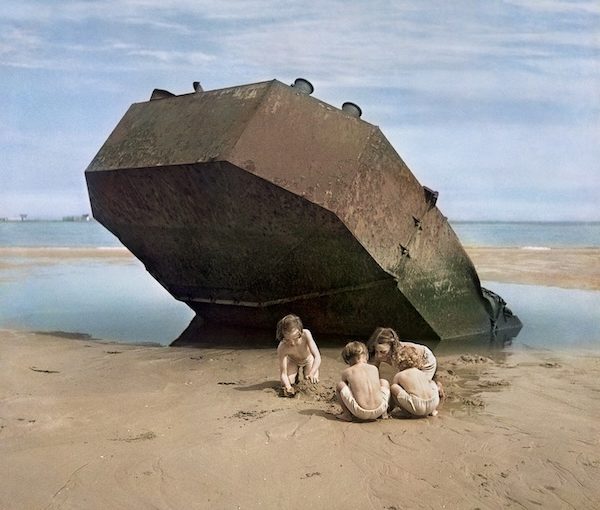
A photograph by David Seymour (Chim) of children in Normandy, in 1947. Part of the exhibit Chim’s Photojournalism: From War to Hope, at the Zack Gallery until June 15. (photo from Ben Shneiderman)
The new show at the Zack Gallery, Chim’s Photojournalism: From War to Hope, features one of the most influential photographers of the 20th century – David Seymour (known as Chim). Chim was killed in 1956, a few days before his 45th birthday, while photographing the Suez Crisis in Egypt, but his legacy lives on even now, almost 70 years after his tragic death.
Gallery manager Sarah Dobbs told the Independent that Ben Shneiderman, Chim’s nephew and the manager of his estate, approached her about the show.
“I was immediately intrigued,” she said. “I met with him and asked if we could host the exhibition. I recognized its importance to the community at the JCC and also to the city of Vancouver. It is a rare opportunity to showcase such an amazing photojournalist. It made sense to host it during the Festival of Jewish Culture in May. I met with the art committee here, and they agreed.… This is the first time these works will be shown together in Canada.”
According to Dobbs, the exhibit was initiated by Cynthia Young, a curator at the New York International Centre of Photography, using vintage prints in their collection.
“Then, the Illinois Holocaust Museum & Education Centre produced the 51 modern prints for their showing,” Dobbs said. “Later, they were presented in Portland, Ore., at their Jewish museum and Holocaust education centre. I flew down to Portland to see the exhibition while it was there and chatted with the curators.”
To package and ship the display to Vancouver, Dobbs needed funds. “I applied for grants and approached individuals,” she said. “In addition to the shipping cost, we also had a special wall built inside the gallery. It will serve us for other exhibitions, moving forward.”
The show preview on April 22 was a joyful event, presided by Shneiderman, who shared with guests his intimate knowledge of his uncle’s work and life.
David Seymour was born in 1911 in Warsaw. His father, Benjamin Szymin, was a respected publisher of Yiddish and Hebrew books. As a young man, Seymour studied printing in Leipzig and, later, chemistry and science in Paris. He wanted to become a scientist. Meanwhile, photography fascinated him. He started taking photographs and selling them to support himself financially, and unexpectedly found a passion for humanitarian photojournalism. His first credited photographs appeared in the French magazine Regards in 1934.
Interested in social issues, Seymour photographed labourers and political rallies, famous actors and street scenes. At that time, he adopted his professional name, Chim, a simplification of his last name, Szymin.
Between 1936 and 1938, as a photojournalist, Chim documented the Spanish Civil War and other international political events. Twenty-five of his Spanish stories were published in Regards. Several of those photos are included in the Zack show. One of them, a close-up of a nursing mother looking up, obviously troubled (1936), is well known. Shneiderman said several history scholars studied this photograph and concluded that it was one of the inspirations of Picasso’s 1937 masterpiece, “Guernica.” Chim’s photo of Picasso in front of “Guernica” positions the painting’s detail of a woman looking up at the falling bombs, right behind the artist.
In 1939, Chim escaped the unfolding war in Europe for Mexico and, later, the United States. As a multilingual and Sorbonne-educated journalist, he served in the US military intelligence as a photo-interpreter. After the war, he resumed his photojournalism career.
In 1947, he and a group of his friends, like-minded photographers, founded Magnum Photos, a cooperative run by photographers. Chim served as Magnum president from 1954 until his death.
Chim’s postwar photographic stories are a blend of anguish and hope. Many of the images are on display at the Zack, divided into several distinct sections. The biggest section is “The Children of Europe.”
In 1948, Chim took a UNESCO assignment to report on the plight of the 11 million European children displaced by the war. He visited Italy, Greece, Hungary, Austria and other European countries. He photographed children who were maimed and orphaned, children playing beside ruins or working in print shops or begging in the streets.
“When LIFE magazine published a spread of those pictures,” Shneiderman said, “together with a list of organizations that accepted donations on behalf of those children, the pouring in of donations was unprecedented.”
Another series of photographs focused on postwar Germany. One of the most poignant ones in this series shows a section of a beach divided by barbed wire – the border between West and East Germany. A couple of boys lounge on the sand. A young woman in a swimming suit runs towards the water. In the foreground, a border guard in uniform stands grim and watchful with his guard dog and his rifle. Tension thrums through the image, underlined by questions and uncertainties.
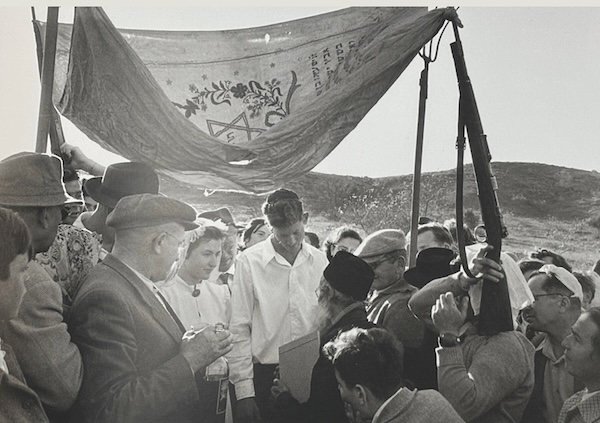
On the other hand, Chim’s Israeli photographs of the early 1950s are infused with hope. A man lifts his baby to the sky in elation – the first baby born in his village. A wedding is celebrated under the chuppah, its makeshift poles including a gun and a pitchfork. An Independence Day parade rolls through Tel Aviv. A team of fishers proudly display their catch of the day to the photographer.
A photograph by David Seymour (Chim) of a wedding in Israel, in 1952. (photo from Ben Shneiderman)
In all his visual stories, Chim is always there with his subjects. They are his co-authors.
“It is that emotional connection that made many celebrities willing to pose for him,” said Shneiderman.
Chim photographed Ingrid Bergman and Audrey Hepburn, Sophia Loren and Picasso, and many others. These photographs are not included in the show, but, together with those that are included, they portray their creator as a man of courage, integrity and vision, one of the best photographic artists of the 20th century.
“Is photojournalism art?” Dobbs mused. “Yes, I think so. Photojournalists capture a moment, an interaction at a specific time. Contemporary art is a mirror of our times. It reflects the societal changes, cultural shifts and significant events that shape our world. It is what the best photojournalists, like Chim, do.”
Dobbs is certain that Chim’s work is still relevant.
“It continues to inspire and draw attention. It teaches photographers to get close to their subjects,” she said. “His images remind us of the past, of the destruction of war, but also of the humanity that transcends it, and of peoples’ resilience.”
Chim’s Photojournalism: From War to Hope is on display until June 15. It is sponsored by the Averbach Foundation, Esther Chetner, the Yosef Wosk Family Foundation and the Government of Canada, in partnership with Shneiderman, Magnum Photos, the International Centre of Photography in New York, the Jewish Community Centre of Greater Vancouver and the Jewish Federation of Greater Vancouver.
For more information and to see a selection of photos, visit davidseymour.com.
Olga Livshinis a Vancouver freelance writer. She can be reached at [email protected].
David Bloom, left, and Richard Newman share two different roles in Western Gold Theatre’s production of Caryl Churchill’s Here We Go, which is at PAL Studio Theatre until May 25. (photo by Colleen Bayati)
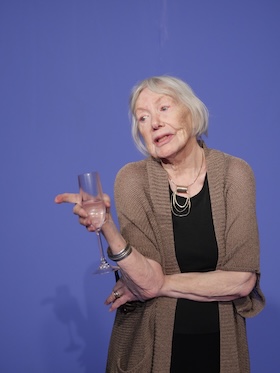
“I love Caryl Churchill – she is quirky,” actor Rosy Frier-Dryden told the Independent. “She makes you think, makes you work. You can’t just rely on lines! You have to bring her lines to life.”
Frier-Dryden co-stars in Western Gold Theatre’s production of Churchill’s Here We Go, which centres around a funeral. Director Kathryn Bracht describes the work as “a deceptively simple, 45-minute exploration on death and dying that is a surrealist meditation wrapped up in her crafty, clever dialogue.”
For the run at PAL Studio Theatre, which goes to May 25, Frier-Dryden is joined by fellow Jewish community members David Bloom and Richard Newman in the cast, which is rounded out by Bernard Cuffling, Kate Robbins and Peihwen J. Tai.
“Without giving all of the storyline away, the general structure of the play is that it’s in three parts: a funeral scene; a monologue scene, where the deceased speaks; and a final scene without words,” explained Newman.
“We did our first runs today, and it’s quite remarkable how the three scenes build on each other to explore relationships with aging and death,” added Bloom. “It’s startlingly funny and weirdly moving.”
Bloom and Newman share roles, as do the other actors: Frier-Dryden with Robbins, and Cuffling with Tai.
“In half of the shows, I am on stage in the first third playing one of five people attending a funeral,” said Newman. “In the other half of the shows, I play the subject of the funeral, the guy who died, who has a lengthy monologue – six pages of script, to be precise. This monologue is brilliantly written – emotional, scary and, always, funny. Quite a challenge, but such a great scene to play.
“Because of Churchill’s writing and Kathryn Bracht’s direction, each actor has a lot of leeway to interpret their lines and define their characters. Like me, David will have his own interpretation of both roles, and we’ve agreed not to watch each other, so we’ll not be influenced by the other – we’re developing our characters independently. Each of us rehearses alone in the room with the director.”
Frier-Dryden also spoke enthusiastically about the latitude the actors have in this play.
“The most marvellous thing is, you are allowed to create your own character, based on what Caryl Churchill writes and the freedom she gives you,” said Frier-Dryden. “In the first scene, I am playing a character that is older and a big personality. She is a Londoner, upper class, and lives in Eaton Square with a vast array of friends. She had an affair with the guy whose funeral we are attending. In the final scene, she is ill, has dementia and she is slipping away. She and her husband have come to terms.”
Rosy Frier-Dryden’s character in Here We Go had an affair with the man whose funeral the characters have come to attend. (photo by Colleen Bayati)
“Caryl Churchill is quite simply a remarkable playwright,” said Western Gold Theatre artistic director Tanja Dixon-Warren. “She has an extraordinary command of language and deep understanding of human nature. Her work is very reminiscent of Pinter and Beckett, in that the text is pared down to its absolute essentials. There is nothing extraneous or gratuitous.
“She has a distinctive, truly singular approach to writing,” Dixon-Warren continued. “Very often there is no punctuation, and lines are not assigned to specific characters, thus allowing the director and actors to find multiple stories and characters within the piece – knowing that they will bring their life experience to the work. This requires that the director, actors, designers really dig into the play, to find all the nuances and be very, very specific about what they are saying. Her material is, essentially, just the beginning of the conversation.”
It certainly has the actors thinking beyond the play and about their own lives: Bloom is 65, Newman is 78 and Frier-Dryden is 90.
“I find myself being grateful for being alive and still being able to move around under my own power,” said Bloom, who commented that the monologue “is both a marathon and a sprint” in which he immerses himself every bus journey, so he’s physically and emotionally exhausted at the end of each day.
“I think about my parents a lot,” he added, “because the play reminds me of their last years and the different ways they faced bodily decline and death. There’s a scene I’m not in that brings up heartbreaking memories of my father’s last years. But, mostly, I’m so delighted to be working on such a beautiful piece of writing with a group of wonderful people, many of whom are even older than I am.”
“You start to think about what’s really important, what I want to do with whatever is left of my life,” said Newman, who has lost many friends in the last year-and-a-half or so.
“What strikes me most strongly is that I am enjoying being here and am looking forward to sticking around to enjoy life as best as I can, as long as I can,” he said. “I consider myself fortunate – I run, work at keeping my body as healthy as I can – and believe my mind will follow…. This play kind of dovetails with my life and the issues and experiences that arise, the things I’m doing and how I’m dealing with life at this age. It’s a kind of serendipity to be in this play.
“At the end of the day,” said Newman, “I’m reminded that life is a gift, a miracle. I have my work, friends both young and old, family. I’m blessed.”
Here We Go also resonates with Frier-Dryden, who recently lost a family member.
“I have lived through the deaths of many, especially recently, and I think of this play and its themes … all the time,” she said. “I am not just going to rehearse – I am going with the knowledge that someone dear has died, and I can send them off and honour them. I love that every day I think of the person I loved, and he is gone, but not gone.”
“Here We Go features some of the best actors in Vancouver,” concluded Newman. “This will be unlike anything you’re liable to see in the Vancouver theatre season! I hope people will come to the show to watch our performances.”
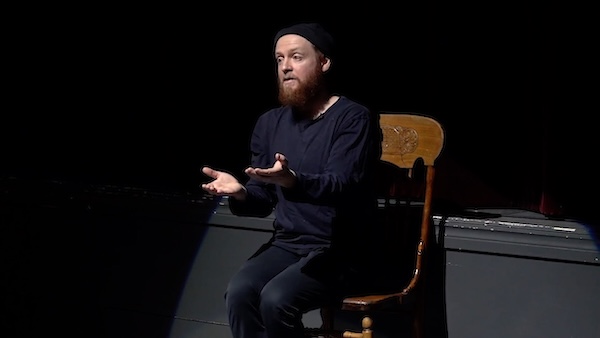
Laen Hershler performing REMNANTS. Hershler brings an interactive version of Dr. Hank Greenspan’s play, which is based on 40 years of conversations with Holocaust survivors, to the Peretz Centre for Secular Jewish Culture on June 8. He will be joined by Vancouver Playback Theatre. (photo from grad.ubc.ca)
In June, Laen Hershler celebrates his first year as artistic director of Theatre Terrific. He also hosts, on June 8, Listening with Survivors, “an evening of deep listening and shared reflection as monologues from Holocaust survivors open into a live, interactive performance with Vancouver Playback Theatre.”
“I was deeply honoured and excited to step in as the artistic director of Theatre Terrific,” he told the Jewish Independent. “This community has always felt like home to me, both as a person and an artist. I look forward to continuing this welcoming tradition.”
“Theatre Terrific Society is a trailblazing mixed-ability theatre company that has been championing inclusivity in the arts since 1985,” reads the website. The society is “dedicated to tackling the challenges of accessibility, representation and inclusion in the arts by breaking down stereotypes and fostering empathy across diverse communities. It creates work that resonates with universal human experiences, bridging differences through storytelling. With a compassionate yet bold approach to theatre-making, it cultivates spaces where respect, rigour and risk drive the creative process.”
Theatre Terrific’s last production, called Proximity: The Space Between Us, was well received at the Vancouver Fringe Festival last September. Directed by Hershler and Susan Bertoia, it was created with the cast and is about the struggles of aspiring artists.
In June, Laen Hershler celebrates his first year as artistic director of Theatre Terrific. (photo from instagram.com/theatreterrificvan)
Hershler is also an actor and improviser, and he is pursuing a doctorate in research-based theatre at the University of British Columbia. He is part of Vancouver Playback Theatre, as well, and, as an observant Jew, he performs complete with head-covering and tzitzit.
“Since my shift to diligently keeping Shabbat about eight years ago, my acting career moved from mainstream theatre, which almost always necessitates working on Friday/Saturday nights, to applied forms of theatre,” he said. “These include playback theatre, forum theatre and academically situated theatre, which are much less dependent on weekend shows. I love performing in these types of shows since they tend to be very socially engaged and meaningful projects.”
Hershler’s responsibilities at Theatre Terrific include arranging all the classes, courses and productions, and hiring the instructors, directors and other artists for TT’s projects. He teaches, directs and sometimes performs in the company’s offerings, and works on establishing connections with the broader community of theatre companies regionally and internationally, especially all-abilities arts organizations.
“I love the meaningfulness of the work, the creative freedom and the amazing human beings I get to work with,” he said. “I appreciate the opportunity to create work and opportunities for theatre artists of all abilities and to produce meaningful and evocative theatre. The challenge of the work – which is learning to hold a radically inclusive space that allows for high-level artistic work while including artists across spectrums of physical, neurodiverse and cognitive abilities – is also something I cherish.”
Hershler’s theatre career began at the Jewish Young People’s Theatre of Vancouver, which was based out of the Peretz Centre for Secular Jewish Culture. The program was guided by Lynna Goldhar Smith, who he credits as being a huge influence – he began classes with her when he was 8 years old and stayed with YPT until he was 14. He said a large percentage of people that he acted with in YPT are still involved in the arts today.
Since graduating with his master’s at the University of Cape Town in 2011, Hershler has been an instructor in the education faculty at UBC in Vancouver and in the creative studies faculty at UBC in Kelowna. He began his career as a performer and educator touring and giving workshops in France, Korea, Australia, Kenya, South Africa and elsewhere on various aspects and uses of physical theatre for both children and adults.
“I loved my role as the Tooth Prince while performing for 5-year-olds (and their parents) at one of the most prestigious theatres in Seoul, Korea,” he said.
A couple of years ago, at the Peretz Centre and at Or Shalom, Hershler performed the one-man show REMNANTS, which was written by Dr. Hank Greenspan and first produced, for radio, in 1991. Based on 40 years of conversations with Holocaust survivors, the work delves into the survivors’ experiences, exploring themes such as loneliness, rage, storytelling and the dynamics of relationships across generations.
“It was a deeply meaningful project,” said Hershler, who is bringing REMNANTS back to the Peretz Centre on June 8, in a different form.
“In this version,” said Hershler in an email, “these monologues will open into a space for collective reflection, storytelling and discussion through playback theatre – a form of theatre that invites the audience’s voices and experiences into the performance itself, creating a space for deep listening and dialogue. For this, we will be joined by Vancouver Playback Theatre.”
The evening will be about listening to the Holocaust survivors, as well as one another, he said, “to find overlap and connection with our own lives, today, in this moment in time – to learn with, to learn from, to learn alongside.”
Hershler would like to do more Jewish storytelling.
“I would love to create work that brings down the mystical tales of Rebbe Nachman of Breslov, an interest I inherited from my father, who has long been a storyteller of Nachman tales…. Being Jewish is who I am, and it pulsates through all the work I do,” he said. “All my artistic work emerges from this prism, from a Jewish lens, from a Jewish neshamah (soul).”
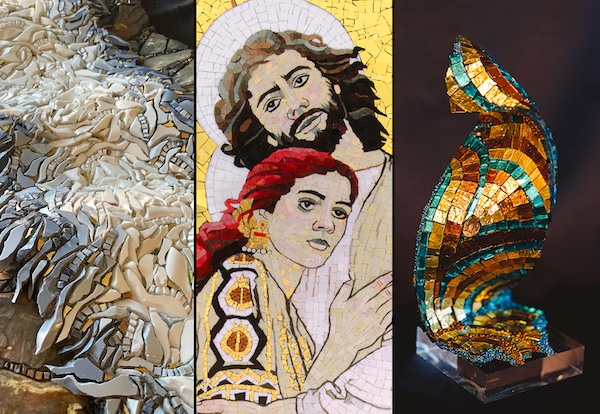
Mosaic Revival: Three Contemporary Expressions features the work of BC artists Maria Abagis, left, Lilian Broca, centre, and Daryl Lynne Wood. Shining the spotlight on this ancient medium, these artists challenge the viewer’s perception of what a mosaic is, and its relevance in the art world today. The exhibit is at CityScape Community ArtSpace, in North Vancouver, untilJune 6. (Images courtesy CityScape)