Skip to content
  • Home
  • Subscribe / donate
  • Events calendar
  • News
    • Local
    • National
    • Israel
    • World
    • עניין בחדשות
      A roundup of news in Canada and further afield, in Hebrew.
  • Opinion
    • From the JI
    • Op-Ed
  • Arts & Culture
    • Performing Arts
    • Music
    • Books
    • Visual Arts
    • TV & Film
  • Life
    • Celebrating the Holidays
    • Travel
    • The Daily Snooze
      Cartoons by Jacob Samuel
    • Mystery Photo
      Help the JI and JMABC fill in the gaps in our archives.
  • Community Links
    • Organizations, Etc.
    • Other News Sources & Blogs
    • Business Directory
  • FAQ
  • JI Chai Celebration
  • JI@88! video

Recent Posts

  • Last hostage home
  • New bill targets hate crimes
  • Concerning actions
  • Recipes not always required
  • Survivor urges vigilance
  • Seniors profoundly affected
  • Farm transforms lives
  • Musical legacy re-found
  • A range of Jewish literature
  • A concert of premieres
  • Variety telethon on Feb. 22
  • Victoria club’s many benefits
  • Avodah dedicated to helping
  • Artists explore, soar, create
  • Life’s full range of emotions
  • Community needs survey closes March 29
  • Jerusalem marathon soon
  • Historic contribution
  • Chronicle of a community
  • Late-in-life cartoonist
  • Cashflow vs growth portfolio
  • My new best friend is Red
  • ישראלים רבים ממשיכים לתמוך בטראמפ ועדיין אינם מבינים במי מדובר
  • עשרים ואחת שנים בוונקובר
  • Supporting the Iranian people
  • The power of photography
  • A good place to start
  • When boundaries have shifted
  • Guitar virtuosos play
  • Different concepts of home
  • Broadway’s Jewish storylines
  • Sesame’s breadth and depth
  • Dylan Akira Adler part of JFL festival
  • Mortality learning series
  • A new strategy to brighten up BC
  • Sharing latkes and light

Archives

Follow @JewishIndie
image - The CJN - Visit Us Banner - 300x600 - 101625

Category: Arts & Culture

A child survivor reflects

A child survivor reflects

At 80, Dr. Robert Krell opens up in his new book.

Dr. Robert Krell, child survivor, psychiatrist, community leader and founding president of the Vancouver Holocaust Education Centre, is probably known to most readers. But few people, perhaps even those closest to him, know him as well as they will after reading his extraordinarily vulnerable new memoir.

Krell acknowledges that he has held much back from the public and his closest family and friends. But, at 80, he has decided to open up in a book called Sounds from Silence: Reflections of a Child Holocaust Survivor, Psychiatrist and Teacher (Amsterdam Publishers).

Krell begins by talking about the duality of his life – the hidden child who, as an adult, tried to remain hidden versus the public figure whose career and community activities have placed him at the fore of various fields; the sadness at his core versus the upbeat visage he presents to the world.

“I have allowed family members and friends to see my inherent optimism and love of life. I live with few regrets,” he writes. “Blessed with a fascinating career, lasting friendships and an incredible family, I have kept at a distance my profound sadness, chronic fears, devastating shame, incapacitating shyness, and nightmares and preoccupations shaped by my earliest experiences and forged in an atmosphere of potential annihilation.”

Krell was 2 years old when his Dutch Jewish parents placed him in hiding with the Munnik family, who he would come to view as his actual parents. He was reunited at age 5 with his birth parents, Emmy and Leo Krell – a miracle on many fronts given the small proportion of Dutch Jews to survive to 1945.

image - Sounds from Silence book cover“After liberation, life became very complicated,” he writes. He had been treated well by his rescuing family, unlike some Jewish children, “but strangely, even those ‘good’ circumstances exacted a psychological toll that never quite healed. After all, my relatively ‘benign’ circumstances were still completely off the scales of what is normal, including separation from my parents, shattering of security, and vague awareness of persecution that contributes to the feeling of shame experienced by a child as having done something wrong to cause the situation. Years later, as a child psychiatrist, I would see this phenomenon in children who, faced with parental separation, assumed responsibility.”

His parents also survived in hiding and his mother in particular never stopped mourning the complete loss of both sides of their extended families.

“I was raised by psychologically wounded parents, no less so than if they had been in the camps,” says Krell. “For three years, they lived in fear of being caught, and that fear exacted a psychological toll that one cannot underestimate.”

Trying to recreate a life, they considered making aliyah to the new state of Israel, but their business before the war had been furs and the climate in Canada was more conducive to that specialty. They came to Vancouver in 1951.

Like many survivors, the Krells found new “family” at Schara Tzedeck Synagogue. Despite many survivors bearing a “burning rage against G-d,” the shul was a second home. His father refused to open a prayer book. And yet, years later, when he was in a position to be philanthropic, he spoke with Rabbi Mordechai Feuerstein and donated $30,000 to buy prayer books for the High Holy Days so that congregants wouldn’t have to carry them to and from synagogue on those days.

“Why would a man who no longer prayed purchase prayer books?” asks Krell. “The rabbi characterized Dad as ‘a man of faithful disbelief.’”

Habonim, the labour Zionist youth movement, was a major stabilizing force for young Robbie. He would attend weekend events, summer at Camp Miriam and do normal Canadian teenage things like matinees at the Stanley Theatre on Granville.

A late-in-life baby, his brother Ronnie, was born in 1956, and his mother’s disordered parenting shifted from the first born to the younger.

“Her subsequent attention to Ronnie grew so intense that even my 16-year-old self realized that he fulfilled her need to replay the years in which I had been lost to her. That need virtually enslaved my younger brother and freed me.”

While building a career as a clinical psychiatrist, professor and academic administrator, Krell and wife Marilyn were raising three daughters.

“I can barely believe that my survival as a young boy has led to the rebirth of an entire Jewish family that now includes nine gorgeous grandchildren,” he writes. “My good fortune scares me. Our world looks so dangerous, and the future of life – Jewish life – remains so precarious. But day-to-day, we are a close family, and every day brings much joy – so far.”

Krell was a leader in Canadian Jewish Congress regionally and nationally. In Vancouver, he became immersed in Holocaust remembrance and education. Kristallnacht commemorative lectures and other Holocaust remembrance events were often begun under the auspices of CJC.

With theologian William Nicholls and English literature teacher Graham Forst, Krell launched what has become a decades-long annual symposium for high school students on the Holocaust.

He was also among the first people anywhere to begin video recording the testimonies of Holocaust survivors.

Krell was also pivotal in the organizing of a succession of world conventions: first, for Holocaust survivors and, later, for “child survivors,” a term he acknowledges was not in use until the 1980s. Hidden children were not viewed as Holocaust victims in the way that survivors of the camps or partisan fighters were. Krell is among a small number of people who helped usher in a reconsideration of the wartime experiences of these children.

In 1984, he gathered 18 survivors and children of survivors in his living room and committed to creating a Holocaust education centre in Vancouver. But some of the older attendees remembered an as-yet unfulfilled promise to create a permanent local memorial to the Shoah, so the group decided to keep that commitment first.

“The memorial was unveiled on Yom Hashoah, April 26, 1987, in the presence of 1,300 members of the community,” notes Krell. “The survivors now had a metzeivah, a ‘burial site,’ albeit symbolic, to visit and to grieve.”

In 1994, the Vancouver Holocaust Education Centre opened, with Krell as founding president.

One time, when he was on the national board of CJC, the organization considered ending their efforts to bring (by then aging) war criminals to justice.

“I argued for continuing the effort,” says Krell. “My measure of success was different. I told my colleagues that it was not only about successful prosecution but also their knowing that, one day, they might hear a knock on the door. The sleep of Nazis should be no less disturbed than that of Holocaust survivors.”

Throughout the book, Krell recalls brushes with history and the figures who make it.

On a trip to Israel as a young adult, he was able to get a seat at the Eichmann trial, thanks to an aunt who had married into the family of Gideon Hausner, the prosecutor of the case. On the same trip, Krell went to Sde Boker and ran into David Ben-Gurion.

A few years later, Krell volunteered to serve in the 1967 war as a doctor fresh out of his internship but, given the chronology of the Six Day War, by the time he got to Europe, the conflict was over.

Two years after that, on another trip to Israel, his plane was hijacked by the Popular Front for the Liberation of Palestine.

Krell was able to attend the ceremony when his family-in-hiding – Albert and Violette Munnik and their daughter Nora – were inducted by Yad Vashem as Righteous Among the Nations (posthumously for Albert).

Krell’s book evokes an array of emotions. The psychiatrist’s self-assessment provides a sometimes startling look inside.

“I kept my rage suppressed, not repressed,” he writes. “It was not unconscious. I knew that it was there. I felt in danger from it and feared losing control. I played, studied and worked hard, surrounded by good friends.”

Format ImagePosted on November 5, 2021November 4, 2021Author Pat JohnsonCategories BooksTags autobiography, child survivor, family, Holocaust, memoir, Robert Krell, survivor
Odd Couple now on

Odd Couple now on

Left to right: Rob Stover, Kimball Finigan, Adam Abrams, Michael S. Weir and Adrian Maxwell in Metro Theatre Vancouver’s The Odd Couple. (photo by Tracy-Lynn Chernaske)

Neil Simon’s famous comedy The Odd Couple opened Oct. 30 on the Metro Theatre Vancouver stage. It runs until Nov. 14.

We meet divorced sportswriter Oscar Madison (played by Rob Stover) as his buddies arrive for their weekly poker game. One of the friends welcomed into Oscar’s messy abode is news writer Felix Unger (played by Adrian Maxwell), who is also divorced, but exists on the opposite end of the neat-and-tidy spectrum. The fact that the men are opposites in so many ways does not prevent Oscar from inviting Felix – who is so depressed it worries Oscar – to move in. Of course, they drive each other nuts.

Jewish community member Adam Abrams plays Roy, a regular at Oscar’s Friday night poker games, in the Metro Theatre production, which is directed by Catherine Morrison.

Abrams has been a part of the local theatre scene for more than 20 years, including many musical theatre productions. “I also played Richard in North Van Community Players’ The Trouble With Richard,” he told the Independent. “A personal favourite was portraying Abraham Goldstein, builder of the Sylvia Hotel, in Kol Halev Performance Society’s Two Views from the Sylvia, back in 2017. That was my last time on the stage, and it’s so great to be back, as part of the return of live theatre, after such a long and trying time for all of us.”

He said that, in real life, he is more like Felix than Oscar.

“My wife Christine will vouch for that – and would readily admit to being much more of an Oscar!” said Abrams. “When Felix is fussing over his London broil dinner or imploring Oscar’s guests to use a coaster, I very much see myself, the chef of the family and the one who is always keeping things tidy. After years of sharing a home, Christine and I have negotiated a much more successful arrangement than anything seen in the play. But our relative household peace has depended on us both accepting each other’s style to some degree.”

As for the character he plays in the show, Abrams said, “I like Roy, though he is somewhat crankier and more blunt than I’d be. He’s a voice of reason for Oscar, imploring him to do what’s right – stop gambling, and pay his debts. No surprise, as he’s Oscar’s accountant!

“My favourite scene in the show is the date with the Pigeon sisters, Oscar’s upstairs neighbours,” added Abrams. “The conflicting attitudes to divorce – a mere inconvenience to the sisters, pure heartache to Felix – and how he both derails Oscar’s hopes for the evening and endears himself to the sisters, is a delight. And, while it’s hilarious, there’s an undercurrent of true emotion that I find touching even as I’m laughing, which I do every time I see it!”

For tickets to the live theatre production of The Odd Couple, visit metrotheatre.com/the-odd-couple, email [email protected] or call the box office at 604-266-7191.

Format ImagePosted on November 5, 2021November 4, 2021Author Cynthia RamsayCategories Performing ArtsTags Adam Abrams, Carousel Theatre for Young People, comedy, Metro Theatre, Neil Simon, Odd Couple
Reviving history in theatre, song

Reviving history in theatre, song

Surplus Production Unit’s Briony Merritt. (photo by Alex McLean)

No matter how well we document history, it matters little unless people are aware of it. Two very different productions at this year’s Chutzpah! Festival, which began this week, were born of personal discoveries of documents from the past – in one case, a trial transcript; in the other, Yiddish compositions. The artists’ unique interpretations help ensure that important aspects of our culture are not forgotten.

Halifax-based Surplus Production Unit, under the direction of Alex McLean, performs A Timed Speed-Read of the Triangle Shirtwaist Factory Fire Trial Transcript on Nov. 21 and 22 at the Jewish Community Centre of Greater Vancouver, in the Wosk Auditorium. Montreal’s Josh “Socalled” Dolgin performs music from his album Di Frosh with a local quartet at the JCC’s Rothstein Theatre Nov. 19 in a concert that will also be livestreamed.

“I had never heard of the Triangle Shirtwaist fire until 2010, when I was doing research for an MA in Toronto,” McLean told the Independent. “I was totally fascinated by the case and got especially swept up in the extensive trial transcript.”

Triangle Shirtwaist Company owners Max Blanck and Isaac Harris were put on trial for manslaughter after a fire at their factory on March 25, 1911, killed 146 people – mostly women and girls – in part because one of the exit doors was locked.

“I think the gender politics were what initially stood out to me – it was an all-male jury, the case hinged on the discrediting of female witnesses, and it was all taking place at a time when women weren’t able to vote in either Canada or the United States. I also knew that this was a time when the labour movement was massive globally and that the Ladies Garment Workers Union had waged its major strike just a couple years earlier. The way that this all reads as subtext in the trial transcript was fascinating to me. I knew that I wanted to work with the material somehow, but wasn’t sure how.”

In 2011, during the 100th anniversary year of the fire, McLean saw an interview with Charles Kernaghan, director of the Institute for Global Labour and Human Rights, who mentioned the Hameen factory fire in Dhaka, Bangladesh. “And then there was the Tazreen factory fire in 2012 and then the collapse of the Rana Plaza building in Dhaka in 2013,” said McLean. “It all made the record of what happened in New York in 1911 hauntingly relevant.

“Somewhere around this time,” he said, “I got a small grant to create a verbatim script from the transcript. I started work on it but it felt lifeless, like a bad ‘historical drama.’ So, I gathered a few actors who I knew and trusted and who were interested in the material. We started playing around with ways to approach the material that felt honest and the current production grew from there.”

McLean believes “it is endlessly worthwhile to think about the hidden costs in our global economy and the conditions under which so many of the products we consume are created.” At the same time, he added, “I was very aware that my life – like those of my colleagues – was radically different from the lives of the people in the trial transcript. None of us are immigrants, none of us are Jewish or Italian (as were almost all of the Triangle victims). As middle-class Canadians in the 21st century, I felt that we had to acknowledge the gulf between us and those New York factory workers in 1911. We had to build this distance into the structure of the show, and so this idea emerged that we would actually sit the trial transcript on the stage and the performance would be a group of people engaging with this historical record, rather than trying to represent it realistically. This felt like the only way we could approach the material respectfully.”

photo - Briony Merritt, left, Kathryn McCormack and Richie Wilcox bring A Timed Speed-Read of the Triangle Shirtwaist Factory Fire Trial Transcript to the Chutzpah! Festival Nov. 21-22
Briony Merritt, left, Kathryn McCormack and Richie Wilcox bring A Timed Speed-Read of the Triangle Shirtwaist Factory Fire Trial Transcript to the Chutzpah! Festival Nov. 21-22. (photo by Alex McLean)

Throughout the trial, said McLean, “witnesses, especially women, were treated with palpable disrespect. Max Steuer, the lawyer defending the factory owners, repeatedly tried to cast suspicion on witness testimony. This came to a head in his cross-examination of Kate Alterman, the ‘star witness’ for the prosecution. Knowing that Alterman’s English wasn’t great, Steuer had her repeat her testimony multiple times to make it appear rehearsed. This ultimately worked for him.

“There’s also a fascinating class dynamic at play: Steuer and his clients, Isaac Harris and Max Blanck, were themselves Jewish immigrants who had worked their way up in New York’s garment district. While at times they appear callous towards the victims and survivors, there is also this sense that they come from the same place. The prosecutor, on the other hand, comes across as much more of a patrician and, at times, this results in condescension. To him, the victims are helpless little girls, while the defence tries to portray them as streetwise conspirators plotting their revenge. Their actual messy humanity gets lost in the crossfire.”

Justice was not served by the trial, nor other legal measures, but there were positive changes that resulted from the tragedy.

“Part of what the case revealed was that workplace safety regulations at the time had no teeth, so the silver lining was that a host of new laws were introduced,” explained McLean. “Frances Perkins, the first woman to serve in a U.S. cabinet, actually witnessed the Triangle Shirtwaist fire and described it as a pivotal moment in her life. She became secretary of labour under FDR [Franklin D. Roosevelt] and was a major player in ushering in the New Deal.”

In terms of lessons learned, however, “we seem doomed to continually forget the inequality that animates our world,” he said. “Going to work under dangerous conditions seems like a reasonable choice to many people in impoverished conditions. As long as those conditions exist, workplace tragedies are likely to occur.”

He added, “There’s a fascinating historian of the Triangle Shirtwaist fire, Michael Hirsch, who argues that it’s a mistake focusing anger and blame on the factory owners. He uncovered the names of several bodies that were unidentified in 1911, and he makes a yearly pilgrimage to the victims’ graves…. To me, Harris and Blanck do appear negligent, but acknowledging systemic imbalances is also important. Economic inequality has proven a difficult problem to solve, but that doesn’t give us the right to forget about it. My sense is that we need a new New Deal today.”

A love of Yiddish music

Josh Dolgin has many artistic interests and musical styles – from composing to photography to puppeteering, from hip-hop to musicals to Yiddish music. As different as they may be, Dolgin said, “all the passions stem from an attraction to ‘realness,’ to things that just deeply move me, spark inspiration, speak to my soul.”

For him, the 2018 album Di Frosh “was a kind of return to a pure, more ‘traditional’ Yiddish music, even though it’s a project of ‘new’ music. I had experimented with using Jewish music sounds in contemporary ways,” he explained, “sampling, mixing, collaborating and fusing to create hip-hop, rap and funky pop music. In so doing, I became rather immersed in the form – in klezmer, in Yiddish folk, art, theatre music, cantorial sounds from the synagogue and Chassidic music – by collecting old records looking for sources. Listening to all that music, I eventually fell in love with the source material … I wanted to play and sing it! I eventually started learning the songs as a pianist, as an accordionist and singer. I wanted to just perform that music, without mixing it, without adding beats, just to play and sing it as is.

photo - Josh “Socalled” Dolgin performs Yiddish music from his album Di Frosh with a local quartet Nov. 19 in a concert that will also be livestreamed
Josh “Socalled” Dolgin performs Yiddish music from his album Di Frosh with a local quartet Nov. 19 in a concert that will also be livestreamed. (photo from Chutzpah! Festival)

“In the meantime, I started getting into four-part harmony singing and collecting choral arrangements, then directing choirs at synagogues and music camps. That love of harmony mixed with my love of singing Yiddish songs and I thought, hmm, it would be cool to present this repertoire in an almost classic style, maintaining all that beautiful real harmony from arrangements from the ‘time.’ Some friends and I created new arrangements based on old sources – all the arrangements are ‘new,’ this repertoire for string quartet never existed before, so it’s ‘new’ music, but it’s more traditional than my fusion/pop experiments.”

Dolgin went to Hebrew school and was raised Jewishly. But, while he “adored” the “holidays and rituals and foods and songs,” he said, “I never was very inspired by the religious aspect of my cultural history, or the establishment ritual practice. When I started to find old records of Yiddish music looking for samples to make hip-hop music, I had stumbled on a part of my cultural identity that I could take pride in, that spoke to me, something I had never been exposed to with the more ‘mainstream,’ ‘modern,’ ‘reform’ version of Judaism I had experienced as a child.”

Musically, he started piano lessons at a young age and “was bribed and forced to keep at it, until I finally was allowed to study ‘jazz,’ i.e., not classical music. Then I got into the ‘rap music’ of my peers, and wanted to participate in that, to make a current music from today. I started looking into studio production techniques, sampling, using drum machines and computers to sequence and combine sounds and compose. Finding the Yiddish sounds and repertoire gave me a voice in hip-hop culture.”

Dolgin has always been one to seek out things that were “off the beaten path” and “a bit more hidden.”

“That led me as a teenager, in the days before the internet, to develop a real love of Brazilian music and funk, by digging and exploring,” he said. “The digging required to find sounds to sample in hip-hop led me unearth … a whole universe of Yiddish music and culture. I never heard Yiddish growing up! I had no idea! It was so fun to discover these treasures of my own cultural history, these sounds, modes, rhythms, poems and songs that were developed by my Eastern European ancestors. I dug around and really got into trying to find as much as I could, and that was more fun for me than having a whole repertoire handed to me on a silver platter.”

Dolgin chose his favourite songs for Di Frosh, ones “that weren’t the same top five Yiddish ‘chestnuts’ that everyone has already sung. Even though it’s not at all a well-known repertoire, there are a few songs that keep coming up, and they’ve been sung and presented enough, thank you very much. I wanted cool, rare repertoire. These could be things I heard from old records, or things I found as piano and choral arrangements on paper that could be brought to life in new arrangements.

“I thought it would be nice to have a range of repertoire from the various sub-genres of Yiddish music, from theatre music, from folk song, from Chassidic song, from postwar things, Holocaust songs, and even some ‘originals’ from contemporary Yiddish writers. Those ‘high concept’ factors were at the back of my mind when putting the program together, but it was mostly just a very subjective process of picking my favourite songs, the songs that blow my mind lyrically, harmonically or melodically.”

He went through another selection process when he was asked by a bass player from Vienna to do some Yiddish songs with a big band. Dolgin said he picked “out a whole new repertoire of more Yiddish songs I was interested in presenting, sent charts and recordings to them and they created arrangements for an actual 19-piece big band! I showed up in Salzburg and, after one rehearsal, performed with them to a sold-out jazz festival audience – it was magical! We have since done the show several times, including this summer with the Toronto Jazz Orchestra for the Ashkenaz Festival.”

They were about to travel with the show in Germany and Austria when COVID struck; the plan is now for a spring tour. During the lockdowns, said Dolgin, “I did manage to write quite a few more arrangements of Yiddish songs for string quartet, so hopefully a Frosh 2 is possible.”

The best part of this project, he said, has been “meeting new string quartets around the world and bringing this new repertoire to them, and then bringing the music to new audiences who may not be too familiar with these songs, with these sounds.

“After recording the music to make the Di Frosh record, with the amazing Kaiser Quartett based in Hamburg,” said Dolgin, “I’ve since presented this music all around the world with ‘local’ quartets: in Vienna, in London, in Venice, New York, Toronto, Montreal, Boston, Paris…. I’m very excited to be in Vancouver and meet Elyse Jacobson and the musicians she will put together for this program.


The Chutzpah! Festival opened Nov. 4 and runs until Nov. 24. For tickets and the full lineup, visit chutzpahfestival.com or call 604-257-5145.

Format ImagePosted on November 5, 2021November 4, 2021Author Cynthia RamsayCategories Performing ArtsTags Alex McLean, Di Frosh, globalization, human rights, immigration, Josh Dolgin, labour laws, theatre, Triangle Shirtwaist, Yiddish music
Exploring our humanity

Exploring our humanity

Body Line of Thought (BLOT) examines “our microbiome as a collection of organisms in perpetual transformation.” (photo by Ionut Rusu)

Vanessa Goodman (Action at a Distance) and Simona Deaconescu (Tangja Collective) explore aspects of our humanity in their dance and art. Their collaborative Body Line of Thought (BLOT) is a four-video installation that “aims to strip the body of social meanings and rethink it as an interconnected system.”

BLOT runs Nov. 24-28, 1-4 p.m., at KW Studios as part of the Dance Centre’s 13th biennial Dance in Vancouver.

“In BLOT, we are interested in examining our microbiome as a collection of organisms in perpetual transformation,” explained Goodman. “The human body contains trillions of microorganisms, that outnumber human cells by 10 to one. Each person’s bacterial composition acts as an ersatz fingerprint: when two people touch, they exchange parts of this identity. With each point of contact we essentially ‘infect’ each other with bacteria. We incorporate these themes of communication and contamination on a physical level. We are interested in the banality and the danger of such exchanges.

“One of the main focuses of BLOT is centred around bacteria being an agent of infection and salt becoming a cleaning and restructuring force in our bodies,” she continued. “We are not scientists, but we are fascinated by how these basic elements of our biological makeup can drastically inform our mental and physical health. Both salt and bacteria transform organic material, and we are drawn to transformation within our work. We are interested in applying these relationships to our art practice, and this has allowed us to create a new space to explore conceptually and physically.”

Without salt, “senses are dulled, muscles can’t fire, and nerves cease to function,” Goodman said. “In BLOT, salt acts as a conductor for our creativity. We explore salt as a staging material and incorporate many of its tactile qualities across various mediums, providing a textural through-line between visuals, sound and movement. We try to reframe the banality of sweat, a ubiquitous element of every dance, as a thematic focus instead of a mere byproduct.”

As part of their research, Goodman and Deaconescu went to Portugal, where they were in residence with Bio-Friction at Cultivamos Cultura. There, said Goodman, “we learned how to cultivate our own bacteria in agar dishes and studied this information and imagery to build BLOT.

“Our work in dance and art aims to speak not only about widely discussed issues but also about the unseen life that shapes our body and connects it with the outside world,” she said. “We seek reciprocity in our practice, parallel to that of a healthy immune system: to become stronger, one must first be vulnerable and exposed.” (BLOT includes nudity.)

BLOT was presented as a three-video installation at Left on Main last year, via 20 personal Zoom performances. Its creators, Goodman and Deaconescu (who is also a filmmaker), connected when they were both choreographers at Springboard Danse Montréal in 2019.

“During this intensive working period, we realized how many artistic interests we share,” said Goodman. “We both use a deconstructed vernacular that flirts with pop culture and is mediated by the lens of conceptual and physical landscapes. We are interested in looking at the body as a biological technology that can be altered by its environment, which is especially relevant today.”

Dance in Vancouver features many ticketed and free events at various locations. This year’s festival was co-curated by Australia-based Angela Conquet with Michelle Olson and Starr Muranko of Vancouver’s Raven Spirit Dance. Some performances, films and events will also be available online. For tickets and information, visit thedancecentre.ca/event/dance-in-vancouver-2021.

Format ImagePosted on November 5, 2021November 4, 2021Author Cynthia RamsayCategories Performing ArtsTags biology, BLOT, dance, philosophy, Vanessa Goodman
Gritty, moving, funny stories

Gritty, moving, funny stories

Stephen Aberle, Nicola Lipman and Geoff Berner will perform stories from Vilna My Vilna: Stories by Abraham Karpinowitz, as translated by Helen Mintz, as part of Western Gold Theatre’s Virtual Gold series.

Vilna My Vilna: Stories by Abraham Karpinowitz (Syracuse University Press, 2016) is a collection of 13 short stories and two brief memoirs by Abraham Karpinowitz (1913-2004), translated from Yiddish into English by local storyteller Helen Mintz.

Thanks to Mintz, “more of us can now visit Karpinowitz’s Vilna – a city full of colourful characters, both real and not, and share in a small part of their lives.” (jewishindependent.ca/vilna-the-place-its-people) And, thanks to Western Gold Theatre, even more people will be able to visit Karpinowitz’s Vilna this Chanukah.

When Vilna My Vilna was published, actor Stephen Aberle both helped present the book and interviewed Mintz at the JCC Jewish Book Festival.

“As part of the presentation, Helen and I read excerpts from several of the stories. I was struck immediately by how engaging and naturally theatrical these stories and characters were, and I’ve been thinking ever since that a dramatic rendition would be a great thing,” Aberle told the Independent. “Then, earlier this year, Tanja Dixon-Warren, Western Gold Theatre’s artistic director, approached me with the idea of curating one of their Virtual Gold series around Chanukah time. I immediately thought of Vilna My Vilna as the perfect material for such a project, pitched it to Tanja, and she loved the idea, as did Helen. So, I set about to recruit my luminously wonderful co-presenters, Geoff Berner and Nicola Lipman, to be part of it all.

“When Helen and I first began talking about some kind of performance of these stories, we thought of Geoff and it just clicked perfectly. His ‘klezmer-punk’ material and presentation and his beautiful selection and rendition of Yiddish songs provide exactly the flavour to suit these rather gritty stories,” said Aberle. “And I had got to know Nicola through working together on the development of a wonderful new play by Manami Hara, Courage Now (coming soon to a theatre near you – but that’s another story) about Chiune Sugihara, the Japanese diplomat who helped thousands of Polish and Lithuanian Jews escape the Nazis.”

Lipman was “another perfect fit,” said Aberle. “And here we are!”

Western Gold Theatre will release individual video recordings of the selected stories, one at a time, throughout Chanukah, said Aberle, “and Geoff will frame each of them with some of his stirringly beautiful Yiddish music – an intro and an ‘extro,’ if you like – thematically linked to the content of the story. I won’t say a lot more except to add that, when Geoff and I were talking about which songs to do where, what connections to make and so forth, I think we both found it haunting and moving. Chills.”

image - Vilna My Vilna book coverDeciding which of the short stories to include in the production wasn’t easy.

“I have pages and pages of notes about the stories, characters, settings, arc of the narrative and so forth,” said Aberle. “In the end, I felt like a lot of my choosing was helped along by the format: we’ll be recording ourselves reading over Zoom, so we need to keep things fairly simple, with not too many characters and not too much complex action. I chose stories where the scenes tend to involve one or two characters at a time, so the performers can dig in and work off each other.

“I also tried to choose a variety of themes and moods. The stories are written against the backdrop of the writer’s awareness of what was to come: the Nazi annihilation of Vilna’s Jewish community. We have to be true to that bleak awareness; at the same time, there’s a lot of joy and humour. I tried to make choices to honour the depth and balance Karpinowitz brings to his work.”

Of the stories to be presented, the production’s press release highlights “Vilna Without Vilna,” describing it: “A Vilna native (a pickpocket in his youth, now grown up and respectable) comes back to visit his home city and finds that not a trace of what he remembers remains.”

In “The Folklorist,” a “researcher into Yiddish folklore finds himself professionally drawn to the Vilna fish market – and personally drawn to one particularly expressive fishwife.” And “Chana-Merka the Fishwife” picks up this story, “continuing the adventures of the Vilna fishwife and the school of Yiddish Institute scholars who swim after her.”

Finally, “Tall Tamara” recounts how a “Vilna prostitute and her friend find their way out of the brothel and into very different lives.”

The performances will all be online.

“Theatres are just starting to re-reopen up to in-person performances, but, for this project, we’re sticking to video presentations,” said Aberle, thanking Dixon-Warren and Western Gold “for their vision in creating the Virtual Gold series.”

“When the pandemic shut things down,” he said, “they decided they weren’t going to let it stop their work. They also decided it was important to provide opportunities to artists from a diverse spectrum of communities. And to make all the presentations free! That all takes courage and generosity of spirit.”

For those who watch the Virtual Gold series, Aberle said, “I think I can pretty much guarantee there will be laughs; there may be a few tears. It’s an honour to help share these works so more people can get to know them.”

The stories from Vilna My Vilna will be posted throughout the week of Chanukah, Nov. 28-Dec. 6, at westerngoldtheatre.org/virtual-gold. The full name of the series is Look! Listen! and Learn! Virtual Gold, and the Learn! segment will feature a video interview with Mintz about Vilna, Karpinowitz and being a translator, which will be posted on the Virtual Gold page, as well as on Western Gold Theatre’s YouTube page.

Format ImagePosted on November 5, 2021November 4, 2021Author Cynthia RamsayCategories Performing ArtsTags Abraham Karpinowitz, Geoff Berner, Helen Mintz, music, Nicola Lipman, Stephen Aberle, storytelling, theatre, Vilna, Yiddish
Museum releases new book

Museum releases new book

Jewish Museum and Archives of British Columbia releases its new publication Looking Back, Moving Forward after its AGM on Nov. 16.

The Nov. 16 annual general meeting of the Jewish Museum and Archives of British Columbia (JMABC) is the culmination of the museum’s 50th anniversary year of celebrations. The special occasion will not only feature Dr. Morton Weinfeld, Chair in Ethnic Canadian Studies at McGill University and author of numerous books on Canadian Jewry, but also the release of the new JMABC publication Looking Back, Moving Forward: 160 Years of Jewish Life in BC.

Taking place at Congregation Beth Israel, the 6 p.m. AGM will be followed by a reception at 7 p.m. and the keynote address. Weinfeld’s most recent publication is a revised and updated version of his book Like Everybody Else but Different: The Paradoxical Success of Canadian Jewry. His virtual presentation will highlight the unveiling of the JMABC’s Looking Back, Moving Forward.

Local historian Cyril Leonoff, who passed away in 2016, established what has become the JMABC with a group of volunteers in 1970. In his research on the B.C. Jewish community, he combed ship manifests and discovered that the first Jews to arrive in the province came to participate in the Gold Rush, in 1858.

The museum’s new book is a testament to the variety and tenacity of Jewish life all over British Columbia. The publication comprises interviews, archival research and community contributions from more than 200 B.C. Jewish community members and it includes more than 400 photos.

Organized into four sections, the book begins with a collection of essays on the history of Jewish life in various regions of the province. This section is followed by short descriptions of historic, modern and new Jewish agencies and organizations that serve(d) the social, cultural, political and religious interests of the Jewish community. Short biographies of notable B.C. Jewish figures from all areas of public and communal life make up the third part of the book. And, finally, a family-sponsored section gives some personal descriptions of a variety of families within the community.

A central mission of the JMABC is to raise awareness of the importance of everyday artifacts to the overall picture of Jewish history in British Columbia. Photos of a family barbecue or a trip to the beach, flyers, letters and other such memorabilia personalize history. Over the years, the museum has created exhibits, films, books and other research material, making its archives as accessible to the public as possible.

The JMABC is hoping to ride the wave of enthusiasm and support from the past year of 50th anniversary activities, as it continues its role as both keepers and disseminators of history within the community and as ambassadors of the Jewish community to broader B.C. society.

Copies of Looking Back, Moving Forward: 160 Years of Jewish Life in BC are now on sale through the JMABC website at a 10% discounted price up until Nov. 16. After the AGM, the price will increase to $50 in general and to $100 for the limited edition hardcover version.

To attend the Nov. 16 event in-person or online, buy your $18 ticket via jewishmuseum.ca/fiftiethbooklaunch.

– Courtesy Jewish Museum and Archives of British Columbia

Format ImagePosted on November 5, 2021November 4, 2021Author JMABCCategories Books, LocalTags AGM, history, Jewish museum, JMABC, Morton Weinfeld
Culture Crawl’s 25th edition

Culture Crawl’s 25th edition

Esther Rausenberg, Eastside Arts Society’s artistic and executive director. (photo by Adam P.W. Smith)

The Eastside Arts Society welcomes art enthusiasts to celebrate the 25th anniversary of the Eastside Culture Crawl Visual Art, Design & Craft Festival in-person and online over two consecutive weekends, Nov. 12-14 (preview by appointment) and Nov. 18-21. The event’s landmark edition will offer arts patrons an enhanced opportunity to fully customize their experience and visit the studios of 400+ artists.

“As we look back on the past 25 years of the Eastside Culture Crawl, we are incredibly proud of the strong, resilient and inspiring visual arts community we have helped to support,” said Esther Rausenberg, artistic and executive director of the Eastside Arts Society, who is a member of the Jewish community.

“Through our annual Culture Crawl celebration,” she said, “we have not only boosted the careers and livelihoods of countless artists who enrich our city through creative vitality, but we have provided an essential outlet for the public to experience artistic expression and creative connection. The 25th annual Culture Crawl presents a special opportunity to acknowledge, pay tribute to and showcase the extraordinary talents and accomplishments of the visual arts community, while looking forward to an even brighter future ahead with the development of the Eastside Arts District.”

To maximize the Crawl experience and open accessibility for all patrons in Metro Vancouver and beyond, the Eastside Arts Society has created further improvements to its digital presence, including a newly designed and user-friendly website, an artist livestream schedule, appointment booking software and increased access to artists through 360° virtual studio tours.

For those visitors who wish to attend in-person, the Culture Crawl features two options. Based on overwhelmingly positive feedback from 2020, when studio appointment bookings were created for the first time, this year’s event will once again provide a preview weekend Nov. 12-14, reserved for appointments only, cultivating an intimate, interactive experience for both artists and guests. For those Culture Crawl enthusiasts wishing for a more traditional event experience, open studios will return for the event’s main weekend Nov. 18-21.

The Eastside Culture Crawl presents unparalleled access to visual artists practising a variety of different art forms, including painting, sculpture, pottery, photography, jewelry, glass art, furniture, and more. Visit culturecrawl.ca for all the festival details.

– Courtesy Eastside Arts Society

Format ImagePosted on November 5, 2021November 4, 2021Author Eastside Arts SocietyCategories Visual ArtsTags art, Eastside Arts Society, Eastside Culture Crawl, furniture, jewelry, painting, photography, pottery, sculpture, studio tours
Remembrance Day Revue

Remembrance Day Revue

The Hot Mammas – left to right, Mary Ella Young, Julie Brown and Georgina Arntzen – with Tom Arntzen. (photo by Dee Lippingwell)

The Hot Mammas – Mary Ella Young, Julie Brown and Georgina Arntzen – with Tom Arntzen perform a Remembrance Day Revue on Nov. 10 and 11 at the Corner Stone Bistro in North Vancouver. With careers spanning decades, they have done it all, from folk to jazz, radio to musical theatre, Vancouver to New York; these women know how to work a room. Long-time friends Arntzen, Brown (who is a member of the Jewish community) and Young formed the Hot Mammas in 2004 and they entertain audiences with the kinds of stories and harmonies that can only come from such a friendship. For reservations, call 604-990-3602 or visit thehotmammas.com.


Format ImagePosted on November 5, 2021November 4, 2021Author The Hot MammasCategories MusicTags Corner Stone Bistro, music, Remembrance Day, women
A happy family holiday

A happy family holiday

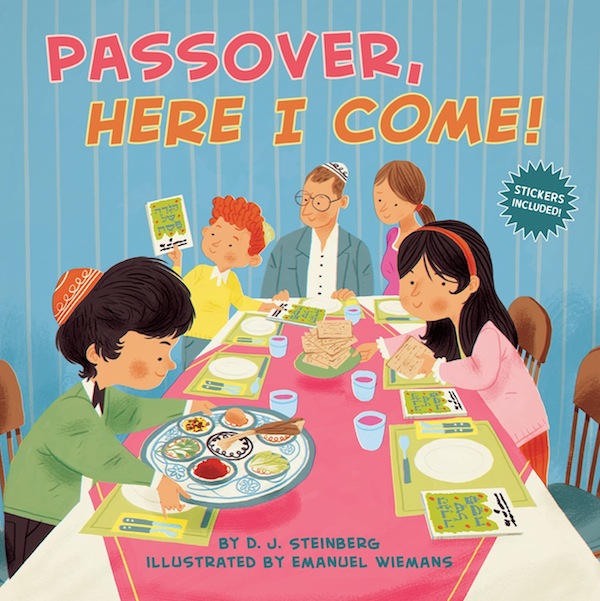
Mini poems that rhyme and colourful  illustrations combine for a family-filled, fun-filled and food-filled holiday book for younger revelers. Hanukkah, Here I Come! (Grosset & Dunlap) by writer D.J. Steinberg and illustrator Sara Palacios is an energetic account that touches upon all the many things a kid might look forward to on Chanukah.

Starting with the setting up of the candles and the stacking of the presents, the meal prep also begins. The children help out their parents.

We briefly learn about the brave Judah Maccabee, “Macca-BAM! Macca-BOOM!” and how he and his brothers made history and the Jews took back their Temple. We light the candles, sharing in the joy with the neighbours across the street, who can be seen from their apartment windows. First gifts are unwrapped and selfies are taken – these illustrations are particularly delightful, as we see and read: “Click! That one cut off my sister.

“Click! Where’s my mother’s head?

“Click! That one’s dark and blurry.

“Click! That’s Mom’s finger instead.”

image - A page from Hanukkah, Here I Come! (Grosset & Dunlap) by writer D.J. Steinberg and illustrator Sara Palacios
A page from Hanukkah, Here I Come! (Grosset & Dunlap) by writer D.J. Steinberg and illustrator Sara Palacios.

There is chocolate gelt, a lesson on how to play dreidel and a visit to Bubbe and Grandpa’s (implying a mixed family perhaps, that the grandfather is not Zayde). Latkes and apple sauce – or are you on Team Sour Cream, instead? – follow. The happy noise of the family celebrating together mounts and dinner is served, with a warning that your jelly doughnut dessert might just explode all over your face.

The last night of Chanukah arrives all too soon.

Editor’s Note: Unfortunately, because of supply chain issues, the publication of Hanukkah, Here I Come! has been postponed to fall 2022.

Format ImagePosted on November 5, 2021November 9, 2021Author Cynthia RamsayCategories Books, Celebrating the HolidaysTags Chanukah, children's books, D.J. Steinberg, Sara Palacios
Chutzpah! back on the stage

Chutzpah! back on the stage

Ophira Eisenberg (photo by Mike Katzif)

Live performances – that you can see in person – are, thankfully, a thing again. At least, for now. And this year’s Chutzpah! Festival, Nov. 4-24, features many shows that people will be able to attend, most of which will also be streamed digitally.

For the two artists the Jewish Independent interviewed this week about the festival, the upcoming performances hold special meaning.

“I am so looking forward to coming back to Canada,” said New York-based comedian and storyteller Ophira Eisenberg, who was born in Calgary. “And Vancouver at that! Where it all started.” Eisenberg performs Nov. 7 at the Rothstein Theatre.

Shay Kuebler/Radical System Art’s Momentum of Isolation sees its world première at the theatre Nov. 13 and 14. The dance company returns to Chutzpah! as resident artists. The Rothstein Theatre and Chutzpah! “have been critical to the growth of Radical System Art and my work as an individual artist,” Kuebler told the Independent, describing the theatre as “the cradle that supported us” during “our infancy as an organization.”

“When I stepped back into the theatre,” Kuebler said, “it was like being back in a close friend’s home. It feels right. There’s a groove and comfort there. This has enabled us to create with as much momentum as possible, both as a company and collective of artists.”

Stepping back into a theatre has been an emotional experience for many artists.

“This spring in New York, I performed numerous times outside,” said Eisenberg. “All of the situations were a little different and, a couple of times, the address of the show was a large tree in a park! It wasn’t ideal and definitely was challenging, but people really wanted to laugh and take in some live entertainment, so it was uplifting.

“My first real performance inside at a comedy club was in early May, when New York opened small performance venues,” she said. “The audience was distanced and masked, and I think they laughed louder and harder than an audience of 3,000 – or maybe my ears weren’t used to hearing live indoor laughter and it sounded explosive. Either way, it almost brought me to tears, and I know I’m not the only one that felt that way.”

Eisenberg comes to Vancouver soon after the final episode of National Public Radio’s comedy trivia show Ask Me Another, which she hosted for nine years, interviewing and joking with numerous famous folk, including Sir Patrick Stewart, Awkwafina, Ethan Hawke and Julia Stiles, among many others.

“After interviewing hundreds of celebrities, authors, musicians,” said Eisenberg, “one thing that stands out to me is that, whenever we talked about a project that meant a lot to an artist, they mentioned that what made that project so successful was the supportive environment – and the fact that they worked with people who allowed experimentation and even failure. That ended up bringing out their best work. I think about that a lot when it comes to creating a space for artists to truly succeed.”

Eisenberg has headlined and performed at countless festivals and appeared on numerous comedy networks and programs. She has her own comedy special, called Inside Joke, and her first book, Screw Everyone: Sleeping My Way to Monogamy (Seal Press), was optioned for a feature film. She is a regular host and storyteller with the Moth, an organization that has become a radio show and  podcast, in addition to putting on live events and other activities.

As for what she would still like to accomplish in her career, Eisenberg said, “I’m working on another podcast that I hope is also long-running! But I have so many things I’d like to do. Maybe too many things! On the docket are writing another book, and I’d love to write for TV. Performing live is my first love, so I’m looking forward to a safer world where that can happen more often.”

Eisenberg’s journey to success began at a young age.

“I truly believe I was drawn to New York as a child from watching Sesame Street!,” she said. “I went to McGill for university, where I got a bachelor’s in anthropology and theatre, then moved to Vancouver for a couple of years, where I tried standup for the first time.

“I was honestly too scared to move to New York,” she admitted, “so I moved to Toronto and spent five years performing and starting to understand my craft. Then, one day, I thought, ‘I need to move to New York now while I can still happily live with a futon and milk crate furniture.’ Two years after moving here, I discovered the Moth…. I love writing jokes, but I was working on other material that just did not fit into the standup mold. I found an outlet of expression at the Moth and in this short form storytelling, and I continue to pursue both.”

When asked to describe her connection to Judaism and/or Jewish community or culture, Eisenberg said, “I have a joke in my act that goes something like this: ‘I was raised Jewish in Calgary, Alberta, or so I thought because when I moved to New York I wondered, “maybe I was raised Protestant?” Everyone in New York is more Jewish than I am. My Puerto Rican neighbour knows more about Judaism than I do.’

“That is just a joke but living in New York is definitely the first time I felt surrounded by pervasive cultural Judaism. My father was the principal of the Hebrew school in Calgary but left that job the year I was born, so I went to public school. We still practised at home and went to synagogue during the High Holidays. As an adult, I’ve definitely been able to find my community here in Brooklyn, which is very wonderful and embracing.”

Exploring isolation

In 2018, before the pandemic sent us all into relative isolation, the United Kingdom appointed its – and, apparently, the world’s – first minister of loneliness, to address the problem as a public health issue.

“Right away, the title of ‘minister of loneliness’ grabbed me,” Shay Kuebler told the Independent. “There’s something very simple about it and it almost feels like a caricature, yet, when you think of someone whose entire work/career is to disrupt loneliness, it becomes deeply serious. When you read about isolation and loneliness, the gravity of this position becomes even more clear.”

The United Kingdom’s action was a catalyst for Kuebler, who noted, “You can now find multiple countries that have ministers of loneliness.”

The work Momentum of Isolation “speaks to a number of ideas around isolation and loneliness,” he said. “By doing so, I hope to open up greater conversations around the topic and maybe have audiences start their own exploration of the topic.”

photo - Sarah Hutton performs in Shay Kuebler/ Radical System Art’s Momentum of Isolation
Sarah Hutton performs in Shay Kuebler/ Radical System Art’s Momentum of Isolation. (screenshot)

Momentum of Isolation explores the theme both through physical isolation and social isolation, explained Kuebler. “These two points are explored through a number of different scenes, which make the show episodic in its structure, with some through-lines and arcs for characters moving all the way through.”

The work has turned out to be even more relevant than Kuebler initially thought it.

“Honestly, this show took on an evolution that I could have never projected,” he said. “The timing of our first full-company research period coincided with the closures and lockdowns across 2020. I knew that this project was important, and being forced into an online/isolated form of research was profound, to say the least.

“This isolated online research, which enabled one-on-one time with each of the company artists, created a well of material,” he said. “It was a format that was completely new, but something I found extremely valuable. While working with each artist one on one, I was simultaneously writing and composing music for the work. This not only led to a lot of new scenes and ideas, but it also distilled what was most relevant and necessary to say.

“For me, this piece was both a rediscovery and a reinforcement of what I hold most valuable. It has brought me back to how and why I want to create. I am grateful for this.”

For those unfamiliar with Radical System Art and dance in general, Kuebler added, “I know when we hear ‘dance’ and, especially, ‘contemporary dance,’ a lot of people can feel hesitant. I want readers and audiences to see this show as more of a ‘contemporary theatre experience.’ It brings together technology, design and multiple art forms around a very relevant – and timely – theme. It is something being made now, through many different artists and their many unique experiences…. With a collaborative approach to connecting with our audiences, we hope to create something new, relevant and accessible.”

For Chutzpah! tickets and the full lineup, visit chutzpahfestival.com or call 604-257-5145.

Format ImagePosted on October 22, 2021October 21, 2021Author Cynthia RamsayCategories Performing ArtsTags Chutzpah!, comedy, dance, isolation, Ophira Eisenberg, Radical System Art, Shay Kuebler, standup, storytelling

Posts pagination

Previous page Page 1 … Page 50 Page 51 Page 52 … Page 161 Next page
Proudly powered by WordPress