Skip to content
  • Home
  • Subscribe / donate
  • Events calendar
  • Business Directory
  • FAQ
  • News
    • Local
    • National
    • Israel
    • World
    • עניין בחדשות
      A roundup of news in Canada and further afield, in Hebrew.
  • Opinion
    • From the JI
    • Op-Ed
  • Arts & Culture
    • Performing Arts
    • Music
    • Books
    • Visual Arts
    • TV & Film
  • Life
    • Celebrating the Holidays
    • Travel
    • The Daily Snooze
      Cartoons by Jacob Samuel
    • Mystery Photo
      Help the JI and JMABC fill in the gaps in our archives.
  • Community Links
    • Organizations, Etc.
    • Other News Sources & Blogs
  • JI Chai Celebration
  • JI@88! video

Recent Posts

  • Federation now across BC
  • Israel fighting for its existence
  • Deal strengthens Iran
  • Patriotic belonging diminishes
  • A campaign to engage
  • Upstanders’ first live event
  • Responding to Carney
  • Having your own home
  • Music a family tradition
  • Musical to warm heart
  • Community milestones … June 2026
  • Sharing her passion for Israel
  • Or Shalom reopens its doors
  • JFS from past to future
  • Need holistic approach
  • Sharing stories, advice
  • Journalist shares fears
  • Skills to live together
  • Road to independence
  • Cutting grass with scissors
  • Zionism as a solution
  • Deceit, desire & the divine
  • Reclaiming sacredness
  • Creative project ideas
  • Summer squares and cobbler
  • Thou shalt … summer commandments
  • Legal help for students
  • Revisiting myth of Lilith
  • Wrong person rebuked
  • Canada’s mixed messages
  • Questions for museum
  • Symposium on antizionism
  • Making soccer political
  • CJPAC lauds Pulver’s impact
  • City recognizes Vrba’s legacy  
  • Organ donation saves lives

Archives

Follow @JewishIndie
image - The CJN - Visit Us Banner - 300x600 - 101625

Category: Arts & Culture

Art dismantles systems

Art dismantles systems

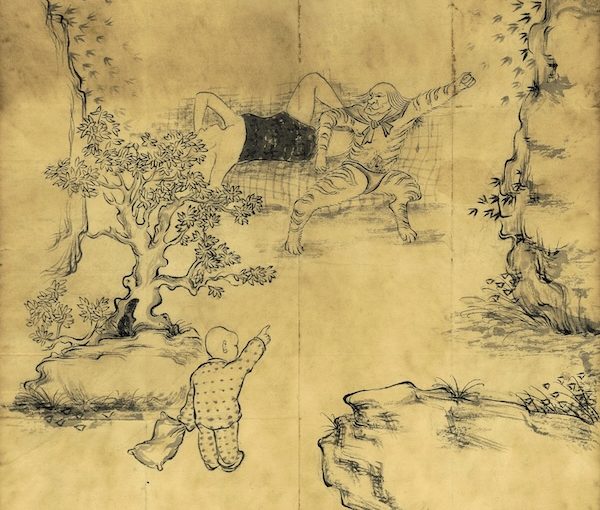
“I Betrayed Him and the Fate of Becoming Him” by Yongzhen Li is part of Li’s solo exhibit – Structures of the Unsaid – at the Zack Gallery. (photo from Yongzhen Li)

On March 5, the Zack Gallery opened its first solo exhibition by a non-Jewish artist in years. Called Structures of the Unsaid, it presents the work of Yongzhen Li, a recent immigrant from China. By coincidence, it is also Li’s first solo show, and the show’s name reflects the artist’s feelings about his native China’s patriarchal culture and collectivist society. 

“The art committee and I asked Li to be part of the Zack Gallery exhibitions over a year ago,” said Sarah Dobbs, the gallery’s curator. 

“His talent, the way he handles the surface of the paper and the themes that we felt resonate with the Jewish community were the primary reasons for selecting him for a solo show,” she said. “The way he works – using ink, rice paper and mugwort water, which stains the surface before the image appears – reflects his deep skills as an artist. This was the primary pull for us to exhibit him. In addition, the water residue acts as a form of embodied memory, recalling the imperative to remember – the surface carries what cannot be seen. 

“His practice emerges from absence, where the creation of each piece is a gesture of repair within fracture, like a quiet form of tikkun, a concept found in the Zohar,” she explained. “Painting is how he wrestles, remembers and remakes meaning. So, the conceptual nature of his work, combined with his skills, was a no-brainer. The committee and I just immediately voted him yes!”

Li and his wife, Jiamin, came to Canada in 2024, settling in Oshawa, Ont.

“I like the food here – so many Asian groceries,” he said with a smile. “But language is hard for me. It’s always been so, even before we came here. Language has always felt too thin. The words seem to flatten what I feel, while images allow it to remain alive.” That’s why he asked his wife to act as his interpreter during his interview with the Independent. 

Li’s road to the arts was not simple. 

“My father is a petroleum worker,” he said. “And so was his father before him. It is traditional in China that a son follows his father’s work. It is a good job, with a decent pay, and it was already arranged for me after I graduated, but I didn’t want to do it. I always felt like an outsider in my family. I didn’t want to know my future for the next 50 years. I knew it wouldn’t make me happy. I wanted to do art. I wanted to be free in my choices.”

That was his first rebellion, his first step against the established routine, but not his last.

“I was about 13 at the time…. By Chinese tradition, children of artists who follow their fathers into art start their artistic training at 6. I was already too old, but I needed to do it. Otherwise, I felt that I had nothing of my own. Fortunately, I had a good art teacher at school,” said Li, adding with a grin: “And I became popular with my classmates.” 

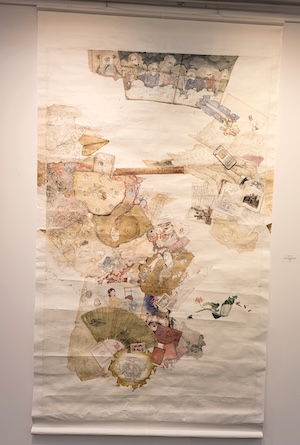
photo - “Underground World” by Yongzhen Li, whose solo exhibit at Zack Gallery runs to April 13
“Underground World” by Yongzhen Li, whose solo exhibit at Zack Gallery runs to April 13. (image from Yongzhen Li)

His next step upon graduation was the Academy of Fine Art in Xi’an, one of the largest cities in China, with an ancient history and a long artistic tradition. The famous Terracotta Army, a UNESCO World Heritage Site, is located just outside the city. The Xi’an academy is considered one of the best art schools in China, but Li didn’t like his time there. 

“There was no creative freedom,” he said. “The professors were rigid, wanted me to copy them, to follow their instructions without thinking. It didn’t work for me.” 

Once more, Li went against the established mode. He quit the academy and found a job to support himself and his wife. He worked with social media while teaching himself to be an artist.

“People thought I was crazy to quit,” he said. “My parents wouldn’t help financially – they didn’t approve of my actions. Besides, they were getting a divorce. And I was already married – we met at the academy. Jiamin was also a student there.” 

When COVID struck, the young couple experienced the restrictions that were placed on people worldwide.

“We became all isolated, had to stay at home,” Li recalled. “But we watched lots on the internet, especially YouTube videos. In China, the world internet is not available – it is illegal there to access YouTube or Google or Facebook. Chinese people have their own limited internet version, allowed by the government, but many young people ignore those restrictions and download apps to watch the real internet. We did too and we learned a lot. We could finally see for ourselves how the world worked. We decided to emigrate to Canada.”

Canada was a revelation to Li. “I’m free here,” he said. 

To make ends meet, Li works for a delivery company, but, in his spare time, he continues to paint and learn, and his art evolves. When he lived in China, his themes tended to be narrow, tied to certain events or ideas, but his latest imagery explores more complex issues of identity, memory and resistance.

“Art has become my emotional refuge as well as a method of self-liberation,” he said. 

It also allows him to process his inner tension and vulnerability, as he struggles for personal and creative autonomy. His large painting “Underground World,” finished in the past month, is symbolic of his current trend of using traditional Chinese motifs and media to address contemporary and universal topics.

The painting looks like a collage, denoting the artist’s inner journey; many aspects intertwine and contradict one another. Family history versus personal fragility. Government direction versus private uncertainty. 

“I am not searching for villains. I am dismantling systems,” Li says in his artist statement. “I refer to structures that appear normal: family control, humiliation disguised as education, and forms of care that carry hidden violence. Tragedy most often happens not through cruelty, but through what is socially justified, well-intentioned and unquestioned.” 

As for his life in Canada, Li said, “I’m thinking of taking some art classes here. There is so much choice, so much freedom for an artist.”

Structures of the Unsaid is on display until April 13. To learn more about Li, visit his website, yongzhenli.com. 

Olga Livshin is a Vancouver freelance writer. She can be reached at [email protected].

Format ImagePosted on March 27, 2026March 26, 2026Author Olga LivshinCategories Visual ArtsTags art, China, immigration, painting, social commentary, Yongzhen Li, Zack Gallery

What is Jewish music?

On March 8, Joshua Jacobson, professor emeritus of music at Northeastern University in Boston, Mass., spoke on the topic Jewish Music: What’s That?

photo - Prof. Joshua Jacobson was the latest speaker in Kolot Mayim’s Voices of Jewish Music series
Prof. Joshua Jacobson was the latest speaker in Kolot Mayim’s Voices of Jewish Music series. (internet photo)

The Zoom lecture was the fifth of six talks in Kolot Mayim Reform Temple’s 2025/26 Voices of Jewish Music series.

How can music even be Jewish? Jacobson asked. Does music keep kosher? Is music circumcised? Did music have a bat mitzvah? He played an excerpt of African-American clarinetist Don Byron performing the klezmer number “Der Nayer Doyne.” 

“You don’t have to be Jewish to compose or perform Jewish music,” he said. “And that’s why I prefer the terminology, the music of the Jewish people. Although I will admit that, for the sake of convenience, I often do use the term Jewish music.”

But the question of what constitutes Jewishness remains. The word represents an ever-widening expanse, including an abundance of liturgical music, a vast array of music influenced by the cultures in which Jews have lived and the languages they have spoken, and the contributions of Jews who have entered the community by choice.

“There is no single Judaism, not anymore. It’s a big tent,” Jacobson said.

One school of thought Jacobson pointed to came from Swiss-American composer Ernest Bloch, who said, “Racial consciousness is something that every great artist must have. A composer who says something is not only himself, he is his forefathers. He is his people.”

Leonard Bernstein wrote in his senior thesis at Harvard University in 1939: “It is easily understandable that a composer whose parents were immigrants still maintains a close contact with the old racial traditions. If their traditions are part of his childhood, they are inevitably part of his life.”

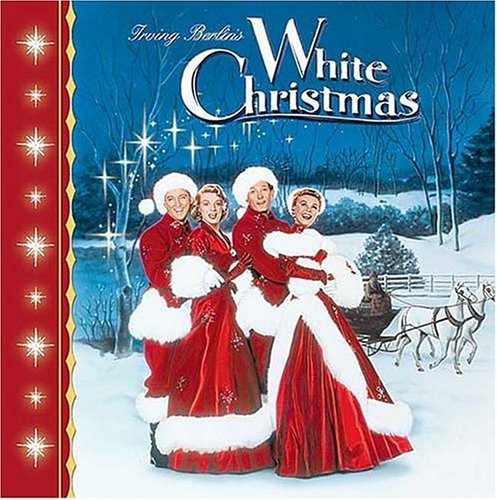
Jacobson played Irving Berlin’s “White Christmas” to illustrate that any music composed by a Jew could be considered Jewish music.

The Nazis, however, defined Jewish in purely racial terms, Jacobson said. They would not allow any music written by a Jew to be heard or even studied in Germany and German-controlled countries. Nor would the Nazis allow Jewish-German conductor Bruno Walter to lead a concert of Ludwig van Beethoven’s works. Jews, the Nazis believed, would spoil the music with their “Jewish accent.”

Jacobson played excerpts of Beethoven’s Symphony No. 6, asking if members of the audience could distinguish between a performance led by Walter and one by conductor Wilhelm Furtwängler.

“How many of you think that the first one was conducted by a Jew? How many of you think the second one was conducted by a Jew? How many of you think that it’s a ridiculous question? – which, of course, it is. Did one of these have a discernible ‘Jewish accent’? No,” Jacobson said.

image - In his March 8 talk, Prof. Joshua Jacobson gave Irving Berlin’s “White Christmas” as an example of how any music composed by a Jew could be considered Jewish music
In his March 8 talk, Prof. Joshua Jacobson gave Irving Berlin’s “White Christmas” as an example of how any music composed by a Jew could be considered Jewish music. (internet image)

Defining what constitutes Jewish music by what exists within borders or, as in much of Jewish history, in exile, can be an equally insurmountable task. As an example, Jacobson played part of a track from Arab-Israeli hip-hop group DAM, which is in Hebrew.

Many Israelis write music that doesn’t sound geographically constrained, he said.

Nonetheless, the professor did offer a definition of traditional Jewish music in his talk, saying it is music that has been used – whether sung, played or listened to – by Jews more than by other people, and, therefore, it has become associated with Jewish people.

Cantillation, the way the Torah and other biblical books are chanted, is the oldest form of Jewish music, Jacobson said. Demonstrating the cantillation styles of Babylonian, German and Yemenite Jews, he showed that the practice is similar, although not entirely the same, in Jewish communities throughout the world.

“Some scholars think that these are variations on an ancient theme, he said. “The variations are due to acculturation. German cantillation betrays the influence of German music. Yemenite cantillation betrays the influence of the culture in which they lived, the Yemenite culture.”

Jacobson said we find Jewish music in many styles and periods, and perhaps the problem in seeking a definition is that there are so many Jewish “musics.” He returned to Bloch, who once said that he could not say what Jewish music is, but one knows it when it is heard. According to Bloch, “It is something that both you and I can recognize and feel, even if we cannot analyze it.”

To Jacobson, the term Jewish music “is itself a wide tent in which all may not agree on a definition, but it’s something that we cherish, and something that fulfils us.”

An authority on Jewish music, Jacobson is also the founder and director of the Zamir Chorale of Boston. He has guest-conducted many ensembles, including the Boston Pops Orchestra, the Bulgarian National Symphony and Chorus, the New England Conservatory Orchestra and the Boston Lyric Opera Company. He has written articles on various aspects of choral music and has published more than 100 compositions and arrangements.

The final speaker in this year’s Voices of Jewish Music series is author Michael Posner on April 12 at 11 a.m. Posner will explore Leonard Cohen’s Jewish heritage, philosophy and musical legacy – and how Judaism influenced Cohen’s lyrics, philosophy and life. For more information, visit kolotmayimreformtemple.com. 

Sam Margolis has written for the Globe and Mail, the National Post, UPI and MSNBC.

Posted on March 27, 2026March 26, 2026Author Sam MargolisCategories MusicTags Jewish music, Joshua Jacobson, Kolot Mayim, speakers, Voices of Jewish Music

The hidden hand of hate

Warren Kinsella has spent much of his career studying the darker corners of political life. A lawyer by training, author of about a dozen books and a longtime political strategist, he has written about Holocaust denial, far-right extremism and organized hate movements. 

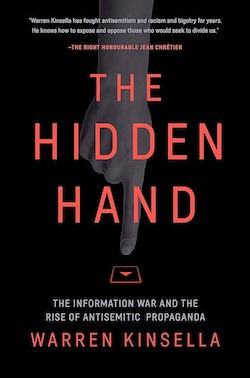
In his just-released book, The Hidden Hand: The Information War and the Rise of Antisemitic Propaganda, he follows these threads down the unseemly rabbit hole that has perplexed many observers since Oct. 7, 2023: the sudden and superficially spontaneous eruption of anti-Israel activism across Western campuses and cities in the aftermath of the horrendous atrocities of that day.

Kinsella’s thesis is straightforward and, to most readers of these pages, probably neither controversial nor surprising. The worldwide surge in anti-Israel protests, he argues, is not organic. Rather, it reflects a long-developed propaganda infrastructure – the “hidden hand” – involving the Iranian regime, Hamas, Hezbollah and a constellation of worldwide activist organizations that have spent years building networks capable of shaping Western public opinion.

Hamas, Kinsella argues, fights two wars simultaneously. One is the familiar military campaign conducted with rockets, bullets and suicide attacks. The other is an information war, waged through imagery, messaging and propaganda. Israel may well win the first war, he suggests, but the second – the battle for global public opinion – is far less certain.

The book opens with the immediate aftermath of the Hamas attacks of Oct. 7. While Israelis were still grappling with the scale of the massacre, demonstrations against Israel began sweeping Western campuses and cities. In the United States, a “national student walkout” took place within days of Oct. 7. Activists insisted these events were spontaneous expressions of outrage over the war in Gaza – but many of them took place before there was even a war in Gaza.

Many of the protests, Kinsella writes, appeared to have been organized rapidly with shared messaging, identical slogans and coordinated materials. Student groups that claimed to be independent grassroots organizations were often connected to larger activist networks. Manuals, posters and protest toolkits circulated almost immediately.

image - The Hidden Hand book coverThis pattern is central to the book’s argument. What looks like decentralized activism, Kinsella contends, often reveals indisputable signs of coordination.

One of the more striking anecdotes in the book involves Gary Wexler, a California professor who worked with the Ford Foundation on programs in Israel and Palestine during the Oslo peace process. Wexler recalls being warned by a leading Palestinian civil society coordinator that pro-Palestinian networks would one day rival – and surpass – the vaunted Jewish advocacy organizations in their ability to mobilize globally. Funding, the activist reportedly told him, would come from European institutions, Arab governments and wealthy donors.

Years later, Wexler began to see the prediction materialize in movements such as the push for boycott, divestment and sanctions (BDS), Israel Apartheid Week and international flotillas challenging Israel’s blockade of Gaza.

Kinsella stops short of claiming a single command centre orchestrating these movements. Instead, he suggests a looser ecosystem in which state actors, activist organizations and sympathetic nongovernmental organizations amplify one another’s messaging.

If there is a common theme running through the book, it is the power of narrative.

According to Kinsella, Hamas and its allies have been remarkably successful at shaping the language through which the conflict is discussed in the West. Terms such as “colonialism,” “apartheid” and “genocide” now dominate activist discourse, particularly among younger audiences. These ideas circulate widely on social media platforms, where emotionally charged content spreads faster than verified information.

The book devotes considerable attention to misinformation and the speed at which it travels. One example Kinsella cites is the widely circulated claim that Israel had bombed the al-Ahli Arab Hospital in Gaza, killing hundreds of civilians. The allegation ricocheted around the world within hours, sparking protests and diplomatic condemnations from the highest levels. Later evidence indicated the explosion was caused by a misfired rocket from Palestinian Islamic Jihad – and that the casualty figures had been exaggerated exponentially. The correction, of course, traveled neither as far nor as fast as the original claim.

Social media algorithms amplify this dynamic, Kinsella argues, pushing users toward increasingly extreme content. The phenomenon is not unique to Middle East politics. The same mechanisms drive conspiracy theories about vaccines, elections and countless other subjects. But, in the case of Israel, he suggests, the misinformation taps into something older and deeper: an antisemitic proclivity to believe the worst and most fantastical allegations about Jews.

In the contemporary context, antisemitic narratives often blend with modern ideological frameworks. In activist discourse, Jews are sometimes recast as embodiments of colonialism or “whiteness,” placing them on the oppressor side of social justice frameworks. The result, Kinsella suggests, is a rhetorical environment in which hostility toward Israel can slide easily into hostility toward Jews.

Polling data cited in the book underscores the generational divide in attitudes toward the conflict. Surveys in North America and Europe have found large numbers of younger respondents expressing sympathy for Hamas or believing that the 10/7 attacks were justified. Other polls show significant numbers of young people convinced that Israel is committing genocide. Such findings shocked even the pollsters who conducted them.

Kinsella argues that universities have played a significant role in shaping these attitudes. For decades, he writes, academic discourse has increasingly framed Israel through the lens of “settler-colonialism.” At the same time, foreign governments – particularly that of Qatar – have donated billions of dollars to Western universities.

The media also come under scrutiny. Western news organizations, he argues, routinely rely on casualty figures supplied by the Hamas-controlled Gaza Health Ministry, numbers that critical analysis suggests are inflated, particularly in terms of non-combatant casualties. Journalists reporting on what’s happening in Gaza frequently depend on local stringers who operate either directly under Hamas authority or in a context where anything but pro-Hamas reporting is existentially dangerous. This situation effectively grants terrorist propaganda the imprimatur of legitimate media platforms.

Because Kinsella is Canadian, The Hidden Hand is rife with Canadian content. This will be interesting to Canadian readers – and a meaningful contribution to the sad litany of incidents in this country – but it is additionally relevant because Canada has been among the worst places for these sorts of offences. Last year, an Israeli government report analyzing the problem worldwide called Canada the “champion of antisemitism.” So, while Canada may not be a major player in many of the world’s foremost competitions or concerns, when it comes to anti-Jewish discrimination, we regrettably find ourselves owning the podium. That makes what happens here – and how (or whether) we confront it – especially relevant.

The thesis of Kinsella’s book, of course, is that these problems know no boundaries (figuratively or literally).

Much of the evidence he presents is circumstantial rather than definitive. He has found no single document or intercepted communication that proves the existence of a centralized propaganda command. The accumulation of connections, coincidences and patterns is what gives the book its force, but Kinsella does not provide the proverbial smoking gun. This is partly understandable because, if there were incontrovertible proof linking ostensibly legal, legitimate activist groups in Canada and around the world with known terrorist entities, surely Western governments would have acted by now.

Ah, but there’s the rub. The very fact that someone like Kinsella, without, say, top-level security clearance, could amass such a damning catalogue of evidence begs the question of just how much effort governments and security services are devoting to this problem. That so many deeply problematic and potentially illegal cases in Canada, including here in British Columbia, have not resulted in charges or even, seemingly, any serious investigation, makes Kinsella’s book especially valuable. If there is this much smoke, where are the governmental and security agencies that are supposed to be the firefighters?

Whether one accepts all of Kinsella’s conclusions or not, The Hidden Hand forces readers to confront the possibility that the global conversation about Israel is shaped by forces far more organized and odious than many seem willing to believe.

If Hamas fights both with bombs and with words, as Kinsella argues, then the information battlefield may prove just as consequential as the physical one. And, on that battlefield, the outcome is still very much in doubt. 

Posted on March 27, 2026March 26, 2026Author Pat JohnsonCategories BooksTags antisemitism, books, government, media, propaganda, protests, rallies, The Hidden Hand, Warren Kinsella
Drawing on his roots

Drawing on his roots

Multi-instrumentalist and songwriter Ezra Ben-Shalom’s debut solo album, Known and Unknown, was released in 2025. (photo by Michelle Behr)

With his debut solo album, released last year, Kelowna musician Ezra Ben-Shalom shows off his personal side, with a uniquely Jewish touch. 

For Ben-Shalom, who reconnected to Jewish ritual practice around five years ago, Known and Unknown – his first solo project – is a deeply personal one. The focus of his music and daily life has become all about asking questions, he said. It’s about finding ways to be of service in the world and creating a connection with something larger than himself.  

“I’m doing my best to be of value to the world and to the culture. And, you know, you step in front of a room of people and take a deep breath and open your mouth and sing – I want to offer something that’s real, that’s authentic and that’s meaningful,” the 43-year-old said in a phone interview.

The album is highly Jewish-inspired, owing to his own reconnections – and, he said, he hopes it will encourage empathy among listeners.  

“I think the album title was maybe a hint to myself to come from that place of humility, that we don’t have the answers, as much as we think we know or that we learn,” said Ben-Shalom. 

The songs on Known and Unknown include some Hebrew words, and the sounds of a shofar on two tracks, though the lyrics are largely in English.

Jewish themes shape much of Ben-Shalom’s interpretation and highly personal expressions; however, he emphasizes that, while his path is Jewish, he sees the disc’s new compositions as something more broadly accessible. The songs, he said, are “about inner experiences and feelings and reflections, and they’re about living in the world as a human being, not as a Jewish human being.”

Themes of transformation, vulnerability and boldness underline the album’s adult alternative and folk-adjacent sounds, and Jewish references abound, with songs titled “Shechina,” “Shake the Dust,” and “El and Gil.” 

New name, old passion

Ben-Shalom is the new-ish musical handle of producer and multi-instrumentalist Ezra Cipes, who grew up in Kelowna and has played in bands since he was 14 years old, he told the CJN.

By the time he was 19, Cipes and one of his three brothers co-wrote a song with Indian-born Canadian punk/alternative music icon Bif Naked, who grew up in Winnipeg. He’s also performed regularly and recorded with the Calgary-born indie-pop-folk artists Tegan and Sara. (Bif Naked’s bassist, Chris Carlson, produced, co-wrote and played most of the other instruments on Ben-Shalom’s 2025 album.)

Prior to the new project, another band featuring the musical Cipes family had been nominated in 2022 for a Juno Award in the children’s music category for the second disc by the troupe, called the Oot n’ Oots. The five-piece band comprised Ezra; his three brothers, Matthew, Gabe and Ari; and his daughter, Ruthie, who was the singer.

When that project wound down following the end of 2023 summer festivals, the guitarist and keyboard player turned to exploring a different expressive musical language. He had set out on that musical exploration when the Oct. 7, 2023, attacks by Hamas in Israel, which triggered the Gaza war, refocused his artistic lens.

“Oct. 7 put a lot of things into focus and showed the ways that, really, we’re all lost in one way or another,” he said. 

The way the world responded after Oct. 7 was a “frustrating and painful” experience, he said.

“You think, ‘What can any of us do?’ And none of us can fix it – you can’t completely change all these cultural narratives and people’s ideas and correct the record or bring a higher perspective on our own, but we can do our part. We can stand strong in our own truth and share it, proudly and with strength and humility.” 

Explaining that he’s always needed “a little spiritual medicine in my life,” Ben-Shalom described reading at night, from literature and philosophy to spiritual and self-help books, and had long realized he needed to do that, even before he connected with Judaism.  

Pivotal turn to Judaism

Growing up, while his family – who own a successful organic vineyard – belonged to a local synagogue, they weren’t traditionally observant, though he became bar mitzvah and attended Jewish summer camp. 

But, as an adult, he reflected, he was “totally disconnected” when it came to traditional Jewish practice and observance. 

It was a moment in 2020, early during the pandemic, following a sweat lodge ceremony led by Ron Hall, a longtime family friend who’s an Indigenous artist and biologist, that brought Ben-Shalom an epiphany. 

“It [the sweat lodge] was one of those moments that really flipped a switch in my whole life, and it was just a hinge moment. I thanked him [Hall] for the ceremony, and I shared with him how powerful it was and how meaningful it was, how deep it was,” said Ben-Shalom.

“And I said to him that he’s lucky to have the traditions to draw on to connect with his own soul and with the creator and I said to him: ‘All I have is this shallow materialistic Western culture.’ 

“And he said, ‘What are you talking about, Ezra? You’re Jewish. You come from an Indigenous people.’”

Nobody had ever said that to him before, Ben-Shalom recalled, and it became a turning point.  

“I had grown up thinking it was cool to be Jewish and, like, neat, but also vaguely embarrassing to be Jewish, and it was something I didn’t really like to talk about or get into very much because … I always felt othered,” he said.

The COVID-era wave of social justice movements brought a resurgence of ideas “about decolonization and equality,” he said. “It’s good to support the Indigenous people keeping their culture, keeping their language, keeping their tradition, keeping the oral culture alive.”

He felt a tinge of hypocrisy. “And then I realized I was not honouring my own ancestors and I didn’t know my own language. I didn’t know my own story,” he said. 

Ben-Shalom now attends the local Chabad, lays tefillin and wears tzitzit and a kippah.

He described one of the first times he performed the new music at a live show at the Kelowna venue Revelry in 2024. 

“I got off stage and my whole body was sore, from holding myself and breathing and keeping myself grounded and keeping myself in a state of service,” he said. (Since then, he’s felt “a little bit more relaxed” performing the new material.) 

“The songs are almost like prayers, and you have to kind of get into that place to sing them, where there’s a genuine connection and not just notes and not just words.” 

Ben-Shalom hopes to bring the album in a live performance to audiences across Canada, and to ensure that includes Jewish audiences, he told the CJN. 

“I’d like to play for all audiences that will have me, but, in particular, I want to go and play for Jewish people,” he said. “I want to share these songs with Jewish people. I want to bring inspiration, pride and honour to our tradition, to Jewish people.” 

Jonathan Rothman is a reporter for the CJN based in Toronto. This article was originally published on thecjn.ca and is reprinted with permission.

Format ImagePosted on March 27, 2026March 26, 2026Author Jonathan Rothman The CJNCategories Local, MusicTags Ezra Ben-Shalom, Judaism, Kelowna, music, Oct. 7
Remain vital and outspoken

Remain vital and outspoken

The stars of Stacey Tenenbaum’s documentary Tough Old Broads, playing at VIFF Centre March 14 and 17: Kathrine Switzer, left, Sharon Farmer, centre, and Siila Watt-Cloutier. (screenshots from film)

If you’re feeling hopeless about the state of the world – or you just want to know more about some incredible people who have spent their lives making the world a better place – head to VIFF Centre March 14 or 17 to see Stacey Tenenbaum’s Tough Old Broads. 

The feature-length documentary features Sharon Farmer, the first woman and first person of colour to be director of White House photography; Kathrine Switzer, the first woman to officially run the Boston Marathon; and Siila Watt-Cloutier, the first woman to connect climate change to human rights (garnering a 2007 Nobel Peace Prize nomination for that work).

Watt-Cloutier, who calls Kuujjuaq, Que., home, also lived in Iqaluit, Nunavut, for 15 years or so. She was a pioneer in fighting for environmental protections, starting in earnest in the 1980s, when it was realized that pesticides and other toxic chemicals were poisoning the marine mammals that the Inuit were eating, ending up in the breast milk of Inuit women. At the time, Watt-Cloutier was head of the Inuit Circumpolar Council, which represents Inuit from Alaska, Canada, Greenland and Chukotka, Russia, on international matters. She has been instrumental in several actions that have changed how people think about climate justice.

In the documentary, she talks about negotiating with the United Nations from the perspective of being a mother. She says, “How could Inuit women be carrying this burden of, if I eat my country food, I’m going to poison myself and my children? At each UN talk, I continuously intervened to educate people on the importance of Inuit culture and how the world needs to do things differently.”

More than 40 years later, she continues to speak internationally, educating people about Inuit culture and the environment. In the film, at a conference, she shares one of the lessons she has learned: there will always be tough moments and “it is really about sticking with it and not giving up during those periods of time because those are the moments that you are meant to be at to raise your next level of consciousness, those are the moments that are making you, not breaking you.”

Not giving up is a key message from Farmer, too. The photographer was part of the civil rights movement in the 1970s, capturing images of the protests at Ohio State University; she was a student there at the time. Her career was spent fighting for social justice and documenting key moments in American history with her camera, including when she was at the White House (during the Clinton administration). She continues to do so.

Right after the 2024 election of Donald Trump, Farmer, who lives in Washington, DC, comments on the lack of people at the White House gates.

“If you don’t register displeasure,” she says, “everybody thinks what happens is OK – and I mean around the world, too. I don’t want that tale of woe to be our legacy. Our legacy should be we still have courage, we still don’t like what’s going on and we’re not giving up. I don’t see that happening down here today, and that’s the disappointing part.”

The third subject of Tough Old Broads is Switzer, who, while running the Boston Marathon in 1967, was literally attacked by race official Jock Semple, so outraged was he by her participation. Switzer’s coach, Arnie Briggs, running alongside her, body-checked Semple out of the way and she finished the race. This was the seminal moment in her life of activism, which has included helping bring the women’s marathon event to the Olympics (1984) and founding the nonprofit 261 Fearless, “261” having been her bib number in the 1967 marathon.

Switzer continues advocating for and mentoring women, pushing for equality. She says in the film: “There is so much to do and I still feel responsible…. It hasn’t been finished yet, and it is very simple. If you put the hard work in, if you pay attention, if you ‘work the phones,’ as we used to say, if you show up, is the biggest thing. That is the key point. It’ll happen. I’m not saying you have to be patient, I’m just saying we have to be persistent.”

Watt-Cloutier and Farmer would likely agree.

Tenenbaum, who is a member of the Montreal Jewish community, said in the press release: “I made this film to share the wisdom and experience of older women with a new generation and to inspire all people to remain vital and outspoken as they age.” 

At tougholdbroads.com, people can read more about the film, find some data on the status of women’s equality and download a discussion guide. It is hoped that the documentary “will spark a movement of women, both young and old, to embrace their power, speak out and demand attention.”

For tickets to the Vancouver 1 p.m. screenings, go to viff.org. 

Format ImagePosted on March 13, 2026March 12, 2026Author Cynthia RamsayCategories TV & FilmTags activism, centre, documentaries, Kathrine Switzer, left, Sharon Farmer, Siila Watt-Cloutierr, Stacey Tenenbaum, Tough Old Broads, VIFF, women
An urgent play to see

An urgent play to see

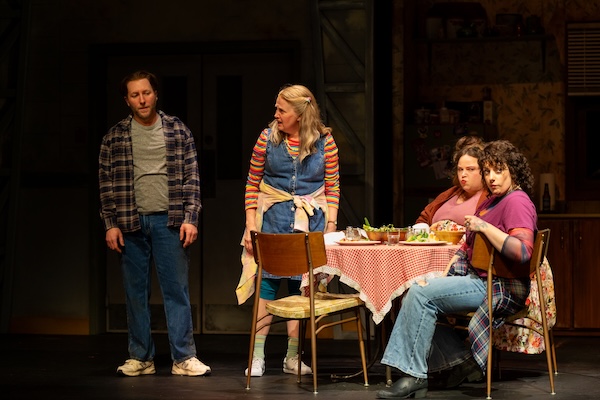
Synthia Yusuf  stars in Kat Sandler’s Wildwoman, which runs March 26 to April 4 at Gateway Theatre, a co-production with Alberta Theatre Projects. (photo by David Cooper)

“Wildwoman is a story that celebrates women who refuse to be silenced and reminds us that theatre can be funny, wild, fearless and alive. With such an amazing cast and design team, we are thrilled to bring this sumptuous theatrical production to life on our stage,” said Barbara Tomasic, executive artistic director of Gateway Theatre, where Toronto Jewish community member Kat Sandler’s play can be seen March 26 to April 4. (Sandler also wrote Yaga, which Crave is making into a series.)

Wildwoman reimagines 16th-century French history, specifically the story that helped shape the legend of Beauty and the Beast. It centres on Catherine de Medici, the new wife of King Henry II of France, who is played at Gateway by Synthia Yusuf. Eager to be on the king’s council, Catherine quickly learns that her political aspirations matter far less than her ability to produce an heir. Surrounded by scheming courtiers, a powerful royal mistress and a male-dominant court obsessed with legacy and control, Catherine feels trapped inside this patriarchal world. That is, until she meets Pete, a wildman kept in the dungeon as one of the king’s caged oddities, who awakens her wild side.

“When I first read this play, it was like my body was filled with bees; I felt inspired, furious and delighted,” said Jamie King, director of the local co-production with Alberta Theatre Projects. “The play looks at power, at fertility, at legacy, all unflinching and full of humour. It’s inspiring to find new plays that are able to speak about both our human history and contemporary issues with such insight and still make it feel alive and fun. This is an urgent play that needs to be seen.”

Tickets start at $37, with a pay-what-you-will option. Go to gatewaytheatre.com or call 604-270-1812. 

– Courtesy Gateway Theatre

Format ImagePosted on March 13, 2026March 12, 2026Author Gateway TheatreCategories Performing ArtsTags Barbara Tomasic, Jamie King, Kat Sandler, Wildwoman
Tapping into their creativity

Tapping into their creativity

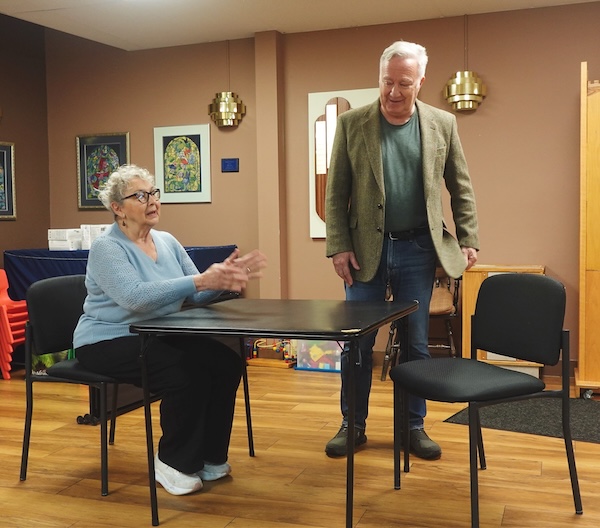
Sidi Schaffer (standing) has been leading an art class at the Weinberg Residence since last October. (photo by Vanessa Trester)

Sidi Schaffer, a well-known Vancouver artist and art teacher, moved to the Weinberg Residence last August. “My husband passed away in June, and I didn’t want to be alone in our big house,” she told the Independent. “Here, I’m not alone.”  

No matter where she lives, Schaffer is an artist at heart, and her art always finds an outlet. In this case, it is a class for Weinberg residents.

“I approached Vanessa [Trester, manager of the Weinberg Residence], and suggested I start an art class,” Schaffer said. “I’ve been an art teacher for decades. I have so much to share with my students.”

Trester agreed with the suggestion and Schaffer’s sessions started last October.

“The official name of the class is Fun Exploring Art with Sidi Schaffer,” said Trester. “Besides the opportunity to learn about art and artists, the students can tap into their creativity with Sidi’s direction. The class provides the residents with joy, lifts their spirits, and brings connectivity through their shared stories.”

Participation in the Monday classes fluctuates between eight and 12 people. “Not everyone can come all the time,” said Schaffer. “The residents here are not young. Someone has a headache or a doctor’s appointment, or their family is visiting. But people come when they can. We put on classical music in the background. I bring some art supplies – I have a lot of brushes and paper and paints – plus what Vanessa bought, and we have fun. As long as my students are happy, I’m happy.” 

Her class makes many attendees happy. One of them, Helen Sankoff, told the Independent: “I don’t have any prior experience creating art, but I used to knit, do needlepoint and make jewelry as a hobby. Now, I attend Sidi’s class because she is a wonderful artist and teacher. She introduces us to many different artists and ways of painting, and I find her art class very relaxing. We have classical music playing in the background, and it’s my favourite time of the week.”

As an experienced teacher, Schaffer doesn’t set impossible goals for herself or her students. “I’m not trying to teach them deep painting techniques,” she said. “They don’t have to create masterpieces. I’m trying to show them how to express themselves through artistic means. Creating art is not a focus in this class, it is a side benefit. The focus is to enjoy it.” 

She enjoys it too and uses famous artists and art history as inspiration. Her artistic education is extensive: first in her native Romania, then in Israel and, finally, in Canada. She has lived, studied and worked in all three countries.

Schaffer shares her love for various art movements with her students.

“We started with Van Gogh. I brought Van Gogh’s reproductions to the class, and some sunflowers,” she said. “First, I told them about Van Gogh, his life and his art. Then, I set up the sunflowers and the students painted them.”  

From Van Gogh, she proceeded to Paul Cézanne. “He painted landscapes and still life, and I brought apples to the class to paint,” said Schaffer.

One class was an introduction to Claude Monet and his waterlilies. “I had some photos, and some of the students saw those paintings when they visited Paris years ago,” she shared.

After French impressionists, Schaffer decided it was time for Canadian art, particularly the Group of Seven. But, she started with Ted Harrison and his Northern Lights, bringing in his books. She had her students imitate his style. 

“I want us to have a field trip to the Vancouver Art Gallery, to see Emily Carr’s paintings. It will probably happen as soon as we have some volunteers available,” she said. 

In the meantime, Schaffer has switched to Australian aboriginal art, where every image is comprised of dots. “It is amazing what can be done in this technique,” she said. “It is very suitable to my students, an easy technique, as each one of them is over 80 years old. Some suffer from arthritis and have trouble holding a brush.”

One participant’s paintings “are similar to each other, no matter which artist I tell them about,” said Schaffer, but they enjoy the class, “and that is the most important outcome.”

Schaffer’s classes are eclectic, covering a variety of styles, materials and methods. In one class, she concentrated on First Nations artist Daphne Odjig. Another time, she talked about avant-garde artist Georgia O’Keeffe. She has focused on the importance of perspective in painting. 

“I want to have a class about painting body and face. I want to buy some clay for a sculpture class and we’ll have a mask-painting class for Purim,” she said before the holiday. “I push my students not to be realistic – to express their inner world, not copy the street outside. Art should be playful.” 

One of her favourite techniques is collage that uses dry flowers and leaves. “They are so beautiful, so transparent, like visual poetry,” said Schaffer, who has albums of material. “I’ve always wanted to preserve their beauty, have done it since childhood. The designs on each leaf are unique. Some of them remind me of a place or a time.”

Schaffer has “no end of ideas for new classes.”

“Other artists – Chagall, Picasso – and other techniques,” she said. “I want to get some old magazines and art books to cut for collages. Perhaps the Waldman Library has some for sale. We’ll have fun in that class.” 

Olga Livshin is a Vancouver freelance writer. She can be reached at [email protected].

Format ImagePosted on March 13, 2026March 12, 2026Author Olga LivshinCategories Visual ArtsTags art classes, art history, education, seniors, Sidi Schaffer, Vanessa Trester, Weinberg Residence
Dialing up the perfect thriller

Dialing up the perfect thriller

Tyrell Crews and Emily Dallas in Dial M For Murder, mounted by Theatre Calgary in 2025. Crews and Dallas reprise their roles in the Arts Club Theatre Company and Theatre Calgary co-production now playing at the Stanley until March 8. (photo by Trudie Lee for Theatre Calgary)

What do a latch key, a handbag, a compromising letter, two blackmail notes and an unexpected telephone call have in common? They are the primary clues in what is supposed to be the perfect murder – you know, the one you get away with. This is the premise for the Arts Club Theatre Company and Theatre Calgary co-production of Dial M for Murder, now playing at the Stanley. 

Frederick Knott’s 1952 play was adapted for cinema early on, with the 1954 thriller starring Grace Kelly and Ray Milland directed by the master of suspense himself, Alfred Hitchcock. About six ago, playwright Jeffrey Hatcher updated the story to add a contemporary and surprising twist. While the 1950s London setting has been preserved, giving it that quintessential British vibe, the cheating wife’s lover is now a woman – definitely a taboo to audiences of that era. Hatcher has also injected comedic moments and witty bon mots into the script, in contrast to the more noirish original.

This is not a murder mystery where the sleuthing detective ultimately exposes the culprit. In this iteration, we know from the beginning what the plan is, how it is to be executed and by whom – the only question is whether the perpetrator will get away with it.

It all starts when Tony Wendice (Tyrell Crews) discovers that his heiress wife, Margot (Emily Dallas), is having an affair with murder mystery writer Maxine Hadley (Olivia Hutt). Since he married Margot for her money, not love, he has no qualms about doing away with her to inherit her fortune. However, he does not want to do the dirty deed himself, so he blackmails a distant acquaintance from his past, Lesgate (Stafford Perry), to carry out the hit. Unfortunately, the plan backfires. Enter Chief Inspector Hubbard (Shekhar Paleja) of Scotland Yard, who, with Maxine’s assistance, attempts to recreate the murder scene to ferret out the mastermind behind the plot. But will they succeed?

Tony is front and centre of the narrative. At the beginning, he is in full control of the situation, callously planning the murder with painstaking attention to the details. He takes the art of manipulation to new heights. As his plan starts to unravel, we see the layers of his confidence peel away. 

Crews commands the role of Tony and Perry ably portrays Lesgate’s nervousness and angst in confronting Margot with the news that he is about to kill her. Dallas, who portrays Margot in a rather subdued fashion initially, is sublime in her portrayal of the hunted housewife, taking the audience on a melodramatic roller-coaster ride of emotions. Flamboyant Hutt infuses the character of Maxine with intelligence, charm and sleek sophistication, and comes across as the smartest person in the room. 

It is a testament to the abilities of these actors that such a small cast can pull off the highs and lows of this psychological thriller. They are assisted in this feat by a talented design team, including Jewish community members Itai Erdal, whose pinpoint lighting directs the audience’s attention to significant clues during scene breaks, and Anton Lipovetsky, whose sound design increases the suspense. 

Then there is set designer Anton deGroot’s revolving turntable stage. All the action takes place in the Wendices’ sparsely furnished drawing room, which slowly and imperceptibly moves back and forth, providing the audience with different perspectives of the action and emphasizing the fluidity of the story. Even the walls and windows move, providing additional layers to the puzzle. 

Jolane Houle’s costumes capture the essence of the stylish 1950s, elegant frocks for the ladies and tailored suits for the gents, all with colour palettes ranging from brown to blue to green that change with Erdal’s lighting. The ladies are perfectly coiffed and made-up à la that glamorous era. Jillian Keily directs her crew well.

This dialogue-dense production requires the audience to pay attention and focus on the various subtle clues that are dropped to determine if indeed Tony gets away with his deception and betrayal. It’s a cat and mouse game at its finest. 

Dial M for Murder runs to March 8. For tickets, go to artsclub.com or call 604 687-1644. 

Tova Kornfeld is a Vancouver freelance writer and lawyer.
Format ImagePosted on February 27, 2026February 26, 2026Author Tova KornfeldCategories Performing ArtsTags Anton Lipovetsky, Arts Club, Dial M for Murder, Itai Erdal, plays, theatre, Theatre Calgary, thrillers
Songs in war of peace

Songs in war of peace

Naomi Cohn Zentner shared how music in the time of war can offer resilience and hope. (photo from Naomi Cohn Zentner)

Earlier this month, ethnomusicologist Naomi Cohn Zentner gave the lecture Music and War: An Optimistic View. Her talk was the fourth in Kolot Mayim Reform Temple’s 2025/26 Many Voices of Jewish Music Zoom series.

Speaking from Israel, Cohn Zentner, a lecturer at Bar-Ilan University, examined how music in the time of war can offer resilience and hope, and is not solely about tragedy and mourning. She started with a photograph of Leonard Cohen and Israeli musician Matti Caspi, who passed away on Feb. 8, the day of her talk. The pair were performing for soldiers during the 1973 Yom Kippur War, Ariel Sharon at their side.

Cohn Zentner then played two songs, composed more than a century apart: “The Battle Hymn of the Republic,” written during the American Civil War, and a 1967 performance by the Nachal Entertainment Troupe called “Hallelujah.”

Contrasting the two, Cohn Zentner argued that the former is a sacralizing, providential song in the war hymn tradition, seeing war very much within a religious way of life and values, while the Israeli song – with lines such as, “If there were no need for rifles anymore, then we would sing ‘Hallelujah’” and “If children could play by the border, then you’d hear their mothers sigh in relief, ‘Hallelujah’” – offers a hope for peace, or a prayer for peace.

“It’s an Israeli war song tradition, which shows just how important peace was in these fighting units,” Cohn Zentner said. “We can see this as two opposing examples of what war songs are about. 

“The religious hymn of the Civil War is ‘Glory, Hallelujah.’ The conflict itself is very religious and violence, while terrifying, is also cleansing and purifying, and death and martyrdom make men free,” she said. In the Israeli song, war is de-romanticized, death is not glorified but used as a reason to end wars, life itself is considered holy, peace is the desired goal, and the music is more national and secular in outlook.

Last year, on the Israeli reality show, Hakokhav Haba (Rising Star), during which a contestant is chosen to represent the country at Eurovision, Daniel Weiss, from Kibbutz Be’eri, selected Cohen’s “Hallelujah” as one of his songs. Weiss, who lost both of his parents during the Oct. 7, 2023, Hamas attacks, performed a duet with Arab singer Valerie Hamaty in both Hebrew and Arabic.

“Of course, this image was so powerful and iconic – of them singing this song together in Hebrew and Arabic after everything that had happened. It was a very emotional moment,” Cohn Zentner said.

Another song Weiss performed, in honour of his parents, was “Ani Guitar” (“I Am a Guitar”) by Naomi Shemer, which contains the lyric “I remember all those who played on me before, and I say thank you.”

“This symbolic issue of a guitar, which used to be a tree, but still has in it the ability to thank all those who [have] played on him … is very, very emotional,” she said.

Weiss lost out to Yuval Raphael in the contest to represent Israel. Raphael, a survivor of the Nova music festival, performed ABBA’s “Dancing Queen” as her final song in the show. She dedicated it to those who died at Nova. 

“I sing about the angels who weren’t fortunate enough to be here now. It hurts because I had this chance not only to come back [from the festival] and to live, but to fulfil my dream. There are those who stayed there, and the shadow behind me is the only thing left of them,” said Raphael, who went on to place second in the 2025 Eurovision with the song “New Day Will Rise.”

At the end of her talk, Cohn Zentner played “Not Alone,” a song penned by Doror Talmon of the band Jane Bordeaux in the weeks following Oct. 7. The song speaks to the feelings of being in the close-knit community of a kibbutz in which everyone has a role and nobody is dispensable; if one person is lost, it affects the entire community.

“The song starts by telling us about all the sad and tragic things that happened, and asks who is going to bring the kibbutz back to what it was,” Cohn Zentner said.

Then, she pointed out, there is a shift in the song to where it answers, “We’ll all extend a hand, we are not alone, and we are partners in fate, in pain and in love, as one people. We will cry and we will overcome, we’re not going to break, we’re going to come together, we have each other, the roots of the trees will go into the earth, and we’re going to be rebuilding.”

The next speaker in Kolot Mayim’s series is Joshua Jacobson, an author, composer and choral director. Jacobson, professor emeritus of music at Northeastern University in Boston, will delve into the history and ongoing evolution of Jewish music in his April 5 talk, Jewish Music: What’s That? For more information, go to kolotmayimreformtemple.com. 

Sam Margolis has written for the Globe and Mail, the National Post, UPI and MSNBC.

Format ImagePosted on February 27, 2026February 26, 2026Author Sam MargolisCategories MusicTags ethnomusicology, Kolot Mayim, music, Naomi Cohn Zentner, peace, songs, war

Personal stories, vital lessons

“In the pages of this book,” write Oga Nwobosi and Christina Myers, co-editors of Beyond Blue: Stories of Heartbreak, Healing and Hope in Postpartum Depression, “readers will find the personal stories of 26 writers who all encountered some variety of perinatal mood disorder, whether officially diagnosed at the time or identified only in retrospect many years after the fact. There is rage and sadness and tears and trauma; there is also hope and humour and healing. What these stories have in common is the vulnerability it requires to share out loud – one of the most powerful manifestations of courage.” 

image - Beyond Blue book coverNwobosi and Myers, who met in 2007 at a meet-up of new mothers facilitated by the Pacific Post Partum Support Society in Richmond, note that, while “perinatal mood disorders are better known and openly discussed today than they were then, there are still too many layers of stigma, shame, isolation and uncertainty. Many people still don’t get timely help; most don’t get any help at all.”

There is a lot to learn from reading Beyond Blue, notably that “depression,” or feeling “blue” doesn’t begin to cover the complexities of postpartum depression. It takes many forms – sadness, fear, pain, exhaustion, anger, some of the above, all the above, and so many other configurations. It’s not a matter of every woman feeling any one thing or all women experiencing the same range of emotions and physical sensations. Every instance is different, in both causes (to the extent they can be known) and effects. Every woman is different, not only in personality, but in health, social and other circumstances.

Leanne Charette, for instance, has cerebral palsy. “I pushed for many long months, trying to get apathetic, or downright ableist, doctors to help me achieve the dream of birthing children from my disabled body,” she writes. The doctors’ attitudes impacted her, of course, increasing her anxiety, among other things. She not only successfully conceived, but gave birth to twin boys.

“As my children were placed in my arms for the first time, their tiny fingers and IV tubes tangling with my own, a hypervigilance awoke alongside the all-consuming love in my heart,” writes Charette. “Sleep became impossible. For days, as we waited to be discharged from the hospital, I would hardly close my eyes, convinced my children might be taken away, starved or harmed in the space of a blink.”

Other women also write about the fear of someone, including themselves, harming their children. Sleeplessness is common, as are feelings of guilt about so many aspects of motherhood, such as having trouble during pregnancy, giving birth or breastfeeding.

Contributors talk about good and bad advice they received while struggling with postpartum depression. In a few instances, seeing a mental health professional was life-saving.

Jewish community member Kelley Korbin is one of the contributors. Her bio notes, “She is the proud mum of three thriving adults, but the early years were not easy as she experienced the shame, anxiety and confusion of postpartum depression following two of her pregnancies.” Her essay is about the first turbulent year of her son Jake’s life.

“Just half a day into motherhood I was doubting my ability to nurture,” writes Korbin. Weeks later, things were not going well. “If Jake was awake – and he was awake most of the time – he was either fitfully nursing or crying.”

Korbin mustered the courage to ask the public health nurse what she was doing wrong. “‘Colic,’ the nurse pronounced, and hastily retreated to the get-away car she had parked in the driveway. I was drowning, but she had thrown me the teeniest of life preservers,” writes Korbin. “Armed with a diagnosis, however vague, and the doggedness of my gritty pre-motherhood persona, I scoured the parenting sections of bookstores and libraries.”

What she found was that “evening colic” normally “vanishes after three months.” Even though Jake cried all day, not just at night, Korbin started the countdown. After “the promised three-month colic finish line” came and went, she took Jake back to the doctor for the “umpteenth visit.” He pronounced Jake healthy, but warned the colic wouldn’t end soon. Two months later, she started therapy. By Jake’s first birthday, “he was sleeping through the night,” and so was Korbin.

Beyond Blue should be read by anyone who’s thinking about having children, new parents, and everyone who knows someone who’s just had kids. So, basically, everyone. 

Posted on February 27, 2026February 26, 2026Author Cynthia RamsayCategories BooksTags Beyond Blue, education, family, health, Kelley Korbin, postpartum depression, women, women's health

Posts pagination

Previous page Page 1 Page 2 Page 3 Page 4 … Page 164 Next page
Proudly powered by WordPress