
Skip to content
  • Home
  • Subscribe / donate
  • Events calendar
  • Business Directory
  • FAQ
  • News
    • Local
    • National
    • Israel
    • World
    • עניין בחדשות
      A roundup of news in Canada and further afield, in Hebrew.
  • Opinion
    • From the JI
    • Op-Ed
  • Arts & Culture
    • Performing Arts
    • Music
    • Books
    • Visual Arts
    • TV & Film
  • Life
    • Celebrating the Holidays
    • Travel
    • The Daily Snooze
      Cartoons by Jacob Samuel
    • Mystery Photo
      Help the JI and JMABC fill in the gaps in our archives.
  • Community Links
    • Organizations, Etc.
    • Other News Sources & Blogs
  • JI Chai Celebration
  • JI@88! video

Recent Posts

  • Legal help for students
  • Revisiting myth of Lilith
  • Wrong person rebuked
  • Canada’s mixed messages
  • Questions for museum
  • Symposium on antizionism
  • Making soccer political
  • CJPAC lauds Pulver’s impact
  • City recognizes Vrba’s legacy  
  • Organ donation saves lives
  • Theodore’s March premiere
  • A healing Shabbaton
  • Supplying healthy food
  • A chime of metal tags
  • Yellowknife seder a first
  • Ishai energizes, unifies
  • A Lag b’Omer to remember
  • Expanding the healing
  • Hannah Senesh – a unique hero
  • Community milestones … May 2026
  • Sharing her testimony
  • Fall fight takes leap forward
  • The balancing of rights
  • Multiple Tony n’ Tina roles
  • Stories of trauma, resilience
  • Celebrate our culture
  • A responsibility to help
  • What wellness means at JCC
  • Together in mourning
  • Downhill after Trump?
  • Birth control even easier now
  • Eco-Sisters mentorship
  • Unexpected discoveries
  • Study’s results hopeful
  • Bad behaviour affects us all
  • Thankful for the police

Archives

Follow @JewishIndie
image - The CJN - Visit Us Banner - 300x600 - 101625

Tag: art history

What makes us human

What makes us human

Michael Posner, author of Leonard Cohen, Untold Stories, was Kolot Mayim’s final speaker in this season’s Zoom lecture series. (photo from Michael Posner)

Kolot Mayim Reform Temple’s 2025/26 Zoom lecture series on Jewish music concluded April 12 with a talk by Michael Posner on Hallelujah and Beyond: Leonard Cohen’s Torah of Song.

Posner, a playwright, author and journalist living in Toronto, penned Leonard Cohen, Untold Stories, covering the musician’s life from his early years in Montreal to his death in Los Angeles in 2016. Posner drew on more than 500 interviews with Cohen’s family, friends and others to offer a complete portrait of the man and his art.

“It won’t surprise many of you to know that Leonard was a very complex character, a very complicated individual,” Posner said. “In fact, when I speak about the Jewish soul of Leonard Cohen, it’s necessary to attach what I would call an asterisk to that description. The asterisk is actually very appropriate to Leonard, and maybe essential, because he was a man of many moods and many masks, many manifestations and many contradictions.”

Cohen had a profoundly Jewish soul, according to Posner. Not only was he a kohanim (descendant of Jewish priests), but an ancestor was the unofficial chief rabbi of Montreal, his grandfather was a talmudic scholar and portraits of Cohen’s forefathers feature prominently on the walls of Congregation Shaar Hashomayim in Montreal.

“From the time that he starts writing, as a teenager in the early 1950s, Jewish themes and motifs, Jewish imagery and history infuse his art – they are a very essential part of the first four books of poetry that he wrote,” Posner said.

It is through his music, however, that Cohen achieved international fame, and many of his songs “cleverly exploit Jewish ideas and scripture,” said Posner.

In “Who by Fire,” for example, which echoes the Unetaneh Tokef prayer of the High Holy Days, Cohen is not rejecting faith, so much as trying to establish, in the wake of the Holocaust, the grounds of continuing faith, argues Posner.

“The metaphor here,” he said, “is a kind of corporate secretary fielding phone calls on behalf of humanity itself, some of whom will live and some of whom will die in the next year, according to the decree of the caller. But who, exactly, is the caller? Who is at the other end of the line? Dear God, it’s me, Leonard. Are you still there? Can you please identify yourself? This is a theme that Cohen mines continually.”

In “Hallelujah,” Posner spots irony in the line, “There was a time you let me know / What’s really going on below / But now you never show it to me, do you?”

The song is often perceived as a celebration of God, but, Posner said, “I don’t think people have paid close enough attention to the lyric, because the lyric is really saying, we want to believe in you, God, but it’s not that simple.”

Posner discussed Cohen’s struggles with established Judaism and his spiritual exploration that delved into other faiths, including Christianity, I Ching and Sufism; Cohen was devoted to Rinzai Zen Buddhism and ordained as a monk in 1996. Nonetheless, there were several aspects of Judaism that Cohen honoured.

“In the 1970s, he began to study with a Chabad rabbi in Montreal and routinely traveled when he was on tour with his tallis and tefillin bags,” Posner said. “In later life, he joined a synagogue in Los Angeles, whose rabbi, Mordecai Finley, was deeply steeped in kabbalah. And, later still, he studied online with Yakov Leib HaKohain, another rabbi who was immersed in the mystical aspects of Judaism.”

Cohen, in Posner’s view, touched upon everything that is human – magnificent, brilliant, humorous and generous, yet capable of being cynical, depressed, angry and jealous.

“I think that is really what I ultimately draw from this fantastic human being – that enormous complexity, an enormous soul that tried to reach beyond our everyday lives and look at the enduring qualities that make us human,” Posner said.

Kolot Mayim’s next series starts in November, with the theme of “Lech Lecha: Journeys of the Soul.” 

Sam Margolis has written for the Globe and Mail, the National Post, UPI and MSNBC.
Format ImagePosted on April 24, 2026April 23, 2026Author Sam MargolisCategories LocalTags art history, history, Kolot Mayim, Leonard Cohen, music, poetry, songwriting
Tapping into their creativity

Tapping into their creativity

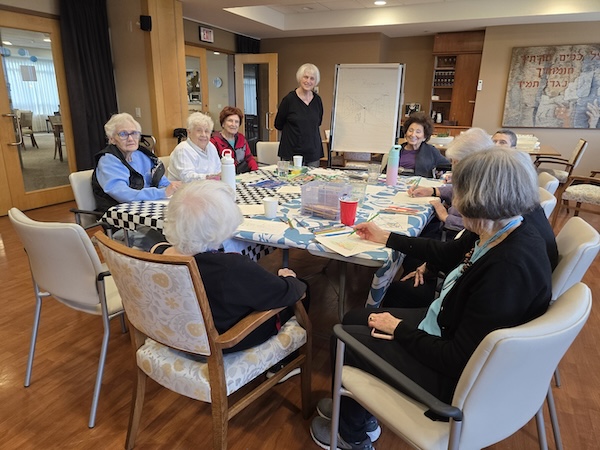
Sidi Schaffer (standing) has been leading an art class at the Weinberg Residence since last October. (photo by Vanessa Trester)

Sidi Schaffer, a well-known Vancouver artist and art teacher, moved to the Weinberg Residence last August. “My husband passed away in June, and I didn’t want to be alone in our big house,” she told the Independent. “Here, I’m not alone.”  

No matter where she lives, Schaffer is an artist at heart, and her art always finds an outlet. In this case, it is a class for Weinberg residents.

“I approached Vanessa [Trester, manager of the Weinberg Residence], and suggested I start an art class,” Schaffer said. “I’ve been an art teacher for decades. I have so much to share with my students.”

Trester agreed with the suggestion and Schaffer’s sessions started last October.

“The official name of the class is Fun Exploring Art with Sidi Schaffer,” said Trester. “Besides the opportunity to learn about art and artists, the students can tap into their creativity with Sidi’s direction. The class provides the residents with joy, lifts their spirits, and brings connectivity through their shared stories.”

Participation in the Monday classes fluctuates between eight and 12 people. “Not everyone can come all the time,” said Schaffer. “The residents here are not young. Someone has a headache or a doctor’s appointment, or their family is visiting. But people come when they can. We put on classical music in the background. I bring some art supplies – I have a lot of brushes and paper and paints – plus what Vanessa bought, and we have fun. As long as my students are happy, I’m happy.” 

Her class makes many attendees happy. One of them, Helen Sankoff, told the Independent: “I don’t have any prior experience creating art, but I used to knit, do needlepoint and make jewelry as a hobby. Now, I attend Sidi’s class because she is a wonderful artist and teacher. She introduces us to many different artists and ways of painting, and I find her art class very relaxing. We have classical music playing in the background, and it’s my favourite time of the week.”

As an experienced teacher, Schaffer doesn’t set impossible goals for herself or her students. “I’m not trying to teach them deep painting techniques,” she said. “They don’t have to create masterpieces. I’m trying to show them how to express themselves through artistic means. Creating art is not a focus in this class, it is a side benefit. The focus is to enjoy it.” 

She enjoys it too and uses famous artists and art history as inspiration. Her artistic education is extensive: first in her native Romania, then in Israel and, finally, in Canada. She has lived, studied and worked in all three countries.

Schaffer shares her love for various art movements with her students.

“We started with Van Gogh. I brought Van Gogh’s reproductions to the class, and some sunflowers,” she said. “First, I told them about Van Gogh, his life and his art. Then, I set up the sunflowers and the students painted them.”  

From Van Gogh, she proceeded to Paul Cézanne. “He painted landscapes and still life, and I brought apples to the class to paint,” said Schaffer.

One class was an introduction to Claude Monet and his waterlilies. “I had some photos, and some of the students saw those paintings when they visited Paris years ago,” she shared.

After French impressionists, Schaffer decided it was time for Canadian art, particularly the Group of Seven. But, she started with Ted Harrison and his Northern Lights, bringing in his books. She had her students imitate his style. 

“I want us to have a field trip to the Vancouver Art Gallery, to see Emily Carr’s paintings. It will probably happen as soon as we have some volunteers available,” she said. 

In the meantime, Schaffer has switched to Australian aboriginal art, where every image is comprised of dots. “It is amazing what can be done in this technique,” she said. “It is very suitable to my students, an easy technique, as each one of them is over 80 years old. Some suffer from arthritis and have trouble holding a brush.”

One participant’s paintings “are similar to each other, no matter which artist I tell them about,” said Schaffer, but they enjoy the class, “and that is the most important outcome.”

Schaffer’s classes are eclectic, covering a variety of styles, materials and methods. In one class, she concentrated on First Nations artist Daphne Odjig. Another time, she talked about avant-garde artist Georgia O’Keeffe. She has focused on the importance of perspective in painting. 

“I want to have a class about painting body and face. I want to buy some clay for a sculpture class and we’ll have a mask-painting class for Purim,” she said before the holiday. “I push my students not to be realistic – to express their inner world, not copy the street outside. Art should be playful.” 

One of her favourite techniques is collage that uses dry flowers and leaves. “They are so beautiful, so transparent, like visual poetry,” said Schaffer, who has albums of material. “I’ve always wanted to preserve their beauty, have done it since childhood. The designs on each leaf are unique. Some of them remind me of a place or a time.”

Schaffer has “no end of ideas for new classes.”

“Other artists – Chagall, Picasso – and other techniques,” she said. “I want to get some old magazines and art books to cut for collages. Perhaps the Waldman Library has some for sale. We’ll have fun in that class.” 

Olga Livshin is a Vancouver freelance writer. She can be reached at [email protected].

Format ImagePosted on March 13, 2026March 12, 2026Author Olga LivshinCategories Visual ArtsTags art classes, art history, education, seniors, Sidi Schaffer, Vanessa Trester, Weinberg Residence
Proudly powered by WordPress