Skip to content
  • Home
  • Subscribe / donate
  • Events calendar
  • Business Directory
  • FAQ
  • News
    • Local
    • National
    • Israel
    • World
    • עניין בחדשות
      A roundup of news in Canada and further afield, in Hebrew.
  • Opinion
    • From the JI
    • Op-Ed
  • Arts & Culture
    • Performing Arts
    • Music
    • Books
    • Visual Arts
    • TV & Film
  • Life
    • Celebrating the Holidays
    • Travel
    • The Daily Snooze
      Cartoons by Jacob Samuel
    • Mystery Photo
      Help the JI and JMABC fill in the gaps in our archives.
  • Community Links
    • Organizations, Etc.
    • Other News Sources & Blogs
  • JI Chai Celebration
  • JI@88! video

Recent Posts

  • Or Shalom reopens its doors
  • JFS from past to future
  • Need holistic approach
  • Sharing stories, advice
  • Journalist shares fears
  • Skills to live together
  • Road to independence
  • Cutting grass with scissors
  • Zionism as a solution
  • Deceit, desire & the divine
  • Reclaiming sacredness
  • Creative project ideas
  • Summer squares and cobbler
  • Thou shalt … summer commandments
  • Legal help for students
  • Revisiting myth of Lilith
  • Wrong person rebuked
  • Canada’s mixed messages
  • Questions for museum
  • Symposium on antizionism
  • Making soccer political
  • CJPAC lauds Pulver’s impact
  • City recognizes Vrba’s legacy  
  • Organ donation saves lives
  • Theodore’s March premiere
  • A healing Shabbaton
  • Supplying healthy food
  • A chime of metal tags
  • Yellowknife seder a first
  • Ishai energizes, unifies
  • A Lag b’Omer to remember
  • Expanding the healing
  • Hannah Senesh – a unique hero
  • Community milestones … May 2026
  • Sharing her testimony
  • Fall fight takes leap forward

Archives

Follow @JewishIndie
image - The CJN - Visit Us Banner - 300x600 - 101625

Tag: UBC

Burying sacred books

Burying sacred books

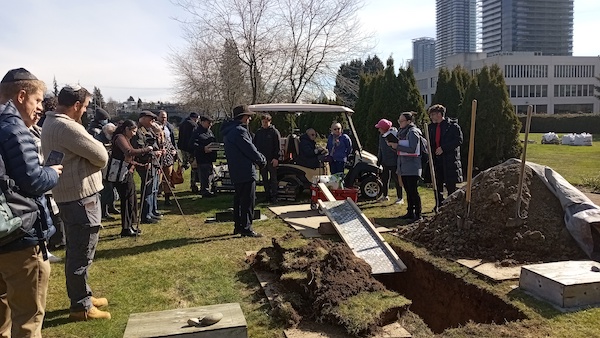
On March 9, community members gathered to bury sacred Jewish texts at Beth Israel Cemetery. (photo by Cynthia Ramsay)

According to Jewish law, no sacred texts and objects are allowed to be thrown out. This includes anything with God’s name printed on it. These texts and objects must be buried in a respectful way,” explained Rabbi Jonathan Infeld of Congregation Beth Israel in an email to the Jewish Independent about the March 9 Genizah Project ceremony at the synagogue’s cemetery. “Since a burial spot is not always convenient, people store their sacred material in a special place called a genizah until they can be buried.”

A few months ago, Infeld received a phone call from Eugene Barsky, a librarian at the University of British Columbia. Barsky was looking for a place to bury a considerable number of sacred books that were beyond repair. Infeld “immediately said yes.”

“But I wanted to do much more than just bury the materials,” the rabbi said. “I asked if he would be interested in a community-wide program, and Eugene also agreed. After that, we sought other interested parties including UBC Jewish studies, Hillel BC, King David High School, Peretz Centre and the Waldman Library.”

Representatives of these organizations were present on March 9, including students from KDHS and UBC. Infeld spoke about how sacred objects and texts not only give Jews a connection to our spiritual existence, but a social connection as well.

“And, no matter what differences we may have as a people, we are brought together within a rubric of study, of prayer, all connected to the written word,” he said. “For us, as a Jewish people, the book is sacred. For us, as a Jewish people, study is a sacred task, a sacred opportunity. And so, it only makes sense that, when we have studied, have brought a book to its conclusion, that’s literally falling apart, we don’t just throw it away, but the book, or the sacred object, has become our friend and become part of us. And so, according to Jewish tradition, we bury it.”

Barsky highlighted one of the many books being buried: a Pentateuch (the Five Books of Moses) published in Furth, Germany, in 1805. “I wish we could preserve these books, but some of them are molding,” he said. “We have a preservation lab at UBC but they reviewed them and some of them just could not be preserved.”

Barsky asked two members of the Vancouver Jewish Folk Choir – Stephen Aberle and Aurel Matte – to sing a couple of songs. The pair led “Hinei Ma Tov,” about how pleasant it is when sisters, brothers, all of us, gather together; and “Al Sh’loshah Devarim,” about the three things on which the world stands (Torah, divine service, acts of love) and by which the world endures (truth, justice, peace).

For UBC student Ellie Sherman, the burial ceremony was particularly meaningful, “as someone who spends every day reading more and more information, paying close attention to authors and narrators, and focusing on crafting assignments with correct references, to give credit where credit is due.”

She said, “The need for the genizah recognizes that the significance of words is beyond two-dimensional figures on a page, that the lessons we learn and the knowledge we gain from our books can be infinite, just as the meaning behind the words.”

Gregg Gardner, associate professor and Diamond Chair in Jewish Law and Ethics at UBC, shared how the name genizah came about. “The ancient rabbis of the first centuries tell a story about a king,” he said. “The king’s name is Munbaz. This king travels to Jerusalem, where there is drought and a famine. To provide relief, Munbaz gives away his fortune to the needy. Munbaz bizbez, Munbaz spends. His brothers confront him and demand an explanation as to why he’s giving away the family fortune…. Munbaz says that he does not bizbez the fortune … but rather he ganaz the fortune, he stores it, he saves it…. Munbaz explains that, by giving your money to charity here on earth, you do not waste your money … you save it in the world to come, in the afterlife.

“The word genizah literally means ‘storing’ and, in doing so, it can denote hiding from view,” he said. “Ancient Jewish traditions going back to the first centuries, the Second Temple period, talk about hiding many things, even the holy vessels from the Jerusalem Temple, and there are traditions in which the word ganaz is associated with storing valuables.”

Gardner said, “We are here at a cemetery, essentially taking these books out of use, laying them to rest, and yet, at the same time, going back thousands of years, the genizah has been a story not only about death, but about Jewish life.”

Richard Menkis, associate professor of medieval and modern Jewish history at UBC, picked up on this last aspect. During the planning for the burial, he said, there was a feeling towards solemnity, even mourning. But, he said, “there was a whole other sensibility that we could be bringing to it.”

He spoke of the Jews of Algeria, who would place items wherever they could around the synagogue and “several weeks later, they would carry them, the books, the other objects, in sacks. They’d escort them to the cemetery and bury them and, on that day, there would be a feast and special hymns for the occasion. There were similar customs in the community in Morocco of Meknes.

“The Sephardic Jews of Jerusalem had a custom of placing sacred objects and texts in the walls of the synagogue and, every three to seven years, would … joyously take them from the synagogues to a special section in one of the cemeteries in Jerusalem.”

The joy would come, said Menkis, from knowing that “the respect and honour that they were giving to these items would bring down upon them a variety of divine segulot, a variety of blessings. For some, it might be, we can call down rain. For others, it might be to prevent a plague.”

Menkis said, “I embrace the Genizah Project as the moral opposite of a horrible feature of modern life – the book burning. While the book burning denigrates ideas and discussion, the genizah shows reverence for ideals and aspirations.”

Those gathered were reminded of this reverence by Rabbi Kylynn Cohen, senior Jewish educator of Hillel at UBC, who led the service by the gravesite. As in the burial of a human body, she said, it is up to us to do the carrying when a person – or, in this case, the books – cannot go forth themselves.

Everyone helped transport the books from the chapel to the gravesite. Maiya Letourneau, head librarian of the Waldman Library, held up a book with gold embossing, another with lace embroidery. She said, “When we’re thinking about the memories that books create and the importance that they have in our lives, as a librarian, it can be really, really hard to take a book out of the collection, but it’s part of maintaining a healthy library, it’s part of making sure the library is useful for years to come, and it’s just an important part of what we do.”

After those gathered recited the Kaddish d’Rabbanan, the prayer that is said whenever a minyan of Jews finishes studying, Rabbi Stephen Berger, head of Judaic studies at KDHS, spoke about the class he brought to the ceremony, which has been studying Malachi, the Book of Kings. “It’s not just that we study to know,” he said. “The studying itself, opening the book and learning the book is a religious act in Judaism. And that’s why we treat it so carefully and so succinctly and sanctify it…. All these acts [serve to remind us] this is who we are, and we should live up to the title of the People of the Book.”

BI Rabbi Adam Stein concluded the ceremony with Eitz Chayim Hi, which most congregations sing when putting the Torah scrolls back in the ark at the end of a Torah service. It describes the Torah as a tree of life.

Format ImagePosted on March 24, 2023March 22, 2023Author Cynthia RamsayCategories LocalTags Adam Stein, Aurel Matte, Beth Israel, books, Ellie Sherman, Eugene Barsky, genizah, Gregg Gardner, Hillel, JCC, Jonathan Infeld, Judaism, KDHS, Kylynn Cohen, Maiya Letourneau, Richard Menkis, Stephen Aberle, Stephen Berger, UBC, Waldman Library
Hillel BC marks its 75th

Hillel BC marks its 75th

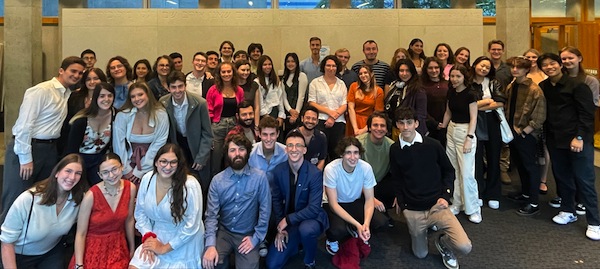
Attendees at UBC Hillel House’s Rosh Hashanah dinner to start the 2022/23 school year. (photo from Hillel BC)

Hillel BC celebrates its 75th year with a celebration March 30 at the University of British Columbia Hillel House.

Hillel BC was founded in 1947, under the name B’nai B’rith Hillel Foundation, in the same spot on UBC’s campus where it still operates from today. This came from an understanding that Jewish students were being excluded from the main student clubs on campus and they needed a place to socialize and be Jewish.

The original space was an old, wooden one-room house that was at the outskirts of campus. Little did they know then that this location would become the heart of the campus as the university expanded.

photo - Established in 1947 on UBC campus (left), Hillel BC’s current building – on the same site as the old one – opened in 2010
Established in 1947 on UBC campus (left), Hillel BC’s current building – on the same site as the old one – opened in 2010. (photo from Jewish Museum and Archives of BC L.00070)

In 2002, B’nai B’rith Hillel Foundation became Vancouver Hillel Foundation, the first Hillel International-affiliated program in Canada, which was followed by establishing space at both Simon Fraser University and University of Victoria. Eight years later, the current building was opened, solidifying Hillel’s space on the UBC campus and beyond. Today, Hillel BC continues to serve at UBC, UVic, SFU, Langara College, Emily Carr University of Art + Design and other post-secondary institutions as needed.

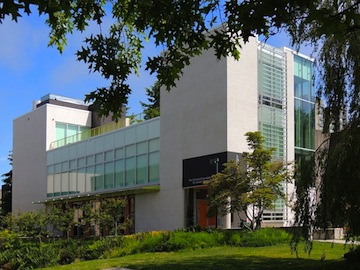
photo - The current Hillel BC building on UBC campus
The current Hillel BC building on UBC campus. (photo by ThosGee via panoramio.com)

In addition to celebrating 75 years on campus, Hillel @ 75 on March 30, 7:30 p.m., will provide an opportunity to thank recent executive directors Rabbi Philip Bregman and Sam Heller. The Jewish Student Association, Israel on Campus Club and AEPi (Jewish fraternity) will offer the community an overview of their activities in dedicated tables, and a short presentation will be given by the board and current staff. Special guests include Deborah Buszard (UBC interim president), Joy Johnson (SFU president), Skip Vichness (Hillel International board chair) and Vancouver Mayor Ken Sim.

“We are very excited to have the community back in our building for this celebration of our 75th anniversary,” said Rob Philipp, executive director of Hillel BC. “Due to COVID, we missed a lot of important events worth noting, specifically the 10th anniversary of our UBC building, and the retirement of Rabbi Philip Bregman and Sam Heller. We want to take the opportunity to celebrate our successes and recognize some of the key people who helped lead us through some difficult times. The evening reception will be at our UBC building, attended by special guests, and it will host the first viewing of our promotional video.”

For more about Hillel BC and to purchase a ticket for the event ($75), visit hillelbc.com. A portion of the ticket price is tax-deductible. 

– Courtesy Hillel BC

Format ImagePosted on March 10, 2023March 9, 2023Author Hillel BCCategories LocalTags anniversary, education, gala, Hillel BC, Hillel House, history, milestone, Philip Bregman, Rob Philipp, Sam Heller, UBC

Every person has a voice

Elon Musk’s purchase of the social media behemoth Twitter, which appears probable, is raising questions about what the new management could mean to users and society at large. For Jewish tweeters and others, there are red flags.

The growth of social media of all varieties over the past 15 years has resulted in a massive change in the public dialogue. People have some ability to amplify or diminish the voices they do or do not want to hear, resulting in an unprecedented ability to self-select the information (or misinformation) to which we are exposed. The relative anonymity of the media has had additional harmful impacts, with racist, misogynistic, homophobic, antisemitic and other hateful statements being posted in volumes too massive to effectively police. The spike in antisemitic hate crimes we have seen in recent years is almost certainly a result, in part, of online antisemitism moving into the “real” world.

Since 2016, when Russian and other bad actors influenced the U.S. presidential election in favour of Donald Trump, some platforms, including Twitter, have been driven to address some of the most egregious content on their sites and abuse of the medium. Their efforts, however imperfect and inadequate, reflect an assumption that hate speech should not be accepted.

Musk’s planned purchase of Twitter (which has a number of hurdles yet to overcome) raises fears among some that his self-identification as a “free speech absolutist” may reverse the small strides Twitter has made in addressing hate speech.

If Musk, who is presumed to be the richest person on earth and who is known to be a micromanager, chooses to imprint on Twitter his vision of absolute free speech, we should expect the limited efforts to police the worst content will be diminished or eliminated.

Of course, Musk would not be the final arbiter of what is acceptable. He may be the richest person on earth and Twitter may be among the most powerful communications platforms ever known, but they are still subject to government oversight.

Among the challenges, of course, is that Twitter, like the rest of the internet, effectively knows no national boundaries. So, while the United States is lenient toward extreme speech, different countries take a different approach.

For example, Canada’s Parliament is considering two proposals to make it illegal to deny or diminish the historical facts of the Holocaust. Legislation like this – as well as existing hate crimes laws that prohibit the targeting of identifiable groups – will inevitably come up against transnational norms set by platforms like Twitter. Will social media platforms face endless legal challenges? Or will the sheer volume of offences make it impossible to challenge any but the most outrageous affronts?

Canadians have always had a different approach to free speech than our American cousins. Our Parliament, like many in Europe, recognizes limitations in the interest of national harmony. These often lead to contentious debates over where lines should be drawn. Introduce an anarchic, foreign-owned social media platform into the equation and these discussions become far more complicated.

These are difficult issues. In a perfect world, absolute free speech would be ideal, because, again in a perfect world, individuals themselves would balance their right to expression with their responsibilities as citizens of a pluralistic society. But, we do not live in a perfect world and some compulsion sadly seems necessary to prevent, say, outright incitement to murder or genocide.

Here, though, is something not difficult or complicated at all – we do not need legislation or philosophical debates around freedom in order to counter hate speech right now. In this space, over many years, we have argued that the best way to confront bad, or hateful, speech is not stifling that speech, but countering it with truth, compassion and decency. Silencing hatred (even if it were possible in the wired world) will not eliminate hatred. We are in a war of words, and more words, not fewer, should be our approach.

A magnificent case-in-point occurred in the past month.

After the student society of the University of British Columbia passed a resolution endorsing the boycott movement against Israel, Santa Ono, the president of the university, responded with a thoughtful statement condemning BDS.

Too often, destructive, hateful messages like anti-Israel boycott resolutions are met with silence, usually with the excuse that such resolutions or protests are legitimate expressions of free speech. Of course, they may well be. But this argument, which was used by UBC administrators and others in the past, misses the point. Free speech does not mean the right to have one’s opinions uncontested. As Ono’s statement makes clear, both sides have a right to have their voices heard. That is free speech.

At a time when too many campuses across North America are roiling with anti-Israel spectacles, the significance of a statement like Ono’s did not go unnoticed. In fact, the university president received a letter from another president. Isaac Herzog, the president of Israel, wrote a “Dear Santa” letter, thanking Ono for his unequivocal statement.

That Israel’s head of state would intervene to express gratitude for Ono’s statement is itself a statement of how serious the threats are from uncontested hate speech. But it also reminds us that we do not need legislation or courts to stand up – as individuals and as a community – against egregious attacks. Every person has a voice. Some use it to spread misinformation and hatred. Others use it for good.

Posted on May 6, 2022May 4, 2022Author The Editorial BoardCategories From the JITags antisemitism, campus, Elon Musk, Empowerment, free speech, legislation, online hate, Santa Ono, social media, UBC

Two modern-day Maccabees

On Nov. 24, Chabad UBC invited two former Israel Defence Forces soldiers to the Nest on the University of British Columbia campus to speak about their personal stories and life lessons from serving in the army.

Amit Shmuel, a former soldier in the elite Palchan unit, and Matan Roettger, a former soldier in the Kfir Brigade, shared some of their experiences in service; stories of their courage and the sacrifice they made protecting and defending the state of Israel, and especially of their perseverance in the face of suffering and adversity. Both suffered career-ending injuries in the line of duty, and their strength and resilience to mentally and physically recover from their trauma were remarkable.

The two soldiers were at UBC as part of a larger tour of college campuses all across North America, along with Belev Echad, an organization dedicated to providing financial and moral support to IDF veterans wounded in action and to easing their transition back into civilian life.

The local event was sponsored by Hasbara Fellowships, which helps train young student leaders to become Israel ambassadors and activists on campus. As a Hasbara Fellow myself and having firsthand experience in Israel, I found the stories of Shmuel and Roettger to accurately represent the victory of hope over despair, the value of the sanctity of life, freedom and dignity that have been deeply encoded in the fabric of Israeli society and the Jewish community worldwide.

Just as the Maccabees 2,000 years ago rededicated the Second Temple from destruction to restoration, so too did these two modern-day Maccabees rededicate their lives from tragedy to triumph. They inspire us to not focus on what we cannot control, but rather on what we can: to elevate our attitude and response toward life’s misfortunes by sharing with others our light of faith and hope for a brighter future.

Eitan Feiger is a student at the University of British Columbia, class of 2024.

Posted on December 10, 2021May 2, 2025Author Eitan FeigerCategories LocalTags Belev Echad, Chabad, Chabad UBC, Chanukah, Hasbara Fellowships, IDF, Israel, Israel Defence Forces, Maccabees, UBC, University of British Columbia, veterans
The effects of isolation

The effects of isolation

How technology can connect people and reduce social isolation was the topic of the Jewish Seniors Alliance’s fall symposium. (photo from pixnio.com)

At the fall symposium of the Jewish Seniors Alliance, which took place on Zoom Nov. 21, attendees heard from experts on the topic Triumphs and Trials Using Technology: Social Isolation Among Older Adults.

Dr. Kristen Haase, assistant professor of applied science at the University of British Columbia School of Nursing, and Dr. Megan O’Connell, professor of geriatric psychology at the University of Saskatchewan, were welcomed by Gyda Chud, co-president of Jewish Seniors Alliance. Chud pointed out that this session related to the key pillars of JSA:

  1. Outreach: to seniors in the community.
  2. Education: we can learn from the professors’ study results.
  3. Peer support: JSA has projects that help combat loneliness and isolation.

Of their study on social isolation among older adults during the pandemic, Haase said they wanted to explore how the inability to interact in person during the pandemic has impacted seniors. She mentioned that two scientific publications – The Lancet and The Journal of the American Medical Association – had commented on the detrimental effect of isolation on seniors. Haase and O’Connell wanted to look at the effects and what could be done to alleviate them.

There is empirical evidence that social isolation impacts mental, physical and cognitive health. Since technology can facilitate social connection, the idea was to train older adults to use these facilities to lessen their isolation. Use of both the telephone and Zoom was embraced by many older adults, and even those people with some cognitive impairment could be trained to use Zoom and other such tools.

Haase and O’Connell reached out to groups and individuals in British Columbia and Saskatchewan for participants. Four hundred individuals and 41 seniors groups were involved in the study, including JSA. Two of the questions were: How did they change their programs? and How did they maintain social connections?

Some groups opted to meet outdoors. The advent of a vaccine helped alleviate some fears. One of the findings was that introverted people, as well as those who lived in rural areas and those who had family nearby, fared better than more extroverted people.

Many community groups rose to the challenge and introduced new technology to their members. In addition to providing training, they also kept in touch with frail members. In rural areas, where broadband access was problematic, groups had to make major use of the telephone. A 1-800 line was purchased to facilitate contact in these areas. These types of disparities in access were highlighted by the pandemic.

A few community groups closed during COVID, but many rose to the occasion by staying in regular contact, providing iPads to clients and helping them learn how to use them.

Haase and O’Connell then turned to the audience for any questions or other information that would help with their research.

One question was how do we find the truly isolated, as we usually rely on people to self-identify if they are in need. The poser of that question, Larry Shapiro, pointed out that, in the United Kingdom, they use the postal service to check on isolated individuals.

Another issue raised was whether groups should continue with a hybrid model of services – this would involve in-person events plus a Zoom possibility. Hybrid models make programming more accessible for those who are ill or who have a disability that impedes mobility. As well, many older adults are still fearful and need help to re-enter society. Funding would be needed to facilitate such programs.

Tammi Belfer thanked the speakers for their research, which was helping improve the lives of older adults.

Shanie Levin is program coordinator for Jewish Seniors Alliance and on the editorial board of Senior Line magazine.

Format ImagePosted on December 10, 2021December 8, 2021Author Shanie LevinCategories LocalTags health, healthcare, isolation, Jewish Seniors Alliance, JSA, Kristen Haase, Megan O’Connell, research, seniors, UBC, University of British Columbia, University of Saskatchewan
How to achieve justice

How to achieve justice

Dr. Cindy Blackstock gives this year’s Dean’s Distinguished Lecture., on Nov. 15. (photo from ulethbridge.ca)

The University of British Columbia’s faculty of education is once again partnering with the Janusz Korczak Association of Canada (JKA)  in presenting the Dean’s Distinguished Lecture on Nov. 15. This year’s featured speaker is Dr. Cindy Blackstock.

The lecture series highlights the ongoing work of those who seek to advance children’s rights in Canada and is presented in partnership with the JKA as a way of continuing the legacy of Janusz Korczak, a Polish-Jewish doctor and educator, who in 1942 perished in Treblinka along with nearly 200 orphans in his care.

Blackstock is a member of the Gitksan First Nation, with more than 25 years of social work experience in child protection and Indigenous children’s rights. Her research interests are Indigenous theory and the identification and remediation of structural inequalities affecting Indigenous children, youth and families.

An author of more than 50 publications, Blackstock has collaborated with other Indigenous leaders to assist the United Nations Committee on the Rights of the Child in the development and adoption of a General Comment on the Rights of Indigenous Children. Recently, she also worked with Indigenous youth, UNICEF and the United Nations Permanent Forum on Indigenous Issues to produce a youth-friendly version of the United Nations Declaration on the Rights of the Child. Her promotion of culturally-based and evidence-informed solutions has been recognized by the Nobel Women’s Initiative, the Aboriginal Achievement Foundation, Frontline Defenders and many others.

Colonialism-entrenched inequality is a lived reality for many Indigenous peoples around the world and Blackstock’s presentation, called Reconciling History, talks about what colonialism is, how it birthed multi-generational inequality and what can be done, including academically, to achieve justice in change resistant environments.

Blackstock is the 2017 recipient of the Janusz Korczak Medal. Following her lecture, directors of the JKA will present the Janusz Korczak Scholarship in Children’s Rights and Indigenous Education, Janusz Korczak Association of Canada Statuette, and Janusz Korczak Association of Canada Medal.

The event will be hosted by Dr. Jan Hare, dean pro tem, UBC faculty of education, and includes Janet Austin, lieutenant governor of British Columbia; Steven Lewis Point, chancellor of UBC; Lillian Boraks Nemetz, board member, JKA; Dr. Anton Grunfeld, board member, JKA; Jerry Nussbaum, president, JKA; Dr. Jennifer Charlesworth, representative for children and youth, British Columbia; and Dr. Chris Loock, board member, JKA.

To register for the Nov. 15 event, which will take place 5:30-7:15 p.m., visit educ.ubc.ca/deans-distinguished-lecture-reconciling-history.

– Courtesy University of British Columbia faculty of education

Format ImagePosted on November 5, 2021November 4, 2021Author UBC faculty of educationCategories LocalTags children's rights, Cindy Blackstock, colonialism, equality, Indigenous children, Janusz Korczak Association, JKA, UBC, University of British Columbia
Protecting children’s rights

Protecting children’s rights

Dr. Jennifer Charlesworth, British Columbia’s representative for children and youth, presented the Dean’s Distinguished Lecture and the Janusz Korczak Medal for Children’s Rights Advocacy on Jan. 27. (photo from the Office of the Representative for Children and Youth)

The University of British Columbia’s faculty of education presented the Dean’s Distinguished Lecture and the Janusz Korczak Medal for Children’s Rights Advocacy on Jan. 27, International Holocaust Remembrance Day. Dr. Jennifer Charlesworth, British Columbia’s special representative for children and youth, gave the talk and the medal was awarded to Dr. Kimberly Schonert-Reichl, an applied development psychologist at the University of Illinois, Chicago.

Born Henryk Goldszmidt, Janusz Korczak (1878-1942) was a Polish-Jewish pediatrician, journalist and educator. His advocacy for children is still recognized today through his writings, which served as a basis of the United Nations Convention on the Rights of the Child.

Prior to the Second World War, Korczak was the director of an orphanage in Warsaw. Although he was offered freedom during the Holocaust, he chose to stay with his orphans when they were forced to board a train to the Treblinka extermination camp in 1942. He, members of his staff and more than 200 children were murdered.

Korczak considered children as partners, equal to adults, insisting that there are no human rights without children’s rights. His pioneering work and enduring legacy were felt throughout the recent event. In the words of B.C. Lt.-Gov. Janet Austen, who introduced the main speaker, “Korczak was an extraordinary man who reimagined the relationship between children and adults. A man of great personal courage and a revolutionary thinker, he understood, whoever saves one child, saves the whole world.”

Charlesworth began her talk on Korczak’s connection to the contemporary era by encouraging the Zoom audience to “think of how far ahead of his times Korczak was in suggesting that each child must be respected. He was rejecting the ideas of his time. His commitment to children is awe-inspiring.”

According to Charlesworth, the first indisputable right of a child is to articulate their own thoughts. Those working with children need to nurture the capacity to listen and understand, to be curious and receptive. Further, practitioners have “to place child’s rights at the centre of their practice, to have both ears open to a child’s voice.” Too often, she said, the individual voices of children can be lost in operational systems.

Charlesworth spoke about advocacy and highlighted the fact that those who work with children will have a significant impact on their lives. Korczak’s advocacy for children, she said, “set the bar very high.”

Adults should want to help children realize their potential, and the relationship between adults and children should never result in the appearance of a struggle for rights. Charlesworth emphasized that, without prioritizing youth voices, there would be no Greta Thunberg, the Swedish environmental activist, or Katherine McParland, co-founder of the B.C. Coalition to End Youth Homelessness.

“We are living in a time of great change and uncertainty. Children and youth sense this, too, and we stand to learn a lot from them as well,” Charlesworth said.

Writer and child survivor Lillian Boraks-Nemetz, a board member of the Janusz Korczak Association of Canada (JKAC), which partnered on the event, drew further on the prescience of Korczak’s work and its continued importance. “Today’s children do not have the same sense of normalcy and routine as before COVID-19,” she said. “At times like these, my thoughts turn to Korczak and a child’s right to education, respect and love.”

Afterwards, JKAC president Jerry Nussbaum and Charlesworth presented this year’s award to Schonert-Reichl, an expert on social and emotional learning, whose nearly four-decade career has been dedicated to children’s rights and well-being. Formerly an educator in British Columbia, she was at the forefront of the province’s revitalized education curriculum, which is often heralded internationally for its advancements in social and emotional learning.

“I am so honoured,” she said upon receiving the award. “And to be in a group where so many are advocating for children’s rights.”

The evening also saw the giving of the Janusz Korczak Graduate Scholarship in Children’s Rights and Indigenous Education to Cayley Burton, a third-year master of arts student in early childhood education at UBC and an instructor in the Indigenous Early Childhood Education Program at Native Education College. Her thesis delves into gender-inclusive teaching practices for preschool children through LGBTQ+ picture books.

“It’s an inspiring, overwhelming honour to have Dr. Korczak’s name associated with the advocacy work that I do alongside and on behalf of young children who are marginalized in Canada,” Burton said.

Sam Margolis has written for the Globe and Mail, the National Post, UPI and MSNBC.

Format ImagePosted on February 12, 2021February 12, 2021Author Sam MargolisCategories LocalTags children, children's rights, health, Holocaust, human rights, Janusz Korczak, Janusz Korczak Association, Jennifer Charlesworth, Kimberly Schonert-Reichl, Lillian Boraks-Nemetz, survivor, UBC, University of British Columbia
Searching for a COVID cure

Searching for a COVID cure

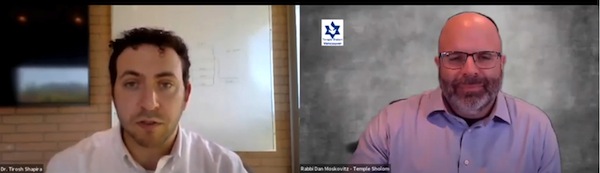
University of British Columbia’s Dr. Tirosh Shapira, left, spoke at a June 18 Temple Sholom-hosted webinar emceed by Rabbi Dan Moskovitz. (screenshot)

“COVID-19 or SARS-CoV-2 has a different type of genetic material than we have. It is an excellent saboteur … and can mutate easily. Thus, if we develop a drug against it, we will likely, over time, begin to see some resistance,” University of British Columbia microbiologist Tirosh Shapira told a Zoom audience in a June 18 webinar.

“In my research,” he said, “instead of looking for one drug, I am looking for four. I am trying to create a cocktail similar to what is applied with treating HIV. We are looking for drug combinations.”

There is an added level of complexity involved in seeking such combinations, he noted, as certain drugs can negate the effects of others.

Shapira is among a select group of Canadian scientists hunting for a cure to COVID-19. He earned his PhD from Australia’s University of Queensland, where he specialized in molecular toxicology for global food security. Before devoting his efforts to COVID-19, his research at UBC led to a novel treatment against tuberculosis and the development of methods to improve drug discovery.

To the web audience hosted by Temple Sholom, Shapira spoke on the topic of drug development in British Columbia, particularly as it pertains to the new coronavirus. He also provided an overview of modern drug discovery and a look at the advanced facility for virology research at UBC.

“Viruses are a large array of different agents,” explained Shapira, “each with unique characteristics, and depend on their hosts in order to replicate and create more copies of themselves … they vary greatly. However, some share similar properties.”

Knowing, for example, the similarities of the common cold and SARS, scientists can gain a better understanding of how the biology of COVID-19 might play out. This type of application led to the discovery of the effectiveness of the drug Remdesivir against the MERS virus, for instance.

Citing the history of combating viruses through treatments, Shapira showed a graph of the downward trend of infections from tuberculosis, starting in the late 19th century. He used this to elucidate the factors needed beyond drugs to control an epidemic, such as economics, sanitation and education.

“On a global scale, sanitation and containment are extremely important for an immediate response to an immediate threat,” he said. “Understanding SARS-CoV-2 is based on understanding similar viruses. The best way to defeat new viruses is through social adjustments.”

Shapira distinguished between the classical and modern approach to drug discovery. The classical approach, he said, is to look under a microscope and examine what is there, while the modern approach considers all possible compounds and is less concerned about the biology.

According to Shapira, the modern approach essentially throws everything at a problem. This, in turn, reduces the research bias on the part of the scientist, has fewer developmental pitfalls and is more “statistically robust,” thereby making it more likely for discoveries to pass clinical trials.

Biology, he hastened to add, is still important – the quality of the test model will determine the quality of the outcome. “Good, sound biology brings good, sound compounds that are good pharmaceuticals,” he said.

When considering how to target a virus, Shapira told the online group that a researcher will look at known antivirals, U.S. Food and Drug Administration-approved drugs, drugs in clinical trials and natural products, the source of most new antibiotics and antivirals.

Drug development is a complex, multi-stage process which has greatly advanced in the past 20 years, he said. In the United States, for example, it begins with pre-clinical trials in labs and with animal testing. Next come clinical trials focusing on safety and efficacy, before moving to randomized testing. Afterwards, there are FDA trials and ultimately production.

UBC’s FINDER (Facility for Infectious Diseases and Epidemic Research), where Shapira conducts his research, has an automated workstation and screening microscopes that handle the large workload of sorting through tens of thousands of compounds without introducing human error.

Due to restricted access to the highly infectious coronavirus, research in Canada can only be performed at a limited number of contamination-free facilities, which also include the University of Toronto and the National Microbiology Laboratory in Winnipeg.

In their studies, UBC’s researchers use lab-grown organs in a dish and a live virus, explained Shapira. FINDER has previous experience with this model from the outbreak of the Zika virus. At FINDER, the UBC team screens the thousands of compounds with collaborators around the world.

Shapira, the only microbiologist conducting research on the COVID-19 virus in British Columbia, estimated that there are 200 biologists and another 2,000 people working on various studies, including in economic areas, related to COVID-19 in Canada.

“SARS-CoV-2, despite being a present threat, will pass,” said Shapira. “But other infectious diseases will emerge in this age of easy travel. Preparedness is key. We will gradually reopen as we are better able to monitor the spread of the virus. We will find a treatment.”

Sam Margolis has written for the Globe and Mail, the National Post, UPI and MSNBC.

Format ImagePosted on July 10, 2020July 9, 2020Author Sam MargolisCategories LocalTags coronavirus, COVID-19, Dan Moskovitz, health, SARS-CoV-2, science, Temple Sholom, Tirosh Shapira, UBC, vaccine
Helping during the pandemic

Helping during the pandemic

COVIDhelp Vancouver founders Imaan Jiwa, left, and Riva Siddiqui. (photo from COVIDhelp Vancouver)

An all-female team of Vancouver-area university students has created a platform to link people who may be more likely to succumb to COVID-19 with volunteers who can help them with essential tasks.

COVIDhelp Vancouver was launched by the University of British Columbia’s Imaan Jiwa and Riva Siddiqui shortly after the coronavirus was declared a pandemic in the spring. Soon thereafter they were joined by Jewish community member Rebecca Baron, who came on board as director of outreach communication.

The organization’s objective is to assist anyone they can, i.e., seniors and the immune-compromised, with such activities as grocery shopping, dog walking and the delivery of medicines. Volunteers also provide companionship for those who have been isolated as a result of the virus, through both online and socially distanced chats.

The students have provided a few ways for volunteers and clients to connect: the internet, telephone and a mobile app.

“We are trying to get to as many people as we can and create a platform to support our community,” Baron told the Jewish Independent. “This service is intended for anyone who needs support during this time, whether they are seniors, people with compromised immune systems, those who have recently returned from abroad, single parents, students unable to travel back home, frontline workers, or anyone else.”

As for her own involvement, Baron credited Vancouver Talmud Torah. “It taught me a lot about chesed [loving kindness] and helping people in the community,” she said.

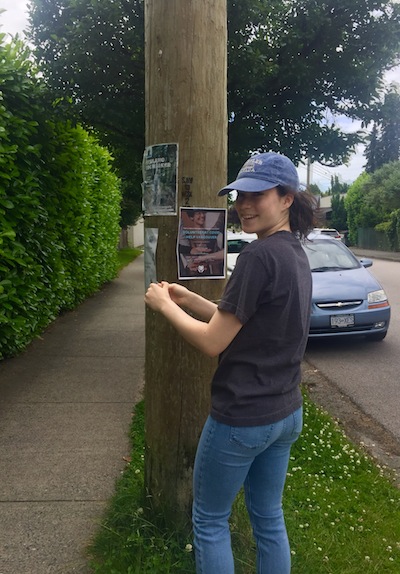
photo - COVIDhelp Vancouver’s director of outreach communication, Rebecca Baron, tapes a poster to an electricity pole to spread the word about the group’s services
COVIDhelp Vancouver’s director of outreach communication, Rebecca Baron, tapes a poster to an electricity pole to spread the word about the group’s services. (photo from COVIDhelp Vancouver)

Currently a third-year student in UBC’s Global Resource Systems Program, with a focus on global health and nutrition, Baron’s contributions to the community and beyond have been recognized. In 2017, she was the inaugural recipient of Temple Sholom’s Teen Tikkun Olam Award for her research on air quality and her efforts to address gender inequality in the sciences. That same year, she was one of the 18 young people honoured by the Jewish Independent with a JI Chai Award, receiving it for her science research and promotion, as well as her extensive and varied volunteer work.

Besides uniting volunteers with people in need, Baron’s other current pursuits include improving global literacy and advancing education for girls to ensure that all women receive equal opportunity in the workforce.

At present, there are more than 40 volunteers who have accomplished more than 30 tasks, and the COVIDhelp Vancouver team expects those numbers to grow.

The services offered are free, but the client has to arrange for payment of groceries and other goods. They can do this by paying the supplier directly or by ensuring the volunteer has the funds, pre-paying the helper via an e-transfer or PayPal payment, with cash as a last resort.

“All necessary precautions are maintained,” Baron said. “Our volunteers wear masks, use gloves and hand sanitizers and maintain social distance.”

She noted, “The current senior demographic in Vancouver makes up more than 15% of our entire population and this includes our grandparents, neighbours, great-aunts and -uncles. Those who are more likely to become severely ill or require intensive care might also experience a higher level of social isolation. The effects are compounded for those who don’t have access to technology platforms or have limited experience navigating the web. To help them stay connected, feel involved, purposeful and less lonely, we have created a COVID helpline. Now, all they have to do is dial our number and help will be on the way.”

COVIDhelp Vancouver stresses that all volunteers and users must adhere to health and hygiene requirements. Volunteers are screened before any client’s contact information is released.

Both founders of COVIDhelp Vancouver, Jiwa and Siddiqui, are masters of business management candidates at UBC. Jiwa, who just finished a bachelor’s degree in psychology, has a strong interest in the connections between social entrepreneurship and technology. For her part, Siddiqui hopes to create stronger pillars in society by strengthening social connections.

Other members of the team include volunteer coordinator Aimee Gray, who is completing her BSc in psychology at the University of Victoria and who also has an interest in learning about growing businesses, and Camryn Pederson, a UBC psychology student who wants to destigmatize mental illness and bolster community ties through volunteerism.

Those who wish to volunteer can do so by downloading the Zelos Team Management app on an iPhone or Android device, register as a volunteer and join the COVIDhelp Vancouver workspace. Volunteers should be healthy, display no symptoms of COVID-19, have not traveled or been in contact with anyone ill within the past 14 days and be practising social distancing.

Anyone who wants to spread the word by printing posters can download them from COVIDhelpvancouver.com.

Anyone who needs services should call 778-280-8686, leave a name and number and provide as much information about their request(s) as possible.

Sam Margolis has written for the Globe and Mail, the National Post, UPI and MSNBC.

Format ImagePosted on July 10, 2020July 9, 2020Author Sam MargolisCategories LocalTags coronavirus, COVID-19, COVIDhelp, Imaan Jiwa, Rebecca Baron, Riva Siddiqui, tikkun olam, UBC
Katz makes difference

Katz makes difference

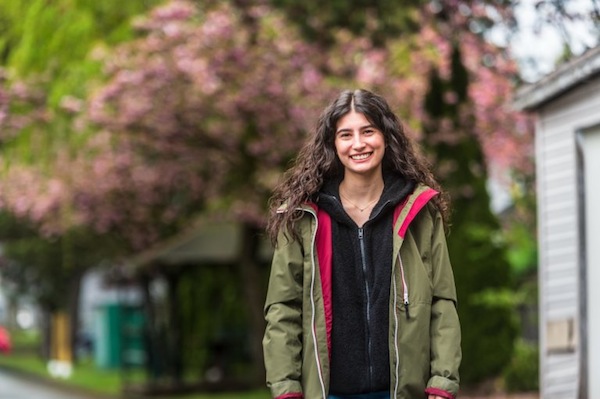
University of British Columbia student Ava Katz has been helping people with errands since the pandemic began. (photo by Paul Joseph/UBC)

First-year kinesiology student Ava Katz commutes to the University of British Columbia from Kerrisdale, where her housemates include her 91-year-old grandmother and a mother with a heart condition. In these extraordinary times, Katz doesn’t want her loved ones risking their health with unnecessary trips to the grocery store. So, in March, she began making those trips herself. As she was transporting groceries home from Save-On Foods, something occurred to her.

“It dawned on me that there are people in the community who don’t have family, who don’t have anyone else to go out for them,” said Katz.

Her final exams were just a couple of weeks away. It’s the time of year when most students’ instincts are telling them to clear their schedules of any distractions. Katz’s instincts were telling her to do something else.

She posted a public note on Facebook: “In wake of the spreading pandemic, I would like to offer my services to anyone who is compromised during this time. If you or someone you know is in need of groceries, household items, etc., please contact me directly and we can arrange for me to complete your needed errands free of charge.”

She indicated where she lived and her phone number, assuring people, “I will not enter your homes, only drop items off at the door. Priority goes to elders and individuals with compromised health. Please do not contact me to run errands for you if you are able and in good health.”

She asked readers to share the post. The calls came quickly. Just a couple at first, but more and more as her friends returned from school in the United States and overseas. They all had to self-isolate for 14 days, so they couldn’t do anything for their own grandparents who were shut in. Katz stepped in.

“That was just kind of a no-brainer for me,” she said. “I was happy to do those things, and still am.”

Katz has been shuttling to and from supermarkets and pharmacies all over Vancouver. Each outing brings her into the orbit of people who potentially carry the virus. Katz has heard the stories about the toll COVID-19 takes on its victims. She wears a mask and takes great care not to bring the virus to the people she’s helping.

She still makes the trips for her mom and grandmother, walks her two dogs, and also delivers food between two seniors homes twice a week as a volunteer for Congregation Beth Israel. It’s a lot to do, but, as far as Katz is concerned, it’s the least she can do.

“It definitely scares me that I could be exposing myself, but people need help,” she said. “I’d rather sacrifice myself than have a senior go into a grocery store and contract the virus instead.”

Many of the volunteers who were delivering food between the two seniors homes when COVID-19 arrived were older folks themselves. It was too risky for them to continue, so the congregation put out a call for new volunteers. Katz was among the first to step up, despite her busy exam schedule.

“Crisis brings out the best and the worst in people, and I think Ava is one of those examples of it bringing out the best,” said Krystine McInnes, volunteer coordinator for the synagogue. “The idea of selfless service and loving our neighbours as ourselves – she really embodies that.”

Helping people is in Katz’s blood. Her grandfather was a doctor for more than 60 years. She came to UBC thinking she would go into medicine eventually, too. Nothing during her first year has changed that. In fact, the COVID-19 outbreak has given her even more respect for the healthcare and support workers who keep our hospitals functioning every day.

“They are real heroes,” said Katz. “I have a huge respect for what it takes to provide care to so many people at a time like this and it reinforces my commitment to be a part of it.”

Format ImagePosted on May 15, 2020May 14, 2020Author Erik Rolfsen UBC Media RelationsCategories LocalTags Ava Katz, coronavirus, COVID-19, seniors, tikkun olam, UBC

Posts pagination

Previous page Page 1 Page 2 Page 3 Page 4 … Page 7 Next page
Proudly powered by WordPress