Skip to content
  • Home
  • Subscribe / donate
  • Events calendar
  • Business Directory
  • FAQ
  • News
    • Local
    • National
    • Israel
    • World
    • עניין בחדשות
      A roundup of news in Canada and further afield, in Hebrew.
  • Opinion
    • From the JI
    • Op-Ed
  • Arts & Culture
    • Performing Arts
    • Music
    • Books
    • Visual Arts
    • TV & Film
  • Life
    • Celebrating the Holidays
    • Travel
    • The Daily Snooze
      Cartoons by Jacob Samuel
    • Mystery Photo
      Help the JI and JMABC fill in the gaps in our archives.
  • Community Links
    • Organizations, Etc.
    • Other News Sources & Blogs
  • JI Chai Celebration
  • JI@88! video

Recent Posts

  • Or Shalom reopens its doors
  • JFS from past to future
  • Need holistic approach
  • Sharing stories, advice
  • Journalist shares fears
  • Skills to live together
  • Road to independence
  • Cutting grass with scissors
  • Zionism as a solution
  • Deceit, desire & the divine
  • Reclaiming sacredness
  • Creative project ideas
  • Summer squares and cobbler
  • Thou shalt … summer commandments
  • Legal help for students
  • Revisiting myth of Lilith
  • Wrong person rebuked
  • Canada’s mixed messages
  • Questions for museum
  • Symposium on antizionism
  • Making soccer political
  • CJPAC lauds Pulver’s impact
  • City recognizes Vrba’s legacy  
  • Organ donation saves lives
  • Theodore’s March premiere
  • A healing Shabbaton
  • Supplying healthy food
  • A chime of metal tags
  • Yellowknife seder a first
  • Ishai energizes, unifies
  • A Lag b’Omer to remember
  • Expanding the healing
  • Hannah Senesh – a unique hero
  • Community milestones … May 2026
  • Sharing her testimony
  • Fall fight takes leap forward

Archives

Follow @JewishIndie
image - The CJN - Visit Us Banner - 300x600 - 101625

Tag: UBC

Provincial campuses roiling
Provincial campuses roiling

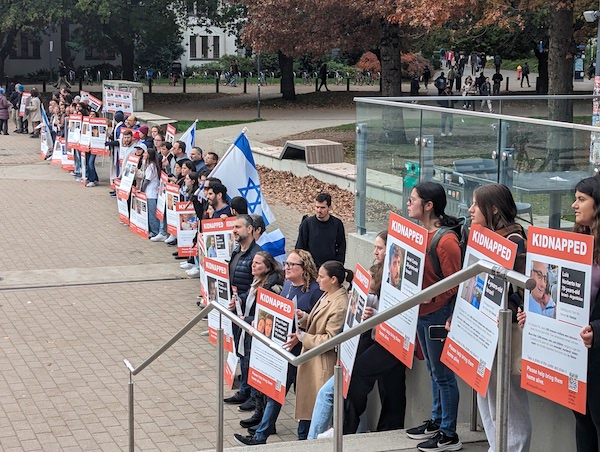
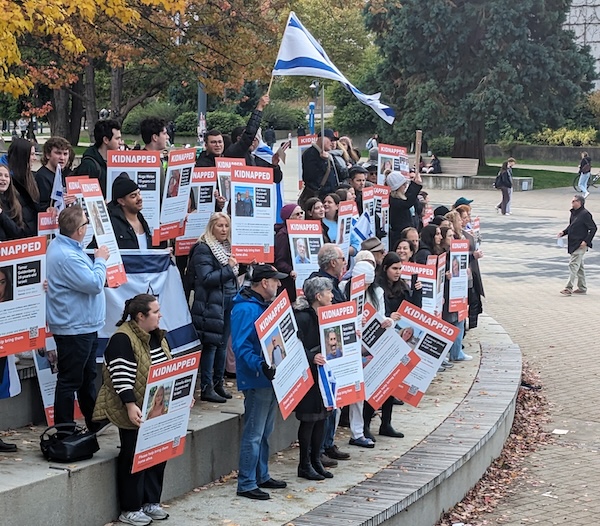
On Nov. 1, about 200 Jewish students and their supporters engaged in a low-key demonstration at the University of British Columbia, with many holding posters of kidnapped Israelis. Since the terror attacks of Oct. 7 and the start of the Israel-Hamas war, universities and colleges worldwide have been hotbeds of conflict. (photo by Pat Johnson)

Jewish students and their supporters at the University of British Columbia celebrated a victory last week after the student government overwhelmingly rejected motions that critics say were openly antisemitic.

The Alma Mater Society (AMS), which represents UBC students, voted in the early hours of Feb. 29 not to include a number of referendum questions on the ballot during upcoming student elections.

One proposed question accused Israel of genocide and called for an end to UBC’s exchanges with Israeli institutions. It would have also invited students to vote on whether they believe Hillel BC, the organization that has represented Jewish students, faculty and staff at the university since 1947, should be evicted from campus. (Hillel’s lease is with the university and the AMS has no jurisdiction over whether Hillel does or does not remain on campus.) This question was rejected by a vote of 23 to 2.

A second proposed referendum question would have asked students to massively revamp the governing structure of the AMS, adding dozens of additional elected representatives of marginalized groups. The change would have assigned designated groups representation on student government, including the Social Justice Centre, UBC Solidarity for Palestinian Human Rights, UBC Trans Coalition, Black Student Union, Indigenous students, and the Women’s Centre. Explicitly excluded from representation were Jewish students and groups that represent them. This proposal was rejected 25-0.

Referendum questions can be submitted anonymously, so it is not known from which individuals or groups these proposals emerged, though they had support from the Social Justice Centre, which calls itself “a resource group that works toward progressive social change, inclusivity and equity through a survivor-centric, harm-reduction, radical, feminist, decolonial, anti-oppression framework.”

“I was very pleased and relieved that the AMS leadership chose not to include what I would say are very antisemitic referendum questions on the student voting ballots,” Rob Philipp, executive director of Hillel BC, told the Independent. The intention of the proposed ballot question was to intimidate Jewish students and the vote is a reassurance to Jewish students, he said. “It’s surprising that it took them close to five hours to discuss this. But the vote, in the end, was pretty overwhelming to turn it down, so that was very heartening for us.”

A few hours later, across town at Simon Fraser University, referendum results were announced, with an anti-Israel ballot question receiving overwhelming support. The compendious policy, adopted by the Simon Fraser Student Society in 2022, was put to a vote by the broader student population, endorsing the boycott, divestment and sanctions campaign and repeating the boilerplate condemnations of Zionism as “a colonial ideology” bent on “ethnically cleansing the Indigenous population.”

The referendum question passed 1,801-442 and, while the statement of results did not indicate percentage turnout, there are around 40,000 students at SFU. It appears perhaps one in 20 students voted in the elections, in which a new president was elected with a tally of 878 votes.

These are just two of the foremost fires the Jewish community has been attempting to put out on campuses across the province recently. Universities and colleges worldwide have been hotbeds of conflict since the atrocities of Oct. 7 and the beginning of the war between Israel and Hamas. Administrators have struggled to balance preservation of free speech with often dangerously inflammatory, sometimes clearly antisemitic expressions. The presidents of the University of Pennsylvania and Harvard University were forced to resign after their remarks before a congressional hearing late last year were viewed as insufficiently condemnatory of overt calls for violence against Jews.

Philipp emphasized that postsecondary administrators in British Columbia have all been supportive of the Jewish community’s concerns – the administrations are not where the problems are coming from, although they are inevitably placed in the middle of these dramatic conflicts.

At Langara College, a months-long controversy over the fate of Natalie Knight, an English instructor who called the Oct. 7 mass murder of Israeli civilians “an amazing, brilliant offensive,” may not be over. Knight was put on leave while the college undertook an internal investigation. She returned to work, albeit in a non-instructional role, after the investigation determined her comments were “not clearly outside the bounds of protected expression.” She then spoke at a rally on campus, where she declared: “I’ve been reinstated as an instructor with no disciplinary actions, which means we won. It means we won. It means I did nothing wrong.”

Knight was then fired. While not mentioning her by name, the college said that an employee had engaged “in activities contrary to the expectations laid out by the college and as a result this employee is no longer an employee.” Her union has taken up her case.

Philipp commended Langara’s president, Dr. Paula Burns, for her leadership.

At Emily Carr University of Art and Design, some instructors have encouraged students to leave classes to attend pro-Palestinian rallies, and what Philipp calls “very, very aggressive posters” have appeared on campus. Hillel has been in conversation with administrators there.

“They understand the issue and they are in process right now of making changes to help protect the student body,” said Philipp.

“All our relationships are pretty strong,” he said of administrators at the many institutions at which Hillel BC has a presence, adding that he was recently in Victoria and had dinner with the president of the University of Victoria.

“These administrators,” he said, “are encountering very, very challenging situations that are really stressing their organizations at different levels. Nobody’s able to figure out exactly how to handle these very tricky situations.”

Hillel is also dealing with a lawsuit from the Social Justice Centre, about which they are unable to speak publicly except to say that an independent contractor, not acting on behalf of the organization, participated in the distribution of contentious stickers around the UBC campus. Hillel terminated its relationship with the contractor but is facing a case that attempts to hold the organization responsible. 

These are not easy times for Jewish students, but, in some cases, individuals are finding resources they did not know they have.

Rachel Seguin, a graduate of Vancouver Talmud Torah elementary and King David High School and a second-year psychology student at UBC, has become an accidental activist.

“Since Oct. 7, I’ve seen a new part of me that I didn’t even know existed – neither did my parents, honestly,” she said. The anti-Israel actions of the Social Justice Centre and the repeated stonewalling by the AMS in response to her complaints have driven Seguin to become a public voice against antisemitism on campus, including addressing the council last week in opposition to the referendum proposals.

“I didn’t imagine myself doing something like that,” she said. The fact that the AMS did what Seguin believes is the right thing was, she said, “really refreshing and satisfying.” 

Format ImagePosted on March 8, 2024March 7, 2024Author Pat JohnsonCategories LocalTags Alma Mater Society, antisemitism, Hillel BC, Langara College, law, Rachel Seguin, referendum, Rob Philipp, SFU, Simon Fraser University, UBC, University of British Columbia

Remembering, learning

Hillel BC’s Holocaust Education Week takes place on campus at the University of British Columbia Jan. 29-Feb. 2. Every day of that week, there will be something going on to attend and learn from, including the exhibit from Yad Vashem called Shoah: How Was It Humanly Possible?, which will be on display the whole week.

photo - Rachel Mines
Rachel Mines (photo from Hillel BC)

Jan. 29, 6 p.m.: Unheard Echoes: Jews in Lithuania Before, During and After the Holocaust. Presentations about the Jewish connection to Lithuania throughout history, focusing on the Holocaust, by Rachel Mines and Gene Homel, two members of the Lithuanian community. Register at forms.office.com/r/s4uAFqv8gc.

Jan. 30, 6 p.m.: Unheard Echoes: The Far Reach of the Holocaust in Asia. Ryan Sun is a PhD candidate in the department of history at UBC, working with Prof. Leo Shin and Prof. Richard Menkis. His transnational project expands the geography of Jewish exile outside Europe and beyond Shanghai, and onto the British colonies of Hong Kong and Singapore. He is particularly interested in Jewish refugees’ ship-bound experiences, how transiting colonial port-cities and encountering local inhabitants informed their understanding of “the Orient,” as well as how these ship-moments disrupt the standard narratives of the Holocaust and survivor testimonies. Register at forms.office.com/r/aQx4LG2Fhi.

photo - Ryan Sun
Ryan Sun (photo from Hillel BC)

Jan. 31, 5 p.m.: In a partnership between Hillel, brothers of the AEPi chapter of Vancouver and Chabad UBC, there will be a reading of the names of those who were murdered in the Holocaust. Meet at Hillel, then walk over to the fountain at the main mall, where the reading of the names will begin at 5:30 p.m. The reading can also be joined online, live on Hillel BC Facebook and Instagram, as well as the Instagram page for AEPi. 

photo - Marie Doduck
Marie Doduck (photo from Hillel BC)

Feb. 1, 5 p.m.: A Fireside Chat and Q&A with Survivor Marie Doduck & Dr. Lauren Faulkner Rossi. Marie (Mariette) Rozen Doduck was born in Brussels, Belgium, in 1935. She immigrated to Canada in 1947 as a war orphan with three of her siblings and settled in Vancouver. She is actively involved in Holocaust education and is a cofounder of the Vancouver Holocaust Education Centre. 

Rossi is currently researching child survivors of the Holocaust, the significance of their memoirs to Holocaust studies and the shared language of trauma among child survivors of different genocides.

Register at forms.office.com/r/1MtRu24BWT.

Feb. 2, 5 p.m.: Students-only Shabbat Dinner with Honoured Guests: Holocaust Survivors will feature a candlelighting ceremony and survivors spread out among the dining tables with students. Students can register at forms.office.com/r/ayufQr3Zmy.

For more information or help with the registration links, email [email protected] or call 604-224-4748. 

– Courtesy Hillel BC

Posted on January 26, 2024January 24, 2024Author Hillel BCCategories UncategorizedTags education, Hillel BC, Holocaust, UBC, University of British Columbia
Prof: “no choice but to resign”

Prof: “no choice but to resign”

Dr. Ted Rosenberg (photo from BC College of Family Physicians)

Ted Rosenberg has stepped down from his post as a clinical assistant professor at the University of British Columbia’s faculty of medicine, citing an unsafe environment, following his repeated attempts to have the school do more to address antisemitism.

In a Jan. 1 letter to UBC, the award-winning geriatrician, who has taught at the medical school for more than 20 years – prior to that, he had a position at the University of Manitoba – wrote that because the faculty has failed to address concerns, he had “no choice but to resign.”

A tense atmosphere developed following the Oct. 7 Hamas attacks when a petition titled “A Call for Action on Gaza” first appeared at the faculty of medicine and was signed by more than 225 of its students. The petition went beyond calling for a ceasefire in Gaza. Rather, it condemned Israel as “a settler colonial state,” accused it of “collective punishment through indiscriminate bombing of civilians” and claimed that “Palestinian people have been continually abused, traumatized and killed by the settler state of Israel and its Western allies for over 75 years.”

In a Nov. 29 letter to UBC president Benoit-0Antoine Bacon, medicine faculty dean Dermot Kelleher and other top officials at the university, Rosenberg wrote, “This petition and other similar statements on campus, as well as the inaction by UBC, makes me wonder if antisemitism has become systemic in this institution.”

While praising UBC’s efforts to redress discrimination and promote diversity and inclusion, he asked, “Why do these efforts for diversity and inclusion come to an abrupt halt when it involves ‘including and protecting’ Jewish/Zionist students and faculty?” According to Rosenberg, the petition not only made him feel unsafe but also traumatized a medical student “who was left distressed, anxious and sleepless after reading it, and enduring the hostile reactions of colleagues and faculty.”

A Dec. 21 letter, co-signed with 283 other physicians – both Jewish and non-Jewish – stressed the growing polarization at the medical school due to events in the Middle East.

“This is resulting in hate speech, student intimidation and the feelings of many students and teachers that they are working in a toxic environment. Several of us have expressed concerns to you in writing and are waiting for specific responses,” the letter read.

The letter also called into question the validity of the anti-Israel petition, emphasizing that it contained several inaccuracies, caused deep divisions within the medical student community, and was one-sided and unrelated to medical care.

In requesting a response from university leadership to take action to protect the integrity of the medical school and the safety of medical students and staff, the letter urged that those who signed the petition “be made aware of the significance of their choice of contentious language.”

Additionally, the letter called on the offices of equity, diversity and inclusion (at both the university and the medical school) to receive sensitivity training regarding Jewish issues and antisemitism, encouraged the university to adopt the International Holocaust Remembrance Alliance definition of antisemitism, and asked the university to form a clear policy on the boundaries of free speech, “having zero tolerance for any speech that crosses the boundary to antisemitic or hate speech or language used to incite violence, either openly or covertly.”

Both letters received responses from Dean Kelleher of the medical school. Rosenberg, however deemed them inadequate. In the resignation letter, he said they “did not address any of our specific concerns re: the medical student’s petition, antisemitism within the faculty, or concerns that politicization and polarization of the Middle East conflict are creating a toxic work environment.

“I checked the recommended links to your and the president’s statements on respect and compassion…. Two words are conspicuously absent from all these documents: 1. Jew(ish) and 2. Antisemitism.”

Rosenberg added that he searched the websites for the offices of equity, diversity and inclusion at the university and the medical school for “antisemitism” and did not find the word included among the several anti’s that were mentioned.

In his most recent letter, Rosenberg said he lamented the deaths of innocent civilians on both sides, but denounced the “oversimplistic ahistorical demonizing narratives and rhetoric” taking place.

Rosenberg also expressed the hope “that the faculty of medicine and UBC will recognize this serious threat of antisemitism/Jew-hatred and the dangers of politicization and polarization of the faculty and student body.”

In his concluding remarks, he advised the school to consult with the physicians who collectively wrote the school leadership in December. “They can work with you to constructively, collaboratively and proactively rectify this situation and ultimately help restore respect, compassion, empathy and trust among colleagues and students,” he said.

Rosenberg told the CJN that he is aware of other faculty members who have considered resigning because of the present atmosphere at the medical school. Since his letter, he also has heard from people at the faculty who are prepared to do more to recognize antisemitism – and to do something about it when it appears at the school.

In response to a request for comment about Rosenberg’s resignation, a spokesperson for UBC wrote, “The faculty of medicine and the University of British Columbia have been very clear that antisemitism, or discrimination of any kind, is completely unacceptable. We are committed to creating a safe and respectful environment for all of our community members and will continue to take steps to do so.

“In response to concerns raised by faculty and learners, the faculty of medicine is also working expediently to develop educational opportunities for inclusive learning and respectful dialogue within the faculty in areas that directly reflect our stated values, including how we address issues such as discrimination, harassment and hate speech,” they added.

Rosenberg, a Victoria-based physician who makes house calls, is an advocate for keeping the elderly in their homes for as long as possible. His company, Home Team Medical Services, aims to improve quality of life and increase independence for older people and their families. The company provides home-based health care for people 75 to 105 with physiotherapists, rehabilitation aides and care coordinators, in addition to a team of nurses and physicians.

In 2016, Rosenberg received the BC College of Family Physicians Award of Exceptional Contribution in Family Medicine. 

Sam Margolis has written for the Globe and Mail, the National Post, UPI and MSNBC. This article was originally published at thecjn.ca.

Format ImagePosted on January 12, 2024January 11, 2024Author Sam MargolisCategories LocalTags antisemitism, medical school, Ted Rosenberg, UBC, University of British Columbia

Rx for antisemitism?

A resident doctor in Vancouver was confronted by a fellow medical student demanding to know why Israel is exchanging three or more Palestinians for each Israeli hostage kidnapped by Hamas and held in the Gaza Strip. Is an individual Palestinian life of less value than a Jewish life? the student demanded.

This is one of many anecdotes making the rounds among Jewish doctors in British Columbia. These experiences, as well as an inflammatory anti-Israel letter signed by a sizeable number of University of British Columbia medical students, caused more than 100 doctors to assemble to discuss the issues Dec. 5.

“If the university doesn’t take these things seriously, I’m prepared to give up my UBC appointments,” said a Vancouver neurosurgeon who asked that their name not be used because they suspect activists would target them with vexatious complaints to professional governing bodies or harass them online or otherwise. “I don’t need to be associated with a university that does not speak out against antisemitism.”

Medical students in the province are trained in Indigenous awareness among other culturally relevant education, said the neurosurgeon.

“I consider myself to be part of the indigenous people of the land of Israel, and a minority,” the doctor said. “We’ve been labeled as settler-colonialists by a quarter of the medical students and our history has been completely ignored. I think those people should be forced to have some education about the indigenous people of Israel.”

The meeting, held at the Jewish Community Centre of Greater Vancouver, brought together about 50 doctors in person, with another 60 attending virtually. The neurosurgeon left uplifted after hearing from community leaders about strategies and actions being taken.

Addressing the meeting were Ezra Shanken, chief executive officer of the Jewish Federation of Greater Vancouver, Nico Slobinsky, Pacific region vice-president for the Centre for Israel and Jewish Affairs, and Ohad Gavrieli, assistant executive director of Hillel BC. The event was convened by Larry Barzelai, a recently retired family doctor, and Marla Gordon, a physician working in elder care and medical director for long-term care in Vancouver.

The gathering was a reunion of sorts, including some doctors who had been part of an informal cadre of Jews in the field who would get together informally a couple of times a year in recent decades. However, the turnout far exceeded expectations.

Gordon contacted Barzelai, thinking 10 or 20 doctors might want to get together over coffee. As of last week, 240 Jewish doctors, most of them in British Columbia, were part of a WhatsApp group of professionals concerned about antisemitism in their discipline, especially affecting younger doctors. About half attended last week’s event.

The letter that precipitated much of the meeting’s concern was signed by more than 300 UBC medical students – an estimated 20 to 25% of the total student body. The letter called on UBC’s new president, Benoit-

Antoine Bacon, to call for a ceasefire between Israel and Hamas, but also called Israel a “settler state” that is “dispossessing Palestinians of their homes” and stated that Palestinian people “have been continually abused, traumatized, and killed by the settler state of Israel and its Western allies for over 75 years” through “colonialism and imperialism.”

Gordon said the doctors are asking for the medical school’s diversity, equity and inclusion education modules to address antisemitism. 

“Just knowing that we are teaching these students who signed this letter, there is discomfort,” Gordon said. “We feel that everyone should be safe in their workplace. If you are a patient, you should feel safe getting care. What if one of your care providers had signed that letter and knows you’re Jewish?”

As much as the meeting had an agenda of fighting antisemitism and biased approaches to international affairs in the medical sector, Gordon said, it is also important for people to gather in mutual support when the community is feeling isolated.

Barzelai echoed Gordon, noting that several doctors told him that any future meetings should continue to be in person, or hybrid, rather than exclusively virtual, because the camaraderie was crucial.

“People are hurt,” said Barzelai. “They are having all sorts of negative experiences in their workplace, with the faculty, with other professors. They want to do something about it.”

Right now, the letter signed by hundreds of medical students is the foremost concern, he said.

“The fact that that many students would sign a letter I think shows the ignorance of the situation, or their lack of knowledge of what’s going on,” he said. “It just pointed to us that we need to educate these people, that it’s too easy to sign a letter and take sides. But the situation itself is a complex situation. To blithely sign a letter like that is kind of distressing. For us, as doctors, we think that people who get into medical school should have done some critical thinking to get there and would be a bit more nuanced about their opinions about the Middle East.”

A lawyer at the meeting stressed the importance of documenting each and every incident on campus, in the workplace or elsewhere. Pro bono legal assistance is available for students and an antisemitism hotline is likely to be operational in the new year.

An alternative letter, signed by Jewish and non-Jewish doctors and medical students, may be drafted and presented to university administrators. Successive meetings will determine next steps. 

Posted on December 15, 2023December 14, 2023Author Pat JohnsonCategories LocalTags antisemitism, doctors, Larry Barzelai, medical school, UBC, University of British Columbia
Tensions at university

Tensions at university

On Nov. 1, about 200 Jewish students and their supporters engaged in a low-key demonstration, with many holding posters of kidnapped Israelis. (photo by Pat Johnson)

When the new president of the University of British Columbia arrived for his first day on the job Nov. 1, he already had a full plate, including a 9 a.m. meeting with Jewish representatives and an urgent letter from community organizations expressing concerns about the safety of Jewish students on campus.

Dr. Benoit-Antoine Bacon starts his tenure at a contentious time, as Jewish, pro-Israel, anti-Israel and other students engage, sometimes constructively but often much less so, with events taking place in the Middle East.

Rob Philipp, executive director of Hillel BC, was joined by his assistant executive director, Ohad Gavrieli, and Nico Slobinsky, Pacific region vice-president for the Centre for Israel and Jewish Affairs, at the meeting with Bacon. Afterward, Philipp told the Independent the university has been on the right track but needs guidance.

“Generally speaking, I would say UBC has been very supportive of us, to the best of their ability,” he said, noting that Bacon’s welcoming of Jewish representatives is a good sign. “I had one of the very first meetings with him, so that speaks to how important this is on their radar.”

The university administration has been “somewhat consistent,” said Philipp.

“We are seeing support,” he said. “We don’t always see the right action, so that’s where we have to help and guide them.”

The larger issues, he said, are the serious affronts to civility on campus during the weeks since the start of the war between Israel and Hamas.

“There are so many red lines being crossed right now, it’s incredible,” said Philipp. “It seems OK now to kill civilians, to murder people for the ‘just’ cause and it keeps spilling over. People aren’t always understanding the details behind it all, so it’s as difficult a time as I have ever seen in this community – and it’s not just UBC, it’s all the university campuses all over North America.”

Hours after the meeting with the university president, about 200 Jewish students and their supporters engaged in a low-key demonstration, walking from Hillel House to the student union building, with many marchers holding posters of kidnapped Israelis. A student entered the building to deliver a letter to the president of the student government, the Alma Mater Society, expressing the group’s collective concerns. An emailed response to the letter from the AMS president was characterized by Hillel officials as positive.

photo - Jewish students and their supporters at the University of British Columbia on Nov. 1
Jewish students and their supporters at the University of British Columbia on Nov. 1. (photo by Pat Johnson)

A Jewish student leader from Simon Fraser University who asked that her name not be published said she came to the rally to protest the antisemitism in the world and, specifically, the lack of regard among student bodies to recognize what happened in Israel.

“It’s an extremely complex conflict that isn’t just black-and-white and I wish people would pay more attention or just seek a more nuanced view on the subject,” she said, adding that the climate at Simon Fraser does not seem as negative as at UBC, but that could change. In the last couple of years, the student government at SFU has demonstrated unbalanced, anti-Israel approaches, including adopting a motion on Israel and Palestine for which they consulted what the student called “tokenized [Jewish] fringe groups” while excluding Hillel and other mainstream Jewish voices.

Other participants at the rally said they felt the need to attend to be seen, and to register empathy with Israelis overseas and with Jewish students in Canada.

“We are here today so UBC acknowledges what’s going on in Israel – the kidnapped kids, elderly, children, women, Israelis – and what happened on Oct. 7,” said a 21-year-old Israeli-born woman who is not a student but came to support her brother, who is.

“I’m feeling very alone and feeling a lack of empathy and sympathy with what’s going on in Israel, feeling like people are too quick to comment sometimes,” she added.

Several non-Jewish students participated in the rally.

“I’m here because even though I’m not Jewish, I have a lot of Jewish friends and I believe the Hamas attacks against Israel are terrorism,” said fourth-year political science student Joe Latam. “The university’s attitude towards these literal terrorist organizations has been completely inadequate and they need to take better action.… The Jewish people have been systematically discriminated against for thousands of years and Israel is the one place where they can feel safe.”

Zara Nybo, who is also not Jewish, was motivated in part because her partner is Jewish and she sees the impact of events on him and his family.

“It’s important for me to stand up against terrorism and help spread the word that there are still innocent hostages who have been taken out of their home country,” she said. “We see a lot on the news that is politicized and very emotionally heartbreaking. I’m not here to say that Palestinian citizens have not died in this war, but I am here to say that death is death and we need to be able to recognize that heartbreak is heartbreak, so we are all here together.”

A first-year student who is Sikh called statements he has seen from peers and student leaders “frankly shameful.”

“I think there are many international students here that have been espousing hate, that have been espousing terrorist beliefs,” he said. “They have been saying they are pro-Hamas, they are saying [the Oct. 7 attacks were] a ‘beautiful act of resistance.’ I think we should double-check whether they deserve to be students at our wonderful university institutions.”

Bar Wolpert, an Israeli doing a one-semester landscape architecture exchange at UBC, said he was accosted by someone who tried to “shame” him as an Israeli.

“He just approached me out of the blue,” said Wolpert. “He was [aiming] his camera in front of my face.”

The person asked Wolpert if he supports “genocide.”

“I’m holding a [poster of a] kidnapped woman,” he said. “I am Israeli. I have a loss. So, please, first, respect my loss, respect my grief. And we are all standing here with many signs of kidnapped people and dead people, that is what is mattering for us right now, so before you are attacking me, respect my loss.”

Also at the rally were two brothers, Israeli high school students, whose parents sent them to stay with Canadian friends and family during the conflict.

A mother, walking with her young adult daughter, teared up when she realized that the poster she was carrying of a 21-year-old French-Israeli hostage could have been her own daughter.

“I can understand the pain,” said Evelyn Fichmann. “I think anybody can understand the pain.”

As he walked alongside scores of Jewish students and allies, a UBC student said the event gave him much-needed optimism.

“It really gave me some hope about unity,” he said.

Format ImagePosted on November 10, 2023November 9, 2023Author Pat JohnsonCategories LocalTags antisemitism, Benoit-Antoine Bacon, Hillel BC, hostages, Israel, Oct. 7, Rob Philipp, security, UBC, university campuses
UBC Chabad celebrates 10th

UBC Chabad celebrates 10th

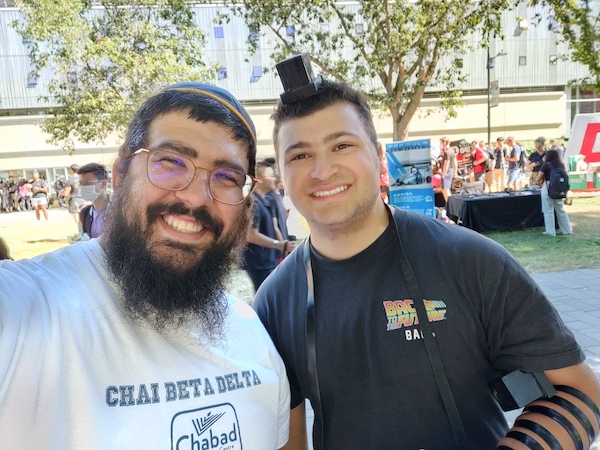
Rabbi Chalom Loeub and student Sagiv Fadida put on tefillin at the weekly Chabad booth at the UBC campus. (photo from Chabad at UBC)

This year marks a milestone, as the Chabad Jewish Student Centre at the University of British Columbia (UBC) celebrates its 10th anniversary. As part of the global Chabad on Campus movement, UBC Chabad has remained steadfast in its commitment to providing a warm and welcoming home for every Jewish student, regardless of their educational or religious background. UBC Chabad offers opportunities to build meaningful relationships with other Jewish students, deepen their connection and sense of belonging to their Jewish heritage, and strengthen their Jewish pride.

Rooted in the mystical traditions of the Hasidic revival of the late 18th century, Chabad-Lubavitch continues to try and make Judaism accessible and personally relevant to Jews worldwide. The teachings of Rabbi Menachem Mendel Schneerson, also known as the Rebbe, emphasize the importance of caring for the spiritual and material needs of all Jews, from Vancouver to Berlin to India and beyond. Inspired by his philosophy, Chabad emissaries, or shluchim, have established thousands of Chabad Houses, providing all Jews a home away from home.

photo - Chabad on Campus students from Western Washington University, University of Washington and University of British Columbia at an annual U.S.-Canada get-together
Chabad on Campus students from Western Washington University, University of Washington and University of British Columbia at an annual U.S.-Canada get-together. (photo from Chabad at UBC)

Over the past decade, Rabbi Chalom and Esti Loeub, the shluchim at UBC Chabad, along with their five children, have supported Jewish students’ physical and spiritual needs. They have hosted many fun and meaningful events, including weekly Shabbat dinners, Lunch & Learns, interactive tabling, and Grill the Rabbi barbeques. They have led holiday programs with lavish kosher meals, hosted a monthly Jewish Women’s Circle, and led educational initiatives such as the study of the Tanya (Chabad’s foundational book), Sinai Scholars (an eight-week series on the introduction to Judaism) and a course on the Six Day War (in partnership with the Jewish Learning Institute).

photo - One of the many weekly Lunch & Learn sessions that take place at the UBC campus
One of the many weekly Lunch & Learn sessions that take place at the UBC campus. (photo from Chabad at UBC)

However, the true measure of their impact lies in their ability to help Jewish students connect with their Jewish identity by performing mitzvot (good deeds). By encouraging students to give tzedakah (charity), wrap tefillin(phylacteries, or black leather boxes containing parchment from the Torah), light Shabbat candles, affix mezuzot (small pieces of parchment with a verse from the Torah rolled in a container) on their doorposts, and keep kosher, UBC Chabad has made a difference in the lives of countless Jewish students on campus.

“When I first came to university, I felt a distance between myself and the Jewish community,” said Gabby Tselos, president of UBC Chabad on Campus. “I always had my family and synagogue at home, but I felt like I was missing a piece of me when I came to UBC. Thankfully, in my second year, I became involved in Chabad and that has changed my whole college experience. Not only do I feel I have a Jewish family at UBC, but one that will remain with me as I continue to explore the world and my future.”

photo - A recent BBQ hosted by Chabad at UBC
A recent BBQ hosted by Chabad at UBC. (photo from Chabad at UBC)

Baruch Eckermann, outreach chair of UBC Chabad on Campus, also spoke about the positive impact Chabad has had on him.

“Chabad at UBC has helped awaken the Jew that was dormant inside my heart,” he said. “Without the love and care I received from Rabbi Chalom and Esti Loeub, I would not have become the Jewish man I am today. They work so dedicatedly for the students on campus, going far and beyond, not only in relation to religious needs, but in personal matters. They care about every Jew so much, it is beautiful to watch. All I can say to them is thank you. And please keep on doing your amazing work. We need you!”

To me, Rabbi Chalom and Rebbetzin Esti are like family. Whether on campus or at their Chabad house, they always put Jewish students’ needs first. What I love is that they genuinely see the inherent goodness in every Jewish student and believe that, by encouraging students to do more good deeds, the students will bring more blessings into the world.

For more information or to connect with the Chabad Jewish Student Centre at UBC, follow them on Instagram (@chabadubc) or visit their website, chabadubc.com.

Eitan Feiger is a student at the University of British Columbia, Class of 2024. He is vice-president and treasurer of UBC Chabad on Campus.

Format ImagePosted on June 9, 2023June 8, 2023Author Eitan FeigerCategories LocalTags Chabad, Chabad at UBC, Chalom Loeub, education, Esti Loeub, Judaism, UBC

Food insecurity at UBC affects Jewish students, too

Food insecurity is a growing problem on the University of British Columbia campus. The Alma Mater Society (AMS) Food Bank saw a 600-visit spike in the past year. Around “40% of undergraduate students and 50% of graduate students said they were worried about running out of food at least once in the past 12 months,” according to the 2022 AMS Academic Experience Survey.

In an open letter to the UBC board of governors, UBC Sprouts highlighted how “[d]espite UBC’s self-proclaimed dedication to reconciliation and equity, they perpetuate food insecurity which disproportionately affects Black, Indigenous, racialized, immigrant, low-income, houseless and/or disabled UBC community members.”

However, Jewish students are also an underrepresented minority group that is subject to this inequity.

Keeping kosher has been one of my greatest personal, physical and spiritual challenges so far in my life. Finding meals on campus that nourish myself and that are within the dietary restrictions of kashrut, all while staying true to my faith and not compromising my values, has been an uphill battle.

As one representing hundreds of Jewish UBC students, I believe there needs to be more access to kosher food on campus.

In Hebrew, the word kosher means “fit” or “acceptable,” according to halakhah, which is Jewish law. Any food grown from the earth is naturally kosher. However, any food that has been processed and prepared by humans must be carefully supervised by an Orthodox rabbi.

You can think of keeping kosher as a form of hygiene. The facility, the kitchen and production line in which a product is manufactured, processed and prepared must be kept very clean – undergoing frequent checks by an Orthodox rabbi – and must avoid cross-contamination with non-kosher food (like pork and shellfish), all with zero signs of any animal infestations (like rats).

In Jewish tradition, mixing milk (representing life) with meat (representing death) is another big no-no. For example, I cannot eat a cheeseburger or order a meal at a café that cross-contaminates dairy utensils with meat utensils. So, even a restaurant that advertises as 100% vegetarian or vegan is not officially kosher until it strictly meets the dietary, hygienic and/or rabbinical supervision requirements above.

Many vendors throughout campus incidentally sell kosher, pre-packaged snacks with a hekhsher, an official certification by an Orthodox organization approving a product as kosher. Although pre-packaged snacks are available, they do not constitute a sufficient meal on their own. There needs to be fresh kosher meals that are healthy, ready-made and affordable.

Since last summer, I have been doggedly persistent at trying to improve vendor availability of kosher food at UBC. I had been in correspondence with UBC Hillel BC, Chabad Jewish Student Centre, UBC Food Services and UBC’s VP Finance and Operations team to arrange a supplier setup and establish “requestor” contact on campus, along with a potential supplier such as the vegan Kosher Experience food truck. But UBC’s bureaucratic system has delayed this process indefinitely.

Kosher food has the potential not only to serve Jewish students, but vegan, vegetarian and Muslim students as well.

While UBC food security initiatives like the UBC Meal Share program, AMS Food Bank, Sprouts, Acadia Food Hub, Agora Café, and the residence meal plan (which has provided some kosher meals since 2020 and kosher meals can be requested in advance, but are only available at designated times for students living in select residences) offer nutritional support for students facing food insecurity, none of them provides kosher-certified meals from a kosher-certified kitchen. For example, the dining halls collaborate with UBC Chabad “to provide support and consultation on kosher food availability at UBC,” but they do not provide kosher-certified meals from a kosher-certified kitchen, according to a statement.

Regarding the plethora of options above tackling food insecurity, one UBC student remarked, “I really like the diversity that the market offers. When I was walking by, you can see a lot of different ethnic foods, a lot of foods that people would enjoy.” Yet, the diversity of food options (such as halal) and the accommodation of dietary needs (such as gluten-free foods) at UBC happens to include everything except kosher-certified meals. Or, namely, it excludes Jewish students.

For many Jewish students applying to university, kosher food is the deciding factor in their enrolment. If other top Canadian universities, such as the University of Toronto or McGill University, offer access to kosher food, then why can’t UBC?

In my personal experience living off campus, there are some days where I wake up late, rush out the door with no meal and, with no access to kosher-certified meals on campus, go hungry throughout the day. I am tired of it.

With UBC’s recent approval of allocating $500,000 toward food security programs and the AMS’s recent launch of their food security initiative, the AMS Food Bank can establish a contract with the leading Orthodox kosher certification organization in British Columbia – Kosher Check – to supervise the preparation of kosher meals (such as falafel and sandwich wraps) in the facilities of the AMS Food Bank.

While establishing and maintaining a kosher kitchen may not be feasible, having access in the Nest to a microwave, refrigerator and a dry goods rack designated only for kosher-certified meals would be the first most practical action to take.

I stand tall and proud to share my identity with others on campus. But, if there is not even any access to kosher-certified meals on campus, it furthers the marginalization of Jewish students like myself.

If the AMS and the UBC are committed to equity, diversity and inclusion, then they must commit to making kosher-certified meals accessible on campus.

Eitan Feiger is a third-year history student at UBC

Editor’s note: The original version of this letter to the editor was published in the Ubyssey.

Posted on May 12, 2023May 11, 2023Author Eitan FeigerCategories LocalTags food security, kashrut, UBC, University of British Columbia
Decline of Polish Jewry

Decline of Polish Jewry

Dr. Kamil Kijek of the University of Wrocław, in Poland. (photo from University of British Columbia)

For Polish Jews who survived the Holocaust, the question of where to begin life anew after the cataclysm was not as clear as it might seem in hindsight.

Looking back at the successive tragedies of postwar life for Jews in Poland, it might seem obvious that the blood-soaked homeland held little hope for the future. The choices for survivors limited their options, though, and the faith that, surely, the worst had passed played a role in the decision by tens of thousands to try rebuilding their families on the soil of their ancestors.

The disastrous history of Jews in postwar Poland was the subject of a special presentation at the University of British Columbia by Dr. Kamil Kijek, an assistant professor in the Jewish studies department at the University of Wrocław, in Poland. Speaking virtually from Poland to students in-class and to a wider audience online, Kijek addressed the decision faced by Polish Jewish communities to stay in or leave post-Holocaust Poland. He was speaking to a class led by Dr. Ania Switzer, a sessional lecturer at UBC, who was born in communist Poland and who is a translator and historian specializing in Jewish studies and Holocaust education.

“Most of Poland did not become the desert of Jewish life right away,” said Kijek. “It happened over time.”

About 50,000 Jews survived the Holocaust in Polish territory. In early 1946, about 136,000 Polish Jews returned from the Soviet Union, where they had survived the war, and a few thousand others found their way back from other parts of Europe. By July 1946, there were about 200,000 Jews in Poland, compared with about 3.3 million in 1938.

The vast majority of Jews who remained in or returned to Poland after the war did not take up life in the places they had been born. The borders of the country had shifted enormously, with the Soviets taking large swaths of what had been eastern Poland and Poland being compensated with formerly German lands in the west. Jews, along with other displaced Poles, were encouraged to take up residency in these newly acquired places in the west of the country, replacing Germans who were expelled.

“It is almost impossible to understand the tragedy of the people the moment when they are freed,” said Kijek. “We need to understand that the end of the war and so-called freedom actually was a time of psychological collapse for most of these people.… These people, when they come back to the places [of their origin], they see their whole communities destroyed and it’s the first time they are sure that most of their friends and family were killed.”

Significant American and other Western funds flowed into the Jewish communities of the country, intended to rebuild Jewish society there. Hebrew schools, synagogues and other institutions were constructed and supported by the Jewish Joint Distribution Committee and other international Jewish welfare and aid agencies.

The postwar period saw continuous upheaval in Poland, with civil war between pro- and anti-communist forces. It was not immediately clear that Poland would fall to communism, nor was it apparent at the time that, even if that did transpire, an Iron Curtain would fall across the continent. Polish Jews in the immediate aftermath of the war maintained close and supportive personal and institutional connections with family and Jewish organizations abroad. A degree of political pluralism revived before the country fell into the Soviet orbit.

Government oppression was not the only concern, though. On July 4, 1946, a pogrom in the southern Polish city of Kielce saw 42 Jews murdered and more than 40 injured. This was just the most deadly and well-known of a series of attacks against Jewish survivors after the war. The immediacy of antisemitic violence by their Polish neighbours disabused many Jews of the hope that they could rebuild a life in the country of their birth.

An exodus followed, but Kijek noted that, while contemporary observers might have seen abandoning Poland as an obvious choice, for people then, there were many considerations. They may not have had any money to facilitate relocation. At middle age or later, it might be natural to resist relocating to a place where one’s language is not spoken and one’s work experience is not transferable. And the prewar barriers that left European Jews to their fate remained largely in place: Western countries still did not open their borders to refugees.

Events unfolded quickly as the communists gained the upper hand in the country, the Cold War arose and the state of Israel was founded, providing at least a place where fleeing Polish Jews could find a welcome.

About 100,000 Jews were still in Poland in 1948, when an estimated 30,000 made aliyah. There was a tremendous amount of judgment, even suggestions of sedition, toward Jews who remained in Poland when Israel existed as an alternative, said Kijek.

“For Zionist leaders, any decision to stay in Poland was an act of a kind of national treason or an act of not understanding the lessons of the Holocaust,” he said, adding that those who remained were not all driven by ideological commitment to communism. The remaining Polish Jews represented a cross-section of Jewish society, including Orthodox, socialist and Zionist individuals. Eventually, even Zionist organizations accepted that not all Jews would make aliyah.

About one-third of Polish Jews who survived the war remained in Poland by 1950, but the emergence of the Cold War isolated them from Jews worldwide.

“All these ties are suddenly cut off in the end of 1948 and 1949,” said Kijek. The burgeoning of Hebrew schools and Jewish cultural organizations was stanched by a communist crackdown on “Zionist” institutions. The state nationalized much of the Jewish community’s remaining assets.

A liberalization occurred after the Stalin era and a number of Jews were able to flee Poland in the late 1950s. Those Jews who remained in Poland into the 1960s were, to a large extent, living a non-Jewish life and may have believed that their identity was no longer a barrier to whatever success they could attain in the country. However, following the 1967 Six Day War, in which Soviet-backed Arab countries were defeated by Israel, and 1968 student demonstrations that posed a genuine threat to the continued dominance of the communist regime, the scapegoat of “Zionism” emerged again, with Jews being accused of disloyalty to Poland, some being forced from their jobs, and the final mass exodus of Polish Jews occurred.

When the communist regime fell, in 1989, there were an estimated 5,000 to 10,000 Jews in Poland, the last remaining of a millennia-old civilization.

Format ImagePosted on April 28, 2023April 26, 2023Author Pat JohnsonCategories Local, WorldTags antisemitism, emigration, history, Holocaust, Kamil Kijek, Poland, UBC, University of British Columbia, University of Wrocław
Diaspora voices its concerns

Diaspora voices its concerns

The message on the Facebook post of this video from UnXeptable, who have been gathering weekly at Robson Square to protest the Israeli government’s proposed judicial reforms, reads: “Rain never stops Vancouver 🇨🇦 from supporting you in your struggle ❤️🇮🇱” (screenshot from Facebook.com/DefendIsraeliDemocracy)

Reverberations from the political tumult in Israel continue to rumble across the Diaspora, including here in British Columbia.

For 10 weekends in a row now, a few dozen Vancouver-area residents, many of them Israeli expats or Israeli-Canadians, have gathered in downtown Vancouver. On March 30, an “emergency meeting” took place at Or Shalom synagogue, titled Saving Israeli Democracy.

Daphna Kedem, one of the organizers of unXeptable, which is behind the rallies, told the group at Or Shalom that similar events are now taking place in more than 50 Diaspora communities.

“There is a point to going out in the street and saying we are here and we care and we want a lot of others to share what we feel,” she said, noting that between 20 and 50 people tend to show up at the weekly gathering at Robson Square.

“It would be great to be 200,” she said, adding that the masses of Israelis taking to the streets have forced a delay in the government’s proposals, but the fight is far from over.

The protests in Vancouver, in Israel and around the world centre on so-called “judicial reforms,” which would remove an existing multifaceted process of appointing Supreme Court justices and centralize it in the hands of the government executive, the cabinet. Among the reams of related proposals is a bill that would allow the Knesset to overturn Supreme Court decisions by majority vote.

Dr. Erez Aloni, an associate professor at the Allard School of Law at the University of British Columbia, said the proposals are “not a legal reform” and that it is “not a joke” to call what the government of Binyamin Netanyahu is attempting to do “a revolution.” Aloni is one of some 200 signees to the “Statement by Canadian jurists on proposed transformation of Israel’s legal system,” which was issued Feb. 9.

“A democracy needs checks and balances and these checks and balances include checks and restrictions on the government so we can enforce laws against the government, so we make sure that the government doesn’t abuse its right, in particular against minorities,” he said. “In Israel, the only checks, the only restrictions on the government, on the executive, is the Supreme Court.”

The power of the cabinet, the lack of a second chamber of parliament, the strictness of party discipline, the absence of a presidential veto, and the lack of a written constitution all combine to put extraordinary reliance on the Supreme Court to rein in any potential overreach by elected officials, said Aloni.

The proposals, which would give the government effective veto power over Supreme Court appointments, is a dramatic step, he said.

“The coalition, the executive, is going to be almost solely responsible for selecting judges by themselves,” Aloni explained.

Not only would this impact the Supreme Court, he argued, but any lower court judge with aspirations of appointment to the highest judicial body would presumably consider political repercussions when handing down decisions.

In addition to the proposals to alter the judiciary, Aloni told the audience that the government is also threatening “independent public broadcasting, control of academia, immunity for IDF soldiers and police actions, increasing jurisdiction of the rabbinical courts and so forth.”

Video-recorded remarks from Achinoam Nini, the well-known Israeli singer commonly known as Noa, were aired at the meeting, with portentous background music.

“The situation is not good,” said Nini. “In fact, Israel is on the verge of the worst tragedy in her short history, worse than any war so far: the death of her democracy and a total system breakdown. The so-called judicial reform … is no such thing. It is rather an antidemocratic coup, a grab for limitless power by a democratically elected government composed of convicted criminals, messianic zealots, corrupt opportunists and ultranationalists, turning democracy against itself and against the citizens of Israel.”

Dr. Lisa Richlen of the David Abraham Centre for International and Regional Studies at Tel Aviv University spoke of the impacts the proposals would have on nongovernmental organizations, especially those she works with that serve non-Jews, non-citizens and asylum-seekers. She addressed the apparent absence of Arab citizens of Israel in the demonstrations.

“I want to make the point that, for them, they haven’t felt that it’s a democracy since even before this,” she said, adding that the apparent attack on minorities has struck a chord with mainstream Israelis.

“When you start with weaker social groups,” said Richlen, “what you have is what you see today, where the mainstream of Israeli society is starting to feel increasingly threatened.”

Dr. Itai Bavli of UBC’s School of Population and Public Health echoed Richlen’s concerns for the rights of those outside the Green Line. He also disputed the idea that opponents of the government’s proposals are overstating the threat to democracy.

“Democracy is disagreeing and I get it that you have political differences, that’s the idea of democracy,” he said. “But these people, they don’t want democracy.… We have to oppose, we have to fight against these forces and support democracy in Israel.”

Rabbi Hannah Dresner, spiritual leader of Or Shalom, spoke and David Berson emceed.

The gathering was only one of many discussions in Jewish communities worldwide, some more public than others, around events in Israel and their impacts inside and outside that country. A February poll commissioned by JSpaceCanada and the New Israel Fund of Canada showed that, while three-quarters of Canadian Jews are emotionally attached to Israel, 73% oppose the judicial reforms (jewishindependent.ca/opposition-to-policies).

“Tensions that had been brewing for months in Israel came to head earlier this week, with the prime minister ultimately postponing the judicial reforms until the next legislative session,” wrote Jewish Federation of Greater Vancouver chief executive officer Ezra Shanken in his March 31 community email. “It is a very welcome decision, and, if our calculations are correct, it gives all parties until sometime in the summer to work out a compromise. A pause is not a halt and we implore the parties to come to the table with President [Isaac] Herzog, which is what we have advocated for since the start.”

The Jewish Federations of North America, the umbrella of 146 Jewish federations and more than 300 communities, released a brief open letter to Israel’s prime minister and opposition leader in February, stating, in part: “[W]e urge you to make clear that a majority of just 61 votes of the Knesset is not sufficient to override a decision of the Supreme Court. The essence of democracy is both majority rule and protection of minority rights. We recognize that any system of checks and balances will be different than those in our own countries, but such a dramatic change to the Israeli system of governance will have far-reaching consequences in North America, both within the Jewish community and in the broader society.”

On March 27, the Centre for Israel and Jewish Affairs, the advocacy voice of Jewish federations in Canada, lauded the Israeli government’s decision to delay the judicial reform legislation and urged more consensus on any changes.

Shimon Koffler Fogel, president and chief executive officer of CIJA, issued a statement, which noted, “The government’s decision must be met with a good faith effort on the part of the opposition parties, engaging in a constructive dialogue and ensuring people feel part of the policy process. Israel was founded on the principle of inclusion and must reaffirm those values at every opportunity. While there may not be uniformity around every decision, Canadian Jews must express unity around the existence of Israel and her contributions to the world, and acknowledge healthy debate is part of a continually evolving and growing democracy.”

Format ImagePosted on April 14, 2023April 12, 2023Author Pat JohnsonCategories LocalTags Achinoam Nini, CIJA, Daphna Kedem, David Abraham Centre, democracy, Erez Aloni, Ezra Shanken, governance, Israel, Itai Bavli, Jewish Federation, JSpaceCanada, judicial reform, Lisa Richlen, New Israel Fund Canada, Nini, Shimon Koffler Fogel, UBC, UnXeptable

Holocaust by bullets

The harrowing history of Ukraine’s past was recounted recently in the annual lecture honouring Rudolf Vrba, the late Vancouver scientist whose 1944 escape from Auschwitz brought the most concrete proof of the Nazi “Final Solution” to the world.

Dr. Nataliia Ivchyk delivered the 2023 Rudolf Vrba Memorial Lecture, titled The Holocaust in Ukraine: Violence, Gender and Memory. Ivchyk is at the University of British Columbia on a visiting fellowship that was created by Dr. Richard Menkis and Dr. Heidi Tworek to bring to Vancouver a Ukrainian scholar at risk. Ivchyk is associate professor in the department of political sciences at Rivne State University for the Humanities in her hometown of Rivne, Ukraine, and her work is focused on public history and memory politics.

Ivchyk’s presentation was based on survivor testimonies held at the USC Shoah Foundation, and narrowed in on the experiences of Jews in the western Ukrainian region of Volhynia and Podilia. Of the approximately 27,000 Jews who lived in Rivne (then known as Rovno) in 1937, it is estimated that just around 1,200 survived to the 1944 liberation by the Red Army. In a single day, on Nov. 6, 1941, about 21,000 Jews were murdered by Einsatzgruppe C and Ukrainian collaborators. The surviving Jews were imprisoned in the Rovno Ghetto, which was created the following month. In July 1942, remaining Jews, about 5,000, were transported to a stone quarry and murdered.

About 1.5 million Jews died in Ukrainian territory during the war years, most of them shot in what has been called the “Holocaust by bullets.”

“The Holocaust has long remained on the margins of collective memory in Ukraine,” said Ivchyk. Babyn Yar, a ravine outside Kyiv where more than 33,000 Jews were murdered over two days in 1941, has become a national symbol of Holocaust remembrance, she said. “However, the local level of remembrance remained low.”

There are many other sites of atrocities that were committed in Ukraine. “Some are marked by monuments, others are still forgotten and lost,” she said.

Of the several thousand Jews who survived the initial mass executions, anyone over the age of 13 was forced into slave labour.

“Nobody wanted to work for the Germans,” Ivchyk quoted one survivor, “but we had to. We hoped it would somehow balance our relationship with the Germans and would help us survive.”

Violence against women was mainly carried out by Ukrainian collaborators, she said, though Nazis also took part.

“I remember many times Germans came at night, knocked on the windows, took away beautiful girls,” Ivchyk quoted a survivor. “Sometimes, they raped and killed them right away. Sometimes, they said we will come again.”

Rabbis became a particular target of violence against men, given their social and symbolic status, and their role as spiritual leaders.

In the Soviet era, historical memorialization was subordinated to the priorities of the regime.

“The Holodomor [the deliberate Soviet famine that killed millions of Ukrainians], the deportation of Crimean Tatars, the Holocaust and the genocide of the Roma – all of these events were suppressed in collective memory by the Soviet regime,” she said.

Today, support in Ukraine for Holocaust memorialization is ambivalent.

“The activities of the state today do not prohibit academic, educational or public activities in the field of Holocaust remembrance, but neither does it act as a financial or ideological initiator,” she said.

The Vrba event was funded by the Holocaust education committee of UBC’s department of history, which is responsible for the annual lecture, as well as a number of other organizations, including the Vancouver Holocaust Education Centre and the Diamond Chair in Jewish Law and Ethics.

Menkis, associate professor of modern Jewish history at UBC and chair of the Holocaust education committee, noted that the event recognizes Vrba’s contributions to two primary areas to which Vrba’s life was devoted: Holocaust education and science, particularly pharmacology. The annual lectures alternate between these topics.

Menkis told the audience how Vrba and his friend Alfréd Wetzler made the momentous decision to escape from Auschwitz after overhearing conversations around the planned deportation of Hungarian Jewry. After a difficult and dangerous trek, the pair reached northern Slovakia, where they compiled a report documenting the layout of Auschwitz and the extermination process there.

“Although the report is credited with saving many lives,” said Menkis, “Vrba and Wetzler were keenly aware that more decisive action could have saved more. After the war, Dr. Vrba continued to speak about Auschwitz and his experiences. His book, I Cannot Forgive, written with Alan Bestic, was first published in 1963 and has been issued in a number of translations and re-editions since. He is also well known for his unforgettable testimony in Claude Lanzmann’s [documentary film] Shoah and perhaps less well-known but also important was his effective testimony in the Canadian trials against Holocaust denier Ernst Zundel.”

Vrba’s widow, Robin, attended the event virtually. Vrba died in 2006.

Posted on April 14, 2023April 12, 2023Author Pat JohnsonCategories Local, WorldTags gender, genocide, history, Holocaust, Nataliia Ivchyk, Richard Menkis, Rudolf Vrba, UBC, Ukraine, University of British Columbia, violence

Posts pagination

Previous page Page 1 Page 2 Page 3 … Page 7 Next page
Proudly powered by WordPress