Skip to content
  • Home
  • Subscribe / donate
  • Events calendar
  • Business Directory
  • FAQ
  • News
    • Local
    • National
    • Israel
    • World
    • עניין בחדשות
      A roundup of news in Canada and further afield, in Hebrew.
  • Opinion
    • From the JI
    • Op-Ed
  • Arts & Culture
    • Performing Arts
    • Music
    • Books
    • Visual Arts
    • TV & Film
  • Life
    • Celebrating the Holidays
    • Travel
    • The Daily Snooze
      Cartoons by Jacob Samuel
    • Mystery Photo
      Help the JI and JMABC fill in the gaps in our archives.
  • Community Links
    • Organizations, Etc.
    • Other News Sources & Blogs
  • JI Chai Celebration
  • JI@88! video

Recent Posts

  • Or Shalom reopens its doors
  • JFS from past to future
  • Need holistic approach
  • Sharing stories, advice
  • Journalist shares fears
  • Skills to live together
  • Road to independence
  • Cutting grass with scissors
  • Zionism as a solution
  • Deceit, desire & the divine
  • Reclaiming sacredness
  • Creative project ideas
  • Summer squares and cobbler
  • Thou shalt … summer commandments
  • Legal help for students
  • Revisiting myth of Lilith
  • Wrong person rebuked
  • Canada’s mixed messages
  • Questions for museum
  • Symposium on antizionism
  • Making soccer political
  • CJPAC lauds Pulver’s impact
  • City recognizes Vrba’s legacy  
  • Organ donation saves lives
  • Theodore’s March premiere
  • A healing Shabbaton
  • Supplying healthy food
  • A chime of metal tags
  • Yellowknife seder a first
  • Ishai energizes, unifies
  • A Lag b’Omer to remember
  • Expanding the healing
  • Hannah Senesh – a unique hero
  • Community milestones … May 2026
  • Sharing her testimony
  • Fall fight takes leap forward

Archives

Follow @JewishIndie
image - The CJN - Visit Us Banner - 300x600 - 101625

Tag: UBC

Opera urges “never forget”

Opera urges “never forget”

The ship’s cabin in Pasazerka (The Passenger), as envisioned by UBC Opera’s creative team. The opera is part of a series of events at the University of British Columbia marking the 75th anniversary of the liberation of Auschwitz. (photo from UBC Opera)

UBC Opera presents the Canadian première of Mieczyslaw Weinberg’s Pasazerka (The Passenger). Opening Jan. 30 at the Chan Centre for the Performing Arts on the University of British Columbia campus, this will be the first time the work has been presented on any university stage in the world.

The Passenger opens on a luxury liner bound for Brazil. A newly married German woman, Lisa, who, earlier in life, had been an aufseherin, camp guard, at Auschwitz, thinks she recognizes a fellow passenger. The passenger is Martha, a Polish Auschwitz prisoner who was thought to have died at the camp. The effect that their meeting (either actual or imaginary – it’s never made clear) has on the two women, and on Lisa’s marriage to the German ambassador to Brazil, is the subject of this dramatic and powerful opera.

UBC Opera’s production is being created from scratch. The opera has proven so popular no sets or costumes are available for rent; consequently, new sets are being constructed and, at this writing, the students were sewing together dozens of striped prison pajamas for the Auschwitz prisoners’ chorus.

After receiving its world première in 2010 at the Bregenzer Festspiele in Austria, The Passenger has seen frequent performances in various German venues, a highly acclaimed production at the English National Opera in 2011 and, more recently, it has been performed successfully in the United States at the Houston Grand Opera and at the Lyric Opera of Chicago. In spring of last year, it was performed at the new Tel Aviv Performing Arts Centre, and it will be performed in Spain later this year.

The UBC production has received funding from various sources, including the Adam Mickiewicz Institute, which promotes Polish culture around the world, and the Consulate General of the Republic of Poland, as well as Poland’s Department of Public and Cultural Diplomacy and Ministry of Foreign Affairs.

When the president of UBC, Dr. Santa Ono, heard about the project, he committed further funding for the production. Other funding has come from UBC’s dean of arts, Gage Averill, and the David Spencer Endowment Encouragement Fund. The production also has received support from the Vancouver Holocaust Education Centre, Temple Sholom and UBC Hillel House.

“In our time, antisemitism and neo-Nazism has become shockingly prevalent again. Even our own neighbour to the south has witnessed a growing social and political climate which has encouraged disrespect for other human beings and blatant racism,” said Prof. Nancy Hermiston, head of the Voice and Opera divisions at UBC and the director of this production of The Passenger, in a recent interview with the Independent. “In my opinion,” she said, “this has, in part, been released as a result of the behaviour and actions of President Trump. His attitude has given those elements of the world’s population promoting discrimination, hatred, antisemitism and neo-Nazism, a sense that they have a licence to do so. Our opera highlights the consequences of this hatred and racism. Now is the time to remind ourselves of respect and tolerance for others and of our humanity. It is the exact time to remind ourselves of the horror of the systematic extermination of millions of innocent people. Genocides continue to plague our world. Have we learned nothing from the past?

“We can never forget the tragic deaths of those millions of innocent souls nor can we forget those who survived that crime against humanity,” she said. “We cannot let another Holocaust occur.”

The Passenger is sung in Polish, Russian, Czech, French, Yiddish, German and English, which offers a particular challenge to the young singers at UBC. Equally challenging for the singers, according to Hermiston, is the difficulty of dealing emotionally with the subject matter, which, in rehearsal, has led to periods of weeping and feelings of deep sorrow, both for the singers and “even for me,” admitted Hermiston, “especially at the end, when the chorus of prisoners comes downstage and challenges the audience to ‘never forget, never forget.’” (Hermiston has engaged a counseling team to help the singers through their own trauma as they reenact this emotional narrative.)

Performances of The Passenger are set for Jan. 30 and 31 and Feb. 1 at 7:30 pm, and Feb. 2 at 2 p.m. Tickets are available online at music.ubc.ca/opera-pasazerka-the-passenger.

The opera is part of a larger commemoration of the 75th anniversary of the liberation of Auschwitz that is being undertaken by UBC Opera; the UBC Modern European Studies program; the UBC department of Central, Eastern and Northern European studies; the UBC Witnessing Auschwitz International Seminar; and UBC Go Global. During a symposium that runs Jan. 27-30, there will be various symposia and exhibits, and school-outreach programs featuring local survivors and UBC professors and students, as well as the opera The Passenger.

Guest speakers for the symposium include Dr. Michael Berenbaum, Dr. Bozena Karwowska, Dr. Piotr Setkiewicz, Dr. Chris Friedrichs, Aleksander Laskowski, Dr. Richard Menkis, Dr. Dorota Glowacka, Dr. Rima Wilkes, Dr. Anja Nowak, Dr. Peter Suedfeld, Dr. Tricia Logan, Dr. Ilona Shulman Spaar, Janos Benisz, Amalia Boe-Fishman and David Ehrlich, among others. For more information, visit auschwitz75.arts.ubc.ca.

Graham Forst, PhD, taught literature and philosophy at Capilano University until his retirement and now teaches in the continuing education department at Simon Fraser University. From 1975 to 2010, he co-chaired the symposium committee of the Vancouver Holocaust Education Centre.
Format ImagePosted on January 17, 2020January 15, 2020Author Graham ForstCategories Performing ArtsTags Auschwitz, education, Holocaust, Nancy Hermiston, opera, theatre, UBC, UBC Opera, University of British Columbia
Funds for Jewish studies

Funds for Jewish studies

Prof. Gregg Gardner has held the Diamond Chair in Jewish Law and Ethics at the University of British Columbia since 2011. (photo from UBC Media Relations)

Gregg Gardner conveys an infectious exuberance when speaking of the $1 million donation from the Diamond Foundation to the University of British Columbia this September.

“None of this would have been possible in terms of Jewish studies at UBC without the Diamond family,” Gardner, an associate UBC professor, told the Independent. “Their sense of giving is felt not just here but throughout the broader community.”

The Diamond Foundation’s most recent gift to the school will build on achievements of the Diamond Chair in Jewish Law and Ethics at UBC to date, with a particular focus on the expansion of Jewish studies programming both in the classroom and beyond the UBC campus.

“The gift is part of a larger initiative which will really go a long way in helping to create and augment programming, assist in having students travel to Israel, bring in new speakers and assist in new research,” said Gardner, current holder of the Diamond Chair.

He plans to invite an array of speakers during the 2020 and 2021 academic years.

“The money from the Diamonds can be used to bring in authorities in various aspects of Jewish research to Vancouver. Once here, they can speak at the university as well as at synagogues, retirement homes or cultural centres in town,” he said.

Gardner also hopes the new funds can serve as a stepping stone towards such things as creating a centre for Jewish studies at UBC and, ultimately, bringing the field of Jewish research at the institution to a level commensurate with that of other universities in North America.

Students at UBC, he said, have shown a widespread interest in Jewish studies, and this interest extends well beyond their own personal background.

The Diamond Chair in Jewish Law and Ethics was established in 2001. Gardner has held the position since 2011, with his research concentrating largely on the history of Jewish thought. At UBC, his classes focus on the history of religions, together with exploring Jewish history, texts and traditions.

In 2018, he teamed up with the Hebrew University of Jerusalem to lead a group of UBC students in an archeological field school at Horvat Midras in Israel, a site that may have been developed by King Herod. There, they helped excavate a pyramid that marked a tomb from the first century and an elaborate underground system of tunnels and caves that served as hideouts for Jewish rebels against Rome in the second century.

The Diamond gift will additionally allow Gardner himself to present more lectures locally and internationally. Heretofore, he has given has public talks at Hillel BC (UBC) and academic lectures at Oxford, Cambridge and Yale universities.

Gardner has authored several academic papers and books, including The Origins of Organized Charity in Rabbinic Judaism (Cambridge University Press, 2015), which examines foundational rabbinic texts and places their discourses on giving within their historical – second- and third-century – contexts.

The Diamonds are equally enthusiastic about the results their donations have brought and will bring.

“We wanted to enhance the current chair and enable Dr. Gardner to play a pivotal role in generating sophisticated research and understanding of Jews and Judaism,” said Leslie Diamond. “He has inspired students and the community by enriching their knowledge of Judaism through his courses, public talks and events with visiting scholars.”

She added, “I am very proud with what our funding of the Jewish Chair in Ethics and Jewish Law has accomplished.”

The Diamond Foundation has long played a pivotal and prominent role in Vancouver philanthropy. Created by Jack, z’l, and Gordon Diamond in 1984, its mission is to improve the quality of life for people in the communities in which the Diamonds live and do business. It donates to organizations throughout the Greater Vancouver area, including schools, hospitals and numerous Jewish organizations. The foundation seeks investments in organizations and issues that strengthen Jewish community life throughout the city and its environs. At age 25, family members are invited to become directors of the foundation.

Jack Diamond arrived in British Columbia as a near-penniless refugee from Poland in 1927 and went on to create the province’s largest meat-packing firm, Pacific Meats. He is credited with setting up Vancouver’s first kosher butcher shop and was instrumental in building the Schara Tzedeck Synagogue, among countless other endeavours.

Sam Margolis has written for the Globe and Mail, the National Post, UPI and MSNBC.

Format ImagePosted on December 20, 2019December 18, 2019Author Sam MargolisCategories LocalTags Diamond Foundation, education, Gregg Gardner, Jewish studies, philanthropy, UBC, University of British Columbia
Jewish war brides talk

Jewish war brides talk

At the University of British Columbia on Nov. 21, Prof. Robin Judd will speak on What’s Love Got to Do With It? Jewish War Brides and North American Soldier Husbands after the Second World War. (photo from Robin Judd)

Prof. Robin Judd noticed that a significant number of the earliest Holocaust memoirs written by women were penned by “war brides” who had married American, Canadian or British soldiers.

In the course of teaching about the Holocaust at Ohio State University, the coincidence struck her and, as happens in research, led her onto a new topic. She is nearing completion on a book about the experiences of Jewish women – and a few men – in Europe and North Africa who married Allied service personnel and moved to Canada, the United States or Britain. She will give a guest lecture on the subject at the University of British Columbia next week and the public is welcome to attend.

The lecture is titled What’s Love Got to Do With It? Jewish War Brides and North American Soldier Husbands after the Second World War, and Judd told the Independent that love certainly played a key role, but some of the other factors at play also interest her.

“What prompts individuals from radically different cultures, who may not necessarily speak the same language, what prompts them to create relationships with one another and long-lasting relationships, relationships that are going to result in marriage and then bring the civilians to Canada, Britain or the United States?” she asked.

Most of the soldiers that Judd is studying were Jewish themselves, though there are exceptions to the rule.

In some cases, the wives would arrive in the new country before or otherwise apart from their new husbands or fiancés. An entire infrastructure was in place to accommodate and integrate them.

“The war brides, particularly if you come to the United States or to Canada as a war bride, first you live with other war brides at least temporarily in a kind of war bride home or war bride camp and you travel on a war bride ship and there are particular Red Cross workers who teach English and show films and cooking classes,” she said.

If the fiancés or husbands were not yet decommissioned or were traveling with their units, the brides may have found themselves in the position of living with their new in-laws.

“These were not the spouses they were planning for their sons,” Judd comments. “And all of a sudden here you have this woman show up. You are processing stories that you are hearing about the war and all of a sudden here comes this person and you might not be able to communicate, you might not have a shared language, you might not know how to even ask questions about what this person had experienced.”

Feeling isolated and foreign, some of these women used the opportunity to express their experiences privately, to themselves, in writing.

“Some of the women that I’ve spoken to have told me that they used that time to write out their story, to put it to paper, because they needed to kind of get it out and there was no one with whom they could talk, literally,” she said. “But then, as they began to create networks, make new connections, maybe by that point their now-husbands have returned to Canada, Britain or the U.S., a number of them tell me that they then destroyed them.”

By an apparent coincidence, though, Judd concluded that it was disproportionately the women who had married soldiers who were among the first to publish English-language Holocaust memoir narratives for general readers in the 1970s and ’80s. She has a theory about this, but admits she could be wrong: these may have been some of the first women who were asked to speak about their early life and Holocaust experiences to Jewish women’s groups, federations and other community audiences, acclimating them to become among the first to put them on paper for general readers.

“But, again, I could be completely wrong,” she said.

Judd’s lecture is supported by a Holocaust education fund in UBC’s department of history to support undergraduate education on the Holocaust. The fund supports a biannual lecture, alternating years with the Rudolf Vrba Memorial Lecture, and is incorporated into an undergraduate course, History of the Holocaust, taught by Prof. Richard Menkis, who is also chair of the committee that manages the fund. The public is welcome to attend on Thursday, Nov. 21, 5-6:15 p.m., at Buchanan D217 at UBC.

Format ImagePosted on November 15, 2019November 13, 2019Author Pat JohnsonCategories LocalTags Holocaust, Robin Judd, Second World War, UBC, war brides, women, writing
Finding hope during war

Finding hope during war

Laura Reynolds and David Volpov in The Wars, which opens Nov. 7. (photo by Javier R. Sotres)

Timothy Findley’s award-winning novel The Wars, adapted by Dennis Garnhum for the stage, comes to University of British Columbia’s Frederic Wood Theatre Nov. 7-23. Directed by Lois Anderson, it will be performed by UBC Theatre and Film’s graduate class of 2020, among whom is Jewish community member David Volpov.

Volpov takes on the leading role of Robert Ross, who is described as “a tender-hearted idealist who shares a strong bond with his wheelchair-bound sister” and “trades his comfortable Canadian life for the harsh world of trench warfare in World War I.”

“What I find challenging about playing Robert is imagining the play as a series of events, with each event slowly transforming him into a new person,” Volpov told the Independent. “At first, he’s a shy city boy who comes from a wealthy family. Over the course of the play, he becomes a confident lieutenant, who’s gained a lot more life experience. It’s not until he escapes his domestic life and goes to war that he truly discovers who he is. He discovers more about his sexuality, his morality around war and his will to live.

“As well as being a war story, the play is also a coming-of-age story. Finding those moments of change has been a rewarding experience because Robert is such a complicated character to crack. Even though he’s so young, he has so much trauma and weight that he carries with him to France. It feels like a big step for Robert every time he grows or learns something, or pushes past his comfort levels.”

Volpov is in his final year of the bachelor of fine arts acting program at UBC. As a writer, his plays include The Minimum-Wage Dame and Ten Years Later. His acting credits include Promethean Theatre Company’s productions of Of Mice and Men and Saint Joan.

“I love working with Promethean because we’re a small group of friends who are passionate about theatre,” he said. “We come together and discuss what stories we want to tell, what stories we think are important to tell. Then we go ahead and tell them. There’s nothing high-brow about it.”

Volpov’s appreciation for storytelling comes in part from his parents.

“My parents were Jewish immigrants from the former Soviet Union – my mom from Latvia and my dad from Belarus. Having grown up persecuted for being Jewish, they found it important to pass on their life stories to me, and that I understood what it meant to be Jewish,” he explained.

Growing up in Richmond as a secular Jew, he said, “It wasn’t until I was a teenager and spent one summer at Camp Tel Yehudah in Upstate New York that I felt connected to my heritage. The camp was oriented on teen leadership, so each camper chose a global issue which they were passionate about, researched it and created an activism action plan.

“The issue I chose to dive into was gun safety,” he said. “My group and I created a policy plan that we got the chance to take to Washington, D.C. We met with senators’ aides and representatives of the NRA [National Rifle Association] and the Brady Campaign. It was very important to be able to speak with people on both sides of the issue and still be able to have a healthy discussion. The experience impacted me a lot because it was the first time that I felt like I had a voice about something I was passionate about, something that felt so personal to me. That’s one thing that really helped in my acting from then on. Before that, I knew how to read and play someone else’s script, but that was when I learned how to make someone else’s text feel like it was my own.”

Considering the text of The Wars, Volpov said that one of the reasons Findley wrote about the First World War “is because that was the war that changed everything. It marked the first use of chemical weapons in war and the first time that the senselessness of war was widely reported. World War I marked a point where the world shifted to a much more cynical outlook, where the chaos of the world was realized.

“Presently,” he said, “we’re living in a similarly cynical time, in a new age of increasing isolationism – of Brexit and [Donald] Trump, and the climate crisis, too. The message that the play applies to the First World War can also apply to today: even when we’ve lowered our faith in our leaders and in humanity, we can always hold onto hope and lean on meaningful connections to others to get by.”

He added that “these connections take precedence over mere survival. The play is so life-affirming because it’s all about finding hope and joy even during the hardest times.”

For tickets to The Wars, call 604-822-2678 or email [email protected].

Format ImagePosted on November 1, 2019October 30, 2019Author Cynthia RamsayCategories Performing ArtsTags David Volpov, theatre, Timothy Findley, UBC, war

Election views diverge

The Independent spoke with people in the Jewish community to gauge attitudes as the federal election approaches. What we found was a diversity of views and a lack of consensus.

An informal focus group of residents at the Weinberg Residence raised issues of out-of-pocket expenses for medical treatments and a lack of available doctors.

“You lose your doctor, you can’t get another one,” said one senior voter.

There was not great enthusiasm for any of the party leaders. One participant said she had lost respect for Liberal leader Justin Trudeau long before the recent brownface and blackface issue emerged.

“I was disappointed in him way back when he went to India and there was this whole thing of dressing up in Indian costumes. I felt it wasn’t very statesmanlike.”

“I feel that he’s had his chance and I don’t want to vote for him because he showed us what he can do. I don’t think he’s got what it takes,” said another voter.

“I expected nothing from Trudeau and I got it,” said another.

But there was no groundswell of support for Conservative leader Andrew Scheer.

“I’m disappointed,” said one. “I haven’t heard anything that’s promising.”

Some voters said NDP leader Jagmeet Singh comes across as sincere, but one said he has a lot of repair work to do with the Jewish community after his party’s positions against Israel in the past.

Elizabeth May, the Green leader, was viewed positively, but not seen as prime minister material.

“She’s very good at her subject, but I can’t envisage her really understanding what’s going on in the economy, in foreign affairs,” one resident said.

Among more than a dozen participants, the vast majority had a positive view of their incumbent MP, Jody Wilson-Raybould.

“I think she deserves better than she’s had,” said one person, while a Conservative supporter said she wishes Wilson-Raybould was running for her party, because she’d like to vote for her.

A show of hands indicated well more than half are undecided about who to vote for.

“Everybody’s confused,” said one, to laughter all around.

* * *

Alice Sundberg, director of operations and housing development for Tikva Housing Society, would like to see the federal government get back into funding nonprofit housing.

“We think that there is a really significant role for the federal government in making rental housing more affordable,” she said. Rather than subsidies to renters, which go into the pockets of landlords and don’t create new housing, she would like to see either capital grants to reduce mortgages for nonprofit or co-op housing, thus reducing the rental costs, or ongoing operating subsidies to organizations like hers that develop new housing.

“We don’t have enough supply,” said Sundberg. “Back in the ’90s, when the federal government withdrew from funding new affordable housing, it was really the beginning of our homelessness crisis.”

Housing is also a topic for Eldad Goldfarb, executive director of the Jewish Community Centre of Greater Vancouver. The centre’s redevelopment will include at least 300 units of affordable rental housing. His team has spoken to many federal officials, including MPs, but, so far, he said, “No commitments, no confirmations, lots of good feedback and great understanding of the project, support for it, but nothing has translated into actual commitments, funding, promises, nothing of that sort.”

Support for the housing component might include financing from the Canada Mortgage and Housing Corporation, rather than grants, though he hopes for federal cash for the new JCC building. He credited the federal government for stepping up with funding for security infrastructure for communities at risk, but added there is always need for more.

* * *

The rise of hate-motivated rhetoric and violence leads some community leaders to call for more federal action and leadership.

“With the rise of antisemitism, racism and far-right extremism, particularly in the online space, the Vancouver Holocaust Education Centre would welcome a comprehensive strategy to tackle hate in all its forms,” said Nina Krieger, executive director of the VHEC.

Russ Klein, principal of King David High School, would like to hear party leaders and candidates address how they are demonstrating moral and ethical leadership that creates trust and inspires Canadians, especially young people.

“How will they work to ease a society which seems quick to feel fear and seems overly stressed and anxious?” asked Klein. “I want to know how they will support a kinder, more inclusive society that offers hope and opportunity for all but especially to young people and to the most vulnerable in our society. How will they work to maintain affordable housing, livable wages and allow people to manage a balanced lifestyle in cities like Vancouver, where young families cannot afford to live in their current community? We live in extremely concerning times globally and I want Canada to lead in decreasing world tensions – how will they do that?”

* * *

Similar broad topics arose among a handful of University of British Columbia students who met at Hillel House to discuss issues that are important to them. All agreed that there has not been enough discussion of foreign affairs and there is a lack of substantive difference between the parties on issues like immigration.

“I don’t see any candidate that has a clear foreign policy vision, even though I think Chrystia Freeland is, personally, a great minister of foreign affairs,” said Adam Yosef Dobrer, a third-year political science student who is volunteering on Zach Segal’s Conservative campaign in Vancouver Granville.

Dobrer also wants Canada to return to the Conservative policy of defunding the United Nations Relief and Works Agency for Palestine Refugees in the Near East (UNRWA), which he called the greatest obstacle to peace between Israelis and Palestinians.

“In the last four years, I found it very difficult to understand where Canada as a nation lies in foreign affairs,” said Nika Perel, a fourth-year psychology student from Ontario who plans to vote Conservative. She credited the previous Conservative government with more clarity on Israel and Palestine and on Russia and Ukraine. “Stephen Harper made it very clear that he took a position supporting Ukraine.”

Jake Reznik, a nursing student with an undergraduate degree in kinesiology who remains an undecided voter, said Canada is not adequately standing up to China over its treatment of the Muslim-minority Uygher population or its other human rights violations. He added: “There is a lot of influence that the Chinese government does have in Canada that goes under-recognized.”

Matt Perzow, an NDP supporter who plans to vote strategically for Joyce Murray, the Liberal candidate in Vancouver Quadra, to prevent a Conservative government, emphasized health care, including mental health services. Defending Canadian values like multiculturalism and care for the most vulnerable are also things he wants to see party leaders prioritize.

All the students agreed that supporting Israel is an important consideration in their vote, but also said it will not be the deciding factor.

“I wouldn’t vote for any party that I thought would jeopardize the future of the Jewish people, whether it’s in Canada, in Israel or in another place,” said Perzow. “I’m not voting for somebody because of that issue, but, if I thought that something compromised the well-being of the Jewish people, I wouldn’t support them.”

Dobrer, whose family migrated to Canada from Israel when he was an infant because of the Second Intifada, said he has a “very resonant emotional connection” to Israel “but I am a Canadian first.” He is concerned about some election candidates, including Green party MP Paul Manly, who Dobrer says has a “long and sordid history of antisemitism and 9/11 ‘trutherism’ and delving into conspiracy theories.” (After being elected in a by-election this year, Manly denied he supports 9/11 conspiracies after the CBC reported on statements he had made in 2007 and 2011.)

The students all agreed that the environment and climate change are top issues for them and their peers, but expressed nearly universal hopelessness that anything substantive would change.

“I have no doubt that it will not be addressed,” said Reznik. “I know personally I’m not going to be willing to sacrifice my own standard of living and, at the same time, I think it is tremendously insulting on my part to tell someone else that they can’t attain my standard of living that we have here.”

“A lot of people are standing up and screaming about things, but they’re not going to do anything about it,” said Perel.

A hint of hope came from Dobrer: “From the government, I’m very skeptical. But from young intellectual minds, from the not-for-profit sector, from the private sector, every day there is more and more innovation, technological advances and more intellectual capital devoted to dealing with climate change.”

Posted on October 11, 2019October 10, 2019Author Pat JohnsonCategories LocalTags Adam Yosef Dobrer, Alice Sundberg, Canada, Eldad Goldfarb, federal election, Hillel House, Jake Reznik, JCCGV, Jewish Community Centre, KDHS, King David High School, Matt Perzow, Nika Perel, Nina Krieger, politics, Russ Klein, Tikva Housing, UBC, Vancouver Holocaust Education Centre, VHEC, Weinberg Residence
Community milestones – Silber Theatre, RJDS-Pawer tzedakah, Rudolph wedding, Pawer and Baitelman grads

Community milestones – Silber Theatre, RJDS-Pawer tzedakah, Rudolph wedding, Pawer and Baitelman grads

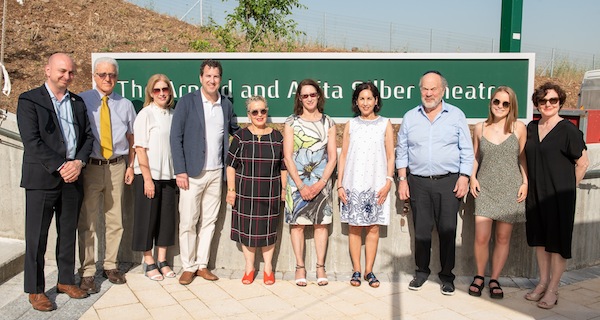
The Arnold and Anita Silber Theatre at Tel-Hai College officially opened last month. (photo from Jewish Federation of Greater Vancouver)

Last month, Jewish Federation of Greater Vancouver chief executive officer Ezra Shanken, as well as board members Karen James, Alex Cristall and Candace Kwinter, and Jewish Community Foundation executive director Marcie Flom were in Israel for the official opening of the Arnold and Anita Silber Theatre at Tel-Hai College. This new 1,200-seat outdoor theatre will be a hub of activity for the university and surrounding area. The theatre is located at the centre of the Tel-Hai campus, and is a key component in the college’s long-term development plan.

The Silbers have long supported Federation’s partnership region of the Galilee Panhandle, and its work there. They have supported a number of projects and established the Friends of Beit Vancouver, a donor-recognition program for supporters of Beit Vancouver. Anita Silber serves on Federation’s Israel and overseas affairs committee, and has for several years. Recognizing that Tel-Hai is a significant economic driver in the region led the Silbers to fund this legacy project and lend their name to it.

The official opening of the theatre began with a welcome reception with Tel-Hai’s board of trustees, followed by a ribbon cutting. The Silbers were joined by their granddaughter, Samantha Addison, and family members from Israel. In reply to the address honouring them that was delivered by Tel-Hai’s president, Prof. Yossi Mekori, Arnold Silber stressed that the students were the primary motivation for this investment. They are the ones to whom the future of the region is entrusted, and it is they who will take it to the next level.

A number of families and individuals from our community agree, and they are funding scholarships, which were awarded to students at the ceremony by James and Cristall: the Coleman Family Scholarships, the Krell Family Scholarships, the Evelynne Loomer z”l Scholarships, the Bernard Lotzkar Scholarships and the Zalkow Family Scholarships.

* * *

photo - Left to right are Lola Pawer, RJDS students Maya Bernal and Penina Berger, and Leslie Diamond
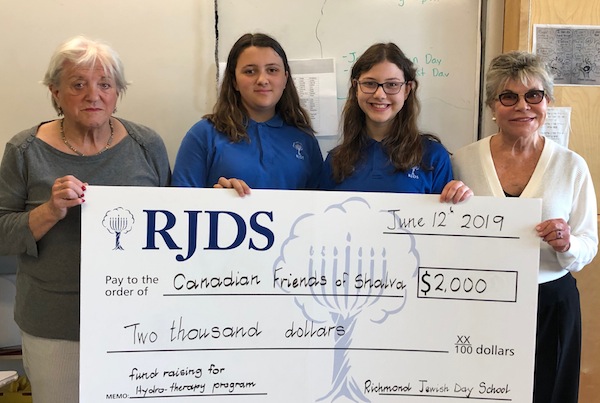
Left to right are Lola Pawer, RJDS students Maya Bernal and Penina Berger, and Leslie Diamond.

Over the course of the 2018/2019 school year, the Student Council Committee of Richmond Jewish Day School took it upon themselves to raise money for the Shalva Centre Hydrotherapy Program in Israel.

With the support of families, the school raised $1,000, which was generously matched by Lola Pawer. Pawer and Leslie Diamond, who is a board member of the Shalva Centre, came to RJDS to teach students about the work Shalva provides for children with disabilities.

The students presented a cheque to Diamond in the amount of $2,000. For anyone wanting to learn more about Shalva or make a donation, visit shalva.org.

* * *

photo - Brett and Caro Rudolph
Brett and Caro Rudolph

Brett and Caro Rudolph have fun at their wedding in Syracuse, Sicily. Brett is the son of Les and Anita Rudolph of Vancouver (previously from South Africa) and Caro is the daughter of André and Svetli Wanne of Vienna. The wedding was officiated by Rabbi Paul Chaim Eisenberg of Vienna and was thoroughly enjoyed by family and friends. Brett and Caro live in Israel.

* * *

photo - Samantha Pawer
Samantha Pawer

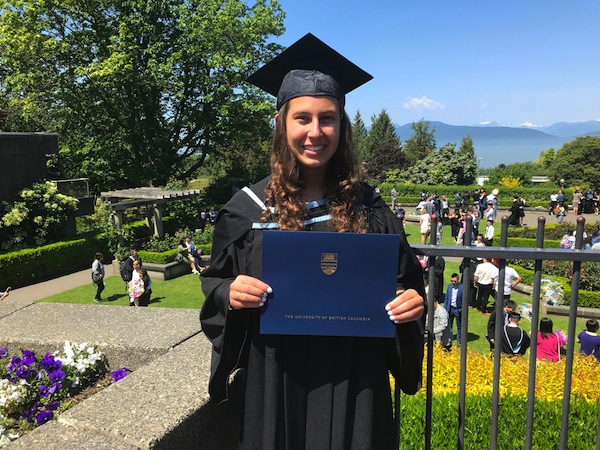
On May 25, 2019, Samantha Pawer was conferred the degree of bachelor of science honours in integrated sciences with distinction from the University of British Columbia. Samantha is an alumna of Richmond Jewish Day School and Hugh Boyd Secondary School. Proud are parents Jeff Pawer and Beverly Pawer and big brother Brayden Pawer.

* * *

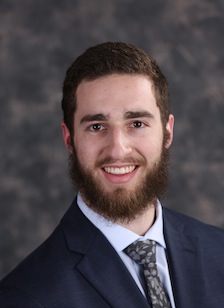
Moshe Baitelman decided to become a doctor when he took his first biology class in high school. On May 26, 2019, the Vancouverite graduated as valedictorian at Touro’s Lander College of Arts and Sciences in Flatbush, Brooklyn, N.Y. He will begin medical school in the fall.

photo - Moshe Baitelman
Moshe Baitelman

Baitelman chose Touro because it offered a strong Jewish environment as well as academic rigour. He majored in honours biology and minored in computer science. Along the way, he built strong relationships with his professors. “They all pushed me to be my best,” he said.

Living in Brooklyn, Baitelman found support for his career goals via the Gedaliah Society, a local network of Chabad men and women in the healthcare profession who offered advice and shared their own experiences in preparing for medical school. He also served as executive editor of Touro’s science journal and president of the Touro Science Society.

“Moshe has distinguished himself as a gifted, multitalented student with outstanding leadership skills. We are confident that he will become a respected physician, who will create a Kiddush Hashem in all his patient and professional interactions,” said Dr. Robert Goldschmidt, vice-president and executive dean of the Lander College.

Prior to Touro, Baitelman attended Vancouver Hebrew Academy for elementary and then the Pacific Torah Institute. Both schools imparted a strong Torah education with Jewish morals and values, and a first-class education. Baitelman’s education in Vancouver was the solid foundation for a life of strong Jewish identity and commitment to Jewish observance and learning, as well as enabling him to pursue further career education.

Baitelman credits his parents for his drive; they instilled a strong work ethic and have continued to encourage him. He offers similar advice to students getting ready to start college: “Be proactive. It will be the difference between just passing through and actually gaining from college. Find activities that will be conducive to your professional and educational growth – use your network of professors, advisors and other students.”

Format ImagePosted on June 28, 2019July 3, 2019Author Community members/organizationsCategories LocalTags Anita Silber, Arnold Silber, Baitelman, education, graduations, Israel, Jewish Federation, Lander College, Leslie Diamond, Lola Pawer, Pawer, philanthropy, Richmond Jewish Day School, RJDS, Rudolph, Shalva Centre, Tel-Hai College, tikkun olam, Touro, UBC, weddings
Mystery photos … June 28/19

Mystery photos … June 28/19

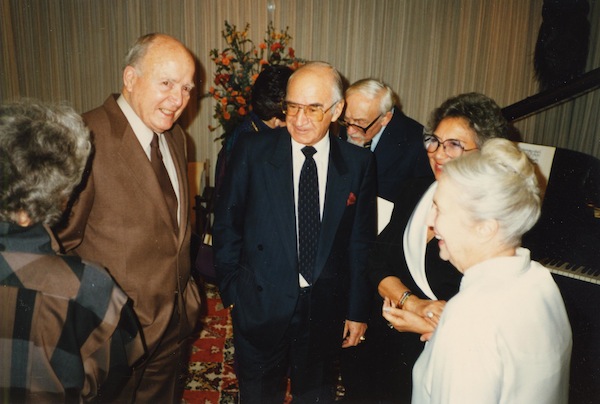
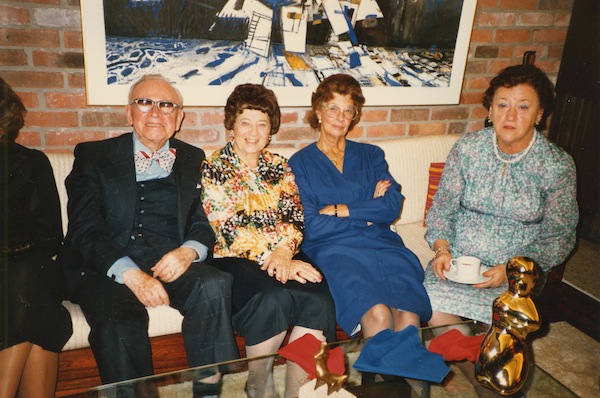
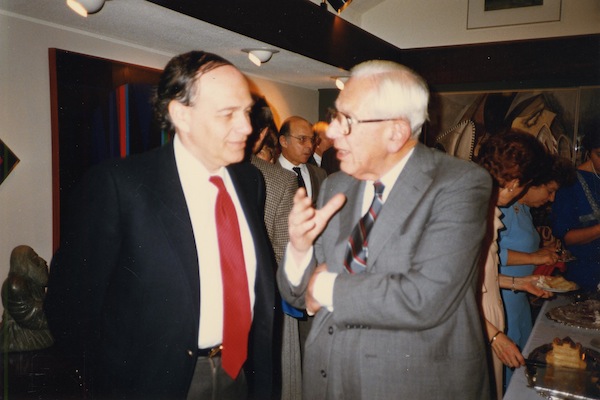
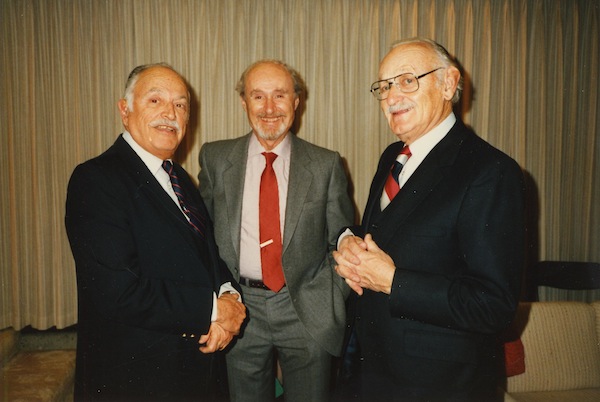
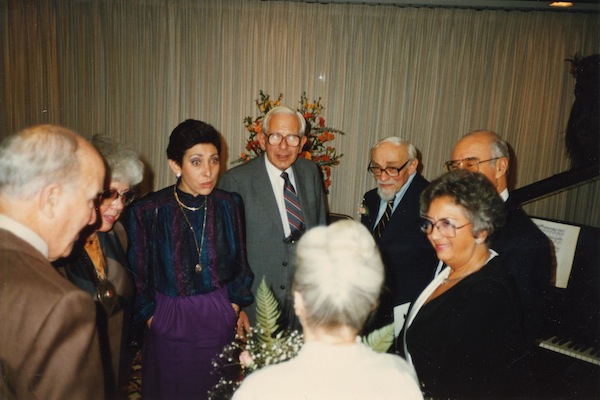
In the photo above and those below: People socializing at an unidentified event, possibly a University of British Columbia event in honour of Harry Adaskin, 1985. (The above photo is from JWB fonds, JMABC L.13764)

If you know someone in these photos, please help the JI fill the gaps of its predecessor’s (the Jewish Western Bulletin’s) collection at the Jewish Museum and Archives of B.C. by contacting [email protected] or 604-257-5199. To find out who has been identified in the photos, visit jewishmuseum.ca/blog.

photo - JWB fonds, JMABC L.13784
(photo from JWB fonds, JMABC L.13784)
photo - JWB fonds, JMABC L.13775
(photo from JWB fonds, JMABC L.13775)
photo - JWB fonds, JMABC L.13762
Sol Kort, middle. (photo from JWB fonds, JMABC L.13762)
Format ImagePosted on June 28, 2019June 26, 2019Author JI and JMABCCategories Mystery PhotoTags Harry Adaskin, history, Jewish museum, JMABC, UBC
Korczak course at UBC

Korczak course at UBC

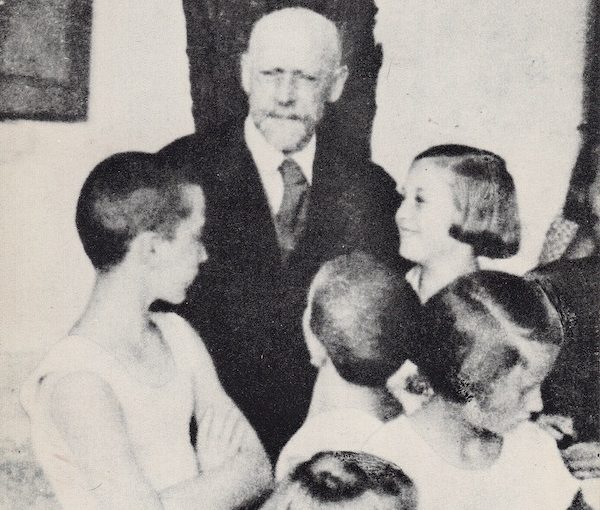
A postcard showing Janusz Korczak in the courtyard of the orphanage on Krochmalna Street in Warsaw, Poland, in the early 1930s.

An unprecedented interdisciplinary event will take place this summer at the University of British Columbia, focusing on the legacy of Janusz Korczak, a pioneer in the area of children’s rights and welfare.

Korczak is perhaps remembered most for his final act of heroism: his refusal to accept an offer of a reprieve, choosing instead to walk with the 200 or so orphaned children of his school as they were sent to their deaths at Treblinka. But it is his legacy as an educator, physician and writer that will be the focus of the 2019 Korczak Summer Institute. The two-week intensive program, called Advocacy in Action: The Legacy of Janusz Korczak, is open to graduate and undergraduate students across disciplines. It takes place July 2-11.

“To the best of my knowledge, there’s never been a university-based course on the work of Janucz Korczak, not in his native Poland, not in Israel, certainly not in North America,” said Rabbi Dr. Hillel Goelman, professor emeritus in UBC’s department of educational and counseling psychology, and special education. The program was developed across disciplines, reflecting Korczak’s range of academic and philosophical work.

“He was a pediatrician by training, so we reached out to the department of pediatrics to get their help and a number of faculty members are going to do Korczak-related activities,” said Goelman. “He was an educator, so the faculty of education were happy to co-sponsor the course with the Januscz Korczak Association [of Canada]. But it would also be open to people studying social work or any sort of child-focused activity. A lot of people at UBC support the whole cause of child activism and child welfare from an interdisciplinary perspective.”

Korczak’s philosophy inspired and informed the United Nations Charter on the Rights of Children. Importantly, his work was not limited to academics or writing, but was devoted to applying his values of child empowerment directly to the real world.

“Children are not the people of tomorrow but people today,” Korczak wrote. “They are entitled to be taken seriously. They have a right to be treated by adults with tenderness and respect, as equals.”

“In the orphanage that he ran in Warsaw, they had a children’s parliament, where children elected their leaders to make the rules and enforce the rules,” said Goelman. “There was a children’s court, where children could complain about their treatment either by the staff or by other students. There was a children’s newspaper that they published. He very much empowered children and he thought it was important to draw on this and give them opportunities to develop their own leadership. I think those are all very important contemporary messages for educators, social workers, pediatricians … and it’s kind of timeless. It’s really relevant to where we are today in terms of child activism, child welfare and child advocacy.”

The institute is designed to help participants transform their working environment to model democratic principles pioneered by Korczak in his writings, pedagogy and governance of the orphanages under his care. It will also encourage participants to adopt strategies to translate the respect for children’s rights into professional practices, including communication with parents and the larger community, and to learn how to help children in developing and sustaining their cultural identity, particularly among those who may struggle with multiple identities.

The course will be taught by Prof. Tatyana Tsyrlina-Spady, an internationally recognized expert on the life and legacy of Korczak and adjunct professor at Seattle Pacific University. She will be joined by a team of international and national invited speakers: teacher trainer and UNICEF consultant Jonathan Levy (Paris, France); founders and leaders in the field of social pediatrics Dr. Gilles Julien and Hélène Trudel (Montreal); researcher and practitioner of Korczak’s legacy Wojtek Lasota (Warsaw, Poland); several UBC professors of nursing and psychology; U.S.-Canadian writer Tilar Mazzeo (Victoria); and a Holocaust survivor and poet, Vancouverite Lillian Boraks-Nemetz.

Promoting Korczak’s pedagogical ideas, as well as their effect on children’s education, is part of the mandate of the Janucz Korczak Association of Canada, which was founded in 2002. The president, Jerry Nussbaum, lives in Vancouver, as do fellow board members Goelman and Boraks-Nemetz.

“His work is very much alive,” said Goelman of Korczak.

The deadline to register for the UBC course is May 28: pdce.educ.ubc.ca/child-advocacy.

Format ImagePosted on May 17, 2019May 16, 2019Author Pat JohnsonCategories LocalTags children, education, Hillel Goelman, history, Holocaust, Janusz Korczak, UBC
Mystery photos … March 29/19

Mystery photos … March 29/19

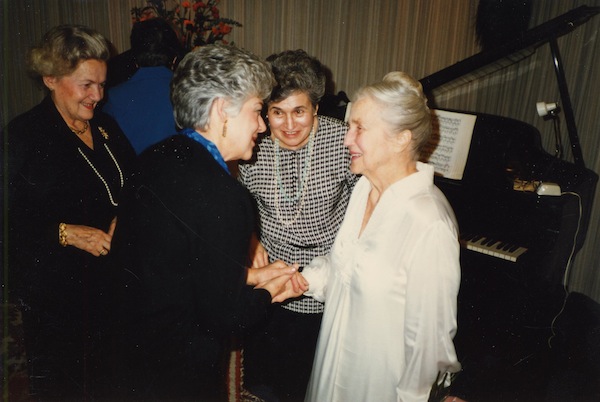
Photographs from an unidentified event, possibly a University of British Columbia event, likely in honour of Harry Adaskin, 1985. In the photo immediately below, of the women socializing by the piano, Shirley Kort is second from the right. (above photo JMABC L.13770)

photo - Shirley Kort is second from the right
Shirley Kort is second from the right. (JMABC L.13761)
photo - from an unidentified event
(JMABC L.13765)

If you know someone in these photos, please help the JI fill the gaps of its predecessor’s (the Jewish Western Bulletin’s) collection at the Jewish Museum and Archives of B.C. by contacting [email protected] or 604-257-5199. To find out who has been identified in the photos, visit jewishmuseum.ca/blog.


Format ImagePosted on March 29, 2019March 27, 2019Author JI and JMABCCategories Mystery PhotoTags Harry Adaskin, history, Jewish museum, JMABC, UBC, University of British Columbia
Jewish fraternity at 20

Jewish fraternity at 20

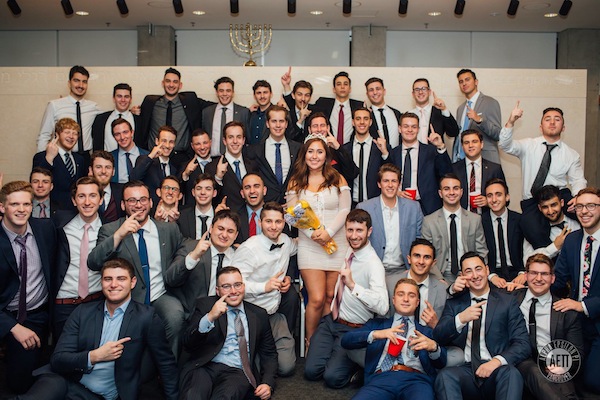
Alpha Epsilon Pi chapter members with the fraternity’s “sweetheart,” Rachel Meadow. A “sweetheart” is elected every year at the chapter’s formal. (photo from AEPi)

The Vancouver chapter of Alpha Epsilon Pi, the traditionally Jewish fraternity, is 20 years old this year. So is Benny Stanislawski, the chapter’s president, who will help oversee the anniversary celebrations next month.

AEPi, as it is commonly known, was not the first Jewish fraternity at the University of British Columbia. Another frat operated on campus in years past but eventually disbanded. In the summer of 1999, the former longtime international executive director of the fraternity contacted Jeff Waldman, a student at UBC, suggesting he consider founding a chapter. A group of eight “founding fathers” came together and Adam Propp, a high school friend of Waldman, also a UBC student, was chosen as the first president, or “brother master,” as the role is called internally.

Hillel has been on the UBC campus since 1947 and provided an avenue for Jewish fellowship and involvement for many students. But the founders of the fraternity saw advantages in creating the male-only society.

“I think all of us had different reasons,” Propp recalled. “For me, to be able to have an impact on the university experience for young Jewish men like myself was important. When I look back at it, Hillel appealed to many, but not all. [The fraternity] just appealed to a different set of people who might not have been attracted to Hillel right away. It was a way to get more people more active and involved in a Jewish experience on campus, especially since UBC is such a commuter school.”

Propp became philosophical reflecting on the chapter’s founding two decades ago, noting that, in the next few years, some sons of the original brothers will likely be pledging to the fraternity. In recent days, Propp has been reconnecting with many of the original brothers, as they plan to gather for the 20th-anniversary celebration with a series of events over the weekend of April 5-7.

photo - Benny Stanislawski, president of the Vancouver chapter of Alpha Epsilon Pi
Benny Stanislawski, president of the Vancouver chapter of Alpha Epsilon Pi. (photo from AEPi)

The relationship between AEPi and Hillel differs from campus to campus and, at UBC, it has generally been extremely strong, sometimes highly symbiotic.

Gabe Meranda, who was executive director of the Vancouver Hillel Foundation at the time the chapter formed, admits he had some trepidation about a Jewish fraternity, not having had any experience with what is called “the Greek system.”

“I was skeptical at first, since I was cautious about fraternities. But these first few guys were so excited about launching the chapter in B.C. that I decided I must get behind it,” Meranda recalled. “I remember the night of their first party at Hillel. I didn’t know what to expect, but all seems to have gone well and it’s taken off from there.”

The chapter made Meranda an honorary brother and he still proudly has the pin, he said.

While fraternities have a reputation for certain excesses, Canadian campuses tend to be a little more low-key, in part because the lower drinking age in Canada means access to booze is not a motivator to joining a frat. What is less obvious to the general public are programs of leadership development, philanthropic ventures and, in the case of AEPi, Jewish cultural activities and, to varying extents, Israel programming or education.

Stanislawski stressed that AEPi has no political or religious orientation. Jewish young men, as well as non-Jewish ones who want to pledge – of which there are usually a few each year – are welcome without concern for their religious affiliation (or lack of affiliation) or their approach to Zionism.

The chapter’s main annual philanthropic event is Hoops 4 Health, an all-day, three-on-three basketball tournament that takes place this year on March 31 at War Memorial Gym. The chapter’s charity beneficiary used to be different health causes, but the Heart and Stroke Foundation has a special meaning to the brothers. A couple of years ago, an AEPi member, Nitai Weinberg, suffered a stroke at the age of 18. Now fully recovered, he and his brothers raised $8,000 for the cause last year, and this year have significantly upped their goal to $25,000.

As an example of the range of programs, the chapter recently hosted a presentation on sexual assault awareness, led by the UBC Mental Health Network. They also host “Greek Shabbats” at Hillel House, where members of all the university’s fraternities are invited.

Fraternities, in general, are a place to nurture leadership.

AEPi has an added mission, noted Stanislawski: “Developing leaders for the Jewish community.”

Founded in 1913, the fraternity now serves 190 campuses in seven countries; it claims 90,000 living alumni. The UBC branch, officially called the Beta Chi chapter, welcomes students from Langara, Simon Fraser, Emily Carr, Capilano and all post-secondary institutions in the region. The chapter usually has 40-plus brothers in any given year, peaking last year at 49.

“I’d love to see the organization get into the 70s,” said Stanislawski. But, given the limited number of Jewish students on campus, slow, steady growth is the realistic goal.

Samuel Heller, the current executive director of Hillel at UBC, congratulated the fraternity and thanked them for their contributions.

“Both the Hillel community and wider campus community are enriched by this brotherhood of young men who exemplify leadership and champion Jewish values,” said Heller. “Brothers of AEPi are a positive force on campus … by creating a group of young leaders who are changing the face of UBC and who, in turn, will change the world.”

Pat Johnson is an honorary brother of Alpha Epsilon Pi Beta Chi chapter.

Format ImagePosted on March 15, 2019September 8, 2025Author Pat JohnsonCategories LocalTags Adam Propp, AEPi, education, fraternities, Gabe Meranda, Judaism, milestones, Sam Heller, tikkun olam, UBC

Posts pagination

Previous page Page 1 … Page 3 Page 4 Page 5 … Page 7 Next page
Proudly powered by WordPress