Skip to content
  • Home
  • Subscribe / donate
  • Events calendar
  • Business Directory
  • FAQ
  • News
    • Local
    • National
    • Israel
    • World
    • עניין בחדשות
      A roundup of news in Canada and further afield, in Hebrew.
  • Opinion
    • From the JI
    • Op-Ed
  • Arts & Culture
    • Performing Arts
    • Music
    • Books
    • Visual Arts
    • TV & Film
  • Life
    • Celebrating the Holidays
    • Travel
    • The Daily Snooze
      Cartoons by Jacob Samuel
    • Mystery Photo
      Help the JI and JMABC fill in the gaps in our archives.
  • Community Links
    • Organizations, Etc.
    • Other News Sources & Blogs
  • JI Chai Celebration
  • JI@88! video

Recent Posts

  • Federation now across BC
  • Israel fighting for its existence
  • Deal strengthens Iran
  • Patriotic belonging diminishes
  • A campaign to engage
  • Upstanders’ first live event
  • Responding to Carney
  • Having your own home
  • Music a family tradition
  • Musical to warm heart
  • Community milestones … June 2026
  • Sharing her passion for Israel
  • Or Shalom reopens its doors
  • JFS from past to future
  • Need holistic approach
  • Sharing stories, advice
  • Journalist shares fears
  • Skills to live together
  • Road to independence
  • Cutting grass with scissors
  • Zionism as a solution
  • Deceit, desire & the divine
  • Reclaiming sacredness
  • Creative project ideas
  • Summer squares and cobbler
  • Thou shalt … summer commandments
  • Legal help for students
  • Revisiting myth of Lilith
  • Wrong person rebuked
  • Canada’s mixed messages
  • Questions for museum
  • Symposium on antizionism
  • Making soccer political
  • CJPAC lauds Pulver’s impact
  • City recognizes Vrba’s legacy  
  • Organ donation saves lives

Archives

Follow @JewishIndie
image - CJN box ad Rockowers 2026

Tag: memoir

Love through good and bad

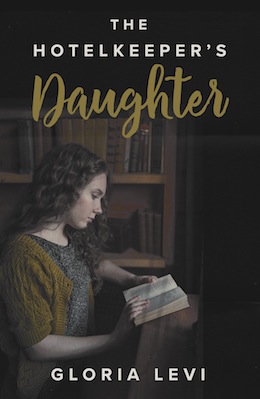
Gloria Levi’s recently published creative memoir The Hotelkeeper’s Daughter is a tribute to her family. And not just the family from whom she comes – the people who inhabit the main part of this story – but also the family she has made herself, the family members in the book with whom she shares her memories and those outside of it, who will read the story.

image - The Hotelkeeper’s Daughter book coverThe memoir is “creative” because memory, almost by definition, is unreliable, and, with this book, the 90-plus-year-old Levi is going back to her childhood. The character Gilda, her avatar of sorts, is trying to make sense of her past:

“They are all gone … Jerry, Macey, Sadie … and Ida and Leo … Bubbie … I, Gilda, at the age of 90, am the only one left of my family of origin. I am the Omega generation, the last letter of the Greek alphabet. I remember so vividly the sweetness of family togetherness, extended family visits, our tight-knit community. How I loved them and felt loved by them: their vitality, their enduring values, their struggles, losses and successes, their remarkable resilience. They are a deep part of me. They are the heroes of a bygone era.”

Speaking to her son and great-grandson, Gilda takes us to Powell Street, in Brooklyn, N.Y., 1938. She is 7 years old. She vividly describes her community, the neighbourhood of Brownsville. Her parents, grandmother and three siblings live downstairs in a duplex shared with her uncle and aunt and their family, who live upstairs. Money is sparse.

“During their usual pinochle card game one Saturday evening in March,” writes Levi, “my father turned to his cousin, Big Eliezer, and said, ‘Eli, I really need to make a change. I don’t want to go on like this. I know I can do better than my chicken store. What do you think, if you, Sammy and I were to rent a summer hotel? My brother Benny runs a hotel with partners. He’s doing just fine. You know, with your catering experience, Eli, and the younger energy and determination of Sammy and me, I think we could make a go of it. What do you think?’ Sammy nodded in agreement. Uncle Shimon closed his hand of cards and stared.”

And the rest, as they say, is history – and the meat of this memoir. Life isn’t easy as the daughter of hotelkeepers. Gilda had been happy on Powell Street, had many friends and her favourite activities. She was very close to her grandmother, who didn’t initially go with the family, and her parents were absorbed in the business. Gilda was lonely and often felt invisible. She has a challenging relationship with her mother, Ida.

Through Gilda’s story, we see how families like hers – an Eastern European Jewish family who immigrated to the United States – struggled and succeeded in their new homeland, through the Great Depression and the Second World War. We also see how Gilda grows into herself and begins to find her own way. The memoir ends in 1948, as Gilda starts university.

As 90-year-old Gilda looks back at this foundational decade of her life, relating her story to her son Daniel and great-grandson Lenny, she ultimately reflects not only on what has passed, but what is yet to come.

“To the Lennys of today and the Idas of yesterday, I want to affirm their vision, their energy, and their inspiring dedication to build a fairer, more just and loving society.”

Posted on December 9, 2022December 8, 2022Author Cynthia RamsayCategories BooksTags family, Gloria Levi, history, Hotelkeeper's Daughter, memoir

Talking with authors

The 35th annual Vancouver Writers Festival includes many members of the Jewish community among the more than 115 authors from across Canada and around the globe who will join the events on Granville Island and elsewhere Oct. 17-23.

The festival will celebrate the five shortlisted Scotiabank Giller Prize finalists; engage in conversations with Booker Prize-winner Douglas Stuart, as well as Canadian superstars Heather O’Neill, Billy-Ray Belcourt and Wayne Johnston. It’ll host conversations between emerging Canadian and American poets, novelists and memoirists, and feature flagship favourites like the Literary Cabaret, Sunday Brunch and Afternoon Tea.

The guest curator of this year’s festival is 2021 Scotiabank Giller Prize winner Omar El Akkad, who has invited a wide range of authors, including Noor Naga (Egypt), Elamin Abdelmahmoud (Ontario) and Threa Almontaser (United States) – and many others – to join him for six conversations that focus on home, identity and storytelling

Among the Jewish community members participating in the festival are Méira Cook, with her adult-young adult crossover novel, The Full Catastrophe, in Mecca, Mitzvah and Milestones, and in Wry Humour for Modern Life; Tilar J. Mazzeo (Sisters in Resistance: How a German Spy, a Banker’s Wife and Mussolini’s Daughter Outwitted the Nazis) speaks with Marsha Lederman (Kiss the Red Stairs: The Holocaust, Once Removed); Sarah Leavitt facilitates a workshop led by University of British Columbia’s creative writing department; and Guy Gavriel Kay (All The Seas of the World) takes part in Fabulous Historical Fantasy.

Lederman is one of the authors participating in the The Power of Story: Live Recording for CBC’s The Next Chapter, she hosts Generational Fiction: Stories of Lineage, History and Things Passed Down, and moderates Bestseller to Blockbuster. Actor, theatre critic and UBC professor emeritus Jerry Wasserman moderates Building Suspense, on writing thrillers, and Dr. Gabor Maté talks with Globe and Mail reporter Andrea Woo about his latest book, The Myth of Normal: Trauma, Illness and Healing in a Toxic Culture.

Festival tickets ($25) can be bought online at writersfest.bc.ca or at the event venue, starting 45 minutes prior to the performance. There are discounts offered for regular events to seniors (10%) and youth under 30 (50%).

– From writersfest.bc.ca

Posted on October 7, 2022October 5, 2022Author Vancouver Writers FestivalCategories BooksTags fiction, Gabor Maté, Guy Gavriel, health, Holocaust, Jerry Wasserman, Marsha Lederman, Méira Cook, memoir, nonfiction, Sarah Leavitt, survivors, Tilar J. Mazzeo, Writers Festival, young adult
Welcomed in Kiryat Gat

Welcomed in Kiryat Gat

Laura Soda, right, with her host family, the Lipiks, and some of her MITF colleagues at Rosh Hashanah. (photo from Laura Soda)

Growing up as a Jewish young adult in White Rock, I always had mixed feelings about celebrating the High Holidays. On one hand, I enjoyed the traditions and the feeling of community that I experienced when we would go to services. However, early fall has always been a hectic and stressful time for our family as well. Aside from Rosh Hashanah and Yom Kippur, there was the beginning of a new school year, all four family birthdays falling within a month of one another and, finally, Thanksgiving. It’s a six-week family marathon.

During the High Holidays, I also was overwhelmed with the feeling of being the “token Jew” in every class. At the beginning of every school year, I dreaded having to approach the teacher and ask for time off so that I could observe holidays that most of my peers, and even some of my teachers, had never heard of. I almost had a sense of guilt, as if I were inventing holidays just to get out of class. All I wanted was to fit in and be like everybody else. And, in the White Rock of my childhood, there was little cultural, ethnic or religious diversity. There were two other Jewish kids at my school, but we rarely – if ever – acknowledged our mutual Jewish connection outside the context of Hebrew school, synagogue or youth group. It wasn’t that we were actively hiding our Jewishness; for me, I simply felt that any sign of difference was “uncool.”

I am currently on a 10-month program teaching English in Israel with Masa Israel Teaching Fellows (MITF). I am living in Kiryat Gat, a small, mostly religious up-and-coming city in the south of Israel. For the next 10 months, I will be teaching English to the children of the community in which I live. Most of the people here do not speak English, and I feel grateful to be in a place where I can help break language barriers and contribute to English language education. For me, however, it has been quite an adjustment.

With the challenges of settling into a new country, in a town where not many people speak English, I am overwhelmed by the tremendous sense of community and unity. Despite the inconvenience of the train and bus schedules around the holidays, it wasn’t just me being inconvenienced. For the first time in my life, I was in the same situation as everyone around me.

Recently, I celebrated my first Israeli Rosh Hashanah with a host family that I was connected to through the MITF program. The Lipik family welcomed my peers and I, quite literally, with open arms and have made us feel at home. My roommate and I walked to Rosh Hashanah services in the morning and passed many others doing the same. Suddenly, I realized that, although I had been prepared to feel like an outsider in a tight-knit community of people who were more religious than me, my Rosh Hashanah experience was so welcoming. I smiled at the children who listened to the shofar with wonder, and I was reminded that children are simply children, no matter where they live or what language they speak.

Later, we joined our host family at their backyard barbeque along with their extended family and friends, and we ate our hearts out as we basked in the smell of smokey chicken kebabs and toasted marshmallows for dessert. Throughout it all, it sunk in that, this year, I don’t have to explain myself. This year, it is my turn to learn – to watch and listen to how other Jews celebrate, being curious about the differences, but, more often, being surprised by the many similarities in our traditions. My first Rosh Hashanah in Israel taught me that although I am far from my home in Canada, I am exactly where I need to be – I feel right at home.

Laura Soda is currently on a 10-month program teaching English in Israel with Masa Israel Teaching Fellows. For more information on the MITF and other Masa programs, visit masaisrael.org.

Format ImagePosted on October 7, 2022October 5, 2022Author Laura SodaCategories Israel, LocalTags education, Israel, Judaism, Kiryat Gat, Masa Israel Teaching Fellows, memoir, MITF, teaching, White Rock

Recollections of youth – Hatzaad Harishon

Sybil Kaplan, whose food articles often appear in the Jewish Independent, has a broader life experience than those articles would suggest, of course. In a recently self-published memoir, she shares a little of that experience: her time as a youth leader/advisor with the Black youth group Hatzaad Harishon, which translates as First Step.

Hatzaad Harishon: A “First Step” Love Story is as much a labour of love as was author Sybil Kaplan’s time spent in the group, which started in 1965 and ended in 1969. The group itself lasted only from 1964 to 1972.

Hatzaad Harishon is based on notes  and articles Kaplan wrote at the time, newspaper articles from which she cites extensively and other research. Many of the group’s key first members and leaders have passed away, so the contemporary voice of the book is Kaplan, with her perspective on the internal politics and ultimate impact of the group. All the names and the various comings and goings of members will mean little to most readers but it’s good to have them on record.

The publication would be mainly of interest to people who were in or encountered the group in their youth. It also would be valuable for researchers of American Jewish community history. There is published research about the group, but not an abundance of it.

Kaplan became involved in Hatzaad Harishon when she was asked to be a dance leader. The group participated in dance and other cultural events in an effort to increase interaction between white and Black Jews. There were other white Jewish leaders in the organization, including its founding director, Yaakov (or Yaacov) Gladstone, who was a Canadian Hebrew teacher. Internal and external politics contributed to the group’s dissolution, including race issues but also disagreements about how much the youth should be able to direct their own affairs, as opposed to taking direction from the adults involved.

One of the more intriguing – and sobering – aspects of Hatzaad Harishon and the period in history that it covers is how much has changed, and how much has not. Black Jews, and Jews of colour in general, still face discrimination and are still questioned about their Jewishness. New groups have formed in recent years in Canada and, no doubt, elsewhere to try and make the Jewish community more inclusive.

Hatzaad Harishon is available for purchase from Kaplan, at [email protected].

Posted on September 16, 2022September 14, 2022Author Cynthia RamsayCategories BooksTags Hatzaad Harishon, history, memoir, Sybil Kaplan
Remembering the Great Roundup

Remembering the Great Roundup

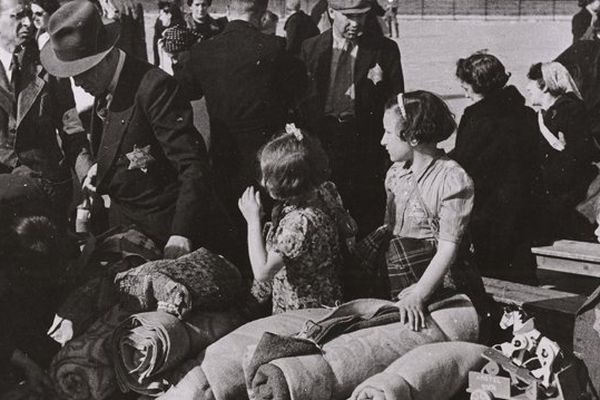
Entire Jewish families were rounded up and interned in the Vel d’Hiv and other places in France, when La Grande Rafle began on July 16, 1942. (unattributed image)

It is 80 years this summer since La Grande Rafle (the Great Roundup) took place in France. It is not only a significant, tragic anniversary for the Jewish people, but one that impacted me directly.

“Happy like God in France” was a saying sometimes heard among Yiddish-speaking Jews of Eastern Europe a century ago, even though antisemitism was fairly widespread in France and few years had passed since the Dreyfus Affair. Falsely accused of selling military secrets to Germany, Capt. Alfred Dreyfus was publicly humiliated and sentenced to Devil’s Island in French Guiana. However, in the end, justice prevailed: Dreyfus was proven innocent and restored to his rank. Jewish loyalty to France remained unshaken. In 1939, as in 1914, Jewish men, citizens and immigrants alike, volunteered to fight in the defence of France, but the country for which they spilled blood betrayed their trust.

The humiliating defeat of 1940 led to the division of the country into two main zones, a Germany-occupied zone in the north and a so-called “free zone” in the south. It also led to the collapse of democracy and a replacement of the republic with a fascist regime, called Etat Français, in Vichy, headed by Marshall Philippe Petain. That regime enacted the sweeping antisemitic Statute des Juifs, the most racist legislation in occupied Europe. Its application was entrusted to a special commissariat for Jewish affairs, of which the first incumbent was Xavier Vallat, who declared to the younger hauptsturmführer (captain) in the SS, Theodor Dannecker, in Paris, “ I am an older antisemite than you are: I could be your father in these matters.”

Vallat was soon replaced by the more vicious Louis Darquier de Pellepoix, a gutter journalist, who, as early as 1937, proposed in one of his screeds to “solve the Jewish problem in France” by wholesale extermination.

At the time, there were 300,000 Jews living in France, who represented less than one percent of the population. Their origins were diverse; Ashkenazim, Sephardim, immigrants from a variety of European and Mediterranean countries, religious and non-practising, etc. That population was composed of native and naturalized citizens. The Census of 1940 placed French Jews under the protection of the Vichy government, while at the same time expelling them from the professions, civil and military. Non-naturalized Jews were liable to internment at the discretion of regional police prefects. Instinctively respectful of the laws of France, even Jews who bore French surnames and spoke fluent French obeyed the order to register.

The regime created a Gulag-type network of internment camps that covered both major zones of the country. Beginning in 1941, Jewish men were summoned by groups, depending on their nationality, to present themselves at the police commissariat nearest to their places of residence (there were no ghettos in France). They were sent to hard labour in camps, of which the most notorious were Pithiviers and Beaune-la-Rolande, northeast of Orléans, and Drancy, a transit camp in a suburb of Paris, from where departed the deportation cattle car trains bound for Auschwitz. Naturalizations granted after 1927 were ordered rolled back.

Beginning on July 16, 1942, a dramatic change in the deportation policy was initiated: La Grande Rafle. Entire families were now targeted, regardless of age or sex. Beginning at 4 a.m., police squads bearing lists of the names and addresses of about 27,000 Jewish immigrants fanned across Paris in vans and requisitioned urban buses, knocking at countless apartment doors. About half of the targeted victims, warned by the Jewish communist underground, were able to escape arrest and find shelter among gentiles, mainly in rural areas. Arrested during that roundup were 3,118 men, 5,019 women and 4,115 children (3,000 of them born in France and, therefore, French citizens).

The Grande Rafle, codenamed by the police Vent Printanier (Spring Wind), was the greatest mass persecution in the city of Paris since 1572, when thousands of Protestants were murdered on the night of St. Bartholomew by Catholic mobs unleashed by Queen Catherine of Medici.

The 1942 military-style operation against the Jews in Paris was carried out from start to finish by French policemen, with no German participation, as they did not have sufficient resources. In fact, the Germans had ordered the French not to arrest children below the age of 16 for the time being, since, as stated, 3,000 of them were born in France. However, then-prime minister of France Pierre Laval averred that it would be “inhuman” to separate children from their parents. On his own initiative, he declared that he assumed the burden of “ridding France of its Jews.”

Laval ordered that entire families be rounded up and, pending deportation to the east, interned in the Winter Circus (Vel d’Hiv), Drancy, Pithiviers and Beaune-la-Rolande. Conditions of interment in the Vel d’Hiv were hellish: suffocating heat, the stench of public latrines, next to no medical attention, and scant distribution of food and drink. Many people went mad, some died. In the end, families were split all the same: adults were transported from Drancy to Auschwitz, while children initially sent to Pithiviers were next carried in the cattle car trains, along the same harrowing itinerary of death, with almost no adult supervision. Many of those children were brutalized by French policeman, who even robbed them of what their parents gave them.

One month after the Grande Rafle, similar atrocities were perpetrated in the free zone of the south, where there was no German occupation and the French government retained complete sovereignty over internal affairs, bearing no obligation other than supplying the Nazis with the products and produce that they demanded.

Caught when we illegally crossed the demarcation line, which divided France’s two major zones, my parents and I were among those “assigned to residence” in a requisitioned hotel of the small town of Lons-le-Saunier, near the Swiss border.

On the morning of Aug. 26, a rafle collected hundreds of Jews across the city, including my mother and me; happening to be on an errand, my father escaped. A pitiful column, we were marched across the city – hurried along by policeman who brutalized and insulted us, calling us “dirty Jews” – to the railway station, where a train awaited to transport us to the gruesome concentration camp of Rivesaltes, near the Spanish border.

The railway station became a scene of unrestrained police brutality, which spared neither adults nor children. I was seized by the hair and the seat of my pants by a brute who was about to throw me on the train, when I was saved by my maternal aunt, a French citizen, who, through personal contacts, obtained my release thanks to the timely intervention of a gendarmerie officer. I last saw my mother as she was being violently dragged along the floor of the station, then waved to me from a window, as the train departed for Rivesaltes. From there, with fellow victims of the rafle, she was transported several days later in a train that traveled north, this time to Drancy. And, there, she was squeezed into a cattle car train bound for Auschwitz. At least two-thirds of the women who left in that convoy either perished along the way, or were gassed following the selection on arrival.

Few of the Vichy regime organizers, policemen and other perpetrators of the summer 1942 and subsequent rafles paid for their crimes. Laval was tried and sentenced to death by firing squad in 1946; Petain was sentenced to life exile on a small island in the Atlantic Ocean; René Bousquet, chief of the national police, was briefly deprived of citizenship rights by General Charles de Gaulle and then resumed his functions, until he was mysteriously assassinated in his Paris apartment shortly before he was to be tried for crimes against humanity in 1980.

Obsessed by his wish for national reconciliation of the French, de Gaulle put a stop to any prosecution of persons who had collaborated with the Nazis. Throughout the postwar decades, the French deluded themselves with the myth that most of them supported or joined the resistance.

It was not until 1995 that then-president Jacques Chirac publicly declared that the opposite was the case – that “France had committed the irreparable,” that at least some financial compensation should be awarded to the survivors of the Holocaust, who had suffered or lost relatives to French collaboration with the Nazi action.

It should be noted, however, that nearly 75% of the Jewish population of France survived the Holocaust, thanks to the assistance offered by French citizens, both urban and rural, who sympathized with the Jewish people. Also, unlike Holland or Belgium, small, crowded countries, the French countryside offered vast areas of wilderness in which many Jews found shelter or joined the resistance.

René Goldman is professor emeritus at the University of British Columbia.

Format ImagePosted on July 22, 2022July 20, 2022Author René GoldmanCategories Op-EdTags France, Grande Rafle, history, Holocaust, memoir, Shoah
Never waste life’s many gifts

Never waste life’s many gifts

The author with her grandmother. (photo from Becca Wertman-Traub)

In the story of the Jewish people, it is not just about our patriarchs but the matriarchs, too. I grew up knowing that both my grandparents, Babi and Zaida, were Holocaust survivors. Zaida would tell me his stories – I know them backwards and forwards from how he spoke about them. But Babi, who was just 13 when the Second World War began, did not really tell hers.

She did talk about her brother – Shaike – who was taken to his death by the Nazi SS when he came out of the house to help young Frieda carry a pail of water. He was taken to a police station and killed in its basement along with numerous other Jews from the town. And she told us that her father, mother, sister and another brother all perished in the Holocaust. But not much else. She was too busy making blintzes, perogies, chicken patties, chicken soup with kreplach and more for her family.

Thankfully, though, she did have the extreme courage to tell her full story to the University of Southern California Shoah Foundation, where I learned the details of how she survived. Frieda’s childhood home in Kamionka-Strumilowa, Poland, became part of a ghetto. During the liquidation of the ghetto, Frieda and her brother, sister and mother hid in a hiding space in the wall and managed to survive, when the rest of the Jews of the town were taken to their deaths at Belzec extermination camp.

Following the liquidation, the German’s declared the town “Judenfrei,” free of Jews, but Frieda and her remaining family were still there. Since their home was located on the edge of the ghetto, they jumped off the balcony, surpassing the ghetto’s fence, and walked to Busk, a town 30 kilometres away, where they had heard that Jews were still living. They went to the Busk ghetto and lived with an aunt. Frieda’s mother died of typhoid there, and Frieda was left with her brother and sister. Unannounced, the Nazis started liquidating the ghetto, and Frieda again hid but was separated from her brother and sister – she never saw them again.

While in the Busk ghetto, Frieda worked as a gardener for a German man who said, if she returned to Kamionka-Strumilowa, he would help hide her. At the time, Frieda did not believe such a thing was possible and simply mentioned it to her cousins. However, after the liquidation, with no immediate family, she decided to give it a shot and walked back to her hometown by herself. The man took her to the village of Obydiv, where she met Mr. Svets, a Polish farmer. Frieda hid in this Polish farmer’s barn for 12 months and, today, his sister-in-law Janina Pelc is listed among Yad Vashem’s Righteous Among the Nations.

Frieda was one of just 20 from a town of 3,000 Jewish people who survived the Holocaust and lived to tell her story.

And did she live!

Babi and Zaida met after the war and moved to Vancouver in 1949. Babi was always walking, or speed-walking, usually leaving Zaida behind so she could do laps back and forth around him. She just could not sit still, whether it was cooking for her three children and, later, eight grandchildren, or cleaning the entire kitchen with a single square of paper towel – there could never be any waste. I remember sitting at Babi and Zaida’s kitchen counter as a little kid and Babi giving me milk in a tiny shot glass because “if you finish this, you get some more.”

Babi played tennis at Richmond Country Club, exercised at the Jewish Community Centre of Greater Vancouver, and dined at the finest restaurants and cafés in downtown Vancouver.

Even when Zaida passed away, she was not done living. Right up until the end, my dad took her out for coffee.

In September, just a few days before my wedding, we were out for coffee and she took my left hand, looked at me and said, “Is he Jewish? Is he from a good family?” I said yes, and reminded her that she was coming to the wedding.

At 95, she came to my wedding. And she danced at it – to none other than “Od Lo Ahavti Di,” Hebrew for “I have not loved enough.”

Babi appreciated life and everything it had to offer to its fullest, never allowing any of its gifts to go to waste. We mustn’t either.

May her memory be for a blessing.

Becca Wertman-Traub grew up in Vancouver and currently lives and works in Jerusalem.

Format ImagePosted on July 22, 2022July 20, 2022Author Becca Wertman-TraubCategories Op-EdTags Frieda Wertman, Holocaust, lifestyle, memoir, reflections, Vancouver
A story of two families

A story of two families

Marsha Lederman’s Kiss the Red Stairs begins in 1919, when her father was born, on erev Yom Kippur. (photo by Ben Nelms)

In the last couple of decades, researchers have identified traits that affect many children of Holocaust survivors. There remains much left to uncover, including how much is epigenetic – that is, whether and how the genes of people like survivors, who have undergone extreme trauma, work differently than other people’s – and how much might be a result of the parenting styles of people who, in many instances, were ripped from their own parents in the most brutal circumstances. The old issue of nature versus nurture, in other words.

While psychologists and scientists try to unravel those mysteries, a genre of second generation memoirs is exploring the deeply personal experiences of being raised by survivors of the Shoah. A page-turning, sometimes shocking and nakedly vulnerable volume has recently added much to the growing library.

Vancouver journalist Marsha Lederman, Western arts correspondent for the Globe and Mail, has written Kiss the Red Stairs: The Holocaust, Once Removed. The book begins in 1919, when Jacob Meier Lederman was born on erev Yom Kippur. The auspicious timing of the birth of this baby, who would grow to become Marsha Lederman’s father, portended great things.

“[T]his was an occasion, an omen – a very good one, the hugest of deals,” she writes. “This person was special, he was going to be something, do something very important with his life.”

Indeed, he did. He survived the Holocaust – the only person in his immediate family to do so and one of only 10% of the Polish Jews alive in 1939 who survived to 1945.

Marsha Lederman’s mother was also a survivor, and one who participated in Steven Spielberg’s Shoah Foundation testimony project, video-recording her Holocaust experiences. This recording would become a touchstone because, despite the journalist daughter’s career asking questions of strangers, there were many unanswered questions in the family. This was due in part to the harrowing, abrupt response to a childish inquiry about the absence of grandparents, an early lesson that unexpected answers can have catastrophic emotional impacts.

Well into adulthood, Lederman decided to visit her mother during a snowbird retreat in Florida. But instead of sitting across the kitchen table learning about her mother’s darkest moments, she was instead living one of her own – delivering her mother’s eulogy. She had waited a day too long to fly south.
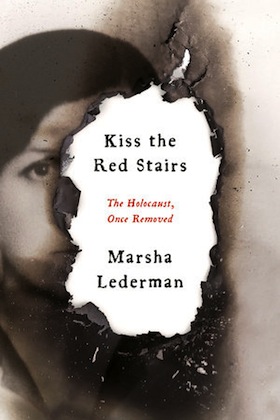
image - Kiss the Red Stairs book coverLederman’s book is the story of a family – two families, really. A family that in some ways never came together quite right, the author’s birth family with its silences about the past, and another that fell apart, that of her marriage. Kiss the Red Stairs, in fact, is a sort of applied case study in second generation (shorthanded “2G”) neuroses, as they distort the author’s reactions and coping mechanisms in a time of personal crisis.

As her marriage collapses, Lederman recognizes, on the one hand, that her responses may not be commensurate with actual events but are exacerbated by a lifetime of fears around loss and abandonment. On another hand, the undeniable anguish of her marital breakdown evokes an added burden of guilt, her own trauma juxtaposed with her parents’ experiences. Given what their mothers and fathers endured, do children of survivors have a right to feel the pain that other people seem to validly experience?

Lederman acknowledges that she was always ready for everything to fall to pieces. She inherited – or developed – an existential pessimism and a catastrophizing worldview: “The glass wasn’t just half-empty; it was half-full of poison,” she writes. “Or Zyklon B.”

The history that has formed Lederman’s identity was not imprinted on her at home only. It was in the zeitgeist of her coming-of-age as a young Canadian Jew in the 1970s and ’80s.

“The slogan ‘Never Again’ was drilled into us, implying – to me, anyway – that there was always the potential for an again, for another catastrophe. What would we do when the Nazis came back and came for us, like they came for our parents?

“This happened to us. This could happen to us again. I was one of the us. On some level I believed, from a very young age, that this could happen to me. I understood the need to be on guard, that we weren’t really safe. We needed to be on alert. Have a plan.”

For whatever were their good intentions, the organizers of a youth trip to Israel reinforced Lederman’s anxieties. Intending to instil in the participants the need for one solitary Jewish state in the world, they reminded their young charges that, in the absence of Israel, Jews would have nowhere to go should the need arise, “if the world once again turned on – or turned its back on – the Jews.”

She doesn’t disagree with the premise. “But the exercise scared the hell out of me. Don’t be so comfortable in that Canada you think of as home; you never know what could happen.”

That awareness of the unimaginable human capability for inhumanity had imprinted on her to the extent that everyday life became a gauntlet of inevitable disaster, misery the preordained endpoint of any happiness. When her marriage broke down, her reaction was extreme, “As if divorce, for instance, were some kind of death camp.”

Having consciously tried to eradicate (second-hand) Holocaust memory from its constant intrusion into her mind, Lederman finally faces the core question of her life, and of the book: “Could I possibly be a victim of the Holocaust, once removed?”

Now a mother, her obsessive worry has a new object, not only in terms of the world into which that child was born, but the potential for epigenetic inheritance. Will the baggage of the past be passed along to another descendant of survivors?

At the same time, Lederman is careful not to ascribe her challenges to the overburdened couple who raised her.

“I am not comfortable blaming what happened to my parents – and, in effect, blaming them – for my little problems. It feels self-indulgent, unfair and actually untrue,” she writes. What they accomplished after the war was almost as miraculous as their survival during it. “The fact that after such tragedy my parents were able to build new lives – purchase and set up a home, go to night school to learn English, buy a business, raise children – seems astonishing to me, as I contemplate it all as an adult. How on earth did they manage to do it, manage to be so normal?”

She quotes Elie Wiesel who, in 1984, told children of Holocaust survivors: “That your parents were not seized by an irrepressible anger … remains a source of astonishment to me. Had they set fire to the entire planet, it would not have surprised anyone.”

Elsewhere in Lederman’s book, Wiesel appears again, seemingly underscoring the legitimacy of second generation complexes by noting that it was they, not their parents, who were the ultimate target of Hitler’s plan.

“You were the enemy’s obsessions,” Wiesel told the children of survivors. “In murdering living Jews, he wished to prevent you from being born.”

Lederman confronts the reader with things she has learned from research, rather than from firsthand experience or from stories her parents shared (because they didn’t). The Holocaust experiences of her parents may be the impetus for her lifelong sense of danger, she seems to suggest, but the larger history of that era should be a warning shot for all humans – because it was humans who perpetrated everything that happened to her parents and to the millions of others of the Nazis’ victims.

In one of several graphic segments, she demands that the reader ponder how ordinary people could throw babies in the air and practise a merciless form of skeet shooting.

There are other psychological conundrums in the book. Reading her father’s journal of a trip back to Europe, Lederman confronts what reads like a cognitive rupture: her father’s love for and comparatively happy memories of Germany.

Rather than remain in Nazi-occupied Poland, young Jacob audaciously crossed into the belly of the beast, into Germany, posing as a Polish peasant boy, and got work as a farmhand, surviving until the end of the war. As a result, he took a perversely positive view. In a travel diary entry, he wrote, “I had a wonderful exciting day and my motto stands again forever: I will never forget you Germany and the peace and security I found here among these fields, meadows and trees in those murderous inhuman times of the year 1942.”

Of all the happenstances in the book – some life-altering and, in several instances, life-saving – there is a particularly poignant one that happened on her father’s trip back to his hometown. On that trip, her father found out that his parents had left a letter for him before they had been evacuated from the ghetto and shortly thereafter murdered.

“A Polish woman who lived there at the time, or moved in after the liquidation – I’m not sure which – had come into possession of that letter. There were photos in this packet and some other family keepsakes,” she writes. “The woman said she had held onto these items for a long time, but after so many years without word, she lost all hope that my father had survived; she figured nobody from the family had. She threw the packet away.

“What was that like for him – to learn that his parents had left him something: a declaration of their love, a wish for his future, some unknown secret, an explanation of what was happening to them? And to learn that those things once touched and left for him by his parents – a written document, photographs, who knows what else – proof that his parents had existed, evidence of their love – had survived, only to be discarded?”

On her own ventures to the blood-soaked continent, Lederman is reminded that the past has not passed. She sees antisemitic graffiti on abandoned synagogues, Polish youths giving obscene gestures to participants during the March of the Living. Lederman and four family members are paying tribute at a Holocaust memorial while a group of boys nearby chant something in Polish, something menacing that included one term she recognized: “Auschwitz-Birkenau.”

“It didn’t sound like they were expressing their condolences,” she writes.

After a lifetime of mostly solitary rumination and fears, Lederman has several epiphanies during the World Federation of Child Survivors of the Holocaust annual conference, held in 2019 in Vancouver. Here, she finds others who share her view that “the other shoe is always about to drop and the world is not safe”; “being plagued with obsessive doubt”; “a heightened ability – one might call it a curse – to observe and engage others”; “A constant expectation that someone is going to get you.”

There, she finds she is not alone.

“I had found my people,” she writes.

Format ImagePosted on July 8, 2022July 7, 2022Author Pat JohnsonCategories BooksTags Holocaust, Marsha Lederman, memoir, second generation, survivors
Grateful for ability to play

Grateful for ability to play

Six members of the 35th Street Gang, with the author second from the left in the back row. (photo from Cassandra Freeman)

Sheena and I don’t recall why we were trying to measure the house with a ball of string. We just remember me holding one end of the string, throwing the rest down from my bedroom, and her running all around the house with the rest of it till she got back to me. We were 8 years old and we were part of what we proudly called the 35th Street Gang.

At a recent reunion, 43 years later, seven of us mischievous women decided that playing was a powerful thing. It was about athletic activity, creativity, community building, trust – and simply some of the funnest times we’ve had.

Fairly early in our lives, “we seven” decided we owned the block. That’s why we called ourselves the 35th Street Gang. For some of us, a rite of initiation to the gang was to climb with hands and bare feet up to the very top of the pole and touch the signs that read 35th and Maple, then slide right back down again.

Kick the can was one of our favourite games. It was a combination of tag and hide-and-go-seek. I remember shivering with anticipation in a neighbour’s garage, hiding from the girl who was “it.” Of course, she found me before the others, and we raced down the short hill and around the corner, each of us trying to be the one who would kick the can first. I’m betting that we ran faster than we ever did in phys ed class. (Some adults still play this game I discovered, and you can search for them on meetup.com.)

Roller skates were all the rage in the early 1970s. They attached to the bottom of your sneakers with a metal key. I can still feel the vibration from the wheels going all the way through my body from the contact with the cement below. And just skating in the middle of the road wasn’t good enough for us. One of us, Louise, created a song we all sang and did the motions to while skating. It went like this: “Butterflies fly, and so do I, and I like it, so I don’t sit, I fly … so do I.”

The most daring kind of play we did was tobogganing. Daring because we slid down a severely slanted sidewalk covered with snow and ice. The year I was 8, winter was particularly cold. That did not deter us and neither did the teenage boys who threw ice balls at us on the way down. We were determined to have a good time.

We had a regular toboggan that fit three of us, a red slippery carpet, and a small round “flying saucer” one that would go round in circles as you went down. The bump we all made in the middle of the run was the most fun. We would fly off that thing so high it took a few seconds to come back down to earth again.

One time, I was sitting in the middle of the flying saucer and flew off that bump and started spinning in circles. I still remember that moment when I realized – too late – that I was going to hit the huge chestnut tree at the bottom of the run. And so I did. Thwack! My back hit that tree so hard it took all the breath out of me. Realizing a few seconds later that I was all in one piece, I got up and marched back up the hill and slid all the way down again on someone else’s toboggan.

We did all of these things running in and out of my parents’ house. As a result, all of my friends still know about all the Jewish holidays and what a kosher kitchen is. They would even march in on Passover with non-kosher-for-Passover popsicles to torment my poor older sister who was trying to keep the holiday. Today, they remember my parents, Joyce and Bernie, as being their second parents growing up. One of us, Madeleine, even says that she became a war crimes prosecutor because she learned about the Holocaust from spending so much time in our house. (See jewishindependent.ca/working-for-human-rights.)

When John Fraser became a member of Parliament, we used his election signs to build a huge maze in the Frasers’ front yard. We crawled around until our knees hurt. We had such a great time until we learned that he and his wife would be leaving for Ottawa with their three daughters. We said our sad goodbyes and waited for the time we would see them again.

Looking back, I am thankful I was involved in an old-fashioned kind of play that created lifelong friendships. Now, at our reunions, we become kids again and laugh our heads off for hours.

Cassandra Freeman is a freelance writer and teaches improv games for parties and performance.

Format ImagePosted on February 25, 2022February 23, 2022Author Cassandra FreemanCategories Op-EdTags 35th Street Gang, friendship, games, history, memoir, play
Novel informed by life

Novel informed by life

Alina Adams, author of The Nesting Dolls, spoke at a recent Zoom webinar organized by the Jewish Community Centre of Victoria. (photo from alinaadams.com)

New York City-based writer Alina Adams, author of the 2020 novel The Nesting Dolls – about three generations of Russian-Jewish women – spoke at a Jan. 27 Zoom webinar organized by the Jewish Community Centre of Victoria.

Adams began with her personal story. Born in the port city of Odessa, she spent the first seven years of her life in a communal apartment: a dwelling, including kitchen and bathroom, that was shared by two families.

“As I mention in The Nesting Dolls, these relationships were not always positive. My parents were lucky in that they got along well with the people they were assigned to share with,” said Adams.

In 1976, her parents decided to emigrate. Two years earlier, the United States had passed the Jackson-Vanik Amendment, which linked U.S. trade with the free movement of Jews and other groups in the Communist bloc.

“I like to say we were traded for wheat,” Adams quipped.

To those leaving the USSR, she said, “it was like stepping off the edge of the earth. You didn’t know where you were going, you didn’t know what life would be like when you were there, and you certainly knew you couldn’t come back.”

The family’s first stop was Vienna. From there, they took a bus to Rome, where they stayed for four months before traveling on to North America in January 1977, first to New York and then to San Francisco.

Adams recounted some of the reactions upon coming to America in the 1970s as a young child: for example, the surprise of watching a television screen in full colour. It was television, namely soap operas, that Adams later credited for helping her learn English.

The young immigrant started out in a Jewish day school, where the differences in various customs – her life in the new versus the old world – became very apparent. Parents in North America, she recalled, did not send their kids to school in the same dress every day; they used Band-Aids instead of green antiseptic to treat cuts; and, if their child had the sniffles, they did not place the child’s feet in hot water and then into socks filled with dried mustard.

Over time, Adams and her family got the hang of life in America. She graduated high school and college. All along, she knew she wanted to be a writer.

“My parents claim my first words were ‘pencil’ and ‘paper,’” said Adams. “And what’s the advice all writers get? Write about what you know. Well, what did I know? I knew about being a Soviet immigrant. I knew about living a culture that wasn’t mine.”

Publishers, at first, were not interested in those themes. Nonetheless, an editor at Avon Publishing did like her writing and contacted Adams, asking if she would write a Regency romance. This would become The Fictitious Marquis, a unique book in the Regency romance genre in that Jews are central characters.

Adams now has more than a dozen titles to her credit, including mysteries, books on figure skating (non-fiction) and other romances.

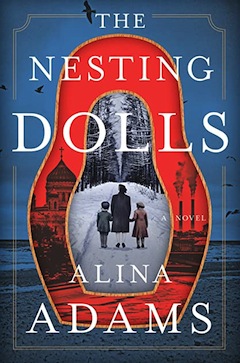
image - The Nesting Dolls book coverAbout four years ago, Adams’ literary agent told her that editors were becoming interested in Russia, and this led Adams to write The Nesting Dolls. The novel begins in the Soviet Union of the 1930s and ends in 21st-century, pre-pandemic Brighton Beach, in New York City. It focuses on the lives of three generations of Russian Jewish women in one family; the periods parallel those of Adams’ grandmother, mother and herself.

For Adams, it is the everyday events that are the most fascinating part of writing historical fiction. “Anyone can look up which date Nikita Khrushchev denounced Joseph Stalin, but it is the small details which make historical fiction compelling,” she said.

As an example, she pointed to a personal account she used in the novel. According to her mother, Adams did not want to be breastfed. This caused her mother to go to a doctor and ask him to write up a prescription for yogurt. “These are the little things, in this case how difficult it was to get regular foodstuffs in the Soviet Union, that bring a situation to life and show the reader what an era was like,” said Adams.

The novel was scheduled to be released in 2019 but was delayed to 2020, which, for Adams, turned out to be a blessing for the story’s timeline, in that she wasn’t finishing it during the pandemic. The last section of the book takes place in pre-pandemic Brooklyn in summer. “The things my characters do in the summer of 2019, they could not have done in the summer of 2020,” she said.

Adams lives in New York with her husband and their three children. She has written about her interracial, interfaith and intercultural family for Interfaith Family Magazine and the Forward, and has written columns and articles for dozens of publications.

Sam Margolis has written for the Globe and Mail, the National Post, UPI and MSNBC.

Format ImagePosted on February 11, 2022February 10, 2022Author Sam MargolisCategories BooksTags Alina Adams, immigration, memoir, romance novels, Russia, United States, Victoria JCC, writing

Turning tragedy to hope

The year 2016 was a milestone for Kalman and Malki Samuels. It marked the inauguration of a dream years in the making – the opening of the Shalva National Centre, one of the largest centres of disability care and inclusion in the world. Built not far from the entrance to Jerusalem, the 12-storey world-class complex features an auditorium, a gymnasium, hydrotherapy and semi-Olympic pools, a virtual reality therapy suite, a research and study institute, a café, some of whose workers have developmental disabilities, and accommodations for 100 respite sleepovers per night.

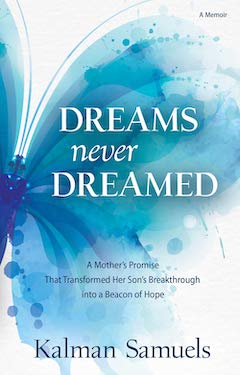
How was it that Kalman and Malki Samuels came to create this extraordinary organization that assists 2,000 children with disabilities each week, while empowering families and promoting social inclusion? The answer lies in the subtitle of Vancouver native Kalman Samuels’ Dreams Never Dreamed: A Mother’s Promise That Transformed Her Son’s Breakthrough into a Beacon of Hope (Toby Press, 2020) – it was a mother’s promise.

In 1977, the couple’s healthy, lively baby boy, two weeks short of his first birthday, was checked by a doctor at a Jerusalem clinic before receiving his second DTP inoculation; and all his developmental milestones were fine, so the nurse gave him the shot.

But Malki knew the same day that something was wrong. “I took Yossi home and followed the instructions they’d given me at the clinic…. I bathed him, gave him baby paracetamol and let him sleep. The moment he woke, I knew my baby was gone. He looked up at me with shiny eyes as if to say: ‘What have you done to me?’”

Only later did the couple discover that, on that October afternoon, “Israel’s health authorities had already known for almost five months that the vaccine batch they were using … was dangerously flawed.” The defective pertussis (whooping cough) component was from the Connaught Laboratories of Canada. The diphtheria and tetanus components were from the Israeli company Rafa, which had combined the three.

Thus began a saga of almost 40 years of anguish, faith, research, perseverance, legal battles and, ultimately, the realization of dreams, not only for the injured Yossi, but for thousands of other children with disabilities.

image - Dreams Never Dreamed book coverDreams Never Dreamed is written chronologically, beginning with Kalman’s personal story of visiting Israel as a college student in the 1960s, eventually becoming Orthodox, making aliyah and marrying his life partner. He writes his family’s spellbinding story with an honesty and openness that opens and pierces our hearts as well.

Yossi was ultimately diagnosed as legally blind – though he loved to wear glasses because it helped him feel more competent – and legally deaf. He is also severely hyperactive.

The Samuels left their home in Israel for New York, following every medical lead in search of help for their son. While her son was attending the Lighthouse – a famous specialized school for the visually impaired – Malki made a pact with God: “… I promise You this. If You ever decide to help my Yossi, I will dedicate my life helping so many other mothers of children with disabilities whom I know are crying with me for their children.”

Some challenges were especially painful, like when children teased Yossi, or when an important Jerusalem rebbetzin, visiting New York, said to Malki, “It’s not fair to yourselves or your healthy children…. You should consider moving this child out of the house, so you can get on with your lives.” Malki answered her: “You have no faith in God.” She invited the rebbetzin to wait 20 minutes, till Yossi came home from school. She saw a child nicely dressed, with glasses and hearing aids, carefully navigating the steps and hugging and kissing his mother, happy to see her. The rebbetzin cried and asked forgiveness.

A few years later, the couple learned that a lawsuit could only be filed in Israel, since that was where the vaccination had been administered. They found an excellent Israeli lawyer and doctors willing to testify, and the family returned home. Samuels describes the legal battles in excruciating detail. In October 1983, five years after the vaccination and after exhaustive paperwork and research, the couple filed suit against the Canadian Connaught Laboratories, the Israeli Rafa pharmaceutical company, the city of Jerusalem and the State of Israel. (The lawsuit ended in a settlement that, even according to the judge, was less than they deserved, but would save them more years of expensive and aggravating legal action.)

At the age of 8, Yossi experienced a “Helen Keller” moment, when Shoshana Weinstock, a warm and loving teacher who was deaf herself taught him his first word – shulchan (table) – using finger spelling. “All of a sudden, he lit up and he got it,” Kalman is quoted as telling the Jerusalem Post. “She taught him the 22 letters of the Hebrew alphabet. Another speech therapist taught him how to speak Hebrew and, slowly, he began to talk.” After that, Yossi was unstoppable. He learned to type on a Braille typewriter, to pray and to speak to those who were able to understand him.

Spurred on by their son’s breakthrough, in 1988, the couple wrote the first proposal for an outreach program that would help other families with children with disabilities. In 1990, that proposal became Shalva, the Israel Association for the Care and Inclusion of Persons with Disabilities, which began as an afterschool program for six children in the Samuels’ Har Nof apartment. The name Shalva is derived from Psalm 127 and means serenity, but, like any new enterprise, the road to success was challenging. The book is filled with anecdotes about how chance meetings on airplanes, or through conversations with a friend or a neighbour, Kalman reached donors who kept Shalva going and led to its development and expansion.

In addition to giving her life and creativity to making sure the professional programs would be the best they can be, Malki, the powerhouse engine behind Shalva, was involved in every aspect of the design and building of the Shalva National Centre, right down to the tiles. She was determined that it feel like a home, not an institution. Renowned Israeli artist David Gerstein, deeply moved by the Shalva story and appreciating Malki’s vision, created a magnificent 20-foot-high mobile of metallic butterflies that hangs in the Shalva atrium.

Around 2005, a gifted young musician, Shai Ben-Shushan, offered his services to Shalva. He had been a member of the Duvdevan special forces unit in the Israel Defence Forces and suffered severe injuries from a grenade attack while pursuing terrorists. He told Kalman, “Like a baby, I had to learn again to eat and to talk. My life was destroyed … I learned what it was like to be helpless and dependent on others  … and I began to think about going back to music and sharing it with others who have similar challenges.”

By the end of a year, Shai had created the now world-renowned Shalva Band, signaling to all that having disabilities does not mean one cannot reach for the stars and make dreams come true.

In 2020, Shalva graduated its first program of young men who entered the IDF as soldiers in the Home Front Command unit. Israel’s Ministry of Foreign Affairs brings heads of state and diplomats to Shalva, just as they take them to Yad Vashem: World Holocaust Centre and to Mount Herzl, the burial place of soldiers who died defending the state of Israel.

Dreams Never Dreamed is alternately inspiriting, infuriating, funny and enlightening, but, for me, Malki’s voice and her photograph are missing. If you want to “meet” her, you can watch a mesmerizing Shalva-produced film on YouTube, About Yossi – A Film About Yossi Samuels.

The Yossi of today is smart, learned, eloquent and brave, with a sharp sense of humour. He can type, read, and daven in Braille, and particularly enjoys high-level Torah literature and magazines. He has traveled the world, met with celebrities and presidents (in Israel and America), is a horseback rider and a certified wine connoisseur. Kalman writes, “[Yossi’s] close friends number in the hundreds and acquaintances in the thousands.”

As his walking ability and balance worsened, Yossi eventually required a wheelchair. “Our blind and deaf son said, ‘For the first time in my life, I feel handicapped,’” writes Kalman. “Yossi had never referred to himself as blind or deaf, but rather ‘low vision’ and ‘hard of hearing.’”

Kalman recalls in the book how his daughter, Nechama, told him that he was like Forrest Gump: “Mommy had her dream and told you, ‘Run, Kalman, run!’ You’ve never stopped; it has coloured your life and all of ours.”

And the lives of thousands more.

Toby Klein Greenwald is an award-winning journalist, the artistic director of Raise Your Spirits Theatre, a poet, a teacher and the editor of wholefamily.com. This review first appeared in the Fall 2021 issue of Jewish Action.

Posted on February 11, 2022February 10, 2022Author Toby Klein GreenwaldCategories BooksTags aliyah, health, inclusion, Israel, Kalman Samuels, Malki Samuels, memoir, Shalva Centre, Yossi Samuels

Posts pagination

Previous page Page 1 … Page 3 Page 4 Page 5 … Page 13 Next page
Proudly powered by WordPress