Singing for my supper

Do you sing? I’ve always fancied myself as one who had a good singing voice. I love to sing. I’m always ready to join in when there’s a sing-song, particularly if I know the tune and especially if I know the words. Although I’ve never had ambitions to be a singing star, I’ve always been first in line to make a musical noise.

For me, singing is associated with all those times around the campfire. The nostalgia for those times may be the underlying reason for the positive response I have toward the whole idea. Those memories carry a strong positive emotional content.

When I was a kid, I never had the least idea about singing. I never was a fan of singers. I never bought records or tapes. I was too busy reading all those delicious books.

My greatest exposure to singing was my experience in the chorus when my high school – St. John’s Tech, in Winnipeg – annually presented operettas by Gilbert and Sullivan. I loved that. I was in the chorus every year I was at that school. I appeared in HMS Pinafore, Yeoman of the Guard and The Mikado. It was a lot of work, and we spent many hours after school in practices before we could get things right. It shouldn’t be a surprise then that some of the tunes are still with me after more than 60 years. The excitement, and even the thrill, of the performance occasions lends a rosy glow to my memories of those days.

It was only in later life, in Montreal, when I tried to repeat my vocal exploits, that I really learned to appreciate how small my talents were in this area of endeavour. I discovered that I was prone to take up the tune of anyone who stood beside me. I found out that my capacity to keep strictly to the notes of the part I was supposed to sing was variable. I had no knowledge of how one could sustain a note. In short, it was a hazardous undertaking for anyone to include me in a respectable chorus. To make things worse, I was known to become confused as to where we were in a production, and to launch myself forcefully into song when the rest of the chorus was steadfastly silent. These were the only solos I ever performed.

To the detriment of those who might be concerned about sound pollution, these small negatives have never discouraged me from forcing my voice on an unappreciative public. I leap with lusty abandon at any chance to show off my limited abilities.

Over time, I have passed from tenor to muffled baritone, and I continue to be eager to share my gifts. While I have never been offered money to do this, I feel it is my duty, nonetheless, to do so, especially when participating allows me to share in the buffet that can sometimes accompany such occasions. It is only fair that I sing for my supper.

When I am engaged in my full-throated roar, I am too busy to note the pained expressions of those around me. This is just good fun for all of us, isn’t it? I am just entering into the spirit of things, and covering for those lacking a musical sense, aren’t I? Or perhaps they are just too shy, a failing from which I do not suffer. Surely, they are enjoying the noise just as much as I am?  I worry only if people start to leave.

I sometimes sing in the rain, something like whistling in the dark, to keep up my spirits as I venture into unknown places. Let the winds blow the clouds away to deliver to us another sunny day, I say.

We were fortunate enough, at one time, to have had a second home in Arizona. Really only a trailer, it permitted us to spend the worst winter months away from the cold and dreariness of both Ireland, when we lived there, and the wet fall and winter seasons in the rain forest where we’ve lived lately. What had brightened our time even more was to have fallen in with a group of Canadians fleeing the winter cold. Wonder of wonders, one of them played the guitar and liked to sing.

Was I happy? You betcha! We were just a small group and when I was belting out songs as loudly as I could, it was as if I were back at camp. And they tolerated my enthusiasm. And, sometimes, they fed me. I was singing for my supper, again.

Now, in our current hideaway, we’ve joined a group, mostly oldsters, who meet weekly to reprise all the melodies reaching back across recorded history. My Bride is a witness – and if I perform as required, she will serve me a hearty brunch as a reward when we return home. I can do this!

Max Roytenberg is a Vancouver-based poet, writer and blogger. His book Hero in My Own Eyes: Tripping a Life Fantastic is available from Amazon and other online booksellers.
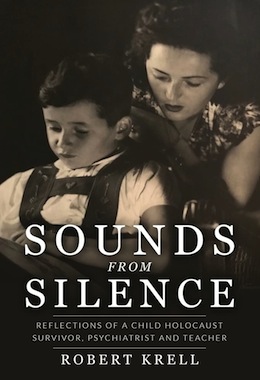
A child survivor reflects

At 80, Dr. Robert Krell opens up in his new book.

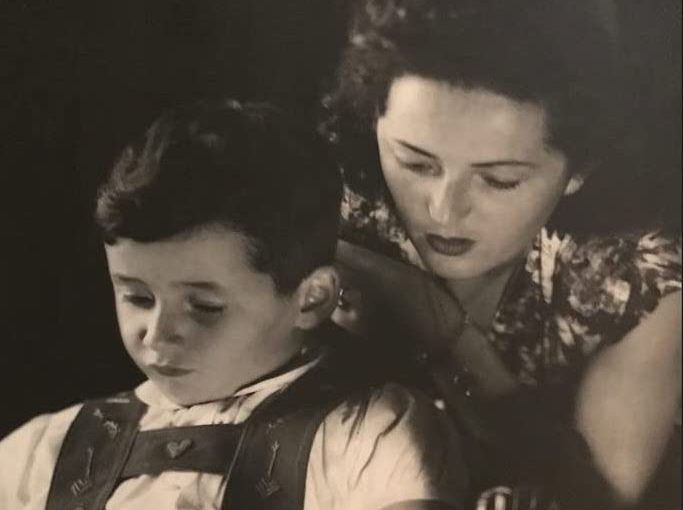
Dr. Robert Krell, child survivor, psychiatrist, community leader and founding president of the Vancouver Holocaust Education Centre, is probably known to most readers. But few people, perhaps even those closest to him, know him as well as they will after reading his extraordinarily vulnerable new memoir.

Krell acknowledges that he has held much back from the public and his closest family and friends. But, at 80, he has decided to open up in a book called Sounds from Silence: Reflections of a Child Holocaust Survivor, Psychiatrist and Teacher (Amsterdam Publishers).

Krell begins by talking about the duality of his life – the hidden child who, as an adult, tried to remain hidden versus the public figure whose career and community activities have placed him at the fore of various fields; the sadness at his core versus the upbeat visage he presents to the world.

“I have allowed family members and friends to see my inherent optimism and love of life. I live with few regrets,” he writes. “Blessed with a fascinating career, lasting friendships and an incredible family, I have kept at a distance my profound sadness, chronic fears, devastating shame, incapacitating shyness, and nightmares and preoccupations shaped by my earliest experiences and forged in an atmosphere of potential annihilation.”

Krell was 2 years old when his Dutch Jewish parents placed him in hiding with the Munnik family, who he would come to view as his actual parents. He was reunited at age 5 with his birth parents, Emmy and Leo Krell – a miracle on many fronts given the small proportion of Dutch Jews to survive to 1945.

image - Sounds from Silence book cover“After liberation, life became very complicated,” he writes. He had been treated well by his rescuing family, unlike some Jewish children, “but strangely, even those ‘good’ circumstances exacted a psychological toll that never quite healed. After all, my relatively ‘benign’ circumstances were still completely off the scales of what is normal, including separation from my parents, shattering of security, and vague awareness of persecution that contributes to the feeling of shame experienced by a child as having done something wrong to cause the situation. Years later, as a child psychiatrist, I would see this phenomenon in children who, faced with parental separation, assumed responsibility.”

His parents also survived in hiding and his mother in particular never stopped mourning the complete loss of both sides of their extended families.

“I was raised by psychologically wounded parents, no less so than if they had been in the camps,” says Krell. “For three years, they lived in fear of being caught, and that fear exacted a psychological toll that one cannot underestimate.”

Trying to recreate a life, they considered making aliyah to the new state of Israel, but their business before the war had been furs and the climate in Canada was more conducive to that specialty. They came to Vancouver in 1951.

Like many survivors, the Krells found new “family” at Schara Tzedeck Synagogue. Despite many survivors bearing a “burning rage against G-d,” the shul was a second home. His father refused to open a prayer book. And yet, years later, when he was in a position to be philanthropic, he spoke with Rabbi Mordechai Feuerstein and donated $30,000 to buy prayer books for the High Holy Days so that congregants wouldn’t have to carry them to and from synagogue on those days.

“Why would a man who no longer prayed purchase prayer books?” asks Krell. “The rabbi characterized Dad as ‘a man of faithful disbelief.’”

Habonim, the labour Zionist youth movement, was a major stabilizing force for young Robbie. He would attend weekend events, summer at Camp Miriam and do normal Canadian teenage things like matinees at the Stanley Theatre on Granville.

A late-in-life baby, his brother Ronnie, was born in 1956, and his mother’s disordered parenting shifted from the first born to the younger.

“Her subsequent attention to Ronnie grew so intense that even my 16-year-old self realized that he fulfilled her need to replay the years in which I had been lost to her. That need virtually enslaved my younger brother and freed me.”

While building a career as a clinical psychiatrist, professor and academic administrator, Krell and wife Marilyn were raising three daughters.

“I can barely believe that my survival as a young boy has led to the rebirth of an entire Jewish family that now includes nine gorgeous grandchildren,” he writes. “My good fortune scares me. Our world looks so dangerous, and the future of life – Jewish life – remains so precarious. But day-to-day, we are a close family, and every day brings much joy – so far.”

Krell was a leader in Canadian Jewish Congress regionally and nationally. In Vancouver, he became immersed in Holocaust remembrance and education. Kristallnacht commemorative lectures and other Holocaust remembrance events were often begun under the auspices of CJC.

With theologian William Nicholls and English literature teacher Graham Forst, Krell launched what has become a decades-long annual symposium for high school students on the Holocaust.

He was also among the first people anywhere to begin video recording the testimonies of Holocaust survivors.

Krell was also pivotal in the organizing of a succession of world conventions: first, for Holocaust survivors and, later, for “child survivors,” a term he acknowledges was not in use until the 1980s. Hidden children were not viewed as Holocaust victims in the way that survivors of the camps or partisan fighters were. Krell is among a small number of people who helped usher in a reconsideration of the wartime experiences of these children.

In 1984, he gathered 18 survivors and children of survivors in his living room and committed to creating a Holocaust education centre in Vancouver. But some of the older attendees remembered an as-yet unfulfilled promise to create a permanent local memorial to the Shoah, so the group decided to keep that commitment first.

“The memorial was unveiled on Yom Hashoah, April 26, 1987, in the presence of 1,300 members of the community,” notes Krell. “The survivors now had a metzeivah, a ‘burial site,’ albeit symbolic, to visit and to grieve.”

In 1994, the Vancouver Holocaust Education Centre opened, with Krell as founding president.

One time, when he was on the national board of CJC, the organization considered ending their efforts to bring (by then aging) war criminals to justice.

“I argued for continuing the effort,” says Krell. “My measure of success was different. I told my colleagues that it was not only about successful prosecution but also their knowing that, one day, they might hear a knock on the door. The sleep of Nazis should be no less disturbed than that of Holocaust survivors.”

Throughout the book, Krell recalls brushes with history and the figures who make it.

On a trip to Israel as a young adult, he was able to get a seat at the Eichmann trial, thanks to an aunt who had married into the family of Gideon Hausner, the prosecutor of the case. On the same trip, Krell went to Sde Boker and ran into David Ben-Gurion.

A few years later, Krell volunteered to serve in the 1967 war as a doctor fresh out of his internship but, given the chronology of the Six Day War, by the time he got to Europe, the conflict was over.

Two years after that, on another trip to Israel, his plane was hijacked by the Popular Front for the Liberation of Palestine.

Krell was able to attend the ceremony when his family-in-hiding – Albert and Violette Munnik and their daughter Nora – were inducted by Yad Vashem as Righteous Among the Nations (posthumously for Albert).

Krell’s book evokes an array of emotions. The psychiatrist’s self-assessment provides a sometimes startling look inside.

“I kept my rage suppressed, not repressed,” he writes. “It was not unconscious. I knew that it was there. I felt in danger from it and feared losing control. I played, studied and worked hard, surrounded by good friends.”

Milestones … Hart-Rappoport wedding, Canadian Jewish Literary Awards, new BGU residences

With gratitude to HaShem, mazel tov to Shmuel Hart (King David High School Class of 2016) and Reut Rappoport on their joyous and spirited wedding at Sakoya Gardens (just outside Jerusalem) on June 15, 2021. Elated parents – Alexander Hart and Kathryn Selby of Vancouver, and Rabbi Jason and Meira Rappoport of Alon Shvut, Gush Etzion, Israel – are so very proud of the newlyweds. The couple resides in Jerusalem, Israel, and both are currently studying at Hebrew University.

* * *

Now in its seventh year, the Canadian Jewish Literary Awards recognizes and rewards the finest Canadian writing on Jewish themes and subjects. This year, the awards ceremony, which took place on Oct. 17, was presented on Zoom and is available for viewing on the Canadian Jewish Literary Awards YouTube channel.

The winner in the fiction category was Nothing the Same, Everything Haunted: The Ballad of Motl the Cowboy by Gary Barwin (Random House Canada). It follows a wannabe cowboy, Motl, as he and his mother flee Vilna and the Nazis’ massacre of the Jews. The ensuing events, characters and horror are met by Motl with humorous absurdity in the face of tragedy.

Plunder: A Memoir of Family Property and Nazi Treasure (Houghton Mifflin Harcourt) by Menachem Kaiser, which tells the story of the author’s quest to reclaim a residential building his family owned in Poland before the Shoah, won for best biography.

Lisa Richter won the poetry prize for Nautilus and Bone (Frontenac House). A reimagining of the unconventional life of Yiddish poet Anna Margolin, this collection also won the 2020 National Jewish Book Award for Poetry, the first time a Canadian poet has ever received the American honour.

For children and youth literature, the winner was Osnat and Her Dove (Levine Querido) by Sigal Samuel, with illustrations by Vali Mintzi. It is based on a true story. Although girls in 15th-century Mosul were told, “Reading is for boys,” Osnat convinces her rabbi father to teach her to read. As she grows older, she asks her father to seek a groom who will allow her to study Torah, and she helps run her father’s religious school while raising her own children. After her father’s death and, later, her husband’s, Osnat becomes the school’s leader, making her the world’s first female rabbi.

For scholarship, the awardee was Survivors: Children’s Lives After the Holocaust by Rebecca Clifford (Yale University Press), which is an exploration of the life trajectories of 100 children who were 10 years old or younger at the time of their liberation in 1945. Through archives found in 12 countries, including Canada, and through personal interviews, the author follows the impact the events of the Holocaust had on their lives, and on those who educated them.

In the category of writing about the Holocaust, the winner was In the Lights of Days: The Untold Story of Women Resistance Fighters in Hitler’s Ghettos (William Morrow) by Judy Batalion. The book points out the lack of recognition and the misrepresentation of women’s roles during the war, the actions they took to fight, as well as their crucial importance.

The Canadian Jewish Literary Awards jury for 2021 was Edward Trapunski, Pierre Anctil, Rona Arato, Miriam Borden, Rita Davies, Alain Goldschläger and Adam Sol.

For more information, visit cjlawards.ca.

* * *

photo - Ben-Gurion University of the Negev student village
Ben-Gurion University of the Negev student village (photo from CABGU)

Fourteen new buildings have been added to the student village at Ben-Gurion University of the Negev (BGU) in Israel. It will allow more than 1,000 students options from studio apartments to married student housing.

“The student village lets them choose their living quarters in accordance with their personal preference,” said BGU president Prof. Daniel Chamovitz, “while everything they could need is nearby: the north campus and the conference centre, which are in development, a hotel for visiting students and faculty, stores and coffee shops … and the high-tech park, the train station and the university’s country club are just a short walk away.”

The student village offers apartments suitable for religious students and those with disabilities. Any registered student is eligible to apply for a room. The rooms come fully furnished with a smart TV, beds, closets, desks, a full kitchen, a sitting area and a solar water heater. Full maintenance service is offered, as is 24/7 security, a 24-hour service hotline, bicycle rooms, laundry rooms, and more.

“Situated in the country’s southern region, the university is known to be a destination institution,” said Mark Mendelson, chief executive officer of Canadian Associates of BGU. “This means that students who attend the university also live either on campus or in the communities in and around the university, including the city of Be’er Sheva. In addition, almost 60% of the undergraduate student body volunteers in their respective neighbourhoods, which is really something very unique to BGU and has brought outstanding community involvement to the citizens of Be’er Sheva.”

Exploring her family’s past

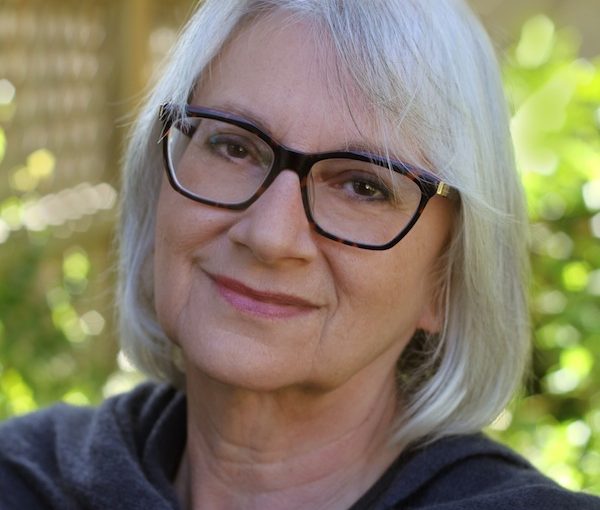
Afterlife is Isa Milman’s first work of nonfiction. (photo by Shea Lowry)

Midway through Isa Milman’s Afterlight, which came out this week, the author cites Reb Nachman of Breslov, who said, “The whole world is a very narrow bridge.” In Victoria-based Milman’s new work, we encounter bridges of various sorts: those that serve as a crucial lifeline to the survival of the denizens of cities, particularly at a time of war, and the bridges that bring together people from different continents in the pursuit of understanding an unconscionably horrific time in Eastern Europe.

And then there are the bridges that link us poignantly to our past – to those we know through words and photos but have never met. In Afterlight, one such bridge connects Milman to her mother’s twin sister, her aunt Basia, who perished in the Holocaust, and who, like Milman, wrote poetry. (Milman is a recipient of the Canadian Jewish Book Award for poetry.)

Milman’s journey began in 2013, when, following her mother’s death, she sought to find Basia’s poems from the 1930s. The book alternates between the present and the past (the war years), as Milman tries to uncover a layered tale. She travels to Europe where, at times, her quest for information leads to dead ends and, at other times, she finds details in unlikely places – a photograph in Amsterdam, for example.

At one stage, Milman finds poetry written in a Polish publication from the 1930s. She writes, “Reading the children’s poems, I felt a terrible nostalgia rise up – a dangerous nostalgia. Even now it hurts too much, this intense longing for a conversation with Basia, for a meeting, a recognition that we’ve lived on the same planet, come from the same earth, share blood and bone. We share a love of poetry, but I shall never know her, not even as smudged ink on a page.”

At one point in her exploration, Milman pens a poem to her aunt. “How many tiny flowers make one lilac sprig? / How many stars in the night sky have names? / How many yet to be seen? They disappear with morning sun too soon but in darkness or in light tucked in their beds they remain,” the poem reads.

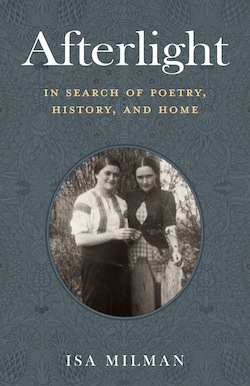
image - Afterlife book coverBasia’s story is but one piece of the book. Afterlight also traces the journey of Milman’s parents and her other surviving aunts through the Holocaust and examines questions about the trauma, displacement and identity caused by the Holocaust to succeeding generations.

“I’d lived my life in a black hole of absence, of never having the experience of grandparents, of feeling rooted and at home with extended family. And this was not because of a tsunami, an earthquake, forest fire or plague. It was because of tribal hatred,” Milman writes.

As well, she explores the issue of reconciling the Poland that Jews thought of as their home with rampant antisemitism and the brutality of the war years. “Why couldn’t I choose how to think about Poland, even if it meant going against most everything I’d learned?” Milman asks. “Why couldn’t I revise my notion and accept that Poland is a place that I can love as well as despise and fear? Why must it be either/or? Was it possible to live in the uncomfortable in-between, where both realities coexist?”

Afterlight is Milman’s first work of nonfiction. At first, Milman, whose collections of poetry include Prairie Kaddish, Between the Doorposts and Something Small to Carry Home, was reluctant to write a nonfiction account of the Holocaust. However, recent surges in antisemitism around the world led her to change her mind.

“The lessons of the Holocaust need to be taught, and not just by citing facts and reportage,” she said. “Telling stories about real people and their experiences is the most effective way of reaching and teaching people about how evil can happen, and how we must fight our worst human inclinations and speak out against hatred and inhumanity.”

A big part of her decision to write a memoir was realizing that her family’s story did not match a more common Holocaust narrative. Hers is a lesser-told account of Jews from eastern Poland, some murdered in what’s known as “the Holocaust of Bullets” and others, like her parents, who survived because of deportation by the Soviets to the Gulag.

“I loved entering the world of creative nonfiction,” she said. “Using my imagination to create scenes where I clearly was not present enabled me to inhabit the places and people I needed to describe. Everything became more real as I entered into the minds of my characters, who happened to be my parents and close family.”

Sam Margolis has written for the Globe and Mail, the National Post, UPI and MSNBC.

Delving into roots of memory

I have more years behind me than most of you. I remember what seems to me all the big events. While prominent in my mind, I do try to pay more attention to the daily round. Today, for example, I bought some plants to fill spaces in my garden in the sky, seeking yellows and oranges to harmonize with the bountiful presence of the red geraniums, fully in their flowering. We ate breaded chicken for breakfast, a gift of our Jimmy, Cookie’s son, while watching the Tokyo Olympics results – Canada is doing great! I spent Saturday morning at the community centre, playing with clay, creating fantastical faces I would not hope to meet on my street.

I think it’s important that we pay lots of attention to the minutiae of daily life, glorying in the simple things that fill our present, appreciating how they add to the pleasure of living. But I also worry about losing the detail about my life in the past, the bits and pieces that brought elements of that life into the now. It takes some work to ferret things out. I’m rummaging about in the closets of memory, poking into the corners to see what I can find.

Can I remember what it was like when I was a kid? I was the only boy, being raised with sisters. Didn’t I get the feeling that I was favoured as the male, as my older sister was called upon to help my mother with the housekeeping? My youngest sister was nevertheless the spoiled one, being considered the most vulnerable to mistreatment. I recall how I tried to keep my room neat and tidy, so that was where we had our family meetings. All this might be a figment of my egomaniac’s self-image, and the facts would have to be checked with living witnesses.

Can I remember what it was like to be the only Jewish kid in the neighbourhood when the family moved to Jarvis Avenue in Winnipeg? The kids next door tried to make our lives miserable by throwing stones at our windows, and parading in front of our house with catcalls deriding my mother’s Jewish names for us. How many times did I fight with Mikey, down and dirty in the mud? And Tony and Danny, from three houses over, scrapping in the schoolyard? And Eddie, who knocked me unconscious in front of a crowd, in Grade 7? I survived the blemish on my brain, and Eddie, too. Didn’t my tiny sister protect me when Big Harry on Dufferin was going to beat me up on our way to school? What did it smell like outside our house, with the coal yard in front and the junkyard at the back?

And yet, it felt like we, my family, lived a totally peaceful, private life inside our home there. Dad had his job shoveling coal at the Cold Storage Co. down the street. (He would end up a graduate engineer after years of home study.) We ate our three squares a day in our rented home, and went the four blocks to Aberdeen school each day. We celebrated the Sabbath every Friday with a special bread and the best meal of the week. I frequented the library every chance I could – maybe escaping the then-current world – and often spent the night reading by flashlight under my covers. We went to the neighbourhood synagogue for the High Holidays. I remember eating chicken in the back lobby on fast days. And, there, I had my bar mitzvah, wearing a suit and with a fedora on my head.

Somehow, I don’t remember much about greenery, though Winnipeg had a reputation for trees. I do remember holding my arms round the trunk of one when we played Buck, Buck, How Many Fingers Up? I remember sucking the honeysuckles I gathered off the hedges for their sweetness, and holding dandelions, which were so plentiful, under our chins to see the yellow there. I remember we liked blowing the dandelions’ heads off when they were ripe. And collecting bulrushes from the ditches, where they grew in the gathered water. Winnipeg had some of the deepest ditches. Winnipeg was famous for its lilac bushes, I remember their heavenly scent.

In the summer, gangs of kids used to gather on the street corner, I think it was Powers Street, and play road games far into the night. Sometimes, we’d end the night raiding summer vegetable gardens and have fights with the tomatoes we stole. And, yes, I do remember the mosquitoes.

Winnipeg was a city with a diverse population. There seemed to be large communities of people from a dozen different origins, from Iceland to the Ukraine, from France and, of course, England; Russia, Germany, the Middle East and Asia were all represented. While city government was initially in “English” hands, it changed over time to represent other ethnic communities.

What I remember above all was how active the Jewish community was, and how every political viewpoint and every internal community need was represented by some Jewish organization. I got the feeling that, although I lived in Canada, I could in some way be living within a totally Jewish environment if I so desired. It dispelled the feeling of isolation that I felt in my younger years. And, when I launched myself into the wider world, when I left Winnipeg, I felt totally at home in my Canadian persona. I really only appreciate that now in retrospect.

Digging into the roots of memory and coming up golden!

Max Roytenberg is a Vancouver-based poet, writer and blogger. His book Hero in My Own Eyes: Tripping a Life Fantastic is available from Amazon and other online booksellers.

Memoir, tribute, history

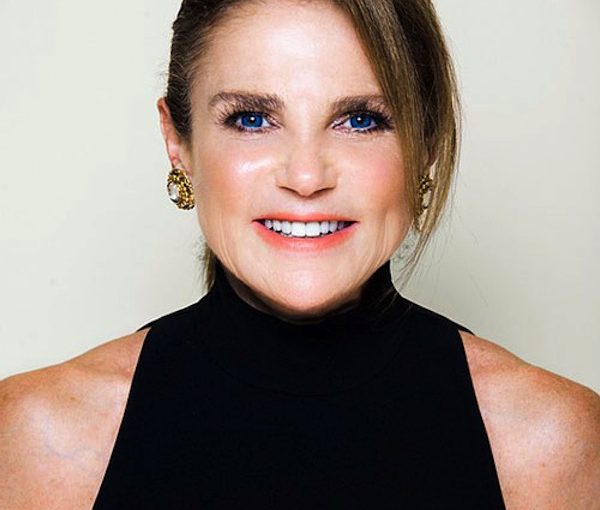
Actor Tovah Feldshuh talks about her new book, Lilyville, on April 15, in an event held in partnership with the JCC Jewish Book Festival. (PR photo)

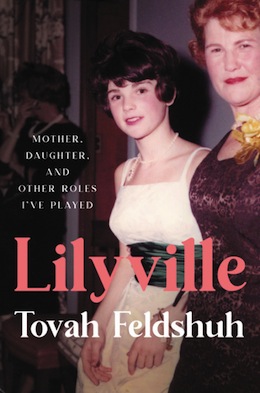
The long-awaited Cherie Smith JCC Jewish Book Festival closing night event – Tovah Feldshuh talking about her new book, Lilyville: Mother, Daughter, and Other Roles I’ve Played – finally takes place on April 15.

The event was postponed to piggyback on the Book Festival of the Marcus JCC of Atlanta and JCC National Literary Consortium In Your Living Room Live series. It will feature Feldshuh in conversation with CNN correspondent Holly Firfer, and promises to be an entertaining evening with many laughs and lots of good advice, if Lilyville is any indication.

Feldshuh’s first book is a unique memoir in that it is framed in terms of her relationship with her mother – the longest and most important of Feldshuh’s roles having been the one she didn’t audition for, being the daughter of Lillian (Lily) Kaplan Feldshuh. The memoir is structured as a theatre piece, starting with the Program Note and ending with Exit Music, with three acts, many scenes and more in between.

Strong women characters, from the fictional Yentl (from the mind of Sholem Aleichem) to the very real U.S. Supreme Court Justice Ruth Bader Ginsburg, dominate Feldshuh’s career. She has performed in theatre, film and television, winning numerous awards and nominations for the excellence of her work. She also has been recognized for her charity work. And, it seems, through it all, family has been a priority.

image - Lilyville book cover

In Lilyville, Feldshuh writes about her upbringing, how and why she became an actor, some of the people and incidents that have influenced her, her marriage (to a lawyer, like her beloved father was, and which she considered becoming at one point) and being a mother herself. Given her successes, readers may be surprised at the professional challenges she has overcome along the way, including being told outright by a director that she’d never make a good actress, she should become an accountant. But the biggest obstacle for her was coming to understand that her mother, who seemed cold and shy throughout Feldshuh’s (and her older brother’s) upbringing, loved them. While hypercritical and emotionally closed throughout their growing-up years, their mother was always there for them. It was only after their father died that their mother – who had been raised to be what was considered a good woman back then, ie. a woman who dedicated herself to her husband and kids, her own aspirations be damned – blossomed.

In an interview with the Detroit Jewish Book Fair, Feldshuh said about writing Lilyville that she “felt compelled to tell her [mother’s] story and mine and how the two of us had a lifelong journey toward each other. In essence, I dig down into the primal relationship between parent and child, with the specifics between mother and daughter.”

Luckily for the women, they had the time to repair and build their relationship, as Feldshuh’s mother lived to 103. Through that century-plus, Lily Kaplan Feldshuh, who was born before women were given the vote in the United States, witnessed countless social, cultural and technological changes, and Lilyville is partly a history of women’s rights in that country.

General admission to Feldshuh’s book talk is free. Admittance to the pre-event meet-and-greet portion of the event comes when, in addition to registering, you purchase the book; the $36US includes shipping and you will receive a copy with a signed bookplate. Visit jccgv.com/jewish-book-festival.

Tale of transformation

Near the beginning of her acting career more than 50 years ago, Beth Kaplan wanted to improve the world through art. “I believe in the theatre as a tool for social change,” she told the director of the London Academy of Music and Dramatic Art when she arrived for a one-year program. “I’d like to touch people’s lives as a force for good.” His reaction? “Well,” he said, standing up. “I do hope you have a fruitful year. Best of luck.”

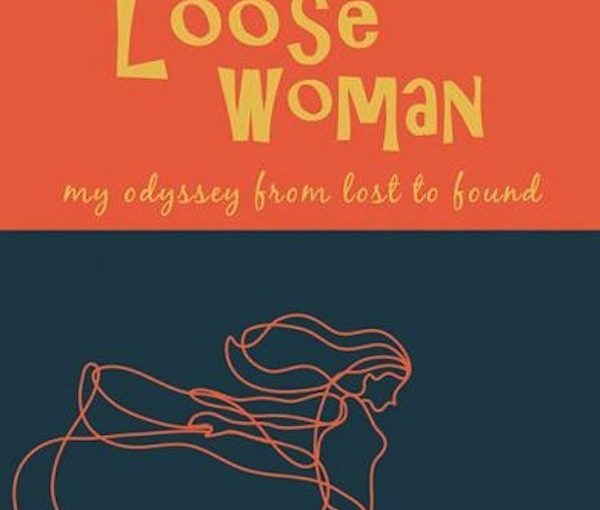
Kaplan writes about her journey from acting to writing, from youth to adulthood, from insecurities to self-acceptance, and more, in her memoir Loose Woman: My Odyssey from Lost to Found. Local JI readers may recall her name, as she was a part of the Vancouver theatre scene in the 1970s. But a 1979 trip that included a visit to France to see her best friend, who had moved there, changed Kaplan’s life.

Through her friend’s husband, Kaplan ended up for a spell living and working in a L’Arche community, which brings people with and without intellectual disabilities together. Initially uncomfortable there, the experience and the slower pace allowed her to learn about herself, and to not treat life as a performance. From her time at L’Arche, she sees how, “in one way or another, we are all handicapped.”

In telling her story, Kaplan seems to rely mainly on thoughts she committed to her diaries over the years. She’s kept one ever since her first, which was a gift when she was 9 years old. Some of the terms she uses, like handicapped, hearken back to that time, and it’s a choice Kaplan makes, “to be true to the time, hoping that readers understand that what is offensive now was not so then.” Indeed, through some of the language and the stories of her objectively wild life during the 1970s, Kaplan highlights the advances that have been made in areas like women’s rights and inclusion.

Loose Woman is an interesting book, even though Kaplan is not a completely likeable heroine, despite it being her own story. Some readers might chafe at her harsh judgments (even when she is the target) and her self-acknowledged mix of confidence (some might say arrogance) and insecurity. But others might revel in her tales of debauchery and her resolute openness.

Childhood memories

Chicken soup with matzah balls is a staple of the Ashkenazi Passover seder; for meat-eaters, at least. (photo from onceuponachef.com)

My father used to start the seder with a joke. One I remember was: Abe goes to see his boss and says: “We’re doing some heavy house-cleaning at home tomorrow for Pesach. My wife says she needs me to move all the heavy furniture, clean the stove and even clean out the garage.” “We’re short-handed Abe,” the boss replies, “I just can’t give you the day off.” “Thanks boss,” says Abe. “I knew I could count on you!”

Passover was both an exciting and an embarrassing time for me. Both my parents were born in Australia in the late 19th century, when Jews were quite a rarity there. The influx of Jews from Europe to Australia only began after the Second World War, when those lucky enough to survive the Holocaust reached our shores. Back then, I was the only Jewish child in my school, so I had no Jewish friends and, apart from some family members, neither did my parents. Of necessity, we were quite assimilated, as there were few facilities available for Jews in those far-off days.

Still, we adhered to some traditions, and one was the seder. As a child aged 7, it was exciting for lots of reasons, but I had no one to share it with except my two brothers and two sisters, all much older than I was. Our family of seven would sit around the table with Great-Aunt Frances and Uncle Dave, and some of our non-Jewish neighbours, who looked forward to being invited to join us in this, to them, odd ceremony every year. One of them was Penelope, who had a daily radio show and, the next day, she would relate to her listeners all the details that she understood and that seemed to fascinate her.

The table would be set with a white tablecloth and all the traditional seder trappings, with a big decanter of raisin wine my mother had made. I was wearing my “best” dress, which I loved. Like most people during those Depression years, we had very little money, so most of my clothes were hand-me-downs from my sisters. But this one had been bought especially for me and I loved it – pink velvet, with puff sleeves and a lace collar. It broke my heart when I outgrew it.

My father, of course, sat at the head of the table, a big pillow on his chair for reclining. Dad was a man of enormous contrasts, something of a genius. He knew Hebrew, Latin and Greek and thought no one could call themselves educated without an acquaintance of these classical languages. But he was also very modest, rarely let it be known that he was a scholar, and had a fund of off-colour stories that always made me blush and resulted in my being very prudish well into adulthood.

He would conduct the service from the Haggadah in Hebrew, giving explanations in English all the way through. He said that the Wise Son who asked questions at the seder was so intelligent that no one had the faintest idea what he was talking about. The Wicked Son had to be excluded from the table, so he went back to work and got paid double-time for working on Pesach. When the Simple Son asks, “What is this?” you just tell him, “It’s dinner.” And, as for the one who does not know how to ask, you go and wake him up and say, “Next year, remember to come to the table.”

When it came to the Four Questions, Dad had transliterated the “Ma Nishtana” for me in big English letters and the guests all thought I was very clever to be reciting something in Hebrew when I was only 7. I did nothing to disillusion them. I loved the singing and so did our guests, who, after some coaching from Dad, sang along with us heartily, with mostly mispronounced words. I remember we always sang one song in English, “Chad Gadya”: “Only one kid, which my father bought for two zuzim….”

A good meal followed, although my mother – a great cook of Australian dishes – didn’t do too well with Pesach recipes, as her own mother had died when she was my age, so she didn’t have the benefit of learning from her mom. But she tried valiantly. The chicken soup was good, apart from the matzah balls, which were as tough as bullets; and her gefilte fish I won’t attempt to describe. Our guests probably thought we were meant to suffer, and this was just another punishment like having to eat matzot for a week.

Just as I couldn’t share my friends’ Christmas and Easter festivities, I didn’t even tell them about our seder. But now I realize how special it was. When I close my eyes, my family are with me again. Maybe that seder was the last time we were all together in person, as my two brothers soon went overseas with the Royal Australian Air Force. The younger one, shot down over Rommel’s lines in Tobruk, never returned. Over the intervening eight-plus decades, the losses have multiplied. There is only one beloved sister left, and she is in Australia.

I would love my parents to be able to see my family at a seder in Israel. We are more than 50 people now, including all the grandchildren and great-grandchildren. I am sure we observe it more authentically today, but there is something special I have lost that can never be replicated – the family I once had, who gave a little girl love, safety and security.

When I think about our seder table back then, it’s not just about the matzot, shankbone, roasted egg, bitter herbs and charoset. I see the family I have loved and lost, and hear the jokes and the songs and the laughter. I have come a long way since then, both spiritually and physically, but the seeds were planted back then, at the seder table with my family, who will never be forgotten.

Dvora Waysman is a Jerusalem-based author. She has written 14 books, including The Pomegranate Pendant, which was made into a movie, and her latest novella, Searching for Sarah. She can be contacted at dwaysman@gmail.com or through her blog dvorawaysman.com.

Novel journeys shared

Ilana Masad participates in the Cherie Smith JCC Jewish Book Festival on Feb. 23. (photo from the JBF)

Women are at the forefront of two new books. Specifically, how we perceive their (our) roles. Especially, with regard to motherhood.

photo - Myriam Steinberg participates in the Cherie Smith JCC Jewish Book Festival on Feb. 24
Myriam Steinberg participates in the Cherie Smith JCC Jewish Book Festival on Feb. 24. (photo from the JBF)

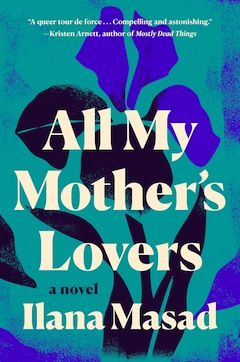
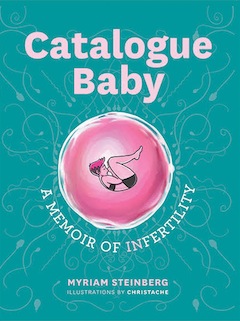
Ilana Masad’s debut novel, All My Mother’s Lovers, is told from the perspectives of a daughter and her mother, and highlights how much we cannot know about the people close to us, while Myriam Steinberg’s graphic novel, Catalogue Baby: A Memoir of Infertility, is a no holds barred sharing of her challenge to become a mom. Both Masad and Steinberg are participating in this year’s Cherie Smith JCC Jewish Book Festival, which takes place online Feb. 20-25.

While the premise is a stretch to my worldview, All My Mother’s Lovers is an extremely relatable read on many levels. Twenty-something Maggie’s mother, Iris, dies in a car crash and Maggie must return home for the funeral and shiva. But, along with her will, Iris has left behind six letters – all addressed to men Maggie hasn’t heard of – and Maggie quickly flees the communal mourning to deliver these missives.

Leaving behind her grief-addled father, who has been the emotional-support parent for her, and her younger brother, with whom she has an older-sister-bossy relationship, Maggie attempts to track down the unknown men. The space from her family and from her current partner, with whom there might actually be a substantial, meaningful relationship brewing, allows Maggie to deal with her long-held insecurities and naïve perceptions of what it means to be married, what it means to be a parent; basically, what it means to be a loving and reliable person. We get to know Iris through the letters and, though Maggie doesn’t get to benefit from these personal musings, she does learn more about her mom, which allows her to connect more deeply with her father, as well as to others in her life.

image - All My Mother’s Lovers book coverMasad’s writing is crisp, intelligent, wry and sensitive. The novel starts with a bang – Maggie answering her brother’s call (telling her about their mother’s death) while having sex with her girlfriend. The pace emphasizes Maggie’s confusion as she tries to understand her mother, and herself. Iris’s letters offer slower moments of reflection, but also were a way for Iris to try and better understand her own missteps and successes.

Steinberg’s Catalogue Baby also took me into a world I’ve never personally experienced, though I do know people who have so wanted to have a child but either could not conceive or had great difficulty conceiving. Steinberg’s refreshing openness on a topic that is often spoken about in whispers, if at all, is most welcome. And her voice is amplified by the colour-bursting, energetic and imaginative illustrations by Christache Ross, which take readers right close up into the physical and emotional upheaval and turmoil that Steinberg has lived.

image - Catalogue Baby book coverCatalogue Baby takes readers from Year One (starting January 2014), and Steinberg’s admission that her dedication to work, organizing the In the House Festival for 11 years, only occasionally gave her the time to put her “loneliness and unrequited motherhood” front of mind. Almost 40 years old at this point, she “didn’t have time to waste with someone who didn’t eventually want a family.” But, people being who we are, Steinberg nonetheless tries to make an unsatisfying relationship work, all while her biological clock (which follows her throughout the novel’s journey) ticked away. From when she finally decides to go it alone to when she gives birth to twins in late 2018, she goes through much. The list includes 123 blood draws, 31 ultrasounds, multiple fertility treatments, five pregnancies, thousands of supplements, about $100,000, help from dozens of family and friends, etc., etc. – and “25 litres of tears.”

To hear more about and from Steinberg, Masad and many other fabulous writers, check out this year’s Jewish Book Festival: jccgv.com/jewish-book-festival.

A long life working, helping others

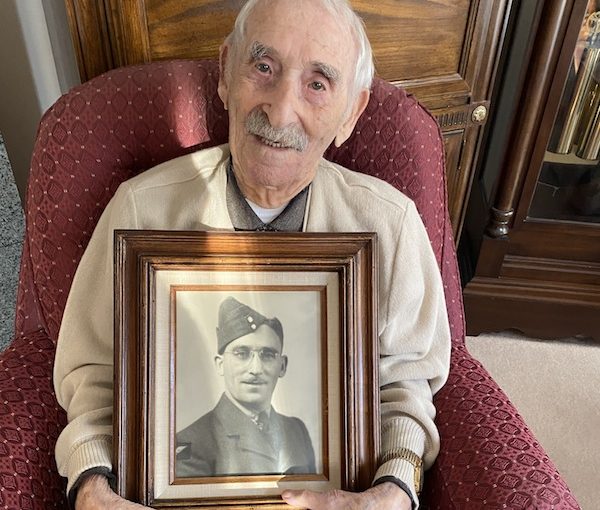
At 109, Richmond resident Reuben (Rube) Sinclair might be Canada’s oldest Second World War veteran. (photo from Reuben Sinclair)

A Richmond resident is almost certainly Canada’s oldest Second World War veteran. Reuben (Rube) Sinclair received a special recognition on Remembrance Day, though, because of confidentiality issues, Veterans Affairs Canada can’t confirm he’s the oldest service member. But, at the age of 109, basic statistics suggests that, if Sinclair isn’t the oldest, he’s got to be close.

The centenarian spoke with the Independent virtually via Zoom about his life and what advice he might have for aspiring super-seniors like himself.

Sinclair was born in 1911 on the family farm near Lipton, Sask. Lipton was one of many “colonies” created by Baron Maurice de Hirsch in Canada, Argentina and Palestine to resettle oppressed Jews from Europe. Sinclair’s father, Yitzok Sinclair (born Sandler), traveled from Ukraine, via Liverpool and arrived at Ellis Island Jan. 4, 1905, on the SS Ivernia. He made his way to Saskatchewan, where he was given land by de Hirsch’s Jewish Colonization Association. However, the land was poor and so the newcomer worked for the Canadian National Railway long enough to save up and buy a better plot and build a house. When he was settled, he sent for his wife, Fraida (born Dubrovinsky), and their two young sons.

Reunited in Lipton, the family grew to include not only Samuel and Sol, who were born in the old country, but the only sister, Clara, then Rube and the youngest, Joe.

The last survivor of his birth family, Sinclair has fond memories of the farm life. He and the other two youngest did chores while the older two headed to university. Samuel became a medical doctor and Sol was a professor of agriculture at the University of Manitoba.

“There was a whole colony of Jewish families,” Sinclair said. “My parents had one of the largest farms – 16 quarter-sections [more than 2,500 acres]. I remember we had 42 horses. We had milk cows. I had my jobs. My job was to go collect the eggs from the chicken house and, when I was 12, I was already driving our car.… Always things to do on a farm.”

Yitzok donated a few acres to the community and helped construct a school, which doubled as a synagogue. On Shabbats and Jewish holidays in winter, the boys would sleep in the hayloft so the local men could stay in the house and not walk home in the freezing Saskatchewan weather.

“My father was a leader in the community,” he said.

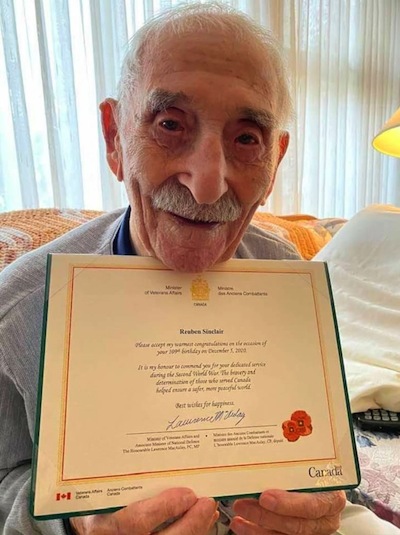
photo - Reuben Sinclair holds a birthday message from Veterans Affairs Canada
Reuben Sinclair holds a birthday message from Veterans Affairs Canada. (photo from Reuben Sinclair)

Sinclair joined the Royal Canadian Air Force during the Second World War and was stationed in North Battleford, Sask. In the days before radar was commonplace, he taught Allied pilots how to take off and land in the dark using a “standard beam approach,” which involved a navigation receiver that allowed the pilot to line the aircraft up with the runway when preparing to land.

“In the air force barracks, I was on the top bunk,” he said. “I always got the top bunk because the younger generation would come home drunk and I wouldn’t sleep in the bottom bunk.”

One day, he encountered a barrack-mate in tears. Sinclair recalls the conversation: “They’re sending me to Vancouver, he said, and my family is all here around Brandon, Manitoba. So I said, that’s no problem. When they want a person to go to Vancouver, they don’t care who the person is. Vancouver wants one person. So, I said, don’t cry. We’ll go see the commanding officer. I told him that my wife has got family in Vancouver and I’d be glad to go instead. He said they don’t care, all they want is one person. So, I was the person who went to Vancouver at that time and I’m still here,” he recalled with a laugh.

Joe, the youngest of the five siblings, had served in the army and after the war joined Rube in British Columbia. They started Sinclair Bros. Garage and Auto Wrecking, in Richmond, just across the two old Fraser Street bridges from Vancouver.

“My job was to go out and find old cars and we had a tow truck,” Sinclair said. “I’d bring them in and my younger brother would wreck them. We opened a wrecking company.” They also bought surplus army vehicles to fix up and sell.

The business soon became a sort of family compound. A small house adjacent went up for sale and the Sinclairs bought it, bringing parents Yitzok and Fraida to the coast. Then sister Clara and her husband Morris Slobasky bought a general store that was next door.

Because of his wartime experience, Sinclair developed migraine headaches and was told to go to a drier climate. He thought Arizona sounded good, but his wife, Ida, had siblings in the Los Angeles area and a brother-in-law offered him a job in a furniture store in Anaheim.

In 1964, Rube and Ida packed up the three kids – Nadine (now Lipetz), Karen and Len – and moved to Southern California.

“He put me in charge of the furniture store,” Sinclair said of his brother-in-law. “I knew nothing about furniture, but I learned pretty quick.”

Soon he was in business for himself again.

“Then my boss that I worked for in Anaheim, his wife wasn’t very well and she spent a lot of time in Palm Springs,” Sinclair recalled. “So, he said, instead of me going back and forth, I’ll move to Palm Springs and you can have the store, just pay me for the inventory.”

In 1994, Ida had a stroke and the couple moved back to British Columbia. She passed in 1996. Rube still lives in their Richmond condo.

Rube and Ida were active in their communities. In Los Angeles, they raised more than a million dollars for City of Hope, a cancer hospital and research facility. Both were active members of Schara Tzedeck Synagogue here, he especially in the Men’s Club, and he is proud of his lifetime honorary membership in the shul. In addition to their three adult children – Nadine is in Vancouver; Karen and Len in California – he has six grandchildren, 16 great-grandchildren and one great-great-grandchild.

Asked if he has any advice for others, Sinclair didn’t hesitate.

“That’s easy. I always say, if you have a problem, don’t worry; you’ll lose your hair. Fix it. If you have a problem, fix it. Don’t sit back and worry. Worry is not going to help.”

Any bad habits?

“I don’t think so,” he said after a thought. “I spent most of my life working and, in my spare time, working for people less fortunate. That was my enjoyment in my spare time.”

Two years ago, the City of Richmond named Sinclair an “honoured veteran.”

Recalled daughter Nadine: “He was part of the Remembrance Day service in Richmond and they made a big deal about it. They sent a limo and he sat with the mayor and the Silver Cross Mother. They gave him a wreath and then they walked him around. He was up on the dais with the mayor and the head of the RCMP as the soldiers all walked by. It was a very big deal for him.” Last Remembrance Day, he received a certificate from Veterans Affairs.

If, by some chance, Sinclair is not

Canada’s oldest veteran of the Second World War, he seems determined to attain that title.

“I’m not going anywhere,” he said. “I still have some unfinished business.”