Think first, then share news

When I write articles lately, they’re usually columns with an Opinion header near the editorial section. Most writers try to back their opinions up with research and information. I’m no different. However, some readers can be easily swayed regardless of the facts involved. This was clear to me when I ate dinner at a neighbour’s home recently. I chatted with my host about a syndicated columnist who gives succinct opinions about all sorts of world politics.

The writer’s accessible approach makes it seem like his opinions are solid. His tone is breezy and confident. But he covers so many different world events and conflicts that I wondered how he knew so much about it all. My host suggested he had a large staff to help him. I doubted this. Writing’s just not that profitable these days.

Here’s why I grew to doubt this columnist’s work. When it came to how he analyzes Israel and the Middle East, I have some academic background in the subject and I read widely. I saw where I disagreed with his assumptions. In several cases, I had more information about the issues than he presented. I saw his bias. I questioned what I read. Yes, his work is always on the newspaper’s editorial page. It’s always an analysis piece but that doesn’t mean his facts and conclusions are always correct. Now when I read his work, I see the “mansplaining” tone. He’s overconfident and oversimplifies big conflicts. Sadly, I suspect few people call him on it.

My host and I had this exchange while talking about mainstream media. In North America, we like to think our journalism is objective, fair and impartial. When I was a kid, my family visited relatives in France. I noticed the sheer quantity of publications on the French newsstands. More than one relative explained that they subscribed to certain newspapers that represented their political view and bought others with differing views. This way, they could get a full picture of world events. They acknowledged that everyone had biases and that media wasn’t objective. The way to get a fair representation of events was by doing more: more reading, more information gathering, critical comparison and analysis.

My recent Talmud study, from the tractate Bava Batra, has taken me through some fun “tall tale” narratives from Rabbah bar bar Hanna. He was prone to exaggeration. In Bava Batra 73, he sees enormous antelopes and a frog as big as 60 houses. He claims that a dragon swallows the frog, which is then eaten by a raven. The raven then sat in a tree. Can you believe, he says, how sturdy that tree was? 

When Dr. Sara Ronis introduces these stories in the My Jewish Learning essay for this page, she calls them what they are: a real fish tale. (You should have seen the fish that got away!) These myths also perhaps have parallels to a Zoroastrian text called the Bundahishn, according to Drs. Reuven Kipperwasser and Dan Shapira. The stories might be crazy, but they were floating around in the ether of multicultural Babylonian marketplaces. Rabbah bar bar Hanna returns to the study hall with his crazy stories. The other rabbis call him on his nonsense. They insult him and call him names, criticizing his choices. There are lots of modern scholarly opinions about why the other talmudic rabbis do this, and what it means. It’s a topic for academic debate.

However, what if this is an ancient reminder for us? What if, during this period of Elul, when we’re supposed to start doing serious introspection, we’re also supposed to be examining exactly what crazy stories we’re swallowing? Imagine social media and news outlets as our marketplace. Maybe we’re bringing home Zoroastrian tall tales and repackaging them for our own consumption. The rabbis teach us in Bava Batra that swallowing these fish tales whole is not the smartest move. The rabbis ask why Rabbah bar bar Hanna didn’t just stop and think more before bringing this “stuff” home with him.

We’re often plied with misinformation – about the war in Israel, but also about other news. What do we know about Russia and Ukraine, repression in Iran, the Uyghurs or the Sudanese crisis? How much propaganda has been sent our way and who paid for it? It’s hard to tell. Too often, a seemingly objective, sincere journalist’s narrative might mislead us simply because their unconscious bias and opinion is submerged in the text. The editor’s headline guides us, too. 

Worse, sometimes it’s not subconscious bias. Sometimes, it’s bots or outright propaganda, paid for by a country that wants to mess up North American elections or culture. I’m not a conspiracy theorist. I believe that, like the rabbis suggest to Rabbah bar bar Hanna, one should reflect on things you read or hear, really look at them, and think critically. 

This season’s the time when we’re supposed to be examining our deeds since last year. Most of us were guilty of complacency in this past year. Last Sukkot, we couldn’t have imagined what was ahead. If someone had described what was to come, we would have accused them of telling an abhorrent tall tale. For many, Oct. 7 and its aftermath have been one scary, real and gruesome nightmare. 

It’s easy to understand complacency. We want to feel safe. We don’t want there to be metaphorical enormous frogs or dragons around the corner. That said, we owe it to ourselves to be like the rabbis in the study hall who called out Rabbah bar bar Hanna. Those rabbis asked bar bar Hanna to pause and think more about what he saw, read or told them. 

In the spirit of the High Holidays, let’s be true to ourselves. There is plenty of horrific real news for us to share. Let’s read widely first. Let’s keep our eyes open so we recognize bias and what is really happening before we pass something along. Let’s avoid the rumours and speculation, too.

Wishing you a sweet, happy, healthy and peaceful 5785, free of misinformation. 

Joanne Seiff has written regularly for the Winnipeg Free Press and various Jewish publications. She is the author of three books, including From the Outside In: Jewish Post Columns 2015-2016, a collection of essays available for digital download or as a paperback from Amazon. Check her out on Instagram @yrnspinner or at joanneseiff.blogspot.com.

One family’s influence

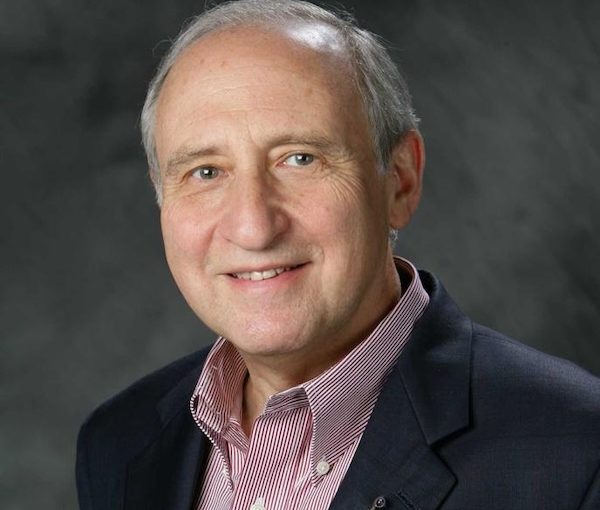
Ben Shneiderman was the featured speaker at Jewish Senior Alliance’s Spring Forum May 26. (photo from hai.stanford.edu)

On Sunday, May 26, the Jewish Seniors Alliance presented their annual Spring Forum. Featured speaker Ben Shneiderman spoke about his family’s influence on journalism, photojournalism and the development of human-computer interactions.

Shneiderman was introduced by Gyda Chud, a past president of JSA and chair of the program committee. He told those gathered at the Peretz Centre for Secular Jewish Culture about his family history, keeping the audience enthralled throughout. 

Shneiderman is an emeritus distinguished professor of computer science at the University of Maryland. He has received six honorary doctorates in recognition of his pioneering contributions to human-computer interaction and information visualization. He has published more than 20 books, most recently, Human-Centered AI (Oxford University Press, 2022), which won the Association of American Publishers award in the computer and information sciences category.

However, Shneiderman did not begin with his own cultural contributions, but with those of his parents, Samuel and Eileen (née Szymin) Shneiderman. They began their journalistic partnership in Warsaw, writing for the many Yiddish publications that existed then. Their lives mirrored the turbulent events of those years. They moved from Warsaw to Paris, where they continued to contribute to Yiddish publications. They did major reporting from Spain during the Spanish Civil War. In 1938, Samuel published a collection of his work on the Spanish Civil War in Yiddish, titled Krig in Shpanyen: Hinterland. This coverage earned him the title of being “the first Yiddish war reporter.” This book was later published in Polish and then in Spanish. It will appear soon for the first time in English as Journey through the Spanish Civil War, translated by Deborah Green and published by the Yiddish Book Centre’s White Goat Press.

In 1940, with the help of the Yiddish press in New York, the family was able to immigrate to the United States and escape the war. Samuel worked with the Yiddish press and published many other books, including editing The Diary of Mary Berg, by an American woman who was incarcerated in the Warsaw Ghetto and described harrowing details of life there. Samuel wrote of the Kielce Pogrom in Between Fear and Hope. The Weitzman National Museum of American Jewish History has two virtual exhibits: one on Samuel and Eileen’s partnership, and the second on Ben Shneiderman’s computing contributions and the photojournalism of David Seymour, Eileen’s brother, who was known as Chim. 

Chim’s humanistic style of reporting influenced modern visual storytelling. One of his photos, related to the war, may have inspired a painting by Picasso. Chim’s war photos were widely published in many magazines and journals, and he became known for his unique photographs of children who had become orphans during the conflict. He also took photos of many celebrities, such as Audrey Hepburn, Maria Callas, Ingrid Bergman, and many others. Some of these images were published in popular media such as Life magazine.

Chim took some interesting shots of life in the state of Israel in the early 1950s. Of note is a photo of a wedding taken outdoors, possibly in the Judaean Hills. The chuppah is torn in a few places and one side is being held up by a rifle and a pitchfork. Chim was killed while photographing the Suez Crisis for Newsweek in 1956. He was 45 years old.

Throughout the presentation, Shneiderman replied to questions and comments, Marilyn Berger, a past president of JSA, thanked him for his inspiring words.

The next JSA event is A Summer Afternoon of Music on June 24, featuring a live concert of classical music, showtunes and Jewish songs by Trio du Souvenir – Rudy Rozanski (piano), Yu Tsai (cello) and Arnold Kobiliansky (violin). Co-sponsored with the Kehila Society and Congregation Beth Tikvah, the concert and lunch take place at Beth Tikvah. To attend, RSVP by June 21 to Toby Rubin, trubin@kehilasociety.org (lunch is $15). 

Shanie Levin is a Jewish Seniors Alliance Life Governor. She is also on the editorial committee of Senior Line magazine.

New face in BC media

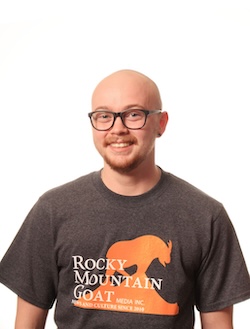
There was a ceremonial handing over of a goat when Spencer Hall, left, bought the Rocky Mountain Goat newspaper from Laura Keil, who founded the paper in 2010. The goat, Buddy, was loaned for the occasion by Amanda Cameron. (photo by Sharon Ireland)

Small towns can get a bad rap. Valemount – a community of just over 1,000 people, tucked into the mountains about 300 kilometres northeast of Kamloops – has proved a pleasant surprise to Spencer Hall.

Hall, a 26-year-old Jewish trans man, has not only found fellow Jews in the tiny town but also nothing except positive responses to his trans identity. And it’s not like Hall is keeping a low profile – he just bought the community newspaper.

The Rocky Mountain Goat was founded in 2010 by Laura Keil, who sold it to Hall officially on Jan. 8 this year. Hall had been serving as a reporter there since the previous autumn. The market for the weekly paper is the sprawling Robson Valley region, which includes not just Valemount, but McBride, Dunster, Blue River, Dome Creek and Crescent Spur. Free copies are also distributed in Blue River and Prince George and in Jasper, Alta. 

photo - Spencer Hall is the new publisher of the Rocky Mountain Goat newspaper, which is based in Valemount, BC
Spencer Hall is the new publisher of the Rocky Mountain Goat newspaper, which is based in Valemount, BC. (photo from Rocky Mountain Goat)

Hall grew up in Terrace, studied broadcast journalism at the BC Institute of Technology and then got a job at a radio station in Fort St. John. The job was one of those on-location gigs, where a station broadcasts live from community events.

“But it was during COVID, so I was going to people’s garage sales,” Hall said with a laugh. “The softest possible start to journalism, I guess.”

He moved up the ranks there before being hired as a reporter in Valemount.

The Goat – the quirky name was one of the draws that attracted Hall – is an independent newspaper and the fate of print journalism in the internet age was a consideration before Hall bought the business. However, on a webinar with local journalism professionals, Hall found he is not the only one to have entered the publishing field recently.

His paper, and many others, are getting support from the LJI – Local Journalism Initiative – a federal program that funds salaries for newspapers to hire reporters. The stories they produce are then shared across a network of participating outlets, sort of like Canadian Press or other newswires, Hall said.

“It allows people to bolster their coverage without having to take the financial burdens on,” he said. If a story published in the Goat is relevant to a paper elsewhere in the province or the country, they can run it.

Among locals, the reaction to Hall’s purchase of the paper has been one of relief.

“It was for sale for a couple of years,” he said. People were afraid that it might get snapped up by a corporate conglomerate or, worse, shut down. “Most people that I’ve talked to, they say, thank goodness.”

Some people have even said they moved to the community because it has its own independent paper, which is both an expression of support and a heavy burden to carry as head of a small team of editorial, sales and production staff.

Another happy surprise is that stereotypes about young people abandoning print media (if not news itself) have proven incorrect, based on Hall’s experience.

“It’s also interesting to see how many young people come into the office and say I love reading the paper every week,” he said. “I say, really? You’re 15.”

Hall thinks the accepted wisdom that “print is dead” is itself an antiquated assumption. 

“There is an appetite, especially in our market, for people who don’t really want to participate in the 24-hour news cycle of social media and that’s why they find value in the paper,” said Hall.

For all his optimism, Hall is not expecting to get rich.

“I knew I wasn’t going to make money,” he said. “I’m hoping I can make a living. But I view what I do as a public service. It’s something that’s very much needed, especially in today’s climate, and that’s kind of the main reason I did it. I hope that I break even but, if I don’t, it is what it is, I tried.”

As an individual fitting into a new community, Hall has been warmly welcomed. A tiny group of Jews get together to celebrate holidays and his transgender identity was right out there when he did a routine addressing it during a fundraising event.

“We were trying to get a mountain bike pump track installed and I did some stand-up comedy and mine was about being trans and [the response] was overwhelmingly positive,” he said. “Everyone’s been super, super supportive.”

Valemount has a rainbow crosswalk, he noted with a laugh, and a Pride society – not what some big city-dwellers might expect from a remote town.

“I think how we view small towns, especially ones the size of Valemount, isn’t necessarily how they are,” he said. “I think there is the expectation that, because it’s a small town, there’s going to be a lot of ignorance, but people are pretty well informed and with the times here.”

The region is a draw for outdoorsy folks.

“It is surrounded by mountains and on the way to Mount Robson, so we do get quite a few tourists,” Hall said. “It’s actually a resort municipality. There’s a lot of mountain biking and getting into the backcountry … snowmobiling or mountain-biking. Also, we are very blessed to be right in the mountains, so anytime anybody wants to see the mountains, Valemount is the place.”

To check out the newspaper, visit therockymountaingoat.com. 

Journalists partly to blame

Journalist Tristin Hopper speaks with an audience member after his talk at Congregation Schara Tzedeck Jan. 14. (photo by Pat Johnson)

Canada has plenty of dark chapters in its history. But, in terms of sheer malice, nothing compares to the celebration of mass murder seen in this country after Oct. 7, according to National Post commentator Tristin Hopper – and he says the media bears part of the blame.

Hopper, who lives in Victoria, spoke at Congregation Schara Tzedeck Jan. 14. He said he massively misjudged Canadian reactions to the violence perpetrated by Hamas and its collaborators, sketching out how he says he thought things would play out.

“I thought there would be ‘Pray with Israel’ placards displayed conspicuously outside mosques and Muslim community centres,” said Hopper. “I thought there would be Israeli flags seamlessly hung next to Ukraine flags in windows of public buildings and public libraries. I thought that Arab and Palestinian Canadians would gather in impromptu ‘Not in our name’ rallies to condemn Hamas. And then, after about a week or two, I thought this whole thing would basically disappear from the headlines.

“You’ll forgive my startling naïveté because obviously very little of that happened and in many cases the exact opposite happened,” said Hopper. “Canada was instead greeted with the largest and most sustained outpouring of hate in our entire history.”

Hopper, who clarified that he was not speaking on behalf of the National Post, said he writes frequently about the darker moments in Canada’s past, such as Japanese-Canadian internment, race-specific land covenants, Indian residential schools and the pro-fascist and antisemitic sentiments that Canada’s longest-serving prime minister William Lyon Mackenzie King shared in his diary.

“In all that, you never once, in all our 160 years, had what we saw in the immediate aftermath of Oct. 7,” he said. “We’ve had KKK rallies, anti-Catholic rallies by the Orange Order, race riots, pro-terror demonstrations by extremist Khalistanis, but not like this. Coordinated rallies in every single time zone, whose sole motivating purpose was to celebrate the deaths of civilians.”

This surprised him, Hopper said, but it did not surprise his Jewish friends.  

“They had been telling it to me for years,” he said. “Did I think that Canada had antisemites? Yes, lots of them. But if you had asked me three months ago, I would have told you that however large a constituency of antisemites, they were Canadians and a Canadian knows that this is a place where primal hatreds are repressed and prejudice is not welcome.”

Hopper chastised the media for failing to dig into the nature of the groups organizing rallies in Canada. 

“You may have heard of these peace rallies that keep blockading roads, desecrating war memorials and [that] intimidated Christmas shoppers [and assumed] they are just concerned citizens who want an end to violence,” he said. Instead, the social media feeds of some of these groups are packed with celebrations of violence, antisemitism and calls for the destruction of Israel.

Among the problems, he contends, is that there are some Palestinian advocacy organizations that exaggerate or lie and media repeat their statements without challenge.

“You refer to terror detainees as political prisoners, you call Israel an apartheid state, you obfuscate or deny every Palestinian terror attack, you circulate faked photos, you launder terrorist propaganda,” he said of some Canadian activists. “You don’t merely misrepresent Israeli actions, you invent Israeli actions that never existed. You use the word ‘genocide’ so often that it’s basically punctuation. Any time someone is killed who had a minor communications role with Hamas, you refer to them as a journalist. This is a level of brazen mendacity that you just do not encounter from any other political movement. You’ll get exaggerations, you’ll get omissions, you’ll get disingenuousness, faulty premises, but you’re probably not going to encounter someone who just lies about everything.”

He is not without sympathy for the journalists.

“How are you going to cover that in a typical 500-word piece of he said/she said news story?” he asked.

He read from one news report: “City Hall today saw 100 people gathered for a ‘stop the genocide’ rally. Demonstrators at a counter-rally said they support Israel.”

“OK, you got both sides there,” he said. “But if you are looking to tell the truth here, you would need an extended essay on how the genocide accusation is utterly unhinged from reality and overlooks how the people who organize this rally handed out candy on Oct. 7.”

There is no context of the larger geopolitical situation or how this particular conflict started, he said.

“You’re not getting into the history of rejected peace offers, why Hamas is subject to repeated blockades, repeated rocket attacks, none of these are in these stories,” Hopper said, adding that voices supporting terrorism are given equal time with voices defending Israel. “The extremist line on this issue is either favoured or at least equated as being morally equivalent to Israel.”

In a country where the vast majority of Jews support Israel, he said, media will enthusiastically give platforms to those who don’t.

Hopper believes that Canadian journalism is experiencing a replica of what he sees as having happened in academia. 

“An activist element took over and are now, in the words of one critic, wearing the institution like a skin suit and demanding respect,” he said.

He was speaking just after the PuSh Festival announced they were canceling The Runner, basically because it featured a Jewish Israeli protagonist. In the arts community, Hopper said, activists with an agenda have infiltrated different organizations and bodies in a way that he compares with interest groups who get themselves elected to school boards because few people pay attention to such things and then parents suddenly discover their children are being taught creationism instead of evolution.

Hopper’s appearance was sponsored by the Centre for Israel and Jewish Affairs and Schara Tzedeck, whose Rabbi Andrew Rosenblatt introduced the program. Shelley Rivkin and Raquel Hirsch had the idea to invite Hopper to speak after being encouraged by his columns in the aftermath of Oct. 7. 

Community milestones … Wasserman & Feldman

Theatre critic, author and actor Jerry Wasserman is the winner of this year’s Max Wyman Award in Critical Writing.

photo - Jerry Wasserman
Jerry Wasserman

The annual award celebrates critical commentary on the visual, performing and literary arts in the province of British Columbia. It is intended to honour informed and compelling writing that stimulates critical thinking, fosters ongoing discussion about the role of arts and culture in contemporary society and demonstrates the value of creative commentary in our understanding of the world around us.

The winner receives a prize of $5,000 and a gold and emerald pin designed by Vancouver artist Robert Chaplin. A mentee, named by the laureate, receives a $1,000 prize. This year’s mentee is Angie Rico, an emerging writer and media artist.

The award was established in 2017 by philanthropist Yosef Wosk to honour the career and lifetime contributions of the Vancouver author, arts critic and commentator Max Wyman. It recognizes writers who have amassed a significant body of work. Eligible subjects of criticism include the visual arts, architecture and design, theatre, literature, dance, music, film and television, as well as more general cultural commentary.

Wasserman began working as a theatre critic on CBC national radio in the mid-1980s and broadcast weekly reviews on Vancouver’s The Afternoon Show from 1987 to 2003. He has since served as theatre critic for the Province and, currently, the Vancouver Sun. About 400 of his articles and reviews have appeared in those papers; since 2004, his website, vancouverplays.com, has received more than 1.6 million visits. He taught English and theatre at the University of British Columbia for more than four decades and served as head of the department of theatre and film from 2007 to 2012. His acting resumé includes stage appearances for the Arts Club, Playhouse, City Stage, Westcoast Actors, New Play Centre, United Players and Western Gold Theatre, and more than 200 film and TV appearances, from The X-Files, Look Who’s Talking and Alive to I, Robot, Watchmen and The Last of Us.

The jury citation reads: “Jerry Wasserman’s remarkable career in many ways embodies the aims of this award. His decades as a teacher and as a performer give his writing about the theatre a sympathetic and thoughtful understanding that is expressed in language that is lively, direct and deeply informed. The jury was unanimous in its appreciation of the way he has encouraged and enhanced a wider appreciation of the richness of the Vancouver arts scene and the talents of those who make that richness possible – both through his print and media reviews and through his website, which is a consistent source of information and critical context on all things theatre in Vancouver.”

Wosk commented: “Jerry Wasserman’s voice has been a steady and trusted source of information and context about the Vancouver theatre scene for decades. He treats criticism and commentary as an integral part of the cultural fabric, and sees the role of the critic not as an antagonist to the performer and creator but as a collaborator. I am delighted that he is to receive this award.”

* * *

Brighton Feldman has been named to the U-18 Canadian National Rugby Team for a tour in the Netherlands this summer. At the school-based age group, however, team members have to pay all their own travel expenses, so Feldman has started a GoFundMe page.

photo - Brighton Feldman
Brighton Feldman

“Ever since I started playing rugby, I’ve wanted to wear the leaf on my chest,” he writes. “Now that I have that opportunity, I need a little help to get me there. I promise to work my butt off and come away with some wins. Any support is appreciated.”

Feldman is the son of Steve Feldman and Kristen Sandborn of Victoria, and grandson of Pearl Feldman of South Surrey, B.C. He is a graduate of Congregation Emanu-El Hebrew School and is completing Grade 12 at Royal Bay Secondary School in Victoria. He plays basketball and rugby for his school teams, as well as playing rugby for the WestshoreFC and, now, for Team Canada. He has previously played and captained the B.C. Bears provincial rugby team.

Next year, Feldman will be attending the University of Victoria, working towards a degree in physical and health education. At UVic, he will compete as a member of the Vikes Rugby Team.

To help Feldman represent Canada in the Netherlands, make a donation at gofundme.com/f/brighton-play-for-team-canada.

Spotting disinformation

On May 30, the Global Reporting Centre’s Peter Klein will give the talk Disinformation and Democracy. (photo from VST)

Emmy Award-winning journalist Peter Klein will be the keynote speaker at this year’s Making Meaning in a Time of Media Polarization conference, organized by the Vancouver School of Theology (VST). Klein’s talk on the evening of May 30 – titled Disinformation and Democracy – is free and open to the public.

Klein, a professor at the University of British Columbia School of Journalism, Writing and Media, also heads the Global Reporting Centre, an independent news organization based at UBC that focuses on innovating global journalism. His lecture will explore the role that disinformation plays in both confusing the public and in undermining journalism.

“Open information is central to democracy,” said Klein. “There is no open society without open dialogue. In the past, the challenge was simply to restrict governments from curtailing the media. That was a challenge in itself, but, today, there are so many forces of propaganda and disinformation, many much more subtle than dictators arresting journalists.”

The origins of disinformation go back a long way, Klein noted. He referred to a Jan. 24, 2018, message on World Communications Day from Pope Francis who spoke of the “crafty serpent” in the Book of Genesis that created “fake news” to lure Adam and Even to “original sin.”

Klein will focus his talk on more contemporary efforts to lead people astray – from Germany’s Hitler to the Russian newspaper Pravda to Iraq’s Saddam Hussein. He will first look at disinformation from a North American context, then provide several international examples.

The Global Reporting Centre recently competed a study on disinformation attacks on journalists, or what he refers to as a “special subset of disinformation.”

“Attacking the messenger is an old trick that people in power have traditionally used, but social media has made it so much easier to undermine the authority of journalists,” said Klein, who has served as a producer for 60 Minutes, created video projects for the New York Times and written columns for the Globe and Mail, among other publications.

“Publish a critical story about a politician or business leader, and there’s a chance they or their supporters will come after you any way they can,” said Klein. “What we found in our study is that those wanting to undermine media do so by attacking on basis of race, gender and a number of other factors, which vary geographically.”

Though social media is what Klein calls “the pointy end of the stick,” mainstream media has, sometimes through disinformation, become polarized, too, he said. The Dominion Voting Systems case against Fox News, ending in April when the network paid a $787 million US settlement, is a clear example. Fox had falsely claimed that Dominion manipulated the results of the 2020 American presidential election.

“Fox had to pay for this, but they’re still standing, and I don’t necessarily see much change at the network,” Klein said.

The latter part of Klein’s talk will examine ways to combat disinformation. A key element of lessening the problem comes down to “public sophistication,” said Klein.

“We’re awash in fake news, not just political but calls to your cellphone that the RCMP is going to arrest you because of unpaid taxes, ads for incredible deals on household goods that just need a small deposit to hold the item, and the classic Nigerian prince scheme. I think we’re getting better at spotting that kind of fake information, although people still fall for it on a regular basis – including me recently, when looking for a deep freezer. As the public gets more sophisticated, so do the scammers.”

The same holds true for disinformation, according to Klein, and people need to improve their ability to identify falsehoods. He spoke about the visit a few years ago to the Global Reporting Centre by a journalist who exposed that torture was being committed by Iraqi special forces fighting ISIS. Following the visit, an Iraqi graduate student arrived at Klein’s office and presented a video that portrayed the journalist as a fabulist and a torturer himself.

“It turned out this video was part of a disinformation campaign in Iraq meant to undermine his embarrassing reporting, but she fell for it. We’re all susceptible, but if we can be better educated about disinformation and better equipped to spot it, we have a chance to combat it,” Klein said.

“In many ways, we’re more powerful than those who are combating traditional heavy-handed censorship and attacks on media. My parents fled Soviet-controlled Hungary, where public dialogue that was not in line with the state narrative could get you tossed in jail. We have the agency to combat it,” he said.

photo - Rabbi Laura Duhan-Kaplan, director of the conference Making Meaning in a Time of Media Polarization, which looks at how religious communities might respond to a crisis in public discourse
Rabbi Laura Duhan-Kaplan, director of the conference Making Meaning in a Time of Media Polarization, which looks at how religious communities might respond to a crisis in public discourse. (photo from VST)

Making Meaning in a Time of Media Polarization, which will be held May 30-June 1, will be VST’s eighth annual inter-religious conference on public life. Its participants will seek answers on how spiritual and religious leaders might proceed at a time when social media, politicians and some news organizations sow polarization and cultivate outrage.

“Under COVID restrictions, our society’s stress points started to crack. We saw bad actors use media and social media to divide people, and we saw innocent, well-meaning people get drawn in,” said Rabbi Laura Duhan-Kaplan, director of Inter-Religious Studies and professor of Jewish studies at VST, who is the conference director.

“Ideally, in spiritual communities, people learn how to live a meaningful life with others. So, we started to think about how religious communities might respond to a crisis in public discourse,” she said. “We designed a conference where media experts can help us understand the crisis, and religious teachers can help us respond.”

To register for Klein’s talk – which will take place at Epiphany Chapel in-person, as well as online – visit vst.edu/inter-religious-studies-program/conference.

Sam Margolis has written for the Globe and Mail, the National Post, UPI and MSNBC.

JP’s legal correspondent

Michael Starr (photo from Michael Starr)

Canadian Michael Starr, who joined the Jerusalem Post in 2021, started a new position last month: that of legal correspondent.

Starr was born and raised in Toronto, but has a B.C. connection. His parents, Steven Starr and Iris Green-Starr, both doctors, moved the family to Victoria, where they still live, “because it is a lovely place and there is more nature there.” It was in Victoria that Starr attended high school.

Starr made aliyah at the age of 18 and joined the Israel Defence Forces later in the year, at the age of 19, serving in the infantry from 2009 to 2012.

“I grew up in a religious and Zionist household, and Israel was a large part of my cultural heritage,” he told the Independent about why he made aliyah. “My grandmother was born in Israel and my grandfather served in the Haganah and IDF. Further, there comes a time in every young man’s life in which he needs to leave his father’s home and put himself in a new environment to truly allow him to become himself.”

His brother, Joseph, came in 2012 and served in the Israeli army; today, he is in the Canadian military. Starr’s younger brother, Sam, is currently part of the IDF’s Golani Brigade.

Starr received a bachelor’s degree, majoring in government studies, and a master’s in terrorism and counterterrorism operations from Reichman University in Herzliya. (Reichman is Israel’s first and only private university, founded in 1994 as the IDC or Interdisciplinary Centre, a private college, before being rebranded in 2021.)

When a friend mentioned that there was a job opening at the Jerusalem Post, he applied and got the job.

“I never set out to be a journalist,” he said. “My interests are security and diplomacy.”

In March of 2021, he started writing for the Jerusalem Post magazine and the Post itself. From March 2020 through December of last year, he was on the breaking news desk.

“When the legal affairs correspondent position opened up, the end of November, I accepted because I wanted to be a journalist and it was a promotion, a step up,” he said. “I also like writing and this would be an opportunity to do more.”

On Jan. 1, Starr started that new position, “where I am reporting on the judicial reforms, which are not just one proposal but many different provisions. It was lucky I studied international law; this is a new field for me.”

Although Starr admits, “I’m a bit of a workaholic,” he runs for enjoyment and takes long walks.

Sybil Kaplan is a Jerusalem-based journalist and author. She wrote Witness to History: Ten Years as a Woman Journalist in Israel, set against the history of Israel in the 1970s, and Hatzaad Harishon, A “First Step” Love Story, relating her experiences as the first youth leader of the first black Jewish youth group in New York. She has edited/compiled nine kosher cookbooks and is a food writer for North American Jewish publications.

Community milestones … awards, honours, weddings, releases

Leamore Cohen (photo by Efrat Gal-Or Nucleus Photography)

The Jewish Community Centre of Greater Vancouver’s inclusion services program is one of the recipients of the Lieutenant Governor’s Arts and Music Awards, in the category of visual arts. This one-time honour, marking the Queen’s Platinum Jubilee, recognizes organizations like the JCC that have excelled in fostering wide community engagement through a robust spectrum of arts and culture programs. Most important: the award emphasizes the JCC’s commitment to diversity and inclusivity.

It all began with a passionate letter of nomination by Chaia Schneid, whose daughter, Sarah Halpern, discovered “a previously untapped creative passion” in the Art Hive and Theatre Lab classes she attended, among other programs run through the JCC’s inclusion services. Writing to the Hon. Janet Austin, lieutenant governor of British Columbia, Schneid stated: “The quality of the arts and culture programs is unlike anything we have found elsewhere. They are professionally delivered and of the highest calibre, and yet individualized to meet the special needs of the diverse participants.” In particular, Schneid praised the JCC’s annual Jewish Disability and Awareness Inclusion Month (JDAIM). Schneid also praised current program director and inclusion services coordinator Leamore Cohen, calling her a “rare individual.”

Shelley Rivkin, vice-president, local and global engagement, at the Jewish Federation of Greater Vancouver wrote a letter of support for the nomination. In it, she highlighted several inclusion services arts and social programs, and Cohen’s leadership.

“Leamore Cohen is the driving force behind these programs and her compassion, creativity and commitment to inclusion shine through in all aspects of the program,” wrote Rivkin. “She is always generating new ways and ideas for participants to engage with the arts and to create to the best of their abilities. These programs break new ground by offering meaningful educational and recreational opportunities for people with diverse needs. Having had the opportunity to attend some events, I have seen firsthand the joy that participants feel in being able to express themselves in a variety of mediums and the pride that their parents and family members experience when they see the creativity and talent of their loved ones.”

For a growing number of Vancouverites from all religious and ethnic backgrounds, and across all ages and abilities, the calibre and range of the JCC’s work is well-known. A schedule of performing and fine arts programs coincides with an array of sport, leisure and fitness options inside a facility that houses a theatre, library, gymnasium and pool. The JCC is also widely known for its annual Jewish Book and Chutzpah! festivals – both occupying a key place in the city’s cultural calendar – alongside community services including preschool and toddler daycare.

“While the arts programming is the centrepiece of what is being offered,” wrote Rivkin, “other inclusion programming for adults includes free memberships and access to all the fitness and wellness facilities at the Jewish community centre along with two virtual classes offered five days a week that are designed to be sensitive to the sensory stimulation needs of participants.”

Noting that activities continued throughout the pandemic, Rivkin concluded, “the program demonstrates its dedication to equity and inclusion daily by the range of programs embedded in the arts that have been opened up to this population and, of course, commitment, both on the part of Leamore Cohen, who dedicates so much time and thought to designing these programs, and to the participants themselves, who have remained active and involved despite their personal barriers and the COVID restrictions.”

* * *

photo - MP Joyce Murray, left, with Annette Whitehead at Trimble Park, June 18
MP Joyce Murray, left, with Annette Whitehead at Trimble Park, June 18. (photo courtesy a community member)

On June 18, Annette Whitehead was awarded a Queen’s Platinum Jubilee pin by MP Joyce Murray. Whitehead was nominated for the honour by Kitsilano Community Centre for her outstanding commitment and dedication to her community. She also received a certificate as a sign of gratitude for all the wonderful and hard work she does for her constituency.

June 2022 marked the 70th anniversary of the coronation of Queen Elizabeth II. To commemorate this milestone, Murray was issued a number of Platinum Jubilee pins, which she decided would be best used to celebrate and thank those who volunteer in Vancouver Quadra. The ceremony took place at Trimble Park.

* * *

On July 7, the National Audubon Society announced the winners of its 13th annual Audubon Photography Awards. This year, judges awarded eight prizes across five divisions from a pool of 2,416 entrants from all 50 states, Washington, D.C., and seven Canadian provinces and territories.

Local Jewish community member Liron Gertsman won three awards:

  • Professional Award Winner for his photo of a white-tailed ptarmigan,
  • Professional Honourable Mention for his photo of a sharp-tailed grouse, and
  • Video Award Winner for his sharp-tailed grouse video.

In a July 7 Facebook post, Gertsman writes about his wins: “Getting a chance to shine some light on these often under-appreciated birds brings a big smile to my face!”

He also writes about the white-tailed ptarmigan:

photo - Liron Gertsman’s Audubon Photography Award-winning photograph of a white-tailed ptarmigan, titled “Mountain Chicken”
Liron Gertsman’s Audubon Photography Award-winning photograph of a white-tailed ptarmigan, titled “Mountain Chicken.”

“Perfectly adapted to harsh alpine conditions, they spend most of their time foraging on small plant matter in the tundra, insulated from the wind and cold by their warm layers of feathers. Ptarmigan are also famous for changing their feathers to match their snowy surroundings in the winter, and their rocky surroundings in the summer. This mastery of camouflage makes them very difficult to find, and I’ve spent countless hikes searching for them, to no avail. On this particular day, after hiking in the alpine for a couple of hours, I stumbled right into my target bird! This individual was part of a small group of ptarmigan that were so well camouflaged, I didn’t notice them until some movement caught my eye just a few yards from where I was standing. Wanting to capture these remarkable birds within the context of their spectacular mountain domain, I put on a wider lens and sat down. The birds continued to forage at close range, and I captured this image as this individual walked over a rock, posing in front of the stunning mountains of Jasper National Park.”

* * *

At the Rockower Awards banquet, held in conjunction with the American Jewish Press Association’s annual conference, June 27, 2022, in Atlanta, Ga., the Jewish Independent received two Simon Rockower Awards for Excellence in Jewish Journalism. These awards honoured achievements in Jewish media published in 2021 and there was a record-breaking 1,100-plus entries from AJPA members.

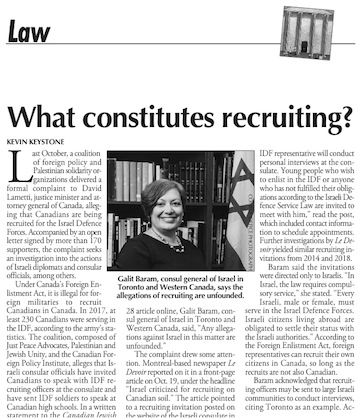
image - “What constitutes recruiting?” article topIn the news story category, in the division of weekly and biweekly newspapers, the ˆI took second place for Kevin Keystone’s article “What constitutes recruiting?” The piece explored the allegation by a coalition of foreign policy and Palestinian solidarity organizations that Canadians are being recruited for the Israel Defence Forces.

For excellence in editorial writing, in which all member papers competed, the JI editorial board of Pat Johnson, Basya Laye and Cynthia Ramsay received an honourable mention, or third place. “Strong reasoning and writing, relevant to Jewish audience,” wrote the judges about the trio of articles submitted. The submission included “Ideas worth the fight,” about university campuses and the need to keep “engaging in the battle of ideas, however daunting and hopeless the fight might appear”; “Tragedy and cruelty,” about the response to the catastrophe at Mount Meron on Lag b’Omer in 2021; and “Antisemitism unleashed,” about how the violence in Israel in May 2021 year spilled out into the world with a spike in antisemitic incidents.

To read all of these articles again, visit jewishindependent.ca. For the full list of Rockower winners, check out ajpa.org.

* * *

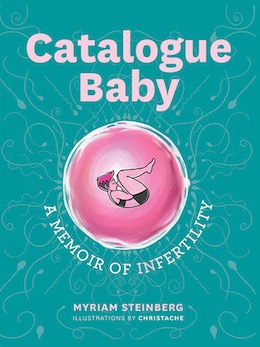
Myriam Steinberg’s Catalogue Baby: A Memoir of Infertility, with illustrations by Christache, has won two gold medals for best graphic novel. The first was the Independent Publishers (IPPY) Awards, and the second is the Foreword Indies Award. This is after having won the Vine Award for Canadian Jewish Literature last fall.

image - Catalogue Baby book cover“This book was not only a labour of love, but also a call-out to the world to recognize and acknowledge the very real experience of so many people,” wrote Steinberg in an email. “Pregnancy loss and/or infertility touch almost everyone in some way or other. It affects those who are trying to conceive the most, but it also touches (often unbeknownst to them) their children, friends, family and colleagues.”

To celebrate the honours, Steinberg is offering a 20% discount on books bought directly from her (shipping extra). To order, email myriam@cataloguebabynovel.com.

* * *

photo - Ben Mink
Ben Mink (photo from sonicperspectives.com)

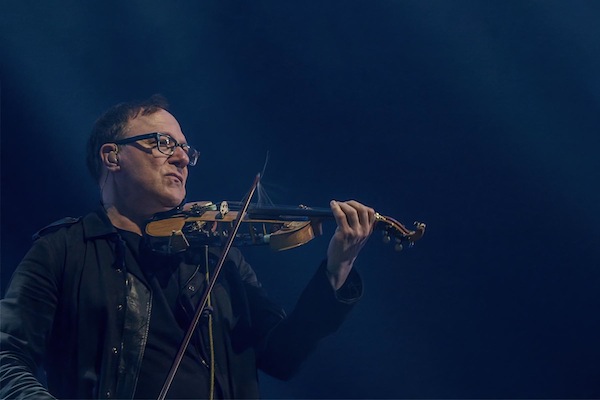
The Vancouver Symphony Orchestra (VSO) and the VSO School of Music (VSO SoM) are excited to recognize the appointment of Ben Mink, CM, as a Member of the Order of Canada. On June 29, 2022, Governor General of Canada Mary Simon announced that Ben Mink, who is a member of the board of directors for both the VSO and VSO SoM, has received the distinction “for his sustained contributions to Canadian music as a producer, multi-instrumentalist and writer.”

Mink has amassed a critically acclaimed body of work spanning decades, styles and genres as an international musical force. His influence is tangible and enduring in the widest range of musical styles and directions, and his imprint can be found in countless recordings, film scores and television programs. As a producer, songwriter, and instrumentalist, Mink has brought his signature style and approach to major musical artists and productions. He has an impressive list of recording collaborations that include k.d. lang, Rush, Daniel Lanois, Roy Orbison, Elton John, Alison Krauss, Heart, Feist, the Klezmatics, Wynona Judd, Method Man, James Hetfield (Metallica), and many more.

He has been nominated for nine Grammies, winning twice for his work with k.d. lang. The song “Constant Craving,” which he co-wrote and produced with lang, won her a Grammy for best female pop performance and has been used in several TV shows.

In 2007, he was co-nominated for his work on Feist’s Grammy-nominated “1234,” which gained global popularity in the roll out campaign for the iPod Nano. His recent collaborations with Heart were Billboard hits. Mink’s work helped set new and significant directions in Canadian popular music, and his writing and producing has been recognized with seven Juno nominations (three wins) and the SOCAN Wm. Harold Moon Award for international recognition.

To read more about Mink, including his reflections on his Jewish upbringing, visit jewishindependent.ca/ben-minks-impressive-cv.

* * *

Reesa Steele and family have the absolute pleasure to announce the upcoming marriage of Talia Magder and Weston Steele on Sunday, July 24, 2022, under the chuppah in front of family and friends in Vancouver.

Mazal tov to Nicole and Philip Magder of Montreal and Reesa Steele and David Steele of Vancouver.

Mazal tov to Talia and Weston. May this be the first of many simchas ♥

* * *

image - Insider Secrets to Hit Songwriting in the Digital Age book coverEmmy nominee Molly Leikin is the author of Insider Secrets to Hit Songwriting in the Digital Age, published by Permuted Press, a division of Simon & Schuster, in July 2022. It is Molly’s eighth book.

Podcasts a vital part of CJN

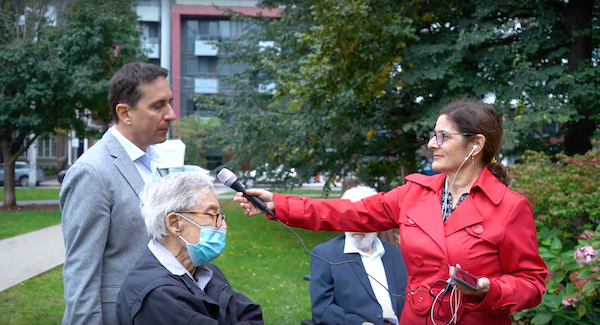
Ellin Bessner in the field reporting, October 2021, for her podcast, called The CJN Daily. (photo from Ellin Bessner)

Ellin Bessner is the host of The CJN Daily, one of several new podcasts featured on thecjn.ca, the Canadian Jewish News’ recently revamped website.

A veteran journalist, Bessner caught the reporting bug early in life.

“I have been a journalist since I was 10 years old – even though I didn’t know I was at the time. I was like the fictional character Harriet the Spy, writing notes about my parents’ friends,” she said of her first recollections as an aspiring member of the press.

These days, she hunts around for and discovers stories throughout the country that others might miss – all with the objective of depicting “what Jewish Canada ‘sounds’ like.”

“I read a lot, I scour the internet. There are literally stories everywhere. I don’t have enough time or enough podcasts to do [them all],” Bessner said, as The CJN Daily nears its first anniversary.

Bessner has broadcast stories on people as diverse as Rabbi Yehuda Sarna, the Montreal-born chief rabbi of the United Arab Emirates; Ashley Waxman Bakshi, a Canadian Israeli social media influencer; and Rabbi Arnold Noteh Glogauer, the first Canadian Jewish chaplain to set sail with the Royal Canadian Navy.

She also attempts to present all sides of contentious issues. During the February blockades in Ottawa, for example, she interviewed Jews who were involved in counter-protests against the truckers and two Jews (both vaccinated) who supported the convoy.

The CJN Daily has done several British Columbia stories, as well. To date, the show has aired a discussion with Aaron Levy, an Abbotsford disc jockey broadcasting about the November floods; a dispatch from a Jewish woman in Kamloops on her experience this summer in the path of British Columbia’s largest wildfire; an interview with Bernard Pinsky on security at the Jewish Community Centre of Greater Vancouver; a talk with environmental activist Seth Klein after COP26, the climate change conference in Glasgow; reflections on high school graduation from King David High School’s Class of 2021; a look at the number of people converting to Judaism in Kelowna; and a report about Jews in Kamloops and their reaction to the discovery of hundreds of Indigenous child graves in their community.

“British Columbia really had a terrible year,” said Bessner. “You had drought, forest fires, smoke, Indigenous issues … security issues and hunger. There is room for a B.C. story every single day. I really try to do as many as I can.”

CJN reinvents itself

In April 2020, a month into the pandemic, the CJN closed for the second time. The first time, in 2013, it returned after several months. This latest closure ended in December 2020, with a new CJN that is mainly a digital periodical.

“They chose to close after the Pesach issue in 2020. There was no revenue coming in and they decided to shut down,” explained Bessner. “A few months later, everyone thought that was CJN’s demise. Other websites came in to fill the gap. Meanwhile, those associated with CJN had decided to pivot to digital.

“It was a good opportunity to do that while everyone was at home and Zooming,” she said. “They re-launched digitally on Facebook only and got rid of the old website. Eventually, more money came in. The CJN doesn’t have the same look as before. We are doing it in a more modern way. These are the times and we have to be with the times.”

That said, for those who want to have a more traditional copy of the paper, the CJN still offers a printable weekly digest of stories every Friday (available on its website) and The CJ Magazine, a quarterly that will have its first issue later this year.

image - The CJN Daily logoAs for The CJN Daily, its start last spring did not go off according to script, Bessner recalled. “The podcast was launched on May 3, right when the Mount Meron tragedy occurred on Lag b’Omer,” she said. “All our planned interviews on Jewish Heritage Month were rescheduled. And then Israel had a war.”

The CJN Daily provides Monday to Thursday updates on the Canadian Jewish scene, from coast to coast to coast. The show can be heard on Spotify, Apple and other podcast platforms, as well as on the CJN website. There are also extended versions of Bessner’s interviews on the CJN’s YouTube channel.

Other podcasts on the CJN roster include Bonjour Chai, a weekly current affairs show; Yehupetzville, a look at Jewish life across Canada; Rivush, interviews with Jews of Colour hosted by Rivka Campbell; Menschwarmers, “the world’s most popular Jewish sports podcast”; and A Few of My Favourite Jews, with comedian Laura Leibow.

Bessner has worked for the Canadian Press, CTV News, CBC News and JazzFM. As a correspondent, she has reported from across Canada, Europe and Africa. As a professor, she has taught journalism at Ryerson University, Seneca College and, most recently, at Centennial College.

She is the author of Double Threat: Canadian Jews, the Military and World War II (2018) and a contributor to Northern Lights: A Canadian Jewish History (2020). In 2019, thanks to her efforts, Veterans Affairs Canada created a section on its website recognizing the contributions of Jewish men and women who served in the Canadian military during the Second World War.

Sam Margolis has written for the Globe and Mail, the National Post, UPI and MSNBC.

Battle of ideas … & lies

Bret Stephens (photo from harrywalker.com/speakers/bret-stephens)

Western media have got the narrative of the Israeli-Palestinian conflict wrong, says Bret Stephens, a Pulitzer Prize-winning journalist, editor and columnist who is an opinion writer for the New York Times. But, for a journalist to diverge from that entrenched storyline is almost impossible.

Stephens, a former editorial page editor at the Wall Street Journal and managing editor of the Jerusalem Post, recalled when he first started covering the region, in 2000.

“I went out there purely wearing my journalist’s hat and saw a story that was very different from the story that was being reported by many of my colleagues in the mainstream press,” said Stephens in a Sept. 23 webinar hosted by Honest Reporting Canada.

“I think lots of the Western press have continued to get much of the story dead wrong, most of all on that fundamental question: who is the aggressor?”

An example of media’s inability to diverge from a predetermined storyline came in 2019, he said, when residents of Gaza were protesting against the oppression and economic deprivation brought on by the Hamas regime that governs the seaside enclave. The global media, which tends to focus disproportionately on Palestinian concerns, almost entirely ignored the anti-Hamas activism, Stephens said.

“They wanted the world to believe that Palestinians in Gaza had one problem,” Stephens said, “and the name of that problem was Israel.”

Accurate reporting from Palestine is also a challenge because Western media hire freelancers, or “stringers,” in Gaza and the West Bank who do not operate with the same freedoms that reporters in Israel enjoy.

“They have colleagues in Gaza, where the pressure is not-so-subtle for those stringers to toe a particular ideological line, to not report stories that would be inconvenient for the Hamas narrative,” he said.

Winning the battle of ideas, Stephens said, is a priority for Hamas.

“The field of combat is not the battle they know they’re ultimately going to lose against Israel, but the one they think they’re going to win in the realm of public opinion,” he said.

Stephens clarified that he is a columnist, paid to have opinions. But too many journalists today, he said, either view themselves as activists or cannot differentiate their own opinions from straightforward reporting.

The broader context of societal understanding of what were once considered verifiable truths does not bode well for Jews, he added.

“Race is replacing ethnicity as the defining marker of group and personal identification,” he said. “Now we have this new kind of racialism that is dividing people into people of colour and white people. So Jews find themselves, or the majority who are not Jews of colour find themselves, shunted into a racial classification that they don’t recognize as their own.

“I don’t think of myself as a white guy,” he said. “I don’t feel like I have participated in any system of white supremacy. I am the son of a woman who was a hidden child in the Holocaust. She was hunted down for not being white. A Jew. To somehow pair me in this new scheme with the white mask is an injustice to millions of Jews who feel deeply discomfited by this new racialism.”

He added: “Jews have never, never done well when racialist dogma becomes a defining feature of society.”

Other social trends should alarm Jewish people, said Stephens, a conservative writer who calls himself a “never-Trump Republican.”

“The concept of personal success is now being called privilege,” he said. “There are all kinds of Jews who came to these shores in North America with nothing, or next to nothing, and who achieved, by virtue of hard work, effort, ingenuity, good luck, whatever. But now success is being called privilege and privilege is being seen as a product not of individual merit, but as a system of oppression.”

Further, he said, independent thinkers are now being treated as heretics, “and Jews have a long tradition of independent thinking.”

The widespread acceptance of outlandish lies, exemplified by the so-called “Pizzagate” theory, the group QAnon and the idea that the 2020 U.S. presidential election was unjustly stolen from Donald Trump, are an indication of fringe ideas seeping into the body politic, he said.

“We now have come to a place where, increasingly, we are a nation that can bring ourselves to believe anything and a nation that can bring itself to believe anything … sooner or later, is going to have no problem believing the worst about Jews. This is the moment that we’re in.

“Conspiracy thinking has gone mainstream and there is no bigger conspiracy theory in the world than antisemitism,” he said.

Stephens challenged the rote assertion that “anti-Zionism is not antisemitism” by making a stark comparison.

“What is antisemitism?” he asked. “It is a belief, born in the 19th century, that Jews were imposters and swindlers. They were imposters because they were pretending to be Europeans, whether German or French or Italians or whatever, but they were really Semites; that they are not from Europe, they are from the Middle East. And, it said further, these imposters are swindlers because they are trying to swindle real Europeans out of their financial wealth and culture and heritage or whatever. Now, think of what anti-Zionism has shown us. Anti-Zionism is the view that Jews are imposters and swindlers, that they claim to have a Middle Eastern descent but there is no Jewish connection to the land of Israel – that’s the line. And they’re swindlers – they’re swindling Palestinians out of their land.”

Stephens said he supports a two-state solution, “just not now.”

“In theory, a two-state solution is the ideal outcome,” he said. “We should labour towards that, while knowing that it could take 10 or 50 years.

“The prospect of a Palestinian state today isn’t about where you draw the borders. It’s about whether a self-governing Palestinian state can have enough pluralism, liberalism, democracy, tolerance and, above all, a willingness to live in an enduring peace with its neighbours … because the last thing Israel needs is re-creating what the Gaza Strip has become in the West Bank.”

Demanding Palestinian self-determination now, he said, is like inducing a baby in the 20th week of pregnancy.

“It’s going to result in tragedy. Let’s be mindful of what the long-term goal is, but let’s be practical and thoughtful and sensible about how we get to it.”

Honest Reporting Canada describes itself as an independent grassroots organization promoting fairness and accuracy in Canadian media coverage of Israel and the Middle East. The webinar is available for viewing at honestreporting.ca.