
Skip to content
  • Home
  • Subscribe / donate
  • Events calendar
  • Business Directory
  • FAQ
  • News
    • Local
    • National
    • Israel
    • World
    • עניין בחדשות
      A roundup of news in Canada and further afield, in Hebrew.
  • Opinion
    • From the JI
    • Op-Ed
  • Arts & Culture
    • Performing Arts
    • Music
    • Books
    • Visual Arts
    • TV & Film
  • Life
    • Celebrating the Holidays
    • Travel
    • The Daily Snooze
      Cartoons by Jacob Samuel
    • Mystery Photo
      Help the JI and JMABC fill in the gaps in our archives.
  • Community Links
    • Organizations, Etc.
    • Other News Sources & Blogs
  • JI Chai Celebration
  • JI@88! video

Recent Posts

  • Federation now across BC
  • Israel fighting for its existence
  • Deal strengthens Iran
  • Patriotic belonging diminishes
  • A campaign to engage
  • Upstanders’ first live event
  • Responding to Carney
  • Having your own home
  • Music a family tradition
  • Musical to warm heart
  • Community milestones … June 2026
  • Sharing her passion for Israel
  • Or Shalom reopens its doors
  • JFS from past to future
  • Need holistic approach
  • Sharing stories, advice
  • Journalist shares fears
  • Skills to live together
  • Road to independence
  • Cutting grass with scissors
  • Zionism as a solution
  • Deceit, desire & the divine
  • Reclaiming sacredness
  • Creative project ideas
  • Summer squares and cobbler
  • Thou shalt … summer commandments
  • Legal help for students
  • Revisiting myth of Lilith
  • Wrong person rebuked
  • Canada’s mixed messages
  • Questions for museum
  • Symposium on antizionism
  • Making soccer political
  • CJPAC lauds Pulver’s impact
  • City recognizes Vrba’s legacy  
  • Organ donation saves lives

Archives

Follow @JewishIndie
image - CJN box ad Rockowers 2026

Tag: Israel

Bahr’s many personas

Bahr’s many personas

Writer and comedian Iris Bahr performs at the Rothstein Theatre on Nov. 12 and 13, as part of the Chutzpah! Festival. (photo by Gail Hadini)

Award-winning writer, actor, director and producer Iris Bahr delves into serious issues using humour – and by being someone other than herself. She will bring some of her many characters to the Rothstein Theatre stage Nov. 12 and 13 as part of the Chutzpah! Festival.

Bahr hosts the weekly podcast X-RAE, as alter ego Rae Lynn Caspar White. In her one-woman show DAI (enough), she portrays 11 different characters in a Tel Aviv coffee shop. In her comedy series Svetlana, which ran for a couple of seasons, she starred as the Russian prostitute and political consultant. These are but a few examples of the personas she has created.

“I think I was about 6 years old,” Bahr told the Independent about when she did her first impression. “My family went on a trip to Italy and I began to imitate the tour guide, who kept going on and on in a heavy Italian accent about ‘marble from Carrera’ and so, for years after that, I would always be asked to ‘perform my Italian woman’ when my parents had company over.”

Using the example of the character of Rae Lynn, Bahr explained how an alter ego allows for a better conversation.

“I host my X-RAE podcast in character because I find it puts people at ease and they open up about topics they wouldn’t otherwise,” she said. “Rae Lynn flips from highbrow to lowbrow in a heartbeat and talks openly and outrageously about parenting, marriage and various R-rated topics. During my interview with Lawrence O’Donnell, for example, we veered from Marxism to Penn Gillette’s sex parties in a single breath.”

A magna cum laude graduate of Brown University, in Providence, R.I., Bahr studied neuropsychology, and has done brain research, as well as cancer research.

“I think I gravitated towards neuroscience because the inner workings of the brain fascinate me and I’m equal parts cerebral and highly emotional, and so that translates into all my work,” she explained. “I have a splintered identity, but not in a 50-50 kind of way – I actually feel 100% American and 100% Israeli at all times and that feeling of connection yet constant alienation lends itself to me inhabiting different characters and being able to truly commit to different viewpoints.”

Bahr was born and raised in the Bronx but moved to Israel as a teenager, staying there through military service; she still has family there. Her latest satire, The Olive Tree, about the Israeli-Palestinian conflict, recently had a soldout reading in New York and is set to open in spring of next year. DAI came to the stage in 2006 and audiences have included the United Nations, in 2007.

“I was invited to perform the show for over 100 ambassadors and delegates and the experience was unforgettable,” she said. “They were highly attentive and laughed at all the right moments, which I was not sure was going to happen. I felt like a diplomat for a day.”

Bahr said she wrote DAI “to communicate the intricacy and complexity of life in Israel, the inner conflicts prevalent in Israeli society, and how they are affected by living under constant threat of suicide bombings/sudden death, which, as any Israeli will tell you, instil not a feeling of helplessness but a vibrancy and love for life. On the flip side, is how that very fact is perceived by visiting outsiders and Palestinians affected by the conflict. The characters we meet in the café – from all walks of life, ideological spectrums and backgrounds – have no idea their lives will be ending abruptly [by a suicide bomber] and so their monologues range from outrageously humourous, vengeful, disillusioned and more.”

She first performed DAI at Baruch College in New York City, “as part of a festival sponsored by the Culture Project,” she said. “I had no idea it would get picked up immediately for a commercial run, and so that was a phenomenal development.

“A lot has changed since I first wrote DAI, in terms of how the conflict is manifesting itself on both sides, and yet the situation has sadly stayed the same. Thankfully, suicide bombings seem to be a thing of the past, but my dear childhood friend and father of four was stabbed to death only last year while out shopping, the Palestinian plight has not improved and the political climate is worse than ever. Nevertheless, the characters in DAI have sustained their relevancy; my German character talks about rising antisemitism in modern-day Germany, for example; my Israeli former military man talks of his son who doesn’t want to serve in the military; and the snooty ex-pat woman who lives in New York City, well, those types of women only seem to multiply by the minute.”

She stressed, “The play is not a polemic – it is a collection of social observations that speak from many different viewpoints. The piece aims to entertain, offer a visceral theatrical experience and, hopefully, also illuminate and enlighten. Thankfully, it has been warmly received amongst extremely ‘pro-Israel’ audiences and also ‘pro-Palestinian’-leaning crowds both in Europe and here in America. Of course, certain right-wingers think it’s too leftist and left-wingers think it’s too right, which is all I could really hope for as a piece about humanity.”

For tickets to see Bahr perform at Chutzpah!, and for more festival offerings, visit chutzpahfestival.com.

Format ImagePosted on November 8, 2019November 6, 2019Author Cynthia RamsayCategories Performing ArtsTags Chutzpah!, comedy, DAI, Israel, Rothstein Theatre, United States, X-RAE

The fire-like impacts of war

Life for many kibbutz members changed after they served in the war. (photo by Victor Neuman)

In this eight-part series, the author recounts his life in Israel around the time of the 1973 Yom Kippur War. The events and people described are real but, for reasons of privacy, the names are fictitious.

Part 7: The Ceasefire

The ceasefire came on Oct. 25, 19 days after the war had begun. It was a short war, if you look at it one way. In another way, it was a short episode in a long war going back to 1948 and stretching forward to a distant and indiscernible point. With the Yom Kippur War, we came to realize that Israel’s enemies could fight and lose many wars and still exist, while Israel could not afford to lose even one.

Still, we were grateful for the end of hostilities and longed for the return of all of those who had gone to fight from the kibbutz. Remarkably, they all survived to return. Remarkable because kibbutz soldiers had a reputation for aggressive leadership and devotion to duty. At that time, the statistic most often referenced was that only five percent of the population of Israel lived on kibbutzim but 20% of the officers in the Israeli military were kibbutz members. Correspondingly, they routinely made up a high percentage of war casualties.

But, just because no one was dead did not mean that nothing had died.

Tzvie and Ari seemed unfazed by the experience. They were back in the bananas with me and back to their joking ways. We were all sitting around having lunch, heads down in our plates when Tzvie popped up, threw a banana peel at Ari and then pretended to be eating like everybody else. Ari first faked a return throw and then threw it in earnest, hitting Tzvie on the side of the head.

“Hey! Why do you think it was me?” said Tzvie.

“I didn’t know at first so I just pretended to throw back. Only you ducked. The one who ducks is the guilty party.”

When they weren’t pranking each other, they were happily preparing for their return to Europe. The kibbutz had voted to give them another vacation to replace the one they had cut short to help in the war.

Others who returned were not the same. Yossi, a quiet youth, was a medic in the war. I had never worked with him nor had a close friendship with him, though, as I did everybody on the kibbutz, I saw him around a lot. Now, I was not seeing him around much. Not in the dining hall, not in the recreation room, not in any of the places kibbutzniks normally gathered. I passed by his flat and noticed a tray of food outside his door. When I asked a friend of his what was going on, he told me that Yossi hadn’t come out of his room since coming back. His friends decided that, if they couldn’t coax him out, at least they could make sure he didn’t starve to death. They would leave a food tray and he’d retrieve it when no one was around, and then put the empty tray out to be picked up. This went on for two weeks before Yossi finally began to appear and made the attempt to begin living again.

Yossi on the one hand, Tzvie and Ari on the other. I suppose war is a fire that can melt some metals and harden others.

Then there was Aryeh, one of our youngest who went to fight. He was still undergoing the three-year service requirement when the war broke out.

Aryeh drove an armoured personnel carrier and had been patroling in his vehicle near the ceasefire lines in the Golan. Night-driving conditions on the border required that headlights be cut or suppressed to reduce the vehicle’s visibility to the enemy. A member of Aryeh’s crew pestered him to let him drive the vehicle. The man was not an experienced driver but Aryeh let him take over the wheel. In a short time, the new driver lost control of the carrier and rolled it off the side of the road – Aryeh’s neck was broken and he was rendered a quadriplegic.

Aryeh was released from the hospital when they had done all they could for him. He required ongoing care but his doctors felt he needed to be home, where his family and friends were. They equipped his bed and room with every gizmo known to mankind and left him to make what he could of his life.

We all were horrified by what had happened to him and it became a kind of required pilgrimage to visit Aryeh and pass some time with him. Tamar was particularly determined to be at his side as much as she could. When we visited him, we were all so damned cheerful.

“Try to keep his spirits up,” we told ourselves. So, we joked, we gossiped, we kibbitzed, we pretended. Tamar was better at it than I was. She was naturally talkative, inherently upbeat and she carried on beautifully.

Aryeh was like Tamar – relentlessly cheerful. He never complained about his condition, never even talked about it. Those were conversations that were kept in his own head and I could only imagine the price he paid for what he couldn’t say.

Thinking about it later, I came to realize I’d do the same in Aryeh’s situation. Here you are, 20 years old, with no working arms or legs, no future to speak of. Perhaps no wedding or kids or life. All you have are your friends. Do you really want to drag them into your abyss to the point where they start avoiding you? Lose the last thing that gives you any semblance of contentment? And so, you let the tears flow when you are alone and the jokes flow when you have company. As I said, relentlessly cheerful.

Our next door neighbour, Shmuel, came home to his wife and two kids. I was incredibly glad to see him. When Shmuel was called up, he was in the middle of a birthday party for one of his two daughters, the 9-year-old. He finished the party, got into his uniform, grabbed his gun and then stopped in to see me before he headed north.

“I have a favour to ask, Kanadi.”

I knew that, in two hours, he would be on the front lines in the Golan. And that, three hours after his daughter’s birthday party, he could be dead. I was ready to give him any damn thing he wanted.

“I understand your parents in Canada shipped you a crate with a stereo system – the one you have on Tamar’s bookshelf. I was wondering if I could get the wood crate from you. I want to make a wagon for my kids.”

“Yes, take it,” I said. “And take the stereo, too.”

He treated it as a joke but I was only half-kidding. In that moment, there wasn’t enough I could do.

But Shmuel came back. I wanted to give him a bear hug when I spotted him walking up the path but his family called dibs.

The war was over. Or, to put it more accurately, this war was over.

(Next Time: Epilogue)

(Previously: “Learning the lay of the land”; “When Afula road went quiet”; “Tending the banana fields in war”; “Weapon training begins”; “Near tragedy on guard”; “Fighters return to kibbutz”)

Victor Neuman was born in the former Soviet Union, where his family sought refuge after fleeing Poland during the Second World War. The family immigrated to Canada in 1948 and Neuman grew up in the Greater Vancouver area. He attended the University of British Columbia and obtained a BA and MA with majors in English literature and creative writing. Between 1968 and 1974, he made two trips to Israel, one of which landed him on a kibbutz at the time of the 1973 Yom Kippur war. Upon his return to Canada, he studied Survey Technology at BCIT and went on to a career of designing highways for the Province of British Columbia and the firm of Binnie Civil Engineering Consultants. When he retired, he reconnected with his roots in creative writing and began writing scripts for Vancouver Jewish Folk Choir concerts and articles for the Jewish Independent. Neuman and his wife, Tammy, live in southeast Vancouver and enjoy the company of friends, their extensive extended family and their four sons.


Format ImagePosted on November 8, 2019November 13, 2019Author Victor NeumanCategories IsraelTags Diaspora Jews, history, Israel, kibbutz, memoir, Yom Kippur War
Fighters return to kibbutz

Fighters return to kibbutz

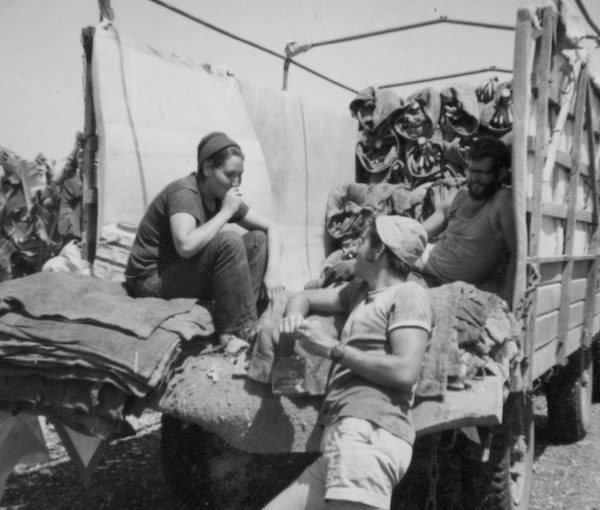
Stacking the banana bunches in the wagon required a type of superpower. (photo from Victor Neuman)

In this eight-part series, the author recounts his life in Israel around the time of the 1973 Yom Kippur War. The events and people described are real but, for reasons of privacy, the names are fictitious.

Part 6: War Comes Home

My first inkling of how fighting is done in this region of the world came in 1969, when I was working on the pipeline near Arad. Our crew was encamped at a motel and so were some Israeli soldiers. At that time, there were infiltrators crossing from Jordan into Israel and planting bombs wherever vehicles were likely to pass. Tourists like myself were warned to hitch rides while standing on the paved part of the road – never the soft shoulder. Similarly, the cars picking you up never pulled over; they simply stopped in the travel lane and waited.

The Israeli patrols were setting up ambushes in wadis in the area. When they came back to the motel to warm up, I talked with them about what they were doing.

As darkness came, the soldiers drove out to a wadi that showed signs of human activity, positioned themselves and waited. It was damn cold, they told me, especially when you had to remain still for a long time. Their jackets and leggings kept most of their bodies warm but their hands became very cold. You can’t properly operate a weapon with gloves on.

“So, what did you do to keep your hands warm?” My question got laughter in response.

“Shall we tell him?”

“Yes, who cares? Tell him.”

“Well, if you must know, we all sit around with our hands in our crotch. That’s the only way to keep them warm.”

Still the greenhorn, I asked them if they had any luck or taken any prisoners. Again, they looked at each other – in more seriousness this time.

“It’s dark and you can’t see what they have in their hands even when their hands are in the air. We just kill them all.”

I had no more questions.

Now, it was 1973 and the war had been going on for two weeks. The tide had turned. Syria had been pushed back from the Golan and Egypt had been cut off in the Sinai. To the relief of all of us on the kibbutz, Jordan’s only contribution to the war had been to send some soldiers to fight alongside the Syrians. There was no Jordanian third front in the war.

A trickle of kibbutz members – mainly the older reservists – began returning from the front lines. One of them was a good friend and a fellow banana worker named Moti.

Moti’s talent in the fields showed itself during our time of kateef (cutting, or harvesting). Moti received the bunches and quickly stacked them in the wagon, usually about eight rows high. His superpower was being able to do this in a way that the row would not collapse before the next row shored it up. I tried it once and produced a banana avalanche. It was one of those things that is funny in hindsight – at the time, we had to empty the whole wagon and start over. Time was wasted, bananas were bruised, Lev was pissed.

Moti told me he hadn’t been on the front but had heard stories from those who were. They told him that they had retaken outposts that were overrun in the first days of the war. They found Israeli soldiers tied to the four corners of their bunk with their bellies cut open. I asked him if he had seen any of this; he told me he hadn’t. They were just stories he had heard, but he believed them.

Having Moti back was like old times. Moti, Lev and I were all back in the bananas, along with a number of tourist-volunteers. We were able to properly tend the fields again and we wished to think that life was returning to normal.

Still, the war came home whenever someone else came back on furlough and brought their stories. Next to return were Tzvie and Ari – good friends who, in peacetime, worked the fields together and, in wartime, shared a tank. Just before the war, they had completed their three years of military service and were off on a tour of Europe. No one on the kibbutz could afford to do such things, so the kibbutz rewarded everyone who completed their army stint with an all-expenses paid trip to Europe. It was a once-in-a-lifetime chance to see the world before settling down and all the kibbutz kids dreamed of their time abroad.

Tzvie and Ari were two weeks into their trip when the news reached them that Israel was under attack. Ari wanted to carry on with the tour, arguing that the war would be over before they got home, but Tzvie would have none of it. He told Ari that he would go insane if he were walking around Europe while his country was at war and he became so agitated that Ari agreed to return.

One of the war stories they shared was that, on one of their forays, their tank was hit by a wire-guided missile – a portable device enabled the operator to fire the missile and control it in flight by means of a wire that played out as the missile flew on its path. The Egyptian army had many of these missiles and they took a deadly toll on Israeli tanks in the opening days of the war.

When Tzvie and Ari’s tank was hit, it was immediately disabled and the entire crew had to abandon it quickly. With the enemy nearby, they couldn’t exit from the top of the tank so they dropped the hatch at the bottom and escaped using their tank’s track-and-wheel assembly as cover. They were tripping and stumbling over anti-tank wires from an earlier battle but managed to haul their guns and a box of ammunition to a nearby hill. They were grateful to be alive but less so when they realized they had brought the wrong ammunition; it was compatible with one of the tank’s machine guns but none of the weapons they were carrying. In despair, they hunkered down and waited to be attacked. Then they began to notice how quiet it was. In fact, there was no one around but them. They came down from the hill to investigate and found that their tank had actually hit a land mine.

Ari said of the experience, “Yes, it was scary, but at least our job is driving a tank. It’s worse to be a paratrooper. There they tell you that, if your chute doesn’t open, point yourself head down toward the ground. That way they can reuse your boots.”

At this point, Ari and Tzvie smacked each other on the back and laughed their heads off. Seeing our cue, we all laughed as well.

Now I had the whole range of it. War, murderous and savage. War as slapstick.

(Next Time: The Ceasefire)

(Previously: “Learning the lay of the land”; “When Afula road went quiet”; “Tending the banana fields in war”; “Weapon training begins”; “Near tragedy on guard”)

Victor Neuman was born in the former Soviet Union, where his family sought refuge after fleeing Poland during the Second World War. The family immigrated to Canada in 1948 and Neuman grew up in the Greater Vancouver area. He attended the University of British Columbia and obtained a BA and MA with majors in English literature and creative writing. Between 1968 and 1974, he made two trips to Israel, one of which landed him on a kibbutz at the time of the 1973 Yom Kippur war. Upon his return to Canada, he studied Survey Technology at BCIT and went on to a career of designing highways for the Province of British Columbia and the firm of Binnie Civil Engineering Consultants. When he retired, he reconnected with his roots in creative writing and began writing scripts for Vancouver Jewish Folk Choir concerts and articles for the Jewish Independent. Neuman and his wife, Tammy, live in southeast Vancouver and enjoy the company of friends, their extensive extended family and their four sons.
Format ImagePosted on November 1, 2019November 6, 2019Author Victor NeumanCategories IsraelTags Diaspora Jews, history, Israel, kibbutz, memoir, Yom Kippur War

Vibrant democracies

On Monday, Canada and Israel each embarked on a new adventure in governance. Here at home, Justin Trudeau’s Liberal party had a surprisingly robust showing in the federal election, winning the irrefutable right to form a minority government, or to form a coalition of some description.

The Liberals’ relatively strong showing – 157 seats to Andrew Scheer’s 121; just 13 short of a majority – opens the door for a government with Jagmeet Singh’s New Democrats holding a balance of power. Just a few days before the election, polls suggested a race so tight, and with the Bloc Quebecois and NDP taking so many seats, that any configuration to reach the magic 170 number would have required not two parties, but three. That complicated scenario was averted, leaving the Liberals free to face the House with either a formal agreement with the NDP or a tacit knowledge that the now-fourth party is in no financial position to return hastily to the election battlefield.

In Israel Monday, President Reuven Rivlin called on Blue and White leader Benny Gantz to attempt to form a government after incumbent Binyamin Netanyahu failed to do so after the second inconclusive election this year. Gantz has said he hopes to form a “liberal unity government,” but that is as challenging as Netanyahu’s failed effort to coalesce a majority. He may be hoping that, if Netanyahu is indicted in the coming days, Likud under a new leader might be a viable partner – or perhaps some MKs unfettered from Netanyahu’s long years of leadership will break away and form a faction to join Gantz. Another plan has Gantz propping up Netanyahu unless and until Netanyahu is charged, at which point Gantz would stand up as prime minister, which seems a strange compromise with a tarnished leader. As usual in Israeli politics, there are a vast number of moving parts.

Multiple moving parts is less typical of Canadian politics, where our tendency toward majority governments typically sequesters any moving parts in the all-powerful Prime Minister’s Office. Not so during a minority Parliament, when individual MPs on all sides are able to wield power in ways they can only dream of in a majority scenario.

In what must be a jagged pill for the once and future prime minister, Jody Wilson-Raybould, whose testimony about Trudeau’s treatment of her was the single most detrimental arrow in Trudeau’s reelection armour, was herself reelected as an independent in Vancouver Granville. A large number of Jewish British Columbians, now, are represented in Parliament by an individual who belongs to no party. This will be fascinating to watch in many respects, not least how she pursues politics from the opposition benches as the SNC-Lavalin affair continues to percolate.

Other sidebars in the result include the scuttled effort by a leading anti-Israel figure to re-enter Parliament. Svend Robinson, who, during 25 years in Parliament, was one of Canada’s most vociferous voices against Israel, threw his hat back in the ring but came up short in Burnaby North-Seymour – being narrowly defeated by the incumbent Liberal despite this being ground zero in the battle over the Liberals’ Trans Mountain pipeline expansion.

More notably, Maxime Bernier, leader of the nascent People’s Party, lost his own seat in Quebec. His party made effectively no impact anywhere, sending the hopeful sign that messages of populist xenophobia that seem to be resonating elsewhere in the world still fall largely on deaf ears, at least electorally, here.

Canada will almost certainly have an easier time forming a government than Israel will but, in both cases, the drama plays out against the backdrop of healthy, vibrant, disputatious democratic systems. No matter what the outcomes, we should be thankful for that.


Posted on October 25, 2019October 23, 2019Author The Editorial BoardCategories From the JITags Andrew Scheer, Benny Gantz, Binyamin Netanyahu, Canada, elections, governance, Israel, Jagmeet Singh, Jody Wilson-Raybould, Justin Trudeau, politics, SNC-Lavalin

Near tragedy on guard

Patroling the kibbutz perimeter. (photo from Victor Neuman)

In this eight-part series, the author recounts his life in Israel around the time of the 1973 Yom Kippur War. The events and people described are real but, for reasons of privacy, the names are fictitious.

Part 5: Night Guard Duty on the Kibbutz

Lev, the banana boss, was in his early 30s and a miracle worker. He was back on the kibbutz and strolling toward me. He had talked the army into releasing him so he could save his banana fields. I was not surprised he had pulled it off. Lev was originally from the United States and a dedicated Zionist. He had long ago concluded that the only proper place for a Jew was in Israel and so he immigrated. Always determined in what he wanted, he bulldozed his way through kibbutz apprehensions to single-handedly create the banana crop as a major branch of our agricultural sector. And he was fearless to a fault.

“Fearless to a fault” may sound like a contradiction. It’s not. The right amount of fearlessness is courage. The wrong amount is stupidity. In my opinion, Lev was sometimes at the wrong end of that equation. Here’s an example.

Before the war, Lev was fed up with the theft from our banana fields and had no confidence that the village police from the nearby Arab town would take any action. The culprits were likely from the town and might even have been relatives of the cops. I had to agree with Lev – the only time I had seen any action from these police was when they drove up to the kibbutz to extort chickens for their next village wedding.

One day, Lev had six of us arm ourselves with clubs and do a stakeout in the banana fields. We had a German Shepherd named Ledie to help take down anyone we caught. Before long, two Arab teenagers appeared, checking for ripe bananas. They came toward where I was hiding. I jumped up but I had moved too early and they raced for their village. Only Lev, the dog and I were near enough to give chase. It was a farce. The teens were lean and fast. Lev smoked two packs a day. Our dog was never trained to be aggressive and was an older dog as well. So, it was the two teenagers way in front, me next, Lev a distant fourth and the dog in last place – tail wagging madly the whole time. I gave up and stopped, but Lev ran past me and yelled, “Come on!”

By the time we arrived at the village, the two thieves had vanished and our dog also had disappeared, likely returning to the kibbutz. I wanted to go back, too, but Lev wasn’t done and I couldn’t leave him on his own. Like a gunslinger minus the gun, he walked us right into the first building we came to. It was some kind of coffee house, full of locals sitting at tables sipping their drinks. All conversation and sipping ceased when we barged in. They all stared at us. I felt like I was in a bad Spaghetti Western. I was convinced Lev was going to get us killed.

Lev stomped around, demanding to know if anybody had seen the two boys. Heads were shaking. Not satisfied, he gave a description of what they looked like and the clothes they were wearing. Heads kept shaking. He then demanded that everybody keep an eye out for these banana thieves and report them to our kibbutz. To my astonishment, heads nodded. I think we had caught them by surprise and then Lev’s pure chutzpah had won the day. Walking out in one piece was a win for me, while Lev was angry at not catching anybody; surviving was not one of his concerns.

Now you know what I mean by “fearless to a fault.” And now, here was fearless-to-a-fault Lev walking up to me.

“Shalom, Victor. I’m back so I’ll be taking over the irrigation. I wanted to keep you on it, but Gidon says he needs you for guard duty. You better see him. And thanks for looking after the bananas. I expected half of them to be dead but they are all good. Nice job.”

High praise from Lev, who rarely expressed gratitude to anybody. The bananas were like children to him and I was the babysitter who, surprisingly, hadn’t murdered any.

Gidon told me I was to patrol the kibbutz from dusk to dawn for the next week at least. He gave me an ammunition belt, a flashlight and a first-aid kit with pressure bandages to patch up anybody I shot inappropriately. He also gave me Chauncy, the English guy. Chauncy was one of those hapless tourist volunteers who came to experience kibbutz life and was experiencing more than he bargained for. Though he wasn’t Jewish, he gamely agreed to be my assistant on patrol.

Our first patrol had a slow start. Chauncy begged me to let him hold the Uzi long enough to get his picture taken. I didn’t want to, but figured it would be better to get it out of his system. I removed the ammunition clip and handed him the Uzi. He gave me his camera and I took a half-dozen pictures of him, empty gun at the ready, looking steely-eyed and staring into the dark. I was thinking he was an idiot but then remembered the photos I had made Tamar take when I first got my weapon. She thought I was an idiot. Israelis would never think of getting this kind of snapshot, as Canadians wouldn’t think of getting their picture taken in their kitchen holding a spatula. Why record it? In this country, everybody has a spatula.

We walked the perimeter for about a week. Early evening was the best, as kibbutz members stopped to chat and the time went quickly. Adding to our duties was the requirement that we join others in checking cars that were coming up the driveway and searching them for bombs. I was particularly happy to intercept the village police who had come on another of their chicken runs. We made them get out of their car and stand around while we did a thorough, very slow check of their vehicle. The chicken-stealing cops were not nearly as annoyed as I had hoped. I was thinking we’d need to do a strip search next time.

As the night wore on, everybody went to sleep and it was just Chauncy and I walking the perimeter. As per Gidon’s instructions, we didn’t go to the dining hall to scrounge for food and thus take ourselves away from our rounds. We carried our lunches and ate under the security lights. I was always conscious of how dark it was beyond the reach of those lights and how impossible it would be to see anyone coming. On the other hand, Chauncy and I, walking directly under the lights, were highly visible from far away.

It became a nagging question in my mind as to how effective night guard duty was when Chauncy and I were always in plain view while the bad guys were always hidden. I confronted Gidon about it one day and his reply was, “When you are shot, it will alert the rest of the kibbutz.” I wished he had had a grin on his face, but he didn’t. I was just thankful he hadn’t ended with “Are we understanding?” We were not.

I never told Chauncy about that conversation but I think he detected my increased wariness. A certain morbidity came over me. In trying to come to terms with the possibility of death, I tried to control the fear by embracing the notion. I decided one night we would have our meal in the kibbutz cemetery. Chauncy was freaked but I put it to him that the dead were dead and gone. Also, I argued, the headstones made good back rests for eating in comfort. To pass the time, I read the Hebrew on some of the stones; the easiest part to grasp being the date of death and age of the departed. Many were in their 20s and had died in 1948, likely in the War of Independence. They were close to my age and Chauncy’s. It made me think of how endless the fighting was in this land. The dead of one war pondered by participants in another, with two other conflicts in between. We only had lunch in the cemetery that one time.

I never had to shoot anybody during my stint as night guard but I did come close once. Chauncy and I were in the area of the mechanical shop at around two in the morning when we heard noises coming from the shop and saw the lights were on. The kibbutz was generally very quiet at night. There was no shift work besides guard duty so everyone should have been in bed.

I told Chauncy to stay behind me as we entered the shop to investigate. For the first time in all my guard duty, I slid the thumb switch of my Uzi from safety to automatic.

Chauncy whispered, “Jesus!”

We got as close to the noise as we could and then I stepped around a corner with my Uzi leveled.

It was a kibbutz teenager named Uri. Apparently, Uri had a bout of insomnia and decided he might as well go to the shop and keep working on his project. He was trying to make a go-kart out of discarded tractor parts. Uri had almost gotten a permanent cure for his sleeplessness. I had almost shot a 15-year-old kid.

(Next Time: The War Comes Home)

(Previously: “Learning the lay of the land”; “When Afula road went quiet”; “Tending the banana fields in war”; “Weapon training begins”)

Victor Neuman was born in the former Soviet Union, where his family sought refuge after fleeing Poland during the Second World War. The family immigrated to Canada in 1948 and Neuman grew up in the Greater Vancouver area. He attended the University of British Columbia and obtained a BA and MA with majors in English literature and creative writing. Between 1968 and 1974, he made two trips to Israel, one of which landed him on a kibbutz at the time of the 1973 Yom Kippur war. Upon his return to Canada, he studied Survey Technology at BCIT and went on to a career of designing highways for the Province of British Columbia and the firm of Binnie Civil Engineering Consultants. When he retired, he reconnected with his roots in creative writing and began writing scripts for Vancouver Jewish Folk Choir concerts and articles for the Jewish Independent. Neuman and his wife, Tammy, live in southeast Vancouver and enjoy the company of friends, their extensive extended family and their four sons.
Format ImagePosted on October 25, 2019October 30, 2019Author Victor NeumanCategories IsraelTags Diaspora Jews, history, Israel, kibbutz, memoir, Yom Kippur War
Complexities of autism

Complexities of autism

Israeli neuroscientist Dr. Ilan Dinstein was in Vancouver last month to talk about autism research. (photo by Adele Lewin)

Neuroscientist Dr. Ilan Dinstein was in Vancouver last month to share research and expand knowledge on best practices internationally. An associate professor of psychology and cognitive and brain sciences at Ben-Gurion University of the Negev (BGU), Dinstein is the director of the new National Autism Research Centre (NAC) in Israel.

David Berson, executive director of the Canadian Associates of BGU for British Columbia and Alberta, told the Independent: “CABGU was delighted to be a part of hosting Dr Ilan Dinstein in Metro Vancouver. This visit was spearheaded by Dr. Grace Iarocci, Dr. Elina Birmingham and Dr. Sam Doesburg from SFU [Simon Fraser University] and Dr. Tim Oberlander from B.C. Children’s Hospital.

“Ilan Dinstein is a true reflection of the pioneering spirit that is unique to the Negev region of Israel, where, over the past five years, clinicians from Soroka University Medical Centre and researchers from Ben-Gurion University of the Negev have organically come together to collaborate for the betterment of all of the residents with ASD [autism spectrum disorder] in the region.”

Dinstein spoke with the Independent about the new centre and the purpose of his visit to Canada.

“We started the centre five years ago, to try to understand different causes of autism,” he said. “Autism is not one disorder. There are different sub-types of autism, with different possible roots and risk factors. Some of those factors are biological or genetic; others might be environmental. For example, a premature birth might be a risk factor in the child developing autism. Or the age of the parents – a child of older parents might have a higher risk of autism diagnosis than if the same parents were younger. We at the centre are trying to discover how the combination of genetic and environmental issues affects autism development.”

According to Dinstein, one of the reasons for the creation of the centre was the way science is funded in Israel. “The funding usually comes for one specific question,” he explained, “but autism is a complex, systematic disorder and it needs many facets of study, measurement and research; it needs collaboration and sharing of information. At the centre, we are able to combine different fields of study with the clinical applications, as we work together with the Soroka medical centre.”

The scientists of the NAC study autistic patients from different multidisciplinary angles: neuroscience and cellular biology, language pathology and motor tracking, even facial features.

“The truly unique thing is that we do all our studies inside the hospital,” Dinstein said. “Parents come in with their children, usually when the children are about 3 years old and the parents and the children’s teachers notice the kids’ uncommon behavioural patterns. The diagnosis of autism usually takes four visits. During those visits, we work in collaboration with the doctors, measuring various characteristics of the child’s development to arrive at the right diagnosis.

“We also started a database of all our patients, so we have a centralized well of knowledge about how various biological, cultural and social factors might contribute to autism development.”

Of course, not all of the parents agree to have their child added to the database, but Dinstein said that their recruitment rate is about 80%.

After the diagnosis, the scientists participate in determining a personalized treatment program, based on their research. “Such a program might include teaching the children useful behavioural habits, helping them with language acquisition or providing occupational therapy,” explained Dinstein. “Some autistic kids are very agitated and certain motions, like spinning, might calm them down. Sometimes, autistic children need to learn basic skills: how to dress themselves or brush their teeth.”

Pharmaceuticals can also help children cope with autism, but Dinstein said that only about 10% of patients use medications.

At the NAC, the scientists don’t treat patients, but rather study and make recommendations, develop new technologies and new methods of dealing with the disorder. Working together with clinical professionals, they hope to contribute to a higher rate of success in treatment.

One of the most important aspects of Dinstein’s and his colleagues’ work is an annual follow-up on the patients in the database. Families are required to come back once a year after the initial diagnosis, so the service providers can see their progress, determine what worked and what didn’t, and adjust their recommendations accordingly.

“We are still in the process of enlarging this project,” said Dinstein. “We want to open other locations in Israel, make our database to cover the entire state of Israel.”

The centre’s autism research, in particular its database of patients with autism, inspired interest locally, from scientists and clinicians to families and service providers. The invitation for Dinstein to visit Vancouver came from a range of people.

“Your researchers want to create a similar database to ours, Canada-wide,” said Dinstein about his presentation at the Children’s Hospital. “I met with scientists from UBC [University of British Columbia] and SFU, even some from Victoria. I also met medical professionals, parents, some service providers and stakeholders. I see these meetings as the beginning of a close relationship between autism research in Israel and in Canada. There are similarities there, but there are differences, too. Both countries have different ethnic maps, cultural traditions and genetic variations. We all want to know how such diversity affects autism.”

Olga Livshin is a Vancouver freelance writer. She can be reached at [email protected].

Format ImagePosted on October 11, 2019October 10, 2019Author Olga LivshinCategories LocalTags autism, Ben-Gurion University, BGU, CABGU, health, Ilan Dinstein, Israel, science
Weapon training begins

Weapon training begins

During the Yom Kippur War, the author had to learn how to fire an Uzi and other weapons. (photo by Victor Neuman)

In this eight-part series, the author recounts his life in Israel around the time of the 1973 Yom Kippur War. The events and people described are real but, for reasons of privacy, the names are fictitious.

Part 4: Training Day

We were two or three days into the war and the news was chilling. Egypt had overrun the defences along the Suez Canal and was pouring into the Sinai. Syria had breached the outposts in the Golan and was within striking distance of Tiberias. We were in shock to think that, a scant six years after the pummeling of the Six Day War, these countries were able to go to war again.

I think the nation was in disbelief as well. Soldiers, in large numbers, had been sent home to observe Yom Kippur with their families. The government had effectively demobilized much of the Israel Defence Forces prior to the attack. The trust in Moshe Dayan and Golda Meir would never be the same.

At first, the response of the average Israeli was cocky. Tamar thought the attack was stupid. “We beat them in six days … now it will be five.” Then, as the news came in, the optimism vanished. Kibbutzniks came around to ask me if I was tuned in to the BBC. They didn’t trust the government to give them the truth of what was going on. It was wartime after all and, at such times, every involved government lies through its teeth. There was not much to listen to, though. Everything was so sudden that the international news services hadn’t caught up with what was going on.

Then Gidon came by. The next day, I was to receive weapons training along with three other volunteers who had just enough Hebrew to say “Halt! Who goes there? Who are you? Stop or I’ll shoot.” The basic wartime jabber.

I don’t recall ever being asked if I wanted to join the fight. As a candidate for kibbutz membership, it was a given that I would step up and do anything required to help. And so it was. This was now my home and these people were my family. Not doing everything I could was never a question in my mind. But, truth be told, to me the fighting seemed far away and unreal and I had no real sense of personal danger. More oblivious than brave might be the way to put it.

Next day, the four of us and Gidon met in a field behind the kibbutz. Gidon had set up a target that consisted of a plywood board on two metal rods that were banged into the ground. There was a rise behind the target to stop the bullets from straying. On a table to the side, he had weapons. There was an Uzi, a bipod sniper rifle and three Second World War relics. Gidon apologized for the older guns, saying they were there just to give us the hang of things and he expected we would have better weapons soon. But, first, he addressed us with a sombre face.

“As you know, our kibbutz is located on Wadi Ara. This valley connects the West Bank territories to the coast of Israel. The military tells me that, if Jordan enters the war and opens a third front, there is a good chance they will come right down Wadi Ara and we are the first Israeli settlement past the West Bank. If that happens, I am told, we have to hold out for six days without help from the army. They are fully occupied in the Golan and the Sinai and will not be able to help us until they have solved their problems over there. Are we understanding?”

“We are,” we all said, a little unenthusiastically. I was thinking, “Worst pep talk ever, Gidon!”

Then came the practice shooting and I learned stuff that no graduate in English literature needed to know.

When sniping with a rifle, lie flat with elbows well anchored. The right leg should be extended back in a line with your rifle and your body to absorb the shock of the recoil. Your left leg is splayed out to the left for stability. Don’t breathe, take aim and squeeze the trigger. Our accuracy was rough, then better. But my main recollection is the kick of those rifles. We were basically lying in fine dirt and, when the round went off, the force pushed our whole body two or three inches backwards. The movement after every shot caused a small cloud of dust to rise up around us and we had to wait a moment before we could see well enough to shoot again.

An Uzi has 32 rounds in its clip. The sliding switch by your thumb has three positions: safety, single shot and automatic. Gidon told us to forget about the first two positions. In battle, you had to be quick. You had to be in automatic mode and learn to shoot from the hip without aiming. The dumbest thing you could do was to hold the trigger down. Doing that would empty your clip in three seconds and the recoil would twist your arm and body up and to the right. Gidon taught us that we had to squeeze off short bursts of around three rounds, see where they hit and adjust accordingly.

Our shooting with the Uzi was fairly awful. Shooting from the hip is really tricky. There were puffs of dust halfway up the hill behind the target, in the dirt just metres in front of us, way off to the left and right of where we were trying to aim. I thought the safest place to be on that range was standing in front of the target.

I had a little better luck than the rest. High with the first burst. Low with the second. Then I adjusted again and hit the target with a burst that knocked the whole thing over.

That evening, Gidon marched us into one of the bomb shelters and gave us all our assigned Uzis. Then he showed us how to disassemble them. We had to disassemble and reassemble our Uzis over and over again until we could do it in a matter of seconds. We were feeling pretty good about ourselves until suddenly Gidon turned off the lights and we had to do the whole thing in pitch dark. A bomb shelter, of course, has no windows. So, when the lights are out, you might as well be spelunking in the world’s deepest cave. We eventually learned to do it using only our sense of touch.

Training ended and so did my date nights in the banana fields with Tamar. She was needed elsewhere and I was approved for carrying a weapon, so I was on my own for going out to the fields at night and dealing with the irrigation. A scary business. Alone in the dark, banana trees making the fields look like a jungle, shadows everywhere and the possibility of infiltrators from the West Bank. I felt like I never breathed until I was in the Willis, job done and heading back to the kibbutz. Back at the kibbutz, I signed in to prove I was still alive. Sometimes I even looked at my own signature to make sure.

When I returned to our flat at 2 a.m., Tamar would be fast asleep. In another world, my girlfriend would leap out of bed and throw her arms around me, overjoyed at my safe return. Tamar would half-waken and say, “Shalom, shalom sweetie,” then go back to sleep. And I understood. It wasn’t that she didn’t care about me. This was Israel. The Yom Kippur War was not their first rodeo.

(Next Time: Night Guard Duty)

(Previously: “Learning the lay of the land”; “When Afula road went quiet”; “Tending the banana fields in war”)

Victor Neuman was born in the former Soviet Union, where his family sought refuge after fleeing Poland during the Second World War. The family immigrated to Canada in 1948 and Neuman grew up in the Greater Vancouver area. He attended the University of British Columbia and obtained a BA and MA with majors in English literature and creative writing. Between 1968 and 1974, he made two trips to Israel, one of which landed him on a kibbutz at the time of the 1973 Yom Kippur war. Upon his return to Canada, he studied Survey Technology at BCIT and went on to a career of designing highways for the Province of British Columbia. When he retired, he reconnected with his roots in creative writing and began writing scripts for Vancouver Jewish Folk Choir concerts and articles for the Jewish Independent. Neuman and his wife, Tammy, live in southeast Vancouver and enjoy the company of friends, their extensive extended family and their four sons.

Format ImagePosted on October 11, 2019October 30, 2019Author Victor NeumanCategories IsraelTags Diaspora Jews, history, Israel, kibbutz, memoir, Yom Kippur War

Help out Israeli teens

Want to make a difference in the lives of Israeli teens? Consider joining Israel Connect, a program where local volunteers connect online, one-on-one, via Zoom (a video conferencing app), with Israeli high school students who want to improve their English conversation and reading skills. The program starts at the end of October and is sponsored by Chabad Richmond. It entails a half-hour per week commitment.

“We’re looking for volunteer retirees, seniors or adults with flexible schedules. No previous tutoring experience is necessary and the curriculum is provided,” said Shelley Civkin, local coordinator of the program.

“We’re looking for Jewish adults who are fluent English speakers, have basic computer skills and own a computer with a camera,” said Civkin. Volunteers can do this from home and technical support is available if needed. Time preferences of volunteers will be coordinated beforehand and sessions take place in the morning between 7 and 11 a.m. any day from Sunday to Thursday. Volunteers will be trained in how to download and use Zoom.

“It’s a very meaningful, practical way for community members to support Israel,” said Rabbi Yechiel Baitelman of Chabad Richmond. “You’ll be doing a mitzvah, while investing in Israel and its young people. Plus, good English skills will give them an advantage in accessing post-secondary education and getting better jobs.

“English proficiency is crucial to Israeli students, since it accounts for a third of their entrance exam marks for university,” he added. “Partnering with the Israeli Ministry of Education, the Israel Connect program targets teens from disadvantaged neighbourhoods in Israel. The tutoring sessions are vital to students’ upward mobility in terms of education and jobs, which is why this program is so vital.”

“Most volunteers really enjoy helping their Israeli students and make great connections with them. It often goes beyond simply tutoring the curriculum and turns into friendship and mentorship,” said Civkin. “This kind of one-on-one tutoring makes a significant difference in their lives, both educationally and personally. It’s hard to estimate the impact of this tutoring on Israeli youth, but we know it’s significant. And it’s incredibly satisfying to know that you’re doing something concrete to help Israeli students improve their lives. Several tutors have visited their students on trips to Israel, and keep in touch beyond just the school year. Building relationships is an integral and highly satisfying part of this program.”

For more information, contact Civkin at 604-789-5806 or [email protected].


Posted on October 11, 2019October 11, 2019Author Chabad RichmondCategories LocalTags Chabad Richmond, education, Israel, seniors, Shelley Civkin, volunteering, writing, Yechiel Baitelman, youth
The future requires chutzpah

The future requires chutzpah

Inbal Arieli recently published the book Chutzpah: Why Israel is a Hub of Innovation and Entrepreneurship. (photo by Micha Loubaton)

Inbal Arieli has always been fascinated by what motivates and drives people, as well as what blocks their paths. “Throughout my career, which was mainly as a business executive, I always kept an eye on the human factor,” Arieli told the Independent. “And so, the businesses I started were somehow all related to that.”

Arieli, who is also a lawyer, is the owner and co-chief executive officer of Israeli start-up accelerator Synthesis. The company provides leadership assessment, as well as business training and development, in Israel, Canada and the United States.

“It is about the effect of the most critical skills that I think anyone should have today,” said Arieli about her recently published book Chutzpah: Why Israel is a Hub of Innovation and Entrepreneurship. “These are, according to the World Economic Forum, the skills which are required in the future, for anyone, regardless of your profession or future position. These are basic life skills – of critical thinking, decision-making, taking on initiative, etc., etc. There’s a long list of soft skills. The book is about these skills.

“What’s still interesting to me is, when looking at these skills, thinking about the future – the future of my kids, the future of the entrepreneurs here in Israel, the future of the job market in the world – about how can one practise these skills.

“The book shows the journey of a typical Israeli child from a very young age, as young as 3 or 4, until after military [age], young adult.”

In Chutzpah, Arieli shows how, in the five stages of childhood – infancy, childhood, adolescence, military service and then the big trip after the military – Israeli culture and society have produced principles, a framework and settings to foster these skills.

The book is not about Israel in and of itself. It is designed to help readers develop their own set of skills using the Israeli experience as an analogy.

Chutzpah (audacity), an ingrained trait, is very much nurtured in Israeli kids from a young age, said Arieli.

“From a very young age, chutzpah comes into play everywhere and anywhere,” she said. “Most of those skills, Israeli education and mindset … I think of them like muscles we all possess … only here, in Israel, we have access to the best gyms to practise these muscles.

“When you play at the playground, at age 3 or 4, the fact that you stand for your own opinion and find your own way of using the slide – an example I give in the book – that, in a sense, is a little bit of chutzpah. You don’t necessarily follow guidelines or practices. You bring your own personality [into your decisions and actions] at a very, very young age. So, it starts then, and then it fills up as we grow up here.”

Arieli sees Israeli society as being very open to giving freedom to everyone’s chutzpah – encouraging kids to exercise their chutzpah muscle, to be risk-takers, to stand out from the crowd, encouraging individualism along with a strong sense of collectivism. “Definitely, the framework that exists here, the environment, so many social structures are helping the muscles to remain developed and strong,” she said.

Chutzpah can be viewed as either negative or positive, and can be used in a positive or negative way. In Hebrew, one can differentiate between the two, depending on where the accent is placed. Arieli does not think it is important to differentiate between the two concepts of chutzpah. Rather, she contends that, just like any other muscle, the use of it needs to be calculated.

“Chutzpah is not a button you can press on or off,” she said. “It’s a mindset. In the context of innovation or entrepreneurship, I think it’s a very positive thing. And so are the other skills, ideas or principles spoken about in the book. I think it’s all a matter of finding the right balance between using them or not using them, and when to use them. What’s right for certain stages is less relevant for other stages.

“More than anything, I think it’s the combination of having these skills along with other skills is what’s optimal. But, I also think it’s very challenging to create an innovative society or an innovative team or group of people without allowing them to have a little bit of chutzpah.”

According to Arieli, just teaching kids how to work in today’s job market is a recipe for failure, as we have little knowledge of what work will even look like in their generation. The one and only thing we know for sure is that the future job market is uncertain. As such, the only way to prepare children is to equip them with the ability to be highly innovative and creative thinkers, capable of taking on initiatives by shaking things up and changing things.

“I wish for my kids that they will have as much chutzpah as possible when thinking about their future,” said Arieli. “They’ll have to reinvent themselves during their career several times and I want them to be proactive in that.”

Another trait Arieli talks about in Chutzpah is balagan (mess or chaos).

“Anyone who has visited Israel knows what I’m talking about – be it traffic, on the playground, in restaurants – everything is really chaotic here,” said Arieli. “But, that chaos, balagan, propels us toward new order, allowing us to rise every time from that balagan.”

Another factor Arieli discusses in her book is teamwork and “how Israeli society, while sometimes divided, at its core, has a galvanizing mechanism rooted in survival, through our culture … what we endured as a people and our mandatory army service … all of which unite us like no other nation on earth.”

For more information about Arieli or her book, visit inbalarieli.com.

Rebeca Kuropatwa is a Winnipeg freelance writer.

Format ImagePosted on October 11, 2019October 11, 2019Author Rebeca KuropatwaCategories BooksTags business, Chutzpah!, entrepreneurship, Inbal Arieli, Israel
הרפר : לעשות עסקים בישראל

הרפר : לעשות עסקים בישראל

תל אביב (Eurovan)

ראש ממשלת קנדה לשעבר מנסה לעשות עסקים בישראל – חלק ג’

מכל הלקוחות והפעילויות שאני מעורב בהן, אולי אין דבר טוב יותר מאשר שילוב כמה תחומי עניין שהיו לי. קודם כל הקרבה של הממשלה שלנו לישראל בזמן כהונתי, שנית העניין שלנו בטכנולוגיה וחדשנות – השקענו זמן רב בקידום תוכניות קנדיות ובנוסף, בתחום המסחר חלק מהמשימה שלי בתפקיד הייתה להרחיב את רשת המסחר של קנדה. כך מציין ראש ממשלת קנדה לשעבר, סטיבן הרפר, שביקר בישראל לאחרונה. הוא רואיין לעיתון “גלובס”. כשנכנסתי לתפקיד היו לקנדה רק חמישה הסכמי סחר, אחד מהם עם ישראל, וכשעזבתי את התפקיד כבר היו לנו חמישים ואחד הסכמים. אבל גם ההסכם עם ישראל היה מיושן וכלל רק מגוון צר של סחורות, ולכן עדכנו את ההסכם הזה.

אחד הדברים שהטרידו אותי במהלך הכהונה היה שזרם הסחר, השירותים וההשקעות בין קנדה וישראל עדיין קטן. זאת למרות המאפיינים של הכלכלה הישראלית ובפרט ההובלה הטכנולוגית שלה, ולמרות המאפיינים של הכלכלה הקנדית והעובדה ששתיהן מתקדמות ובשתיהן יש קהילה יהודית גדולה והסכמי סחר. לכן עדכנו את ההסכם למודרני יותר כדי לסייע לתקן את זה. אבל כמובן שגם חיפשנו הזדמנויות כדי להגדיל באמת את הסחר והפעילות העסקית בינינו ובמיוחד לנצל את ההתקדמות של ישראל בתחום הטכנולוגי.

אני רוצה לראות טכנולוגיה ישראלית מגיעה לקנדה ואני רוצה שקנדים ינצלו את הזדמנויות הרווח בתחום הזה. גם בישראל רוצים למצוא הזדמנויות לגדול ולהיכנס לשווקים חדשים בצפון אמריקה. דרך אגב אני חייב לציין שבזמן כהונתי עודדתי שיתוף פעולה צבאי מוגבר עם ישראל – מן הסתם מטעמים של מדיניות חוץ – אבל הדבר בנה הרבה מהגשרים הללו. שיתופי הפעולה היו יותר בצד המודיעיני, וכמובן צוותים שהחליפו ביניהם מידע ושיטות עבודה.

התוצאה הכי טובה שיכולה להיות לכל הדברים האלה היא מערכת שווקים גלובלית שבאמת משולבים זה בזה, והפריה הדדית ברחבי העולם. אם נשאיר בצד את הדמויות הספציפיות, את המדיניות ואת הממשלות, המציאות היא שזהו אזור שבו סביר שיקרה תהליך שברמה מסוימת תהיה התפצלות לשניים.

אנחנו מדברים על התחום הביטחוני, שהוא אינטרס של העולם הסיני והעולם האמריקאי, אבל אנחנו חברות חופשיות ודמוקרטיות ואנחנו יודעים עד כמה הציבור מודאג מעניינים של הפרת פרטיות ושימוש לרעה בדאטה. אפילו בהקשר של הטכנולוגיות המסחריות הקיימות – סין היא מדינת מעקב, וזה לא שהיא לא מציעה מוצרים מסחריים – אבל כל מהלך ההצטיידות של מגזר הטכנולוגיה שלה הוא לכיוון מעקב, במסגרת האינטרס של ביטחון המדינה.

לכן יש בעצם שני מודלים. אנחנו לומדים מהצבא ומהמודיעין ומהיכולות של ביטחון לאומי, ומבצעים התאמה למטרות תאגידיות מסחריות. אלה מטרות הגנתיות באופן טהור, יש להדגיש, אף פעם לא התקפיות, לחלוטין במסגרת החוק ובמסגרת מה שאנו מחשיבים הגנה נורמלית של הפרטיות. אלה שני מודלים שונים וקשה מאוד לשלב ביניהם. אנחנו רוצים לוודא שכל דבר שמפותח ייעשה במסגרת של חברה דמוקרטית וחופשית ובמסגרת של שימוש מסחרי. זה האינטרס של חברות דמוקרטיות וחופשיות כמו קנדה וכמו ישראל.

הרפר ושות’ היא חברה קטנה אך בעלת פעילות גלובלית. אנו עושים עסקים בעולם ואנו עושים עסקים גם בסין, אך אנו עושים זאת בזהירות. זה חשוב שיהיו קשרים כלכליים ומסחריים עם סין, זה טוב לעולם בטווח הארוך. אז אמנם מדובר על קשרים עסקיים, אך כאלה שנעשים למטרות שעולות בקנה אחד עם האינטרס הלאומי הרחב.

Format ImagePosted on October 10, 2019July 2, 2020Author Roni RachmaniCategories עניין בחדשותTags business, Israel, Stephen Harper, ישראל, סטיבן הרפר, עסקים

Posts pagination

Previous page Page 1 … Page 49 Page 50 Page 51 … Page 111 Next page
Proudly powered by WordPress