Skip to content
  • Home
  • Subscribe / donate
  • Events calendar
  • News
    • Local
    • National
    • Israel
    • World
    • עניין בחדשות
      A roundup of news in Canada and further afield, in Hebrew.
  • Opinion
    • From the JI
    • Op-Ed
  • Arts & Culture
    • Performing Arts
    • Music
    • Books
    • Visual Arts
    • TV & Film
  • Life
    • Celebrating the Holidays
    • Travel
    • The Daily Snooze
      Cartoons by Jacob Samuel
    • Mystery Photo
      Help the JI and JMABC fill in the gaps in our archives.
  • Community Links
    • Organizations, Etc.
    • Other News Sources & Blogs
    • Business Directory
  • FAQ
  • JI Chai Celebration
  • JI@88! video

Recent Posts

  • Sharing her testimony
  • Fall fight takes leap forward
  • The balancing of rights
  • Multiple Tony n’ Tina roles
  • Stories of trauma, resilience
  • Celebrate our culture
  • A responsibility to help
  • What wellness means at JCC
  • Together in mourning
  • Downhill after Trump?
  • Birth control even easier now
  • Eco-Sisters mentorship
  • Unexpected discoveries
  • Study’s results hopeful
  • Bad behaviour affects us all
  • Thankful for the police
  • UBC needs a wake-up call
  • Recalling a shining star
  • Sleep well …
  • BGU fosters startup culture
  • Photography and glass
  • Is it the end of an era?
  • Taking life a step at a time
  • Nakba exhibit biased
  • Film festival starts next week
  • Musical with heart and soul
  • Rabbi marks 13 years
  • Keeper of VTT’s history
  • Gala fêtes Infeld’s 20th
  • Building JWest together
  • Challah Mom comes to Vancouver
  • What to do about media bias
  • Education offers hope
  • Remembrance – a moral act
  • What makes us human
  • המלחמות של נתניהו וטראמפ

Archives

Follow @JewishIndie
image - The CJN - Visit Us Banner - 300x600 - 101625

The making of a milestone

By the time you read this, I’ll be working on the last days of preparation before my twins’ b’nai mitzvah. This, as many have said, is a big simcha (happy party), a once-in-a-lifetime event, a milestone and an achievement in our lives. It won’t surprise those who know me that this also puts a lot of pressure on us! Don’t get me wrong, my household is excited. We’re also nervous, apprehensive and stressed by all the details.

It helps to put this into context. We’re a family who has been going to services on Saturdays regularly since long before these children appeared on the scene. My kids are familiar with what’s expected of them and want to do a good job. We’re from a family with diverse approaches to Jewish life, so we’ve gone to all sorts of services, as well as different kinds of Shabbat dinners, family outings on Saturdays, and more. Our kids have experienced many more different ways of observing holidays and Jewish life than I did growing up. This was one of my goals for raising well-informed Jewish kids. For a small ethno-religion, we have so many varied traditions.

This came to mind when I chatted with some of my husband’s young cousins long ago. They told something to the effect that there was only one way to sing a particular part of the Shabbat service. When I explained that there were many melodies and ways to recite the same Shabbat prayers, they looked at me with disbelief. Their experiences with only one congregation in a specific ethnic group and religious movement meant they hadn’t been exposed to multiple melodies or the rich musical traditions of other Jewish communities.

Exploring these choices has made my kids’ lessons and preparations more difficult. If they only knew one tune, well, that’s the one they would sing. However, offering learners many choices means it can be harder to narrow down and practise one melody to make it shine.

Staying true to our family’s particular needs and choices when it comes to the celebration itself has been its own adventure. If one is used to a specific type of bar/bat mitzvah party, with loud music, dancing, catered “rubber chicken,” a photo slide show or a candlelighting ceremony, anything different can seem peculiar. At age 12, I attended one classmate’s bat mitzvah party that was (gasp) held at the family’s home rather than at the synagogue or at a party venue. Rather than graciously modeling that people are different, I thought this was weird. No one reprimanded me for saying this. In retrospect, it was a lovely, heimisch (homey) party held by a family who celebrated the way that they felt most comfortable. I wish I’d had the maturity to see that then.

Holding a Jewish event on a June Shabbat in Winnipeg means that it will be light until late at night, so we’re having a seudah shlishit (a third Shabbat meal or supper). Our congregation’s building is under renovation so the meal will be at home, without the loud music or DJ, to align with those who observe more traditionally. We’ve made numerous choices that my tween self would call “weird.” As an adult, I see it as providing the celebration that fits our family the best.

We’re mostly introverts. Three of the four of us don’t usually like noisy, crowded events. An entire weekend of socialization will be a lot of people time for us. Since many of our relatives are coming from far away, it may be more like a week of company. One of us jokingly said he would announce, “Hey! The party’s over! Please leave!” so he could go back to reading quietly in a corner. We’ve encouraged him not to voice this aloud to any of our relatives or guests.

Although some people hire event planners to manage this, for many households, the burden falls on the mom to arrange everything. This seems to be yet another gendered responsibility. I’ve been told that 50-some years ago, women in the community cooked all the food as well, and there was no catering on offer. I’ve had kind supportive offers from older women friends who remember those days. However, even if one wants to hire serving staff, it can be hard to do in these post-COVID days. There’s just nobody out there who seems to want to do it.

Making so many decisions, from catering to dishes to compost bins and yard games for kids, feels overwhelming. In some moments, I find myself excited about when it will be over and I can stop worrying. Yet, I know that, for many people, this event is a lifelong memory. I just want to make it a meaningful one for all of us. With twins, we only get one chance at it, too, so … no pressure?

Often, I have Jewish texts to lean on to help me understand and guide me. Although it’s not my family’s tradition to recite Eishet Chayil (Proverbs 31:10-31), the tribute to a “woman of valour,” it strikes me that the woman in this important narrative knew how to throw a perfect Jewish family event. I hope I can do something that is half as acceptable, where everyone feels welcome, comfortable and full of good food at the end.

In my head, I’m hearing phrases offered by the older people in my husband’s family at the end of every family party: “May we only meet at happy occasions,” for example. After such a difficult and sad time, I cannot forget those messages. While I worry over the details, please take the opportunity, when it is offered to you, to celebrate at these once-in-a-lifetime happenings. Bring your joy and light to make them special for everyone. “May we only meet at weddings (and not funerals). May we only meet at happy occasions,” these aunts would say as they hugged us. It’s about time to find space for some happy moments, too. 

Joanne Seiff has written regularly for the Winnipeg Free Press and various Jewish publications. She is the author of three books, including From the Outside In: Jewish Post Columns 2015-2016, a collection of essays available for digital download or as a paperback from Amazon. Check her out on Instagram @yrnspinner or at joanneseiff.blogspot.com.

Posted on May 24, 2024May 23, 2024Author Joanne SeiffCategories Op-EdTags b'nai mitzvah, family, Jewish tradition, milestones
Enjoy weekend in Montreal

Enjoy weekend in Montreal

A bike tour with Fitz Montreal. (photo © Fitz and Follwell Co)

There’s nothing like a weekend in Montreal, whether you’re in the mood for a classic bagel, a mouthwatering babka dripping with chocolate, or a heaping smoked meat sandwich from Schwartz’s Deli. Now that Porter Airlines has launched direct daily flights between Vancouver and Montreal, it’s a great time to explore this fabulous city, which oozes with personality, culture, history and great food. 

We joined a fast-paced bike tour to see the city’s highlights, pedaling 15 kilometres through green alleyways, busy boulevards and along the Lachine Canal to get a broad overview of Montreal’s history. We rode through the Old Quarter, with its ancient stone buildings, following the canal past factories and warehouses reincarnated into swanky apartments. We puffed up the hill to the base of Mount Royal and zipped back down past the austere buildings of McGill University. 

At Place d’Armes, we stopped to gaze at a pair of statues called “The Two Snobs.” On one side, a Francophone woman holds her poodle, looking with contempt at the head office of the Bank of Montreal, a symbol of English power. On the other, an Anglophone holds his pug, looking with similar disdain at the Notre-Dame Basilica, a symbol of the Catholic Church in Quebec. The statues hint loudly at the enduring, simmering tensions between English and French in Montreal.

photo - The Old Quarter of Montreal
The Old Quarter of Montreal. (photo © Freddy Arciniegas – Arcpixel – Tourisme Montréal)

We escaped the tourist crowds in the Old Quarter by heading to Mile End to join a food and history tour offered by the Museum of Jewish Montreal. Our guide, Avery Monette, a 23-year-old master’s student at Concordia, led us on a gastronomic feast as she described the city’s Jewish origins in 1760. That’s when Jews first arrived in Montreal to work as fur trade merchants. The community stayed small until the 1880s, when pogroms drove Eastern European Jews to the safety of Montreal’s Mile End. Over the next 90 years, it would become the largest Jewish community in Canada.

We bit into a sweet, rich cheese crown from Boulangerie Cheskie, a small kosher bakery in the neighbourhood, and then braved the cold wind to line up outside St-Viateur Bagel, one of Montreal’s two most famous bagel shops. Established in 1957 by Hyman Zeligman and Myer Lewkowicz, the store never closes. Ever. “In April 2023, there was an ice and snowstorm that knocked out all the electricity in the area,” Monette recalled. “Even then, this place was open!” 

We strolled along rue Jeanne-Mance in Mile End, where frum families pushed strollers alongside us and a man wearing a shtreimel strode by, headed for the synagogue with his tallit tucked under his arm. The Jewish influence was easily spotted, with most houses having mezuzot on their doors and many with the skeleton of a sukkah in their front yard. 

By the 1950s, Jews in Montreal had migrated to the middle class, and many left Mile End for larger homes in Côte Saint-Luc, Hampstead and Côte-des-Neiges. We passed the College Français, once the home of the B’nai Jacob Synagogue, which was known as the Carnegie Hall of cantorial singing in its heyday. 

Our Vancouver jackets were feeling pretty inadequate in Montreal weather by the time we arrived at Fairmount Bagel, where the line out the door was even longer than at St-Viateur. Once inside, we were surrounded by garlic, pumpernickel, cranberry and muesli bagels, as well as matzah with sesame, onion and poppy seeds. While none of it is kosher, the store is still owned by the same Shlafman family that first opened it in 1949. 

A few doors away is Wilensky’s, a small restaurant with origins in 1932 and family members still at the helm. With its Formica counters, bar stools and what could easily be the world’s tiniest washroom, the store feels like a 1930s time capsule. Monette orders the Wilensky Special, an original family recipe featuring beef salami, beef bologna and mustard on a grilled roll. No special requests or modifications are allowed, not for us or for Anthony Bourdain and Mordecai Richler, both of whom were customers. 

On Boulevard Saint-Laurent, new stories mingle with the old. We picked up a babka at Hof Kelsten, where Jeffrey Finkelstein is turning heads with his challah, rugelach and rye. We passed Leonard Cohen’s grey-stoned triplex, a house he lived in from 1968 and that’s still owned by his family. “He was well known for padding around the streets in the slippers he bought right here,” Monette says, gesturing at J. Schreter, a shoe shop on the corner.

photo - Lunch at Schwartz’s Deli
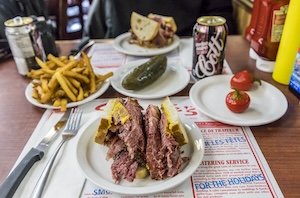
Lunch at Schwartz’s Deli. (photo © Eva Blue)

Between the bagels, the babkas and the Wilensky Special, it’s hard to make room for more food, but the length of the line outside Schwartz’s Deli tells us this one is not skippable, so on we go. Famous for its smoked meat sandwiches since its inception in 1928, the deli is now owned by Celine Dion and her partners, who have kept things much the same, adding a smoked meat poutine to the menu. Take a bite of one of Schwartz’s sandwiches, which literally bulge with hefty portions of meat, and you understand precisely why the little deli is such a cultural icon in the city. Quite simply, it’s unforgettable. It’s a fitting symbol for the city of Montreal, which is bursting with flavour.

Whether you come for the food, the history, the arts scene or the culture, Montreal is charmingly seductive, and so vastly different from Vancouver that it feels like an entirely different country. Now just four-and-a-half hours away, it’s an easy decision to put this sophisticated French city on the itinerary. 

If you go …

• In April, Porter Airlines launched its daily round trip service between Vancouver and Montreal (flyporter.com)

• A bike tour with Fitz Montreal is a great way to explore Montreal’s highlights, with many sights packed into an exhilarating, fast-paced ride (fitzmontreal.com)

• Museum of Jewish Montreal offers regular Beyond the Bagel Tours in the spring, summer and fall. The three-hour tours include food and range from $79-$95 per person (museemontrealjuif.ca/beyond-the-bagel)

• Humaniti Hotel offers sophisticated accommodation in the heart of the city, steps from Old Montreal, the Palais des congrès and the Quartier des Spectacles (humanitihotel.com)

Lauren Kramer, an award-winning writer and editor, lives in Richmond. 

Format ImagePosted on May 24, 2024May 23, 2024Author Lauren KramerCategories TravelTags arts, culture, food, history, Montreal, Porter Airlines, travel

בונדס ישראל בקנדה גיוס כספים למען ישראל

מפעל בונדס ישראל בקנדה מגייס כספים למען ישראל כאשר כלכלה ניזוקה קשות לאור המלחמה הארוכה בעזה

הבונדס שהוא בעצם מפעל מלווה העצמאות והפיתוח עוסק במכירת איגרות חוב של מדינת ישראל ליהודים ברחבי העולם, ובעיקר בארצות הברית וקנדה. מפעל הבונדס הוקם בשנת אלפים תשע מאות וחמישים ביוזמת ראש ממשלת ישראל דאז, דוד בן גוריון. לפרוייקט היו שותפים גם שר האוצר דאז אליעזר קפלן, גולדה מאיר ושמואל רוטנברג

עד כה גייס מפעל הבונדס כחמישים מיליארד דולר (אמריקני) והכספים מיועדים בעיקר לתקציבי הפיתוח של ממשלת ישראל. בין הפרויקטים שהוקמו בישראל בכספי הבונד: המוביל הארצי, מיפעלי ים המלח, תחנת הכוח אורות רבין בחדרה, פיתוח נמלי הים  בחיפה, אשדוד ואילת, עזרה בעלייה הגדולה מברית המועצות, הרחבת נמל התעופה בן גוריון, שיפור תשתיות כולל של רכבת ישראל

קיים ויכוח מתמיד בין התומכים במפעל הבונד ובין השוללים אותו. התומכים אומרים כי בונדס ישראל נחוץ לקיים את הקשר והזיקה בין היהודים בעולם רוכשי אגרות החוב לבין מדינת ישראל. ואילו השוללים טוענים כי הריבית של בונדס ישראל גבוהה מאוד והיא מהווה נטל בלתי מוצדק על תקציב מדינת ישראל

נשיא הבונדס בשלוש השנים האחרונות הוא דני נווה (שמונה על ידי שר האוצר לשעבר איווט ליברמן) ועל מועצת המנהלים בקנדה נמנים: מייק פלורנס, ג’ורג’ כהן, אורה סלוטוביץ’, רוברט אייסמן, עליזה פגן ורחל צפתי. ואילו המנהלים של בונדס ישראל בקנדה הם: וורן קייל (באזור מטרו טורונטו), לן שפירו (באזור מערב קנדה), הרב אהרון פלנצ’ריק וברנלי גלאס. לבונדס יש ארבעה משרדים ברחבי קנדה שנמצאים: בטורונטו – לאזור מטרו טורונטו, במונטריאול – לאזור קוויבק, באוטווה – לאזור מזרח קנדה ובוונקובר (בבניין הג’ואיש קומיוניטי סנטר) – לאזור מערב קנדה

:להלן הריביות לאגרות הבונדס השונות

אגרות ג’ובילי (מינימום השקעה עשרים וחמישה אלף דולר): שנתיים – 4.83%, שלוש שנים – 4.74%, חמש שנים – 4.98%, עשר שנים – 5.25% וחמש עשרה שנים – 5.50%

אגרות מכבי (מינימום השקעה חמשת אלפים דולר): שנתיים – 4.68%, שלוש שנים -4.60%, חמש שנים – 4.83%, עשר שנים – 5.10% וחמש עשרה שנים – 5.35%

אגרות סברה (מינימום השקעה חמשת אלפים דולר): שנה – 4.88%

אגרות סברה (מינימום השקעה אלף דולר): שלוש שנים – 4.87%

אגרות מזל טוב (מינימום השקעה מאה דולר): חמש שנים – 5.17%

אגרות מזל טוב (מינימום השקעה שלושים ושישה דולר): חמש שנים –  5.27%

אגרות שלום (מינימום השקעה מאה דולר): שנה אחת – 4.88%

אגרות שלום (מינימום השקעה שלושים ושישה דולר): שנה אחת – 4.98%

מאז תחילת המלחמה של ישראל בעזה גייס הבונדס למעלה ממאתים מיליון דולר (אמריקני) בעיקר בארצות הברית. מרבית הסכום (כמאה וחמישים מיליון דולר) גוייס ממוסדות שונים בהן מדינות ורשויות. היעד של הגיוס השנתי עמד אשתקד על כמיליארד דולר (אמריקני) והוא הושג במלואו ואף יותר מכך. יו”ר דירקטוריון הבונדס בארה”ב הווארד גולדשטיין אומר: “המסר שלנו לאחינו ואחיותינו בישראל הוא חד-משמעי. עמדו חזק, אתם לא לבד. אנחנו כאן איתכם ותמיד נהיה איתכם. אנו עומדים לצד ישראל עכשיו יותר מתמיד. ארגון הבונדס הוכיח שוב כי הוא מרכיב מכריע בעמוד השדרה הפיננסי של ישראל”

בישראל נשמעת לא מעט ביקורת על מפעל בונדס ישראל שהפך למקור לג’ובים למקורבים, עם הוצאות תפעול גדולות בארצות הברית וקנדה. עלות תפעול הבונד מגיעה לכשלושים וחמישה מיליון דולר קנדי בשנה

Posted on May 22, 2024April 29, 2024Author Roni RachmaniCategories עניין בחדשותTags Canada, economy, Howard Goldstein, Israel Bonds, the war in Gaza, בונדס ישראל, הווארד גולדשטיין, המלחמה בעזה, כלכלה, קנדה
Past echoes in present

Past echoes in present

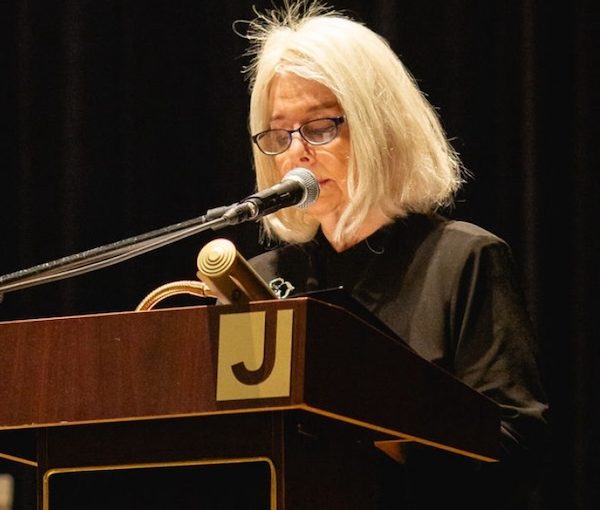
Child survivor Lillian Boraks-Nemetz speaks at the community’s Yom Hashoah Commemoration May 5. (Rhonda Dent Photography)

The pogrom of Oct. 7 and the hurricane of antisemitism that has swirled since then added resonance to commemorations of Yom Hashoah this week.

Around the world, Jewish communities united in different ways to mark the annual Holocaust remembrance day. Sunday night, May 5, the local commemoration at the Jewish Community Centre of Greater Vancouver featured child survivor Lillian Boraks-Nemetz, who reflected on the unmistakable parallels across time, of “Broken families, broken bodies and minds and the poor frightened children and much more.”

Recently, said Boraks-Nemetz, she heard the words of Israel’s ambassador to the United Nations, Gilan Erdan, who reflected on how a sunny Shabbat morning in Israel turned, in a matter of seconds, into hell.

“On just such a sunny morning, in Warsaw, I lost my childhood,” said Boraks-Nemetz, who was introduced Sunday night in a touching tribute by her son, Stephen. “The day Nazis invaded Poland, I remember German bombers flying low over my head against an innocent blue sky and as World War Two began on Sept. 1, 1939, I had to become an adult at the age of 6.”

In the war that began that day, she said, 1.5 million Jewish children were murdered. She suffers guilt and questions around her survival when so many, including her little sister, did not live.

“Some of us were younger than others. Some older,” she said. “Nevertheless, we were all traumatized – as our brothers and sisters are today, in Israel, and in a world that won’t learn history and its lessons. We don’t feel safe anymore around our world. Thousands protest against us as they have always done, just looking for a reason to express their hate for Jews.”

Boraks-Nemetz shared parts of her Holocaust history, from the earliest time, when her mother took her to a favourite café only to find a sign declaring Jews were forbidden from entering – signs that then proliferated in parks, recreation areas, theatres, streetcars and elsewhere.

“We were beginning to lose our humanity,” she recalled. “Thousands protested against us with words such as ‘Death to Jews,’ ‘Final Solution’ and more.”

Today, she said, similar words are directed at Jews.

“This is being allowed to flourish unpunished, using our freedom of speech for their purposes,” she said. “But surely there are red lines where free speech ends and hate speech begins that must be punishable by law.”

She recalled seeing the wall around the Warsaw Ghetto being constructed, higher and higher, as she watched.

“I asked my father what this wall means,” said Boraks-Nemetz. “I asked many questions. I was almost 7 years old. This wall, he replied, will eventually enclose a part of Warsaw where we will be forced to live.”

That day came when, through a window, she saw a long car with officers and a bullhorn ordering Jews to enter the ghetto or suffer severe consequences.

“From the day I and my family entered our one room within these close, shabby quarters, I felt as if I had stepped out of sunlight into darkness,” she said. “I felt as if I was being stifled and the feeling of being stifled stayed with me as a memory and a trigger all of my life. The wall meant confinement, exclusion, isolation, fear, hunger and quarantine of a disease called typhus.”

Boraks-Nemetz shared the story of how she was to be smuggled out of the ghetto by her father, who had bribed a non-Jew but, when the day came, she was ill and instead her sister was sent out, never to be seen again. 

“The streets were treacherous, with children dying of hunger and disease, poor and starved people peddling what little they had for a few potatoes and stealing what they couldn’t buy,” she said. 

While smuggling a child out of the ghetto was a life-threatening act for all involved, so was remaining in the ghetto, she said. Eventually, thanks to an enormous bribe, young Lillian was passed through the gate of the ghetto, where she survived on the outside in the care of her grandmother, who had secured a false identity.

“That day, I felt as if I had lost my family, my home and any degree of safety I had felt,” she recounted. “I became numb and frozen. As a child, I didn’t understand why was I being sent away, alone, into a hostile world. I felt I wasn’t wanted by family or society. That day, I lost my identity as a Jew and a human being, a daughter.”

A forged piece of paper gave her a new, false name, false parents, a false age.

With a small blue suitcase in hand, she walked the short distance from her father, past the bribed guards, who looked the other way, into the care of a waiting stranger who would whisk her to a new, still very hazardous, life outside the ghetto.

“Although it was a very short distance, today I think of it as the longest walk, from impending death to the possibility of life,” she said.

Eventually, she started a new life in Canada, married at 19 and took on the role of a typical Canadian housewife, she said. At 40, she had a crisis, during which she was forced to confront the realities of what she had experienced, a struggle she has addressed ever since, through poetry, sharing her story with students and other means. For her, and for so many others, she said, Oct. 7 brought back from the mists of time the collective consciousness and memory of the past.

“We are still persecuted, blamed, hated,” she said. 

Rabbi Carey Brown, associate rabbi at Temple Sholom, spoke earlier in the evening, expressing the need to be careful in drawing parallels between historical events, but acknowledging that the traumas of the past inform reactions to the present. 

“It is difficult to distinguish between remembering the past and living in the present,” she said. “It feels inseparable.”

The current generation, said Brown, owes it to the memory of those who perished in the Shoah, as well as to the generations yet to come, “to take seriously and be steadfast in our commitment to ‘Never again.’”

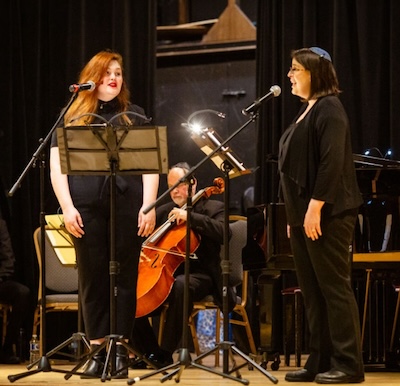
photo - Singers Erin Aberle-Palm, left, and Cantor Shani Cohen and cellist Eric Wilson were part of the music program produced by Wendy Bross Stuart
Singers Erin Aberle-Palm, left, and Cantor Shani Cohen and cellist Eric Wilson were part of the music program produced by Wendy Bross Stuart. (Rhonda Dent Photography)

The solemn ceremony began with Holocaust survivors in a procession escorted by King David High School students who are descendants of survivors.

Shoshana Krell-Lewis, a member of the board of directors of the Vancouver Holocaust Education Centre and a daughter of the centre’s founding president, Dr. Robert Krell, welcomed the audience and acknowledged elected officials and survivors. In recognition of survivors from the former Soviet Union, Irena Gurevich translated into Russian.

Sarah Kirby-Yung, deputy mayor of Vancouver, represented the city. 

Cantor Yaacov Orzech recited El Moleh Rachamim.

A moving musical program by artistic producer Wendy Bross Stuart featured Eric Wilson on cello and singers Erin Aberle-Palm, Cantor Shani Cohen, Lisa Osipov Milton, Matthew Mintsis, Kat Palmer and Lorenzo Tesler-Mabe.

The program was presented by the Vancouver Holocaust Education Centre, funded through the Jewish Federation annual campaign and by the Province of British Columbia, and supported by the Gail Feldman-Heller & Sarah Rozenberg-Warm Memorial Endowment Fund, Temple Sholom Synagogue and the Jewish Community Centre of Greater Vancouver. 

Format ImagePosted on May 10, 2024May 8, 2024Author Pat JohnsonCategories LocalTags antisemitism, Carey Brown, history, Holocaust, Lillian Boraks-Nemetz, memorial, Oct. 7, remembrance, Second World War, terrorism, Yom Hashoah
Highlighting seniors’ issues

Highlighting seniors’ issues

Berlin’s Nana Schewitz brings her show Florida! Ya Kill Me! to Vancouver May 31-June 2. (photo from Nana Schewitz)

Florida! Ya Kill Me! is a “love letter to aging,” says Berlin-based drag artist Nana Schewitz, who created the show with Josh Walker. But it’s also a “wakeup call,” she warned, about the systems we have in place for aging.

Florida! Ya Kill Me! comes to Vancouver for three nights, opening May 31 at the Dusty Flowerpot Cabaret.

“JQT is so excited to bring Nana Schewitz to both Toronto and Vancouver, as part of our JQT [Jewish Queer Trans] Mental Health Support Series in partnership with JFS Vancouver, a series supported by the 

Jewish Community Foundation of Greater Vancouver,” said Carmel Tanaka, executive director of JQT Vancouver, noting that the shows are being sponsored in both cities by Goethe-Institut Toronto, which is part of a global network that works to foster understanding of Germany’s cultural diversity.

“The content of her show addresses the challenges of Jewish queer trans seniors, which is a very near and dear topic to JQT,” Tanaka said of Nana’s Florida! Ya Kill Me! “We hope that, through drag and comedy, we will be able to raise awareness of the work our JQT Seniors Initiative is doing to create safer long-term care homes and spaces, so our aging JQT community members can proudly celebrate all their identities into their twilight years.”

Florida! Ya Kill Me! is a theatrical retelling of Nana’s 2021 trip to Florida in search of a final resting place, Nana told the Independent. The character is a feisty 96 years old.

“Josh and I traveled up and down the state in search of retirement paradise, visiting every bingo hall, craft fair and 55-and-up pool we could find along the way,” she explained. “We met some incredible seniors who really opened up to me about their experiences with aging, finding love, losing love, accepting change and finding joy. I have the privilege to share these words through both my own retelling, and some filmed interviews we took. You’ll meet Josie, the 109-year-old bingo master. You’ll meet Doris, born and raised in Berlin (my current home) who lives in Florida’s largest retirement city (with over 100,000 residents). You’ll even meet my dead Cuban grandmother!

“The ability to tell these often-overlooked stories and cement the legacies of some of my favourite friends is my favourite thing about what this show is,” said Nana. “It’s a love letter to aging, but also a wakeup call to its effects. The systems in place around aging are crumbling quickly while our average life expectancy is getting higher and higher. I don’t want us to have to sacrifice our quality of life as we age, and this show is a call to action to make that happen!”

The name Nana Schewitz was inspired by Manischewitz, perhaps after a few glasses of its sweet kosher wine. The 96-year-old – who doesn’t “look a day over 69” – was brought to life by almost-30-something Bryan Schall, who studied at Philadelphia University of the Arts and graduated in performance design and production.

She emerged as an entity “out of a little hole-in-the-wall disco in Philadelphia. She stayed dormant for awhile, as her ‘style’ didn’t really fit in my idea of what drag in the US was. When I got to Berlin, however, I said, ‘Ooooohhh!!! Nana totally could work here!’

“The drag scene of Berlin was very different,” explained Nana. “It was quirky, brash, silly – all the things I wanted out of a drag performer. And I found myself really missing this very specific branch of Ashkenazi-Americana Judaism that I took for granted at home. I didn’t realize how much I missed it until moving to Berlin.

“Being Nana really allowed for space to connect with my Judaism, while also allowing me to rewrite Judaic tradition in a way that serves queer people,” she added. “I’ve hosted Passover seders, Hanukkah shows, Rosh Hashanah events and more in Berlin, and it’s been a beautiful connective tissue to bring the Jews of Germany (yes, we’re here!) together in a meaningful and unexpected way.”

Nana moved to Berlin in 2016 and says she hasn’t looked back.

“I grew up in South Florida, and just could not do one more winter of beautiful, it was just getting to be unbearable,” she said. “I couldn’t take the beaches and the sunshine of Florida anymore. Call me a masochist, I guess.”

Berlin has her heart, Nana said, “But all cities change, and the Berlin I moved to looks very different than the city I currently live in. I’ve learned here how precious community is, but it is something that requires maintenance and care, and cannot be taken for granted. I’m able to live my most authentic life here, but that is not a forever guarantee…. I worry about the future of this city, especially as a Jew. Your life can be taken very quickly if you stop paying attention and take things for granted.”

Describing herself as “50% lighting designer and 50% drag queen,” Nana said, “I studied lighting design and do it professionally, but doing drag gives me the outlet and access to say and do the things that are really meaningful to me. The lighting design definitely pays for the drag, but I love to light up a room nonetheless. I actually just came off tour doing lights for Canadian-Jewish icon Peaches around the US and Canada! It was a blast, but I really feel the most myself when I’m dressed up as a 96-year-old Jewish grandmother, singing sexually perverse parodies of Barbra Streisand songs in a dark smelly bar.”

Joining Nana in the Vancouver performances will be co-creator Josh Walker.

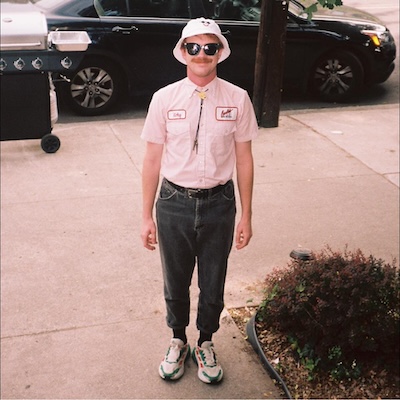
photo - Josh Walker is an integral part of Florida! Ya Kill Me!
Josh Walker is an integral part of Florida! Ya Kill Me! (photo from Nana Schewitz)

“I’m always so grateful to have my life partner/grandson by my side,” she said. “I’ve been working on Nana with Josh Walker for almost 10 years now. He is my most treasured collaborator, and we actually just came back from another two-month trip to Florida where we (along with my new grandson, filmmaker Lucky Marvel) just filmed the Florida! You Kill Me! documentary. We’re in production now after having visited and filmed in different Jewish and queer retirement homes, RV parks, assisted living facilities, etc., around the Sunshine State. The show me and Josh are about to put on in Canada is just a small taste of the incredible shenanigans we got up to around the state. You can catch Josh playing some classic Jimmy Buffett tunes on the banjo during this show.”

Nana exudes confidence, but that doesn’t mean she doesn’t have concerns about people’s reactions.

“I’ve had to stop being afraid, it wasn’t doing anything for me! When we went to Florida, I was extremely nervous,” she admitted. “A lot of what Nana is about is being out on the streets, very public and very vocal. I’m not sure if you know this, but there was recently a drag ban in Florida, as well. I’m not exaggerating, ‘adult live performances featuring sexual content’ were banned in Florida. I’m not sure if you’d consider my matzoh ball titties to be sexual content, but that’s beside the point. So, I went there with my guard up, worried for my safety and for the safety of my team. We had an ‘in case Nana gets arrested’ plan and everything. I’m proud to say, the ban eventually got overturned due, in part, to the relentless work of some of the drag queens of Fort Lauderdale (my hometown). But the damage had been done.

“I came in expecting bigotry,” she said, “but I really believe in my heart of hearts that is not our human nature. I think a lot of people are confused these days. There’s a lot of anger and hurt in the world and lot of information, and people are looking for where to place it and what to do with it all. This ‘drag queens bad’ narrative is political propaganda, but people will think what they want to think. Lucky for me, this Nana can move fast. When some of these Floridians see me, they’re not sure if they should pull out a gun and shoot me dead on the street, or give me a five dollar bill! By the time they’ve made up their mind, I’m gone. Whoosh!”

All jokes aside, Nana and Florida! Ya Kill Me! have a serious message.

“A new friend told me this as I was filming my documentary, and I think about it all the time so wanted to share it here as well,” said Nana. “She worked at the McArtor senior centre [in Florida], taking care of LGBT+ patients with Alzheimer’s and dementia. She told me, ‘If I can get you to do one thing after speaking to me, it’s call an older loved one in your life. A parent, a grandparent, an aunt, whoever. There will come a day when you call them and they won’t remember who you are anymore. Don’t wait for that moment to reach out. Enjoy every interaction you can, while you still can.’”

For tickets ($18) to Florida! Ya Kill Me!, visit jqtvancouver.ca. 

Format ImagePosted on May 10, 2024May 8, 2024Author Cynthia RamsayCategories Performing ArtsTags cultural commentary, drag, Florida! Ya Kill Me!, LGBTQ+, mental health, Nana Schewitz, seniors

Legislating a fine line

Vancouver Police last week arrested a woman for praising the Oct. 7 terrorist attacks. The woman, who multiple reports say is Charlotte Kates, a leader in a group called Samidoun Palestinian Prisoner Solidarity Network, was later released as police develop their case to present to the Crown for possible charges.

News of the arrest was met with a level of satisfaction among Jewish community organizations. Kates and Samidoun have been sources of outrage and concern for years. The group is routinely described as having “direct ties to the Popular Front for the Liberation of Palestine (PFLP),” which is designated as a terrorist entity under the Criminal Code of Canada. Canadian Jewish organizations have called for Samidoun to receive a similar censure – as it has in Germany, where it is a banned organization, and in Israel, where it is designated as a terrorist entity.

Kates, a British Columbia woman who is married to Khaled Barakat, a senior member of the PFLP, was arrested in relation to recorded statements made outside the Vancouver Art Gallery last month. There, she referred to several terrorist organizations as heroes and described the Oct. 7 attacks as “the beautiful, brave and heroic resistance of the Palestinian people.” She led a crowd of hundreds in chants of “long live Oct. 7.”

Emergence of the video led to absolute condemnation from BC Premier David Eby.

“Celebrating the murder, the rape of innocent people attending a music festival, it’s awful,” said the premier. “It’s reprehensible, and it shouldn’t take place in British Columbia. There is clearly an element of some individuals using an international tragedy to promote hate that’s completely unacceptable.”

Kates is banned from participating in public protests for five months, according to a statement released by Samidoun. An investigation is underway and it will be up to Crown prosecutors to determine whether charges are laid and the case goes to trial.

In announcing the arrest, Vancouver police spokesperson Sgt. Steve Addison explained the line police walk.

“We defend everyone’s right to gather and express their opinions, even when those opinions are unpopular or controversial,” said Addison. “We also have a responsibility to ensure public comments don’t promote or incite hatred, encourage violence, or make people feel unsafe. We will continue to thoroughly investigate every hate incident and will pursue criminal charges whenever there is evidence of a hate crime.”

The arrest comes as the federal government begins a process of reviewing Canada’s approach to hate-motivated expression. New legislation beginning its way through the wending process of Parliament is focused especially on “online harms” and involves a multi-pronged approach that would see amendments to the Criminal Code, the Canadian Human Rights Act and new laws addressing cyber-bullying, “revenge porn,” encouragement of self-harm and other actions.

The bill (click here for story) is part of an ongoing effort to address the social and technological challenges of hate-motivated crimes, as well as the range of dangers presented to children and others by online predators, bullies and extortionists.

The federal government’s efforts, long delayed and inevitably controversial, are part of an age-old effort to walk a line between the right to free expression, on the one hand, and the right, on the other hand, for people to be free from harassment and threats based on personal identity or other factors. Any discussion of balancing these contending rights – which is anything but an exact science – is destined to disappoint or anger people on both sides. 

The next steps in the current legal investigation – whether it proceeds to criminal charges and, if so, how the case proceeds and concludes – will also not satisfy everyone, if anyone. Indeed, it is a factor of this sort of case almost exclusively where many argue the challenging position that, in the words of Voltaire, “I disapprove of what you say, but I will defend to the death your right to say it.”

Few today would defend to the death the right of anyone to glorify Oct. 7 (or anything else, probably), but the point is that the right of free expression is considered by many to be sacrosanct. This has always been a core differentiator between our society and that to which we so often compare ourselves, the United States, whose constitution prioritizes precisely this sort of freedom.

An absolutist position is much easier for courts to adjudicate. Drawing lines in moral conundrums is a much more challenging undertaking.

As we watch this one case proceed locally, we will also be carefully observing the broader, legalistic and philosophical disputations occurring in Parliament as Bill C-63 proceeds through the creation process. The outcome, in both instances, will be necessarily imperfect. The hope is that they should be as just as human endeavours can be. 

Posted on May 10, 2024May 8, 2024Author The Editorial BoardCategories From the JITags Bill C-63, Charlotte Kates, free speech, governance, hate, hate speech, legislation, Online Harms Bill, online hate
Rally carries added meaning

Rally carries added meaning

The rally for the hostages at the Vancouver Art Gallery on May 5. (photo by Pat Johnson)

The weekly rally for the hostages at the Vancouver Art Gallery carried added resonance Sunday, May 5, hours before the world marked Yom Hashoah. Myer Grinshpan, a survivor of the Holocaust, spoke, as did his son, Roy Grinshpan. Anna Mae Wiesenthal, a scholar of the Holocaust, and Stephen Lowy, whose father, Leo Lowy, was a “Mengele twin,” also spoke. Rabbi Yitzchok Wineberg, Vancouver’s longest-serving rabbi, shared reflections on the Holocaust and current events and recited the Mourner’s Kaddish.

Format ImagePosted on May 10, 2024May 8, 2024Author Pat JohnsonCategories LocalTags Bring Them Home, Israel, Oct. 7, Oct. 7 hostages

Online harms mooted

A federal bill to address online harassment, bullying and hate has aspects to admire and others to cause concern. What happens in the committee process will determine the success of the proposed law.

That is the take of two experts – including one who had a hand in drafting the legislation. The devil, as always, is in the details of balancing free expression with the right to be free from threats and harassment.

Dr. Michael Geist, the Canada Research Chair in Internet and E-commerce Law at the University of Ottawa, who also serves on the advisory board of the Electronic Frontier Foundation, was joined in a recent online panel by Dr. Emily Laidlaw, Canada Research Chair in Cybersecurity Law and associate professor in the faculty of law at the University of Calgary. Her recent work includes projects on online harms, misinformation and disinformation, and she co-chaired the expert group that advised the federal government on the development of the Online Harms Bill, which is known as Bill C-63. The virtual panel, on April 17, was presented by the Centre for Israel and Jewish Affairs and moderated by Richard Marceau, CIJA’s vice-president, external affairs, and general counsel. More than 850 people registered for the event, indicating what CIJA board chair Gail Adelson-Marcovitz indicated is a depth of interest, and perhaps concern, about the bill.

Geist explained that the new bill is a result of years of work, following the federal government’s withdrawal of an earlier attempt at addressing the problem of online harms.

Bill C-63 is really three separate concepts rolled into one. It would amend the Canadian Human Rights Act and the Criminal Code, as well as introduce a new Online Harms Bill. Together, the components would codify currently inconsistent approaches to the problems.

The bill would redefine “hatred” in the Criminal Code and define a new crime of “offence motivated by hatred.” That offence, as well as advocating or promoting genocide, could lead to life imprisonment.

Amendments to the Canadian Human Rights Act would add the “communication of hate speech” via the internet or other telecommunication technology as a discriminatory practice. Individuals would be empowered to bring a complaint before the Canadian Human Rights Commission, which could penalize offenders up to $50,000. The law, if passed, would affect public communications, like social media posts, not private messaging or emails.

Separate components of the bill would make it easier and quicker to address specific offensive content, such as “revenge porn” and posts that could harm children, encourage suicide or bullying or otherwise endanger young people.

A digital safety commissioner and ombudsperson would help guide individuals through the process of dealing with bullying or other issues related to the law.

image - On April 17, Dr. Michael Geist of the University of Ottawa spoke as part of a CIJA panel discussion on the Online Harms Bill
On April 17, Dr. Michael Geist of the University of Ottawa spoke as part of a CIJA panel discussion on the Online Harms Bill. (screenshot)

Geist said many legal experts who seek to balance freedom of speech with freedom from abuse “breathed a sigh of relief” after the federal government abandoned earlier efforts and relied for the new bill on expert advice.

“It’s a pretty good starting point,” Geist said. “We know the broad brushstrokes of what that might include but there is a lot of uncertainty still, so it’s easy to like it when we don’t know the specifics.”

Geist and Laidlaw agreed on most points but had some differences around oversight. Geist said the bill appears to grant enormous powers to a new digital safety commissioner. The idea of life imprisonment for an online comment, he added, may be a sticking point. “I find that hard to justify,” he said.

Laidlaw said the new office of ombudsperson is an important step in helping individuals navigate online hate and harassment. The ombudsperson would be able to pass specific information on to the digital safety commission, whose mandate includes education and research supported by a digital safety office.

The bill would also place new obligations on corporations that run online platforms, like social media companies. At present, Laidlaw said, some companies, notably X (Twitter), are not taking the problem very seriously.

While Jewish advocacy organizations have long advocated for legal responses to hate speech, Geist warned of a double-edge sword.

“Could somebody who is supportive of Israel will be accused of promoting genocide?” he asked.

Geist upended the binary assumption of harassment and free expression, noting that the idea that limits on hate speech could chill expression ignores the existing, difficult-to-measure effects of online (as well as offline) harassment and bullying.

“There is already a chilling effect for anyone in our community and, frankly, in a number of communities, that speaks out on these issues,” he said. “The backlash that you invariably face causes, I think, many people to [reconsider] whether they want to step out and comment, and it’s not just online. There’s a chilling effect offline as well. These issues are very real and many of them will not be solved by legislation no matter what the legislation says.”

He fears a barrage of complaints, many vexatious, from all sides of many contentious issues.

While there is a needle-in-a-haystack challenge in addressing online harms, Geist said, addressing the problematic major players could have a broad impact, though no one believes online hate and bullying can be completely eradicated.

“The legislation talks about mitigating these harms, it doesn’t talk about eliminating them,” he said. Social media platforms, he believes, are looking for guidance on these issues and will be amenable to adhering to legislation. Moreover, he said, Canada’s proposals are somewhat belated responses that would put us roughly in line with the European Union, Australia, the United Kingdom and other jurisdictions.

image - Dr. Emily Laidlaw of the University of Calgary, who joined the CIJA panel discussion on April 17
Dr. Emily Laidlaw of the University of Calgary, who joined the CIJA panel discussion on April 17. (screenshot)

The inability to erase hate and harassment is not an excuse to do nothing, Laidlaw said.

“Enforcement has always been an issue,” she said. “But I don’t think it’s a reason not to pass laws.”

Laidlaw took exception to criticism that the new bill would represent government censorship. The proposed digital safety commissioner would be an independent body comparable with the existing privacy commissioner. 

“Where there is some risk is in the fact that, in the end, government appoints the individuals,” she said. Still, the appointees would need to be approved by Parliament, not just the government in office.

“And remember,” she added, the commissioner’s “oversight is of companies, not of individuals. They’re not making individual content decisions or holding individuals accountable here.”

The commission would not be subject to legal rules of evidence, making it possible to immediately take down things such as child porn, encouraging suicide or other especially egregious posts.

Geist said this significant power demands that the government spell out more clearly the limitations of the commission.

“At a minimum, it seems to me that it is incumbent on the government to flesh out in far more detail where the limits, where the guardrails, are around the commission, so that we aren’t basically adopting a ‘trust us’ approach with respect to the commission,” said Geist.

Parliament is expected to take up consideration of the bill in committee soon and Laidlaw argued that some aspects deserve speedy passage while others require far more sober consideration.

“The Online Harms Bill could be passed with minor tinkering,” she said. The Criminal Code provisions, she said, give her serious concerns and deserve major revisions or complete scrapping. She also struggles with changing the Canadian Human Rights Act.

Geist agreed on taking the bill apart.

“I would separate out the bill,” he said. Criminal Code and Human Rights Act amendments deserve much deeper consideration, he said. The online harms piece, he said, could be tidied up and passed with tweaks. 

Posted on May 10, 2024May 8, 2024Author Pat JohnsonCategories NationalTags Bill C-63, Centre for Israel and Jewish Affairs, CIJA, Emily Laidlaw, free speech, governance, hate speech, law, legislation, Michael Geist, Online Harms Bill, politics
BI celebrates building’s 10th

BI celebrates building’s 10th

At the 2012 groundbreaking, left to right: Catherine Epstein, Rabbi Jonathan Infeld, Stuart Gales, Sylvia Cristall, Michelle Gerber, Gary Averbach, Sam Hanson, Shannon Etkin and Alfonso Ergas. Obscured from view is Elliot Glassman. (Robert Albanese Photography)

On June 9, Congregation Beth Israel will celebrate the 10th anniversary of its new building at the sold-out Gerry and Ruby Gales Be the Light Gala. The event will honour the synagogue’s visionary leaders – the Lutsky, Gales, Averbach, Cristall, Glassman and Porte families – and the capital campaign’s co-chairs, Gary Averbach, the late Lorne Cristall and the late Hershey Porte, as well as building chair Alfonso Ergas, Burn-the-Mortgage chair Lee Simpson and former BI executive director Shannon Etkin.

“This new building will be built as a place for our synagogue community to grow and thrive,” Lorne Cristall told the Independent in a 2010 interview, as the capital campaign was starting up. 

The new building, designed by Acton Ostry Architects Inc., would give the synagogue an east-facing sanctuary (towards Jerusalem), where it used to face north, and allow the congregation to host High Holiday services under one roof. The plan was to raise enough money that there would be little or no mortgage.

“The campaign began for $10 to $12 million plus about $2 to $3 million for an available piece of land on the southeast corner of the property that Shaughnessy Hospital had expressed a strong interest in purchasing,” Gary Averbach told the Independent in an interview earlier this week. “Even then, while running the numbers, it became quite difficult to see how … we could reach the $10 million mark, let alone the $12 million one.”

That became even more concerning, he said, once the designs were costed out, and the final tally was going to be closer to $18 million.

But the visionary donors being honoured, and many others, gave “unexpectedly generous gifts,” said Averbach, thanking Simpson and Bette-Jane Israels for their help raising the funds, and to Etkin, “who took over after we got the initial pledge.”

Averbach said, “Although we had been incredibly successful in our fundraising, having reached close to $20 million on the day we opened, the final price tag looked to be just over $25 million, and the lot had still not been sold.”

Etkin had found a potential buyer, but, when that deal looked as if it would collapse, Averbach called Gordon Diamond, who had earlier expressed interest in buying the land for possible Vancouver Talmud Torah expansion. It was a long process, said Averbach, “but, finally, thanks to Gordon and Leslie Diamond’s insisting that they find a way, the deal was done.

“There was a final Burn the Mortgage campaign with Lee, Bette-Jane and me. And, under Shannon’s leadership, we were able to pay off all but a little over a million dollars of the final cost of just over $25 million. I believe all that debt has been paid off now.

“An important note is that, of the almost $22 million raised, only two donations, totaling $118,000, came from non-members – and both those had a family history at the BI,” added Averbach.

“I suppose I could talk about all the important roles the Beth Israel synagogue, our shul, my shul, plays in our community, in our personal lives and in our spiritual lives,” Gerry Gales told the Independent about why he and his wife Ruby stepped up. “The answer is not complicated. There was a need. I was asked. I said yes. There was never a second thought in my mind. I do believe we are all here to help one another, to do what we can with what we have.”

He said, “Ruby and I find great comfort in being in our house of worship, our shul…. We know that we are a part of a great tradition, with roots that were planted thousands of years ago. It’s a tradition that will continue long after we are gone. When I think of all the people who have gathered together under this roof, I feel that I am but a small part of something so much larger than me and I feel that I am never alone.

“Then there is the practical role the shul plays in the unfolding of our lives,” he added. “The shul is a place where we come for prayers and to pray, the shul is the place where we can send our children to learn all our traditions and to be educated, the shul is a place where we come to celebrate, where we come to mourn, where we launch our children into adulthood.”

Simpson agrees. “I believe all synagogues play an important part in our Jewish lives. They are a place to gather, pray, gain spiritual renewal, comfort and peace. All so important to our mental and, therefore, physical being – even more important in our world today,” she said. “Plus, they give a sense of community. Seeing familiar faces, sharing a lunch or meal after services, all so important. They are also a place of learning and expanding our knowledge, answer our questions, gain wisdom from others.”

She said it was an honour for her and her husband Bernie to support Beth Israel.

“Beth Israel has been our synagogue for all of our married life – we were married there by Rabbi [Wilfred] Solomon,” she said. “Our children were named there, bat and bar mitzvahs were there and our grandchildren were also named and our grandson’s bar mitzvah has been there, and more to come. I was twice chair of the board of directors and involved in the building campaign.”

As for her involvement in the campaign, Simpson said, “For me, the final straw was at my son’s aufruf [being called to the Torah the Shabbat prior to the wedding]. The auditorium filled with family and friends was also filled with buckets to catch the rain coming in from the roof and windows. We needed more than Band-Aids.”

At the new building’s groundbreaking in 2012, Etkin cited a report from 1988 about a renovation being one of the shul’s “very important priorities.” He spoke about several efforts to move redevelopment forward, with the one that resulted in the new building starting eight years before construction was completed in 2014.

photo - Then Beth Israel executive director Shannon Etkin lifts the Torah during the dedication of the new building in 2014
Then Beth Israel executive director Shannon Etkin lifts the Torah during the dedication of the new building in 2014. (Adele Lewin Photography)

Acknowledging that he stood on the shoulders of Cristall and Porte, who “had been involved as co-chairs in various incarnations of the rebuilding of the Beth Israel Synagogue since at least the early 1990s,” Averbach said, “I had always taken an interest in the project, but it wasn’t until I joined the board around 2008 that I started to take an active interest. My interest was based on the fact that the existing building, besides being arguably halachically incorrect, was also in very sad disrepair.”

Cristall and Porte took Averbach out to lunch and asked him to deal with donors under the age of 55.

“After a few days, I agreed, and a couple of weeks later, Hershey passed away, and the ‘triumvirate,’ with me as junior partner became Lorne and me as co-chairs,” said Averbach. “Given Lorne’s serious illness, I knew my job had expanded many times.”

With the help and work of many people, and with the commitment of the congregation, the redevelopment finally happened.

“Since we opened our doors to our new and very beautiful building 10 years ago, we have seen significant increases in every aspect of synagogue life. Our membership is growing, and our program participant numbers have increased,” BI Senior Rabbi Jonathan Infeld, told the Independent. The clergy now includes Assistant Rabbi Adam Stein, Ba’alat Tefillah Debby Fenson and youth director Rabbi David Bluman.

“Since our new building project was completed, it has literally opened many doors for our congregation,” said Infeld. “We have had the blessing of hosting many large community events including this year’s Yom Ha’atzmaut celebration. We have had the flexibility to do many great programs that utilize all our spaces and meet the needs of many different age groups. The High Holidays are a perfect example of when we use almost every inch of the building. We have nearly 2,000 people come to our various High Holiday services each year and the space is a true blessing for all of us.” It also allows for more varied services and programs on Shabbat, said the rabbi.

“We are really looking forward to our sold-out gala this year, which will celebrate a decade of success because of the hard work and dedication of the people who helped make the dream of a new building possible,” he said. “I am so happy that there will be so many people present to say thank you to our visionaries and builders. Jacci Sandler and the gala committee have done a fabulous job already.”

The gala committee is Jennifer Apple, Kerry Benson, Samara Bordan, Chana Charach, Shannon Ezekiel, Shannon Gorski, Carol Konkin, Samantha Levin, Juliette Sandler, Paige Swartz and Leatt Vinegar. Sandler, head of development at Beth Israel and the creator of the Be the Light Gala, spoke with the Independent about this year’s event, which will feature, among others things, a concert by American-Israeli rapper/singer Nissim Black and a menu created by Israeli Chef Yaniv Cohen, owner of restaurant Jaffa Miami, and the Perfect Bite. Howard Blank will be the auctioneer and Sandler’s husband, Brett, will be master of ceremonies – he has a long history of fundraising in the community and chaired the JCC Sports Dinner twice.

For the main act, Jacci Sandler wanted an internationally known Israeli artist. Black fit the bill, and more.

“Not only are Nissim’s songs all about Judaism but they are filled with messages of spirituality, about hope, victory, friendship, belief, admiration, being lifted and much more,” said Sandler. “At the time we are in now, the Jewish community wants to be lifted and, at the Be the Light Gala, Nissim, with his beautiful words, will do just that. I received approval of this concept by my outstanding gala committee and executive director Esther Moses.

“With the occurrences in Israel this year, we wanted to celebrate the 10th year with an Israeli meal,” Sandler continued. “But we wanted a concept out of the box from the traditional options in Vancouver. Ricci Smith teamed up with Yaniv Cohen to do a Miami-style version of our Israeli meal… Our meal will be incorporating seven Israeli spices that represent kindness, strength, beauty, perseverance, splendour, foundation and royalty.”

Shannon Chung, with whom Sandler has worked before, will perform at the donor reception, which will be hosted at the house of Mark James.

“Beth Israel Synagogue is an essential part of who we are,” said Gerry Gales. “It serves the spiritual and human needs of us, the congregants. It is a focus for our Jewish community that allows us to come together and share our lives, for better or for worse, with each other. And our synagogue plays a role in making us a visible part of our larger community, the Vancouver community.

“In these stressful times, with war in our homeland and revival of old evils and antisemitism around us, we need a place where we can come together, where we can stand together. This is that place. The synagogue needs funding to be what we need it to be, and it needs our participation. If we do not fund it, if we do not make it work, who will?”

Averbach had a message for BI’s future generations.

“Just as I and many others worked long and hard at the renovation of the JCC between 1988 and 1995 and, just over 20 years later, we need to rebuild, so it will be with the BI,” he said. “Maybe it’ll be 30 years, but just remember – never underestimate the generosity of Greater Vancouver’s Jewish community!” 

Format ImagePosted on May 10, 2024May 8, 2024Author Cynthia RamsayCategories LocalTags Beth Israel, Gary Averbach, Gerry Gales, history, Jacci Sandler, Jonathan Infeld, Lee Simpson, milestone
The birth of a classic movie

The birth of a classic movie

David Wallace, J.D. Dueckman, Matt Ramer and Rachel Craft in Metro Theatre’s Moonlight & Magnolias, which runs to May 18. (photo by Emma Chan)

Gone With the Wind (GWTW) is my all-time favourite movie and, if adjusted for inflation, the highest ranking movie of all time. To think that the screenplay for Margaret Mitchell’s 1037-page tome was hashed out in a five-day marathon by two Jews and a WASP holed up in producer David O. Selznick’s Hollywood office beggars belief. And yet, that is what happened – and Moonlight and Magnolias, currently playing at Metro Theatre, is Ron Hutchinson’s hilarious take on what went on in that office.

It is 1939, Selznick is producing both GWTW and The Wizard of Oz (TWO). He has just sacked director George Cukor three weeks into production (due to a run-in with Clark Gable) and pulled Victor Fleming off the set of TWO (he allegedly slapped Judy Garland) to direct. There are only five days until production resumes. Selznick’s reputation with his father-in-law, studio head Louis B. Mayer, is at stake. He needs a hit. Enter Ben Hecht, a successful Hollywood screenwriter, to the rescue. However, Hecht has not read the book and is not crazy about the job – as he says, “No Civil War movie has ever made a dime.” But he succumbs to Selznick’s relentless pressure, sacrificing his artistic standards for financial security.

Selznick gives strict instructions to his assistant, Miss Poppenghul, to hold all calls and let no one in or out of his office. He orders up a diet of peanuts and bananas (apparently brain food) for the triumvirate’s sustenance. 

As Hecht pecks away at his typewriter, Selznick and Fleming reenact various scenes from the book in zany physical comedy fashion, giving life to the iconic characters Scarlett O’Hara, Rhett Butler, Melanie and Ashley Wilkes and even Prissy, the maid. 

In Metro’s production, J.D. Dueckman is sublime as the neurotic Selznick. Kudos to him for mastering his dialogue-intense role and for his parodies of various GWTW cast. From his first approach to Fleming, played by Matt Ramer – “How do you feel about being locked up in a room with two crazy Jews?” – to his eureka moment for Clark Gable’s famous last line where yes, my dear, he frankly did give a damn, you can feel the passion behind the independent producer’s quest for his holy grail. 

In counterpoint, David Wallace as Ben Hecht plays his role in a much more subdued manner. The audience gets that he is torn between writing the screenplay as Selznick envisions it and his own activist leanings to not glorify the Antebellum South but, rather, “make America look its ugly mug in the face” – its racism and antisemitism (sound familiar?). He astutely points out to Selznick that, no matter what his successes are, he will never be allowed to join the country clubs of the WASP elite or buy a house in certain parts of Beverly Hills and that the handful of Jews who created Hollywood are always worried about being shipped back to a Polish shtetl.

Ramer captures Fleming’s broody persona and does a wonderful job portraying Melanie during her childbirth scene. All three men have great chemistry together.

Rachel Craft brings a feminine presence to the testosterone-fueled stage as the ever-suffering and sleep-deprived Selznick assistant. 

As the writing marathon continues, the order of the office disintegrates into paper- and peanut-shell-strewn chaos as the three amigos stumble around the office in a disheveled and bleary-eyed stupor. As they finish the project, the men realize that, indeed, “tomorrow is another day.” Cue the melodramatic theme song to close out the show.

Francesca Albertazzi’s set is what you would expect of a Hollywood mogul’s office – a polished mahogany desk, a crushed velvet couch, leather-bound armchairs and elegant light sconces. In a subtle nod to detail, the office window is framed in the iconic green velvet drop curtains fringed with gold tassels (that Scarlett used to fashion the gown she wore to visit Rhett in jail to ask for money to save her beloved Tara). The glorious reds, oranges and golds of the film are reproduced throughout the play by lighting director Les Erskine.

Director Catherine Morrison has ably helmed the production with her talented crew in this hidden gem of a funky theatre. You don’t have to be a GWTW fan to appreciate the show. Just go and see it. It will give you a nice escape from these troubled times. 

Tickets can be purchased at metrotheatre.com or from the box office, 604-266-7191. 

Tova Kornfeld is a Vancouver freelance writer and lawyer.

Format ImagePosted on May 10, 2024May 8, 2024Author Tova KornfeldCategories Performing ArtsTags Ben Hecht, David O. Selznick, Gone With the Wind, history, Hollywood, Metro Theatre, Ron Hutchinson, theatre, Victor Fleming

Posts pagination

Previous page Page 1 … Page 87 Page 88 Page 89 … Page 667 Next page
Proudly powered by WordPress