Skip to content
  • Home
  • Subscribe / donate
  • Events calendar
  • News
    • Local
    • National
    • Israel
    • World
    • עניין בחדשות
      A roundup of news in Canada and further afield, in Hebrew.
  • Opinion
    • From the JI
    • Op-Ed
  • Arts & Culture
    • Performing Arts
    • Music
    • Books
    • Visual Arts
    • TV & Film
  • Life
    • Celebrating the Holidays
    • Travel
    • The Daily Snooze
      Cartoons by Jacob Samuel
    • Mystery Photo
      Help the JI and JMABC fill in the gaps in our archives.
  • Community Links
    • Organizations, Etc.
    • Other News Sources & Blogs
    • Business Directory
  • FAQ
  • JI Chai Celebration
  • JI@88! video

Recent Posts

  • Story of Israel’s north
  • Sheltering in train stations
  • Teach critical thinking
  • Learning to bridge divides
  • Supporting Iranian community
  • Art dismantles systems
  • Beth Tikvah celebrates 50th
  • What is Jewish music?
  • Celebrate joy of music
  • Women share experiences 
  • Raising funds for Survivors
  • Call for digital literacy
  • The hidden hand of hate
  • Tarot as spiritual ritual
  • Students create fancy meal
  • Encouraging young voices
  • Rose’s Angels delivers
  • Living life to its fullest
  • Drawing on his roots
  • Panama City welcoming
  • Pesach cleaning
  • On the wings of griffon vultures
  • Vast recipe & story collection
  • A word, please …
  • מארק קרני לא ממתין לטראמפ
  • On war and antisemitism
  • Jews shine in Canucks colours
  • Moment of opportunity
  • Shooting response
  • BC budget fails seniors
  • Ritual is what makes life holy
  • Dogs help war veterans live again
  • Remain vital and outspoken
  • An urgent play to see
  • Pop-up exhibit popular
  • An invite to join JWest

Archives

Follow @JewishIndie
image - The CJN - Visit Us Banner - 300x600 - 101625

Sculpting emotion with glass

Sculpting emotion with glass

Some of Tara Pawson’s Human Beams. (photo from Tara Pawson)

Tara Pawson’s fascination with glass began when she was in high school.

“My dad was a welder,” she said. “He would bring home some metal pieces, and I would fabricate some garden art in our garage. Then, I got a birthday present – a weeklong class of glass-blowing – and I knew that was what I wanted to do with my life. Before that class, I was planning to go to a culinary school after graduation. After it, nothing else but glass.”

Pawson’s solo show, Human Beams, opened on March 22 at the Zack Gallery.

“Glass is a fascinating medium,” Pawson told the Independent. “It combines all the elements: air, fire, wood, metal, water. It is labour-intensive and demanding, and the results are beautiful and fragile. There is a contradiction there.”
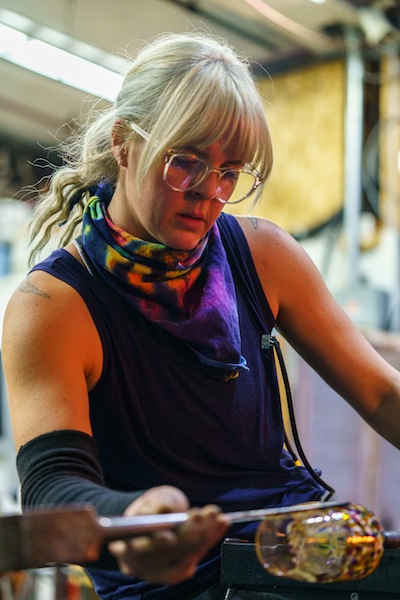
photo - Glass artist Tara Pawson at work
Glass artist Tara Pawson at work. (photo from Tara Pawson)

Pawson enjoys the process of glass-blowing – despite its inherent danger. “It’s like a game to me,” she said. “I’m not afraid of getting hurt. I have been once or twice, but I love doing it all the same…. When a piece is finished, I always want to do it again, in a different way.”

She loves the functionality of glass, its accessibility to everyone in the forms of glassware or candelabras. “I’m not drawn to huge installations. I want to make art for the people,” she said, “for their homes and their hearts.”

Pawson doesn’t have a classical art education, but she has taken many workshops in a wide variety of glass-blowing techniques over the years. “I apprenticed and I learned,” she said.

At 21, she found a job with Robert Held Art Glass.

“The company created giftware and home decor,” she said. “I learned a great deal there. It was a full-time job, and I did everything: glass-blowing, sales, cleaning. I stayed with them for about eight years. During the week, I worked for the company, but on the weekends, they allowed me to use their glass-blowing equipment, and I started making things for myself.”

Then she moved to a company that created glass light fixtures. “There, I learned to work with a different type of glass, different styles, different process,” she said.

About six years ago, Pawson decided to become an independent glass artist. “After my youngest son was born, it was time,” she said. “I wanted to make my own hours and [have] no commute to work, so I could spend more time with my family.”

For the equipment, she joined Terminal City Glass Coop and rents time when it suits her schedule. She makes some unique artworks.

“I make glass gifts and I make memorial pieces that are very popular,” she said. “Those memorial keepsakes are small glass baubles – hearts or orbs or coins – which incorporate tiny amounts of cremains within the glass matrix. The result is a treasured heirloom. I can make them for several family members, so they will always have a keepsake to remember their loved ones. People love them. One client of mine said she always wanted to travel with her father. After he died, she took the glass marble with his ashes on her travels, so he was with her everywhere. This way, she had no problems with customs – an urn with his ashes might be much harder to pass through customs.”

Pawson’s giftware includes vases and glasses, paperweights and funky little “monsters,” candleholders and Christmas ornaments. She sells her glass in several stores in British Columbia, Alberta and Ontario, as well as online, through her website and her Etsy shop. She is also an active participant in many seasonal markets. Recently, she created a new collection of glass beams, which are included in her current show at the Zack.

“My mother passed away shortly before the COVID lockdown started,” Pawson explained. “I was dealing with my grief and I felt alone in the pandemic. Everything was closed. So I started working on these glass pieces. They helped me process my grief. I thought, maybe I could share it, help others. I never had an art show before. I started asking around how to go about it, whom to approach. I know Hope [Forstenzer] through the Terminal City Glass Coop. I asked for her advice, and she said: ‘Why don’t you apply at the JCC? We have a gallery there.’ I did. This is my first show.”

The show at the Zack, where Forstenzer is director, displays three distinct lines: Human Beams glassware, Thought Towers sculptures and Pearls of Light wall decorations. The Human Beams series works are tall cylindrical glasses of different colours, decorated with mandalas.

“The cylinders start as dark shadowy forms and flow into the bright beams of light,” Pawson said. “They reflect the timeline of the dark days, when the trauma begins, and grow organically towards the light days, when you find peace.”

She explained the symbolism of a mandala, which “represents the universe in Hinduism and Buddhism,” she said. “Their circular design without beginnings or ends is a symbol of a spiritual journey. They illustrate the events, memories and thoughts we have when the emotion of grief consumes us. Some days are darker than others, but, with time, work and support, we learn to ride those waves…. I hand-carved every mandala on every glass. It took me about four hours for each mandala. I think I’m done with them for awhile.”
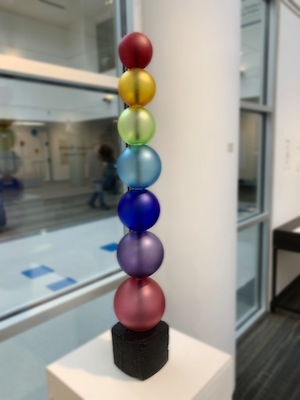
photo - One of Tara Pawson’s Thought Towers
One of Tara Pawson’s Thought Towers. (photo from Tara Pawson)

The Thought Towers are sculptural compositions, orbs of various sizes and colours growing like a tree out of each other. The lighter, bigger orbs echo lighter emotions, like hope or joy, but they are always interspaced with small dark orbs of desperation, guilt or anger. “The Thought Towers convey a spectrum of emotions,” said Pawson. “As we deal with grief, we have good days and bad days. Anything could trigger a crippling emotional response – a song, an image, a TV episode. But we have to remember that good days always follow the bad ones.”

And then, there are the Pearls, each one hand-formed, each a complex and beautiful glass tablet. “Each one is a person or an event we encounter in our daily lives,” Pawson said. “Pearls of Light, or Baily’s Beads, are a phenomenon seen during a sun eclipse. These spots of light encircle the moon. They resemble a string of luminous beads, visible immediately before and after a total eclipse. They are the people around us, our family and friends.”

Pawson’s exhibit is on display until April 28. For more information about her and her work, visit her website, tarapawson.com.

Olga Livshin is a Vancouver freelance writer. She can be reached at [email protected].
Format ImagePosted on April 8, 2022April 7, 2022Author Olga LivshinCategories Visual ArtsTags art, Baily’s Beads, glass-blowing, glass-making, healing, Tara Pawson, Zack Gallery
Opening of hearts

Opening of hearts

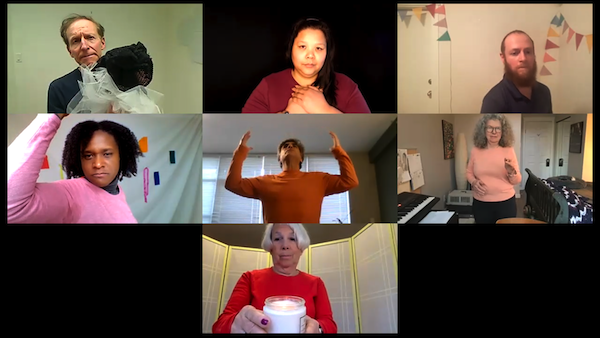
In this Vancouver Playback Theatre screenshot are, top row, left to right, Peter Abrams, Diandra Lee and Laen Hershler; middle row from left, Ingrid Broussillon, Joel Bronstein and Louise Lemieux; and Carol Ann Fried.

If you want to see tikkun olam in action, see the next performance of Vancouver Playback Theatre (VPT). For the last 23 years, the ensemble has been retelling audience participants’ life stories with sensitivity and compassion.

At VPT’s March 6 show, brightly coloured scarves, banners, dance, piano music and improvisation “played back” individual audience experiences of and the accompanying emotions caused by antisemitic events and other forms of discrimination.

“We really want audience members to feel seen, understood, and learn from the playback experience,” VPT’s Peter Abrams told the Jewish Independent.

Fellow Jewish community and troupe member Joel Bronstein added, “Our work takes audience members out of their heads and into their hearts … when people share their feelings and life experiences in a safe and supportive environment, there is a collective opening of our hearts, even when it is light and funny.”

Playback Theatre was created in New York 47 years ago with the intention of returning theatre to its storytelling and community-building roots. With troupes now established worldwide, Playback Theatre directly engages participants in sharing experiences and ideas related to themes of importance to them individually, and as groups, organizations and communities.

Abrams, Bronstein and Carol Ann Fried, who is also a member of the Jewish community, have all been part of the ensemble for more than two decades. Fried’s most memorable audience story involved a father talking about the love he had for his son.

“As he was speaking,” she said, “I wanted to sing a song about his love. I knew there was a Cat Stevens song called ‘Father and Son’ but I couldn’t remember the words or the melody. The only song I could think of was ‘You are the Wind Beneath My Wings,’ and I sang a few lines.”

After the show, the father told Fried that he had made a video of his son when his son was younger and the sound track was “You are the Wind Beneath My Wings.”

“That’s the magic of Playback,” said Fried. “It’s Hashem in action.”

Abrams remembers a story about a woman who found herself attracted to two men who were both interested in her, and she was wondering what to do about her pleasant dilemma.

“In the playback, myself and another male actor represented the two suitors in an old-fashioned duel that was a slow-motion dance, also using fabrics,” said Abrams. “We ended in a draw, appealing to the teller [audience participant] to decide. The teller and the audience loved it, and the teller realized she didn’t need to rush any decision, and decided just to enjoy the experience.”

There seems to be no limit as to what can be expressed in performances with VPT and what insights can be gained.

Fried said she has particularly enjoyed playing “non-literal parts.” For example, she has played a table at which two people fell in love, she has played the feelings of love and has even played internal organs. She said she has learned to trust that her creativity will emerge when invited.

Bronstein remembers when he had to play back a story about a violent character. “Although I symbolically represented the violence, when the story was finished my body was shaking intensely,” he said.

It’s not surprising that VPT works with organizations that help others, such as the Kitsilano-Fairview Mental Health team and Oxfam Canada.

“When we do a workshop for an organization or a community group, we often start with a short performance on an issue, and follow this with breakout groups where participants can dialogue on what they’ve learned and where to go from here on the issue,” Abrams said. “The groups we work with are focused on progressive social issues, so we contribute to forward movement on these issues through our workshops.”

VPT offers a variety of services, including public and conference performances, workplace conflict resolution workshops, peace-building in schools, community engagement projects, and Playback skills training, in person (when possible) and virtually (via Zoom).

Fried said she has learned a lot about the human condition through working with culturally diverse audiences. “Although our lives, cultures, religions and life experiences are different, we all value and care about the same things,” she said. “We all have the same variety of feelings. I feel connected on an internal level with each teller.”

When they aren’t together storytelling, Fried runs her own company and is a keynote speaker, workshop leader and coach; Bronstein is the executive director of Little Mountain Neighbourhood House; and Abrams runs his own organizational development consulting business.

The other members of the ensemble are Diandra Lee, Laen Hershler, Ingrid Brousillon, Louise Lemieux, Laurie Damer and Matthew Spears.

The troupe’s website is vancouverplaybacktheatre.com. Their next online public performance will be on June 26 in honour of World Refugee Day, which is June 20.

Cassandra Freeman writes stories with the support and love of her husband, Irwin Levin.

Format ImagePosted on April 8, 2022April 7, 2022Author Cassandra FreemanCategories Performing ArtsTags Carol Ann Fried, Joel Bronstein, Peter Abrams, Playback Theatre, social justice, tikkun olam
Bar mitzvah reveals tensions

Bar mitzvah reveals tensions

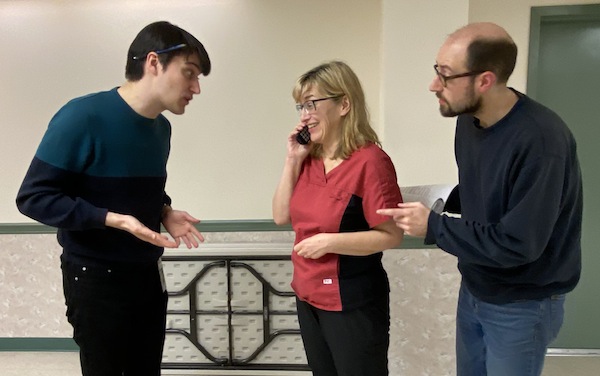
Nicholas Guerriero, left, Lorene Cammiade and Rudy Smith rehearse a scene from Bema Productions’ staging of Men Overboard, which will be at Emanu-El Synagogue’s Black Box Theatre May 5-15. Guerriero plays Jay Silver, a Buddhist monk and the youngest son of Zaida Ernie, Cammiade portrays Eva Fuzesi, the bar mitzvah tutor from Hungary, and Smith plays Doug Silver, Ernie’s middle son and a psychotherapist. (photo from Bema Productions)

Next month, Victoria’s Bema Productions mounts the first full production of Men Overboard.

Winner of the Long Beach Playhouse New Play Contest and a finalist for the Woodward-Newman New Play Award, Men Overboard was written by Rich Orloff. After well-received readings and workshops in New York, Philadelphia, Long Beach and Dayton, the play comes to Victoria, where the première will be directed by Kevin McKendrick.

photo - Things get rough in Men Overboard: Rudy Smith puts a (fake) stranglehold on Nicholas Guerriero
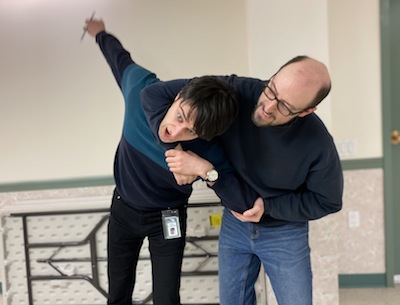
Things get rough in Men Overboard: Rudy Smith puts a (fake) stranglehold on Nicholas Guerriero. (photo from Bema Productions)

The play focuses on a bar mitzvah for a boy, Abraham, who doubts he’s ready to become a man. The event brings together Abraham’s politician father and the father’s two brothers, a therapist and a Buddhist monk. Add their fading but forceful father and Abraham’s bar mitzvah tutor, a woman who loves Abraham and possibly one of his uncles, and it’s easy to see that Abraham is torn between obedience and defiance of his father. Tensions grow, affecting everyone in the family, until anger becomes abuse and it becomes clear that the family’s status quo is no longer an option. Men Overboard asks “What makes a man?” as it explores the responsibility each of us has to protect the souls of those we love.

The Bema production stars Lorene Cammiade, Nicholas Guerriero, Asa O’Connor-Jaeckel, Evan Roberts, Alf Small and Rudy Smith. It is produced by Alan Segal and takes place May 5-15 at Congregation Emanu-El Synagogue’s Black Box Theatre, 1461 Blanshard St. For tickets ($25) and showtimes, visit eventbrite.ca/e/295008758137. 

– Courtesy Bema Productions

Format ImagePosted on April 8, 2022April 7, 2022Author Bema ProductionsCategories Performing ArtsTags Emanu-El, Men Overboard, Rich Orloff, theatre, Victoria

A new story every year

Each year, we revisit the same Torah portions but, while the words remain the same, our understandings change based on what is happening in our world or in our lives. The exodus story, the story of Passover, remains as relevant as ever, as people in many parts of the world are being oppressed, are stateless or are living amid war.

As Russia’s attack on Ukraine continues, citizens of that besieged country are seeking refuge in neighbouring states. It does not appear, at present, that Jewish Ukrainians are suffering any more or less than any other citizens of that state. However, history has shown that whenever and wherever upheaval occurs, it almost inevitably affects Jewish people in some particular way.

The age-old question, “What does it mean for the Jews?” is an acknowledgement that events that ostensibly appear unrelated to Jewish people specifically will have unique consequences for Jews.

As Russia’s invasion has faced an unexpected reply from the Ukrainian military and people, the risk of Vladimir Putin being backed into a corner opens the door to worrying potentials. He has already made threatening noises about chemical weapons and, even more worryingly, nuclear weapons – the very suggestions being an untenable line to cross for any nuclear-capable world leader.

It should be remembered, but it has been too infrequently mentioned during this crisis, that Ukraine once had the third-largest nuclear arsenal in the world, a legacy of the dismantling of the Soviet Union. In 1994, Ukraine was persuaded to transfer its entire arsenal to Russia to be decommissioned with the promise from the Western world that we would ensure that country’s security in return. As Ukraine’s President Volodymyr Zelensky continues his virtual global tour, prevailing upon the West to provide more military aid, we should remember that he is asking for the Western world to fulfil the promise it made to his country less than three decades ago.

We should also not need reminding that the existence of a Jewish state is a modern miracle that provides a place of refuge, mere decades after the absence of a homeland led to Jewish history’s worst cataclysm. There are some 200,000 Ukrainians who would qualify for Israeli citizenship under the Law of Return, and planeloads of Jewish Ukrainians are making their way to Israel, fleeing a modern-day pharaoh.

Of course, the land of milk and honey is, in reality, a real-world country facing an enormous range of problems. Recent terror attacks have some people fearing a third intifada or, at least, a season of upheaval like we saw last year when violence erupted. In turn, that hostility spread worldwide, with spikes in antisemitic incidents around the world, including in Canada. While Jews are securely ensconced in the Promised Land, Israelis still seek liberation from the figurative enslavement by terrorists and their supporters. And, at the same time, Palestinians also do not have the freedom they desire and deserve. This latest violence does not serve either people’s dreams of peace or justice; it further enslaves us to cycles of justifications of more violence and pain.

Meanwhile, Jewish families in North America are excited to return to comparatively normal seders and celebrations after two years of pandemic. This is itself a form of liberation. As we reenact the ancient exodus at our seder tables, we will hope for and commit ourselves to a world where all who are oppressed find freedom. This is not a rote rereading and it is not a theoretical wish. In a world with so many challenges and dangers, the story of escape from bondage remains as relevant and urgent as ever.

Posted on April 8, 2022April 7, 2022Author The Editorial BoardCategories From the JITags Exodus, freedom, Judaism, refugees, Russia, Ukraine, war
Take a comedy break

Take a comedy break

Left to right, Ori Laizerouvich, Israel Atias, Daniel Gad and Omer Perelman Striks co-star in The New Black. (photo from ChaiFlicks)

I have to improve either my Hebrew comprehension or my English speedreading skills before April 12. The second season of The New Black premières that day on ChaiFlicks and it’d be great if I could understand more of what was going on – even with my limited capacity, the first season was an absolute blast.

Also recently premièring on the streaming service ChaiFlicks, which carries all sorts of Israeli films and TV shows, was the second season of Checkout, an Israeli comedy in the tradition of American sitcoms Superstore, The Office and Parks and Recreation. It has some seriously funny moments, though a couple of the characters may grate on folks, as some of the characters on the aforementioned American shows did.

Superstore takes viewers into an Israel that most Jews will recognize, but that will be less familiar to those whose only experience of Israel is via the news. The show is set in a small supermarket, Issachar’s Bounty, in a small town, Yavne. The store’s patrons are regulars, and one in particular, fanny-packed customer Amnon, who has a complaint or gets into a confrontation every time he comes in to shop, is particularly annoying, as often is his main sparring partner, the brash cashier Kochava. But the other characters – notably Shira, the store manager who idolizes and sees herself as an up-and-coming Steve Jobs – offer enough less-in-your-face humour that the show is well worth watching if you like reality-show-type comedies. As in the other shows of this genre, there is a camera crew making a documentary about the store, so the characters not only interact with one another, but express their views in interview snippets with the film crew.

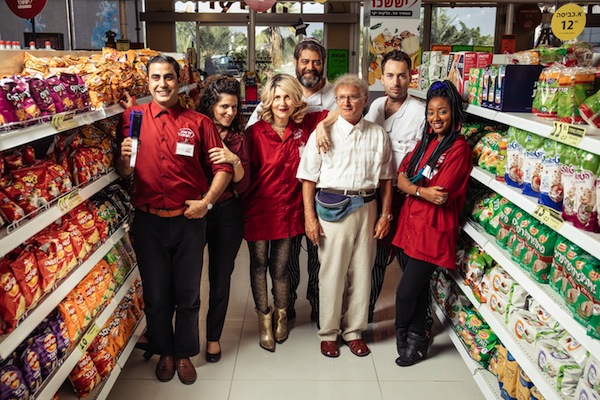
photo - The cast of Checkout, left to right: Amir Shurush, Noa Koler, Keren Mor, Yaniv Swissa, Dov Navon, Daniel Styupin and Aviva Nagosa
The cast of Checkout, left to right: Amir Shurush, Noa Koler, Keren Mor, Yaniv Swissa, Dov Navon, Daniel Styupin and Aviva Nagosa. (photo from ChaiFlicks)

In the guise of humour, many a true observation is made in Superstore, which touches upon social inequality, terrorism, racism, homophobia and many other issues. Viewers can choose to just laugh at the goings-on depicted or they can take more away from the show. The same can be said of The New Black, which has some uncomfortable moments – for example, are we supposed to laugh when one of the yeshivah students is appalled when his matchmaker sets him up with a woman who uses a wheelchair? I don’t think so. I think we’re supposed to be appalled at his behaviour, behaviour that one can easily imagine of many self-absorbed 20-something guys who fancy themselves a prize despite all evidence to the contrary.

That the four yeshivah boys at the centre of The New Black seem like regular college-age men is why the show has broad appeal. That is does, while also being packed with somewhat-high-level (to non-Orthodox Jews) talmudic discussions, is a notable achievement. It is easy to see why the show was nominated for eight Israeli Television Academy Awards. It is smart, engaging, fast-paced and has a fantastic soundtrack. While non-Jews will have to watch it with a semi-knowledgeable Jewish friend and non-Hebrew-speaking Jews will occasionally have to press pause to take in the subtitles fully, The New Black has legs … and Borsalinos aplenty.

For access to these two comedies, and many other programs, visit chaiflicks.com.

Format ImagePosted on April 8, 2022April 7, 2022Author Cynthia RamsayCategories TV & FilmTags ChaiFlicks, Checkout, comedy, Israel, sitcoms, television, The New Black

Criminalize Holocaust denial?

Criminalizing Holocaust denial would draw a moral line in the sand, say two advocates for legal action, but a lawyer and Canadian-Israeli former member of the Knesset has reservations.

Michal Cotler-Wunsh, head of the Nefesh B’Nefesh Institute for Aliyah Policy and Strategy and a former Israeli parliamentarian, acknowledged free speech concerns but focused more on the need for evidence-based decision-making before criminalizing those who question historical facts around the Shoah. She also noted that the countries that have adopted criminal sanctions against those who spread historical fabrications – Germany and France, for example – are among the very places where antisemitism is at its worst.

Sacha Ghozlan, a French legal expert and former president of the Union des étudiants juifs de France (Union of French Jewish Students), dismissed free speech concerns and warned against confusing cause and correlation between antisemitism and legal proscriptions.

“I don’t think you can draw a line between rising antisemitism in its new forms and the fact that a country has developed legislation to address rising Holocaust denial,” Ghozlan said.

Dr. Carson Phillips, managing director of the Neuberger Holocaust Education Centre, in Toronto, generally agreed with Ghozlan. Holocaust denial and expressions of hatred should not be protected grounds based on free speech arguments, he said.

“I don’t see this so much as a freedom of speech,” he said. “This is really an abuse of speech.… Does the listener have to be exposed to hate speech and an abuse of free speech?”

He argued that “putting a fence around free speech” is legitimate in cases where historical revisionism can lead to expressions of hatred.

The three speakers were panelists in an event presented by the Centre for Israel and Jewish Affairs (CIJA) March 29, titled Perspectives on Criminalizing Holocaust Denial.

A private member’s bill introduced in Parliament by Saskatchewan Conservative MP Kevin Waugh would amend the Criminal Code section that prohibits inciting hatred “against an identifiable group” to include “communication of statements, other than in private conversation, that wilfully promote antisemitism by condoning, denying or downplaying the Holocaust.”

Phillips contextualized Holocaust denial as a threat to Canadian society.

“The Holocaust is often [viewed] as being one of the foundational cornerstones of modern human rights and an attack on the Holocaust is certainly an attack on Canadian values and Canadian democracy and it needs to be taken very seriously,” he said.

While he supports criminalization, he acknowledged that this is only a part of the solution.

“I am an educator,” he said, adding that education has to exist alongside legal prohibitions.

“To me, it’s not an either/or situation, it’s a combination,” he said. “I see this as really strengthening and working together.”

Legislating against Holocaust denial would send a societal message, Phillips argued.

“It’s really important to draw a moral line,” he said. “In Canada, where we are a pluralistic society with strong democratic values, I think this is one example of a way of being able to draw a moral line in the sand and being able to say there are certain abuses of free speech that will not be tolerated and for very good reasons because we know where this can lead – obviously, to the Holocaust. But also looking at it from the perspective that Holocaust denial is a form [of], and leads to, antisemitism but it is also an attack on democratic values, which we value so much within the Canadian context.”

Ghozlan said that social media companies have faced calls to pull down expressions of hatred and Holocaust denial, but have often demurred based on the free speech assurances of the U.S. Constitution.

“But it’s not freedom of speech, it’s fake news,” he said. Advocates need to “level up pressure on social media, explaining to them that Holocaust denial is not about freedom of speech but it’s about an abuse of freedom of speech,” he said.

Cotler-Wunsh, former Blue and White party member of the Knesset and Canadian-raised step-daughter of legal scholar and former Canadian justice minister Irwin Cotler, said she has always been a fighter against antisemitism. But she raised red flags around the issue of free expression and focused more narrowly on whether a prohibition on Holocaust denial would have the desired outcome.

“Does the criminalization of Holocaust denial in fact meet the goal of combating antisemitism?” she asked. Banning Holocaust denial – which is easily debunked – may simply be a feel-good act that is “low-hanging fruit” in the battle against anti-Jewish hate and might detract from the bigger responsibility to remain vigilant, contest mistruths in the marketplace of ideas and educate, rather than merely seek to silence, she said.

Canada already has fairly robust legal consequences for hate expressions and Cotler-Wunsh warned that new laws that are difficult to administer, or that sit on the books without being enforced, could have the opposite of the intended effect.

By example, she said, a recent controversy around the Holocaust represents a missed opportunity. After Whoopi Goldberg said on the TV show The View that the Holocaust “was not about race,” she was suspended from the show for a period.

“I would have argued, if anybody would have asked me, that that was a great, great missed opportunity,” said Cotler-Wunsh. It was “exactly the moment to educate the millions of viewers of that show and be able to utilize that opportunity to engage in what the Holocaust was about.”

Education, while slow, is the only answer, she contended.

“At the end of the day, education is the key and that is one of the hardest things to say because it actually is the longest process,” said Cotler-Wunsh. “There is no quick fix in education.”

Where compulsion should be exercised, she said, is on social media platforms, which she said should adopt and implement the International Holocaust Remembrance Alliance Working Definition of Antisemitism.

She worries that passing legislation against Holocaust denial might let elected officials off the hook. She imagines legislators thinking, “Oh we’ve done something. We confronted antisemitism, when in fact data and empirics may show that criminalizing Holocaust denial hasn’t actually made a dent in the rising antisemitism in Europe 30 years [after some countries criminalized it].”

Cotler-Wunsh, Ghozlan and Phillips were in discussion with Emmanuelle Amar, director of policy and research in CIJA’s Quebec office. The event was opened and closed by Jeff Rosenthal, co-chair of the national board of CIJA.

Format ImagePosted on April 8, 2022April 7, 2022Author Pat JohnsonCategories WorldTags antisemitism, Carson Phillips, Centre for Israel and Jewish Affairs, CIJA, education, free speech, Holocaust denial, law, Michal Cotler-Wunsh, Sacha Ghozlan
Making internet safer

Making internet safer

(image from internetmatters.org)

On March 30, Minister of Canadian Heritage Pablo Rodriguez and Minister of Justice and Attorney General of Canada David Lametti announced a new expert advisory group on online safety as the next step in developing legislation to address harmful online content.

While online platforms play a central role in the lives of Canadians, bringing many benefits to society, they can also be used as tools to cause real and significant harm to individuals, communities and the country. Harmful content, such as hate speech, sexual exploitation of children and incitement to violence, is published online every day. There are no broad regulatory requirements in Canada that apply to platforms regarding their responsibilities in relation to such content.

The expert advisory group will be mandated to provide advice on a legislative and regulatory framework that best addresses harmful content online. The group is composed of diverse experts and specialists from across Canada: Amarnath Amarasingam, Queen’s University; Bernie Farber, Canada Anti-Hate Network; Chanae Parsons, community activist and youth engagement specialist; David Morin, Université de Sherbrooke; Emily Laidlaw, University of Calgary; Ghayda Hassan, Université du Québec à Montréal; Heidi Tworek, University of British Columbia; Lianna McDonald, Canadian Centre for Child Protection; Pierre Trudel, Université de Montréal; Signa A. Daum Shanks, University of Ottawa; Taylor Owen, McGill University; and Vivek Krishnamurthy, University of Ottawa.

The advisory group will hold nine workshops to discuss various components of a legislative and regulatory framework for online safety. They will also take part in additional stakeholder engagement, including with digital platforms. The work of the advisory group will be open and transparent. The group’s mandate, the supporting materials for each session, and non-attributed summaries of all sessions and discussions, will be published.

“We conducted a consultation last year and released the What We Heard Report earlier this year,” said Rodriguez. “It’s clear that harmful online content is a serious problem, but there is no consensus on how to address it. We’re asking the expert advisory group to go back to the drawing board. We need to address this problem openly and transparently as a society.”

Facts and figures on online violence in Canada include that:

  • 62% of Canadians think there should be more regulation of online hate speech;
  • 58% of women in Canada have been victims of abuse online;
  • 80% of Canadians support requirements to remove racist or hateful content within 24 hours;
  • one in five Canadians have experienced some form of online hate;
  • racialized Canadians are almost three times more likely to have experienced harmful behaviour online;
  • there was a 1,106% increase in online child sexual exploitation reports received by the RCMP National Child Exploitation Crime Centre between 2014 to 2019.

“Too many people and communities are victimized by harmful online content that is often amplified and spread through social media platforms and other online services,” said Lametti. “The Government of Canada believes that Canadians should have protection from harmful online content, while respecting freedom of expression.”

– Courtesy Canadian Heritage

Also on March 30, the Canadian Coalition to Combat Online Hate announced the launch of their new website, combatonlinehate.ca, providing youth, parents, educators and policymakers with strategic tools to be effective in their efforts to identify and combat online hate.

“Canadians are exposed daily to a barrage of hateful and divisive online messages that pollute social media forums with content that is antisemitic, anti-Black, anti-Asian, anti-Indigenous, misogynistic, Islamophobic and homophobic, and that promotes conspiracy theories. These posts, videos and memes are easily discoverable and readily shared, often masked by anonymity or given undue credibility,” said Richard Marceau, vice-president, external affairs and general counsel at the Centre for Israel and Jewish Affairs (CIJA). “We know that online hate can become real-life violence. Hate-motivated murders at Christchurch’s Al Noor Mosque and Linwood Islamic Centre and at Pittsburgh’s Tree of Life Synagogue stand as notable examples. It is incumbent on all of us, before it is too late, to combat online hate with the most effective tools available.”

According to a 2021 survey by the Canadian Race Relations Foundation, 42% of respondents have seen or experienced hateful comments or content inciting violence online, and younger and racialized Canadians are significantly more likely to be confronted with this hate. The same study indicated that 93% of Canadians believe that online hate speech and racism are problems, of which 49% believe they are “very serious” problems. Findings also showed that at least 60% of Canadians believe that the federal government has an obligation to pass regulations preventing hateful and racist rhetoric and behaviour online. Only 17% prefer no government involvement at all.

“We saw COVID exacerbate online hate exponentially, as stress levels and political division rose amid lockdowns. By working together, we can make the communities we are building online – and, by extension, the communities we inhabit offline – safer places for all Canadians,” said Marceau.

The website combatonlinehate.ca is organized by the Canadian Coalition to Combat Online Hate, funded by Canadian Heritage and powered by CIJA.

– Courtesy Centre for Israel and Jewish Affairs

Format ImagePosted on April 8, 2022April 7, 2022Author Canadian Heritage, Centre for Israel and Jewish AffairsCategories NationalTags antisemitism, Canada, Canadian Heritage, Centre for Israel and Jewish Affairs, CIJA, David Lametti, justice, law, misogyny, online hate, Pablo Rodriguez, racism, regulation
Synagogue’s milestone

Synagogue’s milestone

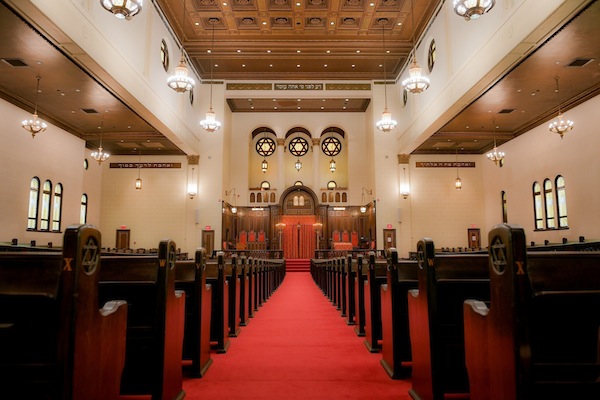
Montreal’s Congregation Shaar Hashomayim has been at its Kensington Avenue home for 100 years. (photo by Lainie Berger / unsplash.com)

Montreal’s Congregation Shaar Hashomayim is 176 years old – and it has been in its current building for 100 years now. Among those who have attended the shul over its long history are Rav Abraham Isaac Kook (who was chief rabbi of British Mandate Palestine), former prime minister Pierre Elliott Trudeau and current Prime Minister Justin Trudeau, legendary musician Leonard Cohen and various members of the Bronfman family. Recently, the historic congregation made history, when it hired Rabba Rachel Kohl Finegold, the first Orthodox woman in Canada to become ordained.

“It remains a traditional synagogue that follows traditional Jewish law,” Finegold told the Independent. “Me being the first female member of the clergy may have been significant, but it only did so in complete consistency with halachah (Jewish law).”

Finegold was among the first group of female students to graduate from Yeshivat Maharat, which is located in the Bronx, N.Y., in 2013. She has chosen as her title the term rabba, although female rabbis exist in other streams of Judaism.

“I walk up to the bimah [pulpit] like my male colleagues, but I go back and sit in the female section, because our building is 100 years old and the bimah resides in the central/men’s part of the sanctuary,” she said. “That is just what the architecture allows.”

Shaar Hashomayim split off from Congregation Shearith Israel (also known as the Spanish and Portuguese Synagogue of Montreal) in 1846. Ashkenazi members – English, German and Polish Jews – wanted to practise rituals and observances more akin to what they were familiar with, rather than what was traditional for the Sephardim. In September 1922, Congregation Shaar Hashomayim moved to 450 Kensington Ave. in Westmount, where it resides to this day. After the Second World War, a school was added to accommodate the new families who had joined the congregation. Further expansion happened in 1967.

“This is among the most grand of Montreal’s synagogues. Their choir is simply like no other and the sound permeates the walls throughout during services,” said Lucy Verebes Shapiro, who, while not a member of Shaar Hashomayim, has visited the shul many times. “There is a notion of great importance about all that transpires within,” she said.

The synagogue cemetery also gets visitors, Jewish and non-Jewish, who are attracted by its denizens.

“I’m a Leonard Cohen fan and visit the cemetery every year on the anniversary of his death,” said Marta Etynkowski. “I’ve never met him, but his poetry and music have helped me through many deep, private, emotional moments throughout my life and it’s one of my biggest regrets that I never saw him while alive. It has become a bit of an annual tradition for many of his fans to pay their respects – some people leave mementos, some play his music there, others just have a private moment in front of his grave. It’s quite beautiful.”

Shaar Hashomayim has a long and rich music tradition. The services are centred around a cantor, who is accompanied by an all-male choir, the origin of which dates back to 1887.

Its museum – the Edward Bronfman Museum – holds much Judaica, including a shofar from Yemen and a few books that are centuries old. It features rotating exhibits and is open to the public.

“In the wake of the COVID pandemic, people often ask, are synagogues still relevant? I think that is because there is a misconception that synagogues are just a place of prayer alone,” said Finegold. “However, many synagogues, and ours in particular, offer a connection to community – that’s something people want. After being isolated and at home for so long, to know that there is a place that has so many doorways to access, is something that will keep the relevance and people coming in for years to come.”

Avi Kumar is an historian and freelance writer. He has lived in six countries and speaks 10 languages. His work has been published in many countries, from his native Sri Lanka to Israel and Ireland, and he has written on a variety of topics, including history, wildlife and linguistics.

Format ImagePosted on April 8, 2022April 7, 2022Author Avi KumarCategories NationalTags Air Canada, anniversary, history, Judaism, Montreal, Shaar Hashomayim

Again: war triggers memories

Again and again the world does not learn. The ego of dictators and high-ranking politicians is inflated, bordering on insanity. There are many conflicts in the world, but it is Russia’s war on Ukraine that I’m thinking of at this moment.

Who is suffering from all this? The mother with her scared child in her arms, the father who is forced to stay behind and fight, the old and frail, the children in the orphanage who have nowhere to go, the 36-day-old baby boy who does not have yet an identification paper, a name of his own. Who is suffering? The expecting mother who is running, injured, between the ruins of the hospital; the children, scared, hiding in the bomb shelters, hearing explosions and not knowing if they will have a home to return to.

Again and again, people are running in fear, looking for safe shelter. All around them, shelling, sirens, bombardment, hundreds of tanks parading on main city streets, explosions, ruins and distraction.

All this is taking me back decades to another time, the Second World War: Romania, 1940. It triggers memories of my early childhood journey of displacement, fear, cold and hunger. Then 2 years old, my family and I – and thousands of other Jews from northern Romania – were driven out of our homes to the unknown. For one year we were forced to live in a ghetto in a city called Czernowitz (now in Ukraine) in terrible conditions.

After one year, the ghetto was dissolved and we were forced for days to walk by foot in deep mud, carrying bundles of our meagre belongings on our backs toward an area called Transnistria. Long lines of frightened people, old and young, crying babies, the sick and those with disabilities. Those who could not walk were left behind or shot. The Romanian or German soldiers riding on their horses where shouting and beating up anyone who did not comply with their orders.

They forced us to walk from village to village until we arrived in a place called Djurin, where we settled down. There, we lived for four years in terrible condition. My father was taken from us to a work camp. My mother collected dry wood bunches from the nearby forest and exchanged them for food with the Ukrainian women who felt sorry for us. Toward the end of the war, my mother was injured in a bombardment when the Germans were retreating.

I am glad that I was too young to remember most of my fears, but I can’t escape the ripples of horror from those times. They are engraved in my psyche, in my pores. I tremble now when I see the young children on the TV screen with their big, scared eyes. Maybe they are hungry, cold or frightened. I wish I could hug and console them and feed them with my special chicken soup.

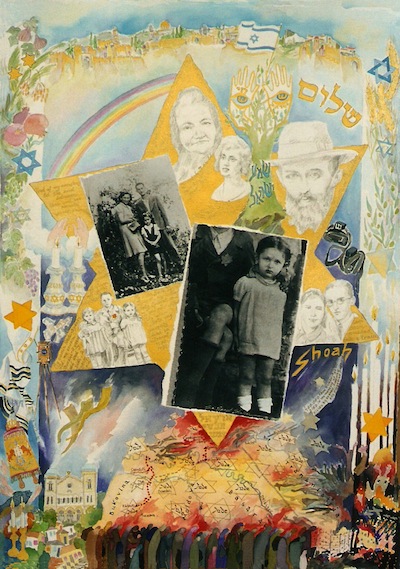
image - “Earth Don’t Cover Their Blood” by Sidi Schaffer, Gesher Project, 1998, mixed media
“Earth Don’t Cover Their Blood” by Sidi Schaffer, Gesher Project, 1998, mixed media.

For us, there was no place to seek shelter, nobody wanted us, and nobody cared. The world was silent to our plight. We were denied refuge from most countries. We should remember the destiny of the St. Louis ship, which carried Jewish refugees trying to escape the terror of the war in Europe but was not allowed to enter Cuba, the United States or Canada. The ship had to return to Germany, where 254 of the passengers were murdered by the Nazis. Nor should we forget the ship Struma’s disaster – it was torpedoed and sunk with 800 Jewish refugees, who were on their way from Romania to Palestine. We should not forget Canada’s Frederick Blair, who was in charge of the immigration branch at the time, or then-prime minister William Lyon MacKenzie King’s immigration policy “None is too many,” just when the Jews of Europe were in despair and looking for shelter.

War is evil, then and now and always. Still, I can’t stop being amazed at the differences I see in the world’s reaction of kindness and compassion toward the Ukrainian refugees these days. Moldova, one of the poorest countries in Europe, Poland, Romania and Germany – all have opened their gates with outstretched arms to help the tired mothers, scared children, orphans, the sick and the old. The world’s reaction shows me that the world is changing – including Canada – and that gives me hope.

Israel is bringing in thousands of people from the war zone. They give humanitarian assistance wherever needed. Synagogues in Ukraine, and Jewish congregations from around the world, help bring people to safety, like the Odessa orphanage children that were taken to Berlin.

Still, millions of people suffer because of politics and a madman who wants to expand his territory and his pockets.

I wish that we had in our camps some support, food and warm clothing, medical attention and safety. For us, the world was blind. Only the ones who survived live to tell.

We child survivors are now home for one another.

Sidi Schaffer was born in northern Romania. In 1940, she and her family were put into a ghetto in Czernowitz and, one year later, they were driven toward a concentration camp named Djurin, in northwestern Ukraine. There, in terrible conditions, they survived for four years. In 1945, they returned to Romania and, in 1959, they immigrated to Israel, where she received her degree in art education. In 1975, with husband David and their three sons, she came to Canada. In Edmonton, she went back to her studies and graduated with a bachelor of fine arts from the University of Alberta. In 1998, she and her family settled in Vancouver. Schaffer is a proud member of the Child Survivor Group of Vancouver.

Posted on April 8, 2022April 7, 2022Author Sidi SchafferCategories Op-EdTags child survivor, history, Holocaust, politics, refugees, Ukraine, war
Praying for family in Ukraine

Praying for family in Ukraine

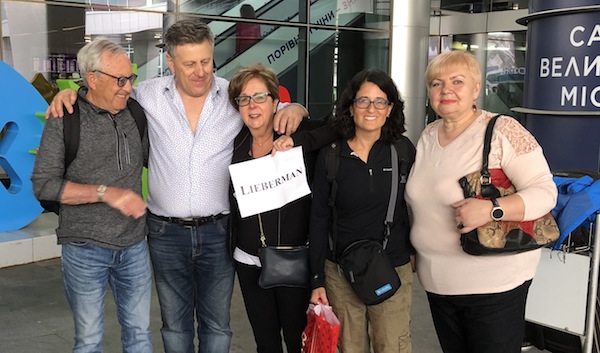
Left to right: Lucien, Grisha, Carole, Leanne and Svetlana at the airport in Kyiv, Ukraine, in 2019. (photo from Carole Lieberman)

My husband Lucien and I have been following the horrific invasion of Ukraine by Russia with particular interest. In 2019, we had the wonderful opportunity of traveling to Kyiv to meet Lucien’s first cousin, Grisha Lieberman, and his family.

Grisha’s father Sam had immigrated to Canada in 1923 and, after spending several years on the family farm in Rumsey, Alta., and later in Calgary, unfortunately Sam returned to Russia in 1928 to escort his parents, who were unhappy in Canada.

Sam had planned to return to Canada, but, after the war, ended up in the Gulag for close to 10 years. At age 57, truly a broken man, Sam met and married Rosa, a Jewish woman, and their son Grisha was born in 1958. We searched for the family for many years and finally contacted them in 2018.

Following our weeklong stay with Grisha and his wife Svetlana in May 2019, we formed a close bond. We are in touch with them often and enjoy regular Zoom visits despite language differences. Our daughter Leanne traveled with us on our 2019 visit, and we were all welcomed warmly.

Svetlana and Grisha have one son, Stanislaus, who is a lawyer in Kyiv. Their daughter, Tina Karol, a famous singer, performs at large concerts in Ukraine and travels the world to perform. Her tour to several U.S. cities, scheduled for this month, was recently canceled.

We follow details of the attack by the Russians on Ukraine closely and value every message that we receive from our cousins. Svetlana messages us regularly and writes that they are in the city of Ivano-Frankivsk, in western Ukraine, where they are staying in an apartment and have access to limited items. They did not want to leave Kyiv and did so only at the last minute by evacuation train. They categorically refuse to leave their cherished land of Ukraine.

She writes: “Fascist Russia wants to destroy our state, just as Hitler tried to destroy other countries in 1941. But Ukraine gives a worthy rebuff to the aggressor…. We believe that Ukraine will win back its freedom and that we will welcome you back to beautiful Kyiv.” She writes that they are getting used to the air raid strikes that occur two or three times each day. Their son Stanislaus is with them in western Ukraine, now in possession of a gun that was provided to him by the government to aid in Ukraine’s defence.

Their daughter Tina left Kyiv before the Russian aggression. When we were there, we clearly remember Tina telling us that she kept a suitcase packed in case of an urgent situation. She is currently in Warsaw; her 16-year-old son goes to school in England.

Last week, we watched with tears as Tina was interviewed on CNN. And, at a recent charity concert in Lodz, Poland, called Together with Ukraine, Tina was one of the performers. It was touching to see her sing with 7-year-old Amelia, who had previously sung “Let it Go” while hiding in a Ukrainian bomb shelter, before making it safely to Poland. Tina performed at a No War telethon attended by the leaders of European countries, the United States and Canada. And, on March 28, she performed in Israel at a charity concert, with funds being raised for medical needs.

We continue to pray for our family and for all Ukrainians, and for a peaceful resolution and a free Ukraine.

Carole Lieberman, a longtime Vancouver resident, is originally from Montreal. She is a mother of three, grandmother of four, and has enjoyed selling Vancouver real estate for 32 years. You can read her article about her family’s 2019 visit to Ukraine at jewishindependent.ca/meaningful-family-trip-to-kyiv.

Format ImagePosted on April 8, 2022April 7, 2022Author Carole LiebermanCategories Op-EdTags family, Kyiv, Russia, Ukraine, war

Posts pagination

Previous page Page 1 … Page 175 Page 176 Page 177 … Page 662 Next page
Proudly powered by WordPress