Skip to content
  • Home
  • Subscribe / donate
  • Events calendar
  • Business Directory
  • FAQ
  • News
    • Local
    • National
    • Israel
    • World
    • עניין בחדשות
      A roundup of news in Canada and further afield, in Hebrew.
  • Opinion
    • From the JI
    • Op-Ed
  • Arts & Culture
    • Performing Arts
    • Music
    • Books
    • Visual Arts
    • TV & Film
  • Life
    • Celebrating the Holidays
    • Travel
    • The Daily Snooze
      Cartoons by Jacob Samuel
    • Mystery Photo
      Help the JI and JMABC fill in the gaps in our archives.
  • Community Links
    • Organizations, Etc.
    • Other News Sources & Blogs
  • JI Chai Celebration
  • JI@88! video

Recent Posts

  • SFU honours Gloria Gutman
  • Lifting people’s spirits
  • Wedding a ray of light
  • Indigeneity and Zionism
  • Rule of law broken: councilor
  • Football and its roles
  • The burden of defence
  • Fish Café returns after fire
  • All right in what goes wrong
  • Nuns & mermaids at TUTS
  • Camp offers holiday retreat
  • Students and mentors inspire
  • Once-in-a-lifetime trip
  • 100 dancers, one heart
  • Money for the sciences
  • What “Jewish food” means
  • Have a cookie, schnitzel too
  • Federation now across BC
  • Israel fighting for its existence
  • Deal strengthens Iran
  • Patriotic belonging diminishes
  • A campaign to engage
  • Upstanders’ first live event
  • Responding to Carney
  • Having your own home
  • Music a family tradition
  • Musical to warm heart
  • Community milestones … June 2026
  • Sharing her passion for Israel
  • Or Shalom reopens its doors
  • JFS from past to future
  • Need holistic approach
  • Sharing stories, advice
  • Journalist shares fears
  • Skills to live together
  • Road to independence

Archives

Follow @JewishIndie
image - CJN box ad Rockowers 2026

Category: Local

Robinson out of cabinet

Robinson out of cabinet

Screenshot of the Jan. 30 B’nai Brith Canada panel discussion during which Selina Robinson spoke her controversial words.

Selina Robinson, who has called herself “the Jew in the crew” that is British Columbia’s cabinet, is out. The minister of advanced education and future skills resigned Monday after a torrent of protest following comments she made last week during a B’nai Brith Canada online panel discussion, in which she referred to the area that would become Israel as “a crappy piece of land.” 

Premier David Eby announced Robinson’s departure from cabinet, saying her comments were “belittling and demeaning.”

“The depth of work she needs to do is substantial,” said Eby. “What has become apparent is the scope of work, the depth of the hurt. As a result, we came to the conclusion together – she needed to step back.”

The announcement came after protesters threatened to disrupt New Democratic Party events, forcing the cancelation of a major fundraising gala Sunday night and a government news conference Monday. A network of Muslim societies issued a statement over the weekend that no NDP MLAs or candidates would be permitted in their sacred spaces until Robinson was removed from cabinet.

Robinson will not run for reelection as member of the Legislative Assembly for Coquitlam-Maillardville, a decision she says she made earlier.

Response from Jewish community leaders was fast and critical.

“The removal of MLA Robinson, who apologized for her comments and promised to do better, sends a chilling message that Jewish leaders are held to a different standard than non-Jewish ones,” said Nico Slobinsky, Centre for Israel and Jewish Affairs’ vice-president for the Pacific region, in a statement. “In the past, when BC NDP politicians and staff have made antisemitic comments, the Jewish community has been asked to accept their apologies and – on every occasion – we have. As a show of goodwill, we never publicly demanded their resignations and, instead, placed our trust and faith in the premier and the BC government when he said that his team would learn from the incidents and not repeat their egregious errors.

“When, on International Holocaust Remembrance Day – a day to commemorate the six million Jews slaughtered in the Second World War – one of Premier Eby’s staff tweeted that ‘we stand with the Muslim community,’ we were asked to accept that stunning gaffe as a mistake. And we did.

“We were also asked to work with a Parliamentary Secretary for Anti-Racism Initiatives who made remarks that were deeply hurtful to our community,” Slobinsky said. “And, despite her repeated offensive actions, she continues to remain in her role.”

This reference to Vancouver-Kensington MLA Mable Elmore alludes to a history of problematic remarks, from claiming before her election that her union was dominated by “Zionist bus drivers” to more recently using a speech in the legislature ostensibly about transgender rights to call for Israel to end the war with Hamas. 

Slobinsky added: “Today, as the Jewish community in BC is confronted by an alarming increase in antisemitism and by frequent pro-Hamas protests calling for the Jews of Israel to be eradicated, the loss of MLA Robinson is especially distressing, as we no longer have our strongest advocate – who understands the challenges and sensitivities of the Jewish community – at the table.

“The community is both offended and hurt by what has happened to a great ally and British Columbian, and it has seriously undermined the confidence of the Jewish community in the Government of British Columbia. Given this obvious double standard and loss of Jewish representation in cabinet, Premier David Eby must share what steps he is going to take to repair the relationship and restore the community’s trust in him and his government.”

“Facing an unprecedented increase in hate, the Jewish community in BC is hurting,” Ezra Shanken, chief executive officer of the Jewish Federation of Greater Vancouver, said in a statement. “The level of online vitriol aimed at Selina Robinson leading up to her resignation – which mirrors the reality faced by much of the Jewish community since the Oct. 7 terrorist attacks committed by Hamas – shows worrying trends in our public discourse. We are saddened to have lost one of the strongest advocates fighting against antisemitism from within cabinet – especially at a time when it is needed most.

“It is shameful that Premier David Eby has bowed to pressure from a loud minority whose campaign to discredit MLA Robinson was centred in anti-Jewish bias and lacked the offer of grace they demand when others falter.

“We need stronger leadership from this government to bring our communities together – not divide us,” said Shanken.

The Rabbinical Association of Vancouver sent a letter to the premier, signed by nine rabbis, expressing disappointment.

“We believe you have capitulated to a small but loud group of people,” the letter read. “Now it feels like you have given in to bullies for political expediency. We will remember this day the next time you ask for our trust and support.”

At least one voice in the Jewish community was pleased with Eby’s decision. “The decision to remove former MP [sic] Selina Robinson from office is a crucial win for organizers including IJV-Vancouver and our allies, who stood firm and united against anti-Palestinian racism,” tweeted Independent Jewish Voices. “The rhetoric we all heard was shameful. Thank you to all who helped hold BC accountable.”

B’nai Brith Canada told the Independent they are grateful for the work that Robinson undertook to combat antisemitism on BC’s post-secondary campuses as minister. 

“It is unfortunate that comments she made last week have resulted in her feeling compelled to step down from her ministerial position,” Richard Robertson, director of research and advocacy for B’nai Brith Canada, said in an email. “We believe her apology was sincere and that MLA Robinson will work to regain the confidence of the constituents who were offended by her remarks.” 

“B’nai Brith Canada believes that this incident underscores the need for the province to take further steps to combat racism and hatred,” said Robertson. “One such step, amid rising levels of antisemitism, is for the BC government to adopt the IHRA definition of antisemitism.” 

Format ImagePosted on February 9, 2024February 8, 2024Author Pat JohnsonCategories LocalTags British Columbia, B’nai Brith Canada, David Eby, Israel-Hamas war, NDP, politics, Selina Robinson
United in grief and resilience

United in grief and resilience

Bassem Eid, right,  addresses those who gathered Feb. 4 for the event United, as fellow speakers Virág Gulyás, left, and Yuval David listen. (photo by Pat Johnson)

Yuval David knew 32 people who were murdered on Oct. 7. Among them were 10 friends who gathered to celebrate a birthday and headed to the Nova music festival. 

“All 10 …” he said, struggling to maintain his composure. “Not one made it out of that celebration.”

David was speaking Sunday night at United, one of the largest community gatherings since the events of Oct. 7 and probably since before the pandemic. About 800 people gathered at Temple Sholom, where three diverse speakers brought their perspectives to an audience of Jews and non-Jewish allies.

The Feb. 4 afternoon event was the brainchild of Megan Laskin, a community leader who organized a similar event last November geared to women, who were asked to bring their non-Jewish friends; hundreds attended. Sunday’s gathering was presented by Jewish Federation of Greater Vancouver, Jewish National Fund of Canada, StandWithUs and Temple Sholom. David, an American actor, filmmaker and activist, who is gay, was joined by Palestinian advocate and media commentator Bassem Eid, and Virág Gulyás, a Hungarian-born former diplomat who grew up with what she described as typical antisemitic stereotypes and has become a leading voice for the Jewish people and Israel. The audience alternated from rapt silence to thunderous ovations. 

Since Oct. 7, David has been thinking about his grandparents, Holocaust survivors who saved others in the camps. His grandfather was known as the “Magic Man” for somehow obtaining desperately necessary medications and helping others out of life-threatening scenarios. 

“When I was a little child in Israel, I couldn’t walk more than a few steps with them in public without somebody rushing up not only to them but to me, to say, ‘Do you know who your grandfather is? Do you know who your grandmother is?’ And they would lean down to me and they would say, ‘If it wasn’t for what your grandparents did, I would not be here today,’” he said. “As a little child, holding their hand, walking in the street, I knew that I was walking with heroes. I knew that I was walking in the footsteps that I must walk someday.”

His grandparents instilled chutzpah in him, he said, for precisely this moment in history.

“I was raised to understand what it means to have chutzpah because I was raised to understand what it means to not have chutzpah,” he said. “I was raised to understand what ‘never again’ actually means.”

His worldview and his Zionism were reframed by Oct. 7, he said.

“But it was also reframed by Oct. 8,” he said, referring to global reaction to the events of the day before. Not only did he lose friends on Oct. 7 and others who have died in battle during the war, but another friend, who survived the Nova festival, recently committed suicide because she could not live with the memories. Closer to home, in a different way, he says he has lost most of his friends in the United States.

“I also lost two-thirds of my friends in my life in America who revealed themselves,” he said. “Revealed that they were not my true friends, revealed that even though they came to my Shabbat dinners and they came to my film screenings and they were plus-ones at fabulous events, especially if they were gift bags … crickets. Where are they?”

Some even sent him photographs of themselves protesting against Israel.

“These aren’t pro-Palestinian marches,” he said. “Whoever calls them pro-Palestinian marches is a liar. These are pro-Hamas, pro-terrorism, anti-Palestinian, anti-Jewish and anti-democratic events, he said.

“I used to be woke,” he said of his years as a progressive activist. “Now I’m awake.” He calls his former allies who condemn Israel and side with Hamas “fauxgressives.” 

“If you are going to be ‘pro,’” he said, “then do something good for the people. If you are pro-Palestinian, help create businesses, help create schools, help refugees – do something that helps somebody’s life. But, if all of your fake ‘pro’ activity is to be ‘anti,’ is attacking, is subjugating, is belittling, then you are a racist bigot. Shame. We must name and shame.”

Gulyás is an academic and former European Union diplomat who devotes much of her time contesting anti-Israel and antisemitic narratives. She spoke of how she confronted the anti-Jewish biases she was raised with in Hungary. She noted that anti-Israel street eruptions began on Oct. 8, before Israel’s military had responded to the pogrom – worldwide, she said, activists were prepared.

“They had all the slogans, all the flyers, all the social media posts, all the hashtags ready,” she said. On the other hand, most Canadians and others in the West do not subscribe to the hatred and anti-Israel vehemence seen on the streets, yet remain silent.

Would large numbers of people have reacted as street activists and social media keyboard warriors have if any other sovereign country were invaded by terrorists with the intention to mass murder, she asked.

“Unless you’re a psychopath, you wouldn’t,” she said. “But, somehow, when it comes to Jews and Israel, we remain silent, we look at the other side and with this we normalize Jew-hatred.”

Eid is a rare Palestinian voice in international media against the defamation of Israel and the corruption and ideology of the Palestinian regimes. He shared a story of a friend who lives in the northern Gaza Strip, who told Eid that Hamas representatives knocked on his door at night. They told him they wanted to pay him $50 a month – a windfall – to build tunnels under his home. Eid asked him how he replied to the request.

“He said, ‘My answer was, “Please try to build four tunnels and give me $200 a month,’” Eid recounted. This is how Hamas exploits the poverty of its people to meet its objectives, he said.

The high Palestinian death toll, Eid told the audience, is due partly to Hamas officers forcing civilians back into the homes and neighbourhoods the Israel Defence Forces has warned them to evacuate.

At the expense of millions of dollars in foreign aid, Hamas has built hundreds of kilometres of terror tunnels, he said. “But, in the meantime, Hamas didn’t build one shelter for their own people.”

When you ask Hamas why they don’t protect their people, Eid said, they reply that keeping Palestinians safe is the responsibility of the United Nations and the Israelis.

Eid blamed the United Nations Relief and Works Agency for Palestine Refugees in the Near East (UNRWA), which has recently been under fire for its employees’ involvement in terrorism, for holding Palestinians hostage for more than 75 years.

“Peace is possible between the Israelis and the Palestinians,” said Eid. “But it is impossible while Hamas is still ruling the Gaza Strip. This is the first thing that we should have to get rid of. The day after the war, the first thing is how to trash UNRWA from Gaza.”

Temple Sholom’s Rabbi Dan Moskovitz opened the event. Laskin, who conceived the event, spoke of the grief of this time.

“As the war goes on and more innocent lives are lost on both sides, it is hard,” she said. “But let me be clear. We can strongly support Israel and the Jewish people and also express sympathy for the innocent Palestinians who are suffering. They are not mutually exclusive. We are mourning for all innocent lives lost. You can take a side though, and that side is against Hamas.” 

Format ImagePosted on February 9, 2024February 8, 2024Author Pat JohnsonCategories LocalTags Bassem Eid, Israel-Hamas war, Megan Laskin, Oct. 7, resilience, Virág Gulyás, Yuval David
Commemorating the Shoah

Commemorating the Shoah

Richmond RCMP Chief Superintendent Dave Chauhan, left, lights memorial candles with survivors David Schaffer, Sidi Schaffer, Amalia Boe-Fishman and Ilona Mermelstein, and Richmond Mayor Malcolm Brodie at a commemoration of International Holocaust Remembrance Day, at the Bayit, in Richmond, on Jan. 25. (photo by Pat Johnson)

Amalia Boe-Fishman was born in Leeuwarden, in the Netherlands, days before the start of the Second World War. Her mother’s parents and siblings had made aliyah to Israel in the early 1930s, but her mother, Johanna, stayed behind to pursue a career in nursing. Working in the Jewish hospital, she met Arnold van Kreveld, a patient who had been in a motorcycle accident, and they fell in love.

The couple married in 1935 and their first child, David, nicknamed Dik, was born in 1937. Amalia arrived Aug. 23, 1939. 

“We had a good life, family, friends and neighbours,” Boe-Fishman said. But then, in May 1940, the German army invaded the Netherlands. 

Boe-Fishman shared the story of her family’s survival at a commemoration of International Holocaust Remembrance Day, at the Bayit, in Richmond, on Jan. 25.

After the Nazis overran the Netherlands, her father’s parents and siblings were deported to Westerbork, a Nazi transit camp in the Netherlands, on Sept. 3, and on to Auschwitz, where they were immediately murdered, on Sept. 7. 

Her father was a scientist and his young research assistant, Jan Spiekhout, a member of the Dutch resistance to the Nazis, would save the lives of the entire van Kreveld family.

“Jan Spiekhout found immediately an address for my father to go into hiding,” Boe-Fishman recalled. “He then found different hiding addresses for my mother, another address for my brother and then one for myself.”

Amalia was not yet a year old and her parents knew they might never see their children again.

“My mother gave me a special doll to keep me company and a letter I brought with me so my new family would understand her little girl a little better,” said Boe-Fishman. “In the letter, [she] told them how fond I was of my older brother Dik. If my parents would not survive the war, the Holocaust, to send us together to Israel to stay with one of my mother’s sisters.”

Amalia was taken to the home of Spiekhout and his parents, Durk and Froukje Spiekhout. The crowded and deeply religious Dutch Reformed household already had six children, of which Jan was the eldest. The younger Spiekhout children were told that Amalia was the daughter of a sick aunt in Rotterdam. 

“They became my family,” said Boe-Fishman. “Father Spiekhout took a great risk bringing me into his household. He was a policeman. After all, policemen were supposed to work for the Nazis and round up Jews.”

She learned later that he instead warned Jewish neighbours of impending Nazi roundups.

“My father, typically Jewish looking, with dark hair, went from hiding place to hiding place – at least 26 different addresses,” Boe-Fishman said. “All at night and all arranged by Jan Spiekhout. My mother, not so typically Jewish looking, did not need to flee so often. 

“As for myself, I don’t know what I remember or what I was told later on,” she said. “I was not allowed to go outside and I had to stay indoors for three years.”

On April 15, 1945, Canadian forces liberated Leeuwarden.

“What did that mean for me?” she asked. “Liberation should have been a really happy time for me. I was told that I could go outdoors. I didn’t know what to expect, what was waiting for me outdoors. Indoors had become my entire life. Indoors was where I felt secure and safe. Indoors was all I knew.”

Greater change was to come.

“I was told I had a real family and I was told I was going home,” she said. “But who were those people, who were those strangers? I did not want to leave the family Spiekhout. They were my real family and I loved them. My own father and mother were patient with me. They would come over to visit and I would run away or hang onto Mother Spiekhout screaming, ‘I don’t want to go home!’”

Dik, who was now 7-and-a-half, was also a stranger to little Amalia. Most incredibly, and at profound danger, a younger sibling had been born in hiding, a baby named Jan, in honour of the family’s saviour.

The name Jan has profound resonance in the family. Amalia’s oldest son, who joined her at the commemoration, was born in 1962 and is also named Jan.

That the entire immediate family had survived the Holocaust – had grown, in fact – was almost inconceivable. Dutch Jews had one of the lowest survival rates during the Holocaust. The van Krevelds owed everything to the Spiekhout family who, in 2008, were recognized as Righteous Among the Nations by Yad Vashem’s Holocaust Martyrs’ and Heroes’ Remembrance Authority. Boe-Fishman and her children attended a ceremony honouring the Spiekhouts in The Hague in 2009. 

In 1961, Boe-Fishman (then van Kreveld) went to Israel trying to find her Jewish identity. The Eichmann trial was taking place at the time, which cracked open consciousness of the Holocaust not only for most of the world, but for survivors, including her family, who had remained almost entirely silent on the subject. In Israel, she met and married a Canadian Jew from Vancouver and settled here becoming, among other things, a devoted speaker to class groups and others about her Holocaust experiences.

photo - Amalia Boe-Fishman and son Jan Fishman. Boe-Fishman shared her survivor experiences at the memorial event
Amalia Boe-Fishman and son Jan Fishman. Boe-Fishman shared her survivor experiences at the memorial event. (photo by Pat Johnson)

Rabbi Levi Varnai of the Bayit contextualized Boe-Fishman’s presentation.

“I think that this year – every year, but this year maybe more than any year – with all the craziness in the world, this event is even more important than ever before,” he said.

Keith Liedtke, president of the Bayit, served as master of ceremonies and credited Michael Sachs, now regional director for Jewish National Fund of Canada, for starting the tradition five years ago of inviting the mayor to recognize Holocaust Remembrance Day annually. 

Cantor Yaakov Orzech chanted El Moleh Rachamim. Richmond’s Mayor Malcolm Brodie read the proclamation and reflected on Boe-Fishman’s experiences. RCMP Chief Superintendent Dave Chauhan joined the mayor and survivors in lighting memorial candles. Liedtke read a message from Steveston-Richmond East Member of Parliament Parm Bains. Kelly Greene, member of the Legislative Assembly for Richmond-Steveston, brought greetings from Premier David Eby. Also in attendance were Richmond South Centre MLA Henry Yao and Richmond city councilors Chak Au, Andy Hobbs and Bill McNulty.

In addition to the Bayit, the event was presented with the Vancouver Holocaust Education Centre, Centre for Israel and Jewish Affairs, Kehila Society of Richmond and Jewish Federation of Greater Vancouver. 

Format ImagePosted on February 9, 2024February 8, 2024Author Pat JohnsonCategories LocalTags Amalia Boe-Fishman, Bayit, history, Holocaust, Levi Varnai, survivor

More aid sent to Israel

The Jewish Federation of Greater Vancouver has made a new transfer of more than $1 million from its Israel Emergency Campaign (IEC). This is its fourth transfer of funds and brings the total transferred to Israel to approximately $7.5 million.  

It has been 125 days since Oct. 7 and Israel is facing challenges that continue to evolve and deepen as time goes by and the war continues. The IEC allocations committee, chaired by Stephen Gaerber, has reviewed funding proposals with great care to ensure that this latest round of allocations addresses the developing needs on the ground.

To give local community members a sense of what Israelis are facing at this stage, Federation asked Rachel Sachs, director of its Israel office, to provide this summary: 

“As the army continues to fight in Gaza, the loss of soldiers’ lives and the ongoing state of captivity of 136 Israelis in Gaza is a growing and unbearable burden that is taking its toll on Israelis across the country. In the last few weeks, many reservists have been released from duty, with the understanding that they may get called up again. Their return home, after months in the battlefield, has sparked a new set of challenges in their families, their professional paths, academic journeys, and more. 

“The evacuation of approximately 130,000 Israelis from the north and the south continues. Some remain housed in hotel rooms across the country, often miles away from home. Some residents of these frontline communities remain determined to return home the minute they will be allowed to, some remain determined that they will never go back, and others are trying to determine what it will take for them to return, both in terms of their sense of security, and actual security itself.  

“Many of the devastated communities of the Gaza Envelope have either found, or are seeking, sites to which they can relocate together. Until their home kibbutzim are rebuilt, that is. They have been taken in by communities across the country, where they are, hopefully, experiencing a small sense of home for the first time since they fled their real homes months ago. 

“The mental and emotional toll of this extended situation is growing, as the need for ongoing care and therapy for survivors, bereaved families and evacuated communities continues in multiple locations across Israel. 

“In our partnership region of the Upper Galilee, the state of emergency continues.

“There is great uncertainty and concern over when the ‘day after’ will be and what will it look like. There is ongoing outreach to evacuated residents, with the understanding that community resilience is a critical factor in bringing people back home and offering them a hopeful future, together, in the north.”

Funding for this round of allocations is focused in four areas: emergency and humanitarian needs, respite for evacuees, economic support, and targeted populations. The following organizations are recipients of this round of IEC allocations:

Adler Institute: support programs for returning reservists and their families to address the specific needs related to returning from service, as defined by the reservists themselves.

Haruv Institute: a leader in training professionals who treat children suffering from trauma, abuse, and neglect, the institute is providing training for Eshkol Region healthcare professionals who are treating children.

Yeelim Centre at Ein Yael: nature therapy for survivors of the Nova festival, families of soldiers, evacuees, and more.

Ziv Medical Centre: funding to expand the centre’s emergency mental health work, so the hospital – itself in the line of fire and operating in emergency mode – can respond to the evolving needs and growing numbers of patients.

Kiryat Shmona Psychiatric Unit: currently operating from a temporary location in Tiberias, funding is to build a safe room at the Kiryat Shmona facility to ensure they can keep up treatment with patients when they return home.

Upper Galilee Hospice: support for terminally ill evacuated patients and their caregivers.

Yozmot Atid: support for the growing number of businesswomen who have been evacuated, some of whom also have spouses who have been serving as reservists for the past three months.

Israel Diving Federation: therapeutics diving excursions for survivors and evacuees from both northern and southern Israel.

Taglit-Birthright Israel: week-long respites for residents of the Eastern Galilee.

Road to Recovery: transportation for evacuees from across the country to reach their treatment sessions in their home regions, which are now often miles away.

Hannaton Education Centre: support for Kibbutz Hannaton to continue to house families of asylum seekers from Sderot, who were evacuated and have nowhere else to go.

Beit Issie Shapiro: rehabilitation and therapy programs for displaced families of individuals with disabilities.

To donate to the Israel Emergency Campaign and for a full summary of the support given to date, visit jewishvancouver.com. 

– Courtesy Jewish Federation of Greater Vancouver

Posted on February 9, 2024February 8, 2024Author Jewish FederationCategories LocalTags fundraising, Israel, Israel Emergency Campaign, Jewish Federation of Greater Vancouver, philanthropy, Rachel Sachs
Games help ALUMA counseling centre

Games help ALUMA counseling centre

Some 130 women came out to play mahjong, bridge or canasta at National Council of Jewish Women Canada, Vancouver section’s Games Day on Feb. 15, raising almost $8,000 for the Israeli nonprofit ALUMA Counseling Centre. (photo by Adele Lewin Photography)

Last month, 130 women gathered for a Games Day Fundraiser for Israel, hosted by National Council of Jewish Women Canada, Vancouver section. Almost $8,000 was raised for the Israeli nonprofit ALUMA Counseling Centre.

The afternoon event on Jan. 21 was held at the Jewish Community Centre of Greater Vancouver and featured mahjong, bridge and canasta, offering participants a chance to connect with one another, while raising funds for ALUMA, so that help can be provided to the many families who need to start the healing process from the Oct. 7 terror attacks.

ALUMA, also known as IFCA, Israel Family Counselling Association, was established in Tel Aviv in 1954 and joined forces with NCJWC in 1973, said NCJWC national president Linda Steinberg.

“Golda Meir had the idea of twinning Israeli organizations needing financial assistance with women’s organizations abroad,” explained Steinberg. Dorothy Reitman, as president of NCJWC at the time, was contacted and this twinning was arranged through Carol Slater, who then lived in Israel. Slater was the chair of NCJWC’s Israel project ALUMA for 15 years.

ALUMA is a centre for counseling and treatment of couples, families and individuals, regardless of their place of residence, origin, religion or economic circumstances. It was a pioneer institution, the first such centre in Israel, said Steinberg. Most people receiving therapy pay what they can, if anything, and the professional therapists are volunteers, receiving little if any remuneration.

Steinberg noted that ALUMA is dependent on donations and NCJWC is the only Canadian organization providing financial support for the nonprofit. National members have supported ALUMA through fundraising teas, brunches and other events, and by yearly contributions as NCJWC members.

Oct. 7 has increased the need for trauma support in Israel and ALUMA has developed several models to meet this growing need, said Steinberg. “Most recently, their therapists have been training and mentoring new volunteers to help.”

photo - Left to right are event co-chairs Lisa Boroditsky, Juleen Axler, Jordana Corenblum (NCJW Vancouver president) and Sandy Hazan. (Co-chair Jane Stoller is missing from photo)
Left to right are event co-chairs Lisa Boroditsky, Juleen Axler, Jordana Corenblum (NCJW Vancouver president) and Sandy Hazan. (Co-chair Jane Stoller is missing from photo.) (photo by Adele Lewin Photography)

Gadi Lifshitz, NCJWC’s contact and spokesperson for the staff at ALUMA, wrote a letter to Lisa Boroditsky, who was one of the chairs of the local games day event, along with Juleen Axler, Sandy Hazan, Lola Pawer and Jane Stoller. NCJWC Vancouver’s president is Jordana Corenblum.

“Dr. Orly Rubin, the director of the institute, and, on my own behalf, I want to thank your wonderful community for the continued contribution and support of ALUMA,” wrote Lifshitz. “First, I will tell you about a treatment process in which Dr. Rubin and I provided a group therapy to five friends in their 30s who, on that cursed Sabbath, simply decided to go to the kibbutzim that were under attack and help as much as they could,” wrote Lifshitz. “Without weapons and without orders from any official authority, they decided that they are going to help. During those hours, they witnessed terrible sights, helped evacuate the wounded and dead, and all this while helping each other and supporting each other.

“About two weeks after the events, they contacted us for help. We quickly developed for them a trauma intervention model for a group therapy. We accompanied them through several group and personal meetings until we felt that their emotional state had stabilized and that they could return to their day-to-day ‘life.’

“It was a very powerful process, which required a lot of commitment, sensitivity and thought from all of us,” wrote Lifshitz. “This is just one of the many examples of the effort we invest in ALUMA in supporting all the many trauma victims who contact us.

“We need your continued support in our journey to expand our services to those, the many, who need them and us today.”

To donate to the ALUMA Counseling Centre or other NCJWC projects, go to give-can.keela.co/NCJWCVAN. 

– Courtesy NCJWC Vancouver

Format ImagePosted on February 9, 2024February 8, 2024Author NCJWC VancouverCategories LocalTags ALUMA, counseling, fundraising, healthcare, Israel, Israel-Hamas war, mental health, National Council of Jewish Women, Oct. 7, trauma
Law seminar on antisemitism

Law seminar on antisemitism

At the daylong legal seminar being held at Congregation Beth Israel on Feb. 15, Howard Mickelson, KC, and Vancouver Mayor Ken Sim discuss the legal implications of adopting the IHRA definition of antisemitism. Mickelson, left, spearheaded the event.

Congregation Beth Israel will be holding a full-day seminar, titled The Legality of Combatting Antisemitism, on Feb. 15. Topics will include defining antisemitism, combatting and addressing antisemitism on campus and in the workplace, examining the Charter implications of fighting antisemitism and the constitutional implications.

“Attendees can expect a top-notch group of speakers providing legal insight on, and addressing, a critical issue of our current troubled times,” said Howard Mickelson, KC, of Gudmundseth Mickelson LLP, who is spearheading the seminar. Mickelson has been a lawyer for more than 30 years.

The daylong event takes place four months after the Hamas attacks on Israel that killed approximately 1,200 people and saw about 240 people taken hostage. More than 130 hostages are still in captivity, with at least 32 believed dead. Since Oct. 7, there has been a dramatic rise in hate crimes in Vancouver, as well as the rest of Canada. A disproportionate number of these crimes have targeted Jews. 

According to information released by the Vancouver Police Department (VPD) on Jan. 16, tensions from the Israel-Hamas war have fueled increases in protest activity and hate crimes in the city. Of the 47 antisemitic hate incidents reported to VPD in 2023, 33 occurred after Oct.7. In all, antisemitic incidents increased 62% in 2023 compared to 2022, when there were 29 incidents reported. 

“The topic of the seminar is a result of the rise after Oct. 7 of antisemitism,” Mickelson told the Independent.

Mickelson, along with Vancouver Mayor Ken Sim, will discuss the legal implications of adopting the International Holocaust Remembrance Alliance (IHRA) definition of antisemitism. Sim promised during his 2022 mayoral campaign to push for the adoption of the IHRA definition by the city and Vancouver city council voted for the definition shortly after he assumed office.

In 2016, the IHRA created a non-legally binding definition of antisemitism, which reads: “Antisemitism is a certain perception of Jews, which may be expressed as hatred toward Jews. Rhetorical and physical manifestations of antisemitism are directed toward Jewish or non-Jewish individuals and/or their property, toward Jewish community institutions and religious facilities.” 

Jewish groups are hoping that other jurisdictions, such as the provincial government, will follow Vancouver’s lead. In June 2022, former British Columbia Premier John Horgan issued his support of the definition in a letter. His successor, David Eby, has made several statements confronting antisemitism but his government has yet to adopt the definition. The federal government has adopted it, as have the provinces of Ontario, Alberta, Saskatchewan, Manitoba, New Brunswick and Newfoundland and Labrador. 

Rob Phillip, executive director of Hillel BC, Beth Israel’s Rabbi Jonathan Infeld and Dr. Jay Eidelman, PhD, who is a professor in the history department at University of British Columbia, will present the seminar’s opening session, What is Antisemitism?

Russell Brown, who served on the Supreme Court of Canada from 2015 to 2023, will focus on the Charter implications of combating antisemitism. Prior to his appointment to the Supreme Court, he was an associate professor and associate dean at the University of Alberta faculty of law and is the author or co-author of numerous legal works.

On the topic of Combating Antisemitism on Campus, one of the scheduled speakers is Prof. Cristie Ford of the Peter A. Allard School of Law at UBC. Colleges and universities across the province and the country have witnessed a sharp uptick in antisemitic incidents over the past four months. Jewish students have reported feeling unsafe on several campuses due to anti-Israel rhetoric and hostile behaviour from other students, as well as faculty.

The session Addressing Antisemitism in the Workplace is a roundtable moderated by Claire E. Hunter, KC. It features Reut Amit of Southern Butler Price LLP, Erin Brandt of PortaLaw and Abigail Cheung of Harris & Co. 

The final topic, Mooting the Constitutional Implications, will be taken on by Marshall Rothstein, CC, KC, Osler Russell Brown; S. David Frankel, KC; Geoffrey Cowper, KC, Fasken; and Greg Allen, Allen/McMillan.

About the seminar as a whole, Mickelson said attendees can expect “legal guidance in a variety of areas, such as employment, campus life and criminal law, to deal with the heightened levels of antisemitism post-Oct 7.

“It is, of course, highly distressing to our community and especially our children,” he added. “As a lawyer, this is the best way I and the others assisting me on this, particularly Claire Hunter, KC, can do something constructive and educational to feel less helpless.”

Mickelson noted that Congregation Beth Israel has put on other topical daylong continuing legal education seminars, with assistance and insight from Infeld, including two separate trips to Israel with members of the bench and bar.

The cost for the Feb. 15 seminar, which runs 8:30 a.m. to 4:30 p.m., is $360 for professionals and $180 for students. Breakfast, snacks and lunch are included. The event is worth six continuing professional development (CPD) credits, including two ethics credits. For more information, visit bethisrael.ca or write [email protected]. 

Sam Margolis has written for the Globe and Mail, the National Post, UPI and MSNBC.

Format ImagePosted on February 9, 2024February 8, 2024Author Sam MargolisCategories LocalTags antisemitism, Beth Israel, Howard Mickelson, law, Oct. 7

2024 public speaking contest

The Jewish Federation of Greater Vancouver’s Public Speaking Contest has been happening annually in Vancouver since 1989 and is open to students in grades 4 to 7. The registration deadline for this year’s event – which takes place March 7, 7 p.m., at the Jewish Community Centre of Greater Vancouver – is Feb. 26.

For the contest, students are asked to prepare a speech of three minutes or less, choosing from a variety of topics connected to Judaism and Israel. Speeches are delivered on the evening of the contest in front of an audience, with two judges who assess the speeches based on content and presentation. 

Prizes are awarded to the top three speeches in each age group. While there are winners in every section, participation is valued above everything else, and all participants receive a prize and a certificate. 

Those students who are Hebrew-speaking or interested in the Hebrew language are encouraged to deliver their speech in Hebrew. Hebrew speeches have their own grouping and are judged on effort and content, not on their level of Hebrew fluency. 

The contest is a great learning experience, good preparation for bar or bat mitzvah, and a skill increasingly needed in our present political climate. For a flavour of the contest, there is a film on YouTube, posted by Larry Barzelai, which was commissioned for the 13th anniversary of the contest in 2018. Barzelai established the contest in memory of his father, a few years after his brother established one in Hamilton, Ont. (See jewishindependent.ca/young-speakers-deliver.)

The topics for the Public Speaking Contest are:

1. Talk about one person from either Tanach or the Talmud and highlight one important life lesson we can learn from them.

2. What makes a piece of art or music Jewish? Is it Jewish just because the person who created it is Jewish or does it have to have something Jewish embedded into it (i.e. a Jewish symbol, tradition or value)?

3. If you were to create a TikTok highlighting the Vancouver Jewish community what would it be about?

4. There are many different ways for Israelis to serve their country. Select one way Israelis do this and discuss why it is important to the country.

5. What is in a name? Talk about your name, what it means and why your parents chose that name.

6. We all have experience where we are the only or one of the only Jewish people. Talk about what it is like to be the only or one of the only Jews in your school, in one of your afterschool activities or at camp.

7. You are planning a trip to Israel. Name one place in Israel that you would like to visit and explain why you would like to visit that place.

8. Rambam (Maimonides), in his eight levels of tzedakah, says the highest form of giving is to enable someone to support themselves. Why do you think this is the highest form of tzedakah?

9. We have a continuing concern about climate change and the environment. What does the Torah say about caring for the land and how can we integrate Jewish values with environmental protection?

10. Topic of your choice.

For more information about the contest, contact Lissa Weinberger at [email protected]. To register, visit jewishvancouver.com/psc2024. 

– From jewishvancouver.com

Posted on February 9, 2024February 8, 2024Author Jewish FederationCategories LocalTags Israel, Judaism, Larry Barzelai, public speaking, youth
Show Your Heart

Show Your Heart

Natalie Portman, Evan Goldberg and Seth Rogen (photos from Variety)

On Feb. 25, 1-5:30 p.m., the 58th annual Variety Show of Hearts Telethon will be broadcast on Global BC. The fundraising event will feature celebrity guests, including appearances by Natalie Portman, Evan Goldberg, Seth Rogen and others, as well as musical performances by renowned artists. Viewers will hear directly from the children and families that have been supported by Variety and the impacts the organization has had on their lives.

“Variety is committed to stepping in for families who need urgent support and specialized care when there is nowhere else to turn,” said Andrea Tang, chief executive officer of Variety BC. “The essential programs, services and resources made possible by our generous donors not only transform daily realities for children – they change the trajectory of their future and positively affect entire communities across the province.”

Every donation made during the Variety Show of Hearts campaign will be matched, allowing donors to make twice the impact in a child’s life. Donors who join Variety’s monthly giving program or make a one-time donation of $169 or more will receive a limited-edition poster of Robert Bateman’s “Northern Reflections – Loon Family.” This artwork was commissioned in 1981 by the Government of Canada as a gift for HRH the Prince of Wales (now King Charles III) on his wedding.

To donate, visit variety.bc.ca or call 310-KIDS (5437) toll-free. To make an automatic $25 donation, text the word KIDS to 45678.

A full list of Variety Show of Hearts guests and performers can be found online at variety.bc.ca.

– Courtesy Variety

Format ImagePosted on February 9, 2024February 8, 2024Author VarietyCategories LocalTags children, Evan Goldberg, fundraiser, healthcare, Natalie Portman, Seth Rogen, Show of Hearts, telethon
Why pick segregated funds?

Why pick segregated funds?

Segregated fund products can offer greater peace of mind for those looking to participate in the market but wanting the reassurance of insurance guarantees to help them sleep better at night. (photo from pxhere.com)

Looking for an investment option that can help you sleep at night? Segregated fund products can guarantee you’ll get back some or all of the money you invest.

Segregated fund products, available exclusively through insurance companies, provide the growth potential of market-based investments with the benefits of an insurance contract. They first came into popularity more than 25 years ago, when interest rates began to fall and conservative investors turned to them as a secure alternative to guaranteed investment certificates (GICs). They continue to provide a safe way to grow your assets while providing you with some protection from market downturns.

Are segregated funds a good investment?

Ninety-eight percent of Canadians surveyed as part of the 2015 Retirement Now report said it’s important to have some form of guaranteed income in retirement. At the same time, Canadians are living longer than ever before and many are underestimating their longevity and are underfunding their retirement.

Segregated fund products can offer greater peace of mind for those looking to participate in the market but wanting the reassurance of insurance guarantees to help them sleep better at night. They’re particularly suitable for those who are:

• Seeking enough return on their investments to reach savings goals.

• Looking for a broad range of quality investment options.

• Building their savings but looking for protection against market downturns.

• Seeking insurance benefits, including prompt estate settlement and guarantees.

• Looking for guaranteed income for life.

Segregated funds vs alternative investments such as mutual funds

Segregated fund products have some similar features to mutual funds in that they can hold a range of assets and enable you to benefit from holding a diverse mix of investments. They differ in that they offer the following unique benefits:

• Maturity guarantee: Even if the value of your investment declines, you are still guaranteed to get back 75% to 100% of the money you have deposited, less any withdrawals, in either 15 years or at age 100, depending on the type of product you have selected.

• Death benefit guarantee: Segregated fund products offer a 75% or 100% death benefit guarantee that can protect the value of your estate. The greater of your market value or death benefit will bypass probate and flow directly to your beneficiaries, depending on the type of product you have selected.

• Potential creditor protection: Small business owners and entrepreneurs can benefit from the fact that, under provincial insurance legislation, segregated fund products may offer protection against creditors in the event of a bankruptcy.

Segregated fund products also provide a variety of investment options to meet the needs of people in specific life stages:

• Competitive fees: In the past, segregated funds have typically been more expensive than mutual funds. But some of today’s segregated funds come with lower maturity and death benefit guarantees and carry management fees not much higher than standard mutual funds.

• Lock in market gains: Some segregated fund products provide the option of resetting the maturity guarantee up to several times a year. If your funds go up in value, you can lock in a higher guarantee.

• Guaranteed income options: Looking to fund your retirement? Some segregated fund products are designed to function like an annuity and provide you with a guaranteed income for life.

• Naming beneficiaries on non-registered accounts so that it bypasses the estate and goes straight to the beneficiaries. This is a good tool for estate planning and to avoid any wills variation issues.

• Designate an irrevocable beneficiary who needs to sign off on any account withdrawals or changes. Owner retains control while providing a gift to children or grandchildren. 

Philip Levinson, CPA, CA, is an associate at ZLC Financial, a boutique financial services firm that has served the Vancouver community for more than 70 years. Each individual’s needs are unique and warrant a customized solution. Should you have any questions about the information in this article, visit zlc.net or call 604-688-7208.

Disclaimer: This information is not to be construed as investment, legal, taxation or account advice, nor as an offer to sell or the solicitation of an offer to buy any securities. It is designed only to educate and inform you of strategies and products currently available. The views expressed in this commentary are those of the author alone and are not necessarily those of ZLC Financial. As each situation is different, please seek advice based on your specific circumstance.

Format ImagePosted on February 9, 2024February 8, 2024Author Philip LevinsonCategories LocalTags investing, segregated funds, ZLC
Rallies help keep hope alive

Rallies help keep hope alive

Jewish Federation of Greater Vancouver chief executive officer Ezra Shanken addresses those who gathered at the Vancouver Art Gallery Jan. 14. (photo by Pat Johnson)

Vancouverites gathered Jan. 14 to mark the 100th day since the Oct. 7 terror attacks and to demand the release of hostages. The weekly vigils – which have taken place since the day after the attacks with the exception only of two weeks during the December holidays – continue to gather hundreds, with police escorts accompanying marchers through downtown streets after speeches outside the Vancouver Art Gallery.

“This is the moment for leaders of the world to take a stand against terrorism, to call on Hamas to release the hostages,” said event organizer Daphna Kedem. “Where are you, world leaders? You stay silent while girls are held in tunnels and Hamas are abusing women of all ages. Where are you? [There are] 136 hostages: 17 women, two children, 15 men and women over the age of 65, 94 men and youngsters, eight foreigners. We will not rest until they are all back.”

Kathryn Zemliya spoke of the commitment she made to Israel when she became a Jew by choice 17 years ago.

“Israel is the Jewish homeland,” she said. “Israel is also the birthplace and source of our Jewish faith. Our religious holidays reflect all the seasonal changes in the state of Israel and we celebrate those throughout the year.”

Her commitment to Israel, she said, is also a very personal one. 

“Israel is one of a very few handful of Middle Eastern countries where people are not punished as criminals simply because of their sexual orientation or gender identity,” said Zemliya. “For me, this is tremendously important. There are lots of places in the world where I could not travel with my family, where I could not travel with my wife, but I know that I would always be welcomed in Israel.”

She called for justice and defined what that justice would look like.

“Justice requires that we listen to and believe those who have given testimony of rape, brutality and torture that they have experienced or witnessed at the hands of terrorists,” she said. “Justice requires that we recognize and care for those who have been displaced from their homes due to conflict on all fronts in Israel because the war is not happening just in Gaza. Justice requires that we recognize and care for those who have lost family members, who have been traumatized and who, because of their life circumstances, are retraumatized daily by this terror. My hope is that we will see this justice soon and in our time, that is what we pray for.”

Rabbi Hannah Dresner, senior rabbi at Or Shalom Synagogue, and Rabbi Arik Labowitz, assistant rabbi, addressed the crowd.

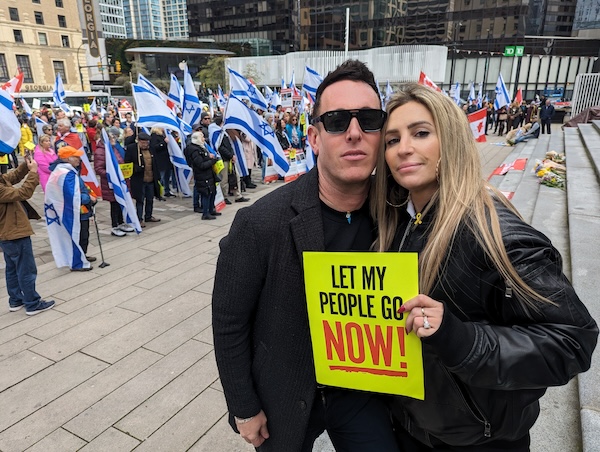
“We are here to console one another through the power of gathering in such a difficult time,” said Dresner. She noted that the week’s Torah portion featured the demand by the Israelites to the tyrant of their time to let their people go. “We, likewise, are commanded by everything we know to be decent, to demand of the tyrant of our time, let our people go.”

Labowitz spoke of “waves of grief, fear and deep concern for the existential realities of our precious home in the land of Israel.”

“We are all heartbroken by the loss of life, the ever-deepening chasm and the generations of repair that will be required to heal from this moment in our shared history,” he said. “We know that the Jewish people have a heart that is bigger than any malicious attempts against us. The love and support that has come together to repair the fabric of Israeli society, of our local communities and of each of our hearts, is made up of the strength whose origin is in the plight of our ancestors to be free people in a land of our own, a land where our people were sovereign for centuries and a land that we returned to after 2,000 years of exile.”

photo - Rabbi Arik Labowitz, assistant rabbi of Or Shalom, standing next to his colleague, Rabbi Hannah Dresner, the congregation’s senior rabbi. The two spoke at the Jan. 14 rally marking 100 days since Oct. 7
Rabbi Arik Labowitz, assistant rabbi of Or Shalom, standing next to his colleague, Rabbi Hannah Dresner, the congregation’s senior rabbi. The two spoke at the Jan. 14 rally marking 100 days since Oct. 7. (photo by Pat Johnson)

Adi Keidar, who moved to Vancouver from Israel in 2000, shared the lesson she has learned since Oct. 7.

“Life, I used to think, matters to all,” she said. “But these past 100 days, I am sad to say, I’m wrong.”

Evil exists, she said, but must not be allowed to be the dominant voice. 

Ezra Shanken, chief executive officer of the Jewish Federation of Greater Vancouver, acknowledging the day’s below-freezing temperatures, said of the hostages: “The least we can do is stand here in the cold if they live in the cold depths of the tunnels.

“Let them know that, even in the coldest days of the year, we will stand out here and we will stand with them because we know that they need it,” he said, urging attendees to “keep showing up.”

Kedem, who has organized the events week after week, read aloud the names of the 136 hostages.

107 days

A week later, the King David High School community was front and centre at the Jan. 21 rally. Students of the Jewish school sang and spoke at the gathering, which ended in a downpour of rain as the group marched through city streets.

“You’re a link in a chain that has been growing stronger for thousands of years,” event organizer Daphna Kedem told the students.

Erica Forman, a 2022 alumna of King David, and brother Max Forman, a Grade 12 student, spoke of the strength they gathered during this time of unprecedented antisemitism from their respective communities at the University of British Columbia Hillel and at King David.

Rutie Mizrahi, parent of a Grade 12 student, spoke of her uncle and aunt, Oded and Yocheved Lifshitz, who were abducted from their home in Kibbutz Nir Oz Oct. 7. Yocheved, 85, was among the first hostages released, after 17 days in captivity, because her captors believed she was near death.

The captors underestimated her aunt, Mizrahi said, and she has survived, despite arriving back in Israel appearing to be about half the weight she was when kidnapped. Yocheved had been rolled in a carpet and driven away on a motorcycle, but not before she saw her 83-year-old husband being savagely beaten outside their home. She did not believe he could have survived, but another hostage, freed later, confirmed that Oded was alive in Gaza but, without his blood pressure medication, had repeatedly fainted and was then taken to a hospital. 

“The odds that we will see him back alive are close to zero,” Mizrahi said.

King David’s head of school Russ Klein said he is grateful his father, Emerich Klein, a Holocaust survivor who passed away earlier in 2023, is not witnessing the hatred in the world since Oct. 7.

“He instilled in us the need for Israel,” the principal said. “Only Jews, he said, would take care of Jews. I spent much of my time growing up not believing him. As I found with so many things as I got older, I learned my father was right.”

Klein called the school assembly on Oct. 10, when students and faculty gathered to mourn the Hamas murder of alumnus Ben Mizrachi, 22, and the other victims of the pogrom, the hardest moment of his career.

He urged people of all ages to inform themselves of facts to better engage in the discussion around events in Israel and Gaza, specifically directing attendees to resources released recently by the Jewish Federation of Greater Vancouver, an online toolkit called “The Power of One” and a messaging guide called “Real Peace Now.” Both are available at jewishvancouver.com. 

Format ImagePosted on January 26, 2024January 24, 2024Author Pat JohnsonCategories LocalTags antisemitism toolkit, Daphna Kedem, hostages, Israel-Hamas war, Jewish Federation, KDHS, King David High School, Oct. 7, rally, terrorism

Posts pagination

Previous page Page 1 … Page 42 Page 43 Page 44 … Page 182 Next page
Proudly powered by WordPress