Skip to content
  • Home
  • Subscribe / donate
  • Events calendar
  • Business Directory
  • FAQ
  • News
    • Local
    • National
    • Israel
    • World
    • עניין בחדשות
      A roundup of news in Canada and further afield, in Hebrew.
  • Opinion
    • From the JI
    • Op-Ed
  • Arts & Culture
    • Performing Arts
    • Music
    • Books
    • Visual Arts
    • TV & Film
  • Life
    • Celebrating the Holidays
    • Travel
    • The Daily Snooze
      Cartoons by Jacob Samuel
    • Mystery Photo
      Help the JI and JMABC fill in the gaps in our archives.
  • Community Links
    • Organizations, Etc.
    • Other News Sources & Blogs
  • JI Chai Celebration
  • JI@88! video

Recent Posts

  • SFU honours Gloria Gutman
  • Lifting people’s spirits
  • Wedding a ray of light
  • Indigeneity and Zionism
  • Rule of law broken: councilor
  • Football and its roles
  • The burden of defence
  • Fish Café returns after fire
  • All right in what goes wrong
  • Nuns & mermaids at TUTS
  • Camp offers holiday retreat
  • Students and mentors inspire
  • Once-in-a-lifetime trip
  • 100 dancers, one heart
  • Money for the sciences
  • What “Jewish food” means
  • Have a cookie, schnitzel too
  • Federation now across BC
  • Israel fighting for its existence
  • Deal strengthens Iran
  • Patriotic belonging diminishes
  • A campaign to engage
  • Upstanders’ first live event
  • Responding to Carney
  • Having your own home
  • Music a family tradition
  • Musical to warm heart
  • Community milestones … June 2026
  • Sharing her passion for Israel
  • Or Shalom reopens its doors
  • JFS from past to future
  • Need holistic approach
  • Sharing stories, advice
  • Journalist shares fears
  • Skills to live together
  • Road to independence

Archives

Follow @JewishIndie
image - CJN box ad Rockowers 2026

Category: Local

A creator of unique places

You may not know his name, but you certainly know his work. Vancouver Jewish architect Richard Henriquez has designed iconic local buildings including Eugenia Place in English Bay (the one with the pin oak on its penthouse terrace), the Sylvia Tower, the Sinclair Centre and the BC Cancer Research Centre. He designed New Westminster’s Justice Institute of BC, the UBC Michael Smith Laboratory, the UBC Recreation Centre and the Presidio. And that’s just scratching the surface of his 53 years of work in Vancouver, and well beyond. 

photo - Richard Henriquez
Richard Henriquez (photo from Richard Henriquez)

Henriquez, 83, was born in Jamaica in 1941. That same year, his father, Alfred George Henriques, aware of the danger facing the Jews of Europe, joined the Royal Air Force as a bomber pilot. He did not survive the war.

One of Richard Henriquez’s earliest childhood memories is of a powerful hurricane that brought wind speeds of 150 miles per hour, devastating Jamaica’s north coast. At the time, the 3-year-old Henriquez was living on the north coast with his mother, grandmother and sister. “I still remember the sound of the metal roofing being torn off the roof, the screaming of the wind and the crashing of crockery being blown off the kitchen shelves,” he told the Independent. “The next morning, there were fish all over the yard and trees flattened everywhere.”

With their family home ruined, Henriquez and his sister joined their grandparents on a citrus plantation in Greenwood, Jamaica. Later, they moved to Buff Bay, to a new home with their mother and stepfather. Henriquez attended boarding school and Hebrew school in Jamaica. “Over the High Holy Days, I’d go to synagogue but I was never very religious,” he said.

By age 10, Henriquez had already decided on a career in architecture, a choice influenced by his grand-uncle Dossie, an architect, engineer and artist who would take him along on building visits. Rudolph “Dossie” Henriques, whose firm was Henriques and Sons, had designed the Kingston synagogue in 1912, after the original was destroyed by a 1907 earthquake. He also won a competition to design and build Jamaica’s Ward Theatre in 1912, and worked on the structural drawings for New York City’s Grand Central Terminal. 

In 1958, after graduating from high school, Richard Henriquez left Jamaica to study architecture at the University of Manitoba. He returned to Jamaica after graduation and spent a couple of years working there before returning to North America to do a master’s degree at the Massachusetts Institute of Technology in 1967. He then settled in Vancouver.

“My wife, Carol, is from Saskatoon, and she didn’t love Jamaica. She preferred to come back to Canada,” said Henriquez, whose time in Jamaica had a lifelong influence on his architectural style.

“In Jamaica, materials are expensive and labour is cheap, so I tend to want to renovate rather than tear down a house,” he explained. “I think that’s much more interesting than creating a new building. Later on in my career, I designed a couple of buildings that look like they were built a long time ago and renovated, like the Sylvia Tower in the West End.” 

His talent as an architect has won Henriquez many accolades. In 1994, he won a Governor General’s Medal. In 2005, he won the Royal Architectural Institute of Canada’s gold medal. And, in 2017, he received an Order of Canada for his contribution to Canadian architecture.

“To me, architecture is about creating a unique place in the world,” he reflected. “Unlike West Coast modernists, who were inspired by light and connection to the outdoors, I was more interested in the specificity of a site, in researching the history of a site and incorporating it into the concept for a building.” 

photo - Richard Henriquez’s Eugenia Place, in English Bay, is topped with a 35-foot pin oak, brought to Vancouver from Oregon, representing a first-growth forest that covered the area decades ago
Richard Henriquez’s Eugenia Place, in English Bay, is topped with a 35-foot pin oak, brought to Vancouver from Oregon, representing a first-growth forest that covered the area decades ago. (photo by Andrew Bowden / flickr)

The Eugenia is a perfect example of Henriquez’s respect for the specific history and culture of a community. That 35-foot pin oak, brought to Vancouver from Oregon, represents a first-growth forest that covered the area decades ago. By incorporating it into the building, he paid homage to the landscape.

Henriquez’s son Gregory has followed in his footsteps and works alongside him at Henriquez Partners Architects in Vancouver, where Gregory Henriquez is overseeing the Oakridge Park complex in Vancouver, valued at over $5 billion. Richard Henriquez’s grandson is completing a master’s degree at the University of Toronto and will soon be joining the firm as the newest architect in the family.

Among his varied works, Henriquez designed Vancouver’s Temple Sholom Synagogue and, at one time, he had hoped to build something in Jerusalem, a goal that now seems remote.

These days, there are many projects competing for his time. A man keenly interested in genealogy, he traced his family history back more than 12 generations to Portugal, learning that his eighth-great-grandmother, Anna Rodriguez, was burned at the stake in 1643. He’s working on his second book on that family history, while also devoting time to art and sculpture, lifelong passions. Some of his work was on display at the Monica Reyes Gallery in Vancouver last month.

To learn more about Henriquez’s work, watch the 30-minute documentary Richard Henriquez: Building Stories on Shelter, an architecture streaming service. Commissioned by Marcon Developments, it celebrates his 53rd year of work in Vancouver and beyond. Also interesting to peruse is henriquezpartners.com/work. 

Lauren Kramer, an award-winning writer and editor, lives in Richmond.

Posted on March 8, 2024March 7, 2024Author Lauren KramerCategories LocalTags architecture, Eugenia Place, Jamaica, Richard Henriquez

Selina Robinson’s resignation letter to the BC NDP caucus: You broke my heart…. Silence is not leadership – it’s cowardice.

My colleagues,

You broke my heart – not just on February 5 when the Premier told me that after the caucus talked about me he did not see a way back, that folks were wondering why I hadn’t already resigned and that the only path forward was a resignation. Resigning was not my choice but I told the Premier that if this was what he wanted and what caucus wanted I wouldn’t fight him on it – but let’s be clear – others asked for my resignation, so I gave it.

You actually broke my heart in the days after October 7 – the day terrorists went into Israel and brutally murdered, slaughtered, raped, mutilated, killed and kidnapped 1,200 civilians. These terrorists didn’t target the military, they killed children, concert goers, grandmothers, peace activists and a young British Columbian named Ben Mizrachi.

The Jewish community was in shock – we are about 40,000 here in British Columbia and we were reeling.

I had offered to the Premier that as a member of the Jewish community, I could speak at a vigil that was being planned a few days after the massacre – this was my community and our two Premiers had tasked me with strengthening the NDP relationship with the community. I put out the call for you to join me. The community was grieving, in mourning and we needed to show them as a caucus and as a government that we are there for them.

 I sent out a group email. Two maybe three responded – that’s it. How is it that with more than 35 lower mainland/valley MLAs only three or four would be on stage with me – I had no idea how many UCP would be there and a poor showing would not reflect well on us. I did not have the emotional capacity to reach out individually, so Alissa offered to help … still not much response. My heart cracked.

In the end there were 7 or 8 of us, two came from the island but I was terribly embarrassed.

And then, within days of the massacre, Aman and Katrina decided that it was appropriate to ‘reply all’ to my initial email asking folks to stand with the Jewish community in grief and mourning, and ask that government make a public statement about the plight of the Palestinians.

We just witnessed the slaughter, rape, mutilation and murder of 1,200 mostly Jews. We watched as the terrorists celebrated this horrific act. Ben Mizrachi hadn’t yet been buried. The IDF hadn’t yet taken any action. The world was stunned. And two of my colleagues wanted to move quickly past what had happened and refocus government on a geopolitical conflict that has been going on for years.

But it wasn’t their antisemitism that broke my heart. It was your silence to their antisemitism that hurt the most. Not a single one of you responded to their insensitive, disrespectful and inappropriate email. No one.

Your silence broke my heart that day.

You abandoned me and my community that day.

I would have hoped that someone, anyone would have replied all to Aman and Katrina and suggested that their email was inappropriate – your silence spoke volumes to me and suggested that either you agreed with them or that you just didn’t want to deal with it because it’s messy.

It is messy. It’s complex. It’s emotional. It’s hard. You just want it to go away. I understand. I want it to go away too – but my community needed you in that moment to be there in their grief and in my grief and none of you were prepared or willing to stand up to colleagues who were antisemitic – minimizing the Jewish experience, the slaughter of innocent civilians by terrorists countering with mirrored message about the plight of Palestinians. In that moment it was not so complex – People were murdered because they were Jewish and people here in British Columbia were needing us to mourn with them.

How eager you all are to join in the #NeverAgain campaign – that the crime of being Jewish that resulted in the death of six million Jews at the hands of the Nazis should never happen again.  That we should fight against Jew hatred – a hatred that repeats itself over and over and over again throughout history. How eager you all are to join the few remaining Holocaust survivors as Nicholas plays Kol Nidre on the cello and we bow our heads, light candles in honour of those murdered – yet when the hordes gather and chant “from the river to the sea” – a Hamas mantra referring to their desire to destroy Israel and the Jews, you are nowhere to be found.

Holocaust survivors have been retraumatized and some have wound up in hospital in the days and weeks after the massacre as they relive the horrors they experienced some 75 years ago. They see the marches, the chanting in our streets, the threats to Jews around the world and they say “it’s happening again.”

Where are you when protesters, their faces covered, march through our campuses intimidating young Jewish adults who now hide their Jewish identity? Where are you when young Jewish students who get trapped in bathrooms on campus because the marching is happening in hallways, and they are afraid to step out into the hall for fear of becoming a target of their hate? Where are your ideals of a broad, inclusive society? How have you been standing up for your declared values?

Almost 300 Jewish physicians signed a letter calling on UBC medical school to address antisemitism on campus. Students are bringing their hate into healthcare and they were speaking on behalf of their Jewish patients and their families. In fact, it was so bad that Ted Rosenberg, a prominent physician quit, citing a toxic work environment and antisemitism in the Faculty of Medicine – I am not sure how we expect to train more physicians when almost 300 of them are refusing to work with students coming from UBC’s faculty of medicine. It was a public leaving and I heard nothing from any of you – not the Minister of Health who committed to more physicians in the system, not the Premier – no one.

In December the four Tri-Cities MLAs received a letter from the Coquitlam Teacher’s Association rife with rhetoric, misinformation and lies about the modern state of Israel. The letter was also posted on their website (which has since been taken down). Jewish parents in SD 43 are now considering pulling their children from public schools because they don’t have faith that teachers in the district will keep their Jewish children safe. I asked Fin if he received the same letter. He did and when I asked him what he was planning to do with it he said, “nothing – I am going to ignore it.” Ignore the fact that Jewish constituents feel unsafe – Is this how we stand up for our constituents?

In January the Vancouver Police Department publicly shared a startling report about the dramatic increase in antisemitic incidents since October 7. And what was government’s response to this report?

Silence.

Shortly afterward I reached out to the Attorney General, as the racism file is under her ministry. Niki had been assigned the point of contact for the Jewish community given the historical antisemitism that the Jewish community has experienced from Mable, the parliamentary secretary for antiracism.

Let me refresh your memory, in 2004 during an interview with Seven Oaks, Mable claimed “we have vocal Zionists in our work sites, and we have had to battle them” regarding her anti-war activism in her union. Carole James, as leader, had to disavow and apologize for the comments. But the Jewish community carried on noting a certain mistrust of Mable, as she never apologized for her comments and when Mable’s recent 2-minute statement in November alarmed the community again of Mable’s antisemitism and asked for her resignation the Jewish community was merely told that Niki would now be the point of contact for anti-racism work in the Jewish community.

So I reached out to Niki at the end of January, two months after she became the designated point of contact for a community that is experiencing a spike in antisemitism, a community that is grieving and fearful. It turns out that the community leadership hadn’t even heard from her. And when I asked her what she is doing about the rise in antisemitism all she could talk about what legislation she is working on, collecting data and the small amount of money that I worked on with PSSG and the PO to make available for additional security measures that the community needed.

Her response to my query was a response you would give the opposition.

There was no acknowledgement of my personal connection to the community or how my contacts and relationships could be useful. There was no sense of understanding that this community is feeling threatened, that people are afraid, that antisemitism was on display in civil society, that Jewish parents don’t want to send their children to public school, that Jewish post-secondary students are being terrorized on campus, that Jewish owned businesses need additional security, that Holocaust survivors are reliving trauma, that plays with Israeli content that actually help to provide dialogue about the conflict are being silenced, that hundreds of Jewish physicians are calling on UBC leadership to address antisemitism on campus, that members of our own public service have started incorporating the Palestinian flag in their email signature and even making a Palestinian land comment when doing a First Nation land acknowledgement at the beginning of meetings resulting in discomfort and fear. No acknowledgment and no action.

Over the past five months a few of you have reached out after caucus discussions about me without me in the room, the first right after Aman and Katrina sent their emails and then again after the February caucus meeting, offering hugs and heart emojis. My response to many of you is that I don’t need your hugs and your emojis. What my community needs however is for you to stand up to antisemitism. When I shared this with Lisa just a few weeks ago, she responded “of course, we always do.” As a government we have not been standing up to antisemitism. If you believe that then it would appear to me that you haven’t been paying attention or you don’t know what antisemitism is or what Jew hatred looks like.

Antisemitism is calling for the destruction and annihilation of Israel, where half the world’s 15.8 million Jews live. Antisemitism is making Jewish people afraid to show their identity. Antisemitism is silencing an openly identified Jewish person who is speaking out about antisemitism. Your collective decision to silence me is antisemitism and you don’t even know it.

Antisemitism is the double standard that we have consistently shown. When any of my colleagues have made antisemitic remarks it was expected that apologies should suffice. It’s not only Mable who has made antisemitic comments. In 2012 Jennifer Whiteside shared content from the anti-Israel website the electronic intifada and posts from Occupy Wall Street that attributed Israeli ‘theft’ of Palestinian land to capitalism and in 2014 shared articles that accused Israel of ‘pinkwashing’ for their acceptance of LGBTQ2S+ community and again in 2016 shared content promoting the BDS movement and was forced to apologize and distance herself from her past support of the BDS movement.

In 2017 it came to the attention of the Jewish community that Ronna Rae invited people to support Haneen Zoubi, a former Palestinian member of the Israeli Knesset who negated the existence of Israel. Ronna Rae also compared the police to Nazis in 2013.

Jagrup quoted Goebbels in 2020 when he was pushing back at the Official Opposition during a speech in the house saying “Someone has said – if you repeat a lie often enough people will believe it” – he apologized the next day for his offence, retracted his comments and that was to be sufficient.

Last year Janet Routledge apologized for comments of Holocaust minimization by comparing the criticisms by the official opposition to Nazi rhetoric when she said “the Holocaust ended in death camps, but started with words.”

I raise these examples not to humiliate or shame any of you, but to point out the double standard. When an elected person says something that harms the Jewish community whether the comments or position is intended or unintended, the expectation is that a simple apology is sufficient. But when a Jewish elected person says something she “has deep work to do” according to the Premier and is no longer trusted. This double standard is antisemitism.

The final straw came for me last week.

I pitched an idea to the Premier 10 days after I was asked to resign that perhaps government could show leadership on this hate and division we are seeing in two hurting communities by bringing these communities together. I suggested that perhaps I could work with the Jewish community and engage with the Arab Muslim community to facilitate dialogue – find a different path for two communities in agony. As part of that work all of caucus could participate in anti-Islamophobia and antisemitism training – set an example of how as leaders we could better understand their respective pain and fear. And government could show leadership by bringing people together.

Last week Matt Smith told me that this work was ‘too political’ and that government was not interested at this time. Antisemitism and anti-Muslim sentiment are at an all-time high and government doesn’t see itself as having a role in helping these communities.

This shattered what was left of my broken heart.

This is not the party I signed on with – it has become a party that is afraid to stand with people, people who are hurting. It is now a party that puts politics and re-election before people.

It is with all of this in mind that I am leaving caucus to sit as an independent. I can no longer defend the choices this government is making, and I need to mend my broken heart and I can’t do that when you simply offer me hugs and heart emojis but don’t care to educate yourselves or understand the fear and anguish of being Jewish in this moment.

Silence is not leadership – it’s cowardice.

And I cannot be silent.

Posted on March 7, 2024March 7, 2024Author Selina RobinsonCategories LocalTags BC NDP, David Eby, Israel-Hamas war, Oct. 7, politics, Selina Robinson, terrorism
Mishpacha comes together

Mishpacha comes together

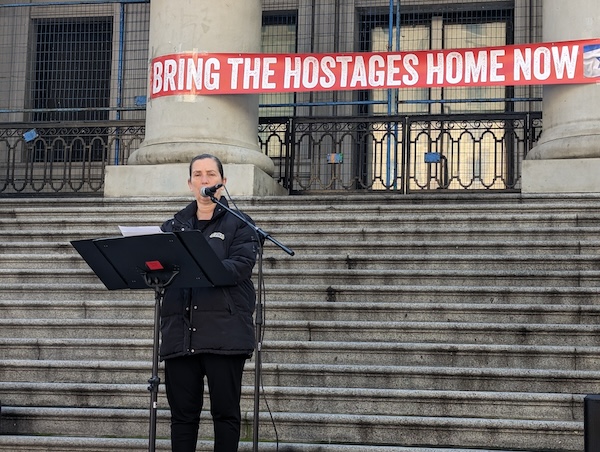
The weekly rally for Israeli hostages at the Vancouver Art Gallery Sunday, Feb. 18. (photo by Pat Johnson)

Family was the theme at the weekly rally for Israeli hostages at the Vancouver Art Gallery Sunday, Feb. 18, the day before British Columbians marked the Family Day holiday. Speakers took to a stage at the edge of the gallery’s north face out of respect for a makeshift memorial to Alexei Navalny, the Russian opposition leader who died in custody two days earlier.

“Family Day will be celebrated here tomorrow,” said Daphna Kedem, organizer of the weekly vigils for the hostages. “But this year casts a heavy shadow over the day for some families of our community here and in Israel…. It is difficult to be happy when families are waiting to be reunited with their loved ones, or for many families who have lost their loved ones.”

Dr. Michael Elterman, a psychologist, spoke of the psychological effects of what is happening in Israel and worldwide.

“We see the indescribable anguish in the families and we easily feel ourselves in their shoes and intuitively imagine what we might feel if that happened to us,” he said. “There has developed a related construct of post-traumatic stress disorder over the past decade … this is the sadness, anger and sometimes spiritual distress that arises from moral outrage. It is a broader set of reactions that arise even when the individual themselves were not present at the trauma but rather are morally outraged and left furious and depressed by events. This is even more likely where we identify so strongly with those who are personally impacted by Oct. 7.”

This anxiety is heightened by increases in antisemitic rhetoric and attacks, including in Vancouver. 

“Some of you may be experiencing the symptoms of post-traumatic stress, such as disturbed sleep, intrusive thoughts, trouble concentrating and being easily startled,” Elterman said, adding that help is available through Jewish Family Services and other resources. Getting involved in the community response can help ease feelings of helplessness and he directed people to the Community Toolkit on the website of the Jewish Federation of Greater Vancouver. 

“Remember to practise self-care in small ways, like proper nutrition and sleep,” he said. “Continue to do the things you previously enjoyed, even if you don’t feel like doing them. Finally, hug each other a little longer and a little tighter.”

Aviya Kones, who works at Jewish Family Services, spoke not about the services offered by that organization, but about the people of Kfar Aza, where she grew up.

photo - Aviya Kones speaks about the people of Kfar Aza, where she grew up
Aviya Kones speaks about the people of Kfar Aza, where she grew up. (photo by Pat Johnson)

“Kfar Aza was a desert oasis,” said Kones. “It was home, it was love and life, it was filled with unique and quirky and hilarious traditions and it was generations of family. It was also savagely and brutally destroyed after countless and seemingly endless hours of horrors.”

Her own childhood home was destroyed on Oct. 7.

She shared memories of three people who died that day.

“Smadar, a year above me, was tall, slender, so elegant,” she said. “Even as a child, I recall looking up to her. She had big, beautiful brown eyes and thick brown hair. I remember being awed by her grace, kindness and gentle nature.

“Nadav was two years older than me,” she said. “He knew how to make everyone laugh in every situation – not at anyone’s expense but maybe his own.

“Yoav was my age group,” she continued. “He had blue eyes, blond hair and a genuine smile. All the girls thought he was cute and all the guys wanted to be his best friend. He was shy, kind, creative and athletic. He loved his family. He was so close with his parents, his siblings and the many, many cousins he had living on the kibbutz.

“All three, amongst many others, tragically, brutally and with unimaginable cruelty, lost their lives on Oct. 7,” said Kones. “They were living in our beautiful oasis, our safe place, our home. They are survived by a broken and mourning community, generations of family that absolutely adored them and … all three were also survived by their young children. Nadav had two daughters, Smadar had three children and Yoav was a first-time dad to a little girl who was only 10 days old on Oct. 7.”

Rabbi Jonathan Infeld, senior rabbi at Congregation Beth Israel and head of the Rabbinical Association of Vancouver, said that Oct. 7 was not just an attack on Israelis or those living in Israel.

“It was indeed the beginning of an attack on the entire Jewish people,” he said. “It was a catalyst for antisemitism across the world that we have felt even here in Vancouver…. Too many of us have felt the antisemitism that began to boil over on that day.”

Gordon Shank, a First Nations member, a business innovator and a survivor of the Sixties Scoop, which saw Indigenous children abducted from their families and placed with white families, spoke of the centrality of family and the trauma of separation. 

“I’ve known the pain of separation from family, being torn from the embrace of loved ones, albeit under different circumstances,” he said. “The Sixties Scoop and the current crisis in Gaza might stem from vastly different contexts yet, at their core, they resonate with the universal cry for the right to family, to unity and to belonging. This parallel is not to equate the experiences but to underline the shared understanding that every individual deserves to grow, to dream and to thrive within the warmth of their family’s love.” 

Of the hostages and their families, Shank said: “Their pain is our pain. Their hope is our hope. Let our gathering today send a powerful message that we stand together across cultures and histories, united in our resolve to bring the hostages home.”

The march through downtown streets that has been a feature of the weekly events since October will be a monthly activity only for the coming weeks, Kedem told those gathered. The crowd then moved to the sidewalk adjacent Georgia Street for a demonstration, with a brief disruption by an individual waving a Palestinian flag.

Kedem has organized the weekly events since October and, early on, affiliated with the ad hoc international group Bring Them Home which, in turn, is affiliated with the Hostage and Missing Families Forum, in Israel. 

Recently, Kedem also associated her activities with another international group, Run for their Lives, which encourages groups as small as a single individual to demonstrate solidarity with Israel and its hostages by walking, biking or running. 

Format ImagePosted on February 23, 2024February 22, 2024Author Pat JohnsonCategories LocalTags Aviya Kones, Bring Them Home, Daphna Kedem, hostages, Israel-Hamas war, Jewish Family Services, JFS, Kfar Aza, mental health, Michael Elterman, Oct. 7, Vancouver
A new voice for BC elders

A new voice for BC elders

Dan Levitt has been appointed to be British Columbia’s new seniors advocate (photo from Dan Levitt)

Dan Levitt is set to become British Columbia’s new seniors advocate. The appointment was announced last month by BC Health Minister Adrian Dix.

“Dan Levitt has championed the rights of seniors for 30 years and with his extensive experience he is an excellent choice for BC’s seniors advocate,” Dix said in announcing the appointment. The Office of the Seniors Advocate is an independent branch of the provincial government, which acts in the interest of seniors and their caregivers.

Levitt becomes only the second person to hold the role, replacing Isobel Mackenzie, who will retire April 5 from the position she initiated a decade ago.

Levitt spoke with the Independent over lunch in the community centre that is part of KinVillage, the Tsawwassen continuing care retirement community he has headed as chief executive officer since 2021. Over the din of an adjacent bingo game, Levitt spoke of his career, the footsteps of his father and his plans for the new job.

The role of seniors advocate is unusual, he explained. British Columbia’s was the first in Canada, being created by legislation in 2013. To date, only two provinces, New Brunswick and Newfoundland and Labrador, have followed suit, though others are considering it.

The purpose of the advocate’s office, which has a staff of 17, is to look at systemic issues that impact seniors and make recommendations to government. 

“The five areas that we look at are transportation, housing, health care, income supports and community services that are geared around older people,” said Levitt. While the office has no authority to force governments to take steps, Levitt said his predecessor, Mackenzie, has recommended many proposals that have found favour with those in power. Not all recommendations will be adopted, he said, but “it usually helps to move the needle in a direction.”

“There isn’t that power, if you will, to say, ‘This must happen.’ But, many times, the recommendations are ones that are introduced and taken forward because they are the right things to do,” said Levitt, noting that his predecessor initiated a great range of measures that the government has taken up. 

“Isobel and the office have been real pioneers in shedding lights on challenges and opportunities with an aging population,” he said. “That’s the purpose of these independent offices. They can reflect, in this case, what matters most to seniors, what are their concerns, and then move that agenda forward in helping to influence public policy.”

The position is nonpartisan and independent from government. 

“In the recruitment process, no political official was involved,” said Levitt. 

Levitt is not the first in his family to work in the senior care field. His father, Ken Levitt, was a longtime administrator of the Louis Brier Home and Hospital, during a time of significant expansion, including the development of the Weinberg Residence. The elder Levitt is now, among other things, past president of the Jewish Seniors Alliance of Greater Vancouver. 

“I am following in his footsteps, for sure,” said the son. “And I think I am honouring, as he did, our parents by ensuring the health and well-being of older adults.”

As his new position requires he hold no outside affiliations, Levitt recently resigned from roles on the boards of directors of CommonAge, which advances the interests of older adults in the 53 Commonwealth countries, and the International Federation on Ageing. He has also given up adjunct professorships in gerontology at Simon Fraser University and in the school of nursing at the University of British Columbia, and a sessional instructor position at the British Columbia Institute of Technology.

Levitt’s undergrad degree in psychology is from UBC and he graduated from the University of North Texas, Centre for Studies in Aging, with a master of science.

“I need to dedicate 110% of my working time to this role,” he said of giving up his other gigs, which included speaking engagements worldwide on topics of aging and extensive public commentary on related subjects. 

The vetting process for the seniors advocate position was a lengthy one – and Levitt compares getting the final word on his selection with the feeling of elation he gets when he places well in his avocation of competitive running.

“Probably like anybody else who’s been through a job search like this, when you get that nod, it feels pretty good,” he said. “I am a competitive runner in my age category and, when I place well in a race, you are elated. So, when I got the message, I was pinching myself, making sure I heard what I thought I heard. You feel this elation. Soon this wears off and you start realizing the responsibility, start realizing what this means now, and people are depending on you to make their lives better.”

Caring for seniors also means helping the people in their lives, he said.

“It’s not just the older people that we’re trying to support, who are directly impacted, but it’s their family members,” said Levitt. 

Although he is not yet in the job – he’ll have to move to Victoria, coming home to Vancouver on weekends – he already has the first few months scoped out.

“I’m going to be doing a tour around the province of BC [meeting with seniors],” he said. “I’ll be asking them questions around what are those policies that help or hinder them in those five areas of transportation, housing, health care, income supports and community supports. We’ll be looking at those issues, listening to them, then we’ll come back to the office, synthesize the information and then we will release a report on what we found. That report will give us a mandate of what the biggest concerns are that seniors have and we’ll make recommendations to the government on how we can improve different aspects of seniors’ lives.”

In the statement announcing Levitt’s appointment, his predecessor had kind words for him.

“It has been an honour and a privilege to serve as seniors advocate for the Province of BC,” said Mackenzie. “Our population is aging and seniors need the ability to live independently at home, knowing the programs and services to support them are easily accessible to everyone. As issues such as dementia, housing and elder care become more complex, it’s crucial to advocate for strengthened seniors services throughout the province. I know Dan is ready to continue the cause and his efforts will make a difference in the lives of seniors for years to come.”

“I have big shoes to fill,” said Levitt, “because Isobel Mackenzie has done a phenomenal job starting the Office of the Seniors Advocate and really setting a very high bar, really pushing forward the agenda of older people, shining a light on some of the inequities and some of the systemic issues that impact older people and making recommendations that have stuck and changed just about every aspect of life for seniors.”

Levitt has spoken out on issues in the past, weighing in, for example, on the controversy around Lisa LaFlamme, whose firing as CTV National News anchor was blamed on sexism and ageism, and in challenging the ageism of birthday cards. While he will be taking on systemic issues on the larger stage of provincial policy, he urges individuals to speak up against ageism in everyday life and to celebrate aging.

Be aware of even subtle language that debases older people and their experiences, he advises.

“Don’t use the language that demonizes or goes into the negative stereotypes we often will see,” he said. “For example, ‘I’m having a senior moment.’ No one who is young says they’re having a junior moment.”

He encourages everyone to reject negative connotations around aging.

“Embrace your own age,” he said. “Embrace who you are and enjoy those birthdays and celebrate them and celebrate getting older. Don’t hide your age.” 

Format ImagePosted on February 23, 2024February 22, 2024Author Pat JohnsonCategories LocalTags British Columbia, Dan Levitt, government, health care, Office of the Seniors Advocate, seniors

Tikva campaign to start

The most vulnerable members of the Jewish community are struggling. The lack of affordable housing and a persistent high inflation rate are causing individuals and families to exhaust their income, which can lead to homelessness. The reality poses a major crisis that affects more than 350 people in the Jewish community who need a safe, secure and affordable home. 

photo - Anat Gogo, executive director at Tikva Housing
Anat Gogo, executive director at Tikva Housing. (photo from Tikva Housing)

The Jewish community witnessed Tikva Housing’s significant growth in 2023, as the organization’s portfolio grew from 98 to 168 units. Also, in keeping with its mission, it increased the monthly maximum rent subsidies available for families, couples and individuals in an effort to reduce the effects of market rental increases. But such hopeful news is overshadowed by growing demand. Vancouver’s vacancy rate is below 0.9%, and, as an example, two-bedroom rents grew by 8.6% on average. Substantial increases in rents of units at turnover drove this growth, and the outlook is not encouraging. The Canada Mortgage and Housing Corporation reported: “Affordability worsened for low-income households: vacancy rates for the most affordable units were lower than average, and these households already spend a greater share of their income on rent.”

“In the last three years, we saw an increase of 458% in people registered with the Jewish Housing Registry,” said Anat Gogo, executive director at Tikva Housing.

The Jewish Housing Registry (JHR) was launched in 2020 to provide affordable-housing seekers with a convenient point of application. It also serves housing providers with demographic information, therefore, a studied approach to future housing developments and partnerships.

“Today, we know that, among those over 350 individuals and families waitlisted, 84 are families with children, 72 are applicants with disabilities, and 129 are seniors over 65 years old,” said Gogo.

Housing is a human right, and we all have a role in ensuring that more people have the dignity and safety of an affordable home. From Feb. 26 to March 11, support Tikva Housing’s annual fundraising campaign. Visit tikvahousing.org. 

– Courtesy Tikva Housing

Format ImagePosted on February 23, 2024February 22, 2024Author Tikva HousingCategories LocalTags affordable housing, fundraising, Tikva Housing, Vancouver
L’Chaim program grows

L’Chaim program grows

L’Chaim Adult Day Centre is now open five days a week. (photo from L’Chaim)

L’Chaim Adult Day Centre has received funding from Vancouver Coastal Health to expand its program. It can now offer its services to frail senior citizens in the community on a five-day-a-week, 16-clients-per-day basis.

L’Chaim first opened its doors on Sept. 14, 1985, in the Maccabee Room of Beth Israel Synagogue. At first, L’Chaim operated only one day a week and was run completely by volunteers. A project of the National Council of Jewish Women and the Jewish Family Services Agency, it was able to secure funding from the Jewish Community Fund and Council, as well as NCJW.

Soon afterward, a committee was formed to secure funding from the BC Ministry of Health, which allowed the program to operate two days a week. Ten years later, L’Chaim moved to the Jewish Community Centre of Greater Vancouver, thanks to a $400,000 grant from the BC government, which enabled the JCC to renovate the premises to meet L’Chaim’s needs. On April 1, 1996, L’Chaim opened at the JCC and, since then, it has been operating three days a week, serving 13 clients a day.

As the Jewish population has grown and aged, the number of clients seeking L’Chaim’s services has increased. Unlike other adult day centres in Vancouver, L’Chaim has a cultural mandate to accommodate Jewish seniors who live outside Vancouver’s geographical boundaries, but prefer to frequent L’Chaim precisely because of the Jewish component of its activities. This has not precluded the intake of seniors in the area who, though not themselves Jewish, want to attend L’Chaim because of its cultural programming and level of care, but demand has been greater than L’Chaim can service and the wait list and wait times are long.

With the recent expansion, under the supervision of L’Chaim’s trained activity specialists, more participants will be able to benefit from the variety of programs offered, including exercise sessions, discussion groups, live entertainment, expressive art and garden therapy, games, and day trips into the community. Participants receive a culturally and nutritionally appropriate meal prepared fresh daily, consisting of a three-course kosher lunch tailored to their dietary needs. As well, L’Chaim has a nurse on the premises who supervises medications, monitors participants’ health status and other aspects. Of course, Shabbat and Jewish holidays are occasions for special celebrations, often in conjunction with other stakeholders and programs at the JCC.

 “Old age,” as Tennyson wrote, “hath yet his honour and his toil,” and the longer people can stay at home surrounded by loved ones and visit those places that have become familiar, the better off we all are. L’Chaim is honoured that it can provide care and comfort to the frail elderly and thereby offer support to their relatives and caregivers. Anyone who goes by the JCC will see that it is a hub of activity and being located within its walls makes L’Chaim all the more vibrant. Relatives can drop off their loved ones and take advantage of JCC activities; L’Chaim clients can see people they know who drop by the office.

Now that L’Chaim has obtained funding to expand its services, it looks forward to growing from strength to strength, and this will require time and money. Fortunately, L’Chaim has an active board of committed individuals, as well as day-to-day onsite volunteers, who aid its director, Leah Deslauriers.

Deslauriers was hired by the JCC as the seniors program coordinator shortly after she graduated from the gerontology program at Simon Fraser University. In 2008, she started overseeing L’Chaim, when their administrator went on vacation, and she left her position at the JCC and became the director of L’Chaim in 2017. The position includes intake, fundraising and strategic planning, and it is in large part due to her accomplishments that L’Chaim now embarks on the next stage in its development.

L’Chaim benefits from the financial support of the Jewish Federation of Greater Vancouver, several Jewish foundations, and the donations, large and small, of many friends and supporters. To all of them, L’Chaim is grateful. 

To see if you or your loved one is eligible for L’Chaim’s services, contact the home and community care office in your local health authority or get in touch with Deslauriers by calling 604-638-7275. 

– Courtesy L’Chaim Adult Day Centre

Format ImagePosted on February 23, 2024February 22, 2024Author L’Chaim Adult Day CentreCategories LocalTags JCC, Jewish Community Centre, Leah Deslauriers, lifestyle, L’Chaim Adult Day Centre, seniors
Exploring past, present

Exploring past, present

During Hillel BC’s Holocaust Education Week, Drs. Gene Homel (pictured above) and Rachel Mines offered Unheard Echoes, a program on Jews in Lithuania. (photo by A. Jaugelis)

Unheard Echoes, a program on Jews in Lithuania, was held Jan. 29 during Hillel BC’s Holocaust Education Week on the University of British Columbia campus. Dr. Gene Homel, an historian, and Dr. Rachel Mines, a Yiddishist and English instructor, spoke about the past and present experiences of Litvaks, Jews with roots in the region of Lithuania.

Homel began by introducing Lithuania, a liberal democracy in the North Atlantic Treaty Organization (NATO) and the European Union, currently in the news because of possible threats from Russia’s attack on Ukraine. He explained that Jews have been a key, productive part of Lithuania since at least the early 1300s, when they were invited by nobility to settle in these territories and were granted a charter to run their own affairs in their own communities. By the 1700s, the largest Jewish population in Europe was in what was then the Polish-Lithuanian Commonwealth, occupying much of Eastern Europe. The partition of Poland in the late 1700s absorbed the region into imperial Russia.

Vilnius, now Lithuania’s capital but then in the Russian empire, was known as “the Jerusalem of the North” for its role as a world-renowned centre of Jewish learning, culture and publishing. However, poverty and Russian conscription motivated many Jews to emigrate in the early 20th century to North America,  South Africa and elsewhere.

In 1918, with the First World War winding down, Jews joined the successful push for an independent Lithuanian state. While the restored Polish state, which now included Vilnius, slid into enhanced antisemitism in the 1930s, the much smaller Lithuanian state avoided pogroms and other extreme manifestations of antisemitism. Lithuanian Jews and Christians lived side by side in relative peace.

The 1939 pact between Nazi Germany and the communist Soviet Union divided Eastern Europe between the two tyrannies, and the Soviets forcibly annexed and Sovietized Lithuania and the other two formerly independent Baltic states, Latvia and Estonia. Mass deportations of Baltic peoples to Soviet Siberia included many Jews, who comprised an estimated 7% of Lithuania’s population but 10% of the deportees.

Nazi Germany’s invasion of the Baltics and the Soviet Union in mid-1941 initiated the Holocaust in Lithuania. Of the 220,000 to 250,000 Jews there, 95% were murdered, most in the early stages of Nazi occupation and control.

Lithuanian historians and researchers agree that, while most Lithuanians were passive bystanders, some thousands (the exact number is unknown) were (by degrees) active collaborators with the Nazis. Homel pointed out that collaborators were active in almost all other European countries, and there were some Lithuanians, such as Catholic clerics, who served as rescuers of their Jewish neighbours. More than 900 Lithuanians have been recognized by Yad Vashem as Righteous Among the Nations, and there were doubtless many more.

In 1944, the Soviets returned to the Baltics, robbing Lithuania, Latvia and Estonia of their independence, and costing many people their freedoms and their lives. Decades later, the fall of Soviet Communism – Lithuania was the first Soviet republic to declare its independence in 1990 – led to a revival of Jewish culture and institutions, as the Soviet Union had not only suppressed religious and cultural expression but denied or downplayed the Jewish Holocaust in the areas it controlled.

Homel discussed a particularly sensitive issue in Lithuania’s history of wartime Nazi occupation, since there was some overlap between those who were both anti-Soviet partisans from 1944 to the early 1950s (thus nationalist heroes) and Nazi collaborators. Recent published research on Lithuanian collaboration in the Holocaust has caused a stir of controversy, raising the problems of a competing sense of victimhood and of definitions of genocide. This can be seen as a sort of zero-sum game.  Collaboration has been a contested issue in other countries’ histories, of course, for example France and, notably, Poland.

That said, the Lithuanian government has accomplished much by way of justice since the restoration of independence. Shortly after that time, in May 1990, the government issued a declaration condemning “without reservation the genocide perpetrated in Lithuania against the Jewish nation … and notes with sorrow that among the executioners who served the occupiers there were also citizens of Lithuania.” The declaration also stated that there would be no toleration for any expressions of antisemitism, and that all bodies of government and citizens should “create the most favourable conditions for the Jews of Lithuania….”

Four years later, the government created the annual Sept. 23 National Memorial Day for the Genocide of Lithuanian Jews. Commemorations are held in schools and other public and governmental institutions. The prime minister recently joined a march to Paneriai, a site of mass murder of Jews and non-Jews during the Nazi occupation. The Vilna Gaon State Jewish Museum includes five sites, one being the “Green House” Holocaust museum. In 2011, Lithuania committed to pay 37 million Euros over a decade in compensation for Jewish communal property seized during the mid-20th century, and recently the government passed a bill to transfer another 37 million euros. Rescuers have been honoured in the country, as well as by Israel’s Yad Vashem. International teams of archeologists are working on a project to recover Vilnius’s historic Great Synagogue, which was utterly destroyed by the Soviets in the 1950s.

Mines followed Homel’s presentation with a more personal view of Lithuania, based on her reconnection with her Litvak roots, and her experiences with the non-Jewish Lithuanian community both in Lithuania and in British Columbia. She detailed her father’s family life in Skuodas, a lively and thriving town near the Latvian border, which, prewar, had many Jewish-owned enterprises. His relatives once owned a productive boot and shoe factory in town. In 1936, her father, Sender, moved to Kaunas, then capital of Lithuania, and married. In 1941, Sender and his family were imprisoned in the Kaunas ghetto. That winter, Sender was deported to Latvia and forced into slave labour in several Nazi ghettos and concentration camps. As a survivor, he emigrated to Canada in the early 1950s, where he remarried and started a second family.

photo - Dr. Rachel Mines presented a more personal view of Lithuania, based on her reconnection with her Litvak roots, and her experiences with the non-Jewish Lithuanian community both in Lithuania and in British Columbia
Dr. Rachel Mines presented a more personal view of Lithuania, based on her reconnection with her Litvak roots, and her experiences with the non-Jewish Lithuanian community both in Lithuania and in British Columbia. (photo by A. Jaugelis)

Mines and Homel have visited Lithuania a number of times in the last 16 years or so, including a Yiddish summer program at Vilnius University. They found a warm, welcoming reception in Skuodas, where the local museum featured a display on the town’s Jewish population, including Mines’s father. Locals took them to sites of interest, including the Jewish cemetery and Holocaust memorials, which date back many decades, to when the country was still under Soviet occupation. In 2015, Mines was invited to Skuodas to address high school students and adults during that year’s commemoration of the Holocaust in Lithuania. As she learned more about her father’s origins, Mines created a bilingual website on the town, shtetlshkud.com, as a genealogical and historical resource.

Both Mines and Homel are members of the board of directors of the Lithuanian Community of British Columbia (LCBC), which welcomes Litvaks and acknowledges the Jewish contribution to Lithuanian history and culture. The last two years, the LCBC has commemorated Lithuania’s National Memorial Day for the Genocide of Lithuanian Jews, first at the Peretz Centre for Secular Jewish Culture and then at the Italian Cultural Centre. LCBC’s website is lithuaniansofbc.com. 

– Courtesy Gene Homel

Format ImagePosted on February 23, 2024February 29, 2024Author Courtesy Gene HomelCategories LocalTags education, Gene Homel, Hillel BC, history, Holocaust, Lithuania, Rachel Mines, Skuodas

A need to shift thinking

New approaches for getting younger generations to engage in communal Jewish life were put forward by Rabbi Mike Uram, the first-ever chief Jewish learning officer for Jewish Federations of North America, in a Zoom talk organized by Kolot Mayim Reform Temple in Victoria on Feb. 4.

Uram admitted he does not have a magic answer to the problem that has been confounding leaders of Jewish institutions for several years. Instead, he regards himself as a “provocateur” who stimulates novel thinking and a sense of possibility.

photo - Rabbi Mike Uram urges organizations to create new entry points and ways for Jews to connect with Jewish life
Rabbi Mike Uram urges organizations to create new entry points and ways for Jews to connect with Jewish life. (photo from Kolot Mayim)

He started by addressing Jewish communities and Jewish institutions, saying they no longer exist as they have in the past. He suggested that there is no longer the same power of gatekeeping and that the concept of who is a Jew has become more fluid. What may be seen as a community – through a synagogue, federation, university campus or geographic area – is, according to Uram, more accurately described as a network. 

“There’s something imprecise about the language, and that imprecision leads to imprecise strategies,” he said, adding that this view is more aligned with an operating system that was in place several decades ago. “And the operating system, which was perfectly aligned with the North American Jewish population in the 1950s and 1960s, is now almost perpendicular with the ways that North American people and Jews access almost everything else in their lives.”

Using television viewing patterns as an example, Uram demonstrated a shift from “macro-communities to micro-communities.” That is, in the 1950s, close to three-quarters of the American public watched an episode of the hit show I Love Lucy at the same time. Today, a successful show might obtain a viewership in single-digit percentages. 

A similar pattern can be identified in Jewish circles, if one were to observe the steep decline in the numbers of Jews affiliated with a synagogue today as opposed to the 1960s, he said. The drop is not singular to Jewish groups; a corresponding fall in institutional engagement has occurred across a range of civic and political organizations.

More broadly, people are spending less time out of the house and have fewer friends than in previous generations. As well, with social media and streaming services’ algorithms, people are now living more in “customized little bubbles.” To solve this dilemma, Uram proposed a change in the language and thinking used by institutions to bring the unaffiliated into their realm. 

“When we say us and them, we’re thinking we’re the core, they’re the periphery. We’re involved, they’re uninvolved. We’re affiliated, they’re unaffiliated. The problem with that thinking is [that] it is measuring Jewish identity on a very linear and highly judgmental spectrum,” Uram said.

The challenge, too, with this institutional mindset, he argued, is that people do not wake up each day thinking they are an uninvolved or unaffiliated Jew and wondering how they can become more involved or affiliated. In fact, he said, many have a negative stereotype of organizational Judaism, as a place they feel judged and like an outsider.

Nonetheless, Jews not participating in institutional Jewish life are no less proud of being Jewish.

“They don’t feel broken,” Uram said. “They don’t feel like they need a synagogue or a federation to fix them. What has changed in American life is that, as affiliation rates have gone down, positive Jewish feelings have actually gone up.” Many Jews are interested in Judaism but not affiliation, he said. Hence, rather than focusing on programming and marketing, institutions should concentrate on building relationships, he said.

While emphasizing that he is not disparaging affiliation, Uram urges organizations to create new entry points and ways for Jews to connect with Jewish life.

“It’s a one-on-one conversation, and it’s more like community organizing than it is like traditional programming,” he said, noting that the organized Jewish community can often function like a taxicab in the age of ride-hailing companies or network television when there are streaming services.

“We’re not in the business of preserving network television,” he said. “We’re in the business of changing people’s lives with amazing shows. So, we should be doing anything we can do to get people to interact with the magic and the power and the wisdom of Jewish values.”

Another issue within a community is infrastructure, such as buildings, staff and program calendars, said Uram. Here, he advocates a change in philosophical approach, focusing on impact over affiliation.

“Spending a little bit more time talking about how we’re going to make a difference in people’s lives, rather than how they can help us keep the organization strong, will trickle down and change the way emails are written, the way the website looks, the way people are greeted,” he said.

Towards the end of his talk, Uram threw some questions out to institutions, asking if they were in the synagogue preservation business, the program planning business, the membership business or the transforming people’s lives business.

“My guess is they do not say that our mission is to make sure that the next generation of Jews joins. It probably says that they’re going to engage in Judaism in a way that transforms them and the world, that makes them feel closer to community and that helps them live more enriched lives, and all those things,” Uram said.

If organizations are to meet the challenges and take advantage of the opportunities offered in the future, they must understand the perspectives of the next generation, he said. Millennials, he added, bring with them their own insights and values that can “guide the future of Judaism in exciting ways.”

Uram is a former executive director of Hillel at the University of Pennsylvania and the author of the 2016 book Next Generation Judaism: How College Students and Hillel Can Help Reinvent Jewish Organizations, which received a National Jewish Book Award. He was speaking as part of Kolot Mayim’s 2023/24 Building Bridges Speaker Series. On March 3, Rabbi Dr. Nachshon Siritsky, spiritual leader of the Reform Jewish Community of Atlantic Canada, will talk on the topic Our Evolving Jewish Understanding of G!d and Gender. To register, visit kolotmayimreformtemple.com. 

Sam Margolis has written for the Globe and Mail, the National Post, UPI and MSNBC.

Format ImagePosted on February 23, 2024February 22, 2024Author Sam MargolisCategories LocalTags affiliation, community organizing, future, history, Jewish communal life, Jewish Federations of North America, Kolot Mayim, Mike Uram

Supporting one another

On Jan. 22, Jewish Seniors Alliance, as part of its Empowerment Series, presented a lecture by Dr. Honoré France. An educator, artist, writer, therapist and consultant in the field of mental health, France explored the early history of seniors peer support, which is based on the concept of seniors helping seniors. 

Grace Hann, trainer and supervisor of Senior Peer Support Services at JSA, co-hosted the Zoom event with Andrea Krombein of South Vancouver Seniors Network, which co-sponsored it. About 60 seniors participated. Gyda Chud, past president of JSA, welcomed everyone.

In her introduction of France, Hann said she uses his writings in the JSA’s peer-support training program. She noted that France has presented his ideas on training in many countries and has been involved with peer support since the late 1970s, when he moved to Victoria. He was influenced by the works of Viktor Frankl, as well as work done in a hospital in Paris, where a doctor and a former patient began a program to help patients by using recovered patients as volunteers. Much research has been done in this area, she said, and it has been shown that paraprofessionals can be as effective as therapists.

France has written a book on peer counseling and peer support. As well, he said, Frankl’s book Man’s Search for Meaning and Erik Erikson’s eight stages of life (of psychosocial development) are still being used by therapists. Communication and listening skills are of prime importance in peer counseling, he said, and Hann pointed out that silence, as well as mirroring back what the client has said, are useful in opening communication and forming a bond between the volunteer counselor and the senior. Two volunteers, Marie and David Kirkpatrick, said they had learned from the training provided by Hann and Charles Leibovitch, senior peer support services coordinator with JSA, and through contact with clients.

France also discussed some of the myths about aging. For example, we are just as mentally fit at age 80 as at age 20, he said, but our reaction times are slower. To keep healthy, we need to exercise both the body and the mind, he said.

Chud thanked France for his comments and his work, noting how effective it has been in JSA’s peer support training program. Comments and questions included Margot Beauchamp on the connection between isolation, loneliness and general health, and Larry Shapiro said volunteering should be first on any list of things seniors should be doing.

A new training session for peer support will begin on March 1 and those interested should contact the JSA office. The next Empowerment program will take place in March, with the Jewish Museum and Archives of British Columbia. More details will soon be available at jsalliance.org. 

Shanie Levin is a Jewish Seniors Alliance Life Governor. She is also on the editorial committee of Senior Line magazine.

Posted on February 23, 2024February 22, 2024Author Shanie LevinCategories LocalTags education, Honoré France, Jewish Seniors Alliance, JSA, peer support, seniors, South Vancouver Seniors Network
Community milestones … Jewish Medical Association, Freilich & Karasick

Community milestones … Jewish Medical Association, Freilich & Karasick

Left to right: Drs. Larry Barzelai, Ran Goldman, Mor Cohen-Eilig, Marla Gordon and Maya Rosenkrantz. (photo from Dr. Marla Gordon)

The Jewish Medical Association of British Columbia held its inaugural event Monday evening, Feb. 12, at Schara Tzedeck Synagogue, with 100 attendees in person and 20 via Zoom. Three speakers presented and all were inspiring, relaying hopeful words, with the broad message being to unite and stand together.

Dr. Dynai Eilig, an Israeli-born and -trained orthopedic surgeon who works and lives in Vancouver, traveled to Israel on Oct. 9 to work in Soroka Medical Centre’s trauma centre. He shared heartbreaking stories, but also stories of resiliency. He spoke about the 150,000 reservist army volunteers from outside Israel who came in the early days after Oct. 7.

photo - Dr. Dynai Eilig presenting at the inaugural event Feb. 12. (photo from Dr. Marla
Dr. Dynai Eilig presenting at the inaugural event Feb. 12. (photo from Dr. Marla Gordon)

Dr. Robert Krell, a retired child psychiatrist and Holocaust survivor, explained the correlation between the rise of antisemitism now and that in Europe in the 1930s. He said Holocaust education is needed in all universities and all faculties and that medical and other educators must not resign from their teaching posts.

Dr. Yael Glassberg, an Israel-based pediatric gastroenterologist, joined via Zoom. She spoke on the child hostages who were released and her assessment and involvement with these children.

Planning for the JMA community-building event took place over a two-month period, led by pediatric emergency room physician Dr. Ran Goldman and elder-care physician Dr. Marla Gordon.

The Jewish Medical Association of British Columbia was started by Gordon and family physician Dr. Larry Barzelai in November 2023 as an attempt to get Jewish physicians together to support one another, especially in the current situation of increased antisemitism. The group has almost 300 members.

– Courtesy Dr. Marla Gordon

***

photo - Eric Freilich
Eric Freilich

Eric Freilich was recently promoted to director of legal, private equity and M&A (mergers and acquisitions) at BMS Group and heads the Canadian legal team for the multinational insurance broker.

Eric grew up in Vancouver and is a graduate of the University of British Columbia, where he was a proud and active member of Hillel and of the Jewish fraternity, Alpha Epsilon Pi. Following graduation from UBC, Eric moved to Toronto to work in the film industry. He then went back to school and received his doctor of law and a master of business administration from York University. He worked at two prominent Toronto law firms prior to going in-house, focusing on corporate/commercial work and mergers and acquisitions.

Eric has recently found his way back into academia, contributing to teaching courses on mergers and acquisitions and risk management techniques in transactions at the Schulich School of Business.

Outside of work, Eric’s strongest sense of identity comes from being the best father and husband he can be.

***

photo - Adina Karasick
Adina Karasick (photo from poets.ca)
photo - Ian Keteku
Ian Keteku (photo from poets.ca)

Adeena Karasick and Ian Keteku are the inaugural winners of the League of Canadian Poets Spoken Word Award, which consists of two $1,000 awards, presented annually to two poets for a single poem or suite of poems up to 10 minutes in length.

Karasick won for the poem “Eicha,” featured in Aerotomania: The Book of Lumenations (bit.ly/aerotomania).

“Attuned to sound poetry’s domain, Adeena Karasick’s homophonic translation ‘Eicha: The Book of Lumenations’ unfolds as a dynamic interplay of acoustic and material expressions,” wrote LCP Spoken Word Award juror Eric Schmaltz. “Immersed in the intricacies of language’s auditory, textural and tonal dimensions, Karasick engages the original text, the Book of Lamentations, and brings it into dialogue with the multifaceted layers of our present. A simultaneous act of lamentation and ecstatic intertextual exploration, Karasick’s performance traverses sonic texture and electroacoustic manipulation to resound with a symphony of hope and sorrow.” 

Keteku was honoured for the triptych: “Mr. Tally Man,” “the space between” and “The Light.” LCP Spoken Word Award juror Andrea Thompson called him “a master of spoken word,” noting: “With impeccable comedic timing and understated affect, Keteku’s performances are a triumph of wordplay and musicality, driven by wisdom and humanity – alive as a heartbeat.”

For more about the League of Canadian Poets, visit poets.ca.

Format ImagePosted on February 23, 2024February 22, 2024Author Community members/organizationsCategories LocalTags Adeena Karasick, Aerotomania, British Columbia, business, Dynai Eilig, Eric Freilich, Ian Keteku, Jewish Medical Association, Larry Barzelai, League of Canadian Poets Spoken Word Award, Marla Gordon, poetry, Ran Goldman, Robert Krell, Yael Glassberg

Posts pagination

Previous page Page 1 … Page 41 Page 42 Page 43 … Page 182 Next page
Proudly powered by WordPress