
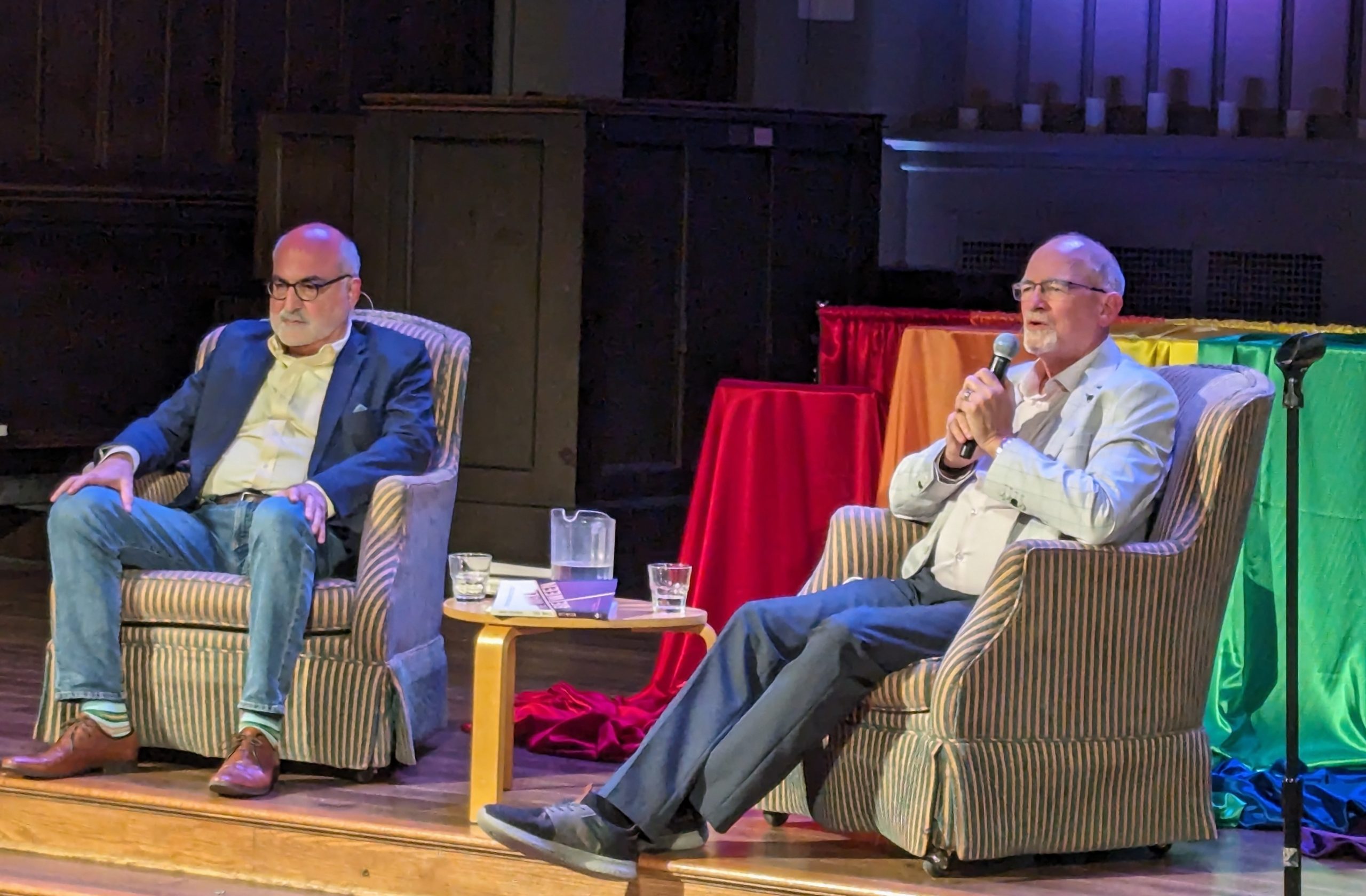

Co-authors Raja G. Khouri, left, and Jeffrey J. Wilkinson in a conversation at Canadian Memorial United Church and Centre for Peace June 13. (photo by Pat Johnson)
To bridge a divide between peoples, Jews and Palestinians need to listen and understand one another’s stories of trauma, according to two authors who spoke in Vancouver June 13.
“Not only do we not know each other’s narrative, we don’t want to know each other’s narrative,” said Raja G. Khouri. “We are resistant to the other’s narrative. Palestinians need to understand Jewish suffering and Jews need to understand Palestinian suffering.”
Khouri, founding president of the Canadian Arab Institute, is a Palestinian-Canadian. With Jeffrey J. Wilkinson, a Jewish American who lives in Canada, he wrote The Wall Between: What Jews and Palestinians Don’t Want to Know About Each Other.
The two men have been engaged in ongoing dialogue around trauma and other topics related to Israel and Palestine. Their book was released four days before the Oct. 7 terror attacks.
Jewish trauma from the Holocaust and Palestinian trauma from the Nakba, or the “Catastrophe” of the 1948 war, replay in various ways among the peoples today, said Wilkinson, an educator who works on issues of trauma.
“It’s not about amount of loss,” said Wilkinson. “Six million Jews died, 750,000 Palestinians [were] displaced. That impact is not about the numbers. That impact is about that loss, that something being taken from you, that feeling of anger, resistance.”
The conversation, at Canadian Memorial United Church and Centre for Peace, was sponsored by Vancouver Friends of Standing Together, in partnership with several other organizations. Standing Together describes itself as “a progressive grassroots movement mobilizing Jewish and Palestinian citizens of Israel against the occupation and for peace, equality and social justice.”
The authors acknowledge the chasms between the consensus Israeli and Palestinian narratives, while carefully noting that they did not claim to speak on behalf of their respective peoples.
“Zionists are saying 1967, 1967, 1967,” said Wilkinson, referring to the war that marks the beginning of what many consider “the occupation.”
“Palestinians are saying 1948, 1948, 1948. The two-state solution does nothing to address 1948,” Wilkinson said.
A two-state solution is not something either author views as a reasonable proposition, said Wilkinson – unless it is as a waystation to an alternative that neither author spelled out explicitly.
“I’m not saying it’s a bad solution and you can’t support it,” Wilkinson said of the idea of two states. “But I want you to frame it from the perspective of justice, and it does not address the injustice of Palestinians.”
While the evening – and the book – were billed as a conversation across barriers, the divide was not as big as advertised. Both authors view the existence of Israel as a problem to be solved.
“I believe that Zionism and my Judaism are not compatible,” Wilkinson said. “That does not lessen my compassion for the vast majority of my community who are somewhere on that journey but not where I am, and I embrace you as you walk through that.”
Wilkinson explicitly denounced the extremist rhetoric heard in some anti-Israel protests, such as calls to destroy Tel Aviv and telling Jews to “go back to Poland.”
Khouri said Palestinians believe that “the antisemitism label” has been misused to silence them.
“We both know that antisemitism is real and it’s dangerous,” he said. “But, to Palestinians, it is a weapon that has been used to silence criticism, or at least that’s what we believe. And it’s important to get that.”
Both men believe there is a misunderstanding around definitions of terms.
Israelis and their allies might hear the word “apartheid” and reject it.
“Lens the word from the person who is speaking,” Wilkinson advised, outlining how he views separate treatment of Palestinians as equivalent to the racist regime of 20th-century South Africa.
“Likewise with terms like genocide,” said Khouri. “We both avoided using the term for the longest time. But I can tell you there isn’t a Palestinian I know who isn’t convinced that this is absolute genocide because of the mass killing that is happening. Whether it meets the legal definition of genocide or not, it feels very much like genocide.”
The defensiveness that comes around these terms, they said, is a barrier to the peoples’ understanding of each other.
The flexibility of definitions extends to the term “intifada.”
“When you hear someone, say, we’re calling for intifada, ask them what they mean by this,” said Khouri. “Do you mean going and blowing up cafés and buses?”
Neither author offered their interpretation of the term.
The Oct. 7 attacks took place in a particular context, they said.
“If you fixate on Oct. 7 only, then you’re missing a big part of the picture,” said Khouri.
“That doesn’t mean you grieve less for the victims of Oct. 7,” Wilkinson said. “It doesn’t mean that.”
Avril Orloff, representing Vancouver Friends of Standing Together, emceed the event. Rabbi Laura Duhan Kaplan, director of inter-religious studies and professor of Jewish studies at the Vancouver School of Theology provided a land acknowledgment and contextualized the discussion in the context of Shavuot, which was ending as the event began.



