Skip to content
  • Home
  • Subscribe / donate
  • Events calendar
  • News
    • Local
    • National
    • Israel
    • World
    • עניין בחדשות
      A roundup of news in Canada and further afield, in Hebrew.
  • Opinion
    • From the JI
    • Op-Ed
  • Arts & Culture
    • Performing Arts
    • Music
    • Books
    • Visual Arts
    • TV & Film
  • Life
    • Celebrating the Holidays
    • Travel
    • The Daily Snooze
      Cartoons by Jacob Samuel
    • Mystery Photo
      Help the JI and JMABC fill in the gaps in our archives.
  • Community Links
    • Organizations, Etc.
    • Other News Sources & Blogs
    • Business Directory
  • FAQ
  • JI Chai Celebration
  • JI@88! video

Recent Posts

  • Sharing her testimony
  • Fall fight takes leap forward
  • The balancing of rights
  • Multiple Tony n’ Tina roles
  • Stories of trauma, resilience
  • Celebrate our culture
  • A responsibility to help
  • What wellness means at JCC
  • Together in mourning
  • Downhill after Trump?
  • Birth control even easier now
  • Eco-Sisters mentorship
  • Unexpected discoveries
  • Study’s results hopeful
  • Bad behaviour affects us all
  • Thankful for the police
  • UBC needs a wake-up call
  • Recalling a shining star
  • Sleep well …
  • BGU fosters startup culture
  • Photography and glass
  • Is it the end of an era?
  • Taking life a step at a time
  • Nakba exhibit biased
  • Film festival starts next week
  • Musical with heart and soul
  • Rabbi marks 13 years
  • Keeper of VTT’s history
  • Gala fêtes Infeld’s 20th
  • Building JWest together
  • Challah Mom comes to Vancouver
  • What to do about media bias
  • Education offers hope
  • Remembrance – a moral act
  • What makes us human
  • המלחמות של נתניהו וטראמפ

Archives

Follow @JewishIndie
image - The CJN - Visit Us Banner - 300x600 - 101625

Byline: Cynthia Ramsay

Community gathering place

Community gathering place

Many community events, lessons and celebrations take place in the Jewish Community Centre of Greater Vancouver’s Wosk Auditorium. (photo from JCC)

A sense of family and community, somewhere to be physically active and mentally stimulated, a haven in which to socialize and relax, to have a nosh, a lifeline during the pandemic and a place to be with like-minded people after Oct. 7. The Jewish Community Centre of Greater Vancouver – “the J” – “is a warm and welcoming place for Jews and the community in general,” offered JCC executive director Eldad Goldfarb.

The Jewish Independent spoke with Goldfarb and others recently, to see how the centre has fared since the Hamas terror attacks on Israel, the Israel-Hamas war and the rise in antisemitism around the world, including in Metro Vancouver.

“The level of security has seen a noticeable increase,” said Goldfarb. “The initial shock had an effect on our entire community, which felt insecure and somewhat afraid to venture out and into Jewish community facilities. This fear quickly changed into a desire to congregate, be with fellow Jews in safe spaces, and the JCC is a place where everyone feels safe and welcome.”

He praised the Vancouver Police Department and its role in allowing the community to gather safely.

“The VPD is amazingly supportive of the Jewish community and the JCC,” he said. “They are doing above and beyond within their limited resources to provide both physical as well as emotional safety at this very difficult time for our community. The JCC staff team is very vigilant and pays close attention to anything out of the ordinary.”

Goldfarb has been the J’s executive director for 11 years, and was assistant executive director for the six years prior to that. He said the centre has “expanded its programs and services, providing substantially more scholarships and subsidies to families and individuals.” And he and the JCC board “have been involved in the conceptualization, visioning and creation of JWest, an exciting innovative community project for generations to come.”

“The JCC has been working diligently on expanding our capacity, we have made investments in recruiting top-notch staff, replacing and transforming our technology systems in order to improve customer experience, ease the registration process and create efficiencies in the organization,” said Goldfarb.

“We’re always trying out new programs,” Hila Olyan, senior director of programs, told the JI. “I’m especially excited about programming for new families, which ramps up this coming fall: pre- and post-natal yoga, baby sign and sing, stroller fitness, storytime in the library. We’re also trying out some new children’s programming over the summer. Music, Music for Littles and Music, Music for Babies will be offered on Sundays. I can say from personal experience that my toddler loves the program. He’s been taking it since April.”
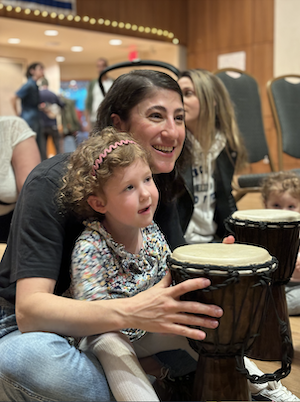
photo - The J's many programs include ones to introduce toddlers and their families to the joys of music
The J’s many programs include ones to introduce toddlers and their families to the joys of music. (photo from JCC)

While the programming hasn’t changed much in response to Oct. 7, Olyan said “the interest in being part of programs has increased. I think, for many people, myself and my family included, the opportunity to participate in Jewish and non-Jewish programming, but in a safe space surrounded by like-minded people, is more important than we previously realized.

“We’ve also tried to be thoughtful as we plan and host our community events like the recent Festival of Israeli Culture. We are thinking about how we can honour the challenging times we are living in, but also celebrate the beautiful culture we all know and love.”

She pointed to significant participation in events such as seniors luncheons, the J’s annual Purim Party and other activities.

“The people of our community want to be around other community members and I think it’s a great thing,” said Olyan. “The atmosphere has shifted a few times. We’ve moved from shock and devastation to strength and resilience. I think it’s a real testament to the spirit of our community.”

“The JCC has and will always be a safe place for me and my family and the entire community,” said Michael Averbach, who has been going to the J since he was a kid himself. “Oct. 7 didn’t change my frequency of visits or how I feel about being at the JCC, nor should it for any current member, but my message to those considering joining – there’s no greater feeling of family than being at the J. It’s the only place where we can truly interact with all sectors of our community, from the non-observant, to the Reform, to the Orthodox and everyone in between. Furthermore, the JCC was built on the foundation where everyone is welcome, regardless of religion or race.”

In addition to being a J member, Averbach has chaired the centre’s main fundraising event, the RBC JCC Sports Dinner, for many years. Attesting to his family’s generations of involvement with the JCC, the welcome desk everyone passes on their way into the centre is called the Betty and Louis Averbach Membership Desk, named after Averbach’s grandparents. And the next generation is also involved. 

“We’ve had our kids in day camp and swimming lessons over the years and, personally, I enjoy boxing sessions with Alexei to keep me sharp and on my toes and to complement my regular fitness routine,” said Averbach. “I also try and get to the J in the later evenings up three to four times a week to enjoy the sauna and steam in the men’s spa.”

photo - Working out at the J
Working out at the J. (photo from JCC)

When asked what keeps him coming back to the centre all these years, Averbach said, “The warm feeling and sense of community walking through the doors.”

This is an aspect that also appeals to J member Cathy Paperny and her family, who joined the JCC in 2006 when their children began the 2-year-old program. 

“I appreciate being surrounded by a Jewish community,” she said. “I have a good relationship with Eldad and we often have good talks about various topics, including the war in the Middle East. During these challenging times, it’s especially important to be surrounded by like-minded people. I feel I have that at the JCC.”

The social aspect is one of Olyan’s favourite parts of her job.

“I like the combination of interacting with members, program participants and administration. I like thinking about how we can make our programming stronger and then having the opportunity to put plans into action and see the results. Every single day I meet and talk with interesting people who are all here at the J for their own unique reason – a workout, childcare drop-off, gymnastics, music lessons, a holiday or festival.”

For Paperny, that reason was the program for 2-year-olds. She said the J was the only place that offered it. “I liked that my children were attending with other Jewish children, some of whom became lifelong friends. It was close to VTT [Vancouver Talmud Torah] for afterschool programs and convenient for me when I was working at the Holocaust Centre,” she said.

Paperny worked at the Vancouver Holocaust Education Centre, which is on the lower level of the centre, until 2019, for about four years as the symposia coordinator and as a docent for more than 10 years.

In addition to the 2-year-old program, Paperny said, “Yaelle went to ballet classes when she was young and did Israeli dancing through Talmud Torah and then performed at the Festival Ha’Rikud events at the JCC until Grade 7. Both of my children attended Camp Shalom for a couple of years.  One of my children did the leadership-in-training program at Camp Shalom. They also attended other sports camps, like soccer.

“I did personal training there for years and attended some of the fitness classes, including circuit training,” she continued. “Now, I swim, do private pilates with Camila, attend yoga twice a week and attend many fitness classes.”

She also attends Jewish Book Festival events and, often, Israeli dancing on Wednesday nights.

These types of activities are exactly what the JCC mission entails.

“For our Jewish community, we continue to be committed to our mission to provide programs to enhance positive identification with Jewish life and Israel,” said Goldfarb. “This can be seen in our children’s camps, early childhood education programs (daycare and out-of-school care) and with our Israeli dance classes – to name a few.”

Nava Creative Kosher Cuisine is also on site. A popular spot to have a coffee or lunch, it is hard not to run into fellow community members when you’re there: members of the J, people visiting the latest exhibit at the Zack Gallery or going up to the Waldman Library, staff from the various Jewish organizations housed in the centre, participants in different programs, parents picking up their kids, students from King David High School, which is located across the street from the centre, and others.

“The JCC, while not without its challenges, is a place of growth and potential,” said Averbach. “I am aware of the high staff turnover and the need for building upgrades and, together, we are actively working on raising the necessary funds to address these issues. If there’s one key area for improvement, it is staff training for those with special needs and neurodiversity. By properly implementing this training, we can ensure that all our children feel comfortable and welcome.”

And it seems that the J is committed to continually improving. For example, staff review its programming often.

“Every participant in a registered program receives an email link to a quick survey,” said Olyan. “We also look at our mission statement and consider how we can continue and better meet our mission and the needs of our community. Are we offering social, educational, recreational and cultural programs for every demographic? Finally, we consider what are the emerging trends and interests within and outside the Jewish community and is the JCC the right place for [such programs]. We really try to listen to our members and find out if there are particular programs they would like to see.”

As for her feedback, Paperny said, “During COVID, the J was a lifeline for me when virtual programs were available, and then when it opened up to in-person programs. My physical health is so integral to my emotional, mental and spiritual health. The J has always been there for me.” 

Format ImagePosted on June 14, 2024June 13, 2024Author Cynthia RamsayCategories LocalTags Cathy Paperny, Eldad Goldfarb, Hila Olyan, identity, JCCGV, Jewish Community Centre of Greater Vancouver, Judaism, Michael Averbach, Oct. 7
Windows into the shul

Windows into the shul

The Beth Israel Mural Project goes beyond the synagogue’s parkade, with a website that features each artwork, as well as information about the holiday depicted, and more. (screenshot)

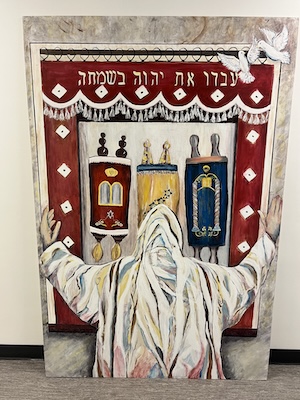
Windows into the synagogue, windows into Judaism. The Beth Israel Mural Project features 13 works of art, each based on a Jewish holiday. Adorning the shul’s parkade, they welcome visitors.

“During COVID, Sy Brown started the Good Times Club at the BI. The goal was to bring in new programming into the shul for the over-50 crowd,” explained project manager Reisa Schwartzman. “We have had blood drives, book clubs and walking clubs. I came up with the idea to do a mural in the garage.

“At first, the idea was to do one large mural. The challenge was that there are parking signs that could not be removed so it motivated us to think out of the box a bit. The smaller framed murals allowed it to have the effect of being windows into the shul.

photo - Ramona Josephson was the lead artist on one of the two murals portraying Shabbat
Ramona Josephson was the lead artist on one of the two murals portraying Shabbat. (photo from Beth Israel Mural Project)

“The next steps were to call out to the congregation to see who would like to participate. At this time, all meetings were held on Zoom due to COVID. Once the committee had the members, we then went out to the congregation – we wanted the entire membership to feel included, to see what they wanted to see in the garage. The overwhelming feedback was the holidays.”

Volunteers were assigned a holiday and the committee helped with each image. “This is when the real work began,” said Schwartzman. “But, up to this point between COVID and summer holidays, it was two years.

“With Peter Sarganis, an amazing artist himself but also an art teacher, he guided us on the steps required to take our wonderful images through the multiple steps to get each image on the boards. Once the boards were ready to go, we met each Sunday afternoon for painting for several months. There were committed painters who would come in during the week to work as well. This was a labour of love! The energy in the room when we were painting was fabulous. Focused artists and painters working together to bring these works to fruition.”

Sarganis answered the callout to members because, he said, “As an artist, I thought it would be a creative way to combine my love of Judaism, the Beth Israel Synagogue, collaboration and painting.”

Sarganis became the project’s art director and a lead artist and designer of one of the two Shabbat works.

“I love Shabbat. From Friday evening family dinners; to Shabbat morning services; to the candles, wine, challah and artifacts used – I can simply say I love it,” Sarganis said of his choice of holiday to portray. “The Shabbat panel I designed and painted is an abstracted representation of our family’s candle holders, Kiddush cup and challah cover.”

About the project, he said, “We had a wide range of expertise, from those who don’t paint at all to those who paint a lot. The common thread that kept us going and made this a beautiful group to be a part of was everyone’s passion for the project. 

“As a professional artist and someone who has taught at a fine arts school for the past 29 years, it seemed the role of me becoming art director happened organically, it was not something that was there at the start of the project,” he added. “This included helping the designers of the panels with their designs, bringing in tools and equipment to help facilitate the transferring of the designs onto the large panels, advising the groups of painters on the painting process and/or techniques, figuring out (with Reisa) the placement of the panels in the parkade.”

“I really believe that we can beautify the most simple areas to make them more impactful,” said Schwartzman. “Having these windows in the garage makes the experience of going to the BI start right from parking your car. But we didn’t stop there. Krystine McInnes came up with the idea that we should add QR codes to each image so that people could open their phones and learn more about each holiday, the customs and history. We hope we can use these to fight antisemitism as well, or just to help educate. We decided to paint on boards rather than the wall itself so, if needed, we could have them traveling.

“One thing different about our art is that none of the pieces are signed. This was with the commitment that the works were collective, designed and inspired by several artists and painted by the community we built. It is a community effort for our shul.”

While the lead artists aren’t indicated on the murals in the garage, they are credited on the project’s website, bethisraelartproject.com: Beryl Israel (Purim and Tu b’Shevat), Sheila Romalis (Hanukkah), Ramona Josephson (Rosh Hashanah, Sukkot and Shabbat), Debby Koffman (Simchat Torah), Janice Masur (Shavuot), Luca Carati (Yom Hashoah and Yom Yerushalayim), Nassa Selwyn (Pesach and Yom Kippur) and Adele Lewin (Simchat Torah). In addition to the QR code integration, McInnes designed the project website, which features information on the holidays, their history and customs from several sources, including work done by Jean Gerber and Jonathan Berkowitz and a dozen or so websites.

The paint was donated by Benjamin Moore Paint and the boards and framing by Burton Mouldings, said Esther Moses, Beth Israel executive director. Ralph (z’l) and Elaine Schwartzman donated to help make the project possible, she said.

“My parents believe in supporting our community and have always been supporters of several Jewish agencies here and abroad,” explained Schwartzman. “Once they heard about what I wanted to do, my mom called the shul and made a donation to make sure we could complete the project. Supporting the shul, the arts, community and engagement for people are all reasons they stepped forward.”

image - Beryl Israel was the lead artist on the Tu b’Shevat mural
Beryl Israel was the lead artist on the Tu b’Shevat mural. (photo from Beth Israel Mural Project)

“I am so proud of Beth Israel and our members who worked on the murals. They are strikingly beautiful,” said Rabbi Jonathan Infeld, the synagogue’s senior spiritual leader. “They bring light to our congregation and are a great educational tool. They brought people together for an important common cause. The murals are another way that we help bring Jews closer to God, Torah and Israel at Beth Israel.”

While he helped, for example, with the Hebrew on one of the works, Infeld admitted, “I am involved in many different aspects and programs of the synagogue, this is one that I did not play a large role in though. Yes, I helped with some of the Jewish content. But anyone who knows my artistic abilities knows why I left this project to others to accomplish.”

The project – which took a total of three years from conception to installation – “was a great way to add colour to our parkade in a meaningful and Jewish way,” said the rabbi. “The murals are educational and exceptionally beautiful. But, most importantly, they created community amongst people of all ages.”

Overall, it has been a huge success, he said. “People love seeing [the murals] when they enter the parkade. They love looking at them and learning from them. I know that the participants loved making them.”

“This project was really a labour of love by all who participated,” agreed Schwartzman. “Peter was incredibly supportive with his knowledge and guidance. There were so many amazing artists that we all learned from each other, helped each other and celebrated together. We really hope that these images bring the shul much enjoyment and support them in any of their programming when possible.”

“This project took a lot of time and work – and was worth every moment,” said Sarganis. “I met some wonderful people, and got to know people I already knew even better. A beautiful community project.” 

Format ImagePosted on June 14, 2024June 13, 2024Author Cynthia RamsayCategories Visual ArtsTags Beth Israel Mural Project, Jonathan Infeld, Judaism, murals, painting, Peter Sarganis, Reisa Schwartzman
A new generation of leaders

A new generation of leaders

Howard Kallner is being honoured at Schara Tzedeck’s MOSAIC gala on June 4 (photo by kenneth88/wikimedia)

“I have been very lucky in my life to be surrounded by lifelong volunteers and builders of community, both my parents, my in-laws and multiple other role models, and it just seemed natural to volunteer and be involved,” Howard Kallner told the Independent.

Kallner is being honoured by Congregation Schara Tzedeck at MOSAIC, the synagogue’s annual gala, on June 4.

“The first thing that came to my mind was discomfort,” said Kallner about finding out he was being recognized. “I was hesitant to accept because there are so many long-time shul volunteers, donors and community-builders who would be deserving of being honoured.”

Kallner has been a part of the congregation since he was 13 years old.

“My family had emigrated from South Africa when I was very young and their synagogues in South Africa were very similar to Schara Tzedeck,” he explained. “My parents, and now my family, have been members for over four decades. On my wife’s side, her great-grandfather, David Davis, was a founding member of Schara Tzedeck, and her grandfather, Charlie Davis, was a past president.”

photo - Howard Kallner
Howard Kallner (photo from Howard Kallner)

For his part, Kallner was on the board for seven years before becoming president. He served three years as president and three more as past president, for a total of 13 years. He was serving as president when the pandemic hit.

“When the COVID pandemic hit, we needed to pivot immediately to online programming, online services where applicable, continue live services with restrictions and make sure our community members, particularly our vulnerable ones, were connected and taken care of,” he said of how his role was affected. “One of the programs that came out of this was Shabbat in a Box. We recognized a need amongst our members and others in our community and delivered over 450 meals a week at the height of the pandemic. For the Jewish holidays, we were delivering over 650 meals accompanied by holiday-specific items so they could celebrate the holidays.

“Additionally, Schara Tzedeck, being an Orthodox synagogue, could not have Shabbat services online,” said Kallner. “With the exception of a few weeks when the government would not allow any public gatherings, we continued services in person with some significant modifications. When limited to 50 people per gathering, we moved services outside, in a tent in our parking lot. At times, services were held in sub-zero temperatures, with most attendees wearing ski jackets, toques and gloves. For the High Holidays that year, we had nine services a day for a maximum of 50 people. We had to find three sets of Torah readers, shofar blowers and leaders of the services.

“While, during COVID, it was undoubtedly the hardest I worked as president of the shul, it was also the most rewarding,” he said.

Now officially “just” a member and supporter of the synagogue, Kallner continues to be part of the Schara Tzedeck Cemetery Board and is a governor of the Jewish Community Foundation, as well. 

“Giving back to a community that has given me and my family so much was very important,” he said. “With different experiences in my life and my relatives’ lives, including immigrating to a new country with little means and losses during the Holocaust, strong Jewish institutions ready for whatever the world would throw at them seemed crucial, and I wanted to do my part.”

Schara Tzedeck’s senior spiritual leader, Rabbi Andrew Rosenblatt, described Kallner as representing the beginnings of a new generation of leadership. At the time Kallner was getting involved, said the rabbi, “There weren’t a lot of people in their 40s who were stepping up to the highest levels of leadership at Schara Tzedeck.”

Kallner helped take the synagogue from being a 20th-century organization into being a 21st-century organization, said Rosenblatt. 

”The backbone of an Orthodox synagogue, certainly in the Pacific Northwest, certainly in Vancouver, is people who have come from much more traditional Jewish communities,” he explained. “For example, Schara Tzedeck has a lot of Holocaust survivors. These are people who came from very traditional Eastern European communities, but you could also have people from Winnipeg or Toronto or Montreal, New York, those places you associate with very traditional, very committed Jewish communities. For a long time, we were able to be a community of people who grew up in that kind of tradition, but there was a recognition at Schara Tzedeck that we needed to be able to be a place which translated to people who did not have that kind of traditional upbringing.”

Kallner had the analytical, organizational and people skills to help the synagogue do that, said Rosenblatt, highlighting Kallner’s leadership during the pandemic. 

“He was practically a paid member of the staff at that point, in terms of generating and developing policy,” said the rabbi. “He was involved in helping us make sure that we were operating on the next level. And he also understood that our organization had to be structured in a way where we could have the manpower to be able to do that, and that outreach. Part of that was that the information technology had to be updated.”

Describing Kallner as “a very humble person but also very hard working,” Rosenblatt said, “one of the things that he was strongest at was helping us transition into a place where we were reaching out more…. One of the programs we developed under his watch was Shabbat in a Box. There were some pre-iterations before that, but it came to its full maturity under him.”

Among the other programs that will benefit from the funds raised at MOSAIC are the synagogue’s education initiatives, some of which reach beyond the shul to the broader Jewish community, such as the series Rosenblatt gave on the history of the Marranos.

“I recognize,” he said, that “one of the great sources of inspiration in Jewish identity is Jewish history.”

Since the Oct. 7, 2023, terror attacks and the subsequent war, his education efforts have been more focused on Israel.

“When Oct. 7th hit, and people started to hear immediately just garbage about colonialization, I realized that there was just so much that people didn’t know or understand,” he said.

The Zionist story most of us have been taught is the inspirational one, he said. “Not that it’s wrong, it’s just not complete, and all histories have complexities. I didn’t want people to be caught flat-footed on these things and be surprised by them.”

He gave the example of a sign he saw on an overpass on the way into Whistler Village recently.

“It says there can be no peace on stolen land. And I’m thinking to myself who stole the land from whom? At what point do you decide that the land belongs to someone? Are you willing to say that 638 is where we’re going to start everything, when Omar ibn al-Khattab conquered Jerusalem, is that the right time? Should we ask ourselves when the Abbasids or the Fatimids or the Umayyads, which one of them? Were the Ottoman Turks? Which one becomes the real owner? At what point do you decide that these things happen? People don’t know – maybe now they do more, but certainly on October the 8th they didn’t know – when was Israel first called Palestine, when did Muslims come to Jerusalem, when were Jews forced out, which empires conquered it … what really happened at Deir Yassin, what were the stages of the War of Independence, what happened? These things, there are a lot of resources on them … and, I thought, Jews didn’t know these things – not to mention that there are libraries full of evidence on Jewish indigenous life in Israel that is far, far older than anything having to do with the name Palestine, and I wanted Jews to be able to know that. I wanted Jews to be able to articulate it. I want Jews to understand a stronger connection to Israel. And I think that has been something that has been a real value added to people’s knowledge base.”

The congregation has several individuals who have gone to do military service in Israel. “They are primarily Israelis who are here for various purposes, as shlichim [emissaries] or for educational reasons, and we’ve had real success in having them share their experiences and stories over the past number of months,” said the rabbi.

These types of programs have been a priority, said Rosenblatt, “to make sure that our community really stays close and understands the nuances and the issues. Every time we have the opportunity to give further insight, we do that.”

One of the people from Schara Tzedeck who has gone to serve was Assistant Rabbi Ishay Gottlieb. “He’s a major in the reserves in the IDF, and he left on Oct. 9th and wasn’t really back until the beginning of January,” explained Rosenblatt. “You’re essentially funding a staff member, like many Israeli organizations [are having to do], but there’s lots that had to be compensated for in that context.

“In some ways,” added Rosenblatt, “we’ve doubled our programming – run a regular program plus an Israel program. Not that we’re that different from the other synagogues [in that respect] but everything costs money and this is part of a case for giving. Since Oct. 7th, we really have been prioritizing the connection with Israel.”

He said, “When you walk into Schara Tzedeck, we want you to feel like you’re in a little embassy of Israel in this building. And participating in MOSAIC means that’s what you’re doing, you’re helping to support that – you’re helping to support a branch of Am Yisrael that is in Vancouver.”

To attend MOSAIC, RSVP by May 28 to 604-736-7607 or [email protected]. 

Format ImagePosted on May 24, 2024May 23, 2024Author Cynthia RamsayCategories LocalTags Andrew Rosenblatt, COVID, education, fundraiser, fundraising, history, Howard Kallner, Israel, leadership, Mosaic, Schara Tzedeck, volunteerism
Highlighting seniors’ issues

Highlighting seniors’ issues

Berlin’s Nana Schewitz brings her show Florida! Ya Kill Me! to Vancouver May 31-June 2. (photo from Nana Schewitz)

Florida! Ya Kill Me! is a “love letter to aging,” says Berlin-based drag artist Nana Schewitz, who created the show with Josh Walker. But it’s also a “wakeup call,” she warned, about the systems we have in place for aging.

Florida! Ya Kill Me! comes to Vancouver for three nights, opening May 31 at the Dusty Flowerpot Cabaret.

“JQT is so excited to bring Nana Schewitz to both Toronto and Vancouver, as part of our JQT [Jewish Queer Trans] Mental Health Support Series in partnership with JFS Vancouver, a series supported by the 

Jewish Community Foundation of Greater Vancouver,” said Carmel Tanaka, executive director of JQT Vancouver, noting that the shows are being sponsored in both cities by Goethe-Institut Toronto, which is part of a global network that works to foster understanding of Germany’s cultural diversity.

“The content of her show addresses the challenges of Jewish queer trans seniors, which is a very near and dear topic to JQT,” Tanaka said of Nana’s Florida! Ya Kill Me! “We hope that, through drag and comedy, we will be able to raise awareness of the work our JQT Seniors Initiative is doing to create safer long-term care homes and spaces, so our aging JQT community members can proudly celebrate all their identities into their twilight years.”

Florida! Ya Kill Me! is a theatrical retelling of Nana’s 2021 trip to Florida in search of a final resting place, Nana told the Independent. The character is a feisty 96 years old.

“Josh and I traveled up and down the state in search of retirement paradise, visiting every bingo hall, craft fair and 55-and-up pool we could find along the way,” she explained. “We met some incredible seniors who really opened up to me about their experiences with aging, finding love, losing love, accepting change and finding joy. I have the privilege to share these words through both my own retelling, and some filmed interviews we took. You’ll meet Josie, the 109-year-old bingo master. You’ll meet Doris, born and raised in Berlin (my current home) who lives in Florida’s largest retirement city (with over 100,000 residents). You’ll even meet my dead Cuban grandmother!

“The ability to tell these often-overlooked stories and cement the legacies of some of my favourite friends is my favourite thing about what this show is,” said Nana. “It’s a love letter to aging, but also a wakeup call to its effects. The systems in place around aging are crumbling quickly while our average life expectancy is getting higher and higher. I don’t want us to have to sacrifice our quality of life as we age, and this show is a call to action to make that happen!”

The name Nana Schewitz was inspired by Manischewitz, perhaps after a few glasses of its sweet kosher wine. The 96-year-old – who doesn’t “look a day over 69” – was brought to life by almost-30-something Bryan Schall, who studied at Philadelphia University of the Arts and graduated in performance design and production.

She emerged as an entity “out of a little hole-in-the-wall disco in Philadelphia. She stayed dormant for awhile, as her ‘style’ didn’t really fit in my idea of what drag in the US was. When I got to Berlin, however, I said, ‘Ooooohhh!!! Nana totally could work here!’

“The drag scene of Berlin was very different,” explained Nana. “It was quirky, brash, silly – all the things I wanted out of a drag performer. And I found myself really missing this very specific branch of Ashkenazi-Americana Judaism that I took for granted at home. I didn’t realize how much I missed it until moving to Berlin.

“Being Nana really allowed for space to connect with my Judaism, while also allowing me to rewrite Judaic tradition in a way that serves queer people,” she added. “I’ve hosted Passover seders, Hanukkah shows, Rosh Hashanah events and more in Berlin, and it’s been a beautiful connective tissue to bring the Jews of Germany (yes, we’re here!) together in a meaningful and unexpected way.”

Nana moved to Berlin in 2016 and says she hasn’t looked back.

“I grew up in South Florida, and just could not do one more winter of beautiful, it was just getting to be unbearable,” she said. “I couldn’t take the beaches and the sunshine of Florida anymore. Call me a masochist, I guess.”

Berlin has her heart, Nana said, “But all cities change, and the Berlin I moved to looks very different than the city I currently live in. I’ve learned here how precious community is, but it is something that requires maintenance and care, and cannot be taken for granted. I’m able to live my most authentic life here, but that is not a forever guarantee…. I worry about the future of this city, especially as a Jew. Your life can be taken very quickly if you stop paying attention and take things for granted.”

Describing herself as “50% lighting designer and 50% drag queen,” Nana said, “I studied lighting design and do it professionally, but doing drag gives me the outlet and access to say and do the things that are really meaningful to me. The lighting design definitely pays for the drag, but I love to light up a room nonetheless. I actually just came off tour doing lights for Canadian-Jewish icon Peaches around the US and Canada! It was a blast, but I really feel the most myself when I’m dressed up as a 96-year-old Jewish grandmother, singing sexually perverse parodies of Barbra Streisand songs in a dark smelly bar.”

Joining Nana in the Vancouver performances will be co-creator Josh Walker.

photo - Josh Walker is an integral part of Florida! Ya Kill Me!
Josh Walker is an integral part of Florida! Ya Kill Me! (photo from Nana Schewitz)

“I’m always so grateful to have my life partner/grandson by my side,” she said. “I’ve been working on Nana with Josh Walker for almost 10 years now. He is my most treasured collaborator, and we actually just came back from another two-month trip to Florida where we (along with my new grandson, filmmaker Lucky Marvel) just filmed the Florida! You Kill Me! documentary. We’re in production now after having visited and filmed in different Jewish and queer retirement homes, RV parks, assisted living facilities, etc., around the Sunshine State. The show me and Josh are about to put on in Canada is just a small taste of the incredible shenanigans we got up to around the state. You can catch Josh playing some classic Jimmy Buffett tunes on the banjo during this show.”

Nana exudes confidence, but that doesn’t mean she doesn’t have concerns about people’s reactions.

“I’ve had to stop being afraid, it wasn’t doing anything for me! When we went to Florida, I was extremely nervous,” she admitted. “A lot of what Nana is about is being out on the streets, very public and very vocal. I’m not sure if you know this, but there was recently a drag ban in Florida, as well. I’m not exaggerating, ‘adult live performances featuring sexual content’ were banned in Florida. I’m not sure if you’d consider my matzoh ball titties to be sexual content, but that’s beside the point. So, I went there with my guard up, worried for my safety and for the safety of my team. We had an ‘in case Nana gets arrested’ plan and everything. I’m proud to say, the ban eventually got overturned due, in part, to the relentless work of some of the drag queens of Fort Lauderdale (my hometown). But the damage had been done.

“I came in expecting bigotry,” she said, “but I really believe in my heart of hearts that is not our human nature. I think a lot of people are confused these days. There’s a lot of anger and hurt in the world and lot of information, and people are looking for where to place it and what to do with it all. This ‘drag queens bad’ narrative is political propaganda, but people will think what they want to think. Lucky for me, this Nana can move fast. When some of these Floridians see me, they’re not sure if they should pull out a gun and shoot me dead on the street, or give me a five dollar bill! By the time they’ve made up their mind, I’m gone. Whoosh!”

All jokes aside, Nana and Florida! Ya Kill Me! have a serious message.

“A new friend told me this as I was filming my documentary, and I think about it all the time so wanted to share it here as well,” said Nana. “She worked at the McArtor senior centre [in Florida], taking care of LGBT+ patients with Alzheimer’s and dementia. She told me, ‘If I can get you to do one thing after speaking to me, it’s call an older loved one in your life. A parent, a grandparent, an aunt, whoever. There will come a day when you call them and they won’t remember who you are anymore. Don’t wait for that moment to reach out. Enjoy every interaction you can, while you still can.’”

For tickets ($18) to Florida! Ya Kill Me!, visit jqtvancouver.ca. 

Format ImagePosted on May 10, 2024May 8, 2024Author Cynthia RamsayCategories Performing ArtsTags cultural commentary, drag, Florida! Ya Kill Me!, LGBTQ+, mental health, Nana Schewitz, seniors
BI celebrates building’s 10th

BI celebrates building’s 10th

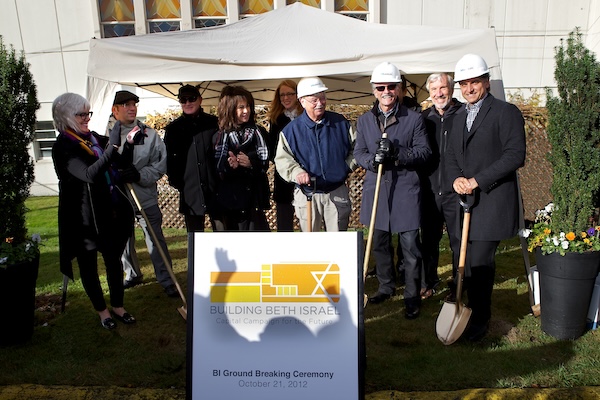
At the 2012 groundbreaking, left to right: Catherine Epstein, Rabbi Jonathan Infeld, Stuart Gales, Sylvia Cristall, Michelle Gerber, Gary Averbach, Sam Hanson, Shannon Etkin and Alfonso Ergas. Obscured from view is Elliot Glassman. (Robert Albanese Photography)

On June 9, Congregation Beth Israel will celebrate the 10th anniversary of its new building at the sold-out Gerry and Ruby Gales Be the Light Gala. The event will honour the synagogue’s visionary leaders – the Lutsky, Gales, Averbach, Cristall, Glassman and Porte families – and the capital campaign’s co-chairs, Gary Averbach, the late Lorne Cristall and the late Hershey Porte, as well as building chair Alfonso Ergas, Burn-the-Mortgage chair Lee Simpson and former BI executive director Shannon Etkin.

“This new building will be built as a place for our synagogue community to grow and thrive,” Lorne Cristall told the Independent in a 2010 interview, as the capital campaign was starting up. 

The new building, designed by Acton Ostry Architects Inc., would give the synagogue an east-facing sanctuary (towards Jerusalem), where it used to face north, and allow the congregation to host High Holiday services under one roof. The plan was to raise enough money that there would be little or no mortgage.

“The campaign began for $10 to $12 million plus about $2 to $3 million for an available piece of land on the southeast corner of the property that Shaughnessy Hospital had expressed a strong interest in purchasing,” Gary Averbach told the Independent in an interview earlier this week. “Even then, while running the numbers, it became quite difficult to see how … we could reach the $10 million mark, let alone the $12 million one.”

That became even more concerning, he said, once the designs were costed out, and the final tally was going to be closer to $18 million.

But the visionary donors being honoured, and many others, gave “unexpectedly generous gifts,” said Averbach, thanking Simpson and Bette-Jane Israels for their help raising the funds, and to Etkin, “who took over after we got the initial pledge.”

Averbach said, “Although we had been incredibly successful in our fundraising, having reached close to $20 million on the day we opened, the final price tag looked to be just over $25 million, and the lot had still not been sold.”

Etkin had found a potential buyer, but, when that deal looked as if it would collapse, Averbach called Gordon Diamond, who had earlier expressed interest in buying the land for possible Vancouver Talmud Torah expansion. It was a long process, said Averbach, “but, finally, thanks to Gordon and Leslie Diamond’s insisting that they find a way, the deal was done.

“There was a final Burn the Mortgage campaign with Lee, Bette-Jane and me. And, under Shannon’s leadership, we were able to pay off all but a little over a million dollars of the final cost of just over $25 million. I believe all that debt has been paid off now.

“An important note is that, of the almost $22 million raised, only two donations, totaling $118,000, came from non-members – and both those had a family history at the BI,” added Averbach.

“I suppose I could talk about all the important roles the Beth Israel synagogue, our shul, my shul, plays in our community, in our personal lives and in our spiritual lives,” Gerry Gales told the Independent about why he and his wife Ruby stepped up. “The answer is not complicated. There was a need. I was asked. I said yes. There was never a second thought in my mind. I do believe we are all here to help one another, to do what we can with what we have.”

He said, “Ruby and I find great comfort in being in our house of worship, our shul…. We know that we are a part of a great tradition, with roots that were planted thousands of years ago. It’s a tradition that will continue long after we are gone. When I think of all the people who have gathered together under this roof, I feel that I am but a small part of something so much larger than me and I feel that I am never alone.

“Then there is the practical role the shul plays in the unfolding of our lives,” he added. “The shul is a place where we come for prayers and to pray, the shul is the place where we can send our children to learn all our traditions and to be educated, the shul is a place where we come to celebrate, where we come to mourn, where we launch our children into adulthood.”

Simpson agrees. “I believe all synagogues play an important part in our Jewish lives. They are a place to gather, pray, gain spiritual renewal, comfort and peace. All so important to our mental and, therefore, physical being – even more important in our world today,” she said. “Plus, they give a sense of community. Seeing familiar faces, sharing a lunch or meal after services, all so important. They are also a place of learning and expanding our knowledge, answer our questions, gain wisdom from others.”

She said it was an honour for her and her husband Bernie to support Beth Israel.

“Beth Israel has been our synagogue for all of our married life – we were married there by Rabbi [Wilfred] Solomon,” she said. “Our children were named there, bat and bar mitzvahs were there and our grandchildren were also named and our grandson’s bar mitzvah has been there, and more to come. I was twice chair of the board of directors and involved in the building campaign.”

As for her involvement in the campaign, Simpson said, “For me, the final straw was at my son’s aufruf [being called to the Torah the Shabbat prior to the wedding]. The auditorium filled with family and friends was also filled with buckets to catch the rain coming in from the roof and windows. We needed more than Band-Aids.”

At the new building’s groundbreaking in 2012, Etkin cited a report from 1988 about a renovation being one of the shul’s “very important priorities.” He spoke about several efforts to move redevelopment forward, with the one that resulted in the new building starting eight years before construction was completed in 2014.

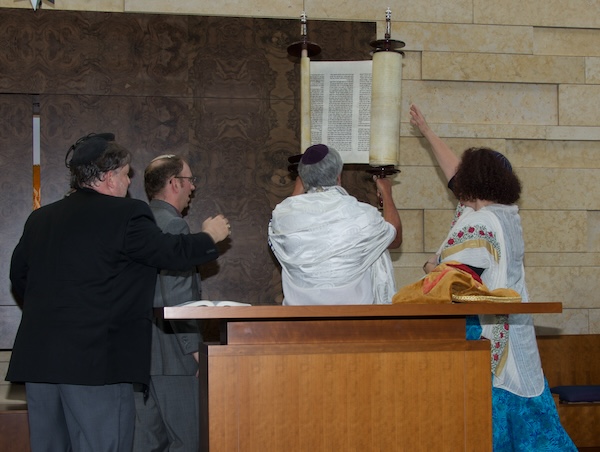
photo - Then Beth Israel executive director Shannon Etkin lifts the Torah during the dedication of the new building in 2014
Then Beth Israel executive director Shannon Etkin lifts the Torah during the dedication of the new building in 2014. (Adele Lewin Photography)

Acknowledging that he stood on the shoulders of Cristall and Porte, who “had been involved as co-chairs in various incarnations of the rebuilding of the Beth Israel Synagogue since at least the early 1990s,” Averbach said, “I had always taken an interest in the project, but it wasn’t until I joined the board around 2008 that I started to take an active interest. My interest was based on the fact that the existing building, besides being arguably halachically incorrect, was also in very sad disrepair.”

Cristall and Porte took Averbach out to lunch and asked him to deal with donors under the age of 55.

“After a few days, I agreed, and a couple of weeks later, Hershey passed away, and the ‘triumvirate,’ with me as junior partner became Lorne and me as co-chairs,” said Averbach. “Given Lorne’s serious illness, I knew my job had expanded many times.”

With the help and work of many people, and with the commitment of the congregation, the redevelopment finally happened.

“Since we opened our doors to our new and very beautiful building 10 years ago, we have seen significant increases in every aspect of synagogue life. Our membership is growing, and our program participant numbers have increased,” BI Senior Rabbi Jonathan Infeld, told the Independent. The clergy now includes Assistant Rabbi Adam Stein, Ba’alat Tefillah Debby Fenson and youth director Rabbi David Bluman.

“Since our new building project was completed, it has literally opened many doors for our congregation,” said Infeld. “We have had the blessing of hosting many large community events including this year’s Yom Ha’atzmaut celebration. We have had the flexibility to do many great programs that utilize all our spaces and meet the needs of many different age groups. The High Holidays are a perfect example of when we use almost every inch of the building. We have nearly 2,000 people come to our various High Holiday services each year and the space is a true blessing for all of us.” It also allows for more varied services and programs on Shabbat, said the rabbi.

“We are really looking forward to our sold-out gala this year, which will celebrate a decade of success because of the hard work and dedication of the people who helped make the dream of a new building possible,” he said. “I am so happy that there will be so many people present to say thank you to our visionaries and builders. Jacci Sandler and the gala committee have done a fabulous job already.”

The gala committee is Jennifer Apple, Kerry Benson, Samara Bordan, Chana Charach, Shannon Ezekiel, Shannon Gorski, Carol Konkin, Samantha Levin, Juliette Sandler, Paige Swartz and Leatt Vinegar. Sandler, head of development at Beth Israel and the creator of the Be the Light Gala, spoke with the Independent about this year’s event, which will feature, among others things, a concert by American-Israeli rapper/singer Nissim Black and a menu created by Israeli Chef Yaniv Cohen, owner of restaurant Jaffa Miami, and the Perfect Bite. Howard Blank will be the auctioneer and Sandler’s husband, Brett, will be master of ceremonies – he has a long history of fundraising in the community and chaired the JCC Sports Dinner twice.

For the main act, Jacci Sandler wanted an internationally known Israeli artist. Black fit the bill, and more.

“Not only are Nissim’s songs all about Judaism but they are filled with messages of spirituality, about hope, victory, friendship, belief, admiration, being lifted and much more,” said Sandler. “At the time we are in now, the Jewish community wants to be lifted and, at the Be the Light Gala, Nissim, with his beautiful words, will do just that. I received approval of this concept by my outstanding gala committee and executive director Esther Moses.

“With the occurrences in Israel this year, we wanted to celebrate the 10th year with an Israeli meal,” Sandler continued. “But we wanted a concept out of the box from the traditional options in Vancouver. Ricci Smith teamed up with Yaniv Cohen to do a Miami-style version of our Israeli meal… Our meal will be incorporating seven Israeli spices that represent kindness, strength, beauty, perseverance, splendour, foundation and royalty.”

Shannon Chung, with whom Sandler has worked before, will perform at the donor reception, which will be hosted at the house of Mark James.

“Beth Israel Synagogue is an essential part of who we are,” said Gerry Gales. “It serves the spiritual and human needs of us, the congregants. It is a focus for our Jewish community that allows us to come together and share our lives, for better or for worse, with each other. And our synagogue plays a role in making us a visible part of our larger community, the Vancouver community.

“In these stressful times, with war in our homeland and revival of old evils and antisemitism around us, we need a place where we can come together, where we can stand together. This is that place. The synagogue needs funding to be what we need it to be, and it needs our participation. If we do not fund it, if we do not make it work, who will?”

Averbach had a message for BI’s future generations.

“Just as I and many others worked long and hard at the renovation of the JCC between 1988 and 1995 and, just over 20 years later, we need to rebuild, so it will be with the BI,” he said. “Maybe it’ll be 30 years, but just remember – never underestimate the generosity of Greater Vancouver’s Jewish community!” 

Format ImagePosted on May 10, 2024May 8, 2024Author Cynthia RamsayCategories LocalTags Beth Israel, Gary Averbach, Gerry Gales, history, Jacci Sandler, Jonathan Infeld, Lee Simpson, milestone
Festival unites sparks of light

Festival unites sparks of light

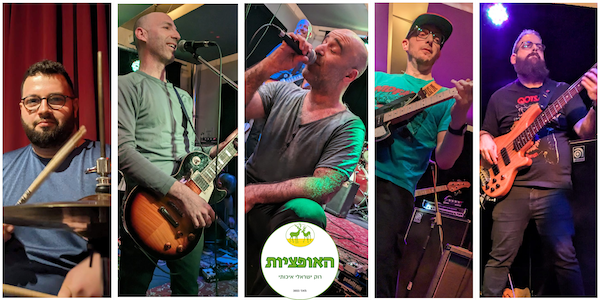
The Options Israeli music cover band closes the Festival of Israeli Culture on May 26. (photo from the JCC)

This year’s Festival of Israeli Culture takes place May 21-26, with the main event at the Jewish Community Centre of Greater Vancouver the afternoon of Lag b’Omer, May 26.

Falling on the 33rd day of the counting of the Omer, between the second night of Passover and Shavuot 49 days later, Lag b’Omer is a celebration amid tragedy. It commemorates the end of a plague that is said to have killed 24,000 of Rabbi Akiva ben Yosef’s students during the Bar Kochba rebellion against the Roman Empire in the second century. Only five students survived, one of whom was Rabbi Shimon bar Yochai, the sage who wrote the Zohar, among other things. Jewish tradition states that, after Rabbi Shimon offered his last kabbalist teaching, he died, on Lag b’Omer, having requested that his death not be mourned. For Rabbi Shimon, death means a soul has taken its place with God.

Among the traditions of Lag b’Omer are bonfires (perhaps in remembrance of fires the Bar Kochba rebels lit to relay messages), weddings, a boy’s first haircut, singing and dancing.

“I felt that it is so sensitive to be celebrating when there is such a complex and sad situation going on in Israel,” Nomi Zysblat, organizer of the annual JCC festival this year, told the Independent. “But, after researching the meaning of Lag b’Omer, I really see it as our community coming together with our individual sparks of light, a way of staying together, of communicating, a collective medura [bonfire or campfire] of strength and warmth.”

This year’s festival will be on the quieter side.

“We thought about this a lot,” said Zysblat. “Is it OK to ‘celebrate’? Is it safe? After many conversations, we decided that we need a gathering, we need to feel safe, we need to remember and we also need to be proud. We aren’t having a huge event, it’s going to be slightly more intimate … more gatherings and community enjoyment rather than huge events, both for the general feeling and also for security reasons. We aren’t flaunting but are also still wanting to enjoy being together.”

On May 21, there will be a dance party, kibbutz-style, at the Anza Club (tickets, $15). The night will be hosted by DJ Guy Hajaj, who will showcase modern and alternative Israeli music.

“He’s had a show for 10 years on Israeli radio and also a popular music blog, among other things,” explained Zysblat. “He DJs at events in Israel throughout the year but has been based in Vancouver for six years.”

photo - On May 23, Moshe Bonen performs a sing-along-style show with festival organizer Nomi Zysblat
On May 23, Moshe Bonen performs a sing-along-style show with festival organizer Nomi Zysblat. (photo from the JCC)

On the afternoon of May 22, the JCC parking lot will become an arts space where kids/teens can participate in a collaborative mural project led by Zohar Hagbi, a local Israeli artist. And, on the evening of May 23, the JCC atrium will come alive with music in a sing-along-style show led by musician and former Israeli radio broadcaster Moshe Bonen with Zysblat (tickets, $10, include a glass of wine).

“I have a music degree from Berklee College of Music in Boston and used to write and perform my own folk/rock music back in the day,” said Zysblat. “But, my favourite thing in the world to do when I was living in New York was to go up to the Bronx to Moshe’s loft and sing while he played his grand piano. He is an amazing player and accompanist.”

Zysblat’s professional background is both in music management and in the food industry. She started her own company 12 years ago – Paletas, which makes and sells natural popsicles. She got the idea while living in New York, discovering the icy Mexican treat at a grocery store. 

“After she brought the idea to the restaurant where she worked as a cook in Brooklyn and created unique desserts for the restaurant’s menu, she realized that it could be a lot of fun to make them in Israel,” it says on the company’s website. “Naomi went on a trip to Mexico to learn from local paleteros, their method and tradition, and get inspiration for special and different flavours, then came back and opened her small business here in Tel Aviv.”

“I was born in Jerusalem to Canadian-born parents – my dad was from Calgary and my mom is from Vancouver,” Zysblat told the Independent. “We grew up visiting our grandparents and aunts and uncles and cousins every summer in Canada so it’s like a second home to me. I even spent a few sabbatical years my parents took here in Vancouver, and attended school here. I knew this was an experience I wanted for my kids as well and, after Oct. 7, realized there’s no better time to come here. My husband Adi always loved BC because he was a mountain biker and beer brewer, so it was a win-win.”

It’s not surprising then that a nature walk is also part of this year’s festival. On the morning of May 25 at Central Park in Burnaby, there will be a walk led by young community madrichim (leaders). The terrain is suitable for all ages and abilities. There will be songs, stories, snacks.

At the festival’s main event at the JCC on May 26, there will be food trucks (Planted and Meet2Eat), a marketplace (jewelry, glass work, flower arrangements, photography, home decor, Israeli popsicles and jachnun, a Yemenite Jewish pastry), DJ’ed Israeli music, Israeli dance shows (troops from across Metro Vancouver, including Or Atid youth dancers), a drum circle, wine-tasting, arts and crafts, a gaga pit, face-painting, and dance, art and hummus workshops. In the Zack Gallery, the Tikun Olam Community Art Installation is already on display. The day closes with a performance by the Options, a group of local Israelis who cover Israeli rock and other songs. 

For more information, visit jccgv.com/ event/festival-of-israeli-culture. 

Format ImagePosted on May 10, 2024May 8, 2024Author Cynthia RamsayCategories Music, Performing Arts, Visual ArtsTags arts, culture, Festival of Israeli Culture, Israel, JCC, Jewish Community Centre of Greater Vancouver, Lag b'Omer, Nomi Zysblat

Ways to tackle anxiety

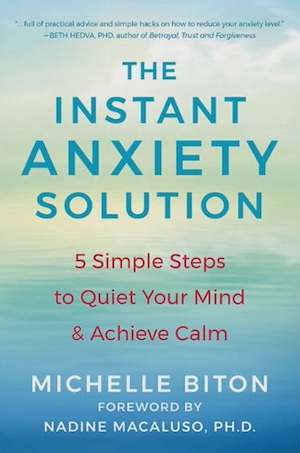
“Our thoughts are influenced by our core belief system. Our opinions are shaped from things we have seen and heard in the past and those opinions affect what we see. The problem is our thoughts are not always necessarily true,” writes Michelle Biton in her new book, The Instant Anxiety Solution (Hatherleigh Press).

“Our own thoughts and beliefs often cause us more anxiety than the actual emotion itself,” she writes. “And sometimes our beliefs are faulty or inaccurate. In order to get to the facts, it’s important to question your thoughts and not always believe everything you think.”

But this is jumping ahead to Step 5 of Biton’s five-step program ALARM, which starts with ways in which we can get our bodies “out of ‘the acute stress’ stage and into a calmer state so you can think properly” (activating the parasympathetic nervous system). It moves to labeling what you’re feeling, then acknowledging that emotions are temporary. Step 4 is about how to remember to avoid building narratives around your thoughts and emotions, and Step 5 is how to move forward and take action.

image - The Instant Anxiety Solution book coverOriginally from Vancouver, Biton is a Los Angeles-based coach, author and health educator. She has a master’s in holistic nutrition, a bachelor’s in psychology and a certificate in kinesiology, health and fitness studies. Her reasons for writing The Instant Anxiety Solution are personal.

“I had been trying to deal with anxiety as if it was logical, but anxiety is not logical. It’s primal and cannot be rationalized. My best friend helped me realize that, in order to manage mine and my daughter’s anxiety, we were going to have to look it in the eye and go through the discomfort of it,” writes Biton. “Going through the anxiety was the only way out of the vicious cycle.”

Biton’s own experiences with anxiety inform her approach. “You are re-learning ingrained patterns and behaviours that will take time to unlearn,” she acknowledges, “so be easy on yourself and give yourself time to go through the process.”

The Instant Anxiety Solution comprises a foreword by marriage and family therapist Nadine Macaluso; an introduction in which Biton lays out some of her reasons for writing the book; an overview of what anxiety is and its effects; a chapter for each of the ALARM steps; a brief conclusion; many exercises readers can do to learn how to better manage anxiety; and 20-plus blank pages for the purposes of journaling.

There are many causes of anxiety, including biological makeup, learned behaviour, lack of sleep, trauma, not eating properly, financial difficulties.

“When we get triggered by an event, our amygdala gets activated, causing the impulsive fight or flight response, and the prefrontal cortex, the logical thinking part of the brain, shuts off,” writes Biton. Our bodies focus on one thing: survival. The sympathetic nervous system is activated, “causing your heart rate, breathing and blood pressure to rise dramatically…. You’ll likely even feel shaky and nauseous.

“Many people make the mistake of trying to problem solve when anxiety hits, but it is absolutely impossible to do,” she writes. We can’t think until we have calmed down, and Biton offers many ways to shock the body out of its anxious state, such as splashing cold water on our face or putting a cold pack on the back of our neck; intense exercise, like a sprint to the end of the block or some push ups; and humming or singing.

There are ways a person can semi-instantly calm themselves, but the crux of tackling anxiety is self-awareness and, for that, there is no quick fix. Biton offers advice on how to identify and deal with feelings, but a main takeaway is to train ourselves to not act in those first moments. Apparently, an emotion lasts seven minutes max, then runs out of steam. It’s “the additional energy that is added in the form of our ‘extra’ thoughts and emotions that we ‘attach’ to the original emotion that keeps the feeling alive and the suffering occurring,” writes Biton.

“Do not act on impulse,” she warns, “you will only regret it afterwards.” But don’t numb yourself either. If you feel like crying, cry. Notice and acknowledge your emotions without judgment. When you’re calm, you can figure out what is really going on, consider both sides of the situation – what happened or was said and your reaction. 

We all have pain, she notes: “It is how we ‘react’ to the pain that determines our ‘suffering.’” Suffering, she says, is a sign that you’re not accepting the here and now. Some clues that you might be fighting against reality are that you’re feeling bitter or resentful, or you’re regularly unhappy or frustrated.

“A major reason that many of us suffer from anxiety today is because we have ‘felt unheard’ or ‘dismissed’ in our lives,” she writes. “We were told that we ‘weren’t good enough’ or that we ‘shouldn’t feel a certain way.’ This negative environment taught us not to trust ourselves, and not to trust our emotions. As a result, we have a lot of self-doubt and anxiety.

“On top of that, many of us project fears from the past into the future. Very rarely do we go into a situation without the ‘baggage’ and ‘opinions’ that we have carried from past experiences.”

Biton believes it possible to “become unstuck from the past.” The advice and exercises in The Instant Anxiety Solution may not result in instant results, but they do offer tangible steps to a solution. 

For more information, visit michellebiton.com.

Posted on May 10, 2024May 10, 2024Author Cynthia RamsayCategories BooksTags anxiety, health, mental health, Michelle Biton
Freedom and friendship

Freedom and friendship

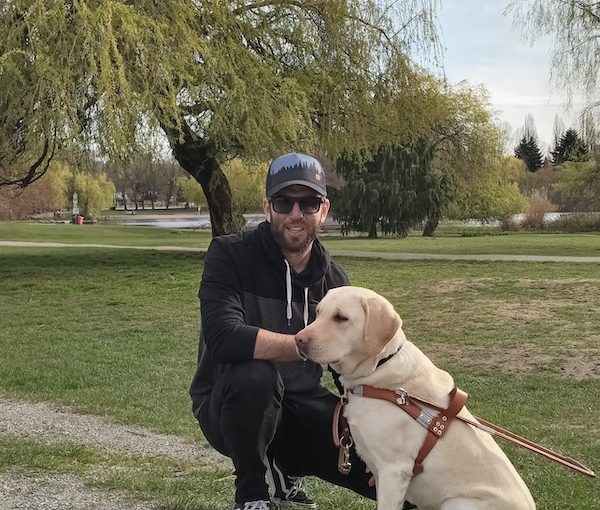
Achiya Klein and Joy at Trout Lake Park in Vancouver April 4. Klein and Joy were brought together by the Israel Guide Dog Centre for the Blind. (photo by Cynthia Ramsay)

“The Israel Guide Dog Centre is not just a centre,” said Achiya Klein. “It’s like a family.”

Klein and his assistance dog, Joy, came to Vancouver from Toronto earlier this month with Atarah Derrick, executive director of Canadian Friends of the Israel Guide Dog Centre for the Blind. The Independent met with them at Trout Lake Park April 4.

It was an educational experience to see Klein and Joy interact, like a unit. Even when Joy was off leash, clearly enjoying the freedom of running around on her own, meeting other dogs, she would respond to Klein’s occasional check-in whistles or calls. Being a Hebrew-speaking dog, one wonders what she had to say to her Canadian compatriots. Only once, enticed by the lake, did Joy hesitate to return to Klein, but she did – and before taking the plunge she so obviously wanted to take. On our walk, Derrick explained that all the 

Israeli guide dogs have English names so that the animals will know it’s them being called – imagine, she said, if a client called out a name like Yossi in an Israeli market, for example.

Klein has had Joy since the end of last October, since his first guide dog, Night, passed away at the age of 8.

“Having a guide dog is my way to get my independence again,” said the Israel Defence Forces veteran, who was injured in 2013. “I can do whatever with a guide dog because I can walk alone, with no fear, and being comfortable.”

Klein has serious visual impairment. “I have some sight,” he said, “but it’s minimal.”

A team commander in Yahalom, a special unit of the IDF that deals with the handling of dangerous ammunition and weapons, Klein was injured in a Gazan tunnel. “I was on a mission to demolish the terror tunnel that crossed into Israel,” he explained, “and, when we were walking in the tunnel … there was a booby-trap, and I got injured from that when it exploded.”

Klein moved to Canada with his wife, who is Canadian, in 2023. Noach Braun, the founder of the Israel Guide Dog Centre, personally brought Joy to Klein, where he worked with the pair for 10 days. The training period was shorter than usual because Klein had already had a guide dog. Normally, after matching a client with a dog, the pair train together for a few weeks at the centre, which then provides more training in the client’s home environment.

“It’s not like they just give you a dog and say, ‘OK, good luck,’” said Klein. “It’s more than that, and I think that one of the best examples is, after Night passed away, even though I was in Canada and I was supposed to go to Israel to receive a new dog, because of Oct. 7, I couldn’t make it to Israel, so Noach … came here during the war. He came here with Joy and I think that’s a beautiful story, to show what it means to be a part of the family.”

According to Derrick, who has been leading the Canadian Friends of the Israel Guide Dog Centre for the Blind since 2021, the centre has placed 796 guide dogs, 39 post-traumatic stress disorder (PTSD) dogs and 442 emotional support dogs, for a total of 1,277 since its founding in 1991. In 2023, there were 176 puppies being raised by centre volunteers, she said.

“The IGDCB (as it is known in Israel) serves Israel’s blind community by providing them with mobility, independence, self-confidence and companionship through the faithful assistance of guide dogs specially trained in Hebrew to meet Israel’s rigorous and challenging environment,” Derrick explained in an email. “We also breed and train service dogs for IDF veterans who have service-related PTSD and provide emotional support dogs for children on the autism spectrum.”

Canadian Friends of the Israel Guide Dog Centre for the Blind was established almost 20 years ago and Canada accounts for 6.6% of donations, according to its 2022 annual report. It is one of Derrick’s goals to increase that amount.

“I have always been passionate about community service and working in the charity sector, raising funds for vulnerable communities,” she said. “I’m a real dog person and, when the opportunity opened at Canadian Friends of the Israel Guide Dog Centre, it was the perfect match for my skills, interests and passions – helping people, Israel and dogs!”

Last year, Derrick and Braun visited Vancouver to visit donors and meet others interested in the centre’s work. “Everyone asked us to come back soon, preferably with a client and their dog, so they could see our work in action,” said Derrick, which was why she came this spring with Klein – who has become, she said, since being injured, “a Paralympic rower, a dedicated skier, a father and an asset to the IDF” – and Joy.

“We visited Vancouver Island first, with a meeting in Ladysmith to meet new friends there,” said Derrick. “We then headed south to Victoria, specifically Chabad of Vancouver Island. Then we moved east to Vancouver, where we met with Schara Tzedeck, the Kollel, and held a parlour meeting at the home of new friends. It was such a lovely visit, and we got to meet terrific people with whom our work really resonated.”

Initially, former Jewish National Fund shaliach (emissary) to Vancouver Mickey Goldwein, his wife Lili and her dog, Zita, were to accompany Derrick on the BC visit. Unfortunately, they couldn’t make the journey from Israel.

Lili Goldwein was partnered with Zita in 2018, explained Derrick, “because Lili’s vision had significantly deteriorated. Mickey joined the Israel Guide Dog Centre for the Blind’s board in 2022.”

The need for the centre and its services has increased since Oct. 7.

“Due to this war, we altered the criteria for receiving an emotional support dog to provide an immediate response to those injured or suffering due to the war,” said Derrick. “Since then, we have provided our emotional support dogs to children and adults with special needs whom the war has immensely impacted. Some of these people fought on Oct. 7 and were discharged immediately because of the trauma they endured. Some are widows of fallen soldiers. Some have been afraid to leave the house for months. 

“We are aware of some soldiers who have lost their vision in this conflict, and we need to be ready for them when they need us. This is in addition to the current clients on the waitlist,” she said.

The war also has disrupted the centre’s training, which may impact the number of guide dogs it can provide this year. “But we are doing our best to meet the challenge,” said Derrick.

photo - Atarah Derrick, executive director of Canadian Friends of the Israel Guide Dog Centre for the Blind, with Cookie
Atarah Derrick, executive director of Canadian Friends of the Israel Guide Dog Centre for the Blind, with Cookie. (photo from Atarah Derrick)

And they are meeting the challenge while still feeling the effects of the pandemic.

“COVID had two major impacts on our training,” said Derrick. “The first was in the socialization of our puppies. In their first year, it’s crucial to expose them to as many environments as possible. The office or university, the mall and the train station are all places where our pups get to experience lots of people, noises and smells and become more comfortable navigating those environments. Because of the lockdowns, most were cut off from those experiences, and many were not ready to take on service work. So, our success rate through COVID dropped, and our clients had to wait longer periods for their dogs. This was the case worldwide. 

“The second was that we were not able to open our residences to clients in guide dog courses. When a person is partnered with a guide dog, they live in residence with us for two weeks while they train together with our professionals. This was impossible during COVID, so our trainers went to the clients and worked with them at home, one-on-one, to complete the course. We put a lot of mileage on our vans during those years.”

Now, it is hospital visits that account for some of the mileage being put on the centre’s vans, with puppies and guide-dogs-in-training traveling to offer comfort to injured soldiers and civilians across Israel. 

“As the war rages on, we’re committed to continuing this mission of love and compassion,” reads the centre’s latest blog. “Because no matter the circumstances, a little bit of puppy love can go a long way in healing hearts and bringing people together.”

Seeing Klein and Joy together at Trout Lake Park and getting a glimpse of what having a guide dog has meant to Klein, the importance of the IGDCB’s work seems clear.

“They provide you with one of the most basic tools that you use every day,” Klein said. “But it’s not just a tool, it’s also a friend.”

To learn more about the Israel Guide Dog Centre for the Blind, visit israelguidedog.ca. 

Format ImagePosted on April 26, 2024April 26, 2024Author Cynthia RamsayCategories Israel, LocalTags Achiya Klein, Atarah Derrick, COVID, dogs, health care, IDF, Israel Defence Forces, Israel Guide Dog Centre for the Blind, Israel-Hamas war, mental health, pandemic, terrorism, veterans
Eat well, while helping Leket

Eat well, while helping Leket

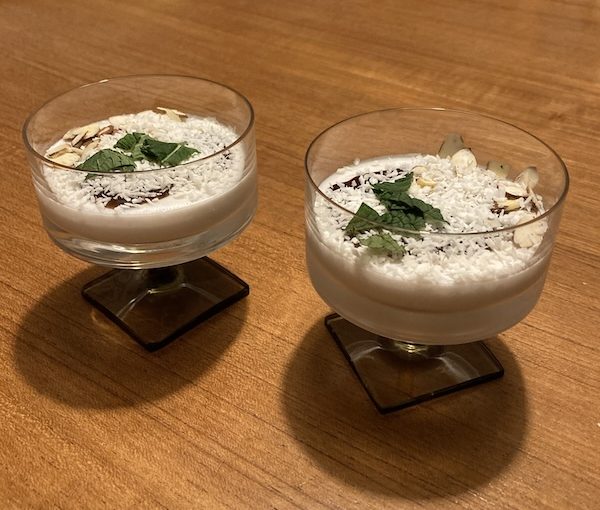
My new favourite dessert: Inbal Baum’s Coconut Cream Malabi. Baum is one of the contributors to June Hersh’s new digital cookbook, Cooking for a Cause. (photo by Ingrid Weisenbach)

I have a new favourite dessert: malabi. At least Inbal Baum’s Coconut Cream Malabi. Baum is one of more than 70 cooks, bloggers and others who have contributed to June Hersh’s new digital cookbook, Cooking for a Cause. All proceeds from the book’s sale support Leket Israel, whose focus is “rescuing healthy, surplus food and delivering it to those in need through partner nonprofit organizations.”

“By purchasing this digital cookbook,” notes Leket’s promotional material, “you will not only be supporting Leket Israel’s routine food rescue operations, distributing fresh, nutritious, surplus food to over 330,000 people in need each week, but you will also be part of Leket’s emergency relief campaign, providing much needed assistance to displaced Israelis throughout the country as well as to the Israeli farming community who has been significantly impacted by the ongoing war.”

Hersh has written several cookbooks “with a charitable flavour,” supporting various causes. She contributes to food blogs and magazines, appears on radio and TV, and gives talks on the importance of preserving Jewish food memory. Cooking for a Cause is a response to the Oct. 7 terror attacks, and Hersh and Leket Israel “reached out to everyone we could think of who has made an impact in the world of Jewish food,” writes Hersh in the introduction. “Additionally, we approached those incredibly outspoken Jewish and non-Jewish supporters who have taken a stand and used their moral compass to point the way. The response was overwhelming!”

image - Cooking for a Cause book coverThe result is a unique cookbook that is interesting both for its recipes and its stories – each entry tells users a bit about the contributor and/or the food being presented, and there are eye-catching colour photos throughout. The cookbook “is not arranged from starters to desserts and it is not consistent in its format,” writes Hersh. “I say this not as an apology but with pride, as this book is deliberately different. It reflects a cacophony of voices that have come together to support Leket and the people of Israel. Each contributor presents their connection to Jewish food and expresses it with a different perspective, writing style and point of view. You, the reader, benefit from diverse cooking techniques, interpretations of Jewish cuisine and fresh commentary with each recipe.”

Recipes that caught my eye as I skimmed through the book included Vegetarian Stuffed Cabbage Rolls (Holishkes) by writer Joe Baur; Pandora’s Chicken with Artichokes, Oregano, Olives and Sundried Tomatoes by Joan Nathan, “award-winning ‘godmother’ of Jewish food”; Aunt Rini’s Tahini Cookies by Elise Addlem, founder of Feminists Against Antisemitism; and Olio Egg Salad by Ben Poremba, who “infuses his Israeli-Moroccan heritage into all his restaurants.”

I have bookmarked these recipes for future cooking/baking sessions, and will certainly try others as well. Between the Jewish Independent’s Passover and Israel special issues, I only had time to try out three recipes. In addition to Coconut Cream Malabi, which Baum writes was inspired by “Our Chef Sevim [Zakuto], with her Turkish-Jewish roots, [who] shared the cherished recipe from her grandmother,” I made Rachel Simons’ Fennel and Herb Salad (Simons is a co-founder of the company Seed+Mill) and award-winning chef and restaurateur Jonathan Waxman’s Steelhead Trout with Vermouth, Baby Sorrel, Chanterelles and Fingerlings.

The salad was as big of a hit as the malabi, and I enjoyed the meal part of the trout recipe but wasn’t so keen on the sauce, which contained vermouth. Not being a lover of vermouth, I had put the sauce on the side, and I thought the food was better without it. When I make the fish again, I’ll try to halve the vermouth or reduce it on the stove to see if that makes it taste less sharp.

COCONUT CREAM MALABI
(by Inbal Baum)

1 can coconut cream (fat content should be greater than 14% for the best results)
3 tbsp sugar
3 tbsp cornstarch
1/3 cup of water
1 tsp of vanilla extract, or rose or orange blossom water
crushed (or chopped) nuts, to taste
desiccated coconut, for serving
pomegranate molasses and/or silan, for serving
optional toppings: chopped seasonal fruit (strawberries, apricots, mango)

In a small saucepan, combine the coconut milk and sugar. Bring to a gentle boil. Meanwhile, in a small bowl, mix the cornstarch and water until well combined. Slowly add the cornstarch to the saucepan, continuously stirring.

Over medium heat, continue stirring until the pudding thickens – this may take 3 to 5 minutes. If needed to thicken, add additional cornstarch in small amounts until the mixture begins to thicken.

Mix in the vanilla extract, orange blossom or rose water, then pour or ladle into four small bowls.

Allow to cool before serving (approximately one hour, but can be less).

When ready to serve, top with a layer of pomegranate molasses or silan (date honey), desiccated coconut and ground nuts.

FENNEL AND HERB SALAD
(by Rachel Simons; 4 servings; 30 minutes to prepare)

1 fennel bulb, very thinly sliced crosswise
juice of 1 lemon
1 cup cold water
1/2 cup fresh mint leaves, roughly chopped
1/2 cup fresh parsley leaves, roughly chopped
1 tbsp white wine vinegar
2 tbsp extra virgin olive oil
1 tsp flaky sea salt
1/8 tsp ground black pepper
1 cup parmesan cheese, thinly shaved (optional)

Place the sliced fennel into a bowl with the lemon juice and cold water. Let sit for about 10 to 15 minutes. Drain the fennel. 

In a large bowl, mix the fennel, mint leaves, parsley leaves, white wine vinegar, olive oil, salt, pepper and parmesan (if using). Mix to combine well. Serve the salad cold.

STEELHEAD TROUT WITH VERMOUTH, BABY SORREL, CHANTERELLES AND FINGERLINGS
(by Jonathan Waxman; serves 4)

4 x 4.5-ounce skin-on, boneless steelhead trout fillets
1/2 cup white vermouth
2 tbsp butter
2 tbsp olive oil
1 cup baby sorrel
1 cup cream
1 cup sliced raw fingerling potatoes
1 cup button chanterelle mushrooms

Season steelhead with sea salt and fresh ground white pepper.

Cook the potatoes in simmering salted water for 12 minutes. Set aside.

Wash mushrooms.

In a sauté pan, add 1 tbsp olive oil and 1 tbsp butter, heat to sizzling, add the trout, skin side down and sauté for 2 minutes.

When skin is crispy, turn over and add remaining olive oil and butter. Then add the potatoes and chanterelles to pan. Cook over medium heat for 5 to 8 minutes.

Remove steelhead to a warm platter. Ensure potatoes and chanterelles are cooked, add them to the fish platter.

Add the vermouth to pan and then add the cream. Turn off heat and add the sorrel leaves.

Taste sauce for seasoning and gently coat the potatoes and chanterelles with sauce. Serve hot.

* * *

To purchase Cooking for a Cause, go to chef.leket.org. For more on Leket Israel – including how you could join the organization’s approximately 54,000 annual volunteers “in gleaning, sorting and packaging rescued food for the Israelis in need” – visit leket.org. 

Format ImagePosted on April 26, 2024April 26, 2024Author Cynthia RamsayCategories Books, IsraelTags baking, cooking, Cooking for a Cause., fundraising, June Hersh, Leket Israel, recipes, tikkin olam
Camp celebrates a lifetime at 70

Camp celebrates a lifetime at 70

Lisa and Andrew Altow with their family on visitors day at Camp Solomon Schechter in 2013. (photo from the Altow family)

On May 5, Camp Solomon Schechter will honour four long-time relationships that were built at the camp. Part of its 70th-anniversary celebrations, there will be three separate events in three different cities – Portland, Seattle and Vancouver – on the same day. Those being honoured include Vancouverites Lisa and Andrew Altow, and Yvonne Rosenberg.

“One of the most special things about camp is the lifelong friendships that it creates and the geographic area that it spans,” Zach Duitch, executive director of Camp Solomon Schechter, told the Independent. “We say camp friends are forever friends and we know that having Jewish friendships throughout your life is one of the most significant and important relationships we have. This is what builds Jewish community.”

Of this year’s honourees, he said, “We have a friendship that has spanned three generations and two countries, from Portland to BC, Yvonne and Sharon [Stern] – they went to camp together, their children went to camp together, their grandchildren go to camp together. We have two relationships that are marriages from camp, the Korches [Melissa and Matt] and the Altows. And we have a beautiful friendship of four friends from four different communities who have stayed friends throughout their lifetime”: Eva Corets, Rochelle Huppin, Wendy Rosen and Karen Twain.

photo - Sharon Stern, left, and Yvonne Rosenberg met in the early 1960s at Camp Solomon Schechter and have been friends ever since
Sharon Stern, left, and Yvonne Rosenberg met in the early 1960s at Camp Solomon Schechter and have been friends ever since. (photo from CSS)

In previous years, Camp Solomon Schechter has awarded the Migdal Or Award to individuals who have provided a “spark of light that guides the way for others to follow.” The inspiration for the award and its first recipients, in 2020, were camp founders Rabbi Joshua and Goldie Stampfer (z”l). While an award won’t be given out this year, the 70th anniversary Schechter Spark will reflect the Stampfers’ “legacy, virtue and commitment to Jewish life and camping.”

Camp Solomon Schechter started in 1954, near Echo Lake, in Washington. The first year, 25 campers attended a one-week session; the next year, 40 campers attended a two-week session. 

The camp moved to Whidbey Island in 1958 but outgrew that space within 10 years. With the help again of Seattle Rabbi Joseph Wagner, one of the camp’s founders, as well as Harry Sherman and Rabbi Zev Solomon from Vancouver, BC, a camp property in the Olympia area was found, and it was for sale.

“Rabbi Stampfer immediately called the number and spoke with the owner, Helen Shank,” reads the Our History page of the CSS website. “And, for $300,000, the 200-acre property could be owned by Camp Solomon Schechter. Each of the rabbis from the major cities (Portland, Seattle and Vancouver) committed to raising $100,000 from their communities, and they were able to accomplish the goal in time for summer 1969.”

CSS is still located at the site near Olympia, with some 600 campers and more than 100 staff attending annually, in addition to the Stampfer Retreat Centre and OSPREY Camp (an outdoor education program).

Seventy years is a special anniversary in Judaism.

“The number 70 is considered a lifetime, so much so that 13 years into the second lifetime, at the age of 83, many Jews will have a second bar or bat mitzvah,” explained Duitch. “Where does that number come from? A midrashic tale tells us that there was an old man planting a carob tree by the side of the road when a traveler walked by. The traveler asked the man, ‘Why are you planting that tree? It will never bear fruit in your lifetime.’ The man responded, ‘I’m doing it for the next generation.’ And so, the legend goes, it takes a carob tree 70 years from seed to fruit and that’s where we get that idea of a lifetime. So, this year, at Schechter Spark, we are celebrating our first lifetime and raising funds for our next lifetime.”

“We are looking forward to being at the event with many of our good friends and all our kids,” Andrew Altow told the Independent. He and Lisa attended CSS in the mid-to-late-1970s. “I was a camper,” he said. “Lisa was a camper and, later, a counselor.”

After their first year at CSS, Andrew said there were a couple of reasons for wanting to return for another summer. “First, all our Jewish friends from all the cities – Vancouver, Seattle, Portland, Spokane – that went every year. Second, the ruach [spirit], the amazing sense of Judaism and fun together.”

Looking back now some 50 years later, Andrew said, “CSS played a massive role for us. Because of our CSS lifelong camp friendships, we met in our 20s at a party in Bellevue [Washington] and fell in love and got married a few years later – Lisa was from Bellevue and I was from Vancouver. Because of CSS, we maintained a meaningful connection with camp and eventually each of our four kids attended CSS and have made their own lifelong friends.”

Andrew and Lisa have each, at one time or another, served on the CSS board or a board committee.

“CSS has been a Jewish string that has connected us to our Judaism and to Israel in a positive and meaningful way, for which we are extremely grateful,” said Andrew. “Mostly, it’s been the amazing people involved with CSS, whether they be staff or volunteers, each one amazing in their passion for CSS and their genuine love for this magical camp, its mission, its values.”

It was “incredibly important” that their kids also go to Camp Solomon Schechter, said Andrew. “Each child – Josh, Lynne, Joey and Ari – got something different out of camp but their experience reinforced their Judaism and their connection to Israel.

“One summer, it was very special to have all four kids and my nephew from Toronto to attend in the same summer session – five Altows at one session. We were so proud to see how close they all were and continue to be. We believe CSS was an incredible positive influence on all of them.”

Humbled to be one of the Schechter Spark 24 honourees, Andrew said, “In a world today full of hate, full of antisemitism, full of turmoil worldwide, CSS is an oasis of safety for Judaism to shine through our children and teach them the beautiful tenets of Judaism so our children, and future children, can continue to repair the world as our faith illustrates.”

To read about the other Schechter Spark 2024 honourees and to RSVP for the (free) local May 5 event at Tap & Barrel in Olympic Village, go to campschechter.org/spark-24. Vancouver co-chairs are Elana Bick and Sheldon Franken, and the special guest will be camp director Manda Graziel. 

Thanks to CSS’s 2024 Matchmakers, any new donation to the camp will be matched dollar-for-dollar, up to $218,000. Visit campschechter.com to donate. 

Format ImagePosted on April 26, 2024April 26, 2024Author Cynthia RamsayCategories LocalTags Andrew Altow, anniversary, Camp Solomon Schechter, fundraising, Judaism, Lisa Altow, Schechter Spark, Vancouver, Yvonne Rosenberg, Zach Duitch

Posts pagination

Previous page Page 1 … Page 15 Page 16 Page 17 … Page 85 Next page
Proudly powered by WordPress