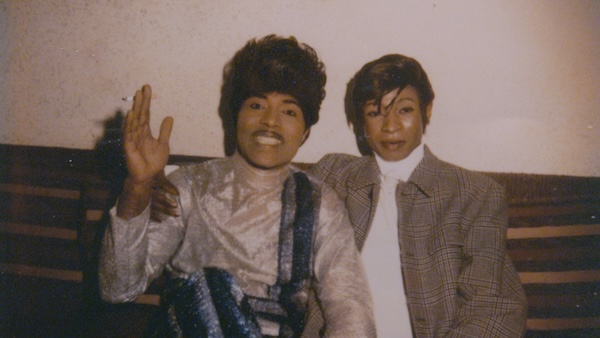
Little Richard, left, and Jackie Shane. A still from the film Any Other Way: The Jackie Shane Story, which closes the DOXA Documentary Film Festival on May 11. (image from NFB and Banger Films)
An incredible voice, a charismatic performer, a unique human being. Yet, most of us have never heard of Jackie Shane, a rising R&B star in the 1950s and ’60s, who appeared to disappear in 1971.
Michael Mabbott and Lucah Rosenberg-Lee’s feature-length documentary Any Other Way: The Jackie Shane Story closes the DOXA Documentary Film Festival on May 11 at Simon Fraser University’s Djavad Mowafaghian Cinema. In addition to Toronto Jewish community member Rosenberg-Lee, who may attend the festival, Winnipeg Jewish community member Toby Gillies is coming to Vancouver with co-director Natalie Baird for the May 10 screening of their short, Don’t Let the Sun Catch You Crying, which also takes place at SFU’s Djavad Mowafaghian Cinema.
An R&B legend
A Banger Films and National Film Board of Canada co-production, Any Other Way mixes animation and real-life footage, using Shane’s music, recorded phone conversations between Mabbott and Shane, as well as other interviews, photos and the sole recorded performance of Shane to tell the transgender artist’s story. And it’s a fascinating story, from her leaving her home of Nashville, because of safety concerns, as a queer person, to being a musician in a traveling carnival, to leaving the carnival for Montreal, then leaving Montreal for Toronto, where she immediately felt at home.
By 1963, Shane was a sensation. Her recording of “Any Other Way” was a hit, even though radio stations in Toronto at the time generally did not play Black music – people called CHUM Radio so much they had to play the song and it rose to #2. Shane was invited onto The Ed Sullivan Show but turned them down because they wouldn’t let her perform with makeup, dressed as she wanted; she didn’t do American Bandstand, saying it was a racist show. Shane chose not to do other shows or tour. She recorded her one live album in Toronto.
But not being able to be her true self took its toll and Shane walked away from her success in 1971, changed her name and moved. “I chose Los Angeles because I wanted to feel something else,” she says in the film.
For family reasons, she eventually had to return to Nashville, where she became a recluse, only emerging in 2016 for a reissue of her songs. Nominated for a Grammy in 2018, she was ready to tour, but died in 2019, before that could happen.
Among the treasures found in Shane’s storage unit was an autobiography she had handwritten, as well as unreleased recordings.
“Those discoveries … were incredible,” said Mabbott in an interview on the NFB website. “After Jackie passed away, we started working with her family, who didn’t know that Jackie existed, and then inherited her incredible archive. As they were discovering who Jackie was, we were understanding her through her jewelry and tapes. What was also born out of that is the family’s story, which was a slightly unexpected creative approach.
“Hearing the family talk about her, learn about her legacy and describe what it meant to them was obviously very personal but also really universal. This is a family that lived blocks away from her, didn’t know she was there and missed out on having her. I think that a lot of us feel that loss and that translates in all sorts of ways.”
Happy imaginings
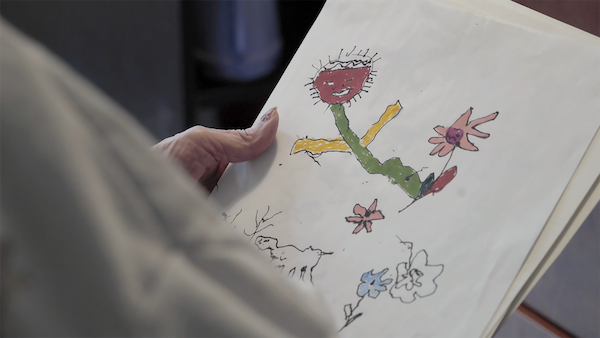
A still from the short Don’t Let the Sun Catch You Crying, co-directed by Toby Gillies and Natalie Baird, which screens May 10 at SFU’s Djavad Mowafaghian Cinema, as part of this year’s DOXA festival. (image from NFB)
The NFB short film Don’t Let the Sun Catch You Crying also explores loss. The PR material describes the seven-minute work as a “meditation on love, grief and imagination,” which “celebrates life and the transformative ability of art to elevate and transcend us.”
Featuring Edith Almadi, the short uses Almadi’s artwork and words to spur contemplation of the bonds people form, and what it’s like to lose a loved one. In this case, Almadi is recalling her son, who recently died.
“I fly with him,” she says, and she feels happiness. In the animation of Almadi’s artwork, we see her son fly to the moon and beyond, with fairies, butterflies and other creatures. Not only is she with her son in her art, but also with everyone she loves. In her imagination, she is totally free.
“Our initial motivation for interviewing Edith was to save memories for ourselves – we find the way she speaks fascinating and poetic,” write Gillies and Baird in a directors’ statement. “When Edith looks at her drawings, she sees her memories and fantasies. She is able to escape her physical circumstance, through entering her marker and watercolour worlds.”
Gillies and Baird have led an art program at Winnipeg’s Misericordia Health Centre since 2014, and that’s where they met Almadi, a Hungarian immigrant in her late 80s, who uses a wheelchair.
“In our time knowing Edith, she has always loved sharing her outlook publicly,” the directors write. “As we have developed the film, we have shown Edith our progress along the way. She says, ‘That’s me’ and ‘That’s all I have to give’ proudly. Facilitating art-making in this personal care home has allowed us to meaningfully connect with many people in their last stages of life. As directors, this film gives us the opportunity to share this one particular experience of intimacy found through collaborative art-making.”
DOXA runs May 2-12. For tickets and the full festival lineup, visit doxafestival.ca.
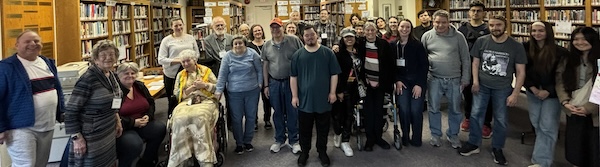
Participants in the Human Library event at the Isaac Waldman Jewish Public Library on April 7. (photo from Waldman Library)
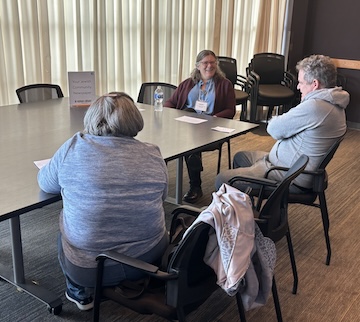
Jewish Independent publisher Cynthia Ramsay (inset, middle) was one of the “books.” (photo from Waldman Library)
The Human Library event at the Isaac Waldman Jewish Public Library on April 7 drew a diversity of “human books” (volunteers who shared some of their life experiences) and readers (people who came out to learn about those experiences). Titles included Police Officer; Coping with Dementia: A Mother/Son Story; More than just MS; Brain Cancer Survivor; Your Jewish Community Newspaper; and Partners in Care. Books and readers gathered at the library, had snacks and shmoozed, before participating in three separate reading sessions over the course of the afternoon. The purpose of the event is to connect one-on-one or few-on-one with individuals from different cultural backgrounds and lifestyles, celebrating our differences and fostering understanding.
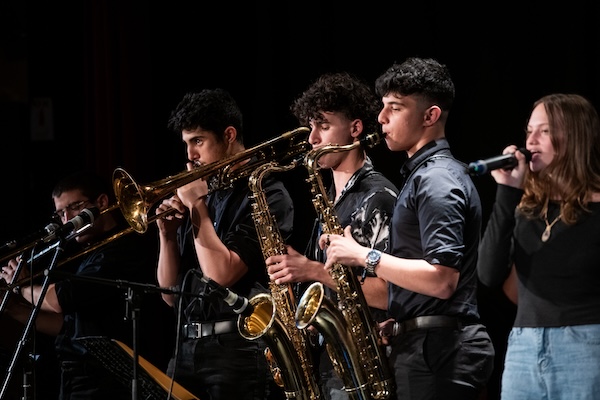
Members of the Clore & Roll Ensemble will perform in Vancouver on May 13. (photo from Clore Centre)
Every year, it is sobering to experience the transition from Yom Hazikaron, the day of remembrance for Israel’s fallen soldiers and victims of terrorism, into Yom Ha’atzmaut, the celebration of Israel’s Independence Day. This year, it will be even more so. And it will be especially poignant, given that the musical group headlining the local community gathering on May 13 is an ensemble from Kfar Blum, a kibbutz in the Galilee Panhandle, in northern Israel, where some 60,000 people have been evacuated because of the threats posed by Hezbollah in Lebanon.
The Clore & Roll Ensemble is an initiative of the music school of the Clore Centre for the Performing Arts, which also has a dance and theatre school. The centre was established in 1996 and approximately 1,000 students (which include adults) study there. They come from kibbutzim and moshavim in the area, as well as Druze and Arab towns.
“I’m glad to say that the conflict doesn’t get inside the centre,” Telem Chorin, chief executive officer of the Clore Centre and director of the ensemble, told the Independent. “Music is an international language and also an emotional language that connects people,” he said.
While the Clore Centre’s offerings remain afterschool programs, the centre has played a more important role in students’ lives since the Oct. 7 terror attacks that led to the current war.
“For some kids, the Clore is like a second home,” said Chorin. “Because, for some students, it is a more stable place than the hotel they were evacuated to, or the school that is currently closed or working partially.”
Despite being displaced, ensemble members have been coming together weekly to practise for the show in Vancouver. Rehearsals are at the centre.
“Last week, we had matriculation exams in dance and, during April and May, we will have matriculation exams in music playing,” said Chorin. “It is interesting to see how committed the students are to performing arts subjects even in such a period, and how much effort they have to invest – time, long journeys, sometimes even risking [their safety] and coming to Kfar Blum, even though it is relatively more dangerous here than in their homes or the hotels they have moved to. This shows how important it is to them and how much they don’t give up on it despite everything, and maybe even this is what keeps them ‘sane’ amidst all the chaos currently prevailing in the north.”
Some members of the ensemble have been playing together for more than five years in different capacities, but the group that is coming to Vancouver has only been playing together for the past three months, said Chorin. Due to the war and the evacuations, the group had to rebuild. “We’ve added additional musicians to the band so that you will have an amazing show!” he said.
Coming to Vancouver are Menachem Ofri (17, singer), Yaron Shir (18, singer), Kachtan Aviv (17, flute), Maman Moria (17, alto saxophone), Moyal Ido (17, tenor saxophone), Shem Tov Ido (19, trombone), Kovesh Gil (24, drums), Primor Adi (17, electric guitar), Fitzer Tal (16, piano) and Deutscher Goni (16, bass guitar). Also coming are Ziv Greenberg (music director), Ferry Stefan (dance teacher and dancer), Malki Smadar (administrative manager) and Kashri Noam (technical manager).
“Ofri, Ido Shem-Tov, Aviv and Noam were evacuated from their homes, and they are coming from all over the country to the rehearsals at the centre – sometimes, under rocket attacks!” said Chorin, who will join the band in the performance, on clarinet.
“Some of the students have already appeared in Edmonton and Calgary,” he said. “I have performed in Edmonton, Calgary, Windsor and Hamilton, but this is my first time in Vancouver and I am very excited! Some of the students were in Vancouver on student exchanges with their schools in Israel.”
Of what it means for the Clore & Roll ensemble to play a Yom Ha’atzmaut concert in the diaspora, Chorin said, “It is a great pride and honour to represent the state of Israel in general, and the Upper Galilee in particular, in such a show, on the eve of Independence Day, in a challenging time like now.”
The ensemble will present a wide-ranging repertoire.
“We are going to play modern Israeli songs (Idan Raichel, Mizrachit [Israeli pop]), classic Israeli songs and also some songs in English,” said Chorin. “A very diverse and happy program.”
“Bringing the Clore ensemble serves as a reminder of the unbreakable bond we share across borders,” said Dafna Silberstein, associate director of Israel connections and partnerships at the Jewish Federation of Greater Vancouver. “It is also an amazing opportunity for the ensemble of teens and young adults to take a break from what they have been through for the past six months. And, for us, it feels like it is exactly what we need this year: coming together as a community united for and with our brothers and sisters in Israel.”
Jewish Federation has supported the Clore Centre as part of the Coast-to-Coast Federations’ Collective and independently, “as the centre is in our partnership region of Kiryat Shmona and the Galilee Panhandle,” explained Silberstein.
“We have wanted to bring the Clore ensemble for awhile now, to showcase the impact our support has had on its students and have been waiting for the right opportunity,” she said, noting that it is “with mixed emotions” that Oct. 7 created that opportunity.
“This year, the commemoration of Israel’s 76th Independence Day holds an even deeper meaning and significance,” said Silberstein. “It is an opportunity to stand together in solidarity and celebrate our shared values. Considering the spike in antisemitism, the need for community unity has become more important than ever.”
For tickets ($18) to the May 13, 7:30 p.m., concert at Congregation Beth Israel, as well as information about other Israel@76 activities, visit jewishvancouver.com/israelhere.
Ed Asner gives a remarkable performance in Tiger Within, which is part of the online Vancouver Jewish Film Festival, April 15-19. (tigerwithin.info/press-photos)
I had the privilege of interviewing Ed Asner several years ago. It was an experience I (and my mother, who also got to speak with him) won’t forget. So, it was with some sentimentality that I watched his last film, Tiger Within, which can be screened online April 15-19, as part of the Vancouver Jewish Film Festival, which has other movies being presented at the Rothstein Theatre April 12-14.
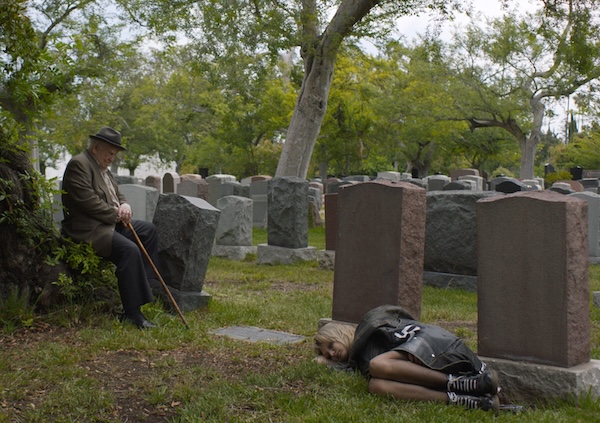
Asner, who died in 2021, gives a wonderful, understated performance in Tiger Within, as widower and Holocaust survivor Samuel, who takes a troubled young woman under his wing, and changes her life for the better. His performance is the main reason to watch this film. People old enough to know Asner will understand when I say Tiger Within would have fit perfectly into the ABC Afterschool Special lineup. Well-intentioned, it is not well written and, with the exception of Asner, the acting is middling.
Casey, played by Margot Josefsohn, is a rebellious teenager with a struggling mother who prefers to keep her nasty boyfriend happy than care for her daughter. Casey’s father has started a new family and their suburban life isn’t a place for the mouthy, punk-loving, artistic teen. Another highlight of Tiger Within is Casey’s art, which makes appearances throughout, further communicating her frustrations and other feelings.
Out on her own, Casey is lucky to meet Samuel, who sees her inner light and inherent worth, even if she doesn’t. He manages to see beyond the swastika someone spray-painted on her jacket, which she didn’t bother to wash off, and her antisemitic opinions, including that Jews made up the Holocaust, which were taught to her by her mom and others. He gives her the unconditional love, snippets of wisdom and space to “tame the tiger within” and make her place in the world.
The movie has a timely and important message. And a younger audience might be just the one to receive it in the manner it was intended.
“One of the biggest tragedies is the misuse of love, the most powerful force there is,” writes director Rafal Zielinski on the movie’s website (tigerwithin.info). “Loving oneself, family, group, race, country (narcissism) and being incapable of loving the other equally, as oneself, is the misuse of love, it breeds hate.
“That is the message, I feel, in this film – Samuel overcomes hate for this girl and shows her unconditional love.
“It’s the greatest gift anyone can receive on this earth, and he keeps his promise, he once made to his wife – ‘to forgive all before he dies.’”
For tickets to Tiger Within and other festival films, visit vjff.org.
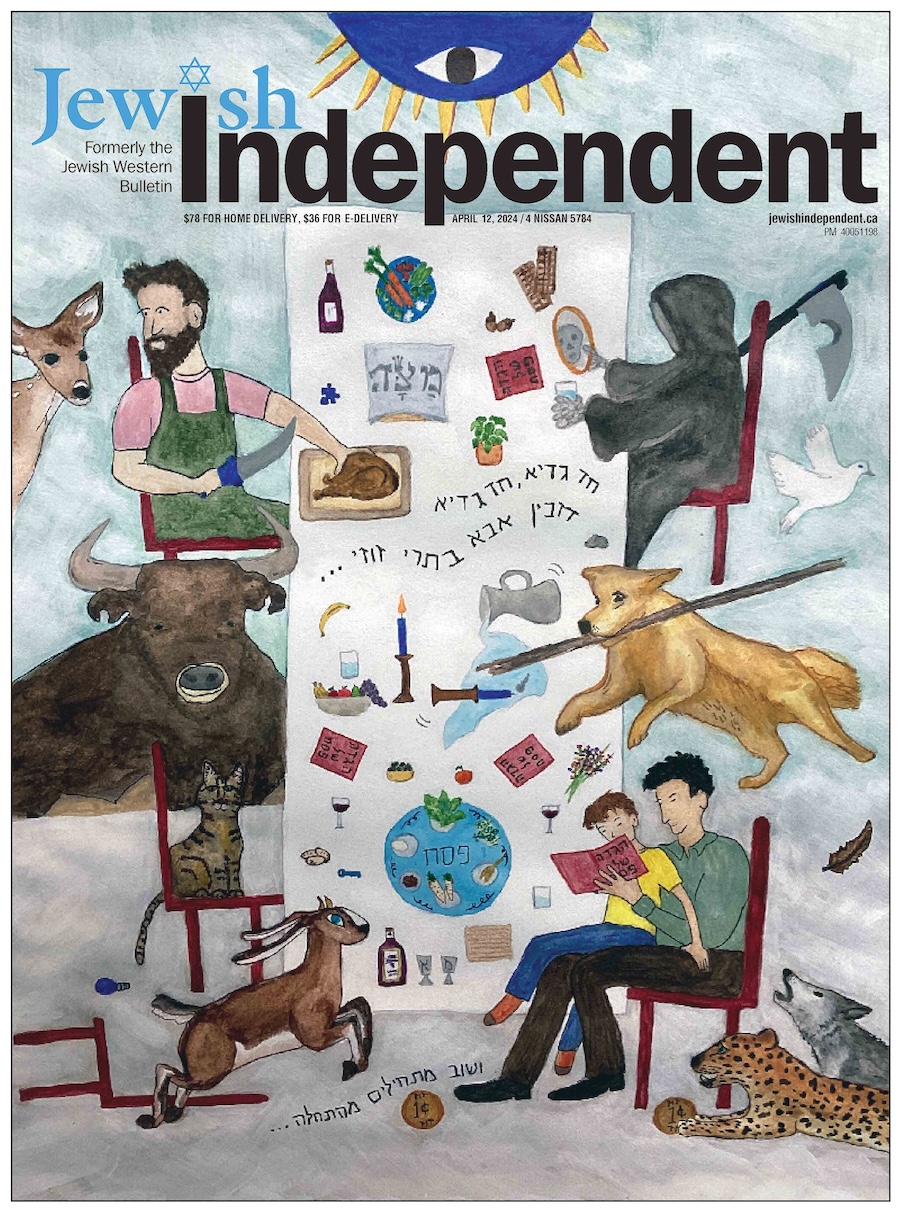
There are numerous interpretations of Chad Gadya (One Little Goat), which ends the Passover seder. A cumulative song, like “There Was an Old Lady Who Swallowed a Fly,” it starts with Father buying a goat, which is then eaten by a cat. Because it’s easier to summarize from the end, the last verse is, depending on your translation: then came the Holy One, Blessed be He, and slew the angel of death, who killed the butcher, who slaughtered the ox, that drank the water, that quenched the fire, that burnt the stick, that beat the dog, that bit the cat, that ate the goat. The Hebrew on the table in the cover image is the beginning of the song: Chad gadya, chad gadya, d’zabin Aba bitrei zuzei (that Father bought for two zuzim).
Often sung with different seder participants making the sounds of the succeeding aggressors, Chad Gadya is a cheerful song despite its violent imagery. With the numerous conflicts that mark human history and our present, I imagined the song’s characters, animate and inanimate, sitting down for a seder and what that might look like. This idea forms the centre of the cover scene.
While specifically about the Israeli-Palestinian conflict, Chava Alberstein’s 1989 version of Chad Gadya has always spoken to me more personally than politically. I have “been” the deer and dove of her song in my more empathetic and hopeful moments; her wolf and leopard in my more angry, fearful and hurt moments. As she sings – I, too, sometimes “don’t know who I am” in this world that can be so incredibly harsh. I, too, have thought, as Alberstein sings, and which I’ve written on the bottom of the cover art in Hebrew: “And we start again from the beginning …” each time one of us attacks another, with words or actions.
But giving up is not an option. So, while the characters of Alberstein’s song lie at the periphery of the seder image I created, 16 other symbols that might appear on a modern seder plate are scattered throughout. They represent what each of us can do to make ourselves better humans and the world a better place. They are not my ideas. I completely lifted all of them from “Beyond Bitter Herbs: Contemporary Additions to the Seder Plate” by Beverley Kort (with Leland Bjerg), which we ran in the Jewish Independent’s Passover issue last year.
Kort explains the meanings behind the fruit, acorns, chocolate, coloured light bulb, key, mirror, potatoes, banana, olives, basil, whole wheat matzah, vegetables, dried flowers, feather, rock and puzzle piece. For all the explanations, visit jewishindependent.ca/the-modern-seder-plate. Highlighting some of them: the acorns at the top of the picture represent an acknowledgement of Indigenous land rights; the rock above the dog’s head is symbolic of resilience; the key by the seder plate is about unlocking doors, embracing change; on the left side, the coloured lightbulb symbolizes the creative spirit; and the feather wafting off to the right is a reminder of the importance of kindness and compassion.
Chef and dietitian Micah Siva’s new cookbook, NOSH: Plant-Forward Recipes Celebrating Modern Jewish Cuisine, proves that plant-forward meals can be bursting with flavour and colour. (photo by Hannah Lozano)
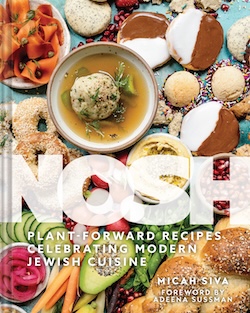
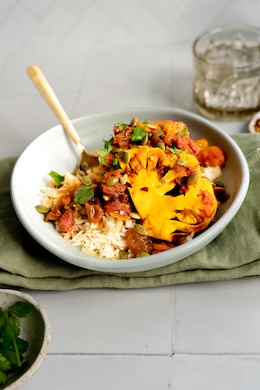
“This is really good,” said my wife, as she tasted the steaming hot Spiced Cauliflower Chraime I had made from the new cookbook NOSH: Plant-Forward Recipes Celebrating Modern Jewish Cuisine (The Collective Book Studio) by chef and dietitian Micah Siva.
“‘Plant forward’ is a way of cooking and eating that emphasizes plant-based foods without limiting one’s diet to being vegetarian or vegan,” writes Siva. “This book is meant for anyone who follows a plant-based diet or is looking to adopt a plant-forward way of eating.”
It’s also for anyone who appreciates delicious food, from what I can tell from the plates I tried. Nonetheless, Siva does offer solid advice for meat-eaters wanting to become more plant-forward. In that regard, she talks about getting enough protein and iron, what can be substituted for eggs, etc.
On the Jewish side, she gives milk and butter substitutions to make a recipe pareve (permissible for observant Jews to eat with milk or meat dishes) and offers sample holiday menus. I found the Shabbat Matrix interesting – the cooking time required (little, more and lots) is on one axis and the effort involved (low and high) is on the other. Siva offers some ideas to think about
depending on the time and effort you can put into the meal. So, you can buy store-bought challah or make your own, make spritzers or just buy a bottle of wine and/or grape juice, for example.
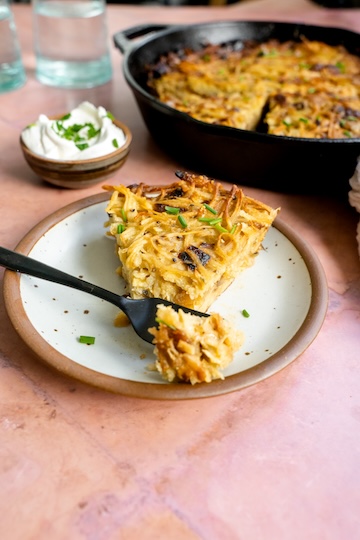
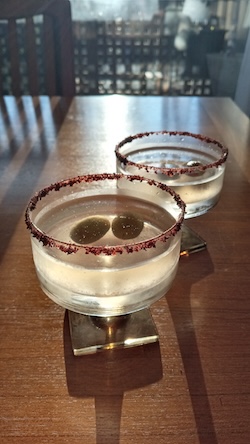
Given that Passover is approaching, I focused on a few of the recipes Siva highlights for the holiday. Her list comprises Turmeric Vegetable Matzo Ball Soup, Vegan “Gefilte” Cakes, the aforementioned Spiced Cauliflower Chraime, Herbed Horseradish Salad, Cast-Iron Potato and Caramelized Onion Kugel, Passover Black and White Cookies and Passover Coconut Macaroons. In addition to the chraime, I made the kugel and the macaroons. For fun, and because I have a huge bag of sumac from another cooking experience, I also made two Olive and Sumac Martinis – though neither my wife nor I are hard-liquor folks, we enjoyed our sips.
The production quality of this cookbook is high. The layouts are beautiful, with lots of colour photos and easy-to-follow instructions, which are supplemented by dietary labels (ex. vegan, gluten-free, Passover-friendly), the time required to get the food or drink on the table and clearly listed ingredients, as well as a brief introduction to each recipe and notes about certain ingredients that may be new to some cooks, or variations that could be used, possible substitutions.
NOSH includes a glossary and I learned a lot perusing it. Amba, for instance, is a “tangy, spicy, pickled mango-based condiment or sauce of Indian-Jewish origin” and toum is a “garlic sauce, similar to aioli, made of garlic, oil, salt, and lemon juice.” Siva gives some hints about measuring, choosing ingredients and shopping efficiently. There is an index at the back of the book, plus conversion charts for liquid and dry measures, and a Fahrenheit-Celsius temperature table. Acknowledgements and a bit about the author round out the publication.
In the few recipes I tried – and Passover-friendly ones at that – the expansive flavour palette on offer was evident.I look forward to making some of the 80+ other recipes in this cookbook, which illustrates the global diversity of Jewish culture. Siva may have grown up in Calgary, but her repertoire travels well beyond, to the Middle East, India, Africa, Europe and elsewhere Jews live or have lived. Her blog, at noshwithmicah.com, is worth checking out.
The cauliflower chraime was packed with spices – all of which I miraculously had in my cupboard! – and I will definitely make this dish again, as it was not only tasty but also easy to put together. According to Siva, it “is typically made with a whitefish poached in a tomato broth” and is often served in Sephardi families instead of gefilte fish during Passover. The recipe suggests serving it with couscous or rice, neither of which observant Ashkenazi Jews can eat during the holiday, so I plated it with mashed potatoes, which are OK for all Jews on Passover, and the two paired well.
It is worth sharing Siva’s note in the cookbook, acknowledging that the recipes “that are ‘Passover Friendly’ will have kitniyot,” even though “Ashkenazi Jews typically prohibit kitniyot, which includes rice, corn, millet, and legumes (beans), as they look too similar to grains. While customarily left out of Passover menus, it is not technically prohibited by the Torah.” So, “[i]f a recipe is listed as suitable for Passover, please use your discretion, and do what feels more comfortable for you and your family.”
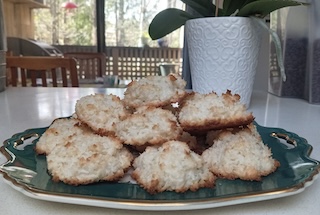
In the recipes that follow, all of which I recommend, I don’t include (for space reasons) the informative introductions that appear in the book. I made only one adaptation, choosing not to dip the coconut macaroons into chocolate, my personal preference being to just enjoy the richness of the coconut, brightened by the splash of lime juice and zest.
SPICED CAULIFLOWER CHRAIME (serves 4, on the table in one hour)
The Spiced Cauliflower Chraime from NOSH will be an immediate favourite. (photo by Micah Siva)
2 tbsp extra-virgin olive oil 1/2 medium white onion, cut into 1/2-inch pieces 3 garlic cloves, finely chopped 3 tbsp tomato paste 4 tsp smoked paprika 2 tsp ground turmeric 1 tsp ground coriander 1 tsp ground cumin 1 tsp ground ginger 1/4 tsp ground cinnamon 1/2 tsp red chili flakes 1/4 tsp sea salt juice of 1 lemon (about 2 tbsp) 1/2 cup canned diced tomatoes 1 1/4 cups vegetable broth (low-sodium, if preferred) 1/2 cup golden raisins 1 small head cauliflower, cut into 6 wedges (if using a large cauliflower, cut into 8 wedges) 2 tsp date syrup or maple syrup 1/2 cup chopped fresh cilantro,for serving Cooked couscous or rice, for serving (I used mashed potatoes)
Heat the olive oil in a deep skillet over medium heat. Add the onion and cook until it begins to soften, 5 to 6 minutes.
Add the garlic, tomato paste, smoked paprika, turmeric, coriander, cumin, ginger, cinnamon, chili flakes, and salt, stir until combined, and cook for 2 to 3 minutes. Pour in the lemon juice, canned tomatoes, broth and raisins and stir to combine.
Place the cauliflower in the pan, cut side down in a single layer. Bring the liquid to a boil, decrease the heat to a simmer, cover and cook until the cauliflower is tender, 15 to 20 minutes.
Drizzle with the date syrup and garnish with the cilantro. serve with cooked couscous or rice.
Note: Store in an airtight container in the fridge for up to 5 days.Reheat in a pan, oven, or microwave until warmed through.
Variations: Substitute chopped dried apricots or figs instead of raisins. Looking for more protein? Add a can of drained and rinsed chickpeas along with the canned tomatoes and/or crumble some feta cheese on top.
CAST-IRON POTATO ANDCARAMELIZED ONION KUGEL (serves 10 to 12, on the table in 2 hours)
Micah Siva’s Cast-Iron Potato and Caramelized Onion Kugel can be a side or a meal. (photo by Micha Siva)
5 tbsp extra-virgin olive oil, divided 2 medium yellow onions, cut into 1/2-inch pieces 1 1/2 tsp salt, divided 2 pounds (3 or 4) russet potatoes 4 large eggs 1/2 tsp black pepper 1/4 cup matzah meal sour cream, coconut yogurt, crème fraîche or labneh, for serving (optional) fresh chives, chopped, for serving
In a 9-inch cast-iron pan, heat 2 tablespoons of the olive oil over medium heat until the oil is hot but not smoking. Add the chopped onions, spreading them evenly over the bottom of the pan. Decrease the heat to medium-low and let cook, undisturbed, for approximately 10 minutes.
Sprinkle the onions with 1/2 teaspoon of the salt and cook, stirring occasionally, until browned and broken down, 30 to 45 minutes. Once golden and caramelized, transfer the onions to a large bowl.
Preheat the oven to 350°F.
Add the remaining 3 tablespoons of olive oil to the cast-iron pan and place it in the oven to heat up while you prepare the potatoes.
Fill a large bowl with ice water.
Using a food processor fitted with the shredding disk, or a box grater on the largest hole, grate the potatoes. The potatoes will oxidize, so be sure to shred right before use.
Add the potatoes to the bowl of ice water. Let sit for 10 minutes to remove excess starch.
Drain the potatoes, transfer them to a clean kitchen towel, and wring out any excess liquid. The more liquid you can remove, the better! Add the potatoes to the bowl with the caramelized onions.
Add the remaining 1 teaspoon of salt, eggs, pepper and matzah meal and stir to combine.
Carefully remove the cast-iron pan from the oven and spread the potato mixture in the pan, pushing it down to compact the potatoes. It should sizzle on contact with the pan. Return the pan to the oven and bake for 1 hour, or until deep golden brown on top.
Serve with sour cream and chopped chives.
Note: Prepare this kugel up to 4 days in advance and store in an airtight container in the fridge.
Variation: Add 1/2 cup chopped parsley to the kugel along with the matzah meal.
Substitution: This recipe uses russet potatoes, but you can use Idaho potatoes instead.
PASSOVER COCONUT MACAROONS (makes 12 [large] macaroons, on the table in 45 minutes, including 10 minutes resting time)
Lime juice and zest make Micah Siva’s Passover Coconut Macaroons special. (photo by Cynthia Ramsay)
2 cups unsweetened shredded coconut 1/2 cup sugar 1/3 cup potato starch 1/2 cup canned full-fat coconut milk 1 tbsp lime juice 1/2 tsp lime zest 1/4 tsp sea salt 6 ounces (about 1 cup) dark chocolate chips 1 tbsp coconut oil
Preheat the oven to 325°F. Line a sheet pan with parchment paper.
In a medium bowl, combine the coconut, sugar, potato starch, coconut milk, lime juice, lime zest and salt until well combined.
Using a cookie scoop or ice cream scoop (large enough to fit approximately 2 tablespoons), scoop up some of the coconut mixture and pack it very firmly into the scoop. Use your fingers or the back of a spoon to press it into the scoop. Gently remove the coconut mound from the scoop and place it onto the prepared sheet pan. Tap the back of the cookie scoop to release it, if needed, and reform the mounds after placing them on the pan. Repeat with the remaining coconut mixture.
Bake for 22 to 25 minutes, or until golden. Let cool on the sheet pan. Once cool, remove them from the pan and place them on a plate. Line the sheet pan with wax paper.
While the macaroons are cooling, combine the chocolate chips and coconut oil in a microwave-safe bowl and microwave in 30-second increments, mixing well between each increment, until smooth.
Once the macaroons are cooled, dip the bottoms into the melted chocolate and place them on the prepared sheet pan. Refrigerate the macaroons until the chocolate is set, about 10 minutes.
Note: Once the chocolate has set, store the macaroons in an airtight container at room temperature for up to 5 days or in the refrigerator for up to 2 weeks. Store them in the freezer for up to 3 months.
Variation: Add 1 teaspoon of vanilla extract or 1/4 teaspoon of almond extract to the mixture in place of the lime zest and lime juice. Fold in 2 tablespoons of rainbow sprinkles and dip them into melted white chocolate.
OLIVE AND SUMAC MARTINI (serves 1, on the table in 10 minutes)
An Olive and Sumac Martini is one of the unique drink options in NOSH. (photo by Cynthia Ramsay)
1/2 ounce olive juice, plus more to rim the glass 1/2 tsp sumac, plus more to rim the glass 2 1/2 ounces gin or vodka 1/2 ounce dry vermouth ice 2 or 3 olives, pitted
Pour a little olive juice into a shallow dish. Place some sumac in another shallow dish. Dip the rim of a cocktail glass into the olive juice and then into the sumac. Gently shake off any excess sumac and set aside.
In a cocktail shaker or a jar with a lid, combine the gin, vermouth, 1/2 ounce olive juice and 1/2 teaspoon sumac and fill with ice. Stir or seal and shake until well chilled, 20 to 30 seconds. Strain the liquid into the rimmed cocktail glass and garnish with olives.
Healing. Of body and soul. Of self, community, family, friends. This year’s Vancouver Jewish Film Festival offers many poignant films – dramas sprinkled with humour that invite contemplation, and hope that we flawed humans are capable of change and loving one another, despite our insecurities and differences.
Of the films the Jewish Independent reviewed this week, Stay With Us and Rose are among the films that will be screened at Fifth Avenue Cinemas in the main portion of the festival, April 4-12, which is followed by various screenings at the Rothstein Theatre April 13-14. No Name Restaurant will be both at Fifth Avenue, as well as online during that portion of the festival, which runs April 15-19.
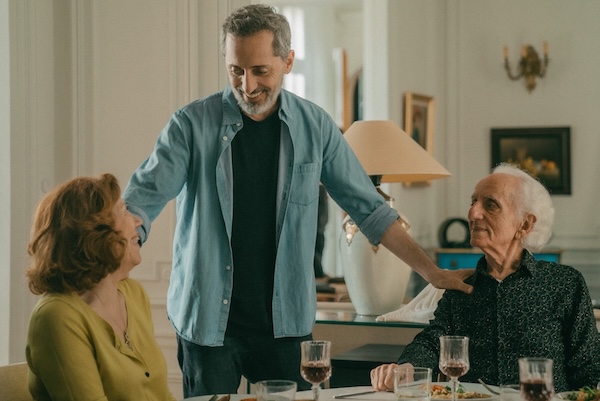
Stay With Us is a sensitively written and well-performed movie that is based on Moroccan-born Canadian comedian Gad Elmaleh’s real-life fascination with the Virgin Mary. In the movie, he returns to Paris to visit his family, not sharing with them that he is in the process of converting to Catholicism. Perhaps because he’s dealing with his own actual emotional journey (though he co-wrote the script with Benjamin Charbit), Stay With Us delicately and thoughtfully explores some of the roles religion has in life and the effects a potential conversion can have on a family.
Despite being an immensely personal film – Elmaleh’s real parents and sister play his family in the film and most of the cast are people close to him – Stay With Us will resonate with anyone who has questioned their purpose in life, or been curious about other religions and cultures. Elmaleh doesn’t disparage religion or the religious. Thankfully, he chooses to tackle the subject seriously, with well-timed comedy, his own stand-up act as part of the story, as well as other natural-seeming, unforced funny moments – the reaction of his parents when they find a statue of the Virgin Mary in his suitcase is hilarious, for example.
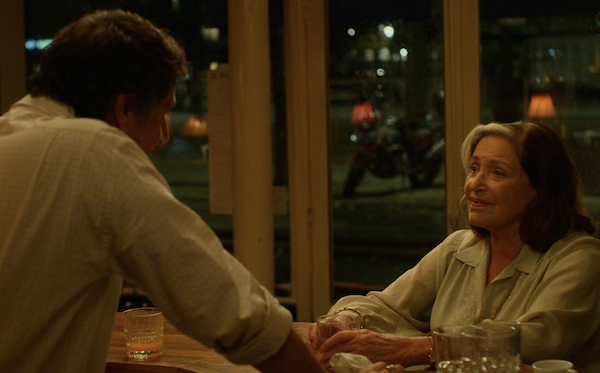
The movie Rose is similarly satisfying – serious but also light and amusing. In the first minutes, set at Philippe’s rocking, festive, friend-filled 80th birthday party, we learn that Rose and Philippe are still madly in love after decades of marriage, that their three adult children each have their own personal challenges and rivalries (between themselves and for their parents’ affection), and that Philippe is fatally ill.
Understandably, after Rose loses the love of her life, she grieves. Her children worry that she doesn’t answer the phone, that she’s not taking care of herself. When 78-year-old Rose does start to take care of herself, to focus on her needs, to rediscover herself after years of being a wife, mother and grandmother, her children worry even more.
Rose (still from the film)
Written by Aurélie Saada and Yaël Langmann, Rose is a charming, heartwarming film about how we choose to experience life, its happy, sad and other moments – and how it’s never too late to find joy. Saada is the film’s director, and she also composed original music for the film, which has a notably wonderful soundtrack. The movie is infused with her Tunisian Jewish background.
“It was important for me to put my first film in this setting because I didn’t want to cheat,” Saada says in the press material. “I wanted this film to resemble me and not to borrow anything from cultures that I hadn’t sufficiently mastered. Also, Eastern Judaism is often caricatured in French cinema. I wanted to show its more complex face, far from the clichés. But it remains a setting, a costume, a perfume because the heart of the subject is not there. This film may be imbued with Judeo-Eastern culture, but a friend of mine from Corsica, a Christian, told me a short while ago: ‘It’s crazy, it’s like home.’ I believe that we humans are much more alike than we imagine.”
This notion pretty much encapsulates the film No Name Restaurant as well. Written and directed by Stefan Sarazin and Peter Keller, the idea for the story apparently came from Sarazin’s “numerous travels to the Middle East” and was “inspired by an abandoned boat in the desert and the friendship to an elderly Bedouin.”
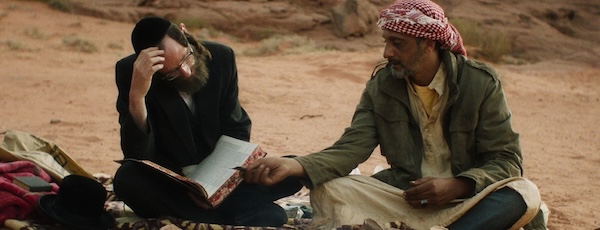
Ben, an ultra-Orthodox Jew from Brooklyn, has yet to marry. Within hours of arriving in Jerusalem, both to visit family but mostly to meet the matchmaker – who he purposefully misses by taking his time to get to his uncle’s shop from the airport – Ben eagerly agrees to Uncle Yechiel’s request to head right back to the airport to catch a flight to Egypt.
No Name Restaurant (still from the film)
The Jewish community of Alexandria, the president of which is Yechiel’s brother-in-law, needs a 10th man to form a minyan before Passover. If they can’t observe the holiday, according to some written agreement, all the community’s property and possessions will have to be turned over to the state.
Ben seizes the chance to save the ages-old synagogue, but misses his plane and then is kicked off the bus to Alexandria by fellow passengers, putting the whole plan in jeopardy. Luckily, he is picked up in the Sinai Desert by Adel, a Bedouin searching for his lost camel. Unluckily, Adel’s truck breaks down and the two men must head out on foot. Short on water – much of which had been used by Ben for ritual handwashings along the way – and going only on Adel’s memory of a well his family had frequented when he was a kid, the journey is fraught with existential concerns, including what other Arabs might do to a Jew in their midst and to the Bedouin who is helping him.
No Name Restaurant is a buddy movie that delivers all that one would expect from such a movie and more. With respect and humour, it brings together Jews, Muslims and Christians in a novel way to optimistic effect.
For the full Vancouver Jewish Film Festival lineup, go to vjff.org.
Lisa Wolfin, executive director and founder of Art Vancouver International Art Fair, which is at the Vancouver Convention Centre East April 11-14. (photo from Art Vancouver)
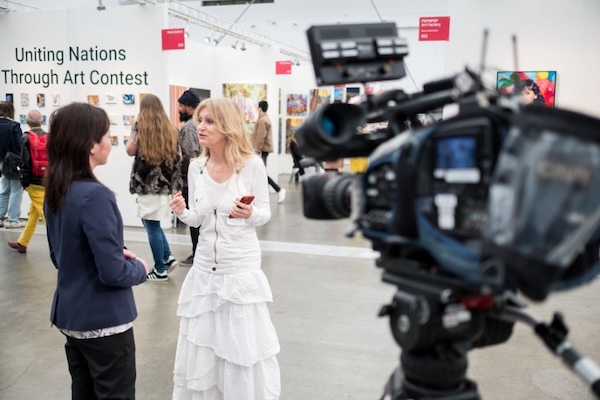
“Art serves as a vital anchor amidst the chaos of the world, both as a creator and a viewer,” said Lisa Wolfin, executive director and founder of Art Vancouver International Art Fair, which returns to the Vancouver Convention Centre East April 11-14.
“As a creator, it offers a therapeutic outlet to process complex emotions, providing a medium through which to express, reflect and make sense of the turbulence surrounding us,” she told the Independent, saying that, no matter the form of artistic expression, she finds solace in the act of creation, in addition to beauty and meaning.
“As a viewer,” she said, “art serves as a sanctuary, offering moments of escape and contemplation. It provides a lens through which to interpret and understand the world, offering insights, perspectives and opportunities for introspection. In both roles, art becomes a source of comfort, inspiration and resilience, offering a sense of connection and grounding amidst the uncertainty of our times.”
Wolfin and her daughters, Taisha Teal and Sky Lilah, who are also part of the Art Vancouver team, are among the Jewish community members participating in the annual art fair that drew more than 11,000 attendees last year. This April’s event is the eighth edition of the exhibit, which includes workshops, live demonstrations, a range of conversations, and is an opportunity for creatives to network and collaborate.
Wolfin is most looking forward to the sense of community and connection that Art Vancouver brings. “I’m eager to be a part of that vibrant atmosphere once again,” she said.
Taisha Teal (photo from Art Vancouver)
Teal echoes that sentiment.
“I’m particularly excited about showcasing my art to a diverse audience of art enthusiasts and collectors,” said Teal. “Connecting with fellow artists, sharing insights and drawing inspiration from their work is another aspect I’m looking forward to. This event also provides a unique opportunity to engage with artists and galleries from around the world…. Moreover, I’m eager to receive feedback from attendees and potential buyers, which will contribute to my growth as an artist and refine my artistic practice.”
Lilah is looking forward to two main things: what she will create for the exhibit – “it is always a surprise,” she said – and, she shared, “Additionally, there’s immense enthusiasm surrounding hosting the opening night! Welcoming everyone to Art Vancouver is a true privilege, and having a significant role at the show is an honour.”
Art Vancouver, which was established in 2015, has been held annually, with the exception of the first two years of COVID.
“During the pandemic, I dedicated time to exploring new artistic styles,” said Teal. “Over the past couple of years, I’ve blended several styles together, continually evolving my approach. For instance, my ‘sparkle ladies’ series has undergone transformations with each passing year, featuring diverse female figures and introducing abstract faces. I particularly enjoy experimenting with abstract shapes and colours, and my upcoming collection will focus on incorporating textured elements using molding paste and various tools.”
Sky Lilah (photo from Art Vancouver)
Following the pandemic, Lilah curated her inaugural solo art exhibition, unveiling a series of abstracts for the first time. “Instead of merely attempting to depict something, I sought to channel the divine through my creative process, crafting unique works of art that had never been realized before – pieces that were distinctly mine,” she said.
“Over the years, I’ve persisted in exploring abstract styles, seamlessly blending them with my previous series,” she added. “I’m currently amalgamating elements from several series, combining the favourite aspects of each into a cohesive whole. While I continually experiment with new styles, I often layer them upon the foundations of styles with which I am familiar – an ongoing ebb and flow of artistic exploration.”
Wolfin, too, has spent time developing and refining her existing style and techniques, while venturing into different areas. “This has allowed me to push the boundaries of my creativity and explore new avenues of expression,” she said, noting that her work is inspired by many sources, “including nature, emotions, personal experiences.”
“I find inspiration in the beauty of the natural world, the complexities of human emotions and the stories of people and cultures,” said Wolfin. “Each of these influences shapes my creative process and fuels my desire to express myself through art.”
Teal also has a deep love for nature – “Whether it’s the patterns in a leaf, the colours of a sunset or the textures of a rock formation, nature constantly offers fresh ideas and motifs that find their way into my artwork” – and points to multiple sources of creativity.
“Firstly, the diverse cultures, landscapes and experiences I encounter during my travels serve as a constant wellspring of inspiration,” said Teal. “Each new destination offers unique perspectives, colours, textures and stories that influence my artistic vision.
“Secondly, connecting with other artists allows me to exchange ideas, techniques and perspectives, fueling my creativity and pushing me to explore new artistic territories. Collaboration and dialogue with fellow creatives foster a sense of community and shared creativity that invigorates my artistic practice.”
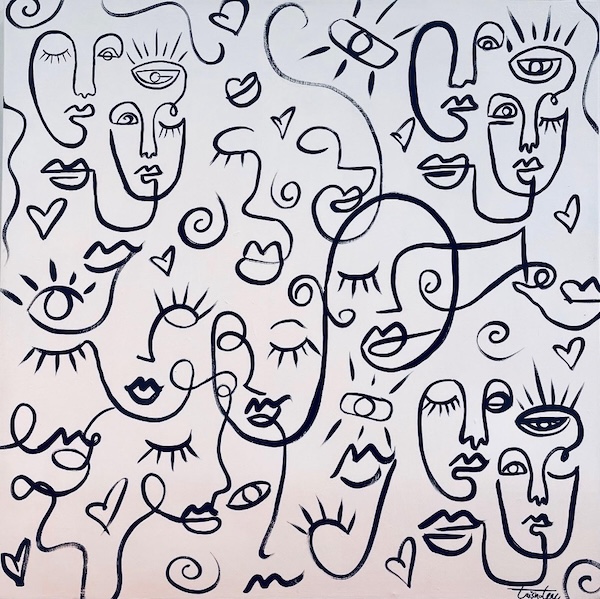
“A Thousand Expressions” by Taisha Teal.
Teal added that her “passion for experimentation with new materials adds another dimension.”
“Exploring unconventional materials and techniques challenges me to think outside the box and pushes the boundaries of my artistic expression,” she said.
“Art serves as a profound means of expression for me,” said Teal. “As a creator, it allows me to channel my emotions and immerse myself completely in the process. I infuse my art with love and happiness, aiming to evoke those feelings in my viewers. In a world filled with chaos, art becomes my sanctuary, a place where I find solace and peace. My intention as an artist is to spark positive emotions and inspire others with each brushstroke, inviting viewers to explore their own creativity and embrace the beauty within themselves.”
For Lilah, art embodies her very existence. “I’ve never known a life without it,” she said. “It serves as a means of creative expression, a harmonizing force for the diverse aspects of my personality and an invitation to embrace play, structure, freedom, love and acceptance.
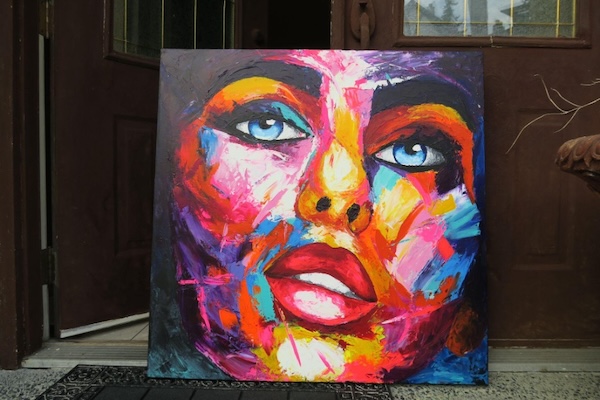
A portrait by Sky Lilah. (photo from Art Vancouver)
“Through art, I learn valuable skills and life lessons, such as time management (as artistic endeavours require dedication), self-love (recognizing that my efforts are ‘good enough’) and the importance of experimentation. It teaches me that we don’t know the result before it happens, and that you have to start in order to get to the end. For my work, I rarely know what I’m going to paint before I start painting, I discover it on the canvas, and that is a life lesson for my role in business as well – when hosting a new event, I won’t have all the answers before. I simply just need to start.”
Transformations in her life and the “opportunity to explore diverse cultures, languages and symbols sparks a fire of creativity,” Lilah said, adding that she tries, in her art, to “communicate a message that embodies inner strength, love, exploration, confidence, authenticity and kindness,” creating works “in an abstract, pop art manner to challenge mainstream thinking.”
Art Vancouver opens April 11, 7 p.m., and runs April 12, 1-9 p.m.; April 13, noon-9 p.m.; and April 14, 11 a.m.-5 p.m. For tickets and more information, visit artvancouver.net.
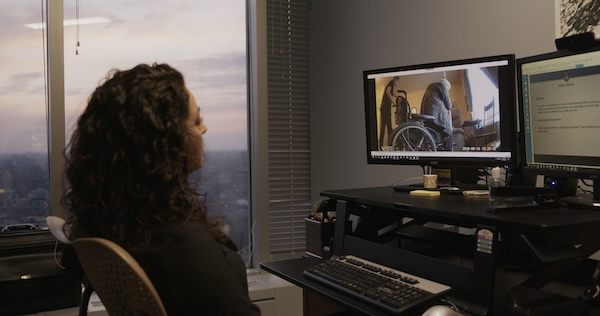
A still from the film Stolen Time: lawyer Melissa Miller reviews footage from a long-term-care room camera. (photo from National Film Board of Canada)
“I’m only at the beginning of this fight,” says lawyer Melissa Miller in the documentary Stolen Time, written and directed by Jewish community member Helene Klodawsky. Miller, of Toronto firm Howie, Sacks & Henry LLP, is lead counsel in mass tort claims against for-profit long-term-care corporations Extendicare, Revera Inc. and Sienna Senior Living.
Stolen Time will screen in Vancouver March 21 at VIFF Centre – Vancity Theatre, as part of a national release that includes Edmonton, Toronto and Montreal. The film is a joint production of Intuitive Pictures Inc. (with Jewish community member Ina Fichman at the helm) and the National Film Board of Canada (Ariel Nasr, producer).
To give readers an idea of what Miller is up against, there is a scene in the film where the private investigator she has hired, Brett Rigby, shares some financial data. According to Rigby’s documents, Extendicare had a revenue of $1.1 billion in 2019, $91 million in earnings and $42 million cash dividends declared – “and they’re locking up incontinence pads,” remarks Miller.
The film notes that “a few hundred family clients have grievances against these companies,” the most common complaints being serious dehydration, malnutrition, injuries and misdiagnoses. The homes apparently meet the requirements for staffing, but at least one person is off at any given time, so they are consistently understaffed. There seems to be no regulatory oversight, while the companies bring in record profits, the film contends.
Miller has been suing for-profit nursing home corporations in Canada and elsewhere for negligence since 2018, both in mass tort (class action) claims and independent cases against various facilities, one of which is featured in the documentary.
Video clips of residents experiencing abuse juxtaposed with family videos of the long-term-care residents when they were healthy allow viewers to see the people more fully and the depth of the injustices more clearly. Miller contends that it isn’t the staff who are to blame, generally, but rather that the staff aren’t given adequate resources by the companies, who could afford to do something but don’t.
A complicating factor in effecting change is that, for example, Revera is owned by a Canadian Crown corporation, ie. the federal government, notes the film. As COVID ravaged nursing homes in 2020, with thousands of residents dying, “governments across North America pass[ed] legislation to protect them from lawsuits.”
“Today, nursing home chains around the world have become sites for wealth extraction by investors and shareholders,” writes Klodawsky in her director’s statement. “At its core, such financialization of care ties frail elders to overworked, racialized and predominantly female staff. When public pension fund managers, private equity and real estate companies help set the rules, compassion and dignity fall by the wayside. Nonetheless, rapidly expanding populations of the frail elderly, combined with shrinking numbers of family caregivers, ensure a steady stream of residents.”
People interviewed in Stolen Time include Dr. Pat Armstrong, a sociologist and professor at York University; Lisa Alleyne, a personal support worker who has worked in for-profit nursing homes (she is also an artist and her illustrations of what some long-term-home residents face are powerful); Rai Reece, who writes and teaches on anti-Black racism; Jackie Brown, who researches how publicly traded companies make money for investors; Jason Ward, who investigates how public pension funds are invested in for-profit nursing homes globally; Katha Fortier, who has been fighting for the rights of care workers for decades; Ayesha Jabbar, a former social worker who became a union rep; and members of a couple of the families Miller is representing.
Stolen Time is an engaging film that raises a lot of important questions about how nursing homes are run. It is unfortunate that it doesn’t include any interviews or statements from company representatives or government officials.
The post-screening panel discussion in Vancouver will feature Sara Pon, staff lawyer and researcher atSeniors First BC, and co-chair of the BC Adult Abuse and Neglect Prevention Collaborative; Bruce Devereux, a recreation therapist with three-plus decades of experience in the not-for-profit aging care sector; and Julia Henderson, assistant professor in the department of occupational science and occupational therapy at the University of British Columbia, and chair of the North American Network in Aging Studies.
Adam is one of the potential converts interviewed in the documentary Converts: The Journey of Becoming Jewish, directed by Rebecca Shore and Oren Rosenfeld, which is part of this year’s Vancouver Jewish Film Festival. (photo from convertsmovie.com)
A religion that encourages questions, one in which people can speak directly with God. A religion that’s thousands of years old, which so many have attempted to wipe out, yet still flourishes. A religion that’s intellectual and communal, which involves both the head and the heart.
Danya (photo from convertsmovie.com)
These are just some of the aspects of Judaism highlighted in Converts: The Journey of Becoming Jewish, directed by Rebecca Shore and Oren Rosenfeld. The 70-minute documentary is part of this year’s Vancouver Jewish Film Festival, which runs April 4-14 in theatres and April 15-19 online.
Converts follows Adam, Danya and Bianka as they go through the conversion process. Each have their own reasons for wanting to become Jewish.
Adam, a student at York University when we meet him, grew up in a violence-filled neighbourhood in Toronto. His father used the family’s savings – that could have gone into moving the family elsewhere –to establish a church, which failed. Adam was attracted to Judaism because, unlike the Christianity he grew up with, Judaism gave him the space to ask questions and to speak with God directly, though giving up belief in Jesus was hard, he admits.
Danya, a businesswoman from Costa Rica, found out in high school that she has Spanish-Portuguese Jewish roots, that her ancestors were forced to convert to Catholicism from Judaism centuries ago. She feels that ancestral pull and uproots her life, traveling to Israel with her daughter in the hope of converting and living there.
Bianka (photo from convertsmovie.com)
Bianka, a PhD student in chemistry at the University of Warsaw, lives in Radom, Poland. She immerses herself in a few other religions before finding comfort in what she considers Judaism’s scientific approach, but also in the warmth of the Jewish community, which she discovers by attending synagogue and holiday events.
Well-constructed and well-paced, Converts is a fascinating look at identity, family, community, religion, the search for meaning and the possibilities of change and self-actualization.