Skip to content
  • Home
  • Subscribe / donate
  • Events calendar
  • News
    • Local
    • National
    • Israel
    • World
    • עניין בחדשות
      A roundup of news in Canada and further afield, in Hebrew.
  • Opinion
    • From the JI
    • Op-Ed
  • Arts & Culture
    • Performing Arts
    • Music
    • Books
    • Visual Arts
    • TV & Film
  • Life
    • Celebrating the Holidays
    • Travel
    • The Daily Snooze
      Cartoons by Jacob Samuel
    • Mystery Photo
      Help the JI and JMABC fill in the gaps in our archives.
  • Community Links
    • Organizations, Etc.
    • Other News Sources & Blogs
    • Business Directory
  • FAQ
  • JI Chai Celebration
  • JI@88! video

Recent Posts

  • Sharing her testimony
  • Fall fight takes leap forward
  • The balancing of rights
  • Multiple Tony n’ Tina roles
  • Stories of trauma, resilience
  • Celebrate our culture
  • A responsibility to help
  • What wellness means at JCC
  • Together in mourning
  • Downhill after Trump?
  • Birth control even easier now
  • Eco-Sisters mentorship
  • Unexpected discoveries
  • Study’s results hopeful
  • Bad behaviour affects us all
  • Thankful for the police
  • UBC needs a wake-up call
  • Recalling a shining star
  • Sleep well …
  • BGU fosters startup culture
  • Photography and glass
  • Is it the end of an era?
  • Taking life a step at a time
  • Nakba exhibit biased
  • Film festival starts next week
  • Musical with heart and soul
  • Rabbi marks 13 years
  • Keeper of VTT’s history
  • Gala fêtes Infeld’s 20th
  • Building JWest together
  • Challah Mom comes to Vancouver
  • What to do about media bias
  • Education offers hope
  • Remembrance – a moral act
  • What makes us human
  • המלחמות של נתניהו וטראמפ

Archives

Follow @JewishIndie
image - The CJN - Visit Us Banner - 300x600 - 101625

Byline: Cynthia Ramsay

JSA celebrates its 20th

JSA celebrates its 20th

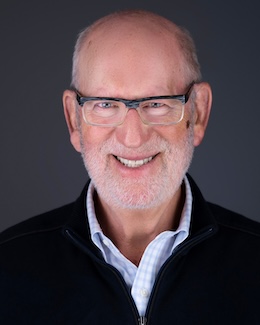
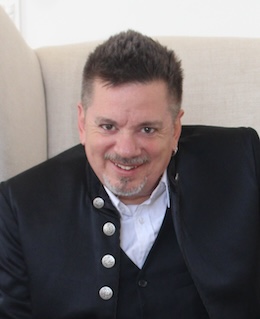
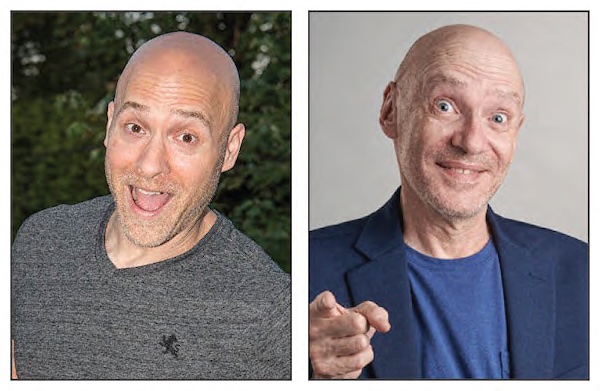
Kyle Berger, left, and David Granirer headline the Jewish Seniors Alliance’s A Night in the Catskills on March 17. (photos from JSA)

The Jewish Seniors Alliance of Greater Vancouver is celebrating its 20th anniversary with an event that’s all about laughter.

A Night in the Catskills: Jewish Humour Then and Now takes place at Congregation Schara Tzedeck March 17, 6 p.m.

“Jewish humour has enabled the Jewish world to gain strength through a history that shows that we should not be in existence today, but here we are bigger, stronger and better than ever!” said Marilyn Berger, a past president of JSA, who will make her debut as a stand-up comedian at the event. “Ask Kyle,” she said, referring to one of her sons. “I have given my family plenty to laugh about.”

It is perhaps not a coincidence then that Kyle Berger preceded his mother on the standup stage, and also produces comedy shows. He and David Granirer, founder of Stand Up for Mental Health, are headliners of the 20th anniversary event, which will include a performance by magician Stephen R. Kaplan, aka the Maestro. The whole megillah will be emceed by JSA board member Michael Geller, whose involvement in JSA was inspired by his late father, Sam Geller.

“He derived a great deal of joy from regularly attending JSA events and this is one of the reasons why the organization is so special to me,” Geller told the Independent.

photo - Michael Geller emcees JSA’s A Night in the Catskills at Schara Tzedeck
Michael Geller emcees JSA’s A Night in the Catskills at Schara Tzedeck. (photo from JSA)

“This comedy night is a follow up to a similar event organized by JSA 13 years ago,” he explained. “It was initiated by a phone call from the late Serge Haber, who called to tell me that the province had just canceled JSA’s gaming grant, but he knew my father would want me to help replace the funds. I asked how much was the grant. He said it was $18,000. I told him that was too much for me, but I had an idea.

“I was a fan of the website Old Jews Telling Jokes. Since JSA served many older Jews, I offered to book a room, buy some deli, and invite 17 of my friends to join me and each put up $1,000 and we would entertain one another with our favourite Jewish jokes.”

Haber – who founded JSA – liked the idea, as did the board, but they also wanted to join, and couldn’t afford to pay $1,000 each. So, the format was changed to one where people would attend and donate what they could, said Geller. Held at Congregation Beth Israel, almost 250 showed up.

“We presented clips from Old Jews Telling Jokes and invited people in the audience to share a joke in return for a donation. Everybody agreed it was a fabulous event,” said Geller. “There was just one small problem. We didn’t raise very much money. 

“So, this year we are charging $118 dollars to attend. Some generous members of the community are coming forward and agreeing to be sponsors. This will allow other seniors in the community who can’t afford $118 to attend. It has also allowed us to hire Tim Bissett, an experienced professional event organizer to assist with the program.”

photo - Stephen R. Kaplan will perform at the 20th anniversary celebration
Stephen R. Kaplan is a special guest performer at the 20th anniversary celebration. (photo from JSA)

Expressing gratitude to the sponsors on behalf of JSA, Geller said, “we are hoping other community members will come forward, especially those who regularly share their favourite Jewish jokes on the golf course. Sponsors will be invited to participate in the program by telling a favourite joke or two, or introducing a favourite comedian or routine.”

For his part, Geller is preparing for his role as emcee by watching vintage and contemporary Jewish comedians and selecting material. “The program will also include some professional comedians who are volunteering their time, and special appearances by local rabbis who have been urged to share stories they would never tell in shul,” he said.

“I am thrilled to be celebrating our 20th anniversary and look forward to going from strength to strength as my own children now, believe it or not, become seniors!” said Berger, who shared her appreciation for the organization that Haber started.

“As I gracefully age,” she said, “I thank Serge for enabling me to spend my golden senior years embraced by the love that Seniors Alliance offers.”

“JSA undertakes many programs that benefit so many Jewish seniors, including the excellent Senior Line magazine,” said Geller. “While we are supported by many community organizations and foundations, we need additional funding. I am, therefore, hoping this evening will help promote the organization’s good work and, this time, actually raise money to allow it to continue.”

For tickets to A Night in the Catskills or to become an event sponsor, visit jsalliance.org or call 604-732-1555. 

Format ImagePosted on February 23, 2024February 22, 2024Author Cynthia RamsayCategories Performing ArtsTags comedy, fundraiser, humour, Jewish Seniors Alliance, JSA, seniors, standup

True crime wraps up festival

They both made headlines in their day, and then were more or less forgotten. A social climber who ends up convicted of killing his wife in one instance, an inventor-turned-money launderer in the other. Two very different men living in different eras who achieved the wealth and lifestyle they sought, then lost it all in spectacular fashion.

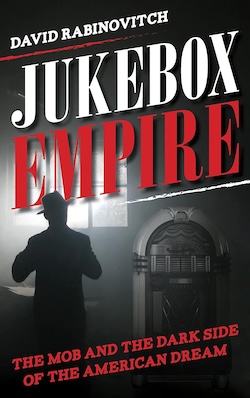
Historian Allan Levine and filmmaker David Rabinovitch close the Cherie Smith JCC Jewish Book Festival on Feb. 15, 8 p.m., at the Jewish Community Centre of Greater Vancouver with the event Jewish True Crime Stories, moderated by SM Freedman, who spent years as a private investigator in Vancouver before becoming a bestselling author of psychological thrillers. Levine will talk about his latest book, Details Are Unprintable: Wayne Lonergan and the Sensational Café Society Murder (2020), and Rabinovitch will talk about : The Mob and the Dark Side of the American Dream (2023), his first book.

Both true crime publications have a similar structure. They both have a cast of characters at the beginning, followed by a prologue or preface, then the narrative proceeds chronologically, beginning with each protagonist’s origin story, and following the circumstances and decisions that led to their headline-grabbing lives. Both books have extensive notes and bibliographies. Levine and Rabinovitch each read more than a thousand pages of court transcripts and related documents, like witness testimonies and letters, as well as newspapers of the day. These types of resources, written as events were unfolding, allow both authors to tell their stories with an immediacy that propels readers along. In both books, it feels as if what we’re right in the midst of what is happening.

image - Details Are Unprintable book coverFor Levine, the idea of exploring Toronto-born opportunist Wayne Lonergan’s conviction for the Oct. 23, 1943, murder of his wife, Patricia Burton Lonergan, the daughter of a wealthy German-Jewish family in New York City, came from reading a 1948 Cosmopolitan article by Raymond Chandler. The renowned detective fiction writer listed Lonergan’s case as #9 in his list of the “10 greatest crimes of the century.” There have been a couple of novels based on the case and, writes Levine, “Over the years, the story of the murder, with the requisite number of theories about Lonergan’s sexual identity, has been told and retold in countless tabloid newspapers and magazines and remains a favourite topic of crime and mystery bloggers.”

Lonergan’s bisexuality plays an important part in the story, including his initial alibi, and Levine adds social context in this and other instances, such as describing the mores of the café society into which Lonergan married. Levine takes the tabloid aspect out of the telling, in that he seems to have harnessed the facts and his conclusion as to Lonergan’s innocence or guilt seems solid.

image - Jukebox Empire book coverRabinovitch’s ability to step back and tell the story of Wolfe Rabin in an apparently unbiased way is even more impressive, given that Rabin is his uncle. Granted, Rabinovitch never met Rabin, but still, family is family. 

“How did my father’s brother, raised in an immigrant Jewish family in a remote Canadian prairie town [Morden, Man.], become a jukebox tycoon, a crony of gangsters and the mastermind behind an audacious and complex international money-laundering scheme?” writes Rabinovitch. “My investigation would reveal his world and a tale of jukeboxes, money laundering and organized crime.”

Rabin was a smart, creative and resourceful person. “He invented the car radio. He was a wartime profiteer. He designed the first jet-age jukebox. He was an international bonds trader,” writes Rabinovitch. “Wolfe and his sexy wife Trudy were a glamorous couple.”

But, early in his career, Rabin makes a deal with the proverbial devil, a mobster, and it’s a deal that makes him rich at first. But a competitor – fellow Manitoban David Rockola – successfully sues for patent infringements in the late 1940s, putting Rabin out of business and in need of money to pay back his criminal investors. It is fascinating to read of the mob connections to the jukebox industry, an industry that pulled in millions a week because, as Rabinovitch writes, “Even at the nadir of the Depression, anyone could afford a nickel for a song.”

And Rabin’s story becomes even more incredible after his jukebox business fails. In pursuit of much-needed cash, he becomes involved with stolen bonds, in what the U.S. Department of Justice called “the largest money-laundering scheme in history.” Eventually, the law does catch up with Rabin and some of his associates. Jail time is served. But Rabin’s biggest secret was only revealed long after his death in 1967, after Rabinovitch completed the draft of this book. It is one of the sadder elements of Rabin’s story. Despite all his achievements, there is much Rabin missed out on in his quest for wealth. 

The Cherie Smith JCC Jewish Book Festival runs Feb. 10-15. For tickets, visit jccgv.com/jewish-book-festival.

Posted on February 9, 2024February 8, 2024Author Cynthia RamsayCategories BooksTags Allan Levine, David Rabinovitch, Details Are Unprintable, history, JCC Jewish Book Festival, Jukebox Empire, the mob, true crime, Wayne Lonergan, Wolfe Rabin
“Moses” does standup at JFL

“Moses” does standup at JFL

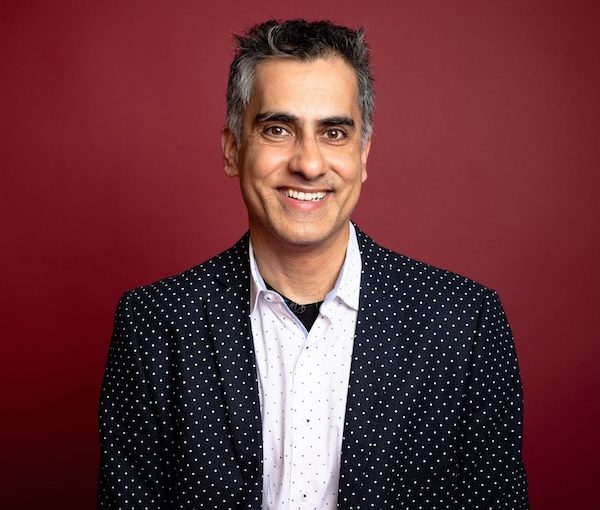
Samson Koletkar, dubbed the “world’s only Indian Jewish standup comedian, performs Feb. 15 as part of Just for Laughs Vancouver. (photo from Just for Laughs Vancouver)

This year’s Just for Laughs Vancouver features several members of the Jewish community, including Samson Koletkar, aka Mahatma Moses. He comes as part of Desi Comedy Fest – On Tour, which takes place at the Biltmore Cabaret Feb. 20, 9 p.m.

Koletkar is a co-founder of the Desi Comedy Fest with fellow San Francisco Bay Area comedian Abhay Nadkarni, who also hails from India. The biggest South Asian comedy festival in the United States, it is described as “celebrat[ing] subcontinental diversity with punchlines that transcend boundaries.”

Desi Comedy Fest isn’t Koletkar’s only entrepreneurial venture. He has a background in technology and also started Comedy Oakland, which “features funny, diverse, industry pros alongside up-and-coming comedians at various venues across Oakland,” according to its website.

Koletkar, who claims to be the “world’s only Indian Jewish standup comedian,” spoke with the Jewish Independent earlier this week.

JI: How does one go from being a techie to a standup comedian? Are there overlaps in skill sets? Do you still work in both areas or are your entrepreneurial endeavours your focus?

SK: I have tried a few things in my life, and standup started the same way. It seemed like a fun thing to do, I gave it a try and, the first time I was on stage, I was hooked. There is definitely an overlap from my tech life into standup – bulletproof logic in my jokes. If I am making a point, and I like to make many, there is no room for bugs, the jokes have to be tested thoroughly and any gaps in logic have to be fixed.

Standup has also helped make my day job easier with the ability to inject humour during tough situations. One of my ex-bosses actually made me realize the value of my standup comedy at work – he used to invite me to the tough customer meetings because invariably I would make the room laugh and the meetings got much easier after that.

JI: What were you like growing up – have you always seen the world with a humourous eye?

SK: I think so. I have always had this urge to crack a joke. There were a lot of inappropriate ones at inappropriate times, but isn’t that how we all learn, by making mistakes? Now, every time I meet parents who think their kids are funny, the one thing I advise them is to accommodate their kids’ misspeaks, and keep that funny bone intact. More often than not, the only mistake we as comedians make is saying out loud what everyone is thinking but politely holding back.

JI: When did you move from Mumbai to the San Francisco Bay Area?

SK: I took the first opportunity I got to move as far away from my parents as I could and, at the age of 24, I moved to the Silicon Valley in October 2000. I felt like the needle that burst the Y2K bubble.

JI: When did you first perform standup?

SK: Late 2005, but then jumped all in in January 2006.

JI: What led you to start Comedy Oakland?

SK: Standup is the one art form you can’t practise in your garage. You need a live audience. After grinding through three years of empty open mics and sub-par independent shows, I decided I could either sit and complain about how poorly some shows were produced, or try to do it myself. That led to Comedy Oakland, in May 2009, starting with one show on Friday nights. My goal was to create a space where comedians needed to only bring good jokes and audience experience was optimized for the art.

Just before the pandemic, I used to run 250+ shows (five shows a week), featuring 400+ comics entertaining 12,000-13,000 [person] audiences every year. In 2024, 15 years running, I am back to five shows a week at three venues in Oakland. These venues are 40 to 90 seaters.

JI: When you envisioned the Desi Comedy Fest, did you think it would become as huge as it is?

SK: I don’t think it is huge enough yet. Yes, the fest has grown from its early days, but we have a long way to go, and partnering with JFL is a big step in that journey. What I knew was that it was going to be fun, and it continues to be one of the most fun shows every year in my calendar.

JI: In what ways have you experienced racism and antisemitism, how do you handle such incidents and how do they impact you?

SK: Those stories are more fun to hear in my standup than they are to read, although they only form a small part of my routine because racism and antisemitism are a small part of my life. The world has a lot more good than bad in it and I don’t let the bad overshadow the good. An optimistic comedian – go figure! But, yes, they do impact me, not only when it happens to me but when I see it happen to others. So, some of my content is driven out of that and I tend to focus on the logical hypocrisy/fallacy of it.

JI: You’ve had much success. What are one or two things that you’d still like to achieve or do professionally?

SK: When my joke offends someone in America, it’s “Go back to where you came from.” When my joke offends someone in India, it’s “Go to Pakistan.” I want to tell an offensive joke in every single country in the world, just to see where they send me next, sort of like The Offensive Joke World Comedy Tour!

JI: If there is anything else you’d like to add, please do.

SK: Come watch a show, nothing gives me more happiness than seeing you laugh!

***

Desi Comedy Fest – On Tour also features Alisha Dillon, Amar Singh and UK Shah. For the full Just for Laughs Vancouver line-up and tickets, visit jflvancouver.com. 

Format ImagePosted on February 9, 2024February 8, 2024Author Cynthia RamsayCategories Performing ArtsTags comedy, Desi Comedy Fest, Just for Laughs, Mahatma Moses, Samson Koletkar, standup
Lanyi’s live Canadian debut

Lanyi’s live Canadian debut

The Vancouver Recital Society hosts London, England-based pianist Ariel Lanyi on March 3. (photo © Kaupo Kikkas)

“Art is there to remind us that there is something bigger and greater than the present moment, something that will remain long after we are gone, which is worthy of our devotion and commitment,” pianist Ariel Lanyi told the Independent in a recent interview. Lanyi will perform an afternoon concert at Vancouver Playhouse March 3.

Hosted by the Vancouver Recital Society, Lanyi will play works by Ludwig van Beethoven (1770-1827), Frédéric Chopin (1810-1849) and Max Reger (1883-1916). In a Facebook post, the London, England-based pianist noted his pleasure at working on Reger’s Variations and Fugue on a Theme by Bach, calling it an “underrated masterpiece of the late-Romantic era” that he couldn’t wait to bring to the stage in 2024.

“Max Reger had a problem: writing fugues was too easy for him. He could jot down fugues with the same ease that Picasso could scribble drawings. Hence, his music sometimes falls into a trap of gratuitous polyphony. However, when he put his heart and soul into a work, as he did with the Bach Variations (which he considered to be his finest work), the result is worthwhile,” Lanyi explained to the Independent. “We hear a multitude of styles in this work – at times, we hear the world of Brahms and his traditional harmonic language; at times, we enter the post-Wagnerian sphere, and we even get a glimpse of more decadent music that was yet to be written. Still, it hangs together organically, and comes to a rousing ending, as all threads convene and the piano truly emulates the sound of the organ. 

“The reason this work is underrated and underplayed is quite obvious,” he added. “People tend to avoid Reger, and it takes a Herculean effort to learn this work. However, I earnestly believe that it is a masterpiece of piano literature.”

Last spring, Lanyi was awarded the Prix Serdang, which is given to young pianists at the beginning of their careers who excel in musicianship and artistic vision. The head of the selection panel, Austrian pianist Rudolf Buchbinder, said of Lanyi: “His playing is precise, nuanced and virtuosic, but he is no superficial virtuoso. What sets him apart is his ability to delve deeply into the music and to establish a connection with it. He doesn’t simply play the notes, he lives the music, seeks to capture its essence, and reflects it with extraordinary intensity, sensibility and expressive maturity.”

If one reads Lanyi’s posts and blogs, one gets a hint of the research that he puts into his performances, which have garnered critical acclaim. In addition to the Prix Serdang, Lanyi won third prize at the 2021 Leeds International Piano Competition. Also in 2021, he was a prize winner in the inaugural Young Classical Artists Trust (London, England) and Concert Artists Guild (New York) International Auditions, as well as being a finalist in the Arthur Rubinstein International Piano Master Competition. Other honours for the 26-year-old pianist include first prize at the 2018 Grand Prix Animato Competition in Paris and first prize in the 2017 Dudley International Piano Competition in the United Kingdom.

Born in Jerusalem, Lanyi studied piano at the Conservatory of the Jerusalem Academy of Music and Dance and moved to London in 2015 to study at the Royal Academy of Music. He remained in the city after graduating in 2021. Last month, he was among those selected by the Royal Academy for a 2023-2024 associate honour, which will be conferred in April: the award recognizes former students who have made “significant contributions to the musical landscape.”

Lanyi has performed around the world, both as a soloist on his own and with orchestras, and as a chamber musician. When he plays concertos or chamber music, he said of his preparation, “I always make sure to study the full score, in order to grasp the music from all points of view, not just through the prism of my individual part. When playing alone, obviously, this doesn’t apply.”

Among the highlights listed on Lanyi’s website for this season is the VRS concert next month. In 2021, during COVID, the recital society shared Lanyi’s Virtually VRS recorded performance on its YouTube channel. The March concert will be his live debut in Canada. In addition to the Reger composition, it will feature Beethhoven’s Sonata No. 30 in E Major, Op. 109; Chopin’s Mazurkas, Op. 59; and Chopin’s Polonaise-Fantaisie in A-flat major, Op. 61.

“Beethoven’s Sonata Op. 109 is a work that has been in my repertoire for quite awhile,” Lanyi told the Independent. “It was the first of the late Beethoven sonatas I worked on as a teenager, so coming back to it now feels enormously gratifying, as my idea of it has evolved in the years since. (It is also, if I remember correctly, the first work for piano to have ever moved me to tears.) The first two movements are concise and contrasting – from the relative serenity of the first movement to the fearful obsessiveness of the second. The third movement begins and ends with a hymn of gratitude and, in between, we are taken on a comprehensive journey through six distinct variations, each inhabiting its own world, deviating from the theme in the most fascinating ways while retaining the same epicentral connection to it.

“The two Chopin works in this program – the Op. 59 Mazurkas and the Polonaise-Fantaisie, Op. 61 – both stem from the composer’s late period, which is characterized by harmonic and structural exploration we seldom find in his earlier works. The mazurkas are elegant and poignant at the same time – in the midst of mellifluous music, Chopin finds ways to express intense distress with bold, dissonant harmonies, often left exposed. The Polonaise-Fantaisie is among his most symphonic works, I find. He never wrote any symphonies and, in my view, some of the late works make up for that by using the piano orchestrally. In the slow middle section of the Polonaise-Fantaisie, we almost hear a foretelling of Bruckner in the long, interwoven lines, which lead to the most unexpected places.”

Lanyi said he doesn’t have any specific formula for choosing performance repertoire.

“Usually, I have an idea of one or two central works I want to include in a program, and look for works which will complement them in a balanced way,” he said. “In the case of this program, the Reger has been on my mind for many years, so I was looking to combine it with works which aren’t as heavy.”

Lanyi’s March 3 performance takes place at 3 p.m. and is followed by a talkback. For tickets, visit vanrecital.com/concert/ariel-lanyi-2. 

Format ImagePosted on February 9, 2024February 8, 2024Author Cynthia RamsayCategories MusicTags Ariel Lanyi, Beethoven, Chopin, piano, Reger, Vancouver Recital Society, VRS

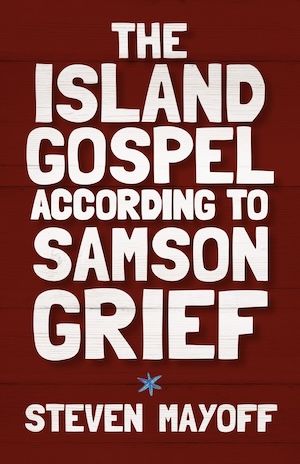
Putting the fun in dystopia – Steven Mayoff’s The Island Gospel According to Samson Grief

For all intents and purposes, it shouldn’t work, but Steven Mayoff’s The Island Gospel According to Samson Grief is a grand work of, let’s say, magical fiction that uses humour in large measure to elicit some very serious thoughts about art, politics, law, love, faith, community and more.

Mayoff takes part in two events during the Cherie Smith JCC Jewish Book Festival: on Feb. 11, he presents at Burquest Jewish Community Association in Coquitlam and, on Feb. 12, he is at the Jewish Community Centre of Greater Vancouver, along with Jeffrey Groberman, author of Globetrotting Strikes Again! Groberman also presents at Har El in West Vancouver on Feb. 11.

image - he Island Gospel According to Samson Grief book coverIt is hard to describe simply the plot of The Island Gospel According to Samson Grief. The title character is a middling artist who, when we meet him, is struggling to finish a painting. Outside his window, he has just seen – after a break of 13 years – three figments of his imagination. The Figs, as he calls them, present themselves in the forms of Judas, Fagin and Shylock, and they have returned with an important mission for Grief.

“The Supreme One,” who the Figs represent, was impressed by Grief’s scandalous, and most famous, painting of Prince Edward Island icon Anne of Green Gables as a Holocaust survivor, which Grief described in an interview as a statement “on the post-911 world we’re living in, where nobody is safe anymore and the primary victim is the delusion of our collective innocence.” Despite that Grief has not had much artistic or other success in the years since that painting – and that he is not actively involved in the island’s Jewish community – the Supreme One wants Grief to build PEI’s first synagogue. Once complete, the province will be consecrated as the new Promised Land, according to the Figs.

Among Grief’s many challenges – once he decides to take on the mission – is that the Supreme One has decreed that the synagogue must be built on a particular plot of land, a once-sacred place that has become a garbage dump and the focus of much political intrigue. It is hard to keep track of all the political manoeuvrings in this novel, but they sadly resonate, with some reality in their self-serving and unscrupulous nature.

It takes Mayoff awhile to set up the many pieces of his narrative puzzle. The characters are numerous, and quirky only begins to describe them. The societal issues that arise as Grief tries to achieve his mission, the role played by the media – both conventional and unconventional – in what ends up happening, the reliability and unreliability of friendship and love … so many factors are up in the air and changing as the story progresses. Somehow Mayoff juggles them all in a way that allows readers to follow along, discovering various elements as Grief does, and losing our naiveté as he does.

The Island Gospel According to Samson Grief is an ambitious novel that delivers beyond its promise. 

For the Cherie Smith JCC Jewish Book Festival guide, visit jccgv.com/jewish-book-festival. 

Posted on January 26, 2024January 24, 2024Author Cynthia RamsayCategories BooksTags fiction, humour, JCC Jewish Book Festival, Steven Mayoff

“Best goddam madam” – Madam: The Biography of Polly Adler, Icon of the Jazz Age

The immigrant experience is rarely if ever easy. It is hard to imagine sending a 13-year-old girl from Russia to the United States on her own, but, in 1913, the year that Pearl (“Polly”) Adler came through Ellis Island, “the Hebrew Sheltering and Immigrant Aid Society estimated that 13,588 ‘unaccompanied Jewish girls’ came through the port of New York, out of the 101,330 Jews who immigrated from eastern Europe,” writes Debby Applegate in Madam: The Biography of Polly Adler, Icon of the Jazz Age.

image - Madam book coverThe revelations abound in Madam and most do not centre around statistics, though there are some intriguing ones, like the fact that, in 1925, New York’s White Light District, with Times Square at its core, had “more than 2,500 speakeasies and 200 nightclubs, up from 300 saloons before Prohibition, all vying to offer the youngest girls, bawdiest songs, and hottest dance bands.”

Polly Adler was a major part of this scene, having entered the world of prostitution when she was 17. She had managed to avoid the lechers who recruited girls coming off the boats, and even got a couple years of education living with extended family in Springfield, Mass. But, once the minimum amount of schooling required was reached – a fourth-grade level of English – she had to work. And working in a factory wasn’t a way to get oneself out of poverty. So, with a little help from unscrupulous men, she started on a different career, one that would have her become the most well-known madam in New York, with clients that may even have included President Franklin Delano Roosevelt.

It was a harsh world, though, filled with gangsters, crime, violence, and it wasn’t even that lucrative because of all the payoffs and the immense levels of corruption at every turn: police, lawyers, judges, politicians. But Adler could literally take the punches, and she was “determined to be the best goddam madam in all America.” She achieved her goal and was successful, if measured by fame and money. However, she never achieved the approval and acceptance she sought, having been cared for as a child but never really loved.

Applegate’s biography of Adler is a page-turner, which is an accomplishment given its comprehensiveness and the amount of detail she covers: there are 33 pages of notes and the bibliography runs 13 pages. Readers will really feel as if they’ve met Adler and walked a few feet in her shoes. 

Applegate will talk about Madam in the Cherie Smith JCC Jewish Book Festival event on Feb. 11, which she shares with Roberta Rich, author of The Jazz Club Spy (see jewishindependent.ca/mysteries-to-be-solved). 

Posted on January 26, 2024January 24, 2024Author Cynthia RamsayCategories BooksTags Debby Applegate, gangsters, history, immigrant story, New York, Polly Adler, prostitution

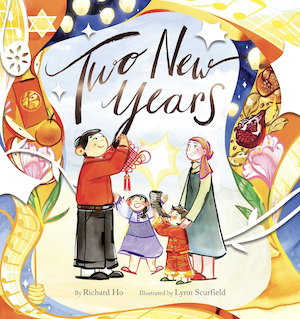
Celebrating two new years 

It would be fun to be a fly on the wall at Vancouver Talmud Torah on Feb. 14 as Richard Ho reads from his book Two New Years, illustrated by Lynn Scurfield, and discusses it with the children. Being that the story is based on his own life experience, he will likely be quite animated (pun intended) and his enthusiasm, combined with Scurfield’s bright, colourful and joyful art, will no doubt hold their attention.

image - Two New Years book coverHo has several kids books to his credit and, according to his website, more on the way. Two New Years highlights the differences and similarities between Rosh Hashanah and the Lunar New Year, both of which he celebrates.

The book notes the differences first: Rosh Hashanah takes place in the fall, is based on the Jewish calendar and began in the Middle East, and the Lunar New Year generally falls in spring, is based on the Chinese calendar and began in East Asia. “They represent different peoples with different histories, cultures and traditions,” he writes. “But in many ways they are also alike.” The many similarities include that each holiday is a chance to “try on new beginnings,” to “bring family home” and “remember the ancestors who live in our hearts,” to eat “foods that symbolize togetherness and the heartfelt sharing of good wishes,” among several other things.

In the author’s note, Ho shares that he converted to Judaism as an adult and that “the blending of two cultures was a conscious choice” for him. These days, he revels in experiencing both new years through the eyes of his children. “The best part?” he asks. “They’re not alone! All over the world, families with mixed backgrounds are blurring the barriers between cultures and customs. With the guidance of parents, grandparents and extended family on all sides, many children are weaving an increasingly diverse tapestry of celebration.”

The book features an eight-page illustrated glossary that’s as interesting to read as the story: it explains what a lunisolar calendar is, and some of both holidays’ rituals and symbols. It is followed by questions that readers can use to facilitate a discussion with others about their own traditions.

Ho’s presentation at VTT is part of the Cherie Smith JCC Jewish Book Festival (jccgv.com/jewish-book-festival). 

Posted on January 26, 2024January 24, 2024Author Cynthia RamsayCategories BooksTags children's books, Chinese heritage, culture, Jewish heritage, Lunar New Year, Lynn Scurfield, Richard Ho, Rosh Hashanah
CANCELED – See The Runner at PuSh

CANCELED – See The Runner at PuSh

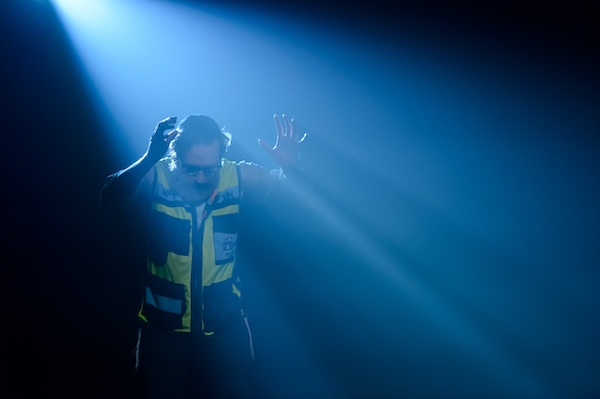
Christopher Morris as Jacob in The Runner, which is at Fei and Milton Wong Experimental Theatre Jan. 24-26. (photo by Dylan Hewlett)

Since this article was published, PuSh has canceled the production. For the statement, click here.

Among the offerings of this year’s PuSh International Performing Arts Festival is Christopher Morris’s The Runner, which runs Jan. 24-26 at Fei and Milton Wong Experimental Theatre.

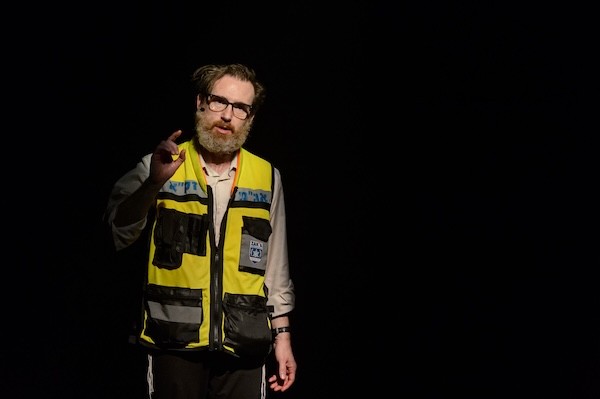
The one-man play is dedicated to Jakoff Mueller, a ZAKA member in Israel who died in 2018. The main character is Jacob, an Orthodox Jew with the Israeli volunteer emergency response organization. In one of the emergencies depicted, Jacob helps an injured Arab woman before he tends to a soldier, and his choice has significant repercussions. The actor in the role – in Vancouver, it will be Morris – performs the whole 60 minutes of the play while walking/running on a treadmill.

The Jewish Independent interviewed Morris by email before the playwright stepped back from doing media after a scheduled Victoria run of the play was canceled due to pressure from protesters, who objected to the story being told “from an exclusively Israeli perspective.”

JI: Can you share more about your relationship with Jakoff Mueller, how you came to meet him, to be invited into his home, and how he contributed to writing of The Runner?

CM: I first met Jakoff in 2009 at a small get-together in the house I was staying at in Jerusalem. This was during my first research trip to Israel to write this play. The owner of the house was a friend of Jakoff and she thought it would be interesting for me to speak with him, seeing as I was doing research about ZAKA. Jakoff was an incredibly thoughtful man with a great sense of humour, and we hit it off. He invited me to come and visit him where he lived in northern Israel and I did, over many occasions during the research trips I made to Israel. Though no event or fact from Jakoff’s life is represented in the play, his compassion for valuing all human life and his spirit of questioning is in the play. The world was a better place with him in it.

JI: When did you start writing The Runner and when and where did it première?

CM: My curiosity with ZAKA began when I was a teenager in Markham, Ont., in the 1990s. I heard a media interview about the work ZAKA did and it really struck me. I kept thinking that ZAKA’s work would be an interesting premise for a play but didn’t know how to do it. So, in 2009, I made my first trip to Israel to begin researching the play. I spent nine years (on and off) writing it and it premièred at Theatre Passe Muraille in Toronto in 2018.   

JI: You’ll be playing the role of Jacob, but I see in much of the material Gord Rand as the actor. Are you stepping in for him, does the role rotate, is he no longer part of the production?

CM: Yes, I’ll be playing the role of Jacob in Vancouver. The show had critical success when it premièred in Toronto, winning three Dora Mavor Moore Awards (best script, best production and best direction for the late Daniel Brooks). We were receiving a lot of interest to tour the show, so we rehearsed in multiples of every role in the production (actor, stage managers, director, designers) in the event that one person from the original team may not be available. Daniel Brooks rehearsed me into the role so I could play it when Gord wasn’t available. Over the years, I’ve played it on and off a few times and am really looking forward to performing the role in Vancouver.

JI: You’ve written a one-pager offering guidance for venues presenting The Runner. Is there anything you’d add to that, given the Israel-Hamas war? Not only because tensions are higher, but, for example, there are direct parallels in the description of victims in the mass grave in Ukraine [where ZAKA members, including Jacob, travel in the play] and what happened to Israelis on Oct. 7, which could be triggering.

CM: It’s always been important when presenting The Runner in collaboration with theatres to give some social context when the show is being presented. I am always available to the staff at the theatre to offer any specific insight about the play in the context it’s being presented in. PuSh and I have been in constant contact about how to support the play and the audiences who will see it in January.  

JI: When were the PuSh shows booked and, if there have there been other productions mounted since Oct. 7, what has reaction been overall?

CM: We’ve been discussing doing this show with PuSh for over a year and it was officially booked last May. We completed a run of the show from Nov. 2nd to the 19th, 2023, at the Thousand Islands Playhouse in Gananoque, Ont., and the reaction to the show was extremely positive. A few hours ago, it was publicly announced that the Belfry Theatre will not be presenting The Runner in March.

I support the conversations taking place in response to The Runner right now, I always think it’s important to discuss things. It’s hard to know how audiences will experience any play right now, let alone one set in Israel, like The Runner. But the power of this production, and why so many people have connected with it since it premièred in 2018, is that it’s a nuanced and thoughtful conversation about the preciousness of human life.

JI: Are you a member of the Jewish community? Either way, why did you choose to write a play about terrorism from the perspective of an Orthodox Jewish man?

CM: I’m not a member of the Jewish community. I was brought up Catholic but regard myself as an ex-Catholic (since the age of 13). I wrote a play about medical triage in the perspective of an Orthodox Jewish man because I wanted to write a play about ZAKA.

JI: I’m struck by what I interpret, perhaps mistakenly, as calls for humanity/morality only from Jews/Israelis, not from terrorists or people who see terrorism as a valid form of resistance. In the thinly veiled Gilad Shalit reference, for example, Jacob bemoans the un-Jewishness of Israel keeping the remains of dead terrorists in case of an exchange but he doesn’t seem to question the morality or humanity of the terrorists. Similarly, the only ones who seem to be called to account for killing in this play are Jews – presumably an Israeli shot the Arab woman in the back, an Israeli shooting an Arab protester leads to an Israeli boy being killed, a Jewish Israeli accidentally shoots another Jew when trying to shoot a terrorist, and another gunshot by a Jew, after a vehicular terrorist attack, has fatal consequences for a Jew.

CM: Because it’s a one-person show, Jacob’s view is a singular perspective, and I wrote about the unique situations he would be facing as a ZAKA member. Jacob is dismayed by all the violence that surrounds him and, throughout the play, he advocates for seeing all human life as equal. As a disempowered, isolated person, with limited interactions to people outside of his community, I believe Jacob feels his best bet to effect change is by addressing those around him.

JI:  While ZAKA prioritizes victims over terrorists, other Israeli medical professionals are supposed to triage patients. In the play, an ambulance takes the Arab girl away and obviously keeps her alive. Why does no Jew in the play support Jacob or show him kindness?

CM: It is true that Israeli medical professionals give care to patients, like the ambulance described in the show that takes the Palestinian teenager away and a hospital which no doubt helped her with her wounds. When writing the complex character of Jacob, it was important to include examples in the play of how hard it was for him to connect to other people before he offers medical care to the teenager. This was important to create a complex human being and an interesting dramatic context. Jacob’s mother supports him and shows him kindness. As does the Palestinian teenager when he arrives unexpectedly at her door, and the Palestinian man who saves him by helping Jacob get to his car.

JI: There is a line in the play that has been highlighted by reviewers as powerful, and that’s [Jacob’s brother] Ari’s dictate about why he’s a settler on the land – “because it’s mine!” Again, this doesn’t come up in your play, but is relevant: the chant for Palestine to be free from the river to the sea. What hope do you see, or does Jacob see, if you’d rather – can one get off “the treadmill” alive?

CM: Though my play is set in Israel, I feel I lack the experience or expertise to offer a fully informed answer to the complexities of the overall conflict. But the biggest hope for me in the play and the only statement about life I feel I wrote (as opposed to the numerous questions I ask in the play) is Jacob’s description of how the Palestinian teenager treated him with kindness:

Her hand on my shoulder.
Are you alright.
That’s all that matters.
Kindness.
An act of kindness.

This is my offering for the complex world we live in. 

To read my op-ed on the Belfry Theatre’s cancelation of The Runner, click here. To read other statements on the cancelation, including from Morris, click here.

For tickets to the PuSh Festival, which includes BLOT, co-created by Vanessa Goodman, and Pli, co-presented by Chutzpah! Festival, go to pushfestival.ca.

Format ImagePosted on January 12, 2024January 12, 2024Author Cynthia RamsayCategories Performing ArtsTags Belfry Theatre, Christopher Morris, Israel, PuSh Festival, terrorism, The Runner
CANCELED Play should not be canceled

CANCELED Play should not be canceled

Christopher Morris as Jacob in The Runner. (photo by Dylan Hewlett)

Since this article was published, PuSh has canceled the production. For the statement, click here.

The Belfry Theatre in Victoria has removed Christopher Morris’s play The Runner from its 2024 lineup. I can see why it did so – the threats of violence are real, and scary. But it was the wrong decision.

“The Belfry Theatre presents contemporary work, with ideas that often generate dialogue. That is why, a year ago, we decided to bring the much-acclaimed play, The Runner, to Victoria. However, we believe that presenting The Runner at this particular time does not ensure the well-being of all segments of our community,” reads the Jan. 2 statement.

Last month, a petition was started to remove the one-man play about an Israeli rescue worker whose life is forever changed after he helps an Arab woman, who may have stabbed an Israeli soldier to death, before attending to the soldier. A counter-petition was started by members of the Jewish community to keep The Runner at the theatre. At press time, the protest petition had more than 1,400 signatures, while the counter-petition had more than 2,400.

The Belfry Theatre invited people to come and discuss any issues surrounding the play. That Dec. 22 meeting dissolved into chaos, overtaken by protesters with bullhorns and anti-Israel signs. The Belfry building was subsequently vandalized with multiple stickers that said “trash” and anti-Israel sentiments, topped off with a red-spray-painted “Free Palestine.”

The threat of more violence – implied by the aggressiveness of the protesters at the December meeting and the defacement of the theatre’s building – was probably a main reason for the Belfry canceling the show. It seems that the protesters have successfully bullied the theatre into changing its programming. Instead of contributing to a safe space in which ideas could be presented, considered, discussed, perhaps agreed upon, perhaps not, the protesters have created an atmosphere of fear. They have put other creatives on notice – unless you reflect only what we believe, we will shut you down.

By succumbing to the pressure, the Belfry has perhaps protected its staff and its building – the importance of which cannot be understated – but a dangerous precedent has been set. On the larger world stage, we have seen how screaming down other viewpoints, vandalism and worse violence, misrepresentation and misinformation, can win the day. The success of such tactics in Victoria is another reminder, if we needed one, of how easily freedoms can be removed. How easily voices can be silenced.

Accuracy and context matter, and the petition includes neither.

The petition describes The Runner as “a story of Israeli settlers in a dehumanizing exercise of whether Palestinian and Arab life is of value.” Its writers “demand[ed]” the Belfry “remove The Runner from [its] 2024 lineup,” claiming that it “features the violent and racist rhetoric of Zionism from an exclusively Israeli perspective.” They cite two unattributed, non-contextualized sentences from the script that ostensibly support their position.

The play is not about Israeli settlers, it does not celebrate Israeli settlers or militant Zionism. Jacob – a volunteer from Jerusalem with ZAKA (Israel’s nongovernmental rescue and recovery organization) – is the main character, the hero, the one the audience is rooting for, along perhaps with the Arab woman he helps save.

The quote chosen by the petitioners is spoken by Ari, Jacob’s brother, who is portrayed as a rabid settler nationalist. He is a jerk, and an awful brother. People like Ari do exist, but one of the points of the play seems to be that he is not the model human, that his views are not what people should think.

The petitioners have one aspect of the play almost correct: it does focus on Israeli perspectives (plural), as the main character is Israeli, and so are his mother and brother, and his colleagues. And I will admit that I had trouble with this aspect of the play, too. I felt that The Runner only asked questions about Israelis’ morality, that it disparaged Jews’ claims to the land, that it depicted every Israeli character other than Jacob harshly. While terrorism is shown, the terrorist characters aren’t held to any account, in my view, and there are no moral demands made of them.

I am proud that the petition to keep The Runner in the Belfry’s lineup was initiated by members of the Jewish community. I believe in Israel’s right to exist and to defend itself, at the same time as I believe in the right of people to criticize, question and protest. In a democratic country, I don’t see the need to attack people or destroy property to voice an opinion, especially not about the arts. It is no wonder there are multiple conflicts taking place around the world – even in Canada, where we enjoy multiple freedoms and are relatively rich in resources, we find it challenging to be open, civil and respectful of diversity.

If The Runner had encouraged violence or discrimination, I might have signed a petition against it, too, and even joined a rally, but I hope that I would have chosen to critique it instead, to share my point of view instead of trying to silence Morris’s. I certainly would not have chosen to threaten or commit violence against people or property.

Several aspects of The Runner bother me, but I think it is an excellent piece of work because it has taken up more of my brain space than almost any other play, movie or performance that I’ve seen or book or article I’ve read. It has made me angry, thoughtful, sad, and I continue to contemplate my various reactions. It has literally kept me up at night. In this respect, Morris has done his job extremely well. People should see this play. I sincerely hope the bullies will not succeed in silencing the PuSh Festival’s presentation of it as well. 

For my interview with Christopher Morris, click here. To read statements about the Belfry Theatre’s decision to remove The Runner from its lineup, click here. For more on the Victoria situation, see thecjn.ca/news/runner-play-victoria. 

Format ImagePosted on January 12, 2024January 12, 2024Author Cynthia RamsayCategories Op-EdTags antisemitism, Belfry Theatre, freedom of expression, Israel, The Runner
What is life’s purpose?

What is life’s purpose?

In her graphic memoir, Artificial: A Love Story, Amy Kurzweil tackles many existential questions, framed around her father’s quest to resurrect his father using artificial intelligence. Kurzweil participates in the Cherie Smith JCC Jewish Book Festival Feb. 12.

The purpose of life, of art, what it means to be human, to love and be loved, the value of relationships, our mortality. In a very personal story, cartoonist and writer Amy Kurzweil explores not just universal questions but the biggest of questions in her new book, Artificial: A Love Story.

Kurzweil participates in the Cherie Smith JCC Jewish Book Festival Feb. 12 in two separate sessions: one about the choice of the comic form to tell a story, the other titled Art & Artificial Intelligence.

In Artificial, readers are invited into another part of Kurzweil’s world. Her debut graphic memoir, Flying Couch, was also family-focused, centring around her maternal grandmother’s story. As she writes on her website, “At 13 years old, Bubbe (as I call her) escaped the Warsaw Ghetto alone, by disguising herself as a gentile. My mother taught me: our memories and our families shape who we become. What does it mean to be part of a family, and how does each generation bear the imprint of the past, its traumas and its gifts? Flying Couch is my answer to these questions, the documentation of my quest for identity and understanding.”

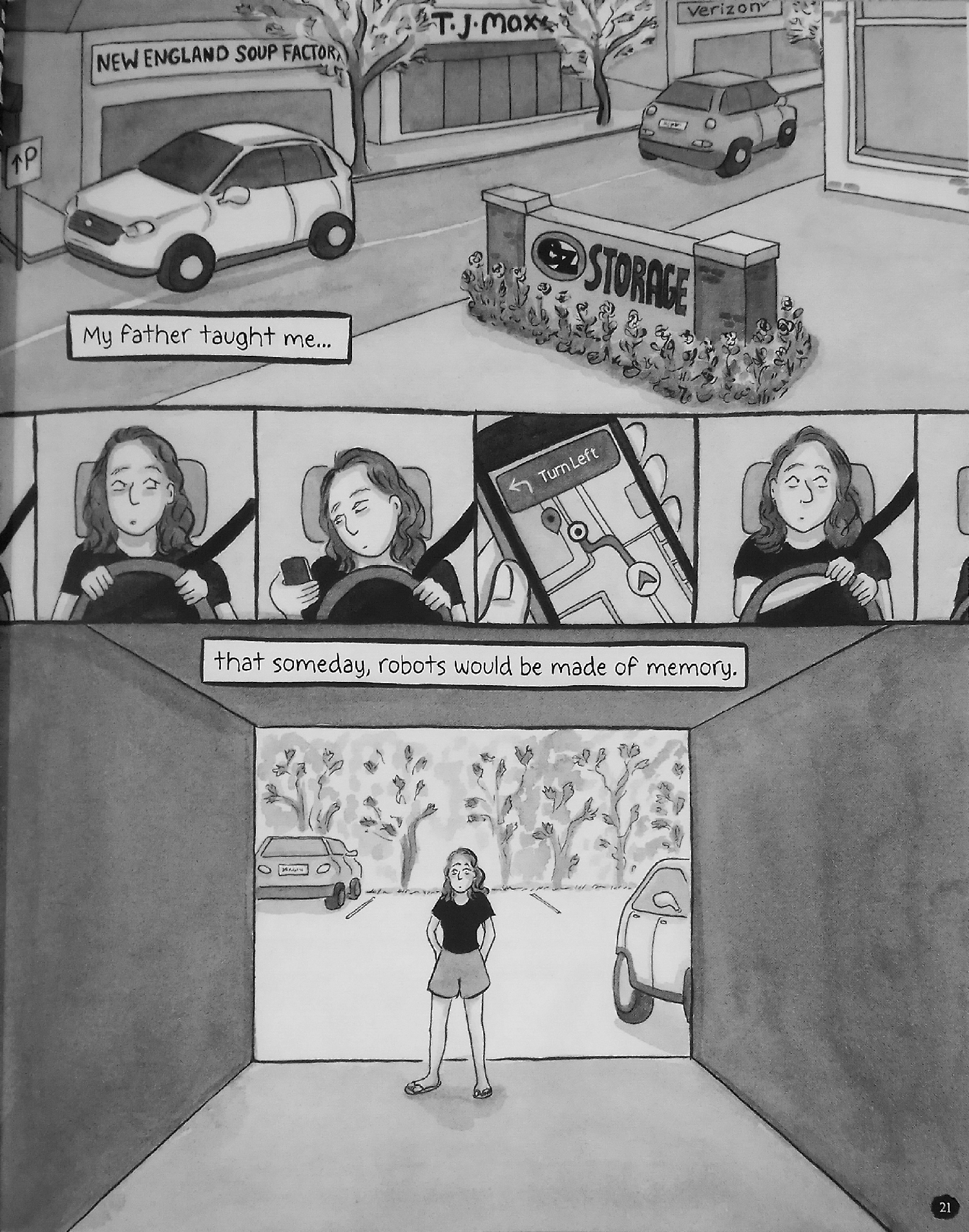
image - Artificial: A Love Story, by Amy Kurzweil, page 21
Artificial: A Love Story, by Amy Kurzweil, page 21.

Kurzweil continues to grapple with these questions in Artificial, this time from the paternal side. Her father, Ray, an inventor and futurist, is building an AI tool that will allow him, basically, to resurrect his father, who died of a heart attack in 1970, at the age of 57. Ray has saved letters, articles, music and other material relating to his father, Frederic, a pianist and conductor, who fled Austria in 1938, a month before Kristallnacht, to the United States, saved by a chance encounter. Amy is helping her father sort through boxes upon boxes of material and computerize the information. She even chats with “her grandfather,” as the AI program is being developed.

“My father taught me … that, someday, robots would be made of memory,” writes Kurzweil. Of course, the creation of a Fredbot has functional, ethical, emotional and other challenges, and Kurzweil – in words and images – presents them with sensitivity, intelligence and creativity. Each page of Artificial is attention-grabbing and the level of detail on some pages is remarkable. Kurzweil meticulously re-creates correspondence, typed and handwritten, newspaper articles and other documents, emails and texts, but she also captures, for example, the doubt on her father’s face during a conversation and the concern she has for her partner when he’s undergoing some medical tests. Readers learn about the people asking the questions, not just the questions themselves.

As for the answers? There are multiple ones. Of her father’s project, his quest to conquer mortality using technology, Kurzweil writes that her father’s definition of infinity is, “Computers become so small and dense that they become intelligence itself. Humans who do not grow up or grow old and seal our stories. Our stories wake up and keep writing themselves. This future sounds like liberation from the sadness of a story’s end. But it also sounds terrifying.”

That Kurzweil isn’t completely convinced of the merits of her father’s project, even though she loves him dearly and is helping him try and accomplish it, makes Artificial a satisfyingly complex and relatable story. It is a love story on many levels, and one well worth reading. 

The Cherie Smith JCC Jewish Book Festival runs Feb. 10-15. For the program guide and to purchase event tickets, visit jccgv.com/jewish-book-festival.

Format ImagePosted on January 12, 2024January 11, 2024Author Cynthia RamsayCategories BooksTags AI, Amy Kurzweil, artificial intelligence, creativity, Frederic Kurzweil, graphic memoir, identity, Jewish Book Festival, Ray Kurzweil

Posts pagination

Previous page Page 1 … Page 17 Page 18 Page 19 … Page 85 Next page
Proudly powered by WordPress