
Skip to content
  • Home
  • Subscribe / donate
  • Events calendar
  • News
    • Local
    • National
    • Israel
    • World
    • עניין בחדשות
      A roundup of news in Canada and further afield, in Hebrew.
  • Opinion
    • From the JI
    • Op-Ed
  • Arts & Culture
    • Performing Arts
    • Music
    • Books
    • Visual Arts
    • TV & Film
  • Life
    • Celebrating the Holidays
    • Travel
    • The Daily Snooze
      Cartoons by Jacob Samuel
    • Mystery Photo
      Help the JI and JMABC fill in the gaps in our archives.
  • Community Links
    • Organizations, Etc.
    • Other News Sources & Blogs
    • Business Directory
  • FAQ
  • JI Chai Celebration
  • JI@88! video

Recent Posts

  • Zionism wins big in Vegas
  • Different but connected
  • Survival not passive
  • Musical celebration of Israel
  • Shoppe celebrates 25 years
  • Human “book” event
  • Reclaiming Jewish stories
  • Bema presents Perseverance
  • CSS honours Bellas z”l
  • Sheba Promise here May 7
  • Reflections from Be’eri
  • New law a desecration
  • Resilient joy in tough times
  • Rescue dog brings joy
  • Art chosen for new museum
  • Reminder of hope, resilience
  • The national food of Israel?
  • Story of Israel’s north
  • Sheltering in train stations
  • Teach critical thinking
  • Learning to bridge divides
  • Supporting Iranian community
  • Art dismantles systems
  • Beth Tikvah celebrates 50th
  • What is Jewish music?
  • Celebrate joy of music
  • Women share experiences 
  • Raising funds for Survivors
  • Call for digital literacy
  • The hidden hand of hate
  • Tarot as spiritual ritual
  • Students create fancy meal
  • Encouraging young voices
  • Rose’s Angels delivers
  • Living life to its fullest
  • Drawing on his roots

Archives

Follow @JewishIndie
image - The CJN - Visit Us Banner - 300x600 - 101625

Tag: true crime

True crime wraps up festival

They both made headlines in their day, and then were more or less forgotten. A social climber who ends up convicted of killing his wife in one instance, an inventor-turned-money launderer in the other. Two very different men living in different eras who achieved the wealth and lifestyle they sought, then lost it all in spectacular fashion.

Historian Allan Levine and filmmaker David Rabinovitch close the Cherie Smith JCC Jewish Book Festival on Feb. 15, 8 p.m., at the Jewish Community Centre of Greater Vancouver with the event Jewish True Crime Stories, moderated by SM Freedman, who spent years as a private investigator in Vancouver before becoming a bestselling author of psychological thrillers. Levine will talk about his latest book, Details Are Unprintable: Wayne Lonergan and the Sensational Café Society Murder (2020), and Rabinovitch will talk about : The Mob and the Dark Side of the American Dream (2023), his first book.

Both true crime publications have a similar structure. They both have a cast of characters at the beginning, followed by a prologue or preface, then the narrative proceeds chronologically, beginning with each protagonist’s origin story, and following the circumstances and decisions that led to their headline-grabbing lives. Both books have extensive notes and bibliographies. Levine and Rabinovitch each read more than a thousand pages of court transcripts and related documents, like witness testimonies and letters, as well as newspapers of the day. These types of resources, written as events were unfolding, allow both authors to tell their stories with an immediacy that propels readers along. In both books, it feels as if what we’re right in the midst of what is happening.

image - Details Are Unprintable book coverFor Levine, the idea of exploring Toronto-born opportunist Wayne Lonergan’s conviction for the Oct. 23, 1943, murder of his wife, Patricia Burton Lonergan, the daughter of a wealthy German-Jewish family in New York City, came from reading a 1948 Cosmopolitan article by Raymond Chandler. The renowned detective fiction writer listed Lonergan’s case as #9 in his list of the “10 greatest crimes of the century.” There have been a couple of novels based on the case and, writes Levine, “Over the years, the story of the murder, with the requisite number of theories about Lonergan’s sexual identity, has been told and retold in countless tabloid newspapers and magazines and remains a favourite topic of crime and mystery bloggers.”

Lonergan’s bisexuality plays an important part in the story, including his initial alibi, and Levine adds social context in this and other instances, such as describing the mores of the café society into which Lonergan married. Levine takes the tabloid aspect out of the telling, in that he seems to have harnessed the facts and his conclusion as to Lonergan’s innocence or guilt seems solid.
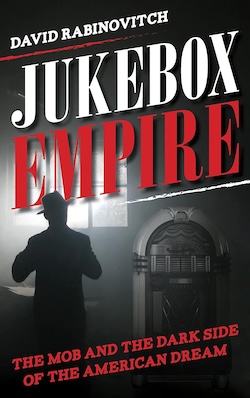
image - Jukebox Empire book coverRabinovitch’s ability to step back and tell the story of Wolfe Rabin in an apparently unbiased way is even more impressive, given that Rabin is his uncle. Granted, Rabinovitch never met Rabin, but still, family is family. 

“How did my father’s brother, raised in an immigrant Jewish family in a remote Canadian prairie town [Morden, Man.], become a jukebox tycoon, a crony of gangsters and the mastermind behind an audacious and complex international money-laundering scheme?” writes Rabinovitch. “My investigation would reveal his world and a tale of jukeboxes, money laundering and organized crime.”

Rabin was a smart, creative and resourceful person. “He invented the car radio. He was a wartime profiteer. He designed the first jet-age jukebox. He was an international bonds trader,” writes Rabinovitch. “Wolfe and his sexy wife Trudy were a glamorous couple.”

But, early in his career, Rabin makes a deal with the proverbial devil, a mobster, and it’s a deal that makes him rich at first. But a competitor – fellow Manitoban David Rockola – successfully sues for patent infringements in the late 1940s, putting Rabin out of business and in need of money to pay back his criminal investors. It is fascinating to read of the mob connections to the jukebox industry, an industry that pulled in millions a week because, as Rabinovitch writes, “Even at the nadir of the Depression, anyone could afford a nickel for a song.”

And Rabin’s story becomes even more incredible after his jukebox business fails. In pursuit of much-needed cash, he becomes involved with stolen bonds, in what the U.S. Department of Justice called “the largest money-laundering scheme in history.” Eventually, the law does catch up with Rabin and some of his associates. Jail time is served. But Rabin’s biggest secret was only revealed long after his death in 1967, after Rabinovitch completed the draft of this book. It is one of the sadder elements of Rabin’s story. Despite all his achievements, there is much Rabin missed out on in his quest for wealth. 

The Cherie Smith JCC Jewish Book Festival runs Feb. 10-15. For tickets, visit jccgv.com/jewish-book-festival.
Posted on February 9, 2024February 8, 2024Author Cynthia RamsayCategories BooksTags Allan Levine, David Rabinovitch, Details Are Unprintable, history, JCC Jewish Book Festival, Jukebox Empire, the mob, true crime, Wayne Lonergan, Wolfe Rabin
A spoof on true crime

A spoof on true crime

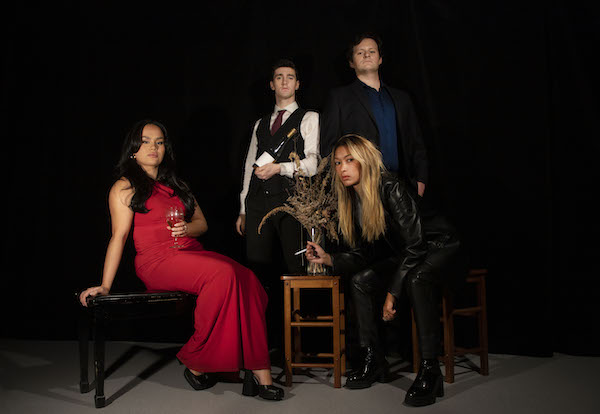
Left to right: Sophia Paskalidis, David Underhill, Drew Ogle and Mai Stone (seated) co-star in Tragedy, Slander & Wine. (photo by Sarah Cherin)

When a community theatre production ends with an actor dying on stage, the media descends on the small B.C. town. Conspiracy theories flourish and no one is above suspicion.

This is the plot of Tragedy, Slander & Wine by Jewish community member David Volpov, which premières at the NEST on Granville Island Nov. 13-19. The mystery/comedy explores, among other things, media literacy.

“My goal in writing Tragedy, Slander & Wine is to bring awareness about the issue and to invite audience members to think more critically about the media they consume. So, that’s where the idea of true crime entered the play,” said Volpov, executive director of Promethean Theatre, which is presenting the work. “I see true crime lovers popularize a lot of sensationalistic interpretations of well-known deaths. I think people tend to want to believe wild hypotheses instead of the cut-and-dried truth simply because it’s more entertaining. This conspiratorial thinking can become dangerous if it impedes on innocent people’s lives, which is what happened in real life to the town of Moscow, Idaho, after several infamous deaths.”

On Nov. 13, 2022, Ethan Chapin, Xana Kernodle, Kaylee Goncalves and Madison Mogen were stabbed to death in the young women’s off-campus (University of Idaho) house. False accusations and other misinformation proliferated, causing much harm to the community. Eventually, suspect Bryan Kohberger was charged with their murders, and his trial continues.

In Volpov’s fictional story, the play’s description notes, “The finger-pointing grows so rampant that the victim’s sister, Shannon (Mai Stone), can’t even have a healthy relationship with her own mother. Shannon’s longtime friend Alec (Drew Ogle) promises to help Shannon replenish her image in the public eye and shed her status as a pariah. But they find out that manipulating the media is harder than they anticipated. They have to get past power-hungry reporter Penelope (Sophia Paskalidis) and gatekeeping publicist Colin (David Underhill). Soon, Shannon uncovers a secret plot that upends everything she thought she knew about the tragedy.”

The play features four actors on stage and seven performers who act only on screen.

“I knew that I needed a multimedia film component in the production to spoof true crime,” Volpov told the Independent. “We filmed interviews with the townsfolk, who give the audience information about the circumstances of the mystery of the play. The film is played on TVs, which are onstage during the entire performance.”

This approach was new to many working on the production and Volpov said he appreciated the help of a few film artists who offered their guidance. In particular, he noted, “Our videographer, Bruna Xavier, and our film editor, Ian Tan, are both godsends. I’m really excited for audiences to see what this collaboration created because it’s not something that Vancouver audiences have seen before.”

Tragedy, Slander & Wine is Promethean Theatre’s sixth production. Formed in 2018, the company’s mandate is “to create work opportunities for emerging artists,” said Volpov. “There are some apprenticeships open to emerging artists in Vancouver theatre companies, but I keep hearing from my peers that these positions only take them so far. They feel stuck in what they consider a trainee limbo before they can get a shot at a role they want. That’s why Promethean puts emerging artists directly in positions of creative leadership. In that sense, we act as a launchpad for artists who want to continue expanding their practices.” (For more information, visit prometheantheatre.ca.)

photo - With Tragedy, Slander & Wine, playwright David Volpov invites audience members to think more critically about the media they consume
With Tragedy, Slander & Wine, playwright David Volpov invites audience members to think more critically about the media they consume. (photo from Promethean Theatre)

Volpov joined the producing team after having acted in Promethean’s first production, Saint Joan. He graduated from the bachelor of fine arts acting program at the University of British Columbia in 2020.

“Like many people who graduated then, my final play at UBC was cut short after just three performances due to COVID,” he said. “This experience really opened my eyes…. I always knew acting is a difficult profession, but to see virtually every theatre and movie set shut down spiked my existential worries a lot. There’s a silver lining, though. I returned to playwriting during the lull period in 2020 because I realized that writing was a way I could create art while social distancing. I learned that I didn’t have to wait for theatre work to come to me; I could generate work myself. In hindsight, I didn’t actually know what art I wanted to make when I graduated UBC. It wasn’t until I began writing plays that I found my voice and had something to say about the world.”

Tragedy, Slander & Wine is one of the works Volpov began writing during the pandemic. “I felt troubled by how quickly conspiracy theories spread,” he says in the press release for the play. “I saw this cycle repeat after each major world event. Our abilities to engage in meaningful discourse eroded while our reliance on bias-confirming news increased. With so much misinformation online nowadays, how is anyone supposed to parse through what’s fact and what’s fiction?”

“Research shows that feelings of anxiety, disenfranchisement and isolation cause people to think more conspiratorially,” Volpov told the Independent. “People feel comforted by believing that their enemies cause their bad fortune (as opposed to random chance). One of the reasons conspiracy theories endure is because they have a backfire effect: when someone confronts a conspiracy theorist about their beliefs, it is interpreted as confirmation. Theorists think ‘of course, the higher powers want to convince me I’m wrong, that’s part of their plan.’ I don’t think conspiracy theories will ever go away, unfortunately.”

Nonetheless, Volpov is doing what he can to improve the situation, in addition to writing about it.

“Promethean Theatre partnered with a media literacy platform to provide education about the topic,” he said. “They are called Ground News and are a Canadian company based out of Kingston, Ont.

“I believe that there are many ways that people can combat their confirmation biases and to have a well-rounded knowledge about current events,” he continued. “The number one thing people can do is to read multiple sources about one story. I know it probably feels like a chore, but reading different perspectives can mitigate our political blindspots.

“After that, I recommend cutting your social media use when engaging with current events. Traditional media isn’t perfect, and it’s rightfully facing scrutiny from the public, but social media can be especially pernicious because the algorithm can steer people to engage with content that already supports their beliefs. Also, the algorithm boosts sensationalistic content while ignoring nuance, which I think is necessary for every discussion.

“My next piece of advice is, be diligent about claims you read. If information can’t be traced back to a source,” he said, “it can’t be verified as true.”

Tragedy, Slander & Wine is recommended for audience members age 16+ because of its “mature content, including references to substance abuse, murder and suicide.” Among the performances is a matinée for high school students Nov. 15, and artist talkbacks after the Nov. 18 and 19 matinées. For tickets, visit plainstage.com/events/tragedy-slander-and-wine.

Format ImagePosted on November 10, 2023November 9, 2023Author Cynthia RamsayCategories Performing ArtsTags comedy, David Volpov, media literacy, Promethean Theatre, satire, Slander & Wine, theatre, tragedy, true crime
Proudly powered by WordPress