Skip to content
  • Home
  • Subscribe / donate
  • Events calendar
  • News
    • Local
    • National
    • Israel
    • World
    • עניין בחדשות
      A roundup of news in Canada and further afield, in Hebrew.
  • Opinion
    • From the JI
    • Op-Ed
  • Arts & Culture
    • Performing Arts
    • Music
    • Books
    • Visual Arts
    • TV & Film
  • Life
    • Celebrating the Holidays
    • Travel
    • The Daily Snooze
      Cartoons by Jacob Samuel
    • Mystery Photo
      Help the JI and JMABC fill in the gaps in our archives.
  • Community Links
    • Organizations, Etc.
    • Other News Sources & Blogs
    • Business Directory
  • FAQ
  • JI Chai Celebration
  • JI@88! video

Recent Posts

  • Sharing her testimony
  • Fall fight takes leap forward
  • The balancing of rights
  • Multiple Tony n’ Tina roles
  • Stories of trauma, resilience
  • Celebrate our culture
  • A responsibility to help
  • What wellness means at JCC
  • Together in mourning
  • Downhill after Trump?
  • Birth control even easier now
  • Eco-Sisters mentorship
  • Unexpected discoveries
  • Study’s results hopeful
  • Bad behaviour affects us all
  • Thankful for the police
  • UBC needs a wake-up call
  • Recalling a shining star
  • Sleep well …
  • BGU fosters startup culture
  • Photography and glass
  • Is it the end of an era?
  • Taking life a step at a time
  • Nakba exhibit biased
  • Film festival starts next week
  • Musical with heart and soul
  • Rabbi marks 13 years
  • Keeper of VTT’s history
  • Gala fêtes Infeld’s 20th
  • Building JWest together
  • Challah Mom comes to Vancouver
  • What to do about media bias
  • Education offers hope
  • Remembrance – a moral act
  • What makes us human
  • המלחמות של נתניהו וטראמפ

Archives

Follow @JewishIndie
image - The CJN - Visit Us Banner - 300x600 - 101625

Byline: Cynthia Ramsay

Supported by paper, by fragility

Supported by paper, by fragility

Inbal Ben Haim in Pli, which will be at the Vancouver Playhouse Feb. 2-3. (photo by Loic Nys)

Imagine flying through the air on … paper?! That’s just what the circus artists do in Pli, which is being co-presented by the PuSh and Chutzpah! festivals Feb. 2-3 at the Vancouver Playhouse.

The show’s concept came from Israeli French circus artist Inbal Ben Haim, who performs the work with Domitille Martin and Alvaro Valdes. Ben Haim has always been attracted to working with various materials. In her first show, Racine(s), which means “root(s)” in French, soil was used as “poetic matter to talk about the connection of human beings with the earth and [their] homeland,” Ben Haim told the Independent. Racine(s) premièred in 2018.

“But my story of paper started from a workshop I had while I was in CNAC [Centre national des arts du cirque], with the artist Johann Le Guillem. In the point of view of Johann, circus is a ‘minor practice’ – a practice that has never been made, that no one’s practising anymore, or that it is very rare. He asked us to prepare a small presentation … and I wanted to work with paper, to create a huge bird of paper and to fly on it. Well, I didn’t manage to do it, but I started sculpting the paper and made a paper puppet, which I suspended in the air and climbed on it.”

“A little bit later,” she continued, “I met Alexis Mérat, who is a paper artist [and who used to perform in Pli], and we figured out we do the same gesture with our hand – he is crumpling, and I am hanging from my rope. So, we wanted to try to do the two actions at the same time – to crumple and suspend. We were sure that the paper would break, but when we discovered that hanging from paper was possible, it inspired us a lot in the poetical point of view of this image – putting your body, your weight, your life, on something so fragile as paper. In a way, it’s a human action that we all do sometimes. It seemed to us that we absolutely needed to continue this research.”

As they did, Ben Haim said it became clear that they had to involve Martin, who she knew from Racine(s). Martin is not only a performer but a scenographer and one of Martin’s specialties is creating a set that is also circus apparatus, said Ben Haim. “This is how we started to work together.”

Ben Haim studied both visual arts and physical practice, and the visual circuses she creates are a melding of those two passions.

“I was always a hyperactive child,” she said. “I did sports, athletics and martial arts since [I was] very young. But, when I discovered circus practice, and especially aerial acrobatics, I found a space of quiet, of high intensity in a calm place. I found a different relation to gravity and to the body, and also a practice that was very physical but at the same time poetic and interior. It touched me deeply.”

Ben Haim said she wasn’t scared the first time she climbed a rope or was suspended from a trapeze. “I was used to climbing on very high places – trees, mountains, and so on,” she explained. “My parents tell that when I was 1 year old, they found me one day up on a ladder – which means I learned how to climb before I knew how to walk.”

It’s only as she has worked longer in the profession that she has felt more fear. “I get to be more aware of all the risks we take, not only in the acrobatic act but in the hanging and rigging – this is where most of the accidents happened,” she said. “I get to be more and more careful with age and with experience.”

Ben Haim moved to France in 2011 to pursue her art and training, first at Piste d’Azur: Centre régional des arts du cirque PACA, then the CNAC de Châlons-en-Champagne, from which she graduated in 2017. Her bio also notes that “she developed a teaching method for therapeutic circus and worked in various contexts in Israel and France. By blending circus, dance, theatre, improvisation and visual arts, Ben Haim has created her own form of poetic expression. Largely inspired by the human bond made possible by the stage, the ring and the street, she aims to create strong connections between the audience and the artist, the intimate and the spectacular, the earth and air, and the here and there.”

This interplay of connections is evident in Pli and how Ben Haim, Martin and Mérat worked together.

“In the moment we discovered that hanging and climbing on paper was possible, we dove into this research, and we wanted to discover and understand all the possible ways to do that,” said Ben Haim. “We did a lot of experiments which are visual and physical, but also mechanical. Alexis is an engineer, so he held all this point of view that finally makes all that we do quite safe.

“We were creating nine apparatus of hanging on paper in different ways, and we observed how the body changed the paper,” she continued. “We created also many scenographies from paper in which I entered to transform them, getting in a different relationship with the matter…. I metamorphose it, and then it holds me differently – it becomes a duet with lots of listening and care.

“In parallel, we were creating costumes from paper, we made lots of sound work, [registering] the different sonorities of paper to compose the music and doing … research on the possibilities of lighting paper on stage. We can say that the paper guided us in this journey.”

Jessica Mann Gutteridge, artistic managing director of the Chutzpah! Festival, was drawn to Pli right away when she was introduced to it by the PuSh Festival, whose director of programming is Gabrielle Martin.

“Chutzpah! and the PuSh Festival share many common interests in terms of the kind of work we present and have been looking for opportunities to work together,” said Gutteridge. “PuSh knows that Chutzpah! has a particular interest in presenting Israeli artists, as well as audiences who are interested in dance and innovative performance, so this project was an excellent opportunity for us to join forces and co-present.”

The 2023 Chutzpah! Festival, which took place just last month, “included a project that centred on long sheets of paper used to create visual artworks on scrolls, with professional and community artists exploring the centuries-old art form of crankies,” said Gutteridge. “This resonance with Inbal’s work creates a lovely bridge to our winter Chutzpah! PLUS collaboration with the PuSh Festival.” (Crankies are a centuries-old artform in which an illustrated scroll is wound on two spools set in a viewing window.)

Chutzpah! took place as the Israel-Hamas war continued, and the probability is that the war will still be going on when PuSh begins Jan. 18.

“We can say that art is not saving anyone’s life in times of war, so what is its power in front of violence?” responded Ben Haim when asked the role of the arts, even in times of conflict.

“I believe that art has the power to bypass the mind and touch beyond it – the heart, the emotions, the curiosity, our sense of humanity,” she said. “Art has the chance to connect us – above the definitions and identities, as nationality, history and politics. And can connect us into something bigger than what we think we are, something which is common.”

She said, “As someone who searches more for solutions than accusations in any conflict (personal or geopolitical), I search the space of connection moreover than the reasons of separation. I believe that that’s the only way we can find peaceful and respectful solutions for all sides. I feel the need of being able to deeply see each other, human beings, beyond the grief, the fear, the sadness. I think art offers us this kind of space, where we can feel all humans, and experience ourselves as a connected grid. It is not the ‘solution,’ but I think it’s a good starting point, especially in our days.”

Having lived for many years in Israel, in a region of recurring conflict, Ben Haim said, “I know how persistent experiences of fear, pain, loss and distress make us become less and less sensitive, and more into defensive and violence. It happens in order to protect ourselves from those difficult experiences, and it is common for all sides. But, in the long run, it is devastating, for ourselves and for our partners. 

“Even in the middle of a storm of violence, I think art helps us keep a space of sensibility in this crazy world,” she said. “An untouched place where we can simply be, observe, experience, feel. To marvel in front of some piece of beauty, beside the destruction. Having, for short moments, a sense of hope. To feel the strength in the subtlety, in vulnerability, the power in the creative act, in being alive. And this sensibility can be a window of connection. A thread to follow slowly and gently.”

Pli is 60 minutes with no intermission and the teaser can be viewed on YouTube or Vimeo. It is recommended for ages 11+. For tickets to the Feb. 2-3 shows at the Playhouse (in-person and livestream), visit pushfestival.ca. 

Format ImagePosted on December 15, 2023December 14, 2023Author Cynthia RamsayCategories Performing ArtsTags Chutzpah! Festival, circus, dance, Inbal Ben Haim, Jessica Mann Gutteridge, paper, Pli, PuSh Festival
Encouraged to be oneself

Encouraged to be oneself

Lifelong friends can be made at summer camp. (photo from Camp Kalsman)

Fun is in all that we do,” Rabbi Ilana Mills, director of URJ Camp Kalsman, told the Independent. “Our staff creates dynamic programming that lets campers laugh and play in a way that doesn’t happen anywhere else. Where else can you spend a day with your friends and your evening doing messy night with a slip-n-slide, water balloons, shaving cream, and more?”

Summer camp is a unique experience for children and young people, for campers and counselors. While fun is at the forefront of programming, so is learning. In the case of Jewish camps, there is the added element of Shabbat observance and other elements of Judaic practise and values.

Looking at the example of Camp Kalsman, which is located north of Seattle, one can see the breadth of activities summer camp can offer. A typical day at Kalsman includes singing, pool time, prayers, and activities that range from canoeing and kayaking on the lake, to climbing the camp’s tower and/or high ropes, to farming or gardening, to painting or having a cook-out.

The camp has chugim (electives), which usually run three to four days, and campers do a project during them, said Mills. “Campers will get to rank their choice from a list of options and we do our best to give campers their choices,” she said. Chugim includes such things as pottery, embroidery, hiking, water aerobics, yoga or soccer.

And older campers have “Sababa Time,” said Mill. “Sababa Time is an hour each day where older campers get to choose their own activities from a number of creative options that changes each day. Those might include volleyball, board games, outdoor cooking, or spa days.”

The camp schedule also carves out free time for campers.

“Life is so busy and camp is as well. Free time enables campers to choose what they need on any given day,” said Mills. “Whenever we have free time, we have options for campers to choose which option best fits their needs.  Some campers need to get energy out, so they play basketball or go to the pool. Others may need down time, so they may read a book in the trees. Campers use free time to relax, recharge and have fun in a manner that best suits them. Recreation can be a time to re-create, to rejuvenate.”

photo - Kids at Camp Kalsman get ready to take a canoe out onto the lake
Kids at Camp Kalsman get ready to take a canoe out onto the lake. (photo from Camp Kalsman)

In addition to obvious practices, such as the celebration of Shabbat and group tefillah (prayer), Kalsman tries to impart Jewish values and culture throughout activities.

“We design our programs to foster a holy community through connection between campers, between campers and staff and between campers and the larger community,” said Mills. “We believe connection is important on every level, so our cabins do cabin time every night to form connections and, every week, we have all-camp programs, where campers of different ages can get to know one another. When we eat, pray and sing together, we connect to the larger community.”

Camp Kalsman ends each night in siyum, “a special closing prayer where we pray Hashkiveinu and Shema using a special tune written just for Camp Kalsman,” said Mills.

When asked what summer camps in general – and Jewish camps specifically – can give kids that schools can’t, Mills shared a quote from a 10-year-old camper, who said, “Kalsman lets me take off all the masks I have to wear at school and really be me.”

“At Kalsman, our campers know that they are valued, honoured and supported for who they are,” said Mills. “Camp enables kids to be kids, to be free, and to have fun in a way that they don’t get anywhere else. It frees them of the burdens of school and competition and allows them an outlet to be part of a great community. Kalsman campers disconnect from their devices and connect to a larger, holy community. Campers learn independence and problem solving, they learn they can make mistakes and how to manage mistakes in a safe environment. Camp is the place where kids can explore who they want to be in the world.” 

Format ImagePosted on December 15, 2023December 14, 2023Author Cynthia RamsayCategories LocalTags Camp Kalsman, education, identity, Israel, summer camp, youth
A 1930s immigration story

A 1930s immigration story

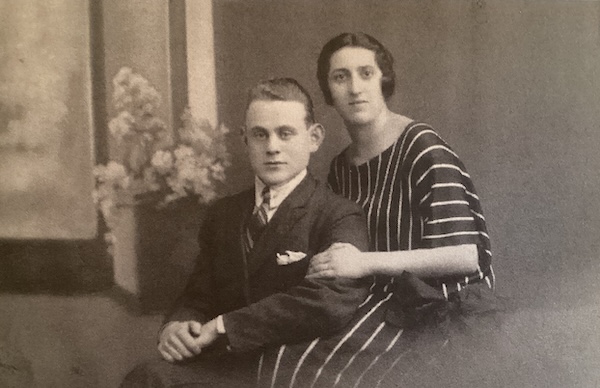
Author Norman Ravvin’s grandparents, Yehuda Yoseph and Chaya Dina Eisenstein, around the time of their engagement, in 1928. (photo from Who Gets In: An Immigration Story)

Relentless perseverance, continual pressure on select politicians and some key allies are what helped Norman Ravvin’s maternal grandfather, Yehuda Yoseph Eisenstein, finally bring his wife and two children to Canada from Poland in 1935, five years after he immigrated here. In a decade generalized as a time of “none is too many” with regards to Canada’s immigration policy towards Jews, Ravvin’s grandfather managed to get his family into the country.

In his new book, Who Gets In: An Immigration Story (University of Regina Press), Ravvin combines his novel-writing skills with his academic expertise to create an engaging memoir about his grandfather’s first years in Canada, one that is firmly situated in the larger context of what was happening at the national level at the time. An extensively researched book – with 10-and-a-half pages of sources – Ravvin’s style will make readers feel like they’ve come to know him a bit, as he allows his personality to be seen in the telling, though what is documented fact and what is conjecture or opinion is clear.

“My approach is to make nothing up. The story rides its own hard-to-believe rails,” says Ravvin on his webpage. “I present its narrative creatively, so readers relate to it on a personal level. Events and personalities from nearly a century ago remain fresh, telling and relevant to contemporary North American life.”

Ravvin does allow his imagination some space. He doesn’t know, for example, the exact reasons his grandfather left Poland, but he can surmise that rising antisemitism was one of them. Whether it was because his grandfather objected physically and publicly to a slur and became a marked man, or whether a rock was thrown into the family’s sukkah, Yehuda Yoseph Eisenstein’s response, writes Ravvin, “was to say ‘I can’t live with these people anymore.’ Or, as he would have said in Yiddish, ‘Ich ken mit zei mer nisht lebn.’ It’s good to hear some of these things in the language in which they took place. In this incident, the spoken words evoke the moment of decision with clarity and purpose.”

Eisenstein had three siblings who had already left Poland, with his younger brother Israel (Izzy) having settled in Vancouver. It was this brother who offered Eisenstein sponsorship and, while Canada was a much less welcoming place by 1930, “a single man could obtain a visa with a brother’s sponsorship.” The problem was Eisenstein had been married in 1928, without a civil licence, as he was already planning on leaving and knew that he would need to appear single to get into Canada. The illegality of the marriage and the misrepresentation of his marital status on his immigration application would cause Eisenstein much tsuris (distress) in getting his wife, Chaya Dina, and their children, Berel and Henna, to Canada as well.

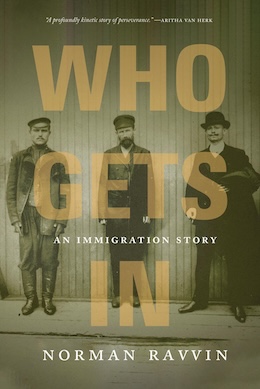
image - Who Gets In book coverWho Gets In is divided into two parts. The first is about Eisenstein finding his place in the country; the second is about his efforts to bring his family over. Ravvin wants to “paint a detailed picture of the time and place, with careful attention to Western Canada,” where his grandfather went, and he does this by talking about such things as the content of school history books in the 1920s, Canada’s immigration numbers and the country’s changing demographics, the implications of government forms that asked immigrants to declare their “Nationality” and “Race or People,” how census data were being interpreted and used, the popularity of eugenics in Canada and beyond, the impacts of the Depression, and so much more.

Ravvin uses history not only to provide context for his grandfather’s experiences but also brings it into the present. Assimilability was a key consideration in assessing immigrants’ suitability in Eisenstein’s day and continues to be – current NDP leader Jagmeet Singh “was approached while campaigning and told that he should remove his turban to look more Canadian,” notes Ravvin.

Ravvin spends quite a lot of ink discussing various perceptions of what a Canadian should like and contemplating how his grandfather would have been considered. The cover of Who Gets In features a photo that was part of a newspaper article in 1910. The three men “appear as cutouts in a group of twelve ‘Types’ of ‘New-Comers’ from ‘Photographs Taken at Quebec and Halifax.’” From left to right, they are described as “Pure Russian, Jew, German.” As the landing form stripped Ravvin’s grandfather of his nationality – someone crossed out the typed letters “PO” and wrote in by hand “Hebrew” – so too is the Jew in this photograph stripped of his, observes Ravvin.

In setting the scene for Part 2 of the book – the bureaucratic fight his grandfather must undertake – Ravvin discusses the Indigenous peoples that inhabited the Prairies where his grandfather ended up. Eisenstein first went to Vancouver, where he hoped to stay and work as a shoichet (kosher butcher), but he was apparently seen as competition by Rev. N.M. Pastinsky, “who happened to be on the board of the Pacific Division of the Jewish Immigrant Aid Society (JIAS) and thus someone with whom one might not want to tangle.”

Eisenstein backtracked to Saskatchewan, living first in the farming town of Dysart and then in Hirsch. Ravvin talks about what Jewish life in rural Canada was like and some of the impacts that European settlement had on the Cree, Saulteaux and Assiniboine.

Ravvin starts the book with the story of the Komagata Maru – the chartered ship from India, full of immigrant hopefuls, mostly Sikhs, that was not allowed to land on the coast of British Columbia in 1914 and was instead forced to return to India, with disastrous results. He returns to the incident at the end of Part 1 to point out that one of the central (negative) figures in his grandfather’s life was A.L. Jolliffe, “who began his civil career in 1913 as an immigration agent in Vancouver,” playing a role in the handling of the Komagata Maru.

“By the 1930s,” writes Ravvin, “Jolliffe had ascended to the position of commissioner for the Department of Immigration in Ottawa. He is the closest thing to a bête noire in my grandfather’s story. If the much better-known doorkeeper, F.C. Blair, played any role in my grandfather’s struggle, he left no trace in any of the documents beyond a shared penchant for the use of pompous and hectoring language that appears in letters in my grandfather’s file.”

Jolliffe denies more than once Eisenstein’s applications for permission to bring his wife and children to Canada – in one instance, while expressly not recommending deportation, Jolliffe suggests that, if Eisenstein wants to be reunited with his family, he should return to Poland. Ultimately, Eisenstein is successful only because he has allies such as A.J. Paull, executive director of the JIAS, and Lillian Freiman who, married to influential merchant A.J. Freiman, had “remarkable access to the leaders of early-twentieth-century Canada.” She also did many amazing good works, including managing “Ottawa’s response to the flu epidemic in 1918 almost single-handedly.” Ravvin also positively differentiates the federal government, as led by R.B. Bennett, prime minister from 1930 to 1935, from that which succeeded it, the “none is too many” government led by William Lyon Mackenzie King as prime minister.

Eisenstein finally achieves his goal through an order-in-council – a decision made by the Privy Council, the prime minister’s cabinet – that “asserted its right to ‘waive’ determinations of an earlier order in which strict immigration regulations were brought into effect. This reflected an ability – understood to exist by those in the know – of the minister to ‘issue a permit in writing to authorize a person to enter Canada without being subject to the provisions’ of the Immigration Act, without interfering with the status of those provisions.”

The Eisenstein family was one of the lucky ones. 

Format ImagePosted on December 1, 2023December 4, 2023Author Cynthia RamsayCategories BooksTags Canada, Eisenstein, history, Norman Ravvin, Who Gets In
Laugh, cheer, boo at panto

Laugh, cheer, boo at panto

Steffanie Davis, who plays Belle, with a couple of the young actors in East Van Panto: Beauty and the Beast, at the York Theatre until Jan. 7. (photo by Emily Cooper, illustrations by Cindy Mochizuki)

Every year, the Cultch and Theatre Replacement’s annual panto, celebrating East Vancouver and poking fun at pop culture and local politics, seems to outdo itself. East Van Panto: Beauty and the Beast, which opened at York Theatre last week, is a rollicking good time that doesn’t sacrifice quality for fun. The text, music, sets, performance – everything is top-notch about this production that will have you cheering, booing, laughing, clapping … generally having a great time.

In the story by new-to-the-panto playwrights Jivesh Parasram and Christine Quintana, Belle, who dreams of studying business at the University of British Columbia so she can get the skills to bring wealth to her East Van neighbourhood, is captured by Beast, an arrogant young man from West Van who is turned into a mattress by Enchantress for his unbending attitude. The curse will not be lifted until this young man, who “won’t flip for nobody,” is able to change his mind – a prized ability in this production. Unfortunately, the curse extends to the staff and patrons of the Japanese food store into which the man had entered to buy some sushi. Transformed into such items as miso soup, soy sauce and various types of sushi, these innocents rely on Belle to save them – and herself – “before the last cherry blossom falls.”

Using physical humour and wittily riffing on pop songs like “Flower” by Miley Cyrus, “Kokomo” by the Beach Boys and “Sweet Dreams” by the Eurythmics, the panto cast is led by Steffanie Davis as Belle and Jason Sakaki as Beast, both strong actors with fantastic singing voices, funky moves and excellent comedic timing. The supporting cast is equally as skilled, and they are, in turn, supported by first-rate creative, design and production teams. Anita Rochon directs the show, and Veda Hille is composer and musical director. Jewish community member Mishelle Cuttler, as assistant musical director, alternates nights with Hille at the keyboard.

East Van Panto: Beauty and the Beast is an ode to community. In this iteration, it highlights two decades-old local businesses, Fujiya Japanese Foods and Mr. Mattress, which are located across the street from each other, at Venables Street and Clark Drive. A highlight of opening night was meeting several folks from Mr. Mattress, a long-time advertiser in the Jewish Independent.

The panto runs until Jan. 7 in-person and on-demand online Dec. 18-Jan. 7. For tickets, visit thecultch.com/event/east-van-panto. 

Format ImagePosted on December 1, 2023November 30, 2023Author Cynthia RamsayCategories Performing ArtsTags Beauty and the Beast, East Van Panto, musical, social commentary, the Cultch, Theatre Replacement
From poems to songs

From poems to songs

Loolwa Khazzoom (photo by Moriel O’Connor)

“Dear Hostages, as the world rallies to celebrate your desecration I will not forsake you,” begins the poem written by Seattle-based multimedia artist and educator Loolwa Khazzoom. Posted on her Facebook page, with a #BringThemHomeNow poster featuring photos of Israelis kidnapped on Oct. 7, it continues, “My instinct is to deprive myself of oxygen / Because you are underground / And I will not forget you // But I know that you would dance / In the sun / If given the chance / So I now rise up / And dance for you.”

Many of Khazzoom’s songs begin as poems. In this case, she told the Independent, “I felt as if I could not breathe and as if I did not even want to breathe, out of solidarity with the hostages and with all of Israel, in particular, all the victims of the Oct. 7 massacre. It’s like I wanted to physically feel their pain and suffering, as a way of physically demonstrating that I would not forsake them or forget them.”

In a traumatized mental state, Khazzoom returned to the “healing tools of poetry and music,” which was another way she could show her solidarity and do her part in keeping the issue of the hostages in front of people.

Similarly, Khazzoom and her band, Iraqis in Pajamas, recently released another poem-turned-song, “#MahsaAmini.” They did so this past Sept. 16, the first anniversary of the death of 22-year-old Mahsa Amini at the hands of Iranian “morality police.”

Finding out about Amini’s murder soon after it took place, from TikTok videos posted by Iranian women, Khazzoom “jumped into action.” She wrote to her political representatives, raised funds for United 4 Iran and reposted Iranian women’s videos on her feed constantly, to help boost the content’s views. “In addition,” she said, “a day after I found out about what happened, a poem with my feelings poured out of me, and I posted it on social media. Months later, I put that poem to a melody, and the band developed it into a full band song, which we released on the [anniversary of the] day of Amini’s murder.”

The death affected Khazzoom deeply for many reasons.

“First, the women in my family wore the abaya, the Iraqi equivalent of the hijab – Jewish women throughout the region were subject to Muslim dress codes, so it’s a Jewish issue, too,” she said. “Second, so many people assume that Islam is indigenous throughout the Middle East and North Africa, but it’s not. Arab Muslims rose up from the Arabian Peninsula and conquered the entire region, forcibly converting masses under the threat of death. So many indigenous ethnicities and religions predated the Muslim conquest, including Jews, Persians, Berbers and Kurds. The Iranian women protesting and burning their hijabs felt to me like challenging that Muslim conquest and awakening the ancient Persian warriors. Third, Persia is central to Jewish history and the origins of the Mizrahi community, dating back nearly three millennia ago…. And, lastly, the fire of these women, and the men who joined them, and their willingness to risk their lives for their dignity and freedom was just breathtaking and profoundly inspirational.”

Another of Iraqis in Pajamas’ releases this year was also intensely personal for Khazzoom.

“I wrote ‘The Convert’s Quest’ in response to some friends on social media sharing how hurt they were, coming under attack during the process of their conversion to Judaism. I had ample experience witnessing variations on this theme throughout my life – both first-person, seeing it happen to friends, and through my research as a Jewish multicultural educator. For decades, I felt very disturbed by this seemingly growing trend.

“I am the daughter of a Jew by choice, as my mother called herself, so the matter of conversion to Judaism is very personal for me,” she said. “I remember understanding very clearly as an Orthodox Jewish child that, according to halachah (Jewish law), once you convert, you are no longer to be called ‘a convert,’ but rather, a Jew, period. So, even from a religious Jewish perspective itself, I was very distraught by the ways that Jewish leaders and communities were rejecting or harassing converts, or even all-out forbidding people from converting. It all flies in the face of Jewish history, theology and practice.”

The band released “The Convert’s Quest” on May 24, on the harvest holiday of Shavuot, which celebrates the giving of the Torah to the Jewish people and on which the Book of Ruth is read. It tells the story of Ruth, a Moabite woman who converted to Judaism, whom Jewish tradition teaches will be the ancestor of the Messiah.

“To me, Jewish converts are the lifeblood of the Jewish people,” said Khazzoom. “I have a provocative line in my song, saying that converts are ‘the most Jewish Jews of all,’ because they are intentionally and consciously practising the foundational precepts of Judaism, which so many either take for granted or do rote, as is often the case in the Orthodox Jewish world where I was raised. In addition, amidst life-threatening levels of racism and violence against Jews, converts choose Judaism…. Why would we reject, in any way, from subtle to blatant, someone with such a heroic Jewish soul?”

Even when delivered in a playful manner, Khazzoom’s song are serious to the core. The campy “Kitchen Pirate,” for example, “emerged from my choice to reject the conventional option of surgery, in the wake of a cancer diagnosis in 2010,” she said. “Instead, I chose to radically alter my diet and lifestyle. Simply by overhauling my diet, I cold-stopped the growth of the nodules, which remained stable for the next five years – neither growing nor shrinking – until I returned to my lost-love of music, following which they began shrinking.”

Khazzoom said her songs “are always questioning, always challenging, always defiant. Sometimes, it’s more explicit, other times it’s embedded in silliness, which, parenthetically, I also see as defiant. I am and forever will be a curious, playful and awe-inspired child. I think that, if and when we ‘outgrow’ that, we die inside. And I refuse to capitulate to that norm of expected behaviour once we enter adulthood. By way of example, to this day, at age 54, when I am flying in a plane, if there is nobody sitting next to me, I will stretch out my arms and pretend I’m a bird, during takeoff.”

Not everyone has appreciated this aspect of her personality. “I have constantly gotten into trouble for it and have been at odds with my family, my community and society at large,” said Khazzoom. “I have endured terrible loneliness and often even self-doubt as a result. But I always come back to my core. And all of my songs emerge from that place – that raw, gut-wrenching place of being fiercely alive and allowing the clash with everything around me, and then writing about it.”

It is this enthusiasm that Victoria-based band member Mike Deeth enjoys about being in Iraqis in Pajamas, whose third member is Chris Belin.

“Loolwa and Chris are both easy-going, creative people. The energy is very positive, which makes collaborating with them fun and organic,” Deeth told the Independent. “Further, I appreciate the passion Loolwa has for the subject matter she writes about. One thing I always struggled with as a musician is ‘What do I have to say?’ At the end of the day, I’m a privileged guy who has never had to face oppression, hate, war or genocide. I have a lot of respect for artists who have experienced darker parts of humanity and have the courage to bring that perspective into their art.”

Born in Toronto, Deeth, who is not Jewish, spent most of his adolescence in Calgary, and moved to Vancouver Island when he was 18. He first picked up a guitar a few years earlier and has been playing ever since. “I was in my first band at 18 and played in bands throughout my 20s. For the past several years, I have been mainly focused on recording,” he said.

photo - Mike Deeth
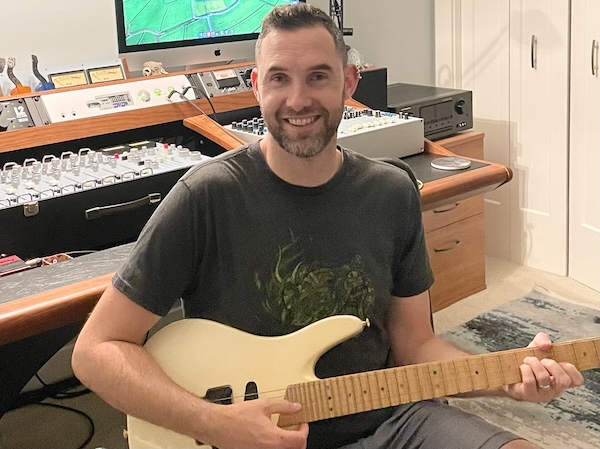
Mike Deeth (photo from Mike Deeth)

Deeth got hooked on music production in his teens, getting his first digital recorder at age 16. “I still remember pulling all-nighters with friends trying to write songs and get ideas down on tape. Production was always fascinating to me, as I could layer parts together into something bigger than I could ever play on my own.”

Deeth and Khazzoom met a couple of years ago through a Craigslist posting. “She was looking for a guitarist to contribute to an early version of her track ‘The Convert’s Quest,’” he explained, complimenting Khazzoom on the fact that she “puts her full heart into her songs.”

“I recorded some initial guitar demos and, about a year later, we reconnected and worked up the current releases,” he said.

Deeth adds guitar to the songs and completes the mix and master of the songs when they are ready for those steps. Khazzoom sings, writes and plays bass, while Belin – who lives in Pennsylvania – composes the drum parts and performs them.

Among his other music ventures, Deeth has “played the guitar with Bryce Allan, a country musician here on the island, and recorded a few tracks with him. I also work closely with Jennie Tuttle, another musician from Victoria. We have been recording together for seven or eight years now.”

For Deeth, “recording is such an interesting combination of art and science. I get to be musically creative, but I also get to play with cool machines, solve problems and think about gain staging, compression ratios and other technical aspects. I thoroughly enjoy both the artistic and scientific parts of the process – they work my mind in different ways.

“I also love how each project starts as a blank canvas and ends with a new piece of music out in the world. There are an almost infinite number of possibilities when recording a track (all the possible settings on the equipment, the subtleties of different instruments) and it always fascinates me how each song takes shape during the process.”

“Mike has an exquisite sensitivity in his musical composition, performance and recording,” said Khazzoom. “He’s not only super-talented and -skilled, but he’s warm, upbeat, enthusiastic and professional. It’s a joy to create music with him. As is the case with our drummer Chris Belin, Mike has an uncanny ability to capture the essence of the songs I write, to the point that I feel he is playing back to me the sound of my soul. I have literally sat and cried after hearing the mixes.”

For more on Khazzoom, visit khazzoom.com. For more on Deeth’s production and sound services, visit glowingwires.com. 

Format ImagePosted on December 1, 2023November 30, 2023Author Cynthia RamsayCategories MusicTags conversion, hostages, Iran, Iraqis in Pajamas, Israel, Judaism, Loolwa Khazzoom, Mahsa Amini, Mike Deeth, Oct. 7, politics, punk music, recording, social commentary, terrorism

Mysteries to be solved

The past can consume you if you let it. And reality isn’t as easy to discern as you might think. Two recently published thrillers from Simon & Schuster share these themes in common, but their authors address them in completely different ways.

Anna Porter’s Gull Island takes readers on an unsettling, at-times gory, modern-day journey through the protagonist’s thoughts and memories as she visits alone her family’s isolated island cottage and a ferocious storm hits, unmooring her boat and rendering her cellphone ineffective. Roberta Rich’s The Jazz Club Spy begins with a brutal pogrom in 1920 Ukraine and then jumps to 1939 Manhattan, where the protagonist, now a young woman, sees in passing one of the Cossacks who rampaged her village – as she starts looking for him to exact her revenge, she is enlisted by the US government to help find him for them, as he is a possible conspirator in an assassination plot.

Neither genre – psychological thriller or espionage novel – is the type of fiction I’d generally pick up, but I enjoyed both. They provided an escape, I learned a few things, I wanted to know how they would end. 

While The Jazz Club Spy started off gritty and harsh, by the second chapter it read more like a young adult novel. Given the state of the world at the moment, I didn’t find that necessarily a negative thing. I rooted for Giddy Brodsky, who survived that traumatic pogrom and was now helping her family pay the rent and feed themselves, her dad having left for reasons we eventually find out.

image - The Jazz Club Spy book coverAs a cigarette girl in a club, Giddy uses her natural sleuthing skills – looking through customers’ pockets, listening to conversations for clues, etc. – to help her friend Hattie’s clairvoyant act. After Giddy sees the Cossack on a tram, but loses him in the crowd, she puts those skills to personal use, and then uses them to help the government. This happens after she asks a club regular who works in the immigration department for assistance, and he shares with her that the Cossack is an “undesirable” and could she help the government track him down.

Giddy is not only a competent detective but an aspiring entrepreneur, who creates her own makeups and lotions. The money she earns from spying goes to help her set up her own beauty store. But, to achieve success, she must first complete her mission, one that is complicated by love and the dangerous situations she must place herself in to root out the Cossack and try to prevent the assassination and a potential global political crisis.

The Jazz Club Spy is all about external threats and heroic acts. There is no doubt about Giddy’s strength, purpose and whether she’s a good person. Gull Island, on the other hand, is all about internal threats and acts that cause harm (even if that isn’t the intent). Jude’s a great unknown, even to herself, and she gets progressively more disoriented as the storm hits the island and she struggles to get the water pump working, hurts herself in various accidents, and drinks we’re not quite sure how much alcohol while she’s there.

image - Gull Island book coverJude has come to the island at her mother’s request. Jude’s father has gone missing and a copy of his will is apparently at the cottage. She is also there for personal reasons, to rummage about, to figure something out, to look through old photographs; there are many of her sister, not so many of her. Jude has grown up in a dysfunctional family and the cottage was not generally a happy place. As the storms intensify – the rain and wind outside, the memories barraging Jude and the physical cuts and bruises she receives along the way, dealing with broken glass, wild animals and things not so clear – the tension ratchets up. When the sun returns and Jude surveys the damage left behind, a key piece of the mystery is understood.

Porter isn’t afraid to explore dark places, and she masterfully leads readers through Jude’s turmoil. I found it noteworthy that the book Jude finds at the cottage to read is Sapiens: A Brief History of Humankind by Yuval Noah Harari. “I had abandoned it years ago because I didn’t want to feel as insignificant as the author had made me feel,” thinks Jude. “But tonight, being alone in the cottage, with something digging under the bedroom window, feeling insignificant would be useful.” Spoiler alert: by the end of the novel, she is set to finish the book. 

Posted on December 1, 2023November 30, 2023Author Cynthia RamsayCategories BooksTags Anna Porter, espionage, fiction, Gull Island, psychological thriller, Roberta Rich, Simon & Schuster, The Jazz Club Spy, young adult fiction
Perfect gifts for holiday

Perfect gifts for holiday

In 2019, NASA astronaut and scientist Jessica Meir was part of the first all-woman spacewalk. According to image - Counting on Naamah book cover: Jewish Women who Rocked the World, she “celebrated Hanukkah in space by wearing festive holiday socks and sending a Happy Hanukkah message to earth on social media.”

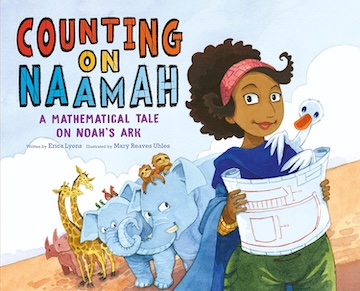
This is just one of the many “Fun Fact[s] to Mench’n” in this enlightening book written by the mother-daughter team of Rachelle Burk and Alana Barouch, and illustrated by Arielle Trenk. She’s a Mensch! is one of two books the JI received from Seattle’s Intergalactic Afikoman to review. The other is the perfect antidote to the “girl math” phenomenon popularized on social media, though hopefully kids under 9 aren’t engaging with that. Counting on Naamah: A Mathematical Tale on Noah’s Ark by writer Erica Lyons and illustrator Mary Reaves Uhles imagines Noah’s wife as being a genius in math and engineering.

Using the basics of the Noah story, Counting on Naamah offers a midrash of sorts. “A midrash is a tale that begins with a story from the Torah. Then it fills in the missing pieces to imagine the rest,” explain Lyons and Reaves Uhles at the back of the book. “The story of Noah leaves a lot to the imagination. What was it actually like to live on that ark? How did they take care of all those animals? And who was the generally unnamed ‘Mrs. Noah’? Counting on Naamah tries to answer these questions.”

The story begins when Naamah is a child, and uses her talents to help each of her three brothers – with market transactions, estimated herd transport times and archery angles. She has her own projects, as well, drafting plans for a desert sand scooter, for example.

When she meets and falls in love with Noah, the two become “impossible to divide,” but Naamah retains her agency and is a crucial help in building the ark, housing and feeding the animals, and more. And Noah knows just what to do to thank her.

Counting on Naamah is a charming story, creatively and colourfully illustrated. As is She’s a Mensch!, which is a nonfiction work that highlights 20 women who “rock!”

“Jewish women ‘round the world have talent, strength and smarts,” the book starts. “They shine like stars in every field from science to the arts.

“Jewish women through the ages have helped shape history. These mensches are authors and activists, athletes and adventurers, and everything in between.”

Indeed, the women featured range from writer Emma Lazarus in 1883 to Meir, in 2019. They include familiar – Golda Meir, Barbra Streisand, Ruth Bader Ginsburg – and less familiar names, like Marthe Cohn, who was a spy for France during the Second World War; Vera Rubin, who provided proof of dark matter in the 1970s; Nalini Nadkarni, who performed the first survey of rainforest treetops in 1981; and Judit Polgár, who became a chess grandmaster at age 15, in 1991. There’s a list of 18 honourable mentions.

Each entry in She’s a Mensch! has something different: unique drawings that connect the mensch to their chosen pursuit, a four-line poem and a short blurb about the mensch, often a fun fact, and always a mensch-related question to ponder, such as, How can you help others? (Henrietta Szold) What kinds of stories can you tell? (Judy Blume) and What great adventures do you dream of going on? (Cheryl and Nikki Bart)

image - Where Do Diggers Celebrate Hanukkah? book coverBoth of these books would make great Hanukkah gifts for kids of any gender. As would this year’s Hanukkah addition to Intergalactic Afikoman publisher Brianna Caplan Sayres’ and illustrator Christian Slade’s Diggers series, which has more than 10 books, and counting.

Where Do Diggers Celebrate Hanukkah? (published by Penguin Random House) would be a happy addition to a kid’s Diggers collection, or a fun introduction to the series. For the diggers, cranes, mixers, armoured trucks, tankers, dump trucks and food trucks, we’re asked to wonder what each does for an aspect of the holiday. For example, “Does Mom dig up the ancient jar that held the precious oil?” And the cranes, “Do they decorate their construction site with ‘Happy Hanukkah’ all around?” After a day of serving meals outside, do food trucks “serve sufganiyot and other food that’s fried?” Inquiring minds will want to know. 

Format ImagePosted on December 1, 2023November 30, 2023Author Cynthia RamsayCategories BooksTags children's books, Diggers, Empowerment, Hanukkah, Intergalactic Afikoman, Penguin Random House, women
Inspiration to improve world

Inspiration to improve world

Jeff L. Lieberman – director, writer and producer of Bella! – with his mother, Carole Lieberman, at the documentary’s July screening in San Francisco. (photo by Pat Mazzera)

“I could feel defeated now / I could be broken-hearted / I could be finished long before I’d even started / But that would be too easy and I never take the easy way.”

In his production notes, Jeff L. Lieberman – director, writer and producer of the award-winning documentary Bella! – rightfully highlights these lyrics from the original song Mark W. Hornburg and Doug Jervey composed specifically for this film about Bella Abzug (1920-1998). Abzug never shied away from a fight and would always come back after a loss.

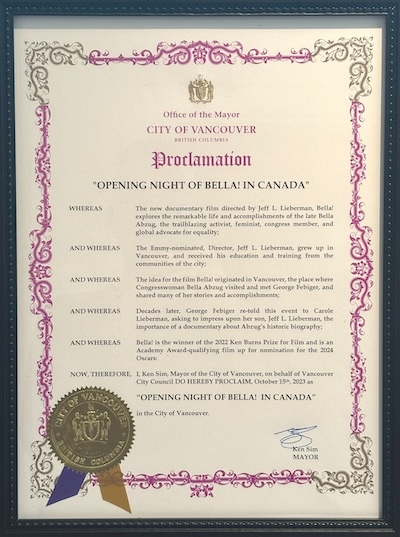
photo - Vancouver Mayor Ken Sim issued an official proclamation of Oct. 15, 2023, as the opening night of the film Bella! in Canada
Vancouver Mayor Ken Sim issued an official proclamation of Oct. 15, 2023, as the opening night of the film Bella! in Canada. (photo from Re-emerging Films)

Lieberman, who has lived in New York City since 2007, returned to his hometown of Vancouver for the Canadian première of Bella! Oct. 15 at the Park Theatre. The film was presented by the Vancouver Jewish Film Centre and sponsored by Dexter Realty. Ahead of the event, Vancouver Mayor Ken Sim issued an official proclamation of the opening night of the film in Canada. The proclamation recognizes that the documentary “explores the remarkable life and accomplishments of the late Bella Abzug, the trailblazing activist, feminist, congress member, and global advocate for equality.” The proclamation acknowledges that Lieberman grew up in Vancouver and that the idea for the film originated here. It was a suggestion from Carole Lieberman, who had gotten the idea from a neighbour, but more on that later.

For those unfamiliar with Abzug, she was one of only 12 women (of 435 members) to enter Congress in 1971. There, she was instrumental in getting women the right to have credit cards in their own name; she introduced curb cuts that allowed people with disabilities or other mobility issues more freedom of movement; and she brought in the Equality Act, the first federal LGBTQ+ rights legislation in the United States. Other issues about which she was vocal included ending the Vietnam War and supporting the impeachment of Richard Nixon.

Abzug was the first woman to run for the Senate from New York and the first woman to run for mayor of New York City. After she lost both races – in heartbreaking fashion – she took on other challenges, including being one of the leaders of the feminist movement and a co-founder of the Women’s Environment and Development Organization.

“Raised in a community filled with strong Jewish women, Bella Abzug was not a totally unfamiliar name,” writes Lieberman in his director’s notes. “Her orbit filled my 1980s home: the books of Letty Cottin Pogrebin (featured in Bella!) and Anita Diamant lined our bookshelves; we sang the songs of Debbie Friedman; and were proud to see Gloria Steinem (also featured in Bella!) appear on the evening news. However, Bella’s name did not quite push through like it had in other homes throughout the 1970s, when she appeared on magazine covers and became one of the most recognizable faces in Congress – due in part to her trademark branding – her iconic hats.”

Lieberman includes many audio clips of Abzug talking about various things, including her first jobs as a lawyer – she enrolled in law school at Columbia University in 1944, where she was one of six women in a class of 120, and graduated in 1947. She said she would go out to clients on behalf of a firm and be told to sit and wait until “the lawyer” arrived.

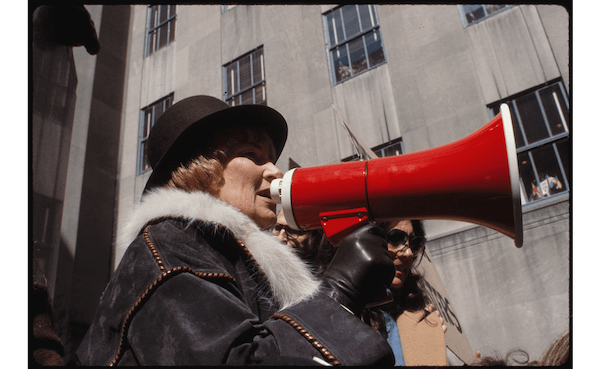
“So, I had an identity crisis and, in those days, professional women wore hats,” she says. “So, I put on a pair of gloves and a hat and whenever I appeared anywhere, they then knew I was there for business. I’ve since taken off the gloves, but I grew to like wearing hats and that was merely my way of being me.”

photo - Congresswoman Bella Abzug, in 1979
Congresswoman Bella Abzug, in 1979. (photo from Bernard Gotfryd, Library of Congress)

Bella! captures Abzug’s big personality and her passion for politics and social change. She made an impact on abortion rights, gay rights, equality for women and minorities, climate issues and more. Not understanding how a person who accomplished so much had basically disappeared from public knowledge was one of the reasons Lieberman made the film.

“In 2016, after completing my previous film, The Amazing Nina Simone, I began brainstorming ideas for my next project,” he writes. “My mom came up with a list of documentary ideas that like any well-meaning parent included suggestions that ignored many boundaries of reality. After politely rejecting most of the ideas, I paused when she mentioned Bella Abzug. I liked the idea but was pretty confident that her story had been told many times before. My mom said the idea had come from a neighbour who had met Bella when she visited Vancouver for a climate conference. I didn’t know George Febiger, but spoke to him on the phone and he told me about his very memorable day spent touring the city with Bella, and the many stories and insights that she had shared. He thought Bella’s story was long overdue. After doing some research, I quickly realized a comprehensive documentary film about Bella Abzug had never been done before, and George was not alone in his belief – it was Bella’s time.”

And Lieberman gives Abzug her due. He had access to never-before-shared audio and video footage, of which he and the production team of Re-emerging Films – Jamila C. Fairley, Tamar Kaissar and Amy Wilensky – made brilliant use. The film includes interviews with Abzug’s children and we meet her supportive husband, Martin, who died in 1986, through archival recordings, as well as other Abzug supporters and rivals. The film features interviews with a host of political activist celebrities who worked with and were inspired by Abzug, including Hillary Clinton, David Dinkins, Phil Donahue, Marlo Thomas, Barbra Streisand, Maxine Waters and many others.

Returning to the original song that ends the film, Lieberman writes, “It is easy for any one of us to retreat and be discouraged by the onslaught of overwhelming, bad news. It takes more work to stand up and fight – but less work if we all do it collectively. With the perils of climate change, dismantling of civil rights, and our democracy being challenged by both inside and outside threats, we hope that Bella! inspires a future generation of leaders who will pick up the bullhorn and lead us toward sustainable solutions. And we hope this film inspires everyone to find those small things they can do improve the world and never take the easy way.”

Bella! had its world première this summer in the United States. While there currently are no other screenings planned for Vancouver, the film will be aired on PBS, and will also stream more widely in the coming months. It can be rented to stream at vimeo.com/ondemand/445444. For more information, visit bella1970.com.

Format ImagePosted on November 24, 2023November 23, 2023Author Cynthia RamsayCategories TV & FilmTags Bella Abzug, documentary, Jeff Lieberman
A fresh take on Hanukkah

A fresh take on Hanukkah

Chicago a cappella in June 2022. The ensemble released Miracle of Miracles: Music for Hanukkah last month. (photo by Kate Scott)

The CD Miracle of Miracles: Music for Hanukkah arrived at the Jewish Independent unsolicited. The album, released last month by Cedille Records, features a range of songs from the American Jewish musical tradition, performed by Chicago a cappella vocal ensemble. As someone who spent a good portion of her teenagehood in a choir at a Conservative synagogue and about a decade singing in another Conservative synagogue choir later in life, I have been happily singing along to this recording, enjoying the fresh take on songs with which I am mostly quite familiar.

Miracle of Miracles will appeal most, I think, to someone like me, who grew up in a Conservative Judaism milieu where a cantor and choir formed a large part of the service, or someone who appreciates classical music, as Chicago a cappella are classically trained A-listers, who perform a repertoire of music from the ninth to the 21st centuries. The current artistic director is John William Trotter, and Miracle of Miracles was recorded over a few days last January at Northeastern Illinois University in Chicago.

image - Chicago a cappella CD coverThe CD opens with an arrangement of “Oh Chanukah / Y’mei Hachanukah” by Robert Applebaum that the liner notes describe as “modern versions of the song form from the confluence of at least two streams, the first springing from Hebrew lyrics, the second flowing together from Yiddish and English sources. Turning again to [composer] Harry Coopersmith’s mid-20th-century collection … to create something of a mash-up of ‘Oh Chanukah’s’ popularity.”

There are several Applebaum arrangements. His “Haneirot Halalu” (“These Lights We Light”) mixes English translation and commentary into the traditional Hebrew lyrics, and his “Maoz Tzur” is a cantor-choir interplay that comprises elements most of us will recognize and be able to join initially, but then becomes more complex. His finger-snapping arrangement of Samuel E. Goldfarb’s well-known “I Have a Little Dreidl” – called “Funky Dreidl” – is in English with the Hebrew “nes gadol haya sham,” “a miracle happened there,” as a kind of chorus. It’s followed on the CD by a lively rendition of Mikhl Gelbart’s Yiddish “I Am a Little Dreidl (Ikh bin a kleyner dreidl).”

Other Yiddish offerings are Mark Zuckerman’s arrangement of “O, Ir Kleyne Likhtelekh” (“O, You Little Candle”), the lyrics of which were written by poet and lyricist Morris Rosenfeld, and an arrangement by Zuckerman of “Fayer, fayer” (“Fire, Fire”) by Vladimir Heyfetz, about burning the latkes while frying them.

Applebaum’s jazzy “Al Hanism” (“For the Miracles”) is one of three versions of the song on this recording. There is also an arrangement by Elliott Z. Levine that is the traditional, fast-paced version I’ve sung countless times and love, and the expansive, movie soundtrack-sounding arrangement by Joshua Fishbein.

Levine also contributes “Lo v’Chayil” (“Not by Might”), based on text from the Book of Zechariah, which is not a Hanukkah song per se, but, as the liner notes say, “rather the more transcendent spirit that underlies the commemoration of Hanukkah.” Translated from the Hebrew, the verse is: “Not by might nor by power, but by My spirit, saith the Lord of Hosts.”

Other composers/arrangers whose work is featured on this CD are Steve Barnett (“S’vivon” / “Little Dreydl”), Gerald Cohen (“Chanukah Lights”), Daniel Tunkel (four movements of his “Hallel Cantata”), Jonathan Miller (“Biy’mey Mattityahu” / “In the Days of Mattityahu”).

Two bonus tracks are included: an arrangement by Joshua Jacobson of Chaim Parchi’s Hanukkah tune “Aleih Neiri” and Stacy Garrop’s take on the prayer for peace “Lo Yisa Goy”: “Nation shall not lift up sword against nation, neither shall they learn war any more.”

In the program notes, Miller, who is Chicago a cappella’s artistic director emeritus, talks about the limited number of Hanukkah songs that are appropriate for an ensemble to perform, commenting that “Jewish choral music is a recent phenomenon, begun in earnest only about 200 years ago in Berlin, so there’s a simple quantity issue: we have much less repertoire to peruse than in other choral traditions. Given all of this, we are especially grateful for the composers and arrangers whose persistence and skill have given us the works found here.”

photo - Chicago a cappella artistic director John Trotter
Chicago a cappella artistic director John Trotter. (photo from Cedille Records)

Despite the dearth of Hanukkah choral music, Trotter, the ensemble’s current artistic director, observes that the CD comprises “a sprawling variety of styles.”

“There are at least two reasons for this breadth,” he writes. “On the one hand, we are in debt to the fertile imaginations of our composers, who envisioned so many different sound worlds and so many different ways to clothe these texts. But there is also the nature of Hanukkah itself, which offers so many different modes of personal, social and spiritual practice. Consider just three of these. Hanukkah offers the chance to reflect on the historical significance of the Maccabean revolt, with its consequences echoing through to the present day. It invites quiet contemplation of the candle flames, set aside from any utilitarian purpose. And it provides an opportunity to gather with family and have a really great party with really great food.”

Miracle of Miracles would provide a perfect acoustic background for a Hanukkah gathering. To purchase a CD or buy or stream the music digitally, visit cedillerecords.org/albums/miracle-of-miracles.

Format ImagePosted on November 24, 2023November 23, 2023Author Cynthia RamsayCategories Celebrating the Holidays, MusicTags Cedille Records, Chanukah, Chicago a cappella, choral music, Hanukkah
A spoof on true crime

A spoof on true crime

Left to right: Sophia Paskalidis, David Underhill, Drew Ogle and Mai Stone (seated) co-star in Tragedy, Slander & Wine. (photo by Sarah Cherin)

When a community theatre production ends with an actor dying on stage, the media descends on the small B.C. town. Conspiracy theories flourish and no one is above suspicion.

This is the plot of Tragedy, Slander & Wine by Jewish community member David Volpov, which premières at the NEST on Granville Island Nov. 13-19. The mystery/comedy explores, among other things, media literacy.

“My goal in writing Tragedy, Slander & Wine is to bring awareness about the issue and to invite audience members to think more critically about the media they consume. So, that’s where the idea of true crime entered the play,” said Volpov, executive director of Promethean Theatre, which is presenting the work. “I see true crime lovers popularize a lot of sensationalistic interpretations of well-known deaths. I think people tend to want to believe wild hypotheses instead of the cut-and-dried truth simply because it’s more entertaining. This conspiratorial thinking can become dangerous if it impedes on innocent people’s lives, which is what happened in real life to the town of Moscow, Idaho, after several infamous deaths.”

On Nov. 13, 2022, Ethan Chapin, Xana Kernodle, Kaylee Goncalves and Madison Mogen were stabbed to death in the young women’s off-campus (University of Idaho) house. False accusations and other misinformation proliferated, causing much harm to the community. Eventually, suspect Bryan Kohberger was charged with their murders, and his trial continues.

In Volpov’s fictional story, the play’s description notes, “The finger-pointing grows so rampant that the victim’s sister, Shannon (Mai Stone), can’t even have a healthy relationship with her own mother. Shannon’s longtime friend Alec (Drew Ogle) promises to help Shannon replenish her image in the public eye and shed her status as a pariah. But they find out that manipulating the media is harder than they anticipated. They have to get past power-hungry reporter Penelope (Sophia Paskalidis) and gatekeeping publicist Colin (David Underhill). Soon, Shannon uncovers a secret plot that upends everything she thought she knew about the tragedy.”

The play features four actors on stage and seven performers who act only on screen.

“I knew that I needed a multimedia film component in the production to spoof true crime,” Volpov told the Independent. “We filmed interviews with the townsfolk, who give the audience information about the circumstances of the mystery of the play. The film is played on TVs, which are onstage during the entire performance.”

This approach was new to many working on the production and Volpov said he appreciated the help of a few film artists who offered their guidance. In particular, he noted, “Our videographer, Bruna Xavier, and our film editor, Ian Tan, are both godsends. I’m really excited for audiences to see what this collaboration created because it’s not something that Vancouver audiences have seen before.”

Tragedy, Slander & Wine is Promethean Theatre’s sixth production. Formed in 2018, the company’s mandate is “to create work opportunities for emerging artists,” said Volpov. “There are some apprenticeships open to emerging artists in Vancouver theatre companies, but I keep hearing from my peers that these positions only take them so far. They feel stuck in what they consider a trainee limbo before they can get a shot at a role they want. That’s why Promethean puts emerging artists directly in positions of creative leadership. In that sense, we act as a launchpad for artists who want to continue expanding their practices.” (For more information, visit prometheantheatre.ca.)

photo - With Tragedy, Slander & Wine, playwright David Volpov invites audience members to think more critically about the media they consume
With Tragedy, Slander & Wine, playwright David Volpov invites audience members to think more critically about the media they consume. (photo from Promethean Theatre)

Volpov joined the producing team after having acted in Promethean’s first production, Saint Joan. He graduated from the bachelor of fine arts acting program at the University of British Columbia in 2020.

“Like many people who graduated then, my final play at UBC was cut short after just three performances due to COVID,” he said. “This experience really opened my eyes…. I always knew acting is a difficult profession, but to see virtually every theatre and movie set shut down spiked my existential worries a lot. There’s a silver lining, though. I returned to playwriting during the lull period in 2020 because I realized that writing was a way I could create art while social distancing. I learned that I didn’t have to wait for theatre work to come to me; I could generate work myself. In hindsight, I didn’t actually know what art I wanted to make when I graduated UBC. It wasn’t until I began writing plays that I found my voice and had something to say about the world.”

Tragedy, Slander & Wine is one of the works Volpov began writing during the pandemic. “I felt troubled by how quickly conspiracy theories spread,” he says in the press release for the play. “I saw this cycle repeat after each major world event. Our abilities to engage in meaningful discourse eroded while our reliance on bias-confirming news increased. With so much misinformation online nowadays, how is anyone supposed to parse through what’s fact and what’s fiction?”

“Research shows that feelings of anxiety, disenfranchisement and isolation cause people to think more conspiratorially,” Volpov told the Independent. “People feel comforted by believing that their enemies cause their bad fortune (as opposed to random chance). One of the reasons conspiracy theories endure is because they have a backfire effect: when someone confronts a conspiracy theorist about their beliefs, it is interpreted as confirmation. Theorists think ‘of course, the higher powers want to convince me I’m wrong, that’s part of their plan.’ I don’t think conspiracy theories will ever go away, unfortunately.”

Nonetheless, Volpov is doing what he can to improve the situation, in addition to writing about it.

“Promethean Theatre partnered with a media literacy platform to provide education about the topic,” he said. “They are called Ground News and are a Canadian company based out of Kingston, Ont.

“I believe that there are many ways that people can combat their confirmation biases and to have a well-rounded knowledge about current events,” he continued. “The number one thing people can do is to read multiple sources about one story. I know it probably feels like a chore, but reading different perspectives can mitigate our political blindspots.

“After that, I recommend cutting your social media use when engaging with current events. Traditional media isn’t perfect, and it’s rightfully facing scrutiny from the public, but social media can be especially pernicious because the algorithm can steer people to engage with content that already supports their beliefs. Also, the algorithm boosts sensationalistic content while ignoring nuance, which I think is necessary for every discussion.

“My next piece of advice is, be diligent about claims you read. If information can’t be traced back to a source,” he said, “it can’t be verified as true.”

Tragedy, Slander & Wine is recommended for audience members age 16+ because of its “mature content, including references to substance abuse, murder and suicide.” Among the performances is a matinée for high school students Nov. 15, and artist talkbacks after the Nov. 18 and 19 matinées. For tickets, visit plainstage.com/events/tragedy-slander-and-wine.

Format ImagePosted on November 10, 2023November 9, 2023Author Cynthia RamsayCategories Performing ArtsTags comedy, David Volpov, media literacy, Promethean Theatre, satire, Slander & Wine, theatre, tragedy, true crime

Posts pagination

Previous page Page 1 … Page 18 Page 19 Page 20 … Page 85 Next page
Proudly powered by WordPress