Skip to content
  • Home
  • Subscribe / donate
  • Events calendar
  • News
    • Local
    • National
    • Israel
    • World
    • עניין בחדשות
      A roundup of news in Canada and further afield, in Hebrew.
  • Opinion
    • From the JI
    • Op-Ed
  • Arts & Culture
    • Performing Arts
    • Music
    • Books
    • Visual Arts
    • TV & Film
  • Life
    • Celebrating the Holidays
    • Travel
    • The Daily Snooze
      Cartoons by Jacob Samuel
    • Mystery Photo
      Help the JI and JMABC fill in the gaps in our archives.
  • Community Links
    • Organizations, Etc.
    • Other News Sources & Blogs
    • Business Directory
  • FAQ
  • JI Chai Celebration
  • JI@88! video

Recent Posts

  • Sharing her testimony
  • Fall fight takes leap forward
  • The balancing of rights
  • Multiple Tony n’ Tina roles
  • Stories of trauma, resilience
  • Celebrate our culture
  • A responsibility to help
  • What wellness means at JCC
  • Together in mourning
  • Downhill after Trump?
  • Birth control even easier now
  • Eco-Sisters mentorship
  • Unexpected discoveries
  • Study’s results hopeful
  • Bad behaviour affects us all
  • Thankful for the police
  • UBC needs a wake-up call
  • Recalling a shining star
  • Sleep well …
  • BGU fosters startup culture
  • Photography and glass
  • Is it the end of an era?
  • Taking life a step at a time
  • Nakba exhibit biased
  • Film festival starts next week
  • Musical with heart and soul
  • Rabbi marks 13 years
  • Keeper of VTT’s history
  • Gala fêtes Infeld’s 20th
  • Building JWest together
  • Challah Mom comes to Vancouver
  • What to do about media bias
  • Education offers hope
  • Remembrance – a moral act
  • What makes us human
  • המלחמות של נתניהו וטראמפ

Archives

Follow @JewishIndie
image - The CJN - Visit Us Banner - 300x600 - 101625

Month: May 2021

The Kitchen food hub opens

The Kitchen food hub opens

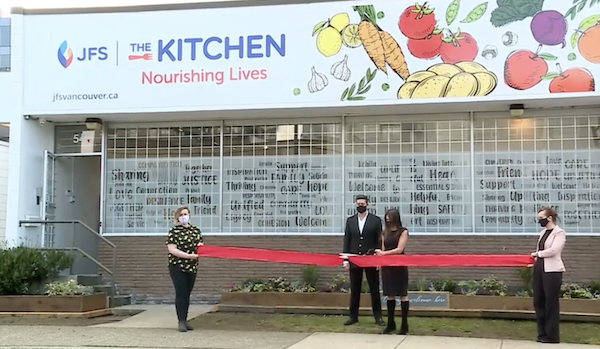
Jody and Harvey Dales cut the ribbon at the Kitchen’s opening on April 18. On their left is Tanja Demajo, JFS chief executive officer; on their right is Janelle Zwarych, JFS director of food security. (screenshot)

Along-in-the-works food hub was launched by Jewish Family Services in a virtual grand opening April 18. Dubbed the Kitchen, the facility will be home to a range of JFS programs that target food insecurity.

“We believe that nourishing and good food has the power to connect people, to build a healthy community and to inspire us to engage in conversations about social justice,” said Tanja Demajo, chief executive officer of JFS. “The Kitchen is not a place but a destination, a destination in which community involvement breaks down the wall between the givers and receivers. We strive to empower people to make personal choices, to advocate for themselves and have access to the basic resources needed for healthy lives.”

The opening of the Kitchen, located on East Third Avenue between Quebec and Ontario streets, is the culmination of more than two years of work, during which JFS and the Jewish Federation of Greater Vancouver have implemented recommendations from their joint Food Security Task Force report, which was released in 2018. Initiatives already undertaken include an expansion of the JFS food program to hub models that recognize and accommodate the 50% of clients now living outside Vancouver city limits. They have also developed new programs, such as Breakfast Club for kids and meals for seniors. Healthy cooking classes have been delivered and, at the start of COVID, food programs were shifted to delivery-only. With the support of RBC, JFS purchased a food van to facilitate movement of goods between suppliers, warehouses and hubs.

Demajo especially thanked Jody and Harvey Dales, who ceremonially cut the ribbon at the new facility.

“Their belief in dignified access to food, in JFS and this community’s ability to undertake this project is what made this dream a reality,” she said.

Bill Kaplan, JFS board chair, put the landmark event in context.

“JFS has been serving our community since 1936,” he said. “Although the context of our times change, our mission has not. We continue to serve our community as an extension of our family and, today, we are here to mark a special occasion in that service…. The name, the Kitchen, captures everything we hope this space to become – a warm, inviting place for members of our community to be welcomed, nourished and cared for. There will be healthy food, cooking classes, counselors to talk to, space for workshops, all provided here at this new location. It’s how we can meet the real needs of our community in an environment that is both dignifying and empowering.

“The tagline that we chose is ‘Nourishing Lives,’ which captures not only the physical nourishment that we receive through food, but a more holistic purpose as well. It’s within community that the act of giving and receiving nourishment takes place. This connection is the context for relationships – for someone to check in with you, to ask you how you’re doing, give a listening ear, give a helping hand. In these times especially, we need human connection for the nourishment of our souls. That is something we aspire to with the space and, as a community, we invite you to join us in that purpose.”

Stan Shaw and Simone Kallner, co-chairs of the JFS Food Security Committee, celebrated the launch and thanked those who made the project possible.

“Our new food hub facility is a wonderful example of what the Jewish community is doing to provide inclusive and dignified and respectful and reliably secure access to food to the most vulnerable among us,” said Shaw. “It’s a dream that’s come true. I am inspired to have been a part of such a wonderful team, including the staff and incredible volunteers at Jewish Family Services that have made this possible.”

Kallner added: “This new space will give people somewhere to go for support, connection, social gatherings … where everyone feels the comfort, warmth and inclusivity that our community can offer. It has been a true honour and privilege to be part of this amazing project alongside an incredibly talented, dedicated and heartfelt committee.”

She thanked Ezra Shanken, chief executive officer of the Jewish Federation of Greater Vancouver, and Marcie Flom, executive director of the Jewish Community Foundation, for invaluable support.

Rabbi Dan Moskovitz of Temple Sholom affixed the mezuzah and spoke of how hunger, by definition, is a problem that is largely out of sight and, as a result, too often out of mind.

“But this building, these people, this sign on the door, this address, this community program – they change everything as of this moment,” he said. “Hunger in the Jewish community is no longer invisible…. With this building and our community’s public and intentional dedication to supporting it, staffing it and promoting its many services, hunger in our community can no longer be overlooked, it can no longer be ignored. The very real pain of an empty stomach, that too many in our community experience on a regular basis, it cries out to us, it cries out for immediate attention, immediate action. This building, and what takes place here, they are the shofar blasts that must wake us up to the most solvable problem in our community. We can end hunger in the Jewish community. We can fix this.”

Torah, he added, commands farmers to leave the edges of their fields unharvested so that the hungry can obtain food.

“When we go shopping, our modern equivalent of harvesting our fields, we must buy extra food for the food bank every single time, and we can bring it here,” he said. “Open your hand to those in need, we read in Torah. It’s through our tzedakah and that of our Jewish community, through food drives and bar/bat mitzvah projects, donations made in honour and memory of our loved ones, all the ways Jews have given throughout time and all the ways that we give of our resources, all of those things will sustain this place and will fulfil the commandment to extend our hand to those in need.”

Janelle Zwarych, director of food security at JFS, led the virtual tour through the facility.

“The Kitchen means so much more than just food,” she said. “At any good party, it’s where everyone comes together, it’s a place of warmth, a place of creativity and a place of fun. Our place, the Kitchen, means all of those things rolled into one.”

In addition to being a place for the storage, sorting and delivery of food to clients, there is space for group cooking and classes, as well as community meals, when health protocols permit. There are offices where clients can meet with caseworkers to access government supports or borrow equipment from the Red Cross while picking up groceries. There is a small library, a kids’ zone with toys and books and working space for volunteers.

More information is online at jfskitchen.ca.

Format ImagePosted on May 7, 2021May 6, 2021Author Pat JohnsonCategories LocalTags Bill Kaplan, Dan Moskovitz, food security, Janelle Zwarych, JFS, Tanja Demajo, Torah
B.C. puts $25 million to JCC

B.C. puts $25 million to JCC

One of the reasons the Jewish Community Centre of Greater Vancouver is being redeveloped is that its amenities, like the gymnasium and swimming pool, are aging. (photo from miss604.com)

The government of British Columbia has announced $25 million to support the redevelopment of the Jewish Community Centre of Greater Vancouver.

At a virtual event April 28, three cabinet ministers and Alvin Wasserman, president of the board of the JCC, publicly shared the major contribution to the $155 million project.

The first phase of the redevelopment, which is what the grant supports, will contribute to the construction of the new, 200,000-square-foot community centre. This will be built on the current JCC parking lot. The new facility will allow the JCC to expand childcare, seniors services, arts and cultural spaces and amenities for all. The centre, when opened, will also be home to about 15 not-for-profit organizations, with expanded space for the Vancouver Holocaust Education Centre, a new theatre, and other facilities. That component is anticipated to be completed in late 2024.

A second phase of the project, which is the largest capital project in the history of British Columbia’s Jewish community, will see the existing JCC replaced with mixed-use rental housing, including units at or below market value. In this phase, King David High School, which is currently located to the east of the JCC, across Willow Street, is expected to move to new, larger premises in the second phase to accommodate growing student enrolment. This phase, expected to be completed in 2027 or 2028, will cost about $272 million.

The redevelopment initiative includes the transfer of the property from the JCC into a community trust, with rent and other revenues being reinvested into the Jewish community in perpetuity.

Melanie Mark, B.C. minister of tourism, art, culture and sport, made the funding official in an enthusiastic announcement.

photo - JCC gymnasium
The JCC gymnasium (photo from miss604.com)

“The Jewish Community Centre of Greater Vancouver is an integral part of our social and cultural fabric, it’s a vibrant, intergenerational community centre,” she said. “But it was built more than 60 years ago and the facility is in desperate need of replacement. Its amenities, like the swimming pool and gymnasium, are aging. Meanwhile, the community of Oakridge has exploded around it.”

Mark added: “We hope this grant will assist the centre to secure other sources of funding for this project. The redevelopment of the centre is a massive undertaking, leaving a legacy for generations to come, which is why I’m encouraging other levels of government to join us in funding this important project. Specifically, I hope the federal government will step up and match our funding commitment. I hope they see the value in meeting the needs of this growing, diverse community.”

The new JCC’s capacity for increased childcare and the residential components of the second phase dovetail, Mark said, with the government’s commitments to affordable housing and childcare.

David Eby, the province’s minister responsible for housing, emceed the event. The JCC’s aim of 500 units of affordable housing is an example of how the province is “going to get to our very ambitious target of 114,000 units of affordable housing across the province,” Eby said.

Also on hand was George Heyman, minister of environment and climate change strategy, who recalled his teenage years hanging out at the centre. He echoed Mark’s call for the federal government to join the province in supporting the project.

“The Jewish Community Centre is a centre not just for Oakridge and the Cambie Corridor but for all of Metro Vancouver, and has been for years,” said Heyman. “Visitors come from all around the region and from a wide variety of ethnic, cultural and religious backgrounds.”

On behalf of the JCC, Wasserman thanked the provincial officials, all three of whom represent Vancouver ridings in the legislature.

“The centre is in desperate need of replacement,” said Wasserman. “Community needs have hugely outgrown it and, fortunately, we are blessed with options. The centre is in the heart of Vancouver, on land worth more than $325 million. Our community pioneers knew this land would be important for our future needs and that future is arriving…. Thanks to the funding from the province of B.C., we are able to move forward with the plan that will bring benefits to many for many generations to come.”

Format ImagePosted on May 7, 2021May 6, 2021Author Pat JohnsonCategories LocalTags Alvin Wasserman, British Columbia, David Eby, George Heyman, government, JCC, Jewish Community Centre, Oakridge, redevelopment

Tragedy and cruelty

Reports from eyewitnesses to the catastrophe at Mount Meron last week, on Lag b’Omer, recount a horrifying crush of humanity propelled as if by an external force. The tragedy of 45 lives lost and scores of seriously injured will be investigated by authorities after allegations that the potential for such a disaster had been foretold.

The investigation into Israel’s worst civilian disaster will likely look at structural factors that led to the stampede and the inability of attendees to escape as the throng converged into a choke point at the site.

A small silver lining in the horrific incident was the mobilization of Arab Israelis in villages near the mountain, who set up help stations to provide water and food to attendees as they gathered in the aftermath.

But the tragedy itself was exacerbated when some among the survivors turned on female Israel Defence Forces soldiers arriving to help. The event was attended almost exclusively by religious men and boys. When female soldiers arrived to deliver first aid and evacuation assistance, some were spit on, kicked and punched as they attempted to help the wounded and remove the bodies of the deceased.

Such misogynistic extremism will probably not be within the parameters of a government inquiry. And perhaps that is fine, because this is a symptom of a much larger societal problem and one that should be confronted thoroughly by the entire country. Interfering in the life-saving work of first responders is not only reprehensible, it is an abrogation of a foremost tenet of Judaism, pikuach nefesh, the saving of life. Most of the victims and survivors are shomer negiah, adhering to a religious principle that restricts or forbids contact between members of the opposite sex. In a deeply distorted interpretation, a number of men in the situation chose to elevate shomer negiah above pikuach nefesh. By spitting on rescue workers, the perpetrators were spitting on the very sacredness they imagined themselves to be defending. That is something that deserves serious consideration by religious people and by secular authorities as the country – and Jews worldwide – grapple with the aftermath of the entire incident.

Another tragic byproduct of the disaster has been reactions to the news among people who gravely lack humanity. Within hours of being posted, a story on Al Jazeera’s website about the tragedy was met with more than 10,000 comments celebrating the deaths. Among the representative comments: “Drinks on me, y’all,” “about time we got some good news on our media,” “I feel so happy, actually” and “May God ensure the bodies pile high.”

It is difficult to fathom that we live in a world where people would respond to a mass casualty event in this manner. It is also nearly impossible to imagine such a response if the tragedy had happened to anyone other than Jews.

For years, a robust discussion has occurred around whether, if or when anti-Zionism crosses a line into antisemitism. Did the callous, sadistic comments reflect a political statement about the right of Israel to exist? Were they even more base, a celebration of dead Jews just because they were Jews? Was it anti-Zionism that drove these depraved commenters, or was it antisemitism?

These questions throw a spotlight on the fundamental foolishness of the dichotomy. A semantic discussion about the motivations of people who would behave in this way gives far too much credence to their actions, as if there could, in some convoluted moral universe, be a justification for their cruelty.

Was it anti-Zionism? Was it antisemitism? At this point, does it really matter what we call it?

Posted on May 7, 2021May 6, 2021Author The Editorial BoardCategories From the JITags anti-Zionism, antisemitism, Israel, Judaism, Lag b'Omer, Mount Meron, pikuach nefesh, shomer negiah, women

A hard-earned +1 year

Every time I put together one of these special five-year anniversary issues, I am both thankful for and awed by the community’s commitment to this newspaper. Even though I have owned it now for a quarter of its existence (!) and have experienced everything it has taken to keep publishing it, I still feel like it’s a miracle that, while so many other newspapers have folded, the Jewish Independent continues.

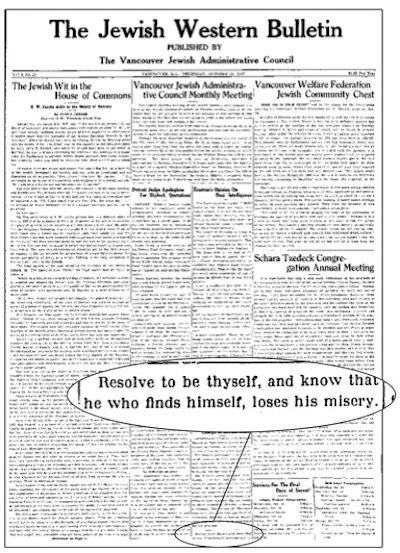
image - Cover of the Oct. 12, 1933, JWB
Cover of the Oct. 12, 1933, JWB

When I look back at old issues of the JI and the Jewish Western Bulletin, I get to see time move in almost an instant. In one sitting, I can follow the creation, the lifetime and, often, the transformation, or occasionally even the end, of a communal organization. I can see how a cohort of community members transitions into a whole new generation of dedicated volunteers and generous philanthropists. I can relate to the financial and other challenges that every former publisher and editor has gone through. I can feel the support of community leaders, readers and advertisers, who consistently have come to the rescue of a paper that has pretty much always been on the edge of solvency. I can share in so many people’s happinesses and sadnesses, their kudos and their complaints. I can appreciate the hard work of the paper’s publishers, writers and staff in every decade and that of countless community members, which has gotten us to today.

The community and the JI/JWB have survived the Great Depression, the Second World War, numerous recessions and other hardships. Currently, we are in the midst of surviving a global pandemic together. It has been a difficult year for all of us, to say the least. I’d be lying if I didn’t admit to having moments of despair and fear, and not just during COVID. I know how privileged and lucky I am, both personally and professionally, but, sometimes, I need reminding.

During this past year, as my few staff have switched to working at home or semi-retired, I have had more opportunities to speak and email with community members and others. While not a replacement for face-to-face encounters, it has been one of the pluses of this hard-earned +1 year of the newspaper, which had to postpone our special 90th anniversary issue until now. It is no exaggeration to say that we have only made it to 90+1 because of you. And not only your financial support, for which I am extremely grateful, but your indomitable spirit. We have pages to print because there are events to cover; classes, lectures and performances to attend; opinions to share; ambitious projects to promote; endeavours for which to raise funds; people offering help and people in need of assistance; people and milestones to celebrate; and losses to mourn. In this very newspaper you are holding in your hands or looking at on screen, there are stories on all of these aspects of our community.

Every time I prepare an issue of the JI, I’m buoyed by the promise that each paper holds – that there is a future, unknown as it may be, towards which we are all working. And, every time I look at past issues of the JIand the JWB, I am inspired by all that we’ve accomplished; by the no small feat that we are still here, showing up for one another and trying to make the world at large, or at least our small corner of it, a little bit better.

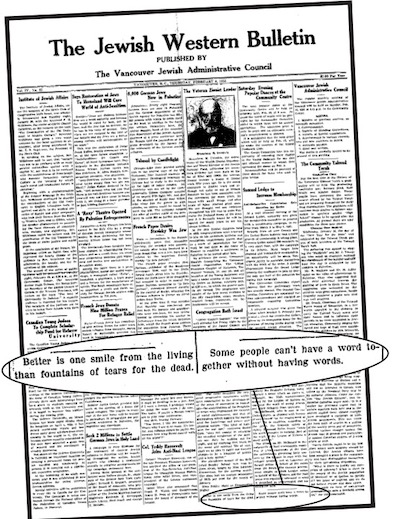
image - Cover of the Feb. 8, 1934, JWB
Cover of the Feb. 8, 1934, JWB

In my forays into the newspaper’s archives for this special edition, I came across, by chance, a few pithy sayings, no doubt intended to be motivational but, more pragmatically, to fill the small spaces that, in the olden days of typesetting, were hard to fill at the end of a column of news. From 1933 and 1934, they impart messages that could apply to any generation: “Resolve to be thyself, and know that he who finds himself, loses his misery”; “Some people can’t have a word together without having words”; “Better is one smile from the living than fountains of tears for the dead.”

I have no idea from where these aphorisms came, but they made me smile when I came across them. This newspaper never fails to surprise me. I just love it. And I thank all of you for helping me fill its pages and keep the presses rolling. May we all go from strength to strength.

Posted on May 7, 2021May 6, 2021Author Cynthia RamsayCategories From the JITags American Jewish Joint Distribution Committee, history, Jewish Western Bulletin, JI, JWB, milestone
Mothers’ importance

Mothers’ importance

One of the countless beneficiaries of the HIPPY (Home Instruction for Parents of Preschool Youngsters) program, which was brought to Canada by National Council of Jewish Women of Canada, Vancouver. (photo from Mothers Matter Centre)

It doesn’t matter if you’re famous, it doesn’t matter if you’re obscure – what you do as a mother matters.

National Council of Jewish Women of Canada (NCJWC) Vancouver knows how much mothers matter. It continues to be a trailblazer, an advocate, a constant pillar of support for women and children, for more than 97 years.

The NCJWC Vancouver universe is full of shining lights, women who are committed to their communities and serve as models for their unique role in leading social change. These stars include Carol Slater, soon to be the Trailblazer honouree of the awards night hosted by the Mothers Matter Centre. She and the Kort sisters – Alisa, Beverley and Suzanne – are passionate about the program originally known as HIPPY.

Slater knew, when she first heard about HIPPY (Israel’s Home Instruction for Parents of Preschool Youngsters) from reports in Israel and the United States, that she had to bring it to Vancouver. The program works in the home with vulnerable and isolated mothers. Slater knew that mothers are the first and most important teachers of the child and that the program would provide the essential tools and skills for them.

photo - Another beneficiary of HIPPY
Another beneficiary of HIPPY. (photo from Mothers Matter Centre)

In 2000, she convinced NCJWC Vancouver to initiate a project, partnering with Simon Fraser University, an institute that trains educators with academic rigour, and the Britannia Community Centre, known for its vibrant presence in the heart of immigrant Vancouver. Now, 20 years later, on May 5, 2021, Slater was recognized as a Trailblazer by the Mothers Matter Centre, which now delivers the HIPPY program on a national level.

More shining stars are coming out that night for special awards: Dr. Cindy Blackstock, a prominent indigenous leader; Dr. Theresa Tam, the director of Canada’s Public Health Agency; Gloria Macarenko, Vancouver’s beloved broadcaster, as host; and an appearance by Sophie Gregoire Trudeau, wife of Prime Minister Justin Trudeau.

Of critical importance to Vancouver’s council section are the Kort sisters, who have followed the philanthropic path of their late mother Shirley Kort, z’l. These shining stars have made a five-year scholarship commitment enabling qualified mothers (who are part of the Mothers Matter Program) to complete academic and professional qualifications. Azeema, one of the seven recipients of the scholarship, had this to say: “It paid for my two courses; it was a great financial help. It was above and beyond my expectations and I am very thankful. The Kort Family Fund joined hands with an immigrant to take steps and for them to help out. I am a step closer to my goal. I did not have to worry about finances this semester.”

HIPPY (now the Mothers Matter Centre) is a demonstration of Margaret Mead’s eloquent observation: “Never doubt that a small group of thoughtful, committed citizens can change the world; indeed, it is the only thing that ever has.”

National Council of Jewish Women in Vancouver is 97 years young and, while they are not giant in size, they are giant in deed.

– Courtesy National Council of Jewish Women Vancouver

Format ImagePosted on May 7, 2021May 6, 2021Author NCJWC VancouverCategories LocalTags HIPPY, Kort, macaroons, milestone, Mothers Matter Centre, Trailblazer
KDHS honours grandparents

KDHS honours grandparents

Ivan Decker, left, and Leonard Brody are among the presenters at King David High School’s Golden Thread Gala May 13. (PR photos)

On May 13, King David High School is honouring its “grandparents,” people who have particularly supported the school over the years, in a variety of ways. With the theme “education is the golden thread weaving our past to our Jewish future,” the virtual Golden Thread Gala “celebrates the community that nurtures King David High School, inspires the next generation of leaders and is rooted in the appreciation of Jewish values and traditions.”

The Diamond Foundation is being recognized as an “honorary grandparent,” while the “grandparents” being paid tribute are Gary Averbach, Shirley Barnett, Beth and Leon Bogner, Sylvia Cristall, Marie Doduck, Rose Marie Glassman, Dr. Arthur and Arlene Hayes, Dr. Simon and Rosalind Jacobson, Evelyn Kahn, Tamar Khalifa, Dr. Robert and Marilyn Krell, Lana and Mendy Landa, Norman and Sandra Miller, Norman and Lola Pawer, Dan and Trudy Pekarsky, Yvette Porte, Lyle Pullan, Arnold and Anita Silber, and David and Elaine Youngson. Dr. Robert and Elke Mermelstein are being celebrated as “adopted grandparents.”

“We can never fully show the Diamond Foundation the gratitude they deserve, so we named the foundation as honorary grandparents,” explained gala co-chairs Jacci Sandler, Chana Charach and Margaret Hemingson in an email interview. “Gordon, Leslie, Jill and Lauri have made our school possible. They are foundational, literally and figuratively, for King David’s existence and success. They have not only provided the building in which we live, learn and play but also have provided ongoing support and funding for the Judaic studies program to ensure the ongoing success of the school.

“Over the years, King David has been blessed by the ongoing support we receive from our grandparents,” they continued. “Whether it’s giving of their wisdom, time or financial support, they are always there for us. This gala recognizes them all! All of our grandparents deserve thanks for instilling Jewish values in their children that they are passing on to our students.”

The 19 grandparent families’ philanthropy has ensured that a Jewish education is accessible for every child, said the co-chairs. “The reality is that, without their generous support, we would not be able to provide a Jewish education to every child. It is a time to show our appreciation and thank every one of our grandparents for continuing the golden thread that binds our past to our future.”

Regarding the Mermelsteins, the co-chairs said, “They are passionate about Jewish education and have adopted all of us at King David as their grandchildren. They are integral members of our King David family and provide ongoing positive input and generous support so all students can attend and be proud King David Lions.”

In Judaism, l’dor v’dor (from generation to generation) is an enduring idea, said the co-chairs. “The passing of knowledge to future generations provides both legacy and a story. Each generation passes down wisdom, ancient traditions, rituals and customs. Jewish education values and honours this transmission of knowledge, literacy and skills…. Our grandparents’ colourful tapestry of experiences enrich the lives of students every day.”

The gala program “includes comedy, inspiration, musical performances by King David students and alumni, plus silent and live auctions with incredible items,” said the co-chairs.

Comedian Ivan Decker – who has appeared at the Montreal Just for Laughs Festival and has various TV and radio appearances, including his own comedy special on CTV and Netflix – will emcee the gala. KDHS head of school Russ Klein will interview entrepreneur, venture capitalist, author and media commentator Leonard Brody, co-founder and executive chair of Creative Labs, about “disruption, innovation, and their effects on our world and children.” And entertainment and media executive Howard Blank will act as the evening’s auctioneer. The online silent auction is currently open and will close during the gala. “Items include workout sessions, cooking classes, handbags, beauty and relaxation products, power tools, wine and so much more!” said the co-chairs.

The inaugural Golden Thread Gala was originally scheduled for May 2020, but it was postponed due to COVID-19. “We witnessed so many families in our community that suddenly found themselves being impacted by the pandemic, financially as well as emotionally,” said Sandler, Charach and Hemingson. “This event is so important as it is King David’s major fundraiser and friendraiser. All funds raised will directly impact our students and enable the school to achieve its vision of ‘empowering Jewish minds and engaging Jewish hearts’ by enhancing our fundamental curriculum, educational excellence and vibrant Jewish life programming.”

With respect to the effects of the pandemic, Klein said, “King David has experienced, as a family, the same challenges that individual families have had and yet the students and staff have been so positive and resilient. We have had full-time school all year and, although we have had to adjust our schedule a little, there has been no loss of learning. I feel for the students, though, in that so many of our wonderful experiential programs are on hold. Our Grade 8 Israel trip is now two years behind, our Los Angeles Holocaust studies trip is a year behind, and our school-wide retreats are not happening. And, of course, the students cannot play competitive sports against other schools, which is a big loss for many of our students.”

But, there have been bright spots, too, he added. “Our parent-teacher meetings were better attended and even more personal, and we have been able to reach out more frequently and invite parents to meet via Zoom. Assembly presentations have also been better, as the smaller in-class environment makes more student engagement and participation possible. In sports, we have been very active within the school grade cohorts and added non-competitive co-ed activities like volleyball and soccer, and the students have really loved the fun and camaraderie with each other and their teachers. No doubt, we will be keeping some things that we have learned but all of us cannot wait to get back to having the meaningful ‘extra’ experiences that make school life and learning so very enjoyable.”

Tickets to the Golden Thread Gala start at $36 for entry, with increasingly more benefits at each level. For tickets, more information about the event and access to the auction, visit goldenthreadgala.com. The pre-show starts at 7 p.m. on May 13, and the main event at 7:30 p.m.

Format ImagePosted on May 7, 2021May 6, 2021Author Cynthia RamsayCategories LocalTags Chana Charach, coronavirus, COVID-19, education, friendraiser, fundraiser, Golden Thread Gala, Jacci Sandler, KDHS, King David High School, Margaret Hemingson, Russ Klein
Beth Israel hails Dr. Henry

Beth Israel hails Dr. Henry

Dr. Bonnie Henry will be honoured at Beth Israel’s gala event May 30. (photo from BI)

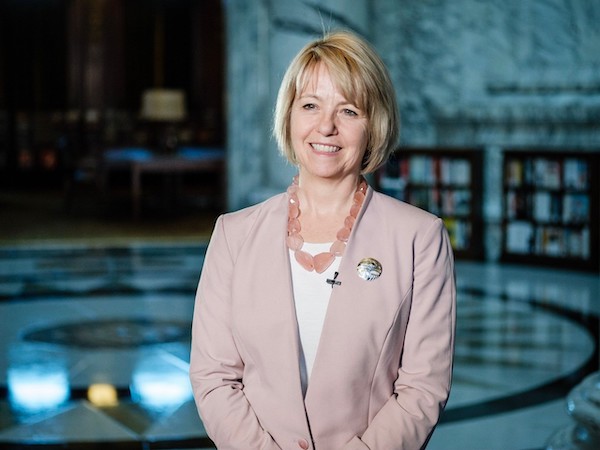
Dr. Bonnie Henry will be honoured at the 2021 Congregation Beth Israel gala May 30. The provincial health officer for British Columbia will be given the Keter Ha’bri’ut Award at the virtual celebration.

The term keter ha’bri’ut translates to Crown of Health, and the award has been created “to honour those in the community who have worked diligently, relentlessly and with humility for the betterment of their fellow citizens.”

“The truth is that we couldn’t think of anyone better than Bonnie Henry because, the fact is that she’s literally been a keter ha’bri’ut, a crown of health, for our province in helping to keep us healthy,” said Rabbi Jonathan Infeld, senior rabbi at Beth Israel. “She embodies one of the single most important concepts of Jewish tradition, spreading the word of chesed, of kindness. It’s not only that she cares about the physical health of our province, but I think one of the reasons that she has become famous across the country and the world is because she cares about the humanity of our province as well.”

When the synagogue’s gala committee asked Henry if she would be willing to be honoured by the gala and receive an award, about nine months ago, organizers hoped that the event might be in person or, at least, a hybrid event with some people present and others tuning in virtually.

Instead, the main portion of the event will feature words from Henry, Infeld and others, all virtually, with musical entertainment by Maya Rae. At certain ticket levels, food delivery is included and, for major donors, a pre-event will feature a mixology session, with cocktail kits delivered to the homes of virtual attendees. Henry will share a favourite cocktail recipe of her own.

Henry’s commitment to inclusion and her respect for Jewish traditions impressed Infeld from the moment Henry held her first group conference call with clergy from around the province, about the time the pandemic began.

“One of the things that really touched me,” he said, “was in her very first address to the clergy of British Columbia – I’m not talking about the rabbis, but for the clergy of British Columbia – many, many months ago, as we were entering into the COVID era, she said, we are going to have to have fewer faces and bigger spaces and one of the things that that means is we won’t be able to do in-person shivas for awhile.”

Infeld believes that Henry’s time as associate medical officer of health for Toronto Public Health during H1N1 and SARS outbreaks in that metropolis put her in close contact with the Jewish community there.

Henry’s work is serious, as is the award she will receive from Beth Israel, said the rabbi, but parts of the evening’s program will be lighthearted.

The gala is to be emceed by Dr. Isaac Elias, a young member of the synagogue and a medical doctor who helped guide the synagogue’s response to COVID from the beginning.

The event will be relatively short – about an hour – and partial proceeds will be donated to the B.C. Centre for Disease Control.

Infeld said, “It’s an opportunity for us as a community to say thank you to someone who has done so much for the province and for the residents of the province and embodies some of the most important messages of Jewish thought, being that of the importance of saving lives and of the importance of being kind to others.”

While the virtual gala will be an unusual event, Infeld stresses that the shul is no stranger to Zooming. Since the week the pandemic began, he said, the decision was made “to ramp up our programming, not ramp down.”

“We actually have more programming than we have ever had before,” he said. “In the early days of COVID, when everyone was literally shut in, we had teams of volunteers calling and assisting our seniors, we engaged all of our young adults and they were helping deliver food to seniors, helping them with whatever needs they had, technological, food and beyond.

“We also increased our programming. We never had a daily learning [before COVID]. Now, we have a daily mussar class. What used to be a monthly Lunch & Learn became the weekly Zoom & Learn and now is becoming the weekly evening program known as Prime Time BI. A Zoom Scholars series was funded in part by Harley Rothstein and Eleanor Boyle. One of the things that we’ve seen is participation rates in our services online and our online programs are up anywhere from 30 to 100%, and we’ve been able to maintain that.”

Presenting sponsor for the gala event is the Shay (Shy) Keil Group.

“I am thrilled to be the presenting sponsor for this event, both in support of the Beth Israel Congregation and also Dr. Bonnie Henry,” said Keil. “It is an honour to present this award to Dr. Henry for all that she has done during the pandemic, making extraordinarily difficult protocol decisions and becoming the public face of this pandemic. It is a thankless task that she has assumed since March 2020 and I am so happy that Beth Israel has decided to recognize her.”

For tickets to the event, visit bethisrael.ca.

Format ImagePosted on May 7, 2021May 6, 2021Author Pat JohnsonCategories LocalTags Beth Israel Synagogue, BI, Bonnie Henry, coronavirus, COVID-19, fundraiser, health, Jonathan Infeld, Shay Keil
Innovators now online

Innovators now online

JFS fundraiser takes guests on “plane ride” to a place above the clouds. (screenshot)

Jewish Family Services is doing something new with its Innovators Lunch. Normally a large in-person event, the annual fundraiser this year is an entirely digital experience that forgoes the usual format of lunch and speaker. And, for the first time, registration is free.

In lieu of a ticket, guests receive a “boarding pass” to click on, which will transport them to a virtual plane, rising above the clouds in what feels like a virtual gaming experience. An introductory message appears from Tanja Demajo, JFS chief executive officer. Once at their digital destination, attendees can navigate to learn about JFS services and the impact they have on the lives of clients.

An AI host greets guests, guiding them through the Gallery of Innovation to view stories focused on three different pillars of JFS services: food security, mental health, and wellness and senior care. There is an opportunity to donate and support the areas of greatest need.

“Even though we can’t physically connect with each other, we’re trying, through this experience, to engage people in this space with some imagination and playfulness, so they can see things in a different and inspiring way,” said Demajo. “As JFS’s major annual fundraiser, the funds raised are critical in giving us the assurance that the 3,000 clients who depend on us to feel secure and supported can continue to do so during the third wave of the pandemic.”

The Innovators event went live on May 4 and has been extended due to popular demand. Flights will continue to “take off” for another week. Visit jfsvancouver.ca for details.

– Courtesy JFS Vancouver


Format ImagePosted on May 7, 2021May 6, 2021Author JFS VancouverCategories LocalTags fundraiser, Innovators, Jewish Family Services, JFS
Louis Brier campaign starts

Louis Brier campaign starts

(photo from thelouisbrierfoundation.com)

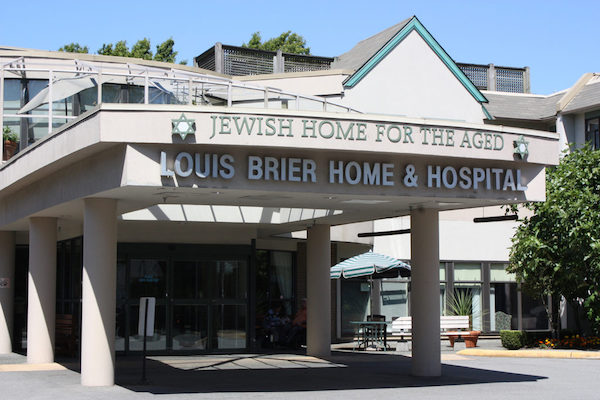
This spring saw the launch of the This Year Like No Other, This Year More Than Ever 2021-2022 Louis Brier Jewish Aged Foundation campaign, which is raising funds to enhance care and innovate the program and service offerings for residents of the Louis Brier Home and Hospital.

Early in 2020, the foundation stepped up to assist the Louis Brier leadership in its exemplary response to the COVID-19 pandemic. By doubling the home’s funding, the foundation was able to support the home in keeping its seniors safe and engaged during one of the most challenging years of their life.

The biennial campaign, which started April 19, will run to May 28. With the community’s help, the goal is to raise $2.4 million. Campaign chairs are Harry Lipetz (board president) and Lee Simpson (immediate past president).

The $2.4 million amount is needed to keep up with the home and hospital’s funding needs, which doubled with the onset of COVID-19. While the foundation is well aware of the many challenges of the present time, we believe this year, like no other, and more than ever, we must collectively come together to care for, and give a well-deserved kavod, to the people who built our community for us in the first place. To contribute and create impact where it’s most needed after the extraordinary challenges of the year 2020. To be part of ensuring that the physical, mental and spiritual needs of the home’s Jewish seniors are met.

Louis Brier’s background

In 1945, 14 friends known as the Hebrew Men’s Cultural Club shared a vision to create a home for Jewish seniors in Vancouver. That home, initially built to accommodate 13 residents, was established in 1946. Over time, that modest facility grew, changed locations and expanded its services, eventually becoming the Louis Brier Home and Hospital, which has progressed in step with Vancouver’s Jewish community.

Today, Louis Brier is part of a continuum of care known as the Snider Campus, which also includes the Weinberg Residence, a boutique assisted living and multi-level care residence adjacent to Louis Brier.

The Louis Brier Jewish Aged Foundation provides and distributes funds to the Snider Campus towards maintaining and fostering the well-being of the Jewish aged of British Columbia, while supporting the enhancement of their quality of life based on Jewish traditions.

Some quick facts

  • The Louis Brier is a 215-bed long-term residential care home serving Vancouver’s Jewish community.
  • The home and hospital provide three levels of residency (intermediate care, extended care and special care).
  • Thirty-five residents of the current population at Louis Brier are Holocaust survivors.
  • Eighty percent of Louis Brier Home and Hospital’s residents are diagnosed with varying levels of dementia.
  • The Louis Brier has 436 employees – 195 full-time, 101 part-time and 140 casual.
  • The home and hospital residents range in age from 50 to 103, with the average age being 84.
  • The Louis Brier is an accredited institution with exemplary standing (2018). The Accreditation Canada survey team spent four days at the facility and reviewed a total of 19 required organizational practices (ROPs), 216 high priority criteria and 295 other criteria, for a total of 551 criteria. The surveyors determined that Louis Brier successfully met 100% of the 551 criteria evaluated.
  • The Louis Brier was awarded the 2020 Canadian Non-profit Employer of Choice Award.
  • The Louis Brier is the only facility in British Columbia with a companion program and has the largest recreation team in Western Canada.
  • The Louis Brier had a single COVID case among residents.

To donate to the campaign, click here. For more information, call 604-261-5550.

– Courtesy Louis Brier Jewish Aged Foundation

Format ImagePosted on May 7, 2021May 10, 2021Author Louis Brier Jewish Aged FoundationCategories LocalTags coronavirus, COVID-19, fundraising, health, Louis Brier Home and Hospital, seniors, Snider Campus of Care

Peer service reinvented

To say that COVID-19 has wreaked havoc on British Columbians would be an understatement. The virus has disrupted anything that we would call the normal activities of daily life. Most of us have had to make major compromises: where we go, what we do and how we can avoid getting the terrible virus. These adjustments have had a major impact on Jewish Seniors Alliance clients, who are already compromised by loneliness and isolation.

How we serve our clients and how we support our volunteers has undergone major changes – let’s give it the label “reinventing peer services.” In order to better understand what has taken place, I interviewed Charles Leibovitch, JSA senior peer support services coordinator, and Grace Hann, JSA trainer of volunteers of senior support services.

In the beginning

By mid-March 2020, the first sign of COVID-19 began to show its ugly head. The lockdown left clients and volunteers absolutely unprepared. Persons who were already isolated and lonely found themselves even more isolated and lonelier. As time progressed, clients were cut off from family members who might have supported their relatives through personal contact and social events. This was especially devastating for persons without family.

In many situations, volunteers were their primary contact; their lifeline! Being alone undermines one’s mental health. Being alone exaggerates one’s fear of COVID-19. Most of the clients were cut off from community programs, like adult day care. Spouses who usually spent time with their spouse in a long-term care facility were also cut off. Simple activities like going for a walk and sitting on a bench were curtailed. Elders had depended on having that human connection – having that human touch makes us feel needed and whole.

Volunteers meet challenge

The changing scene called for quick action, initiated by Grace and Charles. Instead of personal visits, the telephone would become the prime instrument of contact between volunteers and their clients. It was necessary to contact the volunteers quickly. Support for the volunteers would be provided by Zoom. This necessitated a steep learning curve for volunteer and client. After all, making and keeping the connection was critical. The three services – peer support, friendly visits and friendly phone calls – had to be reassessed in terms of the neediest clients. Each of the three services’ volunteers had different levels of training by Grace.

In some situations, a certified peer support volunteer was assigned to a person who ordinarily would have had contact with a friendly visitor or a friendly phone caller. Moving from in-person contact to impersonal contact was a major transition – almost like reinventing how support was to be provided. The JSA volunteers made the transition like veterans, with the extraordinary help of Grace and Charles. There was an increase in the contacts between volunteers and clients and an increase in Zoom online meetings to support the very special work being carried out by the volunteers.

Supporting the volunteers

Grace and Charles organized many activities, including outdoor picnics, weekly webinar seminars, a Chanukah party with a singalong and group support meetings every three weeks. The spirit and esprit de corps by the volunteers has been amazing. Volunteers will send cards to their clients as an additional way to keep in contact. Who doesn’t like to receive mail?

Next steps

Challenging times require challenging solutions. Charles and Grace rose to the challenge and proved that, with dedication, imagination and determination, obstacles can be overcome. When the COVID-19 vaccine has been fully distributed, we will establish a “new normal.” This will present JSA, Grace, Charles and the volunteers with a new set of issues and situations. And, as the song goes, “we shall overcome” – they will face these challenges with creativity, empathy and caring.

Ken Levitt is a past president of Jewish Seniors Alliance, former chief executive officer of Louis Brier Home and Hospital, and a past chair of Camp Miriam. In 1985, he co-edited The Challenge of Child Welfare, the first textbook on child welfare in Canada. A version of this article originally appeared in the March 2021 issue of Senior Line.

Posted on May 7, 2021May 7, 2021Author Ken LevittCategories LocalTags Charles Leibovitch, coronavirus, COVID-19, Grace Hann, Jewish Seniors Alliance, JSA, peer support, Senior Line, seniors, volunteers

Posts pagination

Previous page Page 1 Page 2 Page 3 Page 4 … Page 6 Next page
Proudly powered by WordPress