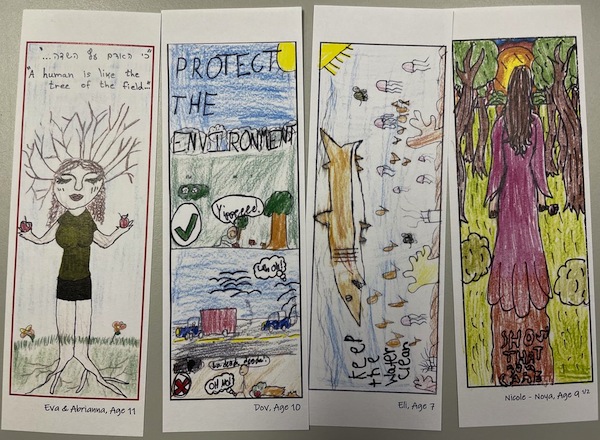
The winning entries of the Isaac Waldman Jewish Public Library’s bookmark contest.
Isaac Waldman Jewish Public Library wishes mazal tov to the winners of its bookmark contest and to all the contest participants. “We really appreciate the efforts of all the participants and the wonderful creativity they have displayed in designing their bookmarks. It was a pleasure to review them all,” said the library in an email. “This year, we have chosen four designs that best reflect the theme of sh’mirat ha’teva, protecting the environment.”
Chosen were the bookmarks by Eli Stefanek, Grade 2, Richmond Jewish Day School; Nicole-Noya, Grade 4, RJDS; Dov Bondar, Grade 5, RJDS; and Eva Rogachevsky and Abrianna Jacobs, Grade 5, Vancouver Talmud Torah.
***
Kleiner Services Inc., owned by Mary and Konstantin Kleiner, was among the top five finalists for the Best Immigrant Entrepreneur Award this year. This award recognizes outstanding new Canadians who, after immigrating, have created successful small businesses while demonstrating leadership and breaking down barriers.
Across four days earlier this month, Small Business BC announced six winners in various categories, capping a competition that saw 937 award nominations in 88 communities across the province. The Best Immigrant Entrepreneur Award went to Charcuterie Vancouver, and the other three finalists were Audielicious Restaurant (Fort St. John), Artemex Mexican Handcrafts (West Kelowna) and Soul Bite Food Inc. (Coquitlam).
Kleiner Services Inc. is a professional moving company that offers pre- and post-moving services, such as packing, storage and assembly. They are based in the heart of the Lower Mainland, servicing Greater Vancouver, Fraser Valley and Vancouver Island.
***
The Independent Press Award recognized Prairie Sonata by Winnipeg-based writer Sandy Shefrin Rabin as the winner in the category of Best Young Adult Fiction.
The competition is judged by experts from different aspects of the book industry, including publishers, writers, editors, book cover designers and professional copywriters. Selected award winners and distinguished favourites are based on overall excellence. This year, the award had entries worldwide – from Australia, Canada, India, Ireland, Japan, Singapore, Switzerland and the United Kingdom, among other countries.
“The quality and quantity of excellent independently published books hit a record…. We are so proud to announce these key titles representing global independent publishing,” said awards sponsor Gabrielle Olczak.
Shira Haas is the featured guest at the July 7 event organized by Canadian Associates of Ben-Gurion University of the Negev. (photo from CABGU)
Israeli actress Shira Haas, star of the popular Netflix series Shtisel and Unorthodox, has been busy in recent months. Not only is she preparing to take on the role of a young Golda Meir in the upcoming series Lioness, executive produced by Barbra Streisand, but she is also the featured guest at the Canadian national virtual gala in support of Ben-Gurion University of the Negev (BGU) on July 7.
An “Unorthodox” National Virtual Gala for Brain Research, organized by Canadian Associates of Ben-Gurion University (CABGU), BGU’s Canadian fundraising arm, will raise money for the Canada Fund to Advance Brain Research.
“We are thrilled to share this exciting announcement with our community,” said Mitchell Oelbaum, national president of CABGU.
“According to the World Health Organization, there are approximately 50 million active cases of dementia worldwide, with an estimated 10 million new cases being added each year. Ten million people battle Parkinson’s each year globally. And, according to the World Stroke
Organization, 13 million people suffer from stroke annually. We wanted to do our part to help improve the chances of finding a cure for these debilitating diseases.”
The numbers are large, and there are no signs of a slowdown. That is why the fund was established by CABGU, with the goal of supporting groundbreaking and cutting-edge research for neurodegenerative diseases at the university’s Zlotowski Centre for Neuroscience.
“We are getting closer to determining the causes of age-related neurodegenerative diseases,” explained Dr. Debra Toiber of the department of life sciences in the faculty of natural sciences at BGU. “It’s an exciting time to be a scientist and uncovering the mechanisms of aging.”
Toiber is one of 67 researchers at the Zlotowski Centre. Her lab recently discovered that the SIRT6 protein is critical for the prevention of neurodegeneration, which can lead to Alzheimer’s and Parkinson’s diseases. Colleague Dr. Shelly Levy-Tzedek’s lab studies the impact of age and disease on the control of body movement and how best to employ robotics to facilitate a fast and efficient rehabilitation process. Meanwhile, Dr. Claude Brodski, also with the Zlotowski Centre for Neuroscience, is currently conducting a study, albeit in its early stages, that may offer a disease-modified drug target to address the impact of Parkinson’s. While these findings are encouraging, more research needs to be conducted.
“CABGU launched the Canada Fund to Advance Brain Research at BGU in April,” said CABGU chief executive officer Mark Mendelson. “Our team has been hard at work ever since, and there is a strong appetite for this subject matter here in Canada. The sad reality is that we all know someone, whether it is a relative, a friend or a neighbour, who is struggling with one of these devastating brain diseases.”
The national virtual gala is already more than 50% sold out. To learn how to become a sponsor or to purchase tickets, head to bengurion.ca.
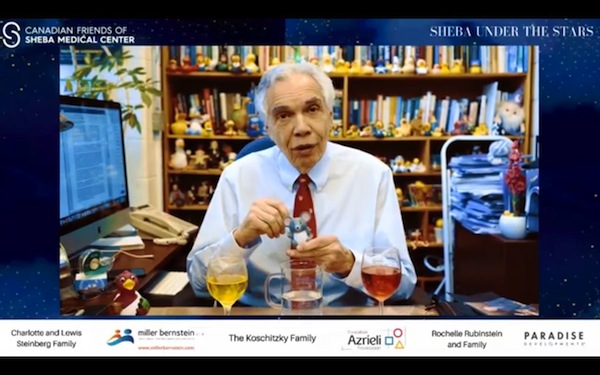
Dr. Joe Schwarcz, director of the Office for Science and Society, McGill University, presented on The Chemistry of Wine and Its Many Benefits, at Canadian Friends of Sheba’s virtual event on May 2. (screenshot)
Canadian Friends of Sheba hosted Sheba Under the Stars on May 2, raising close to $100,000 for Israel’s Sheba Medical Centre. More than 100 guests attended the virtual evening featuring live entertainment, wine tasting and presentations on lifestyle choices from leading world experts.
Guests received a complimentary gift bag of wine and chocolates, and were treated to numerous performances from host Stacey Kay, Juno Award-winning singer/rapper and finalist on America’s Got Talent. The hour-long show also featured live wine tasting with Michael Avery, winemaker at Galil Mountain Winery, in Israel, as well as a presentation on The chemistry of Wine and Its Many Benefits, by Dr. Joe Schwarcz, director of the Office for Science and Society at McGill University.
Prof. Yitshak Kreiss, director general, Sheba Medical Centre, opened the event by highlighting Sheba’s global fight against the coronavirus through its recent support of missions to India, northern Italy, Cyprus and Uruguay, and called on the guests to be “inspired by Sheba’s vision to transform into the city of health.”
Presentations from “Sheba’s stars” included Redefining the Field of Lifestyle Medicine by Dr. Rani Polak, founding director of Sheba’s Centre of Lifestyle Medicine, and from Prof. Michal Schnaider Beeri, director of Sheba’s Joseph Sagol Neuroscience Centre, who shared tips on how wellness and lifestyle affects the brain.
Sheba Medical Centre recently published a study undertaken over three years by its department of obstetrics and gynecology in conjunction with Sheba Genetic Institute and the Genetics Institute in the Tel Aviv Sourasky Medical Centre, which found that women of Ashkenazi descent were twice as likely to have a baby born with Fragile X syndrome (FXS) compared to Jewish non-Ashkenazi women.
Nearly 600 female carriers of the FXS gene from various Jewish heritages participated in the study, which was published in the peer-reviewed publication Nature. Previously, it was known that only CGG repeats and AGG interruptions affect the risk for a child with FXS. This new research adds a third identifier, children of two Ashkenazi parents, allowing for better personalized genetic counselling for carriers who are trying to conceive.
FXS is the most common genetic cause of mental disability in an unborn child and causes intellectual disability, behavioural and learning challenges, and various physical characteristics. The prevalence of carriers in the Jewish population stands at about one in 150 women.
Dr. Noam Domniz of the IVF unit at Sheba Medical Centre said: “The new information from this study regarding the influence of ethnicity stresses the importance of providing more accurate and personally targeted genetic counseling to each woman, according to her personal level of risk. At Sheba, we aim to use this new approach to better evaluate each carrier’s risk level, empower them to make informed choices, leading to a clearer and safer road to motherhood.”
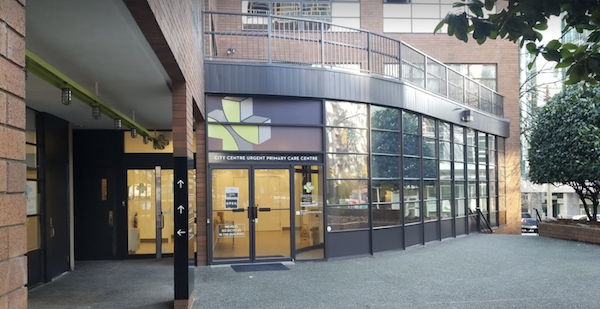
City Centre Urgent Primary Care Centre is one of several UPCC clinics in British Columbia. (photo by John van Bockxmeer)
It was an ordinary Wednesday morning. Up at 5:15 a.m., walk the dog, eat a piece of toast with cream cheese and honey, and hop on my stationary bike for a five-kilometre jaunt before Laina, my physical trainer, arrives for our 75-minute session in my “Super Diva” home gym. At exactly 9:30, I was preparing my “Israeli” breakfast, which includes a hard-boiled egg, mashed avocado, tomatoes, salad and a quarter segment of a green pepper filled with hummus, when it happened….
A week earlier, I had decided that my battered (at least 50-year-old) set of knives had to go. I had a coupon from Bed Bath and Beyond, which gave me a discount of 20%. I got to the store early; being in the time of COVID-19, I wished to avoid crowds. I found a saleswoman, who opened the glass case and brought out a couple of knife sets in wooden or plastic blocks. I chose one, paid at the cash, and left. One of my acquaintances, I can’t remember who, later said to me, “Be careful, new knives are very sharp.”
Back to that morning. I grabbed one of the new knives, held the green pepper in my right hand and sliced down to divide it in two with my left hand (I am ambidextrous). The knife went right through the green pepper and into the fleshy tip of my middle finger. It happened in a flash. I took one look and knew that I was in trouble.
I do not know my own strength. This is not the first time that I have exerted too much force – in cleaning the inside of the oven door, I pressed too hard and broke the glass. The repairman asked me, “How did you do it?” He had never heard of a woman breaking the glass as I had. Once, I pressed down so hard on a plastic broom handle that the shaft split and went straight into my finger, another catastrophe.
But I digress. I looked at the wound, it was deep. This would require stitches (within four hours)! After raising four sons, nine grandchildren and many dogs, you learn a few things. I wrapped it tight. Then I called my family doctor, who owns the Una Medical Clinic, which is located one block from my house. The receptionist heard my story but said they were completely booked and I should go to a clinic on Homer Street I had never heard of. Frustrated and disappointed, I ate my breakfast then called the clinic back. I said all that was required was a 20-minute procedure to put in a couple of stitches and she relented. I had an appointment at 11:10 a.m. Yeah! By noon, after three painful shots to freeze the finger, I was stitched up and ready to resume my life.
On the wall of the Una Clinic was a poster advertising the City Centre Urgent Primary Care Centre. If you live in my neighbourhood, this is the place to go when you are unable to see your family physician or healthcare provider and do not need to go to the emergency department of a hospital. The City Centre clinic is at 1290 Hornby St., and they are open seven days a week, 365 days a year, Monday to Saturday from 8 a.m. to 10 p.m., and Sunday from 9 a.m. to 5 p.m. I took photos of this poster with my iPhone and, when I got home, I added the clinic to my contact list. Somehow, I know that I will be needing their services in the future! And so might you. The list of urgent and primary care centres in British Columbia can be found at healthlinkbc.ca/services-and-resources/upcc. When something happens, there is a place to go. The poster for the City Centre clinic says, “Patients will be seen according to urgency.” That is reassuring. Have a nice day and be careful with knives.
Dolores Luber, a retired psychotherapist and psychology teacher, is editor-in-chief of Jewish Seniors Alliance’s Senior Line magazine. She works out four times a week, studies Modern Hebrew twice a week, and is constantly reading books and watching movies. Her motto is “Never underestimate an old lady who can deadlift you.”
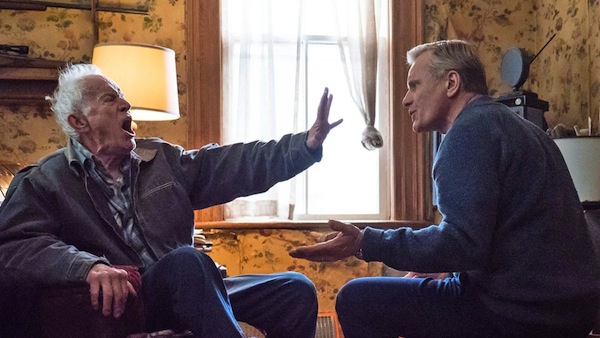
Lance Henriksen, left, and Viggo Mortensen in Falling. (photo from indiewire.com)
In February 2016, the Jewish Independent published my column “Dementia, cinema’s darling,” in which I reviewed seven films about people struggling with dementia. Well, here we go again! This pandemic year has seen the release of four extraordinary films that feature people struggling with the symptoms of dementia, those with the illness and those who are close to them.
These films opened my eyes not only to the symptoms of Alzheimer’s disease, but also how the affected persons perceive what is happening around them and how that altered reality affects loved ones and family members. After having watched these four unique films, I feel like I have taken a course in how dementia evolves, and how it feels to suffer through the gradual deterioration of the self. I have been shocked, educated and enriched by these moving works of art.
Falling (2021): Viggo Mortensen writes, directs and stars in this lacerating drama about a son dealing with his father’s mental decline. Lance Henriksen plays the father Willis, a foul-tempered, bigoted man, filled with intolerance and invective. His meanness is hard to watch. The flashbacks inform us of the subdued menace of Willis, they scrape your senses like sandpaper. John, the son (Mortensen), must call on all his reserves of patience, understanding and love to withstand the onslaught. (I watched it on TIFF Bell Lightbox, but do a Google search to see where it is streaming now.)
The Father (2021): French writer and first-time director Florian Zeller presents a frightening new angle with this movie, which aims to mirror the confusion and discomfort of encroaching dementia. Anthony Hopkins, 83 years old, takes us from the realm of sympathy to empathy. It is disturbing and brilliant. Hopkins, as the father, nails the way in which people learn to cover for their mental mistakes. The supporting cast is excellent, and Hopkins won the best-actor Oscar for his depiction of a mind in decline. (It is on TIFF, but do a Google search.)
Supernova (2020): Stanley Tucci and Colin Firth dazzle as a couple facing their fears. Tusker and Sam have been together for decades. The careers of both have been put on hold because Tusker has been diagnosed with early-onset dementia. They set out on a road trip. Harry Macqueen, the director, has created a drama about love and mortality. The northern English scenery is stunning, as are the performances of these two people stoically accepting mortality. (It is on TIFF and is also accessible on Apple TV+ and perhaps elsewhere.)
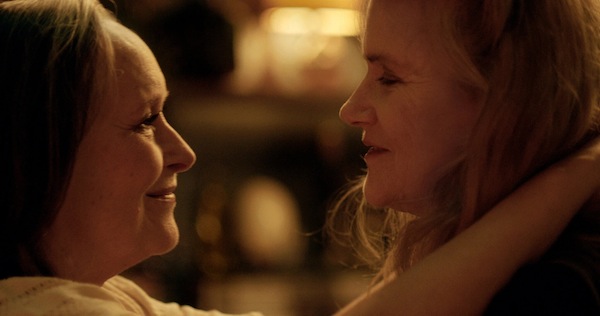
Martine Chevallier, left, and Barbara Sukowa in Two of Us. (photo from Magnolia Pictures)
Two of Us (2021): An older lesbian couple is met with unexpected devastation in the aching romantic drama by Filippo Meneghetti. Nina (German actress Barbara Sukowa) and Madeleine (Martine Chevallier) have waited decades to love one another freely. They are preparing to leave France for new beginnings in Rome. First, Madeleine must come out to her children before realizing her dream, but tragedy strikes before she can speak her truth. Sukowa is ferociously great as a woman whose devotion is as fierce as her determination to drag her lover into a more honest life. This is a film of profound intimacy between two people. In French with English subtitles. (It is available at TIFF Bell Lightbox.)
Dolores Luber, a retired psychotherapist and psychology teacher, is editor-in-chief of Jewish Seniors Alliance’s Senior Line magazine. She works out four times a week, studies Modern Hebrew twice a week, and is constantly reading books and watching movies. Her motto is “Never underestimate an old lady who can deadlift you.”
Over a year ago, I wrote an article for the CBC with suggestions for parents on how to stay sane while coping with kids during the pandemic. I did some research, thought about it, and set out some points to follow. Now, all these ideas sound, well, familiar, but it doesn’t hurt to repeat them. I mentioned things like making a routine, keeping up with learning and life skills, getting some alone time, exercise and going outside. I included efforts to have intentional fun, and practising gratitude. As I write this, much of Canada is experiencing the third wave. Manitoba, where I live, is now our country’s hot spot. It’s been a long haul for all of us.
I’ve been struggling with what is “new” when, frankly, much has stayed the same. Even as some of us have gotten vaccinated, we still need to stay home. Like everyone, I’ve gone through periods of feeling anxious, as those in charge waver on how best to keep people safe. Then, the most recent war in Israel and the Palestinian Territories erupted … and things seem even scarier.
It’s hard to admit that we have little control as individuals. We choose who to vote for, or to wear a mask, or to social distance. We cannot individually control global pandemics, violence, extremism or antisemitism. That lack of control can be very scary.
I often retreat into absorbing “flow activities” to keep myself well during such difficult times. Often, I’m cooking, sewing, knitting or spinning yarn. I’m reading or taking long walks with the dog and kids. We’re watching geese and goslings on the riverbanks and spotting woodpeckers and warblers. Taking time to see and make new things can be really good for our mental health, and it’s often positive and productive.
I also continue to study my page of Talmud, usually late at night. I recently read Tractate Yoma 35, which discusses, in part, what the high priest would wear in the Temple, as he does his most holy actions of the year, on Yom Kippur. Everything is spelled out in detail. This is done by the rabbis both to explain what used to happen in the Temple and what perhaps might happen again, if the Temple were rebuilt. Even the cost of the priest’s clothing, which must be paid for and owned by the public, is noted.
The high priest acts for the whole community and, at the same time, these rituals have to be performed by him alone, as an individual. It’s an example of where the entire community must support a leader but has no control over that leader’s actions.
In the midst of this careful recounting of how he is to fulfil his duties, it says in Yoma 35b: “Rav Huna bar Yehuda, and some say Rav Shmuel bar Yehuda, taught: after the public service concluded, a priest whose mother made him a priestly tunic may wear it and perform an individual service … provided he transfers it to the possession of the public.”
The rabbis’ discussion indicates that the tunic the high priest’s mother made him must be donated to the Temple after he wears it. If he is attached to it, this might be hard. Also, it might be worth more than what the high priest’s garb should cost. It’s something a dear one made him, and it could be both emotionally and monetarily valuable. Yet, his mom makes it freely, knowing it might only be worn at this one time, and then donated for wider Temple usage.
Bear in mind what this meant. A high priest’s mother wants only the best for her child and, yet, must submit to the whole community who depends on him. So, she procures the right fibre-linen. She might have to process it, or it might come ready for spinning. She spins enough for a garment on her spindle. (There were no spinning wheels or industrial textile factories back then!) She weaves the fabric, and sews it into the tunic according to the given specifications. Then, she gives all that work away simply for the chance to clothe her son for a short time in her own handiwork for his extremely important event, serving on Yom Kippur on behalf of the Jewish people. This lesson is an ancient one – and, yet, many of us have to learn it over and over.
There’s so much we cannot control. Many huge world events are beyond us. We learn to submit to the experience that we cannot bend to our will. In the meanwhile, though, we can do everything in our power for good, as we see it. We can offer our money, creations and time. We can behave properly and follow instructions … and wait.
Many of my activities feel the same way as that mother’s tunic, although I have no high priests at my house. I spend many hours on meals, making clothing, helping kids learn, exercise, etc. Then, I finish my tasks and give it away. This “disappearing” work makes a difference in the universe, but I’m no closer to controlling the entire pandemic, the unrest in Israel, or beyond.
This is one of the hardest lessons I’ve had as a parent and an adult. We must accept where we are because, in some cases, nothing we’re capable of will control the situation or effect change. However, in the meantime, we can be like that high priest’s mother. We can offer up our love, our handiwork, our peaceful efforts and knowledge. We can expect never to see it again, like that gorgeous linen tunic.
Learning to make things and give them away may be the most important gift. The activity itself is the part that calms me down in the face of so much uncertainty. Last night, I used some knit remnants and my sewing machine and made a lightweight sweater for a 9-year-old. This is an ancient Jewish process, but it’s also another brand new sweater. Tomorrow, he may wear it … in the mud puddles and the rain – and that’s OK, too.
Joanne Seiff has written regularly for CBC Manitoba and various Jewish publications. She is the author of three books, including From the Outside In: Jewish Post Columns 2015-2016, a collection of essays available for digital download or as a paperback from Amazon. Check her out on Instagram @yrnspinner or at joanneseiff.blogspot.com.
It was the first night of Passover and I was feeling miserable. By now, I recognize the ache. It’s the one I get when I am thousands of miles away from my family.
Away from the days of being young and just naturally assuming there would be a seder night with family. Away from old familiar melodies and reminders. I remembered when my mum would say a prayer in a funny British accent, or how we would all be tapping our hands vigorously on the table while singing. I’d be sitting with siblings and cousins, playing games with the matzah, sneaking a sip or three of heavily sweetened kosher red wine and counting down the time until we could eat.
Forty years ago, after leaving Israel, I moved to London, where there were always relatives to fill that gap. However, back in the younger days, my Jewish identity took something of a back seat. As a teen in Israel, I always wondered why I wasn’t allowed to join my friends at the beach on Shabbat. As a child, we were raised as Orthodox Jews but, when we immigrated to Israel, some of the traditions, sadly fell by the wayside.
Vancouver eventually became my permanent home and, initially, I’d always worry where I would be spending the Jewish holidays. Frequently, friends and kind strangers invited us to their homes. It only seemed to deepen the family longing pangs.
When I became a parent, my husband and I began to host our own celebrations and seders and we always included strangers and synagogue friends. Fortunately, when my oldest son was 3, we became friends with another family. They knew some family-less people and it wasn’t long before we all celebrated the Jewish holidays together, a tradition which has continued – until recently.
When the pandemic began and social distancing became necessary, holiday gatherings were cancelled. Zooming on our phones became the norm. It was different. Something of a novelty.
A few days before Pesach this year, I glanced at the secular calendar, which indicated Sunday as the eve of Pesach, so I arranged for our kids and partners to come Sunday night. It wasn’t until mid-afternoon Saturday that I realized I had goofed and Pesach commenced that night. By 4 p.m., the sadness had crept in. My sister had phoned from Israel and filled me in on the lovely seder she had attended.
My brother had sent photos. All the well-wishers had phoned and sent greetings.
For the first time in many years, my husband and I would be all alone and unprepared. There was little motivation to do anything. We ordered an Indian (vegan) meal to be delivered. I forced myself to light the festival candles and mutter some prayers. Then, the phone rang for the first time in hours.
It was a good friend. She sounded excited. Although she had hosted many a seder elsewhere, she was holding her first with her daughter in Vancouver, rather than attending an organization’s or other event via Zoom.
“You must come over and see my table! It’s so beautiful! Even just for a few minutes,” she said.
I begged off because we would be seeing our infant grandson the following afternoon and just couldn’t take the chance. Besides, our delivery would be arriving any minute. “Cancel it! We have lots of food here!”
I would have dearly loved to have dropped everything and gone to her house. I recalled how, some 20 years earlier, she and her daughter had attended our seder. We settled on a FaceTime call and sang the Shehecheyanu blessing together.
A knock at the door; our food had arrived. We said goodbye. But my friend’s enthusiasm was infectious. Her phone call, when I so needed to be remembered, reminded me that we weren’t, in fact, alone in the world.
We pulled out Haggadot and some of the seder plate preparations for the following day. Miraculously, there was enough kosher wine to get us to the third glass of wine and the spilling of the wine for the 10 plagues. My husband and I took turns reading while the candles flickered.
Unlike most of our past seders, it was quiet and peaceful.
This year, I really asked myself: “Why is this night different?”
The answer could be lengthy but I do know that, on this particular night, there was a little soul intervention.
Jenny Wrightis a writer, music therapist, children’s musician and recording artist.
Eighteen years ago, when I lived in southern Israel, the region that is getting hammered by rockets as I write this, my boyfriend at the time – Muhammed – was a Bedouin Muslim, also living in the area. I went to visit my mother in Berkeley, Calif., for a month or so. During my visit, I was hanging out with a friend of mine, who had grown up a secular Jew, then married a religious Moroccan Muslim. She had been inspired by her husband’s religious devotion to explore her own religious tradition, starting to keep kosher, go to Orthodox synagogue, and so on.
She and I were driving through downtown Berkeley, when we got stopped at a red light. As it so happened, to the right of us was an anti-Israel demonstration and to the left of us was a pro-Israel demonstration. The crowds were shouting slogans, slogans that flew across the street, over our heads in the car, the two of us, Jewish women in relationships with Arab Muslim men. We turned to each other, held our gaze for a minute, then burst out laughing hysterically. When the light turned green, we took off, leaving the Arabs and Jews behind us, yelling at one another.
When we feel threatened, we can get into a defensive posture, Us-Them thinking, unproductive fact-flinging, conversations from the brain instead of from the heart. We can go around and around the same circle of thought and narrative, as, meanwhile, people’s lives are torn apart by trauma and tragedy. I believe that the path to peace is not through political conversations, but, rather, through emotionally intimate relationships with individuals – getting to know and care about them, listen to their stories, understand the complexities and nuances of their lives. So that there is no Us and Them, but rather, there is just Us, the human family.
Prior to my relationship with Muhammed, I was a very political person. I did not just attend rallies; I organized them. As an indigenous Middle Eastern Jew, the daughter of a refugee from Iraq, I certainly had a lot to yell about: I am a direct descendant of the people of ancient Israel, which was destroyed 2,600 years ago by the Babylonians, who took my ancestors as captives to Babylon – the land of today’s Iraq. My ancestors stayed on that land through the Arab-Muslim conquest of the region 1,300 years ago and up through the modern day, until shortly after the Farhud – the pro-Nazi wave of genocidal violence against Jews in Baghdad – following which, my family fled to Israel.
Despite the brutal violence, exile and traumatic uprooting my family endured, along with the material loss – all Jewish personal and communal property was confiscated and nationalized by the Iraqi government – and, despite the personal, intergenerational trauma that carried forward through the years, in Israel and the United States, my family story was invisible in public discourse about Arabs and Jews, in both the Arab and Jewish narratives. This was the case despite the fact that indigenous Middle Eastern Jews made up the majority of Israel’s Jewish population, and that there were 900,000 indigenous Middle Eastern Jewish refugees worldwide in the 20th century, with stories mirroring those of my family.
I spent 20 years of my young adult life devoted to getting these stories out there, with a mission of changing the way people think. I spoke at respected institutes, published in prestigious media, my work reaching the eyes and ears of tens of millions of people. Then, my thinking changed – not about the history or politics, which remained the same – but about what to do with the history and politics, how to interface with them.
Because Muhammed and I were together amid a volatile environment of Arab-Jewish enmity, we kept things apolitical in our relationship. Paradoxically, this led to what was perhaps the most political act of all: Arab-Jewish love, visible for others to witness. My neighbours went from cautioning me against dating Muhammed to asking if I was still with Muhammed, to asking how Muhammed was doing. They feared him at first, but then got to know him and care about him. Experiencing that transformation, in turn, made me realize that the simple things in life, the connection we feel in someone’s presence, can be more powerful and important than all the high-brow intellectual discourse in the world, the litany of things we may have to say, no matter how valid those things may be.
The author’s forthcoming album, Iraqis in Pajamas, includes songs in response to the violence in the Middle East.
In addition, after getting diagnosed with cancer and choosing to heal from it naturally, I radically shifted my values and priorities – with joy, peace and ease shooting up to the top of my list. As part of my transformation, I returned to my lost love of music and started writing songs that were deeply personal, from the heart, and, as far as I knew, entirely apolitical – leaving me surprised when, after a performance, a man told me not only that he loved my music but that it was very political. My music disarms people, he and others have told me, specifically because I have no agenda, no interest in persuading anyone of anything; rather, I am just sharing – my story, my life, my journey. The simplicity and space of it all allows people to open their hearts, listen and, ironically, after all those years trying to change people’s minds – transform the way people think.
I don’t know the solution to this conflict that has been raging on for decades, endangering the lives of my family and friends, Jews and Muslims alike. I do, however, know this: as individuals, we have the choice not to participate in divisive thinking, to instead use conflict as an opportunity to reach out to people across the divide and get to know one another, in the most basic human ways, whether playing basketball or playing music or going for a walk and enjoying the sunset. In our cynical world, putting love at the forefront of our consciousness may sound hokey or impractical. But, at the end of the day, I think it’s the only thing with the hope to effect change.
Loolwa Khazzoom(KHAZZOOM.com) is an Iraqi-American Jewish musician, writer and educator. Her work has been featured in top media, including the New York Times, the Washington Post and the Boston Globe. Her forthcoming album, Iraqis in Pajamas, with her band by the same name, includes songs in response to the violence in the Middle East.
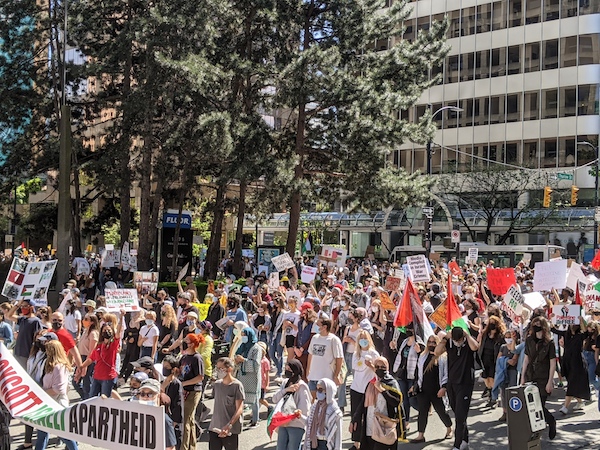
המפגינים צועדים ברחוב רובסון מלווים בכוחות המשטרה שסגרה את הכבישים הסמוכים בדאון טאון ונקובר (רוני רחמני)
הסכסוך הקשה במזרח התיכון בו מעורבת ישראל בימים אלה כולל ארגון הטרור החמאס, ישראלים יהודים וערבים בישראל ופלסטינים וכוחות הביטחון בשטחים – הגיע כצפוי גם לקנדה. הפגנות רבות משתתפים נערכו בימים האחרונים מצד תומכי הפלסטינים ומצד תומכי ישראל, בערים המרכזיות של קנדה. במרבית הפגנות נשמר השקט והסדר בצורה מכובדת, אך במספר אירועים בעיקר באלה שבטורונטו ומונטריאול, הותקפו אזרחים יהודים תומכי ישראל על ידי אזרחים מוסלמים שתומכים בצד הפלסטיני. המשטרה ביצעה כבר מספר מעצרים והיא מנהלת חקירה מואצת לעצור חשודים נוספים באלימות הקשה שהופנתה נגד אלו שתומכים בישראל.
בחלק מהפגנות התמיכה בפלסטינים החזיקו המפגינים כרזות עם דברי נאצה ושנאה מבישים נגד ישראל והיהודים בכלל, בהם: צלבי קרס, “ישראל פעלת נכון, היטלר יהיה גאה בך”, ישראל=נאצים”, “מוות לישראל”, “מה ההבדל בין ישראלי לנאצים” ועוד.
ההפגנה הגדולה ביותר התקיימה על ידי תומכי הפלסטינים בטורונטו ונכחו בה למעלה מחמשת אלפים משתתפים. באותה הפגנה נעצרו כבר על ידי המשטרה המקומית שלושה אזרחים מוסלמים, שתקפו קומץ של מפגינים יהודים שעמדו מולם, וכאמור מעצרים נוספים צפויים בימים הקרובים. המפגינים היהודים ספגו אבנים ובקבוקים, ואחד מהם אף הוכה במקלות, הוא נפגע בראשו ונזקק לטיפול רפואי דחוף. ואילו בהפגנה של תומכי ישראל במונטריאול נאלצה המשטרה המקומית להפעיל גז מדמיע לפזר בכוח אזרחים מוסלמים, שביקשו לפגוע באזרחים יהודים שהפגינו בעת שנערכה הפגנה בעד הפלסטינים.
ההפגנות של שני הצדדים בעד ונגד ישראל נערכו בין היתר בערים הבאות בקנדה: טורונטו, מונטריאול, ונקובר, קלגרי, אדמונטון, אוטווה, ויניפג, הליפקס וסנט ג’ונס.
המפגינים פונים מרחוב ג’ורג’יה לרחוב טרלו בדרכם למשרדים של הקונסוליה האמריקאית בדאון טאון ונקובר (רוני רחמני)
אני עקבתי מקרוב אחרי הפגנה של תומכי הצד הפלסטיני שנערכה בוונקובר ביום שבת האחרון. כחמש מאות מפגינים בהם אזרחים מוסלמים, ילידי קנדה, אינדיאנים, תומכי המרקסיזם ואפילו קבוצה של ארגון שמאל יהודי קיצוני “הקול היהודי העצמאי” – השתתפו בה. תחילה התכנסו מאות מפגינים בכיכר שממול האולפנים של רשת השידור הציבורית הקנדית הסי.בי.סי, ברחוב המילטון בדאון טאון. לאחר סדרה של נאומים וקריאות נגד ישראל שנמשכה למעלה מחצי שעה, החלו המפגינים לצעוד באישור המשטרה כמובן, אל עבר הקונסוליה האמריקנית בעיר, שנמצאת ברחוב פנדר בדאון טאון. רחבות שלמים נסגרו על ידי השוטרים הרבים שנכחו במקום, והצועדים ללא התפרעויות עשו את המסלול מאולפני הסי.בי.סי, אל רחוב רובסון, משם לרחוב ג’ורג’יה ומשם המשיכו בהמוניהם עד לבניין בו שוכנת הקונסוליה האמריקנית.
בין סיסמאות הרבות של המפגינים בעד הפלסטינים, לאור פעולת צה”ל בעזה, שנאמרו בהפגנה או שהופיעו על שלטים בהם החזיקו הצועדים: “אין צדק אין שלום”, “לשחר את פלסטין”, “פלסטין תקום בין הנהר לים”, “הפסיקו את שפיכות הדם”, “הפסיקו את ההפצצות”, “הפלסטינים הם מפלסטין”, “יש לעצור את המלחמה”, “יש להציל את שייח’ ג’ראח'”, “רציחת ילדים איננה נחשבת להגנה עצמית”, “הגידו במפורש את השם פלסטין”, “שתיקה היא אלימות”, “יש לחקור את פשעי המלחמה שמבצעת ישראל”, “יש לתת הגדרה עצמית לפלסטינים”, “יש להחרים את ישראל”. על הדלת הכניסה לקונסוליה האמריקנית שהייתה סגורה בעת ההפגנה, נכתבה הסיסמה באדום: “יש לשחרר את פלסטין, יש להפסיק את רצח העם וכן יש להפסיק את הכיבוש”.
בתגובה לתקיפת המפגינים היהודים בטורונטו, ציינו בארגון המרכז לענייני ישראל והיהודים בקנדה: “אנו מגנים בחריפות את ההתקפה והשנאה שהופנתה נגד יהודים. אין הצדקה לאלימות פוליטית ואלה ששונאים את ישראל שונאים גם את קנדה”.