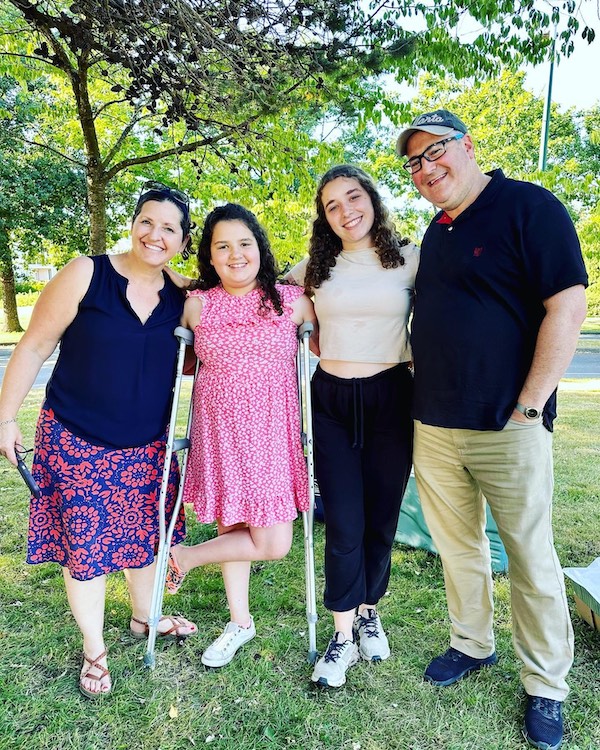
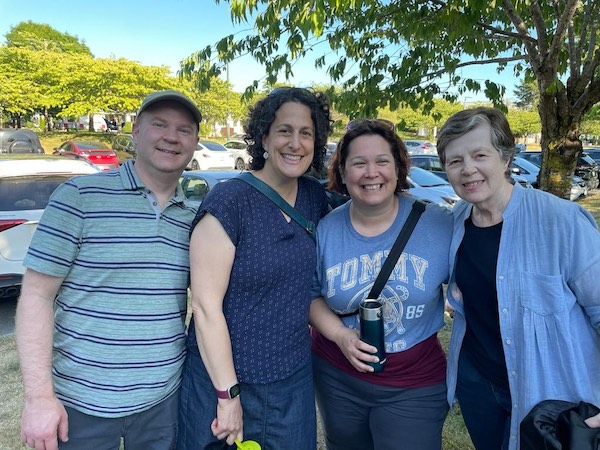
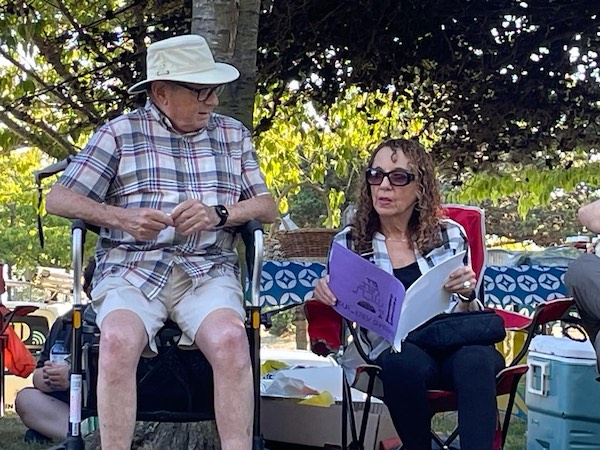
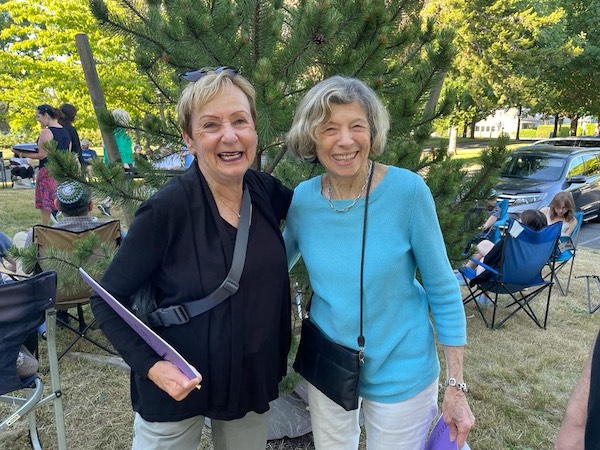
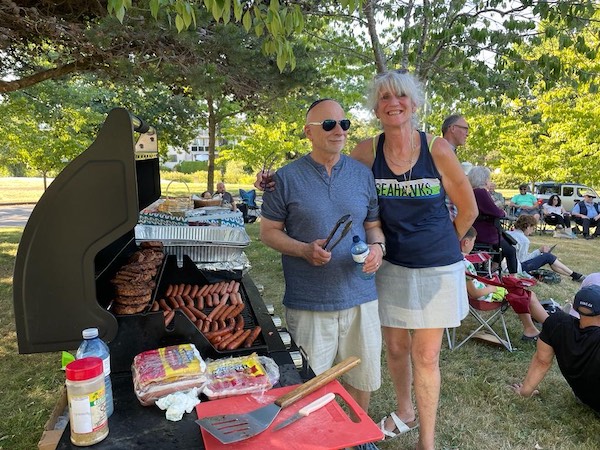
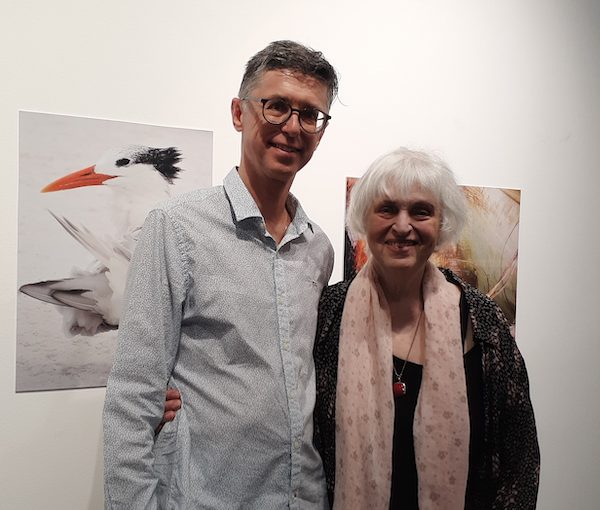
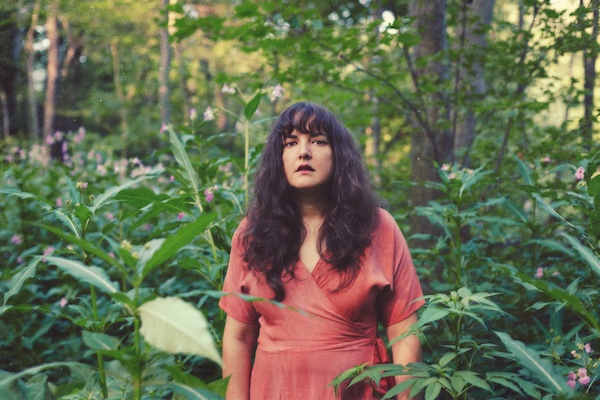
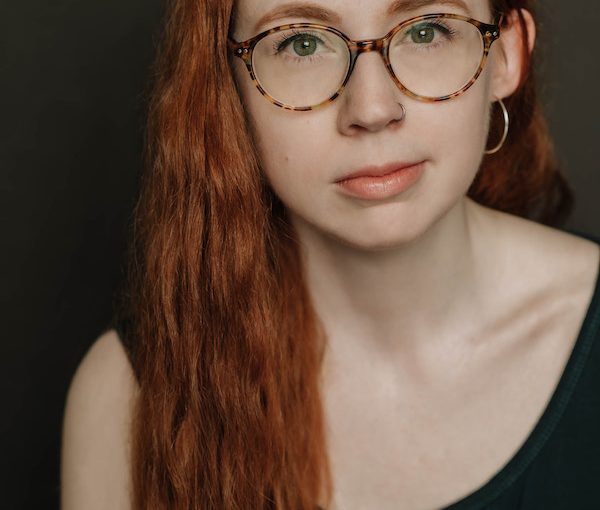
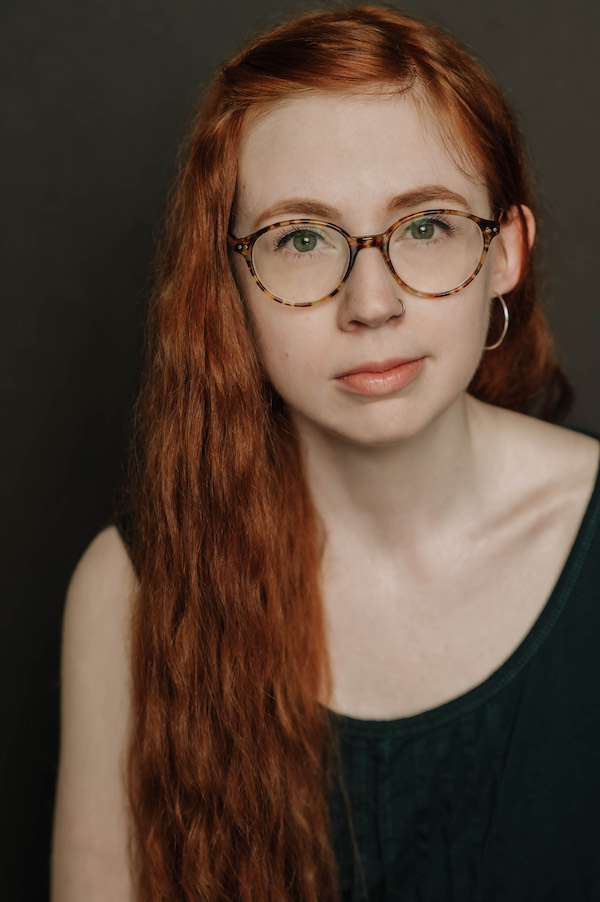
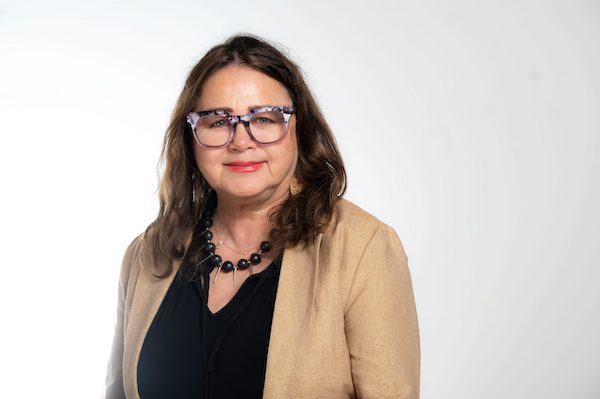
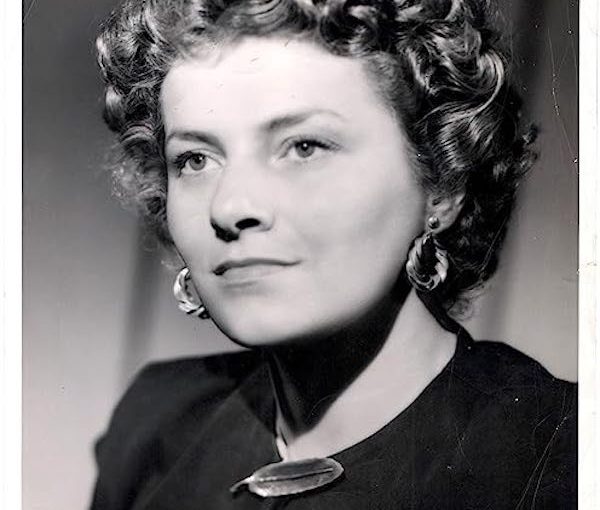
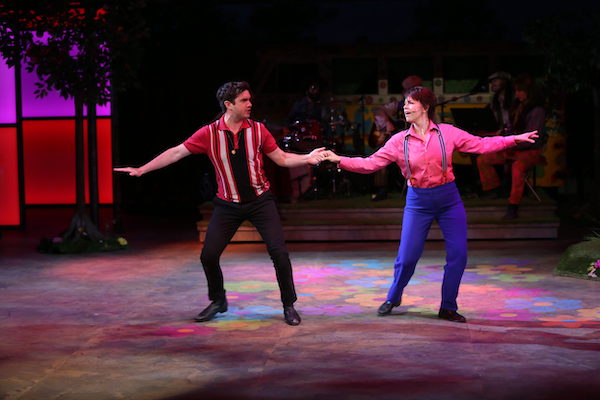
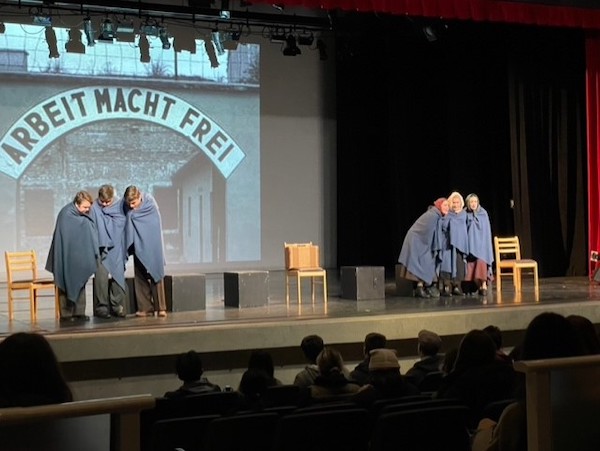
Screenshots from Burquest: Past, Present & Future.
The 37-minute film Burquest: Past, Present & Future – about Burquest Jewish Community’s history – includes photos and interviews with founders and past leaders, and is scored with original music written by Burquest members and supporters. It premièred at a wine and cheese event on June 25 and is now available at burquest.org.
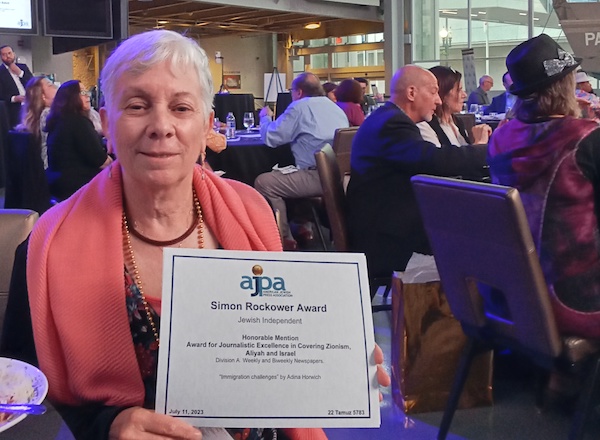
Adina Horwich at the 42nd annual Rockowers Awards. She received an honourable mention for journalistic excellence in covering Zionism, aliyah and Israel. (photo from Adina Horwich)
The Jewish Independent won four Simon Rockower Awards for Excellence in Jewish Journalism this year. The awards, which are given out by the American Jewish Press Association, were for work done in 2022. The JI has had a few Rockower hat tricks in its history, but this is the first time the paper has garnered four honours in one year.
The awards were presented on July 11 at the Higgins Hotel and Conference Centre in New Orleans, La., where the AJPA’s annual conference was held. The JI mainly competed in the division of weekly and biweekly newspapers, but there were some categories for which the competition was between all types of media (print and online); awards were given for first and second place, and sometimes honourable mention.
Writer Adina Horwich traveled from her home in Israel to New Orleans to receive her award in person. She won the JI an honourable mention for journalistic excellence in covering Zionism, aliyah and Israel for her article “Immigration challenges” (jewishindependent.ca/immigration-challenges-2). The piece both reviews Adi Barokas’s Hebrew-language graphic novel, The Journey to the Best Place on Earth (and Back), about Barokas’s experience trying to immigrate to Vancouver from Israel, and shares Horwich’s experience making aliyah from Canada. The jury commented: “Extremely readable story, that skilfully explores from a personal perspective the nitty gritty of making aliyah.”
The JI’s Pat Johnson also received an honourable mention – his article “Oasis in the Caucasus” (jewishindependent.ca/oasis-in-the-caucasus) garnered recognition for excellence in writing about Jewish heritage and Jewish peoplehood in Europe. The jury said about his piece:
“A terrific look into the Jewish community of Azerbaijan that most of us, unfortunately, don’t have on our ‘Must-Go Places to Visit.’ Pat Johnson’s very nice story strongly suggests otherwise. Johnson paints a wonderful picture of this tucked-away ‘shtetl’ where the residents say they have never faced antisemitism. If only we could feel so lucky here in the United States! And while most of us do well playing ‘Jewish geography,’ actual world geography is often more of a challenge. Having Johnson admit having to Google Azerbaijan before traveling there to report this story added a nice touch that connects with readers who may also be unfamiliar with the country – but now more knowledgeable thanks to this feature.”
Johnson was recognized for another of his articles, “Maus not too graphic” (jewishindependent.ca/maus-not-too-graphic), which placed second for excellence in education reporting. Johnson sat in on Anna-Mae Wiesenthal’s Holocaust and Genocide Studies class at King David High School, and listened as students discussed the graphic memoir Maus by Art Spiegelman.
“Lots of people laughed when a Tennessee school board pulled Maus from the curriculum because of the drawing of a naked cat. That was too much for board members and they banished the Pulitzer Prize-winning graphic novel,” wrote the Rockower jury. “Viewing the book through the eyes of five students at a Jewish high school subtly portrays the board decision’s absurdity.”
Rounding out the JI wins was a first place for excellence in editorial writing – where all entries competed in the same division. The JI editorial board of Johnson, Basya Laye and me were honoured for the set of editorials that included “Every person has a voice” (about Elon Musk, hatred and misinformation online, and how people can counter such forces), “Extremism not helpful” (about New Democratic Party leader Jagmeet Singh’s views on the Israeli-Palestinian conflict) and “New era in U.S. politics” (about the U.S. Supreme Court’s rejection of a woman’s right to reproductive self-determination, as well as the Jewish perspective on abortion).
About these editorials the Rockower jury wrote: “These pieces are good examples of what editorials should be – thoughtful examination of pressing issues, using clear reasoning in looking at both sides, then coming to a well-reasoned conclusion. Local tie-ins strengthen opinions.”
All of us at the JI appreciate the AJPA’s recognition of the hard work that goes into producing an independent Jewish newspaper, magazine or website, and we congratulate all of our colleagues on their achievements. For the full list of Rockower winners, visit ajpa.org.
The JI couldn’t do what we do without our subscribers, donors and advertisers – thank you for all your support. For readers who are thinking about subscribing, donating or advertising, please consider doing so to help us continue producing a high-quality, independent Jewish newspaper that connects community members from across the religious and political spectrums; covers lifecycle events and local, national and international news; and documents our community history as it happens. Visit jewishindependent.ca/support-the-ji, email [email protected] or call 604-689-1520.
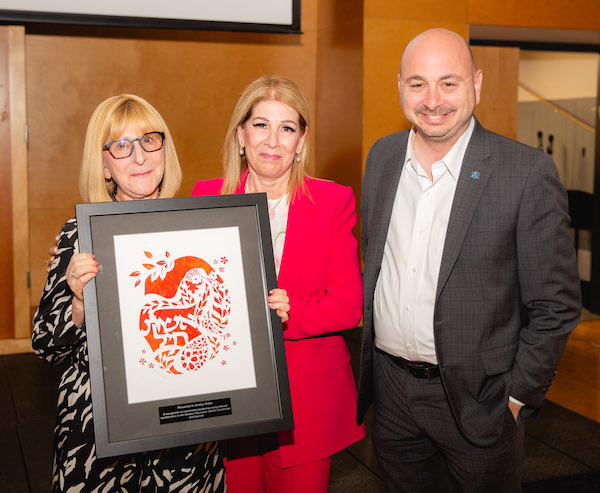
Shelley Rivkin, left, Candace Kwinter and Ezra Shanken
Jewish Federation of Greater Vancouver’s annual general meeting on June 27 at King David High School celebrated Shelley Rivkin, vice-president of local and global engagement, for her contributions to the community. The meeting also honoured several volunteers for their leadership and contributions: Catherine Epstein (Dennis Frankenburg Award), new board chair Lana Marks Pulver (Harry Woogman Award), Stan Shaw (Bob Coleman Award), Brent Davis (Young Leadership Award) and SUCCESS (Community Partner of the Year).
In an email sent after the meeting, chief executive officer Ezra Shanken and immediate past board chair Candace Kwinter shared their joint message that will appear in Federation’s 2022-2023 annual report. In it, they cover much ground, noting that the organization’s “impact resonates farther afield than what the ‘Greater Vancouver’ in our name might suggest. From the Sea-to-Sky to Langley, and all points in between, Jewish community life is thriving – and we are proud to be at the centre of it through our Connect Me In program. On Vancouver Island and in Kelowna, we are now providing security training for volunteers and professionals in their growing Jewish communities.
“As part of her role on the Jewish Agency’s board of governors, Candace traveled to Ethiopia and accompanied some of the 3,000 Jews who were making aliyah. Together, we traveled to Mexico City with the Jewish Agency to see more of their international work, and from Ukraine to Turkey and Syria and beyond, we helped those in need when disaster struck.
“We continued to improve the quality of life for residents of our partnership region in northern Israel. Our work is focused on strengthening the region’s development and regionalism through leadership development and capacity-building while investing in academic excellence. Our long-term investments are helping residents tackle some of the most difficult and complex challenges they face living in Israel’s periphery.
“The political situation in Israel has proven challenging for many in our local community who care deeply about the country,” continue Shanken and Kwinter. “We and our partners have offered multiple events over many months to help people learn more about what is happening and to facilitate discussions.
“Here at home, inflation continued to take a toll on our partners and the people they serve. Across the board, our partners report that inflationary pressures are affecting every part of their work. Ninety-one percent are concerned or very concerned that inflation will affect community members’ ability to fully participate in Jewish life. And 100% of our social service partners are concerned or very concerned that inflation will affect their ability to support their clients’ needs.
“For five years, we have been bringing community together around issues of affordability. Together with key partners, we co-hosted an Affordability Summit on the experiences of children and youth in low-income homes. The three areas of focus identified by our planning council are advocacy for a national breakfast program, creation of a single application point for assistance from multiple organizations, and development of more inclusive, respectful processes.
“This year, we made strides in combatting antisemitism. We were proud to see Vancouver city council and Richmond city council adopt the International Holocaust Remembrance Alliance (IHRA) working definition of antisemitism and the province of B.C. commit to using it as a tool to identify and combat hatred. Identifying antisemitism is the first step in combatting it, which makes these milestones important for all of us, and we want to thank our partners and our advocacy agent, the Centre for Israel and Jewish Affairs, for their work on this.”
Federation also has started “an organizational design initiative intended to build significant capacity within the Federation over the next several years with greater potential for scalability, efficiency, excellence and agility going forward.
“Our unparalleled impact is possible thanks to the strength of our partnerships and the cherished trust of our donors,” Shanken and Kwinter write. “Collective giving is deeply rooted in our tradition, and we play a leadership role in raising the funds our community needs to grow from strength to strength. We invest strategically in initiatives that keep our community strong today, tomorrow and for years to come – as well as in times of crisis. Our partners depend on us to generate the support they need to deliver the vital programs and services on which thousands of people rely.”
The 2022 annual campaign generated more than $13 million for the community: $10.24 million directly through the campaign and $2.91 million in additional support, including special project funding, community relief and emergency relief. The Jewish Community Foundation’s contributions this year surpassed $12.7 million.
“This is more than double the contributions received in the previous fiscal year, which itself exceeded the contributions of the year before that,” write Shanken and Kwinter. “The Foundation strategically disbursed a total of $3.7 million into local, national and worldwide causes, including funding for the Foundation’s Unrestricted Grant Program, which allows response to critical emerging needs in the community.
“JWest also achieved unprecedented milestones. As one of the three lead organizations working together to bring JWest to life, we are excited at the progress made this year. From announcing the capital campaign cabinet to securing $75 million in funding and philanthropic gifts to a $36 million matching gift, this project has gained tremendous momentum.”
* * *
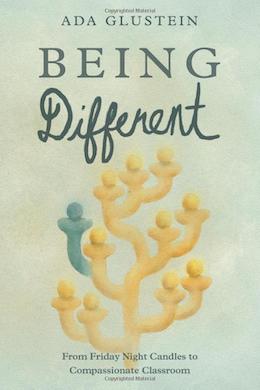
Ada Glustein received a silver medal for Canada-West Region, non-fiction, in this year’s Independent Publisher Book (“IPPY”) Awards for Being Different (self-published).
The “IPPY” Awards are a broad-based, unaffiliated awards program open to all members of the independent publishing industry worldwide who produce books written in English that are appropriate for the North American market. The awards are intended to bring increased recognition to the thousands of exemplary independent, university and self-published books released each year.
A memoir, Being Different tells a universal story about feeling different and longing to belong. Glustein recounts tales of growing up in a Jewish immigrant family during and following the Second World War, and the experiences that stand out during her school days, not knowing how to fit in to the world beyond home. She reflects on her years of teaching diverse children who also experienced life as “different.” She finds her own sense of belonging through helping those children find theirs.
* * *
Barbara Adler
Barbara Adler is the new artistic director of the Only Animal Theatre.
“After a rigorous national search by a leadership transition committee comprising board members and affiliated artists, we are delighted to have Barbara take the lead at the Only Animal,” said board chair Eleanor Stacey. “When we began the search process, we knew it would be an immense challenge to find a successor to founding artistic director Kendra Fanconi, who built such a visionary and essential company. Barbara’s distinctive combination of experience, artistry and vision for the future positions her uniquely to lead the company into its next chapter.”
Adler is an interdisciplinary artist and performer whose practice incorporates text, music, event-making and design. Recent projects centre slow and process-led creations that focus work around relational time and seasonal cycles. As a poet and musician, Adler spent over a decade touring North America, Europe and rural British Columbia as a solo artist and with ensembles, including the Fugitives, Proud Animal and Ten Thousand Wolves. She holds a master of fine arts (interdisciplinary studies) and a bachelor’s in art and cultural studies from Simon Fraser University.
Adler is “thrilled to join a company whose irresistible artistry and deeply held ecological values have brought both innovation and care to the climate crisis.” She added, “The Only Animal’s vision of enduring environmental stewardship reminds me that none of us will individually finish the work. I am honoured to add myself to the beautiful story that Kendra and the company have told for 17 years, and humbled by this opportunity to prepare the way for the next generation of voices in the climate struggle.”
* * *
Rabbi Susan Tendler, her husband Ross Sadoff and their kids.
Beth Tikvah Congregation brought the community together for a Shabbat BBQ at Gary Point Park July 7. Sponsored by the Sadoff family in honour of Ross Sadoff’s birthday and under the leadership of Rabbi Susan Tendler, the event drew around 100 attendees. Amid a picturesque setting, the atmosphere buzzed with ruach(spirit). Laughter and joy filled the air as families and friends relished the food, conversations and Shabbat traditions.
Left to right: Ian Felgar, Elena Felgar, Yvette Tarko-Sabi and Donna FelgarRoy Freedman and Caryl KoshenEstelle Bleet, left, and Ann KramerJeff Rothberg and Stacey Kettleman of Star Catering.Libby Seltzer, left, and Mindy Zimmering
Nathan and Sidi Schaffer at the opening of their photography exhibit at the Zack Gallery June 22. (photo from the artists)
Painter, printmaker and mixed media artist Sidi Schaffer has a new show at the Zack Gallery – a photography exhibit with one of her sons, Nathan Schaffer. Eye Love Nature invites viewers to see the beauty and wonders of the natural world, and for us to recognize the dangers we pose to it.
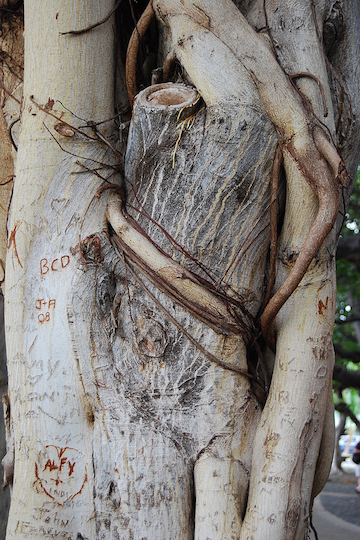
Embraced and Loved” by Sidi Schaffer
Rather than nature as something separate, we see ourselves in the Schaffers’ photos. Sometimes, the animals are doing something that we enjoy doing, like the three whales in Nathan’s “Family Swim,” only their fins visible in the misty ocean. Other times, we can empathize with what a tree has endured, but also our part in hurting it, as in Sidi’s “Embraced and Loved,” which shows a gnarled tree not only tightly wrapped by a vine, but also scarred by the initials, including a pair in a heart, that many people have carved into it.
The titles of some of the photos bring a smile, but also a sense of responsibility. The overall feeling of the exhibit, however, is uplifting, hopeful.
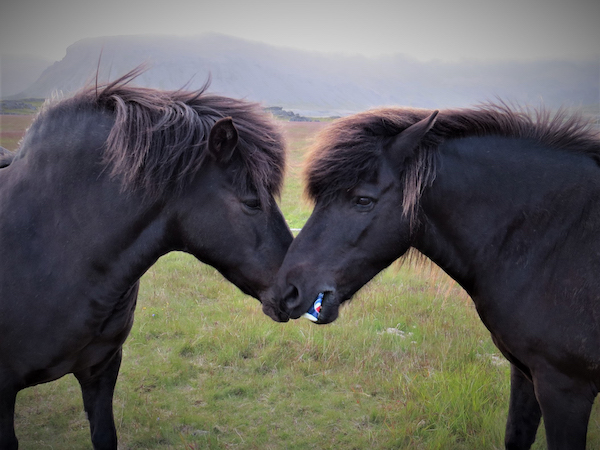
“I have a fondness for word play and puns as a way of expressing humour. I find it helps keep a positive environment when interacting with others and, at times, deal with sensitive issues in a less threatening manner,” Nathan told the Independent. “Artistically, my goal is to engage the audience both visually and with language. ‘The Pepsi Challenge’ [in which two horses tussle over a Pepsi cup] in my mind ‘can’didly raises concerns about human garbage and pollution straight from the ‘horse’s mouth,’ so to speak. In ‘I’m Stumped,’ there is also a bit of fishing line on the stump under the bird’s foot – again a reminder that human pollution is unfortunately prevalent in the lives of wildlife and sometimes it can feel like we are stumped trying to deal with it.”
“The Pepsi Challenge” by Nathan Schaffer
Eye Love Nature is the first photography exhibit for both Schaffers. Sidi said, “as I age, I wanted to see my photos on a gallery wall and share our joy creating them with the people in the community.” Nathan writes in his artist’s statement: “I very much hope the viewers enjoy the photos and that positive emotions arise and carry forth.”
Both Schaffers thanked Zack Gallery director Hope Forstenzer and the selection committee, as well as their friends and family, “for providing guidance and supporting this,” said Nathan, who works as a psychiatrist treating adults at a community mental health clinic.
“The resilience of many patients inspires me to search for strength and marvel at beauty in nature,” he said. “I often recommend spending time in nature as a way of reducing distress from inner turmoil, both to patients and family. I also enjoy my photography as a way of expressing latent artistic interests, as I haven’t improved my drawing beyond a rudimentary level. It is a counterweight to the stress associated with my work.”
For Sidi, who is a career artist, the skills involved in painting/printmaking and photography overlap to some extent.
“The combination of a good eye and imagination can help in both forms of art expression,” she said. “[But] the trigger when taking a photo is coming from outside. It is your sudden surprise of what your eye sees in front of you at a certain moment, in a certain light or shadow. It can be a landscape, people or clouds in the sky. It can be a design that the power of nature created on a tree bark, or a gentle breeze moving the petals of a flower. You can be enchanted by a flower’s seeds that hide themselves from the elements.
“Burst of Colour” by Sidi Schaffer
“As compared to painting or printmaking, with photography, it’s presented to you, you only have to look and explore,” she said. “When I am in front of a canvas or paper, it’s usually in front of a white surface that waits for my imagination, for my expression of freedom to choose the subject or design that comes from inside me. It takes me even more into my inner self, into a world that brings me satisfaction, reflection and peace. Physically, painting is more challenging; my whole body is involved in the making. I love both mediums and hope to combine them in my mixed media works.”
While Eye Love Nature is Sidi’s first photography exhibit, she has been a photographer since childhood. Sidi was born in Romania – her mother studied photography before the Second World War.
“After the war, coming back home from the camps, my parents opened a photo studio,” said Sidi. “From then on, even as a little girl, I immersed myself in their world. I assisted my father in the dark room; I helped colour the black and white photos with watercolour. I learned from my mom how to touch up the negatives. Today, we would call it Photoshop. In my later years, here in Canada, at the University of Alberta, in addition to painting and printmaking, I also studied photography. I will always be thankful to my parents, who exposed me to the magic of photography.”
It was Sidi who gave Nathan his first camera when he was young. “But the love of nature, the curiosity, his investigative spirit and his good eye, he developed through his life, step by step,” she said. “He was always surrounded by art and love of the natural beauty of our world.”
When asked if he had been lucky enough to meet his grandparents, Nathan said, “Yes, I have vivid childhood memories of helping them develop negatives in a darkroom with a red light and strong vinegar-like smell. I very much enjoyed spending time with them while watching photos gradually appear during this process.”
Of course, photography has changed much since that time.
“Through the years, I’ve worked on film and in dark rooms,” said Sidi. “With the explosive development in photography these days, I switched very happily to the digital camera. This way, I have a more direct and faster approach to picture taking. My aim is to stay true to what I see and not manipulate the image except maybe to crop or lighten/darken if necessary. We are surrounded by enough fake images and news these days. I want to be far from all that. The truth gives us freedom.”
More than 40 photographs comprise Eye Love Nature.
“Some Days I’d Rather Be Fishing” by Nathan Schaffer
“For this show, we picked images where we were primarily appreciative observers rather than creators,” said Nathan. “We only attempted to correct minor blemishes, in keeping with our parenting style,” he said with a smile.
There were many candidates for inclusion in the exhibit. “Like in nature, Darwin’s rule of survival of the fittest was the main guiding force,” said Nathan. “Some couldn’t compete due to technical issues such as file size or being unfocused; others lost out due to not being as captivating. Hope, the JCC gallery director, also helped in selecting the final choices.”
As for the choice of where to direct any profits made from the show, the Schaffers have decided to divide them equally between the Canadian Cancer Society and the Canadian Parks and Wilderness Society.
Both organizations, said Nathan, “do their work in what appears to be very different areas; however, they share an important similarity. Cancer is essentially resident cells going rogue and taking over space and resources from the body, thereby putting it in serious danger. Civilization and humans can have a similar destructive impact on nature and wilderness by urban spread and taking of natural resources without limits. Controlling these rogue processes is needed in order to save and heal patients and nature. These organizations share in a mission of tackling some of the major problems we face.”
Eye Love Nature is at the Zack Gallery until July 24.
The Oot n’ Oots band helps launch Mission Folk Music Festival. (photo from Mission Folk Music Festival)
Family band the Oot n’ Oots helps kick off the Mission Folk Music Festival on July 21, as part of the main-stage lineup that opens the weekend of concerts and workshops. Several other Jewish community members are also participating over the weekend, including Boris Sichon, Jesse Waldman and Abigail Lapell, who helps close out the annual event on the evening of July 23.
The theme of this year’s festival builds on last year’s, said artistic director Michelle Demers Shaevitz, also a member of the Jewish community.
“In 2022,” she said, “I programmed a festival that reflected the experience of homecoming, the coming back together of our community, our festival family. This year, I’m digging into the process and ideas of connection and reconnection, as we move through our experiences beyond that initial homecoming and return to the festival. For me, the idea of reconnection speaks to getting to know who we are as a community post-pandemic and how we have changed/emerged as a result of our experiences.
“I was drawn to our 2023 artists through the ways they express their connection to their homelands, their languages, their heritage and cultures, and musical traditions,” she continued. “It’s how Okan celebrates their roots to their homeland of Cuba and her languages and stories, while Terra Spencer sings of the Maritime landscapes and communities around her.
“It could be reconnecting to language, as Cedric Watson and Jourdan Thibidoux explore their roots in the Creole community based in Louisiana alongside Wesli, who sings in his Haitian Creole of home and in French from his newly adopted community in Quebec.
“It’s the ways that Leonard Sumner and Twin Flames sing their connections to their heritage or how Alysha Brilla presents her identity in her songs.”
And, she said, it’s how the Jewish musicians weave their Jewishness into their stories and songs.
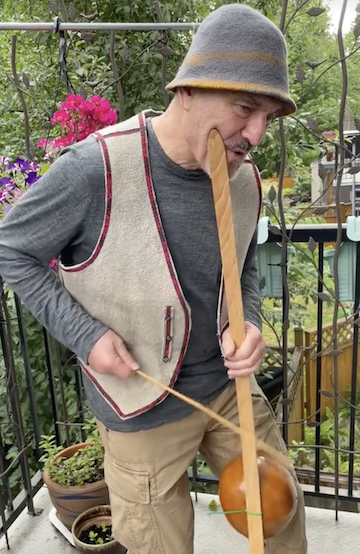
Boris Sichon on TikTok, playing an instrument he made himself. (screenshot)
Sichon, a classically trained percussionist, plays more than 400 different instruments from around the world, many of which would send most of us to the internet to find out what they are, such as mayuri, zurna and agogo bells. He can also make music from wrenches, plastic containers, kitchen bowls and even rocks – basically, anything. His TikTok videos are quite entertaining and mind-broadening. It’s easy to see why he is in demand for school and other educational workshops. He told the Independent he is currently “in the process of preparing a new program with an accent on voice and wind instruments.”
“I love to perform for kids,” he said. “It gives them an opportunity to travel around the world with exotic musical instruments.”
In performances, Sichon sings songs about “love, friendship and freedom [in] Ukrainian, Gypsy, Russian and Yiddish.” He also plays klezmer, and has taken part in the International Klezmer Festival in Jerusalem for many years. He has played at and collaborated with the Mission folk fest many times and, at this year’s festival, he takes part in a Sunday afternoon session, called Global Routes, with Dongyang Gozupa and Robin Layne & the Rhythm Makers.
Jesse Waldman (photo from Mission Folk Music Festival)
Earlier that Sunday afternoon, Waldman takes to the stage as well. A blues and folk artist, the Independent spoke with him ahead of his participation in the 2019 festival (jewishindependent.ca/blues-klezmer-at-mission). A couple of years ago, he shared more about himself and the importance of family in a piece for the JI about being inspired by his great-grandmother, Adele Waldman, to reimagine the Yiddish song “Papirosen” (jewishindependent.ca/a-great-grandmothers-song).
Making her debut at the Mission Folk Music Festival is Lapell, with a shared session on Saturday (with Alysha Brilla) and on Sunday (with Terra Spencer), as well as being part of the festival closing concert. She said “there’s so much great music on the lineup – personally, I’m especially excited for the workshop stages, to have a chance to collaborate with and get inspired by artists from across Canada and beyond.”
Based in Toronto, Lapell’s latest album, Stolen Time, which came out last year, earned her a 2023 Canadian Folk Music Award for English songwriter of the year. She was similarly recognized in 2020 for her album Getaway and she received a CFMA for contemporary album of the year in 2017 for Hide Nor Hair.
“I’m always trying to challenge myself as a writer and collaborator,” she said. “I’ve had the chance to work with so many great players and personnel on these albums and I think it’s really helped me grow from one project to the next.”
Lapell has always sung.
“Singing and writing songs is very intuitive to me and definitely a big source of comfort and community,” she said. “Ultimately, I think it’s such a primal thing, singing and sharing music – for me, it’s a way of connecting with myself, with nature and with the world at large.”
Abigail Lapell (photo by Jen Squires)
Her Jewishness finds its way into her work subtly.
“I find my writing is infused with a lot of biblical and natural imagery,” she said. “I’m very drawn to stylized, sometimes repetitive language, whether prayerful or playful or both. I was raised in a religious Jewish family, and I think there’s a reverent spirit to my music – and sometimes a touch of gentle dissonance or wry humour – that reflects some of the Hebrew and Yiddish traditions I grew up with.”
For the Oot n’ Oots – 16-year-old Ruthie Cipes (voice, ukulele) with her dad Ezra (voice, guitar, keys) and uncles Ari (voice, guitar, keys), Gabe (voice, bass) and Matthew (voice, drums) – Judaism and Jewish community are important parts of their lives, but don’t necessarily influence their music.
“We’re grateful for the wisdom of our ancestors and the culture bestowed since Abraham,” wrote Ezra and Ari in an email interview with the Independent. “It’s a great gift that makes our lives rich and meaningful. We’re members of the Okanagan Jewish Community and supporters of Chabad Okanagan.”
The family lives in Kelowna.
“Our parents moved us from Westchester County in New York to Kelowna, B.C., in 1987,” said the brothers. “They wanted to get off the money-go-round and be farmers living in connection with the earth. They ended up founding Summerhill Estate Winery.”
The Oot n’ Oots was formed in 2007, when Ruthie was born, “but it really got going in 2015 once Ruth joined the band. We released our first album in 2016, although it was mostly recorded back in 2007. Then we made two more albums after our elder brother Matthew joined the band on drums.”
The group is currently recording their fourth album. Their third album, Ponderosa Bunchgrass and the Golden Rule, was nominated for a 2023 CFMA for children’s album of the year and it also garnered a 2022 Juno Award nomination – they were named Children’s Artist of the Year at the 2022 Western Canadian Music Awards.
“We write songs to make each other laugh and to inspire each other. That’s what we’ve always done and it’s what we continue to do,” said the brothers. “It’s a practice that’s ongoing. We want it to continue to be meaningful as we all grow.”
While the awards may refer to children’s music, the Oot n’ Oots describe their music as “all generations together music.”
“That’s the sweet spot for us – when it’s toddlers, teenagers, parents and grandparents all on the dancefloor together,” said Ezra and Ari. “We have a couple of other musical projects that we do, but the Oot n’ Oots is our focus because it seems to provide the most tangible value, and it feels really good to bring that energy of joy to the world.”
In addition to the festival opener, the Oot n’ Oots play a few sessions with other musicians over the weekend, which takes place at Fraser River Heritage Park. The festival includes food and artisan market vendors, as well as a licensed bistro, and attendees can choose to camp in the park for an additional fee. For the full lineup and tickets, visit missionfolkmusicfestival.ca.
Cadence Rush Quibell has their debut at Theatre Under the Stars this summer. (photo by Veronica Bonderud / The Portrait Sessions)
Cadence Rush Quibell makes their debut with Theatre Under the Stars (TUTS) this summer in The Prom, which alternates with Matilda, until Aug. 26 at the Malkin Bowl in Stanley Park.
Growing up in Port Coquitlam, Rush Quibell was homeschooled from Grade 2 to Grade 10. As a young person, they took up musical theatre, joining a junior, amateur-level production company.
“It was the only thing to do,” they told the Independent. “It was what all the homeschool kids did at the time.”
Musical theatre felt comfortable and aligned with their strong sense of creativity. “It was totally up my alley,” they said, and it was not long until they fell in love with the art form. When they moved to a public school for grades 11 and 12, Rush Quibell upheld this passion, participating in their school’s annual productions.
Rush Quibell stopped performing after they graduated. They would regularly tell their wife Jenn how much they missed theatre but, as a wheelchair user, they felt certain that the world of theatre had no space for them. As a kid, Rush Quibell did not use a wheelchair or identify as a person with disabilities.
In the summer of 2021, Rush Quibell chanced upon a Facebook advertisement for Realwheels Theatre, which, its website explains, “creates and produces performances that deepen understanding of the disability experience. We tell stories in which disability itself is not the focus of conflict, but rather forms the landscape upon which universal issues are debated onstage.”
Cadence Rush Quibell has their debut at Theatre Under the Stars this summer. (photo by Veronica Bonderud / The Portrait Sessions)
Rush Quibell found a call for auditions and “it felt perfect,” they recalled. They remember bursting into tears at the “possibility of theatre being possible for me again.” It was their wife Jenn who encouraged them to audition, despite some of Rush Quibell’s health concerns and the logistical challenge of commuting from their home in Langley to Vancouver, where the program was located. “She was there to remind me of who I am,” they said of Jenn.
Rush Quibell’s experience at Realwheels “opened a lot of doors,” they said, not only reminding them of their love for theatre, but giving industry exposure that would lead to subsequent projects. They said it was great to learn from the Realwheels instructors and to be surrounded by Vancouver’s local theatre community. Such access to advice from seasoned professionals, as well as a close community of fellow actors, was “invaluable,” they said.
This period of self-discovery, as Rush Quibell called it, coincided with an exploration of their religious identity. They were curious about exploring Judaism, despite being raised in a Christian household and distancing themselves from religion during adolescence. Their fascination with Judaism formed through conversations with Jewish friends and from connecting with Jewish people on social media. “I didn’t realize you could convert,” they said. “It was a feeling of, ‘I think I found it,’ and ‘this feels right.’” They said the community at Temple Sholom made them feel welcome and comfortable enough to explore Judaism. Days before our interview, Rush Quibell’s conversion became official.
During their time at Realwheels, Rush Quibell learned about a musical theatre course offered by the Arts Club. Musical Theatre 101, led by Peter Jorgenson, provided an amateur setting that allowed them to gain confidence for professional auditions. With this new foundation, when Rush Quibell came across a Facebook post about TUTS auditions for The Prom, they seized the opportunity. Jorgenson and other Arts Club instructors helped them prepare an audition song and organize sheet music.
After securing a role in the show’s ensemble, Rush Quibell faced the challenge of navigating their wheelchair use. TUTS was very accommodating, they said, renting a lift for them to get on and off stage – which was, admittedly, “a little terrifying” to navigate at first.
TUTS continues to remain dedicated to improving accessibility, said Rush Quibell, noting that they are not the first disabled performer at TUTS, just the first wheelchair user. “It’s difficult being the first at anything, but it is also super-rewarding,” they acknowledged.
“This is a really neat experience,” they said, highlighting the importance of authentic and diverse representation on stage.
Reflecting on their own theatre journey, Rush Quibell shared, “If I went to a show and saw a wheelchair user on stage, perhaps I would have gone into theatre sooner.” They are hopeful that their work on The Prom can set a precedent for future disabled actors who aspire to join TUTS, or the theatre in general. “We’re showing the audience and everyone I’m working with that this is a totally viable and normal thing to do,” they said.
Authenticity and acceptance are core messages of The Prom. The production follows four Broadway stars who travel to small-town Indiana to support a local student, Emma, in challenging the rules and expectations of her community so she can take her girlfriend to the prom. Rush Quibell highlighted that, while the show explicitly addresses LGBTQ+ inclusion, its themes extend to anyone seeking meaningful representation and inclusion. “We are talking about literally everyone, not just gay and straight,” they said.
Participating in TUTS has been a great experience for Rush Quibell, and they were looking forward to opening night when the Independent interviewed them.
The cast has been kind and supportive, frequently sharing information on upcoming theatre projects and auditions, said Rush Quibell, adding that The Prom’s story resonates with many of their castmates.
Rush Quibell’s role in the show’s ensemble has been “a blast” – they get to balance singing, dancing and acting, doing so with energy and enthusiasm. In this show’s ensemble, “you do everything,” they said.
Our interview ended with Rush Quibell saying The Prom promises to be a heartwarming, comedic and vibrant production a story well worth sharing in 2023.
For tickets to the show, and to Matilda, visit tuts.ca.
Alisa Bressleris a fourth-year student at Queen’s University in Kingston, Ont. She is an avid reader and writer, and the online director of the arts and culture publication MUSE Magazine. Bressler is a member of the Vancouver Jewish community, and the inaugural Baila Lazarus Jewish Journalism Intern.
Esther Rausenberg, artistic and executive director of the Eastside Arts Society. (photo by Wendy D)
Eastside Arts Society (EAS) presents the return of its two-day summer art-making event, CREATE! Arts Festival, taking place at Strathcona Park on July 22 and at various Eastside Arts District studios on July 23.
A community initiative designed to welcome guests to explore, learn and create art together with local artists, CREATE! features a variety of accessible visual and performing arts workshops for adults and youth, including watercolour painting, needle felting, indigo dying, pottery, glass fusing, photography, ukulele, Salish singing and storytelling.
“In addition to a variety of art workshops, demonstrations and public participation art installations, we are also incredibly proud to introduce our brand new festival art shop, featuring a curated selection of arts and crafts all handmade by local artists,” said EAS artistic and executive director Esther Rausenberg, who is a member of the Jewish community.
On July 22, there will be a series of outdoor art-making workshops taught by more than 15 artists who live and/or work in the Eastside Arts District, many of whom will be participating in CREATE! Arts Festival for the first time. Adult and youth workshops will be hosted by Taaye Wong, Tanna Po, Suzan Marczak, Nima Nasiri, Naomi Yamamoto, Niki Holmes, Ross den Otter, Daphne Roubini, Russell Wallace, Jewish community member Naomi Steinberg, Nicole Caspillo, Nathaniel Marchand, Eri Ishii and Chantal Cardinal (FELT à la main with LOVE). A children and youth workshop will be hosted by Amberlie Perkin and an all-abilities workshop by Alternative Creations Studio.
Saturday festivities will also include a general admission CREATE! Art Zone. Art demonstrations include painting, pottery and glass beading from Francis Tiffany, Julia Chirka (summer skool) and members of Terminal City Glass Co-op. Public participation art projects include a life-size colouring mural with Serena Chu of Chu Chu, squeegee art with Joanne Probyn, and the building and performing of two giant crow puppets – in honour of EAS’s unofficial mascot – with Jacquie Rolston. Opus Art Supplies will have a hands-on block carving and printing activation: carve and pull a mini-block print, and contribute to a collaborative printmaking collage.
A selection of local handmade artworks and goods, curated by OH Studio Project, will be available at the festival shop. There will be a fully licensed beer garden, serving beer, cider and wine from Strange Fellows Brewing, as well as an assortment of food from a collection of food trucks, including Earnest Ice Cream, Wak Wak Burger, Mahshiko and Camion Café.
On July 22, the 8th Annual Art! Bike! Beer! Crawl Brewery Tour & Fundraiser will, for the first time, end at the festival grounds.
Activities will move indoors on July 23, connecting participants with art production spaces in neighbouring Eastside studios, with additional art workshops hosted by members of the Terminal City Glass Co-op, Richard Tetrault, Sonya Iwasiuk, Grace Lee (eikcam ceramics) and Naomi Yamamoto.
Workshops are $35 (plus GST) for youth/adults, with the exception of Perkin’s workshop for children/youth at $20 (plus GST); children under the age of 12 must be supervised by an adult. The general public can access festival activities at Strathcona Park for a $5 general admission fee (children under age 12 are free). For full festival details and workshop registration, visit createartsfestival.ca.
Viola Spolin is widely thought to be the mother of modern improvisation. (photo from amazon.ca)
If you thought that improv was only for entertainment, think again. This summer’s applied improvisation conference at Granville Island will showcase some of the world’s best applied improvisation coaches, trainers and facilitators.
The conference will be hosted by the Applied Improvisation Network in partnership with the Improv Centre, formerly Vancouver Theatresports.
Avril Orloff is one of four Jewish community members on the Vancouver conference planning committee. She told the Independent that there will be more than 30 workshops offered, from improv in education and health care to using it to navigate difficult conversations, increase confidence, build community and address humanitarian issues.
“The hard part will be choosing among all the great offers,” she said.
Conference dates are July 27-30, with July 25-26 called “Learning Journeys” before the conference proper, where people can sign up to do a deep dive into particular topics for a half or full day.
“Another highlight is the Open Space sessions on the final day, which is a marketplace of ideas where anyone can offer a workshop on any topic they’re particularly interested in,” said Orloff. “Open Space is a great lab for people who want to test out new ideas, processes and games, or put out an ask to anyone who’s willing to answer.”
Orloff dived into applied improv in 2022 and fell in love with it.
“The weekly classes and open space sessions were a bright spot in my life during the pandemic,” she said. “They expanded my outlook beyond the confines of the immediate moment and made me feel connected during a time of isolation.”
Since then, she has used applied improv techniques more and more in her work as a facilitator, starting with the online “connection cafés” she hosted during the pandemic, and now in person.
Avi Dolgin is another community member on the planning committee. He said they are expecting 200 delegates with a dozen or so who are local but the majority from elsewhere in Canada, as well as from the United States, Europe and Asia.
Dolgin sees improv as a profound way of unlocking human potential. Now retired, he uses improvisation to teach Bibliodrama at Or Shalom.
“In my life, an improvisation mindset encourages me to greater spontaneity, unexpected creativity and a greater willingness to help others in their ideas,” he said.
Carol Ann Fried, an inspirational speaker and consultant who lives in Vancouver, is also on the conference committee. She is presenting an applied improv workshop alongside Sarah Fisk and Matt Weinstein.
“Now that many people – but not all – are meeting again in person, the need to conduct ‘hybrid meetings,’ where some are in person and others are online, has arisen,” she said. “This split format is difficult, in part because it is hard for people to interact with each other. Our session attempts to address this issue with specific structures and activities to engage people in a hybrid setting, that are based in the values of improv, and that can be used in any work context.”
Well-known improviser Colin Mochrie will be one of the keynote speakers at the conference. Mochrie is most famous for appearing in the television show Whose Line Is It Anyway for the last 30 years.
Jewish community member David Diamond is the other keynote speaker. He will be giving a demonstration of Theatre for Living, with three audience members. Based on Augusto Boal’s Theatre of the Oppressed and Diamond’s lifelong interest in physics, Theatre for Living uses improvisation to create scenes that stimulate community dialogue and calls for change, in particular cross-sectoral understanding.
Applied Improvisation Network (AIN) was created in 2002 to bring together professionals with a keen interest in the study, practice and teaching of applied improvisation. Initially, a group of 30 or so improvisers gathered for the first conference in San Diego. Today, AIN is a global community of more than 8,000 participants online and across numerous regional and local groups.
Ed Reggi is AIN’s president and another member of the Jewish community. Reggi, who lives in St. Louis, Mo., told the Independent that there has always been a Jewish presence in the organization, from its founding to the present day.
Reggi said he takes his inspiration from Viola Spolin (1906-1994), who is widely thought to be the mother of modern improvisation. Spolin was the daughter of Jewish immigrants from Ukraine. Spolin’s father, Make Mills, had escaped pogroms in Ukraine to come to the United States. Her grandfather stayed in Ukraine and died at the hands of Stalin’s troops after the Soviets took his farm.
Much of Spolin’s work and success comes from her body of experience around recreational play. She studied under Neva Boyd, who was a sociologist, and documented recreational games, dance and activities that came over from Europe, Reggi said.
“Of course, Viola’s son, Paul Sills, watched his mother developing her Theatre Games and he took them over to the University of Chicago, where he worked with Mike Nichols, Elaine May, Ed Asner, Alan Alda and Avery Schreiber and so many more.”
Sills went on to create the Second City in Chicago, now North America’s oldest improvisation theatre institution, where Saturday Night Live stars Gilda Radner, John Belushi, John Candy, John Belushi, Dan Aykroyd, Eugene Levy and Catherine O’Hara made their debuts.
Reggi is excited about attending the conference here in July.
“I think, because this conference is happening in Vancouver, I expect more Jewish presence. Last year, we were in Ávila, Spain, after two years of being halted by the pandemic. I am thrilled to be coming back together in person again.”
Oscar Derkx (Orlando) and Chelsea Rose (Rosalind) in As You Like It. (photo by Tim Matheson)
What do you get if you mix a Shakespearean comedy with 23 Beatles hits from the 1960s and set the whole thing in Vancouver and the Okanagan? An unforgettable night at Bard on the Beach, which opened its 34th season with a remounting of its 2018 hit As You Like It.
Various nips and tucks to the original script have been made. While purists may not appreciate the surgery, the Bard version still follows the convoluted saga of four pairs of young lovers who cross paths as they work through obstacles in their quests for true love. After all, all you need is love.
The action starts in Vancouver with a zany pre-show bout of Superstar Wrestling – make sure you get into the tent 15 minutes before curtain time. Ringmaster Touchstone introduces Charles 2 Guns Leibowitz, a narcissist on steroids, who takes on all comers for cash prizes. Orlando, who has been denied his inheritance by older brother Oliver, decides to go for it, although the underdog in size and confidence.
During the match, Orlando catches the eye of Rosalind, and it is love at first sight (“she loves you, ya ya ya!”). However, Rosalind is banished from Vancouver by her aunt, and runs off to the Okanagan with best friend Celia and faithful servant Touchstone. To do this safely, Rosalind uses one of Shakespeare’s favourite ploys and disguises herself as a boy (Ganymede), with Celia playing her sister.
Orlando, with his devoted servant, Adam, also heads to the Okanagan when his brother threatens to have him killed. As expected, he crosses paths with Ganymede/Rosalind and her entourage.
Add to the mix a lovelorn rube and the object of his affections, a shepherdess who becomes enamoured of Touchstone, a commune of back-to-earthers headed by Rosalind’s mother, who also was banished, and the plot twists and turns through secret notes, trysts, actors hiding behind trees (it is Shakespeare after all), strange picnics and more. Every scene morphs smoothly into a Fab Four moment through songs like “I Want to Hold Your Hand,” “Can’t Buy Me Love” and “All you Need is Love,” high-energy, fancy footwork (a shout out to choreographer Jonathan Hawley Purvis) and toe-tapping music from a five-piece band helmed by musical director Ben Elliott (who also acts in the play).
This is a real ensemble piece and every cast member seems to give it their all. I was particularly impressed with Chelsea Rose’s vocals, as Rosalind. Oscar Derkx (Orlando) is boyishly charming and can also belt out a song. Elliott (Silvius) showcases his comedic chops in a raunchy pas de deux with Alexandra Lainfiesta (Phoebe). Finally, Scott Bellis, as Jacques, movingly delivers the iconic soliloquy “All the world’s a stage,” where the Bard explores the circle of life in seven stages, from babe to senile senior. Clad in a black turtleneck sweater and corduroy bell bottoms, Bellis is the quintessential beatnik. He also gets one of the best lines of the night – “I can suck melancholy out of a song as a weasel sucks eggs.”
Director Daryl Clonan can be proud of this latest iteration, which has toured through parts of Canada and the United States. The production values are top rate, starting with the glitzy set including a psychedelic VW parked at the back of the stage. Kudos to costume designer Carmen Alatorre for capturing the essence of the era – paisleys, acid-wash jeans, fringed vests, bell-bottoms, granny glasses, headbands and beads for the Okanagan granola set with Jackie O pillbox hats, white gloves, two-piece suits, chinos and polyester shirts for the urban crowd. And Gerald King’s lighting works wonders with a rainbow palette projected against Plexiglas panels that illuminate the tent backdrop of ocean and mountains.
***
In something completely different, the cast members of As You Like It also star in Julius Caesar, which plays alternating nights on the BMO Stage.
Bard on the Beach last produced Julius Caesar in 2007. This summer’s adaptation by Stephen Drover, set in modern times, brings novel perspectives to the classic tragedy of political ambition, jealousy, tyranny, treachery, mob rule, murder and revenge, and will resonate with contemporary audiences.
Despite the title, the real protagonist is Brutus, who grapples with his loyalty to Caesar and what he believes is the greater good of Rome, when approached by a group of senators to help assassinate Caesar. Hesitant at first, he ultimately joins the other senators in plotting Caesar’s demise – to take place at a meeting on the Ides (15th) of March. Though Caesar has been warned by a local soothsayer to beware that day, he ignores that warning and the pleas of his wife to stay home.
Caesar (an impressive Andrew Wheeler) arrives at the senate resplendent in a white business suit, topped off with a jaunty fedora, to the cheers of his people. Once there, Brutus and his fellow conspirators surround Caesar and, one by one, stab him, the final thrust coming from Brutus. In this viscerally haunting scene, Caesar falls to the ground, his white suit covered in red blood, as he utters his last words, “et tu, Brute,” surrounded by the conspirators, their hands dripping with blood.
At the state funeral, Brutus tries to convince the crowd that Caesar had to die for the good of Rome, but Mark Antony – a loyal friend to Caesar and a skilful orator – gives the “Friends, Romans, countrymen, lend me your ears” speech, over a ghoulish glass coffin containing Caesar’s bloodied body. The crowd turns against the conspirators, who are forced to flee. Antony then summons Caesar’s nephew, Octavius, to raise an army to hunt down and kill the conspirators so that Caesar’s death can be avenged. This leads to a civil war, with the action coming right into the audience.
In the penultimate scene, Brutus, having been visited by Caesar’s bloodied ghost and surrounded by his fallen comrades, realizes that defeat is at hand and implores his trusty servant to kill him. Andrew McNee’s performance as Brutus in this scene is compelling.
The final scene is eerie, as Caesar’s ghost slowly walks off the stage into the sunset amid wisps of smoke.
Director Cherisse Richards has chosen to reverse many of the roles so that most of the conspirators are female, as is the role of Mark Antony, played by Jennifer Lines, who is simply sublime.
In another twist, Caesar’s wife, Calpurnia, and Portia, Brutus’s wife, appear more prominently in the adaptation, providing insights into the private lives and feelings of their husbands.
The stark set showcases a mix of old and new – jagged concrete columns evoke ancient Roman architecture, which morphs into tables, desks and even a wardrobe, against a backdrop of multimedia screens.
Jessica Oostergo’s warrior costumes are metaphors for good versus evil – Octavius’s allies clad in light khaki fatigues while Brutus’s side roams the stage in black and grey, looking like SWAT team members.
Video designer Candelario Andrade’s projections – spanning the spectrum from Joan of Arc, to Napoleon at Waterloo, to the Jan. 6, 2021, riots at the U.S. Capitol – accompanied by sound designer Kate Delorme’s ominous scores contextualize the action.
For Bard on the Beach tickets and the full schedule, which also includes Henry V and Goblin: Macbeth, visit bardonthebeach.org.
Tova Kornfeldis a Vancouver freelance writer and lawyer.
Wendy Kout’s play Survivors is based on 10 real-life stories of young people’s Holocaust experiences. (photo by Peter Nadler)
Last year, Victoria-based Bema Productions and the Victoria Shoah Project collaborated on a pilot project: a nine-performance tour to middle and secondary schools of Survivors, a Holocaust-themed play by Wendy Kout. The success of the tour, which reached more than 1,100 students and 500 adults in the Victoria area, has led the organizations to broaden their reach throughout Vancouver Island, Metro Vancouver and other Western provinces beginning this autumn.
“Following our pilot tour in Victoria, we were asked to cover the Western provinces, and I happily accepted the challenge,” said Zelda Dean, the director of the play. “We will be touring to 30 schools on Vancouver Island in October 2023. In the fall of 2024, we will tour on the Mainland and in Alberta. Saskatchewan and Manitoba will be toured in 2025 – 150 performances in total will be presented.”
Citing a 2018 Canadian survey produced by the Azrieli Foundation, Yad Vashem, the United States Holocaust Memorial Museum and the Claims Conference, the Victoria organizers offer compelling reasons why Holocaust education is necessary today, particularly (but not only) for youth. According to the survey, 52% of millennials cannot name a concentration camp or ghetto; 62% of millennials did not know that six million Jews were killed in the Holocaust; 22% of millennials haven’t heard or are not sure if they have heard of the Holocaust; and 23% of all Canadians believe that substantially fewer than six million Jews were killed (two million or fewer) during the Holocaust, while another 24% were unsure of how many were killed.
“I have been alarmed at the ongoing rise in antisemitism for some years and have been looking for a suitable educational play. I had previously produced a play by Wendy and loved her work,” said Dean, regarding the selection of Survivors.
The intention of the one-hour play, suitable for those from Grade 6 to adulthood, is to provide a vehicle to teach lessons from the Shoah to younger audiences. Based on 10 real-life stories of young people’s Holocaust experiences, the play hopes to enable students to recognize the short- and long-term causes and effects of prejudice, discrimination and, ultimately, genocide. It also aims to foster critical thinking and bring the importance of human rights and social justice advocacy to the forefront.
Survivors goes through the chronological history of the Holocaust by enacting the experiences of Jewish children and teenagers from Europe. The young cast of six professional actors portrays the survivors, starting at innocence and continuing through the terrifying rise and rule of bigotry, xenophobia and violence, before they immigrate to America.
The play includes the true stories of a teen who watched her boyfriend being taken away to a concentration camp, a girl who was separated from her parents and relocated to England through the Kindertransport and a boy whose family struggled to escape to China.
Dean credited the young actors in the production for their diligence and dedication to their parts. “I put a casting call out and was delighted that a large number of very skilled young actors tried out for the roles. Those who were cast were tasked with doing considerable research into the Holocaust prior to rehearsals starting,” she said.
Survivors was originally commissioned and developed by CenterStage Theatre in Rochester, N.Y., in 2017, when Kout was asked to write a Holocaust play about survivors who had immigrated to the city. Shortly thereafter, while watching neo-Nazis march in Charlottesville, Va., Kout expressed the feeling that she was not simply writing an historical play but also a “warning play.”
The Victoria production in November and December 2022 – which played in school auditoriums, theatres and libraries, and had four public performances – was the first international tour of the play. There are other tours currently on both coasts of the United States, with Kout, along with the New York company that developed Survivors, creating a documentary on how the play came to be.
“Sharing the history of the Holocaust with students provides an important historical example of the dangers of allowing hatred and intolerance to take hold within a society,” said former B.C. minister of education Rob Fleming about the Victoria tour.
Additionally, several students who saw the play offered their input concerning how the performance affected them.
“I want to continue to learn more about the Holocaust and people’s stories. I’ve read [Elie Wiesel’s] Night and seen this play but other than that I haven’t heard many personal stories, so I’d like to learn more,” said one.
“I learned once again that I should not judge others selfishly based on race, religion, appearance or prejudice, and I will try to [remember that] whenever I meet new people from now on,” contributed another.
The organizers are looking for financial support to fund the upcoming Western Canadian tours.
“Over $450,000 is required to offer this powerful educational play to so many students, and we are actively fundraising to individuals, corporations, foundations, etc. We are running a campaign inviting folks to sponsor a school in their area for only $500,” Dean explained.


 Screenshots from Burquest: Past, Present & Future.