Blue Rodeo founders Greg Keelor, left, and Jim Cuddy at the Whistler Film Festival. (photo from the festival)
The music documentary Blue Rodeo: Lost Together by director Dale Heslip was named winner of the 2024 Audience Award for a feature-length film at the Whistler Film Festival last week.
“The Audience Awards are a fun, yet important, way for our guests to have their say in the programming we put together at the Whistler Film Festival,” said director of film programming Robin Smith.
The world premiere of Blue Rodeo: Lost Together was attended by band founders Greg Keelor and Jim Cuddy, along with Heslip and producer Corey Russell. Francine Dibacco is also billed as a producer on the project. A Q&A with Keelor, Cuddy and Heslip was moderated by media personality and MuchMusic veteran George Stroumboulopoulos, also featured in the film.
“We were completely thrilled with having our world premiere at the Whistler Film Festival and the magical night we shared with the audience,” said Russell. “This award means so much and we want to thank the fans who took the time to see our film.”
Kelley Korbin, left, and Trilby Smith honour Bernie Simpson, who has been a longtime staunch supporter of Camp Miriam, which he attended, starting in the mid-1950s. (photo by Adi Keidar)
Hundreds gathered Dec. 7 to mark 75 years of Camp Miriam. Generations of campers convened at the Jewish Community Centre of Greater Vancouver for an emotion-packed reunion of alumni and friends, in which the Habonim Dror-affiliated Labour Zionist camp was fêted for having an outsized impact on building British Columbia’s Jewish community.
The celebration actually marked 76 years since the beginning of the camp, but the event, originally scheduled for last year, was postponed as a result of the Oct. 7, 2023, terror attacks.
Some of those who have strengthened Camp Miriam in recent years were honoured at the celebration.
Sam Bernofsky paid tribute to Leah Levi, who retired after 17 years as camp registrar, in 2023, but continues her involvement as bookkeeper and keeper of institutional memory. She received an ovation and video-recorded greetings from alumni and friends.
Trilby Smith and Kelley Korbin honoured Bernie Simpson who, among other contributions, has ensured that camperships are available for all who need them, guaranteeing that finances are never a barrier to participation. Simpson also nurtured relationships with non-Jewish supporters of the camp, including former BC Supreme Court Justice Angelo Branca, and former Speaker of the House of Commons John Fraser, both now deceased. Through fundraising and personal contributions, Simpson is credited with playing a core role in every capital project the camp has completed in recent decades. He is also Camp Miriam’s unofficial historian and archivist.
Speaking to the Independent, Simpson credited Camp Miriam (along with his wife, Lee) for every success in his life, including his time as a member of the BC legislature.
“It means everything to me,” Simpson said of the camp, which he began attending in the mid-1950s. “It probably shaped my whole life. The Habonim leadership at that time, which was the camp leadership, took me under their wing. I came from quite a disturbed home and they had lots of patience for me and they ended up being my life.
“They had time for a shmuck like me,” he said. “That was remarkable. But I’m not the only person.”
Alan Tuffs was being physically abused in his home, Simpson said. The head of the Jewish welfare agency, Jessie Allman, called Simpson up and asked if Camp Miriam would “take this boy.”
Tuffs went on to study Judaism in Israel and recently retired as a rabbi in Hollywood, Fla., after 45 years.
Shalom Preker was another Miriam success story, according to Simpson, having overcome challenges to become a PhD and a global expert in health financing. Preker has served in senior roles at the World Bank and the International Finance Corporation, focused on the health sector in developing countries.
Pioneers of the movement – often kids themselves at the time – were remembered throughout the evening. Michael Livni, né Langer, spearheaded the purchase of the camp on Gabriola Island. As a teenager, Langer/Livnicajoled philanthropists to front the money to purchase the camp’s site from the Cooperative Commonwealth Federation, precursor to the New Democratic Party, in 1956.
Until then, Habonim had rented camps for summer programming, and ran youth programs in Vancouver throughout the year. Livni, who made aliyah and went on to be a leading figure in both Reform Zionism and the kibbutz movement in Israel, died this year at age 89.
Simpson credited the late Army & Navy department store founder Sam Cohen, as well as the late Ben and Esther Dayson and the late Norman Rothstein as benefactors who set the foundation for Camp Miriam’s long-term sustainability.
The anniversary event featured a display of the camp over the decades and pioneers, living and departed, were celebrated. Camp “matriarch” Gloria Levi was on hand, and the movement’s leaders of the past and present shared memories.
Miriam alumni Michael Schwartz emceed the evening, provided a moving reflection on the impacts of Oct. 7 on the Habonim community, and recalled his own memories of camp.
“I got to experience moments I will never forget,” Schwartz said, including the staging of a “show trial” of the Little Mermaid. “Through all these experiences – some absurd, yes – Miriam taught me some of life’s most important lessons. It taught me about the so-called big, important things, like history and justice, political philosophy, but it also taught me about the truly important things, like teamwork, leadership, friendship and girls.”
Jay Eidelman, the camp’s new director of fundraising and strategic planning, said that next summer’s enrolment will be a record 360, with a waiting list of others who want to come.
“That’s 5% more than last year, which was also a record enrolment,” he said. “Our retention rate is an astounding 90%.”
Especially in this time of rising antisemitism, Eidelman said, Jewish kids need safe spaces.
“Miriam is that space and for many of our campers,” he said. “Miriam is the only place where they can explore their Jewish identities, their relationship to Israel and their relationship to our community.”
He noted that 85% of Miriam campers attend public schools and more than half come from outside the city of Vancouver.
“We are growing and we need to grow sustainably,” he said. “That’s why, in 2022, with the help of the Ronald S. Roadburg Foundation, we started a site master planning process to help us grow sustainably.”
Left to right at Camp Miriam’s 75th anniversary celebration are Sue Siklos (parent), Trilby Smith (past camp committee chair) and Gretchen DuMoulin. (photo by Adi Keidar)
Brian Tucker, chair of the camp’s board, and Ariella Smith-Eidelman, who is going into her second year as rosh machenah (head of camp), spoke from their respective positions. Video greetings were shared from alumni Selina Robinson, former provincial cabinet minister, and Seth Rogen, comedian and actor.
The anniversary celebration was emotional, said Leya Robinson, who took over as Camp Miriam’s community director last year, succeeding Levi. Before returning to her hometown of Vancouver, Robinson (a second-generation Habonimnik, thanks to her mother Selina) worked for the North American Habonim movement in New York as director of education and then spent five years in Israel, where she directed programs in Israel for Habonim Dror campers and university students worldwide.
“It was very heartwarming, almost in an overwhelming way,” Robinson said of the event. “Just to have that deep a sense of belonging and to look around and see how many other people felt that same sense of community and belonging to Camp Miriam. I just feel so lucky to be a part of the community and to have the experience at Camp Miriam.”
In these challenging times, she said, that connection is vital.
“It’s really easy to fall into despair seeing what’s happening, and having community helps to build up that sense of hope or to maintain that sense of hope and to see that we are not isolated and we have friends and partners and people to talk with,” she said.
David Bogdanov told the Independent that his camping experiences in the late 1970s and early ’80s were “very transformative and almost lifesaving.”
“It gave me a strong love of Israel,” he said. “It really enhanced my relationship with the Jewish community and really informed my whole life to a very large degree.”
Michelle Plotkin, a member of the committee that put the anniversary event together, wasn’t a camper herself but has seen the camp’s effects on her daughter.
“It just offers so many opportunities for the kids to be independent and learn how to be comfortable outside their comfort zone and stretch their minds and imaginations,” Plotkin said. “My daughter does things I never would have expected her to be comfortable doing.”
It was Plotkin’s idea to put together a one-time band for the event. The six-member group was made up of three professional and three amateur musicians, all of them Miriam alumni. The musicians, who dubbed themselves the Final Messiba, were Yonni Silberman (drums), Sunny Zatzick (guitar), Daniel Pimentel (bass guitar), Ira Cooper (vocals), Roy Vizer (percussion) and Jessica Stuart (lead guitar and vocals, and music director).
Gretchen DuMoulin, who chaired the evening’s organizing committee, has experienced almost all aspects of camp, from being a camper herself, a madricha (counsellor), a parent to campers and madrichim, and an organizer of family camps and then the 75th anniversary celebration.
She said Camp Miriam “is a whole Jewish and cultural experience. Every aspect of camp is thoughtfully planned with aspects of Jewish values, equality, social justice and leadership woven throughout. Every camper has an opportunity to become a leader at some level and for their voice to be heard and counted. It is 100% a youth leadership-run camp.”
DuMoulin cites lasting friendships as an enduring legacy of camp.
“There is something about spending weeks at a time, day and night, independently but together,” she said, “that just allows you to form friendships in a different way than when you are at home and in school.”
By fostering human connection, creativity and a love for the outdoors, Camp Hatikvah teaches children that true joy doesn’t come from likes or notifications – it comes from experiences shared with others. (photo from Camp Hatikvah)
In today’s fast-paced world, it can feel almost impossible to escape technology. Smartphones, tablets and social media have woven themselves into the fabric of daily life, often at the expense of face-to-face interaction and genuine connection. But, at Camp Hatikvah, campers are given the opportunity to disconnect from devices and reconnect with life’s simpler joys.
The camp has a no-technology policy for all its campers. This means that, for the entirety of their stay at camp, campers are completely unplugged so that they can engage with the world around them – through creativity, camaraderie and the kind of joy that is so often lost in the digital age.
For many of today’s youth, the idea of unplugging might seem daunting. Devices have become more than tools; they’re sources of entertainment, connection, and even identity. At Camp Hatikvah, however, the absence of screens doesn’t feel like a loss – campers quickly discover the delights of old-fashioned fun.
“It’s a precious gift to witness children simply at play,” said Liza Rozen-Delman, the camp’s executive director. “When they’re not tethered to screens, you see their imaginations come alive. They’re dancing, creating skits, and laughing in ways that feel so genuine. It’s the kind of joy you rarely see any more in the city.”
Camp Hatikvah has a technology-free approach. (photo from Camp Hatikvah)
These moments of unstructured play do more than just fill the hours; they foster skills that are crucial for a child’s development. Imagination, problem-solving and cooperation flourish in an environment where kids are free to create their own fun. Campers learn to navigate group dynamics, work through challenges and take pride in shared accomplishments.
One of the most profound benefits of Camp Hatikvah’s technology-free policy is the way it nurtures genuine relationships. Without the distractions of social media, campers are fully present for one another. They form bonds over shared adventures, whether it’s paddling across the lake, tackling a team-building challenge, or simply sitting together under a star-filled sky.
The mental health challenges facing today’s youth are unprecedented. Studies have linked the overuse of technology to increased anxiety, depression and feelings of isolation. Camp Hatikvah offers a much-needed antidote: a space where kids can breathe, laugh and simply be themselves.
“Away from screens, there’s a noticeable shift in the kids,” said Eden Gutterman, associate director. “They start to relax. They’re more in tune with their surroundings and with each other. It’s like they’re rediscovering what it means to just be a kid.”
Moments of unstructured play foster skills that are crucial for a child’s development. (photo from Camp Hatikvah)
The benefits of Camp Hatikvah’s technology-free approach aren’t limited to the children who attend. Parents also appreciate the impact of the camp’s philosophy. For many, it’s a relief to know their children are spending time away from screens and social media, engaging in activities that promote health and happiness.
“At the end of the day, what we’re giving these kids isn’t just a summer at camp – it’s a gift that will stay with them for the rest of their lives,” said Rozen-Delman. “The friendships they make, the confidence they build and the memories they create – those are the things that matter. And none of it requires a screen.”
Life’s most meaningful moments often happen when we set aside our screens and fully immerse ourselves in the present. By fostering human connection, creativity and a love for the outdoors, Camp Hatikvah teaches children that true joy doesn’t come from likes or notifications – it comes from experiences shared with others. In an increasingly digital world, the lessons learned at the camp are not just refreshing – they’re transformative, equipping campers with the tools to lead more balanced, connected and fulfilling lives long after summer ends.
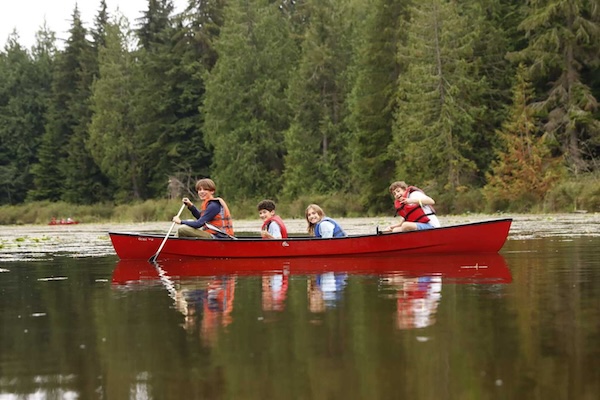
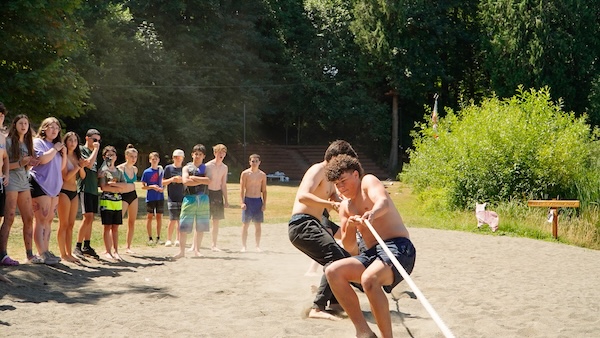
Jewish summer camps fuse the activities, friendships and communal life of traditional camps with Jewish values, role models and culture. (photo from Camp Kalsman)
Whether camping season has just ended or it’s the middle of winter, it’s never too early to begin thinking about Jewish summer camp for the young people in your life. Jewish summer camps fuse the activities, friendships and communal life of traditional camps with Jewish values, role models and culture. This uniquely immersive experience provides a confidence-building opportunity in which campers experience joy and discovery in a communal Jewish setting.
The top six reasons parents, bubbes and zaydes everywhere are sending their kids to Jewish camp are:
1. Kid-centred Judaism
Kids are empowered to contribute to and lead their Jewish community at camp. From services, to music, to hands-on learning, the developmental and social-emotional needs of campers come first, and opportunities exist for campers to take the lead in these experiences. This is a uniquely powerful experience they won’t find anywhere else.
According to the 2023 article “Why Camp Works: Explanations Later” by Rabbi Daniel Greyber on ejewishphilanthropy.com, research shows that “camp attendance makes adults 30% more likely to donate to a Jewish charity, 37% more likely to light Shabbat candles, 45% more likely to attend synagogue monthly or more; and 55% more likely to be very emotionally attached to Israel. But why does camp work? One reason may be that explanations about Judaism take a backseat.” He writes that “Judaism cannot be transmitted through classes and scholarship alone, or even primarily. There is no substitute for doing.”
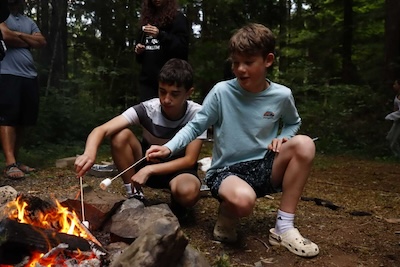
Kids are empowered to contribute to and lead their Jewish community at camp. (photo from Camp Kalsman)
2. Camp friendships last beyond the summer
After the laundry has been washed and the camp trunk put away, friendships endure. The intensity of the shared experience and communal living of camp expedites and deepens relationships. Camp is one easy entry point into a lifelong Jewish community. As kids grow, opportunities arise to increase their connections with Jewish peers through congregational and national youth groups, Israel travel, social justice programs, and much, much more. Many alumni of Jewish camp have found that the friends they make during the summer stick with them through college, young adulthood, and beyond.
3. An immersive Jewish community
Campers live in Jewish time; they are exposed to adult Jewish role models, Jewish peers and Jewish friends from different places, as well as the rhythm of Jewish rituals. These Jewish connections are extremely powerful. Campers experience joy in a Jewish community, develop confidence in their Jewish identity and forge long-lasting connections. Nowhere else do campers have the opportunity to experience Judaism infused into daily life and reinforced by a community of Jewish peers.
4. Camp ends, but Jewish community continues
Children who attend Jewish summer camp are more likely to identify as Jewish adults and actively engage with their communities. The experience of living in an immersive Jewish community has a deep and profound impact, which lasts into adulthood.
After the laundry has been washed and the camp trunk put away, friendships endure. (photo from Camp Kalsman)
5. Jewish camp addresses the whole camper
Children learn confidence, skill-building and socialization by living in a community. They learn how to operate in a diverse group of peers, face new situations and overcome challenges on a daily basis. At camp, adult role models and mentors create safe spaces for campers to grapple with complex ideas based in Jewish values, texts and traditions – topics that secular schools and camps might not be able to address. Camp can provide balance by creating space for spiritual, emotional and physical growth for campers.
6. Camp helps kids succeed
Camp is all about fun and real-world learning. Campers who return to camp as staff members can create opportunities to advance themselves professionally. Many staff from Jewish summer camps have found that their experiences have helped them jumpstart their careers, establish their college networks and meet new people.
A longer version of this article appears on reformjudaism.org, the website of the Union for Reform Judaism. URJ Camp Kalsman, located in Arlington, Wash., serves 600-plus campers ages 7-17 from Western Canada and the Pacific Northwest every summer. For more information, visit campkalsman.org or email [email protected].
Jewish summer camps, like Camp Solomon Schechter near Olympia, Wash., aim to give participants a lifelong sense of belonging, leadership, joy and identity. (photo from campschechter.org)
The California-based Shimon Ben Joseph Foundation, commonly known as the Jim Joseph Foundation, has prioritized investment in what it calls “powerful Jewish learning experiences,” in its effort to enable “all Jews, their families, and their friends to lead connected, meaningful, purpose-filled lives and to make positive contributions to their communities and the world.” This commitment is advanced by signature grantees that provide such experiences to young people: BBYO, Foundation for Jewish Camp, Hillel, Birthright Israel, and Moishe House.
Over the last few years, the foundation has partnered with Rosov Consulting to bring a consistent research lens to the experiences provided by these various organizations. The goal of this partnership has been: (1) to identify both the distinct and common contributions made by each organization to participants at different stages of their young lives, and (2) to identify the components of the experiences they provide that make them so powerful.
Rosov’s latest report, Powerful Jewish Learning Experiences, was released in September. Through a series of 10 virtual focus groups, researchers interviewed 48 people, most between the ages of 25 and 35, who had participated in some combination of Jewish camp, youth groups, campus life and post-grad community.
Program alumni remember powerful Jewish learning experiences as having deep personal significance. They learned something new and important about themselves, locating themselves in relation to a larger entity – typically, the Jewish people. They sensed their lives being propelled forward, often in new directions. These experiences didn’t speak to all the alumni in the same ways or with the same force, but all five experiences, without exception, were described in these terms by many. In their own words, alumni recollected:
Youth group: “[feeling] so fulfilled … I had a purpose in some sort of way in that time that wasn’t school or wasn’t what I had to do.”
Camp: “a big sense of independence … getting to do things I personally never had a chance to do.”
College: “[being] taught a lot for my future in terms of, for me personally, building a Jewish life and a Jewish home.”
Israel: “[Gaining a] whole [new] perspective of what it was to be Jewish and to feel accepted. [It was] the first place I felt truly at home.”
Moishe House: “finding my own way in … having a place to be and be Jewish … that completely changed my life.”
The settings in which these powerful Jewish learning experiences occur are not simply substitutes for one another. They take place at different moments in a young person’s life and are infused by the distinct social and educational priorities associated with that developmental moment. At overnight camp, for example, this involved experiencing a model of Jewish community that was either absent or just very different at home. The specialness of the camp community was emphasized by the physical distance of camp from home and the temporal boundedness of the camp experience during specific months of the year.
The experiences provided by the grantees are all highly experiential, involving learning through doing. This outcome was strongly associated with spending time at overnight camp, in large part because the rhythm of camp runs from morning to night, and from Shabbat to Shabbat; it includes mealtimes, prayer times and other opportunities for learning through the performance of ritual.
“I gained the value of joyous Judaism, social connections … having a community of people that you get to just be with, [is] just amazing.” (photo from campschechter.org)Nearly two-thirds of study participants attended camp at some point. Camp is a place to stretch, to experiment and to explore new experiences, in Jewish and personal terms. This is the theme to which alumni consistently returned most often when talking about camp. They recollect experiencing joy and Jewish learning, and they celebrated the friendships formed, but it was the personal growth they experienced thanks to being given the space to explore that exceeded all other outcomes.
Participant perspectives included:
• “[I was] pushing boundaries in a very safe environment. That’s something that happened at my camp.”
• “I think for me a lot of [the takeaways from camp] were a big sense of independence.… [Camp] really got very different from school…. It gave us a time to just do all the fun things that you don’t always get to do that I personally never got a chance to do. It was a lot of new things that I saw that I’d never seen before or new experiences.”
Their reflections converged around the many lifelong benefits of the Jewish camp experience, such as:
Jewish learning: “I feel like there’s a lot of prayers that I know in my core because of camp and not necessarily because of Hebrew school and Sunday school.”
L’dor v’dor: “All of the camp songs that you’d sing on Shabbat … you take with you for the rest of your life. And I have a son who goes to Jewish preschool now and he is singing these songs, and we sing them together in the car.…”
Independence, joy and friendship: “I gained the value of joyous Judaism, social connections … having a community of people that you get to just be with, [is] just amazing.”
Connecting to Jewish identity: “Camp really helped me understand the importance of Jewish community and continuing involvement with the Jewish community after my bat mitzvah. If it weren’t for camp, I would not have done Hillel in college. I would not have joined Moishe House.”
Belonging, leadership, joy and identity – four of the core building blocks highlighted in the study – were central themes at Foundation for Jewish Camp’s 2024 Leaders Assembly, which brought together more than 800 Jewish camp leaders and advocates from around the world on Dec. 9-11 in Chicago. At the gathering, Rosov Consulting shared more findings from this study, which can be found at jewishcamp.org.
– from Powerful Jewish Experiences,
compiled by Rosov Consulting (September 2024),
and Foundation for Jewish Camp
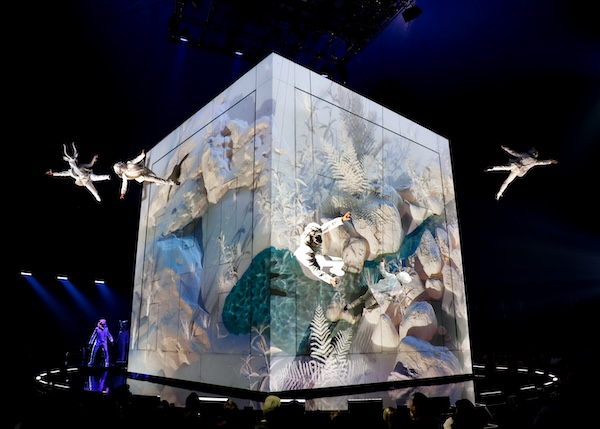
Cirque du Soleil’s ECHO, at Concord Pacific Place untilJan. 5, is just beautiful. (photo by Jean-François Savaria)
Beautiful. Cirque du Soleil’s ECHO, at Concord Pacific Place until Jan. 5, is just beautiful – the costumes, the movements, the music, the projected images. As with most Cirque productions, there is a minimal storyline. This one follows heroine Future and her dog Ewai as they try to restore balance to the world, between humans, animals and the environment. It is an optimistic, fantastical show, an uplifting break from a reality that sometimes seems hopeless.
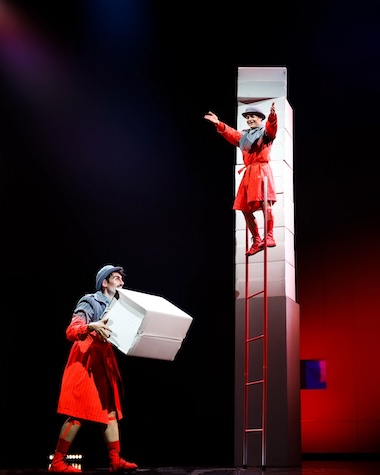
“Double Trouble,” Cirque du Soleil’s ECHO. (photo by Jean-François Savaria)
The performance the audience sees under the Big Top is, of course, as much the result of many behind-the-scenes and front-of-house workers as it is the performers’ hours of practise and great skill. Every Cirque show is a highly orchestrated experience, international in scope. According to its website, since Cirque du Soleil’s creation in 1984, “more than 400 million people have been inspired on six continents and 86 countries. The Canadian company now employs more than 4,000 employees, including 1,200 artists from more than 80 different nationalities.”
One of those employees is Jewish community member Sarah Sananes, who was born in Florida but grew up in Montreal. She and her siblings attended Hebrew Foundation School for elementary.
“We learned to read, write and speak Hebrew, attended synagogue every Friday morning at Congregation Beth Tikvah, and learned both French and English at the same time,” Sananes told the Independent. “I was young, but I remember loving everything I did and learned during my time there, especially getting to eat TCBY [kosher yogurt].
“To this day, my father still uses the menorah I made, which consists of bolts to hold the Hanukkah candles. We celebrated Shabbat every Friday and attended synagogue for the High Holidays. It truly is a beautiful religion to celebrate. As I grew up, I still celebrate the High Holidays and attend Shabbat dinners whenever I can. I continue to educate myself on my religion even as I get older and don’t always have the chance to celebrate like I used to when we were younger.”
Sarah Sananes is a guest experience supervisor with Cirque du Soleil’s ECHO, which is in Vancouver until Jan. 5. (photo from Cirque du Soleil)
Sananes entered the workforce right out of high school.
“I was always more of an active kid than a quiet one who liked to sit in class. This led me straight into the hospitality industry, where I quickly fell in love with the fast pace,” she said. “I worked hard to climb the ladder into assistant manager roles, which led me to managerial positions. I take great pride in my work ethic and leadership skills, even to this day. This is one of the main things that led me to Cirque, and has kept me here. Whether you are presented with a happy guest or an angry guest, the outcome can always be positive, depending on the way you see and handle the situation. One of my favourite quotes is: ‘We can’t control the winds, but we can adjust the sails.’”
Sananes is now a guest experience supervisor with ECHO.
“I first began my journey with Cirque du Soleil in the summer of 2022. I was hired when I started working as the on-site manager on another show, named KOOZA, with the local staffing agency. Once the summer ended, I returned to my job as an entrepreneur,” said Sananes, who owns an employment agency.
“The following summer, I heard Cirque du Soleil was launching a brand new show and, sure enough, I returned once again to manage the local staff. As the Montreal run neared its end, the guest experience position on ECHO became available and, after my interview, I was asked to join the team!”
Sananes had so loved working on KOOZA that, she said, “When ECHO came out, I knew, if it was anything like KOOZA, I would love what I did, everywhere I did it.”
As to what her job entails, it’s a lot.
“The guest experience team is the team that manages everything that has to do with guests in the front of house. Our team is made up of nine supervisors across six departments, which are box office, concierge, merchandise, food and beverage, VIP, and usher,” she explained. “We also have an inventory supervisor and then myself. Each supervisor manages their respective department every day, whereas my role is more like the chameleon of supervisors. Each day, I morph into a different role. Within my time here, I have learned the ins and outs of every single department, being able to cover or assist any of my co-workers whenever and wherever needed.
“Another part of my role is being the direct link between our partnerships and our visibility departments at Cirque du Soleil’s international headquarters located in Montreal and the tour,” said Sananes. “I make sure all our signage and branding are properly managed and set up. This includes physical signs and all digital assets. Lastly, due to my previous experience as an on-site manager, now being on the other side, I work closely with the local staffing agency and their on-site team to ensure they are able to deliver what we need to successfully operate our show call operations, day in and day out. Some markets are tougher than others when hiring and managing local staff, but it wouldn’t be fun and rewarding if it was always easy!”
Sananes has worked in many markets since ECHO launched in Montreal in April 2023. She has been with the show since the beginning, traveling with it from Montreal to Washington, DC, Atlanta, Ga., and Miami, Fla., before returning to Canada, with performances in Toronto and in Gatineau, Que., among other places.
“Human Cradle,” Cirque du Soleil’s ECHO. (photo by Jean-François Savaria)
“After five different cities, we landed here in beautiful British Columbia’s Vancouver,” said Sananes. “My plan is to remain on tour and continue to travel with the show for the foreseeable future. I’ve already got my cowboy boots ready for Houston, so I don’t plan to go anywhere just yet! One of the beautiful perks about being on tour is being able to travel to all these places I’ve never been before, some of which I probably wouldn’t have gotten to see at all.”
When asked if there was anything else she’d like to tell JI readers, Sananes expressed gratitude for her parents.
“My father was born in Jerusalem and my mother was born in Canada. They have both taught me very valuable lessons in life, from when I was little until this very day, and, I pray, for all the days to come,” she said. “Because of my mother, I am tough, courageous and kind. Because of my father, I am resilient, fearless and wise. To my mother and my father, thank you for teaching me the importance of being independent, while still being able to spread love to all those around me.”
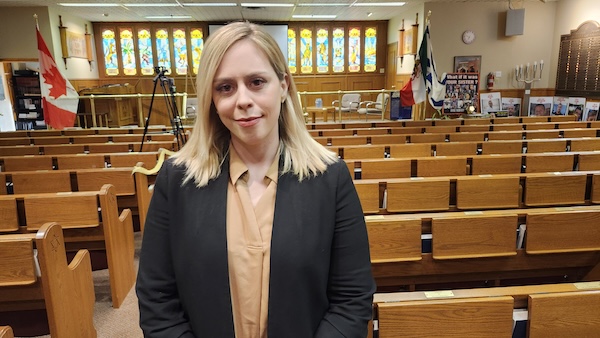
Left to right: Haleema Sadia, Emily Schrader, Christine Douglass-Williams and Goldie Ghamari formed the panel of the Dec. 4 event in Toronto called The Head of the Snake, the Islamic Republic of Iran. (photo by Dave Gordon)
American-Israeli journalist Emily Schrader believes it took years for Canada to designate the Islamic Revolution Guard Corps a terror group, as it did in June, because of “moral cowardice.”
She said other Western countries have “refuse[d] to stand up for moral values and their countries and civilizations” and that is “all the reason to vote for those who will protect democracies and freedoms in Canada.”
Schrader spoke in Toronto at the Lodzer Centre on Dec. 4. She was part of a panel with cofounder of TAG TV Haleema Sadia, Iranian-born Ottawa-area Member of Provincial Parliament Goldie Ghamari, and journalist Christine Douglass-Williams, in a talk called The Head of the Snake, the Islamic Republic of Iran.
Schrader is an anchor on ILTV in Israel, co-hosts a panel show on Jewish News Syndicate, and is a contributor to ynetnews.com. In her opening remarks, she spoke of growing up “nominally pro-Israel” until her time at the University of Southern California as an undergrad student. “I didn’t realize how much people passionately hateIsrael and Jews until I went to university,” she said.
Her first time “really seeing this visceral, irrational obsession with the Jewish state, which really is an obsession with Jews,” was during an Israel Apartheid Week, held by Students for Justice in Palestine. She said she was “irritated” by the “lies they spread across campus.” She joined Students for Israel in response to “this obsessive hatred towards Israel.”
“I always joke that Students for Justice in Palestine – the best thing they ever did was make me the biggest Zionist in the world,” said Schrader. “I would not be Israeli today if it was not for Students for Justice in Palestine. So, I guess I have them to thank for that.”
It was only after making aliyah that Schrader became aware of the historical connection between Iranians and Jews, going back to Cyrus the Great (circa 590 – 529 BCE), who allowed the Jewish exiles to return to the Holy Land. Iranians and Israelis are “really fighting the same evil,” she said.
American-Israeli journalist Emily Schrader spoke in Toronto on Dec. 4. (photo by Dave Gordon)
In 2024, Schrader founded the Israeli Iranian Women’s Alliance (IIWA) to promote women’s advancement and democratic values.
She said Iran’s human rights violations have gotten worse. “There are more restrictions and gender apartheid than we have ever seen before.” She added: “The world is not paying attention because of everything else that’s been going on.”
Ghamari said Canada has been “courting the Hamas votes,” meaning immigrants from countries with “fundamentally different values than Canada.”
Schrader added that “the left overestimates the values of these voters” and “they are against the West – whether it’s a right or left government – so courting them is a fundamental mistake.”
“One of the best ways to support Iranians is to support our king,” Ghamari said of exiled Crown Prince Reza Pahlavi – son of the late, deposed shah – who visited Israel in April 2023. “He is the one true voice of the Iranian people. He has 90% support,” she said.
A way to battle the anti-Israel forces is to build connections with like-minded allies, said Douglass-Williams. “They want the outreach just as much as the Jewish community.”
Ghamari seconded that: “All your support gave me the motivation to speak out and speak up.”
Sadia’s advice to win hearts and minds was to “multiply the voices” on social media.
Douglass-Williams alerted the audience that Venezuela has now sold a million hectares of land to the Iranian regime. “The IDF says they are developing weapons there that could reach America and Israel,” she said.
The Dec. 4 talk was organized by the Canadian Antisemitism Education Foundation, OneGlobalVoice, Allied Voices for Israel, Tafsik, and Canadians for Israel.
In an exclusive interview with the Jewish Independent, Schrader said the new Trump administration will be “excellent” on cracking down on Iran. She believes that moral-minded countries need to “de-recognize” the Islamic regime and ramp up sanctions. “It’s going to be a tall order,” she said of countries who have economic ties.
As for the wave of anti-Israel protests, they are primarily concerned with “support for terrorist organizations and an attempt to infiltrate and undermine Western values and the West,” Schrader told the JI.
If they cared about Palestinians, she said, they would protest the estimated 4,000 Palestinians killed in Syria by the Assad regime during that country’s civil war, she said. The Islamic regime’s “vast majority of the victims” are Arab and Muslim, but again, these protesters are silent.
Law enforcement, she believes, is to blame for allowing “multiple antisemitic assaults and attacks,” because “there’s zero accountability for these crimes that are being committed with a racist, hateful, pro-terror agenda.”
“You have to deter it, or it will only grow,” said Schrader. “And we see that happening. It’s a year after Oct. 7 and, I would argue, that it’s worse.”
Dave Gordonis a Toronto-based freelance writer whose work has appeared in more than 100 publications around the world. His website is davegordonwrites.com.
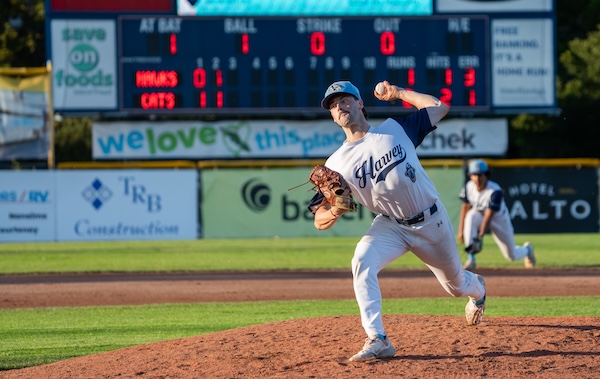
Jake Finkelstein’s repertoire includes a fastball, curveball and changeup. (photo by Justin Morash)
Pitcher Jake Finkelstein is looking forward to his third season in the Victoria HarbourCats lineup next summer.
Finkelstein, a 2020 King David High School graduate, told the Independent the decision to return to the region was a “no-brainer” and that it “feels great” to be coming back. During his first year with the club in 2023, the HarbourCats took home the WCL North Division title and nearly won the WCL championship. The team was knocked out during the 2024 North Division semifinal series, leaving what Finkelstein described as a “tremendous hunger to win it all” in 2025.
The HarbourCats are part of the West Coast League, a collegiate baseball circuit that was started in 2005.
“The past two summers I’ve played there have been some of the most fun I’ve had,” said Finkelstein. “One reason why Victoria is such a great place to play is the fans. They create one of the most electric atmospheres in all of summer ball and it’s a privilege to get to play for a city that cares about the team the way Victoria does.”
The left-handed pitcher credits Victoria head coach Todd Haney, a former Montreal Expo, for recruiting not only players who can perform at a high level but who are team players, making it very easy to build relationships during the short WCL summer season.
Jake Finkelstein has played two summers with the Victoria HarbourCats. (photo by Christian J. Stewart)
“Victoria is also such a great place to play because of the coaching staff. They do a great job of keeping everyone on the same page while making sure we enjoy our summer. The HarbourCats are a team that wins, and I believe that the relationships that the players gain with one another, as well as the coaching staff, are a major reason as to why,” Finkelstein said.
Now spending the academic year at Georgia Gwinnett College (GGC) in Lawrenceville, a suburb northeast of Atlanta, Ga., Finkelstein has also played for Montana State University Billings and Spokane Falls Community College.
The move to GGC was a big decision for Finkelstein. However, after numerous conversations with the GGC coaching staff and some with the players, the lure of suiting up for a college baseball powerhouse ultimately won him over.
“GGC baseball has one of the most knowledgeable coaching staffs in the nation,” said Finkelstein.
“While winning is a huge part of the program, and our track record proves it, development and unlocking an athlete’s full potential are the top priorities. Everything we do on a day-to-day basis reflects that,” he said.
“Speaking with my now-friend and -teammate Austin Testerman before I decided on GGC, I was able to get a glimpse into the mindset that one must possess and the way one must act to be a GGC Grizzly. This was my selling point. I didn’t know much about the minor ins and outs of the program, but I knew that I was walking into a place where I had a chance to be a part of something special.”
The 22-year-old HarbourCat veteran, whose repertoire includes a fastball, curveball and changeup, sees his biggest strength as being able to throw strikes consistently. A pitcher’s job, he said, is not about simply throwing hard, but getting the ball to “end up wherever you want while making it do weird things.”
That control, coupled with composure, according to Finkelstein, are tremendous assets on the mound.
“Being a pitcher is very stressful and can be very humbling at times,” he acknowledged. “I’ve always noticed that the best pitchers keep the same body language and demeanour no matter what is happening in the game. Even if a home run was just hit off of them, they’re right back at it, throwing strike one to the next guy. That is what I pride myself on and try to embody every time I am on the mound.”
As he continues to hone his craft, Finkelstein would like to finish innings on fewer throws.
“Getting every batter you face out, but throwing five or more pitches to each of them adds up and tires you out. Being able to keep your pitch count down is essential to maintaining longevity on the mound. So, I would say that my biggest facet of pitching that I am working on right now is being able to get hitters out early more consistently,” he said.
Turning professional is Finkelstein’s ultimate goal – whether it be affiliated, independent or overseas baseball. Academically, he is working towards a degree in business management with a minor in finance.
The HarbourCats are also excited to have Finkelstein back for another summer.
“Jake’s a great kid. First and foremost, he is a quality individual who has been a tremendous teammate and a competitor. He is a pitcher not a thrower, he wants to get hitters out,” said Jim Swanson, the HarbourCats managing partner.
“He works a good curve that is especially problematic for left-handed hitters and his fastball has more than enough to get guys out,” said Swanson. “He has always played very well for us and been a gamer.”
For Swanson, a game during the 2023 divisional playoffs against the Bellingham Bells stands out. Victoria trailed 6-0 when they brought Finkelstein in and, thanks to his tenacity on the mound, and HarbourCats hitters finding their way around the bases, Victoria came back to win 9-7.
Finkelstein, a college junior, earned academic all-America team accolades at NCAA Division II Montana State University Billings and is a member of Chi Alpha Sigma, the National College Athlete Honour Society. (His sister Leann played collegiate softball for Long Island University Post and Simon Fraser University.)
Last season, Finkelstein made 11 appearances, including nine starts, threw 38.1 innings, struck out 23 and won two games.
The HarbourCats 2025 home opener is June 6 against the PortAngeles Lefties.
Sam Margolishas written for the Globe and Mail, the National Post, UPI and MSNBC.
Clayton Lee explores his childhood obsession with Jewish professional wrestler Bill Goldberg in his The Goldberg Variations, which is at Waterfront Theatre Jan. 30 (photo by Kenneth Koo)
PuSh International Performing Arts Festival runs Jan. 23-Feb. 9. This year’s run marks the festival’s 20th year.
PuSh 2025 features more than 25 presentations, including 20 original performance-based productions; five animated parties and cabaret-style events; two film events; and two artist residencies, one of which will culminate in an open studio showing by international guest artists. In addition to a strong Canadian presence, with 13 presentations, the PuSh Festival includes works by artists of Belgium, South Korea, Brazil, United Kingdom, Uruguay, France, Denmark, Italy, Taiwan, the United States, Sweden and Democratic Republic of Congo.
Among the many presentations this year are at least two with a Jewish angle.
On Jan. 30, 9 pm., at Waterfront Theatre, The Goldberg Variations by Clayton Lee (Canada/United Kingdom) will have its Western Canadian premiere, with a talkback following the show.
Through an unapologetic investigation of desire, power dynamics and identity, Lee explores his childhood obsession with Jewish professional wrestler Bill Goldberg and the impact it has had on his sexual and romantic history. The perplexing crossroads between dominance, submission, heartbreak and vulnerability are laid bare in this candid and unconventional performance where fantasies are both indulged and deconstructed.
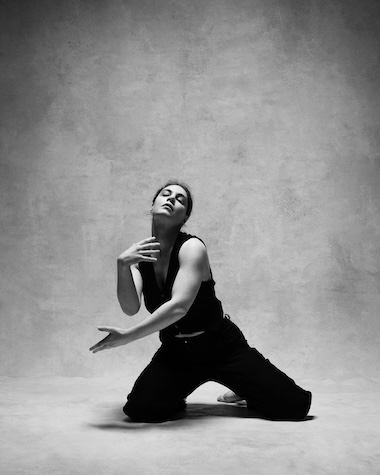
Rebecca Margolick is part of Dances for a Small Stage, Feb. 4 and 5, which showcases 10 experimental, short dance pieces by femme and non-binary artists from different generations and dance practices. (photo from PuSh)
On Feb. 4 and 5, 6:30 p.m., at Please Beverage Co., Jewish community member Rebecca Margolick is part of Dances for a Small Stage. Presented by PuSh Festival and Small Stage, the event showcases 10 experimental, short dance pieces by femme and non-binary artists from different generations and dance practices. The other artists participating are Claudia Moore, Cori Caulfield, Jessica Dawn Keeling, Nasiv Kaur Sall, AJ Simmons, Nicole Rose Bond, Burgundy, Ray Young, Adreane Leclerc and Bettina Szabo. There is a post-show talkback Feb. 5.
Other highlights for the 2025 PuSh include BOGOTÁ (Jan. 31 and Feb. 1) by Montreal’s Andrea Peña & Artists, which constructs a brutalist landscape from choreography inspired by Colombia’s political and spiritual heritage, and Dimanche (Feb. 6-8) by Belgium’s Focus and Chaliwaté companies, which paints a sharp yet tender portrait of humanity caught off guard by devastating natural disasters.
PuSh 2025’s animated parties and cabaret-style events include Van Vogue Jam’s Dune Wars Kiki Ball (Feb. 2), opening and closing parties with surprise performances, and the return of the frank theatre’s QT Cabaret at Club PuSh (Jan. 29).
Rounding out the lineup will be two film events: a free marathon screening featuring Brazilian actress Renata Carvalho, the artist behind PuSh’s Transpofagic Manifesto (Feb. 9), and a Born in Flames (Lizzie Borden) film screening (Feb. 6).
The festival’s Industry Series for arts leaders (producers, presenters, curators, directors, and more) returns for 2025, from Jan. 28 to Feb. 2. PuSh, in partnership with Playwrights Theatre Centre and Festival TransAmériques, will also offer free artistic consultations for local artists with invited national and international dramaturgs.
Ticket prices for most PuSh shows range from $15 to $39. Visit pushfestival.ca or call the PuSh Festival info line at 604-449-6000.
A photo of Reuven Rashkovsky from the book An Improbable Life: My Father’s Escape from Soviet Russia, by his daughter, Dr. Karine Rashkovsky. Here, Reuven is pictured with a MIG 19 Soviet fighter plane. At 18, he was drafted into the military, conscripted for three years.
Perusing the pages of the Independent’s predecessor, the Jewish Western Bulletin from the 1960s and ’70s, demonstrates the centrality of the movement for Soviet refuseniks in Jewish life of that time. Jewish communities in North America and elsewhere in the West were deeply devoted to the Jews behind the Iron Curtain who sought to emigrate to Israel and other places of freedom.
That movement, ultimately, was a largely Western phenomenon. In a new book, Vancouver’s Dr. Karine Rashkovsky shares her family’s story. An Improbable Life: My Father’s Escape from Soviet Russia, and others of its still-emerging genre, open the narrative to the stories from the other side of the Iron Curtain, those of the refuseniks who Western activists were trying to free.
The Soviet Union, Rashkovsky writes, was a country based on an ideology intended to eliminate ethnic and religious lines, but which counterintuitively insisted that every citizen’s internal passport indicate their nationality – and for Jews, regardless of their geographic origins, their nationality was “Jewish.” And that “nationality” meant slammed doors in the face of opportunity for those carrying that mark.
The book is a personal testimony – written by the daughter in the first person from the perspective of her father, Reuven – but it is also part of a larger story of the struggle of refuseniks and the lives they eventually made for themselves.
After his escape from the Soviet Union, Reuven fought in the Yom Kippur War, attained a PhD in Israel and France, and both he and his wife narrowly avoided being on the hijacked Air France flight that was the centre of the famous raid on Entebbe, Uganda.
In the preface, Reuven calls his life, “a kaleidoscope of hardships and failures.” But there are plenty of successes also.
Reuven’s parents were born in Bessarabia, in what is now Moldova. It was a highly multicultural area and they spoke German, Romanian, Yiddish, Hungarian, Ukrainian and Russian. When the Romanian fascists took over their town, the family fled, but went east to Odesa, rather than to Palestine or America.
When Germany invaded the USSR, Reuven’s father was drafted into the Red Army. His facility with languages put him in the intelligence unit and he assisted in interrogating prisoners of war. He was severely injured during a Luftwaffe bombing raid and, because he was an officer, the family was evacuated to a military hospital in Uzbekistan. There, he learned to walk again and returned to service, participating in the capture of Berlin, in March 1945. Reuven was born in Uzbekistan, in November 1945.
After the war, the family relocated to Belgorod-Dnestrovsky (now in Ukraine but under shifting sovereignty for centuries and known by at least 13 different names and transliterations over time). His father was a police officer and his mother worked 25 years in a fish cannery, which was relatively good fortune for the family in terms of providing protein, thanks to fish she smuggled out of the factory in her bra.
Eventually, they would be a family of seven, with five surviving children. At age 6, Reuven was responsible for taking care of his younger siblings all day while the parents were at work.
In response to antisemitic bullying, Reuven became a scrapper, taking his malnourished body to the gymnastics coach at school and forcing the coach, through the power of determination, to take on the unpromising-looking young Jew. As his biceps grew, the bullying receded. But the discrimination became more insidious and systemic.
In the home of a more well-off classmate, Reuven discovered books. Together, they devoured foreign works in translation, “free from Communist Party propaganda and boring Soviet patriotism.” This set Reuven on a trajectory of skepticism and dissidence that could have ended badly (and, along the way, did have bad moments – but ultimately resulted in freedom and a very successful life in the West).
Reuven’s teachers ascertained that he wasn’t a fan of the Communist Party and so he did not get a favourable reference for university. After 10th grade, he got a job at a slaughterhouse, then became an apprentice electrician. He began night school, where his facility with numbers shone and where his politics were not known and he might get a recommendation for university.
At 18, he was drafted into the military, conscripted for three years.
Eventually, the American allies of the refuseniks forced the American government to put conditions on the sale of American wheat, upon which the Soviet economy depended. The 1974 Jackson-Vanik Amendment tied trade in this necessary commodity to visas for Soviet Jews. Until then, of the several million Jews in the USSR at the time, just a few hundred had been permitted to leave.
Reuven was part of a group of about 25 Jewish youths who decided to hold a hunger strike to demand emigration. They took a petition to city hall and police soon blocked the exit. They were taken before authorities and subjected to “a long lecture on how inappropriate it was to think about leaving our Soviet paradise for Israel, that aggressor capitalist country, a puppet of America.”
When an interrogator threatened the group with imprisonment, one of the dissidents explained to the KGB officers why that was not a good idea.
“She calmly explained to him that we’d communicated with Western journalists and passed them our names and plans for the hunger strike. We’d also alerted these journalists to expect a phone call before midnight to tell them what had happened today. If we didn’t call them, they would tell the Western media about us. Katya went on to tell the colonels what would happen if we were arrested: America wouldn’t sign the contract for selling wheat to the Soviet Union, which would harm the whole country. And Moscow would come down hard on Odesa’s KGB for causing such a disaster.”
The next morning, Reuven and his family went to the government offices first thing. The entire family was granted the right to emigrate except for Reuven’s brother Fima, because he was serving in the army. But the authorities finally agreed that everyone would be allowed to emigrate after Fima’s military service. Reuven’s parents refused to abandon their son and decided that Reuven and his sister Hanna should go on ahead to Israel and the rest would follow later, which they eventually did.
Traveling through Moscow, at New Year’s 1971-’72, Reuven was put up at the apartment of a friend’s mother. There, he met Fania, who was visiting from Kyrgyzstan. She didn’t know anything about Israel and it had never crossed her mind to emigrate. A few shots of vodka in, Reuven told her he would be waiting to marry her if she ever decided to come to Israel.
“It was crazy of me to say such words – to offer marriage to the most innocent girl I ever met and one I had only known for hours – on my last evening in the Soviet Union,” he says. “Of course, I was both very stressed and excited that I was leaving the country, and I had been drinking quite a lot of vodka to relax a bit.”
That was the beginning of a happy 50-something-year marriage that continues today.
Freed of the Soviet Union’s antisemitic shackles, Reuven’s career took off. Hebrew University was looking for a Russian-speaking mathematician to teach first-year students, then he developed a curriculum for high schoolers with advanced math skills. An opportunity landed in his lap to teach at an elite Israeli school in Paris. Friends who had migrated to New York extended an invitation, which led to a side journey to Toronto, where Reuven’s career took another turn and the family became Canadian.
While they were living in Paris, Reuven was unable to attend his brother’s wedding in Israel, in June 1976, but Fania went. On his way to the airport to pick her up on her return, Reuven heard that terrorists had hijacked an Air France plane to Uganda. Reuven was beside himself. It turned out, Fania had missed the plane and was rebooked on a later El Al flight – but jammed phone lines prevented her from notifying Reuven for several days.
Jews of a certain age remember the fight for Soviet Jewry. The Rashkovskys’ book, An Improbable Life, is a story of what they were fighting for.
Rashkovsky is part of the JCC Jewish Book Festival on Feb. 24, 6 p.m., at the Jewish Community Centre of Greater Vancouver, along with Sasha Vasilyuk, author of Your Presence Is Mandatory, a debut novel, based on real events, about a Ukrainian World War II veteran with a secret that could land him in the Gulag, and his family who are forced to live in the shadow of all he has not told them. Visit jccgv.com/jewish-book-festival.