Skip to content
  • Home
  • Subscribe / donate
  • Events calendar
  • News
    • Local
    • National
    • Israel
    • World
    • עניין בחדשות
      A roundup of news in Canada and further afield, in Hebrew.
  • Opinion
    • From the JI
    • Op-Ed
  • Arts & Culture
    • Performing Arts
    • Music
    • Books
    • Visual Arts
    • TV & Film
  • Life
    • Celebrating the Holidays
    • Travel
    • The Daily Snooze
      Cartoons by Jacob Samuel
    • Mystery Photo
      Help the JI and JMABC fill in the gaps in our archives.
  • Community Links
    • Organizations, Etc.
    • Other News Sources & Blogs
    • Business Directory
  • FAQ
  • JI Chai Celebration
  • JI@88! video

Recent Posts

  • Sharing her testimony
  • Fall fight takes leap forward
  • The balancing of rights
  • Multiple Tony n’ Tina roles
  • Stories of trauma, resilience
  • Celebrate our culture
  • A responsibility to help
  • What wellness means at JCC
  • Together in mourning
  • Downhill after Trump?
  • Birth control even easier now
  • Eco-Sisters mentorship
  • Unexpected discoveries
  • Study’s results hopeful
  • Bad behaviour affects us all
  • Thankful for the police
  • UBC needs a wake-up call
  • Recalling a shining star
  • Sleep well …
  • BGU fosters startup culture
  • Photography and glass
  • Is it the end of an era?
  • Taking life a step at a time
  • Nakba exhibit biased
  • Film festival starts next week
  • Musical with heart and soul
  • Rabbi marks 13 years
  • Keeper of VTT’s history
  • Gala fêtes Infeld’s 20th
  • Building JWest together
  • Challah Mom comes to Vancouver
  • What to do about media bias
  • Education offers hope
  • Remembrance – a moral act
  • What makes us human
  • המלחמות של נתניהו וטראמפ

Archives

Follow @JewishIndie
image - The CJN - Visit Us Banner - 300x600 - 101625

Images

Stepping up to confront hate

Stepping up to confront hate

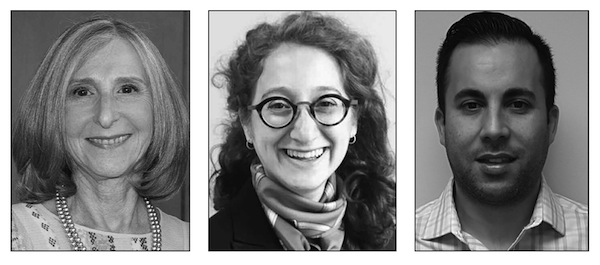
Left to right: Jewish Federation’s Shelley Rivkin, CJPAC’s Kara Mintzberg and CIJA’s Nico Slobinsky spoke at an online event June 17 on topics including how individuals can help fight antisemitism in Canada. (PR photos)

Representatives from three Jewish communal agencies spoke at an online event June 17 on topics including online hate, adoption of the Working Definition of Antisemitism, strengthening supports for the investigation and prosecution of hate crimes, and how individuals can help fight antisemitism in Canada.

Shelley Rivkin, vice-president of local and global engagement at the Jewish Federation of Greater Vancouver, Kara Mintzberg, B.C. regional director for the Canadian Jewish Political Affairs Committee (CJPAC), and Nico Slobinsky, director of the Pacific region of the Centre for Israel and Jewish Affairs (CIJA), spoke about how their agencies are confronting the surge in antisemitism, as well as a range of other topics.

Dafna Silberstein, associate director of the Jewish Federation’s Israel and global engagement department, opened the evening.

“We are here tonight to understand the Canadian political process and learn how you can become more involved, how we can become engaged with a range of issues that matters to you and to our community, and to learn what our community organizations are doing to combat antisemitism,” she said.

Rivkin described Federation’s role as “our community’s primary convener.”

“We are an umbrella organization that represents over 25 organizations locally and an additional number of organizations, approximately 10, in our partnership region [in Israel’s Galil Panhandle] and globally,” said Rivkin.

Federation is the central fundraising arm of the community and runs programs and partners with other agencies to care for the most vulnerable. About one in six Jewish British Columbians lives in poverty, she said, including 13.4% of Jewish children. Federation is also critically involved in supporting Jewish day schools and ensuring continued provincial support for those institutions, she added.

Antisemitic incidents and threats have spiked in recent weeks, coincident with the conflict between Hamas and Israel. Rivkin said the relationships Federation has built with other ethnocultural agencies and communities have proven valuable.

“We have a long history of working side-by-side with other ethnocultural communities,” she said. “These relationships and the supports that we provide are very important so that, when we stand up and speak out on behalf of other ethnocultural organizations, we’re building the bridges and relationships so that they will stand up and speak out on our behalf. Especially this past month, we’ve been very proactive in reaching out to the Indigenous community and the Muslim communities, both of whom faced significant losses over this past month.”

Rivkin also noted Federation’s substantial investment – about $1 million annually – in community security.

“Hate crimes against our community remain one of the highest reported crimes in Canada,” she said. “That was why, in 2016, we made the decision to invest in a director of security that is available and responsive to all of our community organizations, in particular those organizations that have stand-alone facilities.”

Slobinsky explained that CIJA represents hundreds of thousands of voices affiliated with Jewish federations across the country.

“Combating antisemitism, educating Canadians about the central role that Israel plays in Jewish life, strengthening the ties between Canada and Israel and ensuring that Jewish voices are represented in the discussion on a range of issues is some of the long-term work that CIJA does,” he said.

Because of CIJA’s lobbying, he said, the federal government has announced an emergency summit on combating antisemitism, to be led by former justice minister Irwin Cotler.

CIJA also promotes the adoption by governments of the International Holocaust Remembrance Alliance Working Definition on Antisemitism, which Slobinsky calls “the gold standard definition for antisemitism” and a vital tool in fighting antisemitism in Canada and around the world.

“For the first time in our history, we have a definition [of antisemitism] that we as a community champion, that the Canadian government has adopted and now Ontario, New Brunswick and Quebec have adopted,” Slobinsky said. “It’s a very useful tool to work with our elected officials, law enforcement, our partners in other communities, when they ask us what is antisemitism, how do you experience antisemitism, how it manifests.… We are defining what our own discrimination, our own oppression, looks like.”

CIJA is also calling on federal and provincial governments to increase supports for existing hate crime teams in British Columbia and to initiate teams to investigate and prosecute hate crimes in jurisdictions where investigation teams do not yet exist.

Of CJPAC, Mintzberg said: “We are all about political engagement.”

“Our focus is on getting our community interested and involved in politics through volunteering and building relationships with elected officials,” she said. CJPAC, she emphasized, is not involved in lobbying or advocacy; that’s CIJA’s job. “We create programs that reflect the mandate of engagement and highlight the importance of getting involved in Canada’s political process.”

Jewish voters have a significant presence in only about 10 of the country’s 338 ridings. Especially during elections, Mintzberg said, CJPAC acts as a “political concierge,” connecting volunteers with candidates. As Canada is currently governed by a minority government, an election could come at any time. She calls on community members to step up now and be prepared when that call comes.

Mintzberg asked that people pledge to volunteer in the next election and participate in a free, one-hour online training course, which can be accessed via cjpac.ca. Slobinsky invited participants to visit cija.ca/takeaction to find ways to mobilize against antisemitism and support other topics on CIJA’s agenda.

Format ImagePosted on June 25, 2021June 24, 2021Author Pat JohnsonCategories LocalTags antisemitism, CIJA, CJPAC, Jewish Federation, Kara Mintzberg, Nico Slobinsky, politics, Shelley Rivkin
JA’s newest laureates

JA’s newest laureates

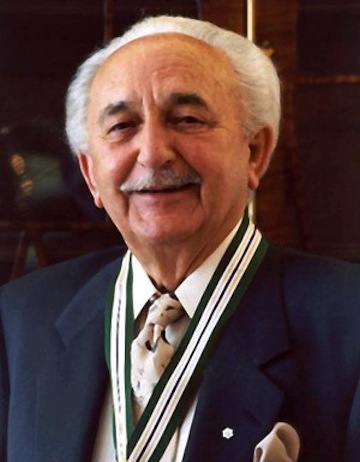
Moderator Greg D’Avignon, left, and newly inducted laureate Gordon Diamond share a laugh at the Business Laureates of British Columbia Hall of Fame celebration May 20. (screenshot)

On May 20, Gordon Diamond – chair of West Coast Reduction Ltd. and Austeville Properties Ltd. – was among those inducted into the Business Laureates of British Columbia Hall of Fame. The ceremony, which was to have been held last year, took place virtually.

The Hall of Fame was created in 2005 by Junior Achievement British Columbia (JABC) to honour local “business leaders whose efforts have shaped our province and country.” It is housed in Vancouver Convention Centre West.

The evening’s other Hall of Fame inductees were Chief Clarence Joseph Louie, chief executive officer of Osoyoos Indian Band Development Corp., and Arran and Ratana Stephens, co-founders and co-CEOs of Nature’s Path Foods Inc.

photo - Morris Wosk, z”l, was honoured as a Pioneer Laureate
Morris Wosk, z”l, was honoured as a Pioneer Laureate. (photo from orderofbc.gov.bc.ca)

Also part of the festivities, in a belated celebration of the hall’s 15th anniversary, was the posthumous induction of 10 Pioneer Laureates. Morris Wosk, z”l, who was president of Liberty Investments Ltd. and M.J. Investment Co., as well as co-founder of Wosk’s Ltd., was so honoured for both his business and philanthropic endeavours. Wosk, who passed away in 2002, “played a significant role in the growth and development of Vancouver” and was a “revered mentor to the next generation of businesspeople.”

The gala included speeches by supporters and representatives of JABC and presentations by some young achievers. There were brief video biographies for each laureate being inducted, and the Hall of Famers spoke with moderator Greg D’Avignon, president and CEO of the Business Council of British Columbia. In that conversation, Diamond pointed to the importance in leadership of building “relationships, trust,” and of being “honourable with the people who work with you, not for you.”

One of the most satisfying aspects of his business at this point, he said, is the people who are running it. “We have family members, we have a team…. I’ll be listening to various meetings and I’m in the background but, if I wasn’t there, what the family and the team has built is that my company will continue without me.”

He said of this legacy, which includes the Diamond Foundation, in addition to the businesses, “You can’t buy that feeling that I have when I look at my plants, when I look at the buildings, and that we’re capable of doing things like this,” he said, referring to supporting JABC and “giving back” to community in general.

The JABC write-up highlights the foundation, which Diamond “set up with his late father, Jack Diamond, in 1984 as a vehicle for his philanthropic aspirations. Since inception, the Diamond Foundation, funded solely by Gordon and his companies, has made donations to hospitals, schools, the arts and other public and charitable causes.”

For more on JABC’s laureates, visit businesslaureatesbc.org.

Format ImagePosted on June 25, 2021June 25, 2021Author Cynthia RamsayCategories LocalTags awards, business, Gordon Diamond, JABC, milestone, Morris Wosk, philanthropy, pioneers
Local kids join in the Chidon

Local kids join in the Chidon

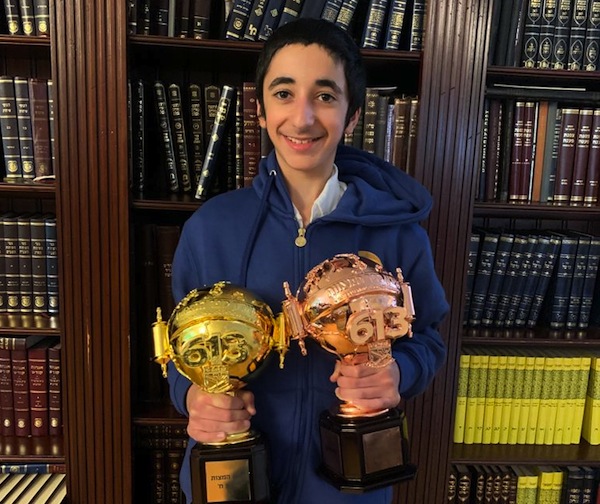
Levi Bitton (photo from Vancouver Tzivos Hashem)

The International Chidon boasts 5,000 participants from around the world and, this year, there were eight participants from Vancouver: Levi Bitton (Grade 8); Liba Baitelman (Grade 4); Yanki Baitelman (Grade 6); Menucha Prinsloo (Grade 8); Shoshana Prinsloo (Grade 5); Yonatan Prinsloo (Grade 7); Miriam Ora Yeshayahu (Grade 6); and Dovber Zhornitsky (Grade 6).

Tzivos Hashem is an international educational program for Jewish children ages 3-13, founded in 1980 by the Lubavitcher Rebbe, Menachem Mendel Schneerson. It focuses on teaching kids about kindness, good deeds and refining their character to become better people and more effective influencers in our community. The program’s goal is to increase Jewish identity and provide children with inspiring and immersive Chassidic Jewish learning through fun, informal activities.

The Vancouver chapter of Tzivos Hashem was established in 2017 as part of Lubavitch BC’s outreach activities and now has approximately 45 children registered in the Sunday morning program. The biggest event of the year and the most highly anticipated part of the program is the Chidon, usually held during a Shabbaton in New York, but virtual this year because of COVID. This event highlights the advanced knowledge and understanding of all 613 mitzvot (commandments) of the Torah, as codified by Maimonides. Kids from around the world compete, and this year’s Chidon took place on May 23. Each of the Metro Vancouver students won a plaque (indicating a grade of more than 80% on the final test) and Levi had the distinction of winning a gold trophy for his grade. He was tested on the fifth book of the Torah, and had the highest mark internationally.

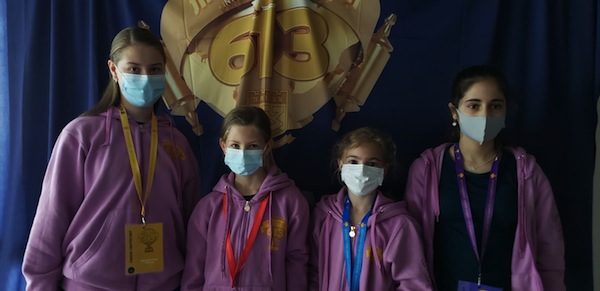
photo - Left to right: Menucha Prinsloo, Shoshana Prinsloo, Liba Baitelman and Miriam Ora Yeshayahu
Left to right: Menucha Prinsloo, Shoshana Prinsloo, Liba Baitelman and Miriam Ora Yeshayahu. (photo from Vancouver Tzivos Hashem)

Riki Oirechman, principal of Tzivos Hashem Vancouver and the local Chidon coordinator, said: “The most important thing is that the kids gain a lot of knowledge. By learning the 613 mitzvot in depth, they gain a deep appreciation and understanding of all the mitzvot, resulting in an increased excitement for, and commitment to, fulfilling them. They work super hard and really commit themselves to fulfilling the Rebbe’s direction and vision.”

Oirechman explained that all the kids in the program study and complete the five books of Torah and master the 613 mitzvot over five years. The Tzivos Hashem program uses the Yahadus curriculum created by the Living Lessons Foundation in memory of Sarah Rohr. It’s a series of textbooks explaining each mitzvah, its source in the Torah and its details.

To participate in the Chidon, students must pass multiple tests. If a child gets a 70% average, they are eligible to join the Chidon Shabbaton. The child with the highest mark in their class gets to represent their class and school at the Chidon competition. On the weekend of the Chidon, the international participants take the final test, which includes everything they learned during the year. Winners receive certificates, plaques, medals and trophies.

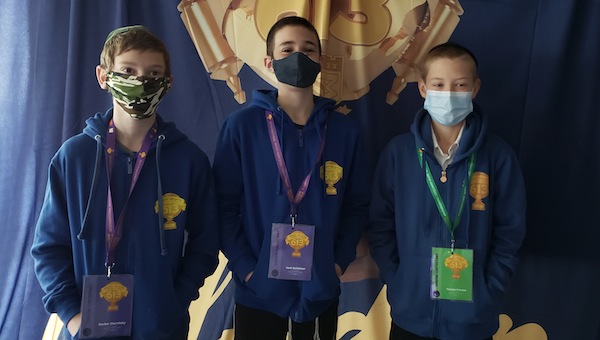
photo - Left to right: Dovber Zhornitsky, Yanki Baitelman and Yonatan Prinsloo
Left to right: Dovber Zhornitsky, Yanki Baitelman and Yonatan Prinsloo. (photo from Vancouver Tzivos Hashem)

“The Chidon includes not only the incredible game show competition, but also an exciting award ceremony. This year, over 100,000 people watched from around the world,” said Oirechman. The Chidon started in 2014 with 54 finalists and eight staff and has grown to 2,414 finalists and 375 staff this year.

Local supporters of the program include founders of the Vancouver Tzivos Hashem chapter, Rabbi Shmulik Yeshayahu of the Kollel and Rabbi Dovid Rosenfeld of Chabad Lubavitch of BC, as well as a grant from the Jewish Federation of Greater Vancouver and local community donors.

For more information about the Vancouver Tzivos Hashem program, email [email protected] or visit lubavitchbc.com/tzivoshashem.

Shelley Civkin is a happily retired librarian and communications officer. For 17 years, she wrote a weekly book review column for the Richmond Review. She’s currently a freelance writer and volunteer, including with Chabad Richmond.

Format ImagePosted on June 25, 2021June 25, 2021Author Shelley CivkinCategories LocalTags awards, Chidon, Dovber Zhornitsky, education, Levi Bitton, Liba Baitelman, Menucha Prinsloo, Miriam Ora Yeshayahu, Shoshana Prinsloo, Torah, Tzivos Hashem, Yanki Baitelman, Yonatan Prinsloo
Russian logic game popular

Russian logic game popular

Irina Zilberstein (photo from Irina Zilberstein)

Many people love the TV show Jeopardy!, which can also be played as a board game and online. There is a variation of it in Russia, which developed independently from the American version. It, too, is hugely popular, not only on television, but there are Chto, Gde, Kogda (What, Where, When) clubs all over the country, and around the world – including here in Vancouver.

“Chto, Gde, Kogda is a game played by teams of five players and a captain,” explained Irina Zilberstein, president of the Vancouver club. “It was invented in the former USSR in the 1970s. Unlike other brain games, which often require lots of factual knowledge, this is a logic game, where a Grade 12 general knowledge of the world plus logic skills are sufficient to play.”

According to Zilberstein, during a game, several teams of six players compete with one another and with the audience. When a question is presented to a team, they have 60 seconds to discuss the possible answers among themselves before they voice the one response they all agreed upon.

“The televised show was very popular in Russia,” said Zilberstein. “In order to get on a team for the televised show, students started university clubs to practise for auditions.… When the USSR fell apart, many people missed the game. It continues on TV in Russia in its original format, but, here, people began creating their own Chto, Gde, Kogda clubs, where they played in tournaments against each other rather than against the audience.”

The Vancouver club was born 15 years ago. Populated by immigrants from the former Soviet Union and played exclusively in Russian, it grew slowly. “At first, we played in community centres, then at UBC, and then we moved to the Perez Centre, as they had a large and readily available space,” said Zilberstein. “For a long time, we had a maximum of five teams, each with six or more players. One of the many challenges, as the club grew, was that crew members brought in their friends, who all wanted to play together. The teams became too large.”

Eventually, the club split into two clubs. “Certain antisemitic attitudes emerged,” Zilberstein recalled. “Some players were mad that Jewish members didn’t want to play on Jewish holidays. The use of a Jewish centre as a meeting location also caused some hostility.”

Zilberstein became the president of the Russian Jewish club. “Our clubs are multi-age, anyone can join. We have teenagers, we have seniors. The game is played in Russian, but several enthusiasts are currently trying to convert it into English. This really helps to attract kids. The English translation and English version of the game are still in pilot stages, with notable leaders in Chicago, New York and San Francisco.”

She also mentioned that the most fascinating games occur when Russian-speaking teenagers, born in North America, participate.

“They consider English their first language and, because of that, they have a unique perspective, which contributes a lot to the teams’ logic and synergy,” she explained. “When they translate the questions in their minds into English, it gives an additional slant to the teams’ problem-solving discussion. The teens’ involvement means that, eventually, they’ll find a way to play in English.”

Zilberstein was proud to say that, right now, there is at least one Chto, Gde, Kogda club in all major Western cities where Russian speakers live, with a heavy concentration in North America, the United Kingdom, Israel and Germany and, of course, in Russia and the former Soviet republics, like Ukraine, Latvia, Uzbekistan and others.

“The biggest Canadian club is in Toronto,” said Zilberstein. “The next one is in Montreal, and the third one is in Vancouver. Most major U.S. cities have a club. The states with larger populations, like California, have 10 to 15 clubs.”

All the teams of all the clubs register with a centralized worldwide governing body, which ranks them internationally. Currently, there are about 51,000 registered teams in the ranking system; this count does not include the teams that play just for fun.

To get a ranking, teams compete. “We have many tournaments of varying sizes,” said Zilberstein. “There are country championships. If your team wins, you get to go to the world championship. There are also big tournaments that are played synchronously internationally, so that teams can compare with each other and get stronger.”

The pandemic has affected the tournament schedules and gatherings, as it has affected most every other aspect of life. “Pre-COVID, we would meet once a week on Sundays and play a tournament,” she said. “Those tournaments were of the online variety. You could register online and then get two or three days to complete the tournament. You had to sign an NDA not to discuss questions online for those days, to accommodate various people’s schedules and time.”

During COVID, they moved the games exclusively online, for safety. “It has actually been a lot of fun,” said Zilberstein. “People from all over the world have joined us for our games via Zoom. After COVID, we will resume playing in person, as that is essential to the cohesive team problem-solving.”

Zilberstein described some of the procedures and how the games work. “Certified question-makers help write the tournaments. There are amazing tournament-makers out there,” she said. “Each tournament usually has 36 to 45 questions, divided into three tours.”

People pay a small fee to participate in the clubs and in tournaments, and part of that money goes towards paying the people who put in the time and effort to create and fact-check the tournament questions.

Zilberstein has enjoyed playing Chto, Gde, Kogda since she was a university student in Russia. In Vancouver, where she has lived since 1999, she works in IT and, in her free time, plays Chto, Gde, Kogda. She also volunteers with JAM, an organization that tries to unite Jewish immigrants for whom English is a second language.

“What is great about this game is that it’s logic-based. No fact memorization is required,” she said. “It’s like gymnastics for your brain, and anyone can play. Often, you only need to know where to start the logical deduction of the question.”

Zilberstein offered an example of a question and its answer. “The question: in many folk stories, tears are compared to gems or semi-precious stones. Russians compare them to pearls; Aztecs to turquoise. What do Lithuanians compare them to? The answer is derived from a following logical progression. Lithuania is on the Baltic Sea. The Baltic Sea is famous for its amber, so the Lithuanian folk tales compare people’s tears to amber.”

She is sure that, as a team game, Chto, Gde, Kogda helps people develop essential life skills. “This involves synergy between team members. I’ve seen teams with superstar individual players, but they don’t have synergy, don’t know how to listen to each other, and end up losing. A big part of creating the synergy is up to the captain. The captain participates in answering the questions, but his or her main job is to make sure the team players listen and build on each other’s ideas rather than contradict each other. A team has to work together to win, and the captain is the key to that victory.”

Zilberstein has been the captain of her team for the past five years.

Anyone who wants to learn more or to participate in the game can contact Zilberstein via email at [email protected] or visit bc-vancouver.chgk.info. The club also has a Facebook and Instagram presence.

Olga Livshin is a Vancouver freelance writer. She can be reached at [email protected].

Format ImagePosted on June 25, 2021June 25, 2021Author Olga LivshinCategories LocalTags Chto Gde Kogda, club, game, Irina Zilberstein, Russia, Russian Jewish club
CABGU gala now sold out

CABGU gala now sold out

Mitchell Oelbaum, national president of Canadian Associates of Ben-Gurion University. (photo from in.bgu.ac.il)

Raising nearly $800,000 at a not-for-profit gala is no small feat, nor is having more than 1,200 people register for an event. When you add a pandemic to the mix and make it a virtual event, one might assume that it would be impossible to come close! But that’s precisely what the Canadian Associates of Ben-Gurion University (CABGU) did in just seven weeks.

“We are a lean but unbelievably keen staff at CABGU, with an incredibly generous and committed group of lay leaders,” said Mark Mendelson, CABGU’s chief executive officer. “Achievements like this make me so proud!”

Mendelson knew that every detail of the event was accounted for, beginning with the star attraction. Israeli actress Shira Haas, star of the popular Netflix series Shtisel and Unorthodox, recently nominated for both a Golden Globe and an Emmy, is the featured speaker. Fresh off her recent press tour for the newly released movie Asia, she will be joining the event live from Israel. Haas will be taking questions from Canada’s Sen. Linda Frum, who will be moderating the conversation along with Prof. Daniel Chamovitz, BGU’s president.

CABGU’s An “Unorthodox” National Virtual Gala for Brain Research at BGU raises money for the Canada Fund to Advance Brain Research. “The fund will go a long way in assisting researchers at the university with conducting groundbreaking and out-of-the-box research,” said Mitchell Oelbaum, national president of CABGU.

“CABGU launched the Canada Fund to Advance Brain Research at BGU in April,” added Mendelson. “We know that there is a strong appetite for the subject of brain research because so many of us know at least one person, if not more, who is impacted by neurodegenerative diseases here in Canada.”

Tickets for the July 7 virtual gala are sold out. However, a few sponsorships are still available at bengurion.ca.

– Courtesy Canadian Associates of Ben-Gurion University

Format ImagePosted on June 25, 2021June 25, 2021Author CABGUCategories NationalTags Ben-Gurion University, Canadian Associates of Ben-Gurion University, fundraising, health, Mark Mendelson, Mitchell Oelbaum, research, science gala
Writing story of the moment

Writing story of the moment

(photo from flickr.com/photos/lukas_photo)

“Identity is a narrative of the self – it’s a story we tell about the self in order to know who we are.” (Stuart Hall)

In our day-to-day lives, we are always telling stories. We tell these stories to one another and in our own minds. A story is anything that we communicate to ourselves. Stories are how we create and communicate content, understanding and relevance between random events and details. I engage with stories through my therapeutic practice, Threads Education and Counselling, by way of narrative therapy.

When you sit down and reflect upon the story that you have been living lately, or what I like to call your “story of the moment,” you begin to shed a mindful light on how you are feeling and experience an embodied sense of knowing.

Ask yourself: what is the story that you have been living lately? The lived stories are often multifaceted; can be contradictory and not linear. Is it a story, to name some possibilities, that includes struggle, hope, perseverance, love, anger, disappointment, grief, overcoming, expansion, growth, steadiness, survival or rapid change? How would you describe your “story of the moment”? What is sitting heavy inside? What are you preoccupied with and why?

It is important to explore your “story of the moment” and start in this place in order to gain insights. We gain insights relationally, through getting inside the stories where they are living and contemplating them. Describe your story in five to seven sentences. Some people like to narrate their stories aloud, others like to write or type them out in a contemplative writing practice through which I guide them.

Once the story is expressed, ask yourself if this is the story you want to be living right now. Explore the reasons why and the reasons why not. This allows a jumping off point into expanding on the “story of the moment” and looking at outside and institutional influences (family, school, work, relationships, location, age, gender, race, class, religion, health) that impact the stories we live. As a trained witness and narrative therapist, it is my job to ask questions of how circumstances, events and your particular social locations are colouring the stories that you are living and breathing inside and alongside.

In my practice, we would then explore if you need to make some significant changes in your life in order to change the story; if there is a way you can shift perspectives to understand your current story in another way; or if there is a new story that you can tell and inhabit in place of the story you have been living inside of and are speaking about.

Mindfulness grounding techniques, thematic prompts and the possibility of expressive art techniques help round out and fully access the complexities of the stories inside.

Here is an exercise I do to explore the narratives of our lives. I ask my clients to create a self-portrait. Many choose to draw themselves, while others stick with words and create rich descriptors based on self-reflection of who and how they are today. This prompt allows the “story of the moment” to appear from the corner of the heart of mind, untangle from the mess in a drawer and reveal itself so that it can be expressed and understood.

Therapeutic letter writing

A letter is a form of written communication addressed to someone that expresses meaningful messages. In the context of counseling, letter writing has a long history and, in the 2007 book Stories as Equipment for Living: Last Talks and Tales of Barbara Myerhoff, Myerhoff writes about how we can be “nourished by the stories being fed back to ourselves” in the genre of a therapeutic letter. Specifically, in the narrative context, therapeutic letters are used with the purpose of creating double story development, where the listener provides an acknowledgement of the problem as well as rich descriptions of alternative stories that were hidden within the dominant “problem” story.

The therapeutic letter, and the practice and process of writing, offers a tangible and layered documented expression of the complex, beautiful, layered and innovative ways in which the people I work with are responding to the problems in their lives. The letters serve to connect them with the many stories that are circulating around them and permeating inside their mind, as well as embodied within them. Simply, therapeutic letters work in tandem with the therapeutic session to connect them with the stories of their lives. Some people I work with actively respond to the letters I send them, with a response in the form of a returned letter, or a poem, drawing or conversation.

Crafting a therapeutic letter demands that the health practitioner carefully and mindfully reflects on the therapeutic conversational sessions that just concluded. For me, letter writing provides me the crucial opportunity and space to critically reflect on my practices and facilitates further growth and insight on how I can craft more expansive questions, as well as opportunities for the people I work with to engage with their stories with me alongside as an active, trained witness.

Letter writing within narrative therapeutic practice enables a deepening of the work of revising an individual’s relationships with the central issues, preoccupations and problems that inform, colour and get entangled up and inside their selves, bodies and lives. Letters are a tangible product that both allows for and demonstrates active listening and validation. It is an evolving and emergent practice, grounded in the contradictory, the complex, the fluid. It has the ability to hold and express multiple stories of the moment that we all hold, carry and live out in our lives.

Dr. Abby Wener Herlin is a feminist narrative therapist who works with tweens and adults, and a social emotional learning/social justice educator. Her website is threadseducation.com. These discussions of narrative therapy were originally posted at health-local.com/author/dr-abby-herlin.

Format ImagePosted on June 25, 2021June 25, 2021Author Dr. Abby Wener HerlinCategories LocalTags education, health, narrative therapy, writing
Indigenous children mourned

Indigenous children mourned

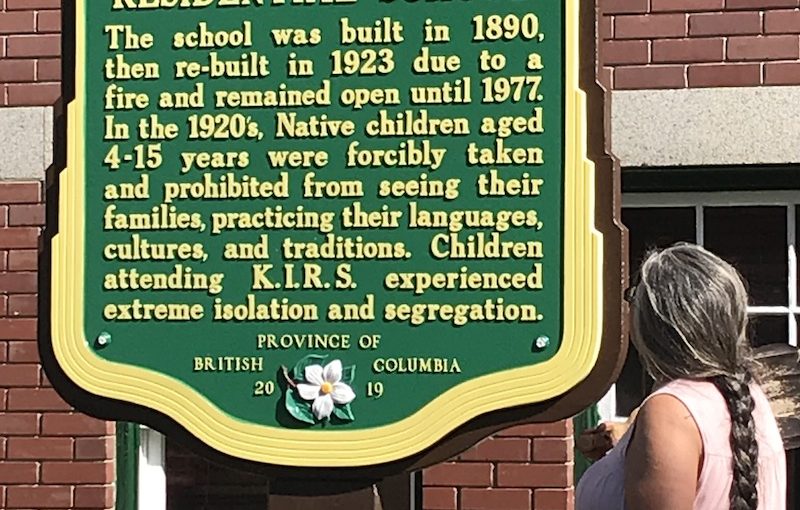
The bodies of 215 children were recently discovered buried adjacent to a former residential school in Kamloops, B.C. (photo from flickr.com/photos/bcgovphotos)

Jody Wilson-Raybould, member of Parliament for Vancouver-Granville and a member of the We Wai Kai Nation, told students at Vancouver Talmud Torah Elementary School last week that most of her family members attended residential schools and she spoke of the tragic legacy of that project, which devastated Indigenous communities for generations.

“Residential schools, these institutions, are a very dark part of our history,” she said, speaking directly to students at a ceremony organized to mourn the 215 children whose bodies were recently discovered buried adjacent to a former residential school in Kamloops, B.C. Most of the city’s rabbis were also in attendance.

“They were in existence for over 100 years in Canada, from the 1870s to 1996, when the last one closed in Saskatchewan. The last one closed in British Columbia in 1984,” said Wilson-Raybould of the residential schools. “These institutions were created by the law of Canada and run by churches. There were 139 residential schools across the country and it’s estimated that 150,00 First Nations, Inuit and Métis children attended the schools, forcibly removed from their homes, compelled to attend, and the purpose of residential schools, as stated by the first prime minister of this country, was to remove the Indian from the child, to get rid of the ‘Indian problem’ in this country.”

She added: “People have asked me, as I know they’ve asked many Indigenous peoples, how do you feel? I feel angry. I feel frustrated. And I feel a deep sense of sadness, because this is not an isolated incident. There will be more that will be revealed and we have to recognize that every Indigenous person in this country has a connection to residential schools and the harmful legacies that still exist. But I am still optimistic. Optimistic that, through young people like you … that we can make a change in this country.”

Speaking of her family’s experiences, Wilson-Raybould singled out her grandmother, who she has frequently cited as her hero, and talked of the courage and resilience her grandmother exhibited.

“Most of my relatives went to residential schools,” she said. “My grandmother, Pugladee, was taken away from her home when she was a very young girl and forced to go to the Indian residential school St. Michael’s, in Alert Bay. She faced terrible violence at that school, but she escaped from that school and she made it home and she is the knowledge keeper in my nation.”

Emily Greenberg, Vancouver Talmud Torah head of school, welcomed guests in person and online, expressing empathy for Indigenous Canadians, faced again with the reminder of this country’s past.

“Their wounds have been reopened once again and their suffering renewed,” she said. “Today, our community gathers to grieve with them and open our hearts to their struggles.”

Rabbi Dan Moskovitz of Temple Sholom contrasted the lives of the children buried in Kamloops with the lives and educational experiences of the Talmud Torah students attending the ceremony, who, he said, “are immersed in their own language and culture and traditions” – the very things Canada’s residential schools system was designed to extinguish in Indigenous young people.

“Our hearts break today not only for the loss of life,” said Moskovitz. “They break for the loss of childhood, the loss of innocence, the loss of joy, of play, of family, of heritage that was stolen from those children by the misguided aims of our nation. It was a different era. It was a different time, but if our people, the Jewish people, have learned anything from our history of trauma and persecution, it is these words: that those who do not study history are bound to repeat it. Echoed by the warning of the Jewish people from the Holocaust, from the Shoah – never again – we have learned, and we know in our souls, that the greatest tribute we can offer these children and their families is not words of condolence, but acts of conscience. The purpose of prayer is to lead us to action, to make our prayer real, not in heaven but here on earth.”

Rabbi Jonathan Infeld of Congregation Beth Israel said that “the children who we are remembering today were forced to go to schools and to a specific school that ripped away their culture, attempted to take away from them their language, attempted to take them literally away from their families.” Addressing the students, he emphasized the message Moskovitz shared: “Today, we are remembering children who had the exact opposite of the opportunities that you have.”

Or Shalom’s Rabbi Hannah Dresner expressed the unity of Jewish, Indigenous and all peoples. “We share a destiny as co-inhabitants of this land and because we are of the same holy stuff, the same flesh and blood and the same God-breath,” she said, encouraging members of the Jewish community to “respond not just in our sentiments but through ongoing engagement service and grace.”

Dresner said: “Justice is what love looks like in the public sphere. Loving our neighbours, our fellows, as ourselves. And so, we stand with Indigenous fellows in love, for justice, for the actualization of recovered records and supportive measures for holistic, multifaceted healing and reparation.”

Rabbi Andrew Rosenblatt of Congregation Schara Tzedeck spoke of the Jewish concept that one who extinguishes even a single life is considered to have destroyed an entire world. “Today, we remember, at a minimum, the destruction of 215 worlds,” he said. “A significant portion of these children died while trying to escape to reunite with their families. They died of exposure in the cold, the frost, simply trying to do one thing that every human being would … simply trying to return to their own families.”

Carrie Plotkin, a Grade 5 student, read the poem “You hold me up,” by Monique Gray Smith. “It was written to encourage us young people, our care providers and our educators to talk about reconciliation and the importance of the connections children make with our friends, classmates and families,” she said.

Rabbi Shlomo Gabay of Beth Hamidrash read a 1936 poem from Rabbi Yosef Tzvi Carlebach of Hamburg, Germany. Cantor Yaacov Orzech sang Psalm 23.

The 215 bodies were discovered using ground-penetrating radar. The Truth and Reconciliation Commission estimated that 4,100 children died at residential schools from abuse, neglect, diseases and accidents. Many were never repatriated to their families and communities and, in many cases, deaths were sloppily recorded using just a given name or a surname and sometimes even completely anonymously. Advocates are calling on the government to commit to identifying more remains and to releasing archival documentation on the schools that has remained sealed.

Format ImagePosted on June 11, 2021June 10, 2021Author Pat JohnsonCategories LocalTags abuse, Andrew Rosenblatt, Carrie Plotkin, Dan Moskovitz, Emily Greenberg, Hannah Dresner, human rights, Indigenous children, Jody Wilson-Raybould, Jonathan Infeld, Kamloops, memorial, residential schools, Shlomo Gabay, Vancouver Talmud Torah, VTT
Leaving one home for another

Leaving one home for another

Rabbi Don and Meira Pacht with their children, left to right, Ora, Shimie, Shoshana and Aharon. (photo from Pacht family)

“We’re very excited for this new adventure,” said Vancouver Hebrew Academy’s Rabbi Don Pacht of his family’s impending move to New York City. “But Vancouver is a huge part of our lives and always will be a huge part of our lives.”

Pacht has been head of school at VHA since 2004. On July 20, 7 p.m., the school will host the Virtual Garden Party, honouring Pacht and his wife Meira for their service to the community and in support of the school’s Fortify Our Future campaign.

“Hebrew Academy is going to need the support of the community,” Pacht said. “And, as it goes through a leadership transition especially … we need to ensure they are fiscally stable.”

VHA has found a new head of school – Rabbi Barak Cohen, who will come here from St. Ives, Australia. “He used to live in Victoria,” said Pacht, “so he understands the West Coast of Canada as a community.”

Cohen comes with much experience in Jewish day schools, added Pacht, who has known Cohen for many years. The two rabbis have been in touch “in terms of passing the torch of the school,” but there won’t be a physical overlap. “For the next school year,” said Pacht, “I’m going to remain connected as a consultant and available, essentially, for Rabbi Cohen, for the board, for anyone who needs whatever is still in my head and not on paper.”

Pacht and his family will be in Vancouver until late July. They came here from Rochester, N.Y., via Torah Umesorah, the National Society of Jewish Day Schools. When the organization suggested the position in Vancouver, Pacht was interested because his friend Rabbi Dovid Davidowitz had recently come to the city, along with Rabbi Noam Abramchik, to set up the Pacific Torah Institute (which left Vancouver in 2019, after 16 years of operations).

Two aspects in particular of the city’s Jewish community struck him.

“Number one, there was a real growth-oriented spirit,” he said. As well, he added, “I think it is unique and special in the integration across the gamut of the community. You can live your entire life in New York City and never meet a Conservative Jew.” But, in Vancouver, “no one would think twice about attending Hebrew Academy’s events even though they themselves are not Orthodox or families of Hebrew Academy and I wouldn’t think twice about attending an event put on by another organization or school even though they’re not my ‘flavour’ of Judaism.”

That everyone works together “for the cumulative benefit of the broader community was very, very impressive to us,” said Pacht.

When Pacht began his first year at VHA, there were more than 100 students. Currently, he said, enrolment is just under 100. He pointed to demographic changes.

“In the 17 years that I’ve been here,” he said, “I would say we have been more successful over time in attracting a broader spectrum of families. But, we continue to lose Orthodox families in the community. There are rabbis who are leaving, or just families who have aged out of the school system. That’s really what happened to PTI…. All the pioneer families that helped establish the organization, all their boys went through and graduated and we weren’t replacing them with new Orthodox families.”

The exodus worries him, he said, “as someone who is concerned about the global Orthodox community and global growth of Torah and Judaism.” But, with respect to VHA, he said he believes the school “will be just fine” because it offers “a product that is not available in any of the other schools…. And, because it’s something that can’t be done anywhere else in Vancouver, Vancouver understands that we need it.”

For example, he said, if you’re a Schara Tzedeck family, you know that, in order to have rabbinic leadership at the synagogue, you need Orthodox education in the community. Similarly, if you want Judaics teachers, even in non-Orthodox schools, you need to educate those leaders.

When he first came to VHA, the school already had two portables and another was added. “At the height of our enrolment, we probably had 130 students in a facility that was really built for 60, and we accommodated them with three portables, and bursting at the seams,” he said.

“It was always the vision to find a more suitable home,” he continued. “We started with trying to buy the property from the Vancouver School Board.” While not successful in that effort, VHA did manage, a handful of years ago, to secure a 10-year lease from the school board. With that security, it launched a capital campaign to replace the portables and improve the property.

“The dream of being able to offer full-day daycare for 3- and 4-year-olds was finally realized a year-and-a-half ago, when we opened this new facility,” said Pacht.

Then COVID-19 hit. “It has been, without a doubt, the most difficult experience that any of our staff, myself included, can remember,” he said. Part of that was because it entailed a whole type of education that no one had been trained for – remote learning – but also because everybody has been traumatized in some way by the pandemic and schools have had to deal with much of the fallout.

VHA’s relatively small size was an advantage in this instance, said Pacht. “I think schools have been doing a phenomenal job overall, but it’s easier when you only have two cohorts instead of eight cohorts.” When students initially were permitted to attend school in-person again, for example, VHA could accommodate more of its student body within the capacity limits set by the government. Generally speaking, said Pacht, all of the students have since returned to the classroom.

Of accomplishments during his tenure, Pacht pointed to the new building and other physical improvements to the school, “along with the broader community profile. I think it’s a fair statement to say that the number of people who are aware of Hebrew Academy, whether or not it’s the school they send their kids or grandkids to, and the appreciation for Hebrew Academy, it has a very significant standing within the community…. It allowed us to expand and it allowed us to have a successful capital campaign. And it allows us to maintain a school of excellence…. I can say without a doubt that the level of education at this school is really top-notch.”

While Pacht and his family are leaving the city, he said, “This is where our children grew up. This is home – when my kids talk about home, they’re thinking Vancouver. We are leaving because an opportunity came up that we could just not say no to, and that is, I received an offer from a school in New York City that happens to be the elementary school that I graduated from … and it puts us in a neighbourhood where we are in walking distance to my parents, my children and my grandchildren.”

The Virtual Garden Party is free to attend, with donations welcome. To register, email [email protected] or call 604-266-1245.

Format ImagePosted on June 11, 2021June 10, 2021Author Cynthia RamsayCategories LocalTags coronavirus, Don Pacht, education COVID-19, Judaism, Vancouver Hebrew Academy, VHA
Six Jewish musical journeys

Six Jewish musical journeys

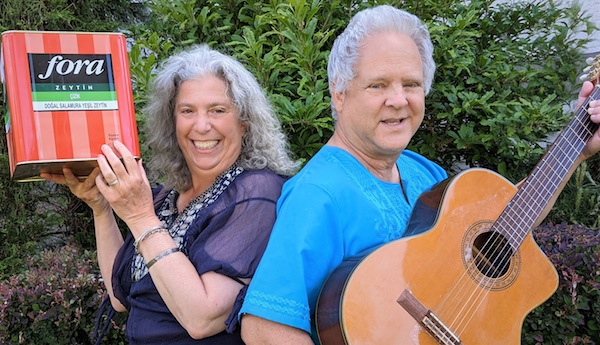
Amber Woods and Gary Cohen are the musical duo Kouskous. They were among the speakers in the six-part Journeys in Jewish Music series. (photo from Kouskous)

In ordinary times, the Victoria Jewish Community Choir meets in person at the synagogue building of Congregation Emanu-El. Unable to do so during the pandemic, the choir has instead been offering Zoom presentations on a diverse array of Jewish music.

Throughout the spring, the six-part Journeys in Jewish Music series, funded by the Jewish Federation of Victoria and Vancouver Island, has brought in an audience from around the world. It has featured talks on biblical cantillation by Vancouver’s Moshe Denburg; the songs of Sefarad, with Prof. Judith Cohen of the University of Toronto; Chassidic meditative melodies (niggunim) with Emanu-El’s Rabbi Matt Ponak; and Sing a New Song to G-d: New Prayer Compositions, with Rabbi Hanna Tiferet Siegel, who lives on Hornby Island. The last event in the series, which takes place June 20, will see Denburg return, to speak on the topic The Way of the Klezmer: Klezmer and Yiddish Song.

The Jewish Independent attended the May 23 musical voyage, which was guided by Gary Cohen and Amber Woods, who form the Victoria-based duo Kouskous. It explored Mizrahi music and how it differs from other Jewish musical styles. To demonstrate this, Cohen and Woods took the liturgical song “Lecha Dodi” and sang it with Ashkenazi, Sephardi and Mizrahi interpretations.

“In general, we see the Mizrahi world being divided into three major geographical blocks: North Africa, Turkey and the Middle Eastern (Arabic) countries,” said Cohen.

Following their expulsion from Spain in 1492, Sephardi Jews migrated to many countries in Europe, as well as going to North Africa, Greece, Turkey and Middle Eastern/Arabic countries. “Wherever Jews went, they blended their own musical traditions with those of the countries to which they moved. For example, the Sephardim combined their own musical style with Moroccan rhythms, Arabic instrumentation and Middle Eastern vocal expressions,” he explained.

“The Sephardim in Turkey and Greece often incorporate odd-metered rhythms such as 7/8, 9/8 in their music. In addition to traditional Arabic instruments, Greek instruments like the bouzouki were commonly used,” Cohen said.

Sephardi musicians who moved to Middle Eastern/Arabic countries were heavily influenced by Arabic musical styles, including “a wide melodic range, as well as vocal and instrumental embellishments,” he said. “Lyrics were often in Arabic, Hebrew or Judeo-Arabic.”

Throughout the presentation, Cohen and Woods performed some musical selections – including a few hot and spicy numbers – from the aforementioned genres for the assembled Zoom audience.

Carol Sokoloff, who co-directs the Victoria Jewish Community Choir with Kenny Seidman, is the person who came up with the idea for the lecture series.

“It has been so well-received it seems natural to repeat it and I hope to do that in the fall, going deeper into many of the subjects, as well as exploring new territory, such as Jewish composers of popular songs, Jewish women’s music, the music of the hidden Jews of Spain and Portugal, cantorial traditions and more,” Sokoloff told the Independent.

“Jewish music has so many flavours and is so rich and varied we have only begun to scratch the surface. Through our conversations, we are learning about other people with knowledge to share and, so far, everyone has been very generous in their enthusiasm for this series,” she said.

The shift from live venues to Zoom since the start of the pandemic has allowed the choir to expand its audience outside of Victoria.

“The series has been wonderful in that people who never knew about the Victoria Jewish Community Choir are now aware of us,” said Sokoloff, “and I believe that, when we finally can meet again to sing together, we shall likely attract many new members or new audiences for our performances and concerts. So, the series has allowed the choir to weather this challenging period and likely emerge stronger than ever! I think it has also generally increased interest in Jewish music in our region as well – all very happy outcomes.”

In non-pandemic times, the choir sings a variety of Jewish music: Psalms and prayers in Hebrew and Aramaic, niggunim, Yiddish songs, Sephardi music in Judeo-Spanish, Israeli songs, Broadway tunes, Yemenite music and contemporary compositions. For more information or to support the choir, send an email to [email protected] or visit their Facebook page, where you can also learn how to receive the link for the June 20, 7:30 p.m., talk.

Sam Margolis has written for the Globe and Mail, the National Post, UPI and MSNBC.

Format ImagePosted on June 11, 2021June 10, 2021Author Sam MargolisCategories MusicTags Carol Sokoloff, culture, education, music, Victoria Jewish Community Choir
Artwork flies, returns home

Artwork flies, returns home

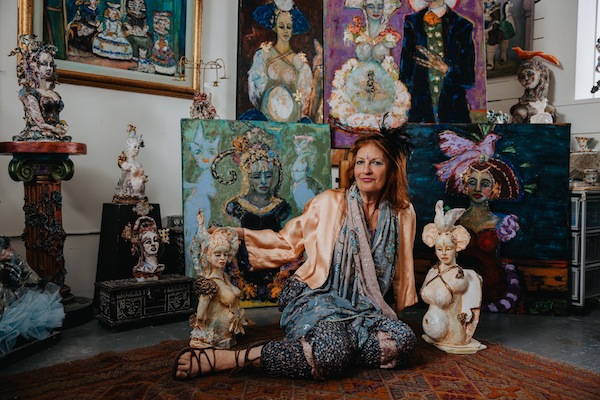
Suzy Birstein in her studio, with works featured in her solo exhibit Tsipora, now at the Zack Gallery. (photo from Suzy Birstein)

Suzy Birstein’s Hebrew name – Tsipora – means bird. The artist’s new show, Tsipora: A Place to Land, which opened at the Zack Gallery on May 20, expatiates on her name’s meaning and its connection to the winged creatures of the sky.

“I love feeling like an exotic bird,” Birstein told the Independent. “I like bringing colour and joy to the people who visit my shows.”

Birstein’s art is bursting with bright hues and glitter. Both her sculptures and her paintings seem to aspire to one purpose only: to instil gladness in people’s hearts, which feels especially important during COVID and all its associated hardships and anxieties.

“The show’s idea was born out of a personal tragedy,” said Birstein. “A few years ago, one of my close friends passed away. I grieved but I knew I didn’t really lose her. She stayed right there, always with me, like a bird on my shoulder, and I thought: what a wonderful concept. I decided to create a series of sculptures of women, with birds incorporated into the whole in different ways.”

Almost every sculpture in the show has a bird. Sometimes, it is a tiny golden bird peeking from behind a woman’s shoulder or hiding in her skirt. Sometimes, it is an elaborate hair ornament. And, sometimes, it is implied rather than shown. But the idea of a bird is always there.

“When I started this series in 2017, my thoughts were all about freedom and travels – flying like a bird,” Birstein said. “I’ve always liked to travel and visited many countries: Europe, Asia, Mexico. I like seeing something new every day.”

Accordingly, the first few sculptures of her new series were reminiscent of her travels, their dark texture a reference to the ancient sacred sites she had visited. Their diaphanous tutus a playful metaphor of dance and flight, a symbol of the weightless grace of a ballerina.

“In 2020, I was planning to travel to the south of France, with a show scheduled in Cannes, when the pandemic hit, and all travel stopped,” Birstein said. After that, the focus of her art changed, becoming more home-oriented.

“Instead of flight, my sculptures became about nesting,” she said. “I couldn’t teach anymore because of the pandemic, didn’t teach for a year due to the school closures, so I took the opportunity and the time to indulge in self-exploration. I asked myself: what is beautiful? And my answer was: birth. And rebirth. Each sculpture I made during that time was of a pregnant woman. Not flights anymore but home and harmony.”

Many sculptures also have mirror fragments embedded in them, making them festive, shining. “The mirror shards help me bridge the inner world of a woman, her home and soul, with the outer world of traveling and flying,” Birstein said.

The show includes not only sculptures but several paintings as well. “The sculptures always come first,” she explained. “They are inspirations for my paintings. After a sculpture is ready, I sometimes paint it: like another version of the sculpture, an exploration of a unique perspective. It is a different experience – working on a flat surface with no fear of breaking the fragile pottery. I don’t use a brush. I paint with a tiny palette and my fingers. It feels almost like working with liquid clay.”

Clay was the medium that catapulted her into the art world, and she feels a deep affinity for it.

“When I was a child,” she recalled, “I couldn’t draw realistically. I thought I couldn’t be an artist. I danced and I modeled for artists. I was about 22 when I started working as an artist model full-time for an art school in Toronto. The administration of the school offered me any art classes I wanted for free, and I decided to try pottery. Clay spoke to me. I also took up weaving and fibre art and liked it. Later, when we moved to Vancouver because of my husband’s work, I wanted to take more art classes. There was no fibre art school at the time, but I enrolled in Emily Carr as a sculptor. They accepted me on the basis of my portfolio – the pieces I created in Toronto.”

Birstein uses white clay for her pieces and paints them before she fires them. “Sometimes, this process has several iterations,” she mused. “I paint the sculpture. Then I fire it, but firing is unpredictable. Colours might burn out or melt into each other in unexpected ways. Then I paint the piece again, maybe add some elements. Fire again. Some pieces take five or six times in the kiln before I know they are ready, but I don’t do perfect. I make mistakes sometimes and then play with my mistakes. I love quirkiness and imperfections.”

It helps that she owns her own kiln. “My kiln is in my basement,” she said. “It was a wedding present from my parents. They knew pottery made me happy.”

It is significant that the most important tool of her art was a gift to celebrate her family.

“I feel free like a bird in my art, but only because I have such strong support from my husband,” said Birstein. “I have stability in my life, a safe place to return, a secure home, and that allows me my freedom of artistic flight.”

That’s why the only image in the show with a man in it is her husband’s portrait.

“I was looking at all those sculptures and paintings of pregnant women in this series and thought: who made them pregnant? There must have been a man,” she said.

“It depicts my husband and my art,” said Birstein of the portrait painting, which features a man standing beside a sculpture of a pregnant woman.

The show Tsipora runs until June 27. In addition to being able to book a walk-through of the exhibit with the gallery, people can arrange a personalized tour with the artist via her website, suzybirstein.com, or by calling her at 778-877-7943.

Olga Livshin is a Vancouver freelance writer. She can be reached at [email protected].

Format ImagePosted on June 11, 2021June 10, 2021Author Olga LivshinCategories Visual ArtsTags birds, painting, paintings, sculpture, Suzy Birstein

Posts pagination

Previous page Page 1 … Page 141 Page 142 Page 143 … Page 492 Next page
Proudly powered by WordPress