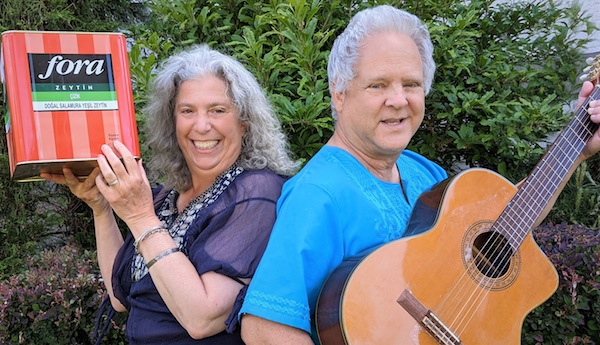
Recorded in Nashville, Carol Sokoloff’s latest album, Change in the Weather, went live on several streaming platforms in late May and the CD was launched to a packed house at the Coda in Victoria on May 30. (photo from Carol Sokoloff)
Recorded in Nashville, Carol Sokoloff’s latest album, Change in the Weather, went live on several streaming platforms in late May and the CD was launched to a packed house at the Coda in Victoria on May 30. The album represents a new musical direction for Sokoloff, who has played everything from folk rock to children’s music, jazz to new age and devotional, to musical theatre.
“Change in the Weather offers a collection of engaging, affirmative, original songs, reflecting various moods and places or stations on my songwriting journey,” Sokoloff told the Independent. “The title song evokes the optimism of spring but also hints at the changing undercurrents of the times we have lived through.”
Among the other songs are the rocking anthem “Free Spirits,” the honky-tonk dance tune “Sweet Wind” (an anniversary present to her husband), the “Hotel California”-flavoured “You Can Lead a Horse to Water,” the Gordon Lightfoot-inspired “That Sound” and the Dylanesque ramble “Walk Together Again.”
Of the time in Nashville, Sokoloff said, “The experience more or less blew my mind. It all happened so quickly and easily, and the result was so professional and engaging that I was immediately hooked and wanted to come back and record more songs.”
She praised the seasoned Nashville musicians featured on the album, led by Eli Beaird, an Academy of Country Music award nominee. The CD highlights the musicianship of players on acoustic and electric guitar, pedal steel, keyboard, drums and bass, all of whom have performed on recordings of top country stars, such as Shania Twain, Willie Nelson, Dolly Parton and Tim McGraw.
 Sokoloff’s musical roots go back to her early days in Toronto, where she was exposed to all types of genres: classical, musical theatre and singers like Frank Sinatra, Judy Garland and Sammy Davis Jr.
“My two older sisters studied piano and, at 4 years of age, I demanded to also take lessons. I learned left from right at the piano keyboard,” she said.
Singing, too, was part of her daily life. With her sisters and father, who had “a powerful, magnetic voice,” said Sokoloff, they often sang multi-part harmony. Her older sisters introduced her to various types of music, including rock and roll and folk music. A guitar found its way into the house, and Sokoloff used her babysitting money to learn how to play it.
“By 15, I was writing songs. I’d been writing poetry, and guitar gave me a way of writing, singing and playing my own songs,” she said.
As a university student, Sokoloff created and performed music for several theatre productions, including at the University of Manchester, England, while a visiting student. She later worked in Toronto theatres and freelanced for CBC Radio, where she gravitated to music-related topics, such as a 90-minute documentary on composer Harold Arlen.
A hankering to go west took hold in the 1980s. First, to a communications job at the Banff Centre, where she was exposed to vocal jazz by singer Jay Clayton, who invited Sokoloff to the final session of her workshop.
“I was enthralled,” Sokoloff recalled. “In 1986, I moved to Victoria and raised children with my husband, poet and playwright Richard Olafson, publisher of Ekstasis Editions. We had met in Banff, drawn together by mutual interest in poetry and theatre.”
In Victoria, she purchased an old piano, hoping to approach the instrument in a different, more improvisatory way, not reliant on reading and memorizing sheet music. For 20 years, she studied with local jazz musician George Essihos.
“I was privileged to study with him,” Sokoloff said. “The understanding of jazz harmony gained enabled me to start writing songs in the style of the great songwriters of the American Songbook standards. At the same time, I realized my greatest interest was in singing my own and others’ songs, with piano a way to accompany myself.”
Sokoloff sang in and then took over the artistic direction of Victoria’s Jewish Community Choir, which gave her the opportunity to arrange and compose choral and prayer music, such as “Lament for Kristallnacht” and a version of “Adon Olam.”
“The choir performed songs I had written, including ‘The Music of the Earth,’ ‘Together and Free’ and a choral version of Karel Roessingh’s ‘Cedars,’ featuring my lyrics,” she said.
At the launch of Change in the Weather, Sokoloff performed with a new group of musicians, the Island Dream Band, which features Sokoloff (rhythm guitar and vocals), Chris Coey (lead guitar), Alex Olson (bass), Martina Peladeau (flute), Dave Pretty (drums) and Kenny Seidman (piano).
Over the summer, Sokoloff is sharing the music widely throughout Vancouver Island and the Lower Mainland. In the fall, she wants to return to Nashville to complete a second album, which is two-thirds recorded.
“I’m excited by this next batch of songs, which features an old country-style ballad as well as some jazz tunes given an infectious Nashville treatment,” she said.
Additionally, Sokoloff, who has written several books of poetry, will release a middle-grade novel, Kayla’s Song, based on her experience as a girl who loved songs and singing. It is scheduled to come out this fall.
Change in the Weather was released on Spotify, Apple Music, Bandcamp and YouTube. The CD comes with a list of the players and their tracks and a booklet with all the lyrics. For more information, visit carolsokoloff.com/music/change-in-the-weather.
Sam Margolis has written for the Globe and Mail, the National Post, UPI and MSNBC.