Skip to content
  • Home
  • Subscribe / donate
  • Events calendar
  • News
    • Local
    • National
    • Israel
    • World
    • עניין בחדשות
      A roundup of news in Canada and further afield, in Hebrew.
  • Opinion
    • From the JI
    • Op-Ed
  • Arts & Culture
    • Performing Arts
    • Music
    • Books
    • Visual Arts
    • TV & Film
  • Life
    • Celebrating the Holidays
    • Travel
    • The Daily Snooze
      Cartoons by Jacob Samuel
    • Mystery Photo
      Help the JI and JMABC fill in the gaps in our archives.
  • Community Links
    • Organizations, Etc.
    • Other News Sources & Blogs
    • Business Directory
  • FAQ
  • JI Chai Celebration
  • JI@88! video

Recent Posts

  • Sharing her testimony
  • Fall fight takes leap forward
  • The balancing of rights
  • Multiple Tony n’ Tina roles
  • Stories of trauma, resilience
  • Celebrate our culture
  • A responsibility to help
  • What wellness means at JCC
  • Together in mourning
  • Downhill after Trump?
  • Birth control even easier now
  • Eco-Sisters mentorship
  • Unexpected discoveries
  • Study’s results hopeful
  • Bad behaviour affects us all
  • Thankful for the police
  • UBC needs a wake-up call
  • Recalling a shining star
  • Sleep well …
  • BGU fosters startup culture
  • Photography and glass
  • Is it the end of an era?
  • Taking life a step at a time
  • Nakba exhibit biased
  • Film festival starts next week
  • Musical with heart and soul
  • Rabbi marks 13 years
  • Keeper of VTT’s history
  • Gala fêtes Infeld’s 20th
  • Building JWest together
  • Challah Mom comes to Vancouver
  • What to do about media bias
  • Education offers hope
  • Remembrance – a moral act
  • What makes us human
  • המלחמות של נתניהו וטראמפ

Archives

Follow @JewishIndie
image - The CJN - Visit Us Banner - 300x600 - 101625

Tag: VHEC

Kristallnacht programs

Kristallnacht programs

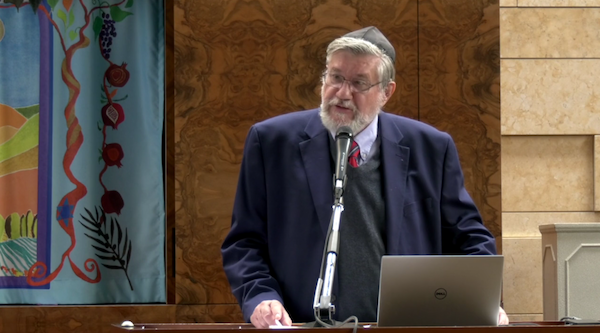
Dr. Chris Friedrichs will deliver the lecture “How to Steal from Jews: A Story from Nazi Germany and What It Teaches Us,” which will be available from Nov. 9, 7 p.m., from the Vancouver Holocaust Education Centre. The Victoria Shoah Project is also holding a commemoration, called “The Persistence of Creativity Emerging from the Shards of Tragedy.” (photo from VHEC)

On the evening of Nov. 9, both the Vancouver and Victoria Jewish communities will be holding virtual Kristallnacht commemorations. This year’s commemoration marks the 82nd anniversary of the state-sponsored Kristallnacht (Night of Broken Glass), which took place throughout Germany and Austria on the night of Nov. 9-10, 1938. In the course of just a few hours, hundreds of synagogues were burned, thousands of Jewish-owned places of business were destroyed, almost 100 Jews were killed, and 30,000 Jews were arrested and sent to concentration camps. The shards of broken window glass seen in front of Jewish-owned stores all over Germany the next morning gave the memorial event its name.

The Vancouver Holocaust Education Centre, in partnership with Congregation Beth Israel and with support from the Robert and Marilyn Krell Endowment Fund of the VHEC and funds from the Jewish Federation of Greater Vancouver annual campaign, is presenting the lecture “How to Steal from Jews: A Story from Nazi Germany and What It Teaches Us,” by keynote speaker Dr. Chris Friedrichs.

The Nazi regime not only murdered millions of Jews, it also relentlessly confiscated Jewish property from owners later sent to their deaths. The illustrated lecture by Friedrichs will describe the step-by-step process by which two elderly Jews from wartime Berlin were stripped of all their assets before they were deported to the death camps – and shows how Nazi officials then fought with one another about what to do with the stolen property.

Friedrichs is professor emeritus of history at the University of British Columbia, where he taught for 45 years before his retirement in 2018. He is a specialist in German history and has been active for many years in Holocaust awareness education.

The Vancouver event is pre-recorded and will be available for viewing any time after 7 p.m. on Nov. 9: visit vhec.org/events-gallery/#videos.

* * *

In Victoria, live-streaming via Zoom, the Victoria Shoah Project will present a program titled “The Persistence of Creativity Emerging from the Shards of Tragedy.” It is a remembrance of those who suffered on Kristallnacht and in the Shoah, as well as a reminder of how and why we, as a collective society, commemorate such tragic events. Remembrance is essential; however, we also must act in tangible ways to protect all peoples in our diverse community.

In recent years, there has been the unfortunate growth of attacks on minority groups and those who are “ the other.” This highlights the need for us to stand together to protect and safeguard all peoples, regardless of religion, race, sexual orientation or other factors, which may make them targets of a hateful few. And, in this context, the Victoria Shoah Project is inviting political and law enforcement leaders, as well as representatives from the diverse faith communities, to join together at the commemoration to lead the reading of a pledge of mutual respect and support.

It is also inviting the entire community to join the event – to remember the past and commit to take action for a better future, where we will respect and protect our neighbours, not remain silent in the face of any injustice against any person or group and work towards building bridges leading to unity and shalom (peace) in our community and beyond.

For more information, email [email protected], or visit victoriashoahproject.ca or facebook.com/victoriashoahproject.

Format ImagePosted on October 30, 2020October 29, 2020Author VHEC & Victoria Shoah ProjectCategories LocalTags Chris Friedrichs, Holocaust, Kristallnacht, Vancouver Holocaust Education Centre, VHEC, Victoria Shoah Project

Uprising observed

The Vancouver Holocaust Education Centre and the Jewish Community Centre of Greater Vancouver were among 125 partners presenting a global commemoration of the 77th anniversary of the Warsaw Ghetto Uprising recently.

Beginning and ending with stirring renditions of the “Partisans’ Hymn,” the online event, which also commemorated the end of the Second World War 75 years ago, featured a long list of singers and performers from Hollywood, Broadway and elsewhere, including Dr. Ruth Westheimer, Mayim Bialik, Whoopi Goldberg, Adrien Brody, Lauren Ambrose and dozens more.

We Are Here: A Celebration of Resilience, Resistance and Hope, which took place June 14, was produced by the Museum of Jewish Heritage: A Living Memorial to the Holocaust, Sing for Hope, the National Yiddish Theatre Folksbiene and the Lang Lang International Music Foundation.

“Zog Nit Keyn Mol” (“Never Say”) is generally called “The Partisans’ Song” or “The Partisans’ Hymn” in English and is an anthem of resilience amid catastrophe sung at Holocaust commemorative events. Written in the Vilna Ghetto by Hirsh Glik after he learned of the six-week uprising by Jews in the Warsaw Ghetto, its stirring concluding lines translate as, “So never say you now go on your last way / Though darkened skies may now conceal the blue of day / Because the hour for which we’ve hungered is so near / Beneath our feet the earth shall thunder, ‘We are here!’”

Other musical performances included a Yiddish rendition of Leonard Cohen’s “Hallelujah,” adapted and performed by pianist and singer Daniel Kahn; “Over the Rainbow,” from the 1939 film The Wizard of Oz, composed by Harold Arlen with lyrics by Yip Harburg, two friends from the Lower Eastside of Manhattan, against the spectre of a darkening Europe; and “Es Brent” (“In Flames”), a musical cri de coeur written in 1936 by Mordechai Gebirtig after what he viewed as the world’s indifference to a pogrom in the Polish town of Przycik.

Andrew Cuomo, governor of the state of New York, spoke of his father, the late former New York governor Mario Cuomo, who helped ensure the creation of the Museum of Jewish Heritage, the world’s third-largest Holocaust museum.

One of the other presenting partners, the National Yiddish Theatre Folksbiene, is the longest continuously producing Yiddish theatre company in the world, now in its 105th season. It was founded to entertain and enlighten the three million Jews who arrived in New York City between 1880 and 1920.

Sing for Hope, another partner, believes in the power of the arts to create a better world. Its mission is to “bring hope, healing and connection to millions of people worldwide in hospitals, schools, refugee camps and transit hubs.”

The Lang Lang International Music Foundation aims “to educate, inspire and motivate the next generation of classical music lovers and performers and to encourage music performance at all levels as a means of social development for youth, building self-confidence and a drive for excellence.”

The program, which runs approximately 90 minutes, is available for viewing at wearehere.live.

Posted on June 26, 2020June 24, 2020Author Pat JohnsonCategories WorldTags commemoration, Holocaust, JCCGV, Jewish Community Centre of Greater Vancouver, memorial, Museum of Jewish Heritage, performing arts, theatre, Vancouver Holocaust Education Centre, VHEC, Warsaw Ghetto, Yiddish
A virtual Yom Hashoah

A virtual Yom Hashoah

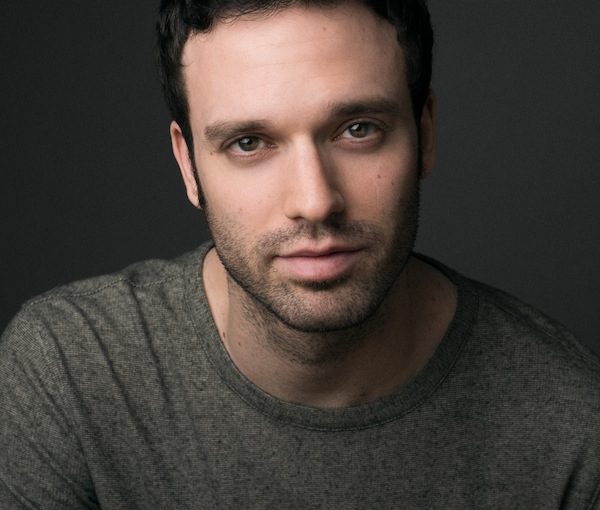
Toronto actor Jake Epstein hosted Canada’s online Yom Hashoah commemoration on April 20. (PR photo)

Days after many Canadian families celebrated Passover remotely using online platforms for virtual seders, Yom Hashoah was commemorated with a virtual ceremony that linked survivors and others across the country in an unprecedented, but deeply moving, program of remembrance and education.

The 27th of Nissan was set aside in 1951 by Israel’s parliament, the Knesset, as Holocaust and Heroism Remembrance Day. This year marked the 75th anniversary since the end of the Second World War and the end of the Holocaust.

Hosted live by Toronto actor Jake Epstein, the event, on April 20, featured prerecorded content from organizations across Canada and new footage broadcast live, including candlelighting from six locations across the country, among them the Vancouver home of Shoshana and Shawn Lewis and their children Charlie, Julian and Mattea.

In a recorded message, Prime Minister Justin Trudeau said Canada stands firm against antisemitism and with Israel and the Jewish people.

“The Shoah was undoubtedly one of the darkest periods in human history and these moments where we pause to remember matter, both to honour those who lived through these horrors but also to make sure these atrocities are never repeated,” Trudeau said. “Sadly, acts of antisemitic violence are more and more frequent today and Canada is not immune to this trend. For many Jewish Canadians, the rise in attacks is not only troubling, it’s downright scary. But, let me be clear, attacks against the Jewish community are attacks against us all. Let me be equally clear, Canada and Israel are partners, allies and close friends and we will continue to stand proudly with Israel. Attacks against Israel, including calls for BDS and attempts to single her out at the UN, will not be tolerated.… We will always condemn any movement that attacks Israel, Jewish Canadians and the values we share.”

The Yom Hashoah program also included recorded messages from Israeli diplomats in Canada and prerecorded musical components.

“During the war, music played an important role in lifting the spirits of ghetto inhabitants, camp inmates, as well as being used as a bargaining chip in negotiating small freedoms in the camps,” said Epstein.

Pieces were performed by the Toronto Jewish Chorus, participants in previous March of the Living programs and by shinshinim, young Israelis performing overseas duties after completing high school. Memorial prayers, El Maleh Rachamim and Kaddish, were offered by Cantor Pinchas Levinson of Ottawa.

Epstein, a grandson of Holocaust survivors, spoke of his family’s history, the good fortune of his grandparents’ survival and the resilience they showed in beginning a new life in a new land.

“Upon being liberated from the camps, survivors faced the inconceivable realization of the enormity of their loss,” Epstein said. “Recovery was a long road ahead. Survivors, like my grandparents, immediately searched for any other surviving family members, only to discover that they had lost everyone. And yet, somehow, they rebuilt their lives.

“My grandparents came to Canada through Pier 21 in Halifax before ultimately moving to Toronto. Even though they were free, the culture shock, the language, the difficulty in finding work, made life extremely hard. My grandfather, an architectural engineer in what was then Czechoslovakia, was lucky enough to find work as a bookkeeper for a lumberyard. My grandmother became a seamstress, working day and night, not only making clothing for customers, but making dresses for my mom as well. Somehow, they managed to connect with other survivors who became like family.…My grandparents’ story of resilience and adversity is a common one. They, like so many other survivors in Canada, raised families, found employment, learned new languages and contributed to Canadian society and Jewish communal life. Some even dedicated their lives, decades later, to speaking out against hate and injustice by sharing their Holocaust stories with students and the public.”

Survivors from across Canada, in video recordings, spoke of their liberation experiences and offered advice to successive generations.

Faigie Libman of Toronto recounted her moment of liberation.

“We saw a man on a horse, a Russian soldier, coming towards us,” she recounted. “He said he was a captain, that we are free. You cannot imagine the joy, you cannot imagine the exhilaration. I still see the picture in front of my eyes, women who could hardly walk, some were even crawling, pulled him down, they were kissing him, they were hugging him, and that day will always be in my mind – Jan. 21, 1945 – we were finally free.”

Sydney Zoltan of Montreal expressed concern about Holocaust awareness after the eyewitnesses pass.

“We, the youngest survivors, now stand in the frontline,” he said. “We often ask ourselves what memory of the Shoah will look like when we are gone. We depart with the hope that our fears are only imaginary.”

Another survivor asked younger generations to be vigilant.

“I want young people to remember, I want them to be politically aware, that their government should never preach hate,” said Elly Gotz of Toronto. “I want them to understand how damaging hate is to people.”

The commemoration, coordinated by the Sarah and Chaim Neuberger Holocaust Education Centre in Toronto, was presented in partnership with organizations across the country, including the Vancouver Holocaust Education Centre. Earlier the same day, a global Yom Hashoah memorial event took place from an eerily empty Yad Vashem in Jerusalem, again with video-recorded survivor testimony and messages from political, religious and civic figures.

Format ImagePosted on May 15, 2020May 14, 2020Author Pat JohnsonCategories NationalTags Holocaust, Jake Epstein, memorial, survivors, VHEC, Yom Hashoah
Survivors reflect on liberation

Survivors reflect on liberation

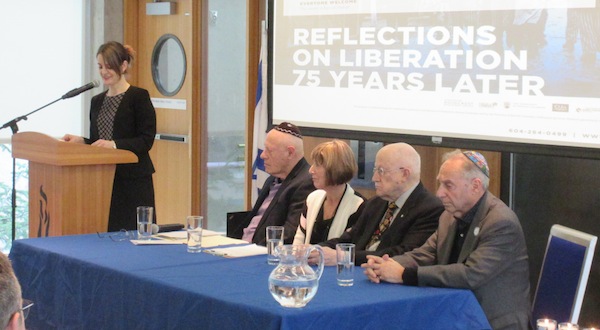
Dr. Ilona Shulman Spaar moderates a panel with Holocaust survivors, left to right, Janos Benisz, Amalia Boe-Fishman, Dr. Peter Suedfeld and Alex Buckman. (photo by Pat Johnson)

One survivor of the Holocaust who spoke at a panel recently believes that, in a generation or two, people will largely forget about the catastrophic events of that time.

“I think the world will forget about Auschwitz,” said Dr. Peter Suedfeld, a professor emeritus in the department of psychology at the University of British Columbia. “The world has already forgotten about ‘never again.’ We’ve had a fair number of genocides since 1945, in which the world did not intervene. A recent poll that I saw … apparently, the proportion of people who remember anything about how many Jews were killed in the Holocaust, what Auschwitz was, what the Holocaust was and so on, is not all that much above 50%.

“This is going to go on generation after generation,” he continued. “The survivors won’t be here to push the story any further. Their children will for awhile, but they have other things to do and other things to be concerned about and their children even more so. In a few more generations, it will be in the history books and people will say, yeah, I read about that or thought about that in grade whatever but, in terms of remembering it as something in your gut, something that arouses an emotion, something that has a personal connection to you, I don’t think it’s going to last all that much longer. I’m sorry to say that, but that’s what I think.”

Suedfeld, who weeks earlier was invested into the Order of Canada for his decades of work on the psychological and physical effects of extreme and challenging environments, was speaking at Hillel House, on the UBC campus, on International Holocaust Remembrance Day, Jan. 27. He was part of a panel of four survivors sharing their reflections 75 years after liberation.

Suedfeld, who was born in Hungary, survived under false papers and a back story as an orphaned Roman Catholic child. He recalled successive bombardments of the various sanctuaries he was in near the end of the war, as Allied bombers repeatedly blew buildings apart while Suedfeld and other children hid in the cellars.

After liberation by Russian forces, Suedfeld was eventually reunited with his father; his mother had been murdered. The lesson he took from the experience, he told the packed afternoon audience, was to cherish and defend the values of freedom.

“Freedom to be who you really are, but freedom of speech, freedom of association, freedom of religion, freedom of everything,” he said. After moving to the United States, Suedfeld became a powerful advocate of the First Amendment, which guarantees freedom of religion and expression. Since coming to Canada, he has been a similar champion of the Charter of Rights and Freedoms, he said.

Suedfeld’s admittedly pessimistic perspective on the future of Holocaust remembrance was contested by Alex Buckman, a fellow survivor on the panel.

As long as organizations exist like the Vancouver Holocaust Education Centre, which co-sponsored the event with Hillel BC, and children of survivors and others who have been touched by their experiences share the lessons they have learned, the future will be better, he said.

“Maybe our children will pick up, speaking on our behalf,” said Buckman. “Maybe they will remember because we will tell them what happened.”

Like Suedfeld, Buckman survived by being hidden by Catholics; in his case, in Belgium.

“They told us that the war was over and that we should rejoice and be happy and our parents would come and pick us up and everything would be hunky-dory,” he recalled. “At 6-and-a-half in an orphanage, nothing was that rosy. We saw parents come and pick up their children and take them home, but nobody came for us. I was there with my sister Annie and she was crying and wondering why our parents weren’t coming and I tried to tell her that I’m sure that they will come. But, like her, I didn’t know why they weren’t coming.”

The pair were moved back to Brussels and put in the care of the Red Cross, which posted the names of orphaned and unclaimed children on sheets around the city. Eventually, a paternal uncle showed up and took the two children to Annie’s parents – who, since little Alex had believed himself to be Annie’s brother, he reasonably concluded were also his parents. The truth came out in a cruel way, when another cousin, in a pique of anger, blurted out to Alex that his parents were dead and that Annie’s parents were not his.

“I took a step back and, for the first time, I realized I was alone,” Buckman recalled. His aunt and uncle did care for him, though, despite the uncle’s misgivings, because of the aunt’s insistence based on a promise she made to the heavens when she learned of her sister’s death.

Also on the panel was Amalia Boe-Fishman, who was born in the northern Netherlands in 1939 and also survived thanks to a Christian family. Like many survivors, her liberation story is not one of joyous freedom but of confusion and fear of the future.

“Liberation should have been a real happy time for me. It wasn’t,” she said. “I was told we were free, but what did that mean? What did that mean to a frightened 5-year-old girl who had been in hiding for three years? What did it mean to be free? I was told that, for the first time I could remember … I would now be able to go outdoors. I didn’t know what to expect. What was there? What was waiting for me outdoors? Indoors had become my entire life. Indoors was where I felt secure and safe. Indoors was all I knew.”

Her first venture out was harrowing. It was odd enough to be surrounded by throngs of strangers after her entire life had been confined to just a few familiar faces. After a victory parade, the girls she knew as her “sisters” decided to walk to the town centre. While crossing a bridge with scores of others – Amalia had never seen a bridge before – a rumour started that the Nazis had returned and panic swept the crowd. Pushing and shoving was accompanied by screaming and concern that the bridge was about to collapse.

“Here I was, trapped outdoors, in a crowd of panicked strangers and I was terrified,” she said. “The bridge didn’t collapse, but, as you can imagine [it was] a very long time before I would ever cross a bridge again.”

Another ostensibly joyous aspect of liberation was also clouded with confusion and fear.

“I was told that I had a real family. I had a real father, a real mother, an older brother and a baby brother,” said Boe-Fishman. “Miraculously, out of many different hiding places, all four of them had survived the war.… But who were these people? They were strangers. So, this is what liberation means to me. To leave the only family I ever had known to go outdoors to a place of terrified strangers, to strange people in a strange home.… I had to adapt to a new and also frightening world.”

For Janos Benisz, liberation was similarly conflicted. As a child, he had seen his father and his grandmother dead in the streets. His mother had been killed earlier by Nazi collaborators, during what was to have been a routine medical procedure.

Young Janos was transported from his hometown of Esztergom, Hungary, to Budapest, where Jews were divided up, many being sent directly to death camps including Auschwitz.

“I ended up in an Austrian slave labour camp,” he said, remaining there for seven or eight months before the Russians liberated them.

“I had the body of a 4-year-old,” he recalled. “At my bar mitzvah, I was under five feet.”

Making his way back to his hometown, he found squatters in the family’s house and learned that, of his immediate family of eight uncles, two aunts and 29 cousins, only Janos and one uncle had survived the Nazis.

Benisz was put in a Jewish orphanage in Budapest, then sent to Halifax, where he was put on a train to Winnipeg. He was bounced from foster home to foster home, back to an orphanage and then to a reformatory.

“I couldn’t fit in,” he said. At 18, he got a job at the Winnipeg Free Press as a copy boy.

“I spent the next 15 years in the newspaper business, then I became a salesman on my own, retired in ’71,” he said. He noted the figurative and literal centrality of the Jewish Community Centre of Greater Vancouver in his life today. He lives 40 yards from the centre, he said, and much of his social life is focused there.

“It’s my second home,” he said. “I work out there. I shmooze there. I’ve got a group of guys I call the ‘kosher nostra.’ I’m very happy. I absolutely adore this country of Canada. It’s been good to me ever since I turned 18.”

Prior to the panel, Holocaust survivors lit candles of remembrance. Vancouver Mayor Kennedy Stewart read a proclamation declaring International Holocaust Remembrance Day in the city. Rob Fleming, British Columbia’s minister of education, spoke on the importance of Holocaust education and credited the partnership of the Vancouver Holocaust Education Centre (VHEC). Student Adam Dobrer shared his family’s Holocaust legacy. Prof. Nancy Hermiston, director of voice and opera at the University of British Columbia, provided opening remarks. Nina Krieger, executive director of the VHEC, introduced the program and spoke of the importance of remembrance and the power of the memory of Auschwitz on the 75th anniversary of its liberation. Dr. Ilona Shulman Spaar, education director and curator of the VHEC, moderated the panel. Rabbi Philip Bregman, chaplain of Hillel BC, chanted El Maleh Rachamim and the Mourners’ Kaddish.

Many other commemorations and events took place throughout the province on and around Jan. 27.

Format ImagePosted on February 14, 2020February 12, 2020Author Pat JohnsonCategories LocalTags Alex Buckman, Amalia Boe-Fishman, commemoration, Holocaust, Janos Benisz, Peter Suedfeld, VHEC
A story of two of six million

A story of two of six million

Dr. Michael Hayden delivers the keynote address at the annual Kristallnacht commemorative program Nov. 7. (photo by Al Szajman)

In the 1930s, German Jews were required to register all precious metals in their possession, a prelude to having them confiscated. In Hamburg alone, the Nazis collected 20 tons of silver, much of it Judaica. Of this, they melted down 18 tons. Two tons was deemed by the Nazi curator Carl Schellenberg to be of artistic or other value in its existing form.

After the war, Schellenberg was kept on by the British because his scrupulous indexing of artifacts made him valuable. His love of the city of Hamburg meant he ensured that some of the most precious pieces of stolen art and artifacts made their way to that city’s museum.

That is where Dr. Michael Hayden, a Vancouver researcher in molecular medicine and human genetics, and one of the world’s leading researchers in Huntington disease, was able to trace one of the few remaining pieces of his grandparents’ once-extensive collection of Judaica.

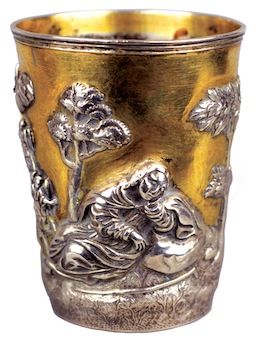
A silver Kiddush cup, crafted in 1757 and embossed with a vivid three-dimensional depiction of the story of Jacob’s vision of a ladder to heaven, which belonged to his grandparents, Gertrud and Max Raphael Hahn, has been restituted to the family. It is now on loan, a small artifact in size but one of the most stunning pieces in a just-opened exhibition at the Vancouver Holocaust Education Centre, titled Treasured Belongings: The Hahn Family & the Search for a Stolen Legacy.

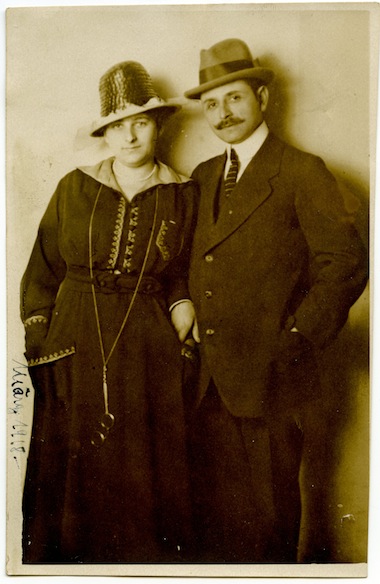
photo - Max and Gertrud Hahn, the patriarch and matriarch of the German-Jewish Hahn family of Göttingen. Photo taken in Berlin, Germany, 1918. While their children, Rudolf and Hanni, emigrated to England, the couple did not survive the Holocaust
Max and Gertrud Hahn, the patriarch and matriarch of the German-Jewish Hahn family of Göttingen. Photo taken in Berlin, Germany, 1918. While their children, Rudolf and Hanni, emigrated to England, the couple did not survive the Holocaust. (photo from Hahn family)

Hayden delivered the keynote address at the annual Kristallnacht commemorative program Nov. 7, before the opening of the exhibition to the public. The exhibit runs to Nov. 27, 2020.

“It’s a story that it’s taken me a long time to confront,” Hayden told the Independent.

Hayden’s grandparents were transported to Riga, Latvia, in 1941, where they were murdered by Latvian collaborators of the Nazis. Max Hahn had been arrested for the first time on Kristallnacht, three years earlier, but, with Gertrud, had managed to secure the passage of many possessions to safe locations in the neutral countries of Sweden and Switzerland. More importantly, they had sent their two children, daughter Hanni and son Rudolf – Hayden’s father – to safety in London.

After the war, the orphaned pair retrieved the remnants of their family’s material possessions. Rudolf, who joined the British army in 1943 and adopted the less Germanic-sounding name Roger Hayden, moved to South Africa. There, more than a dozen boxes sat undiscussed in the family home. When Roger passed away, Michael Hayden shipped the boxes to his Vancouver home, where they sat, unopened, for another two decades.

When he finally confronted the parcels from his family’s past, he discovered a stamp collection, maps, artworks – and 9,000 original documents relating to his family’s history from the 1850s until 1941. These included heart-wrenching letters between Rudolf in England and his parents still in Germany.

While Michael Hayden was growing up, there were some items that his father had not kept stored away. One was a Paul Ritter violin that Rudolf had received on his bar mitzvah. Michael’s daughter, Anna, now a Vancouver hematology oncologist, played on it as a young person and Hayden hopes to one day hear grandchildren also play it. It is part of the exhibit. It is also a hint of how the family got its name. It was not a coincidence that, in anglicizing his name, Rudolf/Roger chose a variation on the surname of a legendary classical composer.

“There were piano recitals and all kinds of concerts in the Hahn family every Sunday,” said Hayden. “They used to have a little chamber orchestra, it was a totally different world. So, he chose the name Roger Hayden from Rudolf Hahn and I’m sure Hayden had some comfort for him because Haydn was so important in his life.”

photo - The silver gilt kiddush cup adorned with the story of Jacob (Germany, 1757), acquired by Max Hahn in the early 1900s and confiscated by the Nazis in 1939, is the only piece of Hahn’s looted Judaica collection that has been restituted to date
The silver gilt kiddush cup adorned with the story of Jacob (Germany, 1757), acquired by Max Hahn in the early 1900s and confiscated by the Nazis in 1939, is the only piece of Hahn’s looted Judaica collection that has been restituted to date. (photo © Vancouver Holocaust Education Centre)

Hayden credits the German government and museums for supporting restitution efforts. His family recently received a grant from the German federal government to hire a researcher to continue the search. Understandably, the challenges are great. The Hahn family’s collection of Judaica was considered one of the finest and most extensive in Germany, rivaling those of the Sassoon and Rothschild families. Because they had lent some objects to museums, and because of Max and Gertrud’s careful recordkeeping, the family has both photographs and detailed inventories of what the collection included before it was looted. Most families do not have such tangible proof.

Hayden emphasizes that any material value of restituted artifacts is irrelevant and the importance is because of personal significance, and that the process represents steps toward reconciliation and restoring dignity of Nazism’s victims.

“For me, personally, it’s been a process of coming to terms with the unimaginable horror and confronting it,” he said.

He has had very positive and some negative experiences during this work. He is impressed with the German government’s efforts to seek forgiveness for their country’s past, including memorializations like the 70,000 Stolpersteine, stumbling stones, that have been installed outside the last homes of victims of the Nazis, and the fact that the vast Holocaust memorial in Berlin is located between the embassies of major countries in the heart of the city.

“When I see Germany and I see what they’re doing, it’s been very instructive for me about confronting your history and confronting it unabashedly,” he said, making parallels with Canada’s reconciliation process with First Nations.

Germany’s response is especially admirable in comparison to other European countries that experienced collaboration and, rather than confronting their past, are actively denying it.

But, Hayden has had negative experiences, including the discovery that the school his father had attended in Hamburg had, as recently as a few years ago, what amounted to a museum to those students who had fought for the Nazis, with not a trace of the fate of the Jewish students who had attended. The Nazi display is now gone and a marker lists the names of Jewish students who were murdered. But he also discovered that the school’s long-held assurance that they had never participated in Nazi activities was fabricated, when photos emerged of the school festooned in Nazi flags and students and faculty making Heil Hitler salutes.

“At a personal level, for me, it’s trying to give up the stowaway of sorrow and pain on my shoulders that I’ve never confronted and to move forward,” Hayden said. “It’s not that I’m at forgiveness, but I recognize that forgiveness is not so much for those you are forgiving, but for the forgiver. You can give up your own toxic anger and move forward. For me, it’s also been a journey to acknowledge my own German ancestry and come to terms with it.”

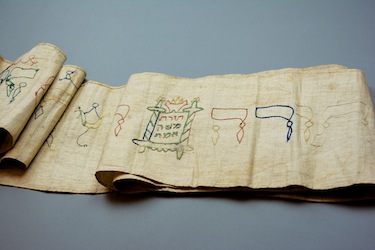
photo - Dr. Michael Hayden, the grandson of Max and Gertrud Hahn, discovered in the 1980s that this Torah binder was in the possession of the City Museum in Göttingen. The piece of cloth was used to swaddle his great-grandfather Raphael Hahn for his brit milah (circumcision ceremony) in 1831. With the help of Göttingen’s mayor, Hayden organized for the Torah binder to be returned to his family
Dr. Michael Hayden, the grandson of Max and Gertrud Hahn, discovered in the 1980s that this Torah binder was in the possession of the City Museum in Göttingen. The piece of cloth was used to swaddle his great-grandfather Raphael Hahn for his brit milah (circumcision ceremony) in 1831. With the help of Göttingen’s mayor, Hayden organized for the Torah binder to be returned to his family. (photo © Vancouver Holocaust Education Centre)

He hopes that the exhibit, his family’s story and the larger facts of the Holocaust resonate in today’s world.

“We’ve got to be aware of ourselves as Jews of condemning other populations, we have to be aware of stereotyping, we have to be even more acutely aware from our own history about the struggles and making sure that we learn from that in the way that we conduct ourselves, so recognizing, as we look at children on television separated from their parents, that we too can be horrified by that and do whatever we can to make sure that we are not complicit or even silent in the face of all of this,” he said. “In certain circumstances, unless we really hold onto some deep principles of democratic culture and value of life, your neighbours can become your killers.”

As the search for additional family heirlooms continues, Hayden acknowledges the challenges. “I think it is a needle in a haystack to be honest, but it’s worth pursuing.”

Of the entire experience, he said: “It’s been an opportunity to give individuality and identity for two of six million people who were murdered, to rescue them from generalizations and understand who they were and understand their distinctiveness and to bring my grandparents out of obscurity and give them the warmth and respect they deserve.”

The Kristallnacht commemoration where Hayden spoke began with a candlelight procession of survivors. Cantor Yaacov Orzech chanted El Maleh Rachamim. Philip Levinson, president of the Vancouver Holocaust Education Centre (VHEC), introduced the event and Nina Krieger, the VHEC’s executive director, introduced the keynote speaker. Rabbi Jonathan Infeld offered reflections after Hayden’s address. Jody Wilson-Raybould, member of Parliament for Vancouver Granville, offered greetings, and Councilor Sarah Kirby-Yung read a proclamation from the City of Vancouver. The event was presented by the VHEC, in partnership with Congregation Beth Israel, the Jewish Federation of Greater Vancouver, the Jewish Community Centre of Greater Vancouver and the Robert and Marilyn Krell Endowment Fund of the VHEC.

Format ImagePosted on November 15, 2019November 15, 2019Author Pat JohnsonCategories LocalTags history, Holocaust, Judaica, Kristallnacht, Michael Hayden, Nazism, VHEC

The next generations

An important event took place in Vancouver last weekend, as hundreds of child survivors of the Holocaust convened at a downtown hotel for the conference of the World Federation of Jewish Child Survivors of the Holocaust and Descendants. A Shabbat dinner, moving speeches, presentations and other events were attended by survivors, their children and grandchildren, with specific programs organized with the interests and needs of each group in mind.

Attendees felt the heavy presence of time, as some reflected that these conferences are seeing fewer survivors and that the firsthand knowledge of these events will soon be carried only by the second and third generations. (See next week’s paper for coverage of the event.) Attendees, who fortunately witnessed Vancouver over a few days of autumn sunshine, raved about the welcome they received from locals and the quality of the program and the achievements of the organizers. But it is Vancouverites who should be most honoured to have been able to meet and experience the spirit and resilience of these remarkable individuals. Each survivor has a very different survival story and life history, yet they come together in part because of a need to connect with others who are most likely to understand not only the facts of their Holocaust experiences, but the unique hurdles – and, notably, the many, many achievements – of having survived and thrived after an early life of often-unimaginable challenge.

We are now amid a week of solemn remembrance – the 81st anniversary of Kristallnacht, on the night of Nov. 9-10, followed by Remembrance Day, Nov. 11. These weighty commemorations are an opportunity to reflect on the past and to rededicate ourselves to a world free of hatred, war and genocide.

The past cannot be undone, but restitution and reconciliation can help to take that past and, in some small ways, find meaning that restores honour and dignity to the victims and those who carry their legacies. That is one of the themes of the new exhibit just opened at the Vancouver Holocaust Education Centre (VHEC).

Treasured Belongings: The Hahn Family and the Search for a Stolen Legacy opened Thursday, launched at the annual Kristallnacht Commemoration with a presentation by Dr. Michael Hayden, a renowned Vancouver medical researcher. Hayden’s grandparents, Max and Gertrud Hahn, who were murdered in the Holocaust, had one of Germany’s most significant collections of Judaica. The story of the survival of parts of that collection – and the ongoing efforts to locate and restitute other items – is not so much, he says, about the artifacts themselves, but about reclaiming the individuality and dignity of his grandparents and the lives that were stolen from them. (Again, next week’s paper will feature coverage of this event.)

For Hayden, the process has been emotional, sometimes rewarding, sometimes disheartening. But it is an act of dedication to restore the individuality of two of Nazism’s victims. Sheer numbers of genocide victims are almost incomprehensible, especially to young minds, which are the most critical target of contemporary Holocaust education. Intergenerational narratives like those of the Hahn-Hayden family, illuminated with tangible artifacts, are a vital means to bring this history in a meaningful way to the generations who will not have the opportunity to meet and hear testimony from those who witnessed and experienced that cataclysmic history themselves.

Those of us who have had the privilege of being entrusted with the stories of survivors, or the experiences of veterans of the wars against tyranny, must appreciate the importance of being witnesses to the witnesses. We should take a moment over this weekend to consider how we can act in our daily lives to advance a world that does justice to their memories and experiences.

Posted on November 8, 2019November 6, 2019Author The Editorial BoardCategories From the JITags child survivor, Holocaust, Michael Hayden, remembrance, VHEC
Danger in remaining silent

Danger in remaining silent

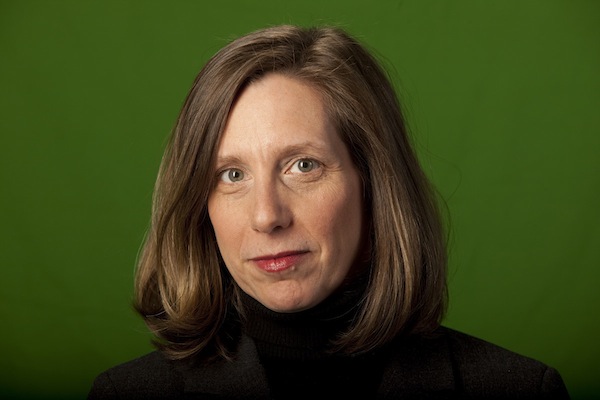
Marsha Lederman (photo by John Lehmann/Globe and Mail)

A few years ago, Marsha Lederman went with her mother, two sisters and a cousin on the adult portion of the March of the Living, which included a walk between the two main camps of the Auschwitz-Birkenau complex.

“The march from Auschwitz to Birkenau was somber and sorrowful, but it was also so empowering,” she recalled at the annual High Holidays Cemetery Service at Schara Tzedeck Cemetery in New Westminster Oct. 6. “We were marching with a statement to the world and a comforting message to the souls whose lives had ended so brutally on those grounds: ‘We are here, we are still living, we are multiplying, we remember you.’”

The family group proceeded to Radom, the town outside Warsaw where Lederman’s mother had grown up. The man who lived in the apartment where she had lived allowed them in and Lederman’s mother recounted her family’s years there.

“It was joyous,” Lederman said. “We were still on a high when we visited the memorial for the Radom Jews killed in the Holocaust. As I recall, it was in a fairly large square and seemed a little neglected. We were looking at this lonely memorial, the five of us women, when a group of, I would say, teenage boys began chanting something nearby. I don’t speak Polish, so I couldn’t understand what they were saying. But I did understand one thing: ‘Auschwitz-Birkenau.’ I don’t think they were offering their condolences.”

She reflected on the way she responded in that moment.

“We hurried away and said nothing. It was a safe thing to do, for sure. But, if that happened to me today, I would not walk away. I am done with walking away. Would I have put us in danger if I had turned around and confronted those boys? Maybe. But I know now that the real danger is in remaining silent.”

Lederman is the Vancouver-based Western arts correspondent for the Globe and Mail. Her father was born in Lodz, Poland, on erev Yom Kippur 1919. Her mother was born in Radom, Poland, in 1925. All four of their parents were killed in gas chambers at Auschwitz and Treblinka, as was Lederman’s father’s sister and little brother, and her mother’s little brother.

Lederman’s parents met in Germany after liberation and had one daughter there before moving to Canada, where they had two more daughters.

Lederman reflected on recent antisemitic incidents in North America and Europe, as well as her own encounters with antisemitism and racism, including a harrowing verbal attack on an Asian woman on the Skytrain at rush-hour, an incident in which Lederman was the only person to intervene.

“We have a duty to speak up,” she said. “We have a responsibility. This is our inheritance. I never had a bubbe or zadie to hug me or spoil me on my birthday or cook chicken soup for me. There’s nothing in my home that was theirs. I did not receive a single heirloom. But I did receive an inheritance – a duty to protect others from hate…. That is my inheritance and that is their legacy. Enough. Never again.”

She recalled being stunned during an interview with famed Vancouver photographer Fred Herzog, who died last month. Chatting after the main interview, Lederman asked the German-Canadian if he had experienced anti-German sentiment when he arrived here after the war. He launched into a discourse on the “so-called Holocaust” and said Jews died in the camps mostly because of lice and because Allied bombings prevented food from getting to them. Lederman agonized over whether to expose the admired photographer, eventually writing the story, for which she has been subjected to a range of criticism.

“Well, I have had enough,” she said. “And I’m going to fight to tell those stories and expose antisemitism and Holocaust denial and racism. I am not going to be quiet anymore. I think of all that was lost in the gas chambers; all the lives, of course, but also all the potential. With those millions of lives extinguished, what was lost with them? Poems were never written, beautiful artworks that were never painted, the cure for cancer, for Parkinson’s, the answer to the climate crisis?

“It was not just the people who were murdered that the world lost. It was all of their descendants and all of their descendants and all of that potential.… I talk about this because of what this leaves on our shoulders. I interviewed a Nisga’a poet, Jordan Abel, and he used a term to describe himself that I have adopted. He calls himself an intergenerational survivor of residential schools, which makes me an intergenerational survivor of Auschwitz. I do not take this lightly. With my parents’ survival came a hefty responsibility on me and on all of us who are descendants.”

At the service, Jack Micner, who led the ceremony and is also a member of the second generation, outlined a litany of antisemitic incidents and comments in Europe and North America in recent weeks.

“I suspect that those of our parents resting here in this cemetery would be furious to see what’s going on across the world,” he said. “We have to continue doing the type of work that VHEC [Vancouver Holocaust Education Centre] is doing in as many ways as we can think … it falls on us, because nobody’s going to do it for us.”

Rabbi Shlomo Estrin reflected on the loss of Chassidic communities during the Holocaust. Cantor Yaacov Orzech chanted El Maleh Rachamim.

Names were read of community members who have passed since the last High Holidays and a moment of silence was observed for the six million.

The Mourner’s Kaddish was recited by Jeremy Berger, a grandson of a Holocaust survivor. After the service ended, the Mourner’s Kaddish was also recited at the Holocaust Memorial in the cemetery.

The annual event is presented by the Vancouver Holocaust Education Centre with Congregation Schara Tzedeck and the Jewish War Veterans, and with support from the Jewish Community Foundation of Greater Vancouver.

Format ImagePosted on October 25, 2019October 23, 2019Author Pat JohnsonCategories LocalTags Holocaust, Kristallnacht, Marsha Lederman, memoir, racism, second generation, survivor, VHEC
Community milestones … VHEC, JMABC, JI and the Bayit

Community milestones … VHEC, JMABC, JI and the Bayit

Michael Schwartz of the Jewish Museum and Archives of British Columbia accepts the Award of Merit: Excellence in Community Engagement on behalf of all the partner organizations in the Cross Cultural Strathcona Walking Tour. (photo from JMABC)

The 2019 B.C. Museums Association Awards for Outstanding Achievement were handed out on Oct. 2 at the BCMA conference gala at Courtyard by Marriott in Prince George. The awards recognize institutions and individuals who have exemplified excellence in exhibitions, community engagement and innovation within the province’s museums, galleries and cultural heritage community. This year, three Jewish community groups were honoured for their work.

The Vancouver Holocaust Education Centre received the Award of Merit: Excellence in Collections for its collections management system, which provides access to Western Canada’s largest collection of Holocaust-related artifacts, survivor testimonies, archival materials and publications (collections.vhec.org). The award recognizes recent excellence in collections best practices, which may include innovative approaches to collecting, collections management, preservation, repatriation, collections-based research, dissemination and accessibility.

The Jewish Museum and Archives of British Columbia (JMABC), along with 16 partner organizations, including the Jewish Independent, received the Award of Merit: Excellence in Community Engagement for the Cross Cultural Strathcona Walking Tour. The award recognizes a recent outstanding success in community engagement, as demonstrated by ongoing participation of new audiences, new partnerships with community organizations, and supporting needs of the community through innovative programming.

Co-led by Carmel Tanaka and Michael Schwartz (director of community engagement at the JMABC), the walking tour celebrates the history of Vancouver Downtown Eastside neighbourhoods Hogan’s Alley, Jewish Strathcona, Japantown (Powell Street) and Chinatown. The guided walking tour builds awareness of the contributions of early immigrant communities then and now. Originally conceived in celebration of Vancouver Asian Heritage Month and Canada’s Jewish Heritage Month, the first series of tours debuted in May 2019.

With the theme of education, the route began at the oldest elementary school in Vancouver, Lord Strathcona Elementary School, referred to as the “League of Nations” for its multicultural makeup. When the triangle rang at the end of the day, school continued for many children in the form of nearby programs where students learned language and cultural traditions. Tour participants learned how these diverse communities interacted with one another in their common struggles, and how they were impacted by the urban renewal of the area.

The Cross Cultural Strathcona Walking Tour Working Group comprises Association of United Ukrainian Canadians; Benny Foods Italian Market; Dr. Sun Yat-Sen Classical Chinese Garden; Musqueam Elder Larry Grant (honourary advisor to PCHC-MoM and VAHMS); Greater Vancouver Japanese Canadian Citizens Association; Heritage Vancouver Society; Hogan’s Alley Society; Jewish Independent; JMABC; Nikkei National Museum and Cultural Centre; Pacific Canada Heritage Centre Museum of Migration; Vancouver Asian Heritage Month Society’s explorASIAN; Vancouver Heritage Foundation; Vancouver Japanese Language School and Japanese Hall; Vancouver School Board; Vancouver School Board Archives and Heritage Committee; Wongs’ Benevolent Association; and Youth Collaborative for Chinatown.

Work is underway to reprise the program in spring 2020. For more information, visit youtube.com/watch?v=nJB3cdkh5yc.

***

After leading the Bayit in Richmond for the last five years, Michael Sachs has stepped down as board president, to spend more time with his young family.

photo - Michael Sachs
Michael Sachs (photo by Lianne Cohen)

Michael’s efforts and dedication have given members of the Bayit much for which to be grateful. During his tenure, Michael had a vision for how he saw the community and, as a man of action, he followed through. With a philosophy of engaging with everyone, he worked together with all of the Jewish organizations in Richmond and beyond, without ever losing focus that he was building a Bayit community.

Michael’s stepping down from the position of president doesn’t mean he won’t continue to be involved in the Bayit. As past president, he will remain on the board of directors and continue to be a part of the Bayit’s future.

Current Bayit board member Keith Liedtke will take over as the Bayit’s interim president. He shares Michael’s vision and sees the need for a strategic plan that will allow the Bayit to continue growing and filling the community’s needs.

The Bayit thanks Michael for his contributions as president and for his decision to stay on as a member of the board.

Format ImagePosted on October 25, 2019October 23, 2019Author Community members/organizationsCategories LocalTags awards, Bayit, Carmel Tanaka, intercultural, Keith Liedtke, Michael Sachs, Michael Schwartz, museums, Vancouver Holocaust Education Centre, VHEC, walking tour

Election views diverge

The Independent spoke with people in the Jewish community to gauge attitudes as the federal election approaches. What we found was a diversity of views and a lack of consensus.

An informal focus group of residents at the Weinberg Residence raised issues of out-of-pocket expenses for medical treatments and a lack of available doctors.

“You lose your doctor, you can’t get another one,” said one senior voter.

There was not great enthusiasm for any of the party leaders. One participant said she had lost respect for Liberal leader Justin Trudeau long before the recent brownface and blackface issue emerged.

“I was disappointed in him way back when he went to India and there was this whole thing of dressing up in Indian costumes. I felt it wasn’t very statesmanlike.”

“I feel that he’s had his chance and I don’t want to vote for him because he showed us what he can do. I don’t think he’s got what it takes,” said another voter.

“I expected nothing from Trudeau and I got it,” said another.

But there was no groundswell of support for Conservative leader Andrew Scheer.

“I’m disappointed,” said one. “I haven’t heard anything that’s promising.”

Some voters said NDP leader Jagmeet Singh comes across as sincere, but one said he has a lot of repair work to do with the Jewish community after his party’s positions against Israel in the past.

Elizabeth May, the Green leader, was viewed positively, but not seen as prime minister material.

“She’s very good at her subject, but I can’t envisage her really understanding what’s going on in the economy, in foreign affairs,” one resident said.

Among more than a dozen participants, the vast majority had a positive view of their incumbent MP, Jody Wilson-Raybould.

“I think she deserves better than she’s had,” said one person, while a Conservative supporter said she wishes Wilson-Raybould was running for her party, because she’d like to vote for her.

A show of hands indicated well more than half are undecided about who to vote for.

“Everybody’s confused,” said one, to laughter all around.

* * *

Alice Sundberg, director of operations and housing development for Tikva Housing Society, would like to see the federal government get back into funding nonprofit housing.

“We think that there is a really significant role for the federal government in making rental housing more affordable,” she said. Rather than subsidies to renters, which go into the pockets of landlords and don’t create new housing, she would like to see either capital grants to reduce mortgages for nonprofit or co-op housing, thus reducing the rental costs, or ongoing operating subsidies to organizations like hers that develop new housing.

“We don’t have enough supply,” said Sundberg. “Back in the ’90s, when the federal government withdrew from funding new affordable housing, it was really the beginning of our homelessness crisis.”

Housing is also a topic for Eldad Goldfarb, executive director of the Jewish Community Centre of Greater Vancouver. The centre’s redevelopment will include at least 300 units of affordable rental housing. His team has spoken to many federal officials, including MPs, but, so far, he said, “No commitments, no confirmations, lots of good feedback and great understanding of the project, support for it, but nothing has translated into actual commitments, funding, promises, nothing of that sort.”

Support for the housing component might include financing from the Canada Mortgage and Housing Corporation, rather than grants, though he hopes for federal cash for the new JCC building. He credited the federal government for stepping up with funding for security infrastructure for communities at risk, but added there is always need for more.

* * *

The rise of hate-motivated rhetoric and violence leads some community leaders to call for more federal action and leadership.

“With the rise of antisemitism, racism and far-right extremism, particularly in the online space, the Vancouver Holocaust Education Centre would welcome a comprehensive strategy to tackle hate in all its forms,” said Nina Krieger, executive director of the VHEC.

Russ Klein, principal of King David High School, would like to hear party leaders and candidates address how they are demonstrating moral and ethical leadership that creates trust and inspires Canadians, especially young people.

“How will they work to ease a society which seems quick to feel fear and seems overly stressed and anxious?” asked Klein. “I want to know how they will support a kinder, more inclusive society that offers hope and opportunity for all but especially to young people and to the most vulnerable in our society. How will they work to maintain affordable housing, livable wages and allow people to manage a balanced lifestyle in cities like Vancouver, where young families cannot afford to live in their current community? We live in extremely concerning times globally and I want Canada to lead in decreasing world tensions – how will they do that?”

* * *

Similar broad topics arose among a handful of University of British Columbia students who met at Hillel House to discuss issues that are important to them. All agreed that there has not been enough discussion of foreign affairs and there is a lack of substantive difference between the parties on issues like immigration.

“I don’t see any candidate that has a clear foreign policy vision, even though I think Chrystia Freeland is, personally, a great minister of foreign affairs,” said Adam Yosef Dobrer, a third-year political science student who is volunteering on Zach Segal’s Conservative campaign in Vancouver Granville.

Dobrer also wants Canada to return to the Conservative policy of defunding the United Nations Relief and Works Agency for Palestine Refugees in the Near East (UNRWA), which he called the greatest obstacle to peace between Israelis and Palestinians.

“In the last four years, I found it very difficult to understand where Canada as a nation lies in foreign affairs,” said Nika Perel, a fourth-year psychology student from Ontario who plans to vote Conservative. She credited the previous Conservative government with more clarity on Israel and Palestine and on Russia and Ukraine. “Stephen Harper made it very clear that he took a position supporting Ukraine.”

Jake Reznik, a nursing student with an undergraduate degree in kinesiology who remains an undecided voter, said Canada is not adequately standing up to China over its treatment of the Muslim-minority Uygher population or its other human rights violations. He added: “There is a lot of influence that the Chinese government does have in Canada that goes under-recognized.”

Matt Perzow, an NDP supporter who plans to vote strategically for Joyce Murray, the Liberal candidate in Vancouver Quadra, to prevent a Conservative government, emphasized health care, including mental health services. Defending Canadian values like multiculturalism and care for the most vulnerable are also things he wants to see party leaders prioritize.

All the students agreed that supporting Israel is an important consideration in their vote, but also said it will not be the deciding factor.

“I wouldn’t vote for any party that I thought would jeopardize the future of the Jewish people, whether it’s in Canada, in Israel or in another place,” said Perzow. “I’m not voting for somebody because of that issue, but, if I thought that something compromised the well-being of the Jewish people, I wouldn’t support them.”

Dobrer, whose family migrated to Canada from Israel when he was an infant because of the Second Intifada, said he has a “very resonant emotional connection” to Israel “but I am a Canadian first.” He is concerned about some election candidates, including Green party MP Paul Manly, who Dobrer says has a “long and sordid history of antisemitism and 9/11 ‘trutherism’ and delving into conspiracy theories.” (After being elected in a by-election this year, Manly denied he supports 9/11 conspiracies after the CBC reported on statements he had made in 2007 and 2011.)

The students all agreed that the environment and climate change are top issues for them and their peers, but expressed nearly universal hopelessness that anything substantive would change.

“I have no doubt that it will not be addressed,” said Reznik. “I know personally I’m not going to be willing to sacrifice my own standard of living and, at the same time, I think it is tremendously insulting on my part to tell someone else that they can’t attain my standard of living that we have here.”

“A lot of people are standing up and screaming about things, but they’re not going to do anything about it,” said Perel.

A hint of hope came from Dobrer: “From the government, I’m very skeptical. But from young intellectual minds, from the not-for-profit sector, from the private sector, every day there is more and more innovation, technological advances and more intellectual capital devoted to dealing with climate change.”

Posted on October 11, 2019October 10, 2019Author Pat JohnsonCategories LocalTags Adam Yosef Dobrer, Alice Sundberg, Canada, Eldad Goldfarb, federal election, Hillel House, Jake Reznik, JCCGV, Jewish Community Centre, KDHS, King David High School, Matt Perzow, Nika Perel, Nina Krieger, politics, Russ Klein, Tikva Housing, UBC, Vancouver Holocaust Education Centre, VHEC, Weinberg Residence
Jessies, Order of Canada, Korczak, Rockowers, Federation & VHEC

Jessies, Order of Canada, Korczak, Rockowers, Federation & VHEC

Warren Kimmel won a Jessie Award for his portrayal of the title character in the Snapshots Collective’s Sweeney Todd: The Demon Barber of Fleet Street. (photo from Snapshots Collective)

The 37th annual Jessie Richardson Theatre Awards were held on July 15 at Bard on the Beach’s BMO Mainstage in Vanier Park. Fifty theatrical productions were nominated from last year’s theatre season.

In the small theatre category, the Snapshots Collective’s Sweeney Todd: The Demon Barber of Fleet Street, which included several Jewish community members in its creative team, garnered eight nominations: director Chris Adams and costume designer Emily Fraser were acknowledged, along with the outstanding performances by Jewish community member Warren Kimmel, Colleen Winton, Oliver Castillo and Jonathan Winsby, and the production as a whole for its quality and innovation. In the end, the show won four Jessies, for the performances of Kimmel, Winton and Castillo, as well as nabbing the award for outstanding musical production.

Jewish community member Itai Erdal won the award for outstanding lighting design category for his work in Arts Club Theatre Company’s The Curious Incident of the Dog in the Night-Time. Erdal was also nominated for his lighting in Théâtre la Seizième’s Le Soulier.

At the July 15 ceremony, community member David Diamond received the Greater Vancouver Professional Theatre Alliance Career Achievement Award.

For more information, visit jessieawards.com.

* * *

On June 27, 2019, Governor General of Canada Julie Payette announced this year’s appointments to the Order of Canada, including, as officers, two local Jewish community members: Gordon Diamond, for “his steadfast leadership in business and for his philanthropic support for causes related to health care, education and social services,” and Dr. Peter Suedfeld, for “his groundbreaking research on the psychological impacts of extreme environments and stressors on human behaviour.”

* * *

On June 18, 2019, at Government House in Victoria, B.C., the Janusz Korczak Medal was awarded to Ted Hughes, OC, and Helen Hughes, OC, while the Janusz Korczak Statuette was awarded to Irwin Elman, the past advocate for children and youth of Ontario. The awards were bestowed in recognition of caring for children in the spirit of Dr. Janusz Korczak.

The ceremony started with welcoming remarks by the event’s host, Lieutenant Governor Janet Austin, and Holocaust survivor and writer Lillian Boraks-Nemetz spoke about Korczak, with a personal touch. The awards were presented jointly by Jennifer Charlesworth, B.C. representative for children and youth, and Jerry Nussbaum, president of the Janusz Korczak Association of Canada. And the event was emceed by Jerymy Brownridge, private secretary to the lieutenant governor and executive director of Government House.

* * *

The Jewish Independent won two American Jewish Press Association Simon Rockower Awards for excellence in Jewish journalism this year (for work published in 2018). The awards were presented at the 38th annual AJPA banquet, held in conjunction with the association’s annual conference in St. Louis, Mo., June 23-26.

Bruce Brown’s “The draft: a dad reflects” – in which he shares his experience of sending his son off to serve in the Israeli Air Force – placed first in the personal essay category for its circulation class.

The JI’s editorial board – Pat Johnson, Basya Laye and Cynthia Ramsay – took second place in the editorial writing category for its circulation group. The submission, which included the editorials “Holocaust education needed,” “Impacts of nation-state” and “What is anti-Zionism?” elicited the following comment from the Rockower judges: “Riveting and well-explained editorials on anti-Zionism, the identity of Israel as a nation-state, and a local controversy involving Holocaust education.”

* * *

photo - Ambassador Nimrod Barkan at Jewish Federation of Greater Vancouver’s annual general meeting on June 18
Ambassador Nimrod Barkan at Jewish Federation of Greater Vancouver’s annual general meeting on June 18. (photo from facebook.com/pg/jewishvancouver)

At Jewish Federation of Greater Vancouver’s annual general meeting on June 18 at King David High School, Federation elected two new directors – Karen Levitt and Melanie Samuels – and the board appointed a new executive. While Karen James has completed her term as board chair, she remains on the board as immediate past chair. Alex Cristall takes over as chair, Penny Gurstein is vice-chair, Bruce Cohen is secretary and Jim Crooks is treasurer.

At the AGM, several honours were bestowed: Stephen Gaerber was the recipient of the Arthur Fouks Award, Megan Laskin the Elaine Charkow Award and Sam Heller the Young Leadership Award. Tribute was also paid to James; as well as Jason Murray, outgoing chair of CIJA’s local partnership council; Richard Fruchter, chief executive officer of Jewish Family Services; Rabbi Noam Abramchik and Rabbi Aaron Kamin, rosh yeshivah of Pacific Torah Institute; and Cathy Lowenstein, head of school at Vancouver Talmud Torah. Ambassador Nimrod Barkan attended the AGM as part of his last visit to Vancouver before he completes his term as Israel’s ambassador to Canada.

Federation thanks the directors who came off the board – Eric Bulmash, Bryan Hack, Rozanne Kipnes and Laskin – for their dedication to community and that they chose to share their time and talents with Federation. In Bulmash’s case, he will continue to contribute, but in a different capacity, as he is Federation’s new vice-president, operations.

* * *

At its annual general meeting on June 19, the Vancouver Holocaust Education Centre announced the two winners of the Kron Sigal Award for Excellence in Holocaust Education. The VHEC also inducted two new recipients of the Life Fellows designation.

The designation of Life Fellow recognizes outstanding dedication and engagement with the Vancouver Holocaust Education Centre Society through long-term involvement and significant contributions to the organization’s programs and mandate. This year, VHEC is delighted to have two recipients, Wendy and Ron Stuart, in recognition of their longstanding contributions as artistic directors of the VHEC’s community-wide Yom Hashoah commemoration.

Each year, the VHEC presents the Meyer and Gita Kron and Ruth Kron Sigal Award to a B.C. elementary or secondary teacher who has shown a remarkable commitment to teaching students about the Holocaust and its important lessons. This year’s recipients are Nicola Colhoun and Dr. Christine Paget from West Vancouver Secondary School.

In their remarks, Colhoun and Paget shared, “As social studies teachers … we are tasked with the lofty goal of having students care about what has come before them to shape the world they live in now…. Through the testimonies of survivors, the past becomes tangible, it becomes human, and it becomes relevant to students…. So many of our students come away from the Holocaust Symposium saying things like, ‘I get it now.’ ‘I didn’t realize, but now I understand.’ They understand why the history of the Holocaust matters. And they also understand why they need to speak up for inclusion, and stand against racism and persecution of any kind, from the school hallways to the hallways of power.”

The VHEC’s executive is Philip Levinson, president; Corinne Zimmerman, vice-president; Marcus Brandt, second vice-president; Joshua Sorin, treasurer; Al Szajman, secretary; and Ed Lewin, past president.

Format ImagePosted on July 19, 2019July 18, 2019Author Community members/organizationsCategories LocalTags AJPA, Christine Paget, Gordon Diamond, Itai Erdal, Janusz Korczak Association, Jessie Awards, Jewish Federation, journalism, Kron Sigal Award, Megan Laskin, Nicola Colhoun, Peter Suedfeld, Rockower, Ron Stuart, Sam Heller, Snapshots Collective, Stephen Gaerber, theatre, Vancouver Holocaust Education Centre, VHEC, Warren Kimmel, Wendy Bross-Stuart, Yom Hashoah

Posts pagination

Previous page Page 1 … Page 4 Page 5 Page 6 … Page 10 Next page
Proudly powered by WordPress