Skip to content
  • Home
  • Subscribe / donate
  • Events calendar
  • News
    • Local
    • National
    • Israel
    • World
    • עניין בחדשות
      A roundup of news in Canada and further afield, in Hebrew.
  • Opinion
    • From the JI
    • Op-Ed
  • Arts & Culture
    • Performing Arts
    • Music
    • Books
    • Visual Arts
    • TV & Film
  • Life
    • Celebrating the Holidays
    • Travel
    • The Daily Snooze
      Cartoons by Jacob Samuel
    • Mystery Photo
      Help the JI and JMABC fill in the gaps in our archives.
  • Community Links
    • Organizations, Etc.
    • Other News Sources & Blogs
    • Business Directory
  • FAQ
  • JI Chai Celebration
  • JI@88! video

Recent Posts

  • Sharing her testimony
  • Fall fight takes leap forward
  • The balancing of rights
  • Multiple Tony n’ Tina roles
  • Stories of trauma, resilience
  • Celebrate our culture
  • A responsibility to help
  • What wellness means at JCC
  • Together in mourning
  • Downhill after Trump?
  • Birth control even easier now
  • Eco-Sisters mentorship
  • Unexpected discoveries
  • Study’s results hopeful
  • Bad behaviour affects us all
  • Thankful for the police
  • UBC needs a wake-up call
  • Recalling a shining star
  • Sleep well …
  • BGU fosters startup culture
  • Photography and glass
  • Is it the end of an era?
  • Taking life a step at a time
  • Nakba exhibit biased
  • Film festival starts next week
  • Musical with heart and soul
  • Rabbi marks 13 years
  • Keeper of VTT’s history
  • Gala fêtes Infeld’s 20th
  • Building JWest together
  • Challah Mom comes to Vancouver
  • What to do about media bias
  • Education offers hope
  • Remembrance – a moral act
  • What makes us human
  • המלחמות של נתניהו וטראמפ

Archives

Follow @JewishIndie
image - The CJN - Visit Us Banner - 300x600 - 101625

Tag: VHEC

Fox retires from VHEC

Fox retires from VHEC

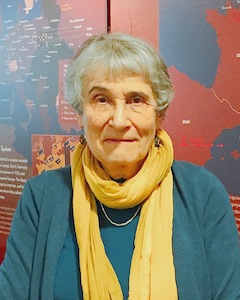
Rome Fox has been associated with the Vancouver Holocaust Education Centre for 25 years. (photo from vhec.org)

Rome Fox has retired as assistant director of the Vancouver Holocaust Education Centre. She was recognized at the VHEC annual general meeting Oct. 20 by being named a Life Fellow of the organization.

Fox has been associated with the VHEC for a quarter-century, first as a volunteer, as a member of the board of directors and the executive committee and as co-chair of the annual Yom Hashoah commemorative event. Joining the centre’s staff as a part-time volunteer coordinator, Fox went on to serve as program coordinator, interim education coordinator and acting executive director, while also taking the lead on annual commemorative events.

In her remarks at the AGM, Fox reflected on the people she has met and worked with, emphasizing the Holocaust survivors.

“It has been life-changing and very fulfilling to participate in the growth of such an important and dynamic museum dedicated to Holocaust education and remembrance,” she said. “I’m truly honoured, fortunate and privileged to work with you, our remarkable and resilient Holocaust survivor community, and I cherish the lessons I’ve learned from you. You made a difference not only in my life but in the lives of thousands and thousands of B.C. students, teachers, citizens and government officials.”

Fox also expressed pride at the changes in the organization and the innovative projects, campaigns and commemorative events with which she has been involved.

She said she treasures her relationships with the three executive directors with whom she has served – Nina Krieger, Frieda Miller and Roberta Kremer – and the meaningful work they have done.

“Every day, when you’re working there, you know you’re making a difference somehow, someway,” she told the Independent. “Somebody’s life is being touched. When you hear the remarks of students of the impact of survivors or when they take a workshop, the questions that they ask, you know that kids are starting to get this stuff.”

Both of Fox’s late parents, Sarah and Al Rozenberg, were Holocaust survivors from Poland. Her mother was in the Warsaw Ghetto and worked in a munitions factory. Ultimately, Sarah was sent to Majdanek, while her entire family was sent to Treblinka and murdered. Many of Sarah Rozenberg’s artifacts are in the VHEC’s permanent collections.

Fox knows less about her father’s story, but he was mostly on the run and helping people as they tried to escape Nazi-occupied Poland.

The couple met in a displaced persons camp and moved to Edmonton, where Rome was born.

In a moving testimonial video shared at the annual general meeting, staff, volunteers and survivors paid tribute to Fox.

Robert Krell, founding president of the VHEC, spoke of “the strength you bring to the centre and the comfort and compassion to our survivors through your own personal understanding of our nature and our struggles.”

Frieda Miller, past executive director, said: “If an organization can be said to have a heart, you were that heart. As daughters of survivor parents, we shared that unique bond, one that I think also uniquely equipped us for our work at the centre. But, Rome, what I want you to know is that your contributions were not just valuable but truly fundamental to the VHEC’s remarkable achievements of over a quarter of a century.”

Lillian Boraks-Nemetz, a Holocaust survivor, said: “I read somewhere that the sturdiest pillars of human morality are compassion and a sense of justice. In all my interactions with you, I have experienced both. In your work at VHEC, you have been supportive and encouraging, you understood what it means to be a survivor of the Holocaust and have helped to guide us in many ways.”

Wendy Bross Stuart and Ron Stuart, who worked with Fox on the musical components of countless commemorative events, thanked her for years of achievements.

“She’s approachable, kind, competent, committed – she’s got the whole package,” Ron Stuart said. “I think you can get some of those qualities in other individuals but to get the whole package is quite unique.”

Krieger, the current executive director of the VHEC, spoke of the absence Fox’s retirement will leave.

“Although it is nearly impossible for us to imagine the centre without Rome as an integral part of our team, I know that we will continue to ask ourselves: What would Rome do?”

Format ImagePosted on November 19, 2021November 18, 2021Author Pat JohnsonCategories LocalTags AGM, annual general meeting, Frieda Miller, Lillian Boraks-Nemetz, milestones, Nina Krieger, retirement, Robert Krell, Rome Fox, Ron Stuart, Vancouver Holocaust Education Centre, VHEC, volunteering
Commemorating the Holocaust

Commemorating the Holocaust

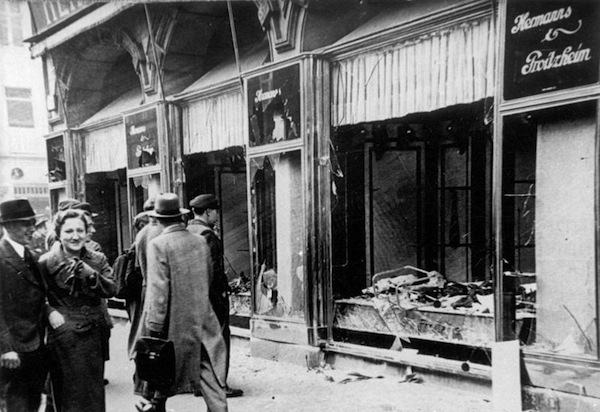
Magdeburg, Germany, 1938. (photo from Bundesarchiv / Bild 146-1970-083-42)

Next month, our community marks the 83rd anniversary of Kristallnacht, the state-sponsored pogrom known as the Night of Broken Glass, which took place on the night of Nov. 9-10, 1938. Hundreds of synagogues were burned, Jewish-owned businesses were destroyed, nearly 100 Jews were killed and 30,000 were sent to concentration camps. The shards of broken window glass seen in front of Jewish-owned stores the next morning gave this event its name.

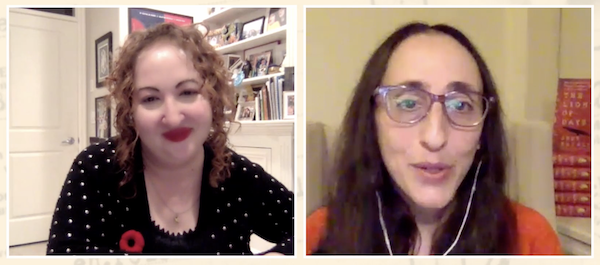
On Nov. 4, 7 p.m., streaming live via Vimeo, the Vancouver Holocaust Education Centre in partnership with Congregation Beth Israel features keynote speaker Judy Batalion, author of The Light of Days: The Untold Story of Women Resistance Fighters in Hitler’s Ghettos, in conversation with the VHEC’s Dr. Abby Wener Herlin, and a Q&A. Visit vhec.org for details.

On Nov. 9, beginning at 7 p.m., streamed live on Zoom, Victoria Shoah Project hosts a program called Communities Standing Together Against Hate: Lessons from Kristallnacht. Remembrance is essential, however we also must act in tangible ways to protect all peoples. The Shoah Project is inviting political and law enforcement leaders, as well as representatives from the diverse faith communities, to join together at the commemoration to lead the reading of a pledge of mutual respect and support. Join in remembering the past and committing to take action for a better future where we will respect and protect our neighbours, not remain silent in the face of any injustice against any person or group and work towards building bridges leading to unity and shalom. For more information, visit victoriashoahproject.ca.

– Courtesy Vancouver Holocaust Education Centre & Victoria Shoah Project


Format ImagePosted on October 22, 2021October 21, 2021Author VHEC & VSPCategories LocalTags commemoration, Kristallnacht, Vancouver Holocaust Education Centre, VHEC, Victoria Shoah Project
B.C. observes Yom Hashoah

B.C. observes Yom Hashoah

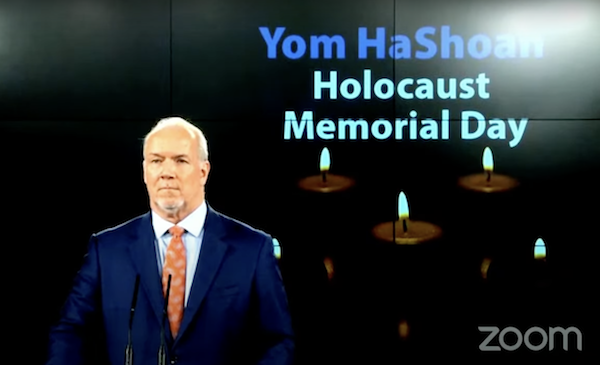
B.C. Premier John Horgan opened the commemorative event. (screenshot)

A uniquely British Columbian virtual commemoration of Yom Hashoah, Holocaust Remembrance Day, took place April 8, convened by the Government of British Columbia in partnership with the Vancouver Holocaust Education Centre (VHEC) and the Centre for Israel and Jewish Affairs, Pacific Region.

Premier John Horgan opened the event.

“On Yom Hashoah, we remember the six million Jewish lives that were lost during the Holocaust. We also remember and honour the millions who lost their lives or were murdered because of their ethnicity, sexual identity or disability,” said the premier. “Today, we also pay tribute to Holocaust survivors and, as that community grows smaller, it’s all the more important that we work together to carry that message forward – that we will never forget and it will never happen again, especially in light of the ongoing threats of violence and discrimination Jewish people are facing worldwide today.”

Horgan noted an incident in Victoria where a Chabad centre was defaced with antisemitic graffiti a day earlier.

“These are the types of acts we must stand together and fight against with a united voice, regardless of where we come from, regardless of our orientations or ethnicities or our faith. We must stand against antisemitism and racism whenever we see it,” said Horgan. “As we light the candles at Yom Hashoah in remembrance, we must remain vigilant and, as we take action today and honour those who lost their lives and those who have struggled since the Holocaust, we must again remember that we cannot repeat our past.”

Michael Lee, MLA for Vancouver-Langara, also spoke.

“As the living memory of the Holocaust fades, the important act of remembering and coming together each year grows in importance,” he said. “It is our collective responsibility to ensure that we never forget and such a thing never happens again, because, sadly, this is not just about remembering history, but about standing together today against the racism, bigotry and antisemitism that still exists in our world.… As a community, now and every day, we must stand against these acts of hate and bigotry.

“Today, on Holocaust Remembrance Day, we are reminded of why it is so important to come together, to reflect and to ensure that the past is not forgotten. We must remember both the parts of this dark, dark history that we must not let be repeated and the acts of heroism that took place amid such tragedy. Even during a period of humanity’s darkest chapters, there was still good in the world, people who risked their lives to hide and save others from the Shoah. Amidst the horrors and atrocities, there were tales of love, hope and bravery, including with the many righteous among nations, people who demonstrated that light can triumph over darkness. Today, we reaffirm our commitment to never forget; remember the victims, the survivors and the heroes; and we pledge to build a better world in their memory.”

Dr. Robert Krell, founding president of the VHEC, lit six memorial candles. The premier lit a seventh candle “to honour the millions of Roma, Slavic, LGBTQ2+ and people with disabilities who lost their lives.”

Krell, speaking on behalf of Holocaust survivors, noted that 1.5 million of the six million Jews murdered in the Holocaust were children. An estimated 93% of Jewish children in Europe were murdered, which makes his survival extremely remarkable. The fact that both his parents survived, when more than 80% of Dutch Jews were killed, is additionally miraculous.

screenshot - Dr. Robert Krell spoke on behalf of Holocaust survivors
Dr. Robert Krell spoke on behalf of Holocaust survivors. (screenshot)

“I had lost all grandparents, uncles and aunts,” Krell said. “One first cousin remained. The war left its mark and I bear a special responsibility to remember what happened and try to derive lessons from that unfathomable tragedy. The tragedy was unique in its objectives, its focus and its ferocity. Jews were extracted wherever they resided, whether Paris, Prague or Vienna, whether city or countryside or the isles of Rhodes or Corfu. The enemy pursued us and tortured and murdered without mercy, without exception.”

While Dutch citizens remember the Canadian military’s role in liberating that country, Krell also noted Canada’s failure to save European Jews before the war.

Krell also addressed the issue of the International Holocaust Remembrance Alliance’s Working Definition of Antisemitism. Around the world, he said, 34 countries have adopted the definition, as has the province of Ontario.

“As a survivor who has been deeply involved in Holocaust remembrance and education, it strikes me as unconscionable not to accept the IHRA definition to assist us all in recognizing the signs and symptoms of the scourge of Jew hatred,” he said.

Yom Hashoah fell the day before the federal New Democratic Party convention that was to consider a resolution rejecting the IHRA definition. The matter never made it to the floor, but another resolution condemning Israel passed by an overwhelming margin.

“It is my hope that we will soon see the provincial government’s adoption of the IHRA definition of antisemitism,” said Krell.

Rabbi Dan Moskovitz of Temple Sholom also took up the issue of the antisemitism definition.

“The International Holocaust Remembrance Alliance’s definition of antisemitism is, I think, the tool that guides us in our work to combat anti-Jewish sentiments,” he said. “I want to urge our provincial government to join other jurisdictions in embracing the action that is required to combat both historical and contemporary hatred of the Jewish people.”

He added: “When we think of the death of a human being, we mourn the loss of the body and the soul, but, in my work, standing with too many grieving families at graveside, it is not the body that we miss most, that is merely the vessel for the soul, the part of that person that is unique in all the world,” he said. “That’s the part that we fall in love with and are forever changed by. The soul of another leaves an imprint on our heart. So, today, we remember six million murdered Jewish souls, their lives that have been extinguished, their dreams unrealized, their loves and relationships gone forever. We pray that those dear souls are comforted and embraced under the wings of God’s presence and that now, remembered so publicly, will never be forgotten.”

Moskovitz then chanted El Moleh Rachamim and a version of the Mourner’s Kaddish that includes the names of the Nazi death camps.

In addition to the B.C. event, the Vancouver Holocaust Education Centre also partnered on April 8 with the Neuberger Holocaust Education Centre in Toronto, the Azrieli Foundation, Canadian Society for Yad Vashem, Facing History and Ourselves, Friends of Simon Wiesenthal Centre, March of the Living Canada and UIA in a Canada-wide Yom Hashoah online program that included survivor testimony from individuals across the country and a candlelighting ceremony.

A day earlier, the VHEC partnered with the Montreal Holocaust Museum for a virtual program focusing on the importance of remembrance in the intergenerational transmission of memory. Survivors and members of the second and third generations spoke about their experiences. Video recordings of all three events are available at vhec.org.

Format ImagePosted on April 23, 2021April 22, 2021Author Pat JohnsonCategories LocalTags anti-racism, antisemitism, Centre for Israel and Jewish Affairs, CIJA, Dan Moskovitz, Holocaust, IHRA, John Horgan, Michael Lee, remembrance, Robert Krell, Vancouver Holocaust Education Centre, VHEC, Yom Hashoah
Shoah education continues

Shoah education continues

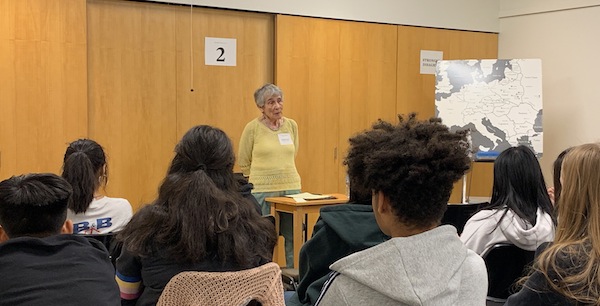
Dr. Claude Romney speaking to students pre-COVID. (photo from Vancouver Holocaust Education Centre)

For many years, people dedicated to educating about the Holocaust and its moral lessons have been adapting to new realities. The declining number of survivors and the need to preserve their eyewitness testimony has necessitated innovative means of conveying these lessons to successive generations. As a result of these preparations, organizations like the Vancouver Holocaust Education Centre (VHEC) have been remarkably prepared to continue their work despite the limitations imposed by a global pandemic.

Dr. Claude Romney has been sharing her wartime experiences with younger audiences for several years. Her father, Dr. Jacques Lewin, was arrested in Paris at the end of 1941 and was among the first prisoners transported to Auschwitz. While Romney and her mother survived the war in southern France, evading numerous close calls, her father survived the most notorious Nazi camp because his skills were useful to the Nazis – he was a doctor who was put into service at the camp. Romney has researched and spoken about the experiences of her father and other “prisoner-doctors.”

Since the pandemic began, Romney has done two virtual presentations to schools and, while she wishes the talks could be in person, she is grateful that the technology exists to allow them to happen at all.

“I personally, and I think the other survivors who continue to talk to students online, have to be grateful both to the [Vancouver] Holocaust Education Centre and, of course, most of all, to the teachers who still get in touch and haven’t given up,” she said. “It’s something which could easily have fallen by the wayside. I think it’s very fortunate that teachers are dedicated enough to continue.”

A year and counting into the pandemic, Romney said the global upheaval could have led to lost opportunities.

“We feel there is some urgency because we’re not getting any younger,” she said. “It’s very important.”

The online events differ, depending on the audience. Some classes that are still meeting in person are set up so that the speaker sees the teacher but not the entire class. When classes are virtual, the speaker is one of many faces on a Zoom call.

“This would never have been possible for students 15 years ago, 10 years ago maybe even,” Romney said. “It makes a big difference because, of course, there are books and articles, but it’s not the same as hearing somebody tell their personal stories.”

While the survivor speakers are talking about their past, the lessons they aim to impart are for the present and future.

“I think it’s vital that the new generations know about what happened because it’s up to them to prevent this kind of thing from happening again,” she said. “And to understand that it’s vital to be tolerant of other people who may be different in some ways because they come from different cultures, different religions. It’s a cautionary tale really.”

Ashley Ross has been teaching a course in genocide studies at Aldergrove Community Secondary School for four years. She can attest that students make connections between the present and the past – and that relevance has been honed more sharply in the past couple of years.

“When I first started teaching it, it was very hard for them to understand the German context of that era,” she said, noting that she was challenged to demonstrate the “slippery slope” of hatred, fear and scapegoating. Sadly, students understand that phenomenon better than just a few years ago. “Right now, they are immediately seeing connections and understanding and seeing it play out in their current world.… More than ever, the lessons of the power of propaganda and the fear and the scapegoating are really resonating in our world. It’s through those historical lessons that we are better equipped to process what we’re currently facing.”

She maintains that the survivor speakers’ virtual events are every bit as powerful on the students as an in-person one. She even sees a benefit in the fact that, when they know they can’t be seen by the speaker, students may be more open with their emotional responses.

“Because the Holocaust survivor is only looking at my face rather than their faces, I find that it’s often more raw for the students. In a large auditorium, it doesn’t have that same personal impact,” said Ross, who has led a student trip to Europe that included a visit to Auschwitz.

Sharing firsthand accounts with young generations puts a human face to a part of history that is enormous in scope and perhaps remote in time from the perspective of a teenager.

“I think there’s a sense of honour to have a direct connection to this history that sometimes feels so far away,” she said. “It’s a reminder that it isn’t so far away. I think it’s really impactful to hear first-person accounts [about] something that can get so bogged down in huge numbers.”

photo - Dr. Ilona Shulman Spaar, education director and curator at the Vancouver Holocaust Education Centre
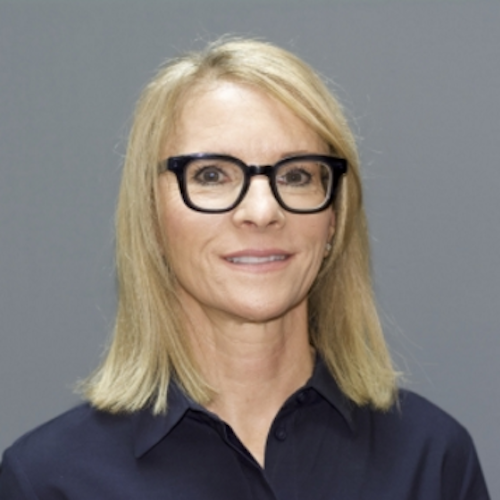
Dr. Ilona Shulman Spaar, education director and curator at the Vancouver Holocaust Education Centre. (photo from vhec.org)

Dr. Ilona Shulman Spaar, education director and curator at the VHEC, acknowledges that her team did not know what to expect when the pandemic began a year ago. At the same time, the remote delivery of programs and resources that was necessary due to COVID was something for which the centre was already prepared. Not only were Holocaust survivors and other educators delivering virtual talks to student groups in remote parts of British Columbia, a vast digitization process over the past several years has made much of the centre’s collections accessible online, including artifacts, documents, written testimonies and videos.

“In a way, that’s nothing new for us,” she said.

Some research requests saw an uptick as teachers encouraged students to undertake individualized projects – and because the revised provincial curriculum also emphasizes “self-directed learning.”

The VHEC also saw an increase in donations of artifacts and documents. This may be because people are spending more time at home and deciding to clean out attics and closets. Shulman Spaar also thinks people may have a little more time to read the communications they send to supporters, which often include appeals for family records and other items.

Echoing the Aldergrove teacher, Shulman Spaar thinks another factor for increased interest in the VHEC’s programs and resources may be due to current events. Political situations in the United States and around the world, the increased awareness of violence against minority communities and other topics in the news daily underscore the relevance of the organization’s work.

“Ultimately, we are an anti-racism-based Holocaust education centre,” she said. “If you look at what’s going on, it does seem very relevant at the moment.”

There were challenges in rapidly scaling the delivery of virtual programs to more groups. Docents, educators and survivor speakers had to learn the new technologies and adapt their messages to the medium.

Conversely, there have been silver linings. Some survivors who, for health or mobility reasons, could not present their testimonies in person have been able to do so virtually. As capacity has grown for delivering programs remotely, so have requests. The VHEC has welcomed invitations from other provinces, as well as schools in northern British Columbia and other remote parts of the province where survivors are unlikely to visit.

Moreover, said Shulman Spaar, some participants have commented that seeing survivors in their own homes, rather than on a stage, is unexpectedly powerful.

“It’s not the same as an in-person encounter,” she acknowledged, “but, also, hearing the speaker speaking from her or his living room, it’s a different intimate situation that happens. Yes, there is this screen still, but some students and teachers comment how they feel very close and it feels like an intimate encounter rather than being in a big hall and on a stage.

“It’s just different,” she said.


Format ImagePosted on April 2, 2021March 31, 2021Author Pat JohnsonCategories LocalTags Ashley Ross, Claude Romney, education, Holocaust, Ilona Shulman Spaar, Shoah, survivors, VHEC
Celebrating good deeds – JMABC @ 50

Celebrating good deeds – JMABC @ 50

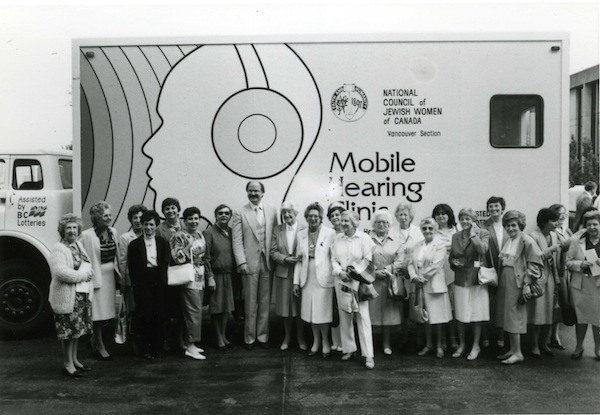
Then-Vancouver mayor Mike Harcourt and members of National Council of Jewish Women in front of the first Mobile Hearing Clinic, outside Vancouver City Hall on June 11, 1984. After raising the funds to build and operate the clinic on a trial basis, NCJW sold it to the provincial health department for the nominal price of $1. They did the same with a second mobile clinic in 1986. (photo from JMABC L.16459)

Passover is one of the foundational stories of Jewish tradition. Around the seder table each year, we learn from our elders the guiding principles of Jewish life: how to be a good person, think of others and pursue justice in the face of persecution.

These same themes can be found in the history of our community locally. The families who laid the foundations of our community, and those who continue to build its future, arrived here from all corners of the world. Mutual aid societies like the Hebrew Free Loan Association (HFLA) and the Jewish Federation of Greater Vancouver (preceded by the Jewish Community Chest and the Jewish Fund and Council) have helped welcome and support new arrivals.

The HFLA was established in 1915 by Solomon Weaver and, while it folded in 1936, it was revived in 1979 by the Jewish Family Service Agency under the leadership of Shirley Barnett. Going at first by the name of the Hebrew Assistance Association, the organization was established to aid a new wave of Jewish immigrants arriving from Russia. With initial capital provided by Joe Segal, Jack Diamond, Morris Wosk and Leon Kahn, the association began issuing loans of up to $3,000. To date, the HFLA has granted more than 2,000 loans, giving people “a hand up, not a hand-out.”

Passover also teaches us that we should apply these principles beyond our own community. As it is written in Exodus: “You shall not oppress a stranger, for you know the feelings of a stranger, having yourselves been strangers in the land of Egypt.” This philosophy can be seen as a guiding principle for community groups such as the Vancouver Holocaust Education Centre and National Council of Jewish Women (NCJW).

Founded in 1983 by local survivors of the Holocaust, the Vancouver Holocaust Centre Society for Education and Remembrance was formed with the goal of establishing an anti-racism education centre. This goal was realized in 1994 in the form of the Vancouver Holocaust Education Centre (VHEC). Education is central to the mandate of the VHEC and, each year, the centre reaches more than 25,000 students and teachers through exhibits, school programs, teaching materials and professional development initiatives for educators.

Since 1924, the Vancouver section of the NCJW of Canada has been dedicated to social action and human rights. For close to a century, its social justice efforts have taken diverse forms, from pioneering a provincial mobile hearing screening program for preschoolers to championing the cause of Nasrin Sotoudeh – illegally imprisoned in Iran – to recent fundraising and awareness initiatives against human trafficking.

These are just a few of the many organizations and individuals who make real the lessons of Passover each day. It has been inspiring to learn more about these and other people and groups as we at the Jewish Museum and Archives of British Columbia collect stories for our upcoming celebration book marking our 50th anniversary.

We invite you to share your story with us and be a part of this milestone publication. Share your family story, recognize someone notable, or sponsor this project. Full information is available at jewishmuseum.ca/fifty-years.

Format ImagePosted on March 19, 2021March 18, 2021Author Jewish Museum and Archives of British ColumbiaCategories LocalTags Hebrew Free Loan Association, HFLA, history, Jewish Federation, National Council of Jewish Women, NCJW, Solomon Weaver, tikkun olam, Vancouver Holocaust Education Centre, VHEC, women
Anti-racism fundraiser

Anti-racism fundraiser

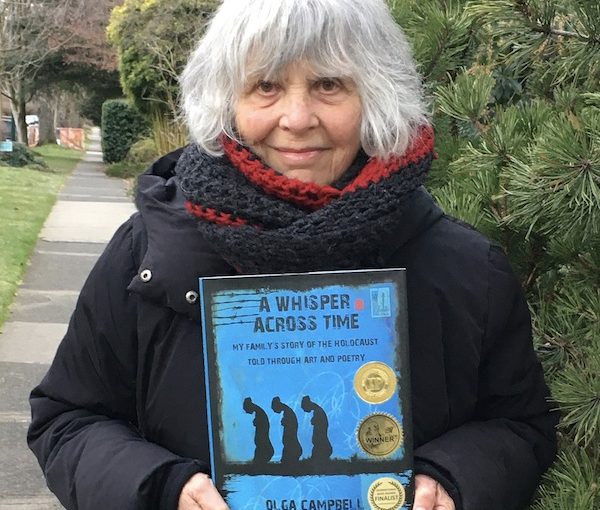
Olga Campbell is raising money for the Vancouver Holocaust Education Centre’s anti-racism programming. (photo from Olga Campbell)

Half of all sales during March of Olga Campbell’s multiple-award-winning A Whisper Across Time: My Family’s Story of the Holocaust Told Through Art and Poetry will be donated to the Vancouver Holocaust Education Centre’s anti-racism programming, engaging youth and teachers in promoting human rights, social justice and genocide awareness. Campbell’s goal is to raise $5,000. Her objective is to raise “concerns about the fragility of democracy and the rise of white nationalism, racism and antisemitism in the world today.”

In A Whisper Across Time, Campbell – whose mother lost all of her family during the Second World War – writes, “This is the story of one family out of millions of families who went through the Holocaust.”

As quoted in the Jewish Independent when the book was published in 2019, “It is ‘the story of survival and death,’ ‘of how trauma of such magnitude is passed from one generation to another to another….’ It is also an ardent call for readers to remember Rwanda, Rohingya, Bosnia, Syria, Afghanistan, Sudan, Iraq, Cambodia.” Campbell notes in the book that, “by the end of 2016, there were 65.6 million refugees, asylum seekers and internally displaced people in the world.” She pleads, “eighty years ago, the world looked away / we must not look away now.” (Read more at jewishindependent.ca/a-story-told-in-art-and-poetry and jewishindependent.ca/whisper-across-time.)

Campbell will be giving away five signed copies of her book. Everyone who wins or buys a book before the end of March will also receive a signed miniature print – images from the book.

Winners of the book giveaway will be announced on March 21, which is the International Day for the Elimination of Racial Discrimination.

To buy the book ($32), visit olgacampbell.com/new-book-whisper-across-time.


Format ImagePosted on March 5, 2021March 4, 2021Author JI staff with information from Olga CampbellCategories BooksTags anti-racism, education, fundraiser, Holocaust, Olga Campbell, philanthropy, tikkun olam, VHEC

A childhood spent in hiding

Alex Buckman, a child survivor of the Holocaust, shared the story of his harrowing childhood years during a moving online event Jan. 27. The program, marking International Holocaust Remembrance Day, was the second annual such event organized by the Bayit in Richmond.

Buckman is the president of the Vancouver Child Survivors Group and has shared his experiences with thousands of students as a Vancouver Holocaust Education Centre (VHEC) survivor speaker.

“I was born on Oct. 31, 1939, in Brussels, Belgium,” he told more than 100 people who attended virtually. “My family was Jewish. I was 7 months old when Nazi Germany invaded Belgium on May 10, 1940. Everything changed for Jewish people in Belgium.”

He recalled how, at the age of 4, he was escorted by a strange woman, as they traveled through the night, sleeping in forests and foraging for food. After days of walking, they arrived at an orphanage. He would only discover years later that his parents were sent to Auschwitz.

At the orphanage, he met up with his cousin Annie but was told that they were to refer to each other as siblings.

When Nazis would come for inspections, Jewish boys were hastily sent into a cellar. “They told us again to be very quiet, then they shut the two wooden doors, replaced the carpet and furniture,” he said. “In the cellar, we were very cold and scared and we peed our pants. We saw large things running around us. They told us later that they were rats. The first time this happened I was 4 years old…. It seemed like we were in that cellar for a very long time. Soon, we heard every footstep over our heads. We heard men screaming loudly in a language that we did not understand. We were scared. We did not know what was going on. They told us that we should not cry but we were scared children so we cried.

“Suddenly, we heard the pushing of the furniture and they opened two wooden doors and we saw the light,” he continued. “They asked us to come out but we did not want to go out. We told them that we had peed our pants [so] they promised that they would give us a warm bath. This happened too many times from the age of 4 to 6-and-a-half.”

Annie’s mother, Alex’s Aunt Becky, was sent to the women’s concentration camp Ravensbrück. When each new train of prisoners would arrive, Becky would run through the crowds of arriving women calling the name of her sister, Devora.

“A young girl came close to Becky and said, I knew Devora but she is dead,” Buckman recounted. “Becky asked her: how did you know Devora? The young girl replied, I am from Belgium and I used to babysit her son, Alex. Becky thanked her and cried. Becky looked at the sky and prayed. She said, if I survive this, one day, and find Alex, I will raise him as my son.”

When liberation finally did come, it took time for the surviving family to find one another. Alex and Annie waited in the orphanage as one child after another was claimed by family. Alex tried to reassure his cousin, whom he believed to be his sister.

“I would tell her that our parents would come soon,” he said, “but, like Annie, I did not know what happened to our parents and why they were not coming for us. The orphanage kept all the children for another six months, hoping that our parents would come and pick us up. But no one came for us.”

The remaining children were transferred to a Red Cross facility in Brussels. Eventually, they were reunited with Annie’s parents, who Alex assumed were also his own. It was another cousin who, in an act of revenge for a childhood spat, blurted out the truth to Alex that his parents were dead.

Buckman went on to share his experience in April 2010 as a survivor-participant in the March of the Living, a program that brings Jewish youth to Poland and then on to Israel to explore firsthand the history of the Holocaust and its survivors who helped build Israel.

“It is almost impossible to describe the feeling I felt entering that camp, Auschwitz,” Buckman said. “On both sides of the camp there were shoes. As I passed the shoes, I caressed the little pair of shoes. The students were crying, but we had to continue.… We saw a mountain of glasses all tangled together.

“We finally walked in a shower room and I closed my eyes,” he said. “I was thinking of my mother and her sister.… We were told that the women panicked when they did not see the water come down from the showers. They ran toward the walls and scratched them with their fingernails. When I heard this, I turned and caressed the wall, feeling the scratches made by Jewish women prisoners. I wondered, were those scratches made by my mother? I would never know.

“In that room, I finally said, au revoir, Maman.”

At the commemoration, Richmond Mayor Malcolm Brodie, accompanied by four city councilors, spoke and read a proclamation.

All four Richmond MLAs were present, with Kelley Greene, MLA for Richmond-Steveston, reading a proclamation from the premier. Finance Minister Selina Robinson also addressed the event, as did Steveston-Richmond East Member of Parliament Kenny Chiu, who spoke of his own visit to Auschwitz.

The Bayit’s Rabbi Levi Varnai noted that this year’s event, which represents the 76th anniversary of the liberation of Auschwitz-Birkenau, also fell on erev Tu b’Shevat, the new year of the trees.

“The marriage of these two days is chilling,” said the rabbi. “Man is compared to the trees of the field, our tradition tells us. The six million souls murdered in the Holocaust were like individual human trees, each had the potential to grow, to flourish, and to bear fruit of the generations. They were obliterated, but one thing remained that can never be destroyed: their roots.

“The roots of the Jews who perished in the Holocaust goes back 3,300 years to Mount Sinai. What gives Holocaust survivors the sustenance to keep going? What motivates future generations of Jews to double down on life? It’s not just the memory of those who passed away, it’s also the memories of hundreds of generations who came before them, the generations who struggled and prevailed against all odds…. As we remember today the six million souls who left us, we can also remember the millions of souls who came before them and the millions who will come after.

“Today, we mourn. Tomorrow, we plant and renew,” said Varnai.

The Bayit’s International Holocaust Remembrance Day program was co-presented with partners including the Centre for Israel and Jewish Affairs, the VHEC, the Kehila Society of Richmond and the Jewish Federation of Greater Vancouver. The program was emceed by Bayit president Keith Liedtke.

Earlier in the day, a national virtual commemoration took place, organized by the Friends of the Simon Wiesenthal Centre in partnership with the VHEC and other groups across Canada. Survivors, including Vancouver’s Serge Haber, lit memorial candles. Heather Dune Macadam, author of the book 999: The Extraordinary Young Women of the First Official Jewish Transport to Auschwitz, spoke with Michael Berenbaum, a writer and professor and director of the Sigi Ziering Institute: Exploring the Ethical and Religious Implications of the Holocaust.

Posted on February 12, 2021February 11, 2021Author Pat JohnsonCategories LocalTags Alex Buckman, child survivor, CIJA, Holocaust, IHRD, International Holocaust Remembrance Day, Jewish Federation, Kehila Society, Serge Haber, VHEC
Mother saved by flowing milk

Mother saved by flowing milk

The author as an infant with her parents Sarah and Mechel, and brother Hy, in Kazakhstan, where she was born in 1944. (photo from Reva Kanner Dexter)

A year ago, I attended the 31st Annual World Federation of Jewish Child Survivors of the Holocaust and Descendants, hosted by our own Vancouver Holocaust Education Centre. I have kept the story of my own Holocaust experience suppressed because it never seemed as tragic nor as diabolical as others’. Furthermore, because I was an infant, born in 1944, I did not think that I had the right to call myself a child survivor. However, attending the conference changed that perception.

I claim the dubious distinction of being in the one percent of children born of Polish parents who survived. As three million Jews of Poland were murdered, I feel very privileged.

Of course, the circumstance of my miraculous survival is due to several factors. First, my parents escaped Poland in September of 1939. Second, they were living close to the Ukraine border. Third, they had the essential skills and resilience to overcome many hardships.

My mother Sarah (daughter of Pinchus and Chana) and my father Mechel (son of Israel and Esther) were born and grew up in small towns in southeastern Poland. Krasnystaw and Izbica were 12 kilometres apart. Close enough for biking and walking between the two towns along the Wieprz River.

Typical of small towns in that region and era, Sarah and Mechel grew up poor. Sarah’s father was a barber, who taught her his skills as soon as she could hold a razor blade. Mechel’s father was a tailor who had taught him the art of sewing, also at a young age.

Sarah and my father had moved to Chelm after their marriage, and Sarah was already six months pregnant when the German troops invaded.

Mechel was a member of a Zionist/socialist club, so he got the news early that the Nazis had taken over the town – 1,500 young men were rounded up and shot. Rumours of castration created panic. Mechel took off by bike with some of his pals, telling Sarah he would be returning.

Sarah’s birth mother lived in Rovno, Ukraine, so she made her way alone across the border with the help of a Yiddish-speaking Russian soldier. She had the prescience to bring her barbering tools. Little did she know that trains and train stations were going to dominate her life from that night forward for the next six years.

Sarah and Mechel gave birth to their first child, Chaim (Hy), who an aunt testified was born in Rovno, while an immigration document states that he was born in Novosibirsk, Siberia. Memories do seem to play tricks when the brain is violently assaulted.

The Russians saw and seized the opportunity of so many Jews fleeing Poland into Ukraine. They tricked Jews by telling them that eastern Poland was now under Soviet rule and that they would be given safe passage back home.

It was a lie, a big one. The Jews were shoved into open cattle cars and sent to forced labour camps all over the U.S.S.R. Workers were required to keep the country running under the murderous hand of Stalin.

My parents and baby brother survived the train ride from Rovno or Kiev, which finally stopped in a logging camp on the banks of the Ob River, in Siberia. They realized immediately that their lives were only worth what their labours could produce.

I recall stories of wolves howling in the night and rats “as big as kittens” stealing their meagre rations while they slaved in the tundra in the day and tried to sleep in the frozen barracks in the night.

My father organized a strike – after all, they were in a communist country weren’t they? The demands for better working conditions were answered rapidly by rounding up the leaders during the night and incarcerating them in the Gulag.

Sarah had to fend for herself again. Even though she was freezing, undernourished and exhausted, she had an ample amount of milk flowing from her body. This was noticed by the commandant, whose wife had just given birth and could not nurse their sickly baby. Sarah was promoted from lumberjack to nursemaid.

As the two women became friends, Sarah got news that Mechel and the other men were still alive.

photo - A photo taken at a displaced persons camp in Germany, 1947. The author and her older brother, Hy, are in the centre, with their arms draped over each other
A photo taken at a displaced persons camp in Germany, 1947. The author and her older brother, Hy, are in the centre, with their arms draped over each other. (photo from Reva Kanner Dexter)

In June 1941, when the Nazis attacked Russia, the Soviets granted amnesty to the surviving Polish citizens. Poland and Russia became allies. The Jewish prisoners were released, only into a more dangerous predicament.

With Mechel’s leadership, the ragtag group of Jewish lumberjacks built rafts, trusting the river to lead them to safety. They navigated the Ob River by day, roping up by night.

During the night, the women would scramble up the banks, scavenging for food on adjacent farms. My mother told us that she dodged many bullets through the darkness. But the plan succeeded in getting them to a train station.

The next few years, they were underground, following trains, bartering at train stations, trying to regain health. Sarah would do pop-up barbering, thankful for her tools and endurance.

They finally made it to Czymkient, Kazakhstan, where Mechel got a job sewing uniforms for pilots at a pilot training academy. I was born in December 1944. Hope and optimism returned to our little family.

Of course, the story does not end here. Other chapters will emerge, as I continue to pull pieces of the survival puzzle together.

Thanks to the conference, I realize how important it is to keep searching for objects and recording memories, which return our beloved victims and survivors to us in spirit.

Reva (Rivka) Kanner Dexter has been a docent at the Vancouver Holocaust Education Centre since 2007.

Format ImagePosted on December 4, 2020December 2, 2020Author Reva Kanner DexterCategories Op-EdTags child survivor, Holocaust, memoir, survivors, VHEC
Pandemic rouses memories

Pandemic rouses memories

Simon Fraser University’s Prof. Lauren Faulkner Rossi, left, interviews child survivor Marie Doduck in a Zoom presentation Nov. 5. (screenshot)

For some survivors of the Holocaust, the COVID pandemic has brought back the traumas of the past. Marie Doduck spoke recently at a virtual event, recounting her survival story and her life in Canada, including her response to the initial lockdown in the spring. It is a response, she said, that is paralleled by many others in Vancouver’s group of child survivors of the Shoah.

Born in Brussels, the youngest of 11 children, Doduck spent most of her childhood hiding in orphanages, convents and strangers’ homes. In 2020, she found herself opening her front and back doors, reminding herself that she was free to go for a walk, yet haunted by the long-ago memory of hiding.

“It brought back a terrible time for us at the beginning of COVID,” she said during an interview that was webcast as part of Witnesses to History, a series presented by the Simon Fraser University department of history in partnership with the Vancouver Holocaust Education Centre. “I know the other survivors feel the same way. I would say that was the hardest of all.”

When the war began, Doduck (then Mariette Rozen) was 4 years old. Her father died when she was a toddler and some of her older siblings were already married and had their own families. After the occupation of Belgium, those who remained at home set out on foot headed for Paris, where a sister lived, unaware that Paris, too, was under occupation. She remembers riding on the shoulders of her brother Henri and seeing what she thought was a magnificent sight.

“I saw this beautiful silver bird in the sky and I thought that was so beautiful,” Doduck recalled. It was surrounded by stars. “The next thing I know, I was flying into the ditch on the side of the road. Of course, the bird and those stars were planes diving and, even now, I can hear the whistle of the diving and the shooting. They were killing people on the road. That was my first contact with death and blood. It was all over the place.”

Soon, the family dispersed and Mariette began a years-long succession of shuttling between hiding places in various countries of northwestern Europe. A facility for languages began then and Doduck is now working on learning Mandarin, her 10th tongue.

In some homes where she was hidden, she would sit under the table while the family’s children did their homework. Then, after others had gone to bed, she scoured the homework to educate herself.

She also has something of a photographic memory and she realizes now that she served as a messenger, repeating what she had been told when asked by siblings who had joined the resistance and who could make occasional contact while she was in hiding.

As is the case with many survivors, Doduck has stories of almost-miraculous near-misses.

As is the case with many survivors, Doduck has stories of almost-miraculous near-misses.

While being hidden in a convent, she was exposed. The mother superior of the convent knew that Mariette was Jewish, but presumably most of the nuns did not. When one sister discovered her secret, she denounced the child to the Gestapo.

“Being a good nun, she went to the mother superior and told the mother superior what she had done,” Doduck recounted. “The mother superior had woken me up and taken me to the centre of the convent to the sewers and dumped me in the sewer. They came to the convent to search for me and they didn’t find me.”

In the sewer, filled with fetid water and rats, Mariette held her breath as she heard the boots of the Gestapo officers above her.

“I killed some rats to make a mountain so I didn’t have to stand in the cold water,” she said. “The mother superior saved me and that night I left and went to another place.”

Even more frighteningly, Mariette was rescued from a train almost certainly headed to catastrophe in the east.

“I was caught and I was put on a train,” she said. “I was the last one put on a cattle car and I was lucky because the cattle car had slats so I was able to breathe because they pushed us like sardines.… I remember the gate shouting and the clang, clang, clang, I can hear it now, and the lock.… Then the train stopped. I have no knowledge of places.”

The gate opened and Mariette saw a Gestapo officer.

“Black uniform, black hat, swastikas on his lapel, black boots, a leather strap with a revolver, a leather strap attached to a baton,” she recalled. “And, in German, he said, ‘What is my sister doing on this train?’ I looked left and I looked right. There was no other child but me.… This Gestapo that had probably killed hundreds of people, children as well probably, took me off the train, put me on his motorcycle and took me [away]. Years later, I found out that this Gestapo went to school with my brother Jean and used to come to my house on Friday to have dinner with us and he recognized me, that I was Jean’s sister.”

In the course of research for her memoir, Doduck recently discovered that her mother and one brother, Albert, were arrested and sent first to a transit camp and then on to Auschwitz. Her brother Jean, who was in the French resistance, was arrested elsewhere but was on the same train. Another brother, Simon, survived the war but died at Auschwitz in the weeks after liberation. Like thousands of others, he succumbed after well-intentioned Allied officials provided food to the starving inmates, whose stomachs could not assimilate it.

Including Doduck, eight siblings survived and somehow found one another after the war. One brother, Jule, chose to remain in Brussels with his family. Charles, who was also married before the war, moved to Brazil. Sister Sara went to the United States. Brother Bernard went to Palestine with Hashomer Hatzair, the socialist-Zionist youth movement.

Doduck, aged 12 at the time, and the three other siblings – Esther, Henri and Jack – were four of 1,123 Jewish child survivors of the Holocaust sponsored to come to Canada under the auspices of Canadian Jewish Congress in 1947.

Her recollections of arrival in her new homeland are not warm.

As the children disembarked the ship in Halifax, they found themselves in a compound surrounded by barbed wire, as though they would try to escape. From there, they were moved to a room with bars on the windows.

“I wasn’t called by my name,” she said. Each refugee had a number pinned to their chest. Hers was 73, she thinks, or possibly 74.

“Nobody talked to us,” she said. “Nobody really welcomed [us]. We were just a bunch of probably wild children. I can only describe that I had an adult’s mind in a child’s body. We survivors saw too much dirt, too much killing, too much that a child should ever see.

“We were treated like we were nothing at all,” she recalled.

She wanted to go to Vancouver. She had seen a map and knew that there were beaches there.

“I remember as a child we used to go to la plage, the beach, with the family,” she said. “That was happy times.

“And just like Brussels, it rains a lot too,” she added, laughing.

The four siblings were fostered by four different families in Vancouver. While not all the 1,123 children who were sponsored found loving homes, Doduck believes that she and her brother Jack were among the luckiest.

Doduck was taken in by a couple, Joseph and Minnie Satanov, who had no children and, weeks after Mariette arrived, celebrated their 30th wedding anniversary. The couple would become surrogate grandparents to Doduck’s three daughters and Doduck would care for them in their old age.

Still, the early months were difficult. The Satanovs spoke Yiddish, but it was a “highbrow” variation, Doduck said. Hers was “street Yiddish” and the initial communication was largely pointing and miming.

While her foster family was wonderful, Doduck, like some other survivor refugees, said their treatment by the broader Jewish community was inhospitable. Asked if the community welcomed her and her peers, she replied: “I hate to say it, they didn’t.”

As a child, she didn’t understand it. As an adult, especially now, as she plumbs her experiences in the process of writing her history, she thinks she understands and empathizes.

“The community did not accept us,” she said. “They were fearful. I understand this now. They were fearful of what we knew, of what we saw. As a child, I didn’t understand that. As an adult, I understand it today.”

Her process of assimilation is akin to a split personality, she explained. She encompasses both the child Mariette and the adult Marie.

“Survivors – this is a secret but I’ll tell the world today – survivors are two people. Mariette is the child who is still in me and is trying to come out, and Marie [is] the person I created to become a Canadian and to fit into our society here in Vancouver.”

“Mariette is a child from Europe. Marie is the name I took in Canada to hide who Mariette was,” said Doduck. “Survivors – this is a secret but I’ll tell the world today – survivors are two people. Mariette is the child who is still in me and is trying to come out, and Marie [is] the person I created to become a Canadian and to fit into our society here in Vancouver.”

That internal dichotomy is most evident when she speaks with school groups and others about her war-era experiences.

“When I do outreach speaking, I speak as Mariette,” she said. “When I leave the school, Mariette is put on a shelf and Marie takes over and becomes a Canadian. Marie cannot survive with the memories if I don’t put Mariette on the shelf…. I can’t live the memories. It takes a lot out of me to relive.”

The stories she has to share can be harrowing and there are still details that she is only now learning as she works on writing her memoirs. Lauren Faulkner Rossi, an assistant professor at SFU’s department of history interviewed her for the Nov. 5 event and is collaborating on the memoir.

While the pandemic may have jogged loose deep-seated memories, Doduck sees other alarming parallels in the world today that hearken to the dark past.

“We are again being persecuted, we are again being hated, we are again being hit, we are again being abused constantly,” she said of rising authoritarianism and antisemitism in parts of the world. “I see what I saw as a 4-year-old, 5-year-old. I’m seeing it around the world and nobody seems to see it, that the hate is coming again.”

Format ImagePosted on November 27, 2020November 25, 2020Author Pat JohnsonCategories LocalTags child survivor, coronavirus, COVID-19, Holocaust, Lauren Faulkner Rossi, Marie Doduck, memoir, SFU, Shoah, survivor, VHEC
How Nazis stole assets

How Nazis stole assets

Prof. Chris Friedrichs speaks at the annual Kristallnacht Community Commemoration, on Nov. 9. (screenshot)

Under the Nazi regime, almost all personal property and wealth owned by German Jews was either explicitly confiscated or, in the case of bank accounts, effectively frozen. Yet, while Jewish property was stolen without compunction, the Reich had scrupulous records and systems in place to ensure that no Aryan German who was owed money by those Jews was deprived of their due.

Chris Friedrichs, professor emeritus of history at the University of British Columbia and himself the son of a couple who fled Germany ahead of the Holocaust, delivered the lecture at the 2020 annual Kristallnacht Community Commemoration, Nov. 9. The event was recorded and presented virtually due to the pandemic. His lecture, How to Steal from Jews: A Story from Nazi Germany and What it Teaches Us, explored the history of the family of Friedrichs’ late wife, Rhoda (Lange) Friedrichs, as a microcosm of the sprawling bureaucracy the Reich put in place to manage the stolen property.

Rhoda Friedrichs’ grandparents, Carl and Thekla Rosenberg, lived comfortably in Berlin. Their two daughters grew up and migrated to the United States. By the time the Nazis came to power and the Rosenbergs might have been able to escape, Carl was already experiencing dementia.

Because there was no room in the Jewish nursing home in Berlin, he was moved to a facility in Koblenz, hundreds of kilometres away. Thekla was forced from their home and ordered into a sort of dormitory for older Jews, where she shared a single room with five or more other Jewish women. From there, she was assigned to forced labour in a factory.

Eventually, consistent with the plan for the “Final Solution,” almost all the Jews remaining in Germany were transported to Nazi-occupied Poland.

“Every time a Jew was put on a list to be deported to the east, he or she first had to fill out what was called a property declaration, a complete list of all his or her property, which would now become the property of the German Reich,” said Friedrichs.

In the spring of 1942, Carl Rosenberg and the other residents of the Koblenz care home were deported to a death camp in Poland.

In November 1942, Thekla and 997 other Berlin Jews were transferred to a train station and deported directly to Auschwitz.

“Who suffered most on these trains to Poland?” Friedrichs wondered. “Was it Carl Rosenberg, his mind clouded by confusion and dementia, suddenly removed from the caring place where he had lived for two years and put on a train for reasons no one could explain to him? Or was it his wife, her mind clear to the last, not knowing the exact destination but almost certainly able to guess what lay ahead for her? This, like much else, we will never know. But we do know that both of their lives ended in unspeakable misery in 1942.”

Their lives ended, Friedrichs noted, “but their victimization did not.”

The German Reich claimed to own whatever property the Rosenbergs still had at the time of their deportation. Like that of the other German Jews who were deported, the assets came under the authority of German finance offices in cities and towns across the country.

“One might think that this was an uncomplicated matter,” said Friedrichs. “Well, no. There was a problem. If a Jew owned a house or a piece of land, there might be a mortgage on it. The mortgage-holder might be a German, who expected his regular interest payments. If a Jew had any debts or obligations, they might be owed to some German, who expected those debts to be honoured and paid. If a Jew still owed some rent or had not yet paid the last gas bill or electric bill before being taken to the station, the landlord or utility company waited impatiently for that payment. You could steal every penny from a Jew, but you still had to be careful not to deprive even a single penny from a German who was entitled to it. So, all the local offices of the ministry of finance had to handle all these matters with scrupulous bureaucratic precision. Otherwise, they might be accused of cheating Germans of what was due to them.”

In files Friedrichs has copies of, the respective finance offices in Berlin and Koblenz had extensive back-and-forths about which office was responsible for settling outstanding obligations from the Rosenbergs’ estates.

The documentation of the officials was meticulous, something Friedrichs credits more to the nature of bureaucrats than to the Nazis specifically.

“Most of the thousands of people who worked for the German ministry of finance or the local finance offices were not hard-core Nazis,” he said. “The majority of them had been working in those offices for many years, usually starting long before the Nazis came to power.… As long as it was clear which ordinances or decrees were pertinent to the work at hand, they carried on as usual.”

Historians have found several instances of officials defying orders and returning stolen property to their Jewish owners, but this was exceedingly rare, said Friedrichs. “Did they ever wonder if they were in fact facilitating or cooperating with a process of mass murder?” he asked.

As the Nazis’ defeat approached, high-ranking officials circulated an order to the local finance offices in Germany, demanding that all records pertaining to the disposition of Jewish property be destroyed rather than fall into the hands of the invading Allied armies.

Again, behaving more like bureaucrats than Nazis, few offices complied. “The work of the finance offices would be carried on right to the bitter end,” said Friedrichs. “This is how bureaucrats reacted when they were taught what to do but not to think about why they were doing it.”

The care the German officials took with Jewish property juxtaposes bleakly with the fate of the Jewish people themselves.

“It teaches us something not just about the fate of two of the victims, but also about those who participated in the victimization,” said Friedrichs. “The Holocaust, in its fullest sense, was not only the murder of Jews. It was also a relentless project to take whatever the Jews had and make it the property of the German Reich or in some cases of their accomplices in other parts of Europe. After all, the Nazis valued everything the Jews owned, everything, that is, except their lives, which the Nazis regarded as worthless.”

screenshot - As part of the Nov. 9 Kristallnacht commemoration, candles of remembrance were lit by Holocaust survivors in their homes
As part of the Nov. 9 Kristallnacht commemoration, candles of remembrance were lit by Holocaust survivors in their homes. (screenshot)

Friedrichs’ lecture dovetailed with the theme of the exhibition currently ongoing at the Vancouver Holocaust Education Centre. Treasured Belongings: The Hahn Family & the Search for a Stolen Legacy tells the history of Max and Getrud Hahn, whose collection of Judaica and other artwork was stolen by the Nazis, and the efforts by their descendants, including their grandson Michael Hayden, a UBC professor, to locate and restitute some of the artifacts.

Friedrichs’ talk paid tribute not only to his wife’s grandparents, Thekla and Carl Rosenberg, but also to his wife Rhoda, who, he said, had hoped to pursue the research on this aspect of history and share it with the public herself, but who passed away due to cancer in 2014.

The lecture was presented by the VHEC and Congregation Beth Israel. It was made possible with support from the Robert and Marilyn Krell Endowment Fund at the VHEC and contributions to the Jewish Federation of Greater Vancouver annual campaign.

Beth Israel’s Rabbi Jonathan Infeld thanked Friedrichs and reflected on his words and their meaning. Nina Krieger, executive director of the VHEC, read a proclamation from the City of Vancouver on behalf of Mayor Kennedy Stewart.

Corrine Zimmerman, president of the board of directors of the VHEC, introduced the event, which took place on the 82nd anniversary of Kristallnacht, Nov. 9-10, 1938. That date is seen by many as the beginning in earnest of the Holocaust. The well-orchestrated pogrom, planned to appear like a spontaneous anti-Jewish uprising, saw violence across Germany and Austria that night. Rioters destroyed 267 synagogues, damaged or destroyed 7,000 Jewish businesses and 30,000 Jewish men were arrested and incarcerated.

Candles of remembrance were lit by Holocaust survivors in their homes and incorporated via video into the commemorative program. Cantor Yaacov Orzech chanted El Moleh Rachamim.

Format ImagePosted on November 27, 2020November 25, 2020Author Pat JohnsonCategories LocalTags Beth Israel, Carl Rosenberg, Chris Friedrichs, Holocaust, Nazis, Rhoda Friedrichs, Shoah, Thekla Rosenberg, VHEC

Posts pagination

Previous page Page 1 … Page 3 Page 4 Page 5 … Page 10 Next page
Proudly powered by WordPress