Skip to content
  • Home
  • Subscribe / donate
  • Events calendar
  • Business Directory
  • FAQ
  • News
    • Local
    • National
    • Israel
    • World
    • עניין בחדשות
      A roundup of news in Canada and further afield, in Hebrew.
  • Opinion
    • From the JI
    • Op-Ed
  • Arts & Culture
    • Performing Arts
    • Music
    • Books
    • Visual Arts
    • TV & Film
  • Life
    • Celebrating the Holidays
    • Travel
    • The Daily Snooze
      Cartoons by Jacob Samuel
    • Mystery Photo
      Help the JI and JMABC fill in the gaps in our archives.
  • Community Links
    • Organizations, Etc.
    • Other News Sources & Blogs
  • JI Chai Celebration
  • JI@88! video

Recent Posts

  • Federation now across BC
  • Israel fighting for its existence
  • Deal strengthens Iran
  • Patriotic belonging diminishes
  • A campaign to engage
  • Upstanders’ first live event
  • Responding to Carney
  • Having your own home
  • Music a family tradition
  • Musical to warm heart
  • Community milestones … June 2026
  • Sharing her passion for Israel
  • Or Shalom reopens its doors
  • JFS from past to future
  • Need holistic approach
  • Sharing stories, advice
  • Journalist shares fears
  • Skills to live together
  • Road to independence
  • Cutting grass with scissors
  • Zionism as a solution
  • Deceit, desire & the divine
  • Reclaiming sacredness
  • Creative project ideas
  • Summer squares and cobbler
  • Thou shalt … summer commandments
  • Legal help for students
  • Revisiting myth of Lilith
  • Wrong person rebuked
  • Canada’s mixed messages
  • Questions for museum
  • Symposium on antizionism
  • Making soccer political
  • CJPAC lauds Pulver’s impact
  • City recognizes Vrba’s legacy  
  • Organ donation saves lives

Archives

Follow @JewishIndie
image - CJN box ad Rockowers 2026

Tag: politics

Auschwitz 75 years on

Auschwitz 75 years on

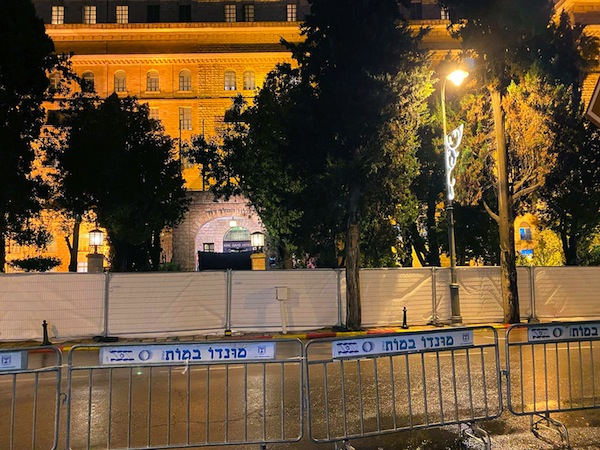
The King David Hotel was partially obscured by a temporary security barrier as part of the preparations that were carried out in Jerusalem for the arrival of leaders from more than 45 countries for in the Fifth World Holocaust Forum, which took place at Yad Vashem this week, and marked the 75th anniversary of the liberation of Auschwitz-Birkenau in Poland. (photo from Ashernet)

Monday marks the 75th anniversary of the liberation of Auschwitz-Birkenau. That date, Jan. 27, has been set aside annually to mark International Holocaust Remembrance Day.

Scores of officials from around the world were to descend on Jerusalem this week to attend a ceremony at Yad Vashem and a forum on the Holocaust. Expected guests include Canada’s Governor-General Julie Payette, Prince Charles, Russian President Vladimir Putin, French President Emanuel Macron, U.S. Vice-President Mike Pence and a long list of royalty, heads of government and others from around the world, especially from Europe.

Among the more attention-grabbing guests is Volodymyr Zelensky, president of Ukraine. Zelensky is a particularly interesting man in a particular role at an interesting time. He will be in Jerusalem alongside Pence and other world leaders at the very moments when the U.S. president is undergoing an impeachment trial initiated as a result of a phone call with Zelensky, probably the only reason most North Americans know his name. But that is among the least remarkable things about the leader.

A political neophyte (aside from playing the Ukrainian president in a satirical TV series), Zelensky was elected on an anti-corruption platform. In advance of his visit to Israel for the commemoration events this week, he engaged in a lengthy and witty interview with the Times of Israel about his family’s history – some relatives live in Israel and he has visited and performed comedy there many times – and his reflections on Jewishness, Israel and contemporary politics.

It caused some curiosity when Zelensky was elected because he has, in his words, “Jewish blood.” It is a common term, perhaps especially in formerly Soviet societies where religion was officially negated and so identities are defined obliquely, but the phrase “Jewish blood” is unfortunate in the context of Ukrainian history.

Among the considerations facing the country at present is the complicity of its citizens in the Holocaust, including in the massacres at Babi Yar, a ravine in the capital of Kyiv, where an estimated 100,000 to 150,000 individuals were murdered during the Nazi occupation, including more than 33,000 Jews on one day in September 1941.

In 1976, Soviet officials erected a monument marking the site and the cataclysm – ignoring the Jewish particularity of the mass murder and lamenting the deaths of Soviet victims of Nazism. It is undeniably true that victims at Babi Yar also included Roma, communists, Ukrainian nationalists and prisoners of war, all of whom deserve to be commemorated and mourned. But the omission of the Jewish identities of most of the victims at the site has been a point of pain and conflict for decades.

Zelensky’s government is remedying this. Begun by civic officials and Jewish leaders and endorsed by Zelensky’s predecessors, a Babi Yar Holocaust Memorial Centre is being constructed, with anticipated completion in 2023. The government is also undertaking a more transparent assessment of the country’s role and its citizens’ collaboration during the Second World War, outpacing most of their eastern European neighbours in addressing this dark past.

Still, some red flags remain. Zelensky claims that there is no antisemitism in Ukraine, an unequivocal statement that bewilders. It would be careless for any leader to ascribe complete innocence of bigotry to their entire citizenry, more so the leader of a country with a history like Ukraine’s.

He is, in some ways, between a rock and a hard place. While making blanket denials of Ukrainian antisemitism, he is also attempting to move his society away from the glorification of nationalist – meaning, among other things, inevitably antisemitic – historical figures. He points to the fact that he, a novice politician with “Jewish blood,” was elected to the country’s top post as evidence of tolerance in Ukrainian society. It does seem encouraging.

Also encouraging is the extensive list of world leaders arriving at Yad Vashem not only for a commemoration but for an educational forum, titled Remembering the Holocaust: Fighting Antisemitism. Israel’s President Reuven Rivlin has said the purpose of the meeting is “to think about how to pass on Holocaust remembrance to generations who will live in a world without survivors, and what steps we must take to ensure the safety and security of Jews, all around the world.”

Seventy-five years after that terrible epoch, the topic remains timely.


Format ImagePosted on January 24, 2020January 22, 2020Author The Editorial BoardCategories From the JITags antisemitism, Auschwitz-Birkenau, Holocaust, Israel, politics, Ukraine, Volodymyr Zelensky, Yad Vashem

Extremes and elections

Drawing parallels between political events in disparate countries may be folly, but it’s the season for frivolity, so why not. As British Conservative Prime Minister Boris Johnson was piling up an historically massive majority government, Canada’s Conservative leader Andrew Scheer was giving in to an apparently inevitable whimpering end to his leadership.

For most British Jews and many other observers, Johnson’s victory elicited something between relief and elation. While the Labour party has been the traditional home for many or most of that kingdom’s Jewish voters for generations, it is estimated that just six percent of British Jews voted to elect Labour leader Jeremy Corbyn prime minister this year. Corbyn has alienated Jewish voters and aligned with the most extreme elements in British society; his party is demonstrably rife with antisemitic people and ideas, as evidenced in a years-long probe first by the party and now by the country’s human rights watchdog. Under Corbyn, it seemed, there were two things the party would not tolerate: racism and Jews.

Of course, the election was not a litmus test on Corbyn’s antisemitism. Few non-Jewish voters probably made their decision based on that concern. Rather, his position on the ballot question – Brexit – was confused and inarticulate. Still, it was with a sense of justice, if not schadenfreude, that many Jewish observers watched Corbyn’s career collapse last week. Even so, the horse they bet on isn’t without serious flaws: Johnson is well known for his racism, xenophobia and Islamophobia, and his hard-right agenda is antithetical in other ways to many Jewish voters who may have found themselves between a rock and a hard place.

Hours earlier, Canada’s Scheer dropped the bomb that he would resign as party leader. The wagons had been circling since his defeat in the federal election in October. His Achilles heel, it is widely accepted, was his ambiguity around socially conservative policy issues.

During the campaign, opponents suggested that Scheer had concealed plans to threaten marriage equality and reproductive rights. However, the law permitting gay marriage and the absence of a law around abortion are both consequences of Supreme Court decisions, not of Parliament acting of its own volition. Barring a revolutionary shift at the Supreme Court, the status quo constitutionally could not be undone. More practically, there is very little political will to alter the status quo on these and a host of other litmus test issues. Not only are Canadians at large mostly in agreement with the way things stand, the critical mass of voters who swing elections are overwhelmingly centrist.

On the face of it, Scheer’s argument – that he has specific personal views that he would not manifest into legislation or policy; indeed, Justin Trudeau effectively and successfully made the same case four years earlier – is a morally valid one. Scheer’s problems on this front were twofold. He expressed his position poorly, failing to articulate either his deeply held values or his endorsement of the people’s consensus in a way that resonated with voters, and he misread the depth of investment many or most Canadians now have on these topics. He bet that Canadians might be satisfied with and respect the idea that he believes particular things but would not legislate on the basis of these faith-based positions. While this left many of his core supporters unenthused, it also misread the enthusiasm of the very voters he was trying to capture. Scheer’s refusal to participate in Pride parades became symbolic. A proportion of Canadians – the proportion that could swing elections – no longer wants a leader who will merely not interfere with an individual’s right to marry or to control their reproductive system, they want leaders who will unambiguously champion these rights.

There was plenty else wrong with the Conservative party’s campaign but, as Scheer tried to remind rogue members of his own party in the weeks following the results, they kept the Trudeau Liberals to a minority and, indeed, created a genuine threat of defeating them at points in the campaign, something few Conservatives thought was a reasonable possibility when Scheer was first elected party leader two years ago. Alas for him, the party smells blood and seems to want someone who can go in for the kill when this minority Parliament dissolves.

Even with the Conservative party in transition, Canadians might have to head to the ballot box before Trudeau’s four years are up. For the British, this month’s election was their third in less than five years. Meanwhile, Israel is gearing up for its third election in a year and the United States, too, is tumbling towards a fraught election.

We are in the midst, it seems, of a continuing test as to how well democracy can negotiate political extremism. At least for now, in Canada, the socially conservative “private” views of Scheer are political losers, but election results in other democracies prove that complacency can’t be an option.

Posted on December 20, 2019December 18, 2019Author The Editorial BoardCategories From the JITags Andrew Scheer, antisemitism, Boris Johnson, Canada, Conservative Party, democracy, elections, politics, United Kingdom

Choose to seek hope

Chanukah is about, among other things, sparking light amid the darkness. It is a message of hope that we should uplift all year round, not only in December. As discussed in this space last week, social media, and media generally, advances divisive and unsettling messages. So, while it takes perhaps more effort to light a candle than to curse the darkness, we should invest the little extra effort to find those stories that soothe our souls, calm our anxieties, and give us frameworks on which to build. Just as we have at our fingertips access to a million indignities and frustrations, so, too, can we choose to search for inspiring stories of kindness and coexistence.

As we share news in these pages throughout the year, we necessarily approach some unpleasant topics. But we also make a point to bring you uplifting news, including medical and other advances from Israel and our own community here in Canada. From Winnipeg, we recently reported on Operation Ezra, an ongoing program through which the Jewish community in that city assists newcomer Yazidis who are survivors of genocide, as well as the interfaith Meditation for Peace program at that city’s St. Boniface Cathedral. Closer to home, the Jewish and Muslim communities of Kelowna and area are celebrating their similarities with neighbourly get-togethers.

Just recently, community action led a Vancouver-area auction house to cancel the sale of Nazi paraphernalia. Taking a similar situation a step further, a Lebanese businessman, Abdallah Chatila, recently paid 50,000 euros for a hat owned by Hitler, and other Nazi memorabilia, in order to keep it out of the hands of neo-Nazis. He donated the items to Yad Vashem.

Israel’s President Reuven Rivlin met with Chatila and pinpointed the significance of the act. “What you did was seemingly so simple, but this act of grace shows the whole world how to fight the glorification of hatred and incitement against other people,” said Rivlin. “It was a truly human act. I know you have been thanked many times, but it was important for me to say it loud and clear here at the President’s Residence in Jerusalem – we appreciate it and thank you for it very much.”

About the same time, a group of civil society leaders and intellectuals from across the Arab world met in London for the inaugural meeting of what is being called the Arab Council for Regional Integration. These individuals, admittedly not-quite-mainstream in their respective bodies politic, reject the boycott and isolation of Israel, recognizing the harm it has caused to Palestinians and the greater Arab world to quarantine the most innovative economy in the region. This comes amid what appears to be a major reconfiguration of Middle East politics, which bodes well for Israel. The Gulf States are making overtures to Israel and other longtime belligerents are softening their tones. It is, of course, part of an internal Sunni-Shiite political struggle within the area, but that in no way takes away from the historic nature of the opening.

This year, we reported on the response to Tag Mechir (“price tag” attacks by radical West Bank settlers) with Tag Meir (“Light Tagging,” in which volunteers perform surprising acts of kindness across divides). We also ran a story on T’ruah: The Rabbinic Call for Human Rights, which works in Jewish social justice circles in Israel and North America. And we published an article on the efforts of the Jerusalem Foundation, a font of coexistence projects in the holy city, from Hebrew-Arabic bilingual education and colour-blind poverty alleviation efforts to a dance troupe for ultra-Orthodox women and kids music programs that transcend cultural differences.

Elsewhere in Israel, dance is the medium of another intercultural project, in a workshop created earlier this year called Steps from Sana’a to Hebron, in which Yemenite Jews pair their traditional dance with the Palestinian dabke danced by a group of Palestinians from outside Hebron.

Especially at this time of year, despite the inter- and intra-cultural divisions in Israel, there are countless small points of light. In Haifa, long considered a model of inter-religious coexistence, December is a time of celebrating Chanukah and Christmas in a diverse community including Muslims, Baha’is, Druze and others.

As simple as such small interactions might seem, they can have the most profound impact on participants. Once you begin searching for such stories, the results are bountiful.

Here in Canada, in Israel and around the world, similar stories of goodwill and overcoming differences abound. They are not likely to crawl across the bottom of your cable news screen. So, we must seek them out. We must.

Posted on December 13, 2019December 12, 2019Author The Editorial BoardCategories עניין בחדשותTags Chanukah, Israel, politics

Troubles in leadership

A world leader decries investigations into his possible criminal corruption as an “attempted coup” based on “fabrications and a tainted and biased investigative process.”

No, not that world leader. This time it is Binyamin Netanyahu, Israel’s prime-minister-by-a-thread. Finally indicted on graft charges after months of anticipation, he became the first Israeli prime minister ever to face charges while in office. He insists the indictment will not impact his leadership, just as the country seems on an irreversible path to a third election in a year.

In a region with a scarcity of free and fair elections, Israel can’t seem to stop having them. From that perspective, things could be worse. Whether Netanyahu’s Likud party stands with him in his time of trouble remains to be seen. The possibility of his departure from the political scene, which he has dominated for nearly a generation, would provide the most significant shakeup of the field and possibly prevent a third inconclusive outcome.

On this side of the ocean, the U.S. House of Representatives continues investigating President Donald Trump. Few people, including Republicans, are making much of an effort to refute the basic facts. Evidence piles upon itself that the U.S. president indeed asked the president of Ukraine for a dirty political favour – a bribe – in exchange for military financial aid that had already been approved by the U.S. Congress. GOP responses to this evidence range from “So?” to the only slightly more nuanced argument that the president of the United States didn’t get what he wanted and the president of Ukraine did, so no harm done.

With Trump seemingly in thrall or somehow beholden to Vladimir Putin, and his party steadfast behind him, we are treated to the spectacle of a party that 60 years ago was trampling over individual liberties based on a largely false suspicion that “the Russians” were infiltrating the country’s government and threatening its entire way of life now responding to a disturbingly similar situation, this one far more provably real, with a shrug.

While Canada, thankfully, has no such level of political intrigue or corruption at the moment, a shocking diplomatic move last week has set the official voices of the Jewish community on edge.

The day before swearing in a new cabinet, the government of just-reelected Prime Minister Justin Trudeau opted to vote at the United Nations General Assembly to condemn all Israeli settlements in the West Bank, jumping on a dogpile led by North Korea, Egypt, Nicaragua and Zimbabwe, none of whom should be arbiters of justice or human rights. To be clear, the vote means almost nothing in practical terms. But symbolism does count. And the vote was a slap in the face by Canada to Israel and those in this country who recognize it as our closest ally in the region for historical, moral and pragmatic reasons.

Some speculate that the shift in tone reflects the new minority government currying favour with the New Democratic Party, which has included some notorious Israel-bashers. That is probably a less likely reason than the campaign by Trudeau to win Canada one of the rotating seats on the United Nations Security Council. Where former prime minister Stephen Harper’s refusal to “go along to get along” in the anti-Israel hatefest that occurs annually at the UN was seen as a key reason we lost out on a seat, Trudeau seems determined to hedge his bets.

A prestigious seat on the Security Council would presumably elevate Trudeau in the eyes of the world after he frittered away the “Canada is back” optimism of four years ago by failing to meet climate targets while bhangra dancing across the world stage.

Regardless of the motive, it is a reprehensible act that could have serious implications for the political orientation of Jewish Canadians in the next few years. Coming as it does while the ink is barely dry on the results of an election in which Liberals mostly made the right noises to Jewish and pro-Israel Canadians, it seems a particularly brutish little dagger to unsheathe now.

Posted on November 29, 2019November 27, 2019Author The Editorial BoardCategories From the JITags Binyamin Netanyahu, Canada, corruption, Donald Trump, Israel, Justin Trudeau, law, politics, United Nations, United States

Trojan horse for Israel?

United States Secretary of State Mike Pompeo said Monday that the United States does not view Israeli settlements in the West Bank as a violation of international law, reversing long-standing U.S. policy.

Most countries, and the United Nations General Assembly, hold that the settlements contravene the Fourth Geneva Convention, which declares that an occupying power “shall not deport or transfer parts of its own civilian population into the territories it occupies.” There are counterarguments: Jewish residency in the area goes back thousands of years and, since Jordanian occupation of the area, which was superseded by Israeli occupation in 1967, was never internationally recognized, there was effectively no legal sovereign power and, as a result, the prohibition outlined by the Geneva Conventions is moot.

These are arcana for legal minds, but the more practical implications of the announcement demand the questions: Why? And why now?

The announcement came 48 hours before the deadline Benny Gantz was granted to form a government in Israel. Was this some last-ditch lifesaver thrown to Prime Minister Binyamin Netanyahu by his friend Donald Trump? Trump seemed to throw Netanyahu more of an anvil than a buoy after Netanyahu’s poor showing in the most recent election, contending that the relationship was between two countries, not between two men. Typically, Trump’s concept of loyalty to ostensible allies is solid as the wind.

And what does the U.S. administration hope to gain from this? Is there some domestic political calculation at play? It may be an ideologically consistent position for Republicans to side with the Israeli right. But ideological consistency, or any consistency at all, is not a hallmark of the administration.

Some would say that there is an overemphasis on settlements as a component of the conflict, that there is a vast range of issues at the root of the continuing Israeli-Palestinian struggle and that settlements are among the most likely to be satisfactorily resolved through compromise. Other accelerants, like incitement in Palestinian society, are less easily dismantled or accommodated through trade-offs.

Whether we are vehemently opposed to settlements in the West Bank, whether we are passionately in favour of the right of Jewish people to live in that area, or whether we fall somewhere in between, realpolitik should convince us that settlements undermine attempts by the Israeli side to project a good-faith commitment to an eventual resolution of the conflict.

But, more to the immediate consequences, almost instantaneously after Pompeo’s comments, the Overseas Security Advisory Council, a branch of his own department, issued a new security alert for Jerusalem, Gaza and the West Bank, warning of potential retaliation by Palestinians in response to Pompeo’s remarks: “U.S. citizens should carefully consider risks to their personal safety and security at sites and events that are potential targets” and “should avoid nonessential movements and events that attract attention.”

Violence should always be blamed on the perpetrator, and defences should not be made that seem to excuse it based on “provocations.” Nevertheless, the Secretary of State made a comment that led to an immediate warning from his own department that American and Israeli people and interests may be put at risk. And for what?

Is this a “gift” to Jewish and Zionist Americans? Sure, if we believe that it is beneficial to have the Diaspora pro-Israel movement associated with the extreme right in both countries, and that our long-standing commitment to peace and two states with contiguous defensible borders is a concept increasingly isolated to the left. Clearer heads would see it as a very divisive gift indeed, a Trojan horse more than a gift basket from Zabar’s.

For whatever else it may have been, Pompeo’s statement is, at root, the manifestation of something we have repeatedly warned against in the space: the politicization of the important bilateral relationship with Israel for short-term political reasons. That isn’t good for Israel in the long run.

Posted on November 22, 2019November 19, 2019Author The Editorial BoardCategories From the JITags Gaza, international law, Israel, Mike Pompeo, politics, settlements, United States, West Bank
A day that changed my life

A day that changed my life

The author in the Sinai in October 1973, before his unit was attacked by two Iraqi planes, which caused the unit’s ammunition supply to explode, killing some soldiers and wounding others. (photo from Yom Shamash)

I would like to say that an event that happened 46 years ago left no marks on me and that I am over it. But then, I would not be honest. In fact, the experience left an indelible mark on my life and changed me completely.

In 1971, I returned to Israel – the country of my birth and early childhood – from Brazil with a Zionist youth group, to Kibbutz Zikim. I remember very well the prevailing thinking in Israel then. Four years after the victory of 1967, Israelis were quite confident. Egypt, the most powerful enemy Israel had, was neutralized. We were strong. We had conquered the Sinai, Gaza, the West Bank and the Golan. All in six days. I had absorbed this attitude and felt secure in my little world.

And then the war of 1973 exploded.

I served in the Sinai before the war; I was in a Nahal Brigade unit in which part of my service was spent on a kibbutz. On Oct. 6, 1973, I was on the kibbutz. It was Shabbat, Yom Kippur. Because Israel was caught off guard, there was no time to set up the unit in an orderly manner. As soon as we arrived at our position behind a high dune in the Sinai desert, we started shooting. My tank had a long-range cannon; we could not see what we were hitting 30 kilometres away.

Because my job was to pull the cannon’s trigger with both hands, I could not block my ears with my fingers, as all my tank mates did. As a result, I have a significant and permanent hearing loss.

On Oct. 13, 1973, our unit was decimated by two Iraqi planes. There had been a lull in the fighting and we had been resting on the sand. Suddenly, the two planes swooped from the sky, dropped bombs and disappeared in a matter of seconds. Very quickly, our own ammunition started to explode. Pieces of shrapnel started flying. The only thing to do was to run away from this inferno. Some soldiers were wounded, some died, and all who survived were traumatized.

Looking back now from the vantage point of 2019, many of us wonder about the heavy loss of young lives. Israel lost about 2,700 soldiers in that war. What did they die for? Defending the Sinai? Those of us who served in the Sinai know well that there isn’t much there except sand, stretching for miles; there isn’t much there to defend. What I didn’t know in 1973 was that, for several months prior to the war, Israel’s then-prime minister Golda Meir had rejected numerous initiatives by Egypt’s then-president Anwar Sadat to negotiate a peace accord. Was it worth it holding on to the Sinai? Especially since, in the end, Israel wound up returning the Sinai anyway?

The same could be said about Lebanon – more than 1,200 Israelis lost their lives in Lebanon from 1982 to 2000. Was it worth it? We must ask this question of the parents of those soldiers who lost their lives. I wonder what they would say.

I am afraid that one day the West Bank and the Golan will return to their rightful owners, the Palestinians and the Syrians, and, years later, we will ask ourselves what the hell we were doing in these places, and in Gaza.

Two million Palestinians in Gaza and two-and-a-half million in the West Bank, who do not have the right to vote in Israel, will not disappear, and I see no reason why Israeli soldiers should be controlling the movements of Palestinians traveling within the West Bank and those wanting to leave or enter the Gaza Strip. If I told you that Israelis traveling from Tel Aviv to Haifa have to pass through Palestinian checkpoints, you would say this is absurd. And I would agree, but it is no less absurd than Palestinians going from Ramallah to Nablus having to pass through Israeli checkpoints.

And why are settlers in the West Bank consuming 10 times more water than the indigenous Palestinians? And why are Israeli soldiers protecting settlers – who should not be there in the first place – some of whom do not serve nor send their children to serve in the army?

There can be no peace in Israel until there is peace in Gaza and the West Bank. The occupation is a recipe for continuous wars and insecurity for all.

I recall clearly, at the end of the Yom Kippur War, returning my equipment at the army base. I pledged that I would never again wear a green uniform.

For a long time, I did not understand how and what changed inside me that October. No one talked about post-traumatic stress disorder; no one talked about personal feelings. But the recurring nightmares never stopped. The fear and anxiety stayed. Right after the war, I sought out a psychiatrist friend, who told me to leave Israel for awhile – I had planned to study in Jerusalem, but he said leave and decide later. I left. I came to Canada, started a new life, married, studied, had four kids, remarried, had a good career and am enjoying life with my wife, children and four grandchildren.

Since leaving Israel in 1974, I have been back twice for visits, in 1998 and 2008.

What happened on Oct. 13, 1973, changed me and shaped my views, my values, my activism, my appreciation for what is important in life. Perhaps one of the most important lessons I learned is that war is never the best option to resolve conflicts. Taking land from others is never a way toward peace. Military strength is not a guarantee of security.

I wish I could be optimistic about the future of Israel, but I am not. For me to have any optimism at all, at a minimum, the occupation would have to end.

Yom Shamash was born in Israel. At the age of 6, his family moved to Brazil. He returned to Israel as a member of the Hashomer Hatzair group and settled in Kibbutz Zikim, south of Ashkelon. In British Columbia, he worked as a public school teacher in Surrey and, since retirement, he has been working as a translator and babysitter.

Format ImagePosted on November 22, 2019November 19, 2019Author Yom ShamashCategories Op-EdTags IDF, Israel, military, politics, Yom Kippur War

Vibrant democracies

On Monday, Canada and Israel each embarked on a new adventure in governance. Here at home, Justin Trudeau’s Liberal party had a surprisingly robust showing in the federal election, winning the irrefutable right to form a minority government, or to form a coalition of some description.

The Liberals’ relatively strong showing – 157 seats to Andrew Scheer’s 121; just 13 short of a majority – opens the door for a government with Jagmeet Singh’s New Democrats holding a balance of power. Just a few days before the election, polls suggested a race so tight, and with the Bloc Quebecois and NDP taking so many seats, that any configuration to reach the magic 170 number would have required not two parties, but three. That complicated scenario was averted, leaving the Liberals free to face the House with either a formal agreement with the NDP or a tacit knowledge that the now-fourth party is in no financial position to return hastily to the election battlefield.

In Israel Monday, President Reuven Rivlin called on Blue and White leader Benny Gantz to attempt to form a government after incumbent Binyamin Netanyahu failed to do so after the second inconclusive election this year. Gantz has said he hopes to form a “liberal unity government,” but that is as challenging as Netanyahu’s failed effort to coalesce a majority. He may be hoping that, if Netanyahu is indicted in the coming days, Likud under a new leader might be a viable partner – or perhaps some MKs unfettered from Netanyahu’s long years of leadership will break away and form a faction to join Gantz. Another plan has Gantz propping up Netanyahu unless and until Netanyahu is charged, at which point Gantz would stand up as prime minister, which seems a strange compromise with a tarnished leader. As usual in Israeli politics, there are a vast number of moving parts.

Multiple moving parts is less typical of Canadian politics, where our tendency toward majority governments typically sequesters any moving parts in the all-powerful Prime Minister’s Office. Not so during a minority Parliament, when individual MPs on all sides are able to wield power in ways they can only dream of in a majority scenario.

In what must be a jagged pill for the once and future prime minister, Jody Wilson-Raybould, whose testimony about Trudeau’s treatment of her was the single most detrimental arrow in Trudeau’s reelection armour, was herself reelected as an independent in Vancouver Granville. A large number of Jewish British Columbians, now, are represented in Parliament by an individual who belongs to no party. This will be fascinating to watch in many respects, not least how she pursues politics from the opposition benches as the SNC-Lavalin affair continues to percolate.

Other sidebars in the result include the scuttled effort by a leading anti-Israel figure to re-enter Parliament. Svend Robinson, who, during 25 years in Parliament, was one of Canada’s most vociferous voices against Israel, threw his hat back in the ring but came up short in Burnaby North-Seymour – being narrowly defeated by the incumbent Liberal despite this being ground zero in the battle over the Liberals’ Trans Mountain pipeline expansion.

More notably, Maxime Bernier, leader of the nascent People’s Party, lost his own seat in Quebec. His party made effectively no impact anywhere, sending the hopeful sign that messages of populist xenophobia that seem to be resonating elsewhere in the world still fall largely on deaf ears, at least electorally, here.

Canada will almost certainly have an easier time forming a government than Israel will but, in both cases, the drama plays out against the backdrop of healthy, vibrant, disputatious democratic systems. No matter what the outcomes, we should be thankful for that.


Posted on October 25, 2019October 23, 2019Author The Editorial BoardCategories From the JITags Andrew Scheer, Benny Gantz, Binyamin Netanyahu, Canada, elections, governance, Israel, Jagmeet Singh, Jody Wilson-Raybould, Justin Trudeau, politics, SNC-Lavalin
Affordability, inclusion focus

Affordability, inclusion focus

CIJA and SUCCESS held a candidates forum Sept. 22. (photo from SUCCESS)

Pocketbook issues and cultural concerns topped the agenda at an election forum put together by the Centre for Israel and Jewish Affairs and the multicultural service organization SUCCESS.

Representatives of four federal parties convened on Sept. 22 in Chinatown to address issues ranging from housing affordability and employment to community security, immigration and inclusion.

“Affordability is the key question every party is facing right now,” said Zach Segal, Conservative candidate in Vancouver Granville. He said his party’s plan to give tax cuts to the lowest income bracket would put more money in pockets.

Don Davies, New Democratic Party incumbent in Vancouver Kingsway, noted that about half of Canadians are $200 away from insolvency and that, for every dollar an average Canadian earns, they owe $1.77. Davies said the former Conservative government eliminated funding for social housing while the Liberals promised to return it and didn’t.

“If Liberal and Conservative policies have been so beneficial to low-income Canadians, why has income inequality only grown every year for the last 30 years?” asked Davies.

Harjit Sajjan, Liberal incumbent in Vancouver South and minister of national defence in the last government, said the Liberal promise to raise the first-time homebuyers’ incentive to apply to homes priced as high as $789,000 reflects the reality of markets in high-priced cities.

The Green party’s representative, Lawrence Taylor, who is running against Davies in the Kingsway riding, said Canada’s immigration policy needs to address changes in the economy. “We will probably need more people with different skills as our economy develops into a knowledge economy,” he said.

All major federal parties are in general agreement about the number of immigrants Canada should accept, and Liberal and Conservative governments have each raised the base annual immigration numbers. Only the People’s Party of Canada, which was not included in the forum, is arguing for lower immigration.

Davies said NDP policy is that immigration should be set at one percent of population and that reuniting families should be a priority for Canada’s immigration system. Family class immigrants, who represented 40% of all new Canadians in the 1990s, have fallen to about 20%, he said.

“Family class is the single most important class of immigrants because they are coming into a supported structure,” said Davies.

Davies also criticized Canada for continuing to treat “Donald Trump’s United States” as a safe third country for refugees, “even though he’s caging children and separating parents from their kids. Yet we still regard that country as a safe third country for refugees and asylum-seekers? I don’t think so.”

The New Democrat also called for more clarity and sensitivity of language from leaders, especially those who use terms like “illegal refugees.”

“Jews that were fleeing from Germany and making their way out of there, they were not jumping any queue. They were fleeing for their lives,” said Davies. “To even use terminology that suggests that refugees that are seeking safety are, in some way, illegal or are breaking the rules is wrong and we need to change that language because language matters.”

Sajjan, who came to Canada at the age of 5, said it is crucial to ensure that new Canadians are well-supported, so that they can quickly become successful in society. He linked immigration to the economy, saying that representatives of Microsoft had told him that they invested in Vancouver operations in part because Canada’s immigration policies make skilled labour accessible.

Segal called for better credential recognition, improved language training and more private sponsorships of refugees.

On the issue of credential recognition, Davies quipped that the back seat of a taxi is the best place in Canada to have a heart attack because of the number of foreign-trained doctors driving cabs in this country.

On community security, an issue of heightened concern to Jews after recent acts of violence around the world, Sajjan called it “ridiculous” that congregants at a synagogue need security to feel safe and said that leadership is needed to stand against hatred and intolerance.

Green candidate Taylor said his party does not have a policy on the subject.

Asked about Justin Trudeau’s brownface and blackface incidents, Sajjan said it has opened a discussion Canadians should have had a long time ago. He said his father told him they didn’t address issues like this in years past because they were confronting much greater racism, including violence. In one of the few flashpoints in the forum, Sajjan then turned the issue to comments made years ago by Conservative leader Andrew Scheer condemning same-sex marriage.

Segal called Trudeau’s blackface incidents “open mockery” and dubbed attacks on Scheer and other Conservatives “character assassinations.” Response to the incidents represent “rank hypocrisy,” said Segal. “Can you imagine if Andrew Scheer was caught wearing this type of costume three times?” he asked.

Taylor, the Green candidate, said of Trudeau: “Trust has been broken and that will be difficult to mend.”

Format ImagePosted on October 11, 2019October 10, 2019Author Pat JohnsonCategories LocalTags CIJA, Don Davies, federal election, Harjit Sajjan, Lawrence Taylor, politics, SUCCESS, Zach Segal

Trump betrays Kurds

U.S. President Donald Trump stunned and confounded even his closest allies in Congress and his military advisors when he announced Monday that he would withdraw American troops that were helping safeguard Kurds who have valiantly held off ISIS and battled the blood-soaked regime of Bashar al-Assad in Syria.

Turkey’s President Recep Erdogan is threatening an incursion into Kurdish-held Syrian territory and analysts say the offensive could include massacres of Kurds, a longtime enemy. The move is a brutal betrayal of the stateless Kurdish people who have been steadfast allies of the West against the worst forces in the world today. Trump’s irrational, inhuman act could lead to mass murder of the very people who are – or were – our greatest allies in that horrific battle. His motives are opaque and suspect. He appears to be doing the bidding of Turkey, Russia and Iran and, at the same time, emboldening ISIS. Trying to understand the inner workings of his mind, in this case, as in most, is probably fruitless.

Stateless people are endangered everywhere, nowhere more than in the contentious and violent region the Kurds are condemned to live. Jews understand the perils of statelessness in a dangerous world. That was one of the lessons of the 20th century. Another lesson was to depend on no one else for survival. Repeatedly, Israel has had to defend itself alone from existential threats. The Kurdish people are in a deeply precarious position now and, in an ideal world, alternative forces would come to their aid.

Meanwhile, for those supporters of Israel who insist that moving an embassy and having a Jewish daughter make Trump a reliable friend of Jews, let this be a lesson about the capriciousness of the man’s loyalty and humanity.

Posted on October 11, 2019October 10, 2019Author The Editorial BoardCategories From the JITags conflict, ISIS, Kurds, politics, Trump, Turkey, United States

Election views diverge

The Independent spoke with people in the Jewish community to gauge attitudes as the federal election approaches. What we found was a diversity of views and a lack of consensus.

An informal focus group of residents at the Weinberg Residence raised issues of out-of-pocket expenses for medical treatments and a lack of available doctors.

“You lose your doctor, you can’t get another one,” said one senior voter.

There was not great enthusiasm for any of the party leaders. One participant said she had lost respect for Liberal leader Justin Trudeau long before the recent brownface and blackface issue emerged.

“I was disappointed in him way back when he went to India and there was this whole thing of dressing up in Indian costumes. I felt it wasn’t very statesmanlike.”

“I feel that he’s had his chance and I don’t want to vote for him because he showed us what he can do. I don’t think he’s got what it takes,” said another voter.

“I expected nothing from Trudeau and I got it,” said another.

But there was no groundswell of support for Conservative leader Andrew Scheer.

“I’m disappointed,” said one. “I haven’t heard anything that’s promising.”

Some voters said NDP leader Jagmeet Singh comes across as sincere, but one said he has a lot of repair work to do with the Jewish community after his party’s positions against Israel in the past.

Elizabeth May, the Green leader, was viewed positively, but not seen as prime minister material.

“She’s very good at her subject, but I can’t envisage her really understanding what’s going on in the economy, in foreign affairs,” one resident said.

Among more than a dozen participants, the vast majority had a positive view of their incumbent MP, Jody Wilson-Raybould.

“I think she deserves better than she’s had,” said one person, while a Conservative supporter said she wishes Wilson-Raybould was running for her party, because she’d like to vote for her.

A show of hands indicated well more than half are undecided about who to vote for.

“Everybody’s confused,” said one, to laughter all around.

* * *

Alice Sundberg, director of operations and housing development for Tikva Housing Society, would like to see the federal government get back into funding nonprofit housing.

“We think that there is a really significant role for the federal government in making rental housing more affordable,” she said. Rather than subsidies to renters, which go into the pockets of landlords and don’t create new housing, she would like to see either capital grants to reduce mortgages for nonprofit or co-op housing, thus reducing the rental costs, or ongoing operating subsidies to organizations like hers that develop new housing.

“We don’t have enough supply,” said Sundberg. “Back in the ’90s, when the federal government withdrew from funding new affordable housing, it was really the beginning of our homelessness crisis.”

Housing is also a topic for Eldad Goldfarb, executive director of the Jewish Community Centre of Greater Vancouver. The centre’s redevelopment will include at least 300 units of affordable rental housing. His team has spoken to many federal officials, including MPs, but, so far, he said, “No commitments, no confirmations, lots of good feedback and great understanding of the project, support for it, but nothing has translated into actual commitments, funding, promises, nothing of that sort.”

Support for the housing component might include financing from the Canada Mortgage and Housing Corporation, rather than grants, though he hopes for federal cash for the new JCC building. He credited the federal government for stepping up with funding for security infrastructure for communities at risk, but added there is always need for more.

* * *

The rise of hate-motivated rhetoric and violence leads some community leaders to call for more federal action and leadership.

“With the rise of antisemitism, racism and far-right extremism, particularly in the online space, the Vancouver Holocaust Education Centre would welcome a comprehensive strategy to tackle hate in all its forms,” said Nina Krieger, executive director of the VHEC.

Russ Klein, principal of King David High School, would like to hear party leaders and candidates address how they are demonstrating moral and ethical leadership that creates trust and inspires Canadians, especially young people.

“How will they work to ease a society which seems quick to feel fear and seems overly stressed and anxious?” asked Klein. “I want to know how they will support a kinder, more inclusive society that offers hope and opportunity for all but especially to young people and to the most vulnerable in our society. How will they work to maintain affordable housing, livable wages and allow people to manage a balanced lifestyle in cities like Vancouver, where young families cannot afford to live in their current community? We live in extremely concerning times globally and I want Canada to lead in decreasing world tensions – how will they do that?”

* * *

Similar broad topics arose among a handful of University of British Columbia students who met at Hillel House to discuss issues that are important to them. All agreed that there has not been enough discussion of foreign affairs and there is a lack of substantive difference between the parties on issues like immigration.

“I don’t see any candidate that has a clear foreign policy vision, even though I think Chrystia Freeland is, personally, a great minister of foreign affairs,” said Adam Yosef Dobrer, a third-year political science student who is volunteering on Zach Segal’s Conservative campaign in Vancouver Granville.

Dobrer also wants Canada to return to the Conservative policy of defunding the United Nations Relief and Works Agency for Palestine Refugees in the Near East (UNRWA), which he called the greatest obstacle to peace between Israelis and Palestinians.

“In the last four years, I found it very difficult to understand where Canada as a nation lies in foreign affairs,” said Nika Perel, a fourth-year psychology student from Ontario who plans to vote Conservative. She credited the previous Conservative government with more clarity on Israel and Palestine and on Russia and Ukraine. “Stephen Harper made it very clear that he took a position supporting Ukraine.”

Jake Reznik, a nursing student with an undergraduate degree in kinesiology who remains an undecided voter, said Canada is not adequately standing up to China over its treatment of the Muslim-minority Uygher population or its other human rights violations. He added: “There is a lot of influence that the Chinese government does have in Canada that goes under-recognized.”

Matt Perzow, an NDP supporter who plans to vote strategically for Joyce Murray, the Liberal candidate in Vancouver Quadra, to prevent a Conservative government, emphasized health care, including mental health services. Defending Canadian values like multiculturalism and care for the most vulnerable are also things he wants to see party leaders prioritize.

All the students agreed that supporting Israel is an important consideration in their vote, but also said it will not be the deciding factor.

“I wouldn’t vote for any party that I thought would jeopardize the future of the Jewish people, whether it’s in Canada, in Israel or in another place,” said Perzow. “I’m not voting for somebody because of that issue, but, if I thought that something compromised the well-being of the Jewish people, I wouldn’t support them.”

Dobrer, whose family migrated to Canada from Israel when he was an infant because of the Second Intifada, said he has a “very resonant emotional connection” to Israel “but I am a Canadian first.” He is concerned about some election candidates, including Green party MP Paul Manly, who Dobrer says has a “long and sordid history of antisemitism and 9/11 ‘trutherism’ and delving into conspiracy theories.” (After being elected in a by-election this year, Manly denied he supports 9/11 conspiracies after the CBC reported on statements he had made in 2007 and 2011.)

The students all agreed that the environment and climate change are top issues for them and their peers, but expressed nearly universal hopelessness that anything substantive would change.

“I have no doubt that it will not be addressed,” said Reznik. “I know personally I’m not going to be willing to sacrifice my own standard of living and, at the same time, I think it is tremendously insulting on my part to tell someone else that they can’t attain my standard of living that we have here.”

“A lot of people are standing up and screaming about things, but they’re not going to do anything about it,” said Perel.

A hint of hope came from Dobrer: “From the government, I’m very skeptical. But from young intellectual minds, from the not-for-profit sector, from the private sector, every day there is more and more innovation, technological advances and more intellectual capital devoted to dealing with climate change.”

Posted on October 11, 2019October 10, 2019Author Pat JohnsonCategories LocalTags Adam Yosef Dobrer, Alice Sundberg, Canada, Eldad Goldfarb, federal election, Hillel House, Jake Reznik, JCCGV, Jewish Community Centre, KDHS, King David High School, Matt Perzow, Nika Perel, Nina Krieger, politics, Russ Klein, Tikva Housing, UBC, Vancouver Holocaust Education Centre, VHEC, Weinberg Residence

Posts pagination

Previous page Page 1 … Page 24 Page 25 Page 26 … Page 36 Next page
Proudly powered by WordPress