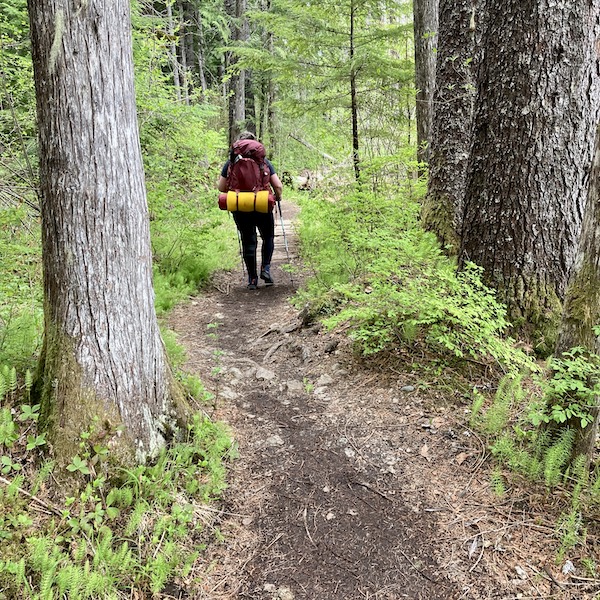
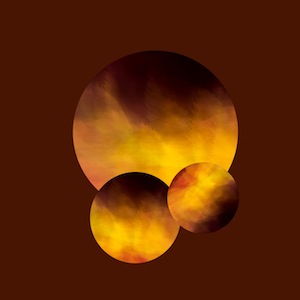
Singing Creek Campground (photo by Ingrid Weisenbach)
This year’s Summer issue cover was taken at Singing Creek Campground in Garibaldi Park over the May long weekend. It was a relatively easy hike to the campsite, and gorgeous, as can be seen by the images below. All the photos were taken by Ingrid Weisenbach, wife of JI publisher and editor Cynthia Ramsay, who also got to enjoy this getaway.
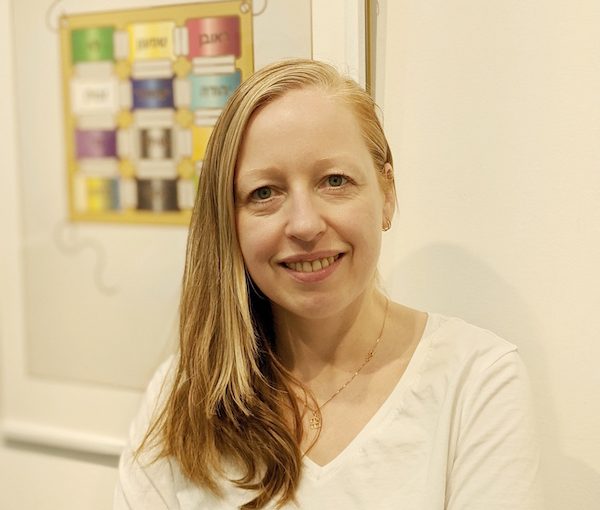
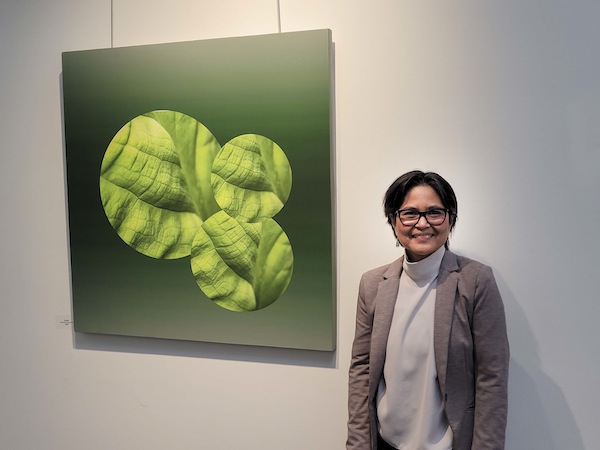
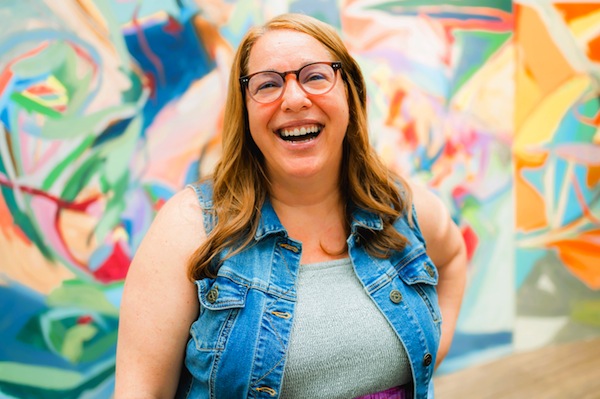
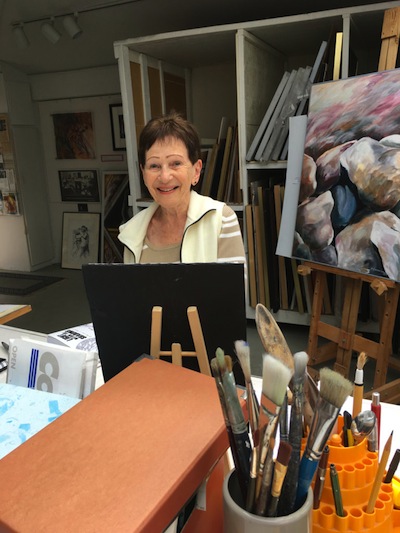
Artist Anna Marszalkowska stands in front of “Levi,” which is part of her Tribes series, which is on exhibit at the Zack Gallery until May 4. (photo from Anna Marszalkowska)
The challenge of visually depicting the tribes of Israel has attracted many famous artists over the centuries. For example, on the 25th anniversary of the state of Israel, Salvador Dali, inspired by descriptions in the Torah, created a series of watercolours, “The Twelve Tribes of Israel.” Before that, in 1962, Marc Chagall made his famous stained-glass windows, “The Twelve Tribes,” for a synagogue in Jerusalem. Anna Marszalkowska, a local Vancouver artist of Polish origins, fits easily into this august company. Her solo show, The Tribes, opened at the Zack Gallery on March 29.
Marszalkowska grew up in Poland, but studied graphic design and worked as a graphic designer in London, England. “Diversity is what made my design path exciting,” she said in an interview with the Independent. “I started my career as a freelance web and graphic designer and then moved to video design and editing, as well as motion graphics and animation.”
Five years ago, she and her husband moved to Canada, but they lived and worked in the eastern part of the country. They relocated to Vancouver two years ago.
“We came here during the pandemic,” she said. “We wanted to try something different. For an outdoor person like myself, this is a great place. The nature is beautiful, and everyone is very friendly.”
She also changed the direction of her professional life. “I work with artists in the movie industry, but not as an artist myself,” she said. “I understand artists because of my past as a graphic designer, but I wanted less time at the computer screen. I wanted to free my creativity for more personal projects, which was hard to do while working as a graphic designer. Then, my creativity was fully engaged in my professional activity, but, on the other hand, I was limited by clients’ requirements. After a full day of work … I was often tired, I wanted to relax. Now, my creativity is freed. I have more time for my artistic experiments. I started abstract painting and I love it. Just me and a painting – it calms me.”
But even while working full time as a graphic designer, she still found energy to search for her individual style and themes. One of them was her Tribes series. “In 2010, I completed a print production course, and this series was the result.”
The series consists of 12 large digital prints, each one corresponding to one of the tribes of Israel. Although Marszalkowska’s version is an entirely modern take, it involves ancient symbolism, which originated in the Hebrew Bible. The artist conducted deep research for this project, and the end results are simultaneously stunningly simple and visually compelling.
“I had a blog before and, when I put the images online, many people expressed their interest. They wanted to buy one or several or all of the images.”
For the artist, this body of work has meaning beyond its commercial success. “It was a personal journey. I was searching for my Jewish ancestry. My grandmother grew up in a town in Poland where most citizens were Jewish before the war. She might have been part Jewish herself, but after the Holocaust, I had no one to ask.”
Instead, she studied the Bible and tried to interpret the narratives within a cultural context. “The symbols of the tribes are by no means fixed,” she explained. “Every artist could have their own interpretation, as the biblical texts describe the sons of Jacob allegorically.”
In her interpretation, the traditional symbols are given a contemporary, stylized appearance. “I explored the relationship between geometric shapes and lines,” she said. “I used repetition and symmetry to keep balance in each individual design and all 12 together.”
She also leaned towards a minimalistic approach, where a symbol of the tribe is centred on a one-colour background, with no other embellishments to attract a viewer’s attention. “In the original design, I had an ornamental frame around each image, but I got rid of them. I think less is more,” she said. “COVID made me realize that my focus should be the meaning, not the decorations.”
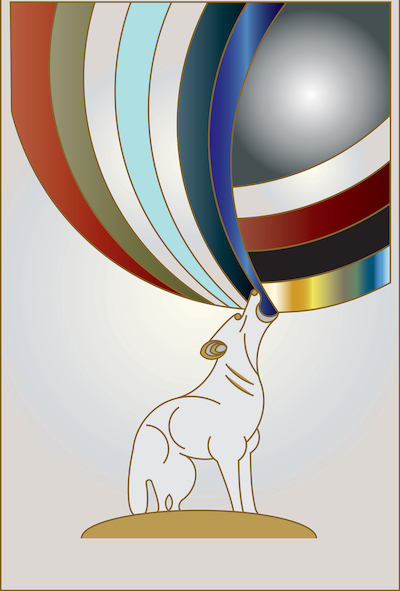
“Benjamin” by Anna Marszalkowska.
In most images, the background colour palette reflects that of the tribe, except for Benjamin, the youngest. “His symbol is a wolf,” Marszalkowska said. “He represents all colours of all tribes. To reflect that, I placed a ‘rainbow’ above the wolf. I think it is his spirit or maybe his song, Or his breath. It would depend on your own interpretation.”
In some of the designs, she incorporated photography for texture. “I used Adobe Illustrator to combine my photographs with my digital illustrations,” she said. For Simeon, her symbol is a tower, and she put her photos of bricks to good use in her pictorial tower construction. For Zebulun, whose symbol is a ship, she employed photos of water. “Issachar’s symbol is a donkey with a burden,” she said. “I used my photos of wood for the donkey’s load.”
When different sources offered different visual symbolisms for a tribe, the artist’s scholarly touch led her towards her own esthetic. For example, in the case of Levi, some documents don’t count him as a tribe and don’t offer any symbols for him. Historically, the Tribe of Levi wasn’t given any land, but its men served as religious leaders and teachers. Maszalkowska decided that Levi’s description as God’s Chosen Tribe warranted its own image: a breastplate of a high priest. The breastplate is embedded with 12 gemstones, each inscribed with the name of one of the tribes in Hebrew.
“Overall, the series is an invitation for everyone to embark on their own journey, to reflect on their own purpose and fulfilment,” said Maszalkowska. “Ultimately, I hope that my art will connect with the viewers and inspire them.”
Tribes runs until May 4.
Olga Livshin is a Vancouver freelance writer. She can be reached at [email protected].
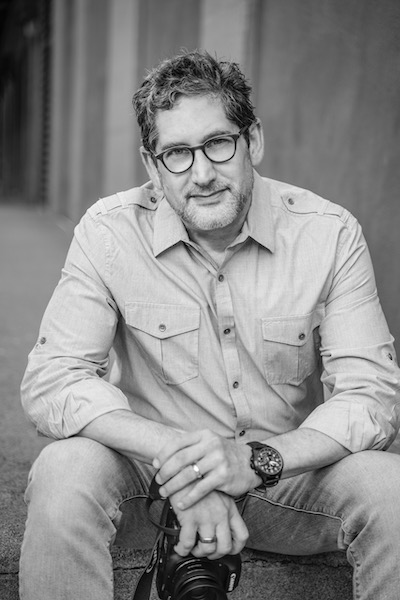
Photographer Jason Langer’s perception of Germany and its capital, Berlin, is a complicated one, and his current exhibition at the Zack Gallery, Berlin: A Jewish Ode to the Metropolis, reflects those complexities. Organized in partnership with the Cherie Smith JCC Jewish Book Festival, the exhibit is Langer’s first show in Canada.
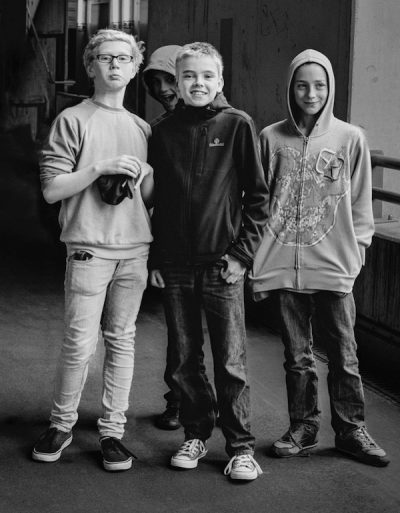
“Boys” (photo by Jason Langer)
Langer’s newly published book, Berlin, includes 135 black and white photographs. A selection of these images forms the exhibit at the Zack, which has an emotional sophistication of its own, even though the show is being promoted as a prologue for the book festival. Both the show and the book catalogue the artist’s several trips to Berlin and his explorations of the city. They also provide visually compelling commentary on Langer’s contradictory and evolving feelings for Germany.
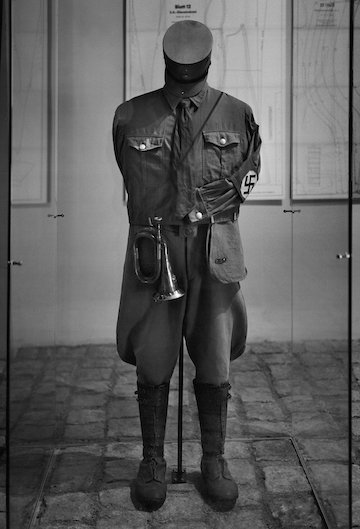
A Nazi uniform in the Sachsenhausen concentration camp museum in Berlin. (photo by Jason Langer)
As in life, the then-and-now overlap and, occasionally, the juxtaposition of the past and the present are jarring in Langer’s imagery. On the one hand, Germany is the country where the Holocaust originated, the country that erased its Jewish population almost entirely and spearheaded the destruction of the Jews of Europe. On the other hand, it is a modern country of laughing kids, hardworking people and beautiful architecture, a country that acknowledges its past actions and tries to make amends to the Jews. It is a country inspiring fear, hatred, respect and admiration in varying measures.
Langer writes in an essay about his relationship with Germany and its progression from total negativity to growing understanding. When he was 6 years old, his family moved from his native United States to Israel, where he spent his formative years, until age 11, on a kibbutz.
“Every year, each children’s house would visit the Holocaust memorial, located on the kibbutz property, during Yom Kippur…. We were asked to walk silently and led into a courtyard with one building and three short walls,” writes Langer. “I remember the walls were made of large, rectangular stones, grey in colour and a bit rough and oddly shaped. We learned about how the Jews had suffered, first as slaves in Egypt and then in the Holocaust by the Germans.”
Later, as an adult, he “vaguely remembered having heard fearful stories of German people from my mother and grandmother, though my mother also made jokes about Germans, putting on a comic fake accent. She died in 2003 and I inherited her books, among other things, including a kind of illustrated encyclopedia titled The Wonderful Story of the Jews, written by Jacob Gewirtz. It was published [in 1970], not long before our move to Israel. The text refers to the Germans’ ‘unspeakable crimes’ against the Jews, as well as the ‘unending ravages of war, persecution and tyranny’ they had faced. Some of the illustrations are quite scary, showing buildings on fire and Jewish people menaced by gun-wielding Nazis. The book presents Israel as a place of refuge, the kibbutzim as almost unique.”
After being exposed to such ideas during childhood, Langer’s predominant feeling towards Germany was aversion. But then, in 2008, when he was already an established photographer, one of his friends suggested he photograph Berlin.
“He thought the city would be a good match for my sensibilities but I met his suggestion with trepidation and fear,” Langer recalled. “I harboured many preconceived ideas about Germans and Germany. I imagined Berlin as a vast, cold, unfriendly, gritty place, but, at the same time, it seemed exciting and sexy somehow.
“I decided to see Berlin for myself, keen to challenge my existing ideas and also uncover reminders of the Jewish people who had lived there, until they fled or were hunted down and killed by the Nazis.”
Photographer Jason Langer’s exhibit at the Zack Gallery runs to Feb. 16. (photo from Jason Langer)
In the next five years, Langer visited Berlin frequently. “From 2009 to 2013,” he said, “I made five trips for two weeks at a time. I stayed in a flat with about six people. When they were going on vacation, they would let me know, and I would fly over and occupy their rooms. They would also give me advice on where to go.”
During those visits, he took multiple photographs and strived to form a new narrative regarding his feelings and associations regarding Germany and its people.
“This work is an attempt to remember, confront and unwind my attitudes about Germans, Germany, Berlin and my Jewish inheritance; these images are part discovery, part remembrance and part fantasy,” he explained. “They’re my attempt to stand where Jewish people were rounded up and deported, to remember but also reassess. They’re an effort to confront my internal attitudes and prejudices, to look into people’s eyes and find a continuation of kindness, to be open to the happiness of contemporary life in Berlin.”
Some photographs in the gallery are full of anguish and terrible beauty, like the Holocaust Memorial, consisting of 2711 concrete slabs (stelae) of different heights, or an ornate door of the Stiftung Neue Synagogue, built in 1865, the only synagogue in Berlin to survive the war, though its interior was burnt.
The horror of the war is also reflected in the image of an old, dilapidated shed, the “goat house,” where one Jewish family, a mother and a daughter, hid for several years to survive the Nazis’ attempt to exterminate Jews. No water, no heat, no electricity, just the women’s indomitable spirits and relentless wish to live.
Every photo has a story to tell. Many a story of heroism and tragedy. But there are other pictures, too, reflecting modern Berlin, the city of now. Laughing boys, a tired-looking woman, an anti-fascist demonstration, various streets and buildings.
Langer writes: “It was a strange mix of death and life.… There was a sense of youth, freedom and joy I felt in Berlin.… Whenever I wandered, I took it as a gift of prolonged, uninterrupted time for reflection.”
The artist’s wanderings and reflections led to the creation of the photobook Berlin.
“This book is not a document,” said Langer. “It is a dream within a dream within another dream. Berlin is immense, there was no way I could cast a wide enough net to what it’s like. Instead, I have painted a picture of then and now, pain and pleasure, some people who died long ago and those who are living and young, all from my own perspective.”
Berlin: A Jewish Ode to the Metropolis opened on Jan. 6 and will continue at the Zack Gallery until Feb. 16. For more information, visit jasonlanger.com.
Olga Livshinis a Vancouver freelance writer. She can be reached at [email protected].
Letters that highlight friendship, writing that facilitates healing, stories that dissect societal mores – the books reviewed by the Jewish Independent this week represent only a small fraction of those featured at the Cherie Smith JCC Jewish Book Festival this year.
While the official festival runs Feb. 11-16, opening with Dr. Gabor Maté in conversation with Marsha Lederman about his latest book, The Myth of Normal: Trauma, Illness & Healing in a Toxic Culture, there are a couple of pre-festival events this month: German writer Max Czollek launches the English version of his book De-Integrate! A Jewish Survival Guide for the 21st Century on Jan. 19 and American-Israeli photographer Jason Langer presents his book Berlin: A Jewish Ode to the Metropolis on Jan. 26. As well, there is a post-festival event, on Feb. 28, which sees former federal cabinet minister and senator Jack Austin launching his memoir, Unlikely Insider: A West Coast Advocate in Ottawa.
If the books reviewed by the Independent are any indication, attendees of the festival can expect to have their views challenged and their perspectives broadened; they will be moved, disturbed and amused, sometimes all at once.
Intimate portraits
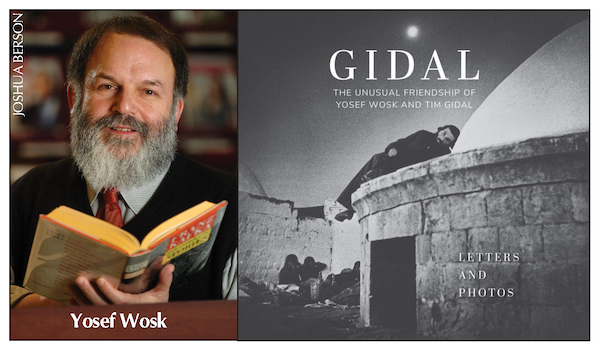
Two years ago, the JCC Jewish Book Festival featured the book Memories of Jewish Poland: The 1932 Photographs of Nachum Tim Gidal (jewishindependent.ca/gidals-photos-speak-volumes). It was the fulfilment of a dying request that Israeli photographer Tim Gidal made in 1996 to Vancouver scholar, writer and philanthropist Yosef Wosk. The book was released at the same time that an exhibit of its photos was mounted at the Zack Gallery (jewishindependent.ca/jewish-poland-in-1932).
The friendship between Wosk and Gidal was evident in that book and in the exhibit. How the two men – separated in age by some 40 years and in geography by almost 11,000 kilometres – became such good friends is the subject of Gidal: The Unusual Friendship of Yosef Wosk and Tim Gidal, written by Wosk (and, technically, Gidal) and edited by another of Wosk’s good friends, Alan Twigg.
Alan Twigg (PR photo)
The bulk of Gidal is letters that Gidal and Wosk wrote to each other from 1993, soon after they met, through to Gidal’s death in 1996. The postscript is a letter from Wosk to Gidal’s wife, Pia, mourning Gidal’s death and hoping that “his work and vision continue to inspire others.” Twigg has masterfully edited the multi-year correspondence, which comprised hundreds of letters, into an engaging narrative that offers insight into the core of these undeniably brilliant men, their work, ideas, loves, frustrations, sadnesses and more. Their vulnerability makes this a brave publication for Wosk to have created, and a meaningful one.
The other main component of Gidal is, of course, Gidal’s photographs, which, Wosk writes in the afterword, “serve as background to the letters.” As he did with Memories of Jewish Poland, Wosk mostly lets the photographs speak for themselves. Each photo section has a theme but each image within the section is simply captioned, placed and dated, without commentary.
There is a short chapter on Gidal and one on his and Wosk’s friendship and how this book came about. Gidal is creatively and esthetically put together. Each letter is headed by a key quote from the missive and the date it was sent. Images are included of some of the actual letters, most of which were sent by fax. It is interesting to contemplate whether this fount of communication would exist if it had been made via email.
Wosk and Twigg will talk about Gidal on Feb. 14, 7 p.m., at the book festival. The event is free of charge.
Therapeutic memoirs
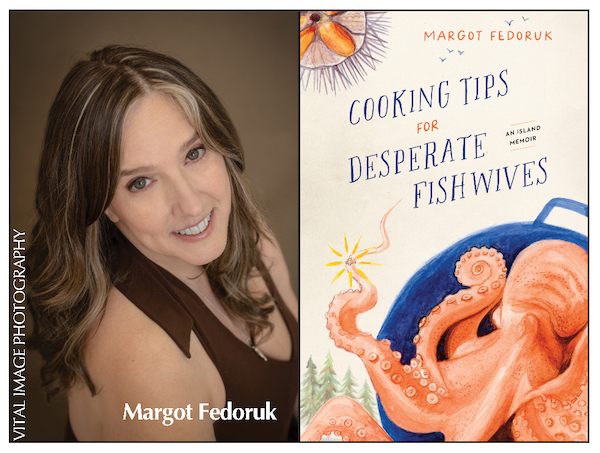
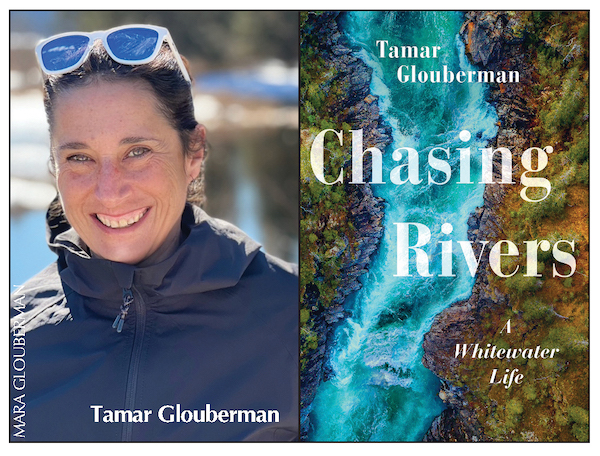
Paired together for a presentation are Margot Fedoruk and Tamar Glouberman. The program categorizes them as “modern-day women” who will be presenting their “offbeat memoirs,” summarized by the question, “How B.C. is that?” Indeed, both Fedoruk and Glouberman tell coming-of-age stories of a sort, Fedoruk’s beginning in her 20s and Glouberman’s in her 30s. And they both lead outdoorsy, independent lives that could be described as the B.C. ideal, yet both have also faced many challenges and darker sides of that ideal.
Fedoruk is the author of Cooking Tips for Desperate Fishwives, in which she openly shares her anxieties of being married to a West Coast sea urchin diver – she is lonely without him, must raise their two daughters mostly without him and is worried that an accident may result in her having to live without him. Yet, she loves Rick, even though she does try (unsuccessfully) to convince him to take up another profession and stay closer to home. The pair moves around a lot, and Fedoruk herself takes up many different jobs over the years to make ends meet. But they stick together, getting married after their daughters are all grown up and have left home.
As dysfunctional as their relationship appears at times, Fedoruk had a more challenging life before she met Rick. Her father is a horrible man, her mother dies of cancer and she and her sister lose the family home to her mother’s second husband, also a horrible man. And there’s more. It is no wonder she leaves Winnipeg, eventually settling in British Columbia, though settling may be too strong a word, as she and her family do live in several different places on the coast, with some time in Calgary.
What makes Fedoruk’s memoir unique is the inclusion of a recipe in almost every chapter that reflects the mood or subject matter of the chapter, like the Killer Lasagne in the introduction, which begins, “The night I ran over Rick with my car, I was over four months pregnant with our first daughter.” Other recipes include Easy Curried Chickpeas With Rice, which appears as an affordable comfort food in a chapter about her being exhausted, on her own, caring for her two then-young daughters; and Wild-crafted Stinging Nettle Pesto, which comes after one of her descriptions of the soaps she makes – her business is Starfish Soap Company.
Near the end of her memoir, Fedoruk mentions that she has started therapy. I would have liked her to have written this book further into that process. As honest as she is about her feelings and circumstances, the memoir would have been more layered and impactful had she been further along in understanding how her traumatic childhood experiences, her genes and other factors affect how she moves through the world.
Glouberman has a less tragic background but a similarly transient life – and also loves something that gives her both great joy and great anxiety, the latter of which eventually takes over. In Chasing Rivers: A Whitewater Life, she shares her emotional journey of trying to make a life as a whitewater rafting guide.
One of the few women to guide tours, Glouberman does face sexism, her skills often underestimated by clients, but her male bosses and colleagues all seem to appreciate her abilities – certainly more than she does. She is constantly worried about making a mistake that will kill her or someone else and, while this is rational, given her job and its risks, the feeling becomes overwhelming. With an accident on the road – there is a lot of travel required to get to places like Chilko River, Williams Lake and further afield, outside the province – and her worst nightmare coming true on a rafting trip, Glouberman’s fears have very real incidents on which to grow.
Glouberman tries other types of work, but is always drawn back to the water. She struggles with depression and has a few other harsh experiences that add to her self-doubt. She tries various forms of therapy, some of which make her feel worse. Her family is supportive, though, and her sister’s home in Whistler is a refuge. She is only beginning her journey to healing when the memoir ends, and part of that has to do with getting into a master’s writing program. Both she and Fedoruk, who also went back to university for a writing degree, thank several people for their memoirs coming to fruition.
Glouberman and Fedoruk present at the book festival Feb. 12, 2 p.m. (tickets are $18). They also speak at Congregation Har El that day, at 11 a.m.
The price of victory
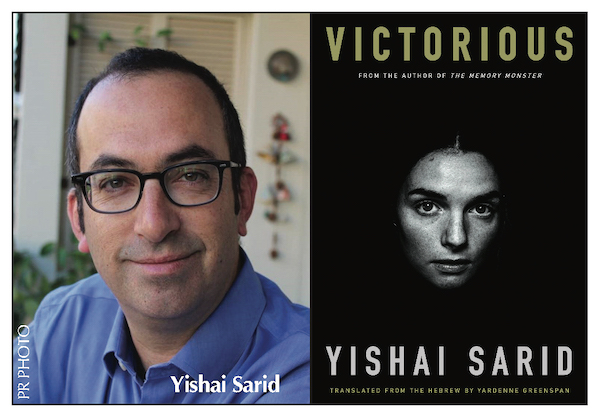
The harm inflicted on a society by war culture is front and centre in Israeli writer Yishai Sarid’s book Victorious. The main character, Abigail, is a military psychologist who, basically, tries to make soldiers into better killers, both “helping” them through trauma after they’ve experienced it and teaching them ways to be immune to trauma so that they can “beat the enemy.” Her father, who strongly disapproves of her work with the army, is a renowned clinical psychologist. On more than one occasion, he tries to talk her out of working for the military, but does not succeed. That the character of the father is dying of cancer is not coincidental.
Abigail blurs professional lines everywhere, working for the married man who fathered her son, the man who is now the army’s chief of staff; sleeping with a patient/friend; trying to become close friends with a former patient; and having a sexual relationship with one of the young soldiers whose unit she’s evaluating. The lessons she teaches are chilling, as is her abandonment of a patient who becomes too difficult for her to handle and some of her other actions.
She believes her job is her patriotic duty, even as her own son, Shauli, enters military service, in the paratroopers no less, and her fears for him fight with her pride in his choice. Though, with both his father and mother being staunch militarists, it could be argued that Shauli doesn’t really have a choice.
Victorious is a sparingly written novel that readers will not only ponder but feel well after they put it down. Translator Yardenne Greenspan must be given credit for making Sarid’s words as impactful in English as they are in Hebrew.
Sarid’s book festival event is Feb. 12, at 8 p.m. Tickets are $18.
For the full author lineup and to purchase festival tickets or passes, visit jccgv.com/jewish-book-festival or call 604-257-5111.
David Cooper is renowned for the skill with which he captures energy and light in photographs and film. But the multiple-award-winning artist was not appointed a Member of the Order of Canada in 2020 only for his “innovative contributions to Canadian performance photography,” but also “for his dedicated mentorship of emerging artists.” One of the many ways in which he has shown that dedication is his support of the Downtown Eastside (DTES) community in which he is based.
Cooper has taken countless photographs for the DTES Heart of the City Festival since the annual festival began 19 years ago, and for Vancouver Moving Theatre – the festival’s main presenter, along with Carnegie Community Centre and the Association of United Ukrainian Canadians – for at least three decades. The festival photo sessions at his studio have been community-building gatherings and the festival provides copies of their photos to the culturally and socially diverse artists who live, perform and create in the neighbourhood. This year’s Heart of the City takes place Oct. 26-Nov. 6, with more than 100 events throughout the DTES and online.
Larissa Healey, from the Heart of the City Festival, in a photo taken by David Cooper.
It was Vancouver Moving Theatre co-founder Terry Hunter who introduced Cooper to the Heart of the City Festival, since it involved artists, writers, singers and storytellers and Cooper’s career has always been in the arts. Though that wasn’t always where his interest lay.
“I started training at U of T [University of Toronto] for architecture,” Cooper told the Independent. “It was a five-year undergraduate program and I came out west after my second year, as a break. I’ve always had a camera but never had formal photography training beyond a summer course at Banff when I was a teenager. Through a friend, I checked out a local theatre company to see if they needed any photos taken. Eventually, I was given a chance to shoot a play at the Vancouver Playhouse Theatre, directed by Christopher Newton. They were really excited about the results from a dress rehearsal and offered me a job. I spent four years there in the publicity department, also creating posters and marketing material.”
Cooper is from Forest Hill in Toronto. He grew up in a conservative Jewish neighbourhood. “I went to Hebrew school but I stopped practising Judaism when I moved out west from my family,” he said. “I still go back for special occasions and joined the JCC here in Vancouver.”
As a theatre, dance and music photographer for more than 40 years, Cooper’s photos and videos have publicized more than 60 companies throughout Canada and the United States. The Shaw Festival, Bard on the Beach, Arts Club Theatre, the Royal Winnipeg Ballet, 605 Collective, Karen Flamenco Company, Vancouver Opera, Vancouver Symphony, Electra Women’s Choir, Chor Leoni Men’s Choir, Spirit of the West and Uzume Taiko Drummers are just a dozen-plus of the groups with which he has worked. He has been a stills photographer for several TV series and his dance videos have been shown internationally. In addition, he teaches and mentors students, holds workshops for both amateur and professional photographers, and photographs for theatre and dance schools.
Among the many recognitions Cooper has garnered, he received a Jessie Richardson Theatre Award in 1995 for his outstanding contribution to the Vancouver arts community and was elected a pioneer member of the B.C. Entertainment Hall of Fame in 2006.
“I’ve mostly been a theatre photographer, shooting live shows,” said Cooper. “I spent 15 years shooting film and transitioned to digital in 2001. It was a Canada Council grant in 1978 that took me to the Royal Winnipeg Ballet to learn more about ballet and I spent two weeks in class and rehearsals documenting the process.”
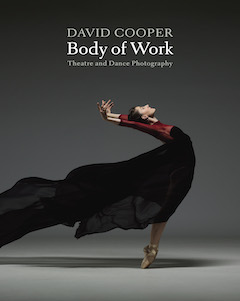
Firefly Books in Ontario recently published the coffee table book David Cooper Body of Work: Theatre and Dance Photography. Each of the 500 copies published includes a limited-edition print signed by Cooper.
Only 500 copies of David Cooper Body of Work have been printed.
“I have worked with a great graphic designer and art director, Scott McKowen, for 30 years, photographing marketing materials for the Stratford Festival, the Shaw Festival, Yale Repertory Theatre, Canadian Stage, Theatre Calgary and others together,” said Cooper of how the publication came to be. “He suggested we compile all our work into a book and include my dance work that is separate from the theatre.”
According to Firefly’s website, the book includes essays on Cooper’s theatre photography (by Newton, artistic director emeritus of the Shaw Festival), on his dance images (by Vancouver writer and arts commentator Max Wyman) and on his marketing images (by McKowen). Ballet dancer Evelyn Hart “has contributed an appreciation, and Cooper himself discusses the most intimate relationship between photographer and subject – portraiture.”
When asked what the most gratifying parts of his career are, Cooper told the Independent: “Working with talented performers. Getting to travel all across Canada and the U.S. shooting for different arts organizations.”
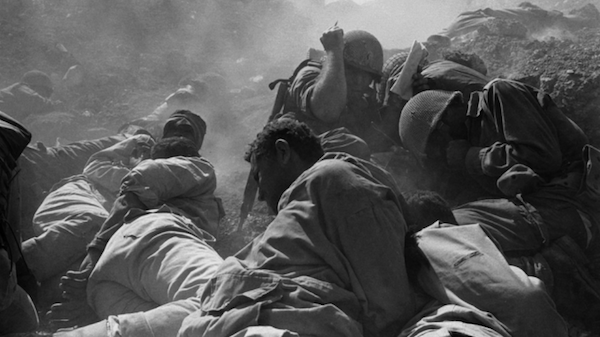
Image from 1341 Frames of Love and War, a photo by Micha Bar-Am.
Photographer Micha Bar-Am, now 92, is considered perhaps the foremost visual chronicler of Israeli history. In 1341 Frames of Love and War, filmmaker Ran Tal creates what amounts to a family reminiscence among Bar-Am, his wife Orna and sons Barak and Nimrod, complete with snippy retorts and full-throated arguments. All of this is set against thousands of Bar-Am’s photos, creating a barrage to the senses of blown-up buses, dancing hippies, funerals and the scope of Israeli life captured in still photos. The family, whose voices make up the narration of the documentary, are seen only in the pictures.
Although Bar-Am was present to immortalize in images the Eichmann trial and the liberation of the Western Wall, his work is mostly of ordinary Israeli people and events, including war, which has been all too “ordinary” for the country and its people. The photos predictably begin in black-and-white – the first colour photo in the film appears during the 1967 war, perhaps not merely a sign of changing technology but also of the before and after times of the occupation.
A photo from the time – an image Bar-Am captured of a soldier praying at the newly liberated Kotel – is a prism through which Micha and Orna chronicle their own changing views of their country. The soldier had fashioned an ammunition belt into a makeshift prayer shawl. Orna explains how they loved the photo at first, apparently as a symbol of resistance and survival. After a few years, they came to detest it as a representation of the connection between religion and power. Now, in their later years, they are agnostic about the thing.
“That’s how it was then,” Orna says. “We don’t have to feel love or hate toward it. That’s how it was.”
Bar-Am acknowledges that he was a shy young man and the camera was an excuse to get closer to things, to understand people better. Through his eyes, and the immortality of his images, Israelis and others can perhaps view themselves and the world around them more closely.
The film is an intimate exploration into the work of a legendary craftsman and, through him, a snapshot into the past.
For the full film festival schedule, visit viff.org.
Megs Gatus’s solo exhibit, Leaves in Space, runs until Sept. 22 at the Zack Gallery. (photo from Megs Gatus)
Megs Gatus – whose solo show, Leaves in Space, opened at the Zack Gallery on Aug. 24 – unexpectedly stumbled onto an artistic path.
“It started for me when I saw a photograph of a butterfly,” she said in an interview with the Independent. “It was in 2010. I was fascinated by that picture. I thought maybe I could be a photographer too.”
She had never taken photos before that day. She came to Canada in 2002 from the Philippines and worked (and still works) for the City of Vancouver. “But there is a creative gene in my family,” she said. “My brother is a contemporary dancer. My sister sings. I decided I wanted to be a photographer.”
In 2011, Gatus signed up for a photography workshop at a local community centre. “I bought my first camera from Craigslist,” she recalled. “It was only a hundred dollars.”
After that, she started taking photos. Portraits, flowers and landscapes were among her favourite subjects.
“I joined an online photography group on meetup.com because I wanted to share my pictures with the others,” she said. “I was amazed when the group picked my photos to display on their website. It was so encouraging. Later, a friend told me I had an eye for composition. I was elated. I wanted to learn more about the photographic art, so I enrolled in the Emily Carr certificate program, evening classes.”
She kept up her daytime job through it all, even as she graduated from Emily Carr University of Art + Design in 2018.
“I never stopped taking photos,” she continued, “but, by that time, I stopped being interested in reality photography. I didn’t want my photos to reflect the objects by themselves, the way they are off camera. I wanted people to see my photographs as an art form, different from reality. I wanted my pictures to invite curiosity in viewers.”
Gatus began experimenting with her camera settings. She also tried to move the camera while taking the photos, and the results meshed perfectly with her artistic vision. No recognizable objects manifested in her images when she used the technique called intentional camera movement, combining it with multi-exposures.
Each image is a play of colours and patterns, abstract and bright. The lines and the colours dance together in her photographs, which look more like paintings. She seems to invite viewers to use their imagination, while she herself explores every possible hue and shape to convey her ideas. Her camera is her paintbrush. “I do everything inside my camera. No Photoshop,” she said.
In 2016, Gatus joined Photoclub Vancouver. Since then, she has participated in many of their group exhibitions, including those the group held annually at the Zack Gallery. She liked the energy of the gallery, so, a few months ago, put forward the idea of a solo show and it was accepted.
“This is my first solo exhibition in a gallery space,” she said. “But I had a show recently in the Britannia Art Gallery, together with another photo artist, and I often display my works in several coffee shops.”
“Edges” by Megs Gatus.
Gatus created all the work displayed in the current show during the pandemic. “We all felt so isolated, but we all occupy the same space. We are all responsible for our environment: plants, leaves, flowers. That’s why I used the shape of a circle,” she explained. “I took photos of nature: autumn leaves and spring flowers, and the circles enclose them. The circles symbolize all of us. That’s what the name of the show means: Leaves in Space.”
No image in the show looks like a standard photograph. One doesn’t see leaves or trees, but rather abstract compositions throbbing with life and fantasy. They could be science fiction illustrations of distant galaxies, visual representations of a soul or screenshots from a computer game. Or just beauty emerging from the artist’s insight.
“I like taking photos of organic matter. Leaves, plants, flowers – they are all alive,” she said. “I take photos in parks and gardens around B.C. I only enhance the colours a little inside the camera. Through my technique, the images become abstract, and I try to find ways to present them differently. I want to engage viewers.”
Besides the images hanging on the gallery walls, Gatus also offers large silk scarves for sale. All the scarves are imprinted with the photographs she used in the exhibit. The same swirls of colours in a different medium look surprisingly different, almost unrecognizable, but still pretty and vibrant.
“Sales are not my motivation,” she said. “I want to show my pictures, to share them with people.” That’s why she enjoys commissions. “A client of mine liked one of the pictures in this show so much, she asked me to enlarge it and she put it in her spa office.”
Gatus has big plans for these works after their run at the Zack Gallery.
“I’d like to exhibit this collection in other B.C. cities: Surrey, Port Moody, Langley. Later on, maybe even in Toronto and Montreal. I’m going to retire soon, and then I will dedicate all my time to my art.”
Leaves in Space continues until Sept. 22. The official opening reception will be held at the gallery on Sept. 8, at 7 p.m. To learn more, visit the website megsgatus-abstract.myportfolio.com.
Olga Livshin is a Vancouver freelance writer. She can be reached at [email protected].
Leamore Cohen (photo by Efrat Gal-Or Nucleus Photography)
The Jewish Community Centre of Greater Vancouver’s inclusion services program is one of the recipients of the Lieutenant Governor’s Arts and Music Awards, in the category of visual arts. This one-time honour, marking the Queen’s Platinum Jubilee, recognizes organizations like the JCC that have excelled in fostering wide community engagement through a robust spectrum of arts and culture programs. Most important: the award emphasizes the JCC’s commitment to diversity and inclusivity.
It all began with a passionate letter of nomination by Chaia Schneid, whose daughter, Sarah Halpern, discovered “a previously untapped creative passion” in the Art Hive and Theatre Lab classes she attended, among other programs run through the JCC’s inclusion services. Writing to the Hon. Janet Austin, lieutenant governor of British Columbia, Schneid stated: “The quality of the arts and culture programs is unlike anything we have found elsewhere. They are professionally delivered and of the highest calibre, and yet individualized to meet the special needs of the diverse participants.” In particular, Schneid praised the JCC’s annual Jewish Disability and Awareness Inclusion Month (JDAIM). Schneid also praised current program director and inclusion services coordinator Leamore Cohen, calling her a “rare individual.”
Shelley Rivkin, vice-president, local and global engagement, at the Jewish Federation of Greater Vancouver wrote a letter of support for the nomination. In it, she highlighted several inclusion services arts and social programs, and Cohen’s leadership.
“Leamore Cohen is the driving force behind these programs and her compassion, creativity and commitment to inclusion shine through in all aspects of the program,” wrote Rivkin. “She is always generating new ways and ideas for participants to engage with the arts and to create to the best of their abilities. These programs break new ground by offering meaningful educational and recreational opportunities for people with diverse needs. Having had the opportunity to attend some events, I have seen firsthand the joy that participants feel in being able to express themselves in a variety of mediums and the pride that their parents and family members experience when they see the creativity and talent of their loved ones.”
For a growing number of Vancouverites from all religious and ethnic backgrounds, and across all ages and abilities, the calibre and range of the JCC’s work is well-known. A schedule of performing and fine arts programs coincides with an array of sport, leisure and fitness options inside a facility that houses a theatre, library, gymnasium and pool. The JCC is also widely known for its annual Jewish Book and Chutzpah! festivals – both occupying a key place in the city’s cultural calendar – alongside community services including preschool and toddler daycare.
“While the arts programming is the centrepiece of what is being offered,” wrote Rivkin, “other inclusion programming for adults includes free memberships and access to all the fitness and wellness facilities at the Jewish community centre along with two virtual classes offered five days a week that are designed to be sensitive to the sensory stimulation needs of participants.”
Noting that activities continued throughout the pandemic, Rivkin concluded, “the program demonstrates its dedication to equity and inclusion daily by the range of programs embedded in the arts that have been opened up to this population and, of course, commitment, both on the part of Leamore Cohen, who dedicates so much time and thought to designing these programs, and to the participants themselves, who have remained active and involved despite their personal barriers and the COVID restrictions.”
* * *
MP Joyce Murray, left, with Annette Whitehead at Trimble Park, June 18. (photo courtesy a community member)
On June 18, Annette Whitehead was awarded a Queen’s Platinum Jubilee pin by MP Joyce Murray. Whitehead was nominated for the honour by Kitsilano Community Centre for her outstanding commitment and dedication to her community. She also received a certificate as a sign of gratitude for all the wonderful and hard work she does for her constituency.
June 2022 marked the 70th anniversary of the coronation of Queen Elizabeth II. To commemorate this milestone, Murray was issued a number of Platinum Jubilee pins, which she decided would be best used to celebrate and thank those who volunteer in Vancouver Quadra. The ceremony took place at Trimble Park.
* * *
On July 7, the National Audubon Society announced the winners of its 13th annual Audubon Photography Awards. This year, judges awarded eight prizes across five divisions from a pool of 2,416 entrants from all 50 states, Washington, D.C., and seven Canadian provinces and territories.
Local Jewish community member Liron Gertsman won three awards:
Professional Award Winner for his photo of a white-tailed ptarmigan,
Professional Honourable Mention for his photo of a sharp-tailed grouse, and
Video Award Winner for his sharp-tailed grouse video.
In a July 7 Facebook post, Gertsman writes about his wins: “Getting a chance to shine some light on these often under-appreciated birds brings a big smile to my face!”
He also writes about the white-tailed ptarmigan:
Liron Gertsman’s Audubon Photography Award-winning photograph of a white-tailed ptarmigan, titled “Mountain Chicken.”
“Perfectly adapted to harsh alpine conditions, they spend most of their time foraging on small plant matter in the tundra, insulated from the wind and cold by their warm layers of feathers. Ptarmigan are also famous for changing their feathers to match their snowy surroundings in the winter, and their rocky surroundings in the summer. This mastery of camouflage makes them very difficult to find, and I’ve spent countless hikes searching for them, to no avail. On this particular day, after hiking in the alpine for a couple of hours, I stumbled right into my target bird! This individual was part of a small group of ptarmigan that were so well camouflaged, I didn’t notice them until some movement caught my eye just a few yards from where I was standing. Wanting to capture these remarkable birds within the context of their spectacular mountain domain, I put on a wider lens and sat down. The birds continued to forage at close range, and I captured this image as this individual walked over a rock, posing in front of the stunning mountains of Jasper National Park.”
* * *
At the Rockower Awards banquet, held in conjunction with the American Jewish Press Association’s annual conference, June 27, 2022, in Atlanta, Ga., the Jewish Independent received two Simon Rockower Awards for Excellence in Jewish Journalism. These awards honoured achievements in Jewish media published in 2021 and there was a record-breaking 1,100-plus entries from AJPA members.
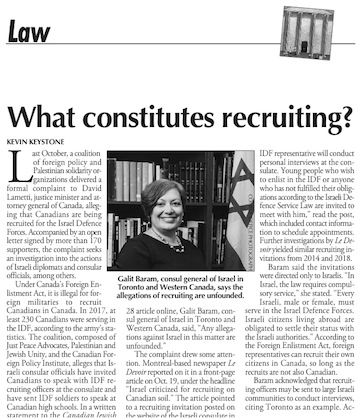
In the news story category, in the division of weekly and biweekly newspapers, the ˆI took second place for Kevin Keystone’s article “What constitutes recruiting?” The piece explored the allegation by a coalition of foreign policy and Palestinian solidarity organizations that Canadians are being recruited for the Israel Defence Forces.
For excellence in editorial writing, in which all member papers competed, the JI editorial board of Pat Johnson, Basya Laye and Cynthia Ramsay received an honourable mention, or third place. “Strong reasoning and writing, relevant to Jewish audience,” wrote the judges about the trio of articles submitted. The submission included “Ideas worth the fight,” about university campuses and the need to keep “engaging in the battle of ideas, however daunting and hopeless the fight might appear”; “Tragedy and cruelty,” about the response to the catastrophe at Mount Meron on Lag b’Omer in 2021; and “Antisemitism unleashed,” about how the violence in Israel in May 2021 year spilled out into the world with a spike in antisemitic incidents.
To read all of these articles again, visit jewishindependent.ca. For the full list of Rockower winners, check out ajpa.org.
* * *
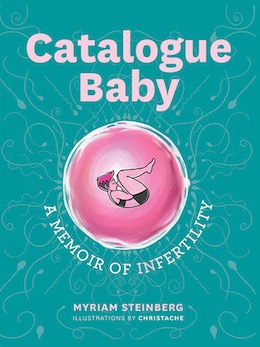
Myriam Steinberg’s Catalogue Baby: A Memoir of Infertility, with illustrations by Christache, has won two gold medals for best graphic novel. The first was the Independent Publishers (IPPY) Awards, and the second is the Foreword Indies Award. This is after having won the Vine Award for Canadian Jewish Literature last fall.
“This book was not only a labour of love, but also a call-out to the world to recognize and acknowledge the very real experience of so many people,” wrote Steinberg in an email. “Pregnancy loss and/or infertility touch almost everyone in some way or other. It affects those who are trying to conceive the most, but it also touches (often unbeknownst to them) their children, friends, family and colleagues.”
To celebrate the honours, Steinberg is offering a 20% discount on books bought directly from her (shipping extra). To order, email [email protected].
* * *
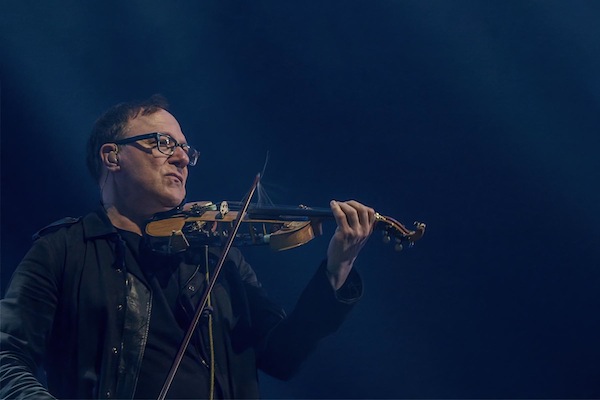
Ben Mink (photo from sonicperspectives.com)
The Vancouver Symphony Orchestra (VSO) and the VSO School of Music (VSO SoM) are excited to recognize the appointment of Ben Mink, CM, as a Member of the Order of Canada. On June 29, 2022, Governor General of Canada Mary Simon announced that Ben Mink, who is a member of the board of directors for both the VSO and VSO SoM, has received the distinction “for his sustained contributions to Canadian music as a producer, multi-instrumentalist and writer.”
Mink has amassed a critically acclaimed body of work spanning decades, styles and genres as an international musical force. His influence is tangible and enduring in the widest range of musical styles and directions, and his imprint can be found in countless recordings, film scores and television programs. As a producer, songwriter, and instrumentalist, Mink has brought his signature style and approach to major musical artists and productions. He has an impressive list of recording collaborations that include k.d. lang, Rush, Daniel Lanois, Roy Orbison, Elton John, Alison Krauss, Heart, Feist, the Klezmatics, Wynona Judd, Method Man, James Hetfield (Metallica), and many more.
He has been nominated for nine Grammies, winning twice for his work with k.d. lang. The song “Constant Craving,” which he co-wrote and produced with lang, won her a Grammy for best female pop performance and has been used in several TV shows.
In 2007, he was co-nominated for his work on Feist’s Grammy-nominated “1234,” which gained global popularity in the roll out campaign for the iPod Nano. His recent collaborations with Heart were Billboard hits. Mink’s work helped set new and significant directions in Canadian popular music, and his writing and producing has been recognized with seven Juno nominations (three wins) and the SOCAN Wm. Harold Moon Award for international recognition.
Reesa Steele and family have the absolute pleasure to announce the upcoming marriage of Talia Magder and Weston Steele on Sunday, July 24, 2022, under the chuppah in front of family and friends in Vancouver.
Mazal tov to Nicole and Philip Magder of Montreal and Reesa Steele and David Steele of Vancouver.
Mazal tov to Talia and Weston. May this be the first of many simchas ♥
* * *
Emmy nominee Molly Leikin is the author of Insider Secrets to Hit Songwriting in the Digital Age, published by Permuted Press, a division of Simon & Schuster, in July 2022. It is Molly’s eighth book.
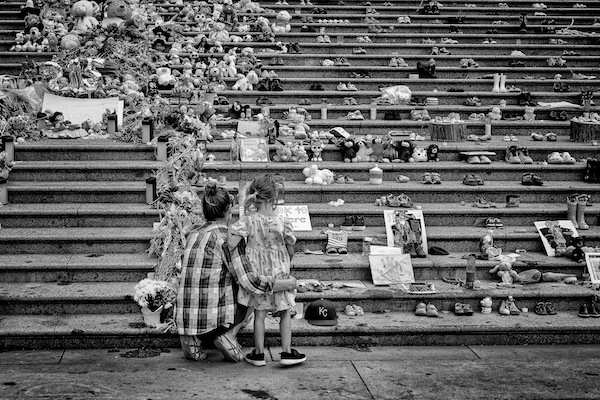
“Remembrance” by Michael Shevloff. Part of PhotoClub Vancouver’s Connections exhibit at Zack Gallery until June 27.
Whenever a photographer – amateur or experienced – snaps a picture, they establish a connection between themself and their subject. They shout to the world that this image at this time and in this place is an important occurrence and should be preserved and treasured.
The PhotoClub Vancouver group show, Connections, opened June 2 at the Zack Gallery. People and birds, industrial cityscapes and soothing nature shots, close-ups and panoramas – every image in the exhibit tells a story about the world and the photographer’s place in it.
The club was officially established in 1998. Its friendly, non-competitive environment for photographers of all skill levels encourages members to develop their technical and artistic abilities through various activities, including peer critique, field trips, workshops and seminars. And, of course, exhibitions like Connections, which allow members to share their art beyond the group.
Some of the photographers took the Connections theme literally, like Ivor Levin’s “Roped In.” The orange ropes in the image are taut and sure, but the objects they hold together are left outside the frame. Only the connection itself is important to the artist.
A similar approach characterizes Lynn Copeland’s “Cranes and Planes.” The image’s graphic simplicity is almost abstract, as the harsh lines of the industrial cityscape, viewed on the background of the distant sky, induces the sense of a steel labyrinth where any uninitiated human would be lost.
Barb Kaiser’s “Hanging Around” also includes ropes as the connecting medium, but the feeling it inspires is vastly different. A window washer hangs in his harness in the foreground, doing his job. Behind him, a skyscraper-studded panorama of North Vancouver is visible in all its urban majesty. We are all connected, the image seems to say, in every window of every building.
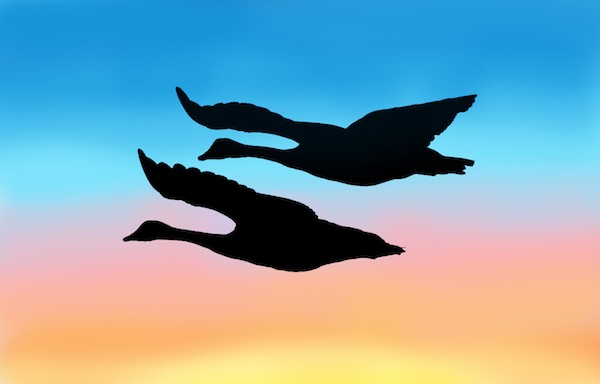
Unlike the stark, sharp-angled industrial imagery, logical and attractive on a cerebral level, the pictures reflecting nature flaunt softer lines. They appeal to our emotions. For example, Terry Beaupre’s “Canada Geese Flying Off Together” depicts two geese. Their dark silhouettes soaring together on the background of a pink sunset evoke ideas of love and companionship. “I couldn’t have asked them to pose more perfectly for me,” Beaupre says in her artist’s statement, although she admits that she painted the dramatic colours of the sunset later on, to enhance the picture.
Terry Beaupre’s “Canada Geese Flying Off Together.”
The grace of a couple in love is also implied in another bird picture – Levin’s “Peck.” The two doves in the image are sharing a kiss. Or maybe they are sharing a bug to eat. Whatever they are sharing, their affection for each other is unmistakable and heartwarming.
The charm of the loving doves is absent in Drago Tutnjevic’s “Bus Stop.” The four people standing in line to board a bus are strangers. Their estrangement is made even more obvious by the fact that three of them are absorbed in their phones. The one not on the phone looks straight ahead, thinking her own thoughts. No doubt, each of the passengers has multiple connections – their friends, family and others – but here, at this bus stop, nothing connects them except the expectation of the bus itself. The photo reflects the complex networks that link us all, as well as the separateness of every person in our huge technology-permeated world.
In contrast, a simple path in the park, portrayed in John Konovsky’s “Onward No Matter What,” reminds us of the mysteries of childhood adventures and the romantic wandering of our youth.
Another image reminiscent of the joy of childhood is David Beaver’s “Balloon Man.” Even in black and white, the man holding bunches of balloons in both hands brings to mind birthday parties and vacation frolicking. The photo is part of the club’s Henry Ballon B&W Challenge.
“Line S” by Ivor Levin.
An entire wall of the gallery is reserved for the black and white photographs, by different photographers, all parts of the challenge, which was started in 2015 in memory of the late Henry Ballon. Ballon was an avid monochrome photographer and advocated photography with minimum retouching by any software. Club members honour Ballon by creating their own art using his principles. The photos demonstrate how deep the artists can reach, even if their expression palette is limited to the gradations of black and white.
But the most visceral and poignant image in this exhibition is “Remembrance” by Michael Shevloff. A mother crouches beside her young daughter in front of a staircase. Their backs are to the viewer. They face the stairs together, just like everyone who looks at this photograph. And on the stairs reside memories. Toys. Shoes. Hats. Books. No people. What does this young mother tell her child? Who were the owners of the objects on this staircase? What happened to them? Where? When? The photograph raises many questions, and all of them remain unanswered – unless the artist decides to answer them, which Shevloff did.
“The photo was taken at the Vancouver Art Gallery, where there was an outdoor installation commemorating the discovery of the unmarked graves found at a residential school recently. It affected many people and brought a dark period of history to light. Flags were lowered across Canada for many months.
“I took the photo on July 1st of 2021. Normally on Canada Day, there are parades and many people celebrating our history. However, last year, with the pandemic and the dark events I mentioned above, it seemed like no one was celebrating our national day.
“In the photo a woman is talking to her child. In my mind, I tried to imagine how she would be explaining the memorial and the events surrounding it to her daughter. Just as the memory of the dead children is elicited by the installation, the mother and child are also photographed from behind and also remain nameless in time.”
Connections is on display until June 27. For more information, check out photoclubvancouver.com.
Olga Livshinis a Vancouver freelance writer. She can be reached at [email protected].
“At Rest” by Dov Glock, mixed media. Glock is one of several Jewish artists participating in this year’s West of Main Art Walk. (from artistsinourmidst.com)
The West of Main Art Walk Preview Exhibition and Sale kicks off at the Roundhouse Community Centre May 18-19. The West of Main Art Walk itself welcomes guests into artists’ studios May 28-29. Among the artists participating are many from the Jewish community, including Michael Abelman, Olga Campbell, Dov Glock, Pnina Granirer and Lauren Morris.
The preview – which is open for visitors 10 a.m. to 9 p.m. both days – features a reception at the Roundhouse on May 19, 7-9 p.m. Preview visitors will be able to buy the work of some of the 80 local artists taking part. There will be paintings, ceramics, jewelry, textiles and photography, as well as free art demos.
Artwork will also be for sale on the walk, which includes studios from Point Grey to Main Street, and from Granville Island to 41st Avenue over the May 28-29 weekend. Dozens more artists are showing their works all under one roof in larger hubs like Aberthau Mansion, Art at Knox and Pacific Arts Market. There, you’ll also find art demonstrations and more. At Lord Byng Mini School for the Arts, you’ll discover young emerging artists.
Also part of the month’s events is the annual (since 2018) Art for All Fundraiser. More than 70 artworks have been donated – and all are on sale for $50 each. Proceeds will go to the art program at Coast Mental Health. Its resource centre’s art room opened in 2000, and is a place where clients discover their creative potential while developing new ways of expressing emotions, healing pain and growing their self-esteem and self-awareness. Supported by volunteers – including clients and professional artists and art instructors – who give their time, feedback and encouragement, clients are able to work in a number of media, including paint and sculpture; supplies are provided. An annual art show brings together the artists, other resource centre members and Coast clients, family and friends and the general public to celebrate their work and their journey towards recovery.
Granirer, who was a co-founder of the very first open studios walk in Vancouver in 1993, is doing something a little different from the main event. On May 18, 7 p.m., at the Roundhouse, she is launching her poetry-art memoir, Garden of Words. (For more on the book, see jewishindependent.ca/poetry-and-painting-flourish.) Some of the paintings featured in the book will be exhibited and the books will be available during the whole time of the preview and at Granirer’s studio during the walk weekend.
Pnina Granirer in her studio. (photo from Pnina Granirer)
During the walk, Granirer is inviting people to her studio, where she will be offering her works for 50% off, with proceeds being donated to Stand up for Mental Health, which has helped people suffering from mental health issues to do away with stigma all over Canada, the United States and Australia.
Artists will be opening their studios from 11 a.m. to 6 p.m. on May 28 and 29. This is a unique opportunity to meet the artists, enjoy the art and ask questions. More information and the interactive online map can be found at artistsinourmidst.com.
– Courtesy Artists in Our Midst and Pnina Granirer


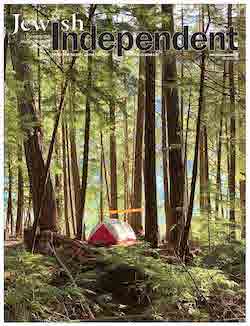 Singing Creek Campground (photo by Ingrid Weisenbach)