Skip to content
  • Home
  • Subscribe / donate
  • Events calendar
  • News
    • Local
    • National
    • Israel
    • World
    • עניין בחדשות
      A roundup of news in Canada and further afield, in Hebrew.
  • Opinion
    • From the JI
    • Op-Ed
  • Arts & Culture
    • Performing Arts
    • Music
    • Books
    • Visual Arts
    • TV & Film
  • Life
    • Celebrating the Holidays
    • Travel
    • The Daily Snooze
      Cartoons by Jacob Samuel
    • Mystery Photo
      Help the JI and JMABC fill in the gaps in our archives.
  • Community Links
    • Organizations, Etc.
    • Other News Sources & Blogs
    • Business Directory
  • FAQ
  • JI Chai Celebration
  • JI@88! video

Recent Posts

  • Sharing her testimony
  • Fall fight takes leap forward
  • The balancing of rights
  • Multiple Tony n’ Tina roles
  • Stories of trauma, resilience
  • Celebrate our culture
  • A responsibility to help
  • What wellness means at JCC
  • Together in mourning
  • Downhill after Trump?
  • Birth control even easier now
  • Eco-Sisters mentorship
  • Unexpected discoveries
  • Study’s results hopeful
  • Bad behaviour affects us all
  • Thankful for the police
  • UBC needs a wake-up call
  • Recalling a shining star
  • Sleep well …
  • BGU fosters startup culture
  • Photography and glass
  • Is it the end of an era?
  • Taking life a step at a time
  • Nakba exhibit biased
  • Film festival starts next week
  • Musical with heart and soul
  • Rabbi marks 13 years
  • Keeper of VTT’s history
  • Gala fêtes Infeld’s 20th
  • Building JWest together
  • Challah Mom comes to Vancouver
  • What to do about media bias
  • Education offers hope
  • Remembrance – a moral act
  • What makes us human
  • המלחמות של נתניהו וטראמפ

Archives

Follow @JewishIndie
image - The CJN - Visit Us Banner - 300x600 - 101625

Tag: photography

Jerusalem in photographs

Jerusalem in photographs

The Dome of the Rock in the snow, 1940s. (photo by Moshe (Nicolas) Schwartz / Schwartz Collection, Bitmuna)
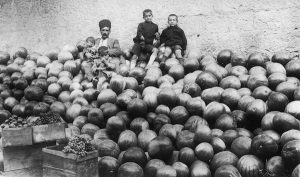
photo - Watermelons, undated
Watermelons, undated. (photo by Elia Kahvedjian)

Jerusalem is one of the most photographed places in the world. The Camera Man: Women and Men Photograph Jerusalem 1900-1950 exhibition at the Tower of David Museum highlights the unique and complex human and cultural heritage of the city. It also offers, for the first time, a comprehensive look at the photographic work in Jerusalem of Christians, Jews and Muslims between the years 1900 and 1950.
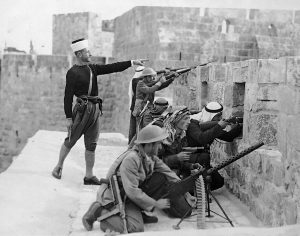
photo - Arab fighters on the walls of the Tower of David
Arab fighters on the walls of the Tower of David. (photo by Chalil Rissas / The Central Zionist Archives)

The 34 photographers chosen to be exhibited in The Camera Man lived and worked in Jerusalem during the first half of the 20th century. The photographers come from all different backgrounds – European, Armenian and local, Jewish, Muslim, Christian, men and women. Many photographers recorded the Jerusalem residents of different communities; some were hired by institutions and organizations to photograph various historical events that occurred in the city and some were artists who sought to honor the unique faces of Jerusalem.

What makes this exhibition different from others is that much of the photography that has been displayed before from this time period looks at the young “strong Zionist,” the developing state of Israel, the rural local villages, the posed “Orient,” the “new Tel Aviv.” This exhibition – which includes many photographs that have never been seen before – examines Jerusalem and its colorful mosaic of people, from everyday life to historic events.
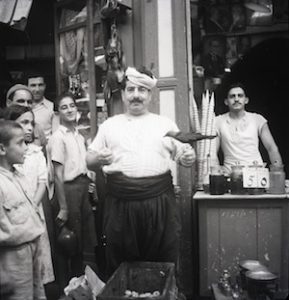
photo - The ice cream seller with his bird, 1940s
The ice cream seller with his bird, 1940s. (photo by Hanna Safieh / Rafi Safieh Collection)

“The juxtaposition of different viewpoints and spheres of activity, placing works by prominent photographers alongside less well-known names, reveals a hitherto untold chapter in the history of photography in the country and in Jerusalem’s own history,” writes exhibit curator Dr. Shimon Lev.

In the mid-19th century, when Europe began to take an interest in the Orient, Jerusalem witnessed an influx of travelers from England, France and, later, from America. At the same time, a new invention was spreading through Europe – the camera – and the newcomers carted their unwieldy photographic equipment with them. The sight of the squalid city was a bitter disappointment to them and clashed with an imagined idea of the Holy City that had prompted their journey to Jerusalem.

The dissonance between the Jerusalem cherished by the heart and the Jerusalem revealed to the eye, between the heavenly and the earthly Jerusalem, and between the ideal and the mundane Jerusalem, still occupies photographers today. Although cameras are now conveniently small and light and exposure times are shorter, today’s photographer still tries to capture his own personal version of Jerusalem, even if it is only a digital self-portrait in front of the Tower of David.
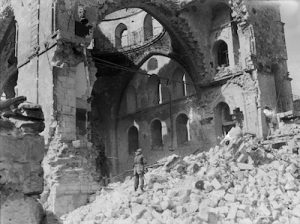
photo - Jordanian soldier at the destruction of the Hurva Synagogue, 1948
Jordanian soldier at the destruction of the Hurva Synagogue, 1948. (photo by Ali Zaarour / Zaarour Family Collection)

In The Camera Man, there are photographs showing action in the streets of Jerusalem from 1948, as well as portraits taken by local photographers who opened up their own photographic stores, most of them along Jaffa Road near Jaffa Gate and the Tower of David. The stores were called photographic houses or photo studios, although the driving spirit between the revival of the Hebrew language, Eliezer Ben-Yehuda (1858–1922), suggested the term ‘“light-painting houses” in Hebrew.

The photographs comprising The Camera Man were collected from private and public archives. The catalogue accompanying the exhibition includes selected photos from the exhibit, several of which are published for the first time, as well as articles by Lev, Dr. Lavi Shai and artist Meir Appelfeld.

The Camera Man is on display until Dec. 10. For more information, visit tod.org.il/en/exhibition/the-photographers.


– Courtesy of 
Format ImagePosted on June 10, 2016June 8, 2016Author Tower of David MuseumCategories Visual ArtsTags history, Israel, Jerusalem, photography
Retiring from the JCC

Retiring from the JCC

In her retirement, Jocelyne Hallé plans to keep working as a photographer. (photo by Rachel Lando)

Members of the Vancouver Jewish community know Jocelyne Hallé. For years, she has been the official photographer of the Jewish Community Centre of Greater Vancouver, taking pictures at gala dinners and art presentations. As well, her smiling face and helpful optimism have enhanced the centre’s membership desk and greeted many members, new and old, whenever they enter the building. But, after June 25, she will no longer be there. She is retiring.

“I came to work at the JCC in 2001,” Hallé said in an interview with the Independent. “Before, I used to work for several engineering firms, as a translator or executive assistant, but, by 2001, I grew unhappy with my job. I wanted a change, so I applied to an employment agency.”

She had never thought about a job at the JCC. “My agent took me for an interview but she didn’t tell me where she was taking me,” Hallé recalled. “She just said it would be a new environment for me and that I would like it. She brought me to an interview with Gerry Zipursky [executive director of the centre at the time]. The interview lasted for two hours, the longest interview of my life, and, after that, he hired me to be his personal assistant.”

When she started her new job, Hallé didn’t know anything about the local Jewish community or Jewish culture, or even about working at a community centre in general.

“I asked him why he hired me, a non-Jew,” she said, wondering aloud. “But he said he only wanted his assistant to be competent and sensitive to the situation in the Middle East. I guess I was both, although I don’t remember talking much during the interview. He did most of the talking.”

She admitted that the adjustment period wasn’t easy. “I had to learn so much. But the more I learned about the community and the Jewish culture, the more I fell in love with it. When, in 2005, I went with the others for a working trip to Israel, I felt very comfortable, as if it was home.”

The year 2005 was a milestone for her in many respects. She took thousands of photographs in Israel, and the experience propelled her lifelong passion for photography to a new level. Her photos of Israel adorned an entire wall of the JCC atrium for three years. Her affection for the country and the people reverberated through the images she captured. “It was so gratifying to see people standing in front of that wall, looking at my pictures,” she said. (In 2009, Hallé landed a show at the JCC’s Sidney and Gertrude Zack Gallery. “My friends told me that if they didn’t know better and only judged by my photos, they would’ve thought Israel a green country,” she confided happily.)

Another, sadder event also happen in 2005 – she was diagnosed with breast cancer soon after she returned from Israel. “Cancer changed me, in a good way,” she said. “Contrary to everyone’s expectations, it was a positive experience. I realized what was important in life. I learned who was a real friend and who wasn’t. Before, I was working too much, always tired and heading for depression, but my illness gave me leave to take care of myself.”

She took time to recover and, after two years, returned to the JCC. Her former boss was no longer there, so she started working at the membership desk. “It was a different environment,” she explained. “I finally met many community members and I was away from all the politics. I loved it. Everyone was very friendly and helpful; I felt almost a part of the family.”

She continued learning about the community, immersing herself in the culture and traditions. “By now, I know so much about Jewish ways, people often ask me questions. I explain to them about Rosh Hashana and Shabbat and other celebrations. Many are surprised to learn that I’m not Jewish. To tell the truth, sometimes I feel that I’m kind of Jew-ish. We joke about it.”

In January this year, Hallé turned 60, and decided it was time to retire.

“In the last couple of years, a few of my friends died,” she shared. “It was very upsetting, but I’m alive. I’m ecstatic to be 60. I want to travel, to take some class, to work more on my photography. Recently, I went to Nicaragua for a month; I worked there as a volunteer and I want to do it again. I want to visit Galapagos and Kenya. I might volunteer with the JCC Seniors.”

Hallé is sure that her work for the JCC created an opportunity for her to develop as an artist photographer. With the support and encouragement of her colleagues and friends, she continues to explore her chosen art form. “I have nine photographic events booked this summer, right after I retire,” she said. “I’ll do a bar mitzvah, a wedding, a fundraiser, even a dance festival.”

Hallé’s plans are still in flux, but they expand every day, perhaps enough to fill the next 60 years.

To learn more about Hallé, the photographer, visit her website, jocelynehalle.com.

Olga Livshin is a Vancouver freelance writer. She can be reached at [email protected].

Format ImagePosted on June 5, 2015June 3, 2015Author Olga LivshinCategories LocalTags JCC, Jewish Community Centre of Greater Vancouver, Jocelyne Hallé, photography
Look up to art

Look up to art

Sharon Tenenbaum’s work can be seen on billboards above highways in Vancouver, Toronto and Montreal. (photo by Sharon Tenenbaum)

Sharon Tenenbaum discovered her love of photography in 2006 on a trip to South East Asia. In 2014, only eight years later, she is a nationally recognized photographer. From Dec. 15 to Jan. 15, four of her photographs will be displayed on billboards along Canadian highways and bridges as part of Paint the City (paintthecity.org), an international initiative to promote arts in unexpected places.

Tenenbaum talked to the Independent about her transformation from an engineer dissatisfied with her career to a successful artist.

“Last year, I participated in a RAW Artists (rawartists.org) competition,” she said, explaining how her images found their way to the billboards. “RAW is an art organization supporting artists in the first 10 years of their career. I became a finalist, together with another artist. Then, the organizer called me and said she nominated us for the Paint the City project. I didn’t even know about them.”

According to Tenenbaum, Paint the City selected the winner through social media. They stipulated that the one who got more “Likes” on Facebook and Twitter would win. “I had to recruit all my friends and even my family in Israel, and my family and friends in turn incited everyone they knew to login and vote for me. I won. I guess I have more friends,” she joked.

In reality, it was a long road from her first travel photos to her sophisticated billboard images displayed on the highways of Vancouver, Toronto and Montreal.

“At first, many people discouraged me. They would say: ‘She discovered a camera, so what?’ But I can’t see myself doing anything else. I didn’t care what anyone said. I have confidence in myself.”

photo - Sharon Tenenbaum: “A color photo doesn’t have to be as good as black and white."
Sharon Tenenbaum: “A color photo doesn’t have to be as good as black and white.” (photo from Sharon Tenenbaum)

In the beginning, what she did was photojournalism, documenting everyday life, she said. “In Asia, I took photos of buildings and people, but when I returned to Vancouver, I couldn’t photograph people here. It requires legal permissions, so I started photographing architecture, rediscovering Vancouver. I wasn’t just documenting anymore; it was my interpretation of what I saw.”

Out of her engineering background sprouted her passion for photographing things constructed by human beings. “I have a talent to see how elements of the whole work in harmony, how shapes and lines come together. I like modern architecture with its clean lines. The approach is artistic. The image has to speak to the heart.”

Her stark black and white images that won their places on billboards speak to people’s hearts. They show the artist’s unerring sense of light and shadows, her flair for the dramatic. Her quest for visual tension resulted in her unique series of bridges, all of them spectacular black and white instants in time and space. Some of them are Vancouver bridges, others she took during her travels.

“When you travel,” she explained, “you see everything with new eyes. It’s harder to achieve at home. I traveled a lot at first. Now I only travel to specific locations. If I want to photograph a certain bridge, I research it, then go there to take pictures.”

Most of her photographs are black and white. “When you use color in a photo, it steals the show,” she said. “A color photo doesn’t have to be as good as black and white. Sometimes, if you take color out of the image, it has no merit otherwise. Black and white photos are more challenging. The image must stand on its own. In many cases, color feels like cheating. I use color in my photos only when it’s essential, when color is what it’s all about. Color is an emotion. When I need to convey that emotion, I leave the colors intact. The same image seems to tell different stories when it’s in color or in black and white.”

Recently, she turned to a new technique, new stories infused with color. She started painting on top of her photographs. She applied this development not to the man-made structures but to something created by nature: trees.

“I started with one image of a tree, a photo from Portugal. There is a maple tree outside my window; it’s gorgeous in the fall. It inspired me. I wanted to convey such beauty with my image too, so I painted on top. Then I participated in Culture Crawl, and this painting was very successful. I started doing more.”

Like every artist, she strives to evolve, constantly finding fresh dimensions in her art. “I want to keep changing. I don’t want to have one style associated with me. Every artist needs to grow. After awhile, you get bored with the old stuff. Look at Picasso. He had five distinctive stages, each one unrecognizable from the others. Same with me. I have to keep reinventing myself.”

She also helps others reinvent themselves: she teaches, offering workshops in photo skills, as well as creativity. “I love teaching, love sharing what I know. Sometimes, when I teach, it clarifies the concept for me as well. I teach people how to be artists. Creativity has different phases. I teach my students how to get into each one, how to recognize and be receptive to new ideas. But then, each idea needs a follow up, lots of hard work. That’s also part of creativity.”

For more on her work, visit sharontenenbaum.com.

Olga Livshin is a Vancouver freelance writer. She can be reached at [email protected].

Format ImagePosted on December 19, 2014December 17, 2014Author Olga LivshinCategories Visual ArtsTags Paint the City, photography, RAW Artists, Sharon Tenenbaum
Estrin captures essentials

Estrin captures essentials

Avie Estrin in Colombia. (photo from Avie Estrin)

On Dec. 4, Avie Estrin’s solo show Blessed People opened at the Sidney and Gertrude Zack Gallery. Many of Estrin’s photos are taken in far-away places. There are Tibetan lamas gardening and a Yemenite bride in her fantastic headgear. An old man in a turban looks as if his perceptive eyes can see straight into your heart. A group of yeshivah students dance in the street. A young girl peeks out from behind a large heavy door. The door is ajar, and only fragments of the girl’s face are visible, but there is joy in her curious eyes. She has escaped her handlers, if only for awhile, and relishes her fleeting moments of freedom. Each picture tells a story.

In an interview with the Independent, Estrin talked about his life with photography, its challenges and rewards.

JI: What prompted you to mount an exhibit of travel photos? Do you shoot photos locally?

AE: Interesting question. I never understood this exhibit as a travel theme per se. While there are images from everywhere, a good number are taken right here, in Vancouver and the Lower Mainland. On the other hand, if “travel” is what others see, I’m OK with that. I can’t dictate what the show is about, since in the end it’s about what you see, not what I think I saw. I would only say that for me, it’s about real people, it’s about real life. It’s about all of us.

JI: Tell me about this show.

AE: The photos span from the early ’90s to as recently as six months ago. Photos were taken with an array of different cameras, from an old-fashioned SLR to early digitals, but nothing more modern than 2004. While I was always very particular about quality, my equipment is modest and minimal.

Photos range from hiking the Himalayas to horse trekking the Andes and Amazon basin, to more domestic venues right here in Vancouver. I could go on about harrowing experiences forging flooded rivers on horseback in Ecuador or negotiating at gunpoint with Colombian guerilla in the outback. While it makes for great storytelling, the real point is that, by and large, my experiences were joy-filled encounters with gracious peoples from across cultures, people who embraced me, brought me into their homes and shared with me the little they had. I hope the exhibit illuminates this sentiment in some small way.

JI: What do you look for in a frame?

AE: Whatever the subject, I am looking for what is essential to it. I don’t for a moment deceive myself that whatever I am experiencing in a given moment can be accurately represented or reproduced in a static concrete format … with any degree of authenticity. But if I can capture just a fragment of whatever the catalyst in that ephemeral moment, that indefinable but quintessential essence of a thing, then maybe I have done it some justice.

JI: Is there a connection between photography and your profession?

AE: It’s been said before, “all things are connected.” When we attempt to compartmentalize our lives, we are merely hanging veils between our bedrooms. The common thread is not so much what we do but how we do it.

JI: You write poetry, too. Are your poems and your photos linked?

AE: To answer this question I would simply recommend going to the exhibit, seeing the work, reading the poems, and then you decide.

JI: Do you ever use Photoshop?

AE: Photoshop? What’s that? Seriously, without getting too technical or mundane, there is no such thing as “untouched” digital photography. The moment you take a jpeg image with your point and shoot, your camera’s firmware is instantly doing a circus act to compress that eight mega-pixel shot you took down to a one or three megabyte image. Aside from losing at least 60 percent of the original image data, you are also letting your camera indiscriminately dictate what 60 percent to throw away. Even in raw format, there is no getting away from post-processing. For better or worse, the days of “untouched” photography are gone forever.

JI: Do you give copies of your photos to your subjects and, if so, do you offer them free of charge?

AE: Various images in Blessed People were taken in the pre-digital era, so showing people immediate results was in many cases not an option. I had a strict practice of sending people hard copies of their images, but often practicalities. such as remoteness, non-existent postal services, etc., didn’t allow for this either. As to charging people for the privilege of capturing their image … isn’t there something in halachah against that? There should be.

JI: What are the biggest challenges and rewards of your work?

AE: I have no idea what a real travel photographer does. For me though, doing is reward in and of itself. Doing without intentionality isn’t “doing” at all. It’s merely a happening. And intentionality implies challenge; otherwise, it would be a redundant endeavor. I love challenge. I love to do.

Olga Livshin is a Vancouver freelance writer. She can be reached at [email protected].

Format ImagePosted on December 12, 2014December 11, 2014Author Olga LivshinCategories Visual ArtsTags Avie Estrin, photography, Zack Gallery

Posts pagination

Previous page Page 1 … Page 6 Page 7
Proudly powered by WordPress