Skip to content
  • Home
  • Subscribe / donate
  • Events calendar
  • Business Directory
  • FAQ
  • News
    • Local
    • National
    • Israel
    • World
    • עניין בחדשות
      A roundup of news in Canada and further afield, in Hebrew.
  • Opinion
    • From the JI
    • Op-Ed
  • Arts & Culture
    • Performing Arts
    • Music
    • Books
    • Visual Arts
    • TV & Film
  • Life
    • Celebrating the Holidays
    • Travel
    • The Daily Snooze
      Cartoons by Jacob Samuel
    • Mystery Photo
      Help the JI and JMABC fill in the gaps in our archives.
  • Community Links
    • Organizations, Etc.
    • Other News Sources & Blogs
  • JI Chai Celebration
  • JI@88! video

Recent Posts

  • Federation now across BC
  • Israel fighting for its existence
  • Deal strengthens Iran
  • Patriotic belonging diminishes
  • A campaign to engage
  • Upstanders’ first live event
  • Responding to Carney
  • Having your own home
  • Music a family tradition
  • Musical to warm heart
  • Community milestones … June 2026
  • Sharing her passion for Israel
  • Or Shalom reopens its doors
  • JFS from past to future
  • Need holistic approach
  • Sharing stories, advice
  • Journalist shares fears
  • Skills to live together
  • Road to independence
  • Cutting grass with scissors
  • Zionism as a solution
  • Deceit, desire & the divine
  • Reclaiming sacredness
  • Creative project ideas
  • Summer squares and cobbler
  • Thou shalt … summer commandments
  • Legal help for students
  • Revisiting myth of Lilith
  • Wrong person rebuked
  • Canada’s mixed messages
  • Questions for museum
  • Symposium on antizionism
  • Making soccer political
  • CJPAC lauds Pulver’s impact
  • City recognizes Vrba’s legacy  
  • Organ donation saves lives

Archives

Follow @JewishIndie
image - CJN box ad Rockowers 2026

Tag: memoir

Sharing their stories

Sharing their stories

Makeda Zook, left, and Sadie Epstein-Fine, editors of Spawning Generations. (photo from Demeter Press)

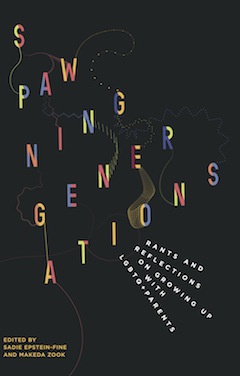
Sadie Epstein-Fine and Makeda Zook will be in Vancouver for the Jan. 17 launch of Spawning Generations: Rants and Reflections on Growing Up with LGBTQ+ Parents (Demeter Press, 2018), which they co-edited.

“It is really important to us that this book was written and edited by queerspawn. So often our stories are told for and on behalf of us by researchers, journalists and academics,” Epstein-Fine told the Independent. “Our intimate, personal family lives have been under the microscope for our entire lives, proving to the world that we turned out all right. By curating stories from our community, including our own stories, Makeda and I ensured that we were not, as we like to call it, airbrushing our stories, but that we were allowing our contributors to tell the nitty gritty, the details of their stories that they have never been able to tell.”

In the book’s introduction, Epstein-Fine and Zook explain that the term queerspawn to describe someone who has one or more LGBTQ+ parents was coined by Stefan Lynch, the first director of COLAGE, an American “network dedicated to connecting and supporting queerspawn,” which has one chapter in Canada (in Toronto).
book cover - Spawning Generations

“By giving a name to our identities and experiences, he laid the foundation for connecting and politicizing queerspawn; Lynch gave us a term to organize around,” they write, acknowledging that the term “is not without controversy. Although some people feel empowered by reclaiming both words (‘queer’ and ‘spawn’), others do not like the association with ‘spawn of the devil.’” Another term, “gayby,” also has its proponents and its critics, those who “find it infantilizing and only representative of people whose parents identify as gay,” note Epstein-Fine and Zook.

Ultimately, the editors chose to use queerspawn for the anthology because it is “unapologetic and bold.” As well, it is “the word most often used in Canada and the United States and, as such, it helps us find each other; it is a common word we can rally around. We often feel highly visible in straight communities and invisible in queer ones. The term ‘queerspawn’ creates a space for us, and helps us to feel strength in numbers and a sense of belonging at times when we feel all too visible. When we feel invisible, naming ourselves as queerspawn tells the queer community that we are still here, even if we have grown up.”

Epstein-Fine was born in Toronto in 1992 to two moms, in an activist home, “surrounded by 11 other women.” She carries on her family’s activist tradition and describes herself as a queer(spawn)-political theatre maker.

According to her bio, Zook “was born in Vancouver in 1986 to her two lesbian feminist moms. She was raised in a mixed-race family surrounded by anti-oppression politics and her OWLs (older, wiser lesbians).” She works in sexual health promotion for a feminist nongovernmental organization.

Epstein-Fine shared with the Independent how she and Zook came to be the editors of Spawning Generations.

“Demeter Press approached Makeda and I to edit the anthology because they saw a gap in their literature,” she explained. “They mostly publish books about motherhood, through a feminist lens, and they realized that, while they had a lot of literature about queer parenthood, they didn’t have anything from the children. This is a trend in the majority of queer parenting literature – we hear a lot from the parents, but rarely from the kids raised in queer households.

“Yes, it’s true, Makeda’s and my primary focus is not editing. Previous to editing this anthology we were both writers, which is how we got connected to this book. Our (queerspawn) community is small and disparate, there is not a plethora of options available. When Demeter first approached me with this project, I tried to think of folks who could do this project, and there was no obvious answer.

“Makeda and I learned to be editors in trial by fire,” she admitted. “We always say that we didn’t just grow alongside this project, but that this project grew us. After three years of working on this project, we now feel confident in our editing skills, which we didn’t feel previously.”

And the pair has done a commendable job in keeping the essays on point. The editing is such that each contributor maintains their own voice, which adds to the book’s readability and interest. Contributors range in age, from 9 years old, to teenagers, to 20-somethings and older queerspawn. And the writers come from all over the world, from as far away as London, England, and as close as Victoria; one was born in Vancouver but seems not to live here anymore. While all the contributors have being the child of one or more LGBTQ+ parents in common and have shared some similar experiences, each story is unique.

“There was a call for writers, which we spread as far as we could,” Epstein-Fine explained about how the essays for the anthology were chosen. She said they asked COLAGE and several organizations and people they know in Canada to publicize the call, which went out in the winter of 2015, with a due date of May 1 that year.

“We received 25 submissions and we took every single one,” she said. “We thought that each person had an interesting story to tell and we were committed to helping them tell their story the way they wanted it to be told. We initially thought that we wanted to be more selective and, if we had received more submissions, we would have been forced to be. However, the wonderful result of us taking everyone is that our book is not just filled with works from professional writers, but we have contributors with a range of experiences – from people who have never written a personal essay to professional writers. It gives a real scope of our community.”

The Spawning Generations book launch takes place Jan. 17, 7 p.m., at Massy Books, 229 East Georgia St., in Vancouver. For more information, visit facebook.com/spawninggenerations.

Format ImagePosted on January 11, 2019January 9, 2019Author Cynthia RamsayCategories BooksTags identity, LGBTQ, memoir, queerspawn
Moving but challenging book

Moving but challenging book

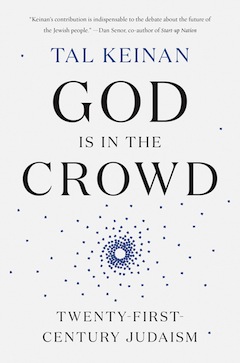
There are many puzzling things about the book God is in the Crowd. It is published by a prominent Canadian publishing house (McClelland and Stewart) but was printed in the United States. It is written by an American-Israeli, Tal Keinan, who was the beneficiary of a first-class prep school education, Exeter, in New England, and was the recipient of an MBA from Harvard. His book is, in some ways, a hodgepodge of personal reminiscences of life in a broken family in America, encounters with various strands of American Judaism, and a passage to Israel, where he beat the odds and became a fighter pilot in the Israeli air force.

Keinan’s English prose style is exceptionally moving, literate and attractive. This is especially true in the section where he describes the rigours of his training and, later, in a discourse filled with self-reproach when he discovers that he has bombed the wrong target during an attack in Lebanon. The author’s thoughts on flying and his lyrical, almost poetical, style reminds this reviewer of French author Antoine de Saint Exupery’s book Night Flight, in which the rhapsody of flying is celebrated with fervour and a certain panache.

Among the many subjects that Keinan tackles in this strangely compelling personal journal is the current configuration of Israel’s population, which he sees as a tripartite collective composed of territorialists, theocrats and secularists. Although his predilection is for the third category, he has much to say about the religious origins of Israel and the Jewish people. In fact, he credits Rabbi Yehudah Hanassi with resuscitating Judaism after the destruction of the Great Temple of Jerusalem through his compilation of the Mishnah in the first century of the Common Era.

Because he finds the world Jewish community dangerously fragmented, and Israel unresponsive to smaller start-up enterprises, Keinan, who founded Koret, a fund for small businesses, and who is active in the Steinhardt Foundation (Birthright), proposes a very ambitious program to galvanize young Jews through, among other things, a vibrant Jewish summer camp experience, higher education in Jewish sources and a commitment to financial obligations to sustain these three essentials. His ideas are complex but he does provide extensive details to buttress his argument.

image - God is in the Crowd book coverThose who look for logical and sequential ideas in this challenging book will be somewhat disappointed in its title, which claims that “God is in the crowd,” an idea the author promotes in ways that are not entirely clear despite the praise heaped on Keinan by six distinguished commentators whose views are on the back of the book jacket, as well as an endorsement on the front of the jacket by Lord Jonathan Sacks. This reviewer must have missed something in his reading of the chapters in which the author talks about “crowd wisdom.”

Based on an experiment to discern how many gum balls were displayed in a large glass container at one of his investment shows, Keinan suggests that the collective guesses were closer to the correct number than individual number choices and, from this observation, the author leaps into generalizations about how Jewish unity among Diaspora Jews was secured by “crowd wisdom,” no matter the geographical, religious or cultural disposition of the disparate communities. Keinan tends to annoy the reader by discoursing on this idea and then abruptly changing his agenda by addressing other concerns, and then returning to the “crowd wisdom” theme.

Despite the ambiguities in his discussion of “crowd wisdom,” Keinan has one section in this autobiographical memoir that merits high praise. During his service in the Israeli air force, the author developed a friendship and admiration for a fellow pilot – a secular kibbutznik who was a model for Keinan both in terms of aeronautics and moral compass. The friendship continued after their air force service and then, one day, years later, Keinan saw that his old buddy was wearing a kippah. Keinan writes with a heavy heart that the longtime friendship dwindled slowly and finally dissolved.

Arnold Ages is distinguished emeritus professor at the University of Waterloo in Ontario.

Format ImagePosted on November 30, 2018November 29, 2018Author Arnold AgesCategories BooksTags Israel, memoir, Tal Keinan
I know who I am … or do I?

I know who I am … or do I?

Moving into a condominium forced the writer to modify how she approached the holiday season, including the purchase of an electric chanukiyah. (photo by Libby Simon)

For Jews, the celebrations of Chanukah arrive on Sunday evening, Dec.2, and close on Monday evening, Dec.10. It is also a time when many people struggle with dissonance between religion and Western values. I know who I am, so it was not a problem – except, an epiphany struck.

I had a dream some time ago. I dreamed I was in the lobby of a hotel filled with a patchwork of people of different colours and garbs reflecting differences in religious, cultural and ethnic backgrounds. My eyes scanned the room searching for someone, or something, the object of my search unclear. No one took notice as I wound my way through the crowd and exited the area into a corridor. Turning to the right, I entered a room through an open door. My eyes were drawn to a box gift-wrapped with blue-and-white Chanukah paper sitting on a table. As I picked it up, a feeling of warmth wrapped around me. Suddenly, a non-descript, dark, threatening shadow loomed overhead, momentarily startling me. With outstretched arms, I handed my gift over to this strange apparition as if to appease it, and was immediately filled with a deep sense of inner peace and contentment.

This dream was so close to the surface, its meaning became readily clear. I was fully aware of a recent inner struggle triggered by the Christmas/Chanukah season in which I felt the very soul of my Jewishness being challenged from an external source. It was a strange and surprising experience because, as an adult, I have never been particularly observant. Although raised in an Orthodox Jewish family, my personal beliefs led me to a secular lifestyle. Following dietary laws, for example, was irrelevant in determining the quality of good character. Traditions were important more for benefit of family than in any religious sense. Rituals, such as lighting the chanukiyah candles on Chanukah did not seem necessary. After all, I know who I am. I define myself first as a human being, who happens to be of Jewish descent. But, after a lifetime of working and living in a dominant, multi-religious society, why now had it become an issue? As an empty nester, for whom do I practise it?

The answer was surprising but simple: the condominium lifestyle. Who would have anticipated that this popular and accepted way of life would create such a fall-out? I had long questioned this concept in which total strangers of diverse backgrounds would make a large monetary investment and enter into a common living arrangement – an arrangement in which they become inextricably bound to one another in some very basic ways. They accept the premise and agree to give up certain freedoms in exchange for reducing personal responsibilities. In doing so, they turn their decision-making powers and independence over to others who may have different opinions, qualifications, priorities, intelligences and abilities. Nonetheless, this is what I bought into without realizing that, as important as these issues are, others would run even deeper – such as ethnicity, culture and religion.

I have grown up with the symbols and celebrations of Christmas. As a child, I participated in school plays and choirs and Santa never asked your religion when he warmly handed you a candy cane. Feelings of deprivation or envy never entered my psyche because the love of family filled my needs. As an adult, I have continued to take in the festivities, in sharing the spirit of peace and goodwill with non-Jewish friends, neighbours and colleagues.

But something changed. Tolerance, appreciation and participation were all possible when “The Season” did not infringe on my personal turf. In the spirit of goodwill, it is important to accommodate and respect these symbolic religious expressions. However, some individuals threatened to extend these decorations over my personal unit and warned that any resistance on my part could be crushed by a simple vote of the majority. Canada is a multicultural country supporting the values and rights of freedom of religion, thus protecting minorities. Such intimidation threatens to swallow who I am.

As neighbours on a street, such a thought would never even materialize. Yet, in a condominium arrangement, boundaries become blurred. Such actions deny my very existence. They render me invisible and impose a choice – assimilation or alienation. Neither is acceptable and therein lies the conflict.

However, the dream did offer a resolution. It led me on a personal journey through the chaos of diversity. I turned towards what was right for me – the box, wrapped in blue-and-white Chanukah paper, that confirmed who I am. By walking through the open door in my dream, I received the reward of self-discovery. I realized that knowing who I am was not enough. It was only in giving my gift to the “faceless figure” of others did I feel a sense of inner peace and contentment. The dream revealed not only who I am, but who I am in relation to others. Until now, my identity had been like a one-way mirror. I could see through the glass while the other side only reflected the viewer’s own image. If others do not see me, I will disappear like a ghost in the morning light. Still, I cannot ask anyone to extinguish their light, for that is who they are, only not to impose it on mine.

What was the solution? Instead of the customary, small, coloured licorice-like wax Chanukah candles whose symbolic message of freedom dies quickly in a muted puff of smoke, I purchased and placed an electric chanukiyah in my window. Through the sustained bright light, the “mirror” becomes translucent, revealing the beautiful cultural mosaic that is Canada’s proud tradition, one that allows each of us to be who we are.

And, perhaps along with the glittering Christmas lights, we will all be enriched, as, together, they cast a far greater illumination in recognizing, respecting, accepting and even appreciating our differences: Just like the mirror on the wall / Silvered coats reflect us all / Strip bare the veneer of hypocrisy / A window reveals you are just like me.

Libby Simon, MSW, worked in child welfare services prior to joining the Child Guidance Clinic in Winnipeg as a school social worker and parent educator for 20 years. Also a freelance writer, her writing has appeared in Canada, the United States, and internationally, in such outlets as Canadian Living, CBC, Winnipeg Free Press, PsychCentral and Cardus, a Canadian research and educational public policy think tank.

Format ImagePosted on November 30, 2018November 30, 2018Author Libby SimonCategories Celebrating the HolidaysTags Chanukah, identity, memoir
An end, a beginning

An end, a beginning

Holocaust survivor Serge Haber speaks with Tina Macaspac and other students at the Writing Lives closing ceremony April 26. (photo by Jennifer Oehler © Langara College)

Langara College recently held the closing ceremony for Writing Lives: The Holocaust Memoir Project, a two-semester collaboration between Langara College, the Vancouver Holocaust Education Centre (VHEC) and the Azrieli Foundation.

At the April 26 event, Dr. Rachel Mines, a member of Langara’s English department and coordinator of the project, described Writing Lives.

“In the first semester of this project,” she said, “students learned about the European Jewish culture and the Holocaust in the classroom, through studying historical and literary texts. They also researched and wrote a paper on prewar European Jewish communities.

“In the second term, students were teamed up with their survivor partners. They interviewed the survivors, transcribed the interviews and turned the transcriptions into written memoirs. The memoirs will be archived and possibly published, and they will also serve as legacies for the survivors and their families.”

Mines also relayed a message from Melanie Mark, B.C. minister of advanced education, skills and training.

“The Writing Lives project gives a voice to Holocaust survivors and teaches us about the type of courage and resilience it takes to overcome injustice,” said Mark in her statement. “These emotional and moving stories help connect people from different cultures and inspire us to do better for each other. I am proud to be part of a government that is committed to building a vision of reconciliation through the adoption and implementation of the United Nations Declaration on the Rights of Indigenous Peoples, and the Truth and Reconciliation Commission’s calls to action. As an indigenous minister whose grandparents went to residential school, as the first person who ever graduated from high school in my family and went to college and university, I know the power of education. I know how transformative it is and how impactful it can be on our communities. Thank you for being truth tellers and helping to keep these stories alive in the minds of people.”

Gene Homel, former chair of the liberal studies department at the British Columbia Institute of Technology, encouraged students to consider entering the fields of history, politics or literature.

“History is very important in providing context to some disturbing developments, not so much in Canada but other parts of the world, which are not as fortunate as Canada,” he said. “History is a scientific-based discipline, and that kind of approach is all the more important in the context of fake news and alternative facts. It is very important that the stories be told, and for us to take an inclusive but evidence-based and scientific approach to history.”

“When I invited the survivors in this program,” said Dr. Ilona Shulman Spaar, education director at the VHEC, “I mentioned two things: first, I expressed that the VHEC is confident that the experience of meeting with a Holocaust survivor will prove meaningful for the students and, secondly, I mentioned that I hope the survivors, too, will benefit from this opportunity. Listening to the positive feedback that I received from both the students and the survivors, and looking at the overall outcome of this project, I am glad to see that my hopes for this program became true.”

Serge Haber, a Holocaust survivor and a Writing Lives participant, talked about the significance of his memoir. “It is very crucial to me, because, for the last 35 years, I have been thinking of writing my experience in this life,” he said. “I never had a chance, the time or the person to listen to me. I hated the machines that record, so [a] personal touch was very important to me. And here it was, presented by Langara. I worked with two students, and I think we created a relationship, a personal understanding of what I went through.”

Haber added, “In fact, I have never been in a concentration camp, but it is important to know that the Holocaust happened not only in camps but also in many cities around Europe, where thousands upon thousands of Jewish people, young and old alike, perished for nothing, only because they were Jewish. I profoundly remember three words that [I was told] while I was watching what was happening on the streets below, where thousands of people had been killed – my father mentioned to me, ‘Look, listen and remember.’ And I remember.”

Heather Parks, reflecting on the passion and dedication that she and her fellow students contributed to the project, shared an emotional speech.

“For their trust in us, we poured our hearts into building their legacy,” she said. “We spent our days and long nights taking words told to us in confidence. We poured our hearts – and sometimes tears – into making a story fit for the most incredible people we have had the honour of meeting. Every part of this was hard work, and every part of this was worth it. We learned so much from them.

“Besides the lessons on history, we learned what true strength means,” she said. “We learned that love can remain even after trauma, loss or heartbreak; that new love grows as lives move forward, and that time can heal many wounds, even though they may leave scars. We were lucky to have been included in this love, this trust and this experience. I am not the only one in this project – in the experience of all of us, this project was illuminating and enlightening. It was surreal and awe-inspiring in every sense of the word. The experience taught us compassion, how to listen and what it means to love in the face of hate.”

The Writing Lives closing ceremony, however, may be an end that ushered in a new beginning. According to Dr. Rick Ouellet, director of Langara College’s indigenous education and services, his department is currently taking initiatives to continue the program. Writing Lives was a collaboration in the two years it ran. Similarly, the future project would be in collaboration with organizations that are working closely with residential school survivors, such as the Indian Residential Schools Survivors Society and the British Columbia Residential School History and Dialogue Centre, to establish necessary protocols and ensure the stories of survivors are respected and the students are well prepared. Though not yet finalized, Ouellet aims to initiate the new Writing Lives program in fall 2019 at Langara.

Marc Perez, a Writing Lives student participant, lives and works on the unceded territories of the Musqueam, Squamish and Tsleil-Waututh First Nations. His creative nonfiction and fiction appear in Ricepaper Magazine and PRISM international 56.3. His personal essay “On Meeting a Holocaust Survivor” is published in Zachor (May 2018).

Format ImagePosted on July 13, 2018July 11, 2018Author Marc PerezCategories LocalTags First Nations, Gene Homel, Heather Parks, Holocaust, Ilona Shulman Spaar, Langara College, Melanie Mark, memoir, Rachel Mines, residential schools, Serge Haber, survivor, VHEC, Writing Lives
Book has added spice

Book has added spice

Traditions can disappear within a blink of an eye. But keeping certain practices alive is what helps us remember where we came from and shapes how we live and be Jewish today.

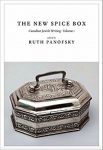
I was excited and curious to read volume 1 of The New Spice Box: Canadian Jewish Writing, edited by Ruth Panofsky, and published by New Jewish Press. I wanted to see how various writers used their family’s history in stories and poems to express their views.

The book is divided into three sections: voice, place and practice. Oppression and triumph are recurring themes throughout, and the stories exhibit strength and are endearing. Panofsky has brilliantly chosen selections that represent what it means to be Canadian in a Jewish context – overcoming difference while maintaining tradition.

The Spice Box: An Anthology of Jewish Canadian Writing was first published in 1981 by Lester and Orpen Dennys; it was edited by Gerri Sinclair and Morris Wolfe. The original book featured many authors, and brought Jewish stories to the forefront in Canada, including translations from original Yiddish texts.

For this new edition, Panofsky researched extensively writings from 1980 to the present. Material that did not make it into the original book was re-evaluated. Pieces relevant to the lives of Jews today were picked out and the contributors include authors from the first edition, such as Matt Cohen and Seymour Wayne. Current pieces were added, and they complement the other writings tremendously. This contemporary collection is intended to provoke new ideologies of culture and what Jewishness means in Canada. To do so, some of the stories refer back to a time before Jews arrived in Canada, while others relate modern-day situations. Readers can see how traditions and circumstances have changed over the years.

The collected pieces within The New Spice Box present how the writers see themselves today and how moving to Canada shaped who they are. In some stories, Canada is depicted as a haven, but also as an intimidating place for new arrivals. Moving to a new location during the war would have been difficult and somewhat terrifying, and these stories show just how much tenacity these immigrants had to begin again. Their families are what kept them going; making sure the next generations would play a role in telling their histories and keeping age-old traditions current.

One story, in particular, demonstrates how daunting moving to another country is. In “My Mother’s Luck” by Helen Weinzweig, a daughter is talking. Initially, it is written in the first person, but the narrative changes into the second person as the story continues. Esther begins, telling her story, but the mother’s perspective takes over. Lily is preparing her daughter, Esther, for her journey to Germany from the United States. Esther is very reluctant to go, even though she agreed beforehand to do so, in the pursuit of a higher education. Esther is scared about the impending changes and is nervous about fitting into a new country, as well as living with her estranged father.

Lily reassures her daughter that this is what she needs to accomplish, even though she herself is skeptical about the value of a higher education, believing that people who are more educated do not necessarily get decent paying jobs in their chosen profession. This attitude is most likely based on Lily’s terrible experiences with men. For example, Esther’s father abandoned them shortly after she was born, preferring to be around his university friends. But, even if mother and daughter fight throughout, Lily’s love for Esther shines through, and Lily assures her daughter that, if everything does not go smoothly, she has a ticket to come back home.

Meanwhile, “Pesach en Provence” by Gina Roitman highlights a duty to safeguard Jewish holiday customs. The narrator describes why making a Passover meal is particularly significant. While in Alpes-Maritimes, taking a break from her life in Montreal, she is planning a seder for a friend. Most of her family was killed in the Holocaust and, besides her brother, only distant relatives remain. In planning the seder, overwhelming memories of her mother at Passover return. Because of these recollections, the narrator adds dishes to the menu other than those she initially planned. By the end of the story, she comes to understand why the meal was so prominent in her family and why Passover is something powerful to celebrate. She realizes her mother’s importance in keeping the tradition alive, and comes to appreciate both her mother and her culture more.

Chloe Heuchert is a fifth-year history and political science student at Trinity Western University.

Format ImagePosted on July 13, 2018July 11, 2018Author Chloe HeuchertCategories BooksTags immigration, Judaism, memoir, Ruth Panofsky
JCC Book Fest awards given

JCC Book Fest awards given

Western Canada Jewish Book Award 2018 winners, left to right: Roger Frie, Deborah Willis, Kathryn Shoemaker and Irene Watts. Missing: Tilar Mazzeo. (photo by Cynthia Ramsay)

Deborah Willis became a writer, in part, because it is a way “to learn about the things that you’re curious about.” Irene N. Watts and Kathryn E. Shoemaker were motivated to reimagine a decade’s-old story in light of its relevance to pressing issues of today. And, in his latest work, Roger Frie found a way to discuss a past for which, previously, “the words were missing for how to speak about it.”

The Western Canada Jewish Book Awards, presented by the Cherie Smith JCC Jewish Book Festival, took place on April 26. Self-proclaimed book lover Daniella Givon, who is part of the JBF committee and was chair of the awards committee, introduced the evening.

“As I looked for ways to enhance the Jewish Book Festival,” she said, “I had a vision that book awards would marry the goals of the festival with the celebration of, and support the achievements of, local Jewish writers from Western Canada and showcase the winning authors. Since then, we’ve already gone through the process of bringing the ideas to fruition with the help of a subcommittee and the first round of awards … a beautiful ceremony was held here two years ago, recognizing five best-deserving authors.”

This year, four awards were presented, as chosen by the selection committee of former librarian Linda Bonder (Victoria); author and librarian Elisabeth Kushner (Vancouver); author and poet Dave Margoshes (near Saskatoon); writer, teacher and critic Norman Ravvin (Montreal); and Judith Saltman, professor emerita at the University of British Columbia School of Library, Archival and Information Studies. The winners were Calgary-based Willis for The Dark and Other Love Stories (Diamond Foundation Prize for fiction); Tilar J. Mazzeo, who divides her time between Maine, New York and Vancouver Island, for Irena’s Children (Pinsky Givon Family Prize for non-fiction); Vancouver’s Watts and Shoemaker for Seeking Refuge (Jonathan and Heather Berkowitz Prize for children and youth literature); and Frie, professor of education at Simon Fraser University and affiliate professor of psychiatry at UBC, for Not in My Family: German Memory and Responsibility after the Holocaust (Kahn Family Foundation Prize for writing on the Holocaust).

At the awards ceremony, each of the donors, or their representative, announced the winner of their sponsored award, which included a cash component. The winners – except for Mazzeo, who could not attend – read excerpts from their books and were interviewed briefly by Marsha Lederman, Western arts correspondent for the Globe and Mail.

Frie, who seven years ago discovered his maternal grandfather’s involvement with the Nazis, told Lederman, “This was a past no one had spoken about and, as I soon learned to understand, I think the words were missing for how to speak about it.” About the war in general, he said, his parents – who immigrated in the 1950s to Canada (Frie was born here) – talked about Germany’s responsibility for the Holocaust, however they did not speak about what his grandparents believed or what their involvement was in the war. He has found, in his research, that this “is a common dynamic amongst Germans in the postwar period.” He said that, while Germany has faced its past, “the emphasis on collective memory and collective understanding and collective responsibility has, in some way, allowed individual families to avoid confronting the past, and this book [Not in My Family] is very much a representation of that.”

Lederman described Mazzeo’s book as “astonishing.”

“I knew nothing about Irena Sendler before I picked up this book, so this has been a gift,” she said. “Irena Sendler was a Polish woman who saved … thousands of Jewish children during the Holocaust with amazing feats of courage, often in the Warsaw Ghetto. Her story is incredible, this book is incredible, and I can only hope that Steven Spielberg gets his hands on a copy.”

Shoemaker gave a brief presentation on the creative process she and Watts went through to create the graphic novel Seeking Refuge, which is based on Watts’ book Remember Me (first published in 2000). And Watts spoke of the challenge of cutting 27 chapters down to nine. “What I had to keep in mind,” said Watts, “is you can get so carried away by cutting and changing the language to make it more dynamic that you lose the story a little bit, and I had to watch that I didn’t diminish the characters.”

About the cover of the graphic novel, which features a girl sitting on a suitcase looking forlorn, Watts said Shoemaker “told the story in that one image.” Later, in response to a question from Lederman, Watts said the current refugee crisis was “the major reason to bring this book back in a different format.”

As for Willis, she spoke with Lederman about her winning collection of short fiction. “I was writing the stories for about five years, and I actually started noticing that the word ‘love’ was coming up over and over again. I was at first a little dismayed by that because I was thinking, oh, love stories, that’s been done. But then I embraced it and I wanted to try and explore that theme in a way that was true to my esthetic, or my goals as a story writer. I set it almost as a challenge.”

After an open Q&A with the authors, JCC Jewish Book Festival director Dana Camil Hewitt wound up the event with thanks to the sponsors, judges, awards committee and audience.

For an interview with Watts and Shoemaker, visit jewishindependent.ca/meet-award-winning-artists and, for a review of Not in My Family, visit jewishindependent.ca/a-grandfathers-sins.

Format ImagePosted on May 4, 2018May 2, 2018Author Cynthia RamsayCategories BooksTags children, Daniella Givon, Deborah Willis, fiction, Holocaust, Irene Watts, Jewish Book Festival, Kathryn Shoemaker, Marsha Lederman, memoir, Roger Frie, Tilar Mazzeo

The value of memoirs

This academic year marks the second session of Writing Lives, a two-semester project at Langara College, coordinated by instructor Dr. Rachel Mines. Writing Lives is a partnership between Langara, the Vancouver Holocaust Education Centre, and the Azrieli Foundation. Last fall, students learned about the Holocaust by studying literary and historical texts. In January, students began interviewing local Holocaust survivors and are now in the process of writing the survivors’ memoirs, based on the interviews. Students are keeping journals of their personal reflections on their experiences as Writing Lives participants. They used their most recent journal entry to reflect on the topic of The Importance of Memoirs. Here are two excerpts.

Memories are our experiences: our interactions with people we love or hate, our communication with the ever-changing world. Our memories remind us of our moral values, our knowledge, our appreciation of our own lives, and perhaps our own inadequacy in being the person that we wanted to be. Our memories are a true reflection of who we are, and that is exactly why they are our most valuable asset.

Writing down our memories is a great way to retain them and, hence, it is meaningful to write a memoir on behalf of David, a man who has experienced one of the most controversial and complex events in history – the Holocaust – so that his memories will be retained in concrete form and can be passed on to many generations. I believe David’s descendants, and anyone who cares about other human beings, will be inspired by what David fought for in the past and will be grateful for what they have. Sometimes, we take food and safety, peace and dignity, the privilege to love and to be loved, for granted, and we forget about the unfortunate ones.

Most importantly, memoirs of Holocaust survivors are a stern reminder of the fact that we humans can turn into perpetrators for not so obvious reasons. It would be wrong for us to think that, since we are civilized, rational, educated people, we cannot become perpetrators. We have come to realize that it is not the case that only psychotic or inherently evil people can harm others in callous and appalling ways. The Holocaust has demonstrated that hatred, racism, conflicts between religions and a sense of insecurity can easily be used to justify our wrongdoings. With the real-life experiences of survivors recorded in memoirs, hopefully people will never forget this painful lesson in human history.

– Bonnie Pun

Storytelling is a phenomenon that all manners of societies and cultures have practised since the hominid species first learned to communicate. We use stories to convey social values and wisdom. In Western society, thanks to pioneers such as Sigmund Freud and Carl Rogers, storytelling forms the bedrock of modern counseling practice. The intimacy of sharing a story with a compassionate and safe person can literally transform a life. Stories transmit meaning, both individually and socially. It’s as simple and complex as that.

Memoirs are a place where individuals can encounter and transform their experience into one that has larger meaning. On a societal level, projects like Writing Lives present the human experience and personal costs of the atrocities that have occurred. The personal narrative transforms historical facts into real and impactful events that can be felt, if not fully understood.

The Holocaust is so often constructed and taught as an historical anomaly, a mysterious evil; however, the fact of the matter is that it is a story of social relationships. Sadly, “stories” such as this have occurred far too frequently over the last 70 years. Globally, we have seen genocidal processes of hate in countries such as former Yugoslavia, Rwanda, Cambodia, Russia, Sudan … the list goes on. As our neighbour to the south, the United States, struggles with an ideological divide that has become so significant it is now one of the countries monitored by the NGO Genocide Watch, memoirs from the Holocaust become particularly important here in the Western world. I think it is sometimes easy to look at racially motivated brutality in the second and third worlds and feel a certain sense of safety. These memoirs confront us with a different reality, one which is too important to ignore.

– Ann Thomas

Posted on May 4, 2018May 2, 2018Author Writing Lives studentsCategories LocalTags Azrieli Foundation, education, Holocaust, Langara College, memoir, survivors, VHEC
Long-enduring trauma

Long-enduring trauma

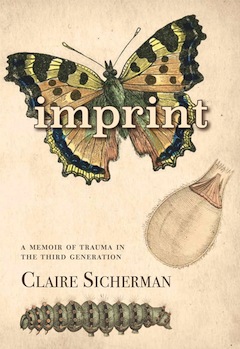
I approached Imprint: A Memoir of Trauma in the Third Generation (Caitlin Press, 2017) with reluctance. But Claire Sicherman’s account of her murdered family members, of her grandparents who were the sole survivors of the Holocaust and of her own intimate life as granddaughter, woman, wife and mother is profoundly moving and tender. Her accounts of her relatives’ lives and deaths under the Nazi regime are brutal and shocking. The proximity of these emotions makes the book challenging to read but hard to put down.

Sicherman’s choice of the title Imprint helped me understand just how stubborn and long-lasting the impression of anxiety, grief and horror can be to the human psyche. My mind went to the reality of fossils. According to one source online, sometimes an animal “is buried before it is destroyed. And when that happens and conditions are just right, the remains of the animal are preserved as fossils…. Fossils are the naturally preserved remains or traces of ancient life that lived in the geologic past…. Fossils represent the remains or traces of once-living organisms.”

For Sicherman, the emotions related to the destruction of her family are permanently imprinted in her body and in her genetic makeup. She must now bring them to conscious awareness.

The juxtaposition of cold, hard accounts of death – as in the chapter “My Family” at the beginning of the book – immediately followed by the first letter to her 9-year-old son Ben, signed “Love Always,” warns the reader that what follows is not for the faint-at-heart. She alternates between three essential narratives: the telling of the destruction and deaths of her relatives in Poland; the survival of her grandmother and grandfather, which leads to the intimate story of her mother and Sicherman’s youth; and the traumatic birth of her son Ben, which acts as a catalyst, breaking through lifelong barriers of ignorance, denial and grief.

book cover - ImprintIn gazing at the cover of the book, the three images of caterpillar, cocoon and butterfly began to make sense. This metamorphosis becomes the symbol of Sicherman’s lifecycle; the lack of awareness of her family’s history, the birth of her son, and her desperate search for knowledge and understanding of why she suffers from chronic health conditions, anxiety and depression.

Sicherman’s answer to the question “why” lies within the concept of epigenetics, the study of heritable changes in gene expression. Traumatic events cause changes in gene expression that can then be inherited. For Sicherman, her task is to explore, through various forms of therapy, the intergenerational transmission of trauma – the genetic imprinting of the horrors that befell her great-grandparents, her great-aunts and great-uncles and their progeny. Despite the distance of being a third-generation Holocaust survivor, her writing captures the beauty and intimacy of family affection (“My Babi,” “My Deda”). Hope of healing and surviving trauma permeate the pages of this creative book, offering acceptance and guidance to others of her – and the next – generation.

Dolores Luber, a retired psychotherapist and psychology teacher, is editor of Jewish Seniors Alliance’s Senior Line magazine and website (jsalliance.org). She blogs for yossilinks.com and writes movie reviews for the Isaac Waldman Jewish Public Library website.

Format ImagePosted on May 4, 2018May 2, 2018Author Dolores LuberCategories BooksTags Claire Sicherman, epigenetics, Holocaust, memoir, survivors, third generation

Reflections on first meeting

This academic year marks the second session of Writing Lives, a two-semester project at Langara College, coordinated by instructor Dr. Rachel Mines. Writing Lives is a partnership between Langara, the Vancouver Holocaust Education Centre and the Azrieli Foundation. Last fall, students learned about the Holocaust by studying literary and historical texts. In January, students began interviewing local Holocaust survivors and will write their memoirs on the basis of the interviews. Students are keeping journals of their personal reflections on their experiences as Writing Lives participants. Students used their most recent journal entry to reflect on their first meetings with the survivor with whom they are partnered. Here are a few excerpts.

Prior to meeting our survivor partner, one of our group members spoke to him on the phone, and she described him as a person “who doesn’t let anything past him.” It seems he’d tested her on her ability to say the word “Holocaust” without shuddering an apology.

It is clear that our partner refuses to spend his time telling his story to anyone who cannot handle it. On one hand, his attitude is a comfort; I believe we will be able to show him that not only are we unafraid to hear his story, but also that we care deeply about helping him tell it authentically. On the other hand, this adds to the building anxiety about our interviews and our worries about writing the memoir. Producing a memoir that our survivor is 100% proud of is my biggest goal and also my biggest fear. I feel that telling the story of another person’s life is a tremendously huge responsibility, and I do not take it lightly.

– Chelsea Riva

We actually met D. before our first meeting: he came to our class to give a talk last semester. Our first interview was arranged at his home, and D. was as warm and friendly as before. So was his wife, and they took good care of us. They helped us with our coats and insisted that we did not have to take our shoes off. D. said we must have walked a long way, and it was the shoes that kept us walking comfortably; therefore, we should not take them off. I immediately recalled what Primo Levi wrote in his book Survival in Auschwitz. Yes, shoes are of the utmost importance, and D. has experienced that. However, we quickly realized that the house was immaculately clean, and so was the light beige carpet that we were stepping on with our shoes! Anyway, while I was worrying about the carpet, the meeting began.

– Bonnie Pun

When I first met D.S., I was apprehensive. The culmination of the past four-and-a-half months was finally at hand, and I was set to be the lead interviewer for our group – not a task that fell lightly on my shoulders.

Moira and he came into the room and she introduced him (she had met him previously). D.S. smiled so widely that his eyes crinkled, and he shook each of our hands in turn. When we were done, D.S. said a few words about himself and then quickly launched into a very compressed, detailed story about his life.

We had been expecting a more casual, getting-to-know-you first interview, and none of us had been expecting to take in such a massive amount of information – although, in hindsight, I’m glad we did. At the end of the interview, after D.S. had given us advice about meeting deadlines and making sure we had enough time to edit and rework parts of his story, we breathed a sigh of relief – it had gone well.

The opportunity to have a question-and-answer session with a person who has survived such great personal trauma is incredible. D.S. is a wonderful storyteller, and the interviews so far have been a continuously rewarding experience.

– Susan Scott

Some of the stories that D.S. shared with us at that first meeting were hard to absorb. I think I didn’t really want to understand what he was saying, as a way of protecting myself, so I wouldn’t show I was affected while I was in the room with him. It was only after I listened to the recorded interview that I could even start to imagine the events that he had endured. It sunk into me that this was a real thing that had happened to a real man, one who sat in front of me, ready to share his pain and perseverance with us. For that, I am grateful and honoured.

What D.S., the other survivors, the Vancouver Holocaust Education Centre, the Azrieli Foundation and Langara College are doing through the Writing Lives program is so immensely important – something I have come to understand on a new level after that meeting. I think the point is to affect others in the way that this one meeting affected me. It’s to try and understand people’s suffering as best we can, though we will never feel their pain, and to use that understanding to become better people, and not be complicit in others’ suffering in the future.

– Moira Henry

Posted on March 2, 2018July 2, 2020Author Writing Lives studentsCategories LocalTags Azrieli Foundation, Holocaust, Langara College, memoir, survivors, VHEC
Reflecting on New York

Reflecting on New York

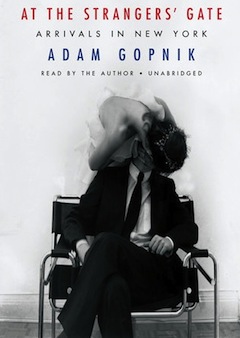
Raised by American parents in Montreal, Adam Gopnik moved, with his Canadian wife Martha, to New York City in the 1980s. There, he began a career as an art critic, editor and writer for such publications as GQ and The New Yorker, and with Knopf publishers. At the Stranger’s Gate: Arrivals in New York (Knopf, 2017) is his chatty memoir of those years.

There are many figures from the art and publishing worlds in this book, appearing in harmlessly gossipy anecdote after name-dropping anecdote. Gopnik is an amusing artist of the character sketch, as shown in his depiction of his wife.

“Someone once called her in print the most innately polite person she had ever met, and the truth is that in each of us natural sociability had been overlaid with Canadian politeness, and hers with a further code of Icelandic courtesy, producing a veneer of politeness so extreme that many took it for disingenuousness – which of course, in another way, it was.”

He can also neatly capture entire generations through their relationships to something inanimate.

“My grandparents had belonged to a check-cashing generation, proud to be engaged in it,” he writes. “To have an institution as large as an American bank in effect endorse their signature on a little bit of paper as equivalent to money meant to be taken seriously as a citizen. My parents, in turn, were credit card cultists – they loved having them, signing them, showing them, using them. For those who came of age in the boom times after the Second World War, the whole notion of credit, of sharing in a limitless improving future – of being trusted to buy now and pay later, since later would be so much richer than now – had some of the same significance that the notion of being trusted with checks had for my grandparents.

“We, in turn, generationally, had regressed, I realized,” he continues, “back into a cash economy – we used checks just to pay the utilities. The [bank] machines were one more instrument of that infantilization; we went to the machines for something that felt, at least, like our allowance.”

book cover - At the Stranger’s GateAs much as the individual characters who inhabit the pages, the protagonists are often the miniscule homes the Gopniks inhabited – and the insects and rodents with whom they cohabited. He credits their first tiny apartment, at least in part, for their marital contentment.

“One reason we didn’t fight was that the studio was so small, so small that you could never get sufficient perspective for the fighting to happen. In order to really have a quarrel, you have to sort of step back three steps and eye the other person darkly. There was just no room for that. We were on top of each other, not in that that sense – well, in that sense, too, at times – but we were also colliding with each other all the time. I don’t have any mental image of Martha from those years, except as a kind of Cubist painting, noses and eyes and ears.”

A later loft apartment seemed too sweet to be true in a New York of radically rising rents, a suspicion that appeared fulfilled when thick, dark liquid began dripping from the ceiling.

“For the next two weeks, the ceiling kept hemorrhaging,” Gopnik writes. “Sometimes, we would wake up and find it dripping slowly, slowly. At other times, it would really be coming down, as though a whole new vein had been opened, or else as though – and this thought struck us both about the same time – a new corpse had just been stowed away under the floorboards upstairs.”

“That’s not blood,” a neighbour told them, “it’s just molasses.”

The building had been a candy factory at the turn-of-the-century and for inexplicable reasons it would sometimes ooze ingredients. Gopnik decided to find this charming: “It was thrilling, like the moment when they opened up the Dead Sea Scrolls and found them pristine. Sugar syrup from a century ago, bubbling out of the walls, and still so sweet.… I felt happy; I was living on the big Rock Candy Mountain.”

The couple were less charmed by another discovery. A pest control officer announces: “You got them, all right. You got the big boys. You got the super-rats.”

“What do you mean, the super-rats?” Gopnik asks.

“‘Well, let’s put it like this,’ He thought for a moment. ‘These rats, if you see one, they look at you like you the problem.”

Leaving the apartment, Gopnik homes in on two of the phenomena of the 1980s that impacted his life in the Big Apple.

“The two great technological gifts of the ’80s were the Walkman and the hyper-developed sneaker, which, together, turned walking into an all-encompassing emotional activity,” he writes. “For a long time in the 1980s, I seemed to do nothing but walk around Manhattan. The modern sneaker, rising from Nike and Adidas, constructed with more architecture inside than most apartments, now allowed even the flat-footed to stride, Hermes-like, on what felt like cushioned air.… And then the Walkman made every block your own movie.”

Eventually, like rats in a too-small apartment, the couple became overwhelmed by the city and they left to raise a family where there are lawns and gardens.

This is a highly sentimental book, which is not a bad thing, especially for a New York-o-phile. Some shortcomings are too-frequent hackneyed phrases (“dense as a hockey puck,” “impossibly beautiful women”), the oddly repetitive use of some esoteric words and a style that sometimes evokes Lake Wobegon, Minn., more than New York, N.Y. In other words, it’s a cute book, which may sound like faint praise, but, given current events, that can be a refreshing break.

Format ImagePosted on December 1, 2017November 29, 2017Author Pat JohnsonCategories BooksTags Adam Gopnik, memoir, New York

Posts pagination

Previous page Page 1 … Page 10 Page 11 Page 12 Page 13 Next page
Proudly powered by WordPress