

Skip to content

  • Home
  • Subscribe / donate
  • Events calendar
  • News
    • Local
    • National
    • Israel
    • World
    • עניין בחדשות
      A roundup of news in Canada and further afield, in Hebrew.
  • Opinion
    • From the JI
    • Op-Ed
  • Arts & Culture
    • Performing Arts
    • Music
    • Books
    • Visual Arts
    • TV & Film
  • Life
    • Celebrating the Holidays
    • Travel
    • The Daily Snooze
      Cartoons by Jacob Samuel
    • Mystery Photo
      Help the JI and JMABC fill in the gaps in our archives.
  • Community Links
    • Organizations, Etc.
    • Other News Sources & Blogs
    • Business Directory
  • FAQ
  • JI Chai Celebration
  • JI@88! video
image - Weizmann Canada Physics Tournament 2025
image - The CJN - Visit Us Banner - 300x600 - 101625

Recent Posts

  • Vrba monument is unveiled
  • Music to build bridges
  • A better future possible
  • Anne Frank exhibit on now
  • Human rights in sport
  • Telling the story of an icon
  • Crawl bigger than ever
  • JCC Maccabi in Toronto
  • A way to meet fellow Jews
  • Time to include
  • Add Jewish joy to the mix
  • Reminder of humanity’s light
  • From the archives … editorials
  • Year-round holiday recipes
  • מדוע עזבתי את ישראל ואינני חושב לחזור ארצה
  • OJC hosts Oct. 7 memorial
  • A journey beyond self
  • Antisemitism a problem
  • Young man is missed
  • Orr action sparks complaint
  • Prison sentence for hate
  • Etgar Keret comes to Vancouver
  • New fall lecture series
  • Series explores music
  • Doc on Zapiro screens Nov. 6
  • Joy of shared existence
  • Community milestones … October 2025
  • MAID vs Jewish values
  • Cheshvan a great month, too
  • Bull, bear or bubble?
  • From the archives … a coin, etc.
  • מדוע האנטישמיות הולכת וגואה בעולם
  • New bio gives Vrba his due
  • Joy brighter than ever
  • When approaches differ
  • New leadership at the JCCV

Archives

Follow @JewishIndie

Tag: epigenetics

Long-enduring trauma

Long-enduring trauma

I approached Imprint: A Memoir of Trauma in the Third Generation (Caitlin Press, 2017) with reluctance. But Claire Sicherman’s account of her murdered family members, of her grandparents who were the sole survivors of the Holocaust and of her own intimate life as granddaughter, woman, wife and mother is profoundly moving and tender. Her accounts of her relatives’ lives and deaths under the Nazi regime are brutal and shocking. The proximity of these emotions makes the book challenging to read but hard to put down.

Sicherman’s choice of the title Imprint helped me understand just how stubborn and long-lasting the impression of anxiety, grief and horror can be to the human psyche. My mind went to the reality of fossils. According to one source online, sometimes an animal “is buried before it is destroyed. And when that happens and conditions are just right, the remains of the animal are preserved as fossils…. Fossils are the naturally preserved remains or traces of ancient life that lived in the geologic past…. Fossils represent the remains or traces of once-living organisms.”

For Sicherman, the emotions related to the destruction of her family are permanently imprinted in her body and in her genetic makeup. She must now bring them to conscious awareness.

The juxtaposition of cold, hard accounts of death – as in the chapter “My Family” at the beginning of the book – immediately followed by the first letter to her 9-year-old son Ben, signed “Love Always,” warns the reader that what follows is not for the faint-at-heart. She alternates between three essential narratives: the telling of the destruction and deaths of her relatives in Poland; the survival of her grandmother and grandfather, which leads to the intimate story of her mother and Sicherman’s youth; and the traumatic birth of her son Ben, which acts as a catalyst, breaking through lifelong barriers of ignorance, denial and grief.
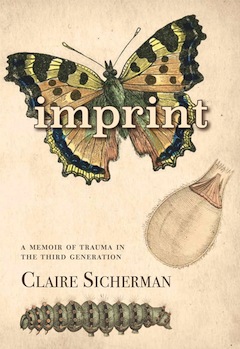
book cover - ImprintIn gazing at the cover of the book, the three images of caterpillar, cocoon and butterfly began to make sense. This metamorphosis becomes the symbol of Sicherman’s lifecycle; the lack of awareness of her family’s history, the birth of her son, and her desperate search for knowledge and understanding of why she suffers from chronic health conditions, anxiety and depression.

Sicherman’s answer to the question “why” lies within the concept of epigenetics, the study of heritable changes in gene expression. Traumatic events cause changes in gene expression that can then be inherited. For Sicherman, her task is to explore, through various forms of therapy, the intergenerational transmission of trauma – the genetic imprinting of the horrors that befell her great-grandparents, her great-aunts and great-uncles and their progeny. Despite the distance of being a third-generation Holocaust survivor, her writing captures the beauty and intimacy of family affection (“My Babi,” “My Deda”). Hope of healing and surviving trauma permeate the pages of this creative book, offering acceptance and guidance to others of her – and the next – generation.

Dolores Luber, a retired psychotherapist and psychology teacher, is editor of Jewish Seniors Alliance’s Senior Line magazine and website (jsalliance.org). She blogs for yossilinks.com and writes movie reviews for the Isaac Waldman Jewish Public Library website.
Format ImagePosted on May 4, 2018May 2, 2018Author Dolores LuberCategories BooksTags Claire Sicherman, epigenetics, Holocaust, memoir, survivors, third generation
DNA’s not only factor

DNA’s not only factor

Epigenetics: environmental effects influence how genes are turned on or off. (photo by Yuval Robichek via wis-wander.weizmann.ac.il)

Blood stem cells have the potential to turn into any type of blood cell, whether it be the oxygen-carrying red blood cells or the many types of white blood cells of the immune system that help fight infection. How exactly is the fate of these stem cells regulated? Preliminary findings from research conducted by scientists from the Weizmann Institute and the Hebrew University are starting to reshape the conventional understanding of the way blood stem-cell fate decisions are controlled, thanks to a new technique for epigenetic analysis they have developed.

Understanding epigenetic mechanisms (environmental influences other than genetics) of cell fate could lead to the deciphering of the molecular mechanisms of many diseases, including immunological disorders, anemia, leukemia, and many more. It also lends strong support to findings that environmental factors and lifestyle play a more prominent role in shaping our destiny.

The process of differentiation – in which a stem cell becomes a specialized mature blood cell – is controlled by a cascade of events in which specific genes are turned “on” and “off” in a highly regulated and accurate order. The instructions for this process are contained within the DNA itself in short, regulatory sequences. These regulatory regions are normally in a “closed” state masked by special proteins called histones to ensure against unwarranted activation. Therefore, to access and “activate” the instructions, this DNA mask needs to be “opened” by epigenetic modifications of the histones so it can be read by the necessary machinery.

In a paper published in Science, Dr. Ido Amit and David Lara-Astiaso of the Weizmann Institute’s immunology department, together with Prof. Nir Friedman and Assaf Weiner of Hebrew University, charted for the first time histone dynamics during blood development. From the new technique for epigenetic profiling they developed, in which just a handful of cells – as few as 500 – can be sampled and analyzed accurately, they have identified the exact DNA sequences, as well as the various regulatory proteins, that are involved in regulating the process of blood stem-cell fate.

Their research also yielded unexpected results: as many as 50 percent of these regulatory sequences are established and opened during intermediate stages of cell development. This means that epigenetics is active at stages in which it had been thought that cell destiny was already set. “This changes our whole understanding of the process of blood stem-cell fate decisions,” said Lara-Astiaso, “suggesting that the process is more dynamic and flexible than previously thought.”

Although this research was conducted on mouse blood stem cells, the scientists believe that the mechanism may hold true for other types of cells. “This research creates a lot of excitement in the field, as it sets the groundwork to study these regulatory elements in humans,” said Weiner. Discovering the exact regulatory DNA sequence controlling stem-cell fate, as well as understanding its mechanism, holds promise for the future development of diagnostic tools, personalized medicine, potential therapeutic and nutritional interventions, and perhaps even regenerative medicine, in which committed cells could be reprogrammed to their full stem-cell potential.

For more Weizmann Institute news releases, visit wis-wander.weizmann.ac.il.

– Courtesy of Weizmann Institute

Format ImagePosted on September 5, 2014September 3, 2014Author Weizmann InstituteCategories LifeTags Assaf Weiner, David Lara-Astiaso, DNA, epigenetics, Hebrew University, Ido Amit, Nir Friedman, Weizmann Institute
Proudly powered by WordPress