As a former World Jewish Congress Ronald S. Lauder Fellow, I attended the first Ronald S. Lauder Fellowship Diplomacy Summit. The fellowship is an international cohort of top Jewish students with an interest in global Jewish advocacy who are invited to Europe to participate in high-level meetings with government institutions. From the moment I arrived at the summit in Brussels, the excitement felt by the other fellows and staff was infectious.
We began the trip in the European Union offices, hearing from EU members about the state of Europe and advocating for the European Jewish community. This was followed by a visit to NATO. The number of brilliant minds in these rooms was astounding, and it was such a privilege to watch as my small cohort of young Jewish students and professionals posed challenging questions to EU and NATO leaders regarding the state of European Jewry, global antisemitism and recent world tensions.
The same can be said about our visit to UNESCO in Paris the following day. As a media and information studies student with a niche interest in big tech policies, I was intrigued to learn about the organization’s recent report, History Under Attack: Holocaust Distortion and Denial Within Social Media, directly from its writers. I am hopeful that, combined with efforts to address online harms in countries such as Canada, the UNESCO report will spur positive change in hate speech regulation worldwide.
Once the summit concluded, with my Jewish pride at an all-time high, I hopped on a plane to Israel for a much-needed reunion with family and friends, celebrating Shabbat with my great-aunt and others at her beautiful Jerusalem apartment.
After we studied the week’s parashah (Torah portion), a neighbour began to translate a book written in Hebrew by our relative about our family’s history in Israel. Although I had heard these names growing up, I had not fully understood their weight or meaning. It was there, sitting with family and friends, and with the WJC experience fresh in my mind, that I began to appreciate their significance and what my Jewish heritage really means to me.
My great-great-grandfather was Zvi Pesach Frank, chief rabbi of Jerusalem during the end of the Ottoman Empire and the British Mandate of Palestine. He was instrumental in the creation of the Chief Rabbinate of Israel, and in the appointment of Rav Kook (Abraham Isaac Kook) as the first Ashkenazi chief rabbi. I learned more of his historic contributions and my family’s legacy of working to build and protect Israel.
My experience as a World Jewish Congress Lauder Fellow and attending the summit took on a new layer of meaning. Not only am I inspired and committed to continuing my work in global Jewish advocacy, but I have also developed a determination to follow this path, grounded in my profound pride in my family and their accomplishments over the generations. For that, I am grateful to World Jewish Congress, to my great-aunt and to the Centre for Israel and Jewish Affairs. I look forward to what’s ahead, fully appreciating the rationale supporting my aspirations, and I will hold the summer of 2022 near and dear to my heart.
Following the conference and my visit to Israel, it became clear to me that, in high school – when I found my footing in Jewish leadership and learned more about my intersecting Muslim and Jewish background – I had found the “what” of my life’s passion. It was this summer that I found the “why.”
Tia Sacks is a Vancouver native going into her fourth year at Western University in the faculty of media and information studies. She participated in the World Jewish Congress Lauder Fellowship and is currently the vice-president of the Israel committee at Hillel Western and an intern at the Centre for Israel and Jewish Affairs.
Before the pandemic, we were once at synagogue on Shabbat when the clergy person leading the family service reminded us that, hey, Elul was here, and we could hear the shofar blown if we came to morning minyan. The next day, Sunday, one of my kids decided we needed to go hear the shofar. It was just a normal Sunday. The minyan was small, largely comprised of senior citizens. My elementary school-aged kid rocked and wiggled in his seat. Most of the adults there smiled and gave him high fives and handshakes and made him feel welcome.
When I explained our shofar mission, they nodded. They all understood why we were there. My kid was given honours and made to feel special. When it was time to hear the shofar, he sat up and listened intently. It was one of those times when I thought, “Oh, we should try to come to minyan to hear this every day.”
This was one of those moments when my aspirations were much higher than my capabilities. Years later, I can’t pretend we’ve ever made it to morning minyan regularly again, even virtually, even during Elul. Maybe, someday, I’ll be one of those senior citizens in the frequent minyan attendee club. For now, I’m rushing to get everyone up, fed and out the door to school and work.
Still, I think that morning minyan experience may stick in a kid’s mind. The Elul shofar is a quintessential wake-up sound for many Jews. It’s the time to think about how the year has gone. We can focus on what’s ahead on the Jewish calendar, how we can make amends and do better in the future. What will change next year? What, most likely, will stay the same?
Is this wake-up ritual true of everyone? No, of course not. I recently saw a TikTok reel of a man, probably in his 20s or early 30s, with a beard. The guy was joking that he observed Jewish holidays through food, and then jokingly said, “Rosh Hashanah? That’s the one with the matzo balls, right?” Maybe I haven’t remembered the skit’s details quite right, but I wasn’t its intended audience. I inadvertently cringed. It was grating to me, jarring, like driving the wrong way down a one-way street.
Here was this guy, probably an influencer, showing everyone that he not only wasn’t religiously literate, but also thought Ashkenazi food was the only essential part of the ritual or the holiday. I mean, food is part of Jewish ritual, don’t get me wrong, but, it rubbed me the wrong way.
Here is a full-blown Jewish adult. And yet, he doesn’t think knowing anything about his ethno-religious identity or choosing to observe anything in regards to its religious context is his responsibility. As a Jewish woman who cares about this stuff, this irked me, because with his masculinity comes a lot of privilege in some parts of the Jewish world. He might be so privileged that he doesn’t even have to know any of this but he still would count in an Orthodox minyan and I don’t.
Our household philosophy is that, if people may potentially harass us or kill us for our Jewish identities, we should know more about who we are and why – and try to find joy or meaning in it. Focusing on Jewish knowledge and joy is kind of a “thing” for us.
This is when I have to remind myself, hey, it doesn’t matter how knowledgeable or observant or ignorant this guy on TikTok is. He’s still Jewish. I am no more or less Jewish than he is. It’s not a competition.
Elul is for introspection. It’s also the time to admit that we are all works in progress. I sure need to keep working. As we grow, learn and age, we can recognize and understand new and different things. Hardest, of course, is to recognize what we don’t know: our biases, intolerances and prejudices. We all have these blind spots. This emphasis, each year, on working on ourselves is valuable in many ways, not least of which is trying to be more inclusive and kind.
Elul is also about wonder – through our senses, when we hear, see, touch, smell and, yes, taste the holiday. It’s the primal feeling we get when hearing the shofar, or the release one gets after a heartfelt apology to a loved one. That wonder continues into Tishri, throwing our bread (like sins) in the water at Tashlich. The wonder is in sweet honey on apples and other holiday symbols. It’s in this season, in the northern hemisphere, when the days shorten and get cooler, the trees lose their leaves and we start again.
As I write this, it’s still summer. I’m the first to say that I’m not ready to embrace Elul. It’s coming though, no matter what. In preparation, we’ve already been apple picking at a neighbour’s tree. We got honey from a local farm. The food part is easy. It’s the introspection that’s the work – and I’m looking forward to hearing the shofar remind me to get busy doing it.
L’shanah tovah (Happy New Year) in advance. May the year ahead be sweet.
Joanne Seiffhas written regularly for CBC Manitoba and various Jewish publications. She is the author of three books, including From the Outside In: Jewish Post Columns 2015-2016, a collection of essays available for digital download or as a paperback from Amazon. Check her out on Instagram @yrnspinner or at joanneseiff.blogspot.com.
We’re hoping the school bus will know to pick up our twins at the right address when school starts. They’re starting Grade 6 this fall. We’ve finally gotten good at figuring out the back-to-school letter, so we send them with most of the right supplies.
Yesterday, I took them shoe shopping, because, apparently – even though kids’ feet grow all year round – you can only buy sneakers for them before school starts. I even know where their lunch kit is located. Last year, the kids got good at packing their lunches – with mom supervision, of course.
I dread the start of school. It’s full of pitfalls. Inevitably, the bus doesn’t come, maybe one twin has a conflict and gets in trouble, or the teacher isn’t connecting with the other one. Things don’t always go smoothly. I have to line everything up as well as I can and hope for the best.
We’d be way ahead of schedule if it weren’t for one thing. We moved this summer. We only moved a short distance. It’s a little less than two kilometres if you walk from our old house, built in 1913, to our new one, also built in 1913. The differences lay in the neighbourhoods, zoning and a few other details.
Our “old” house was entirely habitable, aside from some walls cracked by nearby construction. It’s currently for sale as I write this. We staged it with our furniture and now we’re sleeping on the floor at the “new” house.
Our current home is almost twice as big as the previous one. It has a bigger yard in a quieter neighbourhood, amazing woodwork, a library, leaded glass, two enclosed sun porches, a second floor open-air porch, and more. It’s got all the fine details one might expect of a house built for a doctor who was the head of the Manitoba College of Physicians and Surgeons in 1913. It’s also got only one working bathroom – several remain broken – and only about half of a kitchen. The other half of the kitchen was demolished due to some, umm, small issues like freezing pipes, and structural concerns that need to be fixed.
We moved for a variety of reasons, but we loved how close the new home would be to the synagogue we attend most of the time. To be more clear, the synagogue we used to attend in person and now mostly livestream, due to the pandemic! We imagined that the easy walking distance would be great if Shabbat observant relatives came to stay, for instance. We like walking in nice weather. Then? Things changed.
It turned out the synagogue needs to do big renovations. It has just “moved out” of the building for two years to have asbestos removed, the HVAC system fixed and a few other updates done. Services will now be held in two other places in the Jewish community – both of which require driving. Oh well.
Change is challenging. Our dog isn’t ready to be by herself in the new house. She let us know this yesterday. She broke out of the third floor bedroom, where we had left her for an hour, complete with her dog bed, the radio on, a dollop of frozen peanut butter, and several other treats. She greeted us, in high anxiety, at the first floor front door with all the same toys surrounding her. While we appreciate her intelligent, Houdini-like abilities, we still do sometimes need to leave home. This morning, we signed up to a new dog daycare at the last minute so we could attend a weekend bat mitzvah for a family with whom we’re close.
I could go on with examples because, with the pandemic fluctuations, the house move and other work changes, our life is really keeping us on our toes just now. Like many people, we’re continuing to roll with it. What else can we do?
Around us, we see people nostalgic for some mythical normal they want to get back to experiencing. I’m stymied by this because, at least in Manitoba, even as pandemic restrictions go away, more people continue to die due to COVID. It ain’t over yet, folks.
When I bump into friends or neighbours while walking the dog, everybody asks how we’re managing. We’re probably more deadpan or low-key than people expect. I mean, what are our other options?
At the dinner table, I mentioned these exchanges with my husband and he said, “You know, I’m out of bandwidth right now. I hope that I act appropriately and keep moving.” That is when it hit me that, during these times of big stress, it isn’t uncommon to act this way. We function automatically. When I taught high school, my students called it “home training.” Jewish tradition might call it “derech eretz” or “how to behave.” We’re all doing the best we can, relying on basic skills and manners learned in childhood about how to do the right thing.
We hope that, in every autopilot email, conversation with a neighbour or phone call, we’re behaving in an upright and kind way. Right after we mention this lack of bandwidth, we remember how lucky and grateful we are. We have a home, food and clothing. During this summer of “the great move,” we’re doing fine. We’re not facing any of the many awful things that Jews have had to face. It’s not the Inquisition, a pogrom, the Holocaust or, in 2022, time spent in bomb shelters in Israel or Ukraine.
In Pirkei Avot 2:5, Hillel offers a long list of instructions for how to behave, including: “In a place where there are no people, strive to be a person.” Every day, if Jews recite any prayers at all, we’re reminded to be grateful, caring, appreciative people. The emphasis is to be a mensch, an upright, good person, even in a moment when no one else might be acting as such, or when no one else is around.
It’s really easy to get worked up and dread transitions and the start of new challenges. It’s harder for me to step up, not just face these changes, but to embrace them with good humour and enthusiasm. I wake up each day, heave myself up from the mattress on the floor, recite a very informal Modeh Ani (a prayer of gratitude for waking up) and hope I will meet the day with the right intention. Someday soon, when our furniture makes the move, too, I hope it will feel like less of an effort to get up and meet the challenge.
I hope you have a great start to the school year, and that you are also celebrating some big milestone events! Here’s hoping it all goes smoothly.
Joanne Seiffhas written regularly for CBC Manitoba and various Jewish publications. She is the author of three books, including From the Outside In: Jewish Post Columns 2015-2016, a collection of essays available for digital download or as a paperback from Amazon. Check her out on Instagram @yrnspinner or at joanneseiff.blogspot.com.
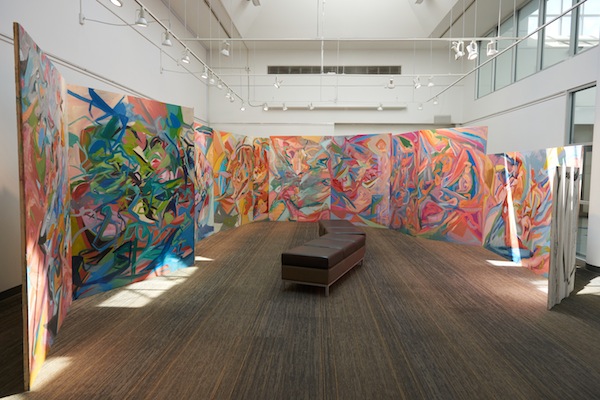
Marty Katzoff’s The Light Within the Shell was created specifically for the Zack Gallery. (photo by Lauren Zbarsky)
The Light Within the Shell exhibit opened at the Zack Gallery on July 4. There is a sign beside the door: “This space is meant to be explored. Wander, sit, experience, enjoy.” The show was created specifically for the gallery.
Created by artist Marty Katzoff, it doesn’t involve traditional paintings hanging on the walls. Instead, it looks like a huge folding screen comprised of a dozen panels. They encircle the room, leaving only a narrow passageway along the walls. Each panel has a colourful abstract painting on its inside surface and a black and white image on its outside. A few small copper sculptures scattered outside the enclosed space complete the installation. Viewers are invited to sit down and meditate on the benches inside the vibrant shell of the exhibit or wander along the outer passageway.
Born in Rhode Island, Katzoff grew up playing sports. “I didn’t do much art until my teenage years,” he told the Independent. “I was going through difficult times in high school. My friend was an artist. She introduced me to the arts. I started making collages and found it therapeutic.”
He never completed high school and worked a variety of jobs. “For the next 10 years, I worked in construction, in restaurants,” he recalled. “And, all that time, I made art. I taught myself to paint. Then I went back to school and completed my BA at Bard College in New York.”
For years, Katzoff worked as an artist in New York, created large murals in indoor and outdoor spaces. He graduated from the University of British Columbia’s master of fine arts program in 2021.
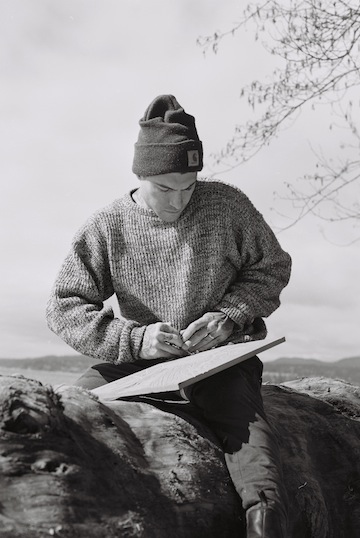
Artist Marty Katzoff at work. (photo by Lauren Zbarsky)
His artistic education vaguely coincided with his newly found fascination with kabbalah, specifically the Tanya, which he has been studying for the past few years. “Before, I had separate ideas about art and spirituality. Now, I’m exploring how Jewish learning is connected to my art, how mythology and tradition transform my spiritual life into my paintings,” he said.
As a child, Katzoff went to a Jewish day school, but kabbalah offered him a different perspective. “I started with a book by Gershom Sholem. Before, I always painted with music in the background. This project is the first I’ve ever done without listening to music. I listened to kabbalah lectures online while I painted. I wanted to discover what I could create while listening to something complex and different … [by the late] Rabbi Yehoshua B. Gordon.”
The idea for the current installation came to him when he was finishing his graduate program at UBC. “One of our family friends lives in Vancouver,” Katzoff explained. “She is Jewish and she told me about the Zack Gallery. I submitted the proposal, and it was accepted. I wanted to create an installation specifically for the gallery, an interactive space, a visualization of light. This show took me 11 months to complete.”
Katzoff sees this exhibit as an amalgam of dreams, painting, architecture, Jewish learning and personal symbolism. Vancouver artist Rosamunde Bordos’s essay about the show, which is available in the gallery, expresses her visual composition in words.
Katzoff’s media, the plywood panels, are all recycled materials. “I have a friend who works in art shipping,” he said. “They ship large pieces in plywood crates. That was where the panels came from. Some of them have holes, so customs could look inside the crates to see the art. I painted around the holes. It was like a collaboration with someone else.”
The size of the panels, some of them taller than a person, left him undaunted. “I always liked to work on a large scale,” he said. “That’s why I did murals in New York.”
His oil paints are also recycled. “I use lots of recycled materials in my art,” he said. “My grandmother was an artist. She gave me her entire collection of pigments for the oil paints I use. I’ll probably work with her paints for the next decade.”
In addition to painting, Katzoff also works as a printmaker. Currently, he teaches printmaking at UBC as a sessional instructor. “For me, printmaking provides the connection with literature, with storytelling and history,” he said. “My brain seems to process that connection better while I’m drawing and etching. My drawings are illustrations, while my painting remains more like a therapeutic activity.”
His abstract copper sculptures, several of which are included in the exhibit, grew organically out of his printmaking. “I make my sculptures reusing the copperplates from my prints,” he said. “I have lots of copper plates. Copper was an important part of Judaism and, after I use the plates for prints, I want to share the metal, recycle it. I make sculptures from it. I also make bracelets and amulets. You can see the remains of the etching if you look closely.”
To learn more, check out martinkatzoff.com. The Light Within the Shell is on display until Aug. 22.
Olga Livshin is a Vancouver freelance writer. She can be reached at olgagodim@gmail.com.
I was driving down the back lane, kids in the car, when I saw a neighbour. I stopped and rolled down the window for a chat. The neighbour’s children lived nearby and they were looking for flooring to refinish the landing on their stairs. Our family, through an ordering snafu, ended up with more flooring than needed. In fact, we’d avoided using any new flooring at all. We had asked our clever contractors to help us reuse 110-year-old quarter-sawn oak flooring from elsewhere in the house and the floor refinishers hadn’t needed any of the new “special order, not returnable” flooring. I asked the neighbour if her kids were still interested in it, because we had a lot. She said she’d ask.
The neighbour then asked me if we were doing serious “purging.” I smiled and said it was more like “redistribution.” She laughed, saying she’d have to remember that. She liked this way of seeing things.
We like to think of ourselves as a family that reuses, recycles and repairs things. While we’re not purists, we try to limit what ends up in the trash as compared to the compost. We try to give away or repurpose the things we no longer can use for their original purpose.
If one imagines three kinds of models for one’s household economies, there are sometimes three terms bandied about. A linear economy involves “take, make, use and waste.” A recycling economy involves something like “take, make, use, recycle, make, use … on repeat and eventually … waste.” A circular economy has a much more complicated chart or trajectory, involving words like “take, make, use, repair, make, reuse, return, make, recycle” but very little becomes waste. Everything is used.
The talmudic-era rabbis were part of a circular and recycling economy. We know it wasn’t entirely circular (most ancient civilizations weren’t) because archeologists keep finding the detritus of all those communities. Ask anyone interested in history about this. They wax rhapsodic about pottery shards, bone fragments, mosaics and more – these are essentially the great finds that finally broke completely. These trash bits were thrown down a privy a hundred to couple thousand years ago. Even that ancient trash has its use now: it tells us a lot about societies long gone.
I thought about all this as I began to study the talmudic tractate of Ketubot as part of Daf Yomi. In the practice of studying a page a day, it takes 7.5 years to finish reading the whole Babylonian Talmud. Nevertheless, this page-a-day approach is superficial. It’s just too much text for me to study in detail, so I try to explore one thing every day that I find interesting.
In Ketubot 4, there is a discussion about what to do if a death happens right when a wedding is supposed to take place. The short version is, well, it depends, according to the introduction offered by Rabbi Heather Miller for My Jewish Learning. However, in many circumstances, the wedding is supposed to happen even if someone has to leave a dead body nearby in another room. Why? There are several reasons.
One important reason is that there was no refrigeration. If a wedding feast was prepared and it couldn’t be sold to someone else, the food shouldn’t be wasted. It can’t be assumed that there was enough food to just waste a whole wedding feast. The rabbis really valued “bal taschit,” or “do not waste,” which comes from the Torah, from Deuteronomy 20:19.
Also, if the bride’s mother or the groom’s father died, it was essential to continue with the wedding. These parents had important roles in the planning of the wedding. Canceling the event would take away from their children’s opportunity to benefit from that work. A bride depends on her mother to help her get ready and setting up a wedding later, after a mourning period, would mean a do-over. The bride’s mother wouldn’t be alive to help then, either.
In a discussion with my online Talmud study group, it was pointed out that, in many cases, rabbis throughout history will find every way possible to help people not waste. If a poor family makes a potential kashrut mistake, asks the rabbi what to do and the rabbi knows they will be hungry without the food, the rabbi finds a way to enable the family to eat the food.
This tradition gives me hope for Jewish sustainability in the future. Here are legitimate Torah and Talmud references that encourage us to avoid waste and to reuse and value others’ work. It gives me extra motivation to recycle when it’s difficult to do so, or to patch and reuse a pair of pants yet again.
In some Jewish situations, these notions of avoiding waste are not always followed. Think of a big holiday meal or Kiddush, where everyone used disposable paper products and plastic utensils and, afterwards, it all went in the trash. Consider some well-to-do congregations where holiday services are a fashion show, and where being seen in new clothing is more valued than just being appropriately dressed. These are instances where perhaps we’ve fallen prey to a consumerist, linear economy.
It’s still possible to dress up or wear something new or different on a special occasion. It’s OK to occasionally make more trash than usual, too. However, doing it on a regular basis is not just bad for the earth now. It also affects us in terms of climate change. It’s probably also a violation of the rabbinic obligation to avoid waste.
It’s true that cleaning, decluttering and renovation trends these days are all about how much can be discarded. Maybe it’s time to save the old growth lumber. Reuse something really good. It’s also good to pass along that new flooring so it, too, can be used sustainably rather than discarded. Don’t just throw everything out and produce more waste. Reuse, recycle, make anew … the rabbis said so.
Joanne Seiff has written regularly for CBC Manitoba and various Jewish publications. She is the author of three books, including From the Outside In: Jewish Post Columns 2015-2016, a collection of essays available for digital download or as a paperback from Amazon. Check her out on Instagram @yrnspinner or at joanneseiff.blogspot.com.
The explosive debate around abortion spurred by the U.S. Supreme Court’s rejection of a woman’s right to reproductive self-determination reminds us that the Jewish perspective on the topic is nuanced.
“Jewish law approaches each case according to its particular circumstances,” notes an article at chabad.org. This central dictum of halachah, Jewish law, makes generalizations difficult. One thing is almost universally accepted: abortion can be halachically required if the life of the mother is in danger.
In 2015, 83% of American Jews told Pew Research Forum that abortion should be legal in all or most cases, which is more than any other religious group, a finding around Jewish support for reproductive choice that has been true for decades. However, a story from the Jewish Telegraphic Agency recently noted that a growing alignment between some Orthodox Jews and the Republican party in the United States has led a minority of Jews to adopt what has been largely a conservative Christian approach to the subject.
The Orthodox Union released a statement that they are “unable to either mourn or celebrate” the court’s overturning of Roe. Their position is that an outright ban is unacceptable under Jewish law, but that abortion should be limited to cases where the mental or physical health of the mother is at stake, with an emphasis on the preservation of life. Further, they stated that abortion should be available regardless of someone’s economic status.
The tectonic decision by the court, overturning 49 years of precedent set by the landmark Roe v. Wade case, has set in motion frenetic activity across that country and beyond. State officials have had the issue thrown into their laps. The United States will become a patchwork of regulations on the subject. The ruling has led to triumphant celebrations by opponents of abortion and it has reenergized those endorsing reproductive freedom. What all of this will mean, not only for abortion rights but for social movements and society more broadly, can only be remotely imagined at this point.
The abortion decision was only one of several massive reversals of existing norms the U.S. court issued in its session. In other cases, the court made it more difficult for lower jurisdictions to limit access to firearms, weakened the power of federal agencies to address climate change and struck down a ruling that limited prayer in public schools (in this specific case, Christian prayer at school football games).
The succession of cases throws down a gauntlet that most people – whatever their opinions – knew was coming when the former president appointed three justices to the court, creating a 6-3 conservative majority.
In many cases, though, these decisions are deeply out of step with what the majority of the population believes. Of course, court rulings should not necessarily mirror societal norms. Historically, courts have made society-altering decisions in spite of opposition – desegregating public schools against the wishes of white racists, for instance. Leaving aside philosophy, public opinion may not be able to impact a Supreme Court packed with political appointees (three of whom testified in their nomination hearings that the abortion question was settled law) but public opinion will change society.
Anti-abortion activists (and anti-climate, anti-secularism and anti-gun control activists) have been celebrating their big wins in these cases.
In 1973, as pro-reproductive choice activists were celebrating their Supreme Court win, a new movement was gaining its footing. It would develop into one of the biggest, most powerful movements in American history, a new conservatism that led, among many other social and economic changes, to the elections of Ronald Reagan, two Bushes and Donald Trump. And it accomplished one of the core objectives it set out to address: it tipped the scales of the Supreme Court and stripped women of rights they have had since 1973.
Those who were celebrating in 1973 are today experiencing a vast array of emotions: grief, disillusionment, fear. But also rage, determination and purpose.
As the Roe decision did in 1973, last month’s ruling will launch a new movement that, like the new conservatism before it, will address a broad range of social issues and injustices. It was impossible, 49 years ago, to foresee the changes that would come. Whichever side one may be on, be assured that we have entered a new era.
Winnipeg has had a bagel renaissance. It’s not exactly a bagel mecca, and these are definitely not the New York City bagels my husband was raised eating. However, the recent bagel trends here are a step forward.
In the earlier days of the pandemic, summer 2020, my kids and I were out at the park when we met another family who seemed to recognize us, I’m not sure from where. I was surprised when they struck up a conversation but we had such a nice moment. Now that we’ve all spent so much time on our own, I have come to realize how important these outdoor encounters can be to our health and well-being.
Towards the end of the chat, these kind strangers handed us a bagel, straight from a brown paper bag that contained a couple dozen, as my twins were missing snack and getting hangry (hungry angry). We divided it up and ate. Ohhh. It was good. Not exactly a Montreal bagel, more like a combination between a New York City and a Montreal bagel, but definitely better than anything I’d ever had in Winnipeg.
I rushed home to tell my husband how to acquire more of these. Bagelsmith was, at that time, almost an underground bakery with a simple website. It didn’t have an open storefront, due to the pandemic, but if you got online right at 8 p.m. Sunday night, you could get bagels delivered on, say, a Tuesday or Thursday afternoon. There were also schmears, but these all had strange things mixed in with the cream cheese, which my purist spouse could not abide even considering. Soon, we were up to ordering three or four dozen of these at a time.
It should be noted that these bagels have a hole in the centre and are properly boiled but, although we enjoy sesame, poppy or everything bagels, they have way too many seeds for our taste. In fact, we’ve collected the seeds from the bottom of a paper bag, filled a spice jar with them and used them for challah toppings. (That is way too many seeds for a house with kids in it. They get everywhere and our dog doesn’t like them!)
I clarify all this because we have been treated to all kinds of bagels over the years that, quite frankly, are not bagels. Round things with a hole perhaps, but they haven’t been boiled, or boiled things that have no hole, or varieties that are absolutely abhorrent to a purist. The Big Nope – blueberry bagels. We’ve lived in a variety of places, including North Carolina, Kentucky and Buffalo, N.Y., and had to do without, because some bagels aren’t worth the calories.
My husband spent part of his childhood getting pletzels and biales from Kossar’s on the Lower East Side in New York and bagels from Russ and Daughters. (Of course, in New York City, there are a lot of good bagel places!) His grandparents and the extended Eastern European family have strong memories of what things should taste like. He has very high standards. Years ago, on a work trip to Montreal, his colleague and good friend (who happens to be Muslim), took my husband on a tour of all the famous Montreal bagel places. Then, the friend loaded him up with so many bagels and so much Montreal smoked meat that it was hard to carry it all home on the plane. This is the kind of love they have for each other, a perfect experience – two longtime colleagues who affectionately value each other through food!
Back to Winnipeg … as the bakery grew and the pandemic situation changed, there were times when we could not get these bagels delivered. The bakery was downtown in a spot that wasn’t far away but was hard to negotiate by car. I even figured out that the bagel baker had children who went to our kids’ school. However, when everybody’s in remote school, that morsel of information is useless. When we couldn’t get them delivered, we went without. This wasn’t a life or death situation. I baked our bread regularly and, when the local bakery was open, we got sourdough bread, baked in a wood-fired oven.
You may think that I could try harder, and maybe that’s true. I bake lots of bread, but draw the line at any recipe that takes more than 24 hours or is fidgety. I leave croissant production, bagel boiling and sourdough to the experts. After one multi-day sourdough experiment in hot weather in Kentucky, we agreed that, while the pink thing I grew was definitely alive, it wasn’t likely to be edible or safe. Lucky for me that my husband is a scientific researcher, because that weird starter attempt was not worth the risk to health and safety.
OK, back to our bagels. A huge thing has happened. Our favourite, artisanal, expensive bagel bakery has opened a second shop, and it’s easy to get to and just about in the neighbourhood. Today was the grand opening. It was also our 24th wedding anniversary.
My husband went out in between work meetings and came home with two dozen – yes, 24 – bagels. No, it’s not flowers or wine or a fancy meal, but to my partner, this is as good and romantic as it gets.
Bagels are an ethnic delight for Polish Jews. To be honest, I wasn’t raised with steady access to good bagels, growing up in Virginia. Bagels weren’t my (more North American assimilated, with some Western European roots) family’s biggest food focus. However, the Talmud speaks to this, too. We have a papercut, framed in our kitchen, of this phrase. Check out Pirkei Avot 3:17 – “No bread, no Torah. No Torah? No bread.” If you don’t have food, you can’t learn properly and without learning? You can’t earn your bread, either.
So, here’s to a good bagel, and a person, a partner, with whom I can continue to learn and grow. Here’s to another 24 years. L’chaim! B’tayavon. Enjoy your meal. Eat in good health!
Joanne Seiffhas written regularly for CBC Manitoba and various Jewish publications. She is the author of three books, including From the Outside In: Jewish Post Columns 2015-2016, a collection of essays available for digital download or as a paperback from Amazon. Check her out on Instagram @yrnspinner or at joanneseiff.blogspot.com.
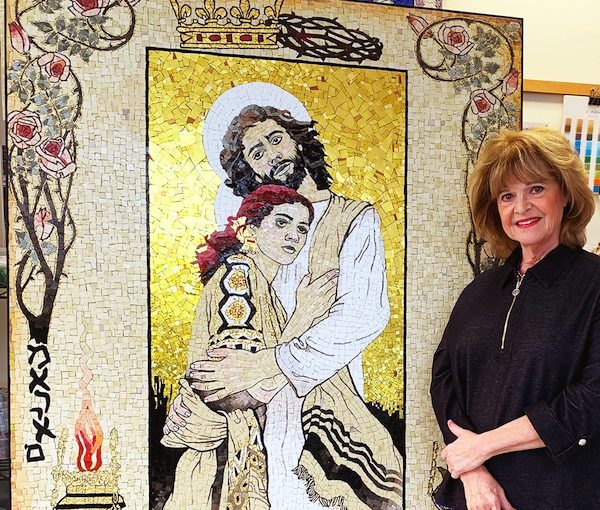
Lilian Broca stands with “Mary Magdalene, The Sacred Union,” which is one of seven panels comprising her current exhibit, Mary Magdalene Resurrected. (photo from Lilian Broca)
Lilian Broca’s artistic canon includes four series on biblical women. The latest, Mary Magdalene Resurrected, is at Il Museo at the Italian Cultural Centre until Aug. 15.
“Each series is an interpretation of a different concern,” Broca told the Independent. “Lilith is the rebel signifying hope for human courage and gender equality. Queen Esther, also courageous and wise, her story addressing the theme of sacrifice and self-empowerment, is actively involved in politics; in her time, known as an almost exclusive masculine realm. Judith, a warrior at heart who single-handedly saves her town from total annihilation, speaks of female effectiveness in the military world – a masculine tradition that she breaks, proving women don’t necessarily excel only in the domestic sphere.
“Unlike Esther and Judith, both actively involved in the masculine domain, Mariam [Mary] is a much more complex figure,” said Broca. “Her story has been greatly redacted in the first couple of centuries CE, leaving us various versions, which offer divergent perspectives of her importance and placement in the life of Yeshua Ben Yosef [Jesus]. One of the concerns in this series is about women’s place, or lack thereof, in institutions – which even in our 21st century – are restrictively based on gender.”
While it may seem odd that Mary Magdalene is included in Broca’s body of work, she reminded the Independent that Mary was “also Jewish until she died, as Christianity did not appear as such until the Edict of Milan in 313 CE and, universally, only at the Council of Nicea in 325 CE.”
A painter for many years, Broca’s Lilith series was created and exhibited in that medium, while Esther, Judith and Mariam are portrayed in mosaics.
“In 2000, I attended The Creation of the World in Jewish and Christian Art with Discussion on Illuminated Manuscripts at the Vancouver Public Library with speakers/presenters Bezalel Narkiss and Dr. Aliza Cohen-Mushlin, both of Israel,” explained Broca. “There, I saw a slide show Bezalel presented on ancient synagogues in the Levant. The Dura Europos in Syria had a beautiful fresco illustrating the Queen Esther story. I was mesmerized and, once home, I started to do some serious research on the Esther stories (more than one version)…. It was during the research that I found out that the palace in which Esther lived with her Persian king, Hashayarshah/Xerxes, had floors ‘encrusted with rubies and porphyry in pleasing designs.’ These were mosaics and, for me, a good omen. I knew I should return to creating mosaics one day, something I experimented with as a student (at 19) but stopped soon after. So, I decided to create the whole Esther series in mosaic glass.”
More than 10 years ago, Broca’s interest in Mary Magdalene was piqued by something she read on the discovery in the 1940s of the Gnostic Gospels, but various circumstances delayed further study, including a visit to her studio by Dr. Adolfo Roitman, curator of the Dead Sea Scrolls, who was in town to give a lecture. He loved the Esther series and suggested she do one on Judith, which she did.
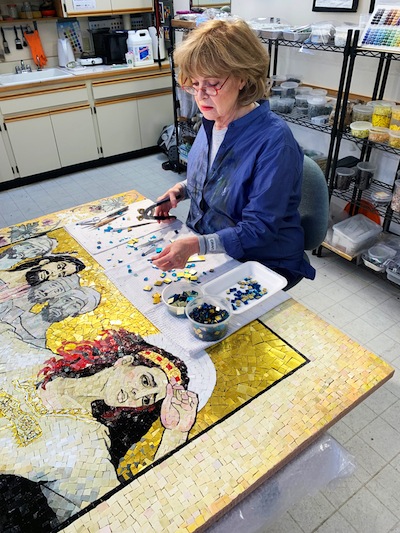
Only in 2016 did Broca return her attention to Mariam. Over eight months, she read dozens of books and essays, and drew and painted the cartoons (drawings for mosaics) for the series now on display. In making the panels, Broca had the help of Adeline Benhammouda, who used to work for Mosaika Studio in Montreal. When Broca was diagnosed with cancer, she asked the studio to make the last two mosaics in the series.
“In the meantime,” said Broca, “the pandemic slowed down activities in all institutions, especially art galleries, and I didn’t know what would happen to my future exhibition.”
The pandemic also temporarily reduced the supply of N95 masks that protected Broca – who suffered a lung infection after her radiation treatment was complete – from the silica dust that results from grinding the glass mosaic tesserae.
One of Broca’s projects as a Shadbolt Independent Scholar at Simon Fraser University was to write a letter describing her activities during the self-isolation months of COVID. All the scholars’ letters were published and Broca’s can be found at the bcreview.ca/2021/02/14/broca-pandemic-magdalene. It is addressed to Mariam and, in it, Broca explains why she chose large (79-by-48-inch) panels for this series.
“In the past, women artists, their works and their stories were mostly associated with the intimate and the small, as though they dared not take up valuable space and time,” she wrote. “As you know from my past art works, I resent that timid notion. My heroines insist and demand the space and importance that long ago was offered to masculine achievements in the military, politics and commerce.
“And, finally, Mariam, after reading so many diverse accusations, betrayals, and the vilification you were subjected to over the centuries, I have decided to express the existence of disparate accounts of your story with text in each mosaic panel, hence the illuminated manuscript composition and unifying motif. Each panel displays three to four lines in an ancient language spoken during your time on earth.”
The languages featured are Aramaic, Hebrew, Ancient Greek, Armenian, Latin, Amharic and Coptic. Broca chose to make seven panels because seven “is a sacred number in the Jewish tradition.”
“Symbolism plays an important part in my artworks and this series is no exception,” Broca told the Independent. “Each drawing includes symbols that are meaningful in both Judaic and Christian traditions. Whether they are flowers, fruit, boats, pottery or textile patterns, these symbols speak of the distant past, yet most of them are recognizable today. Just like an illuminated manuscript page, I sought to illuminate what lies hidden or repressed through the symbols on the borders of each ‘page.’ Hopefully, through them, new ideas can be brought to life.”
Lilian Broca working on the panel “Mary Magdalene, Defiled and Defamed.” Her exhibit, Mary Magdalene Resurrected, is at Il Museo until Aug. 15. (photo from Lilian Broca)
While the Esther and Judith stories have a beginning and an end, Broca said, “Mariam unfortunately is a figure that appears suddenly in Yeshua’s (arguably) 33rd year and disappears right after the Crucifixion that same year. The Gnostic Gospels and other historical documentation that refer to her following the crucifixion are interwoven with legend and myth, none of which is accepted by academics. I chose scenes from all sources, scenes that I felt relayed best her high social status during Yeshua’s life, the love and closeness the two shared, her marginalization once Yeshua died and there was no one to protect her against the ill will and jealousy of the Apostles, the relationship with Mary the Virgin and, finally, my personal vision of a balanced religion, any religion.”
For the series, Broca studied the history of the Jews in the first-century BCE to first-century CE period. “I loved all that research,” said Broca. “I learned so much about Judaism in the process. It was reassuring to read Yeshua’s Jewish parables and to realize that he was very, very concerned with the lack of faith he found in the small beit hamidrash(es) they had in those days and, of course, in the temple. The political situation at that time was extremely complex and the ‘ruling class’ of Sadducees and Pharisees kept the masses in poverty while most of them aligned themselves with the Romans and became wealthier than they had ever dreamed. Yeshua never planned on starting a new religion; on the contrary, he wanted a return to the old ways. My understanding is that the 12 disciples were responsible for all the changes that ensued after Yeshua’s death.”
During the drawing stage of the series, Broca said she consulted two academics – Dr. Mary Ann Beavis and Margaret Starbird – about “‘how far can I push the envelope?’ before I get reprimanded by Christians for profanity or blasphemy.” For instance, wondered Broca, is it OK to portray Jesus washing Mary Magdelene’s feet?
“Each time I heard their answers,” said Broca, “I weighed them carefully, because, after all, I do retain an artistic licence for expressing my own perspective in art. But, at the same time, as a Jewish woman (not a Jewish artist) who embarks on a sensitive subject, I had to make sure I respect the Christian beliefs. I would not appreciate a Christian person making art that endorses what I consider derogatory Jewish images or symbolism.”
At the exhibit’s opening, Broca said, “I am not a theologian nor a religious person and my point of view remains, as always, a feminist one.”
She noted, “Mary Magdalene lived in a strict patriarchal society when women had few rights and freedoms, yet she left her sanctuary, her home and family, in order to follow a single man, without a job or an income, without a fixed address, a man traveling with an entourage of 12 other men spreading the word of God.”
She said, “For 20 centuries, Yeshua, or Jesus, has been both a bridge and a barrier between the Jewish and the Christian faiths. Although I find Jesus equally fascinating, this body of work here, is not about him. It is strictly about his favourite and beloved disciple, Mary the Magdalene.”
The documentary Mary Magdalene in Conversation with Lilian Broca is in post-production. The film, for which Broca wrote the script, is fully subsidized by the Canada Council for the Arts. It follows the journal Broca started in early 2016, when she embarked on her research.
“My hope is that the Mary Magdalene series will open new avenues to perceive the hugely influential relationship between Yeshua and Mariam … as well as considering what happened to that relationship in the hands of the male founders of Christianity,” said Broca. “In addition, I hope that, through my Mariam mosaics, viewers will be profoundly motivated to reexamine this whole critical episode of human history.”
In a 2020 article, Italian Cultural Centre director and curator Angela Clarke spoke in this context about Broca’s body of work as a whole, noting: “Through her mosaics, Broca looks to glass shards as a means to remind viewers that the traditional paradigms associated with traditional institutions and power dynamics can be broken through and reconstructed into a world that is more healing.”
There’s a story in the Babylonian Talmud, in Tractate Yevamot 96b, that cut close to home when I studied it. It’s a brief episode but it addresses modern interpersonal issues. It features Rabbi Elazar, who goes to the beit midrash (study hall) and quotes halachah (Jewish law). However, Elazar makes a big mistake – he doesn’t attribute this teaching to Rabbi Yohanan, who taught it. This news gets back to Yohanan. And it doesn’t sit well.
Now, the backstory. Rabbi Yohanan, according to Rabbi Dan Ornstein’s My Jewish Learning summary online, is seen as “dangerously oversensitive” and quick to anger. Yohanan also apparently had (at least) 10 sons and they all died. He is so sad that, in Tractate Berakhot 9b, he is carrying around a tooth (or a bone?) from his youngest child who died.
Back to the current story: rabbis Ami and Asi, Yohanan’s students, try to calm him. They say anger isn’t good and offer a story about Elazar and Rabbi Yosei, who get so angry with each other that they tear a Torah. Yohanan becomes angrier, because they are comparing Yohanan and Yosei (teachers) with a student (Elazar).
Along comes Rabbi Yaakov bar Idi, who takes a different approach. He explains that everyone knows that all of Elazar’s teachings come from Rabbi Yohanan, who is, in their time, “our iteration of Moses.” In fact, “Everyone knows Elazar is quoting you, even when he doesn’t quote you by name. You have nothing to fear.”
This diplomacy soothes Yohanan, who then corrects Ami and Asi, pointing out this was a great way to manage the situation.
There was so much in this story that affected me. First, there’s the matter of, in modern terms, “copyright.” Everybody deserves credit for their work. It’s not right to just claim somebody else’s ideas, images or innovations as your own.
There’s also the issue of context. Rabbi Yohanan had great personal tragedy and loss. People with this much trauma might be sensitive or angry – and that’s entirely understandable.
It’s also awful to try and “teach” your instructor through the example of one of their poorly behaved students. It disregards Yohanan’s wisdom and authority. Recognizing this trauma and honouring elders means treating them with respect instead of talking down to them, as rabbis Ami and Asi did.
The talmudic story continues: the teachings of a great person speak to us from beyond the grave. Yohanan’s legacy is his teaching of Jewish law and Torah. It’s erased if Elazar fails to acknowledge where it came from. When a person loses their children and hopes that his students will help his name live on? It’s demoralizing and infuriating when his students “erase” him instead.
OK, yes, but this is just an old story, why did it matter to me?
As an author, I care about copyright issues. Most authors don’t earn more than, at most, a dollar when each book is sold. Most writers (myself included) cannot make a living on their books or other writing. So, seeing bootlegged downloads of my books on the internet is infuriating – it’s just another way to “erase” a person’s value and intellectual property.
Then, there’s the issue of our personal story and how it affects our work. We’ve all known people who’ve suffered losses or struggled. Rabbi Yohanan is a good example. Perhaps some learn from this suffering and gain wisdom. Yet Yohanan’s students condescend to him and belittle his anger because “he might tear a Torah” like one of his students? This is not consolation. It’s demeaning.
Rabbi Ornstein uses the word “flattery” to describe what Yaakov bar Idi did, saying that everyone knew Elazar got everything he knew from Yohanan. I think that’s the wrong take. In trying to soothe Yohanan, Yaakov bar Idi gives him respect and credit. This shows how much our work means to us. As a good teacher, when calm, Yohanan made the experience a lesson for his other students. In other words, everything is Torah – we can learn how to be better people from any situation, no matter how upsetting or demeaning.
Occasionally, work situations pop up that “put us in our place” or give us context about what we do. Recently, I opened up my work email to discover I’d lost seven-plus months of emails from my inbox. Now, of course, an organized person would have addressed every issue, filed every email, and had an empty inbox. I hang on to things, I don’t spend enough time on tidying, and I keep things so I can think about them. Mea culpa.
After trying every technical solution available, it became clear that those emails were gone forever. No idea what happened. I had to let go of the panic and the upsetting situation. I hope my work has value, and that people will get in touch if they want to work with me.
Losing my emails this way felt like being erased. Middle-aged women, who are also caregivers, often earn less for the hours we work. We earn nothing for the hours of household labour we do to take care of those around us. It’s natural to feel angry about this. Rabbi Yohanan’s anger reminds that we all want to be acknowledged, have our work valued and respected. It’s not hypersensitive or unreasonable to want to leave a legacy to others. Taking on someone else’s teaching without attribution, as Elazar did, is the erasure that happens to many of us, and Rabbi Yohanan shows us that anger is a human response. Yaakov ben Idi suggests that acknowledging his teacher with respect is the compassionate way forward.
In a perfect world, my inbox would magically repopulate. I’d get offers from new clients showing my value as a writer and editor. My elementary school twins would suddenly acknowledge and thank me for all those meals and chauffeur moments. In reality, we all have to remind ourselves to reach out, acknowledge others, and treat them with respect. It doesn’t always happen automatically. Yohanan’s students valued his wisdom but they had to learn to acknowledge his work and recognize that his feelings mattered, too.
In this way, Rabbi Yohanan’s wisdom teaches us from beyond the grave. We must not erase others’ contributions. An erasure or even an empty inbox doesn’t make anybody’s life fulfilling. We must validate and value each other.
Joanne Seiffhas written regularly for CBC Manitoba and various Jewish publications. She is the author of three books, including From the Outside In: Jewish Post Columns 2015-2016, a collection of essays available for digital download or as a paperback from Amazon. Check her out on Instagram @yrnspinner or at joanneseiff.blogspot.com.
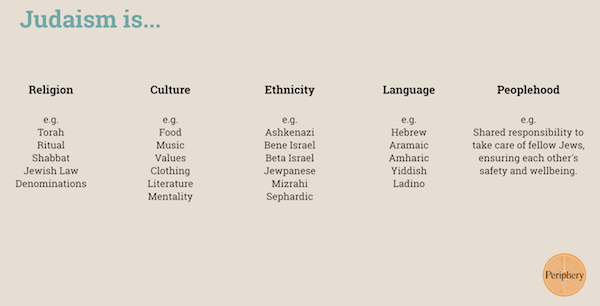
A page of the Intro to Judaism booklet that can be downloaded as part of the Periphery curriculum, which offers a framework to talk and learn about diversity within the Jewish community.
“Make space for a productive and respectful conversation” – this is the first suggested action to frame the use of the recently released Periphery curriculum.
Periphery – a film and photography exhibit exploring the ethnic diversity of Toronto’s Jewish community (jewishindependent.ca/discussing-jewishness) – came out last fall. The new curriculum builds on that 27-minute documentary. It comprises another nine short videos, all under eight minutes each, and lesson guides for students in grades 8 through 12 in both the Jewish and public school systems. There is also a guide for Jewish groups and organizations, which could be used for non-Jewish groups.
Launched by the Toronto-based nonprofit No Silence on Race and the Ontario Jewish Archives (a department of UJA Federation of Greater Toronto) with the organization Facing History and Ourselves (an American group with a Toronto branch), the curriculum is Ontario-focused. That said, most of the information is broadly based and relevant to Canadians no matter where they live, and no matter their age.
There are differences in the curricula for each of the three grade groupings (Grade 8, grades 9 and 10, and grades 11 and 12), the Jewish versus public school content, and the community dialogue package. However, the basic format and information is similar, with appropriate adaptations for probable starting points in knowledge and experience.
The common learning aims include “a greater awareness and understanding about who Jewish people are and the ethnic diversity within Jewish communities”; “Possess a stronger framework for understanding the complexities of intersectional identity, using their own identities as a foundation”; “Understand the difference between individual and group identity with a focus on belonging and recognition”; and the role of students and community members in creating inclusive community spaces. In addition, for example, the Jewish community curriculum also suggests that participants: “Discuss the intersections of race, privilege, mobility (i.e Jewish professional opportunities), power as it relates to Jewish identity and ashkenormativity.”
Before delving into the films and lesson suggestions, the curriculum offers a few activities that help frame what viewers are about to watch and discuss – beginning with making “space for a productive and respectful conversation.”
The most extensive part of the guides is the screening prompts and activities. They are organized by topics based on those of the videos, such as “Hyphenated Identities,” “Immigrating to Canada” and “Finding Strength in One’s Heritage.” They include pre-screening and post-screening questions for each film and topic, and these questions elicit self-evaluation and the sharing of stories and views on identity, race, multiculturalism, sexuality, antisemitism and social justice, as well as discussion of the experiences and opinions of the interviewees featured in the films.
The final part of the guide attempts to have participants take what they have learned out into the world, beyond the classroom or boardroom or office. For example, the title of the last section of the Jewish community dialogue is “Now What?: Social Justice within the Jewish Community and Beyond.” It begins with discussion from a global perspective – using a quote from Canadian anthropologist Wade Davis to talk about questions like, “What does it mean for us to hear from different voices of humanity?” It then highlights a quote from the Mishna and one from Pirkei Avot to further reflect on the idea that repairing the world, tikkun olam, begins within the community.
In addition to the curricula, there are related materials available to download, from worksheets to help understand the concepts being discussed and organize one’s thoughts, to an introduction to Judaism, to a glossary of terms. The poem “Unpacking the Periphery,” by Akilah Allen-Silverstein, can also be downloaded. It concludes “For each other as allies, I pray we can stand tall / Diminish the fine lines, deepen our understanding, / Listen with compassion / Listen with empathy / Act with courage / Act with reason / Because this is the season / To do better / To act on the Open Letters / To be more than trend setters / But intentional change makers.”
All of the Periphery curricula and resources are free and downloadable at peripheryexhibit.org.