New cantor welcomed

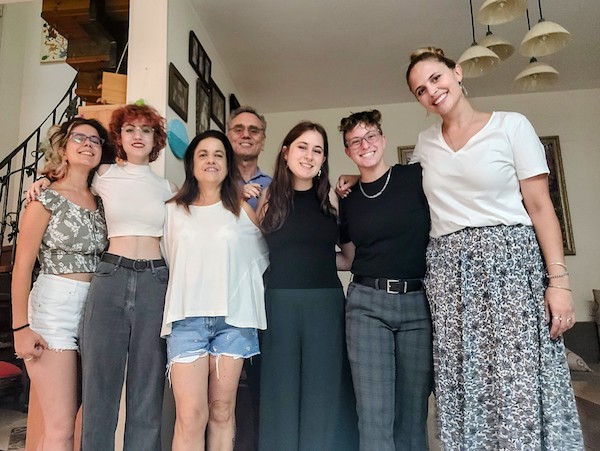
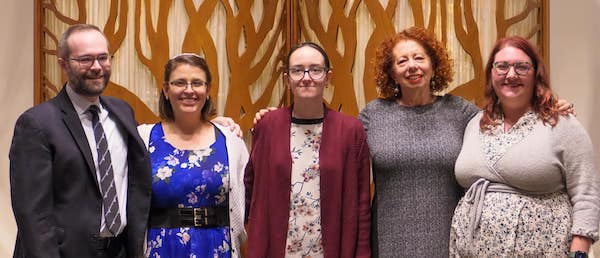
Left to right: Cantor Josh Breitzer, Cantor Shani Cohen, Rabbi Kylynn Cohen, Prof. Joyce Rosenzweig and Cantor Lianna Mendelson at Shani Cohen’s installation as cantor at Temple Sholom the weekend of Oct. 28-29. (photo from facebook.com/templesholom.ca)

Temple Sholom officially installed Cantor Shani Cohen, the first ordained cantor to serve the congregation, on the Oct. 28-29 Shabbat weekend, with services and music throughout to mark the occasion.

Always passionate about music and Judaism, Cohen found a path that combined her interests – and talents – while studying for a master’s of music in vocal performance and pedagogy at the University of Houston in the mid-2010s. There, she started working for Congregation Shma Koleinu.

“Rabbi Scott Hausman-Weiss saw something in me, and invited me to lead High Holy Day services with him. He knew that I would become a cantor before I did. Once I started leading services, I looked into becoming a cantor and what that would mean,” Cohen told the Independent. “What I discovered was that being a Reform cantor encompasses so many different skills: you get to lead the congregation in prayer, teach b’nai mitzvah, introduce new music, and lead lifecycles for the community.”
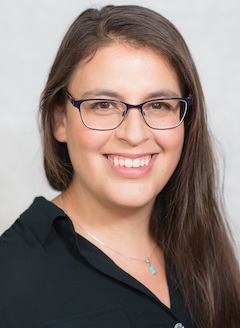
photo - Cantor Shani Cohen
Cantor Shani Cohen (photo from Shani Cohen)

Following her studies in Houston, Cohen enrolled at Hebrew Union College and embarked on a five-year cantorial program, which comprised a first year of study in Jerusalem, followed by four years in New York. “I got to work with the most incredible, groundbreaking cantors and rabbis of our generation, and enter into a diverse community of Jewish clergy around the world,” she said. “The training for cantors centres on Jewish music and liturgy, but many of our courses are in conjunction with the rabbinic students, including pastoral care, Bible, Jewish history and philosophy, and lifecycles.”

As a student, she presented recitals every year on different topics, such as Shabbat, High Holy Days, and Jewish composers. In her final year, she wrote a thesis and presented a recital on the same topic – her research delved into the collaboration between rabbis and cantors, looking into the history of these roles and the way clergy teams function in Reform congregations today.

Cohen was influenced by the cantors of the early to mid-20th century, which is often referred to as the cantorial “golden age.” These cantors included such names as Yossele Rosenblatt, Moshe Koussevitzky, Leibele Waldman and Moishe Oysher.

“I love how they brought their full voices to every piece, whether they were leading services or performing on the concert stage. I am also greatly inspired by the incredible teachers that I had at the Hebrew Union College Debbie Friedman School of Sacred Music (DFSSM), including Chazzan Israel Goldstein, z”l, who I got to work with as my coach my second year.”

Two of Cohen’s mentors, Prof. Joyce Rosenzweig and Cantor Josh Breitzer, were in attendance at her October installation, offering both words and music. Cohen worked with Breitzer as an intern at Congregation Beth Elohim in Brooklyn, where she got “to see firsthand his ability to weave together traditional and contemporary musical styles in an authentic, cantorial way.”

She said, “I too strive to bring the breadth and depth of Jewish music into my cantorial work, showing our community that both new and old music has a place in our synagogues. I think this is what cantors are called to do in order for us to keep this art form alive.”

Cohen delights in both the variety of her job and its interpersonal nature, noting that no two days are alike. “I could go from teaching students and leading prayer with our religious school one day, to officiating a wedding or going to visit one of our home-bound congregants the next,” she said. “Each facet of my work feels meaningful, especially being there for people when they are feeling vulnerable: when someone loses a loved one, gets bad news, or even the excitement and anxiety of preparing for their child’s b’nai mitzvah.”

A native of the Bay Area, Cohen attended the University of Puget Sound in Tacoma, Wash., where she studied music and psychology. “I love being close to the water and, when the sun comes out, you appreciate it so much more because so much of the year is dark and rainy,” she said. “It was definitely a big contrast from where I grew up, but I felt a strong connection to this part of the continent when I was an undergraduate student, and am so grateful to be able to live here now.”

Cohen and her wife Rabbi Kylynn Cohen moved here with their black Lab mix, Trouble.

“The addition of Cantor Cohen to Temple Sholom’s clergy team is a milestone for our growing congregation, having grown from 600 households in 2013 to nearly 950 households just nine years later,” said Rabbi Dan Moskovitz, senior rabbi at Temple Sholom. “Cantor Cohen adds a depth of pastoral skills and Jewish knowledge to her outstanding musical and cantorial abilities.

“She stands upon the shoulders of lay cantorial soloists Arthur Guttman and Naomi Taussig, who together set the tone and tenor for generations of Vancouver Jewish families,” he said.

“It is an honour and a privilege to be part of the Temple Sholom clergy team,” said Cohen, who brings the team to three, joining Moskovitz and Rabbi Carey Brown. “And I am grateful to get to do this work every day.”

Sam Margolis has written for the Globe and Mail, the National Post, UPI and MSNBC.
Art of unweaving as midrash

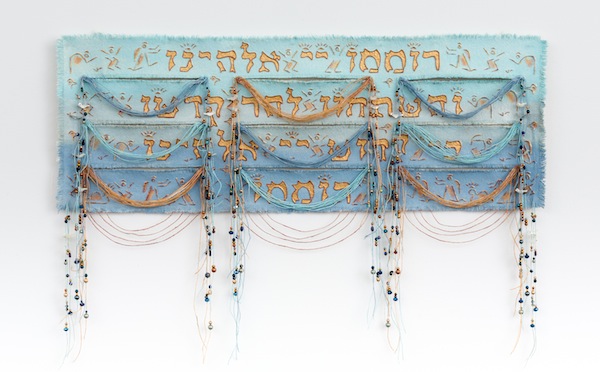
“Romemu” by Laurie Wohl.

Laurie Wohl’s “unweavings” are currently on display at the Zack Gallery, until Nov. 8. The exhibit, Journeys, features two of the New York artist’s collections: the Shabbat Project and the Meditation Project.

“By unweaving the fabric, I make manifest what is hidden within the material – liberating the threads to create shape, then ‘reweaving’ through colour, texture and text,” says Wohl in her artist’s statement.

“My unweavings process came out of my concern with narrative and storytelling,” she told the Independent. “I began as a painter on stretched canvas over 30 years ago, but I came to feel that painting on a flat, rigid surface felt static – distancing me from my materials and my stories. So, I began experimenting, cautiously making slits into the canvas, then unweaving, thread by thread – engaging with the material, exploring it. My work became completely ‘unstrung’ by 1989.

“Unweaving became a meditative process that allows me to feel my way into the material at the same time that I am feeling my way into the spiritual texts that have caught my attention,” she said. “Liberating the threads – creating different forms physically – has given specific resonance to the biblical, spiritual and poetic texts that fascinate me. Both the words within each piece and the unwoven form suggesting these words serve as a visual commentary, a visual midrash. This process of unweaving, then reweaving with text, paint, texture and beads, becomes a modern interpretation of the narrative and ritual function of textiles.”

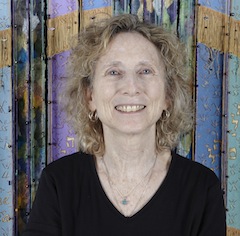
photo - Laurie Wohl
Laurie Wohl’s textile art is on exhibit at the Zack Gallery until Nov. 8. (photo from Laurie Wohl)

Wohl’s maternal grandfather was an Orthodox rabbi – “I was very close to him, going to Shabbat morning services with him, sitting with him in the intense quiet of a Saturday afternoon twilight, at the waning of Shabbat,” she said.

“I was raised in the questioning tradition of Reform Judaism and I have read widely in the faith traditions of Christian and Eastern religions,” she continued. “My work has grown out of my own search for meaning – what is important to me as an artist in our complex world – and from my exploration of a medium that’s congenial to this meaning. The events of our time and my own life experiences have captured my imagination, and led me to be concerned with possibilities for reconciliation, both political and religious – in post-apartheid South Africa, in Christian-Jewish relations and, after Sept. 11, 2001, in possibilities for interfaith conversations among Jews, Christians and Muslims.”

Wohl uses a heavy cotton canvas for her works. She describes her creative process on her website: “I first release either the warp or weft threads to create the desired shape. Various textures may be collaged onto the surface, such as fibrous papers, sand and pumice. My images and calligraphy are applied with modeling paste. I then apply acrylic paints to the surface, and a final thin layer of gold wash. Where gauze is used, the fabric is dipped in diluted paint, then hand-painted and embellished with fibrous papers. In the last part of the process, beads – prayers and marking points – are affixed with acrylic gel.”

Wohl’s textiles are held in numerous public and private collections, including the Museum of Arts and Design, and some of her pieces have been on long-term loan to U.S. embassies in several countries. Her works are recognized by the American Institute of Architects’ Interfaith Forum on Religion, Art and Architecture, and by the Surface Design Association, and she has exhibited in widely differing venues, from Jewish community centre galleries to university galleries to galleries in theological seminaries.

“One of the exhibits in a Christian theological seminary led to a feature on my work in a magazine, Christianity and the Arts, which led to my work being exhibited in a major church in Chicago – Fourth Presbyterian Church,” she said. “This led to a commissioning by the church of 12 pieces for their sanctuary. And that led to another commission in New York City by Madison Avenue Presbyterian Church.

“The pieces I made for these sanctuaries are my responses to the particular interfaith work of those communities and their Old Testament roots. The Psalms Project for Fourth Presbyterian’s main sanctuary consists of 12 large pieces…. The church asked me to use Hebrew as well as English calligraphy to underscore the congregation’s immersion in its Old Testament roots, and the psalmic motif emphasizes the Christian-Jewish dialogue to which that church is committed. The project for Madison Avenue Presbyterian Church uses texts from both Old and New Testaments, and Hebrew, English and Greek calligraphy.

“Between 2001 and 2010, as I was working on projects exploring the relationship of Christianity and Judaism, the necessity of expanding my work into the realm of Islam was percolating beneath the surface,” she said. “I had just moved to New York City when the events of Sept. 11, 2001, occurred. Experiencing the trauma and aftermath, and especially the demonizing of many Muslims, I began to think about how I, as an artist, could contribute to a better understanding among Jews, Christians and Muslims – to suggest a way that art can be used to mediate at the intersection of faith and politics. After extensive reading in medieval and contemporary spiritual texts and poetry in 2009, I began my 18-piece project – Birds of Longing: Exile and Memory – in which I explore the relationships among the three Abrahamic religions, using text, texture, colour and form. I relate spiritual and poetic texts from the Convivencia (the Spanish medieval period) to contemporary Middle Eastern poetry, particularly Israeli, Palestinian and Syrian. The pieces explore common themes of spiritual love, exile, nostalgia for Andalusia, poetry referencing Old and New Testament texts and the Qu’ran, and poetry speaking of mistrust of enemies, yearning for reconciliation.”

Wohl began the Shabbat Project after Birds of Longing, which had been an intense process. “I was somewhat exhausted spiritually – there seemed to be no end in sight to the fighting and misunderstanding in the Middle East, and xenophobia was heating up against immigrants and refugees coming to our borders,” she said. “I felt a need for spiritual renewal and turned to our tradition. The Kabbalat Shabbat service at my own synagogue – Stephen Wise Free Synagogue [SWFS] in New York City – is a wonderful blend of reflective and joyous music. Through wordless music – the niggunim – and through prayerful words set to music, we are invited to enter into the spiritual, the transcendent, both individually and in community.

“Music has long been an important part of my art practice. The pieces in the Shabbat Project embody prayers and psalms of the Kabbalat Shabbat and Shabbat morning services, both in terms of the texts inscribed and the form of each piece, which evokes – hopefully – the spiritual texts. I was fortunate to collaborate with Cantor Dan Singer at SWFS for a soundscape that is integral to and accompanies the project.”

Wohl shared the meaning behind a few of the works from the Shabbat Project. “The piece ‘Kabbalat Shabbat’ is a circular piece suspended from the ceiling,” she explained. “With this form, and using semi-transparent materials, I try to evoke the mystery and beauty of the Shabbat bridge. There are references to many prayers and melodies embedded in the piece: Y’did Nefesh, Ahavat Olam, V’al Kulam, L’chu N’ran’na.”

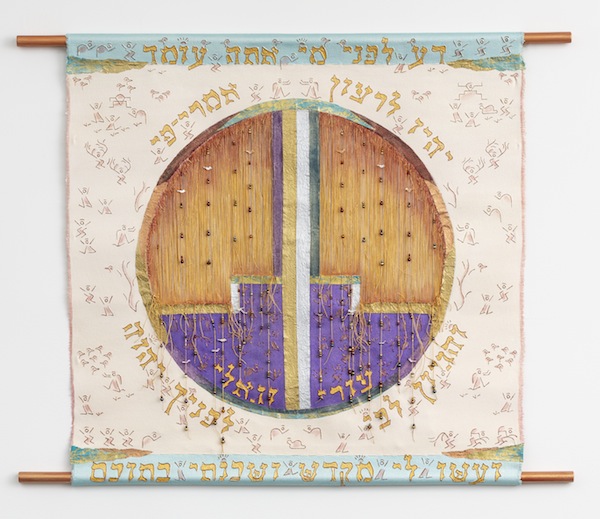
image - “Sanctuary: Mishkan” by Laurie Wohl
“Sanctuary: Mishkan” by Laurie Wohl, who explained: “The partially unwoven centre alludes to the bima and altar, and the piece includes words from Psalm 19, Yih’yu L’ratzon: ‘May the words of my mouth and the meditations of my heart be acceptable to You….’”

Another example she gave was “Hashkiveinu: Evening Prayer,” which, she said, “suggests a tallit or prayer shawl and embodies words from an ancient prayer. ‘Cause us to lie down in peace and raise us up, our Sovereign, to life renewed’: ‘Hashkiveinu, Adonai Eloheinu, l’shalom. V’haamideinu shomreinu l’chayim.’

“‘Romemu’ also echoes the form of a tallit or prayer shawl, and incorporates the praise text from Psalm 99:9: ‘Let us exalt Adonai our God  / and worship at His holy hill / for holy is Adonai, let us exalt.’ (‘Romemu Adonai Eloheinu / V’hishtachavu l’har kodsho / Ki kadosh Adonai Eloheinu, romemu.’)”

In total, 12 pieces comprise the Shabbat Project and the Meditation Project encompasses 11 pieces.

“For many years, the process of unweaving and working with spiritual texts has been a form of meditation for me,” said Wohl of the latter project. “Living in New York City at the beginning of the COVID pandemic, the incomprehensible numbers of those dying daily caused me to search for a way to find solace in a world turned upside down. Rabbi Angela Buchdahl, the senior rabbi at Central Synagogue in Manhattan, started a daily meditation practice on Zoom just then. I found comfort in her teachings and in the communal aspect of the meditation. Rabbi Buchdahl has continued the communal meditation once a week, and I have continued my meditation practice. The pieces in the Meditation Project draw on the teachings from her sessions and my responses to them. My hope is that the thoughts I held as I created the work will project a sense of mindfulness and serenity that viewers can carry with them.”

Judaism’s differing practices

Burquest Jewish Community Centre has invited a series of local Jewish leaders to visit the centre and discuss their approach to Jewish practice. A Coat of Many Colours: Conversations about Jewish Practice takes place every other Sunday, through Dec. 11. It started Oct. 16.

Rabbi Laura Duhan-Kaplan – rabbi emerita of Or Shalom (Renewal), volunteer at Beth Israel (Conservative) and director of inter-religious studies and professor of Jewish studies at Vancouver School of Theology – began the series with a talk called An Integrative Spirituality.

On Oct. 30, 1:30 p.m., Congregation Har El’s Rabbi Philip Gibbs speaks on The Conservative Synagogue and the Modern Jew.

“As a Conservative rabbi, I believe that Jewish law develops over time so that even a deep commitment to live according to Jewish values, traditions and rituals can fit with modern sensibilities,” he said. “At the same time, as a community leader, I also recognize that not every person wants to or is able to follow the discipline of an observant life. The synagogue acts as a spiritual toolbox with the many rituals and values that can add meaning to your life. The tension between an individual’s interest and the communal practice is both a challenge to create a welcoming space and an opportunity to explore the deeper meaning of our tradition. We will look at a few examples of how a synagogue could approach rituals like kashrut, prayer and Shabbat.”

Rabbi Tom Samuels of Okanagan Jewish Community Centre, Beth Shalom Synagogue, will give the Nov. 13, 1 p.m., talk, on the topic From Synagogue to Home.

Samuels, who does not identify with any singular Jewish denomination, institution, theology, pedagogy and the like, said, “My session will explore the idea of relocating the North American model for ‘doing Jewish religion’ from the synagogue building to the home. In response to the destruction of the Second Temple, a new Judaism emerged called Rabbinic Judaism. The ancient rabbis established a new locus of Jewish identity and connection to the home, and specifically, to the shulchan, the Shabbat table. Using the model of the Chassidic tish (or botteh, or what Chabad Lubavitch call the farbrengen), we will experience the seamless tapestry of Torah learning, tefillah (prayer), singing and eating that could be replicated by Jewish communities, with or without a local synagogue, throughout North America.”

On Nov. 27, 1 p.m., Temple Sholom’s Rabbi Dan Moskovitz will speak on These Are The Things – 10 Commandments for Living a Purposeful Life.

“Reform Judaism in general emphasizes the moral ethical commandments as being obligatory while the spiritual ritual commandments are more subjective to the individual worshipper with the autonomy to make meaningful, informed choices in their personal practice,” said Moskovitz. “My current rabbinate as senior rabbi of Temple Sholom is shaped by an emphasis on finding meaning through Jewish custom and practice, social justice work, inclusion, outreach to the unaffiliated and developing a relational community.

“I will present a passage from the Mishnah called Elu Dvarim, which details 10 commandments that, if followed during your life, receive reward now and for eternity…. I will present and we will discuss how the application of these particular commandments to your life, regardless of your faith tradition or whether or not you even have one, is one answer to the eternal question what is the meaning of life.”

Rounding out the presenters will be Rabbi Dovid Rosenfeld, Chabad Lubavitch, on Dec. 11, 1 p.m., with a topic to be announced.

Further information on presentations and presenters is available under events at burquest.org.

How much is your work worth?

Imagine an interview where the interviewer wanders around the office, conducting work while asking intrusive personal questions. The interviewee trails behind. An hour-long appointment stretches into two. Things get further off track. The potential employee, apologizing profusely, gets herself out of the building and into the safety of her car. Cheeks burning, she drives herself home, wondering, “What the heck was that?” Days later, she fields phone calls from the interviewer, asking why she won’t accept an offer that is a dollar or two more than minimum wage. The amount would not likely cover the gas, taxes, work clothes and household/childcare coverage it would take to do the job. Advanced degrees and experience don’t matter, she hears. This is the going rate.

Meanwhile, at home, the same potential employee “works” at the numerous tasks that pop up every day. She self-drafts a clothing pattern, because a kid needs pyjamas of the right size and the pattern she has doesn’t fit. She mends a favourite pair of school pants. She prepares multiple meals in advance, baking bread ahead, too. These tasks are lined up for quick moments to spare amid managing homework and extracurricular activities. She contacts tradespeople to see if they can provide affordable repair quotes, responds to school emails and fits in applying for other jobs or doing her current work as she can. She is sadly behind in keeping up with her friends and family, but doesn’t know when to fit that in.

In between, she walks the dog, meets the kids at the school bus, takes them to medical appointments, or pays bills. She politely tries to get out of volunteer commitments that moms “should” do for the school and community organizations.

This might sound familiar to parents, mostly mothers. It’s all the work that goes unnoticed and is uncompensated in our society. Daring to seek compensation for some of these skills is seen as selfish. After all, these parents (usually mothers) are told, “If you expect to earn anything for your experience or education, you’re mistaken. You ‘chose’ not to stay consistently in the full-time workforce. You chose to have children/get married/study a less-lucrative topic in university….” The list goes on.

Our society functions in many ways because of the unpaid labour. It’s most often women’s physical, emotional, social labour done behind the scenes. It feels new and unfair in every generation, I suspect, even as some things change for women slowly over time.

As I study Ketubot, which is a Babylonian talmudic tractate dedicated, at least in theory, to marriage contracts, I’ve had competing demands on my time. It’s forced me to read aspects of the text differently. When the rabbis debated these issues (1,600 to 2,100 years ago, give or take), women’s roles were more circumscribed. However, some of the basic arguments seem to arise in ways that don’t surprise me.

Some of the takeaway nuggets from this tractate…. When a woman marries, her husband is owed her labour and the fruit from her properties. Even if she brings servants into the marriage, there are certain tasks she must do herself. Her virtue and loyalty are worth a monetary value in the marriage.

There are surprises though. If the husband dies, the woman is owed the price of her marriage contract, or the husband’s heirs must take care of her upkeep. She (or her representatives) may write obligations into the marriage contract that the husband will be required to honour. For instance, if she brings a daughter from a previous marriage with her, she can obligate the new husband to pay for the daughter’s physical support in the contract. (Ketubot 102)

Long story short, smart women can sometimes find ways to protect themselves. This is true even in a rabbinic system that isn’t designed necessarily for them. In these texts, women – and their families – both look out for one another and treat each other unfairly.

What can we draw from all this? I feel less alone when considering that expectations may have changed a bit in 2,000 years, but that many of our sometimes truly overwhelming expectations and commitments remain. Further, clever people have protected themselves whenever they can, throughout the centuries. It’s not new to look out for one’s own interests and avoid being taken advantage of by creating some safe boundaries.

Studying these texts at this point in my life offers me a level of maturity that I didn’t have the first time I went through a bad interview. More than once, I was offered a job that took a lot of skill but offered only a low wage. I remember feeling torn up about these experiences, wondering if I was worth so little. It was also a feeling of desperation. I needed a certain amount to live, and this offer wouldn’t provide it.

One privilege of being older is that women who value themselves aren’t embarrassed to ask for what they’re worth. Earning less than what we need doesn’t do us or our families any favours but, of course, in financial desperation, many women must take those jobs anyway. This is what fuels the cycle of low wage work in the first place.

We aren’t all experts in everything. Drafting a sewing pattern doesn’t make one a professional fashion designer. Finding the right document in a bunch of storage boxes is like finding a needle in a haystack, but it doesn’t make me an archivist or a research librarian. We all have our areas of true expertise. Also, just as the rabbis debated the value of one’s roles and responsibilities in marriage, we do the same. Is our work worth something? Heck, yes.

Tractate Ketubot’s messages about the value of a woman or a wife sometimes seem mercenary, but this, too, is Torah. Sometimes, being mercenary is the way to have our work be seen, valued or compensated appropriately.

Joanne Seiff has written regularly for CBC Manitoba and various Jewish publications. She is the author of three books, including From the Outside In: Jewish Post Columns 2015-2016, a collection of essays available for digital download or as a paperback from Amazon. Check her out on Instagram @yrnspinner or at joanneseiff.blogspot.com.

Welcomed in Kiryat Gat

Laura Soda, right, with her host family, the Lipiks, and some of her MITF colleagues at Rosh Hashanah. (photo from Laura Soda)

Growing up as a Jewish young adult in White Rock, I always had mixed feelings about celebrating the High Holidays. On one hand, I enjoyed the traditions and the feeling of community that I experienced when we would go to services. However, early fall has always been a hectic and stressful time for our family as well. Aside from Rosh Hashanah and Yom Kippur, there was the beginning of a new school year, all four family birthdays falling within a month of one another and, finally, Thanksgiving. It’s a six-week family marathon.

During the High Holidays, I also was overwhelmed with the feeling of being the “token Jew” in every class. At the beginning of every school year, I dreaded having to approach the teacher and ask for time off so that I could observe holidays that most of my peers, and even some of my teachers, had never heard of. I almost had a sense of guilt, as if I were inventing holidays just to get out of class. All I wanted was to fit in and be like everybody else. And, in the White Rock of my childhood, there was little cultural, ethnic or religious diversity. There were two other Jewish kids at my school, but we rarely – if ever – acknowledged our mutual Jewish connection outside the context of Hebrew school, synagogue or youth group. It wasn’t that we were actively hiding our Jewishness; for me, I simply felt that any sign of difference was “uncool.”

I am currently on a 10-month program teaching English in Israel with Masa Israel Teaching Fellows (MITF). I am living in Kiryat Gat, a small, mostly religious up-and-coming city in the south of Israel. For the next 10 months, I will be teaching English to the children of the community in which I live. Most of the people here do not speak English, and I feel grateful to be in a place where I can help break language barriers and contribute to English language education. For me, however, it has been quite an adjustment.

With the challenges of settling into a new country, in a town where not many people speak English, I am overwhelmed by the tremendous sense of community and unity. Despite the inconvenience of the train and bus schedules around the holidays, it wasn’t just me being inconvenienced. For the first time in my life, I was in the same situation as everyone around me.

Recently, I celebrated my first Israeli Rosh Hashanah with a host family that I was connected to through the MITF program. The Lipik family welcomed my peers and I, quite literally, with open arms and have made us feel at home. My roommate and I walked to Rosh Hashanah services in the morning and passed many others doing the same. Suddenly, I realized that, although I had been prepared to feel like an outsider in a tight-knit community of people who were more religious than me, my Rosh Hashanah experience was so welcoming. I smiled at the children who listened to the shofar with wonder, and I was reminded that children are simply children, no matter where they live or what language they speak.

Later, we joined our host family at their backyard barbeque along with their extended family and friends, and we ate our hearts out as we basked in the smell of smokey chicken kebabs and toasted marshmallows for dessert. Throughout it all, it sunk in that, this year, I don’t have to explain myself. This year, it is my turn to learn – to watch and listen to how other Jews celebrate, being curious about the differences, but, more often, being surprised by the many similarities in our traditions. My first Rosh Hashanah in Israel taught me that although I am far from my home in Canada, I am exactly where I need to be – I feel right at home.

Laura Soda is currently on a 10-month program teaching English in Israel with Masa Israel Teaching Fellows. For more information on the MITF and other Masa programs, visit masaisrael.org.

Free expression in workplace

I heard once about an executive who explained in an interview: we debate a lot behind the scenes, but when we present our opinion or policy, it is a united front. We expect all employees to avoid saying or writing anything that would contradict this in public, they continued. Further, it’s spelled out in the work contract what you can and cannot say, and employees must stand behind the policy decisions of the organization.

If you find this kind of approach unsettling, you wouldn’t be alone. Yet, it’s not an uncommon requirement of employees. I wondered, after hearing this, how much money employees have to earn to make it worthwhile to give up their opinions or their right to free speech. Also, what happens if, during the debate behind the scenes, a younger or less powerful employee has a viewpoint that is starkly different than the party line? How does that go? Must an employee then give up her income or change jobs in order to have freedom of expression on those topics? If mainstream, moderate opinions and moderate disagreements are swept under the rug, what else isn’t allowed?

After hearing of this model, which shuts down dissent or situations that might conflict with the policy, I felt nervous. I ended up joking around. This felt like the Mafia. Disagree with the boss? What happens if nobody likes what you have to say? You too could end up in the river wearing some concrete overshoes!

These issues around employment and freedom of expression loom large in democracies and rightly so. If we look back to Judaism’s most foundational texts, written and oral Torah, we see that, consistently, Judaism values hearing all the opinions. Minority voices or rejected outcasts also have their views included and written down. We’re still reading and hearing about rabbis and even outsiders to the community who expressed minority opinions 2,000 years ago that didn’t go forward. In other words, their views did not become “policy.”

For instance, in the Talmud, we learn about Hillel versus Shammai, but mostly Hillel, who is more lenient. The rabbis and, therefore, Jewish law, tend to follow Hillel’s lead. That said, nobody got rid of Shammai’s point of view. He didn’t get fired from the rabbis’ club for having an unpopular opinion.

I recently had a couple of informational interviews. Well, they were really just Zoom chats, which came about because a friend reposted something from a small advocacy group on Instagram. Beware of social media if you are a novice like me. I prodded my friend with an off-the-cuff comment, saying, “So, don’t you think this is just a PR scam?!” Oops … I wasn’t just writing my online friend.

To my surprise, both the chief executive officer and the education and programming lead of the group got in touch with me. They wanted to tell me all about their efforts to make positive change – it wasn’t a publicity stunt. They explained what they hoped to achieve. I was pretty embarrassed by my post. By the end of the first chat, I was impressed with the information they had offered me and how they had engaged. They welcomed all opinions. They asked me if I wanted to contribute in an open and friendly way.

Our second meeting resulted in them recruiting me to serve on a volunteer advisory panel because of what they saw as my expertise. I agreed willingly because our exchange had been such a positive experience.

There’s a meme offered this time of year, that, while how we behave between Yom Kippur and Rosh Hashanah matters, it’s how we behave the rest of the year that counts.

Choosing to be open to differing opinions and innovation keeps us learning and growing. It also aligns us with the model of the rabbis, who discussed and debated and recorded it all in plain view, with minority views counting, too. Also, admitting one’s mistakes – wow, how embarrassing was I on social media? – helps us grow and become better people.

The least Jewish model, I think, is the example with which I led off this article, where everyone is allowed to debate, in theory, but all opinions aside from the official party line are discarded or silenced. We’re speaking here of relatively mainstream opinions, not radical ones. Want the kicker? From what I understood, this is a model used by some nonprofit Jewish organizations.

The smaller advocacy group isn’t a Jewish organization, but one of their employees is. Part of our chat involved a bit of Canadian Jewish geography regarding their Winnipeg relatives. Also, they suggested that I perhaps write up a Jewish topic for their group one day. They were open and excited about diverse voices.

Work life and individual identity can sometimes be entirely separate things. Yet, in others’ lives, Jewish identity, values and models and careers go hand in hand. I want to address my Jewish identity through making the world a better place, including at work. Watching these two different models emerge on my radar recently reminded me that, in fact, non-Jewish organizations can model Jewish ways of questioning and validating ideas, while some Jewish groups choose not to do so.

In a perfect world, we’d all do meaningful, life-changing work. In real life, we know that compromises and the bottom line matter. Sometimes, work isn’t that place of deep meaning or free expression, and we can’t always say everything we think in the workplace, either. However, perhaps there’s a way to avoid stifling creativity – having multiple voices valued in the workplace, while still communicating the basic mission of the organization. Perhaps we can all learn and grow better this way, making educated debate matter, just as the rabbis did 2,000 years ago.

Joanne Seiff has written regularly for CBC Manitoba and various Jewish publications. She is the author of three books, including From the Outside In: Jewish Post Columns 2015-2016, a collection of essays available for digital download or as a paperback from Amazon. Check her out on Instagram @yrnspinner or at joanneseiff.blogspot.com.

Bafflement part of life

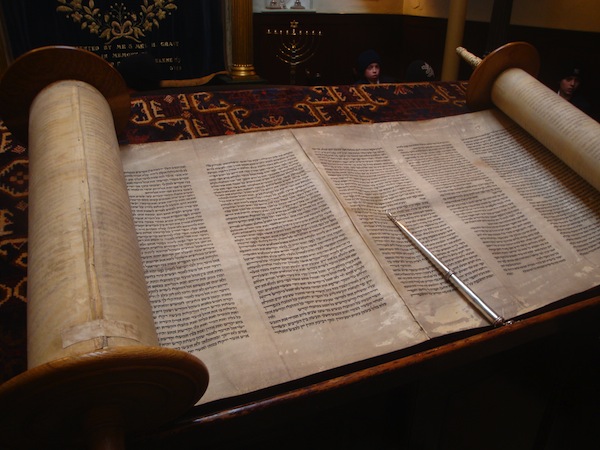
Just as in life outside shul we don’t understand everything we encounter, we don’t all necessarily understand the Torah reading and other parts of the High Holiday service. The High Holidays serve as a metaphor for life itself. (photo from flickr / Lawrie Cate)

Throughout the High Holidays, we repeat in the liturgy pronouncement after pronouncement about our lack of control: we are born against our will, we die against our will, we are but clay in the hands of God, we turn our eyes heavenward as children before a parent, and as slaves before a master. It would be dissonant in such an environment to try to assert our autonomy, to try to shape the experience around our own emotional needs.

And, while we want the High Holidays to be relatable for people, the season by necessity must not be customized to the individual. This is because their meaning lies precisely in the challenge of giving up our individual sense of entitlement in favour of something more important: meaning.

The High Holidays serve as a metaphor for life itself. During this season, we enter into an experience that has been curated for us, that existed before we ever did and which has elements that we are comfortable with and elements that challenge us. I may find myself standing in a synagogue next to people I don’t know, reciting words that I don’t know or would never have written, on a date that means very little to me personally except as a construct of the Jewish calendar.

This is true to life in general: I participate in a world that I don’t completely shape, with others who think differently than I do, within a system that I did not create. We do not choose to be born, nor to which families, nor under what circumstances or accompanied by what baggage. We likewise do not choose what natural successes or tragedies befall us. And, while we do our best to shape our lives, so much of the table is set for us and is beyond our control.

The High Holidays then bid us instead to think about meaning, about the control we do have. If life is not about what we choose, it is about how we choose to engage with what we encounter. We choose how we are going to interpret and how we are going to make meaning of it. How will we choose to see life, and how will our attitudes guide our actions? We may choose to read what we experience charitably or stingily, optimistically, realistically or nihilistically, or more often a messy combination of all of the above. But make no mistake: it is our own choices that will give rise to what we make of those lives that are given to us, to those circumstances that challenge us.

Eschewing a sense of entitlement and control in favour of a sense of meaning and potential is the work of the High Holiday season. It allows us to reflect on how and why we get in our own way, how our sense of entitlement, whether consciously or subconsciously, overrides our good judgment. This helps us to understand the idea of repentance, which is at the core of the High Holidays.

The talmudic sage Rava declared: those who are willing to forgive others easily will likewise be forgiven by God. The language attributed to him is literally, “One who overlooks his/her measurements, [God will overlook all of their sins].” Forgiveness, too, is about letting go of what we may still feel we are owed in favour of building relationships with others. Rather than standing on ceremony over what could have been, I am willing to loosen the reins, to be open to what might emerge. Oftentimes what needlessly keeps us from forgiveness is a focus on what we deserve, what we are entitled to. And, when this happens, we find ourselves once again getting in our own way and holding on to a vision of complete control over what happens or does not happen to us.

Letting go of trying to control the experience is hard. But it can also be liberating. For the High Holiday season, it relieves us of the expectation that we need to relate to everything. More importantly though, for life itself, it relieves us of the expectation of perfection – from ourselves, from others, from life itself.

At the same time, it reminds us of the depth of the human heart and the power of our own will in deciding how we will chart our path forward: that we can come to synagogue not only to be forgiven, but also to forgive; not only to be moved, but to choose to move ourselves.

Wishing all a meaningful New Year.

Dr. Elana Stein Hain is the director of faculty and a senior fellow at the Shalom Hartman Institute of North America, where she serves as lead faculty, directs the activities of the Kogod Research Centre for Contemporary Jewish Thought and consults on the content of lay and professional leadership programs. Articles by Stein Hain and other institute scholars can be found at hartman.org.il. This article was first posted on Times of Israel.

New year, new attitude

One of my twins urges us, after every meal, to offer him dessert. What started as a “desserts on Shabbat, weekends and holidays” and “dessert is a sometimes food” became ”let’s have dessert after nearly every lunch and dinner,” all summer long. He has a sweet tooth. He can often sway us with temptations. It’s hard to resist.

My other twin is often self-limiting when it comes to food. He eats lots of fruits and vegetables, gets full quickly, and often tells his brother, “no, it isn’t a dessert night.” He’s sometimes a little too much into self-denial. It’s a weird sort of sibling pressure and a complicated dichotomy to manage as a parent.

Recently, I studied page 53 of the talmudic tractate Ketubot (marriage contracts). Dr. Sara Ronis offered an introduction from My Jewish Learning. She highlighted an episode in this page of Talmud that describes just how tricky peer pressure can be. It’s a complicated story, so I’m going to summarize Dr. Ronis’s account. Rav Pappa’s son is marrying Abba of Sura’s daughter. They’re writing up the ketubah. Rav Pappa invites his colleague, Yehuda bar Mareimar, along. Abba is a person of limited financial means and Rav Pappa talks through all the potential financial constraints without letting his colleague get a word in edgewise. Then Rav Pappa insists Yehuda should come inside for the ketubah writing.

Yehuda sits silently. Abba feels worried that Yehuda is angry with him. Abba feels pressured and writes an enormous amount of dowry into the marriage contract. It’s all the money he has. Then Abba says (paraphrasing here): “What, you still won’t talk? I have nothing left!”

Yehuda sees the damage and finally speaks up. “Well, don’t act for my sake, this isn’t OK with me.” Then Abba says to Yehuda, “OK, I’m going to retract this.” Then the kicker comes. Yehuda responds (again paraphrasing): “I didn’t speak up so you would be ‘that kind’ of person who retracts a legal document.”

Essentially, this story is a tragedy about social pressure. Even silence can wreck things when a person is very sensitive to peer pressure and power dynamics.

In the great dessert debate at my house, I’ve observed how variable brothers who love each other can be when it comes to this kind of pressure. I’ve got one twin like Rav Pappa (talks a blue streak, seems occasionally clueless and sometimes applies pressure when it comes to dessert) and another kid, maybe like Abba, who is overly self-conscious and senses his parents’ hesitancy. He feels the social pressures so strongly that he overdoes it and self-limits sometimes even when the dessert is offered.

Over the High Holy Days every year, we’re listing a whole slew of sins and failures. Even though the landscape has changed and some of us may be streaming services rather than attending in person, the liturgy doesn’t change. Some of us feel heavily concerned and pressured to repent for the community for every sin on the list, even the ones that well, frankly, we couldn’t possibly have committed. Others of us are not engaged or aware of the pressure, possibly still out in the metaphorical synagogue hallway during services, still trying to cut deals or make potential business connections with others.

It used to be, in a pre-pandemic world, in many congregations, that women would wear new clothing and new hats, in a “see and be seen” Jewish New Year version of the Easter Parade. The pressure to dress up in a certain way is another kind of social pressure.

Perhaps the first step towards understanding the complexity of our social pressures and how to manage these interactions is to recognize that they exist. Once you “see” some of these issues, it’s hard to un-see them. We can then begin to reflect on how to manage the pressures and do better.

I’ll be honest. Although I love dessert, I also have the self-limiting guilty dessert tendencies. Finding that “middle ground” between the all-dessert-all-the-time routine and the “we don’t deserve dessert’” is a path we all may struggle to find. Acknowledging this dynamic and saying out loud that Twin A should stop pressuring us to eat sweets and Twin B should allow himself a scoop of chocolate ice cream sometimes – this is part of speaking and observing this aloud.

When my kids attended Chabad preschool, their birthday parties included cupcakes with lots of icing and a special moment. Each year, the teacher would ask my twins what new mitzvah (commandment) they would take on to celebrate their new age. Like Rosh Hashanah, it was a new year and a chance for self-reflection. The answers of 2-, 3- or 4-year-olds were typically funny ones, but the social pressure was realistic and pushed them towards doing good things. It was often something like, “I’m going to be nicer to my brother” or “I’m going to try to hit people less when I’m angry.”

Sometimes I wonder if we, as adults, could use the pandemic changes to step back, recognize the social complexities around us, and treat Rosh Hashanah and Yom Kippur differently. It’s a whole new year, like those preschool party mitzvah choices. We might experience vastly different things from social situations. We may be heavily influenced by powerful people like Yehuda bar Mareimar. Perhaps we’ve been overexcited and clueless like Rav Pappa. Or, like Abba of Sura, we lose everything because we feel pressured to do things against our own best interests.

Here’s to a meaningful, restful and contemplative holiday, full of love and, yes, good food, including – moderate amounts of – dessert. Wishing you a sweet, honey-filled and happy 5783!

Joanne Seiff has written regularly for CBC Manitoba and various Jewish publications. She is the author of three books, including From the Outside In: Jewish Post Columns 2015-2016, a collection of essays available for digital download or as a paperback from Amazon. Check her out on Instagram @yrnspinner or at joanneseiff.blogspot.com.

New Sephardi congregation

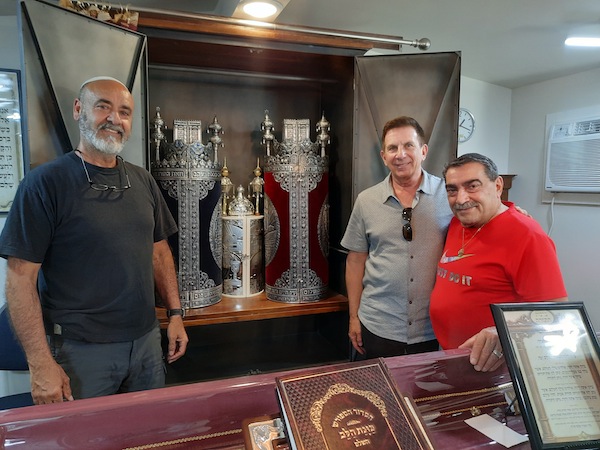
Left to right are Yoseph Hayun, Brian Libin and Shimon Kalhon, founders of Kehillat Klal Israel. (photo by Pat Johnson)

Vancouver has a new Sephardi congregation  – and, while unique in the city, its structure would be familiar to plenty of Israelis and to Jews from places with a larger Orthodox population.

In recent years, alternative housing options have expanded in Vancouver, including coach houses and laneway homes. In an alley behind a home on 12th Avenue, just east of Cambie, passersby might notice a building that resembles one of these newfangled domiciles. Were it not for the mezuzah and the modest sign, they might have no idea that the space is a place for communal gatherings. According to the builder, who does triple duty as the president and leader of daily services, it is not a synagogue.

“A synagogue is a little bit tricky,” said Yoseph Hayun. “I could get [approval for] that, but it’s going to take a long time and I would have to go to a board of variance. We said this was kind of a book club.”

It’s not a lie.

“There are lots of books and we all read the books,” he said. “Then we talk about them.”

The kehillah (congregation or community), called Klal Israel, gathers in the backyard of Shimon Kalhon. The idea started after an informal group of Sephardi families, many of them Israeli, had been getting together for holidays for some time. In Israel, and in places of dense Orthodox populations like parts of the United States, intimate gathering places serving neighbourhood families are not uncommon.

Kalhon said Rosh Hashanah, Yom Kippur and other holidays have taken place under tents and they decided to make it more permanent.

The founders – Kalhon, Hayun and Brian Libin – have nothing against the existing Sephardi synagogue, Beth Hamidrash. They just enjoy the sense of family they get from their small congregation. Kalhon and Hayun also wanted something more like they were familiar with from their upbringing – Kalhon in Tripoli, Libya, and Hayun in Ramat Gan, Israel. (Libin is from Edmonton.)

“For us, we are like a family,” said Kalhon. “We don’t have any politics in the synagogue. We don’t have any membership. Every day after [services] we provide breakfast. Every Shabbat, we have lunch. We do all the holidays together.”

Hayun leads most services, unless Rabbi Yechiel (Helik) Orihman is available. Hayun does not have a rabbinic semichah (ordination), but has served as a cantor almost his entire adult life. He also leads classes and has a conversion group of five at present.

Attendance at morning minyan varies. “Sometimes we have 10, sometimes 12, sometimes 15,” Hayun said. “On the holidays, thank God, we have a beautiful minyan. Sometimes we have 30 people.”

The building itself is about 500 square feet, with air conditioning for summers like the 2021 heat dome, area heaters for winter, plumbing for a washroom and a handwashing station. There is also a fully operational kitchen in a covered patio space of about 400 square feet. There is a screen for presentations and classes, as well as room for cozy meals together.

Kalhon jokes about his family’s long walk to services – out the back door and down a few steps.

Kalhon is known to many Vancouver Jews as the owner of Sabra Kosher Restaurant and Bakery, which he opened in 1991 on arrival in the city after a lifetime in the food sector in Israel. At Klal Israel, he is the gabbai(lay leader).

For Libin, the treasurer, the new congregation has been an opportunity to improve his Hebrew skills.

“All the prayers are in Hebrew,” he said. “There’s not much English. There are times where Yossi [Hayun] will explain things, but, for the most part, I’m using a book that’s all in Hebrew. I didn’t used to. Most of us who aren’t native speakers of Hebrew, our Hebrew has improved.”

The linguistic choice is deliberate.

“This is the idea: to bring the young Israelis,” Hayun said, adding that he meets many Israelis on his soccer team, playing golf and around town who do not attend shul. “My vision is to bring them in, to try once a week, once a month, doesn’t matter. Just bring them in. That’s basically the idea and people are coming … slowly, slowly.”

Funds for the building and its operations come from the three founders and anyone else who wants to make an out-of-pocket contribution.

“We have others who are regulars who help out whenever they can,” Libin said.

While the place technically houses a book club, Hayun said it was designed following the religious laws for how a synagogue must be built.

“It’s not like you do whatever,” he said. “There are rules that you need to follow. I know the rules and I went over the books again and again to make sure that we followed the whole thing.”

The aron kodesh, the Torah ark, is the focus of the modest structure and the Torah covers were commissioned by local people for scrolls that were purchased from Israel.

The trio have already mooted what will happen if success renders the space – which seats 40 – too small. They shrug and say they’ll find a bigger place. In the meantime, Klal Israel is open for anyone who wants to join – and stay for a shmooze and refreshments after services.

Broza releases Tefila

David Broza has a new album out, and more. (photo from davidbroza.net)

This past spring, Israeli singer-songwriter David Broza, with the support of Temple Emanu-El in New York City, released Tefila, a collection of traditional prayers with new musical compositions by Broza and orchestral arrangements by his musical collaborator, Omer Avital.

Tefila (prayer in Hebrew) incorporates various forms: pop and jazz, gospel, folk and classical. While adhering to the intentions of the prayers themselves, the compositions attempt to recreate and re-imagine the experience of the typical Shabbat service, making it, as the album notes suggest, “contemplative, but also ecstatic and wholly engaging.”

The album’s release coincided with a monthly Kabbalat Shabbat celebration, Friday Night Hub, at Temple Emanu-El, a Reform synagogue located in Manhattan. Both the music and the event are geared to young professional Jewish adults between the ages of 21 and 39.

In a recent interview with the Independent, Broza explained how the album came about.

“I got a call from the program director of Temple Emanu-El, Gady Levy. He asked me if I would consider writing new music to the prayers of Kabbalat Shabbat,” said Broza. “I must admit that I was somewhat reluctant as I am not very familiar with the prayers, although I know them from my father. However, after a few months of quarantine, I opened the file with the prayers and started composing the melodies. It was as if the moment had arrived and what just a few months back I thought I would never be able to accomplish, here I was composing and writing a prayer a day for 14 days. Magical.”

With this project, Broza said he ventured into the journey of Kabbalat Shabbat, the receiving of Shabbat, and he fell in love “with the Hebrew scriptures that were written so many generations ago.”

“Now,” he said, “I have given them a new interpretation from someone who was born and raised in Israel. These prayers were written long before Israel existed, and long before the culture of the Hebrew language became a common language, my mother tongue. My voice and melodies blended the words and delivered the new version of these formidable and emblematic sacred verses.”

As for how the musicians came together for the album, Broza said, “I was very lucky to meet Omer, who is an incredibly talented jazz musician, on a New York City sidewalk – literally, by chance. He knew who I was, as he is Israeli, and I love his music. So, I asked him immediately to join me on the challenge of orchestrating the 14 pieces I had just composed. This was my first obstacle and Omer agreed to take it on himself.”

The pair started meeting at Avital’s studio in Brooklyn. In the process, Avital brought in musicians he performs with – all Israeli jazz musicians living in the area.

“It was so inspiring. We would play the songs, prayers, and I got to hear them interpreted in a very lively and profound way. The whole process took about a year before we were ready to record,” Broza said.

image - Tefila album coverThe album features 22 musicians, including string and horn sections, piano, percussion, as well as Broza on guitar and Avital on bass. Also appearing on the album is the 25-piece Moran Choir from Israel, which is conducted by Naomi Faran and with whom Broza has worked many times in his decades-long carrier. While in New York, Broza recruited gospel singers, too, as he wanted to add that fusion to the recording.

At the time Broza spoke with the Independent, he and his fellow musicians had performed the prayers from Tefila twice in front of a live audience at Temple Emanu-El.

“We have had about a thousand people attend each time. It’s been amazing. The rabbi of the synagogue, Joshua Davidson, leads the prayer and comes on stage to tell some stories and other comments in a very tasteful way so it is all a very profound experience,” Broza said.

An internationally recognized musician, Broza’s oeuvre includes songs in Hebrew, Spanish and English, with the influence of Spanish flamenco, American folk, rock and roll, and verse.

Social justice and peace advocacy are mainstays of his work, and his 1977 song “Yihye Tov” is considered an Israeli peace anthem. He has released more than 40 albums, many of which are multi-platinum.

Broza spoke highly of past visits to Vancouver and would welcome the chance to perform here again.

The album was released on Broza Records and distributed digitally by MNRK Music Group.

On Sept. 21, Broza Records will release a cover of “So Long, Marianne,” the first track in a three-song collection entitled David Broza Sings Leonard Cohen. Cover versions of Cohen’s “Famous Blue Raincoat” and “Dance Me to the End of Love” will be released on Oct. 21 and Nov. 21, respectively.

For more information, visit davidbroza.net.

Sam Margolis has written for the Globe and Mail, the National Post, UPI and MSNBC.