
Skip to content
  • Home
  • Subscribe / donate
  • Events calendar
  • News
    • Local
    • National
    • Israel
    • World
    • עניין בחדשות
      A roundup of news in Canada and further afield, in Hebrew.
  • Opinion
    • From the JI
    • Op-Ed
  • Arts & Culture
    • Performing Arts
    • Music
    • Books
    • Visual Arts
    • TV & Film
  • Life
    • Celebrating the Holidays
    • Travel
    • The Daily Snooze
      Cartoons by Jacob Samuel
    • Mystery Photo
      Help the JI and JMABC fill in the gaps in our archives.
  • Community Links
    • Organizations, Etc.
    • Other News Sources & Blogs
    • Business Directory
  • FAQ
  • JI Chai Celebration
  • JI@88! video

Recent Posts

  • תגובתי לכתבה על ישראלים שרצו להגר לקנדה ולא קיבלו אותם עם שטיח אדום
  • Lessons in Mamdani’s win
  • West Van Story at the York
  • Words hold much power
  • Plenty of hopefulness
  • Lessons from past for today
  • Rebuilding a life after Shoah
  • Raising existential questions
  • Explore Jewish music 
  • Life, beginning to end
  • Give yourself the gift of love
  • From the archives … books
  • היהירות היא אחד האויבים הגדולים ביותר של ישראל
  • Vrba monument is unveiled
  • Music to build bridges
  • A better future possible
  • Anne Frank exhibit on now
  • Human rights in sport
  • Telling the story of an icon
  • Crawl bigger than ever
  • JCC Maccabi in Toronto
  • A way to meet fellow Jews
  • Time to include
  • Add Jewish joy to the mix
  • Reminder of humanity’s light
  • From the archives … editorials
  • Year-round holiday recipes
  • מדוע עזבתי את ישראל ואינני חושב לחזור ארצה
  • OJC hosts Oct. 7 memorial
  • A journey beyond self
  • Antisemitism a problem
  • Young man is missed
  • Orr action sparks complaint
  • Prison sentence for hate
  • Etgar Keret comes to Vancouver
  • New fall lecture series

Archives

Follow @JewishIndie
image - The CJN - Visit Us Banner - 300x600 - 101625

Tag: Hodie Kahn

Survival in the forest

The harrowing new memoir by Vancouver’s Evelyn Kahn, They Never Left Me: A Holocaust Memoir of Maternal Courage and Triumph, written with her daughter Hodie Kahn, tells of a family’s survival while hiding in the forests of Eastern Europe.

They Never Left Me includes some of the most debasing inhumanity imaginable. Perhaps most shocking, though, is that human beings can withstand what the author and her family experienced and somehow endure and begin again in a post-Holocaust world, to raise a successful family and find meaning and happiness.
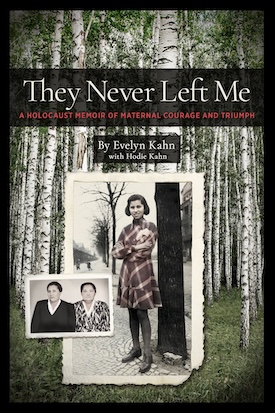
image - They Never Left Me book cover
Evelyn Kahn wrote They Never Left Me: A Holocaust Memoir of Maternal Courage and Triumph with her daughter, Hodie Kahn. On Oct. 19, at Schara Tzedeck Synagogue, Evelyn Kahn will talk about the book with Dr. Robert Krell.

Stories of Chava’s (Evelyn’s) early years, typical of traditional Eastern European Jewish shtetl life – her father’s preparations for morning prayers, her mother baking round challah for Rosh Hashanah, a live fish floating around in preparation for gefilte – read as ominously ordinary, knowing as we do a little of what is to come. 

From their hometown of Eishyshok, a shtetl in Poland that historically had shifted between Lithuania, Poland and then, tragically, between the Nazis and the Soviets, the family moved a few dozen kilometres to Lida, in what is now Belarus. This relocation, an economic move driven by her father’s proficiency in the Russian language, was the least dramatic move of Chava Landsman’s young life. Nonetheless, that move might have been the first of many near-miracles that saved the lives of Chava and the women in her family.

“On the eve of Rosh Hashanah 1941, Eishyshok’s Jews were rounded up and locked in the synagogue and two schools. After three days, they were herded to the horse market.… Over the next two days, the Jews were taken in groups of 250 – first the men and then the women and children – to the old Jewish cemetery. They were ordered to undress and stand at the edge of large open ditches, where they were shot to death by Lithuanian police. Babies were bashed to death against headstones or tossed into the air for sharpshooting practice led by the chief of police, Ostrauskas, before their tiny lifeless or quivering bodies were thrown into the killing pits to join their parents. Everyone was murdered.”

The final victim of the massacre was the town rabbi, “shot after being forced to witness the murder of his entire flock.”

As the Nazis invaded Lida, the family witnessed the aerial bombardment and made the decision to flee. They headed south, and sought refuge in another shtetl, Zhetel. But this was a brief refuge – not an escape. Death was chasing them. 

Chava’s father was rounded up during a cull of intelligentsia on July 23, 1941, barely a month after they arrived. 

“We watched in misery as Papa climbed into the back of a truck and was driven away,” she writes. “I never saw my father again.”

Chava’s Uncle Chaim and Rivke’s husband Shael were conscripted into the Red Army, leaving the women as the only family together in the Zhetel ghetto, which was created in February 1942. Chaim was captured by the Nazis, but incredibly escaped a POW camp and returned to Zhetel, where he became a Partisan in the forest and was killed. On April 30, 1942, the first liquidation began in the Zhetel ghetto.

“My own memory of the procession along the street is of being corralled into a narrow funnel and of feeling smothered by the crush of human bodies around me,” she writes. “I remember telling my mother I could not breathe. I was worried I might pass out and be trampled. People were on top of one another – on top of me – crying and tearing their hair out. I wanted Mama to pick me up, but it was impossible. We were compressed like livestock in a cattle chute. I just held onto Mama’s hand and prayed that mine would not slip out of hers.”

In terror, Chava told her mother she was being suffocated.

“She bent down close to me and I will never forget her tearful words,” Kahn writes. “My child, it is better that you should suffocate here than my eyes should witness you being murdered.

“I took in what she said and then simply asked, ‘Does it hurt to die, Mama?’ She assured me it was a peaceful experience. ‘Neyn mayn kind, es iz vey a feygele, git a brum’ (‘No my child, it is like a chirp of a bird’).

“Her answer quieted my fears and calmed me. I was never afraid of death from that moment on. I never remember feeling despair. On the contrary, I was exceptionally calm and clear throughout the nightmare to come.”

Somehow, the women survived the first liquidation. When the second and what would be the final liquidation of the ghetto began on Aug. 6, 1942, 3,000 Jews were herded to the Jewish cemetery and murdered. Knowing what was to come, Chava’s mother Basia decided to risk going into hiding – a choice between instant death and likely later death for disobedience. Again, it was a lifesaving decision.

Basia, Chava and her grandmother (Bobe) Hoda fled to the forest. Miraculously, with the help of a non-Jewish friend of the family, they were reunited with Chava’s Aunt Rivke, and the three adult women and Chava would endure the horrors of life in the woods for two years. (Shael fought with the Red Army through the war and survived, but he and Rivke did not reunite.)

The women largely fended for themselves with some assistance from Partisans and the occasional righteous non-Jew. Like other Jews in the forests at the time, they formed fluctuating ad hoc survival “family groups” of a dozen or as many as 20 people.

“We had learned the rules of the ghetto and we had survived. Now we would have to learn the rules of the forest. And we would have to learn them very, very well and very, very quickly. We could either adapt and hopefully live or not adapt and definitely die.

“We lived with the constant nervous anticipation of being discovered and killed at any moment. We were careful to speak quietly. We were always alert. We became as hypersensitized and wary as the creatures of the forest.”

In winter, they sheltered in holes in the ground. 

“Needless to say, hygiene and maintaining our health in the forest was hugely challenging,” Kahn writes. “We were malnourished and vitamin deficient. We were unwashed and unkempt. We wore the same clothes day after day with no relief. We were filthy skeletons, bulked up only by the layers of our lice-infested clothing, which we wore 24 hours a day. I often wonder how we managed to survive those two years without bathing.”

Basia’s doggedness saved her family. Even at 40 degrees below zero and with snow to her thighs, she would trudge out of the woods to beg or steal provisions from local farmers. 

“It is true that many (most) farmers were unfeeling or, worse, informers. But it is important to acknowledge that there were those who hung onto their humanity during the war, righteous gentiles who were sympathetic and compassionate and gave us food and other necessities,” Kahn writes.

It is estimated that only one-half to one-third of the Jews who hid in forests survived to liberation. And, when “liberation” did come, and the Nazis were defeated, antisemitism remained. Many ordinary Russians, Poles, Lithuanians and Belarusians thought they had seen the last of the Jews and were not welcoming to the few straggling remnants who found their way back home.

The three generations of women – Bobe Hoda, mother Basia, Aunt Rivke and Chava, as well as Rivke’s baby, Joseph, who was born in and knew life only in the forest – remarkably survived and proceeded through a series of displaced persons camps, with schooling and vocational training for the young survivors. They had no family in the new state of Israel and so America seemed the more logical destination. At age 16-and-a-half, Chaya/Evelyn, her mother, aunt, cousin and grandmother were greeted at New York by the Statue of Liberty and a coterie of cousins. Eventually, Evelyn reconnected with a young man from Eishyshok, Leon (Leibke) Kaganowicz, who would become Leon Kahn and, because of American migration quotas, a Canadian who lived in Vancouver. Together, they became stalwarts of the Vancouver community.

Leon Kahn passed in 2003. His memoir, No Time To Mourn: The True Story of a Jewish Partisan Fighter, was published in 1978 and reissued in 2004. It will be released again this fall.

Evelyn has two sons, Mark and Saul, and daughter Hodie, as well as seven grandchildren and three great-grandchildren.

The idyllic start of Chava’s life, surrounded by a tight and loving family and community, juxtaposes horrifically with the abrupt cataclysm of history that would follow. The survival of three generations of women in the forests of Eastern Europe is a monument to human resolve and resilience. They Never Left Me is a momentous contribution to the literature of the Holocaust.

An event featuring Evelyn Kahn in conversation about the memoir with Dr. Robert Krell will take place on Oct. 19, 2 p.m., at Schara Tzedeck Synagogue, presented by the Vancouver Holocaust Education Centre, Ronsdale Press and Schara Tzedeck. 

Posted on September 26, 2025September 24, 2025Author Pat JohnsonCategories BooksTags book lauch, Evelyn Kahn, history, Hodie Kahn, Holocaust, memoirs, Ronsdale Press, Schara Tzedeck, survivors, They Never Left Me, Vancouver Holocaust Education Centre, VHEC
Revitalizing community

Revitalizing community

Torah West wants to make Metro Vancouver a destination for more Orthodox newcomers. (photo by Cynthia Ramsay)

A new initiative, called Torah West, aims to grow Metro Vancouver’s Jewish population and make it more attractive to Orthodox newcomers – a goal that proponents say will strengthen every component of the community.

Torah West is focused on three Rs: retain, recruit and revitalize. It seeks to stanch the departure of Orthodox families from the region, recruit newcomers and, in the process, revitalize not only the institutions that serve specifically Orthodox families but increase demand and support for services that enhance life for all Jewish British Columbians.

“The more people who come, the more services we’re going to need to be able to sustain those people,” said Dr. Jonathon Leipsic, who co-chairs Torah West with Hodie Kahn. “More kosher restaurants, more people availing themselves of kosher food, more camps, more campers, more kids in Jewish day schools, more synagogue memberships, more Jewish community members, more people taking leadership roles in the community, more people investing in the community and on and on and on.”

Among many other community roles, Leipsic is president of Congregation Schara Tzedeck and Kahn is a past president. Together, they saw a growing challenge in the community and decided to act. They credit the Diamond Foundation for funding a 2020 study of the challenges facing the Orthodox community here, and the Jewish Federation of Greater Vancouver, especially vice-president Shelley Rivkin, for taking Torah West under their umbrella. The initiative will not see brick-and-mortar projects, but rather seeks to close gaps that make observing an Orthodox life in the city challenging.

Facilitating relocation to British Columbia might mean something as simple and comparatively affordable as helping a family with first and last months’ rent. If families want to live in Vancouver but send their kids to yeshivah in Las Vegas or Denver or elsewhere, Torah West can help fund flights home for the holidays, for example, if that tips the scales for the family’s place-of-residence decision. Other angles might include deferred membership fees to synagogues, the Jewish Community Centre of Greater Vancouver or other institutions. The community has systems in place to make Jewish summer camps accessible for all families and, if helping fund travel to the East or to the United States to access another form of camp would encourage families to relocate here, Torah West would support that.

Torah West will work with the Provincial Nominee Program, in which the federal government invites provinces to designate streams of immigrants that fill regional needs. Guiding newcomers through the immigration process, helping them get their credentials assessed and assisting in finding employment will ease some of the logistical challenges of relocation.

The initiative is loosely based on GROWWINNIPEG, a project of Manitoba’s Jewish community that has helped facilitate as many as 1,800 Jewish families migrating there, although there are distinct differences – cost of living, notably – that require unique responses.

Part of the motivation for Torah West was the loss of the Pacific Torah Institute yeshivah and limited Orthodox educational options in the city. But that is merely part of a longer trajectory. In her lifetime, Kahn said, she has witnessed waves in the community, in which there were more or fewer Orthodox families and, in turn, educators and infrastructure to serve them. The end of PTI was just part of a trend, she said, but it was a big blow.

“As they say, every crisis is an opportunity,” she said. “This crisis is that opportunity. Torah West is the response to that opportunity.”

Kahn said a notable aspect of Torah West is the buy-in from every single Orthodox group in the region.

“What’s innovative and fresh about the initiative is that it was developed collaboratively with all the Orthodox institutions and the Chabad centres across the Lower Mainland,” she said. “It’s very groundbreaking in that sense.”

That sort of collegiality is symptomatic not only of the Orthodox community but of the entire Vancouver Jewish community, Kahn said, something she sees as remarkable.

“Granted, we all have our little tiny silos of religious observance, which is reflected in the religious institutions that we choose to align ourselves with,” said Kahn. “But when it comes to the community, Orthodox rabbis play with Reform rabbis … Conservative rabbis play with Chabad. It’s a very unique kind of cultural experience that we have here and it’s reflected in the individuals who share the community and build the community. In a lot of other communities, those silos are very wide and very deep and they do not cross-pollinate or necessarily engage with one another to the extent that we do here.”

Both Kahn and Leipsic stress that a larger Orthodox community means a strengthening of every aspect of the community, to the benefit of all.

“We need to look at undergirding the Orthodox community because, at the end of the day, they provide the Jewish educators for our community, they provide the consumers for Jewish infrastructure like kosher restaurants or other services that are not just Orthodox-centric, they are Jewish-centric,” Kahn said. “That is what our vision is, to make sure that we have the proper foundation that will accrue to the benefit of the entire community at large.”

Similarly, while Torah West aims to draw new Orthodox families, the services the program provides will be available to anyone across the spectrum.

“We welcome everybody,” said Kahn. “There’s nobody who is going to, as they say, measure the length of your tzitzit. But we do have a hope and a dream and maybe some expectation that, if you become part of the Torah West initiative, you will, in turn, become part of the initiative in every respect. That means becoming a member of a synagogue, becoming a consumer of the kosher restaurant, or start another kosher restaurant, ensuring that the kosher butcher can stay in business.… We have a dream that we can create in Vancouver a nexus that combines the gloriousness of life in Vancouver with the ability to sustain a Torah lifestyle and the infrastructure that makes that possible.”

Nobody can talk about migrating to Vancouver without addressing the economic elephant in the room.

“The cost of living in Vancouver obviously has an impact,” said Leipsic, adding that the community is addressing macroeconomic issues and will continue to do so. “As far as people we want to recruit, we think that there are a number of people with capacity, who seek freedom and the opportunity to live a Torah-observant life or a traditional life in a nonjudgmental, diverse community with a lot of richness in it.”

Economic, political and social challenges in South America make that a target market of Torah West. In these cases, migration may be less an economic decision than one based on a desire for political stability.

Not coincidentally, the manager and community liaison of Torah West, Amanda Aron Chimanovitch, is herself a Brazilian-Canadian who came here via the Winnipeg project.

“Our goal is to make sure that there are economic and social and other supports for families who do want to come here,” said Kahn. “Ideally, families that are self-sustaining is a fantastic thing; it’s fantastic for all of us. But we’re not about to turn ourselves blind to the idea that, if you’re a Jewish educator, as an example, Vancouver is a very challenging place to be able to live independently without some support. I think we’re looking to help bridge that gap a little bit.”

Torah West is a three-year pilot project that Kahn and Leipsic are hopeful will prove permanent. Just putting Vancouver on the map as a possible home will be a success.

“When people are thinking about relocating, Vancouver is not even in their consciousness,” Kahn said of many Orthodox families. “Our goal is to create Vancouver as an option for them – whether it becomes the ultimate choice, we can’t control that. But we at least want to put Vancouver on the map.… You need a little bit of pioneer spirit to come here. If you’re looking for a place that’s already got all the amenities and got all the infrastructure, Vancouver is probably not your place. If you’re looking for a place of insurmountable geographical beauty and a real special feeling in the community and the landscape upon which you can plant your own trees and nurture them and make them part of the forest, this is the place for you.”

Rivkin, vice-president of planning, allocations and community affairs at the Jewish Federation, credits the Winnipeg project as a model but acknowledged differences. While Winnipeg was experiencing a declining Jewish population, that is not the case in Vancouver. This is one of North America’s fastest-growing Jewish communities.

“We don’t actually have a diminishing Jewish community, we have a diminishing community of people who are traditional or Orthodox,” said Rivkin. The reasons are straightforward. “We don’t have a yeshivah anymore, we don’t have summer camps that meet the needs of the Orthodox community, we don’t have a nice [kosher] restaurant here anymore.”

Rivkin said studies indicate that new Canadians tend to earn lower salaries than other Canadians in a similar role for up to 10 years after arrival. Helping people through the first challenging years is part of Torah West’s mission.

Kahn summed it up simply.

“There’s something very beautiful about a small community, something especially beautiful about the Vancouver Jewish community,” she said. “What we would love to see is just more opportunity for people who are seeking a halachic Torah lifestyle to be able to do that in Vancouver.”

Format ImagePosted on April 22, 2022April 21, 2022Author Pat JohnsonCategories LocalTags education, Hodie Kahn, Jonathon Leipsic, Judaism, Metro Vancouver, Orthodox, Shelley Rivkin, Torah West
Proudly powered by WordPress