
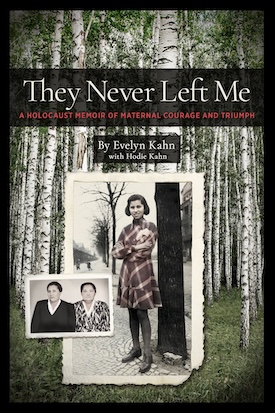
The harrowing new memoir by Vancouver’s Evelyn Kahn, They Never Left Me: A Holocaust Memoir of Maternal Courage and Triumph, written with her daughter Hodie Kahn, tells of a family’s survival while hiding in the forests of Eastern Europe.
They Never Left Me includes some of the most debasing inhumanity imaginable. Perhaps most shocking, though, is that human beings can withstand what the author and her family experienced and somehow endure and begin again in a post-Holocaust world, to raise a successful family and find meaning and happiness.
Stories of Chava’s (Evelyn’s) early years, typical of traditional Eastern European Jewish shtetl life – her father’s preparations for morning prayers, her mother baking round challah for Rosh Hashanah, a live fish floating around in preparation for gefilte – read as ominously ordinary, knowing as we do a little of what is to come.
From their hometown of Eishyshok, a shtetl in Poland that historically had shifted between Lithuania, Poland and then, tragically, between the Nazis and the Soviets, the family moved a few dozen kilometres to Lida, in what is now Belarus. This relocation, an economic move driven by her father’s proficiency in the Russian language, was the least dramatic move of Chava Landsman’s young life. Nonetheless, that move might have been the first of many near-miracles that saved the lives of Chava and the women in her family.
“On the eve of Rosh Hashanah 1941, Eishyshok’s Jews were rounded up and locked in the synagogue and two schools. After three days, they were herded to the horse market.… Over the next two days, the Jews were taken in groups of 250 – first the men and then the women and children – to the old Jewish cemetery. They were ordered to undress and stand at the edge of large open ditches, where they were shot to death by Lithuanian police. Babies were bashed to death against headstones or tossed into the air for sharpshooting practice led by the chief of police, Ostrauskas, before their tiny lifeless or quivering bodies were thrown into the killing pits to join their parents. Everyone was murdered.”
The final victim of the massacre was the town rabbi, “shot after being forced to witness the murder of his entire flock.”
As the Nazis invaded Lida, the family witnessed the aerial bombardment and made the decision to flee. They headed south, and sought refuge in another shtetl, Zhetel. But this was a brief refuge – not an escape. Death was chasing them.
Chava’s father was rounded up during a cull of intelligentsia on July 23, 1941, barely a month after they arrived.
“We watched in misery as Papa climbed into the back of a truck and was driven away,” she writes. “I never saw my father again.”
Chava’s Uncle Chaim and Rivke’s husband Shael were conscripted into the Red Army, leaving the women as the only family together in the Zhetel ghetto, which was created in February 1942. Chaim was captured by the Nazis, but incredibly escaped a POW camp and returned to Zhetel, where he became a Partisan in the forest and was killed. On April 30, 1942, the first liquidation began in the Zhetel ghetto.
“My own memory of the procession along the street is of being corralled into a narrow funnel and of feeling smothered by the crush of human bodies around me,” she writes. “I remember telling my mother I could not breathe. I was worried I might pass out and be trampled. People were on top of one another – on top of me – crying and tearing their hair out. I wanted Mama to pick me up, but it was impossible. We were compressed like livestock in a cattle chute. I just held onto Mama’s hand and prayed that mine would not slip out of hers.”
In terror, Chava told her mother she was being suffocated.
“She bent down close to me and I will never forget her tearful words,” Kahn writes. “My child, it is better that you should suffocate here than my eyes should witness you being murdered.
“I took in what she said and then simply asked, ‘Does it hurt to die, Mama?’ She assured me it was a peaceful experience. ‘Neyn mayn kind, es iz vey a feygele, git a brum’ (‘No my child, it is like a chirp of a bird’).
“Her answer quieted my fears and calmed me. I was never afraid of death from that moment on. I never remember feeling despair. On the contrary, I was exceptionally calm and clear throughout the nightmare to come.”
Somehow, the women survived the first liquidation. When the second and what would be the final liquidation of the ghetto began on Aug. 6, 1942, 3,000 Jews were herded to the Jewish cemetery and murdered. Knowing what was to come, Chava’s mother Basia decided to risk going into hiding – a choice between instant death and likely later death for disobedience. Again, it was a lifesaving decision.
Basia, Chava and her grandmother (Bobe) Hoda fled to the forest. Miraculously, with the help of a non-Jewish friend of the family, they were reunited with Chava’s Aunt Rivke, and the three adult women and Chava would endure the horrors of life in the woods for two years. (Shael fought with the Red Army through the war and survived, but he and Rivke did not reunite.)
The women largely fended for themselves with some assistance from Partisans and the occasional righteous non-Jew. Like other Jews in the forests at the time, they formed fluctuating ad hoc survival “family groups” of a dozen or as many as 20 people.
“We had learned the rules of the ghetto and we had survived. Now we would have to learn the rules of the forest. And we would have to learn them very, very well and very, very quickly. We could either adapt and hopefully live or not adapt and definitely die.
“We lived with the constant nervous anticipation of being discovered and killed at any moment. We were careful to speak quietly. We were always alert. We became as hypersensitized and wary as the creatures of the forest.”
In winter, they sheltered in holes in the ground.
“Needless to say, hygiene and maintaining our health in the forest was hugely challenging,” Kahn writes. “We were malnourished and vitamin deficient. We were unwashed and unkempt. We wore the same clothes day after day with no relief. We were filthy skeletons, bulked up only by the layers of our lice-infested clothing, which we wore 24 hours a day. I often wonder how we managed to survive those two years without bathing.”
Basia’s doggedness saved her family. Even at 40 degrees below zero and with snow to her thighs, she would trudge out of the woods to beg or steal provisions from local farmers.
“It is true that many (most) farmers were unfeeling or, worse, informers. But it is important to acknowledge that there were those who hung onto their humanity during the war, righteous gentiles who were sympathetic and compassionate and gave us food and other necessities,” Kahn writes.
It is estimated that only one-half to one-third of the Jews who hid in forests survived to liberation. And, when “liberation” did come, and the Nazis were defeated, antisemitism remained. Many ordinary Russians, Poles, Lithuanians and Belarusians thought they had seen the last of the Jews and were not welcoming to the few straggling remnants who found their way back home.
The three generations of women – Bobe Hoda, mother Basia, Aunt Rivke and Chava, as well as Rivke’s baby, Joseph, who was born in and knew life only in the forest – remarkably survived and proceeded through a series of displaced persons camps, with schooling and vocational training for the young survivors. They had no family in the new state of Israel and so America seemed the more logical destination. At age 16-and-a-half, Chaya/Evelyn, her mother, aunt, cousin and grandmother were greeted at New York by the Statue of Liberty and a coterie of cousins. Eventually, Evelyn reconnected with a young man from Eishyshok, Leon (Leibke) Kaganowicz, who would become Leon Kahn and, because of American migration quotas, a Canadian who lived in Vancouver. Together, they became stalwarts of the Vancouver community.
Leon Kahn passed in 2003. His memoir, No Time To Mourn: The True Story of a Jewish Partisan Fighter, was published in 1978 and reissued in 2004. It will be released again this fall.
Evelyn has two sons, Mark and Saul, and daughter Hodie, as well as seven grandchildren and three great-grandchildren.
The idyllic start of Chava’s life, surrounded by a tight and loving family and community, juxtaposes horrifically with the abrupt cataclysm of history that would follow. The survival of three generations of women in the forests of Eastern Europe is a monument to human resolve and resilience. They Never Left Me is a momentous contribution to the literature of the Holocaust.
An event featuring Evelyn Kahn in conversation about the memoir with Dr. Robert Krell will take place on Oct. 19, 2 p.m., at Schara Tzedeck Synagogue, presented by the Vancouver Holocaust Education Centre, Ronsdale Press and Schara Tzedeck.