Skip to content
  • Home
  • Subscribe / donate
  • Events calendar
  • Business Directory
  • FAQ
  • News
    • Local
    • National
    • Israel
    • World
    • עניין בחדשות
      A roundup of news in Canada and further afield, in Hebrew.
  • Opinion
    • From the JI
    • Op-Ed
  • Arts & Culture
    • Performing Arts
    • Music
    • Books
    • Visual Arts
    • TV & Film
  • Life
    • Celebrating the Holidays
    • Travel
    • The Daily Snooze
      Cartoons by Jacob Samuel
    • Mystery Photo
      Help the JI and JMABC fill in the gaps in our archives.
  • Community Links
    • Organizations, Etc.
    • Other News Sources & Blogs
  • JI Chai Celebration
  • JI@88! video

Recent Posts

  • Federation now across BC
  • Israel fighting for its existence
  • Deal strengthens Iran
  • Patriotic belonging diminishes
  • A campaign to engage
  • Upstanders’ first live event
  • Responding to Carney
  • Having your own home
  • Music a family tradition
  • Musical to warm heart
  • Community milestones … June 2026
  • Sharing her passion for Israel
  • Or Shalom reopens its doors
  • JFS from past to future
  • Need holistic approach
  • Sharing stories, advice
  • Journalist shares fears
  • Skills to live together
  • Road to independence
  • Cutting grass with scissors
  • Zionism as a solution
  • Deceit, desire & the divine
  • Reclaiming sacredness
  • Creative project ideas
  • Summer squares and cobbler
  • Thou shalt … summer commandments
  • Legal help for students
  • Revisiting myth of Lilith
  • Wrong person rebuked
  • Canada’s mixed messages
  • Questions for museum
  • Symposium on antizionism
  • Making soccer political
  • CJPAC lauds Pulver’s impact
  • City recognizes Vrba’s legacy  
  • Organ donation saves lives

Archives

Follow @JewishIndie
image - CJN box ad Rockowers 2026

Tag: Israel

Israel’s soldiers not forgotten

Israel’s soldiers not forgotten

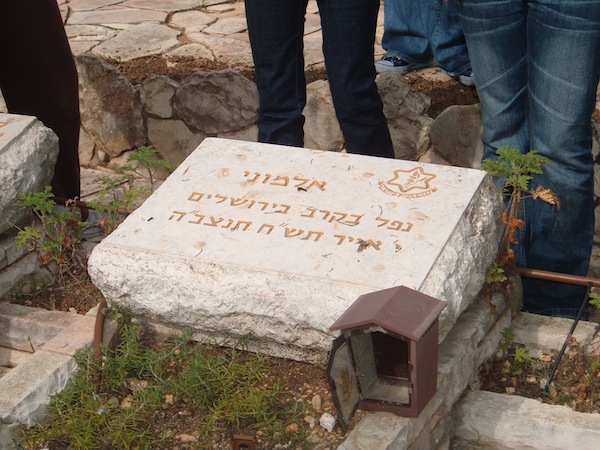
The grave of an unknown soldier on Mt. Herzl in Jerusalem. (photo by Deborah Rubin Fields)

As of Israel Independence Day last year, 23,741 Israeli soldiers had died during their service. The country has come to memorialize its fallen soldiers in one of three ways: 1) most commonly, it provides a grave and a headstone in a military cemetery, with information provided on the soldier, 2) when there is no official grave (that is, when no one really knows where the body of the deceased is), it inscribes the name either on a memorial wall or marker, and 3) it furnishes a grave and a headstone, but little or no information about the deceased is engraved on the stone.

Today, when a soldier dies, the following identification is to be established: the name of the soldier, their army identification number, national civilian identification number, army rank and army unit, as well as their job in the army. When they are buried, the headstone notes the full name of the deceased, their parents’ first names, country of birth (if outside of Israel), date of birth (according to both the Hebrew and Gregorian calendars), aliyah date, date and place of death and age at the time of death. The stone also contains the emblem of the Israel Defence Forces. In a military cemetery, the tombstone’s content reflects a high degree of uniformity. One monument pretty much contains the same details as the next one.

In pre-state Israel and in the War of Independence in 1948, these practices were not yet in place. Young men and women – many of whom had just survived the Holocaust – fought to establish the state. They (and all other soldiers) had little military training. They might not have known Hebrew very well. Not uncommonly, they were the only survivor of their families.

Times were tense, at times verging on the chaotic. The fighting left limited time for socializing, for establishing relationships. So, if a soldier died, it was not surprising to have known them only by their first name. Under the circumstances, most fellow fighters would not have been acquainted with the soldier’s parents, would not have even known their names.

At the end of the War of Independence, about 1,000 of the 4,500 fallen were considered missing. It was the chief rabbi of the IDF, Rabbi Shlomo Goren, who initiated an intensive project of identifying the dead. The establishment of military cemeteries helped the identification process move forward, but, even after that, there remained anonymous soldiers, and headstones with missing information.

Recognizing this situation, Dorit Perry and Uri Sagi started Giving a Face to the Fallen. The organization has been in existence fewer than 10 years. Its team of some 52 volunteer investigators and activists comes from a variety of backgrounds. It includes bereaved family members, friends of fallen soldiers, judges, former career army officers and others. As the organization’s website states, all volunteers believe there is “a duty to remember and, in so doing, to … repay the debt we owe to those who gave their lives for the establishment of the state of Israel.”

All of the volunteers are in a race against time, trying to piece together information on 500 soldiers who fell fighting either in pre-state Israel or in the War of Independence. They ask the following questions: Did you (or maybe your grandfather or an older neighbour) know the fighter we are researching? Maybe you fought with such person either before the creation of the state or in the War of Independence? Maybe you still have pictures of your fighting unit?

The volunteers also try to fill in blanks by asking to see old photos of youth movement activities, aliyah preparation groups (aliyah registration cards have provided investigators with correct birth dates and with the names of relatives, see blog.nli.org.il/en/baumgarten) and family albums. Some soldiers do not even have a photo on file.

Besides trying to find people still alive who were acquainted with these fallen soldiers, volunteers search archives. It is real detective work. When successful, there is the rededication of a tombstone with the added information. To date, out of the more than 800 “untraceable” soldiers, they have pieced together the missing information for 120 of them.

The stories of the fallen soldiers of this period are poignant. Take the example of Tobias Marmolstein, who came from Bitshekov, Czechoslovakia. His father had died in Tobias’s arms at Mauthausen concentration camp. Twenty-year-old Tobias was killed as his Haganah unit fought to open the road to Jerusalem. He had been in Israel for just nine days. He is buried on Mt. Herzl.

Each life story has its twists and turns. For instance, over two decades passed before Shaul Yekutiel Urbach came to be buried in Israel. He arrived in Palestine in 1939 to visit Tel Aviv relatives. When the Second World War broke out, he was unable to return to his large family in Kielce, Poland, so he volunteered to fight for the British. The British sent him to fight in Greece. There, the Germans took him prisoner. The Nazis sent him to do hard labour in Schlesien, Germany. In a revolt against a Nazi camp officer, Shaul was wounded, and he died in a German hospital. After the war, his only surviving brother, Raphael Fishel – the rest of the family had been murdered at Treblinka – tried to have Shaul’s remains brought to Israel. For 22 years, the British stalled in releasing his body from their military cemetery. Finally, in 1967, Shaul was reinterred, on Mt. Herzl.

Uri Sagi has maintained that a blank headstone or one that is missing information makes the soldier invisible. A fallen soldier, Sagi said, should not be invisible.

As time passes, it becomes harder and harder to find acquaintances and family who can fill in the blanks with firsthand testimony. For more information on Giving a Face to the Fallen, visit latetpanim.org.il.

Deborah Rubin Fields is an Israel-based features writer. She is also the author of Take a Peek Inside: A Child’s Guide to Radiology Exams, published in English, Hebrew and Arabic.

Format ImagePosted on April 24, 2020April 24, 2020Author Deborah Rubin FieldsCategories Celebrating the HolidaysTags Giving a Face to the Fallen, IDF, Israel, memorial, soldiers, terrorism, Yom Hazikaron
Culture & accessibility

Culture & accessibility

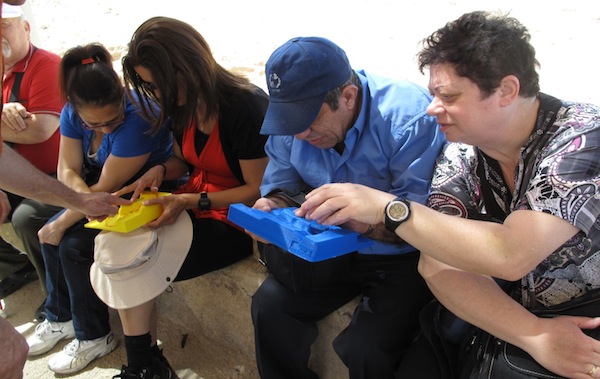
Visitors to Masada learn more about the site through Gadi Mathov’s miniature model of the landmark. (photo from Mathov Design)

What would it take to make museums, cultural sites and tourist attractions more accessible to people with visual, intellectual or developmental disabilities? For the past 25 years, Israeli professional miniaturist Gadi Mathov has been working on solving this problem using models.

At Masada National Park, for example, people with visual impairment can understand the site’s unique topographical structure and history through Mathov’s 3D tactile models.

“We also created for them miniature models of siege vessels that illustrate the Roman siege of Masada,” he explained. “The way I define it, a model is a physical representation of a product or an idea. A model is a medium that allows people to communicate and pass along ideas between them.”

Mathov Design models are used in leading cultural institutions such as the Israel Museum and sites managed by the Israel Antiquities Authority and the Israel Nature and Parks Authority. Mathov also cooperates with the Commission for Equal Rights of Persons with Disabilities, the National Insurance Institute and the Access Israel nonprofit organization.

Mathov Design’s 100-square-metre model of Jerusalem, featuring the Temple Mount, the Tower of David, the Knesset, the new Jerusalem Light Rail and other iconic structures, can be seen in Times Square in New York City as part of the Gulliver’s Gate project.

Birdwatching via models

Agamon Hula, a must-visit birdwatching and natural beauty attraction in northern Israel, is also enhanced by Mathov’s models. Here, he cooperated with Pnina Ceizler, Keren Kayemeth LeIsrael-Jewish National Fund’s northern region projects and accessibility coordinator, and KKL-JNF’s chief ornithologist Yaron Charka to make the site’s research station a place of interest for people with disabilities – visitors can see and/or feel models of the birds that migrate in the area, as well as special globes and maps that highlight migratory routes.

“There are quite a few models that we’ve created to enhance the experience for people with visual impairments,” said Ceizler. “We see that it’s useful for everyone, also for children with disabilities or with autism.”

The accessible experience at the research station has proved to be a huge hit, she told Israel21c. She tried it out on a group of people with visual impairments before opening it up to private visitors and organized trips for schools and people with special needs.

“They enjoyed this whole experience up close. They were impressed and admired everything,” she said of the accessible centre’s first visitors.

Back to the future

Mathov has worked in his profession for 37 years, but it came about quite by accident. “It was a temporary job while I was an architecture student, and then I found out that I liked it better,” he recounted.

Decades later, he’s still in love with the job. “They’ll have to take me out of here in a coffin,” he joked, speaking of his workshop in the central city of Lod.

Along with cultural institutions, his clients include the defence establishment and medical instrumentation companies.

Mathov is not worried about work drying up in the age of technological advancement. “There’s nothing more comfortable or clearer than a model,” he said. “There are dozens if not thousands of uses.”

Lately, it’s become much easier and cheaper to create a model. “The biggest development was the introduction of what we call computerized production,” Mathov explained, citing 3D printers, lasers and CNC (computer numerical control) machines. “Each of these technologies helps us create a much more complex and higher-quality product in less time and for a cheaper price.”

Mathov hopes that, one day, people will be able to print out models at home of the places they’re planning on visiting. “Today, no one goes to the store to buy music; no one goes to Blockbuster to watch a movie. I imagine that, when you’ll want a miniature model, you won’t go to a miniaturist. You’ll be able to download them and print them by yourself,” he explained.

However, printing is only the end of a process that begins with human creativity. Mathov said a model should contain “the human spark of the soul of the person who created it.”

And, while he mourns the disappearance of craftsmanship, Mathov is a firm believer in advancement. “You have to keep on looking forward,” he said. “To understand what the technologies are and where they’re heading; how to adopt them or compete against them or circumvent them.”

For more information, visit mathov.co.il/English.aspx.

Israel21c is a nonprofit educational foundation with a mission to focus media and public attention on the 21st-century Israel that exists beyond the conflict. For more, or to donate, visit israel21c.org.


Format ImagePosted on April 24, 2020April 24, 2020Author Naama Barak ISRAEL21CCategories IsraelTags accessibility, culture, education, Gadi Mathov, inclusion, Israel, tourism
On brink of radical change

On brink of radical change

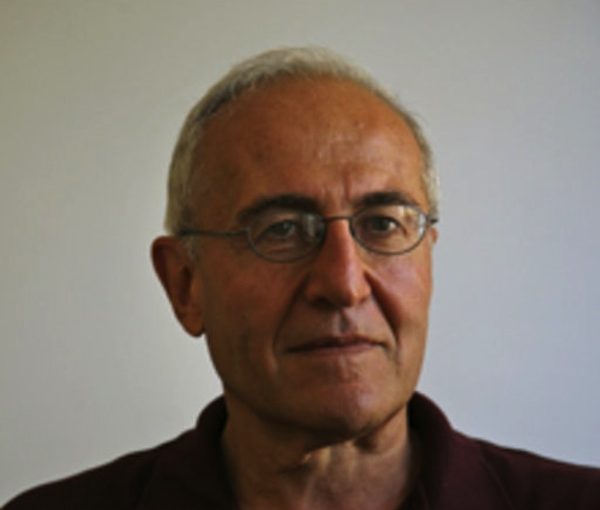
Prof. Shlomo Hasson was slated to bring a pessimistic forecast for the Middle East’s future to a Vancouver lecture March 31, but his visit was canceled due to the coronavirus crisis. (photo from CFHU Vancouver)

The Middle East is in a time of historical change and geopolitical shifts. The outcome is unknown and, for Israel, there may be good and bad consequences.

This is a core message from Prof. Shlomo Hasson, a professor at the department of geography, School of Public Policy, and Leon Safdie Chair at the Institute of Urban and Regional Studies at the Hebrew University of Jerusalem. Hasson was to speak in Vancouver March 31 at an event organized by the Vancouver chapter of Canadian Friends of the Hebrew University, but the lecture was canceled due to the coronavirus crisis. The Independent spoke with him by telephone about what he intended to discuss.

“We are in the midst of turmoil in the Middle East because we have this havoc with Iran and the intensifying tension between the United States and Iran,” he said. “We have the ongoing conflict within the Middle East, especially in Syria, the war now between Turkey and Syria. We have the recent events in Libya, we have a worsening situation in Yemen. I’m not optimistic about the Middle East and, when it comes to the Israeli-Palestinian case … the peace talks were stalled for a long time and now it seems that [U.S. President Donald] Trump’s initiative, in a way, helps to revive the issue but did it in such an awkward way that I’m not optimistic at all about the consequences of this initiative.”

The warming of relations between Israel and Saudi Arabia, as well as with some Gulf states, is cause for limited hope, he said.

“This is indeed a good reason to celebrate because there has been a change, even a significant change, between the Gulf states and even Saudi Arabia, and Israel because [they] are facing the same adversary, which is Iran,” Hasson said. “Israel supports Saudi Arabia because it supports them in containing Iran. In that sense, I think there is something to celebrate but this is very modest, because … the public in Saudi Arabia, for example, does not support Israel. It’s sort of an alliance between the rulers of the countries, but the public is not there yet.”

An additional crisis is climate change, which is hitting the region especially hard and will continue to do so, although this also presents opportunities for Israel to build bridges.

“We face the problem of water scarcity and droughts and flooding,” Hasson said. “I think that, especially in this crisis, Israel can help a lot because we have the technology, we’ve mastered the know-how and we can help the Middle East and Africa, while coping with this issue.”

Speaking before the most recent Israeli elections, Hasson predicted that, regardless of the outcome, they wouldn’t play a significant role in the bigger Middle East picture.

“Israel is not the central actor here,” he said. The central actors are Saudi Arabia and Iran, with China, Russia and the United States intervening from outside.

“Israel is in a position of reacting to these global, regional and intra-state developments,” he said. Even if Blue and White had won, said Hasson, it is still a right-wing party and the Israeli populace is developing a rightward consensus. “I don’t think that these elections are going to present a significant change in Israel’s political behaviour.”

He compares this moment in Middle East history to the pivotal epochs of the past.

“About 100 years ago, we still had the Ottoman Empire and, after that, we had the colonial regimes, the Sykes-Picot regimes, and then we have the nation-state regimes. The Middle East is at the brink of a change, a radical change, and nobody knows for sure what’s going to happen to the Middle East,” said Hasson. “But, in a way, it’s going to affect everything, it’s going to affect the global structure, it’s going to affect the relationships between the United States, China and Russia.”

Format ImagePosted on April 3, 2020April 1, 2020Author Pat JohnsonCategories WorldTags CFHU, elections, Hebrew University, Israel, Israeli-Palestinian conflict, Middle East, peace, politics, Shlomo Hasson
Take time to see Maskit

Take time to see Maskit

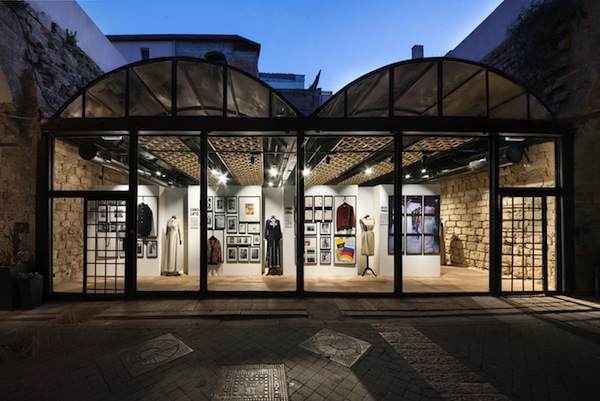
Maskit is located at 4 Auerbach St., in Jaffa. (photo from Maskit)

When next in Israel, in addition to walking the beaches of Tel Aviv, being spiritually uplifted at the Wailing Wall in Jerusalem and enjoying the food across the country, carve out some time to see the fashion houses that have put Israel on the map.

Over the last few years, Israel has been leading in the fashion industry, with numerous graduates from Shenkar College of Engineering, Design and Art landing jobs with renowned fashion ateliers in Europe. But let’s take a step back in time.

In the 1950s, post-independence, immigrants from Yemen and Morocco arrived in Israel. The government sought to train the women in textiles in order to provide for their families. At the time, Ruth Dayan (Moshe Dayan’s wife) was approached to lead the women and, seeing their talent in embroidery and weaving, she suggested that the government and a Hungarian designer, Fini Leitersdorf, initiate a designing business.

The House of Maskit became the headquarters of fashion, with Ruth Dayan as the principal designer. Maskit became famous for their signature caftan, with embellishments of embroidery, textures and the colours of Israel. At their peak, Maskit was featured in Vogue. Their tunic-style creations were considered art, gaining world recognition, enabling them to sell in Bergdorf Goodman, Neiman Marcus and Saks. As Maskit’s success grew, a higher-end line was introduced, which had buttons made from river stones, olive trees and pure silver. The fabrics were from the finest sheep’s wool, as well as silk, linen and cotton.

In the 1970s, however, the Israeli government stopped funding Maskit, shifting its spending to other priorities, notably the military. Ruth Dayan stepped down and, ultimately, Maskit closed.

Full speed ahead some 30 years, designer Sharon Tal, who graduated from Shenkar, returned to her native Israel after designing for the House of Lanvin in Paris and Alexander McQueen in London.

Although a new mother, she was still working, involved with a British lifestyle website that focused on the trends in Israel. Tal’s aha moment came when she saw Duchess of Cambridge Kate Middleton’s wedding dress, which was designed by the House of Alexander McQueen. Upon viewing the outfit, with its elaborate embroidery, she knew it was time for her to get back to design.

Together with her husband, Nil, they discovered that the House of Maskit was ready to reopen. Tal picked up the phone and called Ruth Dayan, then 94 years old. The two became friends and Maskit eventually was reborn, in 2013, melding together its history and Tal’s designs, known for their soft lines and feminine feel.

Maskit’s clients include actresses like Sarah Jessica Parker and Jamie Lee Sigler. However, one of the greatest honours was when the late first lady of Israel, Nechama Rivlin, bestowed then-U.S. first lady Michelle Obama with a coat designed by Tal on a visit to Israel.

The couturier’s home is in Jaffa, where Tal has her atelier. The décor is wondrous, with stone walls, warm natural hues and rows of heavenly designs displayed. On your next visit, do some shopping for what are sure to be lifetime classics.

For more information, visit maskit.com.

Ariella Stein is a mother, wife and fashion maven. A Vancouverite, she has lived in both Turkey and Israel for the past 25 years.

Format ImagePosted on April 3, 2020April 2, 2020Author Ariella SteinCategories IsraelTags fashion, Israel, Maskit, Ruth Dayan, Sharon Tal, travel
Hadrian’s Arch – built to last

Hadrian’s Arch – built to last

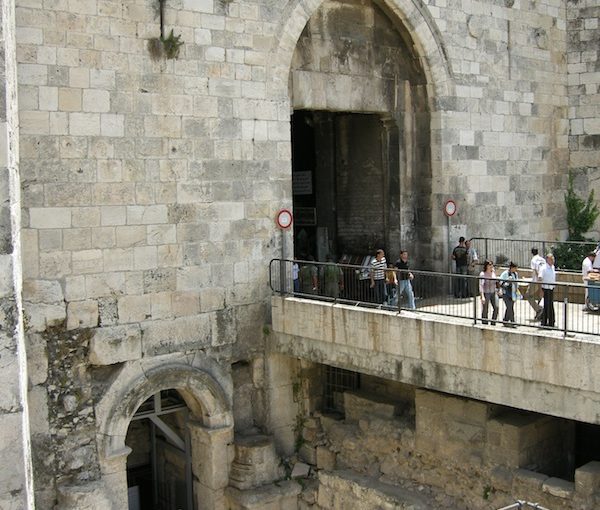
Damascus Gate today and, below it, the Aelia Capitolina arch leading to the Roman Plaza. (photo by Deborah Rubin Fields)

Revenge is sweet. Apparently, while the Roman Emperor Hadrian did not spike enemy heads on palisades, after three years of battle, he did construct an arch celebrating the suppression of the Bar Kochba revolt. This archway was quite detailed, as it marked the northern border of his Jew-less Roman colony (Jews were only allowed in on Tisha b’Av to mourn the temples they had lost) and the Aelia Capitolina, a colony built on the Jerusalem the Romans had destroyed.

Below and to the left of Damascus Gate (built by Suleiman the Magnificent in 16th century CE) are the remains of Hadrian’s Arch of Triumph and his Roman Plaza. Although the site has been explored since 1864 by numerous archeologists, only recently have the Israel Antiquities Authority, the Jerusalem Municipality and the East Jerusalem Development Company (PAMI) cooperated to open to the public the arch that Hadrian ordered built in 135 CE.

The arch seen today was actually part of a three-arched entrance way. Two shorter arches bordered a taller and wider centre one. Only the eastern entrance remains fully intact, along with the bases of what were once elaborate stone pillars. Inside this archway, one still sees the vaulted ceiling and the floor made of large stone slabs.

The thick blocks making up this flooring measure some two metres (6.6 feet) long and 1.2 metres (3.9 feet) wide. To prevent people from slipping on the stones, the Romans striated some of the pavement, which is still in place, albeit worn smooth from use.

None of Hadrian’s building machinery was motorized, of course. Even the Roman tread wheel crane was run on human or animal power. Not one to waste and not one to overlook architectural beauty, Hadrian scavenged the enormous stones of the razed Second Temple and public structures – Herodian stones from the Temple area are distinct in having narrow margins and low, flat, smooth centre bosses. Hadrian used these stones to build two massive guard towers flanking the archway on the right and left.

As the Herodian stones were not attached by mortar, it was probably relatively easy – the average weight of each is said to have been two to five tons – for Hadrian’s gate builders to dismantle the Temple-area stones. These huge limestone pieces still stand, as the remains of the guard towers, neatly stacked at an incredible height of some 11 or 12 metres.

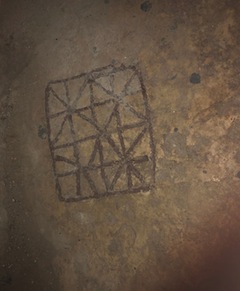
photo - In the Roman Plaza, a Roman soldiers’ game can be found on the ground
In the Roman Plaza, a Roman soldiers’ game can be found on the ground. (photo by Deborah Rubin Fields)

Soldiers throughout history have faced boredom. To counter this, the Roman soldiers in these guard towers played games. One such “board game,” is still scratched into the flooring near the towers.

The gate with its three arches was typical of its period. Just above the remaining arch, one can still decipher the “C” in the Latin inscription bearing the city’s Roman name, Aelia Capitolina. In Jerusalem, a similar example of this kind of gate is the Ecce Homo Arch. It served as an entrance to the eastern forum of Aelia Capitolina. Part of it may be seen today, along the Via Dolorosa.

As further evidence of how well-planned Hadrian’s city was, the gate opened into a plaza, a circular space that was the junction or crossing point of the eastern and western cardines (plural of cardo; literally, heart) or main roads. According to Simon Sebag Montefiore’s book Jerusalem: The Biography, this plaza led to two forums, one close to the destroyed Antonia Fortress and one close to today’s Church of the Holy Sepulchre. There, Hadrian reportedly built a temple to Jupiter.

This gate appears on Jordan’s mosaic Madaba Map. On the sixth-century map – a model of which appears inside the discovered Roman Plaza – one sees an open square with a column just beyond the gate. To prevent anyone from forgetting who was victorious over the Jewish rebels, the column was topped with Hadrian’s figure. On site, there is a model of the column to give current-day visitors an idea of how the column looked. From this column, distances to different parts of the country were measured. Moreover, the column is the source of Damascus Gate’s Arabic name, Bab al-Amud.

To the left of the arch entrance are the large millstone remains from the later Byzantine period. Most likely, an olive oil factory existed there in ancient times.

To the east of the Roman Plaza, there are three other sites worth visiting when such things become possible again, once the COVID-19 pandemic is contained:

Zedekiah’s Cave (also known as Solomon’s Quarry) has visiting hours like those of the Roman Plaza. As the cave has very good acoustics, over the past few years, it has been used to host concerts. The entrance fee is currently 18 shekels. The local telephone is the same as that of the Roman Plaza, 02-6277550. There is partial wheelchair accessibility.

Rockefeller Archeology Museum, on the northern side of the street, recently had a small, but fascinating, exhibit dealing with the 100-year history of Jerusalem Armenian Ceramics. (imj.org.il/en/exhibitions/glimpse-paradise). The museum is free of charge, with hours Sunday, Monday, Wednesday and Thursday, and even on Saturdays. There is a short flight of stairs at the entrance, so contact the curator, Fawzi Ibrahim, about visiting in a wheelchair. The local number is 02-628-2251.

The Northern Promenade route of the Old City’s ramparts allows you to visit these areas from “above,” but is not designed for wheelchairs or strollers. Buy tickets at the tourist office just inside Jaffa Gate.

From the Romans onward, rulers have built special arches marking the defeat of their enemies. Hadrian’s Arch might also have served as a reminder to potential rebels not to try again. What does seem clear is Hadrian has left us with a 1,885-year-old reminder of the many changes of hands Jerusalem has undergone.

Deborah Rubin Fields is an Israel-based features writer. She is also the author of Take a Peek Inside: A Child’s Guide to Radiology Exams, published in English, Hebrew and Arabic.

Format ImagePosted on April 3, 2020April 2, 2020Author Deborah Rubin FieldsCategories TravelTags archeology, Damascus Gate, Hadrian, history, Israel
Writing for Israel at UN

Writing for Israel at UN

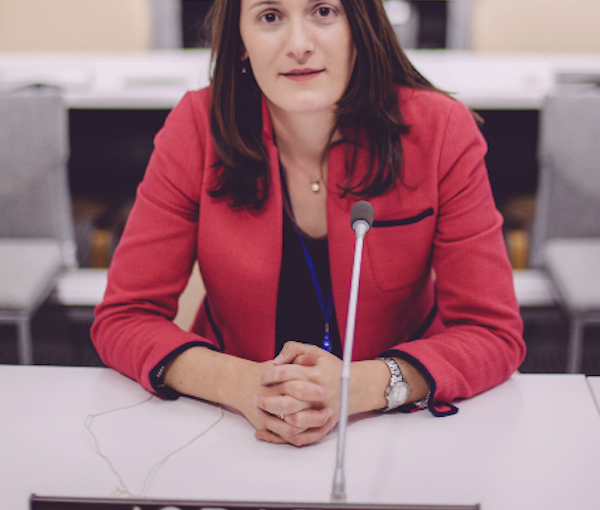
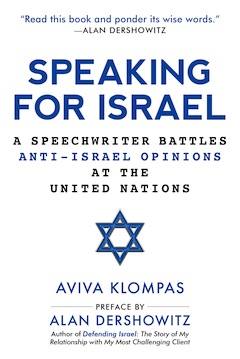
Aviva Klompas recently published the book Speaking for Israel: A Speechwriter Battles Anti-Israel Opinions at the United Nations. (photo from Aviva Klompas)

Aviva Klompas came close to writing a declaration of war. In early 2013, after an Israeli post was fired upon by Syria – one of a number of attacks – Klompas was tasked with penning a condemnation that would be submitted to the United Nations.

Still relatively new as director of speechwriting for Israel’s Permanent Mission to the UN in New York City, she recalled the criticism she received: “Be more direct. Be more assertive about things,” she was told. “I thought to myself, ‘channel outrage.’ I tried to do so. I wrote this very stern letter, and I took it to the ambassador to review.”

Klompas, who spoke with the Independent recently, said she then learned the art of diplomacy, and how words might set off an international firestorm.

“To be clear,” Ambassador Ron Prosor, then Israel’s permanent representative to the UN, told her, “you don’t have any authority to declare war.” And it was off to a rewrite.

Thankfully, there weren’t any other close calls, but there are many other fascinating stories – many of which Klompas has brought to light in Speaking for Israel: A Speechwriter Battles Anti-Israel Opinions at the United Nations (Skyhorse, 2019). The book is a candid examination of how the Israeli delegation – and Israel as a whole – is perceived and treated in the international body.

image - Speaking for Israel book coverDuring Klompas’s time at the UN, several major events occurred, including but not limited to the Iran deal, countless anti-Israel resolutions, Palestinians’ bid to join the International Criminal Court, the kidnapping and murder of three Israeli teenagers, and 50 days of war between Israel and Hamas in Gaza. She wrote the book, she said, to show the tireless work of those who advocate for the Jewish state and who rarely get their due.

“It always feels like it is an uphill battle by the nature of the bias at the UN,” she said. “There are people who show up every single day and never say, ‘Why are we doing this? We should leave the UN.’ I’ve never had a single colleague make that suggestion. They came to work and did the job. I think, it’s a little bit my story, but it’s really our story.”

Klompas was director of speechwriting from 2013 to 2015.

“It’s very few people that make the headlines – the ambassador, maybe the deputy ambassador, maybe the foreign minister – but what about everyone else that is doing it day in and day out?” she asked.

About her work, the Toronto native said it advanced Israel’s policies and informed public opinion. Being successful at it, she said, required overcoming some challenges. For one, there was a culture clash.

“Certainly, Israelis are much more direct in their feedback, which is for better or for worse. At first, it is startling, but then you get to understand that it’s not personal,” she said.

Learning how to write in someone else’s voice was difficult, too. Prosor has “a very distinct style,” she said, describing him as “extremely articulate, funny, charming and intelligent. To be able to write for somebody like that takes time.”

In addition, Prosor took a different approach to diplomacy, when “so many speeches can be dry and not entirely lively,” said Klompas. “He’d be all too happy to break out into song in the middle of a speech, whether it be a song about African nations, which got him a standing ovation from some of the African nations in the General Assembly, [or] he would sing John Lennon’s ‘Imagine.’ In a speech about women, he sang Aretha Franklin’s ‘Respect.’”

Klompas gave him the nickname “the Singing Diplomat.”

“Ambassador Prosor felt it was very important to be heard and, to be heard, you have to be different,” she explained. “He knew he had to capture attention to get people to listen.”

In the beginning, she would have to write up to 20 drafts of a speech before she got a sense of the ambassador’s voice and style. Sometimes, there wasn’t much time to tweak.

“It’s pretty stressful,” she said. “You can get a phone call any time of day or night, weekend, and be told the Security Council is convening a special session, come down to the office, we have to get writing. You could have a couple of days’ notice or a couple of hours’ notice. And emergency sessions tend to get a lot of publicity.”

Klompas, who is now associate vice-president of Israel and global Jewish citizenship at Combined Jewish Philanthropies in Boston, said there were poignant takeaways from her job as a speechwriter.

“You can’t be easily deterred by situations that seem unfair or unreasonable. You need a courage of conviction to deflect the constant attacks and brush aside the fact that systems and processes aren’t as simple as one might hope,” she said. “I’d say that my experience gave me a greater sense of what happens behind the scenes in international diplomacy, and the ways in which Israel is working to find equality in the family of nations.”

Dave Gordon is a Toronto-based freelance writer whose work has appeared in more than 100 publications around the world.

Format ImagePosted on March 27, 2020March 26, 2020Author Dave GordonCategories BooksTags Aviva Klompas, diplomacy, Israel, politics, Ron Prosor, UN, United Nations

Beauty of spring in Israel

Spring. Every year, it returns like a miracle and Israel is carpeted with wildflowers. There are nearly 3,000 types of wild plants in this tiny land, a wonderful profusion, among the most abundant on earth. Israel boasts a variety of different ecological systems – deserts and marshes, high mountains, dense forests and open fields, with wildflowers to suit each habitat.

Wildflowers are protected in Israel and nature reserves prohibit the picking of any flowers, even the most common, which helps them to propagate over wider areas. In turn, this brings the sunbirds, which feast on their nectar.

The Song of Songs, which we read every Passover, is a most beautiful love poem. King Solomon wrote it as a dialogue between a young shepherd and his beloved: “Rise up, my love, my fair one and come away / For lo, the winter is past / The rain is over and gone / The flowers appear on the earth / The time of singing is come / And the voice of the turtle is heard in the land.”

The flowers he refers to, nitzanim, still carpet the fields – shiny red poppies flaunting scarlet beauty in the grass.

In Jerusalem Forest, delicate cyclamens bloom in the crevices between the rocks. Called Solomon’s Crown (in Hebrew), they lift their pink, cream or lilac heads on slender stalks. Clumps of wild violets, the dew shimmering like diamonds, add their touch of magic.

Israel’s rainy season, mid-October to late March, leaves a bequest of green. Sharon Valley is dotted with tulips and narcissus. “I am the rose of Sharon, a lily of the valleys” – it is believed that King Solomon was referring to the magnificent black tulips of the Galilee.

In spring, even the weeds in Israel are pretty – the milk vetch, which is a thistle, adds purple blooms to the roadside. The rockrose is abundant in forest glades and the orange ranunculus bursts into bloom. Like its velvety cousin, the anemone, it is a protected wildflower in Israel.

The perfume of daffodils – which suffused the winter – still wafts on the breeze and the white, cream, yellow and blue noses of lupins are pushing through the soil. Oleanders are in bud, growing wild by the banks of the River Jordan and near streams in Galilee, promising a burst of summer beauty. And the blue statica reminds us that we, too, have a Mediterranean coast like the famed Riviera. This lovely sea plant flowers from mid-spring to mid-summer, when its corolla drops off and only the sepal remains.

Who says Israel has almost no natural resources? When you see the splendour in the grass of the land’s spring glory, the wildflowers glowing like jewels, you’ll echo the poet’s words: “Had I but two loaves of bread / I would sell one of them / And buy white hyacinths to feed my soul.”

Dvora Waysman is a Jerusalem-based author. She has written 14 books, including The Pomegranate Pendant, which was made into a movie, and her latest novella, Searching for Sarah. She can be contacted at [email protected] or through her blog dvorawaysman.com.

Format VideoPosted on March 27, 2020March 26, 2020Author Dvora WaysmanCategories IsraelTags environment, flowers, Israel, nature, spring

Religion and the state

A week is a lifetime in politics, goes an adage. And so it would seem. Just one week ago, we posited that Binyamin Netanyahu’s coalition of the right was likely to form the next government in Israel. Since then, Benny Gantz, head of Israel’s Blue and White party, has been reinvigorated by Netanyahu’s challenges in pulling together a coalition, after original exit polls had the Likud-led coalition at 60 seats out of the 120 in the Knesset. This number has dropped through the actual vote count to 58, and it has changed the outlook.

As it has in the previous two elections, the result will hinge on the decision of Avigdor Liberman and his Yisrael Beitenu party, a right-wing but defiantly secular movement. Liberman has publicly released his demands for support. Among them: he will not support a government led by Netanyahu (or any other individual under indictment) and he wants to increase the number of ultra-Orthodox serving in the military, introduce civil marriage, thereby taking control of this lifecycle event from the exclusive purview of the rabbinate, and hand decision-making about commerce and transportation on Shabbat to local governments. Meanwhile, Gantz is having a rebellion in his own ranks about seeking support from the largely Arab Joint List in parliament. So, the process is largely back to where it’s been for more than a year, with no more certainty of who will form the next government.

Whatever happens, Liberman’s sweeping secularist proposals are nothing to ignore. The ally-turned-nemesis of Netanyahu, Liberman seems to have learned from the masters how to leverage minimal electoral success to enormous political advantage. In the past, it has been the religious parties that conditioned their support for desperate-to-make-a-deal leaders on getting key benefits and concessions for their respective communities. If Liberman succeeds in helping create a Blue and White government that implements some of his plans, it will represent the same tail-wagging-dog effect that religious parties used to assert Orthodox standards across much of Israeli society. Except Liberman will leverage his seven seats to repeal some or much of what those religious parties have achieved.

This Israeli moment brings to mind other rapidly changing political fortunes. Joe Biden, whose campaign was struggling to survive a few weeks ago, is suddenly (again) the undisputed front- runner for the Democratic nomination in the United States. There is another parallel between Israel and the United States that is currently evolving, this one less publicly known. While Liberman strives to diminish the connection between religion and state in his country, U.S. President Donald Trump is moving his country more in the direction of Israel’s religiously influenced society.

As in Canada, many religious organizations in the United States do an enormous amount of good, in many cases filling in gaps where government services can’t or won’t. Republican administrations have tended to expand – contract out, if you will – some social services previously delivered by governments, while the Obama administration, for example, introduced safeguards to prevent those agencies from discriminating against individuals or groups who they might deem outside their theological teachings.

Writing in the New York Times Sunday, Katherine Stewart, author of a book on religious nationalism, warned that Trump is eliminating those Obama-era safeguards and making it easier for publicly funded agencies to discriminate. For example, clients receiving services from a taxpayer-supported Christian organization could be forced to profess allegiance to Jesus in order to access services or an employee could be fired for not living a “biblical lifestyle,” the definition of which the religious organization, presumably, could define at their own whim.

A test case in Missouri seems innocent enough: a church maintains it should get federal funding to build a kids’ playground; that being refused such money represents discrimination against religion. The corollary is clear: if preventing tax money from funding religious organizations (even for something as innocuous as a playground) is discrimination, Stewart warns, “then the taxpayer has no choice but to fund religion.” This would represent an abrogation of one of the most fundamental cornerstones of the U.S. Constitution: the First Amendment, which declares, “Congress shall make no law respecting an establishment of religion, or prohibiting the free exercise thereof….” The framers of the Constitution were concerned not only that eliminating the barrier between government and religion would corrupt a government intended to serve all citizens but, perhaps equally, that it would corrupt religious institutions themselves. A number of the people on the test case’s side are also leaders among Trump’s evangelical constituency.

What was especially jarring when perusing the Sunday Times was a far more prominent story – on page A4, to be specific – about how Quebec’s secularism law is having a detrimental effect on civil servants, mostly women, from cultural minorities. The law, which precludes people who work in most roles in the public service from showing any external indications of religiosity – a kippa, a headscarf, a crucifix, a turban – is preventing individuals from beginning or advancing in their careers and, in some cases, effectively chasing them out of the province.

These disparate examples from three very different societies indicate the folly both of excessive religious interference in governmental affairs and heavy-handed efforts to have the opposite effect. Somewhere in the middle must be a commonsensical approach to these extremities. Of the three countries in the examples, Israel is perhaps the one where the challenges are most concrete and affect the most people. What, if anything, happens as result of Liberman’s gambit will be a fascinating experiment to watch.

Posted on March 13, 2020March 12, 2020Author The Editorial BoardCategories From the JITags Avigdor Liberman, Benny Gantz, Binyamin Netanyahu, democracy, Donald Trump, elections, extremism, freedom, Israel, Quebec, religion, secularism, United States
Predicting the future

Predicting the future

Trend forecasters Lior Fisher Shiloni, left, and Nataly Izchukov. (photo by Michael Topyol)

What do jeans, trench coats and a little black dress all have in common? A place of honour in women’s wardrobes, that’s for sure. And it’s no accident – the three are timeless trends that have been around for decades.

“A trend is a state of mind, a very, very wide perspective that begins in the margins and slowly reaches the masses,” said Israeli trend forecaster Nataly Izchukov. “A trend undergoes evolution and is here to stay. People always think it comes and goes, but that’s actually a mistake. It develops and updates, and it’s here to stay.”

In 2014, Izchukov founded the Visionary, a Tel Aviv lifestyle and design trend forecasting agency that deciphers for its customers the way the wind is blowing. She and her business partner, Lior Fisher Shiloni, also expose the Israeli public to the art of forecasting and even pass on their knowledge in a first-of-its kind local “trendology” school.

Forecasting the future, Izchukov explained, begins in researching the past. She and her team study what has happened in the past year or so across the world, from politics and economics to natural disasters, cinema and fashion, and try to understand how it will affect esthetics and designs. “For example, one of the leading trends for the summer of 2020 is going to be acid-bright colours,” she said. Its source of influence? The yellow vests movement in Paris.

The second step is social research, which involves identifying their clients’ audience and what interests them on social networks and in the media. The third step is what Izchukov calls iconography, the interpretation of the findings in a more abstract way. This all leads to conclusions regarding megatrends and the microtrends that ensue.

Izchukov gave the example of older solo women travelers. More older women are jet-setting off by themselves, but are still looking to feel safe and secure and have a sense of community on their travels. This translates into many different microtrends for Izchukov’s clients, including how hotels are decorated and the colour palette that best suits their guests.

The biggest megatrend, however, is sustainability. “It deals with promoting the status of women, with poverty, with education, it’s a very, very wide issue,” said Izchukov.

Trends are not fads. Fads are not sustainable; they enter and exit our lives quickly. Top examples of fads, Izchukov noted, are Kardashian-style cycling shorts, the 1990s digital pet Tamagotchi craze and a recent favourite – handheld spinners. By contrast, a trend can take three to four years to go mainstream, and not all businesses have patience for such a process.

“They mostly want us to create fads, but we’re really seeing a change developing in 2020,” she said of her clients. “The biggest change is the extreme climate happening across the world. What happened now in Australia [with widespread bushfires] is one of these extreme cases that made people say, ‘OK, there’s a problem here.’ There was great denial of the topic among companies.”

The emphasis on sustainability is causing apprehension in the Israeli business scene, she said. One of the problems is the high cost of creating sustainable fashion.

“The product ends up being expensive and people don’t really want to spend that money on it,” Izchukov said. “There’s still a gap between the goodwill of people for the world to be a better place, and people wanting a good and attractive price, and you have to think how to bridge it.”

Izchukov predicts some big changes in the coming decade for fashion, food and hospitality in Israel.

“In fashion, a few very substantial things are going to happen – mostly companies that will change their appearance and their production lines in a more sustainable, ecological and recycling direction,” she said. “There’ll be fewer stores but these will include a lot more content and information that is beyond fashion.”

In Israel, there will be greater inclusion of people with disabilities in the fashion world, she said. This is in line with the global trend for inclusivity, which sees fashion houses employing ambassadors of all sexes, genders, religions and sizes.

In the Israeli hospitality sector, we can expect “the substantial entry of more hostels and of very affordable hotels,” she said. “They’ll try to create a very interesting experience in their locations in terms of the customer and the hotel itself.”

Izchukov predicts that food will increasingly go in the direction of “how we can eat in a healthier manner that precisely matches our needs and our bodies.”

She said, “Artificial intelligence will greatly help to resolve the issues of need and of customization.”

Food is also a great example of the impact local cultures have on trends. Izchukov noted the failure of American companies such as Starbucks to succeed in Israel. While Israelis like to think that the global giant failed because the local coffee is far superior, Izchukov suggested it has more to do with the Israeli state of mind. Self-service, waiter-less, eateries are a doomed business model in Israel, she said, because locals much prefer personal attention.

Israel21c is a nonprofit educational foundation with a mission to focus media and public attention on the 21st-century Israel that exists beyond the conflict. For more, or to donate, visit israel21c.org.

Format ImagePosted on March 13, 2020March 12, 2020Author Naama Barak ISRAEL21CCategories WorldTags forecasting, Israel, Lior Fisher Shilon, Nataly Izchukov, style, trendology
Israel’s quirky design house

Israel’s quirky design house

Peleg Design’s Magnetic Vase is a bestseller. (photo from Peleg Designs)

From optical illusion flower vases to playful elephant-shaped cutlery drainers, Shahar Peleg wants his products to bring his customers joy, but first and foremost to fulfil a need in their home.

How does he figure out what those needs are? “Some of the ideas came to us while daydreaming, some in the shower, some we woke up with and some just came to us by email,” reads the website’s Suggest an Idea section.

People from all over the world reach out, the designer and founder of the brand told Israel21c. “Once in awhile, we get a great idea and we pay royalties to the designers or inventors,” he said. “It’s really amazing because a lot of people have a lot of ideas.” For example, the Bag Bunny, a magnetic rabbit-shaped tool for easily opening plastic packaging, was inspired by a customer suggestion.

photo - Shahar Peleg wants his products to bring his customers joy, but first and foremost to fulfil a need in their home
Shahar Peleg wants his products to bring his customers joy, but first and foremost to fulfil a need in their home. (photo from Facebook)

Founded in 2005 and based in Tel Aviv, Peleg Design’s online store offers around 100 unique products that stem from everyday needs, each with quirks, twists or optical illusions that Peleg describes as “magical.” Nothing, he said, is what it seems.

The product that kicked off the company’s success was a vase Peleg designed for his own wedding in 2005. These “floating” vases are anchored by magnetic bases hidden underneath the tablecloth. To this day, the vase set is one of Peleg Design’s bestsellers. “It was a huge hit,” he said. “That’s what really began to generate business.”

Another universal problem Peleg wanted to solve was grime building up at the bottom of a cutlery drainer. His answer was Jumbo, an elephant-shaped cutlery holder that drains water out of its trunk, directly into the sink.

Peleg said function is key, and design secondary, to usefulness. But, still, he hopes his customers will fall in love with his “cute” designs.

His newest item, the Egguins, is an example of that cuteness. The penguin-shaped eggholder is not only visually amusing, but makes it easy to remove eggs from boiling water and store them in the fridge. One comment on Peleg Design’s Instagram page calls the item “the best thing since sliced bread.”

Many of Peleg’s products are made from plastic but they are meant to last. Sensitive to environmental issues, he explained that he wants his customers to develop an emotional connection to the items and use them for as long as possible before discarding them.

Passion and profession

Growing up, Peleg dreamed of being an astronaut, but he would eventually find his passion in a different form of exploration: design.

Peleg studied interior design at the Holon Institute of Design. A class project made him realize he had an eye for creating quirky but useful knick-knacks. He had made a wine-bottle holder that seemed to defy gravity. He was able to sell a few even before graduating.

“It started from selling one product in two or three stores in Tel Aviv,” he said. “It’s now become both my passion and my profession.”

photo - The Jumbo cutlery holder drains into the sink straight away
The Jumbo cutlery holder drains into the sink straight away. (photo from Peleg Designs)

What began as a one-man show has expanded to more than 30 countries, including the United States, Japan, Peru, France and South Korea. Some designs can even be found at the gift shop of the Louvre Museum in Paris and the Museum of Modern Art’s gift shop in New York City, where the Magnetic Vase is one of its bestselling items.

Peleg explained that his products are available in most major economies, excluding those that have no political relations with Israel. He hopes one day that will change, and he says so to the businesspeople he meets from countries like Iran and Kuwait.

Every now and then, Peleg receives an email from an Israeli customer, with a photo of his Magnetic Vase on a shelf in the MOMA gift shop. They are so happy to see an Israeli designer’s product among some of the world’s best, he said, noting, “That makes me proud.”

For more information, visit peleg-design.com.

Israel21c is a nonprofit educational foundation with a mission to focus media and public attention on the 21st-century Israel that exists beyond the conflict. For more, or to donate, visit israel21c.org.

Format ImagePosted on March 13, 2020March 12, 2020Author Lauren Izso ISRAEL21CCategories WorldTags art, design, functional art, Israel, Shahar Peleg

Posts pagination

Previous page Page 1 … Page 45 Page 46 Page 47 … Page 111 Next page
Proudly powered by WordPress