Predicting the future

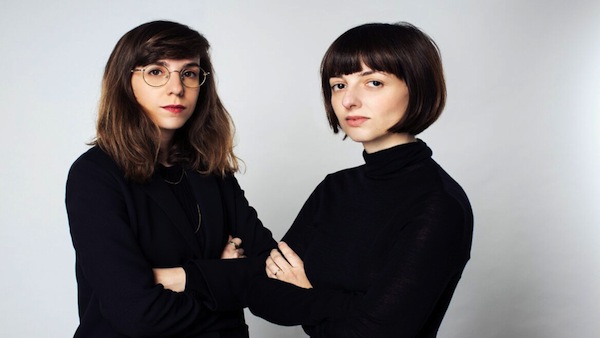
Trend forecasters Lior Fisher Shiloni, left, and Nataly Izchukov. (photo by Michael Topyol)

What do jeans, trench coats and a little black dress all have in common? A place of honour in women’s wardrobes, that’s for sure. And it’s no accident – the three are timeless trends that have been around for decades.

“A trend is a state of mind, a very, very wide perspective that begins in the margins and slowly reaches the masses,” said Israeli trend forecaster Nataly Izchukov. “A trend undergoes evolution and is here to stay. People always think it comes and goes, but that’s actually a mistake. It develops and updates, and it’s here to stay.”

In 2014, Izchukov founded the Visionary, a Tel Aviv lifestyle and design trend forecasting agency that deciphers for its customers the way the wind is blowing. She and her business partner, Lior Fisher Shiloni, also expose the Israeli public to the art of forecasting and even pass on their knowledge in a first-of-its kind local “trendology” school.

Forecasting the future, Izchukov explained, begins in researching the past. She and her team study what has happened in the past year or so across the world, from politics and economics to natural disasters, cinema and fashion, and try to understand how it will affect esthetics and designs. “For example, one of the leading trends for the summer of 2020 is going to be acid-bright colours,” she said. Its source of influence? The yellow vests movement in Paris.

The second step is social research, which involves identifying their clients’ audience and what interests them on social networks and in the media. The third step is what Izchukov calls iconography, the interpretation of the findings in a more abstract way. This all leads to conclusions regarding megatrends and the microtrends that ensue.

Izchukov gave the example of older solo women travelers. More older women are jet-setting off by themselves, but are still looking to feel safe and secure and have a sense of community on their travels. This translates into many different microtrends for Izchukov’s clients, including how hotels are decorated and the colour palette that best suits their guests.

The biggest megatrend, however, is sustainability. “It deals with promoting the status of women, with poverty, with education, it’s a very, very wide issue,” said Izchukov.

Trends are not fads. Fads are not sustainable; they enter and exit our lives quickly. Top examples of fads, Izchukov noted, are Kardashian-style cycling shorts, the 1990s digital pet Tamagotchi craze and a recent favourite – handheld spinners. By contrast, a trend can take three to four years to go mainstream, and not all businesses have patience for such a process.

“They mostly want us to create fads, but we’re really seeing a change developing in 2020,” she said of her clients. “The biggest change is the extreme climate happening across the world. What happened now in Australia [with widespread bushfires] is one of these extreme cases that made people say, ‘OK, there’s a problem here.’ There was great denial of the topic among companies.”

The emphasis on sustainability is causing apprehension in the Israeli business scene, she said. One of the problems is the high cost of creating sustainable fashion.

“The product ends up being expensive and people don’t really want to spend that money on it,” Izchukov said. “There’s still a gap between the goodwill of people for the world to be a better place, and people wanting a good and attractive price, and you have to think how to bridge it.”

Izchukov predicts some big changes in the coming decade for fashion, food and hospitality in Israel.

“In fashion, a few very substantial things are going to happen – mostly companies that will change their appearance and their production lines in a more sustainable, ecological and recycling direction,” she said. “There’ll be fewer stores but these will include a lot more content and information that is beyond fashion.”

In Israel, there will be greater inclusion of people with disabilities in the fashion world, she said. This is in line with the global trend for inclusivity, which sees fashion houses employing ambassadors of all sexes, genders, religions and sizes.

In the Israeli hospitality sector, we can expect “the substantial entry of more hostels and of very affordable hotels,” she said. “They’ll try to create a very interesting experience in their locations in terms of the customer and the hotel itself.”

Izchukov predicts that food will increasingly go in the direction of “how we can eat in a healthier manner that precisely matches our needs and our bodies.”

She said, “Artificial intelligence will greatly help to resolve the issues of need and of customization.”

Food is also a great example of the impact local cultures have on trends. Izchukov noted the failure of American companies such as Starbucks to succeed in Israel. While Israelis like to think that the global giant failed because the local coffee is far superior, Izchukov suggested it has more to do with the Israeli state of mind. Self-service, waiter-less, eateries are a doomed business model in Israel, she said, because locals much prefer personal attention.

Israel21c is a nonprofit educational foundation with a mission to focus media and public attention on the 21st-century Israel that exists beyond the conflict. For more, or to donate, visit israel21c.org.


Israel’s quirky design house

Peleg Design’s Magnetic Vase is a bestseller. (photo from Peleg Designs)

From optical illusion flower vases to playful elephant-shaped cutlery drainers, Shahar Peleg wants his products to bring his customers joy, but first and foremost to fulfil a need in their home.

How does he figure out what those needs are? “Some of the ideas came to us while daydreaming, some in the shower, some we woke up with and some just came to us by email,” reads the website’s Suggest an Idea section.

People from all over the world reach out, the designer and founder of the brand told Israel21c. “Once in awhile, we get a great idea and we pay royalties to the designers or inventors,” he said. “It’s really amazing because a lot of people have a lot of ideas.” For example, the Bag Bunny, a magnetic rabbit-shaped tool for easily opening plastic packaging, was inspired by a customer suggestion.

photo - Shahar Peleg wants his products to bring his customers joy, but first and foremost to fulfil a need in their home
Shahar Peleg wants his products to bring his customers joy, but first and foremost to fulfil a need in their home. (photo from Facebook)

Founded in 2005 and based in Tel Aviv, Peleg Design’s online store offers around 100 unique products that stem from everyday needs, each with quirks, twists or optical illusions that Peleg describes as “magical.” Nothing, he said, is what it seems.

The product that kicked off the company’s success was a vase Peleg designed for his own wedding in 2005. These “floating” vases are anchored by magnetic bases hidden underneath the tablecloth. To this day, the vase set is one of Peleg Design’s bestsellers. “It was a huge hit,” he said. “That’s what really began to generate business.”

Another universal problem Peleg wanted to solve was grime building up at the bottom of a cutlery drainer. His answer was Jumbo, an elephant-shaped cutlery holder that drains water out of its trunk, directly into the sink.

Peleg said function is key, and design secondary, to usefulness. But, still, he hopes his customers will fall in love with his “cute” designs.

His newest item, the Egguins, is an example of that cuteness. The penguin-shaped eggholder is not only visually amusing, but makes it easy to remove eggs from boiling water and store them in the fridge. One comment on Peleg Design’s Instagram page calls the item “the best thing since sliced bread.”

Many of Peleg’s products are made from plastic but they are meant to last. Sensitive to environmental issues, he explained that he wants his customers to develop an emotional connection to the items and use them for as long as possible before discarding them.

Passion and profession

Growing up, Peleg dreamed of being an astronaut, but he would eventually find his passion in a different form of exploration: design.

Peleg studied interior design at the Holon Institute of Design. A class project made him realize he had an eye for creating quirky but useful knick-knacks. He had made a wine-bottle holder that seemed to defy gravity. He was able to sell a few even before graduating.

“It started from selling one product in two or three stores in Tel Aviv,” he said. “It’s now become both my passion and my profession.”

photo - The Jumbo cutlery holder drains into the sink straight away
The Jumbo cutlery holder drains into the sink straight away. (photo from Peleg Designs)

What began as a one-man show has expanded to more than 30 countries, including the United States, Japan, Peru, France and South Korea. Some designs can even be found at the gift shop of the Louvre Museum in Paris and the Museum of Modern Art’s gift shop in New York City, where the Magnetic Vase is one of its bestselling items.

Peleg explained that his products are available in most major economies, excluding those that have no political relations with Israel. He hopes one day that will change, and he says so to the businesspeople he meets from countries like Iran and Kuwait.

Every now and then, Peleg receives an email from an Israeli customer, with a photo of his Magnetic Vase on a shelf in the MOMA gift shop. They are so happy to see an Israeli designer’s product among some of the world’s best, he said, noting, “That makes me proud.”

For more information, visit peleg-design.com.

Israel21c is a nonprofit educational foundation with a mission to focus media and public attention on the 21st-century Israel that exists beyond the conflict. For more, or to donate, visit israel21c.org.

United by challenges

After two inconclusive elections in Israel, incumbent Prime Minister Binyamin Netanyahu appears certain to form a government after elections Monday, ending an unprecedented period of political instability.

Whether Netanyahu himself, under indictment and slated for a trial this month on corruption charges, will remain prime minister for long, the right-wing is certainly poised to govern for the near future. Israel’s Supreme Court explicitly refused to offer an opinion on whether a convicted prime minister could continue in office, a question that may now go from theoretical to very real.

Jews in the Diaspora, including a great many here in British Columbia, follow politics in Israel casually or closely, as many of us do the machinations of American politics that are also roiling this week. Canadian politics and those in British Columbia, around issues of environmental policy, disruptive protests and a host of other topics, have people here at home fired up about politics even without elections on the near horizon.

While there are countless issues and contests vying for our attention, there is also an undercurrent of less immediate yet possibly more ominous peril facing our democracies. Threats of external influence from bad actors, like a repetition of the Russian interference in U.S. elections in 2016, are cause for serious concern. The rise of domestic extremism – in mainstream politics as well as in the form of underground and sometimes violent movements – also deserves close attention. So does apathy.

All of these influences and attitudes present dangers to our democracies – in Canada, in the United States, in Europe and Israel. Newer democracies in Central and Eastern Europe have demonstrated how fragile the tissue of open, accountable and responsive government can be. It is alarming to witness the path that Hungary, Russia, Turkey and Poland have been on recently. Our democracies – in the United States and Canada, even Israel – may be somewhat older, but these countries are still warnings of how things that we take for granted can be snatched away. Democracy is less an enormous oak with deep and broad roots than it is a delicate flower that requires nurturing and constant attention.

For this reason, when there are government policies or election outcomes with which we disagree, we should remind ourselves that democracy may be the ultimate win-some-lose-some proposition and recommit ourselves to respect for the institutions of our democracy, not just when they serve our interests but even – especially – when they deliver outcomes that we find disagreeable. At the same time, we should be identifying and calling out every instance when a political leader or movement threatens the institutions or norms of our democracy.

Amid all of these political dramas, very daunting situations that recognize no geographic or ideological boundaries are challenging each and every one of us. This week, again, coronavirus is spreading and causing panic. Meanwhile, the dangers posed by climate change escalate every day. The economic impacts of these global concerns are blaring across the business pages: pandemic fears are causing wild stock market fluctuations, while the measures necessary to alter the course of climate change demand fundamental economic shifts. All of these threaten to exacerbate existing inequalities locally, nationally and internationally, threatening our morality and the stability of our world.

In the face of existential issues like these, the differences in our ideologies in countries like Canada, Israel or the United States fade into shades of grey. This is perhaps optimistic: that the differences between us are minimal in comparison to the difficulties we face together. That should motivate us to look beyond or to bridge our differences and recognize both the humanity in those with whom we disagree and the challenges to humankind that we must overcome together or succumb to apart.

Using apps and robots – coronavirus

One high-tech solution for patients possibly infected with the coronavirus is a robot that can enter the patient’s room and be controlled by medical staff from the outside. (photo from IMP)

Before the coronavirus arrived in Israel – there were two reported cases at press time – Sheba Medical Centre was preparing for it with different high-tech means: a telemedicine app that enables patients to receive care in the isolation, but comfort, of their own home; and robots that can treat in-hospital patients in order to minimize contact with staff.

Sheba’s Datos Health-In is a telemedicine app that enables patients to remain at home. In the event of an epidemic, with more patients than isolation rooms available, the app can be a viable tool for patients who are not severely ill. With the app, patients can enter vital signs and other information, which is directly accessed by their doctor. Patients can also establish contact with their physicians at any time of day or night.

The program was launched on Feb. 9 and tested on Israelis who had been in China and who, according to Health Ministry instructions, had to be in quarantine for 14 days, the incubation period of the virus. Doctors initialized contact with the patients twice a day.

photo - Sheba Medical Centre’s Dr. Galia Barkai
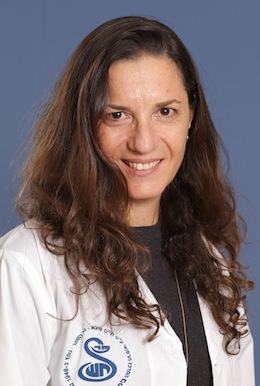
Sheba Medical Centre’s Dr. Galia Barkai (photo from IMP)

“This is one instance where telemedicine protects staff as well as other patients, by minimizing direct contact with those infected with the coronavirus,” explained Dr. Galia Barkai, head of telemedicine services at Sheba.

Another high-tech solution for patients possibly infected with the coronavirus is a robot that can enter the patient’s room and be controlled by medical staff from the outside. Designed by California-based virtual healthcare company Intouch Health, the robots are already in use in other departments, such as in the intensive care unit of pediatric cardiology, and the trauma unit.

“This technology is the perfect solution to provide care for in-patients infected with coronavirus, while protecting staff from contagion,” said Barkai.

Screening for the virus produces results in just a few hours but, with symptoms that are not very dramatic and that are reminiscent of the flu, including fever, cough and shortness of breath, Israel’s Health Ministry is only allowing those who have returned from China and a few other countries in the Far East to be tested.

– Courtesy International Marketing and Promotion (IMP)

Couple cartoons about love

Yehuda and Maya Devir and their self-drawn webcomic characters in One of Those Days. (image from Devirs)

Fans always do a double take when they see Yehuda and Maya Devir at a comics convention or in a New York City subway, or wherever. The young Israeli couple looks like they jumped right out of their virally popular webcomic One of Those Days.

“I suppose it’s like meeting a real Bart Simpson in the street,” mused Yehuda. “We act exactly the same as our characters.”

Indeed, about seven million social media followers know that Maya loves super-hot showers and hates folding laundry. They know Yehuda’s a big baby when he’s sick and is willing to say “I’m sorry” after an argument. They sympathized with the couple’s struggle to get pregnant.

Most of all, fans smile at the humorous spin the webcomic puts on everyday scenes in a marriage, from dishes in the sink to kisses on the couch.

“We get lots of emails and messages from around the world about how we changed the way couples look at their relationship and how they talk to each other,” Yehuda told Israel21c. “It’s amazing that we can make such a difference for people, that our work can connect Muslim, Jewish, black, white, rich, poor … it doesn’t matter.”

One of Those Days won the Most Creative Content Maker Award at the Inflow Global Summit 2019 Awards for social media influencers.

“We dedicated our award to our followers and supporters around the world. We have fans in Brazil, Japan, Trinidad, Iran, Iraq – basically, every country,” Yehuda said. “People thank us for making them happy once a week and making them feel they are not alone. It’s an amazing journey we’ve been on.”

The Devirs’ journey began in September 2016, when they packed up their diplomas in visual communication from Jerusalem’s Bezalel Academy of Art and Design and moved to Tel Aviv.

The newlyweds hoped to find an affordable apartment in a nice neighbourhood. And they hoped to make a living in illustration and design. Neither aspiration was terribly realistic.

“A friend suggested we post a selfie on Facebook asking friends to help us find an apartment,” said Maya. “We didn’t know how to take a good selfie, but we can draw really well, so we did a cartoon of ourselves and posted that.”

Not only did that illustration help them find an affordable flat in a very expensive city, but it also formed the kernel of One of Those Days.

While working as a freelance illustrator in the fashion, music and startup industries, Yehuda posted funny snippets on social media about being a new husband.

“Very quickly I joined him because I wanted him to make me look good,” Maya said with a laugh, “and because the story belonged to both of us. The concept was to illustrate moments we both experienced.”

In May 2017, Bored Panda posted a piece about the Devirs that went viral. “After a week, we gained half a million followers on Instagram,” Maya said. “Since then, we never stopped gaining followers. We got tons of emails and Yehuda couldn’t manage by himself. So, I left my job as art director in an ad firm and joined him full-time in October 2017. This was our dream – to create something of our own.”

They take complementary roles in each cartoon. “We start the idea together and the actual illustration is Yehuda’s talented hand,” said Maya. “Then I add my suggestions about colour composition and typography. I also manage the business.”

She said, “I opened an ecommerce shop. At first, we sold only autographed A5-sized prints of One of Those Days comics and Yehuda’s other comic illustrations. People who were into art and comics appreciated that.”

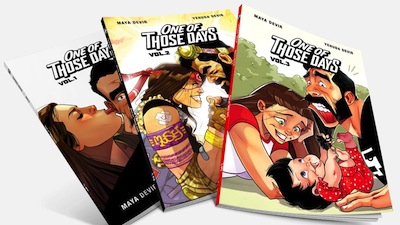
The online shop now sells three One of Those Days books plus merchandise, including apparel, shower curtains, calendars, phone skins and other items imprinted with favourite cartoons.

The Devirs’ YouTube channel has 46,000 subscribers. They have a Patreon subscription content service. They’ve appeared at comic-cons in Europe, India and will soon visit the United States. They are in great demand to give talks and lectures.

“Everything we do is because our fans suggested it,” said Yehuda. “Now, they want a TV show and we are going to try to do it. We are working with a scriptwriter at a studio in the U.S.”

photo - The online shop sells three One of Those Days books, plus other merchandise
The online shop sells three One of Those Days books, plus other merchandise. (image from Devirs)

Relationships proved to be a universal kind of language for the Devirs. “When we decided to move into the stage of being parents and saw it wouldn’t be that easy for us, this was a turning point,” Yehuda confided. “Would we really talk about the unpleasant experience of trying to get pregnant? It’s a super-personal subject.”

Maya felt that Yehuda’s humorous and colourful style would put the right spin on the topic and could be supportive for other couples in a similar situation. And so they introduced comics about ovulation, periods and lovemaking on demand. Messages offering support and advice came pouring in. It was like a worldwide group therapy session, Yehuda said.

The cartoon announcing Maya’s pregnancy got 16 million likes and shares. The first illustration of baby Ariel got 13 million. As of Dec. 1, she had 219,000 Instagram followers at just six months old.

“It was unbelievable to see the amount of love we got from people we didn’t know,” said Yehuda. “As Israeli and Jewish people, it was especially unbelievable to get supportive reactions from our huge fan base in the Arab world. The Israeli part is not important. We’re just the cartoon couple about love.”

Now living on Maya’s childhood kibbutz, the couple puts Ariel in the care of her two grandmothers when they travel to shows and lectures. The difficulty of parting with their baby became another comic that went viral because it was so relatable.

“It’s hard for Maya and me to leave her,” said Yehuda, “but, when she’s older, she’ll join us.”

Israel21c is a nonprofit educational foundation with a mission to focus media and public attention on the 21st-century Israel that exists beyond the conflict. For more, or to donate, visit israel21c.org.

Question that won’t die

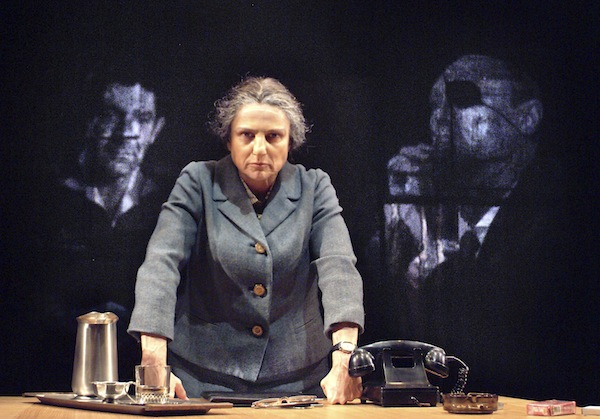
“How does a housewife decide between generals?” asks Golda Meir (played by Tovah Feldshuh) in Golda’s Balcony. In this instance, she must decide between the counsel of David (Dado) Elazar, her chief of staff, left, and Moshe Dayan, her minister of defence. (production still)

Tovah Feldshuh is incredible to watch in Golda’s Balcony, The Film. Not just in her passionate and sympathetic portrayal of Golda Meir, Israel’s prime minister from 1969 to 1974, but in her depiction of all 45 characters in William Gibson’s one-woman play. She’s Meir, David Ben-Gurion, David (Dado) Elazar, her husband Morris, Holocaust survivors and Israeli soldiers, among many others. She moves as easily between the personalities as a child raised in a multilingual household moves between languages. And with powerful effect.

Golda’s Balcony, The Film has two screenings at the Vancouver Jewish Film Festival – March 1, 1 p.m., and March 2, 3:30 p.m., at Fifth Avenue Cinemas. See it. You will have a more nuanced understanding of Meir, as well as of Israel, its origins and the struggles it has faced and will face. Gibson’s text is superb; it is engaging and insightful, with enough humour along the way that you’ll be able to breathe on occasion, as Meir deals with the existential crisis of the Yom Kippur War. Fluidly switching from wartime to other parts of her life, the play depicts, if nothing else, the stressful, heart-wrenching, thankless job that is being prime minister of a country that is constantly under threat.

The film is a recording of the play’s soldout Off-Broadway première on May 4, 2003, at the Manhattan Ensemble Theatre, presented by Issembert Productions. After a four-month soldout run at MET, the show moved to Broadway, and the Helen Hayes Theatre, where it ran for 15 months, making it, apparently, the longest-running one-woman show in Broadway history. It has won countless awards.

The set is relatively simple. A table with a couple of chairs on a tile floor. On the table, a dial telephone, a pitcher and water glass, an ashtray, cigarettes. Light shines on the table from the right, as if from a window. The backdrop is a wall of reddish stone or metal slabs of varying sizes that protrude outward. Images are projected onto the wall or chairs when relevant, giving the audience a visual of the person Meir is talking about, or that Feldshuh is portraying – though it is hard to see these images in the film version. To the side and a step down is a small piece of stage covered in dirt, with a few rocks, which acts as refugee camps in Cyprus, the kibbutz on which Meir lived for a time, Russia when Meir visits on a diplomatic tour, etc. The focal point for the entire production is Feldshuh.

The play begins in darkness, a man chants a prayer, the words “Golda’s Balcony” appear briefly on the wall. Thunder claps, lightning flashes, gunshots ring out, then darkness again, but the sound continues: guns firing, bombs exploding, planes overhead. A housecoat-garbed Golda, sitting at the head of the table, strikes a match and lights a cigarette; the lights rise a bit and calmer music prevails.

“I’m at the end of my story,” says Golda. “I’m old. I’m tired. I’m sick. Dying, the doctors tell me. The picture you have of me as Mamaleh Golde, who makes chicken soup for her soldiers, it’s a nice picture. And I do make chicken soup. But let’s empty it all out for keeps right now because, at the bottom of the pot, is blood. At the bottom of the pot is the question that won’t die. I can do without that music!” she yells. It stops. The lights come on more fully, as Golda then starts to relate the story of her first voyage to Palestine, with her husband, in 1921 – 52 years later, she would become prime minister.

“I remember, starting with a phone call, that woke me up at four o’clock in the morning. Saturday, Yom Kippur, 1973,” she says, as she closes her eyes, looking exhausted, her right arm holding up her head, the left one sliding off the table. The phone rings. Startled, she answers it, hearing the news that Egypt and Syria have attacked Israel. As she takes off the housecoat, Golda is in her familiar muted woolen skirt suit; energy, anger and fear all come to the surface as she relates her generals’ differing views as to what Israel needs to do. Dado: attack! Moshe Dayan: don’t be seen as the aggressor! “How does a housewife decide between generals?” she asks.

Of course, she does decide. But the agonizing and tension-filled process leads her – and Israel – down some very dark paths and the play masterfully depicts her sadness, anxiety and frustration; the sacrifices to her family, her health, as well as to others. Throughout the many narratives, it is the story of the Dimona nuclear facility to which she will get, the story that haunts her, that took her to hell; the story she needs to gather the strength to tell.

Thunder, lightning and gunfire divide the scenes in the whirlwind of action that Golda describes, her domestic life almost as tumultuous as her political life. We see her humanity, but also her toughness. Luckily, she never had to answer the question that “won’t die”: if Israeli forces hadn’t been able to cross the Suez Canal and if the United States had not come through with the needed military aid, would she have ordered the dropping of the nuclear bombs with which she had armed Israel’s planes?

Golda’s Balcony is a must-see in a festival with many excellent films. For the full schedule, visit vjff.org.

Chasing elusive photo

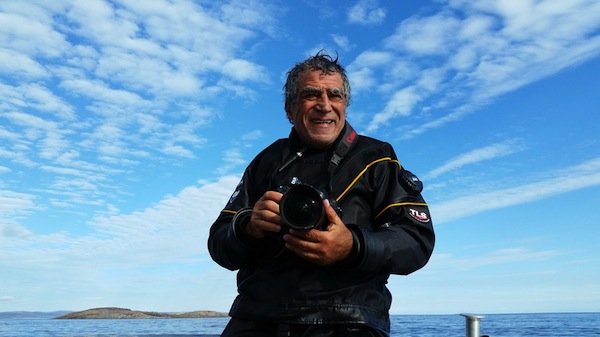
Picture of His Life follows Amos Nachoum to the Canadian Arctic, where he hopes to fulfil his dream of photographing polar bears underwater. (photo from Hey Jude Productions)

The ocean, in its vastness, suits Amos Nachoum perfectly. It’s big enough for him to hide. Not from the great white sharks, orcas, manta rays and other large sea creatures he has obsessively sought out and photographed for four decades. But from his traumatic memories of the Yom Kippur War, and from his father’s impossible expectations.

“Amos has made a decision to put the war behind him, to put violence behind him, and to use the camera to tell a different story, a beautiful story, about men and nature,” Israeli documentary filmmaker Yonatan Nir said in a phone interview while his family frolicked nearby in the kibbutz pool. “I think, in a way, he’s reframing his life with his camera.”

Nachoum’s complicated saga is rendered with gravity and grace in Nir and Dani Menkin’s Picture of His Life, which screens in the Vancouver Jewish Film Festival March 3, 8:45 p.m., at Fifth Avenue Cinemas.

Picture of His Life is structured around Nachoum’s summer 2015 expedition to the Canadian Arctic, more than 3,000 miles from his Pacific Grove, Calif., home, to try and fulfil his ultimate dream of photographing polar bears underwater. (Hence, the second meaning of the film’s title.)

The epic documentary’s executive producer is Nancy Spielberg, a nice bit of irony given that her brother made a flick called Jaws many years ago that spawned a widespread, irrational fear of sharks.

Nir and Menkin originally wanted to make a documentary about Nachoum diving in Tonga a decade ago, but that undertaking proved too expensive. Instead, they made Dolphin Boy, a redemptive portrait of a traumatized young Arab healed by swimming with dolphins in the Red Sea, which earned worldwide acclaim.

As it turned out, the extra years were essential, and not just to raise the funds for four Jews (Nachoum, the directors, and veteran underwater cinematographer Adam Ravetch) and six Inuit to trek to and film at remote Baker Lake. The filmmakers’ taciturn and enigmatic subject had to reach a point where he was willing to confide his deeply hidden feelings and memories.

“He really didn’t talk until we got to the Arctic,” Menkin recalled on the phone from his car in Los Angeles, “and that’s when he started to open up.” Nir added, “Amos needed time to open up and to be able, finally, to let us deep into his soul and to tell it for the first time.”

After the Arctic trip, Nachoum gave surprisingly candid interviews to the Israeli press about both his postwar trauma and his father, who had fought in the War of Independence. His way of dealing with his past continued – and continues – to expand.

There’s no question that the process of making Picture of His Life contributed to Nachoum’s evolution. Nir and Menkin visited his father in the hospital near the end of his life, capturing a raw, powerful moment. They subsequently showed the footage to Nachoum with the understanding that they would include it in the film only if he gave his consent.

Nachoum was touched by the scene and agreed to its inclusion. He even enacted an onscreen form of reciprocation to complete the circle.

“We were able to create this closure between the father and the son, but only through the film,” Nir said. “It never really happened face to face.”

The personal story in Picture of His Life is wrenching, but the environmental component is pretty potent, too. “I see myself as a soldier for Mother Nature,” Nachoum declares in the film, but his desperate, late-career pursuit of the polar bear goes even deeper.

“At the end of the day, Amos was looking for his family,” Menkin said. “His family is the universe. It’s Mother Nature. He found his family and lives with it in harmony, and that’s what he wants us to do.”

Michael Fox is a writer and film critic living in San Francisco.

A soap-opera comedy

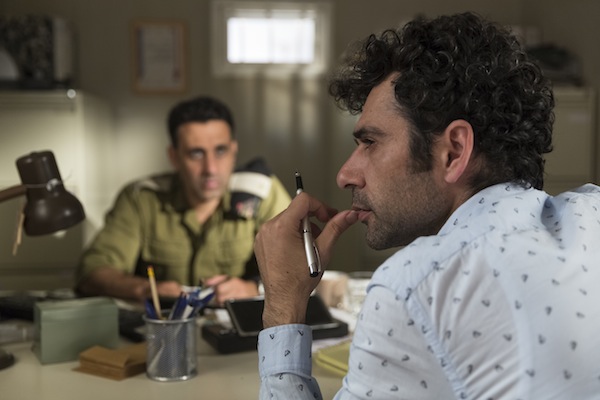
Yaniv Biton as Assi, left, and Kais Nashif as Salam in Tel Aviv on Fire, which screens Feb. 28 as part of the Vancouver Jewish Film Festival. (photo from Cohen Media Group)

Palestinian writer-director Sameh Zoabi achieves something altogether remarkable with his second feature film, particularly at this moment in time: he finds humour in the tattered relationship between Israelis and Palestinians.

“The whole idea of Tel Aviv on Fire is that we have more in common than we want to admit,” Zoabi said in an interview before his movie screened in the San Francisco Jewish Film Festival last year. It screens on Feb. 28, 1 p.m., at Fifth Avenue Cinemas, as part of the Vancouver Jewish Film Festival, which runs Feb. 7-March 8.

“We have to break these stereotypes and talk about what’s in common between us and not what divides us,” he said. “Let’s remind people how humanity can prevail in times where the politics of post-Oslo is, ‘Let’s dehumanize the other to be able to survive.’ I want to do the opposite.”

A sharp, insightful and winning comedy that juxtaposes the delicious absurdity of melodrama with the real-life absurdity of the occupation, Tel Aviv on Fire centres on an underachiever, Salam, who works as a gofer on his uncle’s hit Palestinian soap opera. Through a barely plausible combination of chance, chutzpah and desperation, the shlemiel is elevated to writer. Then he runs afoul of the Israeli commander of the checkpoint he crosses every day, whose wife is a loyal fan of the show.

Salam has to use every iota of guile and cleverness to navigate the opposing agendas that he’s caught between – and to win back the heart of a woman he had dumped. (Even while he’s landing political japes, Zoabi cheerfully seizes every opportunity to lampoon the conventions of both soap operas and movies.)

One of nine children, Zoabi grew up in a village outside of Nazareth, where people went to his grandfather’s barbershop for his humorous stories as much as for a haircut.

“In general, my village is very funny,” Zoabi related. “That’s maybe why comedy has become very easy for me, because I grew up in a place where they don’t take anything seriously.”

Zoabi studied at Tel Aviv University and then at Columbia University in New York, where he discovered the need for Palestinian stories. Returning to Israel, he made a short film, Be Quiet, in 2005 and his feature debut, Man Without a Cell Phone, in 2010. Zoabi’s experience of receiving government funding was the genesis of Tel Aviv on Fire (2018).

“You take money from the Israelis, so suddenly you are watched immediately,” he explained. “Israelis are making sure you are not becoming too Palestinian for them. And the Palestinians are watching, ‘He took money, maybe he’s a sellout, he’s doing a comedy.’”

After presenting Tel Aviv on Fire at several international festivals, Zoabi debuted the film in Haifa and in Nazareth. It was equally well received by both audiences, which didn’t surprise him. But he did have an epiphany.

“All the screenings led to this moment,” Zoabi declared. “Finally I understood – people are fed up. People are fed up of the reality that exists, which is managing the occupation.

“[The film] reminds people of the possibility that used to exist, the feeling that we can be normal people and just get along. I think that’s a fantasy that existed among the Israelis, that we can eat hummus together in Damascus one day. But they aren’t able to see the occupation as a major reason for that not to happen.”

It’s a measure of Zoabi’s skill that the current-events commentary in Tel Aviv on Fire goes down easily for viewers across the political spectrum. The means to that success, in large measure, is Salam’s evolution of necessity from hapless underdog to diplomatic savant.

“I’m attracted to people who don’t wake up knowing what they really want,” Zoabi said. “I think they’re more inspirational for me than black-and-white [characters]. Actually, people who know exactly what they want terrify me. You can’t be so certain all the time.”

For his part, Zoabi grew up in a milieu of group interaction and lots of soap operas, because those were the only two channels the family had. He wasn’t exposed to art, theatre and film until his late teens.

“I always say I’m not an artist, really,” he confessed. “I’m probably a barber of a new era in my family.”

Tel Aviv on Fire is in Hebrew and Arabic with English subtitles.

For the Vancouver Jewish Film Festival schedule, visit vjff.com.

Michael Fox is a writer and film critic living in San Francisco.

Worst traffic in the OECD

In central Tel Aviv, a driver slotted their car in between two properly parked vehicles. (photo from Ashernet)

Traffic density on Israel’s roads averages about 2,800 vehicles per kilometre, worst of all the OECD countries, for which the average is around 800 vehicles/kilometre; after Israel, Spain comes in at number two, with 1,300 vehicles/kilometre. As both the standard of living in Israel and the country’s population increase rapidly, the road and rail infrastructure, as well as the development of public transportation, are not keeping pace, even though there is a high price to pay for congestion. Israel’s Ministry of Finance put the cost of congestion in Israel at approximately $10 billion per year.

Loss-loss only solution

The parallels between the Trump impeachment trial in the U.S. Senate and the release of the Trump administration’s Israeli-Palestinian peace plan are striking. Donald Trump, a master of diversion, unveiled his incendiary proposal for the Mideast at the height of the Senate’s process. Just as the impeachment trial was, in some senses, a process whose outcome was predetermined by the Republican majority, so too is the Mideast proposal outcome predetermined in that it barrels over the Palestinian opposition and rubber-stamps almost everything the more extreme elements of the Israeli body politic have long demanded.

The approach is counterintuitive – like almost everything this U.S. president has done. Supporters might contend that, since all the rational thinking of the best diplomatic minds has not resolved this problem, a 180-degree turn that electroshocks the status quo might be better than nothing. The proposal is so one-sided that, out of sheer outrage, it has at least forced the Palestinian leadership to articulate what they will (or, rather, won’t) accept to a degree greater than they have expressed in recent years.

In the end, though, this emphasis on winning and losing – the Trump plan would be a clear win for Israel and a commensurate loss for Palestinians – is precisely the wrong approach. We may believe that the Palestinian leadership has betrayed their people by rejecting previous offers of coexistence, and conclude that what their people get is what their leaders deserve. But the Palestinian people deserve better than this.

Israel and the Zionist project have always had to contend with the realities and vagaries of coexistence – what other choice do Jews really have? Despite early warnings, coexistence with their neighbours was a widespread expectation among the early Zionists, some of whom thought (naïvely, in retrospect) that they would be welcomed with open arms by the other peoples in the region. But, even with the history of conflict and the absence of anything to give us a great deal of hope, some slow evolution that leads toward coexistence is the only realistic alternative to the status quo of suspended violence and intermittent war.

We need to recognize, above all, that a lasting resolution is not going to look like a win for one side and a loss for the other. Likewise, it is not going to resemble a win-win, as negotiators in various arenas, as well as salespeople, like to say. It will be a lose-lose proposition. An enduring peace and coexistence will almost certainly occur only when both sides are willing to accept a loss on many or most of their key demands – and accept that loss as a price for their children’s lives and well-being.

More immediately, we should be very wary of any master plan for peace that is scribbled out in the middle of an election campaign or another drama like an impeachment. The contents of such a plan are almost certainly more geared to the outcome it is trying to influence (votes for Likud or the Republican Party) or distract from (the U.S. president’s impeachment and trial or the Israeli prime minister’s loss of immunity from prosecution) than the problem it is ostensibly meant to address. Israelis and Palestinians, both, deserve self-determination and lasting peace.