Skip to content
  • Home
  • Subscribe / donate
  • Events calendar
  • News
    • Local
    • National
    • Israel
    • World
    • עניין בחדשות
      A roundup of news in Canada and further afield, in Hebrew.
  • Opinion
    • From the JI
    • Op-Ed
  • Arts & Culture
    • Performing Arts
    • Music
    • Books
    • Visual Arts
    • TV & Film
  • Life
    • Celebrating the Holidays
    • Travel
    • The Daily Snooze
      Cartoons by Jacob Samuel
    • Mystery Photo
      Help the JI and JMABC fill in the gaps in our archives.
  • Community Links
    • Organizations, Etc.
    • Other News Sources & Blogs
    • Business Directory
  • FAQ
  • JI Chai Celebration
  • JI@88! video

Recent Posts

  • Sharing her testimony
  • Fall fight takes leap forward
  • The balancing of rights
  • Multiple Tony n’ Tina roles
  • Stories of trauma, resilience
  • Celebrate our culture
  • A responsibility to help
  • What wellness means at JCC
  • Together in mourning
  • Downhill after Trump?
  • Birth control even easier now
  • Eco-Sisters mentorship
  • Unexpected discoveries
  • Study’s results hopeful
  • Bad behaviour affects us all
  • Thankful for the police
  • UBC needs a wake-up call
  • Recalling a shining star
  • Sleep well …
  • BGU fosters startup culture
  • Photography and glass
  • Is it the end of an era?
  • Taking life a step at a time
  • Nakba exhibit biased
  • Film festival starts next week
  • Musical with heart and soul
  • Rabbi marks 13 years
  • Keeper of VTT’s history
  • Gala fêtes Infeld’s 20th
  • Building JWest together
  • Challah Mom comes to Vancouver
  • What to do about media bias
  • Education offers hope
  • Remembrance – a moral act
  • What makes us human
  • המלחמות של נתניהו וטראמפ

Archives

Follow @JewishIndie
image - The CJN - Visit Us Banner - 300x600 - 101625

Tag: immigration

Making Canada home

Making Canada home

Marianne, left, with her father, Otto Echt, and sister Brigitte. (photo from Canadian Museum of Immigration [CMI] at Pier 21)

Marianne Ferguson’s family missed the train that was supposed to take them to Montreal from Halifax. Just 13 at the time, she and her sister were mostly excited at the prospect of something new, although they were sorry to leave friends and family behind in Europe. Their parents, however, were apprehensive, worried about starting a new life in a foreign country. And that was before they got stuck in Halifax – where, almost eight decades later, Ferguson, née Echt, still calls home.

In Europe, the Echts had lived in a little resort town called Brosen, just outside of the Free City of Danzig, which is today the Polish city of Gdansk. Ferguson’s father, Otto, was a pharmacist and a hobby farmer, and they lived well. Her mother, Meta, had multiple maids; the children – Marianne, Brigitte and Reni – had a nanny, and every spring and autumn a dressmaker would come into their home for a week to create new wardrobes for the upcoming season. When Adolf Hitler came to power, Ferguson’s family was relatively unaffected in the beginning. Even so, her parents saw what was coming and began making contingency plans.

Ferguson’s father kept homing pigeons on his farm. He would go to Poland to deposit money, and send the pigeons back home with coloured ribbons tied to them for Ferguson’s mother to decipher. A yellow ribbon meant he had arrived, for example, while a red ribbon meant he had deposited the money. He was able to get away with this scheme because the guards at the Polish border assumed he was entering his pigeons into competitions.

The Echts continued living in Brosen as the situation deteriorated for Jewish families. When the fair-haired Ferguson traveled to Hebrew school in Danzig with her sister, Hitler Youth would yell at her to ‘Stop walking with that Jew!’ When the Jewish children in the region were no longer allowed to attend school with their peers, the Jews of Brosen opened their own school on a local estate. The estate was at the end of a long street inhabited by Nazis, and it was understood the Jewish children all had to be in school and off the street by 8 a.m.

One day, when Ferguson was about 11 or 12, her streetcar to school was late. As she was walking alone down the long street to her school, a man sent his police dog after her. The dog attacked her, biting her on the elbow.

“And all of a sudden, somebody raised me up. Must have been an angel, really,” said Ferguson in a recent interview with the Independent from her nursing home in Halifax.

It was the milkman. He put Ferguson in his wagon, drove her to school and deposited her inside the gate. Ferguson said that man saved her life.

For her parents, it was the last straw. They decided they had to get out. A member of the Canadian consulate informed them that the country was not accepting pharmacists. Fortunately, though, the consulate worker saw their little farm and suggested sending them as farmers. And so it was that the Echts found themselves coming through Pier 21 in Halifax on March 7, 1939.

When they arrived at the pier, someone called their names and frightened Ferguson’s father. How did people here know who they were? But the woman calling them was Sadie Fineberg, from Jewish Immigrant Aid Services (JIAS). When the Echts missed their train, Fineberg put them up in a boarding house run by a Yiddish-speaking woman, and many Jewish families came to visit them.
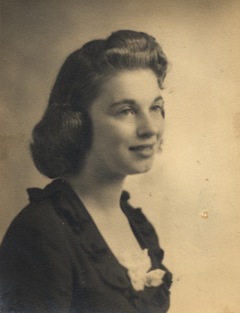
photo - Marianne Ferguson
Marianne Ferguson (photo from CMI at Pier 21)

“My parents said, ‘The people were so nice to us, and how do we know what it’s going to be like in Montreal? Maybe we should stay in Nova Scotia.’ And then they helped us with finding the farm, they drove us out … and we moved over there,” said Ferguson.

The farm was in nearby Milford, about a 45-minute drive from downtown Halifax. The Echts had to stay and work the farm for seven years as a condition of their immigration and, after their term ended, they moved to Halifax. Fineberg became a close family friend, and her nephew Lawrence became Ferguson’s husband.

Ferguson’s extended family was not so lucky. Her parents had applied to bring 11 of them over to Canada, and they were supposed to arrive later in the year. Cutting through all the red tape took time, but the process seemed to be progressing. Ferguson’s 11 family members went to meet their boat in Hamburg – but it wasn’t there. That day was Sept. 1, 1939, and the Second World War had just broken out.

“My father had bought a second farm. We were so lucky, it was right next to our farm. We thought we would all be together in the two farms. But it wasn’t meant to be. They were all killed,” said Ferguson.

When the war ended, Ferguson began volunteering with JIAS, helping Jewish refugees find their way in Canada. Many of the displaced persons were children traveling alone. Ferguson remembers one 17-year-old boy in particular who came through Pier 21 in 1948 and needed money to get to Montreal. Ferguson and her mother gave him $20 and some food. They also told him that he would become a good citizen, and he should work hard and make something of himself. Meanwhile, Ferguson continued to volunteer at Pier 21 until it closed in 1971. She began volunteering there again when it reopened as a museum in 1999.

Unbeknownst to Ferguson, the boy listened to her. His name was Nathan Wasser, and he had survived multiple camps in the Holocaust, including Auschwitz. He was trained as an electrician in Munich after the war, so that’s the work he first did after arriving in Montreal. In 1952, he met his wife-to-be, Shirley, at a parade for Queen Elizabeth, who was still a princess at the time. Together, they started a family, having a daughter and a son, and he ventured into the business world. Wasser eventually came to own his own shopping centre.
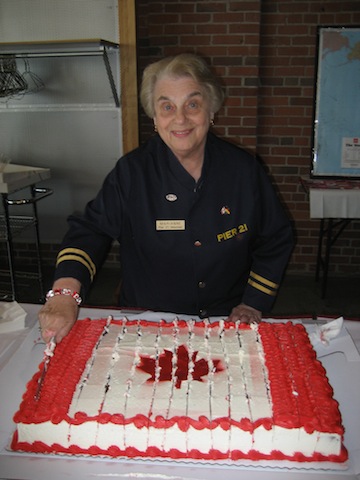
photo - Marianne Ferguson volunteered at Pier 21 when it was an immigration facility and again when it reopened as a museum
Marianne Ferguson volunteered at Pier 21 when it was an immigration facility and again when it reopened as a museum. (photo from CMI at Pier 21)

Through it all, Wasser – who passed away in 2015 – kept in mind the two women who had helped him when he first came to Canada as a scared and overwhelmed teenager.

“So I said to him, ‘You know, you have this vision of two volunteers. Would you like to go back to Pier 21?’” said his wife Shirley Wasser in a phone interview with the Independent. “And he said, ‘Well, I’ll never find anything.’”

Despite his doubts, Wasser contacted the Atlantic Jewish Council in 2003. The council connected him to Ferguson (her mother had already passed away), and they arranged to meet when the Wassers visited Halifax later that year.

On the appointed day, Ferguson and her granddaughter waited in the lobby of Pier 21 for a man with a blue shirt. Unfortunately, it seemed as if every man was wearing a blue shirt that day. Finally, a couple entered. The man was wearing a blue shirt and carrying flowers.

“My granddaughter said, ‘I think that’s for you.’ And, you know, he recognized me,” Ferguson recounted as she started to tear up.

Ferguson and Wasser stayed in touch until Wasser’s death, and she is still in contact with his wife. Whenever the Wassers came to Halifax, the Fergusons would have them over for Shabbat dinner on the Friday, then the Wassers would take out the Fergusons for dinner on the Saturday. Every birthday and holiday, Nathan Wasser would send a bouquet of flowers to Ferguson.

“He had no words for her, how grateful and how appreciative he was to the pier and the volunteers,” said Shirley Wasser. “I think [Ferguson] was one of the finest ladies I’ve ever encountered.”

“He did save his money and he listened to what we were saying. He said he owed it to us to do well. He was so grateful,” said Ferguson, speaking of her late friend somewhere between laughter and tears.

Alex Rose is a master’s student in journalism at the University of King’s College in Halifax. He graduated from the same school in 2016 with a double major in creative writing and religious studies, and loves all things basketball. He wrote this article as part of an internship with the Jewish Independent.
Format ImagePosted on June 2, 2017May 31, 2017Author Alex RoseCategories NationalTags Canada, Halifax, Holocaust, immigration, Marianne Ferguson, Pier 21, tikkun olam
United against racism

United against racism

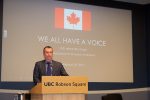
Artur Wilczynski, Canada’s ambassador to Norway, gave the keynote address at the Feb. 22 SUCCESS community forum. (photo from SUCCESS)

SUCCESS’s Safeguarding Our Communities, Upholding Our Shared Values: A Community Forum on Immigration and Racial Discrimination was a full-house event at University of British Columbia Robson Square on Feb. 22.

The keynote speaker, Artur Wilczynski, Canada’s ambassador to Norway, shared his family’s story about how they survived the Holocaust and came to Canada. “I am a Polish, a Jewish, a Quebecois. Most important, I am a Canadian,” he noted.

“Diplomacy doesn’t give you immunity from discrimination but gives you a platform to speak against it,” he said.

“It is important for Canadians to speak out against various forms of discrimination and xenophobia. As an immigrant to this country and the son of Holocaust survivors, I have been privileged to serve my country as an ambassador and senior official. It is why I feel it is my obligation to work towards a more inclusive and respectful Canada.”

He thanked SUCCESS for allowing him to share his story at the forum.

Wilczynski’s keynote address was preceded by two panel discussions. Panelists included, among others, Dr. Robert Krell, Vancouver Holocaust Education Centre founding president and outreach speaker; Dr. Gurdeep Parhar, University of British Columbia faculty of medicine; Chief Dr. Robert Joseph, Reconciliation Canada ambassador; and Sarah Al-Qaysi, program assistant, SUCCESS. SUCCESS chief executive officer Queenie Choo welcomed the audience to the forum. Among the sponsoring organizations of the event were the Jewish Independent, Jewish Federation of Greater Vancouver and the Centre for Israel and Jewish Affairs.

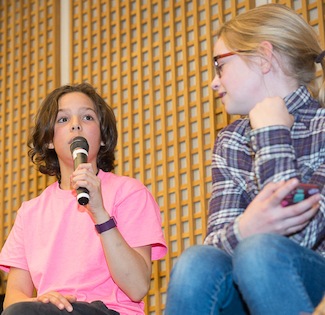
photo - Young audience members hoped to take what they learned at the forum about the immigrant experience and share it with those who could not attend the event
Young audience members hoped to take what they learned at the forum about the immigrant experience and share it with those who could not attend the event. (photo from SUCCESS)

At the facilitated discussion for Call for Actions, a group of young audience members raised questions on how they could share the knowledge they learned at the forum with those who were not able to attend.

SUCCESS will be launching a series of community roundtables across Metro Vancouver. These facilitated conversations will create a platform for community members to share and reflect on thoughts on diversity and inclusion, while engaging them in thought-provoking discussions regarding cultural integration in our community – to build safe, strong and enlightened neighbourhoods. Each session will be held at one of SUCCESS’s local offices or another accessible community location.

SUCCESS will also create a documentary video, featuring interviews with immigrants and community leaders, about the value and contributions of immigrants in Canada. The video will be distributed through multiple channels, including a special screening video launch, online and social media networks, and grassroots outreach through high schools and universities to help educate future generations about the stories of immigrants in Canada, who we are and where we are from.

Format ImagePosted on March 3, 2017February 28, 2017Author SUCCESSCategories LocalTags Artur Wilczynski, immigration, interfaith, racism
A swing and a hit play

A swing and a hit play

Hasan (Nadeem Phillip) tells Haseena (Risha Nanda) about his dream of playing cricket in Canada. (photo by Emily Cooper)

I have to admit I’ve never seen a cricket match in all the years I’ve lived in Vancouver. I’ve seen games in other countries – but I never knew Stanley Park had a field for cricket going back to the 1890s and a clubhouse that just turned 100.

In fact, the pitch at Brockton Oval is considered rather hallowed ground by some and forms a focal point in The Men in White, the current production at the Arts Club Granville Island Stage.

Playwright Anosh Irani takes the audience from India, where dreamers see Canada as a land of refuge; to Canada, where dreams don’t always turn out the way people hope; to the world of cricket, where even a “duck” doesn’t hurt too badly as long as you don’t have to borrow a “box.”

Based partly on the author’s true experience at a chicken slaughterhouse, the play is set in two different locations – a chicken stand in Bombay and a cricket clubhouse in Vancouver.

In India, 18-year-old Hasan dreams of becoming a famous cricket player and playing in Vancouver with his brother. As he laments his lot in life, he admires a local girl from afar, trying to woo her, despite becoming tongue-tied and awkward whenever she comes by. His adoptive father, who owns the shop, looks after him, trying to impart wisdom about life, albeit in rather unorthodox ways.

In Vancouver, Hasan’s brother, Abdul, has been living and working in a restaurant illegally, after arriving on a tourist visa. He’s embarrassed to tell his brother of his circumstance, and the only thing that keeps his spirits up is to be able to play his favourite sport on a beautiful grass cricket field – a privilege for which he is immensely grateful. He’s particularly impressed because Don Bradman, a renowned cricket player, had said in 1948: “The Brockton Point ground is the prettiest upon which it has been my pleasure to play.”

In the clubhouse, Hasan and his teammates discuss the game, each other’s lives and the issues of the day, but come to blows when racist sentiment arises. A doctor who had emigrated from Bombay takes issue with Abdul. His angry outburst ends with him declaring, “I will not allow Muslims in this country!”

The scene is disturbing in its familiarity, given President Trump’s machinations, but also very touching, as the other team members rally around Abdul in support.

While thought-provoking, the play doesn’t offer up any answers. Its forte is in the writing and directing. The performance is jam-packed with witty repartee, sarcastic barbs and playful insults that are tossed at one another like verbal confetti.

Irani has a skill in wordplay and humour that leaves the audience feeling at once unsettled by some of what’s being said, while appreciating its delivery. With six of the cast members almost talking over one another at times, the outcome could have been rather messy, and the play needed the deft hand of Rachel Ditor at the helm to direct the characters in their split-second timing. The set design by Amir Ofek is minimalist, but in some ways reflects a cricket game. The two locations share one stage and action alternates between the two, as it would in a sporting match. Ofek’s design enables the sets to coexist, while still being visually separated by the few props and use of different lighting.

The Men in White runs at Granville Island Stage until March 11 (artsclub.com). Irani’s work – he is also an author – has gained national and international acclaim and honours. Take the opportunity to see it for yourself.

Baila Lazarus is a freelance writer and media strategist in Vancouver. Her consulting services are at phase2coaching.com.

Format ImagePosted on February 24, 2017February 21, 2017Author Baila LazarusCategories Performing ArtsTags Anosh Irani, Canada, cricket, immigration, India, racism, theatre
The time to act is now

The time to act is now

Temple Sholom Rabbi Dan Moskovitz addresses a Concerned Canadian Clergy for Refugees multi-faith clergy press conference at Jack Poole Plaza in Downtown Vancouver on Jan. 29. (screenshot)

The murders at a Quebec City-area mosque Sunday night shattered our sense of Canadian safety and multiculturalism. Six worshippers were killed and at least a score more injured in the shooting rampage inside a Ste.-Foy Islamic centre during evening prayers.

We are confident we reflect the intent of every reader and the broader community we serve when we offer condolences to and solidarity with the victims, their families and the entire Muslim community in Canada, each member of which must be feeling a sense of grief and fear.

We will not, however, state, as some inevitably do in such situations, that “We are all Muslims now.” After this tragedy, only members of the targeted group can fully appreciate the sense of isolation and anxiety such a tragic act instils. We cannot all understand the variety, depth and breadth of feelings of those affected, so, while we should acknowledge our common humanity and grief, we should offer special comforts to our Muslim friends and ensure that they know that Jewish Canadians and all Canadians sympathize with the uniqueness of a hate-motivated attack.

The grief that enveloped us late Sunday should not eclipse the light we witnessed on Sunday morning, when local clergy, led by Temple Sholom’s Rabbi Dan Moskovitz, other rabbis and clergy from different faith traditions, gathered to stand in solidarity against the executive orders signed by U.S. President Donald Trump last Friday.

The president decreed that all refugees would be immediately banned from entering the United States for at least 120 days. A parallel announcement declared that citizens of Iran, Iraq, Libya, Somalia, Sudan, Syria and Yemen would be banned from entering the country for at least 90 days.

The presidential orders came as a stunning blow to those who didn’t take Trump at his word. Even many who count themselves as among his fiercest opponents seemed to believe Trump would stop short of his most extreme promises. But there he was: doing exactly what he said he would do – banning Muslims from entering the United States (as well as taking preliminary steps to construct a wall along the border with Mexico).

“To be clear, this is not a Muslim ban, as the media is falsely reporting,” the president obfuscated in a written statement Sunday. “This is not about religion – this is about terror and keeping our country safe.”

Despite this contention, one of the stomach-churning aspects of this seemingly random list of Muslim-majority countries is what they share in common: as the New York Times has reported, these are countries where the Trump organization has few business interests. If one subscribed to the idea that banning people based on nationality was a wise move, certainly Saudi Arabia, which produced almost all of the 9/11 terrorists, and Egypt and the United Arab Emirates, which have not insignificant records of radicalization, would logically (if that is the correct term) be on such a list. So might Turkey. But residents of those countries can, for now, continue to enter the United States.

Trump’s orders were additionally jarring for Jews and others who were solemnly marking International Holocaust Remembrance Day at the very time Trump was turning America’s back on refugees. The history of the United States – and Canada, and almost every other country – in turning their backs on Jewish refugees is the reason the Holocaust was able to occur in the magnitude that it did. The callousness Trump exhibited in taking actions against refugees on International Holocaust Remembrance Day is abominable, even worse than his intentional omission of Jews in his Holocaust statement that day.

Syrian refugees are not, at present, finding every door in the world closed to them, as Jews did in the 1930s. They are, however, having the door to the golden medina – the great land of liberty whose preeminent symbol openhandedly welcomes the homeless, tempest-tost, huddled masses yearning to breathe free to a place of permanent refuge – slammed in their faces. In Trump’s America, Lady Liberty lifts her lamp beside the golden door only so that refugees can read the sign: “Keep out.”

The move by Canadian clergy is admirable. They deserve our thanks and support as they provide a model for individuals to take a stand at an important time.

Likewise, we were proud to see the remarks of Prime Minister Justin Trudeau, and the thousands of Canadians who have shared his sentiments, that Canada will step up where America is faltering and take in some of those refused entry to the United States. We invite readers to contact members of Parliament to let them know that plenty of Canadians – including Canadian Jews – understand that Canada is in a unique position to act at a time when the United States is betraying our erstwhile shared values.

By press time, it remained unclear what specific animosities drove the perpetrator of the Ste.-Foy attack. And, while it is premature to blame the murderer’s actions on ambient anti-Muslim agitation stoked by a swath of demagogues leading all the way up to the president of the United States, the rhetoric in which Trump and many of his supporters are engaging is certain to have negative consequences.

Consequences, too, will be felt from the actions of well-intentioned people. The rabbis and other clergy who step forward and condemn bigotry are the best antidote to the negativity and hatred we see. They are whom we should emulate. We must step forward with them.

Format ImagePosted on February 3, 2017February 1, 2017Author The Editorial BoardCategories From the JITags immigration, interfaith, Muslims, racism, refugees, Trump
אפקט טראמפ

אפקט טראמפ

אמריקנים מחפשים אופציות הגירה ועבודה בקנדה. (צילום: Makaristos via Wikimedia Commons)

זכייתו של דונלד טראמפ בבחירות לנשיאות בארצות הברית ממשיכה להכות גלים במדינה. אמריקנים רבים המתוסכלים מבחירת טראמפ הנחשב במחינתם למאוד מסוכן, בודקים את האפשרות לעבור לקנדה ולמצוא כאן בית חם.

כפי שכבר פורסם אתר מחלקת ההגירה הקנדית קרס עם פרסום תוצאות בחירות של טראמפ בשמונה בנובמבר. זאת, לאור גידול משמעותי במספר הגולשים האמריקניים שהחלו לחשוב ברצינות על מציאת מקלט בקנדה מהחשש מטראמפ.

אפקט טראמפ משפיע גם בתחום העבודה. לאחרונה נרשם גידול משמעותי ביותר בחיפוש עבודה בקנדה מצד אמריקנים שרוצים לגור כאן לאור זכייתו בבחירות. במקביל נרשם גידול גם כן מצד אמריקנים שמחפשים שידוך עם קנדים, כך שתיפתח בפניהם הדלת להשיג ניירת לעבור ולגור כאן. אפילו בתחום התעופה והתיירות מתברר שיש גידול משמעותי מצד אמריקנים שמחפשים טיסות לקנדה.

יצויין כי קנדיים רבים לא “מאושרים” מבחירתו של טראמפ ומדי כשבוע מתקיימות הפגנות נגדו בסמוך למלונות דירות טראמפ טאור, בערים טורונטו וונקובר. גם הממשלה הקנדית חוששת מטראמפ שחוזר ומצהיר כי הוא רוצה לשנות את הסכם הסחר נפט”א המשותף לארה”ב, קנדה ומקסיקו.

“גדרות מצילות חיים” יותקנו על גשר בורארד למנוע מאזרחים להתאבד

עיריית ונקובר בונה בימים אלה גדרות בצידי גשר בורארד למנוע מאזרחים לקפוץ אל מותם, תוך כדי קפיצה חופשית אל המים העמוקים. עלות הפרוייקט שיימשך מספר חודשים נאמדת בכשלושה וחצי מיליון דולר. זאת, במסגרת עבודות שיקום, שיפוץ הגשר ובניית מסלולי אופניים חדשים. מהנדסי העירייה חשבו תחילה להתקין רשתות בתחתית הגשר שיעצרו את המנסים לקפוץ, או להציב קירות זכוכית בצידי הגשר. אך לבסוף הוחלט שהגדרות ממתכת (משגיעות לגובה 3.6 מטר) הן הפתרון הטוב והיעיל ביותר.

במערכת בריאות הנפש של מחוז בריטיש קולומביה ברכו על החלטה והוסיפו: “הגדרות יצילו חיים. זה ידוע שיש לא מעט נסיונות להתאבד מגשר בורארד”. ואילו המתנגדים לפרוייקט שטוענים כי במקום לבזבז כספים על הקמת הגדרות, עדיף היה להגדיל את תקציב מערכת בריאות הנפש ולעניק שירות טוב יותר לנזקקים, כך שהם לא ינסו להתאבד.

כוכב נוסף לסטארבקס: הרשת תממן טיפול נפשי לעובדיה בקנדה

רשת בתי הקפה סטארבקס בקנדה הולכת משמעותית לקראת העובדים. הנהלת הרשת המקומית תממן לעובדים טיפולים נפשיים בהיקף של עד חמשת אלפים דולר בשנה. מדובר בצעד חסר תקדים בענף רשתות הקפה והמזון ובכלל בקנדה, בארה”ב ובקומות אחרים.

בסטארבקס קנדה מועסקים כתשעה עשר אלף איש וכשבעים וחמישה אחוז מהם שעובדים עשרים שעות לפחות מדי שבוע, זכאים עם בני משפחותיהם לקבל את טיפול הנפשי (ללא צורך שום באישור רופא משפחה), שכולל ביקורים אצל פסיכולוג מורשה. ההחלטה לממן את הטיפולים התקבלה לאור התייעצות עם העובדים. בהנהלת הרשת מודעים לעובדה כי תחום בריאות הנפש משפיע מאוד על רבים בקנדה, כאשר ברובם הם הצעירים. יצויין כי מרבית עובדי סטארבקס צעירים (הגיל הממוצע ברשת עומד על עשרים וארבע) וביקורים אצל פסיכולוג נחשבים ליקרים מאוד במדינה.

מומחה בתחום אומר שלטיפולים נפשיים יש ערך רב. הם מקטינים תביעות רפואיות מצד העובדים, מגדילים משמעותית את שביעות רצונם וכן גם את נאמנותם למקום העבודה. לדבריו מדובר בתרומה חשובה מאוד לעובדים בעיקר בענפי המזון והמסחר הכל כך תחרותיים, ויש לקוות שחברות נוספות ילכו בדרכה של סטארבקס.

גם הנהלת סטארבקס בארה”ב החליטה אחרונה ללכת לקראת העובדים שם. הרשת העלתה את שכר עובדיה (כמאה וחמישים אלף במספר) בלפחות חמישה אחוזים.

Format ImagePosted on November 30, 2016November 30, 2016Author Roni RachmaniCategories עניין בחדשותTags Burrard Bridge, elections, immigration, life-saving fences, mental health, Starbucks, suicide, Trump, בחירות, בריאות הנפש, גדרות מצילות חיים, גשר בורארד, הגירה, התאבד, טראמפ, סטארבקס
The process of integration

The process of integration

Dr. Solly Dreman (photo by Rebeca Kuropatwa)

With the large numbers of refugees and immigrants making their way to Winnipeg and elsewhere in Canada, Winnipeg Friends of Israel invited Dr. Solly Dreman, a Winnipegger who moved to Israel in 1964, to speak on the topic.

In the Sept. 19 lecture at the Asper Jewish Community Campus, Dreman drew from his own experience and expertise, using the work he did, along with colleague Dr. Ava Shinar, on immigration in the 1990s to illustrate an optimal way of integrating immigrants into Israeli society, which could be applied to other countries.

“I did the workshop with her over a decade ago, but the implications are certainly relevant to the contemporary problems occurring in the world today, and to immigrant and refugee populations all over the world,” said Dreman.

“Immigration is widely recognized as a stressful event which increases psychological vulnerability,” he explained. “Researchers have noted that adolescent immigrants … we know that many terrorists are in that age group … constitute an extremely high-risk population. In adolescence and late adolescence, there’s a need to cope with profound physical, psychological and social transformations. And, in those adolescents who have become immigrants and [are] in a strange and often unwelcoming environment, the uprootedness and difficulties in establishing a solid base of identity and meaning could have disastrous results. Indeed, the violence evident today in such places like Paris, Nice, Brussels, Orlando, San Bernardino, as well as Tel Aviv and Jerusalem, testifies to this. Youth confronted with a strange environment and difficult economic conditions, as well as lack of purposefulness in their lives, often latch onto causes and groups that implement terrorism and violence in the international community.”

Dreman also discussed other issues.

“In the 1990s,” he said, “with the collapse of the Soviet Union, there was a mass exodus of over a million Soviet Jews to Israel. Soviet students comprised about 10% of the student body at Ben-Gurion University. They were competing for limited resources, such as dormitory space, scholarships and, eventually, opportunities for employment.

“There were many negative stereotypes and attitudes prevailing between the native Sabra students, who were born in Israel, and their Soviet counterparts. As far as the stereotypes that Israelis had toward the Russians, well, they often viewed them as manipulative, clannish and corrupt … while the Russian students perceived the Israelis as loud, aggressive and uncouth.

“The Russians, in that first year of the workshop, we also heard some terrible things they had to say about the Ethiopians, referring to them as subhuman, subspecies, monkey-like, etc.”

With the extreme alienation between Sabras and the immigrant students – to the point of outright violence and fist fights – Dreman needed to find ways of reducing tensions and bringing understanding, cooperation and solidarity between the groups.

He said it was important to create an atmosphere where each group could participate in an evolving melting-pot culture, where each side would begin to listen to and understand the other. As such, he and Shinar created a two-credit academic course that eventually became a four-credit, year-long course because of its popularity.

“So, students were given an award for their participation and for completing course assignments,” said Dreman.

He explained, “The syllabus described it as being designed to help students learn about their family and individual transitions in the face of such phenomena as birth, adolescence, illness in the family, divorce and death … but with a particular emphasis on aliyah immigration.”

Normative aspects of immigration and transition were discussed in an academic context, so participants could then discuss their own experiences in a non-threatening atmosphere and place those experiences in an appropriate context, in an effort toward understanding what they themselves were going through.

At first, due to the Israelis’ fluency in Hebrew and the Russians’ more reserved manner, the Sabras monopolized the class. But, after a few sessions and with a little prompting, the Russians became much more comfortable and vocal.

“What we wanted to do was create an evolving identity,” said Dreman. “Emphasis was placed on joining the new culture, but space should be provided for the immigrant representatives to give expression to their culture of origin, needs and expectations. On the educational level, awareness workshops should be introduced in citizenship classes in elementary schools, high schools and colleges. It is also critical that government and volunteer groups work together to help promote immigrant absorption.”

Dreman recognizes that the work they did in Israel had many atypical factors working in its favor, but said the attitude of creating a type of melting pot should yield a good result in most cases. As well, while the workshops had some factors going for them, like participants with a common Jewish identity, working with young adults (18-to-24-year-olds) posed challenges that are less common with older immigrants, such as extremism and radicalization.

Dreman wanted to be very clear in differentiating between immigrant and refugee populations, noting the difference “between immigrants who want to immigrate and refugees who are exiled and may not necessarily want to.

“The purpose of our workshop was to make the hosts and the new immigrants understand where the other person is coming from, to create a merging of cultures and understanding in order to ease the process of assimilation,” he said. “I think the beautiful thing is that it was based on reciprocity. It was very successful. In the workshop, at the beginning, people hated each other. At the end, almost all had befriended people from the other group.

“If people knew that the immigrants had a real desire to be part of the hosts’ community, I think there’s a lot of opportunity for mutual understanding,” he added.

According to Dreman, the setting also plays a significant role. “In one of the projects we did, we sent kids out in one of the groups to interview Israelis – native Israelis – concerning their attitudes towards Russians. We sent them to a marketplace, a competitive marketplace with pedlars. And, another group, we sent to interview Israelis in Dizengoff Centre, which is upper-class…. How did the native Israelis describe the Russians in the marketplace? ‘Swindlers, crooks, gamblers, prostitutes, bastards.’ What about in the centre? They described them as ‘wonderful, contributing to the nation,’ and so on.

“In Europe and North America, if somehow they could take select groups of people who host immigrants and let them have that encounter and spread the gospel – ‘Hey, they aren’t that bad,’ that sort of thing – there is no reason it would not be successful.”

Rebeca Kuropatwa is a Winnipeg freelance writer.

Format ImagePosted on October 28, 2016October 27, 2016Author Rebeca KuropatwaCategories NationalTags immigration, Israel, refugees
Community expanding

Community expanding

As the Jewish community expands into Coquitlam and other cities in the Lower Mainland, there must be an adjustment in the allocation of community resources. (photo by Greg Salter via Wikimedia Commons)

The face of Vancouver’s Jewish community is changing, with 36% born outside of Canada – the largest percentage in any Jewish population in the country.

In the Grade 1 classroom at Richmond Jewish Day School, half of the class is learning English as a second language, its students hailing from Israel and Argentina and speaking a mixture of Hebrew, Russian and Spanish.

photo - Abba Brodt
Abba Brodt (photo from Abba Brodt)

“There’s definitely a growing number of Israeli families in all our Jewish day schools,” said Abba Brodt, principal at RJDS. Among them is the second wave of Russian Jews, comprised of Russian emigrés who made aliyah as children and moved to Vancouver after doing army service in Israel and starting their families. “They maintain strong Russian ties but have an incredibly strong connection to Judaism and Israel,” he said.

The new arrivals place extra demands on Jewish day schools in terms of meeting their children’s language needs, and RJDS has had to shift resources internally so the children of new immigrants can learn successfully in class.

“When people come, what’s our obligation to them?” Brodt pondered. “They want their kids to get a Jewish education as they get established. Many of these parents come without jobs, are not established financially and are trying to adjust, but it takes many, many years. The only menschlik thing to do is to open our doors, figure it out and let them know they’re not a burden at all. I think that’s the right approach for any Jewish organization in town. The faster we help them get on their feet, the better for the community.”

Adjustment is easiest for the youngest children. Brodt recalled a Russian-Israeli family that arrived in June 2014 with a child who couldn’t speak a word of English. “He entered kindergarten and by December that year he was speaking to his parents outside of school hours in English!”

photo - Cathy Lowenstein
Cathy Lowenstein (photo from Cathy Lowenstein)

At Vancouver Talmud Torah, head of school Cathy Lowenstein has also witnessed an influx of new immigrants from Israel, as well as from Brazil, Estonia and Hungary. “For students in the younger grades, ESL support isn’t as much of an issue, as they can really immerse themselves in language much faster than students in intermediate grades. But, over the past few years, we’ve increasingly had to allocate budget to students who require ESL support,” she said.

That can be difficult because the ESL needs vary year by year. “Often, these students don’t present until late summer, so we’re left trying to reallocate dollars in August so that we can properly help them transition into the school,” she explained.

Tuition assistance is provided on a case-by-case basis, Lowenstein said. “Even though we may have allocated our cap, we do our very best not to turn away a family wanting a Jewish education,” she said.

The high cost of living in the Lower Mainland is having far-reaching effects on the 26,250 Jews who call this corner of the West Coast home. Approximately 14,000 of them live in Vancouver, close to 6,000 in Richmond and the remainder in outlying cities including Burnaby, New Westminster, Port Coquitlam, Coquitlam, Port Moody, Maple Ridge and Langley, where Jewish resources are few and far between. That’s because the high price of housing forces many new arrivals into these outlying areas, where accommodation is a little more affordable.

While RJDS has space available for more students, the challenge lies in reaching those Jewish families who live in the suburbs.

“We know there are 700 Jewish school-age kids in the Tri-Cities of Coquitlam, Port Coquitlam and Port Moody and, as much as the schools may want them, how many families are going to have their kids get on a bus for an hour’s commute each way?” Brodt said. “You have to be super-committed to do that when there are good public schools around. If I could create a pipeline to Burnaby, I’d do it, but the possible customer base there is not ready to make that sort of commitment. They’re managing their Jewish lives out there, as is their right.”

photo - Shelley Rivkin
Shelley Rivkin (photo from Shelley Rivkin)

At the Jewish Federation of Greater Vancouver, vice-president of community affairs Shelley Rivkin noted that more than 850 children now live in underserved areas beyond the borders of Vancouver and few are receiving any Jewish education. “With community support, Jewish educators can develop innovative programs via which these kids can access that education, sharing fully the richness of our traditions and strengthening their Jewish identities,” she said.

In one such program, Federation collaborated with the Jewish Community Centre of Greater Vancouver and funded a pilot project to enable Jewish children living in Coquitlam, Port Coquitlam and Port Moody to attend Jewish summer day camp. The project made transportation and fee subsidies available to 22 kids.

Federation has established a regional communities task force that began work last month. In the meantime, the organization contributes to a shuttle bus in Richmond that helps seniors attend various community activities, and Burquest seniors can enjoy another day of programming thanks to additional funding provided to Jewish Family Service Agency. For young families, PJ Library is an important outreach program, Rivkin said. “For many young families who are raising children in interfaith households and/or who live in the suburbs, PJ Library is a primary Jewish connection. Recently, 100 people attended a PJ Library Chanukah event in Coquitlam.”

Federation is seriously focused on the future of the Lower Mainland’s Jewish community and anticipating programming to reach its needs over the next 15 years.

“Our population of seniors is expected to double by 2030 and an increased number of them will be 85 or older, so programs and services for this group will need to be expanded,” said Rivkin. “As issues of affordability persist, we expect there to be more Jews moving to more affordable suburbs that have little or no Jewish infrastructure. We expect these regional communities to play a larger role, and Jewish Federation will increase its focus on programs and services to reach them.”

The cost of living in Vancouver will likely continue to impact those who pay a premium to live near Jewish services and institutions, but find that the cost of Jewish life prevents them from participating. “We expect that increased subsidies for program participation will be needed,” she added.

According to the National Housing Survey in 2011, 16% of the Lower Mainland’s Jewish community lives below the living wage of $36,504. Among Jewish immigrants to the Lower Mainland who arrived between 2005 and 2011, that low-income rate is 25%. As one communal effort in dealing with this issue, Tikva Housing Society will expand the affordable housing stock for the Jewish community by 42 additional units in Vancouver and Richmond by 2017.

Lauren Kramer, an award-winning writer and editor, lives in Richmond. To read her work online, visit laurenkramer.net. A longer version of this article was published in the Canadian Jewish News.

Format ImagePosted on February 12, 2016February 11, 2016Author Lauren KramerCategories LocalTags Abba Brodt, affordability, Cathy Lowenstein, education, immigration, Jewish Federation, RJDS, Shelley Rivkin, VTT
Sponsoring Yazidi refugees

Sponsoring Yazidi refugees

Yolanda Papini Pollock, co-founder of Winnipeg Friends of Israel, which initiated Operation Ezra. (photo from Yolanda Papini Pollock)

The Jewish community in Winnipeg has ramped up its efforts to help the Yazidi people, including the sponsorship of families to the city.

“When you look at the plight of the Yazidi people, it kind of mirrors the Jewish reality of 1945,” said Al Benarroch, executive director of Winnipeg’s Jewish Child and Family Services (JCFS). “I’m not going to be one to say that it’s like the Holocaust, but the Yazidis have suffered, over the last 500-600 years, a very significant genocide.

“The Yazidi people have been displaced from that region of the world and have been heavily victimized, murdered and devastated in the millions. And they have nowhere to go to. So, our community and other communities across Canada have really taken this to heart saying, you know, it was a mere 70 years ago that we ourselves were in a similar situation.

“When we say ‘Never again,’ are we just talking about the Jewish people? We see that image of ourselves in the Yazidi plight, and we feel compelled to come forward and act on it. That’s been the message we’ve been putting forward in Winnipeg.”

The group that started this effort in the city is Winnipeg Friends of Israel (WFI), awakening the community to the Yazidis’ situation and the possibility of sponsoring Yazidi refugees to Winnipeg.

“When we heard about the Yazidi massacre in August 2014, we reached out to the Yazidi community,” said Yolanda Papini Pollock, WFI co-founder. “We wanted to hear about the Yazidi plight and support their community by raising awareness.”

WFI invited Nafiya Naso, a Yazidi spokesperson, to share her and others’ stories with the Winnipeg community at the Asper Jewish Community Centre in March 2015.

“After learning about the dire strait conditions of the Yazidis in refugee camps, it was clear to us that we could not sit aside and do nothing,” said Papini Pollock. “We decided to do more than just listen.”

The group initiated Operation Ezra with the goal of sponsoring at least one Yazidi family and of raising awareness of the Yazidis’ plight. They began by partnering with Bridges for Peace, Calvary Temple, the Mennonite Central Committee (MCC), and others. By December, $130,000 (enough for five-plus families) had been raised.

“When we heard Nafiya’s story, we recognized so many similarities to the plight of the Jewish people prior to the establishment of Israel and immediately empathized with her people,” said Papini Pollock. “The Yazidis are an ethno-religious minority and, just like the Jews, they are targeted solely because of their religious beliefs. Many genocide scholars perceive the Yazidis as victims of genocide. The Yazidis have been persecuted 74 times. At one point, there were more than 20 million Yazidis. Today, there are less than one million.”

The Jewish Federation of Winnipeg has helped raise the funds to sponsor as many families as possible and JCFS has taken on the responsibility of managing the resettlement and other services, allowing WFI to do what they do best – connecting on a personal level with people.

Since Operation Ezra was announced, the congregation of Shaarey Zedek has taken on sponsorship of two families under the initiative.

“Collectively, we’re talking about 35 individuals to date who have applications that are or will be submitted,” said Benarroch. “At this point, I think we’re talking about bringing in as many as 50 individuals.

“The more we fundraise, the more we can help. We’ve gotten a hold of many people who are donating furnishings, old televisions and bedding. Someone came forward and said they will donate through their manufacturing company quilts and coats. We are looking for warehouse space.”

The sponsorships are being done through MCC, as they are the only organization in the city that holds a sponsorship agreement with the federal immigration department. This is something Benarroch would like to see change, not due to any lack in MCC’s services, but as an added insurance. “Historically, there was Jewish Immigration Aid Services of Canada (JIAS),” he said. “Located in Toronto, they were the national office for Jewish immigration.

“Because it was a national mandate for that sponsorship agreement and the national office no longer exists, my understanding is that the sponsorship agreement had to be given up. So, now we no longer have a national sponsorship agreement for Canadian Jewish communities. God forbid if we should have a worldwide crisis and the Canadian Jewish communities would be challenged at a national level to take on Jewish refugees.”

While he has been exploring the options regarding making an application to have at least a local sponsorship agreement – “If history repeats itself, as it usually does, you should have that safety” – Benarroch stressed, “I think it’s been amazing to be able to work in partnership with those groups, with the Mennonite community. The Manitoba Multifaith Council sits at the table for Ezra. We get ourselves out there. It’s the right thing to do.”

Some of the most-asked questions by people considering joining the effort, Benarroch said, are “Who are the Yazidis? Are they Muslim? Are they Christian?”

His response is, “They are not Jewish, Christian or Muslim, yet they do share many interesting customs that have a foot in all of those religions. They celebrate their new year … I’m not an expert … in the spring, in their month of Nisan. We, as Jews, also have a month of Nisan. They pray several times a day towards the sun, much like Islam. Yet, they have no formal book or liturgy … no formal Koran, Torah, New Testament, whatever you’d like to call it. It’s an oral tradition.”

Papini Pollock, meanwhile, is finding it hard to wait for the first arrivals. “We will be involved in taking care of the families when they arrive to the best of our abilities,” she said. “We will work with the rest of the Winnipeg community to ensure the refugees have the most natural transition to Winnipeg and to Canada.”

For more information on Operation Ezra, visit jewishwinnipeg.org/community-relations/operation-ezra.

Rebeca Kuropatwa is a Winnipeg freelance writer.

Format ImagePosted on January 15, 2016January 15, 2016Author Rebeca KuropatwaCategories NationalTags Al Benarroch, immigration, JCFS, Jewish Child and Family Services, refugees, WFI, Winnipeg Friends of Israel, Yazidi, Yolanda Papini Pollock

We stand …. together

There has been an outpouring of grief and solidarity since the terror attacks in Paris a week ago. At some point, though, people began to ask why there was not a parallel response to the terror attack the previous day in Beirut, or the sadly frequent but remarkably similar incidents in various flashpoints in Asia and Africa recently. And what about the ongoing knifings and vehicular attacks against Israelis? Are some victims more important than others? Are some acts of violence more justifiable?

For comfortable people in Western societies, the Paris attacks remind us that violence can come to where we live – even though we don’t live in a place normally associated with such mass killings. Yet losing a loved one is no less painful because you live in a war zone. We should not allow ourselves to become numb to murder simply because of where the victims live, the color of their skin, their religion or nationality.

But current events have become far more fraught because of the perpetrators in Paris. Early reports suggest at least one of the murderers entered Europe amid the throngs of legitimate refugees streaming in recently. This will have damning consequences for the millions of persons displaced by war in Syria, Iraq and elsewhere in the region.

And the violence has reverberated to Canada. A mosque in Peterborough, Ont., was set ablaze, almost certainly an act motivated by a disordered response to events in Paris.

We should stand with victims of violence everywhere, whether in Peterborough, Paris, Lebanon or Jerusalem.

Posted on November 20, 2015November 17, 2015Author The Editorial BoardCategories From the JITags immigration, Paris, terrorism
Survivors’ immense impact

Survivors’ immense impact

Holocaust survivors who came to Canada after the Second World War remade this country’s Jewish community.

Before survivors arrived in numbers, beginning in 1947, Canada’s Jewish community had a few poorly resourced social service agencies. The demands created by thousands of new arrivals – many with significant emotional and physical challenges – spurred the growth of Jewish communal organizations across the country. In turn, those survivors have had an impact on the community in the successive seven decades that is incalculable. The impact of the Holocaust – and the arrival of its survivors – is perhaps the defining factor in the development of Canada’s Jewish community.

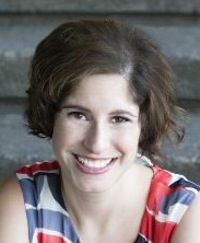
photo - Adara Goldberg
Adara Goldberg (photo from Cherie Smith JCC Jewish Book Festival)

“The Holocaust is a watershed moment and the scale of this watershed resettlement was unprecedented,” said Adara Goldberg, a Vancouverite and author of Holocaust Survivors in Canada: Exclusion, Inclusion, Transformation, 1947–1955. “Many of the agencies across Canada only came to be as a result of the Holocaust. Jewish Immigrant Aid Services [JIAS] did exist, but this was a small organization that only dealt with small numbers up to this point. Having some 35,000 people come in, in less than a 10-year span, really trampled the organizations.”

Survivors who moved to the United States joined a vibrant Jewish community already in progress, while those who came to Canada found a Jewish community with little infrastructure. What exists of the Jewish community and its social service agencies today was built, in large part, for the survivors and, subsequently, by them.

To an extent, there was an unwillingness among Canada’s existing Jewish community to address the Holocaust experiences of the newcomers – those who did not experience the Holocaust may have been afraid of opening wounds or been unwilling to hear the horrors others experienced. There was also a history in Canada of immigrants getting off the boats and throwing themselves instantly into building a new life, leaving the past behind.

Still, Goldberg said, there was a recognition by people like the head of JIAS that these immigrants had some very particular needs.

“The problem was availability,” she said. “This is uncharted territory. Social workers themselves and the Canadian Jewish community were only learning with the survivors about how to treat victims of trauma … the idea of post-traumatic stress didn’t really exist.”

Getting the newcomers integrated was not only a matter of meeting social needs, she added.

“There is also a legal element to that,” Goldberg said. “The fact is, refugees who came to Canada under the auspices of either the Canadian Jewish Congress, or who received support from JIAS or who had relatives sponsor them, were liabilities. If they didn’t find work, if they didn’t have a home, if they became dependent, they risked deportation. They risked becoming a drain on the existing Jewish community, which was already really reaching its max in terms of what they could do.”

A symbol of success is that very few fell through the cracks, although many of the case studies in the book indicate that some survivors were miserable in their assigned living conditions or workplaces.

There was a realization after the war, as the magnitude of what would come to be called the Holocaust dawned, that Canada had failed the imperiled Jews of Europe in the 1930s, when there was still time.

“After the war, relationships changed and there was significant international pressure on Canada to help do its part in relieving the postwar refugee crisis of Jewish and also non-Jewish displaced persons,” Goldberg said. “On the one hand, we can say this was a humanitarian gesture.… There’s also a practical element that we can’t overlook in that Canada stood to gain something from allowing in the Holocaust survivor refugees. There was a need for skilled laborers and this is how most survivors did come in, they came in for skilled labor posts, so Canada benefited.”

The equation of immigration and Canada’s need for labor is underscored by the fact that there was no ministry of immigration at the time – until 1950, Canada’s immigration policy was administered by the ministry of mines and resources. The influx of Jewish and non-Jewish refugees postwar familiarized the Canadian government and public to the concept of receiving refugees on humanitarian grounds. The first major instance of this reconsideration came in 1956 after the Soviet Union crushed the democratic uprising in Hungary. Canada admitted 37,000 refugees in the course of a year.

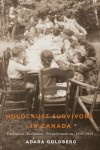
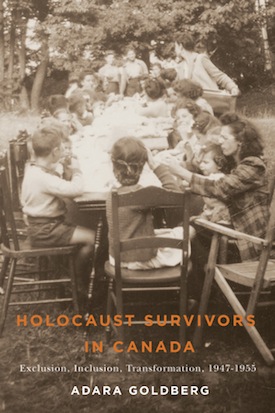
book cover - Holocaust Survivors in Canada: Exclusion, Inclusion, Transformation, 1947–1955Goldberg’s book begins with a refresher on Canada’s abominable record in the prewar period. Chapters then take on topics such as the unique requirements of young orphaned refugees; the double-edged sword of interned “enemy aliens” – Jews from enemy states, mostly Germany and Austria, whose nationality, in the eyes of Britain and its Canadian dominion, trumped their status as endangered victims of Nazism; the various programs under which refugees were admitted to Canada and how established Jewish communities, especially their women’s organizations, cared for refugees’ personal needs; the creation of social clubs and synagogues by and for survivors; the development of an ultra-Orthodox and Chassidic community here; and “transmigrants,” those who came to Canada after a sojourn elsewhere, often in Israel. She has included the stories of survivors who didn’t want to be found; those whose experiences in Europe led them to hide their Jewishness and their past as they began a new life in Canada. It is a monumental work.

A Toronto native, Goldberg wrote the book in fulfilment of her PhD at Clark University in Massachusetts and, while there are differences between the dissertation and the book, which was published in September by University of Manitoba Press, the book avoids the academic jargon that can exclude ordinary readers.

“As a social history that was created with the research that I did both in archives as well as through interviews and other sources, it was written with a wide readership in mind,” she said.

Goldberg eschews statistics in favor of personal case studies both from in-person interviews and records of social service agencies from decades past. The result is an introduction to hundreds of individuals and their stories, as well as a testament to the resilience of the survivors and the history of a small Jewish community rising – not always flawlessly – to the challenge of welcoming tens of thousands of co-religionists who had suffered unspeakable horrors.

The dissertation took about three years to complete and, after Goldberg moved to Vancouver, where she worked for three years as education director at the Vancouver Holocaust Education Centre, she took the opportunity to do additional research that incorporates more local content. The book is enriched by her background as a trained social worker, which underpins a deep analysis of the successes and failures of social service agencies in those early years.

Refugees are the top global news story today and Goldberg sees lessons for the present in her book.

“It’s a very different crisis,” she said. “I think what we can do is, without trying to compare individual experiences, to remember the risk of nativist attitudes and what happened when Canada had very discriminatory, restrictive immigration policies 75 years ago. Canada accepted the fewest number of Jewish refugees of any country in the Western world … Canada had an opportunity at that time to distinguish itself, to take a very restrictive policy and widen the gates. They could have done this and they elected not to. What we can do now is reflect on the result of this inaction. History does not need to repeat itself. Canada can distinguish itself as a world humanitarian leader.

“Similarly,” she continued, “Holocaust survivors have contributed to all aspects of Canadian society. I imagine that so, too, do other refugees to Canada and so will other waves that come in the future. There is so much that we can gain.”

The Vancouver launch of Adara Goldberg’s book takes place on Nov. 25, 5:30 p.m., at the Vancouver Holocaust Education Centre, as part of the Cherie Smith JCC Jewish Book Festival. Admission is free.


Format ImagePosted on November 13, 2015November 11, 2015Author Pat JohnsonCategories BooksTags Cherie Smith JCC Jewish Book Festival, community, Holocaust, immigration, survivors, Syria

Posts pagination

Previous page Page 1 … Page 8 Page 9 Page 10 Next page
Proudly powered by WordPress