Skip to content
  • Home
  • Subscribe / donate
  • Events calendar
  • News
    • Local
    • National
    • Israel
    • World
    • עניין בחדשות
      A roundup of news in Canada and further afield, in Hebrew.
  • Opinion
    • From the JI
    • Op-Ed
  • Arts & Culture
    • Performing Arts
    • Music
    • Books
    • Visual Arts
    • TV & Film
  • Life
    • Celebrating the Holidays
    • Travel
    • The Daily Snooze
      Cartoons by Jacob Samuel
    • Mystery Photo
      Help the JI and JMABC fill in the gaps in our archives.
  • Community Links
    • Organizations, Etc.
    • Other News Sources & Blogs
    • Business Directory
  • FAQ
  • JI Chai Celebration
  • JI@88! video

Recent Posts

  • Sharing her testimony
  • Fall fight takes leap forward
  • The balancing of rights
  • Multiple Tony n’ Tina roles
  • Stories of trauma, resilience
  • Celebrate our culture
  • A responsibility to help
  • What wellness means at JCC
  • Together in mourning
  • Downhill after Trump?
  • Birth control even easier now
  • Eco-Sisters mentorship
  • Unexpected discoveries
  • Study’s results hopeful
  • Bad behaviour affects us all
  • Thankful for the police
  • UBC needs a wake-up call
  • Recalling a shining star
  • Sleep well …
  • BGU fosters startup culture
  • Photography and glass
  • Is it the end of an era?
  • Taking life a step at a time
  • Nakba exhibit biased
  • Film festival starts next week
  • Musical with heart and soul
  • Rabbi marks 13 years
  • Keeper of VTT’s history
  • Gala fêtes Infeld’s 20th
  • Building JWest together
  • Challah Mom comes to Vancouver
  • What to do about media bias
  • Education offers hope
  • Remembrance – a moral act
  • What makes us human
  • המלחמות של נתניהו וטראמפ

Archives

Follow @JewishIndie
image - The CJN - Visit Us Banner - 300x600 - 101625

Tag: immigration

Refugee system doesn’t work

According to David Matas, former president of Canadian Council of Refugees (CCR), changes that have been made to this country’s refugee system within the last few years have made it more difficult to sponsor refugees.
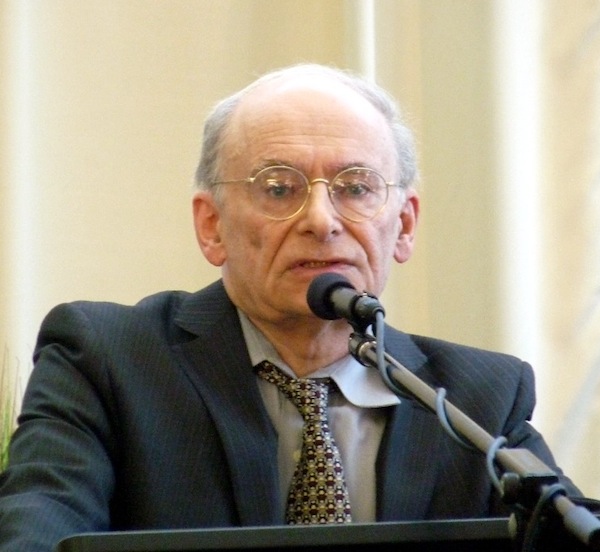
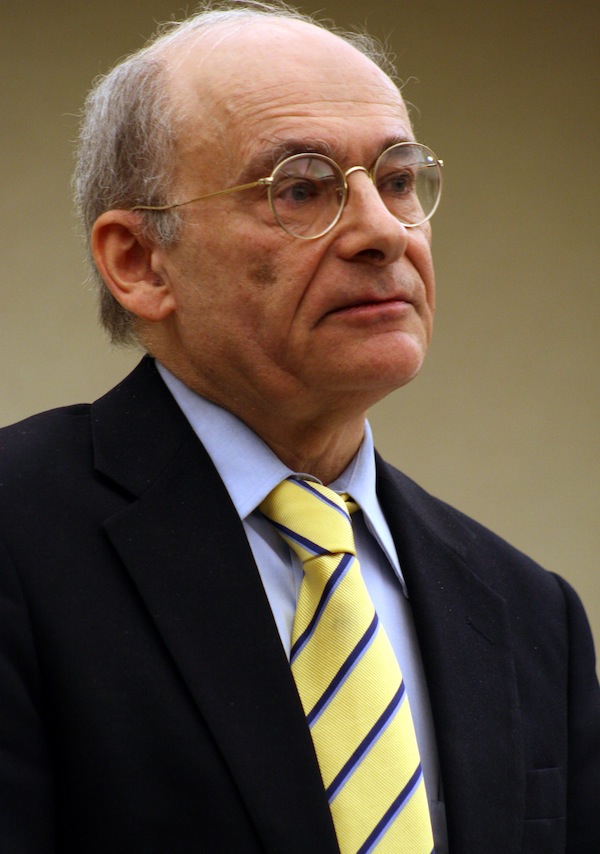
photo - David Matas is a vocal proponent of changing Canada’s immigration system
David Matas is a vocal proponent of changing Canada’s immigration system. (photo from David Matas)

“We set up a sponsorship system in ’78 and it was used in ’79 and ’80 and years around there to bring in the Vietnamese refugees,” said Matas. With the different sponsorship programs developed over the years, mixed with the growing willingness of people to sponsor, visa offices no longer have the capacity to process the amount of sponsorship applications, he said.

“The response of the government, in my view, should have been to increase the resources to match the sponsorship need, but that’s not what happened,” he said. “Instead, what they did is put visa caps on the offices with the biggest numbers, as well as an overall local cap for private sponsorship through sponsorship agreement holders. Then, they divided the global cap amongst the sponsorship agreement holders.”

According to Citizenship and Immigration Canada, “A group of five (G5) is five or more Canadian citizens or permanent residents who have arranged to sponsor a refugee living abroad to come to Canada. All of the group members must be at least 18 years of age and live or have representatives in the area where the refugee will settle.

“The group must agree to give emotional and financial support to the refugee(s) for the full sponsorship period – usually one year.”

They couldn’t cap the G5 applications in the same way as the other, so what they did instead, said Matas, “was insist that anybody who sponsored through group of five had to get prior approval … through the office of the United Nations High Commissioner for Refugees, which is much more overwhelmed and under-funded than the Canadian government.”

The CIC website explains that, effective Oct. 19, 2012, “a G5 may only sponsor applicants who are recognized as refugees by either the United Nations Refugee Agency (UNHCR) or a foreign state, unless you are applying to sponsor a Syrian or Iraqi refugee.”

According to Matas, the caps made the lines longer, forcing people to reapply year after year, making it so that anybody who applied had to wait years before sponsorship came through.

“But, obviously when you’re dealing with refugee people marching across Europe, they can’t wait years,” he said. “And, what’s more, there is a direct connection between people leaving and the failure of the sponsorship. Because, if people know they’re putting in an application and, if they hang around, it will succeed, they’ll stay. But, if it’s going to take five or 10 years, there is no point in waiting.

“So, there’s a direct connection between this exodus that we’re seeing now, the failure of the Canadian sponsorship scheme and the absence of any European sponsorship schemes.”

Matas believes that if we had kept our Canadian sponsorship scheme as it was, then we could have advised Europe to do the same and, if Europe had agreed, all this mass migration could have been avoided.

Recent turmoil has simply shined a spotlight on the issue. “It’s just like water pressing against a dam,” said Matas. “In the beginning, it doesn’t have any impact. It’s only when it breaks, or the water overflows the dam, that you notice the dam isn’t working or that the dam is a problem.”

The current situation does not come as a big surprise to him, with visa offices being “under water” for years. But, instead of giving them more “air” (staff), they were further strained by the capping system, which artificially controlled the number of refugees going through the system, regardless of need.

“With the failure of the Canadian system, there wasn’t a picture to show the Europeans how it is done and ask them to do the same,” said Matas. Instead, “We have a system that collapsed. Well, not completely, but it ceased to be functional.”

According to Matas, the caps need to be removed and the system resources increased “to match the private sponsorship, so we don’t have the generosity of Canadians being frustrated.”

In early September, Matas spoke at a public rally about refugees organized by the Kurdish community of Winnipeg.

“The refugee sponsorship and resettlement community has been against these changes from the first minute they were discussed,” he said. “I am not presenting a new idea here. I’m reiterating a stand that has been taken many times in the past by the refugee support, resettlement, integration [and] advocacy community.”

The topic became an election issue, with candidates talking in terms of numbers – but not in terms of fixing the mechanics of the system. However, said Matas, “Presumably, with the numbers will go the capacity to process them.”

While many of the refugees arriving in Europe are Syrian, many are not, said Matas. “While the situation in Syria is terrible, it’s not the only place in the world that’s terrible,” he said.

About the Canadian government’s decision to not have Canadian visa officers apply the UN refugee definition to 10,000 Syrians, thereby allowing these 10,000 to enter Canada on a first-come, first-served basis, Matas said, “The government, with the recent announcement, did nothing to fix the system,” said Matas. “Rather, it acknowledged, indirectly, its failure, by deciding not to apply it to 10,000 random Syrians who may or may not be refugees. As far as I am concerned, that is not much of a response to the global refugee crisis or even, for that matter, the Syrian one.”

Rebeca Kuropatwa is a Winnipeg freelance writer.
Posted on October 23, 2015October 22, 2015Author Rebeca KuropatwaCategories WorldTags David Matas, immigration, refugees, Syria

Join the effort to help refugees

For me, it was those little blue shoes. In the picture of little Alan Kurdi, laying there like he was sleeping on the beach in Turkey. Only he wasn’t sleeping, I had been sleeping, we have been sleeping.

It was the shoes that woke me from my slumber, from my disregard for the suffering of the Syrian people in the midst of the greatest humanitarian refugee crisis since the Second World War. More than 10 million people have fled from chaos … into chaos. There are 360,000 refugee children under the age of 11 in Turkey alone.

But it only took one. It was those tiny shoes, on those tiny feet, with their tiny toes. I know those shoes, those feet, those toes, my own children have them. They should not be laying there lifeless on the beach – they should be running through sandcastles, stomping in puddles, chasing the tide in and out.

Two hundred thousand people have died in the fighting, or while running or swimming for their lives, many of them children like Alan and his brother Galib. Millions of children are suffering from trauma and ill health. A quarter of Syria’s schools have been damaged, destroyed or taken over for shelter. More than half of Syria’s hospitals are destroyed.

But “it’s the children that catch us,” wrote Sarah Wildman for the Jewish Daily Forward. It’s the children who “bring those dizzying numbers into full focus. Their eyes round, their faces tired or hidden behind a parent’s legs. They are asleep on their parents’ shoulders; they walk beside them or are strapped to their bellies, legs dangling, as their mothers or fathers stride ever forward.

“They are far younger than the Syrian conflict so many of them flee. They have been trapped the entirety of their young lives, and now we see them, lying lifeless on beaches.”

Jonathan Sacks, Britain’s former chief rabbi, wrote: “I used to think that the most important line in the Bible was ‘love your neighbor as yourself.’ Then I realized that it is easy to love your neighbor because he or she is usually quite like yourself. What is hard – is to love the stranger, one whose color, culture or creed is different from yours. That is why the command ‘Love the stranger because you were once strangers’ resonates so often throughout the Bible. It is summoning us now.”

Sacks suggests a modern-day kindertransport, like that which was organized to save Jewish children on the eve of the Shoah.

But “save the children” is not “love the stranger.” To love the stranger, you have to take the parents, too. To love the stranger, you have to love the Syrians, who were taught to fear and hate Israel, to fear and hate Jews.

“Love the stranger” does not mean you have to open wide the borders to Islamists, fundamentalists or terrorists. But, in these numbers the world is dealing with, how many innocents will die while we carefully screen for the next Osama bin Laden?

I hear the concern, the alarm, the plaintive note of caution in our community and beyond.

“Think before acting.”

“It’s a Muslim problem, let those countries come to their aid. They hate us anyway.”

“Allowing millions of Syrians and others from the Muslim Middle East into Europe will end up as a catastrophe for Europe and, therefore, for the West.”

I read these statements and I can’t help swapping the word Muslim for Jew. Re-read them that way and they are indistinguishable from the statements that were issued when it was our people, the Jewish people, trying desperately to get out of Europe ahead of the Nazi menace.

Jews were desperate to leave. Yet country after country shut its doors. Nation after nation, in effect, said it wasn’t their problem. Or, more precisely, said they didn’t want it to be their problem.

We know well the tragedy of the St. Louis, one of the last ships to leave Nazi Germany in 1939 before Europe became involved in the Second World War. Denied entry at every port from Cuba, to the United States, to Canada, the ship sailed back to Europe and the Jewish passengers ended up in Nazi concentration camps, a third of them died there.

We know the infamous response of an unidentified Canadian immigration agent who, in early 1945, was asked how many Jews would be allowed in Canada after the war. He replied, “None is too many.”

This is not the Shoah, thank God.

What’s happening in Europe is a humanitarian crisis of the first order, but it’s not genocide. It shouldn’t need to be said that the Holocaust was the determined effort by one of the world’s leading industrialized powers to murder all the world’s Jews in the course of a nearly successful effort to conquer the globe.

Raising images of the Holocaust may help draw attention to the crisis. But it also shuts down reasoned discourse, and thus drowns out urgent questions that need airing.

“If the borders are opened wide, how many millions will want to flee the world’s no-longer-liveable regions for the safe haven of a continent that works?”

Prime Minister Binyamin Netanyahu, rightfully, reminds us that Israel is a small country that lacks geographic and demographic depth – it cannot take in masses of Syrian refugees. Yet Israel is not standing idly by. Quietly, so as not to endanger those it is helping, Israel is treating hundreds of Syrian wounded on its northern border.

“But,” as J.J. Goldberg wrote in the Forward, “in an atmosphere where every dinghy is the St. Louis, where refrigerator trucks smuggling migrants into Austria become boxcars transporting Jews to the gas chambers, where numbers thoughtlessly scrawled on refugees’ forearms in felt-tip pen by Czech police frantically trying to keep track of the human tidal wave are transformed into numbers tattooed on death-camp inmates – in such an atmosphere, there’s nothing left to discuss.”

Is Canada the best place for Syrian refugees? No, it would be better to keep them near their homeland so that, when troubles are over, they are in position to return to rebuild. Lebanon, Turkey and Jordan have taken in two million; the rest of the oil-rich Gulf States have refused – they need to do their part.

But, as Irwin Cotler reminded us at the Jewish Federation of Greater Vancouver campaign launch, quoting Rabbi Tarfon from the Mishnah (2:16): “It is not our responsibility to finish the work [of repairing the world], but we are not free to desist from it either.”

On the Thursday between Rosh Hashanah and Yom Kippur (Sept. 17), five Vancouver synagogues, their rabbis and lay leaders met with the Jewish Federation and our interfaith partners in the Anglican Diocese and the immigrant aid service agency

MOSAIC to explore the possibility of each synagogue sponsoring a refugee family. We will meet again after the federal elections to continue our planning and due diligence in preparation for family sponsorships.

This will not be a small project. We will be responsible not only for raising enough money to show the Canadian government that we can support a family for a year; we will also be responsible for everything from meeting them at the airport to finding them a place to live, from helping them learn English to helping them find work and schools. If you are interested in getting involved, I urge you to contact your rabbi or the Jewish Federation and offer your support to those who are in desperate need.

We will be responsible long after their images and stories have disappeared from the headlines of our news. But we will stand together with other synagogues – and people of other faiths – across North America, stepping forward to do what we can, to love the stranger because we were once strangers.

This is an excerpt from a sermon delivered by Rabbi Dan Moskovitz on Kol Nidrei 5776 at Temple Sholom. The full sermon can be viewed at youtu.be/2cHd_FV2MWs.

Posted on October 16, 2015October 14, 2015Author Rabbi Dan MoskovitzCategories Op-EdTags immigration, refugees, Syria

More or less immigration?

For political nerds, last week offered a cornucopia. A week ago Wednesday, 11 Republican candidates for president of the United States lined up in front of Ronald Reagan’s Air Force One and squabbled, insulted, demeaned and debated one another. The next night, the three leading candidates for prime minister of Canada lined up and, in a more Canadian manner than their American counterparts (albeit, perhaps, in a more American manner than most previous Canadian debates) did much the same thing.

There was plenty to differentiate the two events. The production values of the American version were Hollywoodesque. The Canadian debate looked high schoolish. With 11 candidates in the American debate, content took a back seat to quips and barbs. The Canadian debate was somewhat more substantive.

What was common between the two was an emphasis on immigration and refugees. With the refugee crisis in the Middle East and Europe making front-page news worldwide, and immigration a perennial hot button issue in the United States, candidates came at the topic through particular prisms.

The Republican candidates mostly clamored over one another to burnish their anti-immigrant cred. Who could build the highest, most impenetrable wall along the southern border, it seemed, was the worthiest candidate. The day after the debate, a pro-immigrant organization released a video that contrasted the current crop of candidates’ comments on immigration with those of Ronald Reagan, in whose presidential library the debate took place and who is generally venerated among Republicans.

Reagan, at least in his rhetoric, viewed America as a “shining city on a hill” to which people around the world aspired to come and where, presumably, they would be welcomed. Typifying the prevalent approach of current Republican candidates, Donald Trump said before the debate: “When Mexico sends its people, they’re not sending their best.… They’re bringing drugs. They’re bringing crime. They’re rapists. And some, I assume, are good people.”

Emma Lazarus Trump is not. The American approach to immigration once – before the 1920s and at intervals since the Second World War – was idealized in Lazarus’ poem, affixed to the Statue of Liberty, and it clearly does not demand “the best” from other countries: “Give me your tired, your poor / Your huddled masses yearning to breathe free / The wretched refuse of your teeming shore / Send these, the homeless, tempest-tossed, to me / I lift my lamp beside the golden door.”

It can still evoke chills. Chills that are different from those evoked by the language and views of some of today’s Republicans.

What was encouraging in the Canadian debate the next day was seeing our leaders similarly clamoring over one another, but in this case to burnish their pro-immigration cred.

We recognize that some of the people we welcome have endured great challenges, and need resources and programs to learn the languages of our country, develop or adapt their skills, perhaps recover from deep trauma. Piles of evidence prove that immigrants and refugees who come here succeed brilliantly.

Of course, Jewish Canadians especially may be torn between heart and head on this matter. Our families came here, more often than not escaping repression and violence, and we understand the life-and-death implications of immigration policies.

We also understand that many immigrants and refugees today are coming from places that deliberately inculcate antisemitism in their citizens, who have been known to then act out on these impulses once they move to places where Jews exist. However, the current crisis involves refugees who are fleeing violent jihad and are likely to be among those Canadians who are most vigilant against that form of hatred.

Above all, we need to understand that we are one world. We need to address security challenges at home and confront, with our allies, the sources of those challenges. This security imperative impacts on our immigration policy, but we should not delude ourselves or punish those who need refuge by pretending we can immunize ourselves from world realities by closing our doors.

Posted on September 25, 2015September 24, 2015Author The Editorial BoardCategories From the JITags Donald Trump, elections, Emma Lazarus, immigration, refugees, terrorism

Migrants fleeing for their lives

Interior ministers from the 28 member-states of the European Union will meet next week to address the crisis of migrants flowing into the continent from across the Mediterranean. But just what constitutes a crisis – and whose crisis is it?

Some politicians and commentators allege that the migrants are primarily “economic refugees,” people just seeking economic advancement. But Britain’s Guardian newspaper reports that 62% of the refugees who made it to Europe by boat in the first seven months of the year were from Syria, Eritrea and Afghanistan, with more coming from Darfur, Iraq, Somalia and Nigeria, all places where mere survival in war-ravaged zones supersedes economic advancement on the hierarchy of needs.

Fears stoked by the stream of migrants have led some, such as the British foreign secretary, to warn that the entire European social order is endangered. In fact, the 200,000 migrants who have made it to Europe so far this year represent 0.027% of the total EU population. Compare these numbers with the situation in Lebanon, a country of 4.5 million people currently hosting 1.2 million refugees from the Syrian civil war.

There is no question that much of the social unrest in Europe these days and a vast proportion of its antisemitism derive from immigrants from the same parts of the world from which today’s migrants originate. That is not a problem to be easily dismissed. But neither is it a justification for ignoring a humanitarian crisis.

Addressing the small proportion of radicalized or Jew-hating individuals within groups is an issue that Europe must confront and address – and it has so far not done an exemplary job. But the problem facing the migrants in their places of origin makes the “crisis” faced by the places in which they hope to settle pale in comparison.

Europe just happens to be the nearest beacon of freedom and peace these people can reach and, therefore, they are clamoring to make their way to the continent. But it is the responsibility of all of us, Canada included, to accommodate a share of people seeking escape from violence and war.

Israel has also been a destination for African migrants and the treatment of some has rightly raised concerns of refugee watchdog groups and, last month, the Israeli Supreme Court. The court ruled that the migrants who had been held in a sort of low-security detention facility, about 1,200 people from Eritrea, Sudan and Darfur, could not be held longer than a year. They were not confined to the encampment, but were required to be present twice daily for a roll call.

In all, Israel has about 45,000 asylum-seekers, the vast majority from Eritrea and 9,000 from Sudan. Most made their way by foot through the Sinai into Israel’s southern frontier. Most have been given visas that allow them to stay but not to work, which puts them in a predictably difficult position.

Meanwhile, countries like Hungary are rolling out razor wire along the southern border, an entry point to the European Union, beyond which migrants are comparatively free to travel throughout the 28 countries of the EU.

Recent days have brought particularly horrendous news, with 71 refugees, including a baby, found dead in a truck in Austria, victims of profiteers exploiting the desperation of migrants trying to reach Europe. In Libya, more than 100 bodies washed ashore after a boat sank filled with people trying to cross the Mediterranean. At least 2,600 people are known to have drowned this year in similar incidents.

It is a sign of the desperation that drives this mass migration. Most of these people leave behind everything they have to make their way to what they hope will be a peaceful and prosperous future. They are met with suspicion, incarceration, violence and worse.

It is a striking reversal of the Jewish people’s own history of the 20th century, when those trying to flee Europe were denied entry at every turn, including to what was to become the Jewish homeland in the Middle East. Now, thousands of people from the Middle East are fleeing to Europe and facing every obstacle.

It should not be ignored that many of the refugees are coming from places whose education systems and popular culture instil suspicion and hatred of Jews (and Western culture), and this will be no consolation to the remaining, beleaguered Jews of countries like France. But that underlying problem – and it is a significant one – must be addressed over the long term both in Europe and in the countries where cultural norms breed intolerance and antisemitism. In the meantime, thousands of people are fleeing for their lives and the world cannot turn our backs.

Posted on September 4, 2015September 2, 2015Author The Editorial BoardCategories From the JITags antisemitism, immigration, refugees
Peddlers in new light

Peddlers in new light

The award-winning Canadian film Lies My Father Told Me begins with a hunched over man on a horse-drawn wagon moving slowly through the snowy narrow streets of old Montreal. His grandson runs through the streets shouting Zayde, Zayde, as he tries to catch up with the wagon. The peddler occasionally cries out, rags, clothes, bottles. It’s a poignant scene that reflects the stereotypical view of how the first Jewish immigrants established themselves in the new world. However, the scene is misleading.

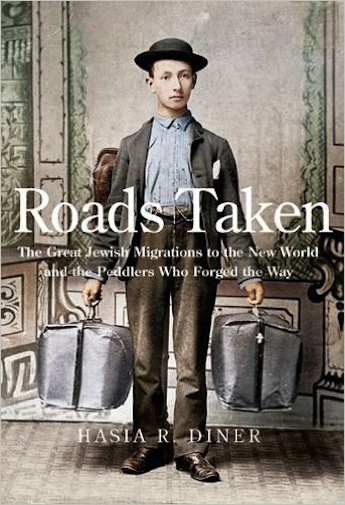
In one of the first histories to look at the role of the Jewish peddler in society, author and academic Hasia R. Diner in Roads Taken: The Great Jewish Migrations to the New World and the Peddlers Who Forged the Way (Yale University Press, 2015) says that most Jewish immigrants who started off as peddlers were young men who headed out to the countryside with suitcases of merchandise, not weary old men with wagons.

More than three million Jewish people left home in search of a better life from the late 1700s to the early 1900s. They came from the Ottoman Empire, North Africa, Eastern Europe and Germany. They headed out to countless isolated corners of the world – Canada, the United States, Cuba, Mexico, Argentina, Peru, Ireland, Wales and southern Africa. Peddling became the engine that fostered migration. A mass of ordinary people in their ordinariness made history. The peddlers were foot soldiers in a vast army of migrants that gave modern Jewish life much of its shape.

Diner, an award-winning professor of American Jewish history at New York University, does not tell the history of any single person, place or time. She relies on an academic approach rather than colorful storytelling, jumping across continents looking for similarities. She discovers them in abundance.

She finds that, regardless of where they came from or their destination, the experience of the Jewish immigrant was remarkably consistent.

On arrival, the Jewish immigrant – almost always a young man – connected with family members, friends or sometimes just a member of the Jewish community who helped them settle into the new world. The “greenhorn” would learn a few phrases in the new language and would be given merchandise to take on the road.

The new peddler did not carry the necessities of life. Rather, he sold a higher standard of living – sheets and pillowcases, picture frames, needles, threads, buttons, tablecloths, eyeglasses or suspenders. As he became more successful, he carried heavier items for sale in a horse-drawn wagon, such as stoves and bathtubs.

While in the countryside, the peddlers bought scrap, rags, metal, paper or anything else to be brought back to the city and sold. Many offered instalment plans to help their customers pay for their purchases. Within a few years, most peddlers opened their own stores in the city or moved on to other work. Their success encouraged family and friends to join them in the new land.

Diner contends that the waves of migration had a significant impact on the development of the countries that took them in. Industrialization, urbanization and social upheavals were transforming those societies at that time, and Diner says that Jewish immigration to the remote countryside played a significant role in the transformation that has previously not been acknowledged.

The Jewish peddlers solidified European colonialism in remote areas, bringing the city’s latest styles in clothing, furniture and tchotchkes to remote farms, mines, plantations, and logging and fishing camps.

image - Roads Taken by Hasia R. Diner book cover, fullThe peddlers crossed economic, social and religious divisions. They blunted social isolation with news of the outside world, helped break down class barriers, spread the gospel of consumption and encouraged individual choice in communities where there was little.

Diner even detects an impact on the evolution of women’s rights. The peddlers dealt mostly with women while men were at work. Women decided which goods to buy, and when and how to pay for the merchandise. In other circumstances at that time, women were mostly in the background while men made the decisions. Meanwhile, in the Old Country, the women left behind temporarily, to care for families, assumed responsibilities previously carried out by their husbands and fathers.

Diner also knocks down several shibboleths about Jewish immigration to the new world.

Contrary to widely held perceptions, Diner found that most Jewish migration was not a response to pogroms, hatred and antisemitism. She disputes that Jewish immigrants went into business as a result of discrimination and that the immigrants relied on the Jewish community for financing their dreams because local banks would not do business with them.

Invariably, as Diner travels the world, several references to Canada pop up.

She writes about Max Vanger, who relied on peddling outside Halifax and Saint John in the early 20th century to provide him “with the bedrock upon which to get started in his new world.” The Finkelsteins’ store in Winnipeg in the 1880s provided merchandise for the new Jewish immigrants who went off to trade with “the Indians and English” in the surrounding territory.

The Baron de Hirsch Institute in the 1880s lent money to peddlers in Montreal. The Jewish Colonization Association had a committee to give out loans across Canada to peddlers to pay for licences and to help the immigrants establish themselves. The Toronto Mail and Empire newspaper in 1897 wrote about the number of Jewish peddlers who go about the city and out among the farmers in the country.

Similar to Jewish immigration in numerous other countries, peddlers in Canada moved on to shopkeeping, financing and other work. Isaac Cohen in Kingston, Ont., started out as a peddler, became a scrap-iron dealer and eventually built up one of the largest scrap-metal firms in Canada.

Peddlers in Canada, as in other countries, occasionally ran up against racism. Reflecting the attitudes of the times, Anne of Green Gables, the legendary children’s book set in Prince Edward Island, describes a devious crook as a German Jewish peddler.

Diner does an impressive job of placing the traditional image of the Jewish peddler in a new context. She convincingly transforms the lonely immigrant peddler into a leading actor in the social, religious and economic upheavals over a 150-year period. However, she should have spent more time on the personal anecdotes of the peddlers. More academic than writer, she leaves it up to the reader to imagine the emotional conversations and inner struggles that might have taken place. She reduces the lives of the immigrants to sweeping generalizations that sometimes feel like exaggerations to prove a point. She passes lightly over the difficulties in conditions in countries that the peddlers left behind, leaving many questions unanswered.

Occasionally, errors creep in that chip away at her credibility. She confuses Saint John, N.B., and St John’s, Nfld.; she says Reform Judaism was founded in the United States, not Germany.

On the whole, however, Diner provides a fascinating account of an overlooked and often misunderstood aspect of Jewish history. Hopefully, her work will lead to more books on Jewish migration and the history of peddling.

Robert Matas, a Vancouver-based writer, is a former journalist with the Globe and Mail. This review was originally published on the Isaac Waldman Jewish Public Library website and is reprinted here with permission. To reserve this book or any other, call 604-257-5181 or email [email protected]. To view the catalogue, visit jccgv.com and click on Isaac Waldman library.

Format ImagePosted on August 28, 2015August 27, 2015Author Robert MatasCategories BooksTags Hasia Diner, immigration, peddler, Roads Taken

Human rights at fore

One would be hard-pressed to find anyone involved in human rights around the world who has not heard of David Matas.

A Winnipeg-based lawyer, Matas has helped countless victims of human rights violations, and written or co-written numerous books on various atrocities in an endeavor to shed light on them and educate the general public about them. In his latest publication, he aims to explain why he has chosen the work that he has, in the hope of motivating others to get involved in human rights advocacy and create change. Why Did You Do That? The Autobiography of a Human Rights Advocate (Seraphim Editions, June 2015) is his first autobiography.

photo - David Matas
David Matas (photo from David Matas)

Matas was moved to pursue a career in refugee, immigration and international human rights law for a number of reasons.

“I started doing it because different people asked me to do it, including people at the law firm,” he explained in an interview. “It’s also something I’m interested in, because I’m interested in politics and human rights. So, I’d say, it was a coincidence of an opportunity to do the work and an interest in it that got me into it.”

Matas had refugees from around the world coming through his doors every day, seeking help. “My immediate effort was to try to get them protection, but the ultimate solution to their problems was the ending of the human rights violations that caused them to flee,” he said. “I felt trying to help them in some sort of systemic way, that I should be directed to that as well.”

Around this time, Matas also ran as a candidate in the federal election for the Liberal party (in 1979, 1980 and 1984) and B’nai Brith Canada approached him, requesting that he chair the local BBC League for Human Rights, largely because of the profile he had developed through his candidacies.

“But, again,” said Matas, “it’s something that, once I got into it, struck a chord of response in me. I got interested in it, involved much more, given the opportunity, because of the resonance it had with me.”

Also around that time, Kenneth Narvey – someone Matas knew from university – was scheduled for a speaking engagement in Manitoba on war-crime issues. Unsure if he would be able to make it, Narvey asked Matas if he would be willing to substitute for him, which Matas agreed to do. As it happened, Narvey ended up being able to attend the lecture, which gave him the opportunity to hear Matas speak and, Matas said, “He [Narvey] really liked it.

“At this time, Irwin Cotler had just become president of the Canadian Jewish Congress [CJC]. Irwin had appointed a chair for a war-crimes committee, as he wanted to do something about the issue himself, and the chair had resigned.”

Narvey lobbied Cotler to have Matas appointed as chair, and Cotler did just that. “So, I got involved in that issue, too, again sort of by coincidence or circumstance,” said Matas.

Another chance encounter was with Harry Schachter, a friend of Matas’ who was involved with Amnesty International, which had been holding meetings throughout the country. Through Schachter, Matas became involved with Amnesty International, which fit well with everything else he was doing.

“The combination of these events, more or less all at the same time, is what really got me into human rights in a very systemic and wholehearted way,” said Matas.

The Holocaust also influenced Matas’ life path. “I, personally, wasn’t affected by the Holocaust, my family wasn’t,” he said. “But, it just struck me. I thought, from an early age, that if the Axis rather than the Allied powers had won World War Two, I nor any other Jewish person would be alive today.”

He explained, “Generally, what I’ve been trying to do is learn the lessons of the Holocaust and act on them, which I saw as protecting refugees, bringing war criminals to justice, combating hate speech and protesting human rights violations around the world wherever one may find them. So, I’ve been trying to act on those four fronts simultaneously throughout my career.”

book cover - Why Did You Do That? The Autobiography of a Human Rights Advocate by David MatasIn his previous books, Matas has focused on specific atrocities or topics related to human rights – from hate speech, to trying to bring Nazi war criminals to justice, to humans rights violations, to refugees, to organ harvesting, and other topics. His autobiography was launched on June 9 at McNally Robinson Booksellers in Winnipeg.

“I go through the various issues I’ve been involved in and explain why I’ve been involved with them, issue by issue,” said Matas about Why Did You Do That? “There’s a chapter on refugees, so I explain what I did in terms of trying to help refugees. And then the rest is why people should help refugees, why everybody should do it. That’s the way it’s structured, chapter by chapter.”

For Matas, this book is a way for him to answer the most frequent question he is asked, “Why are you doing this?”

“I would say the 20th century was a century of genocide,” said Matas. “It wasn’t just the Holocaust. There was one genocide after another. My hope is we will be better, but I don’t think that it comes from hope. It comes from action. So, I’m trying to mobilize people to make things better, so we don’t repeat in the 21st century the vast array of tragedies we saw.”

In Matas’ view, people tend to focus on the problems immediately in front of them.

“People will get really worked up if their neighbor doesn’t mow their lawn, but they get less worked up if people in China are getting killed for their organs,” he explained. “I think there’s a real problem with distance, culture, language and geography, which really makes it difficult to mobilize concern for human rights violations – which is what the Jewish community faced with the Holocaust.”

Why Did You Do That? The Autobiography of a Human Rights Advocate can be purchased online from Seraphim Editions, Amazon and various other booksellers online and in bookstores.

Rebeca Kuropatwa is a Winnipeg freelance writer.
Format ImagePosted on June 26, 2015June 25, 2015Author Rebeca KuropatwaCategories BooksTags David Matas, human rights, immigration, refugees

Aliyah: a 10-year high

According to initial end-of-year figures released by the Jewish Agency for Israel and the Ministry of Aliyah and Immigrant Absorption, aliyah hit a 10-year high in 2014, with the arrival of some 26,500 new immigrants. This marks a 32 percent increase over 2013.

For the first time, France tops the list of countries of origin for immigrants to Israel, with nearly 7,000 new immigrants in 2014, double the 3,400 who came the year before.

Some 5,840 new immigrants came from Ukraine, compared to some 2,020 in 2013. This dramatic 190 percent increase is due primarily to the ongoing instability in the eastern part of the country.

Aliyah from western Europe is up 88 percent, with the arrival of some 8,640 immigrants. Some 620 came to Israel from the United Kingdom, a 20 percent increase over 2013. The number from Italy doubled to some 340. Aliyah from Belgium saw a modest decrease, to 240. German aliyah remained stable, at approximately 120.

Aliyah from the former Soviet Union was up 50 percent, with the arrival of some 11,430 immigrants, with 4,830 from Russia, Belarus and the Baltic states, 300 from the Caucasus and 390 from Central Asia.

Aliyah from Latin America remained stable, with the arrival of some 1,070 immigrants. Aliyah from Brazil saw a 45 percent increase, with 300 immigrants, and approximately 297 came from Argentina, 76 from Mexico, 70 from Venezuela, 62 from Colombia, 58 from Uruguay and 52 from Chile.

Aliyah from North America increased modestly, with the arrival of some 3,870 immigrants compared to 3,600 in 2013. Approximately 3,470 immigrants came from the United States and 400 immigrants came from Canada, compared to 384 the year before.

Eastern Europe saw 232 people make aliyah, compared to approximately 270 in 2013. Approximately 126 came from Hungary, 32 from Poland, 24 from Romania and 24 from Bulgaria.

Some 190 immigrants came to Israel from South Africa, roughly the same as 2013, while 200 came from Australia and New Zealand, a slight decrease from the year before.

More than half of the immigrants who came to Israel in 2014 were under the age of 35. The eldest immigrant was born in 1910 and made aliyah from France at the age of 104. The youngest came from the United States and was only several weeks old. Tel Aviv led the chart of cities receiving new immigrants, with approximately 3,000 new Tel Avivians. The coastal city of Netanya came second and Jerusalem came in third.

Posted on January 9, 2015January 8, 2015Author Jewish Agency for Israel and the Ministry of Aliyah and Immigrant AbsorptionCategories IsraelTags aliyah, immigration, Israel
New North London Synagogue offers comfort to asylum seekers

New North London Synagogue offers comfort to asylum seekers

Volunteers at the drop-in centre work together to offer legal advice, medical care, transportation passes, child care, nutritious meals, friendship and more. (photo from New North London Synagogue)

What would your daily life be like if you were not free? For starters, you would have to learn the skills of surviving while in a state of constant fear. Are you facing torture or rape? Are you in jail for a crime you did not commit? Is there a gun pointed at you because you are gay? If the opportunity to escape persecution presented itself, would you risk your life for a chance at freedom?

Every day in the news, we hear of courageous people doing just this – risking their lives to be free. No matter how dangerous it may be to attempt escape, flight offers their one hope for freedom. The lucky ones end up in free countries. What happens later, though, for those whose hope of establishing legitimacy, of officially being recognized as refugees, is gone? How do undocumented asylum seekers get by?

I was honored when my cousin invited me to volunteer with a group of asylum seekers while vacationing in London, England, last year. Though I was only there for three hours, I caught a brief glimpse into their lives and it has left a lasting impression on me.

Since 2006, New North London Synagogue has been running a monthly asylum drop-in centre. Launched by volunteers, the group works with asylum seekers whose claims have been denied. The group offers medical treatment, legal advice, healthy meals, food parcels, transportation passes, clothing and diapers. The drop-in centre is housed at an elementary school, which I’m told is not large enough to accommodate the more than one thousand people who come from metropolitan London to get assistance.

Asylum can be defined as “a place offering protection and safety; a shelter.” Judging by the crowds in need at the New North London Synagogue, Britain would seem to have failed to offer these protections. Most of the asylum seekers that use the centre’s services have chosen to stay and live in abominable destitution rather than accept deportation to the places from which they risked their lives to escape.

Researching the situation of asylum seekers through the Refugee Council of the United Kingdom, I learned many facts, including:

• The vast majority of people seeking asylum in Britain are law-abiding people;

• Many asylum seekers fear approaching the police to report incidents of assault or sexual harassment. They fear that reporting crimes will expose them to being placed in detention and eventually deported;

• Immigration officers have the power to detain asylum seekers, even if they have not committed any crime; even on mere suspicion.

My cousin, Catherine, is a regular volunteer. Her fluent French is an asset and she often serves as an interpreter. I was there in August and Catherine was worried that there might not be enough volunteers. Thankfully, there were plenty on that day.

Fifteen minutes before opening, a briefing takes place to explain the events of that afternoon. I volunteer to help with the children, as that’s where I think I can be of best use. The children have a section to themselves, but parents may not leave their children unsupervised. In the briefing, we are forewarned that some of the children have difficulty interacting and some may not be comfortable with play because the toys available are foreign to them.

Upon arrival, everyone receives a name tag. New asylum seekers are interviewed.  Some queue for legal or medical advice. Everyone enjoys a nutritious meal. There are people from the Democratic Republic of Congo, Bangladesh, Egypt, Iran, South Sudan, Zaire, Nigeria and Turkey. It is fascinating to hear the various languages and dialects being spoken.

Eventually, I sum up the courage to sit down and speak to people. I talk to a blind woman from Iran who has been coming to the drop-in centre for several years. She lives in a little room, a good 15 miles away. She has no kitchen facilities and must rely on the kindness of friends for food and other necessities.

A Nigerian family of four has been coming for eight years. They ask me about Canada. They have family in Toronto and have heard such wonderful things about this country but, at this point, they do not dare to make enquiries about moving to Canada. As I hold their youngest child, it’s hard not to feel sad that this little boy, despite being born in Britain, may not be afforded legal status.

A single mother tries to gulp down some lunch and socialize with friends while chasing after her active 2-year-old twin girls.

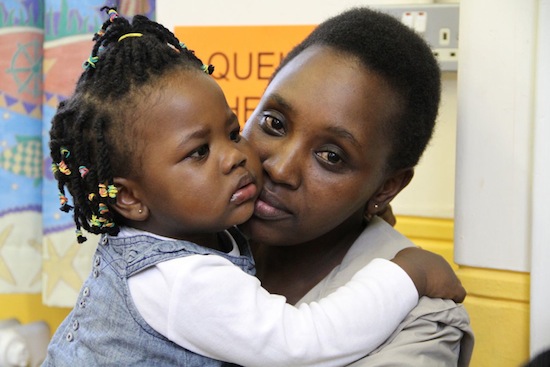
photo - A mother and daughter at the New North London Synagogue drop-in centre for asylum seekers.
A mother and daughter at the New North London Synagogue drop-in centre for asylum seekers. (photo from New North London Synagogue)

A situation that touches me deeply is assisting a young paraplegic man from central Africa. He tells me that he arrived in England eight months prior. Once a Paralympian, his proficiency at manoeuvring his rickety manual wheelchair around narrow corridors and cracked sidewalks is impressive. All his family remain in Africa. He tells me that his goal is to become a lawyer. I guide him to the bus stop where it will take him roughly two hours to get home.

Little children are sitting at tables, munching on snacks and playing with the large assortment of toys. All are supervised by a group of caring volunteers who take time to play and read with them.

Surveying the scene it’s hard not to feel that the situation these people face is grim. It’s a harsh reminder that all is not OK in Britain – or in the world, for that matter. Indeed, there are many British who wish asylum seekers would go away and take their problems with them. There’s a post on the New North London Synagogue website that seeks to clarify the situation: “All of our clients have fled persecution and many have been tortured. Yet myths prevail that this group are here for benefits, free housing and to take British jobs. In fact, asylum seekers are not allowed to work and many receive no accommodation or government support.”

At the same time, despite the despair, positive moments are in evidence. Expressions of a caring community are everywhere, woven into every activity.  Camaraderie can be felt in the crowded rooms. In fact, if someone were to walk in off the street, they would see what looks to be a happy afternoon gathering.   People sit in groups, smiling, laughing, exchanging information and eating a plate of nutritious food. Children play, interacting with each other. Enthusiastic volunteers, teenagers and senior citizens and all ages in between, are connecting and offering advice. Many of them are former asylum seekers who have been given permission to stay in Britain and are volunteering to give back to the community.

On that day in August, the hope was that people would leave the drop-in centre with renewed hope, their spirits lifted, and that volunteers would feel they have played at least a small role in brightening someone’s day.

We must all be active in raising awareness of refugee issues, so that refugees and asylum seekers can know the peace and freedom we are so blessed to enjoy. This Pesach, at my family seder, we will read the Haggadah, celebrating our people’s journey to freedom. My family and I will stop to think of all the refugees of today who have had to make their own exodus from persecution, extreme hunger and violence, and even from modern-day slavery. Stateless, many are forced to continue to wander in an urban wilderness. May they find peace and comfort in a new land.

Jenny Wright is a singer, music therapist and freelance writer in Vancouver who is interested in setting up a similar drop-in centre here. If you are interested in learning more, email [email protected].

Format ImagePosted on April 11, 2014April 27, 2014Author Jenny WrightCategories WorldTags asylum, immigration, New North London Synagogue

Posts pagination

Previous page Page 1 … Page 9 Page 10
Proudly powered by WordPress