Skip to content
  • Home
  • Subscribe / donate
  • Events calendar
  • News
    • Local
    • National
    • Israel
    • World
    • עניין בחדשות
      A roundup of news in Canada and further afield, in Hebrew.
  • Opinion
    • From the JI
    • Op-Ed
  • Arts & Culture
    • Performing Arts
    • Music
    • Books
    • Visual Arts
    • TV & Film
  • Life
    • Celebrating the Holidays
    • Travel
    • The Daily Snooze
      Cartoons by Jacob Samuel
    • Mystery Photo
      Help the JI and JMABC fill in the gaps in our archives.
  • Community Links
    • Organizations, Etc.
    • Other News Sources & Blogs
    • Business Directory
  • FAQ
  • JI Chai Celebration
  • JI@88! video

Recent Posts

  • Sharing her testimony
  • Fall fight takes leap forward
  • The balancing of rights
  • Multiple Tony n’ Tina roles
  • Stories of trauma, resilience
  • Celebrate our culture
  • A responsibility to help
  • What wellness means at JCC
  • Together in mourning
  • Downhill after Trump?
  • Birth control even easier now
  • Eco-Sisters mentorship
  • Unexpected discoveries
  • Study’s results hopeful
  • Bad behaviour affects us all
  • Thankful for the police
  • UBC needs a wake-up call
  • Recalling a shining star
  • Sleep well …
  • BGU fosters startup culture
  • Photography and glass
  • Is it the end of an era?
  • Taking life a step at a time
  • Nakba exhibit biased
  • Film festival starts next week
  • Musical with heart and soul
  • Rabbi marks 13 years
  • Keeper of VTT’s history
  • Gala fêtes Infeld’s 20th
  • Building JWest together
  • Challah Mom comes to Vancouver
  • What to do about media bias
  • Education offers hope
  • Remembrance – a moral act
  • What makes us human
  • המלחמות של נתניהו וטראמפ

Archives

Follow @JewishIndie
image - The CJN - Visit Us Banner - 300x600 - 101625

Tag: health

mRNA & cancer drugs

mRNA & cancer drugs

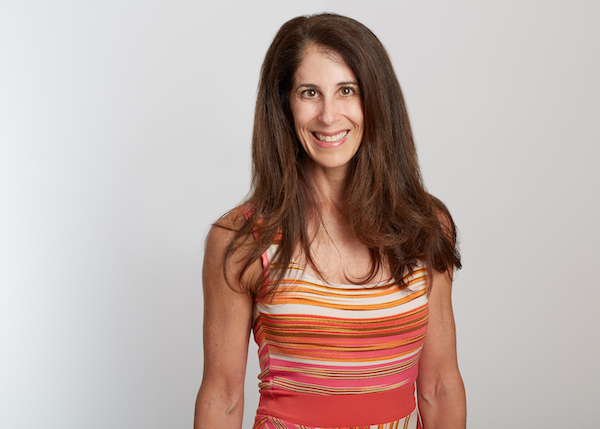
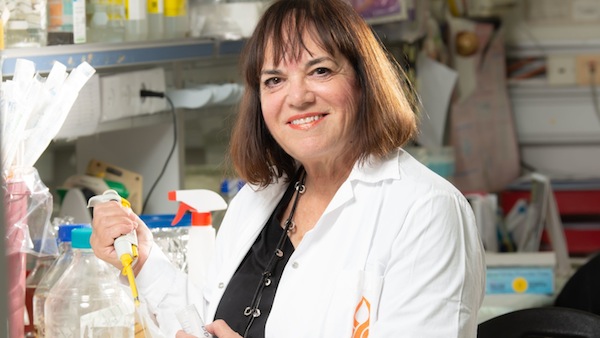
Prof. Etta Livneh (photo by Shay Shmueli/BGU)

Most everyone on the planet has now heard of mRNA, thanks to the vaccines against COVID-19 from Pfizer and Moderna, which are based on messenger RNA. But, before mRNA was used to address COVID, research was conducted into how it could fight cancer. Now, researchers at Ben-Gurion University of the Negev have discovered a key connection between mRNA, peptide proteins and tumour progression.

Messenger RNA codes for different proteins, each with a unique function. There are both “long” and “short” peptides. Until now, scientists were not sure if short peptides had any biological function.

Prof. Etta Livneh of BGU’s Shraga Segal Department of Immunology, Microbiology and Genetics has shown that single short peptides in fact have a very important role – as a kinase inhibitor that can slow tumour growth and invasion, cancer cell survival and metastasis.

Proteins (and protein kinases in particular) propagate signals that carry instructions to the cells and dictate cell fate. There are more than 500 different kinases in the human body.

With cancer, a kinase erroneously tells the cells to divide and reproduce in a rapid and uncontrollable manner. But the flipside is also true: if a kinase can be inhibited, it should block the proliferation of cancer cells.

And that’s “just the tip of the iceberg,” said Livneh, whose discovery has been a decade in the making. “Now that we know that at least some peptides have a biological function, we can begin to discover the roles of many more.”

Kinase inhibitors are already one of the hottest areas of cancer research, in some cases replacing chemotherapy. Livneh’s research will allow scientists to better understand how to control this cancer-fighting technology.

The research was supported by a grant from the Israel Science Foundation and published in PNAS (Proceedings of the National Academy of Sciences of the United States of America).

Israel21c is a nonprofit educational foundation with a mission to focus media and public attention on the 21st-century Israel that exists beyond the conflict. For more, or to donate, visit israel21c.org.

Format ImagePosted on January 14, 2022January 13, 2022Author Brian Blum ISRAEL21CCategories IsraelTags Ben-Gurion University, BGU, cancer, Etta Livneh, health, kinase, mRNA, research, science
בבית החולים בשתיים לפנות בוקר

בבית החולים בשתיים לפנות בוקר

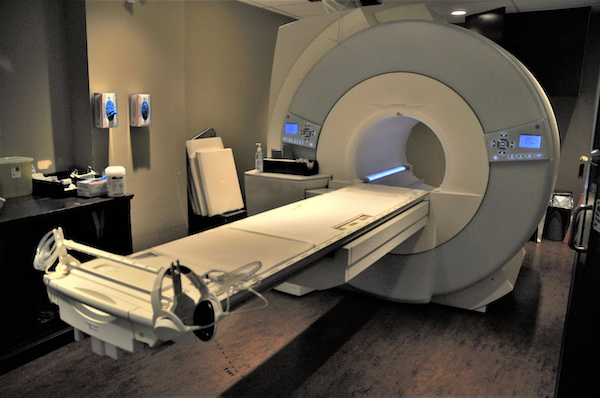
 הרופאה המומחה החליטה שעלי לעשות בדיקת אם. אר. איי. לאזור הצוואר שלי לאור מוגבלות מסוימת שאני חש בו. בדיקת הסי. טי. שעשיתי בבית החולים סנט פול לא הייתה מספיק טובה מבחינתה, והיא התעקשה על בדיקת אם. אר. איי. שהיא הרבה יותר מקיפה. הרופאה הזכירה לי, בביקור במרפאתה בסוף חודש נובמבר, כי התור לאם. אר. איי. הוא ארוך מאוד, ולכן כדאי שארשם לכל בית החולים שעושים אותה באזור ונקובר. אני סירבתי בכל תוקף ואמרתי לה שאני מוכן לעשות את הבדיקה רק בשני בתי החולים המרכזיים של ונקובר: סנט פול וונקובר ג’נרל – כיוון שלהם יש את ציוד הטוב ביותר

המזכירות הרפואית במרפאה בה עובדת הרופאה רשמה אותי לבדיקה וידעתי שיתכן ואאלץ להמתין חודשים ארוכים ואולי אף יותר מכך לבדיקה המיוחלת. לכן מספר ימים לאחר הפגישה עם הרופאה המומחית התקשרתי למזכירות וביקשתי מהם לרשום אותי גם לתור של ביטולים באחד משני בתי החולים בעיר. מניסיוני לאחר שבע עשרה שנים של מגורים בוונקובר, אני יודע שברוב המקרים זה עובד מצוין. מטופל נאלץ לבטל תור לבדיקה מסוימת או אפילו לניתוח, ואז מי שנמצא בתור הביטולים מקבל התראה קצרה על תאריך פינוי לביצועה. קנדים רבים כאן לא חושבים כלל על האופציה של תור הביטולים והם ממתינים בשקט לתור שלהם, גם אם זה כרוך בחודשים רבים מאוד. אני כבר הבנתי מזמן את הפרינציפ: צריך להיות קצת קריאטיבי ואז אפשר להשיג את מבוקשתך

במקביל להמתנה לבדיקת האם. אר. איי. במערכת הציבורית, החלטתי לנסות ולבדוק מה המצב במכונים הפרטיים שבעיר. מצאתי בסך הכול שני מכונים בלבד שמבצעים בדיקה שכזו, והעלות יקרה מאוד: קרוב לאלף דולר. החלטתי לשמור את האופציה היקרה הזאת למקרה שאאלץ להמתין חודשים ארוכים לבדיקה באמצעות המערכת הציבורית. ולשמחתי זה לא קרה. ביום שני בשבוע שעבר (שחל בשבוע האחרון של דצמבר) קיבלתי פתאום טלפון ממספר לא מזוהה. תחילה חשבתי שמדובר בעוד שיחה של נוכלים שמנסים באמצעות תרגילים שונים לגנוב כסף. אך לא כך הוא. על הקו הייתה אחת העובדות במזכירות הרפואית של בית החולים סנט פול, שאמרה לי כי התפנה תור לבדיקת האם. אר. איי למחרת – יום שלישי בשעה שתיים לפנות בוקר. כמובן קפצתי על המציאה והסכמתי מייד. העובדת הסבירה לי כי בשעות שכאלה בית החולים סגור ואפשר להגיע למכון לבדיקת האם. אר. איי. רק דרך חדר המיון. כיוון שהבדיקה בשעות מאוד מאוחרות בלילה היא שאלה אותי היכן אני גר? ואז עניתי לה בפשטות: במרחק חמש דקות הליכה בלבד מבית החולים

ביום שני בלילה בשעה אחת וחמישים אחרי חצות צעדתי בקור המקפיא של ונקובר אל סנט פול. הגעתי כעבור חמש דקות לחדר המיון, ומשם הופניתי אל המכון לבדיקת האם. אר. איי. הלכתי במסדרונות הריקים והכמעט חשוכים של בית החולים עד שמצאתי את דלת המכון. המזכירה הרפואית קיבלה אותי בסבר פנים יפות וביקשה ממני לשבת ולמלא מספר טפסים פשוטים. במקביל היא בדקה את פרטי האישיים. המזכירה הסבירה לי שהבדיקה לוקחת כחצי שעה ובתוך כשבוע הרופאה המומחית ורופאת המשפחה שלי יקבלו את תוצאותיה. המתנתי כעשר דקות ואז הופיע טכנאי נחמד בשם פול שהזמין אותי לחדר הבדיקה. קודם לכן נאלצתי להחליף את בגדי בבגדים של בית החולים. הבדיקה נמשכה כחצי שעה ואז יצאתי לחופשי

Format ImagePosted on January 13, 2022January 13, 2022Author Roni RachmaniCategories עניין בחדשותTags health, hospital, MRI, Vancouver, waitlists, אם. אר. איי., בית החולים, וונקובר, תור של ביטולים

Faux freedom fighters

Last week, a cluster of protesters, including at least two medical doctors, demonstrated on the lawn of the B.C. Legislature, reciting the now-boring litany of justifications for putting others at risk by refusing to be vaccinated against the coronavirus.

Griping from anti-vaxxers has become routine online and, for the most unfortunate among us, in family discussions and among friends. Invoking high ideals of freedom and dredging up quotes from great people in history to reinforce their narrative, many anti-vaxxers claim victimhood, driven either by ignorance of science or obstinacy.

What happened at the legislature last week was more galling than other such incidents, however. On a spectrum from the fairly innocuous act of an individual making ignorant remarks on social media to the atrocious behaviour of impeding emergency vehicles and making a ruckus outside hospitals, this one fell somewhere in the middle.

The demonstration was organized by Common Ground, a free distribution magazine originally focused on natural health and wellness but which has lately gone down conspiracy rabbit holes. The most recent issue warns: “Parents – Protect your children.” The sage advice on how to protect your kids includes rejecting the advice of every legitimate medical professional in North America.

There is also a rambling, full-page open letter to B.C. Attorney-General David Eby from anti-gay activist Kari Simpson, who runs  a group called Culture Guard, which seems determined to guard a culture that most of us would prefer to see vanish. A centrefold of the Canadian Charter of Rights and Freedoms, along with multiple calls for the preservation of free speech, position conspiracy theorists as downtrodden voices of reason and goodness pluckily standing up to tyranny.

And here is where the Common Ground crowd goes particularly off course. The demonstration was specifically linked to the 75th anniversary of the Nuremberg trials. The unsubtle messages at the protest were that modern medical experts and those who follow their advice are ideological descendants of the Nazis and those who refuse the vaccines are defenceless voices of righteousness and reason, equivalent to the victims of the Holocaust.

The demonstrators hanged in effigy Health Minister Adrian Dix, Solicitor General and Public Safety Minister Mike Farnworth and Premier John Horgan. The effigies were a nod to the fact that, as a result of the Nuremberg trials, nine Nazi doctors were hanged for their participation in medical experimentation and other atrocities. Common Ground is, and the protest was, rife with assertions that the vaccines are a form of human medical experimentation. As one doctor who addressed the crowd said, the anti-coronavirus vaccines are “the most dangerous injection in the history of vaccination.” Uh-huh.

The invocation of the Holocaust and Nazism has been a pandemic within a pandemic. People have donned yellow stars to portray their perceived victimization and have shamelessly exploited the language and imagery of that epoch.

In an era when cultural appropriation is a cancelable offence, it seems Jewish history remains the ethical equivalent of public domain. Note that the grievous historical experiences of other peoples with traumatic histories are rarely, if ever, trotted out in quite this way.

If privileged, sanctimonious North Americans wanted to find a reason for justifiable indignation, they wouldn’t have to pick at the scabs of Jewish trauma. They could look at the real tragedy and injustice in the world today: global inequality in vaccination status. While many Canadians now expect a third dose, there are 1.4 billion people in Africa and only 7.8% are double-vaxxed.

But why focus on genuine, contemporary atrocities when one can play a victim in the crudest historical reenactment of the Holocaust and, somehow, incredibly, face the mirror and see a freedom fighter?

Posted on December 17, 2021December 16, 2021Author The Editorial BoardCategories From the JITags anti-vaxxers, antisemitism, B.C. Legislature, Common Ground, COVID, health, Holocaust, Nuremberg trials, pandemic, protesters, vaccination
Living well with dying

Living well with dying

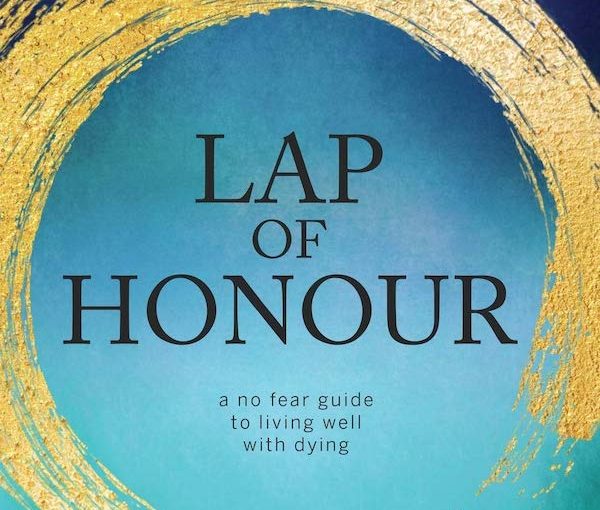
Lap of Honour: A No Fear Guide to Living Well with Dying by Jewish community member Gaby Eirew and Dr. Pippa Hawley is not a new book – it was self-published in 2019 – but its subject matter is timeless. And, after almost two years of the pandemic, many of us have perhaps contemplated the fragility of our existence more than we otherwise would have. While the book talks about what we can do to live well with dying once we are diagnosed with a terminal illness, it’s probably better to read it before that happens, if we have the opportunity, as we’ll have other things to contend with at that point.

Being prepared for something generally reduces our anxiety about that something, no matter what it is – even death.

“When you have been diagnosed with an illness (or someone close to you has) you enter a rather unusual time,” write Eirew and Hawley. “Life’s finishing line might be drawing nearer, but you are still very much alive. This is a time of huge opportunity for warmth, connection and honesty. There are unknowns and inevitably there will be fears, yet once you have a sense of what to expect, fears can be much more manageable, and the personal growth often described by people in this situation can be maximized. There may be difficult conversations ahead, but if these are tackled with honesty and kindness, they can be uplifting.”

Eirew is a counselor and educator, and she created the Recordmenow app, which they recommend in the book as a way to leave messages for your loved ones – you record answers to questions that were derived from interviews of 100 people under the age of 16 who had lost a parent; questions the kids wished their parent had answered for them.

Hawley, a clinical professor and division head at the University of British Columbia, is a pioneer in palliative care, having founded several programs and models of care. She was the founder, for example, of the Bucket List Festival, which was a workshop for people facing end-of-life issues to meet others who were going through similar experiences and has been adapted to other scenarios.

The title of the book comes from the “finishing line” metaphor: “Some runners stop at the finish line. Others take their time, grab a flag, cheer with the crowd and feel the love back. They do a lap of honour, recognizing everything that brought them to this moment, all the events in their life and all the people who are key to them.”

The book has 16 chapters, some written by Hawley, some by Eirew. They touch upon numerous subjects, starting with the process of being diagnosed and receiving a prognosis, or a “best guess as to what will happen to an average person with your condition.” Despite its inherent uncertainty, you might want this prediction because it gives you an idea of what you might want to prioritize.

There are chapters on facing the unknown; on how to tell other people, including children, that you’re ill; on deciding on home, hospital or hospice care; on caring for the person caring for you; on health insurance and the costs that you might face; on celebrating your life; on accessing support services and groups; and more. In the chapter on what you should take into account if you decide to take that trip of a lifetime, to travel with an illness, Hawley highlights “a recurring theme in this book: let people help you.”

While the bulk of the work will still be up to you to do, Lap of Honour discusses almost everything, it seems, that you – and those who love you – will be feeling if you find yourself in this position. And it offers ways for you to “live your life to the very end … in the way that feels right for you.”

For more information, visit lapofhonourbook.com.

Format ImagePosted on December 17, 2021December 16, 2021Author Cynthia RamsayCategories BooksTags dying, Gaby Eirew, health, Lap of Honour, lifestyle, Pippa Hawley, Recordmenow

Living is hard work

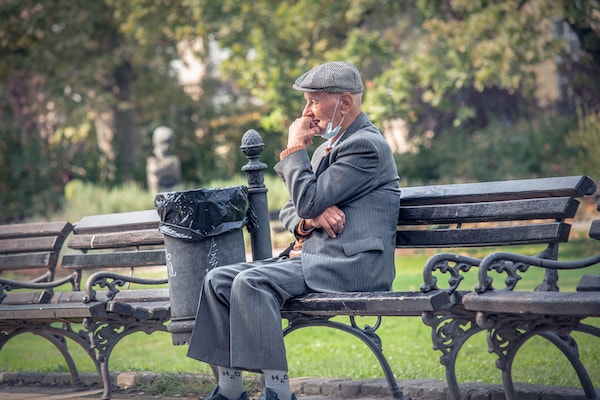
I have never been as old as I am today. I suppose that is true of everybody in the world who is alive. Nothing special, right? Wrong! Wrong! Wrong! It is special – special for everyone of us who are alive. Why is that? Well, aren’t you the lucky people, because I’m going to tell you why. Yes, I am. I know it’s a secret, and that nobody else has the answer – I know that because I just discovered it when I woke up from my afternoon nap. You may think I’m joking, but I’m not. This is deadly serious stuff.

This morning, a Friday, I went to exercises. I go to exercises three times a week: Monday, Wednesday and Friday. I used to kind of enjoy doing that, but I don’t anymore. Lately, I kind of hate these days. And the day I hate the most is Friday. I hate exercising because it hurts, and the day that the exercises hurt the most is Friday. So, I must hate the people who are putting me through these exercises, through that pain, right? Wrong, again. Wrong, wrong, wrong! I love them because they are helping me stay alive.

So, what’s this all about? Am I stupid, or something? If something hurts when you do it, you stop doing it, right? Wrong, wrong, wrong! If I stop doing exercises, I will have less and less control over my body in doing the everyday things that allow me to live independently. These are a bunch of secrets I am telling you, no doubt.

So, as I said, today I am as old as I have ever been. For most of my life, I never gave a thought to such things. I’m not that old, thinking about Methuselah and Moses, and Saparman Sodimejo. Sodimejo claimed to be 146 years old when he died in Indonesia on April 30, 2017. Kane Tanaka of Japan is reportedly 118 years old. Bob Weighton, in the state of New Hampshire, is recognized by Guinness World Records as the oldest living person, at 112. I’ll only be 88 on my birthday next April, so what’s the fuss?

The fuss is that staying alive is hard work. Some of the time, it hurts, particularly if you are trying to stay nimble and in possession of your faculties. If we don’t work at it, we just dry up and blow away, and it happens a lot sooner for most of us than it did for the guys I mentioned above.

Let’s face it, we are losing stuff as we fight the battle for longevity. I can no longer lift myself up to chin the bar like I used to. (The muscle mass vanished when I was looking the other way!) I need a pinch of spice to really enjoy some foods like I used to – I especially need more salt on my food or it seems tasteless. I sometimes need help with a name, and have to use my computer liberally to refresh my memory of things I used to know like the back of my hand. I’m really happy my kids remember my name and I have to be careful to remember all the birthdays and anniversaries. And did I tell you I take a regular regimen of pills, aside from the vitamins B, C, D and E that I ingest?

Today, my Bride asked me what’s on my bucket list. Surely, she said, you must have lots of things that you wanted to do but have not yet done. I thought about that for a moment, then I answered, I want to spend tomorrow with you, and the next day, and the day after that. That’s the real pinch of spice I need in my life.

Every day that we are alive, we are in a place we have never been before. In our world, everything within us, and everything outside us, is in a state of flux, essentially offering us a new experience every day. I intend to grab life by the throat, shake it and get the most out of it. To do that, I need all the strength I can muster. Exercise tomorrow? Hell, yes!

Max Roytenberg is a Vancouver-based poet, writer and blogger. His book Hero in My Own Eyes: Tripping a Life Fantastic is available from Amazon and other online booksellers.

Posted on December 17, 2021December 16, 2021Author Max RoytenbergCategories Op-EdTags aging, health, lifestyle, philosophy
The effects of isolation

The effects of isolation

How technology can connect people and reduce social isolation was the topic of the Jewish Seniors Alliance’s fall symposium. (photo from pixnio.com)

At the fall symposium of the Jewish Seniors Alliance, which took place on Zoom Nov. 21, attendees heard from experts on the topic Triumphs and Trials Using Technology: Social Isolation Among Older Adults.

Dr. Kristen Haase, assistant professor of applied science at the University of British Columbia School of Nursing, and Dr. Megan O’Connell, professor of geriatric psychology at the University of Saskatchewan, were welcomed by Gyda Chud, co-president of Jewish Seniors Alliance. Chud pointed out that this session related to the key pillars of JSA:

  1. Outreach: to seniors in the community.
  2. Education: we can learn from the professors’ study results.
  3. Peer support: JSA has projects that help combat loneliness and isolation.

Of their study on social isolation among older adults during the pandemic, Haase said they wanted to explore how the inability to interact in person during the pandemic has impacted seniors. She mentioned that two scientific publications – The Lancet and The Journal of the American Medical Association – had commented on the detrimental effect of isolation on seniors. Haase and O’Connell wanted to look at the effects and what could be done to alleviate them.

There is empirical evidence that social isolation impacts mental, physical and cognitive health. Since technology can facilitate social connection, the idea was to train older adults to use these facilities to lessen their isolation. Use of both the telephone and Zoom was embraced by many older adults, and even those people with some cognitive impairment could be trained to use Zoom and other such tools.

Haase and O’Connell reached out to groups and individuals in British Columbia and Saskatchewan for participants. Four hundred individuals and 41 seniors groups were involved in the study, including JSA. Two of the questions were: How did they change their programs? and How did they maintain social connections?

Some groups opted to meet outdoors. The advent of a vaccine helped alleviate some fears. One of the findings was that introverted people, as well as those who lived in rural areas and those who had family nearby, fared better than more extroverted people.

Many community groups rose to the challenge and introduced new technology to their members. In addition to providing training, they also kept in touch with frail members. In rural areas, where broadband access was problematic, groups had to make major use of the telephone. A 1-800 line was purchased to facilitate contact in these areas. These types of disparities in access were highlighted by the pandemic.

A few community groups closed during COVID, but many rose to the occasion by staying in regular contact, providing iPads to clients and helping them learn how to use them.

Haase and O’Connell then turned to the audience for any questions or other information that would help with their research.

One question was how do we find the truly isolated, as we usually rely on people to self-identify if they are in need. The poser of that question, Larry Shapiro, pointed out that, in the United Kingdom, they use the postal service to check on isolated individuals.

Another issue raised was whether groups should continue with a hybrid model of services – this would involve in-person events plus a Zoom possibility. Hybrid models make programming more accessible for those who are ill or who have a disability that impedes mobility. As well, many older adults are still fearful and need help to re-enter society. Funding would be needed to facilitate such programs.

Tammi Belfer thanked the speakers for their research, which was helping improve the lives of older adults.

Shanie Levin is program coordinator for Jewish Seniors Alliance and on the editorial board of Senior Line magazine.

Format ImagePosted on December 10, 2021December 8, 2021Author Shanie LevinCategories LocalTags health, healthcare, isolation, Jewish Seniors Alliance, JSA, Kristen Haase, Megan O’Connell, research, seniors, UBC, University of British Columbia, University of Saskatchewan
Seven summer camp benefits

Seven summer camp benefits

(photo from flickr)

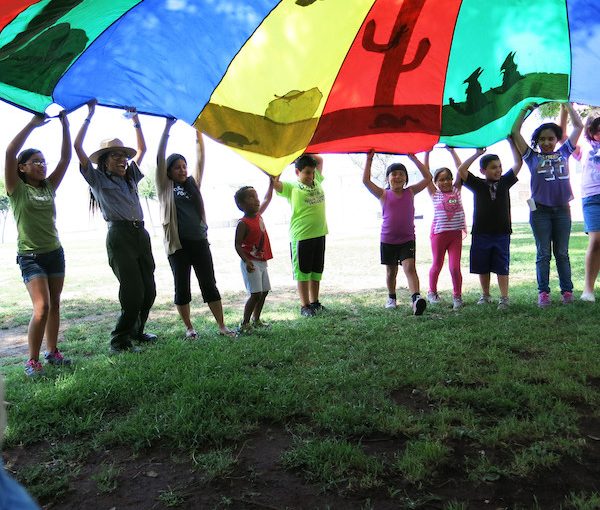
There’s a single destination that gets kids outside having fun, experts say, while teaching them lifelong skills. It’s called camp.

The benefits of camp are plenty, from life lessons beyond the classroom and the value of playtime to appreciating nature and building confidence and leadership skills.

“The major changes in [campers’] growth speaks tremendously of the summer camp experience,” said Troy Glover, the director of the University of Waterloo’s Healthy Communities Research Network.

Glover spearheaded the Canadian Summer Camp Research Project, a nationwide study on the effects of camp on kids. The results demonstrated that for “bubble-wrapped” youth who have been over-programmed and overprotected, camp provides a safe environment to freely learn, grow and develop their capabilities. Summer camp, according to the study, fosters emotional intelligence (or EQ), self-confidence, independence, healthy living, environmental awareness, learning, leadership and other skills that prove beneficial long into adulthood.

The core benefits of camp include building friendships and social skills; developing resiliency and confidence; becoming and staying physical; overcoming nature deficit disorder; learning the values of leadership; continuing education in the summer; and carving time for “active play.”

 Friendships & social skills

It may seem scary at first to enter a whole new social world at camp. However, camp offers a crash course on meeting new people – helping children build social skills, explore their independence and improve their self-esteem, said Stephen Fine, research chair for the Ontario Camps Association. “Teamwork, cooperation and negotiation are inherent to the camp experience,” Fine explained. “Kids’ confidence levels and their ability to be in social situations increase.”

At camp, children boost their self-esteem and develop risk-taking and conflict-resolution skills as they learn to make their own decisions without their parents’ help.

Camp provides children with a “blank slate,” allowing them to try on different behaviours and identities. And the relatively short duration of a camp session decreases the cost of making mistakes.

One of the Canadian Summer Camp Research Project’s most significant findings was in the area of emotional intelligence, often referred to as EQ (emotional quotient). With EQ, which involves recognizing, understanding and managing emotions, children learn how to work, play, relate, get along, empathize and connect with others.

“It’s not just about IQ in children,” Glover said. “Research supports how EQ is more important in terms of future success…. This is an essential component of the maturation process and a skill that camp is successfully developing.”

Resiliency & confidence

Saturated with 24-hour news highlighting crimes in their communities, many parents today are overprotective of their children, “bubble-wrapping” them in order to keep them safe and sheltered. While Glover said it’s safer now, statistically, than it was when he was a child, parents are not as willing to let their kids out of their sight.

At camp, children are encouraged to go outside their comfort zone through activities such as high ropes courses, dramatic and musical performances, or wilderness camping. By allowing children to take risks and face challenges, camp helps children build their independence, resiliency, and self-esteem in a safe, supervised and supportive environment, the study found.

These invaluable life skills often translate into improvements at home and at school, said Mike Pearse, director of Camp Tawingo, a traditional overnight camp in Muskoka, Ont.

Pearse said the camp experience can be divided into the hard skills – for example, learning how to paddle a canoe, tie a knot, identify an edible plant and play a team sport – and accompanying soft skills, such as perseverance, creativity, responsibility and courage.

“At camp, every child has an opportunity to succeed,” he said.

This translates into increased self-confidence and, in many cases, an improved school experience. “I’ve had parents come to me and say, ‘My child is doing so much better in math class this year because of the confidence boost he got from camp,’” Pearse said.

Becoming & staying physical

With video games, Facebook and smartphones all vying for a young person’s attention, the national epidemic of obesity and inactivity won’t be easy to overcome. One Statistics Canada study found that only seven percent of youth aged 6 to 19 got the recommended hour a day of exercise they need.

Enter summer camp, where physical activity is well disguised in the form of fun and games, allowing youth to adopt a healthy lifestyle, often without even realizing it.

“Our study found that campers’ attitudes toward physical activity really improved toward the end of the camping session,” Glover said. “When given a choice, these campers will now choose physical activity because they realize it makes them feel good and contributes to their well-being.”

Along with banning the use of electronics, many camps provide a daily routine that involves waking up early, getting lots of physical activity, eating regular meals and spending extended periods of time outdoors.

“At camp, you’re always on your feet, always on the move, even if you’re just walking to a meal,” Glover said. “So, it’s not about forcing kids to spend 20 minutes on a treadmill, but rather easing them into an active lifestyle that includes lots of walking, engaging in team sports and playing outside with other kids.”

Nature deficit disorder

A bond with nature is sorely missing in the lives of many children today unlike a generation ago, Richard Louv writes in his book Last Child in the Woods: Saving Our Children from Nature-Deficit Disorder. It’s a world where kids may be all too aware of environmental problems, yet rarely venture out to experience the natural world, he writes.

“Camps have their own pressures, but the healing quality of nature is always there, just beyond the screen door,” Louv said.

At camp, kids are given the opportunity to see what they’re missing, and form lifelong bonds and connections with the natural world they may have never experienced before. “Even camps in the city usually have an outdoor dimension to them,” said Glover.

“Children need nature for the healthy development of their senses and, therefore, for learning and creativity,” Louv added.

Values of leadership

A leader isn’t always the loudest person in a group, or the most active. Many leaders share a range of skills and qualities that help him or her take charge: confidence, creativity in their decision-making and an understanding of teamwork, to name a few. It takes practise to become a good leader, too.

That’s where camp comes in, said Moira MacDougall, who heads teen and young adult strategies for the YMCA of Greater Toronto, a charity providing community support programs. Camp helps gradually build leadership skills, MacDougall said.

“You’re often having to rely on your teammates or cabinmates to complete an activity,” said MacDougall. “That builds in-group bonding and, in that process, what you hope the young person’s learning is either to have some voice within that group … or how to be persuasive.”

According to the Canadian Summer Camp Research Project, most campers demonstrated an increase in emotional intelligence and self-confidence, both characteristics attributed to good leaders.

As campers enter their teenage years, there are more opportunities to obtain explicit leadership skills. Most camps offer an LIT (leader-in-training) or CIT (counselor-in-training) program that walks young people through the skills they need to plan activities and programs, care for younger campers and communicate effectively.

Whether it’s by cleaning their cabins without being asked, helping younger campers find their way to the dining hall, or contributing their talents to a play or talent show, youth of all ages learn to take initiative at camp.

Learning how to take the lead essentially teaches youth how to be good citizens. “They learn that we all have a role to play to contribute to a better society, and nothing happens if you sit back and wait for someone else to act,” said Glover.

Continuing education

“It’s not only cognitive learning, it’s emotional learning,” said Tom Potter, associate professor at Lakehead University in Thunder Bay, Ont. Potter has been involved in outdoor adventure education for more than 30 years.

Camp is the kind of place where children can learn canoeing, archery, life skills such as teamwork, and apply the lessons they learned during the school year in many enjoyable activities. Geocaching lessons offered at some camps, for example, teach kids scientific and math skills.

“They’re getting instant and immediate feedback, so if they do something well, they’ll get feedback; if they’re sailing a sailboat and it’s going in the right direction, they’ll get feedback on that,” Potter said. “But if the boat turns upside down, that’s OK … it’s all part of it.”

Time for “active play”

Many children today simply don’t get enough of unstructured playtime. “If you look at time in school, time at home, time watching TV, those things have either stayed consistent or gone up,” said Michelle Brownrigg, chief executive of Active Healthy Kids Canada. “But active playtime has decreased.”

Canadian children are reportedly spending an average of four to six hours a day with TVs, computers and cellphones.

Camp gives children the playtime they need while encouraging creativity and social engagement. Play not only offers children the tools to entertain themselves, it also builds their imagination.

“Kids learn to set their own boundaries, to develop in an environment that’s not necessarily focused on a competitive end, to interact with one another, to determine how to win and lose, and to trade roles and be involved in an active way with their peers,” she said.

This article is a shortened version of the original, which is ourkids.net/camp/benefits-of-summer-camp.php.

Format ImagePosted on December 10, 2021December 8, 2021Author ourkids.netCategories NationalTags Canadian Summer Camp Research Project, health, kids, research, summer camp, Troy Glover, University of Waterloo, youth
Supporting Jews worldwide

Supporting Jews worldwide

Michelle Pollock, chair of Jewish Federation of Greater Vancouver’s Israel and global engagement committee. (photo from JFGV)

For Montreal native Michelle Pollock, chair of Jewish Federation of Greater Vancouver’s Israel and global engagement committee (IGEC), love and loyalty to world Jewry were firmly established early in life – at home, school and in the community at large.

That deep affinity was further solidified after a two-month trip to Israel with her ninth-grade class. More recently, while serving as president of the Jewish Community Centre of Greater Vancouver in 2016, Pollock took a trip with her husband Neil to visit the Krakow and Moscow JCCs.

“These visits were incredibly powerful,” Pollock told the Independent. “Witnessing the young adults of these communities, discovering and exploring their Jewish heritage was beautiful. Even more inspiring was the hard work and dedication of the Polish and Russian volunteers and staff in creating welcoming spaces to facilitate this Jewish self-discovery.”

In November 2017, Pollock traveled to northern Israel as a participant on a Centre for Israel and Jewish Affairs mission. “Many of the participants on the trip were IGEC members or staff and their passion for our partnership region was infectious. I joined the IGEC soon thereafter,” she said.

A visit to Federation’s partnership region, Etzba HaGalil (the Galilee Panhandle), followed, in November 2019. That experience was multifaceted. The area is known for its physical beauty and the warmth of its residents, said Pollock, but the harsh reality of security issues and the regional challenges of jobs, infrastructure and opportunity also prevail, she noted.

“Seeing this firsthand infused me with gratitude to our Federation, which has worked so closely with the region since the mid-1990s to bring desperately needed aid and programming in a continuing effort to address the challenges faced by its residents,” Pollock said. “Jewish Federation has strategically invested funds to strengthen this region through education and social welfare programs, capital projects and regional development, and building enduring relationships between members of our community and residents of Etzba HaGalil.”

Similar to efforts locally, some of the funds to Israel have been allocated to new programs addressing youth mental health issues, violence and abuse at home, educational gaps and food security – all problems that have been compounded by the pandemic.

As for the challenges in another region in need, Far East Russia, where many Jews live in remote locations, Federation partners with the Joint Distribution Committee. The JDC is a global organization that addresses critical rescue and relief needs in more than 60 countries, including in the former Soviet Union (FSU).

“Working together with the JDC, life-saving aid is provided to over 80,000 elderly Jewish people in the former Soviet Union who struggle to survive on meagre pensions of $2 per day. They are the poorest Jews in the world, most without family or government support. Their distress and vulnerability are exacerbated by the region’s remoteness and freezing winters,” Pollock explained.

Many of these elderly Jews are well-educated and trained as doctors, lawyers, scientists and educators, she said. Having spent most of their working lives under communism, however, they were unable to accumulate savings. When the Soviet Union collapsed, along with the region’s pension and social assistance infrastructure, they were left poverty-stricken.

“Vancouver is geographically the nearest Jewish community to the Jewish communities in the easternmost part of Russia, adjacent to Siberia. As a strategic priority to strengthen Jewish life around the world, Jewish Federation (as the closest Federation) plays a very active role in supporting this region,” Pollock said. “We ensure long-term economic and social stability for Jews living overseas and in Israel by funding much-needed programs that provide a safety net for our most vulnerable people.”

These specialized programs, funded in part by the Jewish Federation of Greater Vancouver through the annual campaign, impact the lives of at-risk youth, low-income seniors and those living in economically fragile areas.

This year, Federation is funding a program directed at youth in the FSU called Active Jewish Teen (AJT). Engagement in the Jewish community, it believes, is an essential first step in making communal responsibility an inseparable part of one’s Jewish identity. Though still building momentum, AJT already has more than 3,200 members in 63 locations across seven countries.

Besides investing strategically, Federation’s IGEC has made solid connections with the groups it is serving in the FSU, said Pollock. It is also attentive to urgent needs arising in other Jewish communities around the world, helping fund operations and campaigns in South America, Ethiopia, the United States and elsewhere, she said.

Closer to home, throughout the year, Jewish Federation’s Israel and global engagement department brings opportunities for the Vancouver community to experience Israeli culture. Next year’s Yom Hazikaron (Israel’s Memorial Day) and Yom Ha’atzmaut will present opportunities for the community to come together in person.

“Building off the success of last year’s virtual Israeli Independence Day celebration, we will include more local talents and have community fun projects such as the community song and more surprises,” said Pollock, adding that there is a contingency plan in place should the COVID situation change.

Further, shinshinim, teenage emissaries from Israel, will be in town in the coming year. The shinshinim engage local young people in various activities and help foster meaningful ties between Disapora Jews and Israel.

Members of the Vancouver community have a chance to travel to Israel next summer, as well. Federation is facilitating a community mission from July 24 to Aug. 5, 2022.

“I know many of us are keen to travel and get back to Israel and this is going to be an amazing experience,” said Pollock. “At this point, we are looking for people to register their interest and there are a number of information sessions coming up.”

To learn more about the trip to Israel and to donate to the annual campaign, visit jewishvancouver.com.

Sam Margolis has written for the Globe and Mail, the National Post, UPI and MSNBC.

Format ImagePosted on November 19, 2021November 18, 2021Author Sam MargolisCategories LocalTags education, Etzbah HaGalil, fundraising, Galilee Panhandle, health, Israel, Jewish Federation, JFGV, Michelle Pollock, philanthropy, poverty, Russia, seniors, survivors, tikkun olam, volunteering, youth

Community milestones … Goldschmidt, Mines, BGU & Weizmann Institute

A German translation of the Talmud, and the first translation of the book ever completed by a single person, is now available on Sefaria, a free nonprofit online library of Jewish texts. The translation by scholar Lazarus Goldschmidt was the first German translation of the Talmud and was released in 1935. While it is used in German Jewish studies departments and universities, it had not been widely accessible to the general public until now.

screenshot - Penny Goldsmith
(screenshot)

A celebration of the release took place virtually on Oct. 24. One of the speakers was Penny Goldsmith, Goldschmidt’s eldest granddaughter. Goldsmith is a longtime anti-poverty community worker in Vancouver, and owns a small independent publishing company, Lazara Press, named after her grandfather, who died a few months before she was born. She spoke of her grandfather’s books, “beautiful typographical masterpieces.”

“Grandfather was a type and book designer,” she said. Among his books were literature and poetry, including a collection of poetry he wrote in his early 20s, in Hebrew, “a very unusual choice,” Goldsmith noted, “as Hebrew at that time was reserved for religious study only.”

Goldschmidt was a scholar of Near Eastern languages and, in addition to the Talmud, he translated other religious texts, including a Hebrew translation of the Ethiopic Book of Enoch and a German translation of the Koran. Born in Lithuania, he learned German at the age of 18. His translation of the Talmud took 39 years to complete and he continued to make revisions after publication. He was also a collector of rare books and his extensive collection is now part of the Royal Library in Copenhagen.

After the Goldschmidt Talmud translation became public domain in January 2021, a team of four led by Igor Itkin, a rabbinical student at Rabbinerseminar zu Berlin, integrated its 9,434 pages of text into Sefaria’s free online library. The team’s work included manually linking sections of the translation to corresponding Talmud texts in English and Hebrew/Aramaic already in the Sefaria library. The connections allow scholars, educators and others to navigate between the translations and connect them to the larger library of Jewish scholarship. The team’s work was supported by a grant from the Rothschild Foundation Hanadiv Europe.

***

image - The Rivals book coverThe Rivals and Other Stories by Jonah Rosenfeld, translated from the Yiddish by Vancouver’s Rachel Mines – who recently retired from Langara College’s English department – has been selected by the Yiddish Book Centre as one of its picks for the 2022 Great Jewish Books Club. The book is available through the Yiddish Book Centre’s store and other online booksellers, including its publisher, Syracuse University Press, which is offering The Rivals at a 50% discount until Dec 1, 2021 (press.syr.edu).

Rosenfeld was a prolific and popular writer from the early 1900s until his death in 1944. Although his writing received critical praise, very little was translated into English until the publication of The Rivals. His stories foreground social anxiety, cultural dislocation, family dysfunction and the search for meaningful relationships – themes just as relevant today as they were to their original audiences. (See jewishindependent.ca/stories-that-explore-the-mind.)

***

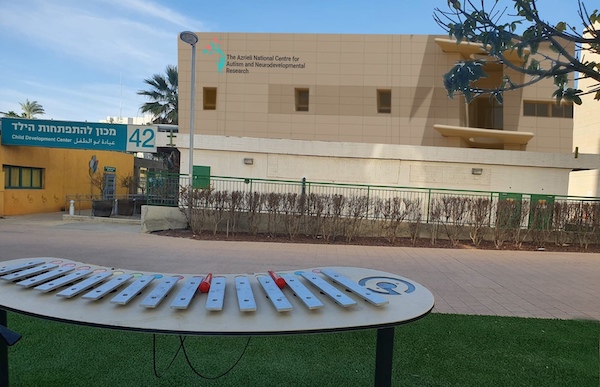
photo - The National Autism Research Centre of Israel
The National Autism Research Centre of Israel (photo from Canadian Associates of Ben-Gurion University of the Negev)

The Azrieli Foundation recently donated $15.6 million Cdn to the National Autism Research Centre of Israel, a collaboration between scientists from Ben-Gurion University of the Negev and clinicians from Soroka University Medical Centre (SUMC), both in the city of Be’er Sheva, Israel. The centre, originally established by the Ministry of Science and Technology, is dedicated to translational research that aims to revolutionize diagnosis techniques and interventions for autism and other neurodevelopmental conditions. In honour of the donation, the centre has been renamed the Azrieli National Centre for Autism and Neurodevelopment Research.

A dedicated facility inside SUMC will be constructed that will double the space for working with children with autism spectrum disorder and performing research. It will house genetics/bioinformatics, biomarker-detection and neuroimaging labs. Existing data collection will be expanded to many autism clinics throughout Israel, where multiple types of clinical and behavioural data, biological samples (e.g., DNA and blood samples) and neuroimaging data will be collected. This data collection will enable the rapid expansion of the National Autism Database, which will triple in size within five years. New faculty members, post-docs and graduate students, as well as scientific, clinical, technical and administrative support staff will be recruited to manage the data collection and sharing effort.

***

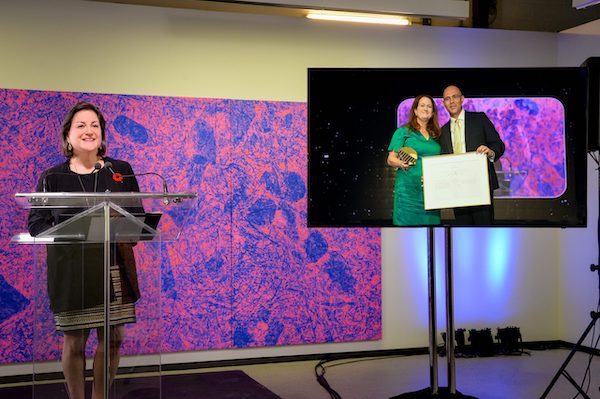
photo - Naomi Azrieli, chief executive officer, Azrieli Foundation Canada, and co-chair, Azrieli Foundation Israel, at the Nov. 7 announcement in Montreal, which took place concurrently with the announcement in Israel
Naomi Azrieli, chief executive officer, Azrieli Foundation Canada, and co-chair, Azrieli Foundation Israel, at the Nov. 7 announcement in Montreal, which took place concurrently with the announcement in Israel. (photo by PBL Photography)

The Weizmann Institute of Science and Weizmann Canada recently received a donation of $50 million US from the Azrieli Foundation, to enable catalytic brain research with the establishment of the Azrieli Institute for Brain and Neural Sciences. A longstanding supporter of the institute, this latest donation adds to past philanthropic investments of nearly $30 million US by the foundation towards Weizmann research facilities and fellowships.

Weizmann’s Azrieli Institute for Brain and Neural Sciences, which will be located at the Weizmann Institute campus in Rehovot, Israel, will promote the full spectrum of neuroscience research, from basic, curiosity-driven studies to translational work of high clinical relevance, with global impact. The donation will enable the construction of a new building that will serve as a hub for neuroscience activities, facilities and technologies.

The Azrieli Institute will focus on research in the development of neural networks; perception and action; mental and emotional health, positive neuroscience; learning, memory and cognition; the aging brain; neurodegeneration; injury and regeneration; theoretical and computational neuroscience; development of innovative neurotechnologies; and integrative brain disorders.

Posted on November 19, 2021November 28, 2021Author Community members/organizationsCategories LocalTags Azrieli, Ben-Gurion University, BGU, health, Israel, philanthropy, science, Weizmann Institute

A death well-planned – an excerpt from Anne of Oasis

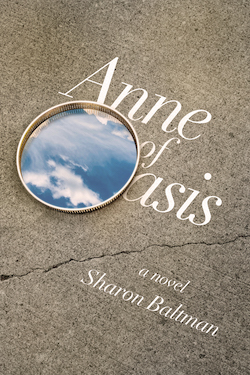
image - Anne of Oasis book coverIn Anne of Oasis, drawing on my many years as a physician psychotherapist, I tell the detailed, fictional story of what goes on in the therapy room when an eccentric, 70-year-old is obsessed with changing her life – or ending it. Anne bumbles through what she views as mysterious rituals with the therapist, explores secrets, re-jigs behaviours and, five years later, finds bliss. Here is the final chapter.

***

Chapter 26: June 2008

For two years, Doug heard sporadically from his mother and continued his requests for pearls. She made it clear to him and his brother she wasn’t coming out to Kelowna anymore. They occasionally visited her in Toronto, or in Golden, where she was staying with Eleanor for longer and longer periods of time.

When he received the phone call from a Toronto hospital, Doug asked if she’d fallen and busted her hip. They said it was more than that. They had found her unconscious on the street in Toronto with no ID, except for a piece of paper with Doug’s number on it as her next of kin. They admitted her as an Unknown Person and she was failing fast. If he wanted to see her alive, he had better come quickly.

He didn’t know what to do. He had promised to be there if she needed him for assistance in dying peacefully, but this was different. Yet how could he leave her to die on her own?

“She’s still your mother,” his wife offered.

He flew out as soon as he could. He arrived at the Toronto General Hospital, where Admitting confirmed there was no patient by the name of Anne Bishop. But a woman had been admitted as an Unknown Person. Doug wandered the halls searching for his mother.

“She was moved to a different floor.”

“She’s in ICU.”

“She’s not in ICU.”

Finally, he stepped into the Cardiac ICU and in the corner he saw a pile of breathing bones. Tube in mouth, IV in arm, sas-sas-sas of a respirator. Unknown Person at the foot of the bed.

“Is this her?” he asked the nurse at the desk.

“She was found with only this slip of paper on her.”

“That’s my name and number.”

“She apparently suffered a sudden, massive heart attack on the street.”

As Doug approached the bed, he recognized the bony lumps on her hands, the chewed-up fingernails, the crepe skin. It was definitely Mum. He gasped. His eyes filled, the lump in his throat tightened. He turned and rushed to the nursing station.

“Please, can the tubes be removed? She didn’t want heroics.”

“We barely know her name. We can’t follow any directives without proper ID and signed papers detailing her wishes.”

He took off uptown to retrieve the Dying With Dignity papers his mother had been talking about for years.

Stepping into his mother’s house, it felt haunted, full of yesterday’s glory. Dust everywhere. Her clothes neatly stashed, but neglect inhabited the place. He walked from room to room, observing photos everywhere – on window ledges, on kitchen counters, on the bedside table. Pictures of Jesse and Catherine and Doug and Bruce and Pam and Sue in every combination. Sitting next to each image was a shiny rock or pebble. He picked up each clear Plexiglass frame and stared. He was shocked to see how she surrounded herself with family. He began to sob.

He found the papers in the second drawer of his grandmother’s mahogany desk, exactly where his mother had said they’d be. Everything was perfectly organized and signed. He grabbed the requisite forms, glanced around at the family photos and returned to the hospital. They removed the tubes.

He returned to the house for a few hours’ sleep and arrived back at the hospital next morning, to find she had again sprouted pipes. The staff explained that overnight she had taken a turn for the worse and they tried to save her.

Angrily showing them the papers again, he repeated her wish to die quietly, and they removed the tubes a second time. He wrapped Mum in her favourite turquoise velour blanket he had brought from her home, took her in his arms and held her exactly as she held him as a sick boy on the farm. He noticed a flicker of a smile cross her face, then she took her last breath.

Just then, Eleanor appeared.

Through their tears, Doug and Eleanor awkwardly made their way to her house together. They expected to start planning how to say goodbye to Anne. But she beat them to it. She had detailed her every wish. They simply had to fulfil them.

“You know what?” Doug asked. “She knew what she was doing all those years ago around Dying With Dignity. We thought she was nuts, but it’s sure helping us now.”

“She was utterly determined in every aspect of her life,” Eleanor replied.

“What do you think we should do with the rocks? My brother thinks we should pitch them.”

“She schlepped them home from every spot she ever visited. Each and every one was special to her,” Eleanor sighed.

“I think we should leave some at the cemetery.”

Because Doug knew Mum hated missing appointments, he searched in her handwritten, dog-eared address book for Dr. C’s number.

“I’m so sorry,” Dr. C responded when he told her the news.

“It’s odd speaking to you in person after hearing about you for so long,” Doug said. “I’m happy to hear your voice. I need to tell you how important you were to my mother. Thank you for helping her.

“She was still difficult to deal with, but she seemed a lot happier. I also want to thank you for all the pearls of wisdom I received second-hand. Mum loved sharing them and they have been extremely helpful in my life.”

“We will all miss her.”

“As per her wishes, we are having a funeral service tomorrow afternoon at 2 p.m. at the Mount Pleasant Cemetery. We would be honoured if you would come.”

“Thank you. It would be a privilege. I’ll see you there.”

Tuesday afternoon, at 2 p.m., under a blistering sun, Doug, Eleanor and Dr. C, along with a handful of grey-haired men and women, gathered as they lowered the casket into the ground. Doug pulled out a heavy purple velvet Crown Royal bag and spoke.

“When I called Dr. C to notify her of Mum’s death, I asked what we could do with the stones Mum collected on her travels. She informed me that according to Jewish tradition, leaving a stone on a loved one’s grave signifies you have been to visit. Because of Mum’s lifelong appreciation of all things Jewish, placing stones on her grave would be a mitzvah, or a blessed act of kindness.

“I am honoured to ask each of you to dig into this bag, which held my marbles as a kid, to take out a pebble and place it on Mum’s final resting place.”

Tears rolled down his face. Doug held the bag open. Eleanor, Dr. C and the others lined up. One by one they removed a rock and placed it on the earth as it was shovelled onto the casket.

For more information, visit sharonbaltman.com.

Posted on November 19, 2021November 18, 2021Author Sharon BaltmanCategories BooksTags aging, Anne of Oasis, Dying With Dignity, estate planning, health

Posts pagination

Previous page Page 1 … Page 5 Page 6 Page 7 … Page 24 Next page
Proudly powered by WordPress