Skip to content
  • Home
  • Subscribe / donate
  • Events calendar
  • Business Directory
  • FAQ
  • News
    • Local
    • National
    • Israel
    • World
    • עניין בחדשות
      A roundup of news in Canada and further afield, in Hebrew.
  • Opinion
    • From the JI
    • Op-Ed
  • Arts & Culture
    • Performing Arts
    • Music
    • Books
    • Visual Arts
    • TV & Film
  • Life
    • Celebrating the Holidays
    • Travel
    • The Daily Snooze
      Cartoons by Jacob Samuel
    • Mystery Photo
      Help the JI and JMABC fill in the gaps in our archives.
  • Community Links
    • Organizations, Etc.
    • Other News Sources & Blogs
  • JI Chai Celebration
  • JI@88! video

Recent Posts

  • SFU honours Gloria Gutman
  • Lifting people’s spirits
  • Wedding a ray of light
  • Indigeneity and Zionism
  • Rule of law broken: councilor
  • Football and its roles
  • The burden of defence
  • Fish Café returns after fire
  • All right in what goes wrong
  • Nuns & mermaids at TUTS
  • Camp offers holiday retreat
  • Students and mentors inspire
  • Once-in-a-lifetime trip
  • 100 dancers, one heart
  • Money for the sciences
  • What “Jewish food” means
  • Have a cookie, schnitzel too
  • Federation now across BC
  • Israel fighting for its existence
  • Deal strengthens Iran
  • Patriotic belonging diminishes
  • A campaign to engage
  • Upstanders’ first live event
  • Responding to Carney
  • Having your own home
  • Music a family tradition
  • Musical to warm heart
  • Community milestones … June 2026
  • Sharing her passion for Israel
  • Or Shalom reopens its doors
  • JFS from past to future
  • Need holistic approach
  • Sharing stories, advice
  • Journalist shares fears
  • Skills to live together
  • Road to independence

Archives

Follow @JewishIndie
image - CJN box ad Rockowers 2026

Tag: governance

Women’s rights evolve

Recently, Prime Minster Justin Trudeau visited Winnipeg. CBC reported that his trip involved promoting the federal budget, meeting with students, trade workers, apprentices and the mayor. The visit included celebrating with members of the Jewish community for Passover, as it fell during the holiday. I was at home and jokingly looked around my living room … nope, Trudeau wasn’t visiting our house! After he left the city, there was a photo published from the Simkin Centre, Winnipeg’s Jewish care home, with Trudeau wearing a kippah and shaking hands with residents. If anybody gets the honour of a visit with the prime minster, it should be our elders. I was pleasantly surprised.

However, the most interesting Winnipeg moment appeared on Twitter and in the news. In it, Trudeau speaks to an anti-abortion University of Manitoba student who says he’s a People’s Party of Canada supporter. Any educator trained in the Socratic method could recognize Trudeau’s response. This student engaged the prime minister in discussion while Trudeau was greeting people and shaking hands. Trudeau responded just as a good high school teacher would. He took the student’s comments seriously, carefully voiced them back and asked direct, probing questions to lead the student to the next step. They covered dental care, religious freedom, and then went on to women’s health care. Trudeau’s questions were things like “Do you believe women should have the right to choose what happens to their own bodies?”

The student later responded, “I think if they’re sleeping around they shouldn’t be allowed to abort the baby, personally.” The student conceded, in a few more steps, that he hadn’t quite decided whether a woman who had been raped should have access to abortion. Trudeau then encouraged him “to do a little more thinking – and praying.”

This clip circulated quickly through social media and brought up many issues. The thing that stuck with me was the student’s assumption that if a woman was pregnant and sought an abortion, it was because “they’re sleeping around.” Not something like the pregnancy might be a danger to the mother and, as such, needed to be terminated, or the fetus had grave abnormalities and wouldn’t live. There are viable reasons to need an abortion. While it’s not always simple, Judaism supports the mother’s right to health and well-being above that of a fetus.

Most surprising: the student failed to acknowledge facts he should have gotten in sex education. Facts like it takes two people to make a pregnancy happen. There was no assumption of any male responsibility.

This parallels something I’ve been studying while doing Daf Yomi (a page of Talmud a day) and am now reading about in Tractate Sotah. This tractate explores the Sotah ritual spelled out in the Torah, which identifies a woman accused of adultery by her husband. There’s not a lot of evidence to show this ordeal was ever practised historically, which hopefully it wasn’t. It involved a series of acts, including the priest at the Temple giving a meal-offering, taking down the woman’s hair, making her swear she was faithful, and then writing the oath on a piece of parchment, erasing it in water mixed with dust from the Tabernacle, and making her drink it. These “bitter waters” theoretically would predict a woman’s guilt. If she is guilty, she would be ill and infertile, or possibly die. A woman who was innocent would be fertile and not be harmed.

From a modern perspective, of course, this sounds completely repugnant, particularly when examining the talmudic tractate. The rabbis debate a scenario in which a man warns his wife not to be alone with another man. If she’s in a room alone with this other man for “some length of time” – this time varies but it could be very short, according to some rabbis – she’s potentially guilty of adultery. Again, no assumption at all of any male responsibility.

I feel eerie parallels between modern events and this talmudic exploration. In some U.S. states, increasingly restrictive access to abortion has brought about some convoluted laws to limit women’s ability to control their bodies. A new law in Florida requires a woman to show proof of rape or incest to be allowed access to an abortion if they are more than six weeks pregnant. Proof of rape or incest means “providing a copy of a restraining order, police report, medical record or other court order or documentation proving her victim status.” While the law is being challenged, if doctors violate the law, they can be charged with a felony.

Today, we recognize that a religious ritual forced on a woman accused of adultery, including forced consumption of bitter waters, doesn’t prove anything. Yet, the “legislators” of biblical and talmudic times felt this public shaming and ordeal proved a woman’s guilt or innocence. It was, perhaps, the ancient equivalent of forcing a rape victim to go through the medical examinations, police reports and other documentation. Many accounts indicate that obtaining this “proof” is not easy.

In Winnipeg, there are so few nurses available in the sexual assault unit to administer the rape kit that victims have been asked to go home and return later when a nurse is on duty, but to avoid showering. There are ample police reports where they assume a woman “asked for it,” or that she deserved it because of what she wore, etc. Expecting compassion from a Temple priest or police officer seems unlikely for many.

What to make of these inequities? To a 21st-century feminist, the Sotah ritual is abhorrent, but it’s equally horrendous that a victim must prove her victimhood again and again to get access to necessary health care. It’s compounded by hearing a Manitoba student assume that a woman slept around if she got pregnant, without any recognition of who else participated or what else might have happened. The Jewish historical tradition shows that, like other rigid biblical punishments – such as the ben sorer u’moreh (the rebellious son), who, in the Torah, is supposed to be stoned to death, but, in the Talmud, the rabbis give so many impossible parameters for the situation that it would be impossible to kill a rebellious son – our culture evolved and didn’t continue these harmful actions, but the ramifications linger.

The hopeful thing in regards to some women’s healthcare access is that our situation, at least in Canada, continues to evolve. Money talks: Trudeau’s Liberal government pledged $3.5 million to improve Canadian abortion services. Yet, the prime minister’s questioning of that student gave me more hope. No one could have predicted that conversation in advance. Our elected leader is “walking the walk” when it could have proved awkward. There’s something powerful about being trained in the (ancient) Socratic method. Unlike the ancient Sotah ritual, it works.

Joanne Seiff has written regularly for CBC Manitoba and various Jewish publications. She is the author of three books, including From the Outside In: Jewish Post Columns 2015-2016, a collection of essays available for digital download or as a paperback from Amazon. Check her out on Instagram @yrnspinner or at joanneseiff.blogspot.com.

Posted on April 28, 2023April 26, 2023Author Joanne SeiffCategories Op-EdTags governance, Judaism, Talmud, Torah, Trudeau, women's rights
Risk … game vs. reality

Risk … game vs. reality

Playing the game of Risk. (photo © Jorge Royan)

I’ve always thought of the Nordic region as peaceful. Admittedly, my knowledge of the area is largely limited to Risk, the board game, where Greenland, Iceland and the Scandinavian countries are considered a haven, free of imminent attack from the throw of a dice.

Well, Finland just purchased Israel’s David’s Sling defensive system. For $345 million US. It was one of Finland’s first moves after recently being accepted into the North Atlantic Treaty Organization. And it was the first sale abroad for David’s Sling, an integrated part of Israel’s multi-tier missile defence system. Israel now carries the title of major supplier to NATO.

I guess the world’s a bit more complicated than Risk.

*** 

So long, Noa Tishby, the Israeli performer appointed by our previous prime minister, Yari Lapid, to advocate for Israel through her strong social media presence. With the formal and former title of special envoy for combating antisemitism and delegitimization of Israel – fit that onto a business card! – she was known for sparring with BDS advocate Bella Hadid and others. Tishby was also a vocal supporter of Israel’s anti-judicial reform movement. Giving voice to the many thousands protesting the current government and its extreme shift rightward and into sometimes theocratic territory, Tishby says this was the reason for her dismissal. Well, ya. As the hawkish Jerusalem Post editorialist Ruthi Blum noted, “Tisbhy is free to share [her opinion]. But she shouldn’t have expected the government she’s been bashing to keep her as a representative.” Well, no. But keep on truckin’ Noa Tishby.

BTW, Tishby will be a guest at the JNF Negev event in Vancouver on June 29.

***

Israel’s Tel Aviv Museum of Art is again among the world’s 100 most visited museums. This according to international art magazine The Art Newspaper. TAMA was ranked 49th in 2022, a jump from its 56th place the year prior. I am fortunate to be one of those visitors, on multiple occasions, over the past many years, often dragging my two children there when they were younger – how fun was that!

Paris’s Louvre and the Vatican Museum took first and second place, respectively. Canada was represented with a 60th place win by Toronto’s Royal Ontario Museum.

***

Congratulations Milk & Honey, Israel’s preeminent whisky distiller, awarded the 2023 world’s best single malt whisky by the World Drink’s Awards for its Elements, Sherry Cask drink. Described as “[f]ruity aromas of citrus zest and white peach with a dash of wood varnish. Sweet to the taste … with flavours of golden syrup, vanilla, tropical fruit and iced tea.…” Sounds like a palate pleaser to me. But, if I had to choose, my favourite would be Seagram’s Five Star rye whisky. Not so much for its taste but for fond memories of fighting with my siblings for the silver sheriff’s star glued to the bottles.

***

Jerusalem was selected by Time magazine as one of the world’s 2023 top 50 destinations, holding the 48th spot. It’s one of my favourite places to visit on a bustling Friday, starting with a walk through the overcrowded neighbourhood of Mea She’arim and enjoying a freshly baked challah. Then, bargaining my way through the Old City’s Arab Market, its tastes, smells and sights, and eventually making my way to the Western Wall, with the golden Dome of the Rock overhead. Ending with lunch at Machane Yehuda, the popular central Jerusalem food market, which has the freshest of meats and vegetables, and many colourful stalls.

Not to be outdone, Canada held two spots. Churchill was third – can’t beat those Northern Light spectaculars. Vancouver was 38th, for its eclectic cuisine and the beautiful Stanley Park.

***

For sure, difficult days in Israel. Sociopolitical cultures are clashing internally. External enemies are looking on with glee, and testing us. But we’re not sinking into despair. Israel has experienced difficult times before and emerged stronger and wiser. So it will be this time.

Arguably, we are being governed by the worst government in our short history – for many reasons, including recent security challenges. I mean, come on, with someone as inexperienced and reactionary as Itamar Ben-Gvir as national internal security minister. Or Finance Minister Bezalel Smotrich spouting off on things about which he should know better and doesn’t. But let’s not blame the victims for the terror and rockets. Hezbollah, Hamas, Iran, an inept Palestinian leadership with a hateful street – they are to blame, not the government.

Usually, it’s the right-wing governments that muster support for the very difficult realpolitik choices, from Menachem Begin’s 1982 Sinai exit to Ariel Sharon’s 2005 Gaza disengagement. Even Binyamin Netanyahu’s 2021 peace deals with several Arab countries under the Abraham Accords. Unfortunately, Netanyahu’s current government may be too inexperienced and messianic to enable reasonable, democratic, liberal change – read judicial reform – at such a scale. But who knows.

We cannot despair. At a very esoteric level, Israelis have hope. In fact, hope is the theme of our national anthem, Hatikvah, The Hope.

***

According to the World Happiness Report, published by the Sustainable Development Solutions Network, Israel remains one of the happiest countries in the world. (See jewishindependent.ca/measuring-happiness.) Rising to fourth place in 2023, just behind Finland, Denmark and Iceland, Israel’s showing likely reflected its reputation as a “villa in the jungle,” as dubbed by former prime minister Ehud Barak – despite being in the Middle East, one of the most contentious spots … on the Risk board.

Bruce Brown is a Canadian and an Israeli. He made aliyah … a long time ago. He works in Israel’s high-tech sector by day and, in spurts, is a somewhat inspired writer by night. Brown is the winner of the 2019 AJPA Rockower Award for excellence in writing, and wrote the 1998 satire An Israeli is…. Brown reflects on life in Israel – political, social, economic and personal.

Format ImagePosted on April 28, 2023April 26, 2023Author Bruce BrownCategories IsraelTags art, Churchill, governance, happiness, hope, Israel, Jerusalem, JNF, Milk & Honey, Noa Tishby, politics, surveys, Vancouver, whisky
Diaspora voices its concerns

Diaspora voices its concerns

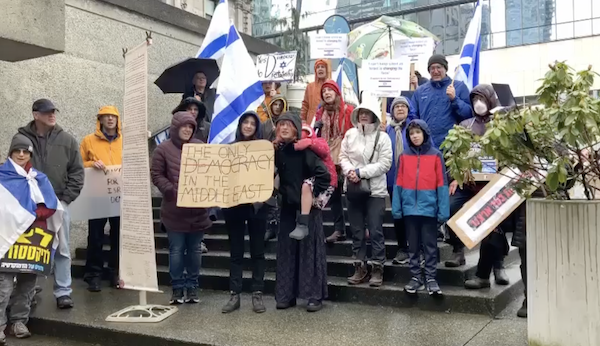
The message on the Facebook post of this video from UnXeptable, who have been gathering weekly at Robson Square to protest the Israeli government’s proposed judicial reforms, reads: “Rain never stops Vancouver 🇨🇦 from supporting you in your struggle ❤️🇮🇱” (screenshot from Facebook.com/DefendIsraeliDemocracy)

Reverberations from the political tumult in Israel continue to rumble across the Diaspora, including here in British Columbia.

For 10 weekends in a row now, a few dozen Vancouver-area residents, many of them Israeli expats or Israeli-Canadians, have gathered in downtown Vancouver. On March 30, an “emergency meeting” took place at Or Shalom synagogue, titled Saving Israeli Democracy.

Daphna Kedem, one of the organizers of unXeptable, which is behind the rallies, told the group at Or Shalom that similar events are now taking place in more than 50 Diaspora communities.

“There is a point to going out in the street and saying we are here and we care and we want a lot of others to share what we feel,” she said, noting that between 20 and 50 people tend to show up at the weekly gathering at Robson Square.

“It would be great to be 200,” she said, adding that the masses of Israelis taking to the streets have forced a delay in the government’s proposals, but the fight is far from over.

The protests in Vancouver, in Israel and around the world centre on so-called “judicial reforms,” which would remove an existing multifaceted process of appointing Supreme Court justices and centralize it in the hands of the government executive, the cabinet. Among the reams of related proposals is a bill that would allow the Knesset to overturn Supreme Court decisions by majority vote.

Dr. Erez Aloni, an associate professor at the Allard School of Law at the University of British Columbia, said the proposals are “not a legal reform” and that it is “not a joke” to call what the government of Binyamin Netanyahu is attempting to do “a revolution.” Aloni is one of some 200 signees to the “Statement by Canadian jurists on proposed transformation of Israel’s legal system,” which was issued Feb. 9.

“A democracy needs checks and balances and these checks and balances include checks and restrictions on the government so we can enforce laws against the government, so we make sure that the government doesn’t abuse its right, in particular against minorities,” he said. “In Israel, the only checks, the only restrictions on the government, on the executive, is the Supreme Court.”

The power of the cabinet, the lack of a second chamber of parliament, the strictness of party discipline, the absence of a presidential veto, and the lack of a written constitution all combine to put extraordinary reliance on the Supreme Court to rein in any potential overreach by elected officials, said Aloni.

The proposals, which would give the government effective veto power over Supreme Court appointments, is a dramatic step, he said.

“The coalition, the executive, is going to be almost solely responsible for selecting judges by themselves,” Aloni explained.

Not only would this impact the Supreme Court, he argued, but any lower court judge with aspirations of appointment to the highest judicial body would presumably consider political repercussions when handing down decisions.

In addition to the proposals to alter the judiciary, Aloni told the audience that the government is also threatening “independent public broadcasting, control of academia, immunity for IDF soldiers and police actions, increasing jurisdiction of the rabbinical courts and so forth.”

Video-recorded remarks from Achinoam Nini, the well-known Israeli singer commonly known as Noa, were aired at the meeting, with portentous background music.

“The situation is not good,” said Nini. “In fact, Israel is on the verge of the worst tragedy in her short history, worse than any war so far: the death of her democracy and a total system breakdown. The so-called judicial reform … is no such thing. It is rather an antidemocratic coup, a grab for limitless power by a democratically elected government composed of convicted criminals, messianic zealots, corrupt opportunists and ultranationalists, turning democracy against itself and against the citizens of Israel.”

Dr. Lisa Richlen of the David Abraham Centre for International and Regional Studies at Tel Aviv University spoke of the impacts the proposals would have on nongovernmental organizations, especially those she works with that serve non-Jews, non-citizens and asylum-seekers. She addressed the apparent absence of Arab citizens of Israel in the demonstrations.

“I want to make the point that, for them, they haven’t felt that it’s a democracy since even before this,” she said, adding that the apparent attack on minorities has struck a chord with mainstream Israelis.

“When you start with weaker social groups,” said Richlen, “what you have is what you see today, where the mainstream of Israeli society is starting to feel increasingly threatened.”

Dr. Itai Bavli of UBC’s School of Population and Public Health echoed Richlen’s concerns for the rights of those outside the Green Line. He also disputed the idea that opponents of the government’s proposals are overstating the threat to democracy.

“Democracy is disagreeing and I get it that you have political differences, that’s the idea of democracy,” he said. “But these people, they don’t want democracy.… We have to oppose, we have to fight against these forces and support democracy in Israel.”

Rabbi Hannah Dresner, spiritual leader of Or Shalom, spoke and David Berson emceed.

The gathering was only one of many discussions in Jewish communities worldwide, some more public than others, around events in Israel and their impacts inside and outside that country. A February poll commissioned by JSpaceCanada and the New Israel Fund of Canada showed that, while three-quarters of Canadian Jews are emotionally attached to Israel, 73% oppose the judicial reforms (jewishindependent.ca/opposition-to-policies).

“Tensions that had been brewing for months in Israel came to head earlier this week, with the prime minister ultimately postponing the judicial reforms until the next legislative session,” wrote Jewish Federation of Greater Vancouver chief executive officer Ezra Shanken in his March 31 community email. “It is a very welcome decision, and, if our calculations are correct, it gives all parties until sometime in the summer to work out a compromise. A pause is not a halt and we implore the parties to come to the table with President [Isaac] Herzog, which is what we have advocated for since the start.”

The Jewish Federations of North America, the umbrella of 146 Jewish federations and more than 300 communities, released a brief open letter to Israel’s prime minister and opposition leader in February, stating, in part: “[W]e urge you to make clear that a majority of just 61 votes of the Knesset is not sufficient to override a decision of the Supreme Court. The essence of democracy is both majority rule and protection of minority rights. We recognize that any system of checks and balances will be different than those in our own countries, but such a dramatic change to the Israeli system of governance will have far-reaching consequences in North America, both within the Jewish community and in the broader society.”

On March 27, the Centre for Israel and Jewish Affairs, the advocacy voice of Jewish federations in Canada, lauded the Israeli government’s decision to delay the judicial reform legislation and urged more consensus on any changes.

Shimon Koffler Fogel, president and chief executive officer of CIJA, issued a statement, which noted, “The government’s decision must be met with a good faith effort on the part of the opposition parties, engaging in a constructive dialogue and ensuring people feel part of the policy process. Israel was founded on the principle of inclusion and must reaffirm those values at every opportunity. While there may not be uniformity around every decision, Canadian Jews must express unity around the existence of Israel and her contributions to the world, and acknowledge healthy debate is part of a continually evolving and growing democracy.”

Format ImagePosted on April 14, 2023April 12, 2023Author Pat JohnsonCategories LocalTags Achinoam Nini, CIJA, Daphna Kedem, David Abraham Centre, democracy, Erez Aloni, Ezra Shanken, governance, Israel, Itai Bavli, Jewish Federation, JSpaceCanada, judicial reform, Lisa Richlen, New Israel Fund Canada, Nini, Shimon Koffler Fogel, UBC, UnXeptable
Systemic change possible?

Systemic change possible?

Eleanor Boyle’s Mobilize Food! Wartime Inspiration for Environmental Victory Today offers concrete ideas for how food systems can be transformed. (Julie Doro Photography)

I plan to make the Honourable Woolton Pie. Just for fun, not necessarily because I think it’ll taste wonderful, though it might. Named after Lord Woolton (Frederick Marquis), who was appointed minister of food in 1940 Britain, it represents several of the British government’s goals during the war years: it was “meatless, thrifty, filling, and made use of domestically produced in-season foods.” The recipe is in Eleanor Boyle’s latest book, Mobilize Food! Wartime Inspiration for Environmental Victory Today (FriesenPress, 2022). The book is the only reason I know who Woolton is. More importantly, the book offers many reasons to feel less naïve for mostly believing that humankind can save ourselves and the planet before we kill ourselves and the planet.

Mobilize Food! is an optimistic examination of Second World War rationing and other wartime policies in England and how the lessons from that period could help us counter the climate crisis by changing our food systems, to start. Lest one think that Boyle is a pie-eyed dreamer, she has solid credentials – a bachelor’s in psychology, a master’s in food policy and a doctorate in neuroscience. The Vancouverite also has been a journalist and she taught for many years. She wrote the book High Steaks: Why and How to Eat Less Meat (New Society, 2012).

image - Mobilize Food! book coverDespite all of Boyle’s education and experience, she still believes that radical change is possible. This is heartening in and of itself. But it’s the 42-page bibliography that I found more assuring. The recommendations Boyle makes in Mobilize Food! are based on extensive research. And they consider what individuals, governments and businesses are already doing, as well as what they could be doing more of (which is a lot). She is not arguing for a socialist utopia, or a utopia of any sort, though she does imagine more engaged, civic-minded communities than I think currently exist anywhere in the world. That said, she gives an example of a city that apparently has ended hunger – Belo Horizonte, Brazil, “which in 1993 declared access to food as every citizen’s right. It then implemented food price subsidies, supply and market regulation, supports for urban agriculture, education on food preparation and nutrition, and job creation in the food sector.”

How does this relate to Second World War Britain? As did Britain during the 1940s, Belo Horizonte set up state-subsidized restaurants that are open to everyone (to avoid stigmatizing people on lower incomes), it feeds kids in the public education system every day, it partners with private grocery stores so that they can sell cheaper fruits and vegetables, and it supports family farms, among other actions “that help democratize food.”

Boyle provides copious data and examples of how the food industry, as it stands, is contributing to climate change “by contributing at least a quarter of human-caused GHGs [greenhouse gases].” It does this through its use of fossil fuels, the cultivation of monocultures (“vast, unnatural acreages of single-species crops”) and destroying ecosystems by removing or burning vegetation, among other activities. One of the eye-opening stats is: “Some analysts calculate the contribution of livestock to overall anthropogenic GHGs as at least 30% and as high as 51%.”

Boyle argues persuasively that how we produce and consume food can be transformed. The first half of Mobilize Food! runs through all that Britain did to make significant changes, “from national agricultural policy to the family dinner plate. They didn’t wait for dire food shortages or society-wide agreement of exactly how to proceed. Even before war was declared, government set up a high-powered food committee to craft plans for making food systems crisis-ready.” They used multiple strategies and strived for general engagement using PR campaigns and other tools. “The programs were simple but transformational,” writes Boyle, “based on shifts toward domestically produced, plant-rich and minimally processed foods. Together those programs adequately fed the population – and, in many ways, better than prewar, by providing broader and more equitable access to food and enhanced health [reducing diabetes and heart disease, for example].”

The wartime measures also show that people can change how they eat and act, she notes. But leadership is key – Lord Woolton was very charismatic, it seems, and, on the larger scale, Boyle writes, “Only governments have the mandate for the public good, the oversight for national strategy and the legislative levers. Only public officials can do the necessary system-wide planning, coordinate sectors, forge agreements across regions, and make the tough decisions.” Lastly, such massive change relies on everyone participating: “We’ll need to think systems-wide and involve every segment of society, every community, every food-related business and civic organization, and every one of us.”

Boyle admits this all “sounds like fantasy. But, as the story of World War II Britain shows, such a transformation has occurred.” Am I personally convinced we have what it takes to mobilize so drastically? The larger whole is still too much for me to contemplate, but I can eat even less meat and fewer processed foods, buy more from local growers, invest in businesses that improve the environment and/or social outcomes, support politicians who are working toward a healthier and more inclusive society. No doubt, there is much more that I could be doing, but it’s a start.

I’m glad that I read Mobilize Food! Full of images (including awesome wartime PR posters), data and stories from people who lived through the war effort, it is engaging on many levels. It reminded me that what seems impossible may not actually be so. And the importance of hope – combined with action – cannot be overstated.

For more information, visit eleanorboyle.com.

Format ImagePosted on March 24, 2023March 22, 2023Author Cynthia RamsayCategories BooksTags climate crisis, education, Eleanor Boyle, England, environment, governance, history, Mobilize Food!, policy, rationing, Second World War
Not your parents’ Netanyahu

Not your parents’ Netanyahu

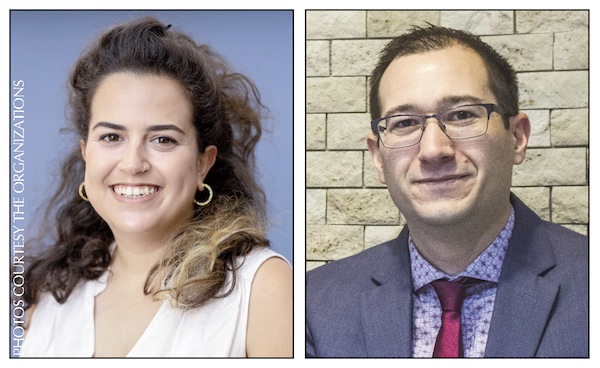
Lihi Shmuely of Israel Hofsheet and Ben Murane of the New Israel Fund of Canada. (photos from the organizations)

Binyamin Netanyahu is the longest-serving Israeli prime minister and should be a known quantity. The government he leads now, however, is unlike anything the country has seen in the past, according to a leading Israeli activist who participated in a cross-Canada speaking tour.

“This is different,” said Lihi Shmuely, deputy director of Israel Hofsheet. “This is completely new to us. This is a very extreme, radical government that we’ve never seen before.”

Israel Hofsheet (Israel Be Free) works to increase freedom and equality in the areas of religion and state, as well as Jewish pluralism in Israel, particularly focusing on civil options for marriage, gender equality, pluralistic Shabbat in the public realm and LGBTQ+ rights.

Even some voters who supported parties that are now in the governing coalition are expressing regret, she said. Many supported right-wing parties based on national security issues or a range of other policies.

“Now they understand that it comes as a whole package, that these people who promised national security … [are] not just racists but also chauvinists and homophobes and misogynistic people who are promoting legislation that will hurt the very core, the liberal and democratic core, of Israel,” said Shmuely.

She warned that people should take members of the new government seriously when they advance what appear to be extreme policy positions. To contextualize what is happening, she compared the reaction in the United States when the U.S. Supreme Court overturned Roe versus Wade, the precedent-setting reproductive rights case.

“We thought this was already set in stone, the Supreme Court has decided and that’s it,” Shmuely said. Returning to the Israeli situation, she warned that some people do not believe that the more extreme statements or policies – even the formally agreed-upon coalition agreements – will actually be codified in legislation or policy. “They will do what they say they’ll do. So, we need to take it very, very seriously.”

Evidence suggests many Israelis are taking it seriously. Rallies throughout the country against the range of legislation and proposals – most notably the subjugation of the Supreme Court to the elected Knesset, as well as women’s equality and LGBTQ+ rights, the status and rights of Palestinians in the West Bank, and encroachments of religion into the public sphere. People who have never been political in the past are getting involved and even attending the mass rallies that take place every weekend.

“We don’t have this privilege anymore, to say, I will not get involved,” Shmuely said, adding that Israelis are facing existential questions. “I feel like we are asking ourselves, what are we? Are we a Jewish state? Are we a democratic state? Are we a liberal democracy? Is there a contradiction between all of them? It feels like these days we are writing the rest of our history.”

Shmuely’s grandmother is a Holocaust survivor and, in recent months, has been saying, “This is not the country that I ran away from Europe for.”

While emphasizing urgency, Shmuely counters that it is not too late to alter course.

“I do think we are under terrible threat and I do think that it’s not too late,” said Shmuely. “It’s almost – but it’s not yet. We still have a lot to do.”

A major focus for opposition groups is this October’s municipal elections across Israel.

“These are sort of like the midterms in the States,” she said. Aside from this, municipal governments also have power to push back against national trends. For example, some municipalities have expanded transportation services to Shabbat.

Shmuely was supposed to be in Vancouver March 1 for a program at Or Shalom synagogue. However, she was stuck in Toronto after contracting COVID and appeared virtually. In person was Ben Murane, executive director of the New Israel Fund of Canada. His group supports civil society organizations in Israel that advance socioeconomic equality, religious freedom, civil and human rights, shared society and anti-racism efforts. Their Vancouver event was co-sponsored by Or Shalom, and the advocacy groups Peace Now and Ameinu.

Murane highlighted what he sees as recent positive developments.

“We couldn’t have anticipated that every Saturday there would be 100,000 protesters coming out – 300,000 last weekend,” he said. Security officials, business leaders, the heads of universities, lawyers, the press council and others who might previously have remained silent on contentious issues are speaking out, said Murane, and high-tech businesses are giving employees time off to attend protests.

“We couldn’t have anticipated that, in the past few weeks, major Diaspora voices who, between you and me, are usually the ones arguing against criticism of Israel, would be coming out saying, please criticize the government of Israel,” he said. “The Jewish Federations of North America issued a very surprising and precedent-breaking statement against the court override. You see individuals like [former Canadian justice minister] Irwin Cotler coming out, you see [former head of the Anti-Defamation League] Abraham Foxman and, for whatever it’s worth, Alan Dershowitz also saying something.”

He cited the resignation of Avi Maoz from cabinet last week as a positive outcome, partly due to public opposition. Maoz is head of the far-right Noam party, which advocates against equality for women and LGBTQ+ people. He resigned from cabinet, though not from the governing coalition, when he realized that Netanyahu was unlikely to implement numerous of his priorities.

“Avi Maoz came in with very bold intentions and then met all of this intense resistance and found that his agenda is not going to be as easily advanced,” he said. The rest of the coalition realized, according to Murane, that it would cost a great deal of political capital for the government to allow Maoz to get his way. “We are seeing them say, Avi, you’re not going to get everything you want, and he quits in a huff.… This is evidence that some of this is actually working, that it may appear a pyrrhic victory, but these are the dribs and drabs of what impact looks like in these moments.”

The role of groups like his and its partners on the ground in Israel is eternal vigilance, Murane said.

“Part of the role of civil society is to let nothing go unchallenged. Nothing,” he said. “Even if our odds of actually completely forestalling it are slim, part of the victory is to make an atrocious thing merely bad and to make the political powers that are advancing these initiatives expend a great deal of political capital in order to get what they want, by making them waste time and energy.”

Murane addressed the extraordinary violence that took place in the Palestinian village of Huwara Feb. 26, where rampaging Jewish settlers engaged in what has been called by some a “pogrom” that left one person dead, almost 400 wounded, and homes and businesses set afire. The attack was revenge for a terror attack the same day, in which Israeli brothers Hallel Yaniv, 21, and Yagel Yaniv, 19, were murdered.

“We’ve seen settler violence,” said Murane. “It’s been on the increase. It’s a real thing. It’s a fact of life for Palestinians from the territories. But to have dozens of settlers go into a village with impunity and commit the violence they committed, that is a new thing.”

He said civil society organizations must draw as much attention as possible to such incidents, including promoting the use of body cameras for police and wider availability of video cameras for civilians.

Incidents like these cloud the reality of evolving Israeli views on Arab-Jewish political cooperation, he said. Over the last several election cycles, opinion polls have indicated a steep increase in the proportion of Israelis who support Arab-Jewish political cooperation, from about 30% a couple of years ago to a majority today. The inclusion of an Arab political party in the last coalition government was groundbreaking.

“That’s a huge change in Israeli society that, a year ago, we didn’t even imagine it was possible,” Murane said. In the 2022 election, he said, “unless you are voting for the right-wing, you are implicitly voting for more Jewish-Arab political partnership.”

Or Shalom’s Rabbi Hannah Dresner introduced the event.

“I think it’s an important time for me to acknowledge that the democracy that I imagine as part of that beautiful place that I called Israel through my whole growing up and adulthood is really a selective democracy, a democracy for some and not for all,” she said. “That is a very important aspect of my concern at the moment – not just what happens with the loss of democracy but what is that democracy and how can it be a democracy that serves all who live in the land of Israel?”

Format ImagePosted on March 10, 2023March 9, 2023Author Pat JohnsonCategories IsraelTags Ben Murane, elections, governance, human rights, Israel, Israel Hofsheet, Lihi Shmuely, Netanyahu, New Israel Fund, NIF, politics, protesters

Standing by our family

If a member of your family were in crisis, would you abandon them? Even if the crisis were partly self-inflicted, of course you would stand by them.

In a metaphorical way, this is the issue facing Diaspora Jews in considering Israel right now. Whether you agree or disagree with the direction of the new government, it is undeniable that Israel is in a crisis. Each weekend, for several weeks, between 100,000 and 300,000 people have marched in the streets in opposition to a range of government policies, particularly proposed judicial “reforms” that many critics view as a threat to the fundamental democratic character of the country.

Watching from afar, these events are discouraging and worrying – and these emotions mingle with what might already be a degree of ambivalence, disappointment and many other sentiments. It is not always easy to be a supporter of Israel overseas. We have struggled in the face of decades of condemnation, some legitimate, some outlandish exaggerations. It would be easier, for some of us, to walk away.

Israelis do not have the luxury of walking away. And if one looks at Israel today and says, “That does not reflect my Judaism, my politics, my values,” remember: it does not reflect the Judaism, politics or values of most Israelis either.

The Israeli government we see today is the result of a tail wagging the dog, a reality facilitated by coalition politics and the desperation of Binyamin Netanyahu to regain power at almost any cost.

In many instances, people who voted based on concerns about national security find themselves appalled at policies around women’s equality, LGBTQ+ rights, the place of minorities in the country, the treatment of Palestinians in the West Bank and, of course, the overriding threats perceived in the attempts to meddle with the infrastructure of the Israeli judiciary – the wellspring from which much of Israel’s liberal character has come.

Most Israelis did not knowingly vote for leaders who would see the settler violence against Palestinians in the village of Huwara and endorse it, vindicate the perpetrators and incite further, even more destructive and possibly murderous violence. This latter example – of politicians (or anyone else, for that matter) openly celebrating and inciting racist violence – should disgust everyone, no matter their political stripe.

Overseas organizations that are connected with Israel – not least the Jewish Federations of North America – have spoken out officially in ways that are unprecedented in the history of Israel-Diaspora relations. Some of these statements have been comparatively mild in the minds of many observers, who view this as genuinely a time for full-throated disapproval. The fact that they are speaking out at all, however, is significant.

One of the side effects of all this is the debunking of the popular accusations that the tendency to keep negative comments within the family reflects “uncritical support for Israel.” This idea, that Zionism is a form of congenital disorder unrooted in reason, has never been true but it is now discredited. For what that’s worth.

Relatedly, individuals and groups who for years have been slandering Israel with hyperbole are now learning that they have exhausted the arsenal of vocabulary when actual events call for some strong language.

There is some reason for optimism. Isaac Herzog, Israel’s president, who has been cast by events into a role unlike the relatively ceremonial function that the office usually carries, said this week that a compromise may be in the offing on the contentious judicial reforms. Moreover, the resignation from cabinet last week of Avi Maoz, a far-right extremist, appears to be evidence that the government is wearying of fighting a multiple-front war. It is believed that Maoz realized the government wasn’t going to impose his racist, misogynistic and homophobic policies and so took his marbles home. There are reports of more turmoil in the ranks, which could drag the government and the country back toward a little sanity.

On the one hand, this should not invite a slackening of the pressure. There is a movement afoot among Diaspora Jews (and others) to discourage world leaders from meeting with extremist members of the Israeli government. Whether or not that will have much effect on anything, it is a valuable expression of revulsion for people who, like Bezalel Smotrich, incited (and then walked back) his call to “wipe out” the Palestinian village where Jewish settlers recently attacked innocent civilians.

On the other hand, anyone who is considering walking away from Israel, of abandoning the emotional energies of this fight, should consider who it is they would be abandoning in the process. A government is fleeting – although the lasting damage a single government can do is significant. But, Israel is the embodiment of the Jewish people’s national self-determination. To walk away from that is to walk away from more than bad government policy. It is to walk away from history. To walk away from everything that one’s ancestors hoped for, prayed for and built.

More importantly, it is to abandon to their own devices the very people in Israel with whom we probably most closely agree, who are struggling nobly to preserve the vision of Israel that many or most of us believe to be an ideal.

When a family member is in crisis, we do not abandon them. We engage. We help. We confront and intervene, if necessary. We do not walk away. In fact, this is precisely the moment when we dig deepest into our resources and do everything we can to make right what is wrong.

Posted on March 10, 2023March 9, 2023Author The Editorial BoardCategories From the JITags Diaspora, elections, governance, human rights, Huwara, Israel, Netanyahu, settlers, violence
Moscovitch play about life in Canada pre-legalized birth control

Moscovitch play about life in Canada pre-legalized birth control

(photo by Matt Reznek – Reznek Creative)

Excavation Theatre presents What a Young Wife Ought to Know by Jewish-Canadian playwright Hannah Moscovitch, at Performance Works on Granville Island March 24-April 1.

It’s Ottawa in the 1920s, pre-legalized birth control. Sophie (Bronwyn Henderson), a young working-class girl, falls madly in love with and marries a stable-hand named Jonny (Michael Briganti). After two difficult childbirths, doctors tell Sophie she shouldn’t have any more children, but don’t tell her how to prevent it. When Sophie inevitably becomes pregnant again, she faces a grim dilemma. Inspired by real stories of mothers during the Canadian birth-control movement of the early 20th century, playwright Moscovitch vividly recreates a couple’s struggles with reproduction.

The Excavation Theatre production will be playing in the final weeks of Women’s History Month, exactly 100 years after Canada’s first birth-control advocacy group was formed in Vancouver, and fresh off the landmark announcement that birth control prescriptions will be free in British Columbia starting April 1. For tickets, visit excavationtheatre.com.

– Courtesy Excavation Theatre

Format ImagePosted on March 10, 2023March 9, 2023Author Excavation TheatreCategories Performing ArtsTags birth control, freedom, governance, Hannah Moscovitch, history, politics, theatre
Canadians Jews doing well

Canadians Jews doing well

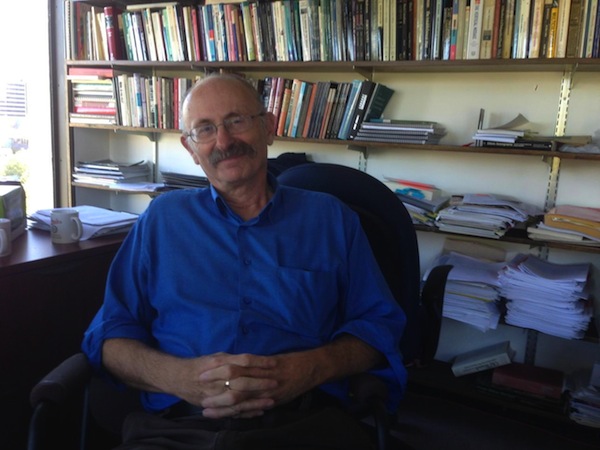
Prof. Dr. Morton Weinfeld was the latest speaker in Kolot Mayim’s 2022/23 series. (photo from Twitter)

On Feb. 5, Morton Weinfeld, a professor of sociology at McGill University in Montreal, presented the talk The Jewish Glass Is Half Full, as part of the 2022/23 Building Bridges Zoom lecture series put on by Kolot Mayim Reform Temple in Victoria.

Weinfeld, the child of Holocaust survivors from Poland and the author of Like Everyone Else But Different: The Paradoxical Success of Canadian Jews, started teaching at McGill in 1977 and has seen more than 4,000 students participate in his course on the sociology of North American Jewry.

The course, Weinfeld explained, formed the basis of his book, in which he uses Jews as a case study for the challenges in Canada of identity, culture and acceptance of the country’s multicultural position. By his own description, he tends to take a more liberal stance on Israel.

Weinfeld confessed at the beginning of his talk that the track record for predicting the future has been, and remains, dismal. The same is the case for sociological studies of the Jewish community, he asserted. As an example, he noted that the social sciences in the 20th century missed the mark on predicting the Holocaust, the triumph of Zionism, and the revival of orthodoxy in North America, among other things.

“Thus, I am doing this presentation with humility, in case anyone thinks I can predict the future,” he stated at the outset.

Accentuating the positive at first, Weinfeld praised Canadian multiculturalism. “Canada is committed to helping promote and enhance cultures, and Canada also will try to offer these cultures maximum participation in Canadian society. So, if you want to be a professor at McGill, or you want to run for a cabinet post in any government, you are free to do that. Canada will remove the barriers that prevent you from achieving that.”

In Weinfeld’s view, the Canadian Jewish community is currently doing quite well in this regard, particularly when compared to other minority groups in Canada and Jewish communities elsewhere in the world.

“One of the reasons why Jews have done well in diasporic settings [like Canada] is because they have been at it for such a long time,” he said. “For at least 2,000 years, since the Roman exile, Jews have had no choice but to learn how to live in a variety of the diasporic settings. Practise makes perfect. Other Canadian minority groups have not had anything like this.”

Weinfeld offered another piece of news: that the Canadian Jewish population is growing. While the number of Jews self-identifying as ethnically Jewish decreased from the 2011 Census to the 2021 Census, the number of Jews self-identifying as Jewish by religion increased from 329,500 in 2011 to 335,295 in 2021. In the context of this statistic, he referred to a 1964 cover story in Look magazine called “The Vanishing American Jew,” which painted a bleak future for North American Jewry, with intermarriage being among the main concerns. Look is no longer around, he noted, but the number of Jews in North America has grown and, “over the past two decades, the fears of assimilation have become muted.”

Further, the pluralism seen in the Jewish community, from liberal denominations to orthodoxy, is a source of strength, said Weinfeld. Together, he said, the different groups combine to make Jews in Canada far more interesting and viable, despite the lack of understanding each group in the community may have for one another.

Weinfeld characterized Jews in Canada as having a high-degree of voluntary self-segregation; that is, each group tends to congregate more within its own circles. However, he said, the comfort of one group can lead to a bolstering of overall Jewish identity.

“Those doom and gloom predictions for Jewish disappearance, certainly in the United States and Canada, have been excessive,” he said.

Weinfeld then spoke about the presence of antisemitism in modern North American society, pointing out that, just a few years ago, it would have been unimaginable for a former American president to dine with an unabashed antisemite like Kanye West.

“There is no question that antisemitism is a reality in Canadian Jewish life,” Weinfeld said, referring to surveys and polls showing that millions of Canadians believe in conspiracies theories, often with Jews as the masterminds behind them.

Canada, according to surveys by the Anti-Defamation League (ADL), is worse than Scandinavian countries and the Netherlands when it comes to levels of antisemitism, but fares better than France and Germany.

Regarding the situation at Canadian universities, Weinfeld said, “I think that, on campuses today, there is a tendency to dismiss the concerns of those Jewish students that like to support Israel. And I’m not speaking of the extreme right, I’m speaking of very liberal, progressive Jewish students who want to also retain Israel’s right to exist.”

Later in his talk, Weinfeld warned, “I think that we may be in for a rocky period – with regard to antisemitism and its links with Israel, Israeli policy and Zionism, in part because of the new Israeli government. But I want to be very clear, the seeds of all of that predate the current Israeli government.”

Rabbi Suzanne Singer of Temple Beth El in California, a former journalist, will wrap up this year’s speaker series on April 9. With a history of leadership at Kolot Mayim, Singer will talk about Hope: How Do We Find Hope in a World with Unending Problems? To register for this talk, visit kolotmayimreformtemple.com.

Sam Margolis has written for the Globe and Mail, the National Post, UPI and MSNBC.

Format ImagePosted on March 10, 2023March 9, 2023Author Sam MargolisCategories LocalTags antisemitism, Canada, census, freedom, governance, Kolot Mayim, Morton Weinfeld, politics
Join rally to support Israeli democracy

Join rally to support Israeli democracy

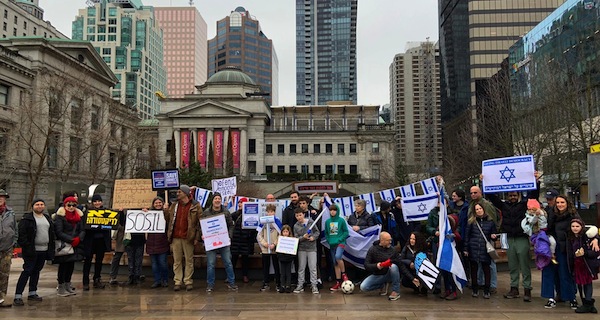
The Vancouver action group UnXeptable has been rallying on Sundays, at noon, at Robson Square, as part of an international grassroots movement to save Israeli democracy. (photo from Daphna Kedem)

We are a group of Israelis and Canadian Jews watching the grim news from Israel closely and feel that Israel’s democracy is on a very slippery slope, without brakes. The judicial crisis is leading to a dramatic loss of checks and balances in a state that has been democratic since its inception. It is shaking Israel and tearing apart its very fabric. We are terrified that the road to dictatorship will be quick and abrupt.

Israelis have been going to the streets in masses for the last many weeks. The biggest demonstrations drew more than 300,000 people to the street, yet we don’t see reference to these events in our local community. It seems that Jewish organizations and leaders are choosing to be on the sidelines, by toning down the crisis. Some are choosing to be silent altogether.

We are utterly frustrated by this silence. We know very well the horrific consequences that silence can bring about. But we realize that unprecedented events have been unfolding. Israel has been our source of pride throughout changing times and because events are happening fast, leaders might feel lost, without a compass in an uncharted territory.

We would highlight the facts as we see them: the Israel that we have known has changed.

Recent elections brought to power a group of people with personal interests counter to the public interest. One is a convicted criminal (bribery) who wants to clear his way to be a minister. The religious parties seek to release religious young people from army service, which is compulsory in Israel. A messianic, racist party wants to spread its agenda. And the prime minister is a defendant in three indictments and, in our opinion, to get away from his trial, he is promoting a change of regime in Israel, a radical move that will eliminate the separation of powers and the independence of the Supreme Court. The legal system will become part of the ruling party.

Until now, the selection of judges to the Supreme Court required agreement between the representatives of the judges and the representatives of the government. But the coalition has voted on a series of laws that approve a change in the judicial system. According to the new proposal, only the representatives of the coalition will be able to choose judges for the court. It seems clear that a preliminary committee will appoint judges that will dismiss the defendant, Binyamin Netanyahu, from all his charges.

The core issue is that the Netanyahu we knew from his 15 years in power previously is not the same Netanyahu. In his previous terms, he defended the Supreme Court as an anchor for freedom and justice. The new Netanyahu’s trial is going into its third year.

Israel has no constitution and no other checks and balances. The Supreme Court is the sole judicial body that secures the rights and freedoms of individuals and minorities. We would like to encourage our local leaders and the community at large to address these issues that will no doubt influence the close and delicate relationship we have with Israel. We would like to encourage people to stand up in defence of Israel’s democracy – our family members in Israel, our friends and colleagues, and the democratic forces in Israel need our help.

We urge you to join the Vancouver action group UnXeptable – Vancouver, which is part of an international grassroots movement in more than 30 cities to save Israeli democracy. Rabbis and community leaders have come out to such rallies around the world to speak out and support the movement. We hope that you, too, will join us. Our next rallies will be held on March 12 and 19, at noon, at Robson Square in downtown Vancouver.

Format ImagePosted on March 10, 2023August 17, 2023Author Daphna Kedem and Rina Vizer and Dalite Har ToovCategories Op-EdTags democracy, Diaspora, governance, Israel, justice, Netanyahu, protests, rallies, UnXeptable
Rallying in Rishon Le-Tzion

Rallying in Rishon Le-Tzion

Protesters in Rishon Le-Tzion Demonstrating against judicial reform February 25, 2023. (photo by Hayden)

It was a valuable experience to attend a protest rally in Rishon Le-Tzion. Several hundred people gathered in a city square to express concerns about the dramatic changes being initiated by the new Israeli government. The rally was more poignant, given that it was held in a square that commemorates people from this city who have died in combat.

As a Canadian, I had mixed feelings about attending. Who am I to be here protesting, as I don’t pay taxes and haven’t served in the army? On the other hand, the changes proposed by the government are going to affect Jews around the world and not just in Israel. Also, having three grandchildren in Israel increases my interest in what happens.

Rishon Le-Tzion, established in 1882, is well known as one of the first cities to be established in modern Israel. Its name, translating as “first in Zion,” says it all. The first Israeli Hebrew school was established here. Baron Edmond de Rothschild established what evolved to be a thriving wine industry here. The city predates the establishment of Tel Aviv by 27 years.

The square itself commemorates the large number of Israelis from Rishon Le-Tzion who have died in combat. Engraved in a monument is a listing, year by year, of names of the deceased. Israel today is one of the most successful countries in the world. When you visualize the large number of names engraved on these walls, it is clear that Israel’s achievements did not come without major losses of life.

The rally itself consisted of many people waving large Israeli flags. There were people of all ages, including many children present.

One of the speakers, Meir Sheetrit, served as minister of several different portfolios in previous Likud governments. Sheetrit was so respected that his name was brought forth as a candidate for the presidency of Israel in 2014. As a Likudnik, he decried the changes taking place and asserted that the current government is deviating radically from the direction of previous Likud governments.

Another speaker was Yair Golan, who was a member of the Knesset and has served on government committees. He was a former general in the Israel army and, at one point, was considered for the position of army chief of staff. He said he values a democracy that is based on law and not on tyranny, a press that is free and not based on peoples’ whims and a government that will protect the rights of minorities.

Merav Michaeli, the leader of the Labour party, was in attendance. She circulated through the audience, but, according to the protocols of the demonstration, being a sitting member of the Knesset, she was not permitted to speak.

The audience was mainly attentive, though occasional side conversations took place. People frequently erupted with Boosha! (Shame) in reference to various proposed government changes. The slogan De-mo-cra-tia frequently reverberated through the audience.

Periodic references were made to the diminishing status of women, LGBTQ+ people and minorities, especially Arab minorities, with the thought that these groups will bear the brunt of the changes.

Jews of non-Orthodox denominations feel that their rights will be diminished under the new government. The Women of the Wall fear they will always be relegated to second-class citizens when they pray at the Kotel. Several of the new government ministers want to cancel the annual Gay Pride parades. Many Israelis and leaders of other countries think the new government will end the possibility of ever having a two-state solution.

Most of all, people are concerned about the future of Israel’s fiercely independent judiciary. In a bill recently introduced into the Knesset, the government will have the ultimate say in who is appointed to the courts. Also, the Knesset will have the ability with a simple majority to overrule decisions of the Supreme Court. Many people, including a large number of Canadian judges and lawyers, have spoken out against these changes.

I came to Israel with major concerns about the new government’s policies and directions. It was instructive to see that a large percentage of the Israeli population shares similar feelings.

The demonstration I attended was only one of many that took place that night. According to reports in the press, there were 40,000 demonstrators in Tel Aviv, 20,000 in Haifa, 2,000 in Beersheva and smaller rallies all over the country. Clearly, a large percentage of the Israeli population strongly objects to the proposed changes. Large demonstrations occur every Saturday night, but also at other times during the week. If public engagement is a sign of a functioning democracy, then Israel is a healthy society.

Will these protests make a difference? So far, the new government has been firm in its conviction that major new directions are needed and is not backing down.

Rallies such as the one in Rishon Le-Tzion raise many questions. Are rallies an effective way to advocate for change in a society? Do democratic governments need to respond to what people participating in rallies are advocating? Are the proposed changes going to lead to a better or worse Israel? Is it important for Diaspora Jews to express their opinions about what is happening in another country far away?

As a Canadian, I came back with a firm opinion about the latter question. Diaspora Jews, who can be greatly affected by what is happening in Israel, need to express their opinions about the changes that may affect them. People who support democratic systems should weigh in anywhere in the world when they perceive that democracy is threatened.

But it is up to Israelis themselves to answer the basic questions as to what type of electoral and judicial systems they prefer. For the sake of the Jewish Diaspora and the rest of the free world, we hope that they will make the right decisions.

Larry Barzelai is a semi-retired physician living in Vancouver. He’s always had strong ties with Israel through the Canadian Zionist Federation, CJPAC and the annual Public Speaking Contest. His main connection now is his three grandchildren who call Israel their home.

Format ImagePosted on March 10, 2023March 9, 2023Author Larry BarzelaiCategories Op-EdTags democracy, Diaspora, governance, Israel, justice, Netanyahu, protesters, rallies, Rishon Le-Tzion

Posts pagination

Previous page Page 1 Page 2 Page 3 Page 4 Page 5 Next page
Proudly powered by WordPress