Skip to content
  • Home
  • Subscribe / donate
  • Events calendar
  • News
    • Local
    • National
    • Israel
    • World
    • עניין בחדשות
      A roundup of news in Canada and further afield, in Hebrew.
  • Opinion
    • From the JI
    • Op-Ed
  • Arts & Culture
    • Performing Arts
    • Music
    • Books
    • Visual Arts
    • TV & Film
  • Life
    • Celebrating the Holidays
    • Travel
    • The Daily Snooze
      Cartoons by Jacob Samuel
    • Mystery Photo
      Help the JI and JMABC fill in the gaps in our archives.
  • Community Links
    • Organizations, Etc.
    • Other News Sources & Blogs
    • Business Directory
  • FAQ
  • JI Chai Celebration
  • JI@88! video

Recent Posts

  • Sharing her testimony
  • Fall fight takes leap forward
  • The balancing of rights
  • Multiple Tony n’ Tina roles
  • Stories of trauma, resilience
  • Celebrate our culture
  • A responsibility to help
  • What wellness means at JCC
  • Together in mourning
  • Downhill after Trump?
  • Birth control even easier now
  • Eco-Sisters mentorship
  • Unexpected discoveries
  • Study’s results hopeful
  • Bad behaviour affects us all
  • Thankful for the police
  • UBC needs a wake-up call
  • Recalling a shining star
  • Sleep well …
  • BGU fosters startup culture
  • Photography and glass
  • Is it the end of an era?
  • Taking life a step at a time
  • Nakba exhibit biased
  • Film festival starts next week
  • Musical with heart and soul
  • Rabbi marks 13 years
  • Keeper of VTT’s history
  • Gala fêtes Infeld’s 20th
  • Building JWest together
  • Challah Mom comes to Vancouver
  • What to do about media bias
  • Education offers hope
  • Remembrance – a moral act
  • What makes us human
  • המלחמות של נתניהו וטראמפ

Archives

Follow @JewishIndie
image - The CJN - Visit Us Banner - 300x600 - 101625

Tag: children

Korczak course at UBC

Korczak course at UBC

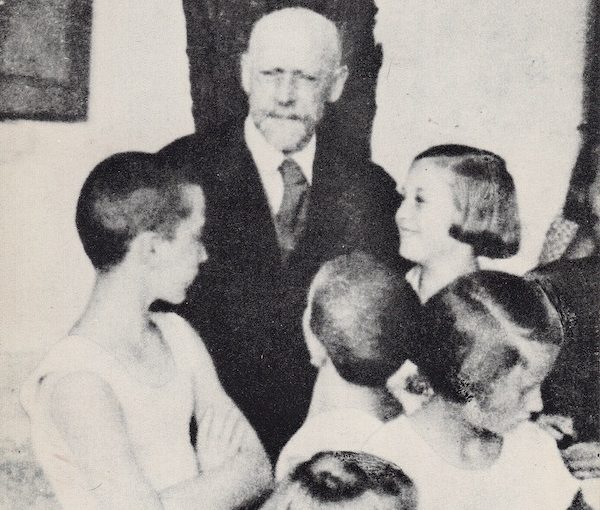
A postcard showing Janusz Korczak in the courtyard of the orphanage on Krochmalna Street in Warsaw, Poland, in the early 1930s.

An unprecedented interdisciplinary event will take place this summer at the University of British Columbia, focusing on the legacy of Janusz Korczak, a pioneer in the area of children’s rights and welfare.

Korczak is perhaps remembered most for his final act of heroism: his refusal to accept an offer of a reprieve, choosing instead to walk with the 200 or so orphaned children of his school as they were sent to their deaths at Treblinka. But it is his legacy as an educator, physician and writer that will be the focus of the 2019 Korczak Summer Institute. The two-week intensive program, called Advocacy in Action: The Legacy of Janusz Korczak, is open to graduate and undergraduate students across disciplines. It takes place July 2-11.

“To the best of my knowledge, there’s never been a university-based course on the work of Janucz Korczak, not in his native Poland, not in Israel, certainly not in North America,” said Rabbi Dr. Hillel Goelman, professor emeritus in UBC’s department of educational and counseling psychology, and special education. The program was developed across disciplines, reflecting Korczak’s range of academic and philosophical work.

“He was a pediatrician by training, so we reached out to the department of pediatrics to get their help and a number of faculty members are going to do Korczak-related activities,” said Goelman. “He was an educator, so the faculty of education were happy to co-sponsor the course with the Januscz Korczak Association [of Canada]. But it would also be open to people studying social work or any sort of child-focused activity. A lot of people at UBC support the whole cause of child activism and child welfare from an interdisciplinary perspective.”

Korczak’s philosophy inspired and informed the United Nations Charter on the Rights of Children. Importantly, his work was not limited to academics or writing, but was devoted to applying his values of child empowerment directly to the real world.

“Children are not the people of tomorrow but people today,” Korczak wrote. “They are entitled to be taken seriously. They have a right to be treated by adults with tenderness and respect, as equals.”

“In the orphanage that he ran in Warsaw, they had a children’s parliament, where children elected their leaders to make the rules and enforce the rules,” said Goelman. “There was a children’s court, where children could complain about their treatment either by the staff or by other students. There was a children’s newspaper that they published. He very much empowered children and he thought it was important to draw on this and give them opportunities to develop their own leadership. I think those are all very important contemporary messages for educators, social workers, pediatricians … and it’s kind of timeless. It’s really relevant to where we are today in terms of child activism, child welfare and child advocacy.”

The institute is designed to help participants transform their working environment to model democratic principles pioneered by Korczak in his writings, pedagogy and governance of the orphanages under his care. It will also encourage participants to adopt strategies to translate the respect for children’s rights into professional practices, including communication with parents and the larger community, and to learn how to help children in developing and sustaining their cultural identity, particularly among those who may struggle with multiple identities.

The course will be taught by Prof. Tatyana Tsyrlina-Spady, an internationally recognized expert on the life and legacy of Korczak and adjunct professor at Seattle Pacific University. She will be joined by a team of international and national invited speakers: teacher trainer and UNICEF consultant Jonathan Levy (Paris, France); founders and leaders in the field of social pediatrics Dr. Gilles Julien and Hélène Trudel (Montreal); researcher and practitioner of Korczak’s legacy Wojtek Lasota (Warsaw, Poland); several UBC professors of nursing and psychology; U.S.-Canadian writer Tilar Mazzeo (Victoria); and a Holocaust survivor and poet, Vancouverite Lillian Boraks-Nemetz.

Promoting Korczak’s pedagogical ideas, as well as their effect on children’s education, is part of the mandate of the Janucz Korczak Association of Canada, which was founded in 2002. The president, Jerry Nussbaum, lives in Vancouver, as do fellow board members Goelman and Boraks-Nemetz.

“His work is very much alive,” said Goelman of Korczak.

The deadline to register for the UBC course is May 28: pdce.educ.ubc.ca/child-advocacy.

Format ImagePosted on May 17, 2019May 16, 2019Author Pat JohnsonCategories LocalTags children, education, Hillel Goelman, history, Holocaust, Janusz Korczak, UBC

A case for mothering

“Oh, I know that I owe what I am today to that dear little lady so old and grey / To that wonderful Yiddishe momme of mine.” (from the song “My Yiddishe Momme,” by Sophie Tucker, 1920s)

It was not until the early part of the 20th century that a day was created to honour and officially acknowledge the importance of mothers. Founded by American Anna Jarvis and first observed on May 10 in 1908, Mother’s Day will be celebrated this year on May 12.

But times change, and what may have applied in Jarvis’s time doesn’t go far enough in our present society. A distinction should be made between the mother and the act of mothering: one is a noun, the other a verb. Historically and biologically driven, the role of mothering has been primarily fulfilled by the biological mother. However, in the 21st century, this role is now often carried out by a variety of others, such as fathers, grandparents, adoptive parents, foster parents, step-parents or paid caregivers.

The explosion of neuroscience research over the past few decades has provided a meteoric rise in neurobiological literature with findings that support their predecessors’ observations and predictions in child development. Selma Fraiberg (1977) was farsighted when she wrote that mothering “is the nurturing of the human potential of every baby to love, to trust and to bind to human partnerships in a lifetime of love.” The evidence from various sources converges in the consensus that the human capacity to love is formed in infancy and this bond should not only be considered a gift of love to the baby, but a right – “a birthright for every child.”

Unfortunately, the recognition and awareness of the crucial role of mothering in a child’s healthy development and, consequently, to future generations, is gradually being eroded. It is often seen as a secondary role in the scheme of our busy lives. It was 42 years ago when Fraiberg wrote that we are seeing a devaluation of parental nurturing and commitment to babies and young children, which may affect the quality and stability of the child’s human attachments in ways that cannot yet be predicted. She warned that the deprivation of a mother or mother substitute will diminish a child’s capacity for life.

Fraiberg’s cautionary notice is eerily apparent in the growing numbers of young children and troubled youth as reflected in mental health issues and criminal behaviours. For example, Canadian Bullying Statistics (Canadian Institutes of Health Research, 2012) indicated that 47% of Canadian parents have had a child who has been a victim of bullying; Canada has the ninth-highest rate of bullying in the 13-year-old category in a survey of 35 countries; and at least one in three adolescents have reported being bullied.

The basic needs of children have not changed, but our priorities seem to have been rearranged, as advertisers increasingly shape our wants into needs. We did not invent childhood. We are only discovering what has likely existed since the beginning of time. Louis Cozolino, PhD, (2014) notes there is “a causal link between interpersonal experiences and biological growth.” These links are of particular interest in their impact on early caretaking relationships, when the neural infrastructure of the social brain is forming.

As Lloyd deMause notes in The History of Childhood, “That because psychic structure must always be passed from generation to generation through the narrow funnel of childhood, a society’s child-rearing practices are not just one item in a list of cultural traits. They are the very condition for the transmission and development of all other cultural elements, and place definite limits on what can be achieved in all other spheres of history.”

A world of mothers and mother substitutes has taken on the loving and arduous tasks of mothering, with all the pleasures and perils of parenting. To those who are fortunate to still have mothers in their lives – be thankful and let her know how much she is cherished. For those who don’t, treasure the memories that have become even more precious. And for those who are themselves mothers, you have undertaken the most difficult but important task of life with all its joys and sorrows. You have taken on the most valuable contribution to society and its future as well. So, to mothers and to those who mother, we honour you today and every day.

Libby Simon, MSW, worked in child welfare services prior to joining the Child Guidance Clinic in Winnipeg as a school social worker and parent educator for 20 years. Also a freelance writer, her writing has appeared in Canada, the United States, and internationally, in such outlets as Canadian Living, CBC, Winnipeg Free Press, PsychCentral and Cardus, a Canadian research and educational public policy think tank.

Posted on May 10, 2019May 9, 2019Author Libby SimonCategories Celebrating the HolidaysTags children, lifestyle, Mother’s Day, parenting, women
Safe, healthy and respectful

Safe, healthy and respectful

Campers at Pennsylvania’s Camp Havaya. (photo from Camp Havaya)

In Pirkei Avot (Ethics of Our Fathers), Ben Zoma says, “Who is honourable? One who honours others.” The Foundation for Jewish Camp’s Shmira Initiative “aims to make camps safe, healthy and respectful model communities. Shmira, in Hebrew and in the vernacular of Jewish summer camp, means guard duty, embodying the social and individual responsibility every community member has to ensure a safe environment.”

For some camps, the initiative provides practical training that has been needed for some time. But, at Camp Havaya in Pennsylvania, camp director Sheira Director-Nowack told the Independent that they have been operating on the initiative’s principles for many years.

“We have people who go by ‘he,’ by ‘she’ and by ‘they,’ as rabbis, teachers, students, educators, campers and staff,” said Director-Nowack of the camp, which is part of the Reconstructionist movement. “So, for us, the sexual harassment piece is something we’ve always discussed, have always had a policy for. I used to work at a camp that did not have that defined as clearly and they had some real challenges. We don’t have some of those challenges here, because it’s very up front and very clear – how you treat all people, not just insofar as gender, but in all areas of inclusion.”

At Camp Havaya, respect is constantly discussed.

“The name of our camp mascot is Howie Bee,” said Director-Nowack. “We talk about ‘how we be,’ using that as a fairly common statement to talk about how we should treat each other with respect, kindness … better than you’d want to treat yourself, you’d want to treat the other person … and, not just as a Jewish phenomena, but as a human phenomena.”

While Director-Nowack acknowledged that, every so often, they run into power conflicts in a relationship, they try to ensure it never gets near the point of harassment.

At Camp Havaya, she said, flirtation is discouraged. For example, there are strict rules as to what clothing is acceptable. Everyone must wear shirts at all times and clothing should be loose fitting. They also have no boys against girls competitions. Instead, all sports are open to everyone and, while everyone swims together, there are rules about appropriate swimwear.

Language and attitude is another area that is closely monitored at the camp. “We don’t use the word ‘broad’ or ‘chick,’ we don’t use a lot of derogatory terms,” said Director-Nowack. “We don’t make jokes at other people’s expense.

“We want everyone to treat each other how they would treat their own family or themselves…. There’s not a constant need for romance or underlying things that go into that modern love thought and, because of that, we don’t see certain behaviours that other places might see.”

The concepts of the #MeToo movement are discussed at camp, as are other relevant topics, like Black Lives Matter and the Israeli-Palestinian conflict.

“Our constituency is made up of people who are interested in these things … also, things like respect for people with special needs, inclusivity, race, culture and minorities,” said Director-Nowack. “We don’t talk about these things because they’re hot topics. We were talking about them before they were considered cool to talk about.

“We also give the credit to younger people, because it is them who are changing the verbiage, changing ideas. They are bringing them to us and we are bringing them to camp, because, if camp is a microcosm of society, then we want to be part of that.”

If and when the topic of sex comes up, Director-Nowack said she teaches her staff to turn the conversation back to the camper and ask why he or she is wondering about it.

Camp Havaya has a no-sex policy. If inappropriate behaviour is observed, Director-Nowack said, ‘We don’t punish people for behaviour, but I may or may not ask them if camp is the appropriate place for it. I don’t feel like there’s any place at camp where you could be sexual appropriately, and that’s what we talk about.

“We don’t hook up in the middle of the woods – that’s just not what we do. And, we really don’t have a lot of that. I don’t think I’d kick someone out of camp just because they kissed someone. But, I’d say something like, ‘I just walked passed you kissing … not what I want to see, not OK, not cool.’ If it got further than that, it would depend on the kid, the parent, the discussion and the situation. We’re dealing with human beings and we have an environment that’s not constant.”

Still, staff members do talk with campers about consent, in an effort to ensure all of them are comfortable in their own space at all times.

“Our goal is to create young leaders in the Jewish community who are thoughtful and intelligent, and who are, therefore, going to go out and lead a Jewish life and know themselves,” said Director-Nowack. “We love that some people find their love and their relationships at camp. But, I also love that people find their independence at camp … or that they want to lead a more productive Jewish life without a partner…. We want our kids and staff to leave camp as people who are going to make decisions guided by some basic values.”

For more information on the Shmira Initiative, visit jewishcamp.org/shmirainitiative.

Rebeca Kuropatwa is a Winnipeg freelance writer.

Format ImagePosted on April 19, 2019April 17, 2019Author Rebeca KuropatwaCategories WorldTags #MeToo, camp, children, ethics, harassment
Love starts with the self

Love starts with the self

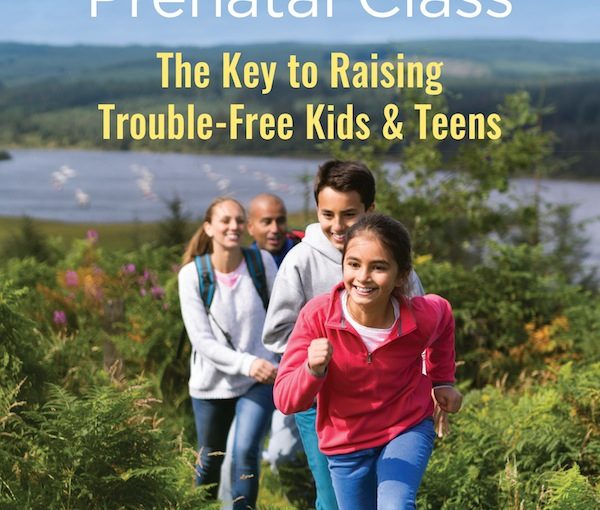
Most of us are familiar with the concepts of “inherent worth” and “unconditional love.” But many fewer of us actually live by these precepts. Anne Andrew would like to help change that fact. She does this in her work, as well as in her new book, What They Don’t Teach in Prenatal Class: The Key to Raising Trouble-Free Kids and Teens, the launch of which takes place April 11, 2 p.m., at the Isaac Waldman Library at the Jewish Community Centre of Greater Vancouver.

In the introduction, Andrew shares, “My experience as a worried parent of a once-troubled teenager (now a well-functioning adult) and my wish to help other parents avoid the sleepless nights, debilitating fear, helplessness and despair, led me to write this book. Our family’s ordeal lasted more than six years and, during that time, we learned strategies that not only helped us survive but actually allowed us to thrive…. At the same time, I was working as a school principal and became aware of the mental health crisis that was starting to take hold in younger and younger students.” As examples, she notes that 77% of children report having been bullied at school and 80% of 10-year-old girls wish they were thinner.

Andrew was a school principal at Temple Sholom for 20 years. “It’s likely,” she writes, “that one or more of your children will face some kind of difficulty, whether it’s an eating disorder, bullying, drug addiction, depression or other mental health issue, and it is almost impossible to predict whose child that might be. You can’t always see it coming – we certainly didn’t!”

Based on what she was learning from her family’s therapist, Andrew “concluded that there is an absolute and fundamental concept that underpins healthy human life.” That concept – inherent worth – is the subject of the first section of What They Don’t Teach in Prenatal Class. Part 2 focuses on unconditional love, explaining “why it is so difficult for us to accept and own our inherent worth, then explain[ing] how this can be done and become part of your ‘way of being.’” The third part of the book discusses parenting priorities, “kindness versus grades,” and “teaches how to parent out of love – not fear.”

While targeted to parents, What They Don’t Teach in Prenatal Class is a valuable guide for anyone who has negative opinions about themselves, which, to hazard a guess, is the vast majority of us.

“Part of the reason that I named my book the way I did is that it would be ideal if parents did some of the self-work ahead of having children,” Andrew told the Independent. “That way, they’d be better prepared to face the challenges of parenting and they would have a deeper understanding of how their children pick up negative beliefs right from the beginning. They’d have a bit more time and space to think clearly about the bigger picture in terms of purpose and priorities before the baby arrives. Imagine if prenatal classes included a few sessions on this topic!”

One of the tools Andrew presents in her book is the Choose Again Six-Step Process, which was developed by Diederik Wolsak, founder and program director of Choose Again Attitudinal Healing Centre and author of Choose Again: Six Steps to Freedom. Wolsak wrote the foreword of What They Don’t Teach in Prenatal Class. In it, he notes that Andrew – who is a Choose Again facilitator – “has written a manual which draws directly from her own heroic and victorious battle with depression and her transformation of some crippling core beliefs. But, more to the point, it tells the story of two people, parents, coming to terms with what they needed to heal to become real parents. Real parents teach by demonstration. Real parents are transparent and not afraid of what they’ll encounter when they begin their own journey to removing all barriers to love.”

By healing a negative belief about ourselves, we can change our behaviour. “By following our familiar feelings, we can retrieve early childhood memories in which we can discover the genesis of our beliefs and we can begin to transform them,” writes Andrew. “You have to be in the feeling for it to work – it is a process that has to be felt, not an intellectual exercise.” In brief, when you’re upset, for example, acknowledge that you’re upset; take responsibility for the feeling – it is not your child’s fault, but rather “a negative belief that you made up in early childhood has been triggered”; focus on the feeling and identify it; remember the feeling and try to determine when you first ever felt it; once you have that memory, contemplate how you judged yourself in that moment and how you thought others judged you; and, lastly, try “to fix your mistaken belief by a process of forgiveness that replaces your mistaken belief with the truth of you – that you are inherently worthy, whole and complete.”

If loving ourselves isn’t hard enough, parenting out of love, and not fear, is as much or more of a challenge. Not blaming your children for your anger, not punishing them for acting out, etc., would seem to require infinite patience and constant self-awareness.

“If people read my book and are feeling overwhelmed, then I would say do one thing, and that is to have a gratitude practice,” said Andrew. “I have a section in the book on exactly how to do that and I know that it’ll make a huge difference. Begin with one thing and then perhaps add another.

“Awareness is half the battle, so simply being aware that young children are developing negative beliefs about themselves will be helpful in the ways you respond to your child’s behaviour. I’ve presented the concept of inherent worth as the antidote to all of these beliefs, so I have actually simplified parenting into one challenge – how to get across to our children that they are inherently worthy beings. They don’t have to establish their own worth by getting good grades or winning competitions. I’ve suggested several techniques, so parents just need to adopt the ones that will work for their family.

“Many of the things that I suggest are simple, such as remembering to smile at your children more often – put a smiley face sticker on your phone, on the fridge or on the bathroom mirror to remind you. Mindfulness can be practised at the dinner table or getting ready for bed by helping children focus on their senses in the here and now.

“Parenting is a marathon, not a sprint,” she continued, “and it is OK to take awhile to get into the stride, stumble and get back up. Parents tend to judge themselves rather harshly (we all do!) and that’s not helpful. Be gentle with yourself and know that it is impossible to make a mistake – we make healing opportunities for ourselves and our children!”

Andrew invites “parents to use the day-to-day parenting upsets as portals to self-healing so that parenting becomes a journey into self-awareness. This in turn benefits the kids enormously. When parents heal their own negative beliefs, they won’t worry about being judged by others, they won’t be drawn into competitiveness and will not need to over-program their children, so that makes life and parenting less stressful and more fun for the whole family.”

Andrew is a parenting coach, and she presents workshops in the United States, Canada and Europe. She said parents take what they can from her recommendations.

“Parents who have taken my workshops, on which my book is based, report that they have more patience, greater understanding of their children’s behaviour and their own, and the ability to communicate more effectively with their children as well,” she said. “I have been told that the methods are transformational and that was certainly my experience. One parent (Roanna Glickman) told me that she dived headfirst into self-healing using the Choose Again Six-Step Process and she has transformed her life and her kids are thriving as a result. She said, ‘It may seem like more work initially but, when you take away the power struggle, it’s way less work in the long run.’”

Andrew shared feedback from another parent, Pam Roy, who said, “Parenting isn’t about trying to do it right but about learning along the way, being authentic with your kids when we don’t get it right; making yourself better helps you be more present and aware with and for your kids.” While acknowledging that self-work is time-consuming and difficult, Roy said it is crucial and, if Andrew’s suggestions “feel overwhelming or time-consuming, that should trigger that there’s work to be done. Change aversion is there but, when these fears come up, it’s the more reason they should be looked at.”

One of the more surprising pieces of advice, perhaps, is to be careful with praise. “How many of us do what we do to win approval from our bosses, peers, spouse, other family members and even our children?” writes Andrew. “When that approval is not forthcoming we beat ourselves up wondering what we did wrong or reminding ourselves that once again we failed.”

As to how to reduce our dependency on external validations of our worth, Andrew told the Independent, “Firstly, I suggest you gradually phase out praise – it tends to be a habit so takes awhile to correct. Notice when you automatically use praise and then follow it up with a question that indicates your sincere interest in whatever it is that was praised. Praise-dependency tends to undermine the concept of inherent worth – it encourages kids to look outside themselves for their worth.

“As far as knowing how to handle praise and criticism, knowing one’s inherent worth is the way to handle praise and criticism. Neither praise nor criticism has an impact on one’s inherent worth, though it may have an impact on self-esteem. Criticism says more about the person doing the criticizing than it does about the one being criticized. Children can be taught to just say ‘thank you’ to anyone who offers them criticism (or praise for that matter). The criticism can be taken for what it is – a neutral fact to be examined or ignored – not an emotionally charged thing.”

If you can’t make the April 11 launch, What They Don’t Teach in Prenatal Class is available on Amazon, and Andrew is currently putting her workshops online so that parents can access them more easily. She said they should be available in May or June at anneandrew.com.

Format ImagePosted on April 5, 2019April 2, 2019Author Cynthia RamsayCategories BooksTags Anne Andrew, children, education, lifestyle, parenting

Helicopter parent’s confession

A couple years ago, I sat smugly through a lecture on helicopter parenting, feeling fully confident that nothing spoken during that time applied to me. Who were these overly involved parents who just couldn’t let go, even once their kids had left for college? They were nothing like me, I thought. I’d been an early advocate of children’s independence in my community, encouraging my kids to navigate Vancouver’s public transit alone at the age of 12. My 9-year-old daughter walks around Steveston Village with her best friend and my 15-year-old girls have flown to the United States on their own. I thought I had the helicopter mom in me under control – until my son left for college.

That’s when my over-protective mama-bear instincts kicked into gear, where they remain on high alert. How do you protect your child when they’re so far from home? And where is the line between supportive help and concern, and running your child’s life instead of allowing them to live it on their own? These days, I ponder these questions a great deal, my stomach churning with anxiety as I contemplate all the unseen dangers my son could encounter in the absence of his mother’s watchful eyes and words of cautious advice.

Yesterday, a phone call. “Mom, the craziest thing happened as I was walking to school this morning,” he declared. “I was crossing the road at the traffic lights when a hard tug on my backpack pulled me backwards. I stepped back just as a car ran a red light, flying past inches away from me. I was so close to being hit!”

The vision torments me as I write this, my child so close to life-threatening danger. I worry now about more cars hurtling at breakneck speed on those icy roads that separate his dorm room from his lecture halls. About his reading break, when he’ll be a passenger on the icy 401, his safety at the mercy of drivers I’ve never met. About his plans to go ice fishing in the Muskokas – what if the ice breaks?

This precious, precious child of mine is so excited to experience the world in all its beauty, to challenge his personal limits and dive deep into the friendships and opportunities that surround him. I want all this for him, of course. He is growing, thriving and learning with every turn in this journey far from home. Yet I cannot stop the worry for his vulnerability, nor the fear of “what if?” that pesters my mind incessantly. If that’s the whirring of helicopter parenting, then I’m guilty as sin.

As parents, it’s not always easy to know when to step back and when to be actively involved, particularly when our children head off to college. It’s natural for us to want to protect our kids, said Julie Lythcott-Haims, who published the book How to Raise an Adult after witnessing years of helicopter parenting when she was dean of freshmen at Stanford University. “We love our children fiercely and we’re fearful about what the world has in store for them. But we make the mistake of … being like a concierge in their lives.” (See jewishindependent.ca/ dont-helicopter-parent.)

If I’m a concierge in my kids’ life, let it be known I’m a darn good one. Case in point: my son recently signed a lease on an apartment with a friend-who-turned-out-not-to-be-a-friend, and needed to get out fast. The management company delivered a virtual shrug when he asked for his money back. “We’re not in a position to do refunds,” they told my 18-year-old. At that age, you don’t necessarily know how to respond to a statement like that. But, when you’re 46, you do. You call the company’s chief financial officer and let them know in no uncertain terms that a refund needs to be forthcoming. Posthaste. Voila, the cheque arrived.

I canvassed a mom’s group to ask for their definitions of helicopter parenting, hoping they might help identify the line between caring, support and over-involvement in the lives of college-age kids. You might be a helicopter parent, they suggested, if:

  • You know your kids’ passwords so you can register them on time for courses.
  • You have been known to call your kids’ instructor/professor, suggest they graded an essay, test or exam unfairly and insist that they reconsider the grade.
  • You proofread and edit your kids’ college essays because you want them to get the best results possible.
  • You feel compelled to step in and prevent your kids from making mistakes.

I suspect we all want to shelter our children from making awful, life-changing mistakes, so we try to gently guide them around the sharp curves of young adulthood, intervening perhaps too often in our efforts to break their fall. There is deep love in this act, a love that stretches way back to their infancy and embeds us with the certainty that our children are our richest legacies, irreplaceable treasures we want and need to hold close. There will be times when we teeter on the line of over-protectiveness, when the whirring sounds of helicopter parenting will be obvious to those around us. But the best we can do is walk the line, treading with the utmost care. Trust me, it’s much harder than it sounds.

Lauren Kramer, an award-winning writer and editor, lives in Richmond. To read her work online, visit laurenkramer.net.

Posted on February 22, 2019February 21, 2019Author Lauren KramerCategories Op-EdTags children, lifestyle, parenting
PJ Library extends program

PJ Library extends program

Florencia Katz and family. (photo from Florencia Katz)

PJ Library, which provides Jewish children with free Jewish-themed books and CDs, has expanded its program and now serves readers up to 11 years old.

Available in Jewish communities across North America, PJ Library is supported by local Jewish federations and many other donors. In Winnipeg, the program is in its 10th year, and Florencia Katz has been coordinating it since 2011. As a mom of two, she has experienced firsthand the impact the books have on her kids.

Eventually, Katz’s children aged out of the PJ Library program, which is for kids ages 6 months to 8 years old. But now, with the new program, PJ Our Way, Katz’s younger child, Tali, can once again enjoy the perks of PJ.

“PJ Our Way is the next chapter of PJ Library, for kids ages 9 to 11,” explained Katz. “Kids throughout the United States and Canada are eligible to enrol in the program from the day they turn eight-and-a-half until the day before their 12th birthday.

“The Harold Grinspoon Foundation, with the generous support of PJ Alliance Partners, provides PJ Our Way subscriptions at no cost to families or partner communities.”

PJ Our Way is considered the next chapter of PJ Library because it follows the same goals of the original program: engaging families and children in Jewish values, content and, ultimately, community.

PJ Our Way offers tweens the possibility of engaging online – allowing them to choose their own book, write book reviews, blog and more.

“My children and family have enjoyed the PJ Library program for years and, as avid readers, my kids were quite sad to stop receiving books at home once they aged out from PJ Library,” said Katz.

“My daughter, Tali, currently 10-and-a-half, was over the moon when I told her that she can now sign up to PJ Our Way. On the morning of the launch of PJ Our Way in Canada, before going to school, we signed up as one of the first sign-ups in Winnipeg, and maybe all Canada.

“As a parent, I am excited that, through this amazing program, my daughter will have the opportunity to keep reading quality Jewish-themed literature. The possibility that this program offers to engage online to choose the book, watch and read reviews, and submit their own reviews makes [it] attractive and exciting for this demographic.”

Tali was excited to pick her first book and spent some time on the PJ Our Way website, reading reviews and the synopses of all the available books, before choosing.

After narrowing her choice down to two books, she asked her mom for help deciding which to pick. After reading each book summary herself, Katz went to the parent section of the site to read more about the Jewish concepts and values and about the positive role models featured in each book. This helped her suggest which book her daughter might enjoy the most.

“Besides the synopsis and the concepts and values section provided for parents, there is also a section called Talk it Over, which suggests a question to discuss with your child after reading the book,” said Katz.

“I will definitely check all the information out and make a point of including it into our conversation about the book if it comes up. I will also suggest to my child to write a review of the book after she is done, so other kids can read it, the same as she read reviews when she picked the book. I want this experience to be enjoyable and fun, so I will not put any pressure or make it feel like a school task.”

Katz said the more Tali reads and learns about Jewish culture and tradition, the better equipped she will be to make her own decisions on how to live her Judaism when she grows up.

Candice Tenenbein, another parent who is part of the Winnipeg PJ Library initiative, is also very excited to have her older son, Jacob, 9, be part of PJ Our Way.

“Every month, our boys eagerly await their newest PJ Library arrivals,” said Tenenbein. “Both of our boys are avid readers. Recently, we were becoming sad that our older son, Jacob, was graduating out of this program. When we heard from Katz that PJ Our Way is now available in Winnipeg, we immediately signed up! We love that the books are exciting and fun to read, and that they all have a Jewish connection.

photo - Candice Tenenbein and family
Candice Tenenbein and family. (photo from Candice Tenenbein)

“In our home, we celebrate Shabbat and all the Jewish holidays. These books and the online portion will add more layers to raising our children to be more knowledgeable about, and proud of, their Jewish heritage.”

Tenenbein is also looking forward to her sons spending time on their iPads in a more educational and productive manner, instead of just watching videos. PJ Our Way offers a safe and protected online environment.

At the Tenenbein house, all family members read the books provided by PJ Library, as they love to discuss their favourite parts of each one and share their thoughts of how the books impacted them.

“Jacob is especially excited that his friends will also be joining PJ Our Way,” said Tenenbein. “The kids are planning to choose the same books each month, so they can have their own book club.

“Growing up, my mother, may she rest in peace, instilled in us a love of reading and a pride in our Jewish heritage. Now, as a mother myself, I understand how truly important opportunities are which provide for our kids to understand what the religion means to them and their daily lives.

“This is especially important in today’s environment, where antisemitism and its newer anti-Israel BDS face are becoming more prevalent. My husband and I are grateful for the excellent education our children receive at Gray Academy [in Winnipeg]. PJ Library and PJ Our Way are excellent supplements for helping foster and strengthen these feelings in our children.”

Jacob is also excited about going online and becoming part of a larger community of Jewish peers. He is looking forward to being able to share his thoughts about each book and read what others have to say.

“He cannot wait to begin blogging once he reads his latest PJ Our Way book!” said Tenenbein.

These days, getting paper mail is not common, so PJ kids receiving a free gift in the mail, addressed just to them, is a unique and individual part of the experience. The online aspect then allows them to connect with other Jewish kids who are reading the same books as them. For more information, visit pjourway.org.

Rebeca Kuropatwa is a Winnipeg freelance writer.

Format ImagePosted on February 22, 2019February 21, 2019Author Rebeca KuropatwaCategories BooksTags books, children, Judaism, literacy, parenting, PJ Library
Run to reduce poverty

Run to reduce poverty

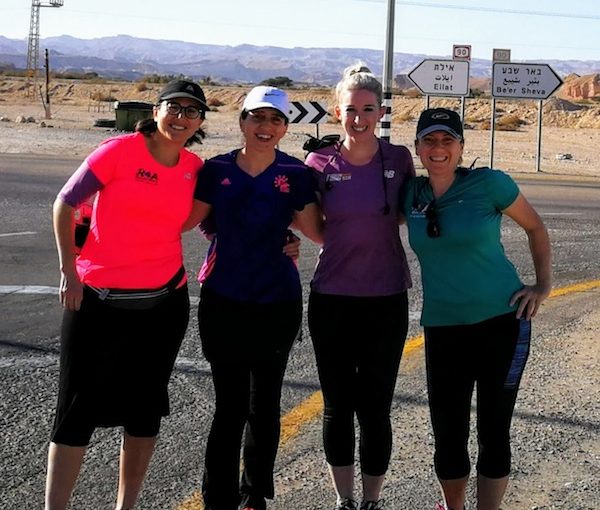
Esther Edel (right) has participated in the Run 4 Afikim twice. (photo from Esther Edel)

The annual Run 4 Afikim supports Afikim, a nonprofit organization in Israel that addresses child poverty. One of the participants in the run – for two consecutive years now – has been former Vancouverite Esther Edel.

Jerusalem-based Afikim was founded in 2008 by Israeli educator and child services administrator Moshe Lefkowitz. At the moment, Afikim staff helps 528 impoverished children in 14 learning centres throughout Israel, mainly in Jerusalem.

Afikim’s approach is to help parents as well, providing family counseling, while the children receive hot meals, tutoring, life skills training and emotional support. Currently, Afikim cannot keep up with the demand for its services, and Lefkowitz would like to see the number of students Afikim accepts increase by 80 this year.

One of the ways Afikim raises funds is the Run 4 Afikim. The website describes the event as a non-competitive relay from Jerusalem to Eilat, totaling 370 kilometres in 36 hours. Participants run in groups of three. Each group completes one leg of nine to 14 kilometres at a time and each runner ends up running multiple legs over the 36 hours. Participants must raise a minimum of $2,000 each to take part.

This year, the Run 4 Afikim began on Jan. 9 and ended on Jan. 11. The event raised more than $265,000, exceeding its goal of $250,000. One of the participants was Edel, who made aliyah in 1997.

“I had a strong religious Zionist education, which contributed to my moving to Israel.… My parents and sister still live in Vancouver. Unfortunately, I do not visit them as often as I would like,” shared Edel in an email interview with the Independent.

While Edel first participated in Run 4 Afikim last year, it wasn’t her first long-distance run.

“I’ve always been active, since I was little. Non-competitive sports and any outdoor activity are parts of my day-to-day life. I’ve participated in numerous 10-kilometre runs over the years. Most of them have been in Jerusalem, as parts of the annual Jerusalem Marathon, generally as fundraisers for different organizations.”

She was introduced to Afikim, she said, “via a good friend, Ruchie Schwartz, who already participated in the run. She had posted on Facebook the recap/promo video of the previous year’s run. When I watched it, I was moved by the passion of the participants and, even more so, by the cause that was driving them to raise funds and awareness for the Afikim Family Enrichment programs.”

The weekly programs include music, sports and other extracurricular activities. “While these types of pursuits are easily available for children from more privileged backgrounds,” explains the website, “Afikim’s children would have no access to them without this program. Like all facets of Afikim, extracurricular activities help close the achievement gap between disadvantaged children and those from higher socioeconomic backgrounds.”

Edel wanted to participate in the Run 4 Afikim but had some doubts. “I was slightly hesitant, as I had taken a break from running for a bit and wasn’t sure if I would get back into it,” she said.

photo - Esther Edel at this year’s run
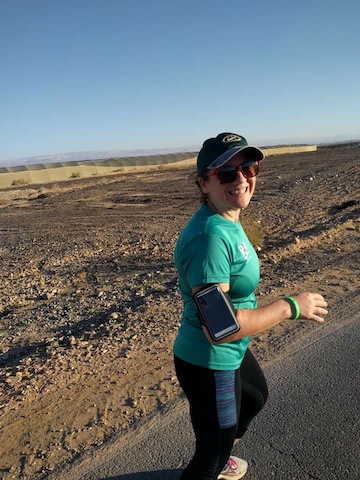
Esther Edel at this year’s run. (photo from Esther Edel)

But those doubts were easily overcome. “I added a few runs to my weekly workout schedule, which I had not consistently been doing before I decided to participate,” she said.

To meet the $2,000 financial contribution requirement, she fundraised using email, connected with people on Facebook, contacted friends by other means and benefited from word of mouth.

“This year, there were eight groups and 32 segments divided between the groups,” she said about the run. “My team ran five segments, which approximately totaled 48 kilometres over 36 hours. Due to the timing of the segments, all the groups were functioning on very little sleep throughout the run. It’s mainly 36 hours where adrenaline and endurance get you through.”

Edel’s team schedule included, on the Wednesday evening, one run from the Jerusalem starting point, and three running segments on the Thursday, the first starting at 5:30 a.m., the second at 2:30 p.m. and the third at 10:45 p.m. “Friday morning, we started at 6 a.m. and most of the participants completed the final few kilometres to Eilat,” she said.

Edel added, “It’s important to note that it is purely volunteer-based, with the maximum effort to keep the overhead as low as possible.… Throughout the run, there are always one or two escorts, including trained paramedics, who also volunteer their time each year to drive the roadside escort.”

Edel also mentioned the lunch on the Thursday, which was “an organized activity, with all the runners and some of the Afikim children. This allowed us to connect with the Afikim kids and see firsthand how this run and fundraising affect these children.”

To learn more about Afikim’s work, visit afikim.org.

Olga Livshin is a Vancouver freelance writer. She can be reached at [email protected].

Format ImagePosted on February 15, 2019February 13, 2019Author Olga LivshinCategories IsraelTags Afikim, children, Esther Edel, fundraiser, Israel, philanthropy, poverty
Teaching entrepreneurship

Teaching entrepreneurship

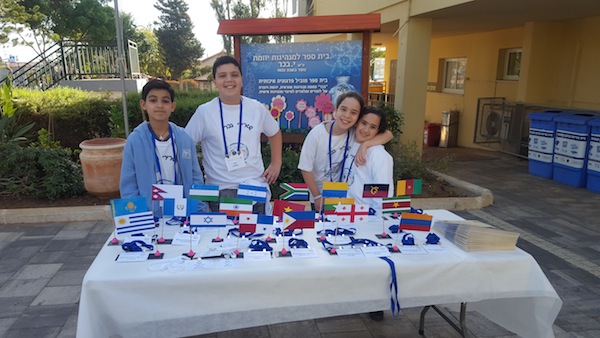
Students at the Bachar school in Even Yehuda, which educates for leadership and entrepreneurship, prepare to welcome a delegation of educators from developing countries, who came to learn how Israeli schools educate for entrepreneurship. (photo from Galit Zamler)

For Galit Zamler, a course that began as a volunteer position at one school has become a full-time job, with more and more schools picking up her program.

In 2009, when Zamler’s third child was in Grade 6, his school principal wanted to have an after-school activity. She brought representatives of a company that was not only expensive to hire, but would only present to outstanding students, and required at least 20 of them.

Seeing the value of educating kids about entrepreneurship, Zamler – who has an MBA and has co-founded two businesses – told the principal that she would do such a presentation at no charge, as long as her son could be one of the participants. A month later, Zamler was teaching her first group of 12 children. She knew she was onto something great after she had sent the students’ parents notes about what was being taught, and the parents responded with thank you letters.

Word spread and, after volunteering for six years, Zamler turned her volunteer work into a full-time career. Now, 10 years into it, she said, “At the beginning of the course, I’d count each one of them, but now there are a lot of schools and there’s awareness of the need to teach entrepreneurship. I don’t need to go and try to convince anyone. They are going out looking for it.”

One of the first things Zamler teaches is that there are different kinds of entrepreneurs. It is not strictly about entrepreneurs of technology or inventions, and it is not just about opening a business. Students are taught that, to succeed, one must stand out from others – be creative and make their initiative unique.

“Then, they raise ideas and learn that there are no bad ideas,” said Zamler. “Each idea can be good and that’s how we do it. Being critical will prevent others from raising ideas. It’s very important that the class be open-minded and let everyone, whatever their idea, say it aloud and learn to explain it. Sometimes, what they have in their head is not clear to the others. They learn to stand in front of the class and explain their ideas.

“It’s not that every idea is great,” she clarified. “It’s just that we won’t criticize ideas. We ask questions to understand, and we discuss what difficulties we see in ideas – things like, how much it will cost, who will need it, to take a good look at it.

“Sometimes, this makes the student drop an idea, because they understand it can’t be implemented…. For example, there was a student who said she wanted every student to have a cupboard in the class to put their books into. The kids asked where she would put them, with very little space. And, she realized it couldn’t be done.”

photo - Sixth graders at the Hayovel school in Ashdod present their social project: A Birthday to Everyone
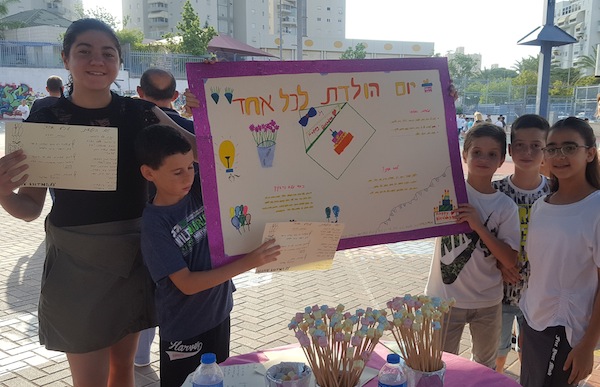
Sixth graders at the Hayovel school in Ashdod present their social project: A Birthday to Everyone. (photo from Galit Zamler)

Once all the ideas are shared with the class, students start to determine which ones they like the most and come up with business plans – tackling the process like a cake recipe, considering which ingredients they will need to bring their concepts to life. This includes the physical elements, as well as how to make their business unique, part of which involves seeking advice from experts in various fields to see if any changes might be needed.

Only then do the students try to implement their project, which can sometimes be as simple as composing a letter to the municipality.

“I have a school that wanted to have a gym,” said Zamler. “But, the school is small and there’s no place. So, they wrote a letter. The municipality sent an expert to explain why it can’t be done, but gave them money to buy equipment for activities they can move from place to place; using it outside and bringing it back inside as needed. And, they were satisfied with this.”

The curriculum is offered to grades 2 through 9 in Israel and it is funded in part by the government, as principals are allowed some leeway to allocate funds as they see fit within a list of external programs pre-approved by the Ministry of Education.

“Sometimes, they teach it as a science class,” said Zamler. “Other times, it is categorized as a life skills lesson in the curriculum … and, when the school principal thinks it’s important, he or she finds a way.”

Zamler – and other parents – consider the entrepreneurship course a great addition to what is being taught in school, as it will help in practically every aspect of life.

“I think, sometimes, it’s the parents that bring the program to the schools, because they know that children learn something useful for life … not just the ordinary curriculum,” which includes things that may not “help them when they grow up, as things change so quickly,” said Zamler.

Even armed with this entrepreneurial knowledge, Zamler acknowledged that the overwhelming majority of students – 90% to 95% – will end up as employees. But, she is hoping they will be leader employees.

“I was an employee with entrepreneur skills, and that’s what helped me go from the bottom up to management,” she said. “Being an entrepreneur in an organization means that you think big, you do more than you are told. Those are the kinds of workers we need in the workforce.”

While Zamler has not yet conducted follow-up studies on the students who have taken the program, other countries are taking note and looking for ways to implement the program in their own schools.

“The foreign office brings delegations to Israel twice a year and takes them to a school that educates for entrepreneurship,” said Zamler. “And what we see is that, instead of students who don’t like to go to school, we see students who are really enjoying their time in school, because they have choices.

“The army is also looking for these kinds of students…. If they don’t have these kinds of skills – persistence, creativity, and working on team goals – the army doesn’t want them. We know it helps them in the future, in the army and, I think, the workforce.”

The Hebrew Academy in Miami Beach was the first school outside of Israel to implement the program. Also, a company from Hong Kong has purchased the licence to bring the program there.

“They do amazing things there and they’re opening more and more classes,” Zamler said of Hong Kong. “But, there, it is an after-school activity, because it’s hard to bring it into the public school curriculum.”

Zamler has created an online training program for both students and teachers wanting to bring entrepreneurship into their school. For more information, visit tomorrowsuccess.com.

Rebeca Kuropatwa is a Winnipeg freelance writer.

Format ImagePosted on February 8, 2019February 7, 2019Author Rebeca KuropatwaCategories IsraelTags children, education, entrepreneurship, Galit Zamler, Israel
Connect gifts to holiday

Connect gifts to holiday

Gifts can range from superhero socks to a journal to time with family and friends.

“When you consider the meaning of Chanukah, it’s about the Jewish struggle to maintain observance within a non-Jewish world,” writes Deena Yellin in the article “To gift or not to gift” on chabad.org. “The Maccabees’ victory was not just a military triumph but a win over assimilation as they succeeded in preserving the Jewish tradition. Chanukah presents a wonderful opportunity to convey the message of maintaining a strong identity despite outside pressures.”

In Yellin’s household, they “get out the Chanukah box filled with homemade decorations featuring menorahs and Maccabees that the children made in previous years…. We hang them up in our windows and around the candlelighting area. After all, publicizing the miracle is a big part of celebrating Chanukah.”

As well, every child lights their own chanukiyah, often one they’ve made themselves, and they invite people over. “One of the best ways to show children the beauty of the holiday is by sharing it with friends and relatives.”

Of course, food – latkes, sufganiyot and other deep-fried treats – is part of the celebration, as are games and crafts. Even gift-giving games. “One of my friends,” writes Yellin, “holds a ‘Mystery Maccabee’ project in which everyone picks the name of a family member from a hat so that they only need to buy a gift for that person. At their annual Chanukah party, everyone has fun guessing who got whose gift.”

Finally, many people use “Chanukah as an opportunity to teach their children to think of others who are less fortunate. One way to do this is by encouraging them to donate one of their gifts or some of their gelt to sick or needy children. Other philanthropic options are donating non-perishable items to a local food pantry or volunteering in a soup kitchen.”

***

Sarah Zadok, also in an article published on chabad.org (“Is giving Chanukah presents a non-Jewish custom?”), notes, “The word Chanukah shares a root with the word l’chanech or chinuch, which means ‘to mold’ or ‘to educate.’ Education, especially the education of children, is the foundation of what we celebrate on Chanukah.”

She allows that it is possible to educate and “to highlight the meaning of Chanukah through gift-giving. For example, giving your kids books or tapes or videos about the story of Chanukah…. Or, by drawing attention to the concept of the triumph of light over darkness – another powerful theme of the Chanukah story – you could invite your kids to bring ‘light’ where it is dark. You could, for example, make a project and bring it to a retirement home and brighten up someone’s day, or hand out cookies or latkes or winter coats to homeless people, or teach another Jew about our Chanukah traditions and invite them in to make a blessing over the candles with you.”

***

In the forward.com article “8 days of meaningful Hanukkah giving,” Shanee Markovitz writes, “it’s not about what we give as much as why we are giving it.” She offers night-by-night suggestions based on different themes.

Night 1 (Jewish values and roots): gifts like Chanukah Mad Libs for kids or a gift card to a Judaica store for adults.

image - Wonder Woman socksNight 2 (self-care): for kids, tablets that change the colour of bath water; for adults, essential oils for the bath or a massage.

Night 3 (dream big): for all ages, a journal or a pillow and/or pillowcase.

Night 4 (family and friends): again, for all ages, a picture frame for photos of/with family and friends.

Night 5 (hope): for kids, a night-night projector; for adults, scented candles.

Night 6 (gratitude): write someone “a letter of why you are grateful for them and leave them an empty card for them to write a letter and pass on the favour to someone else.”

Night 7 (surround yourself with warmth): for kids and adults, a sweater.

Night 8 (resilience): superhero socks for the kids and, for the adults, a goal planner or household tool kit (Maccabees means “Hammer,” after all).

***

Rabbi Rona Shapiro writes on ritualwell.org, in the article called “Chanukah gifts,” about using theme nights in an effort to practise moderation. Her family has had Big Gift Night (when each child gets one big gift from their parents); Grandparent Night (gifts from the grandparents); Book Night; Music Night (a night of songs); Cooking Night (make latkes and enjoy them with friends); Tzedakah Night (wrap presents to deliver to a children’s hospital or other charity); and Homemade Gift Night (such as a family photo album or scrapbook).

Shapiro suggests incorporating some new rituals into your celebration. For example, “Chag Habanot, the seventh night of Chanukah, is traditionally a women’s holiday (it falls out on Rosh Chodesh) when it was customary for women to give gifts and tell the stories of valiant Jewish women.”

For adults, she suggests presents ranging from personal blessings to wine, food and candles.

Format ImagePosted on November 23, 2018November 20, 2018Author The Editorial BoardCategories Celebrating the HolidaysTags Chanukah, children, gifts

The draft: a dad reflects

February 2015

Collected the mail this morning. A few flyers and bills. And my son’s draft notice. A quick double take. A flashback to my son playing with plastic dinosaurs. Then I texted my wife, “It’s here.”

A few hours later, my son came home. “How was school? There’s a letter for you on the table.” Opening it, and with a surprising degree of nonchalance, he said, “My call-up.” As if going into the army was an ordinary occurrence. “Ah, yeah. It’s here.”

A few days later, I asked D if I could post a picture of his call-up on Facebook. “Dad, you can’t post this stuff. It’s, like, confidential.” Duh. Of course.

May 2015

Picked my son up from Jerusalem. He was there for a series of pre-army tests. He couldn’t stop talking about the cute chayelet (army girls). Teenagers!

October 2015-January 2016

D interviewed for various roles in different divisions. None of interest. He wants something air force-specific. My wife and I helped him with a letter to the IAF manpower division. Emphasized

his aircraft knowledge. His love of plane simulators. (How many times did we catch him “flying” instead of doing his homework?) His flying lesson (a 17th birthday gift).

February-March 2016

Silence.

April 2016

The air force came knocking. Another interview. Another psychometric test. D felt he aced this one (pun intended).

May 2016

Text message from the Israeli Air Force. Accepted. Not the specific role he wanted but within his window of satisfaction. Excitement. Trepidation. The air force is the darling of the military. Best conditions. High-tech environment. Much to my son’s amusement, I don’t really understand what he’ll be doing.

July 2016

D called me at the office. Draft date pulled in. “Dad, we need to change our holiday plans – three weeks and I’m in.” New York will have to wait. Improvising, we quickly made other travel arrangements. A week later, we were in northern Italy. My son a reluctant traveler. He’d rather be home with his friends sharing the excitement of the draft.

August 2016

Took D for a buzz cut. His beautiful golden locks. Gone. I also had a buzz cut. My less beautiful grey locks. Gone. Solidarity.

We threw a draft bash. Lots of friends and family. I toasted: “We are celebrating your draft … into the world’s best air force…. I can’t tell you how proud we are…. You obtained a role – and I still don’t get it – that is meaningful and challenging, with great responsibility and opportunity. Embrace it. Be safe and strong. Keep us safe and strong. D, sweet child of mine. May God make you like Ephraim and Menashe … and establish peace for you.”

Draft day, 2016

We traveled in two cars. My wife. Our daughter. My mother-in-law. D’s friends. His girlfriend. And, of course, the cadet. We arrived at the induction centre at 0800 hours. Despite living in Israel for more than 22 years, I’m still amazed by the informality. Sometimes disguised as chaos. My Canadian self still says lines. Order. Please. Excuse me. The security appeared to be in disarray. Then I remembered I’m on an army base. Umm … can’t get more secure than that.

Hundreds of young recruits. Balagan. Israeli flags waving overhead. Old ladies passing out amulets with the prayer for the Israeli army. Sephardi grandmothers spraying water into the crowd to wash away the evil eye.

Much too quickly my son’s name was called. Won’t forget the apprehensive “I guess it’s my turn” look on his face. Nor the tears flowing from my wife’s almond-shaped eyes. Nor the tears flowing from my daughter’s green eyes. Nor my mother-in-law’s “shouldn’t there be peace by now?” hunched and saddened look. I took D aside. Covered his head with my hand. Recited the blessing for a son. Then, like at a beach party, his friends hoisted him on their shoulders. Carried him forward. Innocence. Bravado. Another generation coming of age in Israel.

He walked the final distance alone. Oversized backpack. Buzz cut. Excitement. Trepidation. Then disappeared into the military transport and his next three years. Actually, two years and eight months, but who’s counting.

Bruce Brown has been living in Israel for a long time and is the proud father of two Sabras, one currently a sergeant in the Israeli Air Force.

Posted on September 7, 2018September 6, 2018Author Bruce BrownCategories Op-EdTags army, children, IDF, Israel, parenting

Posts pagination

Previous page Page 1 … Page 3 Page 4 Page 5 … Page 7 Next page
Proudly powered by WordPress